


Product Monograph - 0.9% Sodium Chloride Irrigation USP
1 INDICATIONS
0.9% Sodium Chloride Irrigation USP is indicated for all general irrigation, washing, rinsing and dilution purposes which permit use of a sterile, nonpyrogenic electrolyte solution.
2 CONTRAINDICATIONS
0.9% Sodium Chloride Irrigation USP is not for injection by usual parenteral routes.
An electrolyte solution should not be used for irrigation during electrosurgical procedures.
3 SERIOUS WARNINGS AND PRECAUTIONS BOX
Serious Warnings and Precautions
- FOR IRRIGATION ONLY
- NOT FOR INJECTION
4 DOSAGE AND ADMINISTRATION
As required for irrigation.
When used as a diluent, or vehicle for other drugs, the drug manufacturer’s recommendations should be followed.
Some additives may be incompatible. Consult with a pharmacist. When introducing additives, use aseptic techniques. Mix thoroughly. Discard unused portion.
Directions for Use of Plastic Container
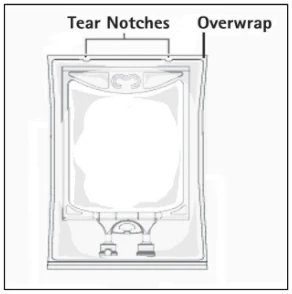
Not for injection.
Not for use with pressurized irrigation systems.
Aseptic technique is required.
- Inspect irrigation bag: overwrap and primary bag.
- Do not use if overwrap has been damaged.
- Do not use unless solution is clear and closure is intact.
To Open
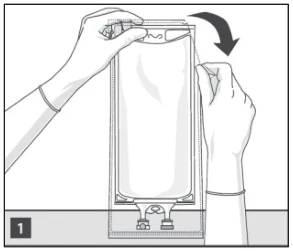
- 1. Tear overwrap starting from the tear notches. (Figure 1)
- 2.
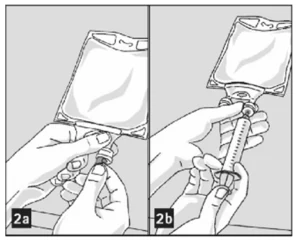
Prepare medication port by removal of aluminum foil. (Figure 2a)
Puncture resealable medication port by using 19-22 gauge
needle and inject additive(s). (Figure 2b)
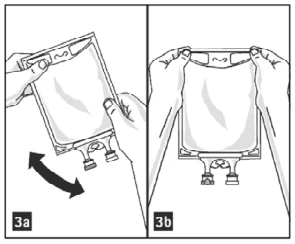
- Mix solution and medication thoroughly. (Figure 3a)
Medication port must be swabbed with disinfection agent
(e.g. iso-propanol or chlorhexidine) before re-puncturing.
- Check admixture visually for particulate matter. (Figure 3b)
- 3.
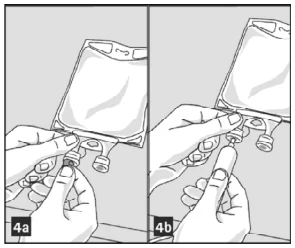
Remove aluminum foil from outlet/set port at bottom of the
container (Figure 4a) and attach administration set (Figure 4b):
use non-vented infusion set or close air vent on a vented set.
Refer to directions for use accompanying the administration set.
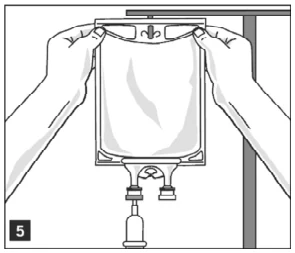
- 4. Hang bag on IV Pole. (Figure 5)
5 OVERDOSAGE
In the event of overhydration or solute overload, reevaluate the patient’s condition, and institute appropriate corrective treatment. Intravascular volume overload may respond to hemodialysis. See Warnings and Precautions and Adverse Reactions.
For management of a suspected drug overdose, contact your regional poison control centre.
6 DOSAGE FORMS, STRENGTHS, COMPOSITION AND PACKAGING
Each 100 mL of 0.9% Sodium Chloride Irrigation USP contains:
Container (mL) | Composition and Concentration | Ionic concentration (mEq / liter) | Osmolarity (mOsmol / L) | pH | Non-Medicinal Ingredients | |
Sodium Chloride (g / 100 mL) | Na+ | Cl– | ||||
| 2000 | 0.9 | 154 | 154 | 308 | 4.5 - 7.0 | Water for Injection USP |
| 3000 | ||||||
pH adjusted with Hydrochloric Acid NF
0.9% Sodium Chloride Irrigation USP is sterile, nonpyrogenic, isotonic and contains no bacteriostatic or antimicrobial agents.
Flexible Plastic Container not made with natural rubber latex, PVC or DEHP.
The plastic container is made from a multilayered film specifically developed for parenteral drugs. The solution contact layer is a rubberized copolymer of ethylene and propylene. The container is nontoxic and biologically inert. The container-solution unit is a closed system and is not dependent upon entry of external air during administration. The container is overwrapped to provide protection from the physical environment and to provide an additional moisture barrier when necessary. 0.9% Sodium Chloride Irrigation USP is supplied sterile and nonpyrogenic in single use flexible irrigation containers. Both the 2000 mL and 3000 mL containers are packaged 4 per case.
7 WARNINGS AND PRECAUTIONS
Please see the Serious Warnings and Precautions Box at the beginning Part I: Health Professional Information.
General
Irrigating fluids have been demonstrated to enter the systemic circulation in relatively large volumes; thus, irrigation solutions must be regarded as system drugs. Absorption of large amounts can cause fluid and/or solute overload resulting in dilution of serum electrolyte concentrations, over hydration, congested states or pulmonary edema.
The risk of dilutional states is inversely proportional to the electrolyte concentrations of the administered parenteral solutions. The risk of solute overload causing congested states with peripheral and pulmonary edema is directly proportional to the electrolyte concentration.
Do not warm above 66°C.
After opening container, its contents should be used promptly to minimize the possibility of bacterial growth or pyrogen formation.
Discard unused portion of irrigating solution since it contains no preservative.
Do not use product if solution shows haziness, particulate matter, discolouration, or leakage.
Use aseptic technique when preparing and administering sterile irrigation solutions.
Do not use for irrigation that may result in absorption of large amounts of fluid into the blood.
Caution should be observed when the solution is used for continuous irrigation or allowed to “dwell” inside body cavities because of possible absorption into the blood steam and the production of circulatory overload.
When used for irrigation via appropriate irrigation equipment, the administration set should be attached promptly. Unused portions should be discarded and a fresh container of appropriate size used for the startup of each cycle or repeat procedure. For repeated irrigations of urethral catheters, a separate container should be used for each patient.
7.1 Special Populations
7.1.1 Pregnant Women
Animal reproduction studies have not been conducted with 0.9% Sodium Chloride Irrigation USP. It is also not known whether 0.9% Sodium Chloride Irrigation USP can cause fetal harm when administered to a pregnant woman or can affect reproduction capacity. 0.9% Sodium Chloride Irrigation USP should be given to a pregnant woman only if clearly needed.
Safety and effectiveness of 0.9% Sodium Chloride Irrigation USP during labor and delivery have not been established. Caution should be exercised and the fluid balance, glucose and electrolyte concentrations, and acid-base balance, of both mother and fetus should be evaluated periodically or whenever warranted by the condition of the patient of fetus.
7.1.2 Breast-feeding
It is not known whether this drug is excreted in human milk. Because many drugs are excreted in human milk, caution should be exercised when 0.9% Sodium Chloride Irrigation USP is administered to a nursing woman.
7.1.3 Pediatrics
The safety and effectives of 0.9% Sodium Chloride Irrigation USP in pediatric patients have not been established. Its limited use in pediatric patients has been inadequate to fully define proper dosage and limitations for use.
7.1.4 Geriatrics
Clinical studies of 0.9% Sodium Chloride Irrigation USP did not include a sufficient number of patient age 65 years and over to determine whether they respond differently from younger subjects. In general, dose selection for an elderly patient should be cautions, usually starting at the low end of the dosage range, reflecting the greater frequency of decreased hepatic, renal, or cardiac function, and of concomitant disease of other drug therapy.
This drug is known to be substantially excreted by the kidney, and the risk of toxic reactions to this drug may be greater in patients with impaired renal function. Because elderly patients are more likely to have decreased renal function, care should be taken in dose selection, and it may be useful to monitor renal function. Frequent laboratory determinations and clinical evaluations are recommended to monitor changes in blood glucose, electrolyte concentrations, and renal function.
8 ADVERSE REACTIONS
Possible adverse effects arising from the irrigation of body cavities, tissues or indwelling catheters and tubes can be minimized when proper procedures are followed. Displaced catheters or drainage tubes can lead to irrigation or infiltration of unintended structures or cavities. Excessive volume or pressure during irrigation of closed cavities may cause undue distension or disruption of tissues. Accidental contamination from careless technique may transmit infection.
If an adverse reaction does occur, discontinue administration of the irrigant, evaluate the patient, institute appropriate therapeutic countermeasures, and save the remainder of the fluid for examination if deemed necessary. See Warnings and Precautions and Adverse Reactions.
9 DRUG INTERACTIONS
Some additives may be incompatible. Consult with pharmacist. When introducing additives, use aseptic technique. Mix thoroughly. Discard unused portion.
10 ACTION AND CLINICAL PHARMACOLOGY
0.9% Sodium Chloride Irrigation USP is utilized for a variety of clinical indications such as sterile irrigation of body cavities, tissues or wounds, indwelling urethral catheters, surgical drainage tubes, and for washing, rinsing or soaking surgical dressings, instruments and laboratory specimens. It also serves as a diluent or vehicle for drugs used for irrigation or other pharmaceutical preparations.
0.9% Sodium Chloride Irrigation USP provides an isotonic saline irrigation identical in composition with 0.9% Sodium Chloride Injection USP (normal saline).
Physiological irrigation solutions are considered generally compatible with living tissues and organs.
Sodium, the major cation of the extracellular fluid, functions primarily in the control of water distribution, fluid balance, and osmotic pressure of body fluids. Sodium is also associated with chloride and bicarbonate in the regulation of the acid-base equilibrium of body fluid.
Chloride, the major extracellular anion, closely follows the metabolism of sodium, and changes in acid-base balance of the body are reflected by changes in the chloride concentration.
11 STORAGE, STABILITY AND DISPOSAL
Exposure of pharmaceutical products to heat should be minimized. Avoid excessive heat. Protect from freezing. Store at 20° to 25°C; excursions permitted between 15° to 30°C. [See USP Controlled Room Temperature.]
PART II: SCIENTIFIC INFORMATION
13 PHARMACEUTICAL INFORMATION
Drug Substance
Proper name: Sodium Chloride USP
Chemical name: Sodium Chloride USP
Molecular formula and molecular mass: NaCl; 58.44 g / mol
Structural formula: Na-Cl
If you want more information about 0.9% Sodium Chloride Irrigation USP:
- Talk to your healthcare professional
- Find the full prescribing information that is prepared for healthcare professionals by visiting the Drug Product Database (https://www.canada.ca/en/health-canada/ services/drugs-health-products/drug-products/drug-product-database.html or by calling 1-800-227-2862.
B. Braun Medical Inc.
824 Twelfth Avenue
Bethlehem, PA 18018-3524 USA
Date of Preparation: September 08, 2022