


Product Monograph - Accrufer
RECENT MAJOR LABEL CHANGES
Not applicable.
TABLE OF CONTENTS
Sections or subsections that are not applicable at the time of authorization are not listed.
RECENT MAJOR LABEL CHANGES ........................................................................................2
TABLE OF CONTENTS ..............................................................................................................2
PART I: HEALTH PROFESSIONAL INFORMATION .................................................................4
1 INDICATIONS ..................................................................................................................4
1.1 Pediatrics .............................................................................................................. 4
1.2 Geriatrics ............................................................................................................... 4
2 CONTRAINDICATIONS ..................................................................................................4
4 DOSAGE AND ADMINISTRATION .................................................................................4
4.1 Dosing Considerations ........................................................................................ 4
4.2 Recommended Dose and Dosage Adjustment ................................................ 4
4.3 Reconstitution ....................................................................................................... 5
4.4 Administration ....................................................................................................... 5
4.5 Missed Dose ......................................................................................................... 5
5 OVERDOSAGE ...............................................................................................................5
6 DOSAGE FORMS, STRENGTHS, COMPOSITION AND PACKAGING ........................6
7 WARNINGS AND PRECAUTIONS .................................................................................6
7.1 Special Populations ............................................................................................. 7
7.1.1 Pregnant Women ........................................................................................... 7
7.1.2 Breast-feeding ................................................................................................ 7
7.1.3 Pediatrics ........................................................................................................ 7
7.1.4 Geriatrics ......................................................................................................... 8
8 ADVERSE REACTIONS ..................................................................................................8
8.1 Adverse Reaction Overview ............................................................................... 8
8.2 Clinical Trial Adverse Reactions ........................................................................ 8
8.3 Less Common Clinical Trial Adverse Reactions .............................................. 9
8.4 Abnormal Laboratory Findings: Hematologic, Clinical Chemistry and Other Quantitative Data ........................................................................................................... 9
8.5 Post-Market Adverse Reactions ........................................................................ 9
9 DRUG INTERACTIONS ...................................................................................................9
9.2 Drug Interactions Overview ................................................................................ 9
9.3 Drug-Behavioural Interactions .......................................................................... 10
9.4 Drug-Drug Interactions ...................................................................................... 10
9.5 Drug-Food Interactions ..................................................................................... 12
9.6 Drug-Herb Interactions ...................................................................................... 12
9.7 Drug-Laboratory Test Interactions ................................................................... 12
10 CLINICAL PHARMACOLOGY ......................................................................................12
10.1 Mechanism of Action ................................................................................... 12
10.2 Pharmacodynamics ..................................................................................... 12
10.3 Pharmacokinetics ......................................................................................... 12
11 STORAGE, STABILITY AND DISPOSAL .....................................................................13
12 SPECIAL HANDLING INSTRUCTIONS ........................................................................13
PART II: SCIENTIFIC INFORMATION ......................................................................................14
13 PHARMACEUTICAL INFORMATION ...........................................................................14
14 CLINICAL TRIALS ........................................................................................................15
14.1 Clinical Trials by Indication ......................................................................... 15
14.2 Study Results ............................................................................................... 16
16 NON-CLINICAL TOXICOLOGY ....................................................................................17
PATIENT MEDICATION INFORMATION .................................................................................19
PART I: HEALTH PROFESSIONAL INFORMATION
1 INDICATIONS
ACCRUFER (ferric maltol capsules) is indicated for the treatment of
- Iron deficiency anemia in adult patients who are unresponsive or intolerant to other oral iron preparations.
1.1 Pediatrics
Pediatrics (<18 years): No data are available to Health Canada; therefore, Health Canada has not authorized an indication for pediatric use (see 7 WARNINGS AND PRECAUTIONS, 8 ADVERSE REACTIONS and 10 CLINICAL PHARMACOLOGY).
1.2 Geriatrics
Geriatrics (≥65 years): Evidence from clinical studies suggests that use of ACCRUFER in the geriatric population is not associated with differences in safety and effectiveness.
2 CONTRAINDICATIONS
Ferric maltol is contraindicated in patients
- with hypersensitivity to this drug or to any ingredient in the formulation, including any non-medicinal ingredient, or component of the container. For a complete listing, see 6 DOSAGE FORMS, STRENGTHS, COMPOSITION AND PACKAGING.
- with hemochromatosis and other iron overload syndromes (see 7 WARNINGS AND PRECAUTIONS). Use may result in iron overdose (see 5 OVERDOSAGE).
- receiving repeated blood transfusions. Use may result in iron overload (see 7 WARNINGS AND PRECAUTIONS and 5 OVERDOSAGE).
4 DOSAGE AND ADMINISTRATION
4.1 Dosing Considerations
- ACCRUFER should be initiated under the supervision of a healthcare professional who is experienced in the management of iron deficiency anemia.
- Iron deficiency anaemia (IDA) diagnosis and subsequent monitoring should be made based on blood tests; it is important to investigate the cause of the IDA and to exclude underlying causes of anaemia other than iron deficiency.
4.2 Recommended Dose and Dosage Adjustment
The recommended dosage of ACCRUFER is 30 mg twice daily, morning and evening, on an empty stomach.
Treatment duration will depend on the severity of iron deficiency but generally at least 12 weeks of treatment is required. The treatment should be continued as long as necessary to replenish the body iron stores according to blood tests.
Geriatric population
No dose adjustment is needed in elderly patients.
Pediatric population
Health Canada has not authorized an indication for pediatric use (see 1 INDICATIONS, 7 WARNINGS AND PRECAUTIONS; and 10 CLINICAL PHARMACOLOGY).
Renal impairment
No dose adjustment is needed in patients with renal impairment (eGFR ≥15 ml/min/1.73 m2). No clinical data on the need to adjust the dose in patients with renal impairment (eGFR <15 ml/min/1.73 m2) are available.
Hepatic impairment
No clinical data on the need to adjust the dose in patients with impaired hepatic function are available.
4.3 Reconstitution
Not applicable.
4.4 Administration
ACCRUFER capsules should be taken whole on an empty stomach (1 hour before or 2 hours after a meal) with half a glass of water, as the absorption of iron is reduced when it is taken with food.
Do not open, break, or chew ACCRUFER capsules.
4.5 Missed Dose
If a dose of ACCRUFER is missed, skip the missed dose and take the next dose as normal. Do not take a double dose to make up for a missed dose.
5 OVERDOSAGE
Accidental overdose of iron-containing products is a leading cause of fatal poisoning in children under 6. Keep this product out of reach of children. In case of accidental overdose, call a doctor or poison control center immediately. Health Canada has not authorized the use of ACCRUFER in pediatric population.
No data are available regarding overdose of ACCRUFER in patients. Acute iron ingestion of 20 mg/kg elemental iron is potentially toxic and 200- 250 mg/kg is potentially fatal. Early signs and symptoms of iron overdose may include nausea, vomiting, abdominal pain and diarrhea. In more serious cases there may be evidence of hypoperfusion, metabolic acidosis and systemic toxicity.
Dosages of ACCRUFER in excess of daily iron requirements may lead to accumulation of iron in storage sites leading to hemosiderosis. Periodic monitoring of iron parameters such as serum ferritin and transferrin saturation may assist in recognizing iron accumulation. Do not administer ACCRUFER to patients with iron overload.
| For management of a suspected drug overdose, contact your regional poison control centre. |
|---|
6 DOSAGE FORMS, STRENGTHS, COMPOSITION AND PACKAGING
Table 1 – Dosage Forms, Strengths, Composition and Packaging
ACCRUFER contains 30 mg elemental iron, as ferric maltol, in red capsules, printed with “30” in black ink, and available in bottles of 6 capsules (sample), 14 capsules (sample) and 60 capsules (trade).
7 WARNINGS AND PRECAUTIONS
General
Accidental overdose of iron-containing products is a leading cause of fatal poisoning in children under 6. Keep this product out of reach of children. In case of accidental overdose, call a doctor or poison control center immediately.
Concomitant administration of ferric maltol with intravenous iron, dimercaprol, chloramphenicol or methyldopa is to be avoided (see 7 Hematologic and 9 DRUG INTERACTIONS).
Gastrointestinal
ACCRUFER is not recommended for use in patients with inflammatory bowel disease (IBD) flare as there is potential risk of increased inflammation in the gastrointestinal tract.
This medicinal product contains lactose. Patients with rare hereditary problems of galactose intolerance, total lactase deficiency or glucose-galactose malabsorption should not take this medicinal product.
Hematologic
Excessive therapy with iron products can lead to excess storage of iron with the possibility of
| Route of Administration | Dosage Form / Strength/Composition | Non-medicinal Ingredients |
| Oral | Each capsule contains 231.5 mg of ferric maltol equivalent to 30 mg of iron. | Black printing ink, colloidal anhydrous silica, crospovidone (Type A), FD&C Blue No. 1, FD&C Red No. 40, FD&C Yellow No.6, hypromellose, lactose monohydrate, magnesium stearate, sodium lauryl sulfate and titanium dioxide |
iatrogenic hemosiderosis. Do not administer ACCRUFER to patients with evidence of iron overload (see 2 CONTRAINDICATIONS). Assess iron parameters prior to initiating ACCRUFER and monitor iron parameters while on therapy (see 5 OVERDOSAGE).
Concomitant administration of ferric maltol with intravenous iron may induce hypotension or even collapse due to the fast release of iron resulting from saturation of transferrin caused by intravenous iron. Concomitant administration is to be avoided. (see 9 DRUG INTERACTIONS)).
Immune
This medicinal product also contains FD&C Red No. 40 and FD&C Yellow No. 6: these may cause allergic reactions.
Reproductive Health: Female and Male Potential
- Fertility
There are no data on the effect of ferric maltol on human fertility. No effects on fertility are anticipated since systemic exposure to ferric maltol is negligible.
7.1 Special Populations
7.1.1 Pregnant Women
ACCRUFER is not absorbed systemically as an intact complex following oral administration, and maternal use is not expected to result in fetal exposure to the drug (see 10 CLINICAL PHARMACOLOGY).
In animal reproduction studies, oral administration of ferric or ferrous compounds to pregnant CD1-mice and Wistar-rats during organogenesis at doses 13 to 32 times the recommended human dose resulted in no adverse developmental outcomes. An overdose of iron in pregnant women may carry a risk for spontaneous abortion, gestational diabetes and fetal malformation (see 16 NON-CLINICAL TOXICOLOGY).
The estimated background risk of major birth defects and miscarriage for the indicated population is unknown. All pregnancies have a background risk of birth defect, loss, or other adverse outcomes. In the Canadian general population, the estimated background risk of major birth defects and miscarriage in clinically recognized pregnancies is 2-3% and 15-25%, respectively.
7.1.2 Breast-feeding
There are no data on the presence of ACCRUFER in human milk, the effects on the breastfed child, or the effects on milk production. Ferric maltol is not absorbed systemically and is therefore unlikely to pass into the mother's milk.
7.1.3 Pediatrics
Pediatrics (<18 years): Based on the data submitted and reviewed by Health Canada, the safety and efficacy of ACCRUFER in pediatric patients have not been established; therefore, Health Canada has not authorized an indication for pediatric use (see 1.1 Pediatrics, 10.3 Pharmacokinetics, Special Populations, Pediatrics).
7.1.4 Geriatrics
Of the 295 patients in the randomized trials of ACCRUFER, 39% of patients were aged 65 and older, while 23% were aged 75 and older. No overall differences in safety or effectiveness were observed between these patients and younger patients.
8 ADVERSE REACTIONS
8.1 Adverse Reaction Overview
The most frequently reported adverse reactions were gastrointestinal symptoms, including flatulence (4.6%), diarrhea (4%), constipation (4%), feces discoloured feces (4%) and abdominal pain (2.9%). These adverse reactions were mainly mild to moderate in severity.
The proportion of patients who discontinued treatment due to adverse reactions during the double-blind, placebo-controlled portion of studies was 4.6% for patients taking ACCRUFER. The most common adverse reaction leading to discontinuation of ACCRUFER in these studies was abdominal pain (1.7% of patients).
8.2 Clinical Trial Adverse Reactions
Clinical trials are conducted under very specific conditions. Therefore the adverse reaction rates observed in the clinical trials may not reflect the rates observed in practice and should not be compared to the rates in the clinical trials of another drug. Adverse reaction information from clinical trials may be useful in identifying and approximating rates of adverse drug reactions in real-world use.
The data described below reflect exposure to ACCRUFER in 175 patients in the placebo-controlled phase of three randomized studies conducted in patients with iron deficiency anemia and quiescent inflammatory bowel disease (IBD) (Studies AEGIS 1 & 2) or non-dialysis dependent chronic kidney disease (CKD) (AEGIS 3). The pooled patient population had a mean age of 58 years, 67.4% were female (n=118), and 81.7% (n=143) were Caucasian. Most of the events were mild or moderate in severity.
Study AEGIS 1 & 2
The most common study drug-related Treatment Emergent Adverse Events (TEAEs), occurring in 5 (7.8%) ferric maltol and 4 (6.3%) Placebo subjects was abdominal pain. Other more common treatment-related events were constipation (4 [6.3%] versus 1 (1.6%]) and flatulence (4 [6.3%] versus 0). All other study drug-related AEs occurred in 1 (1.6%) (diarrhea, thirst, joint stiffness, pain in extremity, headache, erythema [1 ferric maltol versus 0 placebo]) or 2 (3.1%) (abdominal discomfort, abdominal distension [2 ferric maltol versus 0 placebo]) subjects in the ferric maltol treatment group.
Serious adverse events (SAEs) were reported in 1 (1.6%) ferric maltol subject and 2 (3.1%) placebo subjects. No related SAEs were reported in either treatment group. The most frequently reported severe TEAEs were abdominal pain [(5 [7.8%] ferric maltol versus 1 [1.6%] placebo] and diarrhea [3 [4.7%] ferric maltol versus 1 [1.6%] placebo]. The severe TEAEs of abdominal pain were considered drug-related in 3 (4.7%) ferric maltol group and one (1.6%) subject in the placebo group. Severe diarrhea was considered drug-related in 1 (1.6%) subject in the ferric maltol treatment group.
Three (3) (4.7%) subjects in the ferric maltol group and 2 (3.1%) subjects in the placebo group discontinued treatment due to treatment-related adverse events. The treatment related AEs leading to discontinuation in ferric maltol group were constipation (1 event), abdominal pain (1 event), and diarrhea (1 event).
Study AEGIS 3
The most common study drug-related TEAEs by preferred term were diarrhea (6 [5.4%] versus 2 [3.6%] subjects) and feces discolored (7 [6.3%] versus 1 [1.8%] subjects). Other drug-related AEs included flatulence (4 [3.6%] versus 0), nausea (3 [2.7%] versus 1 [1.8%]), constipation, vomiting (3 [2.7%] versus 0). All other study drug-related AEs occurred in only 1 subject (1.6% ferric maltol versus 0 placebo): dyspepsia, gastritis, upper abdominal pain and pruritus.
Serious adverse events (SAEs) were reported in 23 (20.7%) ferric maltol subjects and 12 (21.4%) placebo subjects. No related SAEs were reported in either treatment group. Seven (7) (6.3%) subjects in the ferric maltol group and 5 (8.9%) subjects in the placebo group discontinued treatment due to treatment-related adverse events. Three (3) subjects experienced study drug-related adverse events that led to discontinuation: one subject in the ferric maltol group experienced study drug-related adverse events of nausea and vomiting; one subject in the ferric maltol group experienced study drug-related adverse events of diarrhea, nausea, and vomiting; and one subject in the placebo group experienced study drug-related adverse events of asthenia and dizziness.
8.3 Less Common Clinical Trial Adverse Reactions
Less common adverse reactions occurring in clinical studies to date with ACCRUFER (<1%) are listed below.
Gastrointestinal: gastrointestinal bacterial overgrowth
General Disorders and Administration Site Conditions: thirst
Investigations: blood alkaline phosphatase increased, blood thyroid stimulating hormone increased, gamma-glutamyltransferase increased
Musculoskeletal and Connective Tissue: joint stiffness, pain in extremity
Nervous System: headache
Skin and Subcutaneous Tissue: acne, erythema
8.4 Abnormal Laboratory Findings: Hematologic, Clinical Chemistry and Other Quantitative Data
Not applicable.
8.5 Post-Market Adverse Reactions
Not available.
9 DRUG INTERACTIONS
9.2 Drug Interactions Overview
No clinical interaction studies have been performed with ferric maltol. Based on an in vitro study maltol is glucuronised through UGT1A6 (see 10.3 PHARMACOKINETICS) food has been shown to inhibit uptake of ACCRUFER. The treatment should be taken on an empty stomach (see 4 DOSAGE AND ADMINISTRATION).
Intravenous administration of iron salts:
Concomitant administration of ACCRUFER and intravenous iron may induce hypotension or even collapse due to the fast release of iron resulting from saturation of transferrin caused by intravenous iron.
Absorption of oral iron may be reduced by calcium and magnesium salts (such as magnesium trisilicate). Administration of iron preparations with such compounds should be separated by at least 2 hours. Absorption of both iron and antibiotic may be reduced if oral iron is given with antibiotics. Administration of iron preparations and tetracyclines, quinolones, penicillin, should be separated by 2 to 3 hours. Administration of iron preparations and tetracyclines should be separated by 2 to 3 hours.
For oral drugs where reductions in bioavailability may cause clinically significant effects on its safety or efficacy, including mycophenolate, ethynyl estradiol, ciprofloxacin and doxycycline, separate the administration of ACCRUFER by at least 4 hours. Monitor clinical responses to concomitant drugs as appropriate.
9.3 Drug-Behavioural Interactions
Not applicable.
9.4 Drug-Drug Interactions
The drugs listed in this table are based on either drug interaction case reports or in vitro studies, or potential interactions due to the expected magnitude and seriousness of the interaction (i.e., those identified as contraindicated).
Table 2 - Established or Potential Drug-Drug Interactions
| Proper/Common name | Source of Evidence | Effect | Clinical comment |
| Intravenous iron | T | Concomitant administration of ACCRUFER and intravenous iron may induce hypotension or even collapse due to the fast release of iron resulting from saturation of transferrin caused by intravenous iron. | Avoid concomitant use of ACCRUFER with intravenous iron. |
| Ciprofloxacin | T | Oral iron is known to reduce the absorption of ciprofloxacin. | For oral drugs where reductions in bioavailability may cause clinically significant effects on its safety or efficacy, separate the administration of ACCRUFER by at least 4 hours. Monitor clinical responses to concomitant drugs as appropriate. |
| Proper/Common name | Source of Evidence | Effect | Clinical comment |
| Penicillamine, bisphosphonates, entacapone, levodopa, levofloxacin, levothyroxine (thyroxine) moxifloxacin, norfloxacin and ofloxacin | T | Oral iron is known to reduce the absorption of penicillamine, bisphosphonates, entacapone, levodopa, levofloxacin, levothyroxine (thyroxine) moxifloxacin, norfloxacin and ofloxacin. | These medicinal products should be given at least 2-3 hours apart from ACCRUFER. |
| Methyldopa, chloramphenicol and dimercaprol | T | The combination of dimercaprol and iron is nephrotoxic. Chloramphenicol delays plasma iron clearance, incorporation of iron into red blood cells and interferes with erythropoiesis. Oral iron may antagonize the hypotensive effect of methyldopa. | Avoid use of these medicines with ACCRUFER. |
| Tetracyclines | T | Absorption of both iron and antibiotic may be reduced if oral iron is given with tetracycline. | Administration of iron preparations and tetracyclines should be separated by 2 to 3 hours. |
| Mycophenolate, ethynyl estradiol, doxycycline | T | In in vitro studies, mycophenolate recovery was reduced by up to 16% at pH 1.2 but there was no interaction at pH 4.5; due to solubility issues data are not available for pH 6.8. Ethynyl estradiol recovery was reduced by up to 35% at pH 4.5; due to solubility issues data are not available for pH 1.2 and pH 6.8. | For oral drugs where reductions in bioavailability may cause clinically significant effects on its safety or efficacy, separate the administration of ACCRUFER by at least 4 hours. Monitor clinical responses to concomitant drugs as appropriate. |
| Lisinopril, metaprolol, warfarin | T | In in vitro studies, lisinopril, metaprolol and warfarin showed no interaction at pH 1.2, pH 4.5 or pH 6.8. | Lisinopril, metaprolol and warfarin can be taken with ACCRUFER. |
Legend: C = Case Study; CT = Clinical Trial; T = Theoretical
9.5 Drug-Food Interactions
Food has been shown to inhibit uptake of ACCRUFER: The treatment should be taken on an empty stomach (see 4 DOSAGE AND ADMINISTRATION).
9.6 Drug-Herb Interactions
Interactions with herbal products have not been established.
9.7 Drug-Laboratory Test Interactions
Interactions with laboratory tests have not been established.
10 CLINICAL PHARMACOLOGY
10.1 Mechanism of Action
ACCRUFER contains iron in a stable ferric state as a complex with a trimaltol ligand. The complex is designed to provide utilizable iron for uptake across the intestinal wall and transfer to the iron transport and storage proteins in the body (transferrin and ferritin, respectively). The complex dissociates on uptake from the gastrointestinal tract and the complex itself does not enter the systemic circulation.
10.2 Pharmacodynamics
ACCRUFER has been shown to increase serum iron parameters, including ferritin and Transferrin Saturation (TSAT).
10.3 Pharmacokinetics
The pharmacokinetic properties of ferric maltol were assessed through measurement of plasma and urine concentrations of maltol and maltol glucuronide, together with serum iron parameters after a single dose and at steady state (after 1 week) in 24 subjects with iron deficiency, randomised to receive 30 mg, 60 mg or 90 mg ACCRUFER twice daily. Blood and urine samples were assayed for maltol and maltol glucuronide. Serum samples were assayed for iron parameters. Maltol was transiently measured in plasma with a AUC0-t between 0.022 and 0.205 h•µg/mL across all dosing regimens and both study days. The maltol appeared to be rapidly metabolised to maltol glucuronide (AUC0-t between 9.83 and 30.9 h•µg/mL across all dose regimens). There was no significant accumulation of either after 7 days treatment with ACCRUFER. Peak TSAT values were reached 1.5 to 3 hours after oral administration of ACCRUFER. Total serum iron concentrations and TSAT values were generally higher with increasing ACCRUFER doses. TSAT and total serum iron profiles were comparable between Day 1 and Day 8.
The pharmacokinetic properties of ACCRUFER were also investigated at steady state in 15 subjects who were already participating in the AEGIS1/2 study and who had been in the open-label treatment phase for at least 7 days (ACCRUFER 30 mg twice daily). Maltol was again transiently measured in plasma with a half-life of 0.7 hours, with a Cmax of 67.3 + 28.3 ng/mL. The maltol appeared to be rapidly metabolised to maltol glucuronide (Cmax = 4677 + 1613 ng/mL). Maximum maltol and maltol glucuronide concentrations were reached approximately 1 hour after oral administration of ACCRUFER. Maximum total iron serum concentrations were measured 1-2 hours after administration. The pharmacokinetic profiles of maltol/maltol glucuronide and iron parameters were independent of one another.
Absorption
Maximum maltol and maltol glucuronide concentrations were reached 1 to 1.5 hours after oral administration of ACCRUFER. Total serum iron peak values were reached 1.5 to 3 hours after oral administration of ACCRUFER.
Exposure to maltol glucuronide increased dose proportionally over the ACCRUFER 30 to 90 mg twice daily dosing range. Total serum iron concentrations increase in a less than dose proportional manner with increasing ACCRUFER doses.
Food has been shown to decrease the bioavailability of iron after administration of ferric maltol.
Distribution
ACCRUFER contains iron in a stable ferric state as a complex with a trimaltol ligand. ACCRUFER dissociates upon uptake from the gastrointestinal tract allowing iron and maltol to be absorbed separately. The complex itself does not enter the systemic circulation.
Metabolism
Maltol is metabolized through glucuronidation (UGT1A6) and sulphation in vitro.
Elimination
Of the total maltol ingested, a mean of between 39.8% and 60.0% was excreted in the urine as maltol glucuronide.
Special Populations and Conditions
- Pediatrics: Based on the data submitted and reviewed by Health Canada, the safety and efficacy of ACCRUFER in pediatric patients have not been established; therefore, Health Canada has not authorized an indication for pediatric use.
- Renal Insufficiency: There was no clinically meaningful change in exposure of maltol or maltol glucuronide in subjects with non-dialysis dependent chronic kidney disease (eGFR of >15 mL/min/1.73m2 and <60 mL/min/1.73m2).
11 STORAGE, STABILITY AND DISPOSAL
Store at room temperature (15°C to 30°C). Keep out of reach and sight of children.
12 SPECIAL HANDLING INSTRUCTIONS
No special requirements for disposal.
PART II: SCIENTIFIC INFORMATION
13 PHARMACEUTICAL INFORMATION
Drug Substance
Proper/Common name: Ferric maltol
Chemical name: 3-hydroxy-2-methyl-4H-pyrane-4-one iron (III) complex (3:1)
Molecular formula: (C6H5O3)3Fe
Molecular mass: 431.2 g/mol
Structural formula:
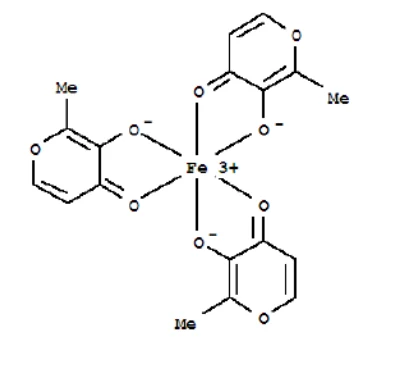
Physicochemical properties: A dark reddish brown crystalline powder. The melting point of - Form C is 293.8 + 0.2. Ferric maltol is slightly soluble in water, methanol, acetone and dichloromethane.
14 CLINICAL TRIALS
14.1 Clinical Trials by Indication
Inflammatory Bowel Disease (IBD)
Table 3 - Summary of Patient Demographics for Clinical Trials in Iron Deficiency Anemia patients with IBD
| Study # | Study design | Dosage, route of administration and duration | Study subjects (n) | Mean age (Range) | Sex |
| AEGIS 1/2 | Randomized, double-blind, placebo-controlled | Oral ferric maltol 30 mg bid or placebo for 12 weeks plus up to 52 weeks open label | 128 patients with inflammatory bowel disease (IBD) and iron deficiency anemia | 39 years (18 – 76 years) | 45 M 83 F |
The efficacy of ACCRUFER for the treatment of iron deficiency anemia was studied in three randomized, placebo-controlled trials (AEGIS 1, AEGIS 2, and AEGIS 3). Studies AEGIS 1 and AEGIS 2 enrolled 128 patients (age range 18-76 years; 45 males and 83 females) with quiescent IBD (58 patients with Ulcerative Colitis [UC] and 70 patients with Crohn’s disease [CD]) and baseline hemoglobin (Hb) concentrations between 9.5 g/dL and 12 /13 g/dL for females/males and ferritin < 30 mcg/L. All patients had discontinued prior oral ferrous product treatment due to lack of efficacy or inability to tolerate oral iron replacement products. Subjects were randomized 1:1 to receive either 30 mg ACCRUFER twice daily or a matched placebo control for 12 weeks. Following completion of the 12-week placebo-controlled phase of the studies, eligible patients transitioned to ACCRUFER 30 mg twice daily open-label treatment for an additional 52 weeks. The primary efficacy endpoint was the mean difference in hemoglobin (Hb) concentration from baseline to week 12 between ACCRUFER and placebo.
Non-Dialysis Dependent Chronic Kidney Disease (NDD-CKD)
Table 4- Summary of Patient Demographics for Clinical Trials in Iron Deficiency Anemia patients with NDD-CKD
| Study # | Study design | Dosage, route of administration and duration | Study subjects (n) | Mean age (Range) | Sex |
| AEGIS 3 | Randomized, double-blind, placebo-controlled | Oral ferric maltol 30 mg bid or placebo for 16 weeks plus up to 36 weeks open label | 167 patients with chronic kidney disease (CKD) and iron deficiency anemia | 67 years (30 – 90 years) | 50 M 117 F |
Study AEGIS-3 enrolled 167 patients (mean age 67.4 years, range 30-90 years; 50 males and
117 females) with non-dialysis dependent CKD and baseline Hb concentrations between 8 g/dL and 11 g/dL and ferritin <250 mcg/L with a TSAT <25% or ferritin < 500 mcg/L with a TSAT <15%. ACCRUFER was administered at a dose of 30 mg twice daily. Subjects were randomized 2:1 to receive either 30 mg ACCRUFER twice daily or a matched placebo control for 16 weeks. Following completion of the 16-week placebo-controlled phase of the study, eligible patients transitioned to ACCRUFER 30 mg twice daily open-label treatment for an additional 36 weeks. The primary efficacy endpoint was the mean difference in Hb concentration from baseline to Week 16 between ACCRUFER and placebo.
14.2 Study Results
AEGIS 1 & 2
In the AEGIS 1 & 2 trials, the Least Square [LS] mean difference from baseline was 2.18 g/dL (see Table 5).
Table 5 – Summary of Hemoglobin Concentration (g/dL) and Change From Baseline to Week 12 AEGIS 1 & 2 - Analysis Using Multiple Imputation - Full Analysis Set Population*
Visit (Week) Statistic | ACCRUFER (N = 64) | Placebo (N =64) | ||||||||
|---|---|---|---|---|---|---|---|---|---|---|
| Baseline | ||||||||||
| Mean (SD) | 11.0 (1.03) | 11.10 (0.85) | ||||||||
| Mean change from baseline to Week 12 | ||||||||||
| LS Mean (SE) | 2.25 (0.12) | 0.06 (0.13) | ||||||||
| Treatment Comparison | Difference in Change From Baseline | |||||||||
LSM Difference (SE) ACCRUFER – Placebo | 1-sided lower 97.5%CI | p-value | ||||||||
| ACCRUFER versus placebo | 2.18 (0.19) | (1.81) | <0.0001 | |||||||
*Multiple imputation was based on treatment, gender, disease [UC or CD], and Hb concentration at baseline, Week 4, and 8. For each imputed dataset, the change from baseline to Week 12 was analyzed using an ANCOVA model with treatment as the factor and gender, disease, baseline Hb concentration as covariates.
The LS mean difference in change from baseline Hb to Week 4 and 8 between ACCRUFER and placebo were 1.04 g/dl and 1.73 g/dl, respectively (P<0.0001) (secondary endpoint).
The mean ferritin (mcg/L) levels in ACCRUFER subjects at baseline were 8.6 mcg/L [SD 6.77]) and the mean ferritin (mcg/L) levels at Week 12 were 26.0 mcg/L [SD 30.57] with a mean overall improvement of 17.3 mcg/L (descriptive endpoint).
During the open-label phase with ACCRUFER, the mean change in Hb concentration from baseline to Week 64 was 3.1 g/dL [SD 1.46 g/dL, n = 35] and the ferritin value demonstrated a mean of 68.9 mcg/L [SD 96.24] at 64 weeks, with a mean overall improvement of 60.4 mcg/L (exploratory endpoint).
AEGIS 3
In the AEGIS-3 trial, the LS mean difference was 0.52 g/dL (p= 0.0149) (see Table 6).
Table 6 – Summary of Hemoglobin Concentration (g/dL) and Change From Baseline to Week 16 - Analysis Using Multiple Imputation – Intent-to-Treat Population*
Visit (Week) Statistic | ACCRUFER (N = 111) | Placebo (N = 56) | ||||||||
|---|---|---|---|---|---|---|---|---|---|---|
| Baseline | ||||||||||
| Mean (SD) | 10.06 (0.77) | 10.03 (0.82) | ||||||||
| Mean change from baseline to Week 16 | ||||||||||
| LS Mean (SE) | 0.50 (0.12) | -0.02 (0.16) | ||||||||
| Treatment Comparison | Difference in Change From Baseline | |||||||||
LSM Difference (SE) ACCRUFER – Placebo | 95% CI | p-value | ||||||||
| ACCRUFER versus placebo | 0.52 (0.21) | (0.10, 0.93) | 0.0149 | |||||||
* Multiple imputation was based on treatment, gender, eGFR at baseline, and Hb concentration at baseline, Week 4 and 8. For each imputed dataset, the change from baseline to Week 16 was analyzed using an ANCOVA model with treatment as the factor and baseline Hb concentration, baseline eGFR as covariates.
The LS mean difference in change from baseline Hb to Week 4 and 8 between ACCRUFER and placebo were 0.13 g/dl and 0.46 g/dl respectively (secondary endpoints).
The LSM change in ferritin concentration from baseline to Week 16 was 25.42 µg/L for the ACCRUFER group and -7.23 µg/L for the placebo group. The mean difference for ACCRUFER versus placebo was 32.65 µg/L.
During the open-label phase with ACCRUFER, the LS mean change in Hb concentration from baseline to Week 52 was 0.64 g/dL [SE 0.177 g/dL] and the ferritin value demonstrated a mean of 142.50 mcg/L [SD 105.98] at 52 weeks, with a mean overall improvement of 59.28 mcg/L (exploratory efficacy endpoints).
16 NON-CLINICAL TOXICOLOGY
General Toxicology:
Ferric Maltol
Ferric maltol is not absorbed systemically as an intact complex. Non-clinical studies revealed no special hazard for humans based on repeated dose toxicity and local tolerance studies conducted with ferric maltol.
Deposition of iron in the reticulo-endothelial system, liver and spleen was recorded in dogs administered 500 mg/kg/day ferric maltol.
Maltol
Haemosiderin was observed in Kupffer cells of dogs administered 250 mg/kg/day maltol. At doses of 500 mg/kg/day, testicular degeneration and toxic signs indicative of iron chelation were recorded. These effects were not observable in a second study in dogs receiving up to 300 mg/kg/day.
Carcinogenicity:
Ferric Maltol
Carcinogenicity studies have not been conducted with ferric maltol.
Maltol
The carcinogenic potential of maltol has been evaluated in long-term animal toxicity studies in two species: CD-1 mice and Sprague-Dawley rats. Maltol was not carcinogenic in a 18-month study in mice at doses up to 400 mg/kg (approximately 5 times the human daily dose). Maltol was not carcinogenic in a 2-year study in rats at doses up to 400 mg/kg (approximately 10 times the human daily dose).
Genotoxicity:
Ferric Maltol
Ferric maltol was mutagenic in vitro in reverse bacterial mutation (Ames) assays. Ferric maltol increased revertant frequency in the absence and presence of metabolic activation.
Maltol
Maltol was mutagenic in vitro in reverse bacterial mutation (Ames) assays. Maltol increased revertant frequency in the absence and presence of metabolic activation. Maltol was clastogenic in vivo in a mouse micronucleus assay (increase in polychromatic erythrocytes) at intraperitoneal doses of 774 mg/kg. Absorbed maltol is rapidly conjugated with glucuronic acid. It is therefore unlikely that the mutagenic activity of maltol would be expressed under the conditions of oral human intake.
Reproductive and Developmental Toxicology:
Ferric Maltol
No reproductive and developmental toxicity studies have been conducted with ferric maltol.
Other Ferrous Compounds
In embryofetal development studies in mice and rats, pregnant animals received oral doses of ferric or ferrous compounds (ferrous sulfate or ferric sodium pyrophosphate) of up to 160 mg/kg/day in mice, or up to 200 mg/kg/day in rats, during the period of organogenesis. Administration of ferric or ferrous compounds at doses 13 times (in mice) or 32 times (in rats) the recommended human dose resulted in no maternal toxicity and no adverse developmental outcomes.
Maltol
In a multi-generation fertility and reproduction study in male and female rats, there were no effects on mating, fertility, or early embryonic development at doses up to 400 mg/kg/day maltol (approximately 10 times the human daily dose).