


Patient Medication Information: uses, side effects, how to take - Airomir
What is AIROMIR used for?
AIROMIR is used in adults and children 6 years and older to:
- relieve bronchospasm symptoms
- prevent bronchospasm symptoms
- prevent bronchospasm symptoms caused by exercise
Bronchospasm is a sudden worsening of shortness of breath and wheezing.
The safety and effectiveness of AIROMIR in children under the age of 6 years is not known.
How does AIROMIR work?
AIROMIR belongs to a group of medicines called bronchodilators. It relaxes the muscles in the walls of the small air passages in the lungs. This helps to open up the airways and so helps to relieve chest tightness, wheezing and cough so that you can breathe more easily.
What are the ingredients in AIROMIR?
Medicinal ingredient: Salbutamol Sulfate.
Non-medicinal ingredients: Ethanol, Oleic Acid, and Propellant HFA-134a.
AIROMIR comes in the following dosage forms:
AIROMIR is a pressurized inhalation aerosol. Each inhalation of aerosol from the canister contains 100 micrograms of salbutamol (as sulfate).
AIROMIR Inhalation Aerosol will deliver at least 200 sprays for the 200-dose size. However, after the labeled amount of sprays, the amount of drug delivered per spray may not be consistent. You should keep track of the number of sprays used from your canister of AIROMIR Inhalation Aerosol and discard the canister after 200 sprays (for the 200-dose inhaler).
Do not use AIROMIR:
- If you are allergic to salbutamol sulfate or any of the non-medicinal ingredients in the AIROMIR Inhalation Aerosol.
- For the treatment of preterm labour or miscarriage.
To help avoid side effects and ensure proper use, talk to your healthcare professional before you take AIROMIR. Talk about any health conditions or problems you may have,
including if you:
- have ever had to stop taking other medicines for this illness because you were allergic to them or they caused problems;
- have a thyroid condition;
- have a history of seizures;
- have high blood pressure or a heart problem;
- have diabetes;
have low levels of potassium in your blood (hypokalemia), especially if you are taking:
- drugs known as xanthine derivatives (such as theophylline) to treat breathing problems like COPD and asthma,
- steroids to treat asthma,
- water pills (diuretics);
are pregnant or intend to become pregnant. Taking AIROMIR during pregnancy may cause harm to your baby. Your healthcare professional will consider the benefit to you and the risk to your baby of taking AIROMIR while you’re pregnant;
- are breastfeeding. It is possible that AIROMIR passes into breast milk.
Other warnings you should know about:
The effects of AIROMIR should last for 4 to 6 hours. If the relief of wheezing or chest tightness is not as good as usual, or the effect lasts for less than three hours, contact your healthcare professional as soon as possible. It may be that your chest condition is worsening, and you may need to add another type of medicine to your treatment. If you notice a sudden worsening of your shortness of breath and wheeze shortly after taking your medicine, contact your healthcare professional or the nearest hospital immediately.
You should always carry your AIROMIR Inhalation Aerosol with you to use immediately in case you experience an asthma attack.
If you have to go to the hospital for an operation, take your inhaler with you and tell the healthcare professional about all the medicine(s) you are taking.
Tell your healthcare professional about all the medicines you take, including any drugs, vitamins, minerals, natural supplements or alternative medicines.
The following may interact with AIROMIR:
- anti-depressants;
- epinephrine;
- bronchodilators used to open the airways (such as other asthma medication);
- diuretics (‘water pills’);
- drugs to lower blood pressure such as propranolol;
- digoxin, a heart medication.
How to take AIROMIR:
AIROMIR should only be inhaled. Do not swallow.
Use AIROMIR only as directed by your healthcare professional.
If you are also using an inhaled corticosteroid:
- Always use AIROMIR first.
- Wait a few minutes.
- Then use your inhaled corticosteroid.
You should call your doctor immediately if:
- the effects of one dose last less than 3 hours;
- you notice a sudden worsening of your shortness of breath;
- your symptoms get worse;
- your usual dose does not provide relief of wheezing or chest tightness;
- you need to use AIROMIR more often than before.
These may be signs that your asthma or chest condition is getting worse. Your doctor may want to reassess your treatment plan.
Do not increase the dose or the number of times you use your medicine without asking your doctor, as this may make you feel worse.
Usual dose:
For relief of bronchospasm symptoms:
Adults and Adolescents 12 years and older: 1 to 2 inhalations of AIROMIR Inhalation Aerosol as needed.
Children (6 - 11 years of age): 1 inhalation of AIROMIR Inhalation Aerosol as needed.
If you have a more severe attack, you can repeat the dose every 4 to 6 hours, and immediately consult your doctor or the nearest hospital.
For prevention of bronchospasm symptoms:
Adults and Adolescents 12 years and older: 1 to 2 inhalations of AIROMIR Inhalation Aerosol repeated every 4 to 6 hours as needed, not exceeding 8 inhalations per day.
Children (6 - 11 years of age): 1 inhalation of AIROMIR Inhalation Aerosol, repeated every 4 to 6 hours as needed, not exceeding 4 inhalations per day.
For prevention of bronchospasm symptoms caused by exercise:
Adults and Adolescents 12 years and older: 2 inhalations of AIROMIR Inhalation Aerosol 30 minutes before exercise.
Children (6 - 11 years of age): 1 inhalation of AIROMIR Inhalation Aerosol 30 minutes before exercise.
Maximum Dose per 24-hour period:
Adults and Adolescents 12 years and older: 8 inhalations of AIROMIR Inhalation Aerosol.
Children (6 - 11 years of age): 4 inhalations of AIROMIR Inhalation Aerosol.
How to prime AIROMIR Inhalation Aerosol:
Before using AIROMIR for the first time, or if your inhaler has not been used for 2 weeks or more, shake the inhaler well and release 4 sprays into the air, away from your face, to insure that it works properly.
How to use AIROMIR Inhalation Aerosol:
AIROMIR should only be used with the mouthpiece supplied with the product. You should test the mouthpiece and aerosol canister before using them for the first time, or if you have not used your inhaler for more than 2 weeks.
| 1 | SHAKE THE INHALER WELL right before each use (see figure A). Then take the cap off of the mouthpiece (see figure B). Check the mouthpiece for dirt or other objects before you use it. Make sure the aerosol canister is pushed all the way into the actuator (the small vertical cylinder in the mouthpiece). It should fit tightly, without wobbling. | 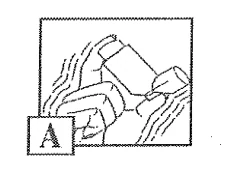 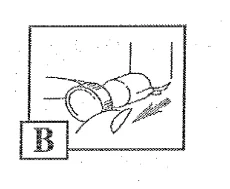 |
| 2 | BREATHE OUT AS BIG A BREATH AS YOU CAN THROUGH YOUR MOUTH, pushing as much air out of your lungs as possible. Place the mouthpiece in your mouth between your teeth and close your lips around it. Make sure the inhaler stays straight up (see figure C). | 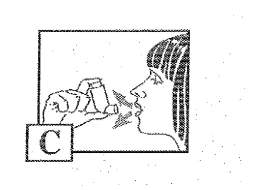 |
| 3 | AT THE BEGINNING OF A DEEP, SLOW BREATH THROUGH YOUR MOUTH, PUSH ALL THE WAY DOWN ON THE TOP OF THE AEROSOL CANISTER. (See figure D). | 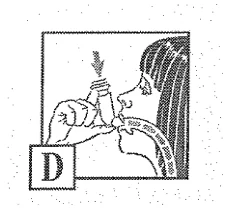 |
| 4 | HOLD YOUR BREATH FOR AS LONG AS YOU CAN. Before breathing out, take the inhaler out of your mouth and stop squeezing down on the aerosol canister. (See figure E). | 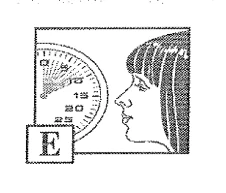 |
| 5 | If your healthcare professional has told you to take two puffs, wait one minute and shake the inhaler again. Repeat steps 2 through 4. Replace the cap after you are finished using the inhaler. | |
| 6 | KEEPING THE PLASTIC MOUTHPIECE CLEAN IS VERY IMPORTANT TO PREVENT THE INHALER FROM BECOMING DIRTY AND CLOGGED. |
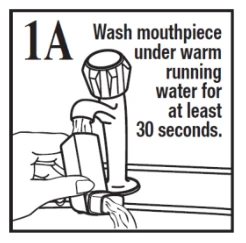
Routine Cleaning Instructions:
Step 1A & 1B. To clean, remove the canister and mouthpiece cap. Rinse the mouthpiece through the top and bottom with warm running water for at least 30 seconds. Let the water run through the mouthpiece as shown in figure 1A. Turn the mouthpiece unit around and let the water run through the unit as shown in figure 1B for another 30 seconds. Look into the mouthpiece to make sure any medicine build-up has been completely washed away. If there is any build-up, repeat steps in figure 1A & 1B. Never put the metal canister in water. | 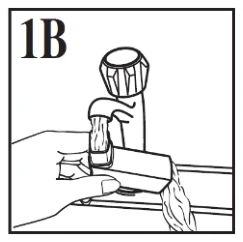 |
| Step 2. To dry, shake off as much excess water as you can and let the mouthpiece air dry thoroughly, such as overnight. When the mouthpiece is dry, put the canister back in and make sure it fits firmly without wobbling. Replace the cap. If you use the inhaler before it is dry, you may cause it to clog. | 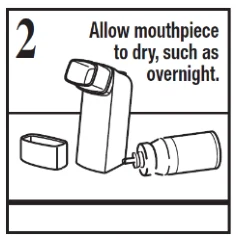 |
These cleaning and drying instructions are very important and should be performed at least once a week to prevent clogging of the unit. IF YOUR INHALER HAS BECOME BLOCKED (little or no medication coming out of the mouthpiece, see figure 3 and 4), wash the mouthpiece as described in STEP 1A & 1B and air dry thoroughly as described in STEP 2. If you need to use your inhaler right after you have washed it, shake off excess water, put the canister back in and test spray it into the air twice, away from your face, to remove most of the water remaining in the mouthpiece. Then take your dose as prescribed. After such use, re-wash and air dry thoroughly as described in STEPS 1A & 1B and 2. | 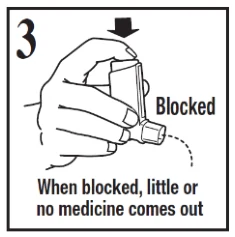 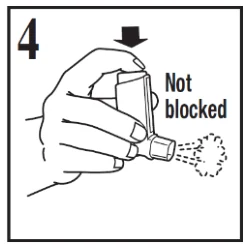 |
Overdose:
| If you think you have taken too much AIROMIR, contact your healthcare professional, hospital emergency department or regional Poison Control Centre immediately, even if there are no symptoms. |
If you accidentally take a larger dose than prescribed, you are more likely to get side effects like a faster heartbeat, headaches and feeling shaky or restless. These effects usually wear off within a few hours, but you should tell your healthcare professional as soon as possible.
Missed Dose:
If you forget a dose, just inhale the next dose when it is due or if you become wheezy.
What are possible side effects from using AIROMIR?
These are not all the possible side effects you may feel when taking AIROMIR. If you experience any side effects not listed here, contact your healthcare professional.
Side effects may include:
- chest pain or discomfort
- tremor, feeling shaky
- nervousness
- restlessness, feeling anxious or irritable
- headache
- dizziness, feeling as though you are spinning or loss of balance (vertigo)
- drowsiness
- feeling tired or weak
- trouble sleeping (insomnia)
- flushing
- nausea, vomiting
- diarrhea
- trouble passing urine
- unusual taste in your mouth
- dry or irritated throat
- cough
- infection and/or inflammation in your airways or lungs
- muscle cramps or pain
- high blood pressure
Side effects in children may also include:
- changes in sleep patterns
- changes in behavior such as restlessness and excitability (hyperactivity)
Serious side effects and what to do about them
| Symptom / effect | Talk to your healthcare professional | Stop taking drug and get immediate medical help | |||
| Only if severe | In all cases | ||||
VERY RARE Bronchospasm: Sudden worsening of shortness of breath and wheezing shortly after using AIROMIR | ✓ | ||||
| Allergic reactions: Sudden wheezing and chest pain or tightness; or swelling of eyelids, face, lips, tongue or throat | ✓ | ||
RARE: Low levels of potassium in the blood (Hypokalemia): muscle weakness and muscle spasms | ✓ | ||
| Hallucinations in children: see or hear things that are not there | ✓ | ||
| COMMON: Heart palpitations, faster than normal heartbeat | ✓ | ||
UNKNOWN: Irregular heartbeat | ✓ |
If you have a troublesome symptom or side effect that is not listed here or becomes bad enough to interfere with your daily activities, talk to your healthcare professional.
Reporting Side Effects
You can report any suspected side effects associated with the use of health products to Health Canada by:
NOTE: Contact your health professional if you need information about how to manage your side effects. The Canada Vigilance Program does not provide medical advice. |
Storage:
Store AIROMIR between 15°C and 30°C. Protect it from direct sunlight and freezing.
Warning: The contents of AIROMIR inhalation aerosol are under pressure. The canister may explode if heated. Do not place in hot water or near radiators, stoves or other sources of heat. Do not puncture or incinerate the aerosol canister, even when it seems to be empty. As with most inhaled medications in aerosol canisters, AIROMIR may not work as well when the canister is cold.
If your healthcare professional changes your treatment and you no longer require AIROMIR
Inhalation Aerosol, please return your inhaler to your pharmacy for disposal.
Keep out of reach and sight of children.
If you want more information about AIROMIR:
- Talk to your healthcare professional
- Find the full product monograph that is prepared for healthcare professionals and includes this Patient Medication Information by visiting the Health Canada website at www.healthcanada.gc.ca; or by calling 1-800-361-4261.
You may need to read this leaflet again. Please do not throw it away until you have finished your medicine.