


Product Monograph - Ampicillin Sodium for Injection, BP
Actions and Clinical Pharmacology
Ampicillin has a broad spectrum of bactericidal activity against many gram-positive and gram-negative aerobic and anaerobic bacteria. It acts through the inhibition of cell wall mucopeptide biosynthesis during the stage of active multiplication.
Indications and Clinical Use
The treatment of infections due to susceptible gram negative organisms (including strains of shigellae, S. typhosa and other salmonellae, E. coli, H. influenzae, and P. mirabilis) and susceptible gram positive organisms (including streptococci, pneumococci, and non-beta-lactamase (penicillinase) producing staphylococci).
To reduce the development of drug-resistant bacteria and maintain the effectiveness of
Ampicillin Sodium for Injection, BP and other antibacterial drugs, Ampicillin Sodium for Injection, BP should be used only to treat infections that are proven or strongly suspected to be caused by susceptible bacteria. When culture and susceptibility information are available, they should be considered in selecting or modifying antibacterial therapy. In the absence of such data, local epidemiology and susceptibility patterns may contribute to the empiric selection of therapy.
Contraindications
A history of allergic reactions to penicillin or cephalosporins.
Warnings
Before therapy, inquiry as to past penicillin or other allergies is essential as reactions occur more frequently in hypersensitive persons. During therapy, if allergic or anaphylactic reactions occur, discontinue treatment and initiate usual measures, i.e. antihistamines, pressor amines or corticosteroids. During long-term therapy, renal, hepatic, and hematopoietic functions should be checked periodically. Candidiasis and other superinfections may occur, especially in debilitated and malnourished patients, or those with low resistance to infection due to corticosteroids, immunosuppressors or irradiation.
The passage of any penicillin from blood into brain is facilitated by inflamed meninges and during cardiopulmonary bypass. In the presence of such factors and particularly in the presence of renal failure when high serum concentrations can be attained, central nervous system adverse effects including myoclonus, convulsive seizures and depressed consciousness can be expected. Although this complication has not been reported with ampicillin, it should be anticipated.
Precautions
General: A high percentage of patients with infectious mononucleosis or lymphatic leukemia who receive ampicillin develop a skin rash, and the drug should not be administered to such patients. In most cases, the rash is maculopapular, pruritic, and generalized.
Prolonged use of antibiotics may promote overgrowth of nonsusceptible organisms. Should superinfections occur, appropriate measures should be taken.
Susceptibility/Resistance
Development of Drug Resistant Bacteria
Prescribing Ampicillin Sodium for Injection, BP in the absence of a proven or strongly suspected bacterial infection is unlikely to provide benefit to the patient and risks the development of resistant organisms.
Drug Interactions
The concurrent administration of allopurinol and ampicillin increases substantially the incidence of rashes in patients receiving both drugs as compared to patients receiving ampicillin alone. It is not known whether this potentiation of ampicillin rashes is due to allopurinol or to hyperuricemia present in these patients. Ampicillin and aminoglycosides should not be reconstituted together due to the in vitro inactivation of the aminoglycosides by the ampicillin.
Drug/Laboratory Test Interactions: Following administration of ampicillin to pregnant women, a transient decrease in plasma concentration of total conjugated estriol, estriol glucuronide, conjugated estrone and estradiol has been noted.
With high urine concentrations of ampicillin, false-positive urinary glucose reactions may occur if copper reduction methods are used. Therefore, it is recommended that glucose tests based on enzymatic glucose oxidase reactions be employed.
Pregnancy: Animal studies with ampicillin have shown no teratogenic effects. There are, however, no adequate and well-controlled studies in pregnant women. Because animal reproduction studies are not always predictive of human response, this drug should be used during pregnancy only if clearly needed.
Lactation: Ampicillin is excreted in trace amounts in human milk. Therefore, caution should be exercised when ampicillin is administered to a nursing mother.
Use in Elderly: There are no known specific precautions for the use of ampicillin in the elderly.
Adverse Reactions
Gastrointestinal Disturbances: glossitis, stomatitis, black “hairy” tongue, nausea, vomiting, diarrhea, enterocolitis and pseudomembranous colitis. (These reactions are usually associated with oral administration.)
Hypersensitivity Reactions: Erythematous maculopapular rashes have been reported fairly frequently; urticaria, erythema multiforme, and a few cases of exfoliative dermatitis have been observed. Anaphylaxis is the most serious reaction usually associated with parenteral administration.
Note: Urticaria, other skin rashes, and serum sickness like reactions may be controlled with antihistamines, and if necessary, systemic corticosteroids. Serious anaphylactic reactions require the immediate use of epinephrine, oxygen and intravenous (IV) corticosteroids. In cases of infectious mononucleosis, where ampicillin has been administered, an extremely high incidence of generalized rash has been reported.
Renal: Interstitial nephritis has been reported.
Ototoxicity: Ampicillin may be ototoxic when given IV in very high doses.
Hepatic: A mild transitory elevation of serum glutamic oxaloacetic transaminase (SGOT) in individuals receiving large (2 to 4 times recommended dose) and often repeated intramuscular (IM) injections. Evidence indicates that serum glutamic oxaloacetic transaminase (SGOT) is released at the site of IM injection of sodium ampicillin and that the presence of the enzyme in the blood does not necessarily indicate liver involvement.
Hematologic Disturbances: Anemia, thrombocytopenia, thrombocytopenic purpura, hemorrhagic diathesis, eosinophilia, leukopenia and agranulocytosis have been reported rarely in association with ampicillin therapy. These reactions are usually reversible on discontinuation of the drug and are believed to be hypersensitivity phenomena.
Symptoms and Treatment of Overdosage
The treatment of overdosage would likely be needed only in patients with severely impaired renal function. In case of overdosage, discontinue medication, treat symptomatically and institute supportive measures as required. In patients with renal function impairment, ampicillin-class antibiotics can be removed by hemodialysis but not by peritoneal dialysis.
Dosage and Administration
Dosage:
Infections of the ear, nose, throat and lower respiratory tract: Adults: 250 mg to 500 mg every 6 hours. Children: 25 mg/kg/day to 50 mg/kg/day in equally divided doses at 6-hour intervals. Infections of gastrointestinal tract and of the genitourinary tract: Adults: 500 mg every 6 hours.
Children: 50 mg/kg/day in equally divided doses at 6-hour intervals.
Larger doses may be required for stubborn or severe infections. The children’s dosages are intended for individuals whose weights will not result in calculated dosage greater than that recommended for adults.
In the treatment of chronic urinary tract and intestinal tract infections, frequent bacteriological and clinical appraisal is necessary. Smaller doses than those recommended above should not be used; higher doses may be needed at times. In stubborn infections, therapy may be required for several weeks. It may be necessary to continue clinical and/or bacteriological follow-up for several months after cessation of therapy.
Treatment should be continued for a minimum of 48 to 72 hours beyond the time that the patient becomes asymptomatic or evidence of bacterial eradication has been obtained. A minimum of 10 days’ treatment is recommended for any infection caused by Group A beta-hemolytic streptococci. In gonorrhea therapy, serologic tests for syphilis should be performed initially and monthly for 3 months.
Administration:
Intramuscular (IM)/Direct Intravenous (IV) Use: Entire contents should be withdrawn and the dose injected over a period of 3-5 minutes.
Intravenous (IV) Infusion: Entire contents should be withdrawn and the dose injected over a period of at least 10-15 minutes.
CAUTION: More rapid administration may result in convulsive seizures. The solution must be used within 1 hour after reconstitution.
Pharmaceutical Information
Drug Substance:
Name: ampicillin sodium
Chemical Name: Sodium (2S,5R,6R)-6-[[(2R)-2-amino-2-phenylacetyl]amino]-3,3-dimethyl-7-oxo-4-thia-1-azabicyclo[3.2.0]heptane-2-carboxylate
Structural Formula:
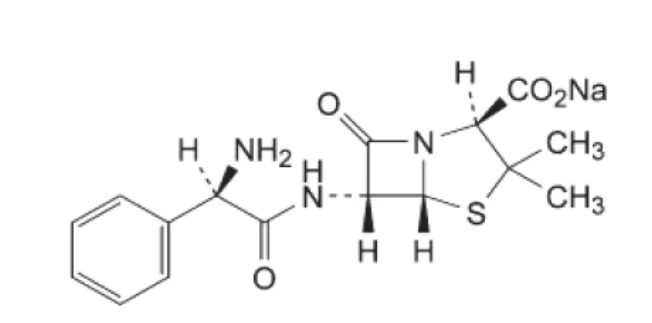
Molecular Formula: C16H18N3NaO4S
Molecular Weight: 371.4 g/mol (anhydrous)
Description: A white or almost white powder, hygroscopic. Freely soluble in water, practically insoluble acetone, in fatty oils and in liquid paraffin.
Composition: Each vial contains 250 mg, 500 mg, 1000 mg or 2000 mg of ampicillin base as the sodium salt. Each gram of Ampicillin Sodium for Injection, BP contains approximately 60 mg, or approximately 6-8% sodium.
Stability & Storage Recommendations
Store the dry powder at controlled room temperature not exceeding 25°C.
Reconstituted Solutions: Use Sterile Water for Injection as the only diluent. Reconstituted solutions should be used within 1 hour when kept at controlled room temperature not exceeding 25°C. Protect reconstituted solutions from freezing.
Reconstitution
IM Use: Using Sterile Water for Injection, reconstitute as follows:
Vial Size (mg) | Volume of Diluent Added (mL) | Withdrawable Volume (mL) | Nominal Concentration (mg/mL) |
|---|---|---|---|
| 250 | 1.9 | 2.0 | 125 |
| 500 | 1.8 | 2.0 | 250 |
| 1000 | 3.5 | 4.0 | 250 |
Withdraw the entire contents and use within 1 hour after reconstitution.
Direct IV Use: Using Sterile Water for Injection, reconstitute as follows:
Vial Size (mg) | Volume of Diluent Added (mL) | Withdrawable Volume (mL) | Nominal Concentration (mg/mL) |
| 250 | 1.9 | 2.0 | 125 |
| 500 | 1.8 | 2.0 | 250 |
For direct intravenous administration, the product should be diluted to a concentration of 50 mg/mL with Sterile Water for Injection and administered by slow injection (three to four minutes).
Withdraw the entire contents and use within 1 hour after reconstitution.
I. V. Infusion: Use Sterile Water for Injection for initial dilution of the 1000 mg and 2000 mg vials, and reconstitute as follows:
Vial Size (mg) | Volume of Diluent Added (mL) | Withdrawable Volume (mL) | Nominal Concentration (mg/mL) |
|---|---|---|---|
| 1000 | 3.5 | 4.0 | 250 |
Vial Size (mg) | Volume of Diluent Added (mL) | Withdrawable Volume (mL) | Nominal Concentration (mg/mL) |
|---|---|---|---|
| 2000 | 6.8 | 8.0 | 250 |
Withdraw the entire contents and use within 1 hour after reconstitution.
Parenteral Products: Stability studies on ampicillin sodium, at concentrations of 2 mg/mL and
30 mg/mL in various IV solutions, indicate the drug will lose less than 10% activity at room temperature (25°C) for the time periods stated when the drug is added to the following infusion fluids:
| Isotonic sodium chloride | (30 mg/mL) | 8 hours |
| 5% dextrose in water | (2 mg/mL) | To be used immediately. |
| 5% dextrose in 0.4% sodium chloride solution | (2 mg/mL) | 4 hours |
| M/6 sodium lactate solution | (30 mg/mL) | 4 hours |
Availability of Dosage Forms: Ampicillin Sodium for Injection, BP is supplied as a dry powder in vials containing: 250 mg, 500 mg, 1000 mg or 2000 mg of ampicillin base as the sodium salt.