


Patient Medication Information: uses, side effects, how to take - Apo-Cladribine
What is APO-CLADRIBINE used for?
- APO-CLADRIBINE is used to treat adult patients with relapsing-remitting multiple sclerosis (RRMS). Multiple sclerosis (MS) is a disease that affects the brain and spinal cord.
- Treatment with APO-CLADRIBINE has been shown to reduce the frequency of relapses and to slow down disability progression.
- APO-CLADRIBINE is generally recommended for MS patients who have not responded well to, or cannot tolerate one or more of the other therapies for MS.
How does APO-CLADRIBINE work?
Cladribine, the active substance in APO-CLADRIBINE is cytotoxic, which means it causes cell death. Cladribine acts in specific ways on cells in your immune system called B and T lymphocytes. Cladribine helps to reduce inflammation in your body as a result of having MS.
What are the ingredients in APO-CLADRIBINE?
Medicinal ingredient: Cladribine
Non-medicinal ingredients: 2-Hydroxy propyl βeta cyclodextrin, magnesium stearate and sorbitol.
APO-CLADRIBINE comes in the following dosage forms:
Tablets: 10 mg tablet of cladribine.
Do not use APO-CLADRIBINE if:
- you are allergic (hypersensitive) to cladribine or any of the other ingredients of APO-CLADRIBINE;
you are at risk for infections because you have a weak immune system due to:
- treatments you receive (for cancer [medication or radiation], chronic corticosteroids, bone marrow transplant(s), etc.);
a medical condition you have (for example, if you are infected with the human
- immunodeficiency virus [HIV]);
- you have an active or inactive (past) infection, for example tuberculosis or liver inflammation (hepatitis);
- you have or had a type of rare infection of the brain called progressive multifocal leukoencephalopathy (PML);
- you have an active cancer;
- you have moderate or severe kidney problems;
- you are pregnant or breast-feeding;
- you are a woman of childbearing potential or a man who could potentially father a child and you are not using birth control.
Talk to your healthcare professional if you are unsure if any of the above applies to you.
To help avoid side effects and ensure proper use, talk to your healthcare professional before you take APO-CLADRIBINE. Talk about any health conditions or problems you may have, including if you:
have a weakened immune system due to:
- treatments you receive (for cancer [medication or radiation], bone marrow transplant(s), etc.);
- a medical condition you have (for example, if you are infected with the human immunodeficiency virus [HIV]);
- have an infection;
- have liver problems;
- have recently been vaccinated;
- have or have previously had cancer;
- require blood transfusions;
- are pregnant, are thinking of becoming pregnant as APO-CLADRIBINE may harm your baby;
are breast-feeding or plan to breast-feed;
- it is not known if APO-CLADRIBINE goes into breast milk;
- do not breast-feed on the days you take APO-CLADRIBINE, and for 10 days after the last dose;
- are less than 18 years of age.
Other warnings you should know about:
Blood Tests
You will have blood tests taken before you start treatment to see if you can take APO-CLADRIBINE. Your healthcare professional will also do blood tests during and after treatment to ensure you can continue to take APO-CLADRIBINE. The tests will determine if you are developing any complications from the treatment.
General Infections
You will be tested to see if you have any infections prior to starting APO-CLADRIBINE. It is important to talk to your healthcare professional if you think you have an infection before, during or after treatment. These could be serious and possibly even life-threatening. Symptoms of infections can include:
- fever
- aching, painful muscles
- headache
- generally feeling unwell
- loss of appetite
Your healthcare professional may delay start of treatment, or interrupt current treatment, until the infection clears up.
Vaccination
Talk to your healthcare professional if you have recently been given, or might be given, certain vaccines (called ‘live’ or ‘live attenuated’ vaccines).
- Treatment with APO-CLADRIBINE can only begin 6 weeks after you have been vaccinated.
- If necessary, you will be vaccinated against varicella (chickenpox) prior to starting treatment.
- You must not be vaccinated during treatment with APO-CLADRIBINE.
- You may only be vaccinated after APO-CLADRIBINE treatment when your white blood cell count is normal.
Progressive Multifocal Leukoencephalopathy (PML)
Talk to your healthcare professional if you believe your MS is getting worse or if you notice any new symptoms, such as:
- weakness on one side of the body that gets worse
- clumsiness of your arms and legs
- trouble with your vision
- changes in your thinking and memory that lead to confusion and personality changes
These may be the symptoms of a rare brain disorder caused by infection and called progressive multifocal leukoencephalopathy (PML). PML is a serious condition that may lead to severe disability or death.
As a precaution, you may have a head MRI (magnetic resonance imaging) within 3 months prior to starting treatment. This is particularly important if you have previously taken other multiple sclerosis treatments where PML is a risk.
Risk of Cancer
APO-CLADRIBINE causes damage to the DNA (genotoxicity) and suppresses the immune system. As a result, APO-CLADRIBINE could potentially increase the risk of cancer. In studies with APO-CLADRIBINE, there were single cases of patients who developed different types of cancer, such as skin, ovarian, thyroid, breast and pancreatic cancer.
Follow your healthcare professional’s instructions for screening for cancer.
Fructose Intolerance
APO-CLADRIBINE contains sorbitol. Do not take APO-CLADRIBINE if you have hereditary problems of fructose intolerance.
Pregnancy and Fertility
It is important that:
- women taking APO-CLADRIBINE prevent pregnancy during treatment and for at least 6 months after the last dose.
- men taking APO-CLADRIBINE prevent pregnancy in their female partner while they are taking APO-CLADRIBINE and for at least 6 months after the last dose.
- If you or your partner gets pregnant during treatment or within the 6 months after the last dose, there may be a risk to the unborn baby. Your healthcare professional will stop treatment with APO-CLADRIBINE if you are a woman and you get pregnant while taking it.
- APO-CLADRIBINE may affect male fertility. Talk to your healthcare professional for more information.
- For male patients, it is not known if APO-CLADRIBINE is detectable in semen. A barrier method of contraception (for example, condoms) should be used during treatment with APO-CLADRIBINE and for 10 days after the last dose.
Tell your healthcare professional about all the medicines you take, including any drugs, vitamins, minerals, natural supplements or alternative medicines.
The following may interact with APO-CLADRIBINE:
- medicines used to suppress the immune system (e.g., cyclosporine, cyclophosphamide, and azathioprine);
- methotrexate, a medicine used to treat certain conditions such as psoriasis or rheumatoid arthritis;
- corticosteroids, medicines used to reduce inflammation;
- carbamazepine, a medicine used to treat seizures;
- medicines used to treat heart and blood vessel conditions (e.g., dipyridamole, dilazep, nimodipine, and cilostazol);
- sulindac, a medicine used to reduce pain and inflammation;
- medicines used to treat high blood pressure (e.g., nifedipine and reserpine);
- medicines used to treat cancer (e.g., gefitinib and imatinib);
- medicines used to treat HIV/AIDS (e.g., elvitegravir and cobicistat);
- eltrombopag, a medicine used to treat blood disorders;
- rifampin, a medicine used to treat tuberculosis;
- St. John’s wort, a herbal medicine used to depression.
Do NOT take APO-CLADRIBINE at the same time as any other oral medicine. It may interact with other medicines in your stomach. Take other medicines 3 hours before or after you take APO-CLADRIBINE.
How to take APO-CLADRIBINE:
- A. Understanding the APO-CLADRIBINE Packaging
Follow the steps below for opening the APO-CLADRIBINE package and for how to handle the tablets. As APO-CLADRIBINE is cytotoxic, it is important that you follow the instructions below to make sure you handle and take APO-CLADRIBINE safely.
- 1. Have a glass of water ready and make sure your hands are clean and dry before taking the tablet(s).
- 2. Pick up the carton with the instructions facing up.
- 3.
Open the package as follows (see Figure A below):
- i. Press and hold the button gently.
- ii.
Pull the medication card out gently until you feel resistance and the card stops sliding out. Do not try to remove the medication card from the carton. It is important the medication card stays in the carton to help prevent anyone from touching the tablets, especially children.
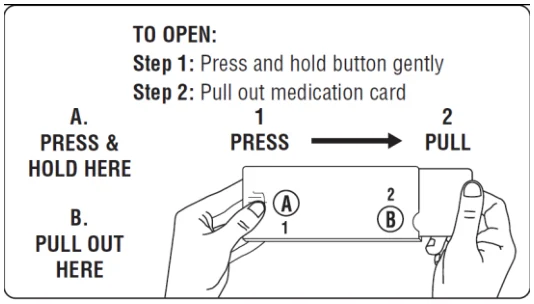
Figure A
- 4. Take the Package Insert out and read through all of it before taking APO-CLADRIBINE.
- 5.
Place your hand under the blister pack and push 1 or 2 tablet(s) into your hand, based on your prescribed dose.
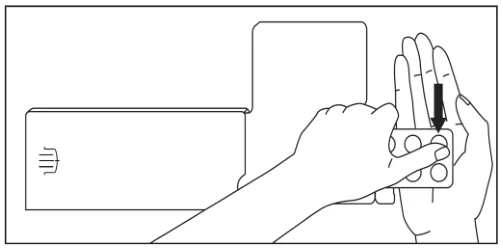
Figure B
- 6.
Tablets must be swallowed whole and not chewed or allowed to dissolve in your mouth. Swallow the tablet(s) with water immediately after removing them from the blister.
- i. Do not leave your tablet(s) exposed on surfaces, for example on a table, or handle the tablet longer than necessary.
- ii. If a tablet is left on a surface or if a broken or fragmented tablet is released from the blister, the area must be thoroughly washed.
- iii. If you lose a tablet, contact your healthcare professional for advice.
- 7. Wash your hands thoroughly with soap and water before touching your nose, eyes, and other parts of the body.
- 8. Push the medication card back into the carton.
- 9. Keep your tablets in the blister until your next dose. It is important that the tablets stay in the blister to help prevent anyone from touching the tablets or taking it by mistake.
B. Understanding Your Treatment Courses
You will be given APO-CLADRIBINE as two treatment courses over 2 years.
One treatment course is 2 treatment weeks, which are taken one month apart at the beginning of each treatment year.
A treatment week consists of 1 or 2 tablets daily given for 4 or 5 days.
Example: if you start your treatment mid-April, you take your tablets as shown.
| Year 1 | Year 2 | ||
| 1st treatment week | 1 or 2 tablets daily for 4 or 5 days, mid-April | 1st treatment week | 1 or 2 tablets daily for 4 or 5 days, mid-April |
| 2nd treatment week | 1 or 2 tablets daily for 4 or 5 days, mid-May | 2nd treatment week | 1 or 2 tablets daily for 4 or 5 days, mid-May |
Before you start a treatment course, your healthcare professional will do a blood test to see whether the levels of lymphocytes (a type of white blood cells) are in an acceptable range. If this is not the case, your treatment will be delayed.
Once you have completed the 2 treatment years, your healthcare professional will observe your condition for another 2 years, in which you do not need to take the medicine. The efficacy of taking APO-CLADRIBINE for longer than 2 years has not yet been established.
Usual dose:
Always take APO-CLADRIBINE exactly as your healthcare professional has told you. Check with your healthcare professional if you are not sure. Take the tablet(s) at about the same time each day. You do not have to take the tablets at meal times. You can take them with or without food. Your healthcare professional may recommend that you take any other oral medication 3 hours before or after you take APO-CLADRIBINE.
- 1. You will be prescribed the correct number of tablets for each treatment week, based on your body weight according to the table below.
- 2. In the left column of the table below find the row that fits your body weight (in kg), and then check the number of tablets that should be in the pack(s) for the treatment week you will be starting.
- 3. If the number of tablets in your pack(s) is different from the number shown for your weight in the table below, speak to your healthcare professional.
- 4. Note that for some weight ranges the number of tablets may vary from one treatment week to the next.
Example: if you weigh 85 kg and are about to start treatment week 1, you will be given 8 tablets.
| Your weight in | Number of tablets to take | ||||||||||||
| Year 1 treatment course | Year 2 treatment course | ||||||||||||
| kg | Treatment week 1 | Treatment week 2 | Treatment week 1 | Treatment week 2 | |||||||||
| Less than 40 kg | Your healthcare professional will tell you the number of tablets to take | ||||||||||||
| 40 to < 50 | 4 | 4 | 4 | 4 | |||||||||
| 50 to < 60 | 5 | 5 | 5 | 5 | |||||||||
| 60 to < 70 | 6 | 6 | 6 | 6 | |||||||||
| 70 to < 80 | 7 | 7 | 7 | 7 | |||||||||
| 80 to < 90 | 8 | 7 | 8 | 7 | |||||||||
| 90 to < 100 | 9 | 8 | 9 | 8 | |||||||||
| 100 to < 110 | 10 | 9 | 10 | 9 | |||||||||
| 110 and above | 10 | 10 | 10 | 10 | |||||||||
Duration of a treatment week
Depending on the total number of tablets you have been prescribed, you have to take them over 4 or 5 days, in each treatment week.
The table below shows how many tablets (1 or 2 tablets) you have to take on each day. If your daily dose is 2 tablets, take them at the same time.
Example: if you have to take 8 tablets, you would take 2 tablets on Day 1, Day 2, Day 3, then 1 tablet on Day 4 and Day 5.
| Total number of tablets per treatment week | Day 1 | Day 2 | Day 3 | Day 4 | Day 5 |
| 4 | 1 | 1 | 1 | 1 | 0 |
| 5 | 1 | 1 | 1 | 1 | 1 |
| 6 | 2 | 1 | 1 | 1 | 1 |
| 7 | 2 | 2 | 1 | 1 | 1 |
| 8 | 2 | 2 | 2 | 1 | 1 |
| 9 | 2 | 2 | 2 | 2 | 1 |
| 10 | 2 | 2 | 2 | 2 | 2 |
If you have any further questions on the use of this medicine, ask your healthcare professional.
Overdose:
There is limited experience with overdose of APO-CLADRIBINE. It is known that the more of this medicine you take the fewer white blood cells you may have in your body.
If you think you, or a person you are caring for, have taken too much APO-CLADRIBINE, contact a healthcare professional, hospital emergency department, or regional poison control centre or Health Canada’s toll- free number, 1-844-POISON-X (1-844-764-7669) immediately, even if there are no signs or symptoms.
Missed Dose:
| If you miss a dose and you remember on the same day you were supposed to take it | If you miss a dose and do not remember it until the following day |
| Take the missed dose on that day. | Do not take the missed dose along with the next scheduled dose. Take the missed dose on the next day and extend the number of days in that treatment week. |
Example: If you forget to take the Day 3 dose and do not remember it until Day 4, take the Day 3 dose on Day 4, and extend the total number of days in the treatment week by 1 day. If you miss 2 consecutive doses (for example both Day 3 and Day 4 doses), take the missed doses for the next 2 days, and then extend the treatment week by 2 days.
If you have any further questions on the use of this medicine, ask your healthcare professional.
What are possible side effects from using APO-CLADRIBINE?
These are not all the possible side effects you may have when taking APO-CLADRIBINE. If you experience any side effects not listed here, tell your healthcare professional.
Very common side effects: may affect more than 1 in 10 people
- Nausea
- Headache
Common side effects: may affect up to 1 in 10 people
- Cold sores (oral herpes)
- Rash
- Thinning or hair loss
- Fever
- Abdominal pain
- Toothache
- Flu and flu like symptoms
- Cold symptoms
- Bronchitis or other chest infections
- Symptoms of gastroenteritis (diarrhea, vomiting, abdominal pain)
- Back pain
- Anxiety
- Vaginal infection
Serious side effects and what to do about them
| Serious side effects and what to do about them | |||
| Serious side effects and what to do about them | |||
| Symptom / effect | Talk to your healthcare professional | Stop taking drug and get immediate medical help | |
| Symptom / effect | Talk to your healthcare professional | Stop taking drug and get immediate medical help | |
| Symptom / effect | Talk to your healthcare professional | Stop taking drug and get immediate medical help | |
| Only if severe | In all cases | ||
| Only if severe | In all cases | ||
| Only if severe | In all cases | ||
| VERY COMMON | |||
| Decreased white blood cell count: infections, feeling unusually tired, fever, aches, pain, or flu-like symptoms. | ✓ | ||
| COMMON | |||
| Allergic reaction: skin rash, hives, itching, swelling, shortness of breath, fever, wheezing, runny | ✓ | ||
| nose, itchy, or watery eyes. | |||
| Shingles: localized ‘band’ of severe pain and blistering rash, typically on one side of the upper body or the face; headache, burning, tingling, numbness or itchiness of the skin in the affected area, feeling generally unwell, or fever in the early stages of infection. | ✓ | ||
| UNCOMMON | |||
| Liver problems: nausea, vomiting, stomach pain, loss of appetite, fatigue, dark urine, skin or whites of the eyes turning yellow. | ✓ | ||
| VERY RARE | |||
| Tuberculosis: cough that does not go away, fever, or loss of weight. | ✓ | ||
| UNKNOWN FREQUENCY | |||
| Encephalitis and/or meningitis (inflammation of the brain and/or the membranes covering the brain, which may be caused by fungal (Cryptococcus) or viral (chickenpox) infections: headache accompanied by stiff neck, sensitivity to light, nausea, repeated vomiting, confusion, or seizures (fits). | ✓ | ||
| Other infections (including bacterial, viral, parasitic, and fungal infections): fever, chills, nausea, vomiting, diarrhea, generally feeling unwell, no appetite, confusion, increased sweating, shortness of breath, | ✓ | ||
| muscle aches, rash, fatigue, or chest pain. | |||
If you have a troublesome symptom or side effect that is not listed here or becomes bad enough to interfere with your daily activities, tell your healthcare professional.
Reporting Side Effects
You can report any suspected side effects associated with the use of health products to Health Canada by:
- Visiting the Web page on Adverse Reaction Reporting (https://www.canada.ca/en/health-canada/services/drugs-health-products/medeffect-canada/adverse-reaction-reporting.html) for information on how to report online, by mail or by fax; or
- Calling toll-free at 1-866-234-2345.
NOTE: Contact your health professional if you need information about how to manage your side effects. The Canada Vigilance Program does not provide medical advice.
Storage:
- Store APO-CLADRIBINE at room temperature 15°C to 30°C.
- Store this medicine in the original package in order to protect from moisture.
- Keep out of reach and sight of children.
If you want more information about APO-CLADRIBINE:
- Talk to your healthcare professional
- Find the full product monograph that is prepared for healthcare professionals and includes this Patient Medication Information by visiting the Health Canada website: (https://www.canada.ca/en/health-canada/services/drugs-health-products/drug-products/drug-product-database.html); the manufacturer’s website (http://www.apotex.ca/products), or by calling 1-800-667-4708.