


Product Monograph - Apo Cloxi Cap 500mg
PHARMACEUTICAL INFORMATION
Drug Substance
Proper/Common Name: Cloxacillin Sodium
Chemical Names: 1) 4-Thia-1-azabicyclol[3.2.0]heptane-2-carboxylic acid, 6-[[[3-
(2- chlorophenyl)-5-methyl-4-isoxazolyl]carbonyl]amino]-3,3-dimethyl-7- oxo-, monosodium salt, monohydrate, [2S-(2α,5α,6β)]-
- 2) Monosodium (2S, 5R, 6R)-6-[3-(o-chlorophenyl)-5-methyl-4- isoxazolecarboxamido]-3,3-dimethyl-7-oxo-4-thia-1-azabicyclo [3.2.0]heptane-2-carboxylate monohydrate
Structural Formula:
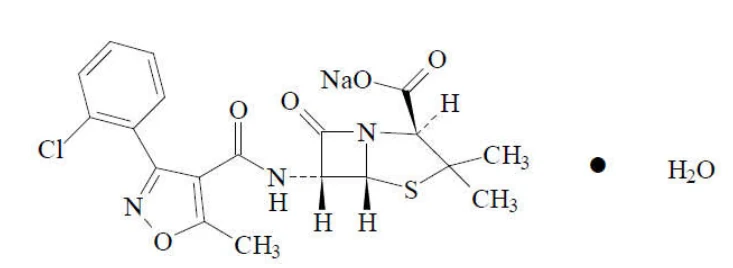
Molecular Formula: C19H17ClN3NaO5S ⋅ H2O
Molecular Weight: 475.88 g/mol
Description: Cloxacillin sodium is a white, odorless, crystalline powder. It is freely soluble in water, soluble in alcohol and slightly soluble in chloroform.
Composition
In addition to cloxacillin sodium, APO-CLOXI capsules also contain the non-medicinal ingredients colloidal silicon dioxide, stearic acid, and talc (as an antistatic agent). The capsule shells, imprinted with edible white ink, contain the non-medicinal ingredients D&C yellow #10, FD&C blue #1, FD&C red #40, FD&C yellow #6, gelatin, silicon dioxide, sodium lauryl sulfate and titanium dioxide.
PRESCRIBING INFORMATION
Pr APO-CLOXI
Cloxacillin Sodium Capsules 250 mg and 500 mg cloxacillin
USP
THERAPEUTIC CLASSIFICATION
Cloxacillin sodium is an antibiotic belonging to the semi-synthetic penicillin family.
ACTION
APO-CLOXI exhibits a bacterial action against sensitive organisms during the active multiplication stage. It acts through the inhibition of biosynthesis of cell wall mucopeptides.
INDICATIONS AND CLINICAL USE
APO-CLOXI (cloxacillin sodium) finds use in the treatment of infections caused by streptococci when associated with sensitive penicillinase-producing staphylococci; also in the treatment of all staphylococcal infections, whether penicillin G-sensitive or resistant.
In infections suspected of being caused by penicillinase-producing staphylococci, cloxacillin may be used for initial treatment after appropriate specimens have been taken for culture and before results of microbial susceptibility tests are known. If the results of identification and susceptibility tests indicate that the infecting organism is not a penicillinase-producing staphylococcus susceptible to cloxacillin, cloxacillin should be discontinued and treatment with an appropriate alternative agent instituted.
To reduce the development of drug-resistant bacteria and maintain the effectiveness of APO-CLOXI and other antibacterial drugs, APO-CLOXI should be used only to treat infections that are proven or strongly suspected to be caused by susceptible bacteria. When culture and susceptibility information are available, they should be considered in selecting or modifying antibacterial therapy. In the absence of such data, local epidemiology and susceptibility patterns may contribute to the empiric selection of therapy.
CONTRAINDICATIONS
A history of allergic reactions to penicillin or cephalosporins.
WARNINGS
Serious and occasionally fatal hypersensitivity (anaphylactoid) reactions have been reported in patients receiving penicillin therapy. These reactions are more apt to occur in individuals with a history of sensitivity to multiple allergens. Careful inquiry should be made concerning previous hypersensitivity reactions to penicillins, cephalosporins or other allergens. If an allergic or anaphylactic reaction occurs, discontinue treatment and administer the usual agents, e.g. antihistamines, pressor amines, corticosteroids.
Safety for use in pregnancy has not been established.
Susceptibility/Resistance
Development of Drug Resistant Bacteria
Prescribing APO-CLOXI in the absence of a proven or strongly suspected bacterial infection is unlikely to provide benefit to the patient and risks the development of drug-resistant bacteria.
Severe Cutaneous Adverse Reactions
Severe cutaneous adverse reactions (SCAR) such as acute generalized exanthematous pustulosis (AGEP), drug reaction with eosinophilia and systemic symptoms (DRESS), Stevens-Johnson syndrome (SJS), and toxic epidermal necrolysis (TEN) have been reported in association with beta-lactam treatment. When SCAR is suspected, APO-CLOXI should be discontinued and appropriate therapy and/or measures should be taken.
PRECAUTIONS
Candidiasis and other superinfections may occur, especially in debilitated and malnourished patients, or those with low resistance to infection due to corticosteroids, immunosuppressive agents or irradiation. If superinfection occurs, institute appropriate measures.
During long-term therapy, renal, hepatic and hematopoietic functions should be checked periodically.
Experience in premature and newborn infants is limited. Cautious administration of the drug to such patients and frequent evaluation of organ system function is recommended.
The passage of any penicillin from blood into brain is facilitated by inflamed meninges and during cardiopulmonary bypass. In the presence of such factors, particularly in renal failure when high serum concentrations can be attained, central nervous system adverse effects including myoclonia, convulsive seizures and depressed consciousness can be expected. Although this complication has not been reported with cloxacillin, it should be anticipated.
ADVERSE REACTIONS
Gastrointestinal disturbances, such as nausea, vomiting, epigastric discomfort, flatulence and loose stools, have been noted in some patients. Rarely, mild leukopenia has occurred. Mildly elevated SGOT levels (less than 100 units) have been reported in a few patients for whom pre-therapeutic determinations were not made. Fever, anaphylaxis and allergic reactions (rash, urticaria) including wheezing and sneezing, have occasionally been encountered.
Eosoinophilia, with or without overt allergic manifestations, has been noted in some patients during therapy. Thrombophlebitis has occurred occasionally I.V. therapy.
SYMPTOMS AND TREATMENT OF OVERDOSAGE
When penicillin reaches a certain (as yet undetermined) concentration in the cerebrospinal fluid, neurotoxic symptoms may occur consisting of myoclonia, convulsive seizures, and depressed consciousness. Unless administration of the drug is stopped or its dosage reduced, the syndrome may progress to coma and death. Penicillin does not normally cross the blood-brain barrier to any substantial extent, but when massive doses are used (several grams a day) in the presence of inflamed meninges and/or impaired renal function, or in elderly patients, the drug may cause the above- mentioned toxic reactions. No antidote is required.
Treatment of overdose:
Stop administration temporarily - promote excretion (dialysis, etc.).
Toxic serum levels and the lethal serum level of cloxacillin in man are not known.
MICROBIOLOGY
APO-CLOXI (cloxacillin sodium) is bactericidal and has an anti- bacterial spectrum similar to that of benzylpenicillin but is less active. It is also effective in the dosage recommended for treatment of infections caused by streptococci and penicillin-G sensitive staphylococci.
The average minimal inhibitory concentrations (M.I.C.) of sodium cloxacillin monohydrate for these organisms are as follows: 1, 2, 3, 4, 5
| MICROORGANISMS | USUAL M.I.C. mcg/mL | M.I.C. RANGE mcg/mL |
| Streptococcus pneumoniae | 0.20 | 0.10-0.80 |
| Staphylococcus aureus | 0.20 | 0.10-1.60 |
| non-penicillinase producing | ||
| Staphylococcus aureus | 0.40 | 0.10-1.60 |
| penicillinase producing | ||
| Streptococcus pyogenes | 0.05 | 0.02-0.10 |
PHARMACOLOGY
Sodium cloxacillin monohydrate is rapidly but incompletely absorbed from the gastrointestinal tract after oral administration.
When a dose of 500 mg cloxacillin sodium (2 x 250 mg cloxacillin sodium capsules) was administered to fasting adult volunteers a mean peak plasma level of 8.5 mcg/mL was obtained with a Tmax of 0.88 hr.6
A dose of 500 mg cloxacillin sodium reconstituted granules for oral solution yielded peak plasma levels of 13.3 mcg/mL with a Tmax of 0.58 hr. in fasting adult volunteers.7
Oral doses of 250 mg sodium cloxacillin to adult fasting volunteers resulted in 4.8 mcg/mL peak serum levels with a Tmax of 1 hr.8
Mean urinary excretion of cloxacillin after an oral dose of 500 mg was found to be 37%.8 Total urinary excretion in healthy volunteers was 62% of an intravenously injected dose of 750 mg
(250 mg/hr for three hours).12
Food delays the absorption of cloxacillin sodium. cloxacillin.9, 10 Sodium cloxacillin is bound to serum proteins to the extent of 94%.11
The plasma half-life of cloxacillin is reported to be 25 minutes in healthy volunteers following infusion of 750 mg over a 3 hour period.12 The plasma half-life in uremic patients was increased to 49 minutes.
Cloxacillin passage across the CNS barrier is insufficient for practical purposes unless the meninges are inflamed. Cloxacillin passes the placental barrier as do the penicillins to the extent of about 50% of the mothers plasma level.
Serum concentrations are enhanced if probenecid is given concomitantly.10
TOXICOLOGY
Acute Toxicity
Cloxacillin sodium shares the lack of toxicity of other penicillins. It has been administered to mice, rats, dogs, cats and rabbits by various routes.
Studies on the acute toxicity of cloxacillin sodium have shown that it has a very low acute toxicity whether given orally or parenterally. Studies on newborn rats also show low toxicity. The oral LD50 in mice was more than 5,000 mg/kg and 1,200 mg/kg by intravenous injection.3
Subacute Toxicity
Cloxacillin sodium in doses of 100 mg and 500 mg/kg was administered orally and subcutaneously to two groups of 12 male rats each over a period of 12 weeks. No haematological, biochemical, histological or organ weight abnormalities were observed.3
Sodium cloxacillin was administered in doses of 500 mg and 2000 mg/kg twice daily to two groups of 3 dogs each for a period of 4 weeks. No haematological, biochemical or histological abnormalities were noted.3
Teratogenicity
No evidence of teratogenicity was reported in a study of sodium cloxacillin given intramuscularly to female rabbits.13 Six pregnant rabbits were administered 250 mg/kg cloxacillin from the 8th day to the 16th of pregnancy. The animals given cloxacillin had no abortions and delivered normal sized litters with no fetal abnormalities.
DOSAGE AND ADMINISTRATION
Adults: Mild to moderate infections: 250 to 500 mg every 6 hours. It should be given l to 2 hours before meals as the presence of food in the stomach and small intestine reduces absorption. Maintain therapy for a minimum of 5 days.
Larger doses may be required for very severe infections.
A daily dose of 6 g should not be exceeded.
In infections associated with streptococcus pyogenes, treatment should be continued for at least 10 days to reduce the risk of glomerulonephritis or rheumatic fever.
AVAILABILITY OF DOSAGE FORMS
Capsules
250 mg: Each orange and black no. 2 capsule, identified APO 250, contains cloxacillin sodium equivalent to cloxacillin 250 mg. Available in bottles of 100 and 1000 capsules.
500 mg: Each orange and black no. 0 capsule, identified APO 500, contains cloxacillin sodium equivalent to cloxacillin 500 mg. Available in bottles of 100 and 500.
STORAGE AND STABILITY
Stability and Storage Recommendations
Store at room temperature not exceeding 25°C.
REFERENCES
- 1.
Knudsen, E.T., Brown, D.M., Rolinson, G.N.: A New Orally Effective Penicillinase-Stable
Penicillin - BRL. 1621. The Lancet, ii:632, 1962.
- 2.
Smith, J.T., Hamilton-Miller, J.M.T., Knox, R.: Isoxazolyl Penicillins and Penicillinase.
Nature, 195:1300, 1962.
- 3.
Nayler, J.H.C., Long, A.A.W., Brown, D.M., Acred, P., Rolinson, G.N., Batchelor, F.R.,
Stevens, S., Sutherland, R.: Chemistry, Toxicology, Pharmacology and Microbiology of a New Acid-Stable Penicillin, Resistant to Penicillinase (BRL 1621). Nature, 195:1264, 1962.
- 4.
Bunn, P.A., Milicich, S.: Laboratory and Clinical Studies with Cloxacillin. Antimicrobial
Agents and Chemotherapy, 220,1963.
- 5. Cravenkemper, C.F., Bennett, J.V., Brodie, J.L., and Kirby, W.M.M.: Dicloxacillin:In Vitro and Pharmacologic Comparison with Oxacillin and Cloxacillin. Arch. Intern. Med., 116:340, 1965.
- 6.
"A Comparative Bioavailability Study of 250 mg Cloxacillin Capsules''.Report 27205,
Sept. 1975, Teva Canada Limited.
- 7.
A Comparative Bioavailability Study of Cloxacillin for Oral Solution". Report 30067, Jan.
1976, Teva Canada Limited.
- 8.
Bodey, G.P., Vellejos, C., and Stewart, D.: Flucloxacillin: A New Semisynthetic
Isoxazolyl Penicillin.Clin. Pharm. Ther.13:512, 1972.
- 9.
Sidell, S., Bulger, R.J., Brodie, J.L., Kirby, W.M.M.: Cloxacillin a New Oral Synthetic
Penicillin (Comparisons with Oxacillin). Clin. Pharm. Ther., 5:26, 1964.
- 10.
Kislak, J.W., Eickhoff, T., Finland, M.: Cloxacillin: Activity In Vitro, and Absorption and
Excretion in Normal Young Men. Am. J. Med. Sciences, 249:750, 1965.
- 11.
Rolinson, G.N., and Sutherland, R.: The Binding of Antibiotics to Serum Proteins. Brit. J.
Pharmacal. 25 :638, 1965.
- 12. Rosenblatt, J.E., Kind, A.C., Brodie, J.L., and Kirby, W.M.M.: Mechanisms Responsible for the Blood Level Differences of Isoxazolyl Penicillins. Arch. Intern. Med., 121:345, 1968.
- 13.
Acred, P., and Brown, D.M.: Further Pharmacology and Chemotherapy of Cloxacillin.
Brit. J. Pharmacol. 21:339, 1963.
- 14.
Rutenburg, A.M., Greenberg, H.L., Levenson, S.S., Schweinburg, F.B.: Clinical
Evaluation of 5-Methyl-3-Phenyl-4-Isoxazolyl Penicillin in Staphylococcal Infections. New Engl. J. Med.,266:755, 1962.
- 15.
Stewart, G.T., ed. et al.:Clinical and Laboratory Results with BRL 1621: A Report from
Six Hospitals. The Lancet ii:634,1962.
- 16.
Stratford, B.C.: Clinical and Laboratory Experiences with Cloxacillin. Med. J. Australia
2:447, 1963.
- 17. Klein, J.O., Finland, M.: The New Penicillins. New Eng. J. Med. 269:1019, 1963.
- 18.
Boger, W.P., Gavin, J.J.: Comparison of Cloxacillin, Oxacillin and Phenoxymethyl
Penicillin. Chemotherapia 8:142, 1964.
- 19.
Kunin, C.M.: Clinical Pharmacology of New Penicillins. Clin. Pharmacol. Ther., 7:166,
1965.
- 20.
Idsoe, O., Guthe, T., Willcox, R.R., and De Week, A.L.: Nature and Extent of Penicillin
Side-Reactions, with Particular Reference to Fatalities from Anaphylactic Shock. Bulletin World Health Organization, 38:159, 1968.
- 21. Howell, A., Sutherland, R., and Rolinson, C.N.: Penetration of Ampicillin and Cloxacillin into Synovial Fluid and the Significance of Protein Binding on Drug Distribution. Annals Rheumatic Disease, 31:538, 1972.
- 22.
Ferrieri, P., Dajani, A.S., and Wannamaker, L.W.: A Controlled Study of Penicillin
Prophylaxis Against Streptococcal Impetigo. J. Infect. Dis., 129:429, 1974.
- 23.
Strominger, J.L.: The Action of Penicillin and Other Antibiotics on Bacterial Wall
Synthesis. Johns Hopkins Med. J., 133:63, 1973.
- 24.
McCracken, G.H. Jr., Ginsberg, C., Chrane, D.F., Thomas, M.A., and Horton, L.J.:
Clinical Pharmacology of Penicillin in New- born Infants. J. Pediat., 82:692, 1973.
- 25.
Cloxacillin Sodium Monograph, Martindale: The Extra Pharmacopoeia 27th ed., 1118-
1120, 1977, Pharmaceutical Society Great Britain, London.
- 26.
Weinstein, L.: Chapter 57 "Penicillins and Cephalosporins" p. 1130 in The
Pharmacological Basis of Therapeutics, 5th ed., L.S. Goodman, A. Gilman, ed., Collier MacMillan, Toronto, 1975.
- 27.
Product Monograph “PrTEVA-CLOXACILLIN” (cloxacillin sodium); 250 mg and 500 mg
Capsules and 125 mg/5 mL Granules for Oral Solution; Teva Canada Limited; Date of revision: March 17, 2020; Control No.: 235602.