


Product Monograph - Biltricide
RECENT MAJOR LABEL CHANGES
| 3 SERIOUS WARNINGS AND PRECAUTIONS BOX | 11/2023 |
|---|---|
| 7 WARNINGS AND PRECAUTIONS | 11/2023 |
TABLE OF CONTENTS
Sections or subsections that are not applicable at the time of authorization are not listed.
RECENT MAJOR LABEL CHANGES ................................................................................................... 2
TABLE OF CONTENTS ..................................................................................................................... 2
PART I: HEALTH PROFESSIONAL INFORMATION ............................................................................. 4
1 INDICATIONS ............................................................................................................................. 4
1.1 Pediatrics........................................................................................................................................ 4
1.2 Geriatrics ....................................................................................................................................... 4
2 CONTRAINDICATIONS ................................................................................................................. 4
3 SERIOUS WARNINGS AND PRECAUTIONS BOX ............................................................................ 4
4 DOSAGE AND ADMINISTRATION ................................................................................................. 5
4.1 Dosing Considerations ................................................................................................................... 5
4.2 Recommended Dose and Dosage Adjustment .............................................................................. 5
4.4 Administration ............................................................................................................................... 6
5 OVERDOSAGE ............................................................................................................................ 6
6 DOSAGE FORMS, STRENGTHS, COMPOSITION AND PACKAGING .................................................. 6
7 WARNINGS AND PRECAUTIONS .................................................................................................. 6
7.1 Special Populations ........................................................................................................................ 7
7.1.1 Pregnant Women ...................................................................................................................... 7
7.1.2 Breast-Feeding .......................................................................................................................... 8
7.1.3 Pediatrics .................................................................................................................................. 8
7.1.4 Geriatrics ................................................................................................................................... 8
8 ADVERSE REACTIONS ................................................................................................................. 8
8.1 Adverse Reaction Overview ........................................................................................................... 8
8.4 Abnormal Laboratory Findings: Hematologic, Clinical Chemistry and Other Quantitative Data .. 9
9 DRUG INTERACTIONS ................................................................................................................. 9
9.1 Serious Drug Interactions .............................................................................................................. 9
9.2 Drug Interactions Overview ........................................................................................................... 9
9.3 Drug-Behavioural Interactions ..................................................................................................... 10
9.4 Drug-Drug Interactions ................................................................................................................ 10
9.5 Drug-Food Interactions ................................................................................................................ 11
9.6 Drug-Herb Interactions ................................................................................................................ 11
9.7 Drug-Laboratory Test Interactions ............................................................................................... 11
10 CLINICAL PHARMACOLOGY ..................................................................................................... 12
10.1 Mechanism of Action ................................................................................................................. 12
10.2 Pharmacodynamics .................................................................................................................... 12
10.3 Pharmacokinetics ....................................................................................................................... 12
11 STORAGE, STABILITY AND DISPOSAL ....................................................................................... 13
12 SPECIAL HANDLING INSTRUCTIONS ......................................................................................... 13
PART II: SCIENTIFIC INFORMATION .............................................................................................. 14
13 PHARMACEUTICAL INFORMATION .......................................................................................... 14
14 CLINICAL TRIALS ..................................................................................................................... 14
15 MICROBIOLOGY...................................................................................................................... 14
16 NON-CLINICAL TOXICOLOGY ................................................................................................... 15
PATIENT MEDICATION INFORMATION ......................................................................................... 17
PART I: HEALTH PROFESSIONAL INFORMATION
1 INDICATIONS
BILTRICIDE (praziquantel) is indicated for:
- treatment of infections due to the following species of schistosoma: (Schistosoma haematobium, Schistosoma japonicum, Schistosoma mansoni, and Schistosoma mekongi)
- treatment of infections due to the liver flukes Clonorchis sinensis/Opisthorchis viverrine (approval of this indication was based on studies in which the two species were not differentiated).
1.1 Pediatrics
Pediatrics (≥ 4 years of age): See 4.2 Recommended Dose and Dosage Adjustment, Adults and children 4 years of age and older.
Pediatrics (< 4 years of age): The safety and efficacy of BILTRICIDE in pediatric patients under 4 years of age have not been established (see 7.1.3 Pediatrics).
1.2 Geriatrics
Geriatrics (≥ 65 years of age): No data is available. Safety in geriatric patients has not been established (see 7.1.4 Geriatrics).
2 CONTRAINDICATIONS
BILTRICIDE (praziquantel) is contraindicated in patients who are hypersensitive to this drug or to any ingredient in the formulation or component of the container. For a complete listing, see the 6 DOSAGE FORMS, STRENGTHS, COMPOSITION AND PACKAGING.
Since parasite destruction within the eye may cause irreversible lesions, ocular cysticercosis must not be treated with BILTRICIDE.
The concomitant administration of praziquantel with strong inducers of Cytochrome P450 such as rifampin is contraindicated as therapeutically effective plasma levels of praziquantel may not be achieved (see 9.4 Drug-Drug Interactions).
3 SERIOUS WARNINGS AND PRECAUTIONS BOX
Serious Warnings and Precautions
|
|---|
4 DOSAGE AND ADMINISTRATION
4.1 Dosing Considerations
Doses should be individualized depending on the diagnosis.
4.2 Recommended Dose and Dosage Adjustment
Adults and children 4 years of age and older
Based on clinical experience, the following dosages are recommended:
The dosage recommended for the treatment of schistosomiasis is: 20 mg/kg bodyweight three times a day as a one day treatment, at intervals of not less than 4 hours and not more than 6 hours.
Table 1 describes the appropriate dosing based on body weight.
Table 1 – BILTRICIDE dosing for Schistosomiasis
| Body Weight (kg) | 20-25 | 26-33 | 34-41 | 42-48 | 49-56 | 57-63 | 64-70 | 71-78 | 79-86 |
|---|---|---|---|---|---|---|---|---|---|
| Dose (mg) | 450 | 600 | 750 | 900 | 1050 | 1200 | 1350 | 1500 | 1650 |
| Number of tablets corresponding to 20 mg/kga (i.e., one dose) | 3/4 | 1 | 1 1/4 | 1 1/2 | 1 3/4 | 2 | 2 1/4 | 2 1/2 | 2 3/4 |
- a - Each 600 mg oblong tablet has 3 scores. When broken, each of the four segments contains 150 mg of active ingredient so that the dosage can be adjusted to the patient’s body weight.
The recommended dose for clonorchiasis and opisthorchiasis is: 25 mg/kg bodyweight three times a day as a one day treatment, at intervals of not less than 4 hours and not more than 6 hours.
Table 2 describes appropriate dosing based on body weight.
Table 2 – BILTRICIDE dosing for Clonorchiasis and Opisthorchiasis
| Body Weight (kg) | 22-26 | 27-33 | 34-38 | 39-44 | 45-50 | 51-56 | 57-62 | 63-68 | 69-75 |
|---|---|---|---|---|---|---|---|---|---|
| Dose (mg) | 600 | 750 | 900 | 1050 | 1200 | 1350 | 1500 | 1650 | 1800 |
| Number of tablets corresponding to 25 mg/kga (i.e., one dose) | 1 | 1 1/4 | 1 1/2 | 1 3/4 | 2 | 2 1/4 | 2 1/2 | 2 3/4 | 3 |
- a - Each 600 mg oblong tablet has 3 scores. When broken, each of the four segments contains 150 mg of active ingredient so that the dosage can be adjusted to the patient’s body weight.
Renal Impairment
No dosage adjustment is required (see 7 WARNINGS AND PRECAUTIONS, Renal).
Pediatrics
The safety and efficacy of BILTRICIDE in pediatric patients under 4 years of age have not been established (see 7.1.3 Pediatrics).
4.4 Administration
The tablets and/or tablet segments should be swallowed whole with a little liquid, preferably during or after meals. Keeping the tablets and/or tablet segments in the mouth may reveal a bitter taste which can cause gagging or vomiting.
Segments are broken off by pressing the score (notch) with thumbnails. If one quarter of a tablet is required, this is best achieved by breaking the segment from the outer end.
The interval between administrations should be at least 4 hours and not more than 6 hours.
5 OVERDOSAGE
Activated charcoal may be administered to aid in the removal of unabsorbed drug. General supportive measures are recommended.
No data is available regarding overdosage in humans. In the event of an overdose, a fast-acting laxative is recommended. In rats and mice the acute oral LD50 was approximately 2500 mg/kg and in dogs the oral LD50 was less than 200 mg/kg.
6 DOSAGE FORMS, STRENGTHS, COMPOSITION AND PACKAGING
Table 3 – Dosage Forms, Strengths, Composition and Packaging
| Route of Administration | Dosage Form / Strength / Composition | Non-medicinal Ingredients |
|---|---|---|
| Oral | Tablet, 600 mg praziquantel | Corn starch, Hypromellose 15 cp, Magnesium stearate, Microcrystalline cellulose, Polyethylene glycol 4000, Povidone, Sodium lauryl sulphate, Titanium dioxide |
BILTRICIDE (praziquantel) is supplied as a 600 mg white, film-coated, oblong tablet with three scores on both sides. Each tablet is engraved BAYER on one side and LG on the other.
BILTRICIDE is available in bottles of 6 tablets.
7 WARNINGS AND PRECAUTIONS
Please see 3 SERIOUS WARNINGS AND PRECAUTIONS BOX.
General
- When schistosomiasis or fluke infection is found in patients living in or coming from areas with endemic human cysticercosis, it is advisable to hospitalize the patient for the duration of treatment.
- Treatment with praziquantel in the acute phase of infection may not prevent progression into chronic phase, based on data from two observational cohort studies in patients (n = 18, n = 11). Published in vitro data have shown a potential lack of efficacy of praziquantel against migrating schistosomulae (see 15 MICROBIOLOGY).
- Treatment of schistosomiasis with the use of praziquantel may be associated with clinical deterioration (paradoxical reactions, serum sickness, Jarisch-Herxheimer-like reactions: sudden
| For management of a suspected drug overdose, contact your regional poison control centre. |
- inflammatory immune response suspected to be caused by the release of schistosomal antigens). These reactions predominantly occur in patients treated during the acute phase of schistosomiasis. They may lead to potentially life-threatening events, e.g. respiratory failure, encephalopathy, and/or cerebral vasculitis.
- The concomitant administration of praziquantel with efavirenz, a strong inducer of cytochrome P 450 should be avoided as therapeutically effective plasma levels of praziquantel may not be achieved. For established and potential drug interactions, see 9 DRUG INTERACTIONS.
Cardiovascular
Patients suffering from cardiac irregularities should be monitored during treatment.
Driving and Operating Machinery
Patients should be warned not to drive a car and not to operate machinery on the day of BILTRICIDE treatment and for 24 hours after administration. BILTRICIDE may temporarily affect vigilance.
Hepatic/Biliary/Pancreatic
Caution should be taken in patients with uncompensated liver insufficiency or with hepatosplenic schistosomiasis. Because of reduced drug metabolism in the liver, considerably higher and longer lasting concentrations of unmetabolized praziquantel can occur in the vascular system and/or collateral circulation, leading to prolonged plasma half-life. If necessary, the patient may be hospitalized for the duration of treatment. Mild increases in liver enzymes have also been reported in some patients (see 10.3 Pharmacokinetics, Special Populations and Conditions).
Neurologic
As BILTRICIDE can exacerbate central nervous system pathology due to schistosomiasis, paragonimiasis, or Taenia solium cysticercosis, as a general rule this drug should not be administered to individuals reporting a history of epilepsy and/or other signs of potential central nervous systems involvement such as subcutaneous nodules suggestive of cysticercosis. When schistosomiasis or fluke infection is found in patients living in or coming from areas with endemic human cysticercosis, it is advised to hospitalize the patient for the duration of treatment.
Renal
Approximately 80% of praziquantel and its derivatives are excreted in the kidneys, almost exclusively in the form of metabolites. Excretion may be delayed in patients with impaired renal function, but accumulation of unchanged drug would not be expected. Therefore dose adjustment for renal impairment is not considered necessary. Nephrotoxic effects of praziquantel or its metabolites are not known. Nephrotoxic effects of BILTRICIDE have not been observed (see 4.2 Recommended Dose and Dosage Adjustment, Renal Impairment).
7.1 Special Populations
7.1.1 Pregnant Women
No adequate and well-controlled studies have been conducted with BILTRICIDE in pregnant women.
An increase in the abortion rate was found in rats at three times the single human therapeutic dose. Although animal reproduction studies have not brought to light any evidence that the mother or the unborn child might be harmed, these studies are not always predictive of human response. Praziquantel should not be used in pregnancy unless the potential benefit of treating women of reproductive age and pregnant women far outweighs the risk to their health and to the health of their babies.
7.1.2 Breast-Feeding
Praziquantel appears in the milk of nursing women at a concentration of 20-25% that of maternal serum. Breast-feeding should be suspended for the day(s) of treatment and the following 72 hours. The physician should evaluate if the potential benefit clearly outweighs the potential risk (taking into consideration the quality of available alternative artificial nutrition).
7.1.3 Pediatrics
Pediatrics (< 4 years of age): The safety and efficacy of BILTRICIDE in pediatric patients under 4 years of age has not been established.
7.1.4 Geriatrics
Geriatrics (≥ 65 years of age): No data is available. Safety in geriatric patients has not been established.
8 ADVERSE REACTIONS
8.1 Adverse Reaction Overview
Adverse reactions vary according to dose and duration of BILTRICIDE (praziquantel) medication. Furthermore, they are dependent on the parasite species, extent of parasitization, duration of infection and localization of the parasites in the body.
Adverse reactions are based on publications and on spontaneous reports sorted by CIOMS III categories of frequency and MedDRA System Organ Classes. Frequencies of adverse reactions are estimated mainly based on data from medical literature.
The following adverse reactions have been observed after praziquantel administration. It is often not clear whether the complaints reported by patients or the undesired effects recorded by the physician are caused by praziquantel itself (direct relation), or may be considered to be an endogenous reaction to the death of the parasites (indirect relation) or are symptomatic observations of the infestation (no relation). It may be difficult to differentiate between the possible variations.
Table 4 – Observed Adverse Drug Reactions – BILTRICIDE
| System Organ Class | Adverse Drug Reaction (unknown frequency) |
|---|---|
| Cardiac Disorders | Arrhythmia |
| Gastrointestinal Disorders | Gastrointestinal and abdominal pains |
| Gastrointestinal Disorders | Nausea |
| Gastrointestinal Disorders | Vomiting |
| Gastrointestinal Disorders | Anorexia |
| Gastrointestinal Disorders | Diarrhea (very rarely bloody diarrhea) |
| General Disorders and Administration Site Conditions | Asthenia |
| General Disorders and Administration Site Conditions | Feeling unwell |
| General Disorders and Administration Site Conditions | Fever |
| General Disorders and Administration Site Conditions | Fatigue |
| Immune System Disorders | Jarisch-Herxheimer Reaction |
| Immune System Disorders | Allergic reaction |
| Immune System Disorders | Polyserositis |
| Immune System Disorders | Eosinophilia |
| Musculoskeletal, Connective Tissue and Bone | Myalgia |
| Nervous System Disorders | Headache |
| Nervous System Disorders | Dizziness |
| Nervous System Disorders | Vertigo |
| Nervous System Disorders | Somnolence |
| Nervous System Disorders | Seizures |
| Skin and Subcutaneous Tissue Disorders | Urticaria |
| Skin and Subcutaneous Tissue Disorders | Rash |
| Skin and Subcutaneous Tissue Disorders | Pruritus |
8.4 Abnormal Laboratory Findings: Hematologic, Clinical Chemistry and Other Quantitative Data
Mild increases in liver enzymes have been reported in some patients.
9 DRUG INTERACTIONS
9.1 Serious Drug Interactions
Serious Drug Interactions
See 9.4 Drug-Drug Interactions for detailed information. |
|---|
9.2 Drug Interactions Overview
Praziquantel is believed to be metabolized via the CYP450 enzyme system.
Many categories of drugs are known to inhibit or induce CYP450 enzymes causing an increase or decrease in serum concentration or bioavailability. Care must therefore be exercised when co-administering such drugs.
Reported, suspected or predicted drug interactions include, but are not limited to: albendazole, anticonvulsants, azole anti-fungal agents (e.g., miconazole, ketoconazole, itraconazole), cimetidine, chloroquine, dexamethasone, erythromycin, rifampin, ritonavir, efavirenz, glucose, bicarbonate, and grapefruit juice.
9.3 Drug-Behavioural Interactions
Drug-behavioural interactions have not been established.
9.4 Drug-Drug Interactions
Established and potential drug-drug interactions with praziquantel are presented in Table 5. Other interactions, such as effects upon absorption, among others, may also exist.
Table 5 – Established or Potential Drug-Drug Interactions
| Proper / Common Name | Source of Evidence | Effect | Clinical comment |
|---|---|---|---|
| Albendazole | C | Praziquantel has been shown to increase albendazole bioavailability and serum levels. | Dose adjustment may be considered based on clinical assessment. |
Anti-convulsants (e.g., phenytoin, fosphenytoin, carbamazepine and phenobarbital) | C | Co-administration of praziquantel with anticonvulsants like phenytoin, fosphenytoin, carbamazepine and phenobarbital has been reported to lower praziquantel bioavailability and serum levels. | Dose adjustment may be considered based on clinical assessment. |
| Anti-fungal agents (e.g., miconazole, ketoconazole, itraconazole) | C | Anti-fungal agents like miconazole, ketoconazole and itraconazole have been shown to inhibit P450 enzyme mediated metabolism. When co-administered with praziquantel, increased bioavailability and serum levels of praziquantel have been reported. | Dose adjustment may be considered based on clinical assessment. |
| Cimetidine | C | Cimetidine has been shown to inhibit P450 enzyme mediated metabolism. When co-administered with praziquantel, increased bioavailability and serum levels of praziquantel have been reported. | Dose adjustment may be considered based on clinical assessment. |
| Chloroquine | CT | Co-administration of praziquantel with chloroquine has been reported to lower praziquantel bioavailability and serum levels. | Dose adjustment may be considered based on clinical assessment. |
| Dexamethasone | C | Co-administration of praziquantel with dexamethasone has been reported to lower praziquantel bioavailability and serum levels. | Dose adjustment may be considered based on clinical assessment. |
| Efavirenz | CT | Therapeutically effective plasma levels of praziquantel may not be achieved with co-administration with efavirenz (see 7 WARNINGS AND PRECAUTIONS, General) and no dosage recommendation for praziquantel can be given due to missing pharmacokinetic and safety data. Therapeutic alternatives to praziquantel should be considered. | Co-administration of praziquantel with efavirenz should be avoided. Therapeutic alternatives to praziquantel should be considered. |
| Proper / Common Name | Source of Evidence | Effect | Clinical comment |
|---|---|---|---|
| Erythromycin | P | Erythromycin has been shown to inhibit P450 enzyme mediated metabolism. When co-administered with praziquantel, erythromycin may increase bioavailability and serum levels of praziquantel and may increase side effects. | Dose adjustment may be considered based on clinical assessment. |
| Ritonavir | CT | Co-administration of praziquantel with ritonavir, which decreases the activity of drug metabolizing liver enzymes (cytochrome P 450), may increase plasma levels of praziquantel. | Dose adjustment may be considered based on clinical assessment. |
| Strong inducers of Cytochrome P450 such as Rifampin | CT | Therapeutically effective levels of praziquantel may not be achieved when co-administered with strong inducers of Cytochrome P450 such as rifampin. | Strong inducers of Cytochrome P450 such as rifampin is contraindicated. In patients receiving rifampin who need immediate treatment for schistosomiasis, alternative agents for schistosomiasis should be considered. However, if treatment with praziquantel is necessary, rifampin should be discontinued 4 weeks before administration of praziquantel. Treatment with rifampin can then be restarted one day after completion of praziquantel treatment. |
Legend: C = Case Study; CT = Clinical Trial; P = Potential
9.5 Drug-Food Interactions
BILTRICIDE film-coated tablets should be swallowed whole with some liquid, preferably during or after meals (see 4.4 Administration).
Glucose and bicarbonate lower praziquantel bioavailability and serum levels.
Grapefruit juice was reported to produce a 1.6-fold increase in the Cmax and a 1.9-fold increase in the AUC of praziquantel. However, the effect of this exposure increase on the therapeutic effect and safety of praziquantel has not been systematically evaluated.
9.6 Drug-Herb Interactions
Praziquantel is metabolized via the CYP450 enzyme system.
Some herbal products, such as St. John’s Wort, are known to inhibit or induce CYP450 enzymes, causing an increase or decrease in serum concentration or bioavailability (see 2 CONTRAINDICATIONS).
9.7 Drug-Laboratory Test Interactions
Drug-laboratory test interactions have not been established.
10 CLINICAL PHARMACOLOGY
10.1 Mechanism of Action
BILTRICIDE (praziquantel) induces a rapid contraction of schistosomes by a specific effect on the permeability of the cell membrane. The drug further causes vacuolization and disintegration of the schistosome tegument. The effect is more marked on adult worms compared to young worms. An increased calcium influx may play an important role.
Secondary effects are inhibition of glucose uptake, lowering of glycogen levels and stimulation of lactate release. The action of praziquantel is limited very specifically to trematodes and cestodes; nematodes (including filariae) are not affected.
10.2 Pharmacodynamics
In vitro studies on trematodes and cestodes (tapeworms) have shown that BILTRICIDE (praziquantel) induces a rapid contraction of schistosomas by a specific effect on the permeability of the cell membrane.
10.3 Pharmacokinetics
Kinetic examinations were carried out with radiolabelled praziquantel in different animal species (rat, dog, rhesus monkey and sheep). A rapid absorption, distribution and elimination after oral application, independent of the animal species, was observed.
Absorption
After oral administration, praziquantel is rapidly and completely absorbed (approximately 80%). Maximal plasma concentrations are achieved within 1-2 hours. Maximal serum concentration is achieved 1 to 3 hours after dosing.
Distribution
The drug's concentration is 0.05 to 5.0 mg/L in peripheral blood after administration of 5 to 50 mg/kg; the concentration in the mesenteric vein is 3 to 4 times higher compared to peripheral blood. Unchanged praziquantel passes the blood-brain barrier; its concentration in cerebrospinal fluid is estimated to be 10% to 20% of the plasma concentration.
Metabolism and Elimination
The half-life of unchanged praziquantel is 1-2.5 hours. The half-life of praziquantel in serum is 0.8 to 1.5 hours. The half-life of total radioactivity (praziquantel plus metabolites) after administration of 14C-praziquantel is 4 hours.
Praziquantel is rapidly metabolized by a first pass effect. Both the unchanged drug and the metabolites are eliminated predominantly via the kidneys. More than 80% of the dose administered is eliminated renally within 4 days, 90% of this amount within the first 24 hours. Main metabolites are hydroxylated degradation product of praziquantel.
Based on animal and human studies at the plasma level of 0.6 µmol/L (0.19 mg/L), a therapeutic effect is achieved for 4-6 hours, and in some cases may last as long as 10 hours.
Special Populations and Conditions
Hepatic Insufficiency
The pharmacokinetics of praziquantel were studied in 40 patients with Schistosoma mansoni infections with varying degrees of hepatic dysfunction (see Table 6). In patients with schistosomiasis, the pharmacokinetic parameters did not differ significantly between those with normal hepatic function (Group 1) and those with mild (Child-Pugh class A) hepatic impairment. However, in patients with moderate-to-severe hepatic dysfunction (Child-Pugh class B and C), praziquantel half-life, Cmax, and AUC increased progressively with the degree of hepatic impairment. In Child-Pugh class B, the increases in mean half-life, Cmax, and AUC relative to Group 1 were 1.58-fold, 1.76-fold, and 3.55-fold, respectively. The corresponding increases in Child-Pugh class C patients were 2.82-fold, 4.29-fold, and 15-fold for half-life, Cmax, and AUC.
Table 6 – Pharmacokinetic parameters of praziquantel in four groups of patients with varying degrees of liver function following administration of 40 mg/kg under fasting conditions
| Patient Group | Half-life (hr) | Tmax (hr) | Cmax (μg/mL) | AUC (μg/mL*hr) |
|---|---|---|---|---|
| Normal hepatic function (Group 1) | 2.99 ± 1.28 | 1.48 ± 0.74 | 0.83 ± 0.52 | 3.02 ± 0.59 |
| Child-Pugh A (Group 2) | 4.66 ± 2.77 | 1.37 ± 0.61 | 0.93 ± 0.58 | 3.87 ± 2.44 |
| Child-Pugh B (Group 3) | 4.74 ± 2.16a | 2.21 ± 0.78a,b | 1.47 ± 0.74a,b | 10.72 ± 5.53a,b |
| Child-Pugh C (Group 4) | 8.45 ± 2.62a,b,c | 3.2 ± 1.05a,b,c | 3.57 ± 1.30a,b,c | 45.35 ± 17.50a,b,c |
- a p<0.05 compared to Group 1
- b p<0.05 compared to Group 2
- c p<0.05 compared to Group 3
11 STORAGE, STABILITY AND DISPOSAL
Store at room temperature below 30°C. Protect from light and excessive humidity.
12 SPECIAL HANDLING INSTRUCTIONS
There are no special handling requirements for this product.
PART II: SCIENTIFIC INFORMATION
13 PHARMACEUTICAL INFORMATION
Drug Substance
| Proper name: | Praziquantel |
|---|---|
| Chemical name: | 2-(cyclohexylcarbonyl)-1, 2, 3, 6, 7,11b-hexahydro4H-pyrazino [2,1-a]isoquinolin-4-one |
| Molecular formula: | |
| Molecular mass: | 312.4 |
| Structural formula: | C19H24N2O2 |
| Physicochemical properties: | Praziquantel is a colourless crystalline powder of bitter taste. The compound is stable under normal conditions and melts at 136°C-140°C with decomposition. The active substance is hygroscopic. Praziquantel is easily soluble in chloroform and dimethylsulfoxide, soluble in ethanol and very slightly soluble in water. |
14 CLINICAL TRIALS
The clinical trial data on which the original indication was authorized is not available.
15 MICROBIOLOGY
The effect of praziquantel on all species of schistosoma pathogenic to man, such as S. haematobium, S. mekongi, S. mansoni and S. japonicum was proven by extensive animal experiments in mice, mastomys, hamsters, and different primates.
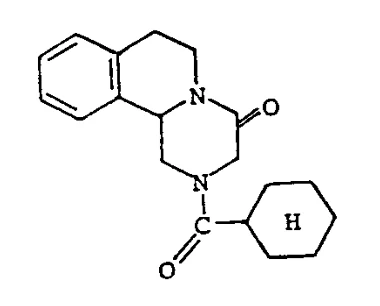 |
Table 7 – ED95-values of praziquantel (total dose in mg/kg) against schistosome species in 3 different rodent hosts
| Host Animal | Mouse | Mastomys | Syrian Hamster | ||||
|---|---|---|---|---|---|---|---|
| Schistosoma Species | S. mansoni | S. mansoni | S. mansoni | S. haematobium | S. japonicum | S. intercalatum | S. mattheei |
| Route, duration of treatment | |||||||
| 5 x p.o., 1 day | 479 | 411 | 469 | 500 a | 250 a | -- | -- |
| 3 x p.o., 1 day | 796 | 251 | 194 | >300 a | <100 a | <300 a | <150 a |
| 2 x p.o., 1 day | 1059 | 308 | 197 | >200 a | <100 a | -- | <200 a |
| 1 x p.o., 1 day | 685 | 278 | 249 | >250 a | 100 a | -- | -- |
| 3-10 x p.o., 1 day | 200 | 187 | 63 | 150 a | -- | >150 a | -- |
- a - estimated values
Praziquantel proved to be equally effective against all tested Schistosoma mansoni strains from different geographical areas and also against other trematode species such as the liver flukes Clonorchis sinensis and Opisthorchis viverrini.
Published data have demonstrated that the migrating juvenile stages of S. mansoni and S. japonicum, (schistosomulae) were less susceptible to treatment with praziquantel than adult forms.
16 NON-CLINICAL TOXICOLOGY
Acute Toxicity
The acute toxicity of BILTRICIDE (praziquantel) is low as demonstrated in uninfected mice, rats, and rabbits after oral application and in mice and rats after subcutaneous, intraperitoneal, and intramuscular injection. The acute toxicity for dogs could not be evaluated owing to the emetic effect of higher doses of the compound in this species.
Table 8 – Acute toxicity of praziquantel
| Route of Administration | Species | LD50 in mg/kg | |
|---|---|---|---|
| 1 Day | 7 and 14 Days | ||
| p.o. | Mouse | 2454 | 2454 |
| p.o. | Rat | 2976 | 2840 |
| p.o. | Rabbit | 1100 | 1050 |
| p.o. | Dog | > 200 | > 200 |
| s.c. | Mouse | 7268 | 7172 |
| s.c. | Rat | > 16000 | > 16000 |
| i.m. | Mouse | > 2000 | > 2000 |
| i.m. | Rat | > 1000 | > 1000 |
| i.p. | Rat | 796 | 796 |
In mice infected with Schistosoma mansoni, the acute toxicity of praziquantel was within the same range as found in healthy animals.
Praziquantel proved to be well tolerated in tests carried out in rabbits for primary skin tolerance and for mucosal tolerance in the eye. Furthermore, the substance showed no sensitizing effect in intracutaneous tests in guinea-pigs and in epicutaneous tests in man.
Long-Term Toxicity
In the four-week study in rats and dogs and a three-month study in dogs, the only consistent toxicities observed were enlarged liver and thyroid glands in rats (at 300 mg/kg/day and above), enlarged liver in dogs (180 mg/kg/day after 4 weeks of exposure) and increased absolute and relative liver weight (180 mg/kg/day after 3 months of exposure). These changes were not associated with abnormal findings in clinical chemistry or histopathological examination.
Carcinogenicity
Long-term carcinogenicity studies were conducted in Sprague-Dawley rats and golden hamsters. Praziquantel was not considered to be carcinogenic in rats. In hamsters, praziquantel might be considered to be a weak carcinogen based on a slight increase in percent malignant tumours in the female.
Reproductive and Developmental Toxicology
In reproduction tests with doses up to 40 times the human dose (300 mg/kg body weight/day), praziquantel had no effect either on the fertility of male and female rats or on the embryonal and fetal development of the offspring. Even with daily oral administration during organogenesis, praziquantel did not show any embryotoxic or teratogenic effects. An increase in the abortion rate was found in rats receiving three times the single human therapeutic dose.
Reproduction studies in rabbits at doses up to 40 times the human dose revealed no evidence of impaired fertility or harm to the fetus due to praziquantel.
Genotoxicity
Extensive studies in various test systems (both in vitro and in vivo) have yielded no evidence of mutagenicity. Mutagenic effects in Salmonella tests observed by one laboratory have not been confirmed in the same tested strain by other laboratories.