


Patient Medication Information: uses, side effects, how to take - Brevicon 0.5/35 Tablets (21-Day Pack)
Serious warnings and precautions box
What BREVICON is used for:
BREVICON is used for the prevention of pregnancy.
How BREVICON works:
BREVICON is a birth control pill (oral contraceptive) that contains two female sex hormones (ethinyl estradiol and norethindrone).
Combination hormonal contraceptives, like BREVICON work in two ways:
- To stop the monthly release of an egg by the ovaries.
- To change the mucus produced by your cervix. This slows the movement of the sperm through the mucus and through the uterus.
BREVICON has been shown to be highly effective in preventing pregnancy when taken as directed by your healthcare professional. The chance of becoming pregnant increases with incorrect use.
Effectiveness of Birth Control Pills
Combination birth control pills (like BREVICON) are more than 99 percent effective in preventing pregnancy when:
- The pill is TAKEN AS DIRECTED, and
- The amount of estrogen is 20 micrograms or more.
- Cigarette smoking increases the risk of serious adverse effects on the heart and blood vessels. This risk increases with age and becomes significant in oral contraception (OC) users over 35 years of age. You should not use birth control pills while smoking.
- Oral contraceptives do not protect against sexually transmitted infections (STIs) including HIV/AIDS. For protection against STIs, it is advisable to use latex condoms together with oral contraceptives.
A 99 percent effectiveness rate means that if 100 women used birth control pills for one year, one woman in the group would get pregnant.
Birth control pills (like BREVICON) may become less effective when:
- You miss taking tablets.
- You have vomiting or diarrhea.
- You take other medications that may interact with BREVICON.
Other Ways to Prevent Pregnancy
Other methods of birth control are available. They are usually less effective than birth control pills. If used properly, the other methods of birth control are effective enough for many women.
The following table lists pregnancy rates for different types of birth control, including no birth control. A pregnancy rate is the number of women out of 100 who would become pregnant in one year.
Reported Pregnancies per 100 Women per Year
| Combination pill | less than 1 to 3 |
| Intrauterine device (IUD) | less than 1 to 6 |
| Condom with spermicidal foam or gel | 1 to 6 |
| Mini-pill (progesterone-only pill) | 3 to 6 |
| Condom | 2 to 12 |
| Diaphragm with spermicidal foam or gel | 3 to 18 |
| Spermicide | 3 to 21 |
| Sponge with spermicide | 3 to 28 |
| Cervical cap with spermicide | 5 to 18 |
| Periodic abstinence (rhythm), all types | 2 to 20 |
| No birth control | 60 to 85 |
There are differences in these pregnancy rates. This is because not all people use birth control as carefully or as regularly as they should. This does not apply to IUDs since they are implanted in the uterus. If you are careful and use your birth control regularly, pregnancy rates should be lower. Regular users may achieve pregnancy rates in the lower ranges.
The effective use of birth control methods other than birth control pills and IUDs requires more effort than taking a single pill every day. It is an effort that many couples undertake successfully.
The ingredients in BREVICON are:
Medicinal ingredients: ethinyl estradiol and norethindrone.
Non-medicinal ingredients:
BREVICON 0.5/35 active tablets (pale blue): corn starch, FD&C Blue No. 2, lactose monohydrate, magnesium stearate, povidone.
BREVICON 1/35 active tablets (white): Corn starch, lactose monohydrate, magnesium stearate, povidone.
Inactive tablets (orange): FD&C Yellow No. 6 Lake, lactose CDL21, lactose monohydrate, magnesium stearate, microcrystalline cellulose.
BREVICON comes in the following dosage form(s):
BREVICON is available in 21-day or 28-day packs.
The BREVICON 0.5/35 21-day pack contains 21 pale blue active tablets (containing the 2 hormones norethindrone 0.5 mg and ethinyl estradiol 0.035 mg).
The BREVICON 0.5/35 28-day pack contains 21 pale blue active tablets (containing the 2 hormones norethindrone 0.5 mg and ethinyl estradiol 0.035 mg) and 7 orange inactive tablets (no hormones).
The BREVICON 1/35 21-day pack contains 21 white active tablets (containing the 2 hormones norethindrone 1 mg and ethinyl estradiol 0.035 mg).
The BREVICON 1/35 28-day pack contains 21 white active tablets (containing the 2 hormones norethindrone 1 mg and ethinyl estradiol 0.035 mg) and 7 orange inactive tablets (no hormones).
Do not use BREVICON if:
- You have or have had a blood clot in the legs (deep vein thrombosis), lung (pulmonary embolism), eyes or somewhere else in your body.
- You have or have had inflammation of a vein. This is called thrombophlebitis.
- You have or have had a stroke or a condition that may be a first sign of stroke (for example, mini-stroke).
- You have disease of the heart valves with complications.
- You have or have had an irregular heartbeat.
- You have or have had a heart disease, heart attack or chest pain.
- You have or have had jaundice, or liver problems, including tumors/cancer.
- You have or have had breast cancer, cancer of the endometrium (lining of the uterus), cancer of a sex organ, or a family history of it.
- You have or have had a tumour associated with use of estrogen containing products.
- You have or have had unusual bleeding from your vagina.
- You have or have had loss of vision due to a blood vessel disease of the eye.
- You are pregnant or think you may be pregnant.
- You have or have had migraines with visual and/or sensory disturbances. You may be at increased risk of having a stroke.
- You have diabetes or have high blood sugar levels.
- You have severe or uncontrolled high blood pressure.
- You have or have had an inflamed pancreas.
- You are allergic reaction to norethindrone, ethinyl estradiol or to any other ingredients in BREVICON or its container.
- You have or have had a condition that increases your risk for developing blood clots.
You have a blood clotting problem such as:
- Factor V Leiden mutation,
- Activated protein C (APC) resistance,
- Protein C deficiency,
- Protein S deficiency,
- Hyperhomocysteinemia,
- Prothrombin mutation G20210A,
- Antiphospholipid-antibodies.
- You have very high blood cholesterol or triglyceride levels.
- You are a smoker and over age 35.
- You had an injury or trauma, or are scheduled for major surgery.
- You have severe obesity (body mass index of 30 or more).
- You had prolonged bed rest, or immobility (for example long air travel).
- You have enlarged and twisted veins (varicose).
- You need a leg cast.
- You have not yet started to menstruate.
- You are in menopause.
- You are using medicines to treat Hepatitis C Virus (HCV) which contain combination of ombitasvir, paritaprevir, ritonavir and dasabuvir with or without ribavirin. Using these drugs at the same time as BREVICON can cause problems with your liver, such as an increase in the ALT liver enzyme. You must finish your hepatitis C treatment first before starting BREVICON. Your healthcare professional will tell you when to start, stop or restart BREVICON if you need to take these hepatitis C drugs.
The birth control pill is not suitable for every woman. In a small number of women, serious side effects may occur. Your healthcare professional can advise you if you have any conditions that would pose a risk to you. The use of the birth control pill always should be supervised by your healthcare professional.
To help avoid side effects and ensure proper use, talk to your healthcare professional before you take BREVICON. Talk about any health conditions or problems you may have, including if you:
- Are pregnant or breastfeeding.
- Have a history of jaundice or other liver problems.
- Have cholestasis. This is a condition where the bile flow from the liver is decreased.
- Have high blood pressure.
- Have migraines and headaches.
- Have diabetes or family history of diabetes.
- Wear contact lenses.
- Have or have had a family history of breast disease (e.g. breast lumps) or a family history of breast cancer.
- Have or have had fibroid tumours on the uterus.
- Have porphyria. This is a disease of blood pigment that is passed down in families (inherited).
- Have or have had Sydenham chorea (a condition that causes random, involuntary body movements).
- Have or have had herpes gestationis (a skin condition that may happen during pregnancy and shortly after childbirth).
- Have otosclerosis (a condition that causes loss of hearing).
- Have or have had a history of emotional disorders, especially depression.
- Have or have had metabolic or endocrine diseases and abnormal metabolism of calcium and phosphorus.
- Have or have had rheumatoid arthritis or synovitis.
- Have or have had hereditary or history of angioedema (episodes of swelling in body parts such as hands, feet, face, or airway passage).
- Have an abnormal level of fat in the blood stream (high cholesterol or triglycerides).
- Smoke cigarettes.
- Have or have had heart or kidney disease.
- Have or have had epilepsy/seizures.
- Have or have had gallbladder or pancreatic disease.
- Have or have had a family history of blood clots, heart attacks or strokes.
- Have or have had persistent irregular vaginal bleeding.
- Are overweight.
- Have or have had systemic lupus erythematosus (a condition where your body’s immune system attacks your tissues and organs).
- Have or have had inflammatory bowel disease such as Crohn’s disease or ulcerative colitis.
- Have or have had hemolytic uremic syndrome (a condition where blood vessels in your kidneys become damaged).
- Have sickle cell disease. This is a disease that affects hemoglobin, a molecule in red blood cells that delivers oxygen throughout the body.
- Have problems with the valves in your heart.
- Have an irregular heartbeat.
- Have hepatitis C.
- Have an allergy or intolerance to dairy products.
Other warnings you should know about:
Surgery
Be sure to tell your healthcare professional if you are scheduled for surgery or other medical treatment. You may need to stop using BREVICON four weeks before surgery. You may need to wait until after your first period following surgery before restarting BREVICON.
Check-ups and tests
BREVICON should be used only under the supervision of a healthcare professional, with regular check-ups to identify side effects related to its use. Your healthcare professional will conduct a physical exam. He or she will examine your breasts, abdomen, liver, arms and legs. They will conduct a pelvic exam, which includes a PAP smear. Your healthcare professional will also ask you some questions about your personal health history and that of your close relatives. He or she will also measure your blood pressure and do blood tests.
While you are taking BREVICON, you will need to have regular check-ups with your healthcare professional. Visit your healthcare professional about three months after starting BREVICON. Afterward, visit your healthcare professional about once a year. At these visits, your healthcare professional will conduct physical and internal exams. He or she will also measure your blood pressure and do blood tests. Use BREVICON only on the advice of your healthcare professional and carefully follow all directions given to you. You must use the birth control pill exactly as directed. If not you may become pregnant.
If you are scheduled for any laboratory tests, be sure to tell your healthcare professional that you are taking BREVICON. This is because birth control pills can affect some blood tests.
Vaginal Bleeding
Abnormal bleeding (breakthrough bleeding or spotting) may occur while you are taking birth control pills like BREVICON. This blood is coming from the vagina in between periods. This is most likely to happen in the first 3 months of starting a birth control pill. If this bleeding does not stop or begins again, you should tell your healthcare professional.
Missing periods
You may miss periods when taking hormonal birth control, even if you are not pregnant. However, if you are having regular periods and then do not have one, it is possible that you may be pregnant. If you were not taking BREVICON as directed by your healthcare professional, you should have a pregnancy test. This will rule out if the missed period is because you are pregnant.
Women with history of missing periods (amenorrhea) or have irregular or infrequent periods (oligomenorrhea) may continue to miss periods even after stopping the use of birth control pills like BREVICON.
Blood Clots in legs, lungs, heart, eyes or brain
Women who use birth control pills, like BREVICON, have a higher risk of developing blood clots. Blood clots are the most common serious side effect of birth control pills. Clots can occur in many areas of the body.
- In the brain, a clot can result in a stroke.
- In a blood vessel of the heart, a clot can result in a heart attack.
- In the legs and pelvis, a clot can break off and travel to the lung resulting in a condition called pulmonary embolus.
- In a blood vessel leading to an arm or leg, a clot can result in damage to or loss of a limb.
Any of these conditions can cause death or disability. Clots can also occur in the blood vessels of the eye, resulting in blindness or impaired vision.
Women who use birth control pills have a higher incidence of blood clots. While the risk of blood clots is greater with age, the increased risk from the pill appears to be present at all ages.
The risk of developing a blood clot seems to increase with higher estrogen doses. It is important, therefore, to use the lowest dose of estrogen as possible.
While you are taking BREVICON, if you have any of the below symptoms, contact your healthcare professional right away. These are signs of blood clots.
- Sharp pain in your chest.
- Coughing up blood.
- Sudden shortness of breath.
- Pain and / or swelling in your calf.
- Crushing chest pain or chest heaviness.
- Sudden severe or worsening headache.
- Vomiting.
- Dizziness.
- Fainting.
- Changes in vision.
- Changes in speech.
- Weakness or numbness in an arm or leg.
- Sudden pain, swelling and slight blue discoloration of an arm or leg.
Cancer
Using birth control pills may increases the risk of certain cancers including cancer of the breast, cervix and liver.
Breast Cancer
The risk of breast cancer in women increases as you get older. It also increases if there is family history of breast cancer, meaning if your mother or sister have or had breast cancer. Other factors that increase your risk for breast cancer are being obese, never having children, or having your first full-term pregnancy at a late age.
If you have breast cancer now, or had it in the past, do not use birth control pills. The hormones in these pills can affect some cancers.
Some women who use birth control pills may have a higher risk of developing breast cancer before menopause. These women may have used birth control pills for a long time (more than eight years) or may have started using birth control pills at an early age.
In a few women, using of birth control pills can speed up the growth of a breast cancer that has not yet been found. The risks for breast cancer related to using birth control pills seem to be small. You should have a healthcare professional check your breasts at least once per year, especially if:
- A history of breast cancer in the family.
- Breast nodules or thickenings.
- Discharge from the nipple.
While you are taking BREVICON, check your breasts often. See your healthcare professional if you notice any changes such as:
- Dimpling or sinking of the skin, • Changes in the nipple, or • Any lumps you can see or feel.
Talk to your healthcare professional for advice and instructions on how to self-examine your breasts. If you detect any new masses on your breasts while taking BREVICON you should talk to your healthcare professional.
Cervical cancer
Women who use birth control pills may have a higher chance of getting cervical cancer.
However, this may be due to other reasons including infection with the Human Papilloma Virus
(HPV). HPV is an important risk factor for cervical cancer. However, it is possible that oral birth control pills may also cause such cancers.
Liver cancer
Liver cancer (hepatocellular carcinoma) and liver tumours may be linked to oral birth control pills. The risk for liver cancer increases the longer these pills are used. However, liver tumours are extremely rare. If you feel severe abdominal pain or find a lump in your abdomen, contact your healthcare professional right away.
Pregnancy
Birth control pills should not be taken by pregnant women. This is because there may be risks of damaging the developing child. Tell your healthcare professional if you have symptoms of pregnancy such as morning sickness or unusual breast tenderness. Stop taking BREVICON if you get pregnant. You should check with your healthcare professional about risks to your unborn child from any medicines taken during pregnancy.
If you want to get pregnant talk to your healthcare professional before stopping BREVICON.
Pregnancy after stopping BREVICON
You will have a period when you stop taking birth control pills like BREVICON. You should delay pregnancy until another period occurs within four to six weeks. This will help to better date the pregnancy. Contact your healthcare professional for advice on other methods of birth control during this time.
Use after pregnancy, miscarriage or an abortion
Your healthcare professional will tell you when to start using BREVICON after childbirth, miscarriage or an abortion.
Breastfeeding
If you are breast-feeding, talk to your healthcare professional before starting BREVICON. The hormones in birth control pills like BREVICON are known to appear in breast milk. These hormones may reduce the flow of breast milk. The long-term effects on the developing child are not known. However, cases of breast enlargement have been reported in breast-fed infants. You should use another method of birth control and only consider starting BREVICON once you have stopped breastfeeding your child.
Gallbladder disease
Women who use birth control pills, like BREVICON, have a higher chance of developing gallbladder disease within the first year of use. This risk may double after four or five years of use.
Increase in epileptic seizures
If you are having seizures, stop taking BREVICON and talk to your healthcare professional.
There are also conditions that your healthcare professional will want to watch closely or that might cause your healthcare professional to recommend a method of birth control other than birth controls pills.
If you see a different healthcare professional, inform them that you are taking BREVICON.
Skin conditions
Chloasma may develop while you are using BREVICON. This appears as yellowish-brown patches on the skin, particularly of the face. It is more likely to happen if you have previously had chloasma gravidarum. This is when these patches appear on the skin of the face during pregnancy. This is commonly known as “the mask of pregnancy.”
If you have or had chloasma, avoid too much exposure to the sun while using BREVICON. Sunlight contains invisible rays (ultraviolet light) that can burn the skin.
Tell your healthcare professional about all the medicines you take, including any drugs, vitamins, minerals, natural supplements or alternative medicines.
The following may interact with BREVICON:
- Medicines used to treat epilepsy (anticonvulsants) such as carbamazepine, ethosuximide, felbamate, oxcarbazepine, phenobarbital, phenytoin, primidone, topiramate, lamotrigine, barbiturates).
- Antibiotics such as ampicillin, cotrimoxazole, penicillin, rifampin, chloramphenicol, metronidazole, neomycin, nitrofurantoin, sulfonamides, tetracyclines, troleandomycin, rifabutin.
- Medicines used to treat fungal infections (antifungals) such as griseofulvin, fluconazole.
- Medicines used to lower cholesterol such as clofibrate, atorvastatin.
- Medicines used to treat anxiety and sleeping disorders (sedatives and hypnotics such as benzodiazepines, barbiturates, chloral hydrate, glutethimide, meprobamate, chlordiazepoxide, lorazepam, oxazepam, diazepam.
- Medicines used to treat heartburn, indigestion or upset stomach (antacids).
- Medicines used to treat high blood pressure and attention deficit hyperactivity disorder (ADHD). (Alpha-II Adrenoreceptor Agents) such as clonidine.
- Medicines used to treat diabetes such as oral hypoglycemics and insulin.
- Medicines used to lower blood pressure (antihypertensive Agents) such as guanethidine, methyldopa and beta blockers.
- Medicines used to treat fevers (antipyretics) such as acetaminophen, antipyrine, acetylsalicylic acid (ASA).
- Medicines used to inhibit contractions of the uterus (betamimetic agents) such as isoproterenol.
- Medicines used to treat inflammation (corticosteroids) such as prednisone, dexamethasone.
- Medicines used to treat mental and emotional disorders (phenothiazine tranquilizers) including all phenothiazines, reserpine and similar drugs.
- Medicines used to treat human immunodeficiency virus (HIV) infection such as ritonavir, indinavir, nevirapine.
- Medicines used to treat Hepatitis C virus (HCV) infection such asboceprevir, telaprevir, ombitasvir, paritaprevir, ritonavir and dasabuvir, with or without ribavirin.
- Medicines used to relax the muscles in longs and widen airways (bronchodilator) such as theophylline.
- Stimulants such as modafinil.
- Medicines used to treat depression (tricyclic antidepressants) such as clomipramine.
- Medicine used to treat high blood pressure in the lungs called bosentan.
- Phenylbutazone, a medicine used to relieve pain and reduce inflammation.
- Medicines used to treat allergies (antihistamines).
- Medicines used to relieve pain (analgesics).
- Medicines used to treat migraines (antimigraine preparations).
- Medicines used to help prevent blood clots (anticoagulants).
- Aminocaproic acid, a medicine used to manage and treat bleeding disorders.
- Vitamin E, vitamin B12, and vitamin C.
- Cyclosporine, a medicine used to prevent organ rejection in patients who have received an organ transplant.
- Folic acid, a herbal product used for healthy cell growth and function.
- Meperidine, a medicine used to relieve pain.
- St. John’s Wort, an herbal product used to treat depression and other conditions.
- Flunarizine, a medicine used to treat migraines.
The effects of caffeine and alcohol may also be increased. This is because birth control pills affect how these are metabolized.
When using BREVICON with products that may affect its effectiveness, it is recommended that you use a non-hormonal back-up method of birth control in addition to BREVICON. In the case of prolonged use of such products, birth control pills, like BREVICON, should not be considered the main contraceptive. Talk to your healthcare professional for guidance if you are taking medicines that interact with BREVICON.
This is not a complete list of possible drug interactions with BREVICON. Talk to your healthcare professional for more information about drug interactions.
How to take BREVICON:
Be sure to read these instructions;
- Before you start taking BREVICON, and
- Any time you are not sure what to do.
- Look at your pill pack to see if it has 21 or 28 pills:
- 21-PILL PACK: 21 active pills (with hormones) taken daily for 3 weeks, and then no pills for 1 week.
OR
- 28-PILL PACK: 21 active pills (with hormones) taken daily for 3 weeks, and then 7 inactive “reminder” pills (no hormones) taken daily for 1 week.
Note: Pictures below apply to both BREVICON 0.5/35 and BREVICON 1/35.
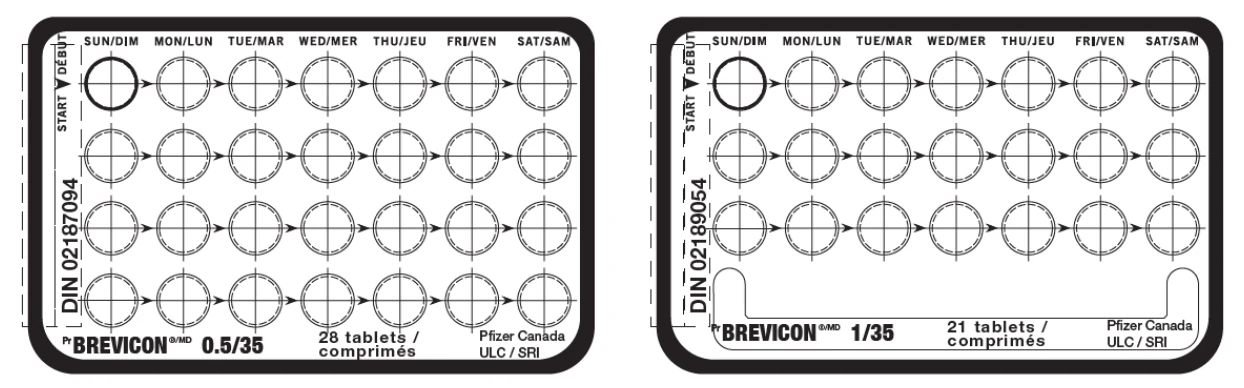
- 2. Use a second method of birth control (e.g. latex condoms and spermicidale) for the first 7 days of the first cycle of pill use. This will provide a back-up in case pills are forgotten while you are getting used to taking them.
- 3.
Decide with your healthcare professional what is the best day and time for you to start taking your pill. Pick a time of day that will be easy to remember. It is important to take it at the same time every day and in the order as directed on pack. Your pills may be either a 21-day or a 28-day type.
Note:
The pack is pre-printed with Sunday as the starting day. If starting on a day other than Sunday, you should use the provided Flexi-start sticker labels provided to correctly mark the starting date.
Choose the label for the appropriate starting day and apply it over the pre-printed days on top of the card.
When to start the first pack of BREVICON pills:
- 21-day combination:
With this type of birth control pill, you are on pills for 21 days and off pills for 7 days. You must not be off the pills for more than 7 days in a row.
- The first day of your period (bleeding) is Day 1 of your cycle. Your healthcare professional may advise you to start taking the pills on Day 1, on Day 5, or on the first Sunday after your period begins. If your period starts on Sunday, start that same day.
- Take 1 pill at approximately the same time every day for 21 days. Then take no pills for 7 days. Start a new pack on the 8th day. You will probably have a period during the 7 days off the pill. (This bleeding may be lighter and shorter than your usual period).
- 28-day combination
With this type of birth control pill, you take 21 pills that contain hormones and 7 pills that contain no hormones.
- The first day of your period (bleeding) is Day 1 of your cycle. Your healthcare professional may advise you to start taking the pills on Day 1, on Day 5, or on the first Sunday after your period begins. If your period starts on Sunday, start that same day.
- Take 1 pill at approximately the same time every day for 28 days. Begin a new pack the next day, not missing any days. Your period should occur during the last 7 days of using the pills
What to do during the month
Take a pill at approximately the same time every day until the pack is empty.
- Try to associate taking your pill with some regular activity such as eating a meal or going to bed.
- Do not skip pills or days even if you feel sick to your stomach or bleeding between monthly periods. Tell your healthcare professional if this feeling does not go away.
- Do not skip pills even if you do not have sex very often.
- There is no need to stop taking birth control pills for a rest period.
- When you first start taking BREVICON, spotting or light bleeding in between your periods may occur. Talk to your healthcare professional if this does not go away after a few months.
- When receiving any medical treatment, be sure to tell your healthcare professional that you are using birth control pills.
- Keep a calendar to track your period.
When you finish a pack
- 21 Pills: Wait 7 days to start the next pack. You will have your period during that week.
- 28 Pills: Start the next pack on the next day. Take 1 pill every day. Do not wait any days between packs.
If your questions are not answered here, talk to your healthcare professional
Usual dose:
Take 1 tablet per day.
Overdose:
Numerous cases of the ingestion, by children, of estrogen progestogen combinations have been reported. Although mild nausea may occur in case of overdosage, there appears to be no other reaction.
If you think you, or a person you are caring for, have taken too much BREVICON, contact a healthcare professional, hospital emergency department, regional poison control centre or Health Canada’s toll-free number, 1-844 POISON-X (1-844-764-7669) immediately, even if there are no signs or symptoms.
Missed dose:
If you miss pills at any time, you could get pregnant. The greatest risks for pregnancy are when you start a pack late, or when you miss pills at the beginning or at the very end of the pack.
Missing pills also can cause some spotting or light bleeding, even if you make up the missed pills. You also could feel a little sick to your stomach on the days you take two pills to make up for missed pills.
The following outlines the actions you should take if you miss one or more of your birth control pills. Match the number of pills missed with the appropriate starting time for your type of pill pack.
| SUNDAY START | |
|---|---|
| If you miss 1 pill |
|
| If you miss 2 pills in a row | First two Weeks:
Third Week:
|
| IF YOU MISS 2 PERIODS IN A ROW, talk to your healthcare professional. | |
| If you miss 3 or more pills in a row | Anytime in the Cycle:
IF YOU MISS 2 PERIODS IN A ROW, talk to your healthcare professional. |
| OTHER THAN SUNDAY START | |
|---|---|
| If you miss 1 pill |
|
| If you miss 2 pills in a row | First two Weeks:
Third Week:
IF YOU MISS 2 PERIODS IN A ROW, talk to your healthcare professional. |
| If you miss 3 or more pills in a row | Anytime in the Cycle:
|
| IF YOU MISS 2 PERIODS IN A ROW, talk to your healthcare professional. | |
NOTE: 28-DAY PACK: If you forget any of the seven inactive "reminder" pills (without hormones) in Week 4, just safely dispose of the pills you missed. Then keep taking one pill each day until the pack is empty. You do not need to use a back-up method.
Always be sure you have on hand:
- A back-up method of birth control (such as latex condoms and spermicidale) in case you miss pills, and
- An extra, full pack of pills.
If you forget more than 1 pill 2 months in a row, talk to your healthcare professional. They will suggest ways to make pill-taking easier or about using another method of birth control.
If you experience vomiting or diarrhea, or if you take certain medicines, such as antibiotics, you pills may not work as well. Use a back-up method, such as latex condoms and spermicide, until you can talk to your healthcare professional.
Possible side effects from using BREVICON:
These are not all the possible side effects you may have when taking BREVICON. If you experience any side effects not listed here, tell your healthcare professional.
- Abdominal pain.
- Nausea and vomiting.
- Weight change.
- Change in appetite.
- High or low blood pressure.
- Growth of pre-existing fibroid tumours of the uterus.
- Increased blood sugar levels.
- Hirsutism.
- Changes in libido (increase or decrease).
- Abnormal cervical (Pap) smear.
- Painful period cramps.
- Vaginal infection.
- Difficult or painful urination, blood in the urine.
- Flu-like symptoms.
- Acne.
- Breast tenderness, pain, swelling.
- Anxiety.
- Headache, dizziness, irritability.
- Migraines.
- Skin pigmentation.
- Changes or loss of hearing.
- Cloudy vision, sore eyes.
- Rash.
- Feeling bloated and gassy.
Serious side effects and what to do about them
| Frequency/Side Effect/Symptom | Talk to your healthcare professional | Stop taking this drug and get immediate medical help | |
|---|---|---|---|
| Frequency/Side Effect/Symptom | Talk to your healthcare professional | Stop taking this drug and get immediate medical help | |
| Only if severe | In all cases | ||
| Only if severe | In all cases | ||
| Uncommon | |||
Hypersensitivity (Allergic Reaction): difficulty swallowing or breathing, wheezing; drop in blood pressure; feeling sick to your stomach and throwing up; hives or rash; swelling of the face, lips, tongue or throat | √ | ||
Pulmonary embolism (Blood clot in the lung): Sharp pain in the chest, coughing blood, or sudden shortness of breath | √ | ||
Deep vein thrombosis (blood clot in the legs) or Thrombophlebitis (inflammation of a vein often in the leg): sudden leg swelling or pain; redness, warmth, tenderness and pain in affected area | √ | ||
Arterial thromboembolism, Myocardial infarction (blood clot in the artery, heart attack): sudden pain, discomfort, pressure, heaviness, sensation of squeezing or fullness in the shoulder, chest, arm, or below the breastbone; discomfort radiating to the back, jaw, throat, arm, stomach, feeling of being full, having indigestion or choking; sweating, nausea, vomiting or dizziness; extreme weakness, anxiety, or shortness of breath; rapid or irregular heartbeats | √ | ||
| Stroke: Sudden severe or worsening headache or vomiting, dizziness or fainting, disturbance of vision or speech, or weakness or | √ | ||
| numbness in an arm or leg, or numbness in the face | |||
| Blood clot in the eye: Sudden partial or complete loss of vision, double vision | √ | ||
| Tumour in the liver: Severe pain or lump in the abdomen | √ | ||
Depression: persistent sad mood accompanied by difficulty in sleeping, weakness, lack of energy, fatigue | √ | ||
Jaundice: Yellowing of the skin or eyeballs, accompanied frequently by fever, fatigue, loss of appetite, dark-coloured urine, or light-coloured bowel movements | √ | ||
Neuro-ocular lesions (damaged eye nerves): blurred vision, sudden complete or partial loss of vision in eye, eye pain | √ | ||
| Unexpected (abnormal) vaginal bleeding | √ | ||
| Unusual swelling of the arms and legs | √ | ||
| Breast lumps | √ | ||
| Crohn’s Disease or Ulcerative Colitis: Cramps and bloating, diarrhea | √ | ||
| Inflammation of the Pancreas: Abdominal pain that lasts and gets worse when you lie down, nausea, vomiting | √ | ||
| Lupus: A combination of fever, muscle or joint pain, and general fatigue and feeling unwell and memory changes. | √ | ||
| Raynaud's phenomenon: Pain, numbness change in colour, and feeling cold in the hands and feet. | √ | ||
If you have a troublesome symptom or side effect that is not listed here or becomes bad enough to interfere with your daily activities, tell your healthcare professional.
Reporting side effects
You can report any suspected side effects associated with the use of health products to Health Canada by:
- Visiting the Web page on Adverse Reaction Reporting (canada.ca/drug-device-reporting) for information on how to report online, by mail or by fax; or
- Calling toll-free at 1-866-234-2345.
NOTE: Contact your healthcare professional if you need information about how to manage your side effects. The Canada Vigilance Program does not provide medical advice.
Storage:
Store BREVICON between 15°C and 25°C.
Keep out of reach and sight of children.
If you want more information about BREVICON:
- Talk to your healthcare professional.
- Find the full product monograph that is prepared for healthcare professionals and includes this Patient Medication Information by visiting the Health Canada Drug Product Database website (https://www.canada.ca/en/health-canada/services/drugs-health-products/drug-products/drug-product-database.html); the manufacturer’s website http://www.pfizer.ca, or by calling 1-800-463-6001.
Date of Authorization: 2025-08-07