


Product Monograph - Burinex
Recent Major Label Changes
| 3 Serious Warnings and Precautions Box | 2026-03 |
|---|---|
| 7 Warnings and Precautions, Skin | 2026-03 |
Table of Contents
Certain sections or subsections that are not applicable at the time of the preparation of the most recent authorized product monograph are not listed.
Recent Major Label Changes ................................................................................................. 2
Table of Contents ................................................................................................................. 2
Part 1: Healthcare Professional Information.......................................................................... 5
- 1.
Indications..................................................................................................................... 5
1.1. Pediatrics .................................................................................................................... 5
1.2. Geriatrics .................................................................................................................... 5
- 2. Contraindications .......................................................................................................... 5
- 3. Serious Warnings and Precautions Box ........................................................................... 5
- 4.
Dosage and Administration ............................................................................................ 6
4.1. Dosing Considerations ............................................................................................... 6
4.2. Recommended Dose and Dosage Adjustment .......................................................... 6
4.4. Administration ........................................................................................................... 6
4.5. Missed Dose ............................................................................................................... 6
- 5. Overdose ....................................................................................................................... 6
- 6. Dosage Forms, Strengths, Composition, and Packaging .................................................. 7
- 7.
Warnings and Precautions ............................................................................................. 7
General ................................................................................................................................... 7
Driving and Operating Machinery .......................................................................................... 7
Ear/Nose/Throat ..................................................................................................................... 7
Endocrine and Metabolism .................................................................................................... 8
Gastrointestinal ...................................................................................................................... 8
Hepatic/Biliary/Pancreatic ..................................................................................................... 8
Immune .................................................................................................................................. 8
Monitoring and Laboratory Tests ........................................................................................... 8
Renal ....................................................................................................................................... 9
Reproductive Health ............................................................................................................... 9
Skin ......................................................................................................................................... 9
7.1. Special Populations .................................................................................................... 9
7.1.1. Pregnancy ........................................................................................................... 9
7.1.2. Breastfeeding ..................................................................................................... 9
7.1.3. Pediatrics ............................................................................................................ 9
7.1.4. Geriatrics ............................................................................................................ 9
- 8.
Adverse Reactions ....................................................................................................... 10
8.1. Adverse Reaction Overview ..................................................................................... 10
8.2. Clinical Trial Adverse Reactions ............................................................................... 10
8.2.1. Clinical Trial Adverse Reactions – Pediatrics.................................................... 10
8.3. Less Common Clinical Trial Adverse Reactions ........................................................ 10
8.3.1. Less Common Clinical Trial Adverse Reactions – Pediatrics ............................ 11
8.4. Abnormal Laboratory Findings: Hematologic, Clinical Chemistry, and Other Quantitative Data ................................................................................................................. 11
8.5. Post-Market Adverse Reactions ............................................................................... 11
- 9.
Drug Interactions ......................................................................................................... 12
9.3. Drug-Behaviour Interactions .................................................................................... 12
9.4. Drug-Drug Interactions ............................................................................................ 12
9.5. Drug-Food Interactions ............................................................................................ 13
9.6. Drug-Herb Interactions ............................................................................................ 13
9.7. Drug-Laboratory Test Interactions........................................................................... 14
- 10.
Clinical Pharmacology .................................................................................................. 14
10.1. Mechanism of Action ............................................................................................... 14
10.2. Pharmacodynamics .................................................................................................. 14
10.3. Pharmacokinetics ..................................................................................................... 14
- 11. Storage, Stability, and Disposal .................................................................................... 14
Part 2: Scientific Information .............................................................................................. 16
- 13. Pharmaceutical Information ........................................................................................ 16
- 14.
Clinical Trials ............................................................................................................... 16
14.2. Comparative Bioavailability Studies ........................................................................ 16
- 16. Non-Clinical Toxicology ................................................................................................ 17
Patient Medication Information ......................................................................................... 20
Part 1: Healthcare Professional Information
1. Indications
BURINEX (bumetanide) is indicated for:
- The treatment of edema associated with congestive heart failure, cirrhosis of the liver and renal disease including the nephrotic syndrome.
1.1. Pediatrics
Pediatrics (<18 years): No data are available to Health Canada; therefore, Health Canada has not authorized an indication for pediatric use.
1.2. Geriatrics
Geriatrics (> 65 years of age): No data are available to Health Canada; therefore, Health Canada has not authorized an indication for geriatric use.
2. Contraindications
BURINEX is contraindicated in patients who are hypersensitive to this drug, other sulfonamide derivatives or to any ingredient in the formulation, including any non-medicinal ingredient, or component of the container. For a complete listing, see 6 Dosage Forms, Strengths, Composition and Packaging
- Anuria
- Hepatic encephalopathy including coma
- Severe electrolyte depletion
- Galactose intolerance, Lapp lactase deficiency, glucose-galactose malabsorption
3. Serious Warnings and Precautions Box
- Toxic epidermal necrolysis (TEN) and Stevens-Johnson syndrome (SJS), which can be life-threatening or fatal, have been reported in relation to non-antibiotic sulphonamide containing products, including BURINEX. Patients should be advised of the signs and symptoms of SJS and TEN. If SJS or TEN is suspected, BURINEX should be withdrawn immediately. If the patient has developed SJS or TEN, treatment with BURINEX must not be restarted in this patient at any time. See 7 Warnings and Precautions for more detailed information.
- BURINEX is a potent diuretic which, if given in excessive amounts, can lead to profound diuresis with water and electrolyte depletion. Therefore, careful medical supervision is required and dose and dosage schedule have to be adjusted to the individual patient's needs (see 4 Dosage and Administration).
4. Dosage and Administration
4.1. Dosing Considerations
- Dosage should be individualized with careful monitoring of patient response
- In patients with hepatic failure the dosage should be kept to a minimum, and if necessary, dosage increased very carefully. A maintenance dose as low as 0.5 mg daily should be considered and the daily dose should not exceed 5 mg. (See 7 Warnings and Precautions)
4.2. Recommended Dose and Dosage Adjustment
The usual total oral daily dosage of BURINEX is 0.5 to 2.0 mg and in most patients may be given as a single dose.
If the diuretic response to an initial 1 mg dose of BURINEX is not adequate, a second or third dose may be given at 4 to 5 hour intervals. The maximum recommended daily dose is 10 mg.
Health Canada has not authorized an indication for pediatric use.
4.4. Administration
An intermittent dose schedule, whereby BURINEX is given on alternate days or for 3 to 4 days with rest periods of 1 to 2 days in between, is recommended as the safest and most effective method for the continued control of edema.
4.5. Missed Dose
If a dose was missed, it should be taken as soon as the patient remembers. If the next dose is due in less than four hours that dose should be omitted and the next dose taken at the usual time. A dose should not be doubled to make up for a missed dose.
5. Overdose
Symptoms
Symptoms of electrolyte imbalance include dry mouth, thirst, weakness, lethargy, drowsiness, confusion, gastrointestinal disturbances, restlessness, muscle pain and cramps and seizures.
Profound water loss and electrolyte depletion, dehydration, reduction of blood volume and circulatory collapse with a possibility of vascular thrombosis and embolism.
Treatment
Discontinue the drug. Treatment is by water and/or electrolyte replacement.
For the most recent information in the management of a suspected drug overdose, contact your regional poison control centre or Health Canada’s toll-free number, 1-844 POISON-X (1-844-764-7669).
- 6. Dosage Forms, Strengths, Composition, and Packaging
Table 1 – Dosage Forms, Strengths, and Composition
Description
Tablets 1 mg: White, flat, circular (8 mm), uncoated, bevelled edge tablet, marked on one face with a score line and the number 133. Blister pack of 30 tablets.
Tablets 5 mg: White, flat, circular (10 mm), uncoated bevelled edge tablet marked with a score line and “5 mg” on one face. Blister pack of 30 tablets.
7. Warnings and Precautions
See 3 Serious Warnings and Precautions Box.
General
The dose of BURINEX should be adjusted to patient's need. Excessive doses or too frequent administration can lead to profound water loss, electrolyte depletion, dehydration, reduction in blood volume and circulatory collapse with a possibility of vascular thrombosis and embolism, particularly in elderly patients.
Patients under treatment should be observed regularly for possible occurrence of blood dyscrasias, liver damage, or idiosyncratic reactions which have been reported rarely in foreign marketing experience.
Cardiovascular
If you have hypotension, the dosage of BURINEX should be reduced or the drug stopped.
Dope Tests
BURINEX is banned for use in sports. Taking BURINEX will lead to disqualification for athletes. This drug can be detected in the urine during routine dope testing.
Driving and Operating Machinery
BURINEX has no or negligible direct influence on the ability to drive and use machines. However, the patient should be informed that dizziness may occur during treatment and take this into account while driving or using machines.
Ear/Nose/Throat
The potential for ototoxicity with the use of BURINEX exists, particularly with at high treatment doses,
| Route of Administration | Dosage Form/ Strength/Composition | Non-Medicinal Ingredients |
| oral | tablet 1 mg, 5 mg | Agar, Colloidal Anhydrous Silica, Lactose, Magnesium stearate, Maize starch, Microcrystalline cellulose, Polysorbate 80, Povidone, Talc |
or repeated use in patients with severe renal impairment. The ototoxic effects of aminoglycosides may be increased by concomitant administration of potent diuretics such as BURINEX. (see 9.4 Drug-Drug Interactions).
Endocrine and Metabolism
Hypokalemia can occur as a consequence of BURINEX administration. Prevention of hypokalemia requires particular attention in the following conditions: patients receiving digitalis and diuretics for congestive heart failure, hepatic cirrhosis and ascites, states of aldosterone excess with normal renal function, potassium-losing nephropathy, certain diarrheal states, or other states where hypokalemia is thought to represent particular added risks to the patient, (i.e.) history of ventricular arrhythmias.
Since rigid sodium restriction is conducive to both hyponatremia and hypokalemia, such restriction is not advisable in patients on BURINEX therapy.
Administration of proton pump inhibitors has been associated with development of hypomagnesaemia. Hypomagnesaemia may be exacerbated with co-administration of BURINEX, therefore magnesium levels should be measured before and periodically when this combination is used.
Electrolyte disturbances can occur especially during long term treatment.
Studies in normal subjects receiving BURINEX revealed no adverse effects on glucose tolerance, plasma insulin, glucagon and growth hormone levels but the possibility of an effect on glucose metabolism exists. Periodic monitoring of urine and blood glucose should be made in diabetics and patients suspected of latent diabetes.
Gastrointestinal
BURINEX tablets contains lactose as an excipient and patients with rare hereditary problems of galactose intolerance, the Lapp lactase deficiency or glucose-galactose malabsorption should not take this medicinal product (see, 2 Contraindications).
Hepatic/Biliary/Pancreatic
In patients with hepatic cirrhosis and ascites, sudden alterations of electrolyte balance may precipitate hepatic encephalopathy and coma.
Therefore, strict observation is necessary during the period of diuresis. Supplemental potassium chloride and, if required, an aldosterone antagonist is helpful in preventing hypokalemia and metabolic alkalosis.
Caution is advised if BURINEX is to be administered to patients with severe hepatic impairment.
Immune
If known hypersensitivity to sulphonamides there may be a potential risk of hypersensitivity to BURINEX (see, 2 Contraindications).
Monitoring and Laboratory Tests
Serum electrolyte determination should be performed frequently.
Serum potassium concentrations should be monitored regularly and potassium supplements or potassium sparing diuretics may be required especially when high doses are used for prolonged periods. Particular caution with potassium concentration is necessary in patients receiving digitalis glycosides or potassium depleting steroids. Periodic determination of other electrolytes is also advised, particularly in patients on low salt diets.
Electrolyte and fluid imbalance may occur and replacement therapy should be instituted where indicated to avoid any risk of electrolyte depletion, hypovolemia or hypotension.
Renal
BURINEX may increase urinary calcium excretion with resultant hypocalcemia.
Reversible elevation of BUN and creatinine may occur, especially in association with dehydration and in patients with renal insufficiency. Marked increases in BUN and creatinine or the development of oliguria during treatment of patients with progressive renal disease is an indication for discontinuation.
BURINEX may cause an increase in blood uric acid.
BURINEX should be used with caution in patients with potential obstruction of the urinary tract.
Reproductive Health
Fertility
There are no clinical studies with BURINEX regarding fertility.
Skin
Severe cutaneous adverse reactions (SCARs), including Stevens-Johnson syndrome (SJS), toxic epidermal necrolysis (TEN), have been reported in association with BURINEX.
7.1. Special Populations
7.1.1. Pregnancy
BURINEX may cause harmful pharmacological effects during pregnancy, to the foetus or to the newborn child. BURINEX should not be used during pregnancy unless the clinical condition of the woman requires treatment with BURINEX. It may be used only in case of heart failure when the potential benefit justifies the potential risk to the foetus.
7.1.2. Breastfeeding
Since BURINEX passes into the breast milk, the drug should not be used during breast-feeding.
7.1.3. Pediatrics
Pediatrics (18 years of age): No data are available to Health Canada; therefore, Health Canada has not authorized an indication for pediatric use.
7.1.4. Geriatrics
Geriatrics (> 65 years of age): No data are available to Health Canada; therefore, Health Canada has not authorized an indication for geriatric use.
8. Adverse Reactions
8.1. Adverse Reaction Overview
The most frequently reported adverse reactions during treatment are headache and electrolyte imbalance (including hypokalaemia, hyponatraemia, hypochloraemia and hyperkalaemia) occurring in approximately 4% of the patients, followed by dizziness (including orthostatic hypotension and vertigo), fatigue occurring in approximately 3% of patients and muscle cramps (>1%).
8.2. Clinical Trial Adverse Reactions
Clinical trials are conducted under very specific conditions. Therefore, the frequencies of adverse reactions observed in the clinical trials may not reflect frequencies observed in clinical practice and should not be compared to frequencies reported in clinical trials of another drug.
Table 2 – Adverse Drug Reactions Occurring in ≥ 1% of Patients
| System organ class/preferred term | BURINEX n = 369 |
| Gastrointestinal Disorders | Nausea, Abdominal pain |
| General disorders and administration site conditions | Oedema peripheral |
| Metabolism and nutrition disorders | Electrolyte imbalance (including hypokalaemia, hyponatraemia, hypochloraemia and hyperkalaemia) |
| Musculoskeletal and connective tissue disorders | Muscle cramps |
| Nervous system disorders | Dizziness |
| Renal and urinary disorders | Micturition disorder |
| Respiratory, thoracic and mediastinal disorders | Dyspnoea |
8.2.1. Clinical Trial Adverse Reactions – Pediatrics
The safety profile of BURINEX has not been established in the pediatric population.
8.3. Less Common Clinical Trial Adverse Reactions
Ear and labyrinth disorders: Impaired hearing, ear discomfort
Gastrointestinal disorders: Abdominal pain, vomiting, diarrhoea, constipation, dry mouth, upset stomach
General disorders and administration site conditions: Chest pain, malaise/weakness, thirst, fatigue, sweating
Investigations: Electrocardiogram changes
Metabolism and nutrition disorders: Gout, dehydration
Musculoskeletal and connective tissue disorders: Arthralgia, musculoskeletal pain, muscle spasms
Nervous system disorders: Headache, encephalopathy (in patients with pre-existing liver disease), vertigo, asterixis
Renal and urinary disorders: renal failure
Reproductive system and breast disorders: nipple tenderness, premature ejaculation and difficulty maintaining an erection
Respiratory, thoracic and mediastinal disorders: Cough, hyperventilation
Skin and subcutaneous tissue disorders: Pruritus, urticaria (hives), rash, sweating
Vascular disorders: Hypotension
8.3.1. Less Common Clinical Trial Adverse Reactions – Pediatrics
The safety profile of BURINEX has not been established in the pediatric population.
8.4. Abnormal Laboratory Findings: Hematologic, Clinical Chemistry, and Other Quantitative Data
Clinical Trial Findings
Laboratory abnormalities reported have included hyperuricemia (18.4%), hypochloremia (14.9%), hypokalemia (14.7%), azotemia (10.6%), hyponatremia (9.2%), increased serum creatinine (7.4%), hyperglycemia (6.6%), and variations in phosphorus (4.5%), CO2 content (4.3%), bicarbonate (3.1%) and calcium (2.4%). Although manifestations of the pharmacologic action of BURINEX these conditions may become more pronounced by intensive therapy.
Diuresis induced by BURINEX may also rarely be accompanied by changes in LDH (1.0%), total serum bilirubin (0.8%), serum proteins (0.7%), SGOT (0.6%), SGPT (0.5%), alkaline phosphatase (0.4%), cholesterol (0.4%) and creatinine clearance (0.3%). Also reported have been thrombocytopenia (0.2%) deviations in hemoglobin (0.8%), prothrombin time (0.8%), hematocrit (0.6%), WBC (0.3%), platelet counts (0.2%) and differential counts (0.1%). Increases in urinary glucose (0.7%) and urinary protein (0.3%) have also been seen.
8.5. Post-Market Adverse Reactions
- : Bone marrow failure and pancytopenia, thrombocytopenia, leukopenia including neutropenia, anaemia
- : Chest discomfort
- : Abdominal discomfort
- : Glucose metabolism disorder and hyperuricaemia
- : Myalgia
- : Fatigue (including lethargy, somnolence, asthenia), syncope
- : Renal impairment
- : Rash (various types of rash reactions such as erythematous, maculo-papular and pustular have been reported), dermatitis and eczema, photosensitivity. Severe cutaneous adverse reactions (SCARs), including Stevens-Johnson syndrome (SJS), toxic epidermal necrolysis (TEN), have been reported in association with BURINEX. The frequency is not known (cannot be estimated from the available data).
9. Drug Interactions
9.3. Drug-Behaviour Interactions
The interaction of BURINEX with individual behavioural risks (e.g. cigarette smoking, cannabis use, and/or alcohol consumption) has not been studied.
9.4. Drug-Drug Interactions
The drugs listed in this table are based on either drug interaction case reports or studies, or potential interactions due to the expected magnitude and seriousness of the interaction (i.e., those identified as contraindicated).
Table 3 – Established or Potential Drug-Drug Interactions
| Non-proprietary name(s) of the drug product(s) | Source of evidence | Effect | Clinical comment |
| Digitalis glycosides | C | Hypokalaemia increases the sensitivity to digitalis glycosides which might result in digitalis toxicity (nausea, vomiting, and arrhythmias). | Potassium level and signs for digitalis toxicity should be monitored. Potassium supplementation and lower digitalis glycoside dose should be considered. |
| Non-depolarising neuromuscular blocking agents | C | Hypokalaemia increases the sensitivity to non-depolarising neuromuscular blocking agents. | Use with caution. |
| Lithium | C | BURINEX reduces lithium clearance resulting in high serum levels of lithium. | Lithium should generally not be given with diuretics such as BURINEX. Concomitant therapy requires close monitoring of serum lithium levels. Lower lithium doses may be required. |
| Antiarrhythmics | C | Concomitant use of BURINEX and class III antiarrhythmic drugs may result in increased risk of electrolyte imbalance and subsequent cardiotoxicity (QT prolongation, torsades de pointes, cardiac arrest). | Patients’ electrolyte levels should be monitored as should symptoms of arrhythmias. |
| Probenecid | T | Probenecid inhibits the renal tubular secretion of bumetanide leading to a diminished natriuresis. | Use with caution. |
| NSAIDs | C | BURINEX may enhance the nephrotoxicity of | The effects of concurrent use should be monitored (e.g. blood pressure, signs of renal failure). |
| Anti-hypertensive agents and medicinal products inducing postural hypotension | C | BURINEX may potentiate the effect of anti-hypertensive agents including diuretics and drugs inducing postural hypotension (e.g. tricyclic antidepressants). | First-dose hypotension may occur. |
| Potassium depleting agents | C | The potassium depleting effect of BURINEX may be increased by other potassium depleting agents. | Simultaneous administration should generally be avoided especially in patients with impaired renal function |
| Aminoglycosides | C | BURINEX may enhance the nephrotoxicity of aminoglycosides. The ototoxic effects of aminoglycosides may be increased by concomitant administration of potent diuretics such as BURINEX. | Use with caution. |
Legend: C = Case Study; T = Theoretical
9.5. Drug-Food Interactions
Interactions with food have not been established.
9.6. Drug-Herb Interactions
Interactions with herbal products have not been established.
9.7. Drug-Laboratory Test Interactions
Interactions with laboratory tests have not been established.
10. Clinical Pharmacology
10.1. Mechanism of Action
BURINEX is a loop diuretic. The diuretic effect of BURINEX results largely from the inhibition of sodium reabsorption in the ascending limb of the loop of Henle. This is shown by a marked reduction in freewater clearance during hydration and tubular solute-free water reabsorption during hydropenia.
10.2. Pharmacodynamics
BURINEX may have an additional action in the proximal tubule, since phosphaturia has been observed during BURINEX induced diuresis and the renal clearance of BURINEX is decreased by probenecid. The proximal tubular activity does not seem to be related to an inhibition of carbonic anhydrase. Potassium excretion is increased by BURINEX in a dose-related fashion.
Pharmacological and clinical studies have shown that 1 mg BURINEX produces a diuretic response similar to that of approximately 40 mg furosemide.
10.3. Pharmacokinetics
Animal
In the dog, bumetanide causes a marked increase in urine flow without significant alterations in urine osmolality. It enhances excretion of sodium, chloride and potassium at oral doses as low as 0.005 mg/kg. Sodium reabsorption is reduced from 98% in control periods to 79% during I.V. infusion. Maximum diuresis occurs at 1-2 hours after oral or I.V. administration and lasts 3-6 hours.
Bumetanide significantly reduces the clearance of para-aminohippuric acid (PAH) in dogs. Creatinine clearance is not significantly altered.
Human
After oral administration of 1 mg of BURINEX diuresis begins within 30 minutes with a peak effect between 1 and 2 hours. Diuresis is nearly completed after 3 to 4 hours.
Absorption
Following oral administration to normal subjects, BURINEX is rapidly and almost completely (>80%) absorbed from the gastrointestinal tract. The time to reach peak blood levels is 0.5-2 hours. Plasma protein binding of BURINEX is approximately 95%.
Elimination
BURINEX is rapidly eliminated, the plasma half-life being 1.5 hours. The majority (approx. 80%) of an oral dose of BURINEX is recovered in the urine (about 60% of this as unchanged bumetanide, the remainder as metabolites).
- 11. Storage, Stability, and Disposal
1 mg tablet: Store below 30 °C.
5 mg tablet: Store at 15-25 °C.
To protect from light keep the blister in outer carton.
Part 2: Scientific Information
13. Pharmaceutical Information
Drug Substance
Non-proprietary name of the drug substance(s): Bumetanide
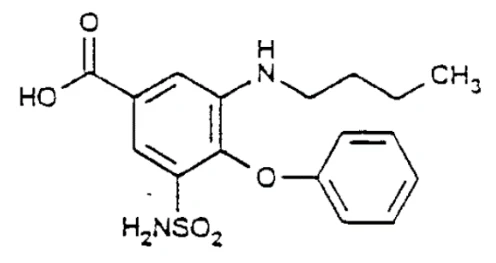
Chemical name: 3-Butylamino-4-phenoxy-5-sulphamoyl-benzoic acid
Molecular formula and molecular mass: C17H20N2O5S, 364.41
Structural formula:
Physicochemical properties: White crystalline powder with a slightly bitter taste, sensitive to light. Slightly soluble in water, ether and chloroform, moderately soluble in 96% ethanol and acetone with a melting point of 233-234oC and approximate pka values 0.3-4-10.
Pharmaceutical standard: manufacturer’s standard
14. Clinical Trials
14.2. Comparative Bioavailability Studies
Table 4 – Summary Table of the Comparative Bioavailability Data
BURINEX (2 X 0.5 mg Tablets vs. 1 X 1.0 mg Tablet) Geometric Mean Arithmetic Mean (CV %) | ||||||
BURINEX (2 X 0.5 mg Tablets vs. 1 X 1.0 mg Tablet) Geometric Mean Arithmetic Mean (CV %) | ||||||
| Parameter | BURINEX 2 x 0.5 mg tablets | BURINEX 1 x 1.0 mg tablet | % Ratio of geometric means | |||
| Parameter | BURINEX 2 x 0.5 mg tablets | BURINEX 1 x 1.0 mg tablet | % Ratio of geometric means | |||
AUCT (µg.hr/L) | (G.M.) | 76.17 | 74.21 | 102.6 | ||
| (A.M.(CV)) | 79.31 | 31.0 | 76.75 | 26.6 | ||
AUCI (µg.hr/L) | (G.M.) | 86.31 | 85.10 | 101.4 | ||
| (A.M.(CV)) | 89.33 | 28.7 | 87.25 | 22.9 | ||
Cmax (µg/L) | (G.M.) | 41.28 | 39.62 | 104.2 | ||
| (A.M.(CV)) | 43.14 | 30.7 | 41.38 | 28.8 | ||
| TMAX1 | (A.M.(CV)) | 1.00 | 46.2 | 1.14 | 41.4 | |
| (h) | ||||||
T½1 (h) | (A.M.(CV)) | 1.02 | 20.0 | 1.00 | 20.1 | |
1Expressed as the arithmetic mean (CV %) only.
16. Non-Clinical Toxicology
Acute Toxicology
In rabbits, ataxia, lacrimation and tremors were observed. These symptoms were not observed in mice or rats.
| Species | Route | LD (mg/kg) mean + SD |
| Mice | P.O. I.P. S.C. I.V. | 930 + 49 280 + 13 570 + 33 > 150 ** |
| Adult Rats | P.O. I.P. I.V. | > 2000 310 + 15 > 150 ** |
| Neonatal Rats | P.O. | 480 + 47 |
| Rabbits | P.O. I.V. | 800 + 125 70 * |
* 14 day observation period ** 2 day observation period | ||
Chronic Toxicity:
Rats: Bumetanide was administered orally at doses of 10, 30 and 60 mg/kg/day to 3 groups of 60 male and 60 female rats for 78 weeks. Convulsive episodes (not dose-related) were noted in some treated (30%) and one control rat; most convulsions occurred immediately after dosing.
A dose related increase in the incidence of renal dystrophic calcifications was noted. Ovarian weight was reduced in the mid and high dose groups and the incidence of testicular atrophy was increased in males in the high dose groups. The incidence of mammary tumors was slightly increased in females of the middle and high dose groups.
In order to clarify the tumorigenic potential of bumetanide, the 78 week rat toxicity study was repeated using the same doses in groups of 80 males and 80 females. The oral administration of bumetanide did not increase the prevalence of mammary tumors nor affect the profile of spontaneous tumors in the rat.
Dogs: Bumetanide was administered orally for 1 year to 3 groups of 3 male and 3 female dogs at dose levels of 0.12, 0.4 and 1.2 mg/kg/day. Tubular atrophy and dilation associated with varying degrees of chronic inflammatory cell infiltration and fibrosis, atrophic glomeruli, capsular thickening and fluid filled capsular cysts occurred in the kidneys of high and mid-dose group dogs.
Baboons: Bumetanide was administered orally to 4 groups of 3 male and 3 female baboons for 26 weeks at dose levels of 0.1, 1.0, 5.0 and 10 mg/kg/day. After 4 weeks of dosing, the 5.0 and 10 mg/kg/day dose levels were reduced to 2.5 and 5.0 respectively because the animals appeared dehydrated. One high dose female was sacrificed because of marked deterioration in general condition.
Histological examination showed calcified material associated with macrophages and inflammatory cells with eosinophilic granular casts in the renal tubules of the two high dose groups.
Mutagenicity:
Bumetanide was devoid of mutagenic activity in various strains of Salmonella typhimurium when tested in the presence of an in vitro metabolic activated system.
Reproductive Studies:
Mice: Doses of 0.05, 0.25 and 0.50 mg/kg/day were administered orally to 3 groups of 15 pregnant Hauschka/Nirand mice from day 6 through day 16 of gestation. A slight increase in fetal deaths and resorptions was noted at the high dose. No malformations were observed.
Doses of 10, 30 and 100 mg/kg/day were administered to groups of 22 to 25 Charles River CD-1 mice from day 6 to day 15 of gestation. No signs of toxicity were observed.
Bumetanide is neither teratogenic nor embryotoxic in mice when given in doses up to 3400 times the maximum human therapeutic dose.
Rats: Doses of 10, 30 and 100 mg/kg/day were administered orally to 3 respective groups of 40 female rats from day 15 prior to mating. The same doses were administered to 3 respective groups of 20 male rats from day 84 prior to mating. Dose-related increases in fetal mortality were observed. No malformations were observed.
Similar doses were administered to 30, 26 and 27 pregnant females from day 6 to day 15 of gestation. No effect on fetal mortality was seen. Moderate growth retardation and an increased incidence of delayed ossification of sternebrae were observed in pups at 100 mg/kg/day. These effects were associated with maternal weight reduction during dosing. No such adverse effects were observed at 30 mg/kg/day. No malformations were observed.
Hamster: Bumetanide was not teratogenic in the hamster at an oral dose of 0.5 mg/kg/day.
Rabbits: Doses of 0.03, 0.10 and 0.30 mg/kg/day were administered orally to groups of 7 to 12 rabbits from day 6 to day 18 of gestation. Dams receiving the high dose showed depressed activity. A dose-related decrease in litter size and an increase in resorption rate were noted at oral doses of 0.1 and 0.3 mg/kg/day. A slightly increased incidence of delayed ossification of sternebrae occurred at 0.3 mg/kg/day; however, no effects were seen at 0.03 mg/kg/day.
The sensitivity of the rabbit to bumetanide parallels the marked pharmacologic and toxicologic effects of the drug in this species.
Other Studies:
In studies with 49 cats, 55 dogs and guinea pigs, bumetanide was found to produce dose-related depressions of the auditory afferent action potentials (N1) and cochlear microphonics following intravenous administration.
In these test animals BURINEX was 5 to 6 times more potent than furosemide and, since the diuretic potency of BURINEX is about 40 to 60 times greater, it is anticipated that blood levels necessary to produce ototoxicity in humans will rarely be achieved.