


Patient Medication Information: uses, side effects, how to take - Butorphanol Nasal Spray
Serious Warnings and Precautions
Seek immediate medical help for your baby.
In addition, you may experience withdrawal effects if you: |
|---|
Therefore, you must tell your healthcare professional if you are taking any of these medicines, and when you stop taking them. If you are unsure about the medicines you take, ask your healthcare professional. Your healthcare professional will regularly monitor your health and adjust your dose accordingly.
|
|---|
What is BUTORPHANOL Nasal Spray used for?
BUTORPHANOL Nasal Spray is used in adults to manage moderate to severe short-term (acute) pain. It is NOT used “as needed” to treat pain that you only have once in a while.
How does BUTORPHANOL Nasal Spray work?
BUTORPHANOL Nasal Spray is a painkiller belonging to the class of drugs known as opioids. It relieves pain by acting on specific nerve cells of the spinal cord and brain.
What are the ingredients in BUTORPHANOL Nasal Spray?
Medicinal ingredient: butorphanol tartrate.
Non-medicinal ingredients: benzethonium chloride, citric acid, hydrochloric acid, purified water, sodium chloride, and sodium hydroxide.
BUTORPHANOL Nasal Spray comes in the following dosage forms:
Solution, 10 mg/mL of butorphanol tartrate.
Do not use BUTORPHANOL Nasal Spray if:
- your healthcare professional did not prescribe it for you.
- you are allergic to butorphanol tartrate, other opioids, benzethonium chloride (a preservative), or any of the other ingredients in BUTORPHANOL Nasal Spray.What are the ingredients in BUTORPHANOL Nasal Spray?
- you have mild pain that can be controlled by the occasional use of painkillers including those available without a prescription.
- you have severe asthma, trouble breathing, or other breathing problems.
- you have any heart problems.
- you have bowel blockage or narrowing of the stomach or intestines.
- you have a condition where the bowel does not work properly (ileus) or you have severe pain in your abdomen.
- you have increased pressure in your skull or have a head injury.
- you have or have a history with epilepsy.
you suffer from alcoholism or alcohol withdrawal.
- you are taking or have taken within the past 2 weeks a Monoamine Oxidase inhibitor (MAOI) (such as phenelzine sulphate, tranylcypromine sulphate, moclobemide, or selegiline).
- you are going to have a surgery or operation, or have had a surgery in the last 24 hours.
- you are pregnant, or you are in labour or delivery.
- you are breastfeeding or planning to breastfeed.
- you have severe central nervous system (CNS) depression (nervous system slows down).
To help avoid side effects and ensure proper use, talk to your healthcare professional before you take BUTORPHANOL Nasal Spray. Talk about any health conditions or problems you may have, including if you:
- have a history of illicit or prescription drug or alcohol abuse.
- have severe kidney or liver problems.
- have been told you are at risk of having heart problems or seizures.
- have low blood pressure.
- have or have had problems with your mood (such as depression or anxiety), hallucinations, or other mental health problems.
- suffer from chronic or severe constipation.
- have pancreas or gallbladder problems.
- have problems with your thyroid, adrenal, or prostate gland.
- suffer from migraines.
- have a sleep disorder which causes pauses in breathing or shallow breathing while sleeping (sleep apnea).
- are planning to become pregnant.
- are planning on drinking alcohol. Drinking alcohol while taking BUTORPHANOL Nasal Spray may cause dangerous side effects, including death. Do not drink alcohol while taking BUTORPHANOL Nasal Spray.
- have a condition that causes weakness or frailty.
- have difficulty urinating.
- have circulatory problems (e.g., body does not get enough oxygen and nutrients to function properly due to a lack of blood flow).
- are elder or over 65 years of age.
Other warnings you should know about:
Taking BUTORPHANOL Nasal Spray can cause the following serious side effects:
Disorder of the adrenal gland: You may develop a disorder of the adrenal gland called adrenal insufficiency. This means that your adrenal gland is not making enough of certain hormones. You may experience symptoms such as:
- nausea, vomiting;
- feeling tired, weak or dizzy;
- decreased appetite.
You may be more likely to have problems with your adrenal gland if you have been taking opioids for longer than one month. Your healthcare professional may do tests, give you another medication, and slowly take you off BUTORPHANOL Nasal Spray.
Serotonin toxicity (also known as serotonin syndrome): BUTORPHANOL Nasal Spray can cause serotonin toxicity, a rare but potentially life-threatening condition. It can cause serious changes in how your brain, muscles and digestive system work. You may develop serotonin toxicity if you take BUTORPHANOL Nasal Spray with certain anti-depressants or migraine medications.
Serotonin toxicity symptoms include:
- fever, sweating, shivering, diarrhea, nausea, vomiting;
- muscle shakes, jerks, twitches or stiffness, overactive reflexes, loss of coordination;
- fast heartbeat, changes in blood pressure;
- confusion, agitation, restlessness, hallucinations, mood changes, unconsciousness, and coma.
- Sleep Apnea: Opioids can cause a problem called sleep apnea (stopping breathing from time to time while sleeping). Tell your healthcare professional if you have a history of sleep apnea or if anyone notices that you stop breathing from time to time while sleeping.
See the Serious side effects and what to do about them table below for more information on these and other serious side effects.
Opioid dependence and addiction: There are important differences between physical dependence and addiction. It is important that you talk to your healthcare professional if you have questions or concerns about abuse, addiction or physical dependence.
Pregnancy, nursing, labour and delivery: Do not use BUTORPHANOL Nasal Spray while pregnant, nursing, during labour or delivery. Opioids can be transferred to your baby through breast milk, or while still in the womb. BUTORPHANOL Nasal Spray can then cause life-threatening breathing problems in your unborn baby or nursing infant.
If you are pregnant and are taking BUTORPHANOL Nasal Spray, it is important that you don’t stop taking your medication all of a sudden. If you do, it can cause a miscarriage or a still-birth. Your healthcare professional will monitor and guide you on how to slowly stop taking BUTORPHANOL Nasal Spray. This may help avoid serious harm to your unborn baby.
Driving and using machines: Before you do tasks which may require special attention, you should wait until you know how you react to BUTORPHANOL Nasal Spray. BUTORPHANOL Nasal Spray can cause:
- drowsiness,
- dizziness, or
- light headedness.
This can usually occur after you take your first dose and when your dose is increased.
Sexual function/reproduction: Long term use of opioids may lead to a decrease in sex hormone levels. It may also lead to low libido (desire to have sex), erectile dysfunction, or being infertile.
Worsened pain: Taking opioids for pain can sometimes have the unintended effect of making your pain feel worse (opioid-induced hyperalgesia) even though your opioid dose has been unchanged or increased. This can also include feeling pain in new places in your body, or feeling pain from something that would not normally hurt, for example, feeling pain from clothing touching your skin. Tell your healthcare professional if you notice a change like this in your pain while you are taking BUTORPHANOL Nasal Spray.
Testing and check-ups: Your healthcare professional will regularly monitor your health. This includes monitoring signs of:
- misuse and abuse;
- sleep apnea (a sleep disorder which causes pauses in breathing or shallow breathing while sleeping);
- respiratory depression and sedation (e.g., slow, shallow, or weak breathing).
Tell your healthcare professional about all the medicines you take, including any drugs, vitamins, minerals, natural supplements or alternative medicines.
Serious Drug Interactions Serious drug interactions with BUTORPHANOL Nasal Spray include:
|
|---|
|
|---|
|
|---|
|
|---|
The following may interact with BUTORPHANOL Nasal Spray:
medicines that act on a brain chemical called serotonin. This includes:
- antidepressants, medicines used to treat depression (e.g., Selective Serotonin Re-Uptake Inhibitors (SSRIs), Serotonin Norepinephrine Re-Uptake Inhibitors (SNRIs), tricyclic antidepressants, mirtazapine, and trazodone);
- lithium, a medicine used to treat bipolar disorder;
- triptans, medicines used to treat migraines (e.g., sumatriptan);
- medicines known as 5-HT3 receptor antagonists, used to prevent nausea and vomiting caused by chemotherapy, radiation therapy, and postoperatively;
- St. John’s Wort, a herbal medicine used for depression and mood disorders.
- anticoagulants, medicines used to prevent or treat blood clots (e.g., warfarin such as coumadin).
- cimetidine, a medicine used to treat ulcers.
- oxymetazoline, a medicine used to treat nasal congestion.
- grapefruit juice.
If you are unsure, ask your healthcare professional.
How to take BUTORPHANOL Nasal Spray:
- Take the BUTORPHANOL Nasal Spray exactly as directed by your healthcare professional. BUTORPHANOL Nasal Spray is sprayed into your nose and must not be taken any other way. DO NOT repeat your dose sooner than directed by your healthcare professional. Check with your healthcare professional if you are unsure.
- BUTORPHANOL Nasal Spray should not be used by anyone other than the person for whom it was prescribed.
For proper use of the nasal spray bottle, read the following instructions carefully.
Instructions for use:
- 1) Blow your nose. (Fig. 1)
- 2) Pull the clear cover off pump unit. Remove protective clip. (Fig. 2)
- 3) Prior to initial use, prime the unit by pumping sprayer firmly and quickly until a fine spray appears (up to 4-5 strokes). While priming the unit, direct the pump sprayer away from yourself, others, or animals. (Fig. 3)
- 4) Insert the spray tip approximately 1 cm into one nostril, close the other nostril with your forefinger and pump the spray unit once firmly and quickly. (Fig. 4)
- 5) Your healthcare professional will tell you whether a two spray dose is needed. If needed, administer a second spray in the other nostril.
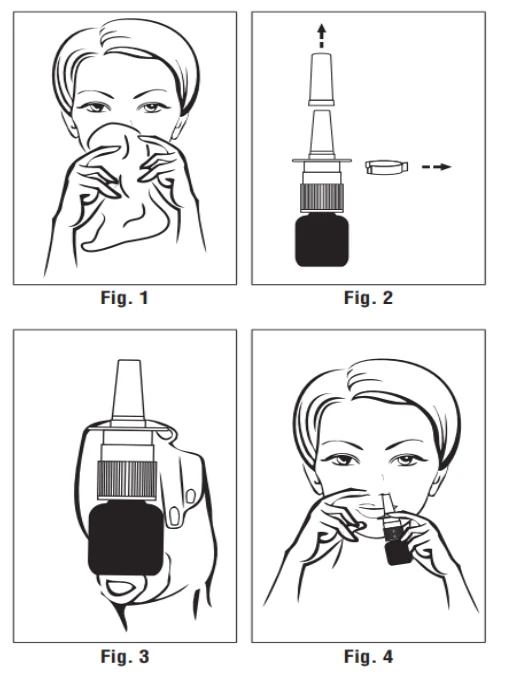
If not used for 48 hours or longer, the unit must be primed with one or two strokes.
Note: Each priming reduces the number of effective doses per bottle.
Usual dose:
Your dose is tailored/personalized just for you. Be sure to follow your healthcare professional’s dosing instructions exactly. Do not increase or decrease your dose without consulting your healthcare professional.
If you are prescribed ONE SPRAY, only spray once into ONE NOSTRIL ONLY. DO NOT spray into both nostrils unless directed by your healthcare professional. DO NOT repeat sooner than directed by your healthcare professional.
Your healthcare professional will prescribe the lowest dose that works to control your pain. It is recommended that you only take BUTORPHANOL Nasal Spray for up to 3 days as it is not known if it is effective beyond this time period. If you need to take BUTORPHANOL Nasal Spray for longer, your healthcare professional will determine the best dose for you to lower the risk of side effects and overdose. Higher doses can lead to more side effects and a greater chance of overdose.
Review your pain regularly with your healthcare professional to determine if you still need BUTORPHANOL Nasal Spray. Be sure to use BUTORPHANOL Nasal Spray only for the condition for which it was prescribed.
If your pain increases or you develop any side effect as a result of taking BUTORPHANOL Nasal Spray, tell your healthcare professional immediately.
Stopping your Medication: If you have been taking BUTORPHANOL Nasal Spray for more than a few days you should not stop taking it all of a sudden. Your healthcare professional will monitor and guide you on how to slowly stop taking BUTORPHANOL Nasal Spray. You should do it slowly to avoid uncomfortable symptoms such as having:
- body aches,
- diarrhea,
- goosebumps,
- loss of appetite,
- nausea,
- feeling nervous or restless,
- runny nose,
- sneezing,
- tremors or shivering,
- stomach cramps,
- rapid heart rate (tachycardia),
- having trouble sleeping,
- an unusual increase in sweating,
- heart palpitations,
- an unexplained fever,
- weakness,
- yawning.
By reducing or stopping your opioid treatment, your body will become less used to opioids. If you start treatment again, you will need to start at the lowest dose. You may overdose if you restart at the last dose you took before you slowly stopped taking BUTORPHANOL Nasal Spray.
Refilling your Prescription for BUTORPHANOL Nasal Spray: A new written prescription is required from your healthcare professional each time you need more BUTORPHANOL Nasal Spray. Therefore, it is important that you contact your healthcare professional before your current supply runs out.
Only obtain prescriptions for this medicine from the healthcare professional in charge of your treatment. Do not seek prescriptions from other healthcare professionals unless you switch to another healthcare professional for your pain management.
Overdose:
Signs of overdose may include:
- unusually slow or weak breathing,
- dizziness,
- confusion,
- toxic leukoencephalopathy (a brain disorder affecting the brain’s white matter),
- extreme drowsiness.
| If you think you, or a person you are caring for, have taken too much BUTORPHANOL Nasal Spray, contact a healthcare professional, hospital emergency department, or regional poison control centre immediately, even if there are no symptoms. |
|---|
Missed Dose:
If you miss one dose, take it as soon as possible. However, if it is almost time for your next dose, then skip the missed dose. Do NOT take two doses at once. If you miss several doses in a row, talk to your healthcare professional before restarting your medication.
What are possible side effects from using BUTORPHANOL Nasal Spray?
These are not all the possible side effects you may have when taking BUTORPHANOL Nasal Spray. If you experience any side effects not listed here, tell your healthcare professional.
Side effects may include:
- drowsiness;
- insomnia;
- dizziness;
- fainting;
- nausea, vomiting, or a poor appetite;
- dry mouth;
- headache;
- problems with vision;
- weakness, uncoordinated muscle movement;
- itching;
- light headedness;
- sweating;
- constipation. Talk with your healthcare professional about ways to prevent constipation when you start using BUTORPHANOL Nasal Spray;
- low sex drive, impotence (erectile dysfunction), or infertility;
- sore throat;
- taste loss;
- feeling cold;
- fever.
Serious side effects and what to do about them
| Symptom / effect | Talk to your healthcare professional | Stop taking drug and get immediate medical help | |
|---|---|---|---|
| Only if severe | In all cases | ||
| COMMON | |||
| Bowel blockage (impaction): abdominal pain, severe constipation, or nausea. | √ | ||
| Fast, slow or irregular heartbeat: heart palpitations. | √ | ||
| Gastrointestinal disorders: severe constipation, nausea | √ | ||
| Paresis (muscle weakness caused by nerve damage or disease): memory problems, language problems, mental status changes, mood changes, delusions, hallucinations, or irritability. | √ | ||
| UNCOMMON | |||
| Drug dependence: feeling of craving, feeling you need more drug to achieve the same effect, taking higher dose of the drug that is recommended | √ | ||
| Ear and labyrinth disorders: unusual tolerance to ordinary environmental sounds (hyperacusia), ear pain, or tinnitus. | √ | ||
| Edema: swelling caused by excess fluid trapped in your body's tissues | √ | ||
Serious side effects and what to do about them
| Symptom / effect | Talk to your healthcare professional | Stop taking drug and get immediate medical help | |
|---|---|---|---|
| Only if severe | In all cases | ||
| Eye disorders: visual disturbance, photophobia, eye pain, or eye problems. | √ | ||
| Gastrointestinal disorders: abdominal pain, passing gas (flatulence) | √ | ||
| Hypertension (high blood pressure): shortness of breath, fatigue, dizziness, fainting, chest pain, chest pressure, swelling in your ankles and legs, bluish colour to your lips and skin, racing pulse, or heart palpitations. | √ | ||
| Hypotension (low blood pressure): dizziness, fainting, or light-headedness. | √ | ||
| Neurological disorders: walking abnormality (abnormal gait), speech disorder caused by muscle weakness (dysarthria), increase in the sensitivity of any of your senses, such as sight, sound, touch, and smell (hyperesthesia), transient difficulty speaking (aphasia), or executing purposeful movements (apraxia). | √ | ||
| Psychiatric problems: vivid imagination, or abnormal dreams. | √ | ||
| Renal and urinary disorders: impaired urination. | √ | ||
| Respiratory depression: slow, shallow, or weak breathing. | √ | ||
| Seizures (fit): uncontrollable shaking with or without loss of consciousness. | √ | ||
| RARE | |||
Serious side effects and what to do about them
| Symptom / effect | Talk to your healthcare professional | Stop taking drug and get immediate medical help | |
|---|---|---|---|
| Only if severe | In all cases | ||
| Allergic reaction: itchy, red, painful, and irritated or swollen skin (rash), outbreak of pale red bumps or welts on the skin that appear suddenly (hives), swelling of the face, lips, tongue or throat, difficulty swallowing (dysphagia), or difficulty breathing (dyspnea). | √ | ||
| Overdose: hallucinations, confusion, inability to walk normally, slow or weak breathing, extreme sleepiness, sedation, dizziness, floppy muscles/low muscle tone (hypotonia), or cold and clammy skin. | √ | ||
| Serotonin toxicity (also known as serotonin syndrome): a reaction which may cause feelings of agitation or restlessness, flushing, muscle twitching, involuntary eye movements, heavy sweating, high body temperature (>38°C), or rigid muscles. | √ | ||
| Withdrawal: nausea, vomiting, diarrhea, anxiety, shivering, cold and clammy skin, body aches, loss of appetite, or sweating. | √ | ||
| UNKNOWN FREQUENCY | |||
| Androgen deficiency: decreased interest in sexual activity (low libido), inability in a man to achieve an erection or orgasm (impotence), inability to get and keep an erection firm enough for sex (erectile | √ | ||
Serious side effects and what to do about them
| Symptom / effect | Talk to your healthcare professional | Stop taking drug and get immediate medical help | |
|---|---|---|---|
| Only if severe | In all cases | ||
| dysfunction), absence of menstruation (amenorrhea), or not being able to get pregnant (conceive) after one year (or longer) of unprotected sex (infertility). | |||
| Disorder of the adrenal gland: nausea, vomiting, anorexia, fatigue, weakness, dizziness, or low blood pressure. | √ | ||
| Sleep apnea: stop breathing for short periods during your normal nightly sleep. | √ | ||
If you have a troublesome symptom or side effect that is not listed here or becomes bad enough to interfere with your daily activities, tell your healthcare professional.
Reporting Side Effects
You can report any suspected side effects associated with the use of health products to Health Canada by:
NOTE: Contact your healthcare professional if you need information about how to manage your side effects. The Canada Vigilance Program does not provide medical advice. |
Storage:
- Store BUTORPHANOL Nasal Spray at room temperature 15°C to 30°C.
- Store the spray unit in the child resistant container.
- Keep unused or expired BUTORPHANOL Nasal Spray in a secure place to prevent theft, misuse or accidental exposure.
- Keep BUTORPHANOL Nasal Spray under lock, out of sight and reach of children and pets.
- Never take medicine in front of small children as they will want to copy you. Accidental ingestion by a child is dangerous and may result in death. If a child accidentally takes BUTORPHANOL Nasal Spray, get emergency help right away.
Disposal: To prevent accidental ingestion, and to reduce the chance of children taking the medication, it is important to dispose of any excess BUTORPHANOL Nasal Spray as soon as it is no longer needed. BUTORPHANOL should never be thrown into household trash, where children and pets may find it. It should be returned to a pharmacy for proper disposal.
If you want more information about BUTORPHANOL Nasal Spray:
- Talk to your healthcare professional
- Find the full Product Monograph that is prepared for healthcare professionals and includes this Patient Medication Information by visiting the Health Canada website: (https://www.canada.ca/en/health-canada/services/drugs-health-products/drug-products/drug-product-database.html); the manufacturer’s website (https://www.aapharma.ca/en/), or by calling 1-877-998-9097.