


Product Monograph - Cafergot Sup
CLINICAL PHARMACOLOGY
The mechanism of action of Cafergot in relieving migraine is not completely understood.
| Ergotamine is an agonist at serotoninergic 5-HT1 receptors (5-HT | , 5-HT | , 5-HT | , and |
| 1A | 1B | 1D |
| 5-HT | ), 5-HT | receptors, adrenergic receptors, and dopaminergic D | receptors. At higher doses, |
| 1F | 2 | 2 |
ergotamine is an alpha adrenergic blocking agent with a direct stimulating effect on the smooth muscle of peripheral and cranial blood vessels. In comparison to dihydrogenated ergotamine, the adrenergic blocking actions of ergotamine tartrate are less pronounced and vasoconstriction actions are greater. The addition of caffeine to ergotamine tartrate facilitates the absorption of ergotamine when administered orally or rectally and increases migraine pain relief effects.
Ergotamine is rapidly and incompletely (approximately 62% of the oral dose) absorbed by the gastro-intestinal tract. Peak plasma levels are reached about 2 hours after ingestion. Ergotamine is extensively metabolized in the liver. The bioavailability of unchanged drug is about 2% when the drug is administered orally and 5% when it is administered by the rectal route. It has been suggested that the therapeutic effects of the drug are partially due to active metabolites. Protein bindings amounts to 98%. Parent drug and metabolites are mainly excreted with the bile. Their elimination from plasma is biphasic with a half-life of 2.7 hours and 21 hours respectively.
Caffeine is rapidly and almost completely absorbed; it is to a large extent metabolized. The metabolites are mainly excreted in the urine. Plasma elimination half-life is about 3.5 hours, protein binding 35%.
Pharmacokinetics: Interactions
Pharmacokinetic interactions (increased blood levels of ergotamine) have been reported in patients treated orally with ergotamine and macrolide antibiotics (e.g., troleandomycin, clarithromycin, erythromycin), and in patients treated orally with ergotamine and protease inhibitors (e.g. ritonavir) presumably due to inhibition of cytochrome P450 3A metabolism of ergotamine (See CONTRAINDICATIONS). Ergotamine has also been shown to
| be | both | an |
inhibitor and substrate of cytochrome P450 3A catalyzed reactions. No pharmacokinetic interactions involving other cytochrome P450 isoenzymes are known.
INDICATIONS AND CLINICAL USE
CAFERGOT® (ergotamine mesylate and caffeine) is indicated in acute attacks of migraine with or without aura..
CAFERGOT® Tablets are not intended for the prophylactic therapy of migraine or for use in the management of hemiplegic, basilar, or ophthalmoplegic migraine (see Contraindications). CAFERGOT® suppositories are available for the treatment of patients who have nausea and vomiting early in the attack and cannot retain or absorb anything taken orally. They have a faster onset of action due to by-pass of portal circulation.
CONTRAINDICATIONS
CAFERGOT is contraindicated in:
- Any known hypersensitivity to ergot alkaloids, caffeine, or any other components of the formulation.
Concomitant treatment of any potent CYP 3A4 inhibitors, including macrolide antibiotics
(e.g. clarithromycin, erythromycin, troleandomycin), HIV protease or reverse transcriptase inhibitors (e.g. delavirdine, indinavir, nelfinavir, and ritonavir), and azole antifungals (e.g. ketoconazole, itraconazole, voriconazole).
Coadministration of ergotamine with potent CYP 3A4 inhibitors has been associated with acute ergot toxicity (ergotism) characterized by vasospasm and ischemia of the extremities, with some cases resulting in amputation. There have been rare reports of cerebral ischemia in patients on protease or reverse transcriptase inhibitor therapy when
CAFERGOT (ergotamine tartrate and caffeine) was coadministered, at least one resulting in death. Because of the increased risk for ergotism and other serious vasospastic adverse events, ergotamine use is contraindicated with these drugs and other potent inhibitors of
| CYP 3A4 (see | WARNINGS | : CYP 3A4 Inhibitors and also | PRECAUTIONS | : Drug |
Interactions).
- Concomitant treatment with vasocontrictive agents (including ergot alkaloids, triptans
| and other 5HT1 | receptor agonists) (see | PRECAUTIONS | : Drug Interactions). |
Confirmed or suspected central or peripheral ischemic diseases, such as coronary vascular disease, stroke, transient ischemic attack, peripheral vascular disorders;
obliterative vascular disease, because of the vasoconstrictor action of ergotamine.
- Complicated migraine, migraine with prolonged aura, temporal arteritis; hemiplegic or basilar migraine.
- Heart disease, inadequately controlled hypertension.
- Septic conditions, shock.
- Severe renal or hepatic impairment.
Women who are or may be pregnant because ergotamine has oxytocic and
vasoconstrictor effects on the placenta and umbilical cord.
Nursing mothers. Ergotamine is excreted in breast milk and may cause symptoms of vomiting, diarrhea, weak pulse and unstable blood pressure in infants.
WARNINGS
WARNING
Serious and/or life-threatening ischemia has been associated with the coadministration of
CAFERGOT® with potent CYP 3A4 inhibitors including protease inhibitors and macrolide antibiotics. Because CYP 3A4 inhibition elevates the serum levels of CAFERGOT®, the risk for vasospasm leading to cerebral ischemia and/or ischemia of the extremities is increased. Hence, concomitant use of these medications is contraindicated. (See also CONTRAINDICATIONS)
CYP 3A4 Inhibitors (e.g. Macrolide Antibiotics and Protease Inhibitors)
Coadministration of ergotamine with potent CYP 3A4 inhibitors such as HIV protease or reverse transcriptase inhibitors or macrolide antibiotics has been associated with serious adverse events;
for this reason, these drugs should not be given concomitantly with ergotamine (See
CONTRAINDICATIONS). While these reactions have not been reported with less potent CYP 3A4 inhibitors, there is a potential risk for serious toxicity including vasospasm when these drugs are used with ergotamine. Examples of less potent CYP 3A4 inhibitors include:
saquinavir, nefazodone, fluconazole, fluoxetine, grapefruit juice, fluvoxamine, zileuton, metronidazole, and clotrimazole. These lists are not exhaustive, and the prescriber should consider the effects on CYP3A4 of other agents being considered for concomitant use with ergotamine.
Fibrotic Complications:
There have been reports of patients on CAFERGOT therapy developing retroperitoneal and/or pleuropulmonary fibrosis. There have also been rare reports of fibrotic thickening of the aortic, mitral,
tricuspid, and/or pulmonary valves with long-term continuous use of CAFERGOT®.
CAFERGOT® should not be used for chronic daily administration (see DOSAGE AND
ADMINISTRATION).
PRECAUTIONS
Although signs and symptoms of ergotism rarely develop, care should be exercised to remain within the limits of recommended dosage. Excessive or prolonged dosage is not recommended since vasospams may occur. Such symptoms as tingling in the fingers or toes should be reported to the physician immediately and the drug should be discontinued at once.
Owing to its vasoconstrictor properties, ergotamine may cause myocardial ischemia or, in rare cases, infarction, even in patients with no known history of coronary heart disease.
Patients who are being treated with CAFERGOT should be informed of the maximum doses
| allowed and of the first symptoms of overdosage: | hypoesthesia, | paresthesia (e.g. numbness, |
tingling) in the fingers and toes, non-migraine-related nausea and vomiting, and symptoms of myocardial ischemia (e.g. precordial pain).
CAFERGOT is only indicated for the treatment of acute migraine attacks and not for prevention.
Like all drugs, CAFERGOT must be kept out of the reach of children.
If contrary to recommendations ergotamine-containing drugs including Cafergot are used excessively over years, they may induce fibrotic changes, in particular of the pleura and the retroperitoneum. There have also been rare reports of fibrotic changes of the cardiac valves (see
WARNINGS).
Patients with mild to moderate hepatic impairment, especially cholestatic patients should be appropriately monitored.
The occurrence of drug-induced headaches has been reported during prolonged and uninterrupted treatment with CAFERGOT.
Rare cases of a solitary rectal or anal ulcer have occurred from abuse of ergotamine-containing suppositories, usually at higher than recommended doses or with continuous use at the recommended dose for many years.
Drug Interactions:
The concomitant use of cytochrome P450 3A (CYP3A) inhibitors such as macrolide antibiotics
(e.g. troleandomycin, erythromycin, clarithromycin), HIV protease or reverse transcriptase inhibitors (e.g. ritonavir, indinavir, nelfinavir, delavirdine) or azole antifungals (e.g.
ketoconazole, itraconazole, voriconazole) and CAFERGOT must be avoided (see
CONTRAINDICATIONS), since this can result in an elevated exposure to ergotamine and ergot toxicity (vasospasm and ischemia of the extremities and other tissues). Ergot alkaloids
| have also been shown to be | both | inhibitors and | substrates | of CYP3A |
. No pharmacokinetic interactions involving other cytochrome P450 isoenzymes are known.
Among patients treated concomitantly with ergotamine-containing preparations and propranolol a few cases of vasospastic reactions have been reported. Concurrent use of vasoconstrictor agents including preparations containing ergot alkaloids, and 5HT1 receptor agonists (triptans), and nicotine (e.g. heavy smoking) must be avoided since this may result in enhanced vasoconstriction (see CONTRAINDICATIONS).
CAFERGOT should not be used in patients on estrogen-based contraceptives or those who are smoking. Estrogen-based contraceptives and cigarette are independent risk factors of thrombosis.
The interactions of ergotamine, estrogen-based contraceptives, and smoking are complex; the combination of these conditions may significantly increase the risk of thrombosis.
ADVERSE REACTIONS
Postmarketing experience
The most common of all side effects are nausea and vomiting. Depending on the dose of ergotamine, signs and symptoms of vasoconstriction may occur.
Adverse reactions are ranked under heading of frequency, the most frequent first, using the following convention: very common (= 1/10); common (= 1/100, < 1/10); uncommon (= 1/1,000,
< 1/100); rare (= 1/10,000, < 1/1,000) very rare (< 1/10,000), including isolated reports.
Immune system
| Rare: Hypersensitivity reactions (such as skin rash, face | edema, urticaria and dyspn | ea) |
Nervous system
Common: Dizziness
| Uncommon: Par | esthesia (e.g. tingling), hypo | esthesia (e.g. numbness) |
Ear and labyrinth
Rare: Vertigo
Cardiac
Uncommon: Cyanosis
Rare: Bradycardia, tachycardia
Very rare: Myocardial ischemia, myocardial infarction
Vascular
Uncommon: Peripheral vasoconstriction
Rare: Increase in blood pressure
Very rare: Gangrene
Respiratory, thoracic and mediastinal
Rare: Dyspnea
Gastrointestinal
Common: Nausea and vomiting (not migraine related), abdominal pain
Uncommon: Diarrhea
Skin and subcutaneous tissue
Rare: Rash, face edema, urticaria
Musculoskeletal and connective tissue
Uncommon: Pain in extremities
Rare: Myalgia
General disorders and administration site conditions
Uncommon: Weakness in extremities
Investigations
Rare: Absence of pulse
Injury, poisoning and procedural complications
Rare: Ergotism (intense arterial vasoconstriction, producing signs and symptoms of peripheral vascular ischemia)
If ergotamine containing drugs are used excessively over years, they may induce fibrotic changes, in particular of the pleura and the retroperitoneum. There have also been rare reports of fibrotic changes of the cardiac valves.
The occurrence of drug-induced headaches has been reported during prolonged and uninterrupted
| treatment with Cafergot (see | PRECAUTIONS | ). |
Rectal and anal ulcers may occur after long-term use or use at doses higher than the
| recommended dose of ergotamine-containing suppositories (see | PRECAUTIONS | ). |
OVERDOSAGE
Symptoms:
In humans, the minimum lethal dose of ergotamine ranges from 15 to 20 mg. The following cases of ergotamine tartrate overdosage are cited to provide broad guidelines only.
- 1) An overdosage of 44 mg ergotamine tartrate taken by an adult female, presumably all absorbed, was followed by recovery on supportive therapy only.
- 2)
A 14 month old child died following the ingestion of 12 mg ergotamine tartrate.
Although vomiting was induced shortly after ingestion, the child was not exposed to expert treatment for some 13 hours after ingestion.
Ergotamine poisoning results in nausea, vomiting, diarrhea, thirst, muscle pain, cold and pale skin, itching, a rapid and weak pulse, bradycardia or tachycardia, pain suggestive of angina, rise and/or fall of blood pressure (usually in that order), mental confusion, dizziness, headache,
| depression, drowsiness | , hypotension, convulsion, shock, | possible unconsciousness, | coma |
, symptoms and complications of ergotism. Ergotism is defined as an intense arterial vasoconstriction, producing signs and symptoms of peripheral vascular ischemia such as numbness, tingling and pain in the extremities, cyanosis, absence of pulse and if the condition is allowed to progress untreated, gangrene may result. Most cases of ergotism are associated with chronic intoxication and/or overdose. CNS changes can rarely include convulsions and hemiplegia. Respiratory depression can occur.
TREATMENT OF OVERDOSAGE
In the case of orally ingested drug, administration of activated charcoal is recommended. In the case of very recent oral intake gastric lavage may be considered.
Treatment should be symptomatic. In the event of severe vasospastic reactions, i.v.
administration of a peripheral vasodilator such as nitroprusside, phentolamine or dihydralazine, local application of warmth to the affected area and nursing care to prevent tissue damage are recommended. In the event of coronary constriction, appropriate treatment such as nitroglycerine should be initiated.
DOSAGE AND ADMINISTRATION
CAFERGOT (ergotamine tartrate and caffeine) should be given at the first symptoms of an attack. CAFERGOT should not be administered prophylactically.
Dosage:
- 1.
Adult:
CAFERGOT Tablets: The first time CAFERGOT is taken, an initial dose of 2 tablets of
CAFERGOT is recommended. If relief is not obtained within half an hour a further tablet should be taken; this may be repeated at half-hourly intervals (see maximum daily dosage).
For subsequent attacks the initial dose may be increased up to 3 tablets, depending on the dose required in previous attacks. If necessary, additional doses may be taken at half-hourly intervals up to the maximum dosage indicated below.
CAFERGOT Suppositories: Average dose: One suppository rectally at start of attack, followed by one after one hour, if required.
- 2.
Children (6 to 12 years):
The initial dose is one tablet or half a CAFERGOT suppository; additional doses of one tablet or half a suppository may be given twice only, if required, in the course of an attack.
If supplemental antimigraine medication is required, a minimum of 6-8 hours should elapse before the use of any ergotamine or dihydroergotamine-containing preparations; and at least 24 hours should elapse before the use of a triptan . Conversely, CAFERGOT should not be taken until at least 6 hours have elapsed following the use of a triptan or ergotamine or dihydroergotamine-containing preparations.
Maximum dose per attack per day
Adults: 6 mg ergotamine tartrate = 6 tablets or 3 suppositories.
Children: 3 mg ergotamine tartrate = 3 tablets or 1-1/2 suppositories.
Maximum weekly dose
Adults: 10 mg ergotamine tartrate = 10 tablets or 5 suppositories.
Children: 5 mg ergotamine tartrate = 5 tablets or 2-1/2 suppositories.
PHARMACEUTICAL INFORMATION
Drug Substance
Trade Name: CAFERGOT
Common Name: Ergotamine tartrate and caffeine
Ergotamine tartrate
Chemical name: Ergotaman-3',6',8 trione, 12'-hydroxy-2'-methyl-5'-(phenyl-methyl-),
(5'")-,[R-(R*,R*)]-2,3-dihydroxy-butanedioate (2:1) (salt)
Structural Formula: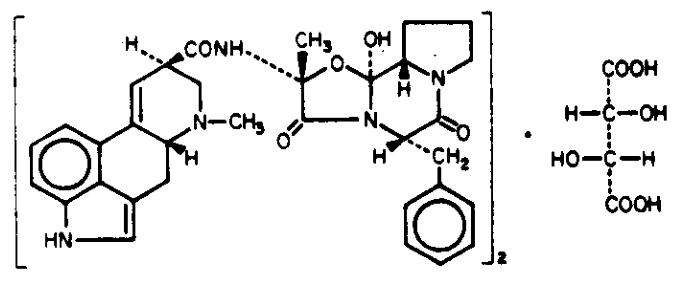
Molecular formula (C33H35N5O5)2.C4H6O6
Molecular weight 1313,43
Description: Colourless, odourless crystals or white to yellowish-white crystalline powder.
Slightly soluble in water and in alcohol; pH (25% in water) = 4-6
Caffeine
Chemical Name: 1-H-Purine-2,6-dione,3,7-dihydro 1,3, 7-trimethyl-1,3,7-
Trimethylxanthine
Structural Formula: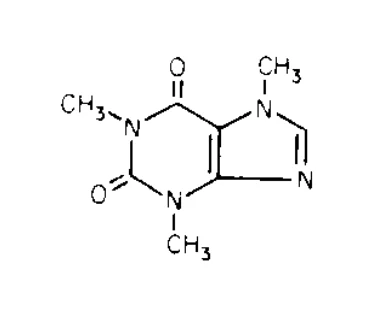
Molecular formula: C18H10N4O2
Molecular weight: 194.19
Description: Odourless, silky white crystals usually matted together or white crystalline powder. Sparingly soluble in water, very soluble in boiling water; slightly soluble in alcohol and ether pH (1% in water)=6.9
Composition:
| Each CAFERGOT Tablet | Each CAFERGOT Suppository | |
Ergotamine tartrate USP Caffeine USP | 1 mg 100 mg | 2 mg 100 mg |
Storage Requirements:
CAFERGOT Suppositories = Store below 25/C in tight container (sealed foil)
If soft, chill in refrigerator before opening foil wrapper.
AVAILABILITY OF DOSAGE FORMS
Cafergot Tablets
Circular, flat, speckled yellowish-white with isolated dots of pigment, compressed tablets, flat-faced, bevelled edge, 9 mm in diameter with “XL”
| and | a score | on one side |
. Cartons containing
10 blisters of 10 tablets each.
Cafergot Suppositories
White, torpedo shaped suppository. Boxes of 12.
REFERENCES
- 1.
Briggs GG, Freeman RK and Yaffe SJ. Drugs in Pregnancy and Lactation: A Reference
Guide to Fetal and Neonatal Risk, 5th ed. Williams & Wilkins, Baltimore, MD; 1998:
389-393
- 2.
Dresser GK, Spence JD, and Bailey DG. Pharmacokinetic-pharmacodynamic consequences and clinical relevance of cytochrome P450 3A4 inhibition. Clinical
Pharmacokinetics 38 (1): 41-57
- 3.
Pea F and Furlanut M. (2001). Pharmacokinetic aspects of treating infections in the intensive care unit - Focus on drug interactions. Clinical Pharmacokinetics 40 (11):
833-868
- 4.
Malaty LI and Kuper JJ. (1999). Drug interactions of HIV protease inhibitors. Drug Safety
20 (2): 147-169
- 5.
Venkatakrishnan K, von Moltke LL, and Greenblatt DJ. (2000). Effects of the antifungal agents on oxidative drug metabolism - Clinical relevance. Clinical Pharmacokinetics 38
(2): 111-180
- 6. Peyronneau MA, Delaforge M, Riviere R, Renaud JP, Mansuy D. (1994) High affinity of ergopeptides for cytochromes P450 3A. Importance of their peptide moiety for P450 recognition and hydroxylation of bromocriptine. Eur J Biochem. Aug 1; 223 (3): 947-56