


Patient Medication Information: uses, side effects, how to take - Cyclogyl
ABOUT THIS MEDICATION
What the medication is used for:
CYCLOGYL* is used to dilate the pupil of your eye(s). This allows for closer examination of the eye(s).
What it does:
CYCLOGYL* acts on your eyes by:
Dilating the pupils of your eye(s). This is known as
mydriasis.
Freezing the ciliary muscles of your eye(s). This is known
as cycloplegia.
When it should not be used:
CYCLOGYL* should not be used in patients who:
Are allergic to cyclopentolate hydrochloride or to .any
other ingredients in CYCLOGYL* (see What the important nonmedicinal ingredients are).
- Have or may have narrow-angle glaucoma.
- Are under 6 years old.
What the medicinal ingredient is:
Cyclopentolate hydrochloride
What the important nonmedicinal ingredients are:
Benzalkonium chloride (preservative), boric acid, edetate disodium, potassium chloride, sodium bicarbonate and/or hydrochloric acid (to adjust pH), purified water
What dosage forms it comes in:
Drops: 1% w/v
WARNINGS AND PRECAUTIONS
BEFORE you use CYCLOGYL* talk to your doctor or pharmacist if you or your child:
- Have or have had an allergic reaction to atropine.
Have a fever or are exposed to hot climates. This may
increase your chances of developing a high body temperature (hyperthermia).
May have glaucoma. CYCLOGYL* may cause an
increase in your eye pressure (intraocular pressure).
BEFORE you use CYCLOGYL* for your child talk to your doctor or pharmacist if you child has:
- Down syndrome.
- Spastic paralysis.
- Brain damage.
- A history of epilepsy.
- Fair skin and blue eyes.
Your child may be at a higher risk of developing serious side effects. Do not get CYCLOGYL* in your child’s mouth or cheeks. Wash your hands and your child’s hands, mouth and cheeks after using CYCLOGYL*.
While using CYCLOGYL*
Talk to your doctor or pharmacist if you notice any changes in your behaviour. Some people may develop psychotic reactions and other behavioural disturbances while using CYCLOGYL*.
Eye care and contact lens wear: Your eyes may become more sensitive to light when using CYCLOGYL*. Protect your eyes in bright light.
Do not wear contact lenses while applying CYCLOGYL*. CYCLOGYL* contains a preservative (benzalkonium chloride), which may irritate your eyes and can discolour soft contact lenses. Remove your contact lenses before using CYCLOGYL* and wait at least 15 minutes before you put your lenses back in.
Driving and using machinery: CYCLOGYL* may:
- Cause you to become sleepy.
- Make your eyes sensitive to light.
- Make your vision become blurry.
If any of these effects happen to you, wait until they pass before driving or using machines.
Pregnant and Breastfeeding Women: If you are or may be pregnant or are breastfeeding or planning to breastfeed, talk to your doctor or pharmacist before using CYCLOGYL*.
INTERACTIONS WITH THIS MEDICATION
Drugs that may interact with CYCLOGYL* include:
- Amantadine (a medicine used to treat Parkinson’s disease and certain influenza infections).
- Medicines used to treat allergy symptoms (anti-histamines).
- Medicines used to treat schizophrenia and bipolar disorder (anti-psychotics).
- Medicines used to treat depression (anti-depressants).
Tell your doctor or pharmacist about all the medicines you take, including any drugs, vitamins, minerals, natural supplements or alternative medicines.
PROPER USE OF THIS MEDICATION
Usual adult and child (6 years and older) dose:
Apply 1 drop to the eye(s). If necessary, apply a second drop 5 minutes later.
How to use:
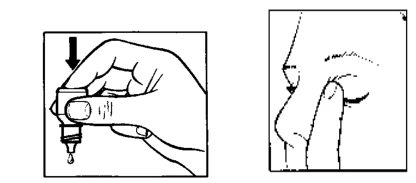
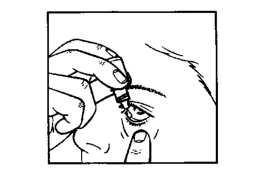
1 2 3 Before you start:
- Get the CYCLOGYL* bottle and a mirror.
- Wash your hands.
- Twist off the bottle cap.
After cap is removed: if security snap collar is loose,
remove before using product.
Applying a drop:
Hold the bottle, pointing down, between your thumb and
fingers.
- Tilt your head back.
Pull down your lower eyelid with a clean finger until
there is a ‘pocket’ between your eyelid and your eye. The drop will go in here (picture 1).
Bring the bottle tip close to the eye. Do this in front of a
mirror if it helps.
Do not touch your eye or eyelid, surrounding areas or
other surfaces with the dropper. It could infect the drops.
Gently press on the base of the bottle to release one drop
of CYCLOGYL* at a time.
Do not squeeze the bottle. It is designed so that a gentle
press on the bottom of the bottle is all that it needs (picture 2).
After a drop has been put into the eye, press a finger into
the corner of your eye by the nose (picture 3). This helps to keep the drop in the eye.
If you use drops in both eyes, repeat the steps for your
other eye.
- If a drop misses your eye, try again.
After use:
- Close the bottle cap firmly immediately after use.
Wash your hands (and your child’s hands, mouth and
cheeks).
Overdose:
In case of drug overdose, contact a health care practitioner, hospital emergency department or regional Poison Control Centre immediately, even if there are no symptoms.
If you use more CYCLOGYL* than you should, rinse your eye(s) with warm water. Do not put any more drops in.
Symptoms of an overdose may include:
- Flushing and dryness of the skin
- A rash in children
- Blurred vision
- Rapid and irregular pulse
- Fever
- Shaking (convulsions)
- Hallucinations
- Loss of coordination
SIDE EFFECTS AND WHAT TO DO ABOUT THEM
Related to the eye(s):
- Blurred vision
- Increased pressure in the eye
- Inflammation
- Irritation
- Prolonged increase in pupil size
- Pain
- Redness
- Sensitivity to light
- Swelling
General effects:
- Agitation
- Confusion
- Decreased intestinal motility
- Decreased secretion in saliva, sweating, throat, breathing and nasal passages
- Difficulty urinating
- Difficulty walking
- Disorientation
- Dizziness
- Drowsiness
- Dry mouth
- Headache
- Increase in heart rate
- Lack of coordination
- Nausea
- Recent memory loss
- Restlessness
- Skin redness
- Tiredness (fatigue)
- vomiting
| SERIOUS SIDE EFFECTS, HOW OFTEN THEY HAPPEN AND WHAT TO DO ABOUT THEM | ||||
| Symptom / effect | Talk with your doctor or pharmacist | Stop taking drug and call your doctor or pharmacist | ||
| Only if severe | In all cases | |||
| Unknown | Allergic reaction: rash, hives, swelling of the face, lips, tongue or throat, difficulty swallowing or breathing | ✓ | ||
Low blood pressure with rapid, shallow breathing: dizziness, fainting, lightheadedness | ✓ | |||
This is not a complete list of side effects. For any unexpected effects while taking CYCLOGYL,* contact your doctor or pharmacist.
HOW TO STORE IT
Store at 8oC to 27oC. Keep bottle tightly closed. Keep out of the reach and sight of children.
REPORTING SUSPECTED SIDE EFFECTS
You can help improve the safe use of health products for Canadians by reporting serious and unexpected side effects to Health Canada. Your report may help to identify new side effects and change the product safety information. 3 ways to report:
- Online at MedEffect;
- By calling 1-866-234-2345 (toll-free);
By completing a Consumer Side Effect Reporting Form and sending it by:
- Fax to 1-866-678-6789 (toll-free), or
Mail to: Canada Vigilance Program
Health Canada, Postal Locator 0701E
Ottawa, ON
K1A 0K9
Postage paid labels and the Consumer Side Effect Reporting Form are available at MedEffect.
NOTE: Contact your health professional if you need information about how to manage your side effects. The Canada Vigilance Program does not provide medical advice.
MORE INFORMATION
This document plus the full Prescribing Information, prepared for health professionals can be found at:
www.alcon.ca or by contacting the sponsor, Alcon Canada Inc., at: 1-800-613-2245.
Last revised: September 11, 2020
*a trademark of Novartis