


Product Monograph - Dantrium Intravenous
RECENT MAJOR LABEL CHANGES
| 7 WARNINGS AND PRECAUTIONS, Hepatic/Biliary/Pancreatic | 05/2024 |
|---|
TABLE OF CONTENTS
Sections or subsections that are not applicable at the time of authorization are not listed.
RECENT MAJOR LABEL CHANGES ............................................................................................ 2
TABLE OF CONTENTS .............................................................................................................. 2
PART I: HEALTH PROFESSIONAL INFORMATION ...................................................................... 4
1 INDICATIONS ............................................................................................................... 4
1.1 Pediatrics .............................................................................................................. 4
1.2 Geriatrics .............................................................................................................. 4
2 CONTRAINDICATIONS ................................................................................................. 4
4 DOSAGE AND ADMINISTRATION ................................................................................. 4
4.1 Dosing Considerations .......................................................................................... 4
4.2 Recommended Dose and Dosage Adjustment ..................................................... 5
4.3 Reconstitution ...................................................................................................... 5
4.4 Administration ...................................................................................................... 5
5 OVERDOSAGE .............................................................................................................. 5
6 DOSAGE FORMS, STRENGTHS, COMPOSITION AND PACKAGING ................................. 6
7 WARNINGS AND PRECAUTIONS .................................................................................. 6
7.1 Special Populations ............................................................................................... 8
7.1.1 Pregnant Women ............................................................................................. 8
7.1.2 Breast-feeding .................................................................................................. 8
7.1.3 Pediatrics .......................................................................................................... 8
7.1.4 Geriatrics .......................................................................................................... 8
8 ADVERSE REACTIONS .................................................................................................. 8
8.1 Adverse Reaction Overview .................................................................................. 8
8.4 Abnormal Laboratory Findings: Hematologic, Clinical Chemistry and Other Quantitative Data ............................................................................................................. 9
9 DRUG INTERACTIONS .................................................................................................. 9
9.3 Drug-Behavioural Interactions .............................................................................. 9
9.4 Drug-Drug Interactions ......................................................................................... 9
9.5 Drug-Food Interactions ....................................................................................... 10
9.6 Drug-Herb Interactions ....................................................................................... 10
9.7 Drug-Laboratory Test Interactions ...................................................................... 10
10 CLINICAL PHARMACOLOGY ....................................................................................... 10
10.1 Mechanism of Action .......................................................................................... 10
10.2 Pharmacodynamics ............................................................................................ 10
10.3 Pharmacokinetics ............................................................................................... 11
11 STORAGE, STABILITY AND DISPOSAL ......................................................................... 11
12 SPECIAL HANDLING INSTRUCTIONS ........................................................................... 11
PART II: SCIENTIFIC INFORMATION ....................................................................................... 12
13 PHARMACEUTICAL INFORMATION ............................................................................ 12
14 CLINICAL TRIALS ........................................................................................................ 12
15 MICROBIOLOGY ........................................................................................................ 12
16 NON-CLINICAL TOXICOLOGY ..................................................................................... 12
PATIENT MEDICATION INFORMATION .................................................................................. 14
PART I: HEALTH PROFESSIONAL INFORMATION
1 INDICATIONS
DANTRIUM INTRAVENOUS (dantrolene sodium for injection) is indicated in:
- the management of malignant hyperthermia crisis.
1.1 Pediatrics
Pediatrics (< 18 years of age): Based on the data submitted and reviewed by Health Canada, the safety and efficacy of DANTRIUM INTRAVENOUS in pediatric patients has been established. Therefore, Health Canada has authorized an indication for pediatric use in this subpopulation (see 7.1.3 Pediatrics).
1.2 Geriatrics
Geriatrics (≥ 65 years of age): The use in geriatric population may be associated with differences in safety or effectiveness (see 7.1.4 Geriatrics).
2 CONTRAINDICATIONS
Patients with known hypersensitivity to this drug or to any ingredient in the formulation or component of the container. For a complete listing, see 6 DOSAGE FORMS, STRENGTHS, COMPOSITION AND PACKAGING.
4 DOSAGE AND ADMINISTRATION
4.1 Dosing Considerations
- Preoperatively: If after suitable evaluation of the patient, including family history relative to malignant hyperthermia, it is felt that a malignant hyperthermia crisis may develop during anesthesia and surgery, oral dantrolene sodium may be used prophylactically 1-2 days prior to surgery (refer to dantrolene sodium capsules Product Monograph for further information). DANTRIUM INTRAVENOUS could also be used preoperatively at a starting dose of 2.5 mg/kg, approximately 75 minutes before anticipated anesthesia and infused over approximately 1 hour. This dose should prevent or attenuate the development of clinical and laboratory signs of malignant hyperthermia provided that the usual precautions, such as avoidance of established malignant hyperthermia triggering agents, are followed.
- Post Crisis Follow-up: Oral dantrolene sodium should also be administered following a malignant hyperthermia crisis for a one- to three-day period to prevent recurrence of the manifestations of malignant hyperthermia (refer to dantrolene sodium capsules Product Monograph for further information).
4.2 Recommended Dose and Dosage Adjustment
During the crisis: DANTRIUM INTRAVENOUS should be administered by continuous rapid intravenous push beginning at a minimum dose of 1 mg/kg and continuing until symptoms subside or the maximum cumulative dose of 10 mg/kg has been reached. If the physiologic and metabolic abnormalities reappear, the regimen may be repeated. It is important to note that administration of DANTRIUM INTRAVENOUS should be continuous until symptoms subside. The effective dose to reverse the crisis is directly dependent upon the individual’s degree of susceptibility to malignant hyperthermia, the amount and time of exposure to the triggering agent, and the time elapsed between onset of the crisis and initiation of treatment.
Pediatrics (< 18 years of age): Experience to date indicates that the dose for children is the same as for adults.
4.3 Reconstitution
Parenteral Products:
- Each vial of DANTRIUM INTRAVENOUS should be reconstituted by adding 60 mL of sterile water for injection USP (without a bacteriostatic agent), and the vial shaken until the solution is clear. Store reconstituted solution between 15°C to 30°C, protected from light. The reconstituted solution must be used within 6 hours after reconstitution (see 11 STORAGE, STABILITY AND DISPOSAL).
4.4 Administration
As soon as the crisis is recognized (i.e., tachycardia, tachypnea, central venous desaturation, central venous hypercarbia, metabolic acidosis, fever, skeletal muscle rigidity or cyanosis and mottling of the skin), anesthetics should be discontinued, then cooling procedures should be instituted and DANTRIUM INTRAVENOUS should be administered by continuous rapid intravenous push. It is also important that appropriate supportive measures be instituted for treatment of the physiologic and metabolic abnormalities.
DANTRIUM INTRAVENOUS is available only for use in hospitals or in dental clinics that are equipped to provide the necessary supportive measures used in the treatment of the malignant hyperthermia crisis.
5 OVERDOSAGE
There is no known constellation of symptoms with acute overdose. Drowsiness and generalized muscle weakness have been reported following very large doses of oral dantrolene sodium and would be expected as the major symptoms of overdosage. Other symptoms, which may occur in case of overdose include, but are not limited to, alterations in the state of consciousness (e.g., lethargy, coma), vomiting, diarrhea and crystalluria.
For acute overdosage, general supportive measures should be employed. Intravenous fluids should be administered in fairly large quantities to avert the possibility of crystalluria. An adequate airway should be maintained and artificial resuscitation equipment made available. Electrocardiographic monitoring should be instituted, and the patient carefully observed. No experience has been reported with dialysis; hence its value in DANTRIUM INTRAVENOUS overdosage is not known.
For management of a suspected drug overdose, contact your regional poison control centre.
6 DOSAGE FORMS, STRENGTHS, COMPOSITION AND PACKAGING
Table 1 – Dosage Forms, Strengths, Composition and Packaging
DANTRIUM INTRAVENOUS is available in 70 mL vials containing a sterile lyophilized mixture of 20 mg dantrolene sodium, 3,000 mg mannitol, and sufficient sodium hydroxide to yield a pH of approximately 9.5 when reconstituted. These are not multiple dose vials. Available in cartons of 6 vials.
7 WARNINGS AND PRECAUTIONS
General
The use of DANTRIUM INTRAVENOUS in the management of malignant hyperthermia crisis is not a substitute for supportive measures.
Since the effect of disease state and other drugs on dantrolene sodium related skeletal muscle weakness, including possible respiratory depression, cannot be predicted, patients who receive intravenous dantrolene sodium preoperatively should have vital signs monitored.
Caution is also indicated at meals on the day of administration, because difficulty swallowing and choking have been reported.
Because of the high pH of the intravenous formulation of DANTRIUM INTRAVENOUS and potential for tissue necrosis, care must be taken to prevent extravasation of the intravenous solution into the surrounding tissues.
When mannitol is used for prevention or treatment of renal complication of malignant hyperthermia, the 3 g of mannitol contained in each 20 mg vial of intravenous dantrolene sodium should be taken into consideration.
Carcinogenesis and Mutagenesis
Toxicity studies in animals provided evidence of low-grade carcinogenic activity of dantrolene sodium in the rat (see 16 NON-CLINICAL TOXICOLOGY, Carcinogenicity). In view of the animal
| Route of Administration | Dosage Form / Strength/Composition | Non-medicinal Ingredients |
| Intravenous | Lyophilized powder for injection 20 mg / vial | Mannitol, sodium hydroxide |
findings, potential carcinogenicity in humans cannot be disregarded. Therefore, the potential benefits of the drug should be weighed against the possible risks of drug use for the individual patient. Consideration should be given as to whether the patient has responded to other medication and to benefits of the trial administration of DANTRIUM INTRAVENOUS as recommended. In assessing risk acceptability, the age of the patient, the degree of disability and life expectancy should also be considered. The long-term safety of DANTRIUM INTRAVENOUS has not yet been established.
Driving and Operating Machinery
After the administration of DANTRIUM INTRAVENOUS, symptoms of muscle weakness should be expected postoperatively (i.e., decrease in grip strength and weakness of leg muscles, especially walking downstairs). In addition, symptoms such as “lightheadedness”, dizziness and/or drowsiness may be noted. Since some of these symptoms may persist for up to 48 hours, patients must not operate an automobile or engage in other hazardous activity during this time. Caution should be exercised in the concomitant administration of alcohol and/or tranquilizing agents (such as central nervous system (CNS) medication).
Hepatic/Biliary/Pancreatic
Hepatic dysfunction, including fatal hepatic failure, can occur with dantrolene sodium use, and is related to dose and duration of therapy. There have been reported cases of hepatotoxicity following the use of intravenous dantrolene products. Elevated liver enzymes have occurred hours to days following use of intravenous dantrolene, though many of these cases were observed in patients with comorbidities (e.g., critical illness). Dantrolene sodium should be used in conjunction with appropriate individualized monitoring of hepatic function, as deemed medically necessary after surgery, for symptoms of hepatotoxicity and determination of SGOT or SGPT.
Patients should be instructed to contact their physician should signs or symptoms of hepatotoxicity (e.g., discoloured feces, generalized pruritus, jaundice, anorexia, nausea, vomiting) occur after therapy.
Monitoring and Laboratory Tests
Dantrolene sodium should be used in conjunction with appropriate individualized monitoring of hepatic function, as deemed medically necessary after surgery, for symptoms of hepatotoxicity and determination of SGOT or SGPT.
Peri-Operative Considerations
If patients judged malignant hyperthermia susceptible are administered intravenous dantrolene sodium preoperatively, anesthetic preparation must still follow a standard malignant hyperthermia susceptible regimen, including the avoidance of known triggering agents (see 4.1 Dosing Considerations). Monitoring for early clinical and metabolic signs of malignant hyperthermia is indicated because attenuation of malignant hyperthermia, rather than prevention, is possible. These signs usually call for the administration of additional intravenous dantrolene sodium.
Sensitivity
The possibility of cross-sensitivity with compounds of related chemical structure exists; however, no such reactions were reported in clinical trials.
7.1 Special Populations
7.1.1 Pregnant Women
Pregnancy and Lactation: The safety of DANTRIUM INTRAVENOUS in women who are or who may become pregnant has not been established; in such patients it should be given when the potential benefits have been weighed against possible hazard to mother and child. Dantrolene crosses the placenta.
7.1.2 Breast-feeding
Dantrolene sodium has been detected in human milk at low concentrations (less than 2 micrograms per milliliter) during repeat intravenous administration over 3 days. DANTRIUM INTRAVENOUS should be used by nursing mothers only if the potential benefit justifies the potential risk to the infant.
7.1.3 Pediatrics
Pediatrics (< 18 years of age): Experience to date indicates that the dose for children is the same as for adults.
7.1.4 Geriatrics
Geriatrics (≥ 65 years of age): The use in the geriatric population could be associated with differences in safety and effectiveness.
8 ADVERSE REACTIONS
8.1 Adverse Reaction Overview
There have been occasional reports of death following malignant hyperthermia crisis even when treated with intravenous dantrolene sodium. Most of these deaths can be accounted for by late recognition, delayed treatment, inadequate dosage, lack of supportive therapy, intercurrent disease and/or the development of delayed complications such as renal failure or disseminated intravascular coagulopathy. In some cases, there are insufficient data to completely rule out therapeutic failure of dantrolene sodium.
There are rare reports of fatality in malignant hyperthermia crisis, despite initial satisfactory response to intravenous dantrolene sodium, which involve patients who could not be weaned from dantrolene sodium after initial treatment.
The following serious reactions were reported use of oral dantrolene sodium for 60 days or longer: hepatitis, seizures and pleural effusions with pericarditis. For a list of adverse reactions reported with the use of dantrolene sodium capsules, please consult the appropriate Product Monograph.
The administration of intravenous dantrolene sodium to human volunteers is associated with loss of grip strength and weakness in the legs, as well as subjective central nervous system complaints.
There have been reports of the effects listed below by systems following administration of intravenous dantrolene sodium:
Cardiovascular System: thrombophlebitis, injection site reactions
Digestive System: choking, difficulty swallowing
Hepatobiliary: hepatotoxicity (see 7 WARNINGS AND PRECAUTIONS, Hepatic/Biliary/ Pancreatic)
Integumentary System: erythema (rare), urticaria (rare)
Musculoskeletal System: loss of grip strength, muscular weakness
Nervous System: lightheadedness
Respiratory System: pulmonary edema (rare) (diluent volume and mannitol needed to deliver intravenous dantrolene may contribute to the event)
8.4 Abnormal Laboratory Findings: Hematologic, Clinical Chemistry and Other Quantitative Data
See the 7 WARNINGS AND PRECAUTIONS, Hepatic/Biliary/Pancreatic
9 DRUG INTERACTIONS
9.3 Drug-Behavioural Interactions
Dantrolene sodium causes dizziness, drowsiness, and weakness; alcohol and other central nervous system (CNS) medications may intensify this effect.
9.4 Drug-Drug Interactions
Dantrolene sodium is metabolized by the liver, and it is theoretically possible that its metabolism may be enhanced by drugs known to induce hepatic microsomal enzymes. However, neither phenobarbital nor diazepam appears to affect dantrolene sodium metabolism. Binding to plasma protein is not significantly altered by diazepam, diphenylhydantoin, or phenylbutazone. Binding to plasma proteins is reduced by warfarin and clofibrate and increased by tolbutamide.
The combination of therapeutic doses of intravenous dantrolene sodium and verapamil in halothane/α-chloralose anesthetized swine has resulted in ventricular fibrillation and cardiovascular collapse in association with marked hyperkalemia. Hyperkalemia and myocardial depression have been observed in malignant hyperthermia-susceptible patients receiving intravenous dantrolene and concomitant calcium channel blockers. It is recommended that the combination of intravenous dantrolene sodium and calcium channel blockers, such as verapamil, not be used during the reversal of a malignant hyperthermia crisis.
Administration of dantrolene may potentiate vecuronium-induced neuromuscular block.
Caution should be exercised in the concomitant administration of alcohol and tranquilizing agents (such as central nervous system (CNS) medication).
The effects of non-depolarizing muscle relaxants may be potentiated in patients administered dantrolene sodium. Caution should be exercised in the concomitant administration of tranquilizing agents.
The concomitant administration of dantrolene and therapies with estrogens or other potentially hepatotoxic substances may increase the risk of developing hepatotoxicity (liver damage). While a definite drug interaction with dantrolene and estrogen therapy has not been established, caution should be observed if the two drugs are to be given concomitantly. Hepatotoxicity has occurred more often in women over 35 years of age receiving concomitant estrogen therapy.
9.5 Drug-Food Interactions
Interactions with food have not been established.
9.6 Drug-Herb Interactions
Interactions with herbal products have not been established.
9.7 Drug-Laboratory Test Interactions
Interactions with laboratory tests have not been established.
10 CLINICAL PHARMACOLOGY
10.1 Mechanism of Action
Dantrolene sodium is a muscle relaxant acting specifically on skeletal muscles.
Dantrolene sodium may prevent the increase in myoplasmic calcium and the acute catabolism within the muscle cell associated with anesthetic-induced malignant hyperthermia syndrome by interfering with the release of calcium from the sarcoplasmic reticulum to the myoplasm. Thus, the physiologic, metabolic and biochemical changes associated with the crisis may be reversed or attenuated.
10.2 Pharmacodynamics
Based on limited information obtained from study patients with malignant hyperthermia, it is estimated that therapeutic efficacy of the drug is obtained at a serum concentration of dantrolene of about 1 mcg/mL.
Dantrolene sodium causes marked, dose-dependent skeletal muscle relaxation in laboratory animals with a long duration of action. The pharmacologic profile of dantrolene sodium in animals is unlike neuromuscular blocking agents in that total muscle paralysis and/or respiratory depression do not occur.
Various studies in vivo and in vitro demonstrated the apparent selectivity of action of dantrolene sodium for skeletal muscle. There were some non-specific depressant effects seen in several smooth muscle studies and insignificant effects in cardiac muscle in doses which cause skeletal muscle relaxation. Nerve transmission was not affected by dantrolene sodium in several animal studies.
Intravenous dantrolene sodium has no appreciable effect on the cardiovascular system or on respiratory function. A transient inconsistent effect on smooth muscles has been observed at high doses.
10.3 Pharmacokinetics
Distribution: Based on assays of whole blood and plasma, slightly greater amounts of dantrolene are associated with red blood cells than with the plasma fraction of blood. Significant amounts of dantrolene are bound to plasma proteins, mostly albumin, and this binding is readily reversible.
Metabolism: In humans, dantrolene metabolism is rapid via hepatic microsomal enzymes. The major metabolites in body fluids are the 5-hydroxy analog and the acetylamino analog. Dantrolene sodium also undergoes a minor metabolic pathway of hydrolysis and subsequent oxidation to form nitrophenylfuroic acid.
Elimination: Urinary excretion of dantrolene sodium and its metabolites occurs in an initially rapid phase (t1/2, 2.5 to 3 hours) followed by a slower phase over a 24-hour period. Dantrolene sodium is also removed by biliary excretion and through the feces. The mean biologic half-life of dantrolene sodium after intravenous administration is about 5 hours.
11 STORAGE, STABILITY AND DISPOSAL
Unreconstituted vials: Store at controlled room temperature (20°C to 25°C) and protected from light.
Reconstituted vials: Store reconstituted solution between 15°C to 30°C, protected from light. The reconstituted solution must be used within 6 hours after reconstitution.
Disposal: Discard any portion of the reconstituted solution that remains unused. Any unused medicinal product or waste material should be disposed of in accordance with local requirements.
12 SPECIAL HANDLING INSTRUCTIONS
Not applicable
PART II: SCIENTIFIC INFORMATION
13 PHARMACEUTICAL INFORMATION
Drug Substance
Proper name: dantrolene sodium
Chemical name: 1-{[5-(p-nitrophenyl)-furturylidene] amino}-hydantoin sodium hydrate
Molecular formula and molecular mass: C14H9N4NaO5 ·3½ H2O
399.29 (hydrous)
336.23 (anhydrous)
Structural formula:
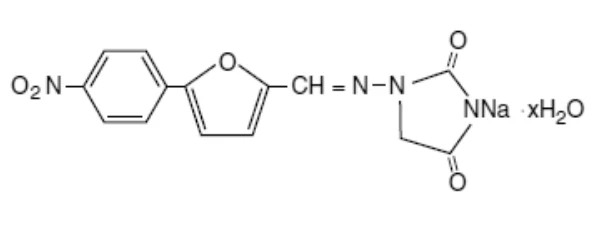
Physicochemical properties: orange powder, slightly soluble in water, but due to its slightly acidic nature, the solubility increases somewhat in alkaline solution.
14 CLINICAL TRIALS
The clinical trial data on which the original indication was authorized is not available.
15 MICROBIOLOGY
No microbiological information is required for this drug product.
16 NON-CLINICAL TOXICOLOGY
General Toxicology:
Because of the low drug concentration (0.5 mg/mL) requiring the administration of large volumes of fluid, acute toxicity of intravenous dantrolene sodium could not be assessed. In 14-day (subacute) studies, dantrolene sodium was relatively non-toxic to rats at doses of 10 and 20 mg/kg/day. While 10 mg/kg/day in dogs for 14 days evoked little toxicity, 20 mg/kg/day for 14 days caused hepatic changes of questionable biologic significance.
Carcinogenicity:
Lifetime tumorigenesis studies were conducted in Sprague-Dawley and Fischer 344 rats. The treated Sprague-Dawley rats received dantrolene sodium in the diet at levels of 15, 30, and 60 mg/kg daily for 18 months and the Fischer 344 rats received the same levels for 20 months. The animals subsequently were maintained on a standard diet until 90% of each treatment group died spontaneously. Dantrolene sodium produced in the female Sprague-Dawley rats a linear, dose-related increase in the number of rats with malignant neoplasms, and a decrease in the time of onset of mammary neoplasms. There were also increased incidence of benign hepatic tumours including lymphangiomas and bile duct cystadenomas, and angiosarcomas. In Fischer rats, there was a significant, dose-related reduction in the times of onset of mammary and testicular tumours.
A two-year tumorigenesis study was conducted in Swiss mice (CD®-1 HaM/ICR). Dantrolene sodium was fed to mice at levels of 15, 30, and 60 mg/kg/day for 15 months and then the mice were maintained on a standard diet for 9 additional months. There was an increased incidence of benign angiomatous neoplasms.
Genotoxicity:
Dantrolene sodium has produced positive results in the Ames S. Typhimurium bacterial mutagenesis assay in the presence and absence of a liver activating system.
Reproductive and Developmental Toxicology:
Dantrolene sodium administered to male and female rats at dose levels up to 45 mg/kg/day showed no adverse effects on fertility or general reproductive performance of adult animals.
In rabbits receiving 45 mg/kg/day during the period of organogenesis, there was a statistically significant increase in the frequency of pelvic ribs. In rats receiving 20 mg/kg/day, there was an increased frequency of pelvic ribs, and in rats receiving 60 mg/kg/day, there was suppression of fetal weight.