


Product Monograph - Darzalex
Recent Major Label Changes
| 2024-04 |
|---|---|
| 2025-12 |
Table of Contents
Certain sections or subsections that are not applicable at the time of the preparation of the most recent authorized product monograph are not listed.
Recent Major Label Changes ................................................................................................. 2
Table of Contents ................................................................................................................. 2
Part 1: Healthcare Professional Information.......................................................................... 4
- 1.
Indications ................................................................................................................ 4
1.1. Pediatrics ............................................................................................................ 4
1.2. Geriatrics ............................................................................................................ 4
- 2. Contraindications ...................................................................................................... 5
- 3. Serious Warnings and Precautions Box ...................................................................... 5
- 4.
Dosage and Administration ....................................................................................... 5
4.1. Dosing Considerations ....................................................................................... 5
4.2. Recommended Dose and Dosage Adjustment .................................................. 5
4.3. Reconstitution .................................................................................................... 9
4.4. Administration ................................................................................................... 9
4.5. Missed Dose ..................................................................................................... 13
- 5. Overdose ................................................................................................................ 13
- 6. Dosage Forms, Strengths, Composition, and Packaging ............................................ 14
- 7.
Warnings and Precautions ....................................................................................... 14
General ............................................................................................................................. 14
Hematologic ..................................................................................................................... 15
Immune ............................................................................................................................ 15
Infections ......................................................................................................................... 16
Monitoring and Laboratory Tests .................................................................................... 17
7.1. Special Populations .......................................................................................... 17
7.1.1. Pregnancy ......................................................................................................... 17
7.1.2. Breastfeeding ................................................................................................... 18
7.1.3. Pediatrics .......................................................................................................... 18
7.1.4. Geriatrics .......................................................................................................... 18
- 8.
Adverse Reactions ................................................................................................... 19
8.1. Adverse Reaction Overview ............................................................................. 19
8.2. Clinical Trial Adverse Reactions ....................................................................... 22
8.3. Less Common Clinical Trial Adverse Reactions ................................................ 40
8.4. Abnormal Laboratory Findings: Hematologic, Clinical Chemistry, and Other Quantitative Data ............................................................................................................. 46
8.5. Post-Market Adverse Reactions ....................................................................... 50
- 9.
Drug Interactions .................................................................................................... 50
9.2. Drug Interactions Overview ............................................................................. 50
9.3. Drug-Behaviour Interactions ............................................................................ 51
9.4. Drug-Drug Interactions .................................................................................... 51
9.5. Drug-Food Interactions .................................................................................... 51
9.6. Drug-Herb Interactions .................................................................................... 51
9.7. Drug-Laboratory Test Interactions................................................................... 51
- 10.
Clinical Pharmacology ............................................................................................. 52
10.1. Mechanism of Action ....................................................................................... 52
10.2. Pharmacodynamics .......................................................................................... 52
10.3. Pharmacokinetics ............................................................................................. 52
10.4. Immunogenicity ............................................................................................... 56
- 11. Storage, Stability, and Disposal ................................................................................ 56
- 12. Special Handling Instructions ................................................................................... 57
Part 2: Scientific Information .............................................................................................. 58
- 13. Pharmaceutical Information .................................................................................... 58
- 14.
Clinical Trials ........................................................................................................... 58
14.1. Clinical Trials by Indication .............................................................................. 58
Newly diagnosed multiple myeloma, ineligible for autologous stem cell transplant. .... 61
Multiple myeloma, received at least one prior therapy. ................................................. 69
Multiple myeloma, received one to three prior lines of therapy. ................................... 78
Multiple myeloma, received at least three prior lines of therapy including a proteasome inhibitor (PI) and an immunomodulatory agent (IMiD), or who are refractory to both a PI and an IMiD. ................................................................................................................. 81
- 15. Microbiology ........................................................................................................... 84
- 16. Non-Clinical Toxicology ........................................................................................... 84
Patient Medication Information ......................................................................................... 87
Part 1: Healthcare Professional Information
1. Indications
DARZALEX (daratumumab for injection) is indicated:
- in combination with bortezomib, thalidomide and dexamethasone for the treatment of patients with newly diagnosed multiple myeloma who are eligible for autologous stem cell transplant.
- in combination with lenalidomide and dexamethasone, or with bortezomib, melphalan and prednisone, for the treatment of patients with newly diagnosed multiple myeloma who are ineligible for autologous stem cell transplant.
- in combination with lenalidomide and dexamethasone, or bortezomib and dexamethasone, for the treatment of patients with multiple myeloma who have received at least one prior therapy.
- in combination with carfilzomib and dexamethasone for the treatment of patients with relapsed multiple myeloma who have received 1 to 3 prior lines of therapy.
for the treatment of patients with multiple myeloma who have received at least three prior lines of therapy including a proteasome inhibitor (PI) and an immunomodulatory agent (IMiD), or who are refractory to both a PI and an IMiD.
Marketing authorization was based on the primary efficacy endpoint of overall response rate demonstrated in a single-arm study. Progression-free survival and overall survival benefits cannot be characterized in a single-arm study (see 14. Clinical Trials).
1.1. Pediatrics
Pediatrics (< 18 years of age): No data are available to Health Canada; therefore, Health Canada has not authorized an indication for pediatric use.
1.2. Geriatrics
Geriatrics (≥65 years of age): No overall differences in effectiveness were observed between elderly and younger patients. Some differences in clinical safety have been identified between elderly and younger subjects (see 7.1.4. Geriatrics). No dose adjustments are considered necessary in elderly patients.
2. Contraindications
Darzalex is contraindicated for patients with a history of severe hypersensitivity to daratumumab or who are hypersensitive to any ingredient in the formulation or component of the container. For a complete listing, see 6. Dosage Forms, Strengths, Composition, and Packaging.
3. Serious Warnings and Precautions Box
- Darzalex can cause severe and/or serious infusion-related reactions. Early diagnosis and appropriate management are essential to minimize potential life-threatening complications. Patients should be monitored for signs and symptoms suggestive of immune-mediated adverse reactions (see 7. Warnings and Precautions and 4. Dosage and Administration for management guidelines for these adverse reactions).
4. Dosage and Administration
4.1. Dosing Considerations
- Darzalex should be administered by a healthcare professional with immediate access to emergency equipment and appropriate medical support to manage infusion-related reactions if they occur.
- Pre- and post-infusion medications should be administered (see 4.4. Administration).
- Administer only as an intravenous infusion after dilution (see 4.3. Reconstitution).
- Immunoglobulin levels should be monitored and local-treatment guidelines should be followed to manage hypogammaglobulinemia (see 7. Warnings and Precautions).
- Monitor patients for signs and symptoms of infections prior to and during treatment with Darzalex SC and treat appropriately according to local guidelines. Administer prophylactic antimicrobials according to local guidelines (see 7. Warnings and Precautions).
4.2. Recommended Dose and Dosage Adjustment
Combination therapy with bortezomib, thalidomide and dexamethasone (4-week cycle regimen)
The Darzalex dosing schedule in Table 1 is for combination therapy with bortezomib, thalidomide and dexamethasone (4-week cycle regimen) for patients with newly diagnosed multiple myeloma who are eligible for autologous stem cell transplant (ASCT).
The recommended dose of Darzalex is 16 mg/kg body weight administered as an intravenous infusion according to the following dosing schedule (Table 1):
Table 1: Darzalex dosing schedule in combination with bortezomib, thalidomide and dexamethasone ([VTd]; 4-week cycle dosing regimen)
| Treatment Phase | Weeks | Schedule | |
|---|---|---|---|
| Induction | Weeks 1 to 8 | weekly (total of 8 doses) | |
| Weeks 9 to 16a | every two weeks (total of 4 doses) | ||
| Stop for high dose chemotherapy and ASCT | |||
| Consolidation | Weeks 1 to 8b | every two weeks (total of 4 doses) | |
a First dose of the every-2-week dosing schedule is given at Week 9 b First dose of the every-2-week dosing schedule is given at Week 1 upon re-initiation of treatment following ASCT | |||
Bortezomib (1.3 mg/m2 body surface area) is given twice weekly for 2 weeks (Days 1, 4, 8, and 11) in each cycle. Thalidomide (100 mg) is given daily in each cycle. Dexamethasone (40 mg) is given on Days 1, 2, 8, 9, 15, 16, 22, and 23 of Cycles 1 and 2. For Cycles 3-4, dexamethasone is given at 40 mg on Days 1-2 and 20 mg on subsequent dosing days (Days 8, 9, 15, 16). Dexamethasone 20 mg is administered on Days 1, 2, 8, 9, 15, 16 in Cycles 5 and 6.
For more information on the VTd dose and dosing schedule when administered with Darzalex, see 14. Clinical Trials.
Combination therapy with lenalidomide and dexamethasone, and Monotherapy (4-week cycle regimens)
The Darzalex dosing schedule in Table 2 is for combination therapy with 4-week cycle regimens (e.g. lenalidomide) and for monotherapy as follows:
- combination therapy with lenalidomide and low-dose dexamethasone for patients with newly diagnosed multiple myeloma who are ineligible for ASCT.
- combination therapy with lenalidomide and low-dose dexamethasone for patients with multiple myeloma who have received at least one prior therapy.
- monotherapy for patients with multiple myeloma who have received at least three prior lines of therapy including a PI and an IMiD, or who are refractory to both a PI and an IMiD.
The recommended dose of Darzalex is 16 mg/kg body weight administered as an intravenous infusion according to the following dosing schedule (Table 2):
Table 2: Dosing schedule for Darzalex monotherapy and in combination with lenalidomide and dexamethasone (4-week cycle dosing regimens)
| Weeks | Schedule |
|---|---|
| Weeks 1 to 8 | weekly (total of 8 doses) |
| Weeks 9 to 24a | every two weeks (total of 8 doses) |
| Week 25 onwards until disease progressionb | every four weeks |
a First dose of the every 2-week-dosing schedule is given at Week 9 b First dose of the every 4-week-dosing schedule is given at Week 25 | |
For dosing instructions for medicinal products administered with Darzalex, see 14. Clinical Trials, and consult the corresponding Product Monographs.
Combination therapy with bortezomib, melphalan and prednisone (6-week cycle regimens)
The Darzalex dosing schedule in Table 3 is for combination therapy with bortezomib, melphalan and prednisone (6-week cycle regimen) for patients with newly diagnosed multiple myeloma ineligible for ASCT.
The recommended dose of Darzalex is 16 mg/kg body weight administered as an intravenous infusion according to the following dosing schedule (Table 3):
Table 3: Darzalex dosing schedule in combination with bortezomib, melphalan and prednisone ([VMP]; 6-week cycle dosing regimen)
| Weeks | Schedule |
|---|---|
| Weeks 1 to 6 | weekly (total of 6 doses) |
| Weeks 7 to 54a | every three weeks (total of 16 doses) |
| Week 55 onwards until disease progressionb | every four weeks |
| a First dose of the every-3-week dosing schedule is given at Week 7 b First dose of the every-4-week dosing schedule is given at Week 55 | |
Bortezomib is given twice weekly at Weeks 1, 2, 4 and 5 for the first 6-week cycle, followed by once weekly at Weeks 1, 2, 4 and 5 for eight more 6-week cycles. Melphalan (9 mg/m2) and prednisone (60 mg/m2) are given on days 1-4 of each cycle. For more information on the VMP dose and dosing schedule when administered with Darzalex, see 14. Clinical Trials.
Combination therapy with bortezomib and dexamethasone (3-week cycle regimens)
The Darzalex dosing schedule in Table 4 is for combination therapy with bortezomib and dexamethasone (3-week cycle regimen) for patients with multiple myeloma who have received at least one prior therapy.
The recommended dose of Darzalex is 16 mg/kg body weight administered as an intravenous infusion according to the following dosing schedule (Table 4):
Table 4: Dosing schedule for Darzalex with bortezomib and dexamethasone (3-week cycle dosing regimens)
| Weeks | Schedule |
|---|---|
| Weeks 1 to 9 | weekly (total of 9 doses) |
| Weeks 10 to 24a | every three weeks (total of 5 doses) |
| Week 25 onwards until disease progressionb | every four weeks |
a First dose of the every 3-week dosing schedule is given at Week 10 b First dose of the every 4-week dosing schedule is given at Week 25 | |
For dosing instructions for medicinal products administered with Darzalex, see 14. Clinical Trials, and consult the corresponding Product Monographs.
Combination therapy with carfilzomib and dexamethasone (4-week cycle regimen)
The Darzalex dosing schedule in Table 5 is for combination therapy with carfilzomib and dexamethasone (4-week cycle regimen) for patients with relapsed multiple myeloma who have received 1 to 3 prior lines of therapy.
The recommended dose of Darzalex is 16 mg/kg body weight administered as an intravenous infusion according to the following dosing schedule (Table 5):
Table 5: Dosing schedule for Darzalex with carfilzomib and dexamethasone ([Kd] 4-week cycle dosing regimens)
| Weeks | Darzalex Dosec | Schedule |
|---|---|---|
| Week 1 | 8 mg/kg | days 1 and 2 (total 2 doses) |
| Weeks 2 to 8 | 16 mg/kg | weekly (total of 7 doses) |
| Weeks 9 to 24a | 16 mg/kg | every two weeks (total of 8 doses) |
| Week 25 onwards until disease progressionb | 16 mg/kg | every four weeks |
a First dose of the every-2-week dosing schedule is given at Week 9 b First dose of the every-4-week dosing schedule is given at Week 25 c Based on actual body weight | ||
In the CANDOR Study of Darzalex in combination with carfilzomib and dexamethasone, carfilzomib was administered twice-weekly (20/56 mg/m2). For further details and dosing instructions for medicinal products administered with Darzalex, see 14. Clinical Trials, and consult the corresponding Product Monographs.
Dose modifications:
No dose reductions of Darzalex are recommended. Dose delay may be required to allow recovery of blood cell counts in the event of hematological toxicity (see 7. Warnings and Precautions). For information concerning medicinal products given in combination with Darzalex, consult the corresponding Product Monographs.
4.3. Reconstitution
Darzalex is administered as an intravenous infusion following dilution with 0.9% Sodium Chloride. See Table 6 and 4.4. Administration - Instructions for Use and Handling and Disposal.
After dilution: The diluted solution should be used immediately. If not used immediately, the solution may be stored in a refrigerator protected from light at 2°C-8°C for up to 24 hours prior to use, followed by 15 hours (including infusion time) at room temperature (15°C-25°C) and room light. See 11. Storage, Stability and Disposal.
4.4. Administration
It is very important that the instructions for preparation and administration provided in this section are strictly followed to minimize medication errors.
Darzalex is administered as an intravenous infusion following dilution with 0.9% Sodium Chloride. Darzalex should be intravenously administered at the appropriate initial infusion rate with incremental escalation as presented in Table 6.
For subsequent infusions, incremental escalation of the starting infusion rate or reduction in dilution volume should be considered only in the absence of infusion reactions (see Table 6).
To facilitate administration, the first 16 mg/kg dose at Week 1 may be split over two consecutive days, i.e. 8 mg/kg on Day 1 and 8 mg/kg on Day 2 (see Table 6 below).
Table 6: Infusion rates for Darzalex administration
| Dilution volume | Initial rate (first hour) | Rate Incrementa | Maximum rate | ||||
|---|---|---|---|---|---|---|---|
| Dilution volume | Initial rate (first hour) | Rate Incrementa | Maximum rate | ||||
| Week 1 Infusion | |||||||
| Option 1 (Single dose infusion) | |||||||
| Week 1 (16 mg/kg) | 1000 mL | 50 mL/hour | 50 mL/hour every hour | 200 mL/hour | |||
| Option 2 (Split dose infusion) | |||||||
| Week 1 Day 1 (8 mg/kg) | 500 mL | 50 mL/hour | 50 mL/hour every hour | 200 mL/hour | |||
| Week 1 Day 2 (8 mg/kg) | 500 mL | 50 mL/hour | 50 mL/hour every hour | 200 mL/hour | |||
| Week 2 (16 mg/kg) Infusionb | 500 mL | 50 mL/hour | 50 mL/hour every hour | 200 mL/hour | |||
| Subsequent (Week 3 onwards, 16 mg/kg) Infusionsc | 500 mL | 100 mL/hour | 50 mL/hour every hour | 200 mL/hour | |||
a Consider incremental escalation of the infusion rate only in the absence of infusion reactions (see Table 7). b Dilution volume of 500 mL for the 16 mg/kg dose should be used only if there were no infusion reactions the previous week. Otherwise, use a dilution volume of 1000 mL. c Use a modified initial rate (100 mL/hour) for subsequent infusions (i.e. Week 3 onwards) only if there were no infusion reactions during a final infusion rate of ≥100 mL/hour in the Week 1 and Week 2 infusions. Otherwise, continue to use instructions indicated in the table for the Week 2 infusion rate. | |||||||
Management of infusion-related reactions
Administer pre-infusion medications prior to treatment with Darzalex to reduce the risk of infusion-related reactions.
For infusion-related reactions of any grade/severity, immediately interrupt the Darzalex infusion, and manage symptoms.
Management of infusion-related reactions may require reduction in the rate of infusion, or treatment discontinuation of Darzalex as outlined in Table 7 (see 7. Warnings and Precautions).
Table 7: Infusion Rate Modification Guidelines for Infusion-Related Reactions
| Infusion-Related Reaction Grade | Infusion Rate Modification | |
| Infusion-Related Reaction Grade | Infusion Rate Modification | |
Grade 1-2 (mild to moderate) | Temporarily interrupt infusion and treat symptoms. Once the patient’s condition is stable and the reaction symptoms resolve, resume the infusion at no more than half the rate at which the reaction occurred. If the patient does not experience any further infusion-related reaction symptoms, infusion rate escalation may resume at increments and intervals as clinically appropriate up to the maximum rate of 200 mL/hour (see Table 6). | |
| Grade 3 (severe) | Temporarily interrupt infusion and treat symptoms. Once reaction symptoms resolve, consider restarting the infusion at no more than half the rate at which the reaction occurred. If the | |
| patient does not experience additional symptoms, resume infusion rate escalation at increments and intervals as appropriate (see Table 6). Repeat the procedure above in the event of recurrence of Grade 3 symptoms. Permanently discontinue Darzalex upon the third occurrence of a Grade 3 or greater infusion reaction. | ||
Grade 4 (life threatening) | Permanently discontinue Darzalex treatment. | |
Recommended Concomitant Medications:
Pre-infusion medication:
For all patients, to reduce the risk of infusion-related reactions administer pre-infusion medications approximately 1-3 hours prior to every infusion of Darzalex as follows:
Combination therapy:
- Administer 20 mg dexamethasone (or equivalent) prior to every Darzalex infusion. When dexamethasone is the background-regimen specific corticosteroid, the dexamethasone treatment dose will instead serve as pre-medication on Darzalex infusion days (see 14. Clinical Trials).
- Dexamethasone is given intravenously prior to the first Darzalex infusion and oral administration may be considered prior to subsequent infusions. Additional background regimen specific corticosteroids (e.g. prednisone) should not be taken on Darzalex infusion days when patients have received dexamethasone as a pre-medication.
- Antipyretics (oral paracetamol/acetaminophen 650 to 1000 mg).
- Antihistamine (oral or intravenous diphenhydramine 25 to 50 mg or equivalent).
Monotherapy:
- intravenous corticosteroid (methylprednisolone 100 mg, or equivalent dose of an intermediate-acting or long-acting corticosteroid) plus
- oral antipyretics (acetaminophen 650 to 1000 mg), plus
- oral or intravenous antihistamine (diphenhydramine 25 to 50 mg or equivalent).
Following the second infusion, the dose of corticosteroid may be reduced (e.g., methylprednisolone 60 mg IV).
Post-infusion medication:
Administer post-infusion medication to reduce the risk of delayed infusion reactions as follows:
Combination therapy:
Consider administering low-dose oral methylprednisolone (≤ 20 mg) or equivalent the day after the Darzalex infusion.
- However, if a background regimen-specific corticosteroid (e.g. dexamethasone or prednisone) is administered the day after the Darzalex infusion, additional post-infusion medications may not be needed (see 14. Clinical Trials).
Monotherapy:
- Administer oral corticosteroid (20 mg methylprednisolone or equivalent dose of a corticosteroid (intermediate or long-acting) in accordance with local standards) to patients the first and second day after each infusion (beginning the day after the infusion).
Additionally, for patients with a history of chronic obstructive pulmonary disease, consider the use of post-infusion medications including bronchodilators (short and long acting), and inhaled corticosteroids. Following the first four infusions, if the patient experiences no major infusion-related reactions, these inhaled post-infusion medications may be discontinued.
Prophylaxis for herpes zoster virus reactivation:
Anti-viral prophylaxis should be considered for the prevention of herpes zoster virus reactivation.
Instructions for Use and Handling and Disposal
The Darzalex vial is for single use only.
Prepare the solution for infusion using aseptic technique as follows:
- Calculate the dose (mg), total volume (mL) of Darzalex solution required and the number of Darzalex vials needed based on patient weight.
- Check that the Darzalex solution is colourless to yellow. Do not use if opaque particles, discoloration or other foreign particles are present.
- Using aseptic technique, remove a volume of 0.9% Sodium Chloride solution from the infusion bag/container that is equal to the required volume of Darzalex solution.
- Withdraw the necessary amount of Darzalex solution from the vials and dilute to the appropriate volume by adding to the infusion bag/container containing 0.9% Sodium Chloride. Infusion bags/containers must be made of polyvinylchloride (PVC), polypropylene (PP), polyethylene (PE) or polyolefin blend (PP+PE).
- Dilute under appropriate aseptic conditions.
- Discard any unused portion left in the vial.
- Gently invert the bag/container to mix the solution. Do not shake or freeze.
- Parenteral drug products should be inspected visually for particulate matter and discoloration prior to administration, whenever solution and container permit. The diluted solution may develop very small, translucent to white proteinaceous particles, as daratumumab is a protein. Do not use if visibly opaque particles, discoloration or foreign particles are observed.
- Since Darzalex does not contain a preservative, diluted solutions should be used within 15 hours (including infusion time) when kept at room temperature (15°C-25°C) and in room light.
- If not used immediately, the diluted solution can be stored prior to administration for up to 24 hours at refrigerated conditions (2°C-8°C) and protected from light. Do not freeze.
- Administer the diluted solution by intravenous infusion using an infusion set fitted with a flow regulator and with an in-line, sterile, non-pyrogenic, low protein-binding polyethersulfone (PES) filter (pore size 0.22 or 0.2 micrometre). Polyurethane (PU), polybutadiene (PBD), PVC, PP or PE administration sets must be used.
- Do not infuse Darzalex concomitantly in the same intravenous line with other agents.
- Do not store any unused portion of the infusion solution for reuse. Any unused product or waste material should be disposed of in accordance with local requirements.
4.5. Missed Dose
If a planned dose of Darzalex is missed, administer the dose as soon as possible and adjust the dosing schedule accordingly, maintaining the treatment interval.
5. Overdose
There is no information on overdosage with Darzalex.
There is no known specific antidote for Darzalex overdose. In the event of an overdose, the patient should be monitored for any signs or symptoms of adverse effects and appropriate symptomatic treatment be instituted immediately.
For the most recent information in the management of a suspected drug overdose, contact your regional poison control centre or Health Canada's toll-free number, 1-844 POISON-X (1-844-764-7669).
- 6. Dosage Forms, Strengths, Composition, and Packaging
To help ensure the traceability of biologic products, healthcare professionals should record both the brand name and the non-proprietary (active ingredient) name as well as other product-specific identifiers such as the Drug Identification Number (DIN) and the batch/lot number of the product supplied.
Table 8: Dosage Forms, Strengths, Composition and Packaging
Darzalex is supplied as a colourless to yellow preservative-free liquid concentrate for intravenous use. It is supplied in a Type 1 single-use glass vial. Each Darzalex 100 mg/5 mL or 400 mg/20 mL vial is individually packaged in a carton.
7. Warnings and Precautions
General
Darzalex (daratumumab for injection) should only be administered under the supervision of a healthcare professional experienced in the treatment of cancer.
Darzalex can be used in combination with other medications; therefore, the warnings and precautions applicable for use with those medications also apply to Darzalex combination therapy including the potential risk of fetal harm, the presence and transmission in sperm and blood, and prohibitions against blood and/or sperm donation. The prescribing information for all medications used in combination with Darzalex must be consulted before starting therapy. See 7.1.1. Pregnancy Women and 7.1.2. Breastfeeding.
Patients with Hereditary Fructose Intolerance (HFI)
Darzalex contains sorbitol (see 6. Dosage Forms, Strengths, Composition, and Packaging). Patients with HFI must not be given Darzalex unless necessary.
| Route of Administration | Dosage Form / Strength/Composition | Non-medicinal Ingredients |
| Intravenous (IV) infusion | Concentrate for solution for infusion 20 mg/mL | L-histidine, L-histidine hydrochloride monohydrate, L-methionine, polysorbate 20, sorbitol, water for injection. |
Hematologic
Neutropenia/Thrombocytopenia
When used in combination with background therapy, Darzalex increases the risk of neutropenia and thrombocytopenia (see 8. Adverse Reactions).
Monitor complete blood cell counts periodically during treatment according to manufacturer’s prescribing information for background therapies. Monitor patients with neutropenia for signs of infection. Darzalex dose delay may be required to allow recovery of blood cell counts (neutrophils or platelets). No dose reduction of Darzalex is recommended. Consider supportive care with transfusions or growth factors as needed.
Immune
Infusion-Related Reactions
Darzalex can cause severe and/or serious infusion-related reactions (IRRs), including anaphylactic reactions. These reactions can be life-threatening and fatal outcomes have been reported. See 3. Serious Warnings and Precautions Box.
In clinical trials, IRRs were reported in approximately 40% of all patients treated with Darzalex. The majority (82%) of infusion-related events occurred at the first infusion and most were Grade 1-2. IRRs can also occur with subsequent infusions. Four percent of patients had an IRR at more than one infusion. Fatal IRRs were not reported in these trials.
Reactions occurred during or after completing Darzalex infusion (see 8. Adverse Reactions). Most reactions occurred during infusion or within 4 hours of completing Darzalex. Prior to the introduction of post-infusion medication in clinical trials, IRRs occurred up to 48 hours after infusion.
Signs and symptoms may include respiratory symptoms, such as wheezing, larynx and throat tightness and irritation, laryngeal edema, pulmonary edema, and cytokine release syndrome. The most common (≥5%) symptoms were mostly mild to moderate in severity and included cough, and dyspnea. Other symptoms were nasal congestion, throat irritation, bronchospasm, chills, hypotension, headache, pyrexia, chest discomfort, wheezing, rash, urticaria, pruritus, allergic rhinitis, nausea, vomiting, and blurred vision. Severe IRRs (4.1%), including hypertension (1.2%), dyspnea (0.9%), bronchospasm (0.7%), hypoxia (0.5%), laryngeal edema (0.3%), and pulmonary edema (0.1%), were also reported (see 8. Adverse Reactions). There have also been rare reports of severe IRRs of myocardial infarction and ocular adverse reactions (including choroidal effusion, acute myopia and acute angle closure glaucoma). Patients should be monitored for symptoms of IRRs.
Pre-medicate patients with antihistamines, antipyretics and corticosteroids to reduce the risk of IRRs prior to treatment with Darzalex. Immediately interrupt Darzalex infusion for IRRs of any grade/severity and institute medical management or supportive treatment as needed. For patients with Grade 1, 2, or 3 reactions, interrupt Darzalex therapy and manage symptoms;
reduce the infusion rate when re-starting the infusion. If an anaphylactic reaction or life threatening (Grade 4) IRR occurs, permanently discontinue administration of Darzalex and institute appropriate emergency care (see 4.4. Administration - Management of infusion-related reactions).
To reduce the risk of delayed IRRs, administer oral corticosteroids to all patients after each infusion. Additionally, consider the use of post-infusion medications (e.g. inhaled corticosteroids, short and long acting bronchodilators) for patients with a history of chronic obstructive pulmonary disease to manage respiratory complications should they occur. Pre- and post-infusion medications may vary when Darzalex is used in combination therapy. If ocular symptoms occur, interrupt Darzalex infusion and seek immediate ophthalmologic evaluation prior to restarting Darzalex (see 4. Dosage and Administration).
Hypogammaglobulinemia
Hypogammaglobulinemia can occur in patients treated with Darzalex. Immunoglobulin levels should be monitored during treatment with Darzalex. In patients with low immunoglobulin levels, pre-emptive measures according to local guidelines such as infection precautions, antibiotic prophylaxis and immunoglobulin replacement should be considered.
Infections
Darzalex can cause serious, life-threatening, or fatal infections, with higher incidences reported in patients when Darzalex is used in combination with additional therapies including but not limited to proteasome inhibitors and immunomodulatory agents compared to patients treated with these additional therapies without Darzalex (see 8. Adverse Reactions). Monitor patients for signs and symptoms of infections prior to and during treatment with Darzalex and treat appropriately. Administer prophylactic antimicrobials according to guidelines prior to, during or post-treatment (See 4. Dosage and Administration).
Hepatitis B Virus Reactivation
Hepatitis B Virus (HBV) reactivation, in some cases fatal, has been reported in patients treated with Darzalex. HBV screening should be performed in all patients before initiation of treatment with Darzalex.
For patients with evidence of positive HBV serology, monitor for clinical and laboratory signs of HBV reactivation during, and for at least six months following the end of Darzalex treatment. Manage patients according to current clinical guidelines. Consider consulting a hepatitis disease expert as clinically indicated.
In patients who develop reactivation of HBV while on Darzalex, suspend treatment with Darzalex and any concomitant steroids, chemotherapy, and institute appropriate treatment. Resumption of Darzalex treatment in patients whose HBV reactivation is adequately controlled should be discussed with physicians with expertise in managing HBV.
Monitoring and Laboratory Tests
Interference with indirect antiglobulin test (indirect Coombs test)
Daratumumab binds to CD38 found at low levels on red blood cells (RBCs) and may result in a positive indirect Coombs test. Daratumumab-mediated positive indirect Coombs test may persist for up to 6 months after the last Darzalex infusion. Daratumumab bound to RBCs masks detection of antibodies to minor antigens in the patient’s serum (see 9. Drug Interactions). The determination of a patient’s ABO and Rhesus (Rh) blood type are not impacted.
Patient’s blood should be typed and screened prior to starting Darzalex. In the event of a planned transfusion notify blood transfusion centers of this interference with serological testing.
Interference with determination of complete response
Daratumumab is a human IgG kappa monoclonal antibody that can be detected on both the serum protein electrophoresis (SPE) and immunofixation (IFE) assays used for the clinical monitoring of endogenous M-protein. This interference can impact the determination of complete response and of disease progression in some patients with IgG kappa myeloma protein. In patients with persistent very good partial response, consider other methods to evaluate the depth of response (see 9. Drug Interactions).
7.1. Special Populations
7.1.1. Pregnancy
Risks of Darzalex use during pregnancy have not been assessed. Animal studies have not been conducted. However, immunoglobulin G1 (IgG1) monoclonal antibodies are known to transfer across the placenta. Mice that were genetically modified to eliminate all CD38 expression (CD38 knockout mice) had reduced bone density at birth that recovered by 5 months of age. In cynomolgus monkeys exposed during pregnancy to other monoclonal antibodies that affect leukocyte populations, infant monkeys had a reversible reduction in leukocytes.
Based on its mechanism of action, Darzalex may cause fetal myeloid or lymphoid-cell depletion and decreased bone density (see 16. Non-Clinical Toxicology).
Darzalex should not be used during pregnancy. If the patient becomes pregnant while taking this drug, the patient should be informed of the potential risk to the fetus. Defer administering live vaccines to neonates and infants exposed to Darzalex in utero until a hematology evaluation is completed.
Patients of childbearing potential should use effective contraception during treatment and for at least 3 months after cessation of Darzalex treatment.
In combination treatment, Darzalex is administered with other agents that can cause fetal harm. For example, lenalidomide and thalidomide can cause embryo-fetal harm and are contraindicated for use in pregnancy due to the potential for severe outcomes including severe life-threatening human birth defects. Refer to the Product Monographs for all other agents to be administered with Darzalex, depending on the specific combination therapy regimen, for requirements regarding contraception and for additional details.
7.1.2. Breastfeeding
It is not known whether daratumumab is excreted into human or animal milk or affects milk production. There are no studies to assess the effect of daratumumab on an infant who has received breast milk from a patient administered Darzalex.
Human IgG is excreted in breast milk. Because the risks of Darzalex to the infant are unknown, a decision should be made whether to discontinue feeding an infant breast milk (by breastfeeding or other means), or discontinue Darzalex therapy, taking into account the benefit for the child of receiving breast milk and/or breast feeding versus the benefits of Darzalex therapy for the patient.
Darzalex may be administered as part of a combination therapy regimen that includes but is not limited to proteasome inhibitors, immunomodulatory agents and cytotoxic chemotherapies. Therefore, serious adverse reactions may occur in infants receiving breast milk from a patient not only due to the presence of daratumumab but also from the additional therapies. This includes lenalidomide and thalidomide, which are teratogenic, and it is contraindicated to give an infant breastmilk from a patient treated with these immunomodulatory agents. Refer to the necessary Product Monographs for any additional therapies used in combination with Darzalex for identified and potential risks to infants receiving breast milk from a patient treated as part of a combination therapy regimen.
7.1.3. Pediatrics
Pediatrics (< 18 years of age): The safety and efficacy of Darzalex have not been established in pediatric patients.
7.1.4. Geriatrics
Geriatrics (≥ 65 years of age): No overall differences in effectiveness were observed between elderly and younger patients. Some differences in clinical safety have been identified between elderly and younger subjects (see 8.2. Clinical Trial Adverse Reactions -Special Population: Geriatrics). No dose adjustments are considered necessary in elderly patients.
In the CANDOR study 308 patients were treated with daratumumab in combination with carfilzomib (twice-weekly) and dexamethasone (DKd). Of these, 146 patients (47%) were ≥ 65 years of age and 28 patients (9%) were ≥ 75 years of age. The incidence of serious adverse events was 52% in patients < 65 years of age, 61% in patients 65 to 74 years of age, and 57% in patients ≥ 75 years of age. Fatal treatment-emergent adverse events (TEAEs) occurred in 6% of patients < 65 years of age and 14% of patients ≥ 65 years of age. In the Kd arm, fatal TEAEs occurred in 8% of patients < 65 years of age and 3% of patients ≥ 65 years of age (see 8.2. Clinical Trial Adverse Reactions -Special Population: Geriatrics). There are increased risks for cardiovascular events in patients ≥ 75 years of age compared with patients < 75 years of age when treated with DKd.
8. Adverse Reactions
8.1. Adverse Reaction Overview
Patients with newly diagnosed multiple myeloma who are eligible for autologous stem cell transplant (ASCT)
The safety of Darzalex in combination with bortezomib, thalidomide and dexamethasone (DVTd) was evaluated in a Phase 3, randomized, open label study in patients with newly diagnosed multiple myeloma (MMY3006; n=1074). The most frequently reported treatment-emergent adverse events [TEAEs] (≥20%) in the DVTd arm were: infusion-related reactions, peripheral sensory neuropathy, constipation, asthenia, upper respiratory tract infections, nausea, peripheral edema, neutropenia, pyrexia, paraesthesia, and thrombocytopenia. The overall incidence of serious TEAEs was 46.8% in the DVTd arm and 47.4% in the bortezomib, thalidomide and dexamethasone (VTd) arm. Serious TEAEs with a 2% higher incidence in the DVTd arm compared to the VTd arm included neutropenia (DVTd 3.9% vs VTd 1.5%) and pneumonia (DVTd 3.5% vs VTd 1.7%). Study treatment discontinuation due to an AE occurred in 7.5% of subjects in the DVTd group, and 8.4% in the VTd group.
Patients with newly diagnosed multiple myeloma who are ineligible for ASCT
The data described below reflect exposure to Darzalex in two Phase 3 active-controlled trials that included 710 patients with multiple myeloma treated with Darzalex at 16 mg/kg in combination with either lenalidomide and dexamethasone (DRd) [Study MMY3008; n=364] or bortezomib, melphalan, and dexamethasone (D-VMP) [Study MMY3007; n=346].
Patients who received Darzalex in combination with lenalidomide and dexamethasone
The safety of Darzalex in combination with lenalidomide and dexamethasone (DRd) was evaluated in a Phase 3, randomized, open-label study in patients with newly diagnosed multiple myeloma (MMY3008; n=729). The most frequently reported TEAEs (≥20%) in the DRd arm were: infusion-related reactions, diarrhea, neutropenia, constipation, fatigue, peripheral edema, anemia, back pain, asthenia, nausea, insomnia, muscle spasms, bronchitis, dyspnea, weight decreased, cough, peripheral sensory neuropathy, pyrexia, upper respiratory tract infection, pneumonia, decreased appetite, and hypokalemia. The overall incidence of serious TEAEs was 62.9% in the DRd arm and 62.7% in the Rd arm. Serious TEAEs with a 2% higher incidence in the DRd arm compared to the Rd arm were pneumonia (DRd 15.4% vs Rd 7.7%) and bronchitis (DRd 3.6% vs Rd 1.9%). Study treatment discontinuation due to an AE occurred in 7.4% of subjects in the DRd group, and 16.2% in the Rd group.
Patients who received Darzalex in combination with bortezomib, melphalan, and prednisone
The safety of Darzalex in combination with bortezomib, melphalan, and prednisone (D-VMP) was evaluated in a Phase 3, randomized, open-label study in patients with newly diagnosed multiple myeloma (MMY3007; n=700). The most frequently reported TEAEs (≥20%) in the D-VMP arm were: infusion-related reactions, neutropenia, thrombocytopenia, anemia, upper respiratory tract infection, pyrexia, diarrhea, nausea, and peripheral sensory neuropathy. The overall incidence of serious TEAEs was 41.6% in the D-VMP arm and 32.5% in the VMP arm. Serious TEAEs (≥2%) with at least a 2% higher incidence in the D-VMP arm compared to the VMP arm included infections (23.1% vs 11.9%), including pneumonia (D-VMP 10.1% vs VMP 3.1%). Study treatment discontinuation due to a TEAE occurred in 4.9% of subjects in the D-VMP group, and 9.0% in the VMP group.
Patients with multiple myeloma who have received at least one prior therapy
The data described below reflect exposure to Darzalex in two Phase 3 active-controlled trials that included 423 patients with multiple myeloma treated with Darzalex at 16 mg/kg in combination with either lenalidomide and dexamethasone (DRd) [Study MMY3003] or bortezomib and dexamethasone (DVd) [Study MMY3004].
Patients who received Darzalex in combination with lenalidomide and dexamethasone
The safety of Darzalex in combination with lenalidomide and dexamethasone was evaluated in a Phase 3, randomized, open-label study in patients with relapsed/refractory multiple myeloma after at least one prior therapy (n=569). In MMY3003, the most frequently reported TEAEs (≥20%) in the DRd arm were: infusion-related reactions, neutropenia, thrombocytopenia, anemia, diarrhea, constipation, upper respiratory tract infection, pneumonia, cough, dyspnea, nausea, fatigue, muscle spasms, insomnia, and pyrexia. The overall incidence of serious TEAEs was 54.1% in the DRd arm and 44.8% in the Rd arm. Serious TEAEs (≥2%) with at least a 2% higher incidence in the DRd arm compared to the Rd arm included infections (33.6% vs 23.8%) such as influenza (DRd 3.9% vs Rd 1.4%) and febrile neutropenia (DRd 4.2% vs Rd 1.4%). Study treatment discontinuation due to a TEAE occurred in 16.3% of subjects in the DRd group, and 13.9% in the Rd group. The most common TEAEs leading to study treatment discontinuation were pneumonia, septic shock and fatigue (each 1.4%), and general physical health deterioration (1.1%) in the DRd group, and pulmonary embolism (1.1%) in the Rd group.
Patients who received Darzalex in combination with bortezomib and dexamethasone
The safety of Darzalex in combination with bortezomib and dexamethasone was evaluated in a Phase 3, randomized, open-label clinical study in multiple myeloma patients (n=498) who had received at least one prior therapy. In Study MMY3004, the most frequently reported TEAEs (≥20%) for the DVd group were: infusion-related reactions, thrombocytopenia, anemia, peripheral sensory neuropathy, diarrhea, constipation, upper respiratory tract infection, cough, and fatigue. The overall incidence of serious TEAEs was 49% of patients in the DVd group and 34% in the Vd group. Serious TEAEs with at least a 2% higher incidence in the DVd arm compared to the Vd arm included anemia (DVd 3.3% vs Vd 0.4%), bronchitis (DVd 2.9% vs Vd 0.8%), thrombocytopenia (DVd 2.5% vs Vd 0.4%), atrial fibrillation (DVd 2.5% vs Vd 0%) and second primary malignancy (3.7% vs 0.4%). TEAEs resulting in treatment discontinuation occurred in 9.3% (n=22) of subjects in the DVd group, and 9.1% (n=22) in the Vd group.
Patients who received Darzalex in combination with carfilzomib and dexamethasone
The safety of Darzalex in combination with twice-weekly carfilzomib and dexamethasone (DKd) was evaluated in a Phase 3, randomized, open-label clinical study in multiple myeloma patients (n=461) who had received 1 to 3 prior lines of therapy (CANDOR study). The median duration of treatment for the DKd arm (n=308) was 68.14 weeks (range: 0.1 to 100.3 weeks) and 40.29 weeks (range: 0.3 to 97.3) for the Kd arm (n=153). In the CANDOR study, the most common adverse reactions (> 20%) in either treatment arm included: thrombocytopenia, anemia, diarrhea, fatigue, respiratory tract infection, cough, and hypertension. Serious adverse events were reported in 56% of the patients in the DKd arm and 46% of the patients in the Kd arm. The most common serious adverse reactions that occurred with ≥ 2% incidences in either treatment arm were: pneumonia, urinary tract infection, influenza, sepsis, pyrexia, pulmonary embolism, dyspnea, cardiac failure, acute kidney injury, anemia, and plasma cell myeloma. Grade ≥ 3 adverse events occurred in 82% of patients in the DKd arm as compared with 74% in the Kd arm. Discontinuation of any study treatment due to any adverse event occurred in 22% of patients in the DKd arm versus 25% in the Kd arm. The most common adverse reactions leading to discontinuation of any study drug were cardiac failure (n = 6, 2%) and fatigue (n = 6, 2%) in the DKd arm and cardiac failure (n = 3, 2%), hypertension (n = 3, 2%) and acute kidney injury (n = 3, 2%) in the Kd arm. The most common reaction leading to discontinuation of daratumumab was pneumonia (n = 4, 1%). The most common reactions leading to discontinuation of carfilzomib were cardiac failure (n = 6, 2%) and fatigue (n = 6, 2%) in the DKd arm and cardiac failure (n = 3, 2%), hypertension (n = 3, 2%) and acute kidney injury (n = 3, 2%) in the Kd arm. Additionally, deaths due to adverse events within 30 days of the last dose of any study treatment occurred in 30/308 (10%) patients in the DKd arm compared with 8/153 (5%) patients in the Kd arm. The most common causes of death occurring in patients (%) in the two arms (DKd vs. Kd) was infections 14 (5%) vs. 4 (3%). The risk of fatal treatment-emergent adverse events was higher among patients ≥ 65 years of age.
Patients with multiple myeloma who have received at least three prior lines of therapy including a PI and an IMiD, or who are refractory to both a PI and an IMiD
The data described below reflect exposure to Darzalex in three pooled open label clinical studies that included 156 patients with relapsed and refractory multiple myeloma treated with Darzalex at 16 mg/kg. The median duration of Darzalex treatment was 3.3 months (range: 0.03 to 41.5 months).
Infusion-related reactions were the most frequently observed TEAEs and occurred in 48% of patients treated at 16 mg/kg.
Other frequently reported (≥20%) adverse events included fatigue, pyrexia, upper respiratory tract infection, nausea, back pain, cough, anemia, neutropenia and thrombocytopenia.
Grade 3 or 4 TEAEs were reported for 57.1% of patients. The most commonly reported Grade 3 or 4 TEAEs (≥10%) were anemia (17%, all Grade 3), thrombocytopenia (8.3% Grade 3, 5.8% Grade 4), and neutropenia (9.6% Grade 3, 2.6% Grade 4).
The most common (≥ 2%) serious TEAEs were pneumonia (6%), general physical health deterioration, hypercalcemia and pyrexia (each at 3%), cross-match incompatible and herpes zoster (each at 2%). Four percent of patients discontinued Darzalex treatment due to an adverse event. The adverse events leading to discontinuation were general physical health deterioration, H1N1 influenza, hypercalcemia, pneumonia, and spinal cord compression. The median time to discontinuation was 21.5 days (1.0, 106.0). Adverse events leading to treatment delay were observed in 25 (16.0%) of patients, and the most frequent adverse event was infections, reported in 14 (9.0%) patients.
8.2. Clinical Trial Adverse Reactions
Clinical trials are conducted under very specific conditions. The adverse reaction rates observed in the clinical trials; therefore, may not reflect the rates observed in practice and should not be compared to the rates in the clinical trials of another drug. Adverse reaction information from clinical trials may be useful in identifying and approximating rates of adverse drug reactions in real-world use.
Patients with newly diagnosed multiple myeloma who are eligible for ASCT
Study MMY3006: Darzalex in combination with bortezomib, thalidomide and dexamethasone
TEAEs described in Table 9 reflect exposure to Darzalex in combination with bortezomib, thalidomide and dexamethasone (DVTd) up to day 100 post-transplant. The median duration of induction/ASCT/consolidation treatment was 8.9 months (range: 7.0 to 12.0 months) for the DVTd group and 8.7 months (range: 6.4 to 11.5 months) for the bortezomib, thalidomide and dexamethasone (VTd) group.
Infusion-related reactions (including terms determined by investigators to be related to infusion; see Infusion-related Reactions (IRRs) from Pooled Clinical Studies) were reported in 35.4% of patients in the DVTd group.
Table 9: Number of Subjects With 1 or More Treatment-emergent Adverse Events (≥ 5% in Patients Treated with DVTd) by MedDRA System-Organ Class, Grouping of Preferred Terms and Toxicity Grade; Safety Analysis Set (Study 54767414MMY3006)
| Induction/ASCT/Consolidation | |||||||||||||||||
| Induction/ASCT/Consolidation | |||||||||||||||||
| VTd | DVTd | ||||||||||||||||
| VTd | DVTd | ||||||||||||||||
| All Grades n (%) | Grade 3 or 4 n (%) | All Grades n (%) | Grade 3 or 4 n (%) | ||||||||||||||
| All Grades n (%) | Grade 3 or 4 n (%) | All Grades n (%) | Grade 3 or 4 n (%) | ||||||||||||||
| Analysis set: safety | 538 | 536 | |||||||||||||||
| MedDRA system organ class / preferred term | |||||||||||||||||
| Blood and lymphatic system disorders | |||||||||||||||||
| Neutropeniaa | 119 (22.1%) | 109 (20.3%) | 179 (33.4%) | 170 (31.7%) | |||||||||||||
| Thrombocytopenia | 73 (13.6%) | 40 (7.4%) | 109 (20.3%) | 59 (11.0%) | |||||||||||||
| Lymphopenia | 67 (12.5%) | 52 (9.7%) | 99 (18.5%) | 91 (17.0%) | |||||||||||||
| Anaemia | 81 (15.1%) | 22 (4.1%) | 73 (13.6%) | 17 (3.2%) | |||||||||||||
| Leukopenia | 15 (2.8%) | 13 (2.4%) | 27 (5.0%) | 18 (3.4%) | |||||||||||||
| Ear and labyrinth disorders | |||||||||||||||||
| Vertigo | 44 (8.2%) | 1 (0.2%) | 40 (7.5%) | 0 | |||||||||||||
| Gastrointestinal disorders | |||||||||||||||||
| Constipation | 262 (48.7%) | 7 (1.3%) | 272 (50.7%) | 7 (1.3%) | |||||||||||||
| Nausea | 130 (24.2%) | 12 (2.2%) | 162 (30.2%) | 21 (3.9%) | |||||||||||||
| Diarrhoea | 89 (16.5%) | 10 (1.9%) | 103 (19.2%) | 20 (3.7%) | |||||||||||||
| Vomiting | 52 (9.7%) | 9 (1.7%) | 87 (16.2%) | 12 (2.2%) | |||||||||||||
| Stomatitis | 104 (19.3%) | 88 (16.4%) | 86 (16.0%) | 68 (12.7%) | |||||||||||||
| Abdominal pain | 22 (4.1%) | 4 (0.7%) | 36 (6.7%) | 2 (0.4%) | |||||||||||||
| Abdominal pain upper | 29 (5.4%) | 2 (0.4%) | 32 (6.0%) | 1 (0.2%) | |||||||||||||
| Dry mouth | 20 (3.7%) | 0 | 27 (5.0%) | 0 | |||||||||||||
| General disorders and administration site conditions | |||||||||||||||||
| Oedema peripheralb | 155 (28.8%) | 7 (1.3%) | 172 (32.1%) | 3 (0.6%) | |||||||||||||
| Asthenia | 155 (28.8%) | 6 (1.1%) | 171 (31.9%) | 7 (1.3%) | |||||||||||||
| Pyrexia | 114 (21.2%) | 12 (2.2%) | 140 (26.1%) | 14 (2.6%) | |||||||||||||
| Fatigue | 86 (16.0%) | 5 (0.9%) | 70 (13.1%) | 1 (0.2%) | |||||||||||||
| Chills | 22 (4.1%) | 0 | 47 (8.8%) | 0 | |||||||||||||
| Malaise | 24 (4.5%) | 3 (0.6%) | 36 (6.7%) | 2 (0.4%) | |||||||||||||
| Influenza like illness | 29 (5.4%) | 0 | 33 (6.2%) | 0 | |||||||||||||
| Injection site erythema | 28 (5.2%) | 0 | 32 (6.0%) | 0 | |||||||||||||
| Immune system disorders | |||||||||||||||||
| Hypogammaglobulinaemia | 19 (3.5%) | 2 (0.4%) | 36 (6.7%) | 1 (0.2%) | |||||||||||||
| Infections and infestations | |||||||||||||||||
| Upper respiratory tract infectionc | 91 (16.9%) | 3 (0.6%) | 147 (27.4%) | 3 (0.6%) | |||||||||||||
| Bronchitisd | 68 (12.6%) | 6 (1.1%) | 105 (19.6%) | 8 (1.5%) | |||||||||||||
| Pneumoniae | 38 (7.1%) | 23 (4.3%) | 58 (10.8%) | 25 (4.7%) | |||||||||||||
| Sepsisf | 35 (6.5%) | 33 (6.1%) | 44 (8.2%) | 37 (6.9%) | |||||||||||||
| Investigations | |||||||||||||||||
| Weight decreased | 34 (6.3%) | 1 (0.2%) | 33 (6.2%) | 1 (0.2%) | |||||||||||||
| Metabolism and nutrition disorders | |||||||||||||||||
| Decreased appetite | 36 (6.7%) | 5 (0.9%) | 39 (7.3%) | 6 (1.1%) | |||||||||||||
| Hypokalaemia | 19 (3.5%) | 2 (0.4%) | 30 (5.6%) | 5 (0.9%) | |||||||||||||
| Musculoskeletal and connective tissue disorders | |||||||||||||||||
| Bone pain | 82 (15.2%) | 9 (1.7%) | 70 (13.1%) | 11 (2.1%) | |||||||||||||
| Back pain | 55 (10.2%) | 9 (1.7%) | 59 (11.0%) | 14 (2.6%) | |||||||||||||
| Pain in extremity | 42 (7.8%) | 1 (0.2%) | 37 (6.9%) | 1 (0.2%) | |||||||||||||
| Myalgia | 30 (5.6%) | 2 (0.4%) | 33 (6.2%) | 0 | |||||||||||||
| Muscle spasms | 35 (6.5%) | 0 | 29 (5.4%) | 0 | |||||||||||||
| Nervous system disorders | |||||||||||||||||
| Peripheral sensory neuropathy | 340 (63.2%) | 46 (8.6%) | 314 (58.6%) | 47 (8.8%) | |||||||||||||
| Paraesthesia | 108 (20.1%) | 6 (1.1%) | 118 (22.0%) | 4 (0.7%) | |||||||||||||
| Tremor | 58 (10.8%) | 2 (0.4%) | 71 (13.2%) | 2 (0.4%) | |||||||||||||
| Dysgeusia | 34 (6.3%) | 0 | 49 (9.1%) | 0 | |||||||||||||
| Headache | 43 (8.0%) | 2 (0.4%) | 42 (7.8%) | 1 (0.2%) | |||||||||||||
| Dizziness | 32 (5.9%) | 0 | 34 (6.3%) | 1 (0.2%) | |||||||||||||
| Psychiatric disorders | |||||||||||||||||
| Insomnia | 78 (14.5%) | 3 (0.6%) | 61 (11.4%) | 4 (0.7%) | |||||||||||||
| Anxiety | 46 (8.6%) | 4 (0.7%) | 58 (10.8%) | 4 (0.7%) | |||||||||||||
| Respiratory, thoracic and mediastinal disorders | |||||||||||||||||
| Dyspnoeag | 88 (16.4%) | 5 (0.9%) | 101 (18.8%) | 9 (1.7%) | |||||||||||||
| Coughh | 49 (9.1%) | 0 | 91 (17.0%) | 0 | |||||||||||||
| Rhinorrhoea | 25 (4.6%) | 0 | 45 (8.4%) | 0 | |||||||||||||
| Skin and subcutaneous tissue disorders | |||||||||||||||||
| Rash | 67 (12.5%) | 1 (0.2%) | 86 (16.0%) | 4 (0.7%) | |||||||||||||
| Erythema | 47 (8.7%) | 1 (0.2%) | 61 (11.4%) | 0 | |||||||||||||
| Dry skin | 31 (5.8%) | 0 | 27 (5.0%) | 1 (0.2%) | |||||||||||||
| Vascular disorders | |||||||||||||||||
| Venous and embolic thrombotic eventsi | 64 (11.9%) | 29 (5.4%) | 61 (11.4%) | 18 (3.4%) | |||||||||||||
| Hypertension | 29 (5.4%) | 12 (2.2%) | 51 (9.5%) | 22 (4.1%) | |||||||||||||
| VTd = bortezomib (VELCADE) + thalidomide + dexamethasone; DVTd = daratumumab + bortezomib (VELCADE) + thalidomide + dexamethasone. aAgranulocytosis, Febrile neutropenia, Neutropenia, Neutropenic infection bGeneralised oedema, Oedema, Oedema peripheral, Peripheral swelling cLaryngitis, Laryngitis viral, Metapneumovirus infection, Nasopharyngitis, Oropharyngeal candidiasis, Pharyngitis, Respiratory syncytial virus infection, Respiratory tract infection, Respiratory tract infection viral, Rhinitis, Rhinovirus infection, Sinusitis, Tonsillitis, Tracheitis, Upper respiratory tract infection, Viral pharyngitis, Viral rhinitis, Viral upper respiratory tract infection dBronchiolitis, Bronchitis, Bronchitis chronic, Respiratory syncytial virus bronchitis, Tracheobronchitis eBronchopulmonary aspergillosis, Idiopathic interstitial pneumonia, Lung infection, Pneumocystis jirovecii infection, Pneumocystis jirovecii pneumonia, Pneumonia, Pneumonia aspiration, Pneumonia bacterial, Pneumonia haemophilus, Pneumonia legionella, Pneumonia parainfluenzae viral, Pneumonia pseudomonal, Pneumonia respiratory syncytial viral, Pneumonia staphylococcal, Pneumonia streptococcal, Pneumonia viral, Pulmonary mycosis fBacterial sepsis, Device related sepsis, Enterococcal sepsis, Escherichia sepsis, Intestinal sepsis, Klebsiella sepsis, Pneumococcal sepsis, Pseudomonal sepsis, Pulmonary sepsis, Salmonella sepsis, Sepsis, Septic shock, Staphylococcal sepsis, Streptococcal sepsis, Urosepsis, Viral sepsis gDyspnoea, Dyspnoea exertional hCough, Productive cough iAxillary vein thrombosis, Brachiocephalic vein thrombosis, Deep vein thrombosis, Jugular vein thrombosis, Ophthalmic vein thrombosis, Post thrombotic syndrome, Pulmonary embolism, Retinal vein occlusion, Thrombophlebitis, Thrombophlebitis superficial, Vena cava thrombosis, Venous thrombosis, Venous thrombosis limb Note: Adverse events are reported using MedDRA version 20.0. Note: Percentages are calculated with the number of subjects in each group as denominator. | |||||||||||||||||
Patients with newly diagnosed multiple myeloma who are ineligible for ASCT
Study MMY3008: Darzalex in combination with lenalidomide and dexamethasone
TEAEs described in Table 10 reflect exposure to Darzalex in combination with lenalidomide and dexamethasone (DRd) for a median treatment duration of 25.3 months (range: 0.1 to 40.44 months) and a median treatment duration of 21.3 months (range: 0.03 to 40.64 months) for the lenalidomide-dexamethasone group (Rd).
Infusion-related reactions (including terms determined by investigators to be related to infusion; see Infusion-related Reactions (IRRs) from Pooled Clinical Studies) were reported in 40.9% of patients in the DRd group.
Table 10: Number of Subjects With 1 or More Treatment-emergent Adverse Events ( ≥ 5% in Patients Treated with DRd) by MedDRA System-Organ Class, Grouping of Preferred Terms and Toxicity Grade; Safety Analysis Set (Study 54767414MMY3008)
| Rd | DRd | |||||||||||||||
| Rd | DRd | |||||||||||||||
| Rd | DRd | |||||||||||||||
| All Grades n (%) | Grade 3 or 4 n (%) | All Grades n (%) | Grade 3 or 4 n (%) | |||||||||||||
| All Grades n (%) | Grade 3 or 4 n (%) | All Grades n (%) | Grade 3 or 4 n (%) | |||||||||||||
| All Grades n (%) | Grade 3 or 4 n (%) | All Grades n (%) | Grade 3 or 4 n (%) | |||||||||||||
| Analysis set: safety | 365 | 364 | ||||||||||||||
| MedDRA system organ class / preferred term | ||||||||||||||||
| Blood and lymphatic system disorders | ||||||||||||||||
| Neutropeniaa | 156 (42.7%) | 131 (35.9%) | 208 (57.1%) | 183 (50.3%) | ||||||||||||
| Anaemiab | 140 (38.4%) | 72 (19.7%) | 130 (35.7%) | 43 (11.8%) | ||||||||||||
| Leukopenia | 34 (9.3%) | 18 (4.9%) | 68 (18.7%) | 40 (11.0%) | ||||||||||||
| Thrombocytopenia | 69 (18.9%) | 32 (8.8%) | 68 (18.7%) | 27 (7.4%) | ||||||||||||
| Lymphopenia | 45 (12.3%) | 39 (10.7%) | 66 (18.1%) | 55 (15.1%) | ||||||||||||
| Cardiac disorders | ||||||||||||||||
| Atrial fibrillation | 37 (10.1%) | 11 (3.0%) | 23 (6.3%) | 10 (2.7%) | ||||||||||||
| Eye disorders | ||||||||||||||||
| Cataract | 59 (16.2%) | 29 (7.9%) | 54 (14.8%) | 26 (7.1%) | ||||||||||||
| Vision blurred | 16 (4.4%) | 0 | 26 (7.1%) | 0 | ||||||||||||
| Gastrointestinal disorders | ||||||||||||||||
| Diarrhoea | 168 (46.0%) | 15 (4.1%) | 207 (56.9%) | 24 (6.6%) | ||||||||||||
| Constipation | 130 (35.6%) | 1 (0.3%) | 149 (40.9%) | 6 (1.6%) | ||||||||||||
| Nausea | 84 (23.0%) | 2 (0.5%) | 115 (31.6%) | 5 (1.4%) | ||||||||||||
| Vomiting | 45 (12.3%) | 1 (0.3%) | 61 (16.8%) | 2 (0.5%) | ||||||||||||
| Abdominal pain | 33 (9.0%) | 1 (0.3%) | 43 (11.8%) | 5 (1.4%) | ||||||||||||
| Abdominal pain upper | 28 (7.7%) | 0 | 34 (9.3%) | 1 (0.3%) | ||||||||||||
| Dyspepsia | 28 (7.7%) | 1 (0.3%) | 26 (7.1%) | 1 (0.3%) | ||||||||||||
| Stomatitis | 13 (3.6%) | 0 | 22 (6.0%) | 2 (0.5%) | ||||||||||||
| General disorders and administration site conditions | ||||||||||||||||
| Oedema peripheralc | 122 (33.4%) | 2 (0.5%) | 151 (41.5%) | 7 (1.9%) | ||||||||||||
| Fatigue | 104 (28.5%) | 14 (3.8%) | 147 (40.4%) | 29 (8.0%) | ||||||||||||
| Asthenia | 90 (24.7%) | 13 (3.6%) | 117 (32.1%) | 16 (4.4%) | ||||||||||||
| Pyrexia | 65 (17.8%) | 9 (2.5%) | 84 (23.1%) | 8 (2.2%) | ||||||||||||
| Chills | 6 (1.6%) | 0 | 46 (12.6%) | 0 | ||||||||||||
| Non-cardiac chest pain | 16 (4.4%) | 5 (1.4%) | 20 (5.5%) | 4 (1.1%) | ||||||||||||
| Infections and infestations | ||||||||||||||||
| Upper respiratory tract infectiond | 133 (36.4%) | 8 (2.2%) | 190 (52.2%) | 9 (2.5%) | ||||||||||||
| Bronchitise | 75 (20.5%) | 5 (1.4%) | 106 (29.1%) | 10 (2.7%) | ||||||||||||
| Pneumoniaf | 52 (14.2%) | 31 (8.5%) | 93 (25.5%) | 57 (15.7%) | ||||||||||||
| Urinary tract infection | 38 (10.4%) | 8 (2.2%) | 64 (17.6%) | 9 (2.5%) | ||||||||||||
| Influenza | 21 (5.8%) | 6 (1.6%) | 34 (9.3%) | 8 (2.2%) | ||||||||||||
| Gastroenteritis | 15 (4.1%) | 0 | 19 (5.2%) | 0 | ||||||||||||
| Lower respiratory tract infection | 23 (6.3%) | 10 (2.7%) | 19 (5.2%) | 9 (2.5%) | ||||||||||||
| Injury, poisoning and procedural complications | ||||||||||||||||
| Contusion | 22 (6.0%) | 0 | 27 (7.4%) | 0 | ||||||||||||
| Investigations | ||||||||||||||||
| Weight decreased | 63 (17.3%) | 9 (2.5%) | 101 (27.7%) | 9 (2.5%) | ||||||||||||
| Weight increased | 6 (1.6%) | 1 (0.3%) | 25 (6.9%) | 1 (0.3%) | ||||||||||||
| Blood creatinine increased | 15 (4.1%) | 1 (0.3%) | 24 (6.6%) | 0 | ||||||||||||
| Metabolism and nutrition disorders | ||||||||||||||||
| Decreased appetite | 55 (15.1%) | 2 (0.5%) | 80 (22.0%) | 3 (0.8%) | ||||||||||||
| Hypokalaemia | 61 (16.7%) | 32 (8.8%) | 75 (20.6%) | 32 (8.8%) | ||||||||||||
| Hyperglycaemia | 28 (7.7%) | 14 (3.8%) | 50 (13.7%) | 26 (7.1%) | ||||||||||||
| Hypocalcaemia | 32 (8.8%) | 8 (2.2%) | 50 (13.7%) | 6 (1.6%) | ||||||||||||
| Dehydration | 17 (4.7%) | 1 (0.3%) | 25 (6.9%) | 8 (2.2%) | ||||||||||||
| Hyponatraemia | 13 (3.6%) | 9 (2.5%) | 19 (5.2%) | 9 (2.5%) | ||||||||||||
| Hypophosphataemia | 7 (1.9%) | 3 (0.8%) | 19 (5.2%) | 10 (2.7%) | ||||||||||||
| Musculoskeletal and connective tissue disorders | ||||||||||||||||
| Back pain | 96 (26.3%) | 11 (3.0%) | 123 (33.8%) | 11 (3.0%) | ||||||||||||
| Muscle spasms | 79 (21.6%) | 4 (1.1%) | 107 (29.4%) | 2 (0.5%) | ||||||||||||
| Arthralgia | 64 (17.5%) | 5 (1.4%) | 70 (19.2%) | 3 (0.8%) | ||||||||||||
| Pain in extremity | 50 (13.7%) | 0 | 60 (16.5%) | 4 (1.1%) | ||||||||||||
| Musculoskeletal pain | 40 (11.0%) | 1 (0.3%) | 51 (14.0%) | 1 (0.3%) | ||||||||||||
| Bone pain | 36 (9.9%) | 7 (1.9%) | 37 (10.2%) | 5 (1.4%) | ||||||||||||
| Muscular weakness | 23 (6.3%) | 4 (1.1%) | 33 (9.1%) | 6 (1.6%) | ||||||||||||
| Musculoskeletal chest pain | 43 (11.8%) | 3 (0.8%) | 27 (7.4%) | 3 (0.8%) | ||||||||||||
| Myalgia | 25 (6.8%) | 0 | 25 (6.9%) | 3 (0.8%) | ||||||||||||
| Neck pain | 26 (7.1%) | 0 | 21 (5.8%) | 0 | ||||||||||||
| Nervous system disorders | ||||||||||||||||
| Peripheral sensory neuropathy | 54 (14.8%) | 0 | 87 (23.9%) | 5 (1.4%) | ||||||||||||
| Dizziness | 58 (15.9%) | 1 (0.3%) | 69 (19.0%) | 3 (0.8%) | ||||||||||||
| Headache | 39 (10.7%) | 0 | 69 (19.0%) | 2 (0.5%) | ||||||||||||
| Paraesthesia | 30 (8.2%) | 0 | 58 (15.9%) | 0 | ||||||||||||
| Tremor | 51 (14.0%) | 1 (0.3%) | 57 (15.7%) | 0 | ||||||||||||
| Dysgeusia | 35 (9.6%) | 0 | 40 (11.0%) | 0 | ||||||||||||
| Hypoaesthesia | 16 (4.4%) | 0 | 19 (5.2%) | 0 | ||||||||||||
| Psychiatric disorders | ||||||||||||||||
| Insomnia | 107 (29.3%) | 11 (3.0%) | 109 (29.9%) | 9 (2.5%) | ||||||||||||
| Anxiety | 34 (9.3%) | 4 (1.1%) | 32 (8.8%) | 2 (0.5%) | ||||||||||||
| Depression | 32 (8.8%) | 4 (1.1%) | 30 (8.2%) | 2 (0.5%) | ||||||||||||
| Confusional state | 20 (5.5%) | 2 (0.5%) | 23 (6.3%) | 7 (1.9%) | ||||||||||||
| Renal and urinary disorders | ||||||||||||||||
| Acute kidney injury | 28 (7.7%) | 11 (3.0%) | 28 (7.7%) | 14 (3.8%) | ||||||||||||
| Renal impairment | 28 (7.7%) | 8 (2.2%) | 26 (7.1%) | 3 (0.8%) | ||||||||||||
| Chronic kidney disease | 18 (4.9%) | 9 (2.5%) | 22 (6.0%) | 9 (2.5%) | ||||||||||||
| Respiratory, thoracic and mediastinal disorders | ||||||||||||||||
| Dyspnoeag | 74 (20.3%) | 4 (1.1%) | 116 (31.9%) | 13 (3.6%) | ||||||||||||
| Coughh | 65 (17.8%) | 0 | 111 (30.5%) | 1 (0.3%) | ||||||||||||
| Dysphonia | 18 (4.9%) | 0 | 27 (7.4%) | 0 | ||||||||||||
| Rhinorrhoea | 11 (3.0%) | 0 | 25 (6.9%) | 0 | ||||||||||||
| Oropharyngeal pain | 9 (2.5%) | 0 | 24 (6.6%) | 0 | ||||||||||||
| Pulmonary embolism | 20 (5.5%) | 19 (5.2%) | 19 (5.2%) | 19 (5.2%) | ||||||||||||
| Skin and subcutaneous tissue disorders | ||||||||||||||||
| Rash | 43 (11.8%) | 1 (0.3%) | 57 (15.7%) | 4 (1.1%) | ||||||||||||
| Pruritus | 29 (7.9%) | 0 | 32 (8.8%) | 0 | ||||||||||||
| Dry skin | 14 (3.8%) | 0 | 25 (6.9%) | 0 | ||||||||||||
| Erythema | 18 (4.9%) | 0 | 23 (6.3%) | 0 | ||||||||||||
| Rash maculo-papular | 9 (2.5%) | 4 (1.1%) | 21 (5.8%) | 1 (0.3%) | ||||||||||||
| Hyperhidrosis | 5 (1.4%) | 0 | 19 (5.2%) | 0 | ||||||||||||
| Vascular disorders | ||||||||||||||||
| Hypertensioni | 26 (7.1%) | 13 (3.6%) | 48 (13.2%) | 24 (6.6%) | ||||||||||||
| Hypotension | 33 (9.0%) | 3 (0.8%) | 36 (9.9%) | 3 (0.8%) | ||||||||||||
| Deep vein thrombosis | 35 (9.6%) | 8 (2.2%) | 31 (8.5%) | 7 (1.9%) | ||||||||||||
| Key: Rd = lenalidomide-dexamethasone; DRd = daratumumab-lenalidomide-dexamethasone; TEAE = treatment-emergent adverse event. a “Neutropenia” includes Febrile neutropenia, Neutropenia, Neutropenic infection, Neutropenic sepsis b “Anaemia” includes Anaemia, Anaemia macrocytic, Haematocrit decreased, Iron deficiency anaemia, Microcytic anaemia c “Oedema peripheral” includes Generalised oedema, Gravitational oedema, Oedema, Oedema peripheral, Peripheral swelling d “Upper respiratory tract infection” includes Acute sinusitis, Bacterial rhinitis, Laryngitis, Metapneumovirus infection, Nasopharyngitis, Oropharyngeal candidiasis, Pharyngitis, Respiratory syncytial virus infection, Respiratory tract infection, Respiratory tract infection viral, Rhinitis, Rhinovirus infection, Sinusitis, Tonsillitis, Tracheitis, Upper respiratory tract infection, Viral pharyngitis, Viral rhinitis, Viral upper respiratory tract infection e “Bronchitis” includes Bronchiolitis, Bronchitis, Bronchitis viral, Respiratory syncytial virus bronchiolitis, Tracheobronchitis f “Pneumonia” includes Atypical pneumonia, Bronchopulmonary aspergillosis, Lung infection, Pneumocystis jirovecii infection, Pneumocystis jirovecii pneumonia, Pneumonia, Pneumonia aspiration, Pneumonia pneumococcal, Pneumonia viral, Pulmonary mycosis g “Dyspnoea” includes Dyspnoea, Dyspnoea exertional h “Cough” includes Cough, Productive cough i “Hypertension” includes Blood pressure increased, Hypertension Note: Adverse events are reported using MedDRA version 20.0. Note: Percentages are calculated with the number of subjects in each group as denominator. | ||||||||||||||||
Study MMY3007: Darzalex in combination with bortezomib, melphalan, and prednisone
TEAEs described in Table 11 reflect exposure to Darzalex in combination with bortezomib, melphalan, and prednisone (D-VMP) for a median treatment duration of 14.7 months (range: 0 to 25.8 months) and a median treatment duration of 12 months (range: 0.1 to 14.8 months) for the bortezomib, melphalan, and prednisone (VMP) group.
Infusion-related reactions (including terms determined by investigators to be related to infusion; see Infusion-related Reactions (IRRs) from Pooled Clinical Studies) were reported in 27.7% of patients in the D-VMP group.
Table 11: Number of Subjects With 1 or More Treatment-emergent Adverse Events (≥ 5%) in Patients Treated with D-VMP by MedDRA System-Organ Class, Preferred Term and Toxicity Grade; Safety Analysis Set (Study 54767414MMY3007)
| VMP | D-VMP | |||||||||||||||
| VMP | D-VMP | |||||||||||||||
| All Grades n (%) | Grade 3 or 4 n (%) | All Grades n (%) | Grade 3 or 4 n (%) | |||||||||||||
| All Grades n (%) | Grade 3 or 4 n (%) | All Grades n (%) | Grade 3 or 4 n (%) | |||||||||||||
| Analysis set: safety | 354 | 346 | ||||||||||||||
| MedDRA system organ class / preferred term | ||||||||||||||||
| Blood and lymphatic system disorders | ||||||||||||||||
| Neutropenia | 186 (52.5%) | 137 (38.7%) | 172 (49.7%) | 138 (39.9%) | ||||||||||||
| Thrombocytopenia | 190 (53.7%) | 133 (37.6%) | 169 (48.8%) | 119 (34.4%) | ||||||||||||
| Anaemia | 133 (37.6%) | 70 (19.8%) | 97 (28.0%) | 55 (15.9%) | ||||||||||||
| Leukopenia | 53 (15.0%) | 30 (8.5%) | 46 (13.3%) | 28 (8.1%) | ||||||||||||
| Lymphopenia | 36 (10.2%) | 22 (6.2%) | 37 (10.7%) | 26 (7.5%) | ||||||||||||
| Infections and infestations | ||||||||||||||||
| Upper respiratory tract infection | 49 (13.8%) | 5 (1.4%) | 91 (26.3%) | 7 (2.0%) | ||||||||||||
| Pneumonia | 17 (4.8%) | 14 (4.0%) | 53 (15.3%) | 39 (11.3%) | ||||||||||||
| Bronchitis | 27 (7.6%) | 3 (0.8%) | 50 (14.5%) | 8 (2.3%) | ||||||||||||
| Urinary tract infection | 12 (3.4%) | 1 (0.3%) | 29 (8.4%) | 6 (1.7%) | ||||||||||||
| Nasopharyngitis | 20 (5.6%) | 0 | 19 (5.5%) | 0 | ||||||||||||
| General disorders and administration site conditions | ||||||||||||||||
| Pyrexia | 74 (20.9%) | 2 (0.6%) | 80 (23.1%) | 2 (0.6%) | ||||||||||||
| Oedema peripheral | 39 (11.0%) | 1 (0.3%) | 62 (17.9%) | 3 (0.9%) | ||||||||||||
| Fatigue | 51 (14.4%) | 9 (2.5%) | 48 (13.9%) | 11 (3.2%) | ||||||||||||
| Asthenia | 42 (11.9%) | 7 (2.0%) | 40 (11.6%) | 4 (1.2%) | ||||||||||||
| Chills | 6 (1.7%) | 0 | 26 (7.5%) | 0 | ||||||||||||
| Gastrointestinal disorders | ||||||||||||||||
| Diarrhoea | 87 (24.6%) | 11 (3.1%) | 82 (23.7%) | 9 (2.6%) | ||||||||||||
| Nausea | 76 (21.5%) | 4 (1.1%) | 72 (20.8%) | 3 (0.9%) | ||||||||||||
| Constipation | 65 (18.4%) | 1 (0.3%) | 63 (18.2%) | 3 (0.9%) | ||||||||||||
| Vomiting | 55 (15.5%) | 6 (1.7%) | 59 (17.1%) | 5 (1.4%) | ||||||||||||
| Abdominal pain | 25 (7.1%) | 0 | 18 (5.2%) | 1 (0.3%) | ||||||||||||
| Dyspepsia | 12 (3.4%) | 0 | 18 (5.2%) | 0 | ||||||||||||
| Nervous system disorders | ||||||||||||||||
| Peripheral sensory neuropathy | 121 (34.2%) | 14 (4.0%) | 98 (28.3%) | 5 (1.4%) | ||||||||||||
| Neuralgia | 16 (4.5%) | 0 | 25 (7.2%) | 1 (0.3%) | ||||||||||||
| Headache | 14 (4.0%) | 1 (0.3%) | 23 (6.6%) | 0 | ||||||||||||
| Dizziness | 22 (6.2%) | 1 (0.3%) | 22 (6.4%) | 1 (0.3%) | ||||||||||||
| Musculoskeletal and connective tissue disorders | ||||||||||||||||
| Back pain | 42 (11.9%) | 4 (1.1%) | 48 (13.9%) | 6 (1.7%) | ||||||||||||
| Pain in extremity | 22 (6.2%) | 1 (0.3%) | 29 (8.4%) | 0 | ||||||||||||
| Arthralgia | 22 (6.2%) | 0 | 27 (7.8%) | 0 | ||||||||||||
| Bone pain | 9 (2.5%) | 0 | 20 (5.8%) | 4 (1.2%) | ||||||||||||
| Respiratory, thoracic and mediastinal disorders | ||||||||||||||||
| Cough | 27 (7.6%) | 1 (0.3%) | 52 (15.0%) | 1 (0.3%) | ||||||||||||
| Dyspnoea | 16 (4.5%) | 3 (0.8%) | 43 (12.4%) | 9 (2.6%) | ||||||||||||
| Metabolism and nutrition disorders | ||||||||||||||||
| Decreased appetite | 46 (13.0%) | 1 (0.3%) | 40 (11.6%) | 2 (0.6%) | ||||||||||||
| Hyperglycaemia | 13 (3.7%) | 8 (2.3%) | 21 (6.1%) | 10 (2.9%) | ||||||||||||
| Hypocalcaemia | 17 (4.8%) | 8 (2.3%) | 20 (5.8%) | 8 (2.3%) | ||||||||||||
| Hypokalaemia | 17 (4.8%) | 6 (1.7%) | 19 (5.5%) | 5 (1.4%) | ||||||||||||
| Skin and subcutaneous tissue disorders | ||||||||||||||||
| Rash | 39 (11.0%) | 2 (0.6%) | 29 (8.4%) | 1 (0.3%) | ||||||||||||
| Pruritus | 10 (2.8%) | 1 (0.3%) | 19 (5.5%) | 0 | ||||||||||||
| Vascular disorders | ||||||||||||||||
| Hypertension | 11 (3.1%) | 6 (1.7%) | 35 (10.1%) | 14 (4.0%) | ||||||||||||
| Hypotension | 24 (6.8%) | 2 (0.6%) | 31 (9.0%) | 2 (0.6%) | ||||||||||||
| Psychiatric disorders | ||||||||||||||||
| Insomnia | 32 (9.0%) | 2 (0.6%) | 26 (7.5%) | 1 (0.3%) | ||||||||||||
| Key: VMP=bortezomib-melphalan-prednisone; D-VMP=daratumumab-bortezomib-melphalan-prednisone. Key: TEAE = treatment-emergent adverse event. Note: Adverse events are reported using MedDRA version 20.0. Note: Percentages are calculated with the number of subjects in each group as denominator. | ||||||||||||||||
Patients with multiple myeloma who have received at least one prior therapy
Study MMY3003: Darzalex in combination with lenalidomide and dexamethasone
TEAEs described in Table 12 reflect exposure to Darzalex in combination with lenalidomide and dexamethasone (DRd) for a median treatment duration of 16.6 months (range: 0 to 24.4 months) and to lenalidomide and dexamethasone (Rd) for a median treatment duration of 14.8 months (range: 0.2 to 24.0 months).
Infusion-related reactions (including terms determined by investigators to be related to infusion; see Infusion-related Reactions (IRRs) from Pooled Clinical Studies) were reported in 48% of patients in the DRd group.
Table 12: Number of Subjects With 1 or More Treatment-emergent Adverse Events (≥5%) in patients treated with DRd by MedDRA System-Organ Class, Preferred Term and Toxicity Grade; Safety Analysis Set (Study 54767414MMY3003)
| MMY3003 | |||||||||||||||||
| MMY3003 | |||||||||||||||||
| Rd (N=281) | DRd (N=283) | ||||||||||||||||
| Rd (N=281) | DRd (N=283) | ||||||||||||||||
| Any Grade (%) | Grade 3/4 (%) | Any Grade (%) | Grade 3/4 (%) | ||||||||||||||
| Any Grade (%) | Grade 3/4 (%) | Any Grade (%) | Grade 3/4 (%) | ||||||||||||||
| Infections and infestations | |||||||||||||||||
| Upper respiratory tract infectiona | 147 (52.3%) | 12 (4.3%) | 194 (68.6%) | 21 (7.4%) | |||||||||||||
| Pneumoniab | 43 (15.3%) | 26 (9.3%) | 62 (21.9%) | 40 (14.1%) | |||||||||||||
| Influenza | 14 (5.0%) | 2 (0.7%) | 25 (8.8%) | 9 (3.2%) | |||||||||||||
| Lower respiratory tract infectionc | 9 (3.2%) | 3 (1.1%) | 19 (6.7%) | 5 (1.8%) | |||||||||||||
| Urinary tract infection | 12 (4.3%) | 1 (0.4%) | 17 (6.0%) | 5 (1.8%) | |||||||||||||
| Gastrointestinal disorders | |||||||||||||||||
| Diarrhoea | 79 (28.1%) | 9 (3.2%) | 133 (47.0%) | 18 (6.4%) | |||||||||||||
| Constipation | 72 (25.6%) | 2 (0.7%) | 84 (29.7%) | 3 (1.1%) | |||||||||||||
| Nausea | 44 (15.7%) | 1 (0.4%) | 71 (25.1%) | 4 (1.4%) | |||||||||||||
| Vomiting | 17 (6.0%) | 3 (1.1%) | 48 (17.0%) | 3 (1.1%) | |||||||||||||
| Abdominal pain upper | 10 (3.6%) | 0 | 22 (7.8%) | 0 | |||||||||||||
| Abdominal pain | 11 (3.9%) | 0 | 20 (7.1%) | 0 | |||||||||||||
| Dyspepsia | 7 (2.5%) | 0 | 19 (6.7%) | 0 | |||||||||||||
| Stomatitis | 6 (2.1%) | 0 | 18 (6.4%) | 0 | |||||||||||||
| General disorders and administration site conditions | |||||||||||||||||
| Fatigue | 82 (29.2%) | 9 (3.2%) | 100 (35.3%) | 18 (6.4%) | |||||||||||||
| Pyrexia | 32 (11.4%) | 4 (1.4%) | 60 (21.2%) | 6 (2.1%) | |||||||||||||
| Oedema peripherald | 44 (15.7%) | 3 (1.1%) | 54 (19.1%) | 2 (0.7%) | |||||||||||||
| Asthenia | 37 (13.2%) | 8 (2.8%) | 48 (17.0%) | 9 (3.2%) | |||||||||||||
| Chills | 9 (3.2%) | 0 | 18 (6.4%) | 1 (0.4%) | |||||||||||||
| Influenza like illness | 13 (4.6%) | 1 (0.4%) | 17 (6.0%) | 0 | |||||||||||||
| Blood and lymphatic system disorders | |||||||||||||||||
| Neutropeniae | 124 (44.1%) | 109 (38.8%) | 169 (59.7%) | 149 (52.7%) | |||||||||||||
| Anaemia | 102 (36.3%) | 58 (20.6%) | 97 (34.3%) | 39 (13.8%) | |||||||||||||
| Thrombocytopenia | 85 (30.2%) | 43 (15.3%) | 79 (27.9%) | 38 (13.4%) | |||||||||||||
| Leukopenia | 18 (6.4%) | 7 (2.5%) | 21 (7.4%) | 8 (2.8%) | |||||||||||||
| Lymphopenia | 15 (5.3%) | 10 (3.6%) | 17 (6.0%) | 15 (5.3%) | |||||||||||||
| Respiratory, thoracic and mediastinal disorders | |||||||||||||||||
| Coughf | 42 (14.9%) | 0 | 90 (31.8%) | 0 | |||||||||||||
| Dyspnoeag | 38 (13.5%) | 2 (0.7%) | 64 (22.6%) | 10 (3.5%) | |||||||||||||
| Nasal congestion | 5 (1.8%) | 0 | 15 (5.3%) | 0 | |||||||||||||
| Rhinitis allergic | 3 (1.1%) | 0 | 15 (5.3%) | 0 | |||||||||||||
| Musculoskeletal and connective tissue disorders | |||||||||||||||||
| Muscle spasms | 57 (20.3%) | 5 (1.8%) | 77 (27.2%) | 2 (0.7%) | |||||||||||||
| Back pain | 49 (17.4%) | 4 (1.4%) | 52 (18.4%) | 4 (1.4%) | |||||||||||||
| Arthralgia | 25 (8.9%) | 1 (0.4%) | 29 (10.2%) | 3 (1.1%) | |||||||||||||
| Muscular weakness | 26 (9.3%) | 2 (0.7%) | 24 (8.5%) | 0 | |||||||||||||
| Pain in extremity | 34 (12.1%) | 1 (0.4%) | 24 (8.5%) | 0 | |||||||||||||
| Bone pain | 14 (5.0%) | 1 (0.4%) | 21 (7.4%) | 2 (0.7%) | |||||||||||||
| Musculoskeletal pain | 18 (6.4%) | 3 (1.1%) | 20 (7.1%) | 1 (0.4%) | |||||||||||||
| Musculoskeletal chest pain | 17 (6.0%) | 0 | 16 (5.7%) | 1 (0.4%) | |||||||||||||
| Myalgia | 10 (3.6%) | 0 | 16 (5.7%) | 0 | |||||||||||||
| Nervous system disorders | |||||||||||||||||
| Headache | 21 (7.5%) | 0 | 41 (14.5%) | 0 | |||||||||||||
| Tremor | 24 (8.5%) | 0 | 26 (9.2%) | 1 (0.4%) | |||||||||||||
| Peripheral sensory neuropathy | 21 (7.5%) | 1 (0.4%) | 25 (8.8%) | 1 (0.4%) | |||||||||||||
| Dizziness | 24 (8.5%) | 0 | 23 (8.1%) | 0 | |||||||||||||
| Dysgeusia | 16 (5.7%) | 0 | 23 (8.1%) | 0 | |||||||||||||
| Neuropathy peripheral | 15 (5.3%) | 1 (0.4%) | 16 (5.7%) | 2 (0.7%) | |||||||||||||
| Metabolism and nutrition disorders | |||||||||||||||||
| Decreased appetite | 32 (11.4%) | 1 (0.4%) | 36 (12.7%) | 4 (1.4%) | |||||||||||||
| Hypokalaemia | 23 (8.2%) | 7 (2.5%) | 34 (12.0%) | 10 (3.5%) | |||||||||||||
| Hyperglycaemia | 22 (7.8%) | 10 (3.6%) | 27 (9.5%) | 11 (3.9%) | |||||||||||||
| Hypocalcaemia | 11 (3.9%) | 2 (0.7%) | 19 (6.7%) | 4 (1.4%) | |||||||||||||
| Hypophosphataemia | 11 (3.9%) | 7 (2.5%) | 17 (6.0%) | 12 (4.2%) | |||||||||||||
| Skin and subcutaneous tissue disorders | |||||||||||||||||
| Rashh | 33 (11.7%) | 0 | 49 (17.3%) | 2 (0.7%) | |||||||||||||
| Pruritus | 29 (10.3%) | 0 | 29 (10.2%) | 2 (0.7%) | |||||||||||||
| Hyperhidrosis | 8 (2.8%) | 0 | 22 (7.8%) | 0 | |||||||||||||
| Psychiatric disorders | |||||||||||||||||
| Insomnia | 59 (21.0%) | 3 (1.1%) | 61 (21.6%) | 2 (0.7%) | |||||||||||||
| Anxiety | 13 (4.6%) | 2 (0.7%) | 21 (7.4%) | 1 (0.4%) | |||||||||||||
| Depression | 8 (2.8%) | 0 | 20 (7.1%) | 2 (0.7%) | |||||||||||||
| Vascular disorders | |||||||||||||||||
| Hypertensioni | 10 (3.6%) | 2 (0.7%) | 27 (9.5%) | 11 (3.9%) | |||||||||||||
| Hypotension | 6 (2.1%) | 1 (0.4%) | 20 (7.1%) | 2 (0.7%) | |||||||||||||
| Eye disorders | |||||||||||||||||
| Cataract | 14 (5.0%) | 6 (2.1%) | 26 (9.2%) | 7 (2.5%) | |||||||||||||
| Vision blurred | 16 (5.7%) | 0 | 23 (8.1%) | 0 | |||||||||||||
| Investigations | |||||||||||||||||
| Weight decreased | 11 (3.9%) | 1 (0.4%) | 19 (6.7%) | 0 | |||||||||||||
| Alanine aminotransferase increased | 11 (3.9%) | 3 (1.1%) | 16 (5.7%) | 7 (2.5%) | |||||||||||||
| Renal and urinary disorders | |||||||||||||||||
| Renal impairment | 13 (4.6%) | 1 (0.4%) | 22 (7.8%) | 1 (0.4%) | |||||||||||||
Key: DRd=Daratumumab-lenalidomide-dexamethasone, Rd=lenalidomide-dexamethasone. a “Upper respiratory tract infection” includes bronchitis, sinusitis, respiratory tract infection viral, rhinitis, pharyngitis, respiratory tract infection, metapneumovirus infection, tracheobronchitis, viral upper respiratory tract infection, laryngitis, respiratory syncytial virus infection, staphylococcal pharyngitis, tonsillitis, viral pharyngitis, acute sinusitis, nasopharyngitis, bronchiolitis, bronchitis viral, pharyngitis streptococcal, tracheitis, upper respiratory tract infection bacterial, bronchitis bacterial, epiglottitis, laryngitis viral, oropharyngeal candidiasis, respiratory moniliasis, viral rhinitis, acute tonsillitis, rhinovirus infection. b “Pneumonia” includes lobar pneumonia, pneumonia cytomegaloviral, pneumocystis jirovecii pneumonia, pneumonia pneumococcal, bronchopneumonia, lung infection, pulmonary sepsis, pneumonia legionalle, pneumonia bacterial, pneumonia influenza, pneumonia haemophilus, pneumonia Klebsiella, pneumonia streptococcal, pneumonia aspiration, pneumonia viral c “Lower respiratory tract infection” includes lower respiratory tract infection and lower respiratory tract infection viral d “Oedema peripheral” includes oedema, generalised oedema, peripheral swelling e “Neutropenia” includes febrile neutropenia f “Cough” includes productive cough, allergic cough g “Dyspnoea” include dyspnoea exertional h “Rash” includes rash erythematous, rash maculo-papular, rash pruritic, rash macular i “Hypertension” includes blood pressure increased Note: Adverse events are reported using MedDRA version 18.0. Note: Percentages are calculated with the number of subjects in each group as denominator. | |||||||||||||||||
Study MMY3004: Darzalex in combination with bortezomib and dexamethasone
TEAEs described in Table 13 reflect exposure to Darzalex in combination with bortezomib and dexamethasone (DVd) for a median treatment duration of 11.1 months (range: 0 to 21.2 months) and to bortezomib and dexamethasone (Vd) for a median treatment duration of 5.2 months (range: 0.2 to 8.0 months).
Infusion-related reactions (including terms determined by investigators to be related to infusion; see Infusion-related Reactions (IRRs) from Pooled Clinical Studies) were reported in 45% of patients in the DVd group.
Table 13: Number of Subjects With 1 or More Treatment-emergent Adverse Events (≥5%) in patients treated with DVd by MedDRA System-Organ Class, Preferred Term and Toxicity Grade; Safety Analysis Set (Study 54767414MMY3004)
| MMY3004 | ||||||||||||||||||
| MMY3004 | ||||||||||||||||||
| Vd (N=237) | DVd (N=243) | |||||||||||||||||
| Vd (N=237) | DVd (N=243) | |||||||||||||||||
| Any Grade (%) | Grade 3/4 (%) | Any Grade (%) | Grade 3/4 (%) | |||||||||||||||
| Any Grade (%) | Grade 3/4 (%) | Any Grade (%) | Grade 3/4 (%) | |||||||||||||||
| Infections and infestations | ||||||||||||||||||
| Upper respiratory tract infectiona | 73 (30.8%) | 6 (2.5%) | 119 (49.0%) | 19 (7.8%) | ||||||||||||||
| Pneumoniab | 33 (13.9%) | 25 (10.5%) | 44 (18.1%) | 32 (13.2%) | ||||||||||||||
| Conjunctivitis | 8 (3.4%) | 1 (0.4%) | 22 (9.1%) | 0 | ||||||||||||||
| Herpes zoster | 7 (3.0%) | 1 (0.4%) | 15 (6.2%) | 6 (2.5%) | ||||||||||||||
| Urinary tract infection | 6 (2.5%) | 1 (0.4%) | 15 (6.2%) | 2 (0.8%) | ||||||||||||||
| Blood and lymphatic system disorders | ||||||||||||||||||
| Thrombocytopenia | 105 (44.3%) | 78 (32.9%) | 145 (59.7%) | 110 (45.3%) | ||||||||||||||
| Anaemia | 75 (31.6%) | 38 (16.0%) | 67 (27.6%) | 36 (14.8%) | ||||||||||||||
| Neutropeniac | 23 (9.7%) | 11 (4.6%) | 46 (18.9%) | 33 (13.6%) | ||||||||||||||
| Lymphopenia | 9 (3.8%) | 6 (2.5%) | 32 (13.2%) | 24 (9.9%) | ||||||||||||||
| Leukopenia | 12 (5.1%) | 5 (2.1%) | 21 (8.6%) | 6 (2.5%) | ||||||||||||||
| Nervous system disorders | ||||||||||||||||||
| Peripheral sensory neuropathy | 90 (38.0%) | 16 (6.8%) | 120 (49.4%) | 11 (4.5%) | ||||||||||||||
| Neuralgia | 26 (11.0%) | 2 (0.8%) | 33 (13.6%) | 2 (0.8%) | ||||||||||||||
| Headache | 14 (5.9%) | 0 | 27 (11.1%) | 1 (0.4%) | ||||||||||||||
| Dizziness | 25 (10.5%) | 0 | 25 (10.3%) | 1 (0.4%) | ||||||||||||||
| Gastrointestinal disorders | ||||||||||||||||||
| Diarrhoea | 53 (22.4%) | 3 (1.3%) | 83 (34.2%) | 9 (3.7%) | ||||||||||||||
| Constipation | 38 (16.0%) | 2 (0.8%) | 52 (21.4%) | 0 | ||||||||||||||
| Nausea | 27 (11.4%) | 0 | 34 (14.0%) | 2 (0.8%) | ||||||||||||||
| Vomiting | 9 (3.8%) | 0 | 27 (11.1%) | 0 | ||||||||||||||
| Abdominal pain upper | 7 (3.0%) | 0 | 18 (7.4%) | 1 (0.4%) | ||||||||||||||
| Respiratory, thoracic and mediastinal disorders | ||||||||||||||||||
| Coughd | 32 (13.5%) | 0 | 73 (30.0%) | 0 | ||||||||||||||
| Dyspnoeae | 26 (11.0%) | 3 (1.3%) | 51 (21.0%) | 10 (4.1%) | ||||||||||||||
| Bronchospasm | 1 (0.4%) | 0 | 23 (9.5%) | 6 (2.5%) | ||||||||||||||
| Throat irritationf | 1 (0.4%) | 0 | 15 (6.2%) | 0 | ||||||||||||||
| Epistaxis | 12 (5.1%) | 1 (0.4%) | 13 (5.3%) | 1 (0.4%) | ||||||||||||||
| Nasal congestion | 3 (1.3%) | 0 | 13 (5.3%) | 1 (0.4%) | ||||||||||||||
| General disorders and administration site conditions | ||||||||||||||||||
| Oedema peripheralg | 32 (13.5%) | 0 | 58 (23.9%) | 2 (0.8%) | ||||||||||||||
| Fatigue | 58 (24.5%) | 8 (3.4%) | 53 (21.8%) | 12 (4.9%) | ||||||||||||||
| Pyrexia | 28 (11.8%) | 3 (1.3%) | 42 (17.3%) | 3 (1.2%) | ||||||||||||||
| Asthenia | 37 (15.6%) | 5 (2.1%) | 24 (9.9%) | 2 (0.8%) | ||||||||||||||
| Musculoskeletal and connective tissue disorders | ||||||||||||||||||
| Back pain | 24 (10.1%) | 3 (1.3%) | 44 (18.1%) | 5 (2.1%) | ||||||||||||||
| Arthralgia | 13 (5.5%) | 0 | 29 (11.9%) | 4 (1.6%) | ||||||||||||||
| Pain in extremity | 16 (6.8%) | 2 (0.8%) | 26 (10.7%) | 4 (1.6%) | ||||||||||||||
| Muscle spasms | 5 (2.1%) | 0 | 21 (8.6%) | 0 | ||||||||||||||
| Bone pain | 14 (5.9%) | 3 (1.3%) | 19 (7.8%) | 4 (1.6%) | ||||||||||||||
| Musculoskeletal chest pain | 5 (2.1%) | 0 | 19 (7.8%) | 1 (0.4%) | ||||||||||||||
| Musculoskeletal pain | 3 (1.3%) | 0 | 14 (5.8%) | 1 (0.4%) | ||||||||||||||
| Metabolism and nutrition disorders | ||||||||||||||||||
| Decreased appetite | 12 (5.1%) | 1 (0.4%) | 26 (10.7%) | 2 (0.8%) | ||||||||||||||
| Hypokalaemia | 11 (4.6%) | 3 (1.3%) | 25 (10.3%) | 6 (2.5%) | ||||||||||||||
| Hyperglycaemia | 18 (7.6%) | 6 (2.5%) | 22 (9.1%) | 9 (3.7%) | ||||||||||||||
| Hypocalcaemia | 11 (4.6%) | 2 (0.8%) | 14 (5.8%) | 4 (1.6%) | ||||||||||||||
| Hypophosphataemia | 7 (3.0%) | 1 (0.4%) | 13 (5.3%) | 5 (2.1%) | ||||||||||||||
| Psychiatric disorders | ||||||||||||||||||
| Insomnia | 36 (15.2%) | 3 (1.3%) | 42 (17.3%) | 1 (0.4%) | ||||||||||||||
| Skin and subcutaneous tissue disorders | ||||||||||||||||||
| Rashh | 8 (3.4%) | 0 | 20 (8.2%) | 0 | ||||||||||||||
| Vascular disorders | ||||||||||||||||||
| Hypertensioni | 8 (3.4%) | 2 (0.8%) | 22 (9.1%) | 16 (6.6%) | ||||||||||||||
| Hypotension | 10 (4.2%) | 4 (1.7%) | 13 (5.3%) | 4 (1.6%) | ||||||||||||||
| Investigations | ||||||||||||||||||
| Alanine aminotransferase increased | 10 (4.2%) | 0 | 17 (7.0%) | 4 (1.6%) | ||||||||||||||
| Weight decreased | 3 (1.3%) | 0 | 16 (6.6%) | 0 | ||||||||||||||
| Aspartate aminotransferase increased | 5 (2.1%) | 0 | 13 (5.3%) | 0 | ||||||||||||||
Key: DVd=Daratumumab-bortezomib-dexamethasone, Vd=bortezomib-dexamethasone. a “Upper respiratory tract infection” includes bronchitis, sinusitis, respiratory tract infection viral, rhinitis, pharyngitis, respiratory tract infection, metapneumovirus infection, tracheobronchitis, viral upper respiratory tract infection, laryngitis, respiratory syncytial virus infection, staphylococcal pharyngitis, tonsillitis, viral pharyngitis, acute sinusitis, nasopharyngitis, bronchiolitis, bronchitis viral, pharyngitis streptococcal, tracheitis, upper respiratory tract infection bacterial, bronchitis bacterial, epiglottitis, laryngitis viral, oropharyngeal candidiasis, respiratory moniliasis, viral rhinitis, acute tonsillitis, rhinovirus infection. b “Pneumonia” includes lobar pneumonia, pneumonia cytomegaloviral, pneumocystis jirovecii pneumonia, pneumonia pneumococcal, bronchopneumonia, lung infection, pulmonary sepsis, pneumonia legionalle, pneumonia bacterial, pneumonia influenza, pneumonia haemophilus, pneumonia Klebsiella, pneumonia streptococcal, pneumonia aspiration, pneumonia viral c “Neutropenia” includes febrile neutropenia d “Oedema peripheral” includes oedema, generalised oedema, peripheral swelling e “Cough” includes productive cough, allergic cough f “Dyspnoea” include dyspnoea exertional g “Rash” includes rash erythematous, rash maculo-papular, rash pruritic, rash macular h “Hypertension” includes blood pressure increased Note: Adverse events are reported using MedDRA version 18.0. Note: Percentages are calculated with the number of subjects in each group as denominator. | ||||||||||||||||||
CANDOR Study: Darzalex in combination with carfilzomib and dexamethasone
Patients received treatment with any study drug for a median duration of 70 weeks in the DKd arm and 40 weeks in the Kd arm. Patients received a median of 68 weeks of treatment with daratumumab and a median of 58 weeks of carfilzomib treatment in the DKd arm; patients in the Kd arm received a median of 40 weeks of carfilzomib. Adverse events that occurred in ≥ 5% of patients are presented in Table 14.
Table 14: Number of Subjects With Adverse Reactions (≥5%) in Patients Treated with Either Kd or DKd by MedDRA System-Organ Class, Grouping of Preferred Terms and Toxicity Grade; Safety Population (CANDOR Study)
CANDOR
Kd (N=153)
DKd (N=308)
Any Grade (%)
≥ Grade 3 (%)
Any Grade (%)
≥ Grade 3 (%)
Blood and lymphatic system disorders
Thrombocytopeniaa
46 (30.1)
25 (16.3)
115 (37.3)
76 (24.7)
Anaemiab
48 (31.4)
22 (14.4)
101 (32.8)
51 (16.6)
Neutropeniac
15 (9.8)
9 (5.9)
45 (14.6)
28 (9.1)
Lymphopeniad
12 (7.8)
11 (7.2)
27 (8.8)
21 (6.8)
Leukopeniae
6 (3.9)
2 (1.3)
20 (6.5)
9 (2.9)
Cardiac disorders
Cardiac failuref
8 (5.2)
7 (4.6)
15 (4.9)
7 (2.3)
Eye disorders
Cataract
5 (3.3)
3 (2.0)
17 (5.5)
7 (2.3)
Gastrointestinal disorders
Diarrhoea
22 (14.4)
1 (0.7)
97 (31.5)
12 (3.9)
Nausea
20 (13.1)
1 (0.7)
56 (18.2)
0
Vomiting
13 (8.5)
0
37 (12.0)
0
Constipation
6 (3.9)
0
22 (7.1)
0
Abdominal paing
11 (7.2)
2 (1.3)
20 (6.5)
0
General disorders and administration site conditions
Fatigue
28 (18.3)
7 (4.6)
75 (24.4)
24 (7.8)
Pyrexia
23 (15.0)
1 (0.7)
60 (19.5)
6 (1.9)
Edema peripheral
14 (9.2)
1 (0.7)
33 (10.7)
0
Asthenia
17 (11.1)
5 (3.3)
30 (9.7)
9 (2.9)
Chills
6 (3.9)
0
17 (5.5)
0
Infections and infestations
Respiratory tract infectionh
45 (29.4)
5 (3.3)
124 (40.3)
22 (7.1)
Pneumonia
19 (12.4)
13 (8.5)
55 (17.9)
41 (13.3)
Bronchitis
18 (11.8)
2 (1.3)
52 (16.9)
8 (2.6)
Influenza
10 (6.5)
1 (0.7)
34 (11.0)
11 (3.6)
Nasopharyngitis
13 (8.5)
1 (0.7)
27 (8.8)
1 (0.3)
Urinary tract infection
4 (2.6)
3 (2.0)
18 (5.8)
4 (1.3)
Injury, poisoning and procedural complications
Infusion-related reaction
3 (2.0)
0
18 (5.8)
4 (1.3)
Metabolism and nutrition disorders
Hyperglycemia
11 (7.2)
5 (3.3)
28 (9.1)
13 (4.2)
Decreased appetite
9 (5.9)
1 (0.7)
27 (8.8)
3 (1.0)
Hypokalemia
9 (5.9
2 (1.3)
18 (5.8)
5 (1.6)
Musculoskeletal and connective tissue disorders
Back pain
15 (9.8)
2 (1.3)
50 (16.2)
6 (1.9)
Muscle spasms
18 (11.8)
2 (1.3)
36 (11.7)
2 (0.6)
Arthralgia
8 (5.2)
1 (0.7)
26 (8.4)
2 (0.6)
Pain in extremity
10 (6.5)
1 (0.7)
19 (6.2)
1 (0.3)
Nervous system disorders
Peripheral neuropathyi
7 (4.6)
0
45 (14.6)
0
Headache
18 (11.8)
1 (0.7)
41 (13.3)
2 (0.6)
Dizziness
4 (2.6)
0
23 (7.5)
2 (0.6)
Psychiatric disorders
Insomnia
17 (11.1)
3 (2.0)
55 (17.9)
12 (3.9)
Renal and urinary disorders
Acute kidney injury
9 (5.9)
7 (4.6)
12 (3.9)
7 (2.3)
CANDOR
Kd (N=153)
DKd (N=308)
Any Grade (%)
≥ Grade 3 (%)
Any Grade (%)
≥ Grade 3 (%)
Respiratory, thoracic and mediastinal disorders
Coughj
32 (20.9)
0
63 (20.5)
0
Dyspnea
34 (22.2)
4 (2.6)
61 (19.8)
12 (3.9)
Skin and subcutaneous tissue disorders
Rash
10 (6.5)
1 (0.7)
17 (5.5)
0
Vascular disorders
Hypertension
42 (27.5)
20 (13.1)
94 (30.5)
54 (17.5)
Key: DKd=Daratumumab-carfilzomib-dexamethasone, Kd=carfilzomib-dexamethasone. a 'Thrombocytopenia' includes Platelet Count Decreased PT and Thrombocytopenia PT.
b 'Anemia' includes Anemia PT, Hematocrit Decreased PT and Hemoglobin Decreased PT.
c 'Neutropenia' includes Neutrophil Count Decreased PT and Neutropenia PT.
d 'Lymphopenia' includes Lymphocyte Count Decreased PT and Lymphopenia PT.
e 'Leukopenia' includes Leukopenia PT and White Blood Cell Count Decreased PT.
f 'Cardiac Failure' includes Cardiac Failure PT, and Cardiac Failure Congestive PT.
g 'Abdominal Pain' includes Abdominal Pain PT, and Abdominal Pain Upper PT.
h 'Respiratory Tract Infection' includes Respiratory Tract Infection PT, Lower Respiratory Tract Infection, Upper Respiratory Tract Infection PT and Viral Upper Respiratory Tract Infection.
i 'Peripheral Neuropathy' includes Peripheral Sensory Neuropathy PT and Neuropathy Peripheral PT.
j 'Cough' includes Productive Cough PT, and Cough PT.
Patients with multiple myeloma who have received at least three prior lines of therapy including a PI and an IMiD, or who are refractory to both a PI and an IMiD
Studies MMY2002 and GEN501: Darzalex monotherapy
TEAEs occurring at a rate of ≥2% are presented in Table 15.
Table 15: Treatment-emergent adverse events (≥ 2%) in multiple myeloma patients treated with Darzalex 16 mg/kg
| All Grades n (%) N= 156 | Grades 3-4 n (%) N= 156 | |||||
| All Grades n (%) N= 156 | Grades 3-4 n (%) N= 156 | |||||
| All Grades n (%) N= 156 | Grades 3-4 n (%) N= 156 | |||||
| General disorders and administration site conditions | ||||||
| Fatigue | 62 (39.7%) | 3 (1.9%) | ||||
| Pyrexia | 34 (21.8%) | 2 (1.3%) | ||||
| Chills | 16 (10.3%) | 0 | ||||
| Asthenia | 13 (8.3%) | 1 (0.6%) | ||||
| Oedema peripheral | 11 (7.1%) | 1 (0.6%) | ||||
| Chest pain | 9 (5.8%) | 0 | ||||
| Pain | 8 (5.1%) | 1 (0.6%) | ||||
| Influenza like illness | 7 (4.5%) | 1 (0.6%) | ||||
| Non-cardiac chest pain | 7 (4.5%) | 0 | ||||
| General physical health deterioration | 5 (3.2%) | 1 (0.6%) | ||||
| Chest discomfort | 4 (2.6%) | 0 | ||||
| Respiratory, thoracic and mediastinal disorders | ||||||
| Cough | 38 (24.4%) | 0 | ||||
| Nasal congestion | 29 (18.6%) | 0 | ||||
| Dyspnoea | 25 (16.0%) | 1 (0.6%) | ||||
| Oropharyngeal pain | 15 (9.6%) | 0 | ||||
| Rhinitis allergic | 11 (7.1%) | 0 | ||||
| Throat irritation | 10 (6.4%) | 0 | ||||
| Dyspnoea exertional | 9 (5.8%) | 0 | ||||
| Epistaxis | 9 (5.8%) | 0 | ||||
| Productive cough | 8 (5.1%) | 0 | ||||
| Wheezing | 8 (5.1%) | 0 | ||||
| Bronchospasm | 5 (3.2%) | 2 (1.3%) | ||||
| Pleural effusion | 4 (2.6%) | 0 | ||||
| Sinus congestion | 4 (2.6%) | 0 | ||||
| Sneezing | 4 (2.6%) | 0 | ||||
| Musculoskeletal and connective tissue disorders | ||||||
| Back pain | 40 (25.6%) | 4 (2.6%) | ||||
| Arthralgia | 28 (17.9%) | 0 | ||||
| Pain in extremity | 26 (16.7%) | 1 (0.6%) | ||||
| Musculoskeletal chest pain | 19 (12.2%) | 2 (1.3%) | ||||
| Musculoskeletal pain | 16 (10.3%) | 1 (0.6%) | ||||
| Bone pain | 15 (9.6%) | 1 (0.6%) | ||||
| Muscle spasms | 10 (6.4%) | 0 | ||||
| Myalgia | 7 (4.5%) | 0 | ||||
| Neck pain | 5 (3.2%) | 2 (1.3%) | ||||
| Groin pain | 4 (2.6%) | 1 (0.6%) | ||||
| Infections and infestations | ||||||
| Upper respiratory tract infectiona | 63 (40.4%) | 12 (7.7%) | ||||
| Nasopharyngitisb | 25 (16.0%) | 0 | ||||
| Pneumoniac | 17 (10.9%) | 9 (5.8%) | ||||
| Sinusitisb | 11 (7.1%) | 0 | ||||
| Urinary tract infection | 9 (5.8%) | 0 | ||||
| Bronchitisb | 8 (5.1%) | 1 (0.6%) | ||||
| Herpes zoster | 5 (3.2%) | 2 (1.3%) | ||||
| Influenza | 4 (2.6%) | 0 | ||||
| Gastrointestinal disorders | ||||||
| Nausea | 44 (28.2%) | 0 | ||||
| Diarrhoea | 28 (17.9%) | 1 (0.6%) | ||||
| Constipation | 24 (15.4%) | 0 | ||||
| Vomiting | 21 (13.5%) | 0 | ||||
| Abdominal pain | 9 (5.8%) | 2 (1.3%) | ||||
| Abdominal discomfort | 4 (2.6%) | 0 | ||||
| Dyspepsia | 4 (2.6%) | 0 | ||||
| Stomatitis | 4 (2.6%) | 0 | ||||
| Toothache | 4 (2.6%) | 0 | ||||
| Blood and lymphatic system disorders | ||||||
| Anaemia | 43 (27.6%) | 27 (17.3%) | ||||
| Neutropenia | 36 (23.1%) | 19 (12.2%) | ||||
| Thrombocytopenia | 32 (20.5%) | 22 (14.1%) | ||||
| Leukopenia | 15 (9.6%) | 7 (4.5%) | ||||
| Lymphopenia | 10 (6.4%) | 9 (5.8%) | ||||
| Metabolism and nutrition disorders | ||||||
| Decreased appetite | 23 (14.7%) | 1 (0.6%) | ||||
| Hypercalcaemia | 18 (11.5%) | 5 (3.2%) | ||||
| Hyperglycaemia | 14 (9.0%) | 4 (2.6%) | ||||
| Hypokalaemia | 12 (7.7%) | 1 (0.6%) | ||||
| Hypomagnesaemia | 10 (6.4%) | 0 | ||||
| Hyponatraemia | 8 (5.1%) | 0 | ||||
| Hyperkalaemia | 5 (3.2%) | 1 (0.6%) | ||||
| Hypoalbuminaemia | 5 (3.2%) | 0 | ||||
| Hyperuricaemia | 4 (2.6%) | 1 (0.6%) | ||||
| Nervous system disorders | ||||||
| Headache | 19 (12.2%) | 2 (1.3%) | ||||
| Dizziness | 14 (9.0%) | 0 | ||||
| Hypoaesthesia | 8 (5.1%) | 0 | ||||
| Peripheral sensory neuropathy | 7 (4.5%) | 0 | ||||
| Somnolence | 5 (3.2%) | 1 (0.6%) | ||||
| Tremor | 4 (2.6%) | 0 | ||||
| Investigations | ||||||
| Blood creatinine increased | 10 (6.4%) | 2 (1.3%) | ||||
| Weight decreased | 8 (5.1%) | 1 (0.6%) | ||||
| Aspartate aminotransferase increased | 6 (3.8%) | 0 | ||||
| Alanine aminotransferase increased | 4 (2.6%) | 1 (0.6%) | ||||
| Blood alkaline phosphatase increased | 4 (2.6%) | 0 | ||||
| Weight increased | 4 (2.6%) | 0 | ||||
| Skin and subcutaneous tissue disorders | ||||||
| Pruritus | 5 (3.2%) | 0 | ||||
| Dry skin | 4 (2.6%) | 0 | ||||
| Hyperhidrosis | 4 (2.6%) | 0 | ||||
| Rash | 4 (2.6%) | 0 | ||||
| Injury, poisoning and procedural complications | ||||||
| Contusion | 5 (3.2%) | 0 | ||||
| Fall | 5 (3.2%) | 1 (0.6%) | ||||
| Rib fracture | 4 (2.6%) | 0 | ||||
| Psychiatric disorders | ||||||
| Anxiety | 10 (6.4%) | 0 | ||||
| Insomnia | 9 (5.8%) | 0 | ||||
| Confusional state | 8 (5.1%) | 2 (1.3%) | ||||
| Vascular disorders | ||||||
| Hypertension | 15 (9.6%) | 7 (4.5%) | ||||
| Hypotension | 7 (4.5%) | 1 (0.6%) | ||||
| Flushing | 4 (2.6%) | 0 | ||||
| Haematoma | 4 (2.6%) | 0 | ||||
| Eye disorders | ||||||
| Vision blurred | 10 (6.4%) | 0 | ||||
| Renal and urinary disorders | ||||||
| Dysuria | 4 (2.6%) | 0 | ||||
| Cardiac disorders | ||||||
| Palpitations | 5 (3.2%) | 0 | ||||
| Neoplasms benign, malignant and unspecified (incl cysts and polyps) | ||||||
| Basal cell carcinoma | 4 (2.6%) | 0 | ||||
| a includes upper respiratory tract infection, nasopharyngitis, sinusitis, bronchitis, pharyngitis, rhinitis, viral upper respiratory tract infection, respiratory tract infection, lower respiratory tract infection, pneumonia, lobar pneumonia, and pneumonia streptococcal. b includes upper respiratory tract infection, nasopharyngitis, sinusitis, bronchitis, pharyngitis, rhinitis, viral upper respiratory tract infection, and respiratory tract infection. c includes pneumonia, lobar pneumonia, and pneumonia streptococcal. | ||||||
There were 4 deaths due to TEAEs (cardio-respiratory arrest [n=1], pneumonia [n=2] and general physical health deterioration [n=1]).
Bleeding events occurred in 20 patients (18.9%) in Study MMY2002 and 2 patients (4.4%) in Study GEN501. These were mainly Grade 1/2, with two Grade 3 events. Of these patients, 9 patients also had thrombocytopenia.
Adverse Events from Clinical Trials
Cardiac Disorders
In Darzalex combination therapy studies, a higher incidence of all grade cardiac disorder TEAEs occurred in the Darzalex arm compared with the control arm: in Study MMY3006 (DVTd: 10.8% vs VTd: 10.0%); in Study MMY3008 (DRd: 27.5% vs Rd: 26.3%); in Study MMY3007 (D-VMP: 14.7% vs VMP: 11.3%); in Study MMY3003 (DRd: 16.3% vs Rd: 10.0%); and in Study MMY3004 (DVd: 14.0% vs Vd: 6.3%). Grade 3 and 4 cardiac disorder TEAEs were generally balanced between the 2 arms in the studies (MMY3006, DVTd: 2.2% vs VTd: 3.5%; MMY3008, DRd: 8.2 % vs Rd: 8.2%; MMY3007, D-VMP: 3.8% vs VMP: 3.1%; MMY3003, DRd: 3.9% vs Rd: 3.2%; MMY3004, DVd: 4.5% vs Vd: 3.0%).
In Study MMY3006, the most commonly reported cardiac disorder TEAE in the DVTd arm was tachycardia (DVTd: 2.1%, VTd: 1.1%).
In Study MMY3008, the most commonly reported cardiac disorder TEAEs in the DRd arm were atrial fibrillation (DRd: 6.3%, Rd: 10.1%), palpitations (DRd: 3.3%, Rd: 2.2%), and cardiac failure (DRd: 3.0%, Rd: 3.6%).
In Study MMY3007, the most commonly reported cardiac disorder TEAE (≥2% incidence vs VMP arm) was atrial fibrillation (D-VMP: 4.9%; VMP: 2.0%).
In Study MMY3003, the most commonly reported cardiac disorder TEAEs in the DRd arm were atrial fibrillation (DRd 3.5%; Rd 2.8%), tachycardia (DRd 3.5%; Rd 0.7%), and angina pectoris (DRd 2.8%; Rd 0.4%).
In Study MMY3004, the most commonly reported cardiac disorder TEAEs in the DVd arm were atrial fibrillation (DVd 4.5%; Vd 1.7%), sinus tachycardia (DVd 2.5%; Vd 0.4%), and palpitations (DVd 2.1%; Vd 0.8%). Deaths due to cardiac disorders occurred in 1.2% of patients in the DVd arm and 0.4% of patients in the Vd arm.
In the CANDOR study, the most commonly reported cardiac disorder TEAEs in the DKd arm was cardiac failure (DKd 7.5%; Kd 10.5%). Deaths due to cardiac disorders occurred in 1.3% of patients in the DKd arm and none in the Kd arm.
Herpes Zoster Virus Reactivation
In Darzalex 16 mg/kg monotherapy studies, systemic anti-viral medications were used in 75% of patients. Herpes zoster was reported in 3% of patients.
In Darzalex combination studies for patients with relapsed or refractory multiple myeloma, systemic anti-viral medications were used in 61.4% of patients. Herpes zoster was reported in 2.8% of patients. In Darzalex combination studies for patients with newly diagnosed multiple myeloma, systemic anti-viral medications were used in 81% of patients. Herpes zoster was reported in 3.4% of patients.
Infections
In the Darzalex combination therapy study for patients with newly diagnosed multiple myeloma who are eligible for ASCT, infections were reported with the Darzalex combination and background therapy (DVTd: 65.5%, VTd: 56.9%). Grade 3 or 4 infections were reported (DVTd: 22.0%, VTd: 19.5%), including pneumonia (DVTd: 3.0%, VTd 2.2%) and bronchitis (DVTd: 1.3%, VTd: 0.9%). Opportunistic infections occurred at a higher incidence in patients receiving DVTd (13.1%) compared to VTd alone (8.2%). Discontinuations from treatment due to infection were reported (DVTd: 2.1%, VTd: 1.1%).
In the Darzalex combination therapy studies for patients with newly diagnosed multiple myeloma who are ineligible for ASCT, infections were reported with Darzalex combinations and background therapies (DRd: 86%, Rd: 73%, D-VMP: 67%, VMP: 48%). Grade 3 or 4 infections were reported (DRd: 32%, Rd: 23%, D-VMP: 23%, VMP: 15%). Discontinuations from treatment due to infection were reported (DRd: 0.5%, Rd: 1.4%, D-VMP: 0.9%, VMP: 1.4%). Fatal infections were reported in 1.4% to 2.2% of patients across studies primarily due to pneumonia, sepsis, peritonitis, or upper respiratory tract infection.
In Darzalex combination therapy studies for patients with relapsed or refractory multiple myeloma, infections were reported in 87% and 73% of patients in the DRd and DVd groups, respectively. Grade 1 or 2 infections were reported with Darzalex combinations and background therapies (Grade 1 - DVd: 7.8%, Vd: 10%, DRd: 14.1%, Rd: 10.7%; Grade 2 – DVd: 39.1%, Vd: 24.9%, DRd: 41.0%, Rd: 39.5%). Grade 3 or 4 infections were reported with Darzalex combinations and background therapies (DVd: 26%, Vd: 19%, DRd: 31%, Rd: 24%). Grade 5 infections were also reported (DVd: 1.2%, Vd: 1.7%, DRd: 2.8%, Rd: 1.4%). Pneumonia was the most commonly reported severe (Grade 3 or 4) infection across studies. Discontinuations from treatment due to infection were reported (DVd: 4.1%, Vd: 2.5%, DRd: 4.6%, Rd: 2.5%). Fatal infections were reported in 1.2% to 2.8% of patients across studies primarily due to pneumonia and sepsis. Higher rates of fatal infections (5%) have been observed when Darzalex is combined with carfilzomib/dexamethasone. In Darzalex 16 mg/kg monotherapy studies, infections were reported in 59% of patients, the majority were respiratory tract infections (including upper respiratory tract infections and pneumonia) (48.1%). Most infections were Grade 1/2 in severity and Grade 3/4 infections were reported in 10% of patients. Pneumonia was the most common Grade 3/4 infection (5.8%).
In the CANDOR study, infections were reported in 81.2% of patients in the DKd group. Grade ≥3 infections were reported for 37.3% of patients in the DKd group and 29.4% in the Kd group. Grade 5 infections were reported in 4.5% of patients in the DKd group and 2.6% in the Kd group. Pneumonia was the most commonly reported Grade ≥3 infection (DKd: 13.3%; Kd: 8.5%). Discontinuations from treatment due to infection were occurred in 4.5% of patients in the DKd group and 2.0% in the Kd group.
Opportunistic infections occurred at a higher incidence in patients receiving DVd (14%) compared to Vd alone (9%). Grade 3 and 4 TEAEs of opportunistic infection occurred in 5% of patients in the DVd arm and 0.4% of patients in the Vd arm. The incidence of opportunistic infections (any grade) was 13.1% in the DRd arm compared with 11.4% in the Rd arm. Serious opportunistic infection occurred in 2.5% of patients in the DRd arm and in 1.4% of patients in the Rd arm. In the CANDOR study, the incidence of opportunistic infections was 9.1% in the DKd arm and 3.9% in the Kd arm. Opportunistic infections were observed in 10.9% of the patients in Darzalex 16 mg/kg monotherapy studies.
Cytomegalovirus (CMV) infection was reported in 0.7% of patients treated with daratumumab in randomized clinical trials, with 0.5% of patients reporting serious events. These included cytomegalovirus infection, cytomegaloviral pneumonia, cytomegalovirus chorioretinitis, cytomegalovirus gastroenteritis and cytomegalovirus esophagitis.
Infusion-related Reactions (IRRs) from Pooled Clinical Studies
In clinical trials (monotherapy and combination treatments, n=2356), the majority of IRRs were Grades 1 and 2. Grade 3 and Grade 4 IRRs were reported in 3.9% and 0.2% of patients, respectively. The incidence of any grade infusion-related reactions was 32.9% with the first (16 mg/kg, Week 1) infusion of Darzalex, 1.9% with the Week 2 infusion, and 6.3% with subsequent infusions. Less than 1% of patients had a Grade ≥3 infusion reaction with Week 2 or subsequent infusions. The median time to onset of a reaction was 1.5 hours (range: 0 to 72.8 hours). The incidence of infusion modifications due to reactions was 31.7.0%. Median durations of 16 mg/kg infusions for the 1st, 2nd and subsequent infusions were 6.9, 4.3 and 3.5 hours respectively. Discontinuation of Darzalex treatment due to an IRR occurred in <1% of patients.
IRRs include, but are not limited to, the following adverse reaction terms: cough, dyspnea (both ≥5%), chills (4.9%), nausea (3.1%), hypertension (3.1%), throat irritation (2.8%),bronchospasm (2.7%), nasal congestion (2.1%), allergic rhinitis (1.3%), and hypoxia (1.2%). Severe IRRs (4.1%) included hypertension (1.2%), dyspnea (0.9%), bronchospasm (0.7%), hypoxia (0.5%), laryngeal edema (0.3%), and pulmonary edema (0.1%).
When Darzalex dosing was interrupted in the setting of ASCT, [(Study MMY3006) for a median of 3.75 (range: 2.4; 6.9) months], upon re-initiation of Darzalex the incidence of IRRs was 11% at first infusion following ASCT. Infusion rate/dilution volume used upon re- initiation was that used for the last Darzalex infusion prior to interruption due to ASCT. IRRs occurring at re-initiation of Darzalex following ASCT were consistent in terms of symptoms and severity (Grade 3/4: <1%) with those reported in previous studies at Week 2 or subsequent infusions.
In Phase 1b Study MMY1001 (n=97), patients were given daratumumab in combination treatments with the first dose at Week 1 split over two days (i.e. 8 mg/kg on Day 1 and 8 mg/kg on Day 2). Interim study results demonstrate that 42% of patients had an IRR (any grade), with 35 (36%) patients experiencing IRRs on Day 1 of Week 1, 4 (4%) patients on Day 2 of Week 1, and 8 (8%) patients with subsequent infusions. The median time to onset of a reaction was 1.8 hours (range: 0.1 to 5.4 hours). The incidence of infusion interruptions due to reactions was 30%. Median durations of infusions were 4.2 h for the Week 1-Day 1, 4.2 h for Week 1-Day 2, and 3.4 hours for the subsequent infusions.
Special Population
Geriatrics: The incidence of serious adverse reactions was higher in older than in younger patients. Among patients with relapsed and refractory multiple myeloma (n=1213), the most common serious adverse reactions that occurred more frequently in elderly (≥65 years of age) were pneumonia and sepsis. Among patients with newly diagnosed multiple myeloma who are ineligible for autologous stem cell transplant (n=710), the most common serious adverse reactions that occurred more frequently in elderly (≥75 years of age) was pneumonia.
Other Adverse Reactions
Other adverse reactions (any grade) reported in patients treated with daratumumab in pooled clinical studies are listed in Table 16.
Table 16: Other adverse reactions reported in patients treated with daratumumab in clinical trials
System Organ Class
Adverse Reaction (%, any grade)
Gastrointestinal disorders
Pancreatitisa (1%)
Immune system disorders
Hypogammaglobulinemiab (2%)
Nervous system disorders
Syncope (3%)
a Pancreatitis, Pancreatitis acute, Pancreatitis chronic, Hyperamylasemia, Obstructive pancreatitis, Lipase increased.
b Hypogammaglobulinemia, Blood immunoglobulin G decreased. Immunoglobulins decreased.
8.3. Less Common Clinical Trial Adverse Reactions
Patients with newly diagnosed multiple myeloma who are eligible for ASCT
Study MMY3006: Darzalex in combination with bortezomib, thalidomide and dexamethasone
Other TEAEs (<5% in the DVTd arm) of clinical relevance include:
Cardiac disorders: tachycardia.
Ear and labyrinth disorders: tinnitus.
Eye disorders: vision blurred, dry eye.
Gastrointestinal disorders: dyspepsia, mouth ulceration, abdominal distension, hemorrhoids.
General disorders and administration site conditions: chest discomfort, chest pain.
Hepatobiliary disorders: hepatocellular injury.
Infections and infestations: herpes zoster, urinary tract infection, gastroenteritis, sepsis, influenza.
Investigations: weight increased.
Metabolism and nutritional disorders: diabetes mellitus.
Musculoskeletal and connective tissue disorders: arthralgia, musculoskeletal pain, neck pain.
Nervous system disorders: neuralgia, neuropathy peripheral, hyperesthesia, hypoesthesia, syncope, encephalopathy.
Psychiatric disorders: agitation, depression.
Renal and urinary disorders: dysuria.
Respiratory, thoracic and mediastinal disorders: lung disorder, pulmonary embolism, oral pharyngeal pain.
Skin and subcutaneous tissue disorders: pruritis, urticaria, eczema, hyperhidrosis.
Vascular disorders: hypotension, orthostatic hypotension, hot flush.
Patients with newly diagnosed multiple myeloma who are ineligible for ASCT
Study MMY3008: Darzalex in combination with lenalidomide and dexamethasone
Other TEAEs (<5% and ≥2% in the DRd arm) of clinical relevance include:
Cardiac disorders: palpitations, cardiac failure, bradycardia, sinus tachycardia.
Ear and labyrinth disorders: vertigo, tinnitus, hypoacusis.
Gastrointestinal disorders: abdominal distension, hemorrhoids, gastritis, flatulence, inguinal hernia.
General disorders and administration site conditions: influenza-like illness, pain, malaise, chest discomfort, peripheral swelling, chest pain, edema.
Hepatobiliary disorders: hyperbilirubinemia.
Infections and infestations: cystitis, pharyngitis, cellulitis, lung infection, sepsis, tooth abscess, conjunctivitis, diverticulitis, tooth infection.
Injury, poisoning and procedural complications: rib fracture, spinal compression fracture.
Investigations: alanine aminotransferase increased, blood alkaline phosphatase increased.
Metabolism and nutritional disorders: gout, hyperkalemia, vitamin D deficiency, hypoalbuminemia, hypoglycemia, vitamin B12 deficiency.
Musculoskeletal and connective tissue disorders: pain in jaw, joint swelling, arthritis.
Neoplasms benign, malignant and unspecified (incl cysts and polyps): basal cell carcinoma, squamous cell carcinoma of skin.
Nervous system disorders: syncope, memory impairment, ageusia, cognitive disorder, neuropathy peripheral.
Psychiatric disorders: agitation, mood altered.
Renal and urinary disorders: dysuria, urinary retention, hematuria, nocturia.
Reproductive system and breast disorders: pelvic pain.
Respiratory, thoracic and mediastinal disorders: productive cough, nasal congestion, throat irritation, rhinitis allergic, wheezing, bronchospasm, hypoxia.
Skin and subcutaneous tissue disorders: skin ulcer.
Vascular disorders: hematoma, flushing, orthostatic hypotension.
Study MMY3007: Darzalex in combination with bortezomib, melphalan, and prednisone
Other TEAEs (<5% and ≥2% in the D-VMP arm) of clinical relevance include:
Infections and infestations: herpes zoster, lower respiratory tract infection, viral upper respiratory tract infection, pharyngitis, sinusitis, influenza, oral herpes, respiratory tract infection.
Gastrointestinal disorders: abdominal distension, abdominal pain or discomfort, stomatitis.
General disorders and administration site conditions: influenza-like illness, injection site erythema, malaise, non-cardiac chest pain, peripheral swelling.
Respiratory, thoracic and mediastinal disorders: oropharyngeal pain, bronchospasm, catarrh, epistaxis, nasal congestion, pleural effusion, pulmonary edema.
Musculoskeletal and connective tissue disorders: myalgia, musculoskeletal pain, musculoskeletal chest pain.
Nervous system disorders: paraesthesia, dysgeusia, peripheral sensorimotor neuropathy, syncope, tremor.
Metabolism and nutritional disorders: hyperuricemia, hyperkalemia, hyponatremia, dehydration, hypoalbuminemia.
Psychiatric disorders: depression, confusional state.
Investigations: alanine aminotransferase increased, aspartate aminotransferase increased, weight decreased, gamma-glutamyltransferase increased, blood alkaline phosphatase increased, blood creatinine increased, oxygen saturation decreased.
Renal and urinary disorders: dysuria, acute kidney injury.
Injury, poisoning and procedural complications: fall, spinal compression fracture, contusion.
Cardiac disorders: atrial fibrillation.
Patients with multiple myeloma who have received at least one prior therapy
Study MMY3003: Darzalex in combination with lenalidomide and dexamethasone
Other TEAEs (<5% in the DRd arm) of clinical relevance include:
Infections and infestations: conjunctivitis, gastroenteritis, herpes zoster, oral candidiasis, oral herpes.
Gastrointestinal disorders: toothache, abdominal distension, dry mouth, mouth ulceration, abdominal discomfort, dysphagia, hemorrhoids.
General disorders and administration site conditions: non-cardiac chest pain, malaise, chest discomfort.
Respiratory, thoracic and mediastinal disorders: dysphonia, nasal congestion, bronchospasm, rhinitis allergic, oropharyngeal pain, rhinorrhea, throat irritation, epistaxis, wheezing, hiccups, pulmonary embolism, hypoxia, laryngeal edema.
Musculoskeletal and connective tissue disorders: neck pain, pain in jaw, spinal pain.
Nervous system disorders: paraesthesia, hypoesthesia neuropathy peripheral, syncope, lethargy.
Metabolism and nutritional disorders: dehydration, hypomagnesemia, hyponatremia, hyperuricemia.
Skin and subcutaneous tissue disorders: dry skin, urticaria, erythema.
Psychiatric disorders: restlessness, agitation, irritability, mood altered.
Vascular disorders: flushing.
Investigations: aspartate aminotransferase increased, blood creatinine increased, gamma-glutamyltransferase increased, blood alkaline phosphatase increased.
Eye disorders: eye irritation, lacrimation increased.
Renal and urinary disorders: pollakiuria.
Injury, poisoning and procedural complications: fall, contusion.
Cardiac disorders: atrial fibrillation, tachycardia, angina pectoris.
Ear and labyrinth disorders: tinnitus.
Study MMY3004: Darzalex in combination with bortezomib and dexamethasone
Other TEAEs (<5% in the DVd arm) of clinical relevance include:
Infections and infestations: urinary tract infection, influenza, oral herpes, gastroenteritis.
Nervous system disorders: paraesthesia, dysgeusia, peripheral motor neuropathy, lethargy.
Gastrointestinal disorders: abdominal distension, abdominal pain, abdominal discomfort, gastroesophageal reflux disease, dyspepsia.
General disorders and administration site conditions: chills, pain, chest pain, influenza-like illness, injection site erythema, malaise.
Respiratory, thoracic and mediastinal disorders: epistaxis, nasal congestion, oropharyngeal pain, rhinorrhea, wheezing.
Musculoskeletal and connective tissue disorders: musculoskeletal pain, myalgia, myopathy, spinal pain, neck pain.
Metabolism and nutritional disorders: hypocalcemia, hyponatremia, hypoalbuminemia diabetes mellitus, hypercalcemia.
Psychiatric disorders: depression, restlessness.
Vascular disorders: hypotension, flushing, hematoma.
Investigations: aspartate aminotransferase increased, glutamyltransferase increased, weight increased, blood creatinine increased.
Skin and subcutaneous tissue disorders: hyperhidrosis, erythema, pruritis.
Eye disorders: eye irritation, lacrimation increased, dry eye, vision blurred.
Cardiac disorders: atrial fibrillation, sinus tachycardia, palpitations.
Injury, poisoning and procedural complications: fall.
Ear and labyrinth disorders: vertigo, tinnitus.
Renal and urinary disorders: renal impairment.
Endocrine disorders: cushingoid.
CANDOR Study: Darzalex in combination with carfilzomib and dexamethasone*
* All adverse reactions < 5% based on the DKd arm:
Blood and lymphatic system disorders: febrile neutropenia, thrombotic thrombocytopenic purpura
Cardiac disorders: cardiac failure, tachycardia, atrial fibrillation, palpitations, cardiac arrest, myocardial infarction, myocardial ischemia, pericardial effusion
Ear and labyrinth disorders: tinnitus
Eye disorders: vision blurred
Gastrointestinal disorders: dyspepsia, toothache, gastrointestinal hemorrhage
General disorders and administration site conditions: chest pain, pain, influenza like illness, malaise, infusion site reactions
Hepatobiliary disorders: hyperbilirubinemia, cholestasis
Infections and infestations: sepsis, viral infection, gastroenteritis, lung infection, rhinitis, clostridium difficile colitis
Investigations: alanine aminotransferase increased, blood creatinine increased, aspartate aminotransferase increased, gamma-glutamyltransferase increased, C-reactive protein increased, ejection fraction decreased, creatinine renal clearance decreased
Metabolism and nutrition disorders: hypocalcemia, hypomagnesaemia, hyperkalemia, hyperuricemia, hypoalbuminemia, hyponatremia, hypophosphatemia, dehydration, tumour lysis syndrome, hypercalcemia
Musculoskeletal and connective tissue disorders: myalgia, musculoskeletal chest pain, muscular weakness, bone pain, musculoskeletal pain
Nervous system disorders: hypoesthesia, cerebrovascular accident, posterior reversible encephalopathy syndrome, intracranial hemorrhage, paresthesia
Psychiatric disorders: anxiety
Renal and urinary disorders: acute kidney injury, renal impairment, renal failure
Respiratory, thoracic and mediastinal disorders: dysphonia, oropharyngeal pain, epistaxis, pulmonary embolism, pulmonary hypertension, pulmonary edema, interstitial lung disease, wheezing, pneumonitis, pulmonary hemorrhage, acute respiratory failure
Skin and subcutaneous tissue disorders: pruritus, erythema, hyperhidrosis
Vascular disorder: hypotension, deep vein thrombosis, flushing, hypertensive crisis
Of the 307 patients in the DKd arm with baseline CrCL data, 174 had CrCL ≥ 80 mL/min (normal renal function), 96 had CrCL ≥ 50 to < 80 mL/min (mild renal impairment), 32 had CrCL ≥ 30 to < 50 mL/min (moderate renal impairment), and 5 had CrCL ≥ 15 to < 30 mL/min (severe renal impairment). Serious adverse events were reported in 58.0%, 56.3%, 87.5% and 80.0% of patients with normal renal function, mild renal impairment, moderate renal impairment and severe renal impairment, respectively; fatal adverse events were reported in 9.2%, 7.3%, 18.8% and 20.0% of patients, respectively.
Of the 293 patients in the DKd arm with baseline hepatic status (based on bilirubin and transaminase levels), 269 had normal hepatic function and 24 had mild hepatic impairment. Patients with moderate or severe hepatic impairment were excluded from the study. Serious adverse events were reported in 58.7% and 70.8% of patients with normal hepatic function and mild hepatic impairment, respectively; fatal adverse events were reported in 8.9% and 12.5% of patients, respectively.
Patients with multiple myeloma who have received at least three prior lines of therapy including a PI and an IMiD, or who are refractory to both a PI and an IMiD
Studies MMY2002 and GEN501: Darzalex monotherapy
Other TEAEs (<2%) of clinical relevance not meeting the threshold in Table 15 include:
Blood and lymphatic system disorders: red blood cell agglutination, crossmatch incompatible.
Respiratory, thoracic and mediastinal disorders: hypoxia, throat tightness, upper-airway cough syndrome, respiratory failure, dysphonia, laryngeal edema, laryngitis allergic, pulmonary edema, rhinorrhea.
Gastrointestinal disorders: abdominal distension, gastroesophageal reflux disease, colitis, dysphagia, gastritis, pancreatitis.
Infections and infestations: conjunctivitis, candida infection, varicella, cellulitis, cystitis, ear infection, gastroenteritis, oral fungal infection, pyelonephritis, parainfluenza virus infection, pharyngitis, sepsis.
Metabolism and nutrition disorders: hypocalcemia; diabetes mellitus, hypernatremia, hyperphosphatemia, hypoglycemia.
Nervous system disorders: syncope, depressed level of consciousness, encephalopathy.
Skin and subcutaneous tissue disorders: eczema, erythema, petechia, rash maculo-papular, urticaria.
Vascular disorders: flushing.
Renal and urinary disorders: hematuria, pollakiuria, proteinuria, renal failure, urinary retention.
Investigations: electrocardiogram QT prolonged.
Cardiac disorders: tachycardia, angina pectoris, atrial flutter, bradycardia, cardiac failure congestive, transient ischemic attack.
Immune system disorders: allergic edema, cytokine release syndrome, seasonal allergy.
8.4. Abnormal Laboratory Findings: Hematologic, Clinical Chemistry, and Other Quantitative Data
Patients with newly diagnosed multiple myeloma who are eligible for ASCT
Study MMY3006: Darzalex in combination with bortezomib, thalidomide and dexamethasone
Laboratory abnormalities during treatment are listed in Table 17.
Table 17: Treatment-emergent hematology laboratory abnormalities in Study MMY3006
| Study MMY3006 | ||||||||||||||||
|---|---|---|---|---|---|---|---|---|---|---|---|---|---|---|---|---|
| DVTd (N=536) | VTd (N=538) | |||||||||||||||
Any Grade n (%) | Grade 3 n (%) | Grade 4 n (%) | Any Grade n (%) | Grade 3 n (%) | Grade 4 n (%) | |||||||||||
| Anemia | 191 (36) | 22 (4) | 0 | 187 (35) | 25 (5) | 0 | ||||||||||
| Thrombocytopenia | 436 (81) | 46 (9) | 26 (5) | 314 (58) | 43 (8) | 15 (3) | ||||||||||
| Leukopenia | 438 (82) | 74 (14) | 54 (10) | 304 (57) | 31 (6) | 51 (9) | ||||||||||
| Neutropenia | 337 (63) | 100 (19) | 73 (14) | 223 (41) | 53 (10) | 49 (9) | ||||||||||
| Lymphopenia | 510 (95) | 237 (44) | 78 (15) | 492 (91) | 201 (37) | 54 (10) | ||||||||||
| Key: D=daratumumab, VTd=bortezomib, thalidomide and dexamethasone. | ||||||||||||||||
The incidence of Grade 3 or 4 febrile neutropenia was 6.7% (DVTd) and 5.2% (VTd). The incidence of all grade bleeding events (hemorrhages) were 7.5% in the DVTd arm and 6.7% in the VTd arm.
Patients with newly diagnosed multiple myeloma who are ineligible for ASCT
Study MMY3008: Darzalex in combination with lenalidomide and dexamethasone
Laboratory abnormalities worsening during treatment from baseline are listed in Table 18.
Table 18: Treatment-emergent hematology laboratory abnormalities in Study MMY3008
| Study MMY3008 | ||||||||||||||||
|---|---|---|---|---|---|---|---|---|---|---|---|---|---|---|---|---|
| DRd (N=364) | Rd (N=365) | |||||||||||||||
Any Grade n (%) | Grade 3 n (%) | Grade 4 n (%) | Any Grade n (%) | Grade 3 n (%) | Grade 4 n (%) | |||||||||||
| Anemia | 172 (47) | 48 (13) | 0 | 209 (57) | 87 (24) | 0 | ||||||||||
| Thrombocytopenia | 243 (67) | 21 (6) | 10 (3) | 213 (58) | 27 (7) | 13 (4) | ||||||||||
| Leukopenia | 328 (90) | 108 (30) | 19 (5) | 298 (82) | 73 (20) | 16 (4) | ||||||||||
| Neutropenia | 331 (91) | 142 (39) | 63 (17) | 281 (77) | 103 (28) | 39 (11) | ||||||||||
| Lymphopenia | 305 (84) | 150 (41) | 39 (11) | 274 (75) | 131 (36) | 21 (6) | ||||||||||
| Key: D=daratumumab, Rd=lenalidomide-dexamethasone. | ||||||||||||||||
The incidence of Grade 3 or 4 febrile neutropenia was 3.0% (DRd) and 3.0% (Rd). The incidence of all grade bleeding events (hemorrhages) were 29.4% in the DRd arm and 26.3% in the Rd arm.
Study MMY3007: Darzalex in combination with bortezomib, melphalan, and prednisone
Laboratory abnormalities worsening during treatment from baseline are listed in Table 19.
Table 19: Treatment-emergent hematology laboratory abnormalities in Study MMY3007
| Study MMY3007 | ||||||||||||||
|---|---|---|---|---|---|---|---|---|---|---|---|---|---|---|
| D-VMP (n=346) | VMP (n=354) | |||||||||||||
Any Grade n (%) | Grade 3 n (%) | Grade 4 n (%) | Any Grade n (%) | Grade 3 n (%) | Grade 4 n (%) | |||||||||
| Anemia | 161 (47) | 61 (18) | 0 | 177 (50) | 75 (21) | 0 | ||||||||
| Thrombocytopenia | 305 (88) | 92 (27) | 39 (11) | 311 (88) | 91 (26) | 56 (16) | ||||||||
| Neutropenia | 297 (86) | 116 (34) | 34 (10) | 307 (87) | 112 (32) | 38 (11) | ||||||||
| Lymphopenia | 293 (85) | 158 (46) | 43 (12) | 294 (83) | 155 (44) | 33 (9) | ||||||||
| Key: D=Daratumumab, VMP=bortezomib-melphalan-prednisone. | ||||||||||||||
The incidence of Grade 3 or 4 febrile neutropenia was 1.2% (D-VMP) and 2.2% (VMP).
Patients with multiple myeloma who have received at least one prior therapy
Study MMY3003: Darzalex in combination with lenalidomide and dexamethasone
Laboratory abnormalities worsening during treatment from baseline are listed in Table 20.
Table 20: Treatment-emergent hematology laboratory abnormalities in Study MMY3003
| Study MMY3003 | |||||||||||||||
|---|---|---|---|---|---|---|---|---|---|---|---|---|---|---|---|
| DRd (N=283) | Rd (N=281) | ||||||||||||||
Any Grade n (%) | Grade 3 n (%) | Grade 4 n (%) | Any Grade n (%) | Grade 3 n (%) | Grade 4 n (%) | ||||||||||
| Anemia | 150 (53) | 42 (15) | 0 | 167 (59) | 55 (20) | 0 | |||||||||
| Thrombocytopenia | 209 (74) | 20 (7) | 20 (7) | 191 (68) | 31 (11) | 18 (6) | |||||||||
| Neutropenia | 261 (92) | 103 (36) | 50 (18) | 246 (88) | 94 (33) | 24 (9) | |||||||||
| Lymphopenia | 269 (95) | 118 (42) | 30 (11) | 246 (88) | 93 (33) | 20 (7) | |||||||||
| Key: D=Daratumumab, Rd=lenalidomide-dexamethasone. | |||||||||||||||
The incidence of Grade 3 or 4 febrile neutropenia was 6% (DRd) and 3% (Rd). The incidence of all grade bleeding events was 20% (DRd) and 15% (Rd), and serious bleeding events were 1.4% (DRd) and 1.8% (Rd).
Study MMY3004: Darzalex in combination with bortezomib and dexamethasone
Laboratory abnormalities worsening during treatment from baseline are listed in Table 21.
Table 21: Treatment-emergent hematology laboratory abnormalities in Study MMY3004
| Study MMY3004 | |||||||||||||||
|---|---|---|---|---|---|---|---|---|---|---|---|---|---|---|---|
DVd (N=243) n (%) | Vd (N=237) n (%) | ||||||||||||||
| Any Grade | Grade 3 | Grade 4 | Any Grade | Grade 3 | Grade 4 | ||||||||||
| Anemia | 122 (50) | 35 (14) | 0 | 133 (56) | 33 (14) | 0 | |||||||||
| Thrombocytopenia | 218 (90) | 68 (28) | 48 (20) | 202 (85) | 52 (22) | 31 (13) | |||||||||
| Neutropenia | 147 (60) | 28 (12) | 11 (5) | 95 (40) | 14 (6) | 1 (<1) | |||||||||
| Lymphopenia | 216 (89) | 99 (41) | 18 (7) | 192 (81) | 57 (24) | 8 (3) | |||||||||
| Key: D=Daratumumab, Vd=bortezomib-dexamethasone. | |||||||||||||||
The incidence of Grade 3 or 4 febrile neutropenia was 2% (DVd) and 0.4% (Vd). The incidence of all grade bleeding events was 14% (DVd) and 11% (Vd), and serious bleeding events were 2.1% (DVd) and 1.3% (Vd).
CANDOR Study: Darzalex in combination with carfilzomib and dexamethasone
Table 22 and Table 23 describe Grade 3-4 hematologic and laboratory abnormalities reported in the CANDOR study.
Table 22: Abnormal Hematologic Findings in the CANDOR Study
| Grade 3 or 4 Laboratory Values | ||||||
|---|---|---|---|---|---|---|
DKd (n=308) n (%) | Kd (n=153) n (%) | |||||
| Absolute neutrophil count (ANC) decreased | 31 (10.1) | 13 (8.5) | ||||
| Hemoglobin decreased | 28 (9.1) | 20 (13.1) | ||||
| Lymphocyte count decreased | 177 (57.5) | 56 (36.6) | ||||
| Platelet count decreased | 59 (19.2) | 16 (10.5) | ||||
| Total white blood cell (WBC) count decreased | 58 (18.8) | 14 (9.2) | ||||
Table 23: Abnormal Clinical Chemistry Findings in the CANDOR Study
| Grade 3 or 4 Laboratory Values | ||||||
|---|---|---|---|---|---|---|
DKd (n=308) n (%) | Kd (n=153) n (%) | |||||
| ALT increased | 7 (2.3) | 1 (0.7) | ||||
| AST increased | 1 (0.3) | 1 (0.7) | ||||
| Hypocalcemia | 6 (1.9) | 1 (0.7) | ||||
| Hypercalcemia | 6 (1.9) | 4 (2.6) | ||||
| Hypokalemia | 13 (4.2) | 1 (0.7) | ||||
| Hyperkalemia | 5 (1.6) | 0 | ||||
| Serum creatinine increased | 7 (2.3) | 2 (1.3) | ||||
| Hyponatremia | 8 (2.6) | 8 (5.2) | ||||
| Serum albumin decreased | 1 (0.3) | 3 (2.0) | ||||
| Total bilirubin increased | 1 (0.3) | 0 | ||||
Patients with multiple myeloma who have received at least three prior lines of therapy including a PI and an IMiD, or who are refractory to both a PI and an IMiD
Studies MMY2002 and GEN501: Darzalex monotherapy
Laboratory parameters with treatment-emergent worsening toxicity grade (≥20%) during treatment are presented in Table 24.
Table 24: Laboratory hematology and chemistry treatment-emergent worsening toxicity grade during treatment (incidence ≥20%) in multiple myeloma patients treated with Darzalex 16 mg/kg (n=156)
| Toxicity Grade | |||||||
| Any Grade | 3 | 4 | |||||
| Hematology | |||||||
| WBC low | 89 (57.1%) | 26 (16.7%) | 3 (1.9%) | ||||
| Hemoglobin low | 70 (44.9%) | 30 (19.2%) | 0 | ||||
| Platelets low | 75 (48.4%) | 15 (9.7%) | 13 (8.4%) | ||||
| Neutrophils low | 93 (59.6%) | 26 (16.7%) | 5 (3.2%) | ||||
| Lymphocytes low | 113 (72.4%) | 46 (29.5%) | 15 (9.6%) | ||||
| Chemistry | |||||||
| AST high | 35 (23.3%) | 2 (1.3%) | 0 | ||||
| Creatinine high | 33 (21.7%) | 3 (2.0%) | 0 | ||||
| Sodium low | 45 (29.6%) | 6 (4.0%) | 0 | ||||
| Potassium low | 32 (21.1%) | 4 (2.6%) | 1 (0.7%) | ||||
| Corrected calcium high | 49 (32.2%) | 6 (3.9%) | 5 (3.3%) | ||||
| Corrected calcium low | 48 (31.6%) | 0 | 0 | ||||
| Albumin low | 62 (40.8%) | 5 (3.3%) | 0 | ||||
| Keys: WBC = White Blood Cell. Note: The laboratory toxicity grades are derived based on the NCI CTCAE (National Cancer Institute Common Terminology Criteria for Adverse Events) Version 4.03. Note: For each lab parameter, percentages are calculated with denominator as the number of subjects with both a baseline and postbaseline laboratory value available. Only subjects with worsening toxicity grade during treatment compared to baseline are reported. | |||||||
Ten subjects (6%) received granulocyte-colony stimulating factor. No treatment-emergent adverse events of febrile neutropenia were reported. Forty-six subjects (29.5%) received a red blood cell transfusion (37.7% in Study MMY2002 and 11.1% in Study GEN501). No treatment-emergent adverse events related to red blood cell transfusions were reported.
8.5. Post-Market Adverse Reactions
The following adverse reactions have been reported during daratumumab post-marketing experience. Because these reactions are reported voluntarily from a population of uncertain size, it is not always possible to estimate their frequency reliably or establish a causal relationship to drug exposure.
Immune system disorders: anaphylactic reaction (see 7. Warnings and Precautions -Immune: Infusion-Related Reactions)
Infections and infestations: hepatitis B virus reactivation (see Warnings and Precautions -Infections), COVID-19
9. Drug Interactions
9.2. Drug Interactions Overview
No formal drug interaction studies have been conducted with Darzalex.
9.3. Drug-Behaviour Interactions
No formal drug-behavioural interaction studies have been conducted with daratumumab.
9.4. Drug-Drug Interactions
No formal drug-drug interaction studies have been conducted with Darzalex. IgG1 molecules are biotransformed by degradation into small peptides and amino acids via catabolic pathways.
9.5. Drug-Food Interactions
No formal drug-food interaction studies have been conducted with Darzalex.
9.6. Drug-Herb Interactions
No formal drug-herb interaction studies have been conducted with Darzalex.
9.7. Drug-Laboratory Test Interactions
No formal drug-laboratory test interaction studies have been conducted with Darzalex.
Interference with Indirect Antiglobulin Tests (Coombs Test)
Daratumumab binds to CD38 on RBCs and interferes with compatibility testing, including antibody screening and cross matching. Daratumumab interference mitigation methods include treating reagent RBCs with dithiothreitol (DTT) to disrupt daratumumab binding or genotyping. Since the Kell blood group system is also sensitive to DTT treatment, K-negative units should be supplied after ruling out or identifying alloantibodies using DTT-treated RBCs.
If an emergency transfusion is required, non-cross-matched ABO/RhD-compatible RBCs can be given per local practices.
Interference with Serum Protein Electrophoresis and Immunofixation Tests
Daratumumab may be detected on serum protein electrophoresis (SPE) and immunofixation (IFE) assays used for monitoring disease monoclonal immunoglobulins (M protein). This can lead to false positive SPE and IFE assay results for patients with IgG kappa myeloma protein impacting initial assessment of complete responses by International Myeloma Working Group (IMWG) criteria. In patients with persistent very good partial response, consider other methods to evaluate the depth of response.
10. Clinical Pharmacology
10.1. Mechanism of Action
Daratumumab is an IgG1κ human monoclonal antibody (mAb) that targets the CD38 protein expressed at a high level on the surface of cells in a variety of hematological malignancies, including multiple myeloma tumor cells, as well as other cell types and tissues at various levels. CD38 protein has multiple functions such as receptor mediated adhesion, signaling and enzymatic activity.
Daratumumab has been shown to potently inhibit the in vivo growth of CD38-expressing tumor cells. Based on in vitro studies, daratumumab may utilize multiple effector functions, resulting in immune mediated tumor cell death. These studies suggest that daratumumab can induce tumor cell lysis through multifactorial effects such as activation of complement cascade, i.e. complement-dependent cytotoxicity (CDC), antibody-dependent cell-mediated cytotoxicity (ADCC), and antibody-dependent cellular phagocytosis (ADCP) in malignancies expressing CD38.
Daratumumab induced apoptosis in vitro after Fc mediated cross linking. In addition, daratumumab modulated CD38 enzymatic activity, inhibiting the cyclase enzyme activity and stimulating the hydrolase activity. The significance of these in vitro effects in a clinical setting, and the implications on tumor growth, are not well understood.
A subset of myeloid derived suppressor cells (CD38+MDSCs), regulatory T cells (CD38+Tregs) and B cells (CD38+Bregs) are decreased by daratumumab. T cells (CD3+, CD4+, and CD8+) are also known to express CD38 depending on the stage of development and the level of activation. Significant increases in CD4+ and CD8+ T cell absolute counts, and percentages of lymphocytes, were observed with daratumumab treatment in peripheral whole blood and bone marrow. In addition, T-cell receptor DNA sequencing verified that T-cell clonality was increased with daratumumab treatment, indicating immunomodulatory effects that may contribute to clinical response.
10.2. Pharmacodynamics
Natural killer (NK) cell count
NK cells are known to express high levels of CD38 and are susceptible to daratumumab mediated cell lysis. Decreases in absolute counts and percentages of total NK cells (CD16+CD56+) and activated (CD16+CD56dim) NK cells in peripheral whole blood and bone marrow were observed with daratumumab treatment.
10.3. Pharmacokinetics
The pharmacokinetics (PK) of daratumumab following intravenous administration of Darzalex monotherapy were evaluated in patients with relapsed and refractory multiple myeloma at dose levels from 0.1 mg/kg to 24 mg/kg. A population PK model of daratumumab was developed to describe the pharmacokinetic characteristics of daratumumab and to evaluate the influence of covariates on the disposition of daratumumab in patients with multiple myeloma. The population PK analysis included 223 patients receiving Darzalex monotherapy in two clinical trials (150 subjects received 16 mg/kg). The structural model was comprised of two compartments with parallel linear and Michaelis-Menten elimination from the central compartment. Vmax was assumed to decrease with time through a Kdes parameter which had an eta shrinkage of 40%. The other estimated parameters had an eta shrinkage of 25% (CL), 19% (Vc), and 20% (Vmax). The epsilon shrinkage for the additive error was 10%.
In the 1 to 24 mg/kg-cohorts, peak serum concentrations (Cmax) increased in a dose-proportional manner after the first dose, and volume of distribution was consistent with initial distribution into the plasma compartment. Increases in AUC were more than dose-proportional and clearance (CL) decreased with increasing dose, indicating target mediated disposition (TMD). Clearance also decreased with multiple doses, which may be related to tumor burden decreases.
Figure 1 and Figure 2 (below) display the mean (± SD) daratumumab serum concentration versus time since end of infusion for the first and sixth weekly infusion for 8 and 16 mg/kg, including the extended terminal elimination phase following the sixth weekly infusion.
Figure 1: Daratumumab Concentration vs Nominal Time Following the First Full Dose and Sixth Weekly Dose – Log Scale (Study GEN501 Part 1)
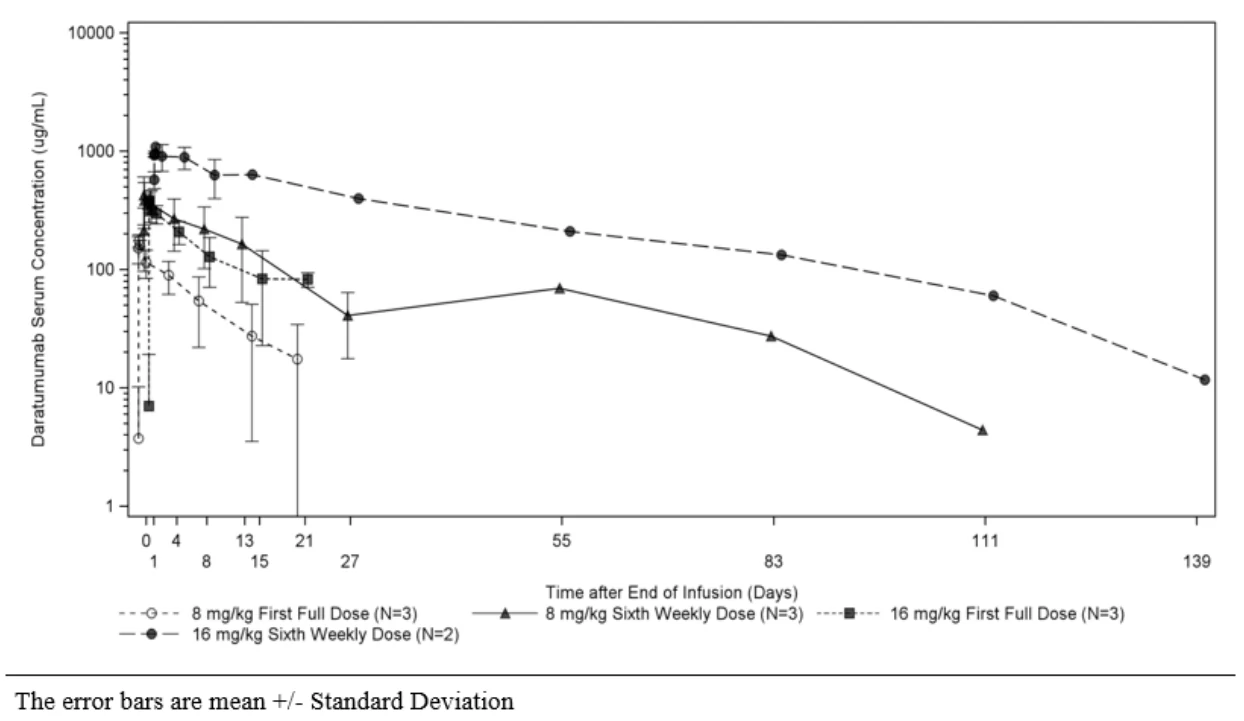
Figure 2: Daratumumab Concentration vs Nominal Time Following the First Full Dose and Sixth Weekly Dose – Linear Scale (Study GEN501 Part 1)
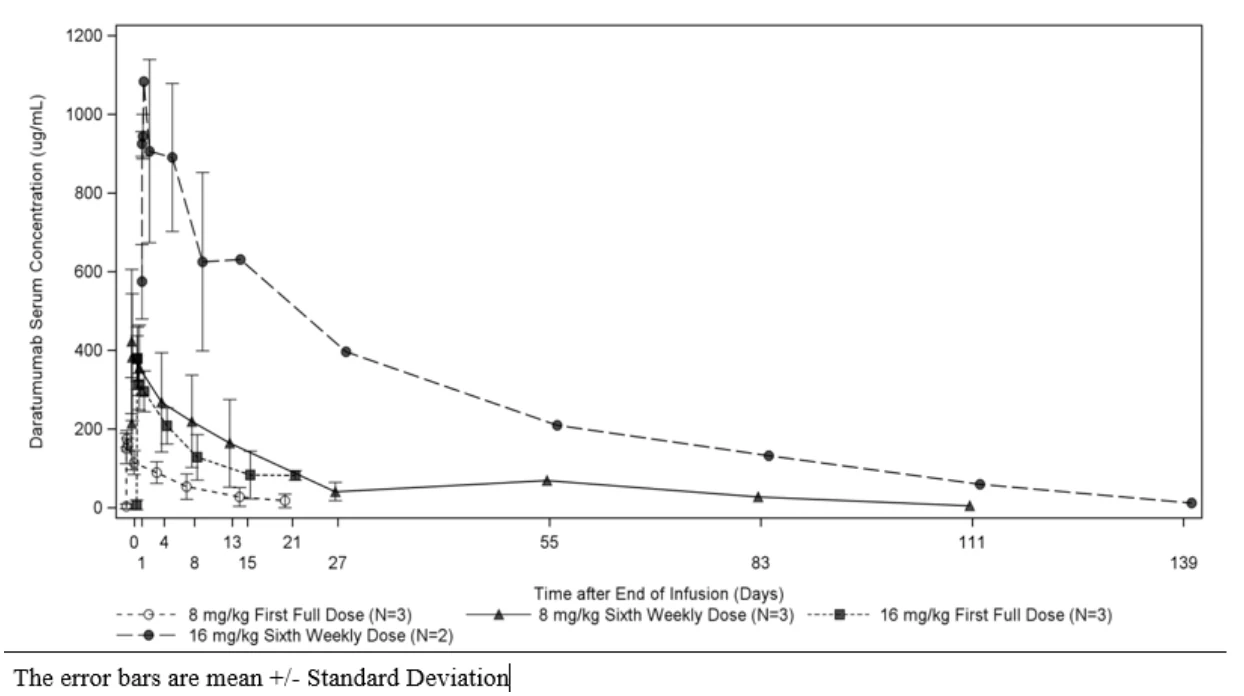
A series of population PK analyses were conducted in patients with multiple myeloma that received daratumumab in various combination therapies from six clinical trials (1390 patients of which 1380 received daratumumab at 16 mg/kg). The source of the observed values in the daratumumab concentration-time profiles could not be distinguished following the monotherapy and combination therapies in patients who received daratumumab at 16 mg/kg.
Distribution At the end of weekly dosing for the recommended monotherapy schedule and dose of 16 mg/kg, the mean (standard deviation [SD]) serum Cmax value is 915 (410.3) mcg/mL, approximately 2.9-fold higher than following the first infusion. The mean (SD) predose (trough) serum concentration at the end of weekly dosing is 573 (331.5) mcg/mL.
Based on the population PK analysis of Darzalex monotherapy, daratumumab steady state is achieved approximately 5 months into the monthly dosing period (by the 21st infusion), and the mean (SD) ratio of Cmax at steady-state to Cmax after the first dose was 1.6 (0.5). The mean (SD) central volume of distribution is 56.98 (18.07) mL/kg.
Metabolism As an IgG1қ mAb, daratumumab is likely metabolized via degradation into small peptides and amino acids via catabolic pathways.
Elimination The clearance rate of daratumumab decreases with increasing doses across the dose levels and with repeated dosing. The observed average CL (SD) in the 16 mg/kg cohort was 0.42
(0.424) mL/h/kg after the first dose. Based on population PK of Darzalex monotherapy, the every 2 week- and every 4 week- dosing at 16 mg/kg appeared to maintain the total clearance close to the non-specific linear clearance (0.125 mL/h/kg). Based on population PK analysis body weight was identified as a statistically significant covariate for daratumumab clearance. Simulation showed that the trough concentration of daratumumab was similar for subjects with different body weight after administration on a mg/kg basis.
Terminal half-life increases with increasing dose and with repeated dosing. The mean (SD) estimated terminal half-life of daratumumab following the first 16 mg/kg dose was 9 (4.3) days. Based on population pharmacokinetic analysis, the mean (SD) half-life associated with non-specific linear elimination was approximately 18 (9) days; this is the terminal half-life that can be expected upon complete saturation of target mediated clearance and repeat dosing of daratumumab. The mean (SD) estimated terminal half-life associated with linear clearance in combination therapy was approximately 23 (12) days.
Split Dose Interim data from Phase 1b Study MMY1001 demonstrate that following the second dose of the split dose (administered Cycle 1, Day 1 and Day 2), serum daratumumab concentrations are similar to those seen following the first 16 mg/kg infusion given as a single dose.
Special Populations and Conditions
- Pediatrics: Daratumumab has not been studied in pediatric patients.
- Geriatrics: Based on a population PK analysis in patients receiving monotherapy, age (range: 31-84 years) was not a statistically significant covariate on the trough concentration of daratumumab. Similar to monotherapy, no clinically important influence of age on the exposure to daratumumab was observed in the population PK analyses in patients receiving combination therapies. The difference in exposure was within 6 to 15% between younger (age <65 years, n=391) and older subjects (age ≥65 to <75 years, n=683; or age ≥75 years, n=316).
- Gender: Based on a population PK analysis in patients receiving monotherapy, the extrinsic factor gender [female (n=91), male (n=132)] was not a statistically significant covariate on the trough concentration of daratumumab. Similar to monotherapy, gender did not affect exposure to daratumumab in the population PK analyses in patients receiving combination therapies (female n=648; male n=742).
- Ethnic Origin: In a population PK analysis in patients receiving monotherapy, there was no statistically significant difference in the trough concentration of daratumumab between white (n=197) and non-white subjects (n=26). In an additional population PK analysis in multiple myeloma patients that received daratumumab with various combination therapies, the exposure to daratumumab was also similar between white (n=1173) and non-white (n=217) subjects.
Hepatic Insufficiency: No formal studies of daratumumab in patients with hepatic impairment have been conducted. A population PK analysis of patients with multiple myeloma that received daratumumab in various combination therapies included 1214
- patients with normal hepatic function, 155 patients with mild hepatic impairment and 8 patients with moderate (TB >1.5× to 3.0× ULN), or severe (TB >3.0× ULN) hepatic impairment. No clinically important differences in the exposure to daratumumab were observed between patients with hepatic impairment and those with normal hepatic function. There are limited data available on the exposure to daratumumab in patients with moderate to severe hepatic impairment.
- Renal Insufficiency: No formal studies of daratumumab in patients with renal impairment have been conducted. Population PK analyses in patients receiving combination treatments demonstrated no clinically important differences in exposure to daratumumab between patients with renal impairment (mild, n=543; moderate, n=455; severe, n=21) and those with normal renal function (n=370).
10.4. Immunogenicity
Patients in Darzalex monotherapy Study MMY2002 (n=111) and combination therapy studies (n=992) were evaluated for anti-therapeutic antibody (ATA) responses to Darzalex at multiple time points during treatment and up to 8 weeks following the end of treatment using an electrochemiluminescent (ECL) assay. Following the start of Darzalex dosing, of the 1135 evaluable patients, none of the monotherapy patients and 2 (0.18%) of the combination therapy patients tested positive for anti-daratumumab antibodies; 1 of the combination therapy patients developed transient neutralizing antibodies against daratumumab. However, the immunogenicity assay used in the study has limitations in detecting anti-daratumumab antibodies in the presence of high concentrations of daratumumab; therefore, the incidence of antibody development might not have been reliably determined.
Immunogenicity data are highly dependent on the sensitivity and specificity of the test methods used. Additionally, the observed incidence of a positive result in a test method may be influenced by several factors, including assay methodology, sample handling, timing of sample collection, drug interference, concomitant medication and the underlying disease. Therefore, comparison of the incidence of antibodies to daratumumab with the incidence of antibodies to other products may be misleading.
- 11. Storage, Stability, and Disposal
Store vials at 2°C-8°C.
After dilution: Since Darzalex does not contain a preservative, unless the method of preparation precludes the risk of microbial contamination, the diluted solution should be used immediately. If not used immediately, the solution may be stored in a refrigerator protected from light at 2°C–8°C for up to 24 hours prior to use, followed by 15 hours (including infusion time) at room temperature (15°C–25°C) and room light.
12. Special Handling Instructions
Do not freeze or shake. Protect from light. This product contains no preservative.
Part 2: Scientific Information
13. Pharmaceutical Information
Drug Substance
Proper name: daratumumab
Molecular mass: Approximately 148 kD
Structure: Daratumumab is an IgG1κ human monoclonal antibody against CD38 antigen.
Physicochemical properties: Darzalex (daratumumab for injection) is supplied as a colorless to yellow preservative free liquid concentrate for intravenous use. The pH is 5.5.
Product Characteristics:
Daratumumab is produced in a mammalian cell line (Chinese Hamster Ovary [CHO]) using recombinant DNA technology.
14. Clinical Trials
14.1. Clinical Trials by Indication
Newly diagnosed multiple myeloma (NDMM), eligible for autologous stem cell transplant.
The clinical efficacy and safety of Darzalex in combination with bortezomib, thalidomide and dexamethasone for the treatment of patients with newly diagnosed multiple myeloma who are eligible for ASCT was demonstrated in Study MMY3006 (Table 25).
Table 25: Summary of clinical trials in patients with newly diagnosed multiple myeloma who are eligible for ASCT.
Study # Trial design | Dosage, route of administration and duration | Number of subjects |
Study MMY3006 (CASSIOPEIA Study) Phase 3, open-label, randomized, active-controlled study comparing induction and consolidation treatment with Darzalex in combination with bortezomib, thalidomide and dexamethasone (DVTd) to treatment with bortezomib, thalidomide and dexamethasone (VTd) in patients with newly diagnosed multiple myeloma eligible for ASCT. The consolidation Phase of treatment began a minimum of 30 days post-ASCT, when the patient had recovered sufficiently, and engraftment was complete. The number of planned cycles was 6 overall (4 cycles of induction therapy before ASCT and 2 cycles of consolidation therapy after ASCT). Response was assessed approximately 100 days post-ASCT and eligibility for randomization to a maintenance study was determined. | Induction: Darzalex 16 mg/kg (IV) on Days 1, 8, 15, and 22 of Cycles* 1 and 2 (weekly dosing), on Days 1 and 15 of Cycles 3 and 4 (every two week dosing). Bortezomib 1.3 mg/m2 body surface area (SC or IV) on Days 1,4, 8, and 11 (twice weekly) of Cycles 1 to 4. Thalidomide 100 mg (po) daily Cycles 1 to 4. Dexamethasone 40 mg (po or IV) on Days 1, 2, 8, 9, 15, 16, 22, and 23 of Cycles 1 and 2, and at 40 mg on Days 1-2 and 20 mg on subsequent dosing days (Days 8, 9, 15, 16) of Cycles 3-4. If Darzalex was administered on the same day, the dexamethasone dose was administered IV as a pre-infusion medication. Consolidation: Darzalex 16 mg/kg (IV) on Days 1 and 15 of Cycles 5 and 6 (every two week dosing). Bortezomib 1.3 mg/m2 body surface area (SC or IV) on Days 1,4, 8, and 11 (twice weekly) of Cycles 5 and 6. Thalidomide 100 mg (po) daily Cycles 5 and 6. Dexamethasone 20 mg (po or IV) on Days 1, 2, 8, 9, 15, 16 in Cycles 5 and 6. If Darzalex was administered on the same day, the dexamethasone dose was administered IV as a pre-infusion medication. Dose reduction due to toxicity: Bortezomib: 1st reduction – reduce to 1.3 mg/m2 weekly (Day 1 and 8); 2nd reduction – reduce to 1.0 mg/m2 weekly (Day 1 and 8); 3rd reduction – discontinue bortezomib. Thalidomide: 1st reduction – reduce to 50 mg daily; 2nd reduction –50 mg every second day; 3rd reduction – discontinue thalidomide. Dexamethasone: 1st reduction – reduce by 50% of first dose; 2nd reduction – skip dexamethasone on days when Darzalex not given; 3rd reduction – discontinue dexamethasone Dose reductions for Darzalex were not allowed * Cycle = 4 weeks. | N=1085 DVTd arm: 543 VTd arm: 542 |
See Table 25 for a summary of study design and dosing. Patients were randomized 1:1 to receive DVTd or VTd. The randomization was stratified by site affiliation (Intergroupe Francophone du Myelome [IFM] or Dutch-Belgian Cooperative Trial Group for Hematology Oncology [HOVON]), International Staging System (ISS) stage (I, II or III), and by cytogenetics (standard risk or high risk as defined by presence of del17p or t(4; 14) as centrally assessed during screening). Key inclusion criteria included 1) patient must be newly diagnosed and eligible for high-dose chemotherapy with stem cell transplant; 2) patient between 18 to 65 years of age; 3) must have an Eastern Cooperative Oncology Group (ECOG) score of 0-2.
The baseline demographic and disease characteristics were similar between the two treatment groups. The median age was 58 (range 22 to 65) years old. The majority were male (59%), 48% had an ECOG performance score of 0, 42% had an ECOG performance score of 1 and 10% had an ECOG performance score of 2. Forty percent had ISS Stage I, 45% had ISS Stage II and 15% had ISS Stage III disease. In the intent-to-treat population, 15.5% of subjects had high-risk cytogenetic abnormalities at baseline.
Study Results:
The primary efficacy endpoint for Study MMY3006 Part 1 was stringent complete response (sCR) rate at 100 days post-ASCT based on International Myeloma Working Group (IMWG) criteria using a computer algorithm (Table 26). Key secondary endpoints were complete response (CR) or better rate at 100 days post-ASCT, progression-free survival (PFS) from first randomization, and overall survival (OS) from first randomization.
Table 26 Efficacy results from MMY3006 at Day 100 post-transplant
| DVTd (n=543) | VTd (n=542) | |||||
|---|---|---|---|---|---|---|
| Stringent Complete Response (sCR) | 157 (28.9%) | 110 (20.3%) | ||||
| p-valuea | 0.0010 | |||||
| Complete response (CR) | 54 (9.9%) | 31 (5.7%) | ||||
D-VTd = daratumumab-bortezomib-thalidomide-dexamethasone; VTd = bortezomib-thalidomide-dexamethasone; CI = confidence interval a p-value from Cochran Mantel-Haenszel Chi-Squared test. | ||||||
In exploratory analyses, in the assessment of stringent complete response, treatment benefit decreased with increasing ISS stage; no treatment benefit (sCR) was observed for patients with high-risk cytogenetics.
Study MMY3006 demonstrated an early trend towards improvement in PFS in the DVTd arm as compared to the VTd arm: with a median follow-up of 18.8 months, the median PFS had not been reached in either arm. Treatment with DVTd resulted in a reduction in the risk of disease progression or death by 53% compared to VTd alone (HR=0.47; 95% CI: 0.33, 0.67; p<0.0001) (Figure 3).
Figure 3: Kaplan-Meier Curve of PFS in MMY3006a
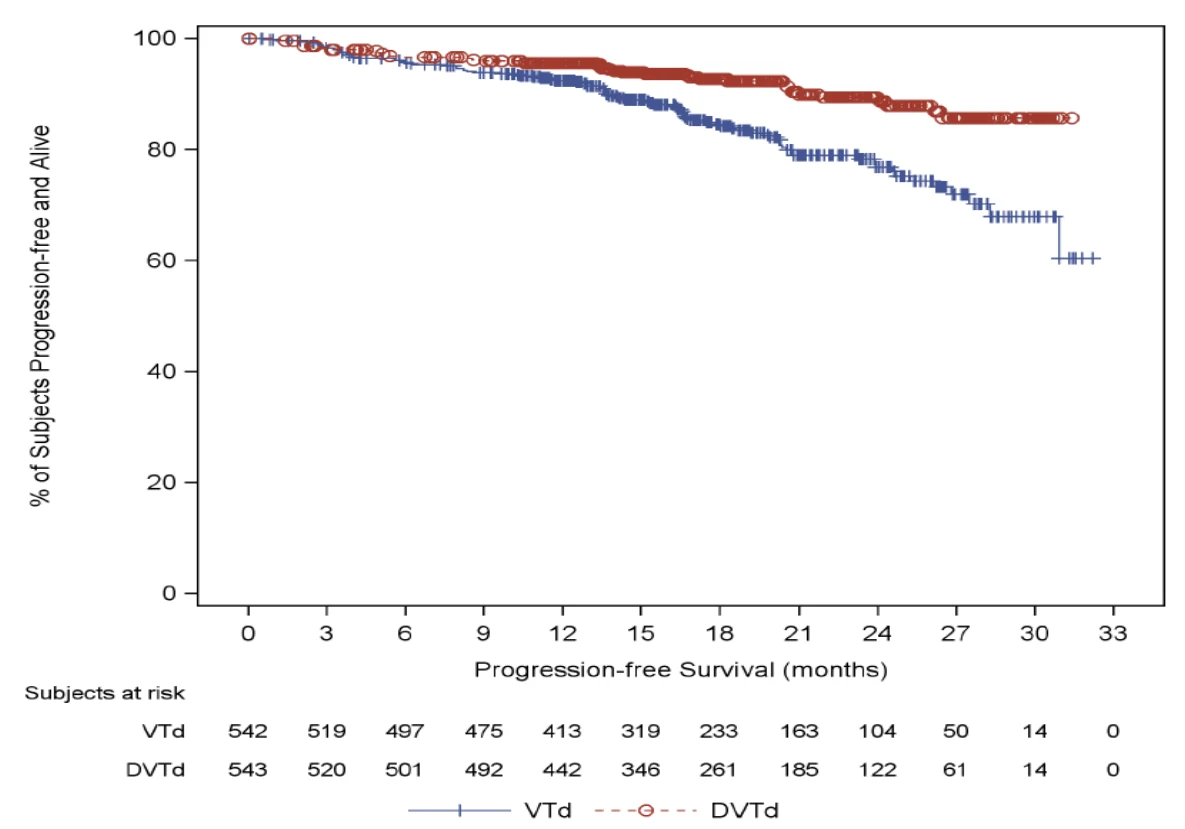
abased on interim analysis and the boundary for PFS was crossed.
Newly diagnosed multiple myeloma, ineligible for autologous stem cell transplant.
The clinical efficacy and safety of Darzalex for the treatment of patients with newly diagnosed multiple myeloma who are ineligible for ASCT was demonstrated in two open-label, randomized, active-controlled studies (Table 27).
Table 27: Summary of clinical trials in patients with newly diagnosed multiple myeloma who are ineligible for ASCT.
Study # Trial design | Dosage, route of administration and duration | Number of subjects |
Study MMY3008 (MAIA Study), Phase 3, open-label, randomized, active-controlled study comparing treatment with Darzalex in combination with lenalidomide and low-dose dexamethasone (DRd), to treatment with lenalidomide and low-dose dexamethasone (Rd) in patients with newly diagnosed multiple myeloma who are ineligible for ASCT. | Darzalex 16 mg/kg (IV) on Days 1, 8, 15, and 22 of Cycles 1 and 2 (weekly dosing), on Days 1 and 15 of Cycles 3 to 6 (every two week dosing), and on Day 1 of Cycle 7 and subsequent cycles (every four week dosing). Lenalidomide (25 mg once daily orally on Days 1-21 of repeated 28-day [4-week] cycles) with low dose oral or intravenous dexamethasone 40 mg/week (or a reduced dose of 20 mg/week for patients >75 years or body mass index [BMI] <18.5). | N=737 DRd arm: 368 Rd arm: 369 |
Study MMY3007 (ALCYONE Study), Phase 3, open-label, randomized, active-controlled study comparing treatment with Darzalex in combination with bortezomib -melphalan-prednisone (D-VMP), to treatment with VMP in patients with newly diagnosed multiple myeloma who are ineligible for ASCT. | Darzalex* 16 mg/kg (IV): Cycle** 1 (weeks 1-6): weekly; Cycle 2-9 (weeks 7-54): every 3 weeks; Cycle ≥10 (week 55 onwards): every 4 weeks until disease progression, unacceptable toxicity or study end (D-VMP arm only). Bortezomib 1.3 mg/m2 body surface area (BSA), subcutaneous (SC): Cycle** 1 (week 1, 2, 4, and 5): twice-weekly; Cycle 2-9 (for week 1, 2, 4, and 5 of each cycle): once weekly Melphalan 9 mg/m2 BSA orally (PO) and prednisone 60 mg/m2 BSA (PO): Days 1-4 of each bortezomib cycle. * Darzalex was administered before bortezomib on treatment days when both bortezomib and Darzalex were to be administered. ** Cycle = 6 weeks. | N=706 D-VMP arm: 350 VMP arm: 356 |
Study MMY3008: Darzalex in combination with lenalidomide and dexamethasone (DRd)
See Table 27 for a summary of study design and dosing. Patients were randomized 1:1 to receive DRd or Rd. The randomization was stratified by ISS (I, II or III), region (North America vs Other) and age (<75 vs ≥75). Key inclusion criteria included 1) patient must be newly diagnosed and not considered a candidate for high-dose chemotherapy with stem cell transplant due to a) being ≥65 years of age, or b) in patients <65 years old, the presence of comorbid condition(s) likely to have a negative impact on tolerability of high dose chemotherapy and stem cell transplant; and 2) patient must have an ECOG score of 0-2. On Darzalex infusion days, dexamethasone served as the treatment dose of steroid for that day, as well as the required pre-infusion medication. Treatment was continued in both arms until disease progression or unacceptable toxicity.
The baseline demographic and disease characteristics were similar between the two treatment groups. The median age was 73 (range 45-90) years old, with 44% of the patients ≥75 years of age. The majority were white (92%), 52% were male, and 83% had an ECOG performance score of 0 or 1. Patients had IgG/IgA/Light chain myeloma in 66%/19%/11% instances; 27% had ISS Stage I, 43% had ISS Stage II and 29% had ISS stage III disease. Of the 642 subjects who had baseline cytogenetic data reported, 14% had high-risk cytogenetic abnormalities, which included t(4;14) (5%), del17p (8%), and t(14;16) (1%), with similar proportions in the 2 arms (DRd:15%, Rd: 14%).
Study Results:
The primary efficacy endpoint was progression free survival (PFS) based on International Myeloma Working Group (IMWG) criteria using a computer algorithm. Key secondary endpoints were overall response rate (ORR), minimal residual disease (MRD) negative rate, and overall survival (OS).
With a median follow-up of 28 months, the primary analysis of PFS in Study MMY3008 demonstrated an improvement in PFS in the DRd arm as compared to the Rd arm; the median PFS had not been reached in the DRd arm and was 31.9 months in the Rd arm (hazard ratio [HR]=0.56; 95% CI: 0.43, 0.73; p<0.0001), representing a 44% reduction in the risk of disease progression or death in patients treated with DRd (Figure 4).
Figure 4: Kaplan-Meier Curve of PFS (Primary Analysis) in Study MMY3008
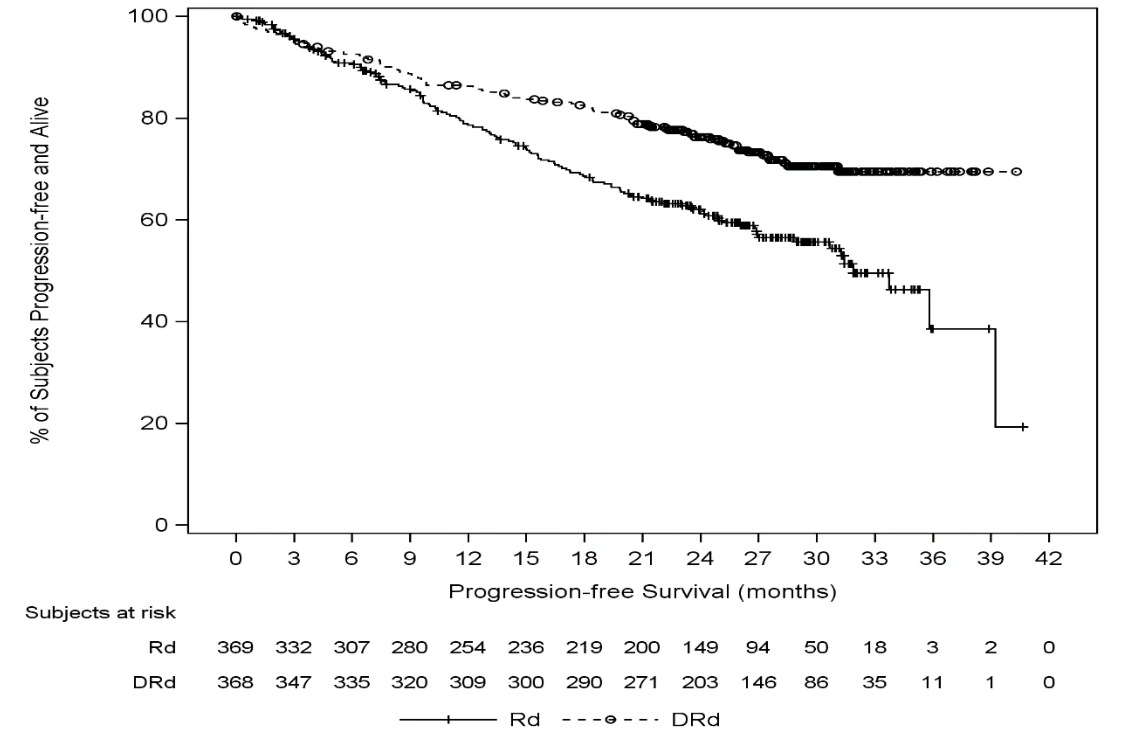
Pre-specified subgroup analyses based on PFS hazard ratio were generally consistent across the subgroups and showed a PFS improvement for subjects in the DRd group compared to those in the Rd group.
Efficacy results from Study MMY3008 are presented in Table 28 below.
Table 28: Efficacy results (Primary Analysis) from Study MMY3008
| DRd (n=368) | Rd (n=369) | ||||||||
|---|---|---|---|---|---|---|---|---|---|
| PFS | |||||||||
| Number of events (%) | 97 (26.1) | 143 (38.8) | |||||||
| Hazard Ratio [95% CI]a | 0.56 (0.43, 0.73) | ||||||||
| Stratified log-rank test p-valueb | <0.0001 | ||||||||
| Median PFS in months [95% CI] | NE (NE, NE) | 31.87 (28.94, NE) | |||||||
| Overall response (sCR+CR+VGPR+PR) n(%) | 342 (92.9%) | 300 (81.3%) | |||||||
| Risk difference [95% CI]c | 11.6% (4.5%, 18.8%) | ||||||||
| p-valued | <0.0001 | ||||||||
| Stringent complete response (sCR) | 112 (30.4%) | 46 (12.5%) | |||||||
| Complete response (CR) | 63 (17.1%) | 46 (12.5%) | |||||||
| Very good partial response (VGPR) | 117 (31.8%) | 104 (28.2%) | |||||||
| Partial response (PR) | 50 (13.6%) | 104 (28.2%) | |||||||
| Duration of Response, median in months (95% CI)e | NE (NE, NE) | 34.7 (30.8, NE) | |||||||
DRd=daratumumab-lenalidomide-dexamethasone; Rd=lenalidomide-dexamethasone; CI=confidence interval a Hazard ratio and 95% CI from a Cox proportional hazards model with treatment as the sole explanatory variable and stratified with ISS staging (I, II, III), region (North America vs. Other), and age (<75 years vs. ≥75 years) as randomized. A hazard ratio <1 indicates an advantage for DRd.
b p-value is based on the log-rank test stratified with ISS staging (I, II, III), region (North America vs. Other), and age (<75 years vs. ≥75 years) as randomized.
c exact 95% CI. A risk difference > 0 indicates a benefit for DRd.
d p-value from Fisher’s exact test.
e The Kaplan-Meier estimates of duration of response were provided based on subjects with overall response of PR or better.
Note: A hierarchical testing procedure was used to control the overall Type I error rate for the primary and secondary endpoints. The corresponding alpha levels for PFS and ORR were 0.0085 and 0.0244, respectively.
In responders, the median time to response was 1.05 months (range: 0.2 to 12.1 months) in the DRd group and 1.05 months (range: 0.3 to 15.3 months) in the Rd group.
In the ITT population, 89 (24.2%) patients in the DRd group achieved CR or better and minimal residual disease (MRD) negativity status at the threshold of 10-5 versus 27 (7.3%) in the Rd group (risk difference: 16.9%; 95% CI: 9.7%, 23.9%; p<0.0001). Among patients who achieved CR/sCR this corresponds to 50.9% in the DRd group versus 29.3% in the Rd group.
In an updated PFS analysis occurring after a median follow-up of 64 months (range 0.0 to 77.6 months), median PFS was 61.9 months (95% CI: 54.8, NE) in the DRd arm and 34.4 months (95% CI: 29.6, 39.2) in the Rd arm.
After a median follow-up of 56 months, the primary analysis of overall survival has demonstrated an improvement in favour of DRd over Rd with a hazard ratio of 0.68 (95% CI: 0.53, 0.86; p=0.0013), representing a 32% reduction in the risk of death in patients treated in the DRd arm. Median OS was not reached for either arm. The 60-month survival rate was 66% (95% CI: 61, 71) in the DRd arm and was 53% (95% CI: 47, 59) in the Rd arm (Figure 5).
Figure 5: Kaplan-Meier Plot for OS in Study MMY3008 (ITT population)
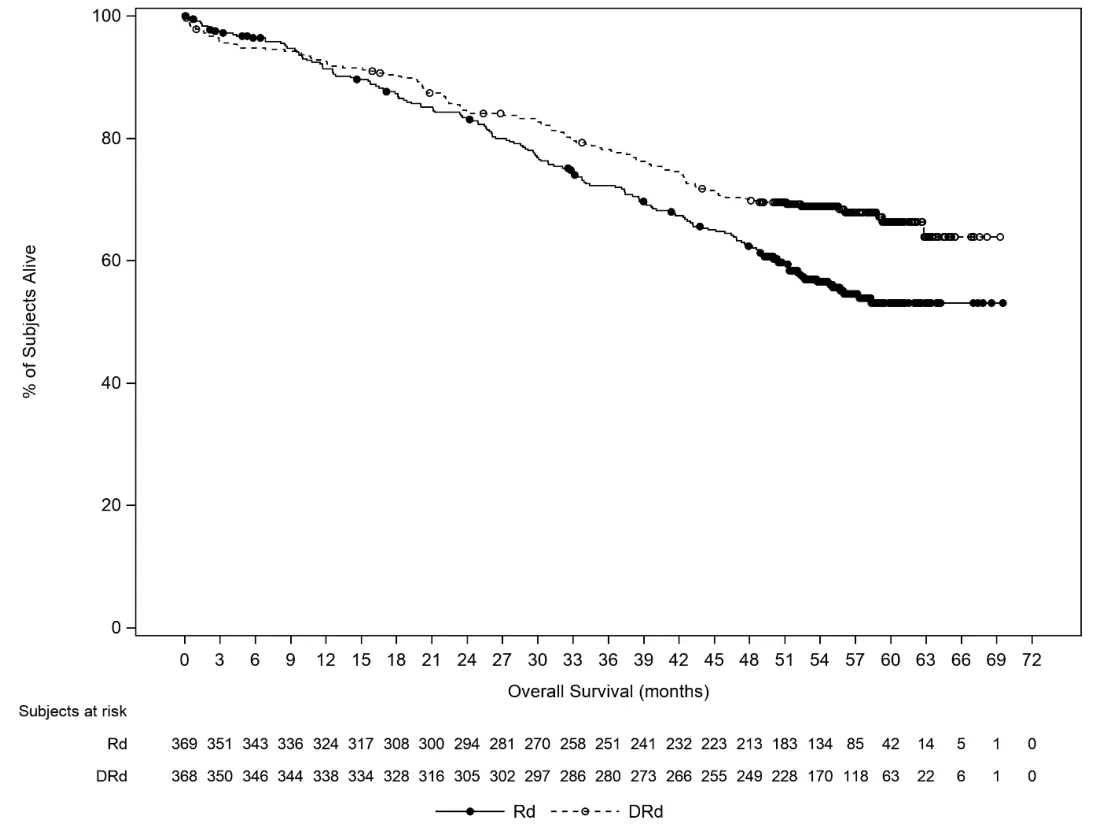
Study MMY3007: Darzalex in combination with bortezomib, melphalan, and prednisone (D-VMP)
See Table 27 for summary of study design and dosing. Patients were randomized 1:1 to receive D-VMP or VMP. The randomization was stratified by ISS (I, II, or III), region (Europe vs Other), and age (<75 vs ≥75).
Key inclusion criteria included 1) patient must be newly diagnosed and not considered a candidate for high-dose chemotherapy with stem cell transplant due to a) being ≥65 years of age, or b) in patients <65 years old, the presence of comorbid condition(s) likely to have a negative impact on tolerability of high dose chemotherapy and stem cell transplant; and 2) patient must have an ECOG score of 0-2. The baseline demographic and disease characteristics were similar between the two treatment groups. The median age was 71 (range 40-93) years old, with 29.9% of the patients ≥75 years of age. The majority were white (85%), 46% were male, and 75.4% had an ECOG performance score of 0 or 1. Patients had IgG/IgA/Light chain myeloma in 64%/22%/10% instances; 19% had ISS Stage I, 42% had ISS Stage II and 38% had ISS stage III disease. Of the 616 subjects who had baseline cytogenetic data reported, 16% had high-risk cytogenetic abnormalities, which included t(4;14) (7%), del17p (9%), and t(14;16) (2%), with similar proportions in the 2 arms (D-VMP:17%, VMP:15%).
Study Results:
The primary efficacy endpoint was progression free survival (PFS) based on International Myeloma Working Group (IMWG) criteria using a computer algorithm. Key secondary endpoints were objective response rate (ORR), minimal residual disease (MRD) negative rate, and overall survival (OS).
Based on the pre-defined interim analysis, Study MMY3007 demonstrated an improvement in PFS in the D-VMP arm as compared to the VMP arm; the median PFS had not been reached in the D-VMP arm and was 18.1 months in the VMP arm (hazard ratio [HR]=0.5; 95% CI: 0.38, 0.65; p<0.0001), representing a 50% reduction in the risk of disease progression or death in patients treated with D-VMP (Figure 6).
Figure 6: Kaplan-Meier Plot for Progression-free Survival in Study MMY3007 (median follow-up of 16.5 months)
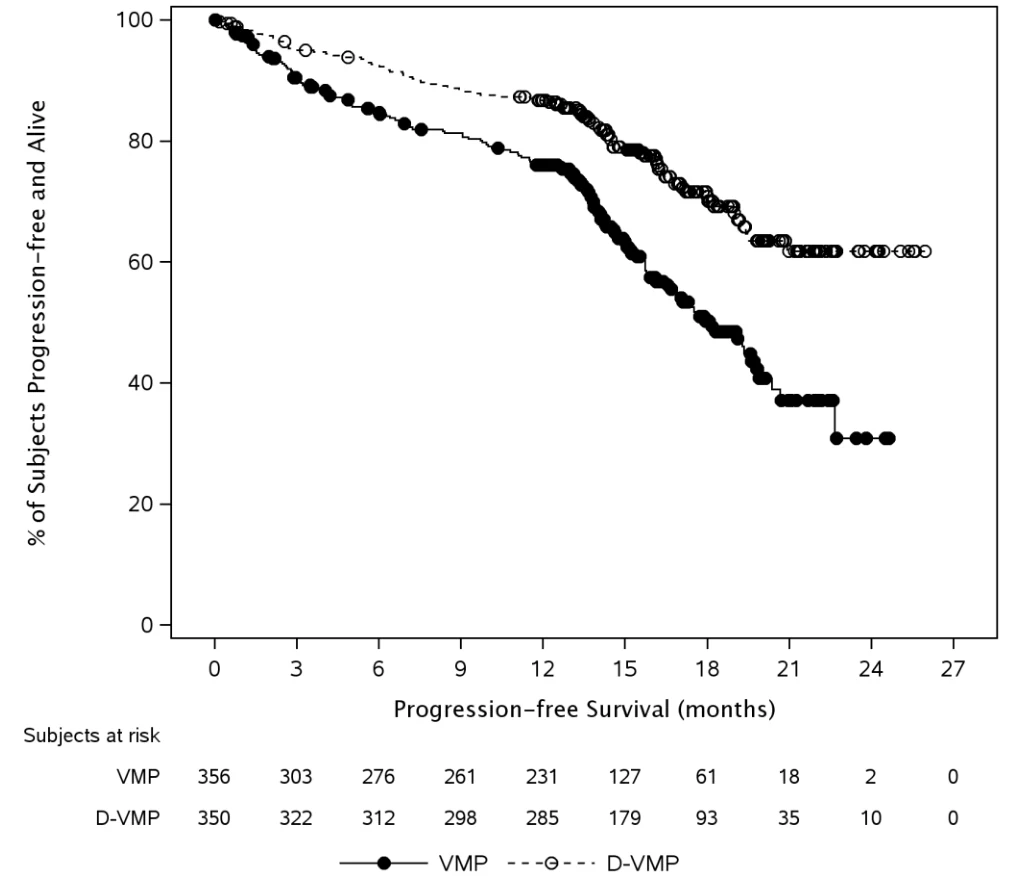
Subgroup analyses based on PFS hazard ratio were consistent across the pre-specified subgroups and showed PFS improvement for subjects in the D-VMP group versus patients in the VMP group.
Efficacy results from Study MMY3007 are presented in Table 29 below.
Table 29: Efficacy results from Study MMY3007 (ITT population)
| D-VMP (n =350) | VMP (n =356) | ||||||||||
|---|---|---|---|---|---|---|---|---|---|---|---|
| PFS | |||||||||||
| Number of events (%) | 88 (25.1) | 143 (40.2) | |||||||||
| Hazard Ratio [95% CI]a | 0.50 (0.38, 0.65) | ||||||||||
| Stratified log-rank test p-valueb | <0.0001 | ||||||||||
| Median PFS in months [95% CI] | NE (NE, NE) | 18.14 (16.53, 19.91) | |||||||||
| Overall response (sCR+CR+VGPR+PR) n (%) | 318 (90.9) | 263 (73.9) | |||||||||
| p-valuec | <0.0001 | ||||||||||
| Stringent complete response (sCR) | 63 (18.0) | 25 (7.0) | |||||||||
| Complete response (CR) | 86 (24.6) | 62 (17.4) | |||||||||
| Very good partial response (VGPR) | 100 (28.6) | 90 (25.3) | |||||||||
| Partial response (PR) | 69 (19.7) | 86 (24.2) | |||||||||
| Time to Response, median in months (range)d | 0.79 (0.4, 15.5) | 0.82 (0.7, 12.6) | |||||||||
| Duration of Response, median in months (range)d | NE (NE, NE) | 21.3 (18.4, NE) | |||||||||
D-VMP = daratumumab-bortezomib-melphalan-prednisone; VMP = bortezomib-melphalan-prednisone; MRD = minimal residual disease; CI = confidence interval; NE = not estimable. a Hazard ratio and 95% CI from a Cox proportional hazards model with treatment as the sole explanatory variable and stratified with ISS staging (I, II, III), region (Europe vs. Other), and age (<75 years vs. ≥75 years) as randomized. A hazard ratio <1 indicates an advantage for D-VMP. b p-value is based on the log-rank test stratified with ISS staging (I, II, III), region (Europe vs. Other), and age (<75 years vs. ≥75 years) as randomized. c p-value from Cochran Mantel-Haenszel Chi-Squared test. d The descriptive statistics of time to response and the Kaplan-Meier estimates of duration of response were provided based on subjects with overall response of PR or better. | |||||||||||
In the ITT population, 74 (21.1%) patients in the D-VMP group achieved CR or better and MRD negativity status at the threshold of 10-5 versus 22 (6.2%) in the VMP group, which met the prespecified significance level of ≤0.0244. Among patients who achieved CR/sCR this corresponds to 49.7% in the D-VMP group versus 25.3% in the VMP group.
In an updated analysis of PFS occurring after a median follow-up of 40 months (range 0.0 to 52.1 months), median PFS was 36.4 months (95% CI: 32.1, 45.9) in the D-VMP arm and 19.3 months (95% CI: 18.0, 20.4) in the VMP arm.
In a pre-specified interim analysis of OS, with a median follow-up of 40 months, an OS advantage was shown for the D-VMP arm over the VMP arm (HR=0.60; 95% CI: 0.46, 0.80; p=0.0003), representing a 40% reduction in the risk of death in patients treated with D-VMP versus VMP (Figure 7). Median OS was not reached for either arm. There were 267 subjects (76.3%) still alive in the D-VMP group and 230 subjects (64.6%) still alive in the VMP group.
Figure 7: Kaplan-Meier Plot for Overall Survival; Intent-to-treat Analysis Set in Study MMY3007
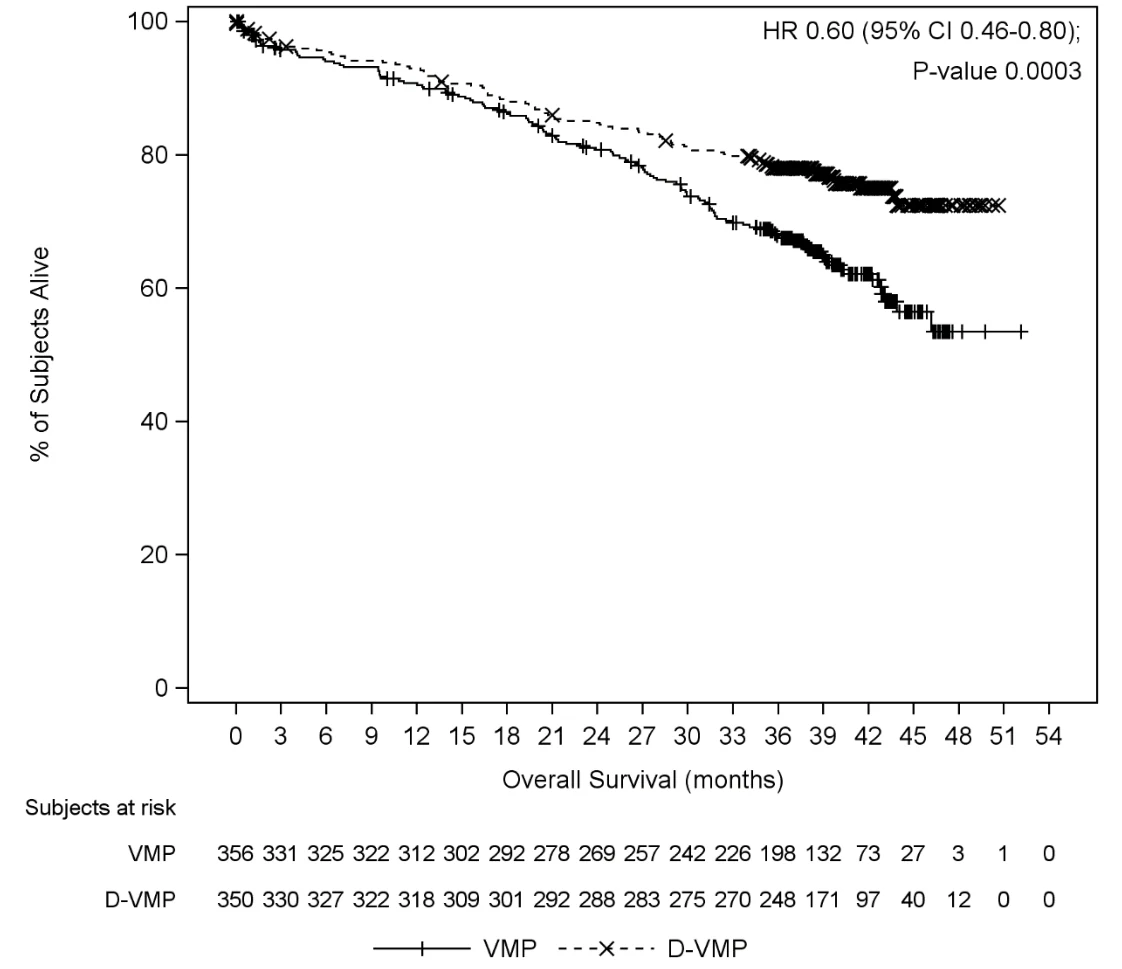
Multiple myeloma, received at least one prior therapy.
The clinical efficacy and safety of Darzalex for the treatment of patients with multiple myeloma who have received at least one prior therapy was demonstrated in two open-label, randomized, active-controlled studies (Table 30).
Table 30: Summary of clinical trials in patients with multiple myeloma who have received at least one prior therapy who were treated with Darzalex 16 mg/kg
Study # Trial design | Dosage, route of administration and duration | Number of subjects |
Study MMY3003 (POLLUX Study), Phase 3, open-label, randomized, active-controlled study comparing treatment with Darzalex in combination with lenalidomide and low-dose dexamethasone (DRd) to treatment with lenalidomide and low-dose dexamethasone (Rd) in patients with multiple myeloma who had received at least one prior therapy. | Darzalex 16 mg/kg (IV) on Days 1, 8, 15, and 22 of Cycles 1 and 2 (weekly dosing), on Days 1 and 15 of Cycles 3 to 6 (every two week dosing), and on Day 1 of Cycle 7 and subsequent cycles (every four week dosing). Lenalidomide (25 mg once daily orally on Days 1-21 of repeated 28-day [4-week] cycles) with low dose oral or intravenous dexamethasone 40 mg/week (or a reduced dose of 20 mg/week for patients >75 years or body mass index [BMI] <18.5). | N=569 DRd arm: 286 Rd arm: 283 |
Study MMY3004 (CASTOR Study), Phase 3, open-label, randomized, active-controlled study comparing treatment with Darzalex in combination with bortezomib and dexamethasone (DVd), to treatment with bortezomib and dexamethasone (Vd). | Darzalex 16 mg/kg (IV) on Days 1, 8, 15 of Cycles 1 to 3, on Day 1 of Cycles 4 to 8, and on Day 1 of Cycle 9 and subsequent cycles every four weeks. Bortezomib by subcutaneous injection or IV injection at a dose of 1.3 mg/m2 body surface area twice weekly for two weeks (Days 1, 4, 8, and 11) of repeated 21 day (3-week) treatment cycles, for a total of 8 cycles. Dexamethasone orally at a dose of 20 mg on Days 1, 2, 4, 5, 8, 9, 11, and 12 of the 8 bortezomib cycles (80 mg/week for two out of three weeks of each of the bortezomib cycle) or a reduced dose of 20 mg/week for patients >75 years, BMI <18.5, poorly controlled diabetes mellitus or prior intolerance to steroid therapy. | N=498 DVd arm: 251 Vd arm: 247 |
Study MMY3003: Darzalex in combination with lenalidomide and dexamethasone (DRd)
See Table 30 for a summary of study design and dosing. On Darzalex infusion days, 20 mg of the dexamethasone dose was given as a pre-infusion medication and the remainder given the day after the infusion. For patients on a reduced dexamethasone dose, the entire 20 mg dose was given as a Darzalex pre-infusion medication. Dose adjustments for lenalidomide and dexamethasone were applied according to manufacturer’s prescribing information. Treatment was continued in both arms until disease progression or unacceptable toxicity. Patients were randomized 1:1 to receive DRd or Rd. The randomization was stratified by ISS (I, II or III) at screening, number of prior lines of therapy (1 vs 2 or 3 vs >3), and prior lenalidomide (yes vs no).
Key inclusion criteria included i) patients must have achieved a partial response or better to at least 1 prior regimen; and ii) patients must have an ECOG status 0-2. Patients refractory to lenalidomide were excluded from the study. A total of 569 patients were randomized; 286 to the DRd arm and 283 to the Rd arm. The baseline demographic and disease characteristics were generally balanced between the Darzalex and the control arm. The median patient age was 65 years (range 34 to 89 years), 11% were ≥75 years, 59% were male; 69% Caucasian, 18% Asian, and 3% African American. Patients had received a median of 1 prior line of therapy. Sixty-three percent (63%) of patients had received prior autologous stem cell transplantation (ASCT). The majority of patients (86%) received a prior proteasome inhibitor (PI) including bortezomib (84%), and carfilzomib (2%). Fifty-five percent, (55%) of patients had received a prior immunomodulatory agent (IMiD), including lenalidomide (18%) and thalidomide (43%). Forty-four percent (44%) of patients had received both a prior PI and IMiD. At baseline, 27% of patients were refractory to the last line of treatment. Eighteen percent (18%) of patients were refractory to a PI only, and 21% were refractory to bortezomib. Of the 439 subjects who had baseline cytogenetic data reported, 16% had high-risk cytogenetic abnormalities, which included t(4;14) (6%), del17p (10%), and t(14;16) (2%), with similar proportions in the 2 arms (DRd:15%, Rd:17%).
Study Results:
The primary efficacy endpoint was progression free survival (PFS) based on International Myeloma Working Group (IMWG) criteria using a computer algorithm. Key secondary endpoints were objective response rate (ORR) and overall survival (OS).
Based on the pre-defined interim analysis, Study MMY3003 demonstrated an improvement in PFS in the DRd arm as compared to the Rd arm; the median PFS had not been reached in the DRd arm and was 18.4 months in the Rd arm (hazard ratio [HR]=0.37; 99.39% CI: 0.23, 0.59; p<0.0001) representing 63% reduction in the risk of disease progression or death in patients treated with DRd (Figure 8).
Figure 8: Kaplan-Meier Plot for Progression-free Survival in Study MMY3003 (median follow-up of 13.5 months)
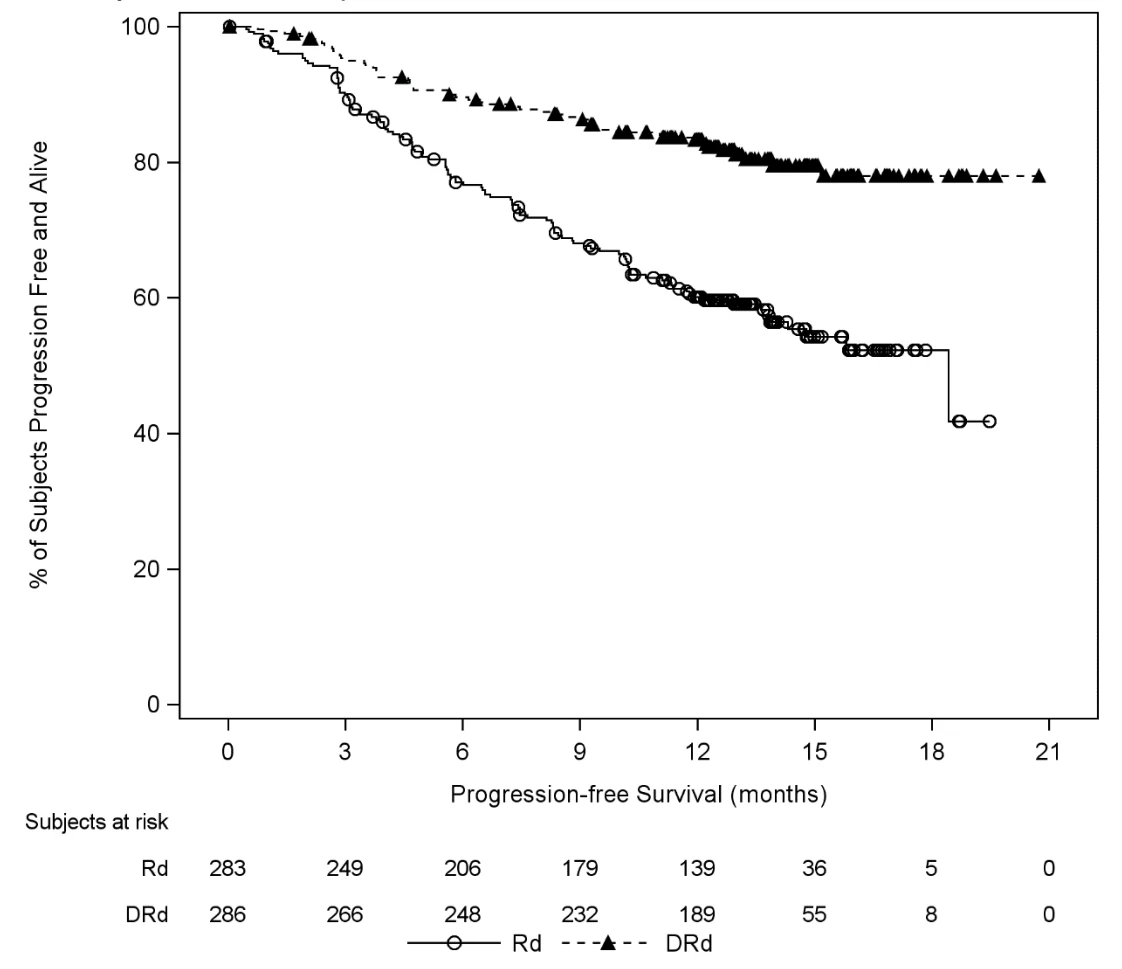
Subgroup analyses based on PFS hazard ratio were consistent across the pre-specified subgroups and showed PFS improvement for subjects in the DRd group versus patients in the Rd group.
Efficacy results from Study MMY3003 are presented in Table 31.
Table 31: Efficacy results from Study MMY3003
| Intent-to-treat patient number | DRd (n=286) | Rd (n=283) | |||||||||
|---|---|---|---|---|---|---|---|---|---|---|---|
| PFSa | |||||||||||
| Number of events (%) | 53 (18.5%) | 116 (41.0%) | |||||||||
| Hazard Ratio [99.39% CI] | 0.37 (0.23, 0.59) | ||||||||||
| Stratified log-rank test p-valueb | <0.0001 | ||||||||||
| Median PFS in months [95% CI] | NE (NE, NE) | 18.4 (13.9, NE) | |||||||||
Responsea Overall response (sCR+CR+VGPR+PR) n (%) | 261 (91.3) | 211 (74.6) | |||||||||
| p-valuec | <0.0001 | ||||||||||
| Stringent complete response (sCR) | 51 (17.8) | 20 (7.1) | |||||||||
| Complete response (CR) | 70 (24.5) | 33 (11.7) | |||||||||
| Very good partial response (VGPR) | 92 (32.2) | 69 (24.4) | |||||||||
| Partial response (PR) | 48 (16.8) | 89 (31.4) | |||||||||
| Time to Response, median in months (range)d | 1.0 (0.9, 13.0) | 1.1 (0.9, 10.2) | |||||||||
| Duration of Response, median in months (range)d | NR (1+, 19.8+) | 17.4 (1.4, 18.5+) | |||||||||
DRd=daratumumab-lenalidomide-dexamethasone; Rd=lenalidomide-dexamethasone; CI=confidence interval; NE=not estimable; NR=not reached. a The PFS and ORR interim analysis were based on an adjusted alpha level of 0.00612 and 0.02442 respectively. b p-value was based on the log-rank test stratified with ISS (I, II, or III), number of prior lines of therapy (1 vs. 2 or 3 vs. >3), and prior lenalidomide treatment (no vs. yes). c p-value from Cochran Mantel-Haenszel Chi-Squared test. d Time to response and duration of response were based on subjects with overall response of PR or better. | |||||||||||
Twenty-nine percent (29.0%) of the subjects in the DRd group achieved minimal residual disease (MRD) negativity status by the threshold of 10-4 versus 7.8% in the Rd group.
In an updated PFS analysis occurring after a median follow-up of 55 months (range 0.0 to 61.9 months), median PFS was 45.0 months (95% CI: 34.1, 53.9) in the DRd arm and 17.5 months (95% CI: 13.9, 20.8) in the Rd arm.
In the final analysis of OS, which occurred after a median follow-up of 80 months, an improvement in OS was observed for the DRd arm compared to the Rd arm. The hazard ratio was 0.73 (95% CI: 0.58, 0.91; p=0.0044), in favour of DRd, representing a 27% reduction in the risk of death. The median OS was 67.6 months in the DRd arm and 51.8 months in the Rd arm (Figure 9).
Figure 9: Kaplan-Meier Plot for OS in Study MMY3003 (ITT population)
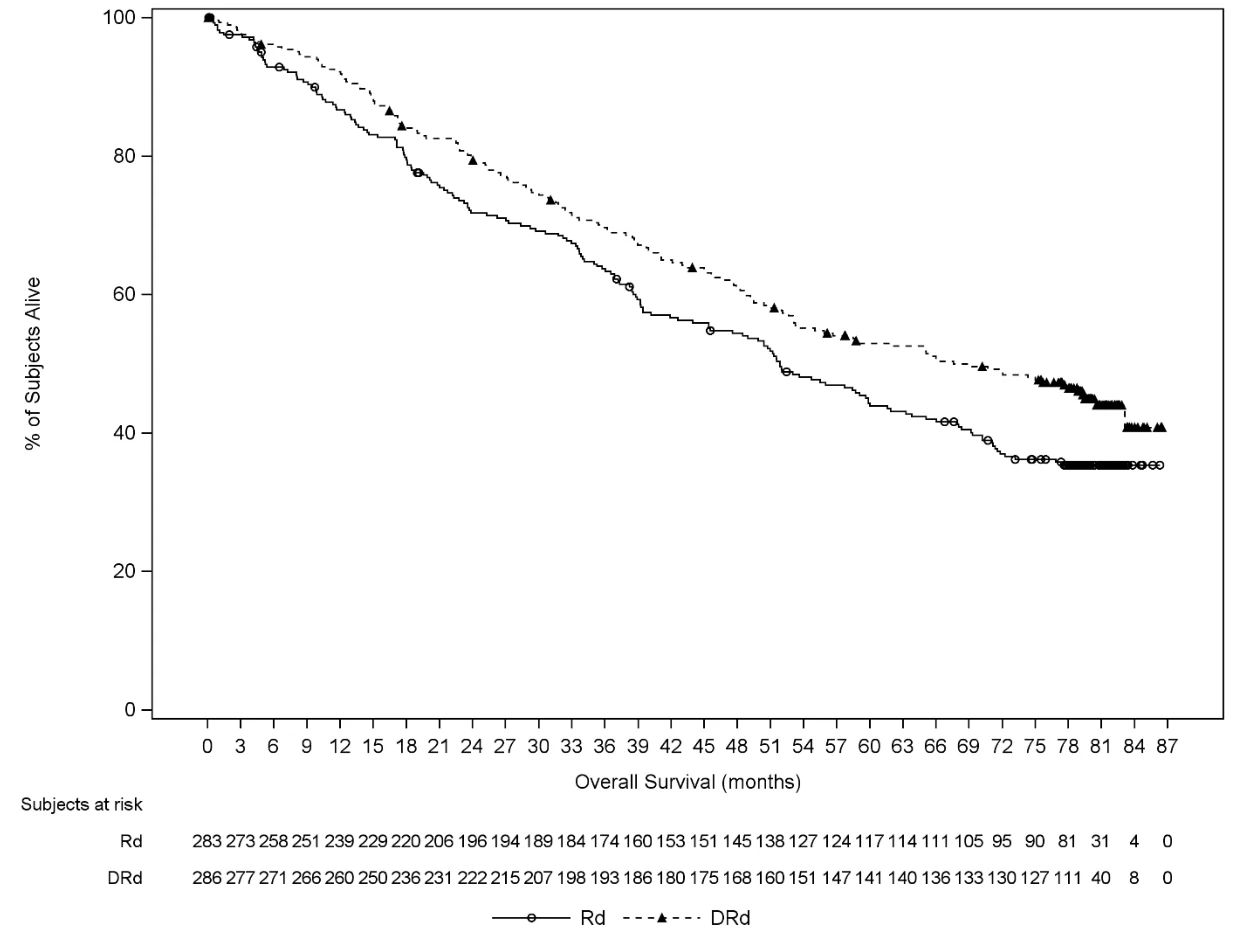
Study MMY3004: Darzalex in combination with bortezomib and dexamethasone (DVd)
See Table 30 for a summary of study design and dosing. On the days of Darzalex infusion, 20 mg of the dexamethasone dose was administered as a pre-infusion medication. For patients on a reduced dexamethasone dose, the entire 20 mg dose was given as a Darzalex pre-infusion medication. Bortezomib and dexamethasone were given for 8 three-week cycles in both treatment arms; whereas Darzalex was given until disease progression in the DVd arm. However, dexamethasone 20 mg was continued as a Darzalex pre-infusion medication in the DVd arm. Dose adjustments for bortezomib and dexamethasone were applied according to manufacturer’s prescribing information. Patients were randomized 1:1 to receive DVd or Vd. The randomization was stratified by ISS (I, II or III) at screening, number of prior lines of therapy (1 vs 2 or 3 vs >3), and prior bortezomib (yes vs no).
Key inclusion criteria included i) patients must have achieved a partial response or better to at least 1 prior regimen; and ii) patients must have an ECOG status 0-2. Key exclusion criteria included i) patients refractory to bortezomib or another proteasome inhibitor; and ii) patients intolerant to bortezomib. A total of 498 patients were randomized; 251 to the DVd arm and 247 to the Vd arm. The baseline demographic and disease characteristics were generally balanced between the Darzalex and the control arm. The median patient age was 64 years (range 30 to 88 years); 12% were ≥75 years, 57% were male; 87% Caucasian, 5% Asian and 4% African American. Patients had received a median of 2 prior lines of therapy and 61% of patients had received prior autologous stem cell transplantation (ASCT). Sixty-nine percent (69%) of patients had received a prior PI, including bortezomib (66%) and carfilzomib (4%); 76% of patients received an IMiD, including lenalidomide (42%), pomalidomide (3%) and thalidomide (49%). At baseline, 32% of patients were refractory to the last line of treatment and the proportions of patients refractory to any specific prior therapy were well balanced between the treatment groups. Thirty-three percent (33%) of patients were refractory to an IMiD only, with 24% of patients in the DVd arm and 33% of patients in the Vd arm refractory to lenalidomide. Of the 355 patients who had baseline cytogenetic data reported, 22% had high-risk cytogenetic abnormalities by karyotype and/or FISH analysis, which included t(4;14) (8%), del17p (14%), and t(14;16) (3%), with similar proportions in the 2 arms (DVd:23%, Vd:21%).
Study Results:
The primary efficacy endpoint was progression free survival (PFS) based on International Myeloma Working Group (IMWG) criteria using a computer algorithm. Key secondary endpoints were objective response rate (ORR) and overall survival (OS).
Based on the pre-defined interim analysis, Study MMY3004 demonstrated an improvement in PFS in the DVd arm as compared to the Vd arm; the median PFS had not been reached in the DVd arm and was 7.2 months in the Vd arm (HR=0.39; 98.98% CI: 0.26, 0.58; p-value < 0.0001), representing a 61% reduction in the risk of disease progression or death for patients treated with DVd versus Vd (Figure 10).
Figure 10: Kaplan-Meier Plot for Progression-free Survival in Study MMY3004 (median follow-up of 7.4 months)
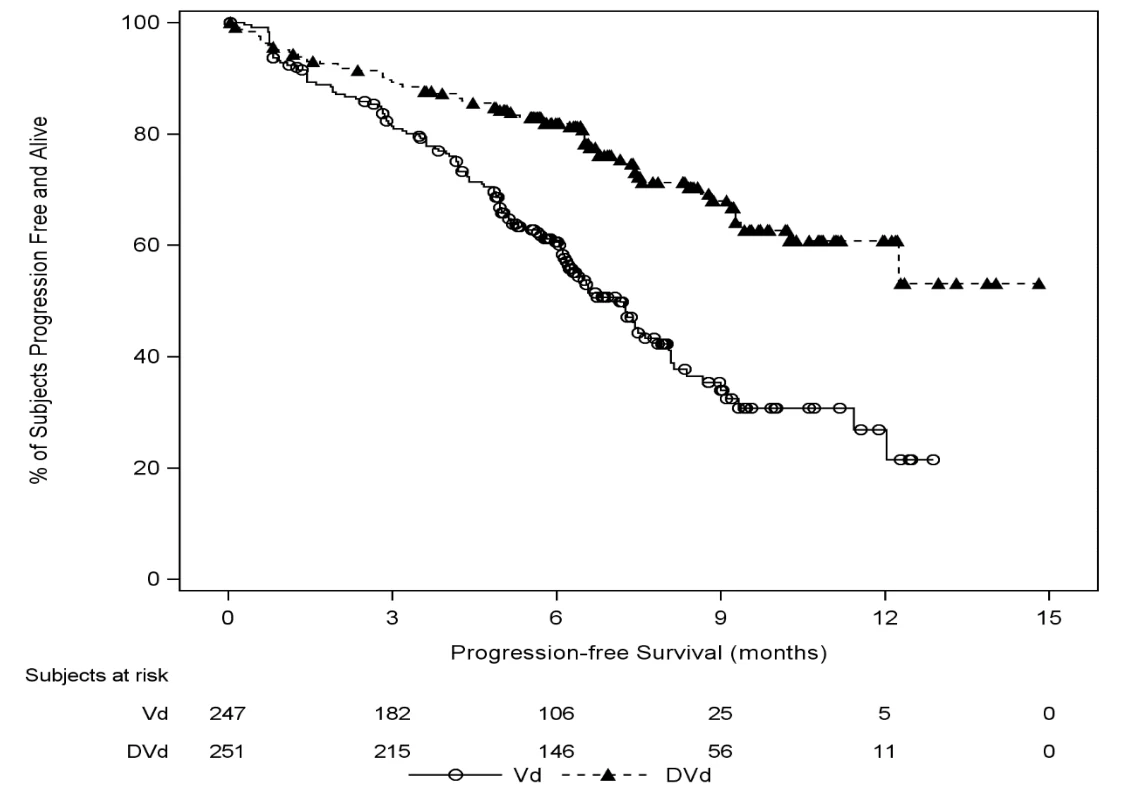
Subgroup analyses based on PFS hazard ratio were consistent across the pre-specified subgroups and showed PFS improvement for subjects in the DVd group versus patients in the Vd group.
Efficacy results from Study MMY3004 are presented in Table 32 below.
Table 32: Efficacy results from Study MMY3004
| Intent-to-treat patient number | DVd (n=251) | Vd (n=247) | ||||||||||
|---|---|---|---|---|---|---|---|---|---|---|---|---|
| PFSa | ||||||||||||
| Number of events (%) | 67 (26.7%) | 122 (49.4%) | ||||||||||
| Hazard Ratio [98.98% CI] | 0.39 (0.26, 0.58) | |||||||||||
| Stratified log-rank test p-valueb | <0.0001 | |||||||||||
| Median PFS in months [95% CI] | NE (12.3, NE) | 7.2 (6.2, 7.9) | ||||||||||
Responsea Overall response (sCR+CR+VGPR+PR) n (%) | 199 (79.3) | 148 (59.9) | ||||||||||
| P-valuec | <0.0001 | |||||||||||
| Stringent complete response (sCR) | 11 (4.4) | 5 (2.0) | ||||||||||
| Complete response (CR) | 35 (13.9) | 16 (6.5) | ||||||||||
| Very good partial response (VGPR) | 96 (38.2) | 47 (19.0) | ||||||||||
| Partial response (PR) | 57 (22.7) | 80 (32.4) | ||||||||||
| Time to Response, median in months (range)d | 0.8 (0.7, 4.0) | 1.5 (0.7, 5.1) | ||||||||||
| Duration of Response, median in months (range)d | NR (1.4+, 14.1+) | 7.9 (1.4+, 12.0+) | ||||||||||
DVd=daratumumab- bortezomib-dexamethasone; Vd=bortezomib-dexamethasone; CI=confidence interval; NE=not estimable; NR=not reached a The PFS and ORR interim analysis were based on an adjusted alpha level of 0.0102 and 0.02442 respectively. b p-value was based on the log-rank test stratified with ISS (I, II, or III), number of prior lines of therapy (1 vs. 2 or 3 vs. >3), and prior bortezomib treatment (no vs. yes). c p-value from Cochran Mantel-Haenszel Chi-Squared test. d Time to response and duration of response were based on subjects with overall response of PR or better. | ||||||||||||
Thirteen point five percent (13.5%) of the subjects in the DVd group achieved MRD negativity status by the threshold of 10-4 versus 2.8% in the Vd group.
In an updated analysis of PFS occurring after a median follow-up of 50 months (range 0.0 to 58.6 months), median PFS was 16.7 months (95% CI: 13.1, 19.4) in the DVd arm and 7.1 months (95% CI: 6.2, 7.7) in the Vd arm.
In the final analysis of OS, which occurred after a median follow-up of 73 months, an improvement in OS was observed for the DVd arm compared to the Vd arm. The hazard ratio was 0.74 (95% CI: 0.59, 0.92; p=0.0075) in favour of DVd, representing a 26% reduction in the risk of death arm. The median OS was 49.6 months in the DVd arm and 38.5 months in the Vd arm (Figure 11).
Figure 11: Kaplan-Meier Plot for OS in Study MMY3004 (ITT population)
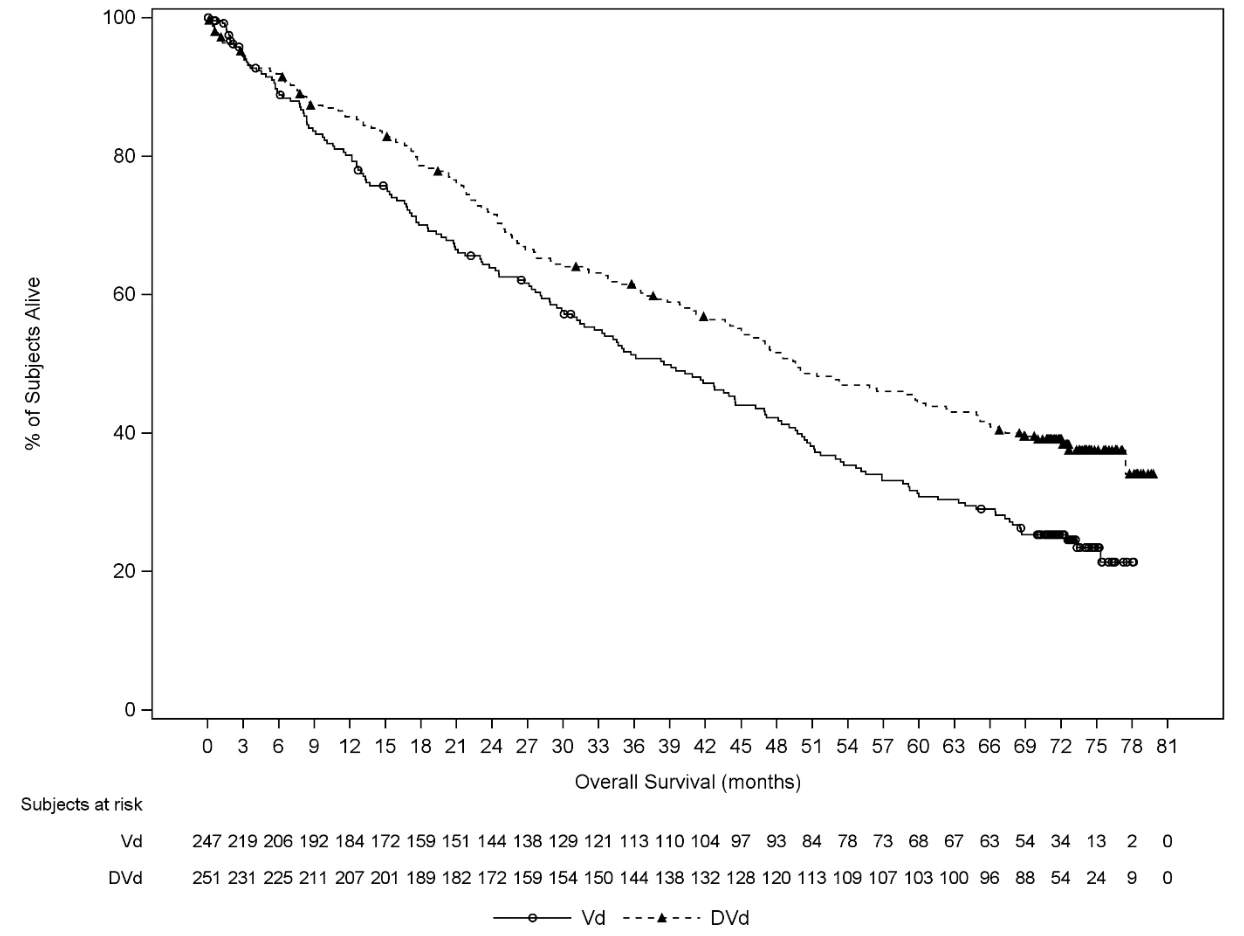
Multiple myeloma, received one to three prior lines of therapy.
The clinical efficacy and safety of Darzalex in combination with carfilzomib and dexamethasone for the treatment of patients with relapsed or refractory multiple myeloma was demonstrated in the CANDOR Study (with twice-weekly carfilzomib) (Table 33).
Table 33: Summary of clinical trials in patients with multiple myeloma who have received 1 to 3 prior lines of therapy
Study # Trial design | Dosage, route of administration and duration | Number of subjects |
Study # Trial design | Dosage, route of administration and duration | Number of subjects |
CANDOR Study, Phase 3, randomized, open-label, multicenter superiority trial of Darzalex with carfilzomib and dexamethasone (DKd) vs. carfilzomib | Darzalex 16 mg/kg (IV; 28-day cycles): Cycle 1: Split dose (8 mg/kg) on Days 1 and 2; thereafter, 16 mg/kg once weekly on Days 8, 15, and 22. | N=466 DKd arm: 312 Kd arm: 154 |
| and dexamethasone (Kd) in patients with relapsed or refractory multiple myeloma who had received 1 to 3 prior lines of therapy. | Cycle 2: once weekly dosing on Days 1, 8, 15 and 22 Cycles 3 to 6: every two-week dosing Cycle 7 and subsequent cycles: every four-week dosing until disease progression or unacceptable toxicity. Carfilzomib 20/56 mg/m2 (IV): Administered at a dose of 20 mg/m2 in Cycle 1 on Days 1 and 2; at a dose of 56 mg/m2 in Cycle 1 on Days 8, 9, 15, and 16; and at a dose 56 mg/m2 on Days 1, 2, 8, 9, 15, and 16 of each 28-day cycle thereafter. Dexamethasone 20 mg was administered orally or intravenously on Days 1, 2, 8, 9, 15 and 16 and then 40 mg orally or intravenously on Day 22 of each 28-day cycle. | |
CANDOR Study: Darzalex in combination with carfilzomib (20/56 mg/m2) and dexamethasone (DKd)
See Table 33 above for study design and dosing. Patients were excluded if they had known moderate or severe persistent asthma within the past 2 years, known chronic obstructive pulmonary disease (COPD) with a FEV1 <50% of predicted normal, and active congestive heart failure. A total of 466 patients were enrolled and randomized in a 2:1 randomization (312 in DKd arm and 154 in Kd arm). Randomization was stratified by the ISS (stage 1 or 2 vs stage 3) at screening, prior proteasome inhibitor exposure (yes vs no), number of prior lines of therapy (1 vs ≥ 2), and prior cluster differentiation antigen 38 (CD38) antibody therapy (yes vs no).
The baseline demographic and disease characteristics were similar between arms. In the study population, the median age was 64 years (range 29 to 84 years), 9% were ≥75 years, 58% were male; 79% White, 14% Asian, and 2% Black. Patients had received a median of 2 prior lines of therapy and 58% of patients had received prior autologous stem cell transplantation (ASCT). The majority of patients (92%) received a prior PI and of those 34% were refractory to PI including regimen. Forty-two percent (42%) of patients had received prior lenalidomide and of those, 33% were refractory to a lenalidomide containing regimen.
Patients received treatment with any study drug for a median duration of 70 weeks in the DKd arm and 40 weeks in the Kd arm. Patients in the DKd group received a median of 68 weeks of treatment with daratumumab. Patients received a median of 58 weeks of treatment with carfilzomib in the DKd arm and 40 weeks in the Kd arm.
Study Results:
The primary efficacy endpoint of the CANDOR study was PFS determined by a Blinded Independent Review Committee using IMWG Uniform Response Criteria. Key secondary efficacy endpoints were overall response rate, minimal residue disease-negative complete response (MRD [-] CR) rate at 12 months and overall survival.
The trial demonstrated an improvement in PFS in the DKd arm as compared to the Kd arm; the median PFS has not been reached in the DKd arm vs. 15.8 months in the Kd arm (hazard ratio [HR]=0.630; 95% CI: 0.464, 0.854; p=0.0014) representing a 37% reduction in the risk of disease progression or death in patients treated with DKd (Figure 12).
Figure 12: Kaplan-Meier Curve of PFS in CANDOR
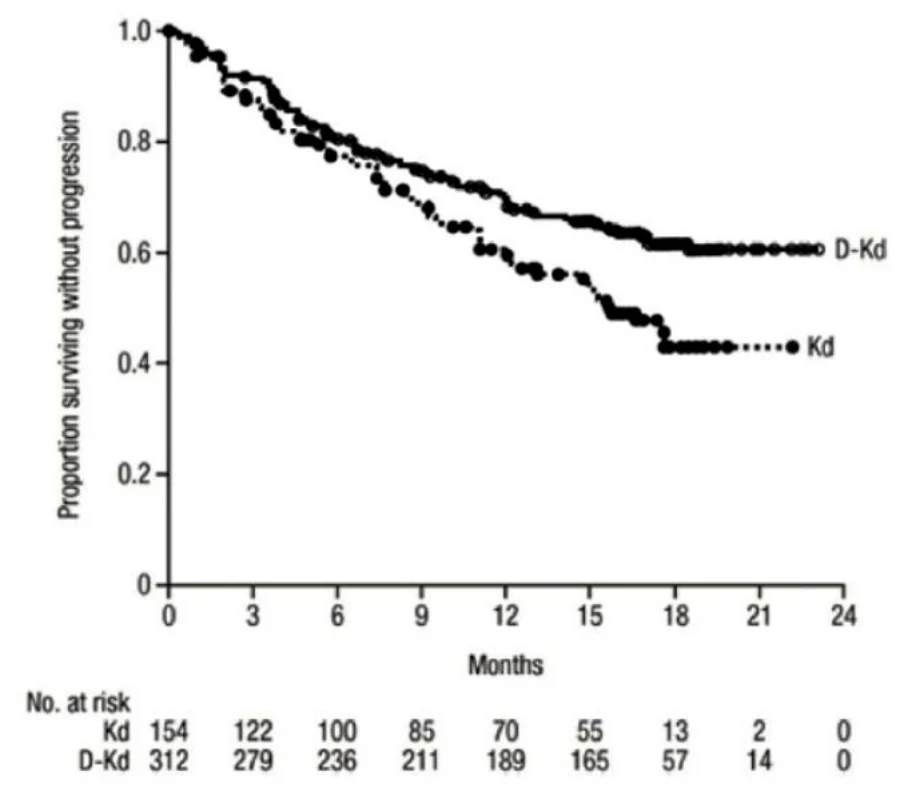
Efficacy results from CANDOR are presented in Table 34.
Table 34: Efficacy Results From CANDOR (Intent-to-Treat Population)
| DKd (N=312) | Kd (N=154) | |||||||||||
|---|---|---|---|---|---|---|---|---|---|---|---|---|
| DKd (N=312) | Kd (N=154) | |||||||||||
| PFSa | ||||||||||||
| Number of events, n (%) | 110 (35.3) | 68 (44.2) | ||||||||||
| Median, Months (95% CI) | NE (NE, NE) | 15.8 (12.1, NE) | ||||||||||
| Hazard Ratio (95% CI) | 0.630 (0.46, 0.85) | |||||||||||
| p-value (1-sided) | 0.0014 | |||||||||||
| Overall responseb (sCR+CR+VGPR+PR) | ||||||||||||
| N with Response | 263 | 115 | ||||||||||
| ORR, (%) (95% CI) | 84.3 (79.8, 88.1) | 74.7 (67.0, 81.3) | ||||||||||
| Odds Ratio (95% CI) | 1.925 (1.18, 3.13) | |||||||||||
| p-value (1-sided) | 0.0040 | |||||||||||
| CR, n (%) | 89 (28.5) | 16 (10.4) | ||||||||||
| VGPR, n (%) | 127 (40.7) | 59 (38.3) | ||||||||||
| PR, n (%) | 47 (15.1) | 40 (26.0) | ||||||||||
| MRD [-] CR at 12 months (at a 10-5 level)b, c | ||||||||||||
| MRD[-]CR rate (%) (95% CI) | 12.5 (9.0, 16.7) | 1.3 (0.2, 4.6) | ||||||||||
| Odds Ratio (95% CI) | 11.329 (2.70, 47.48) | |||||||||||
| p-value (1-sided) | <0.0001 | |||||||||||
CI = confidence interval; CR = complete response; Kd = carfilzomib and dexamethasone; DKd = Darzalex, carfilzomib, dexamethasone; MRD[-]CR = minimal residual disease negative-complete response; NE = not estimable; ORR = overall response rate; PR = partial response; PFS = progression-free survival; VGPR = very good partial response Stratification factors used in the analyses include (as assessed at randomization): International Staging System (ISS) stage (Stage 1 or 2 vs Stage 3) at screening; prior proteasome inhibitor exposure (yes vs no); number of prior lines of therapy (1 vs ≥ 2). a Hazard ratio and 95% CI were estimated using stratified Cox proportional hazards model; 1-sided p-value was calculated using log-rank test stratified by the randomization stratification factors at level of 0.025 (1-sided); medians were estimated using the Kaplan-Meier method. 95% CIs for medians were estimated using the method by Klein and Moeschberger (1997) with log-log transformation. b Odds ratio and 95% CI were estimated by a stratified analysis using the Mantel-Haenszel method; 1-sided p-values were calculated using Cochran-Mantel-Haenszel Chi-Square test controlling for the stratification factors at level of 0.025(1-sided); 95% CIs for proportions were estimated using the Clopper-Pearson method. c MRD[-]CR at 12-month is defined as achievement of CR or better per IMWG-URC and MRD[-] status as assessed by NGS at 12 months landmark (from 8 months to 13 months window). | ||||||||||||
Overall survival data were not mature. The median duration of response was not estimable for the DKd arm and was 16.6 months (13.9, NE) for the Kd arm. The median time to response was 1 (range: 1, 14) months for the DKd arm and 1 (range: 1,10) months for the Kd arm.
Multiple myeloma, received at least three prior lines of therapy including a proteasome inhibitor (PI) and an immunomodulatory agent (IMiD), or who are refractory to both a PI and an IMiD.
The clinical efficacy and safety of Darzalex for the treatment of patients with relapsed and refractory multiple myeloma was demonstrated in two open-label studies (Table 35).
Table 35: Summary of clinical trials in patients with relapsed and refractory multiple myeloma treated with Darzalex 16 mg/kg
Study # Trial design | Dosage, route of administration and duration | Number of subjects |
MMY2002 (SIRIUS Study) Phase 2, open-label, 2-part, single arm study in patients with multiple myeloma who have received at least three prior lines of therapy including a proteasome inhibitor (PI) and an immunomodulatory agent (IMiD), or who are double-refractory to a PI and an IMiD. | 16 mg/kg (IV) on Days 1, 8, 15, and 22 of Cycles 1 and 2 (weekly dosing), on Days 1 and 15 of Cycles 3 to 6 (every two week dosing), and on Day 1 of Cycle 7 and subsequent cycles (every four week dosing). | 106 subjects treated with 16 mg/kg |
GEN501 Phase 1/2, open-label, 2-part, single arm study in patients with multiple myeloma whose disease was relapsed or refractory to at least 2 prior lines of therapies. | 16 mg/kg (IV): first dose followed by three week resting period, then weekly for eight weeks, then every two weeks for sixteen weeks, then every four weeks. | 42 subjects treated with 16 mg/kg |
Study MMY2002: Darzalex monotherapy
Study MMY2002 was a Phase 2, open-label, 2-part, single arm study in patients with multiple myeloma who had received at least three prior lines of therapy including a PI and an IMiD, or who were refractory to both a PI and an IMiD. The selected dose from Part 1 was 16 mg/kg. Part 1 of the study was to establish an optimal dose schedule, and Part 2 was an expansion cohort. A total of 106 patients received 16 mg/kg Darzalex monotherapy weekly for 8 weeks, then every two weeks for 16 weeks, and every four weeks thereafter until disease progression or unacceptable toxicity. The primary efficacy endpoint was objective response rate (ORR) according to the International Myeloma Working Group (IMWG) criteria (2011) as assessed by an Independent Review Committee (IRC). Tumour assessment was performed every 28 days (± 3 days) until disease progression. Key secondary endpoints included duration of response.
The median patient age was 63.5 years (range: 31-84), 49% were male, and 79% were white. Twenty-seven percent of patients had a baseline ECOG score of 0 while 65% and 7.5% of patients had an ECOG baseline of 1 and 2, respectively. Based on the International Staging System (ISS), 24.5%, 37.7% and 37.7% of the patients had disease stage I, II and III, respectively.
Patients had received a median of 5 (range: 2-14) prior lines of therapy. Eighty percent of patients had received prior autologous stem cell transplantation (ASCT). Prior therapies included proteasome inhibitors (bortezomib [99%] and carfilzomib [50%]), and immunomodulatory drugs (lenalidomide [99%], and pomalidomide [63%]). At baseline, 97% of patients were refractory to the last line of treatment, 95% were refractory to both a PI and an IMiD, 77% were refractory to alkylating agents, 63% were refractory to pomalidomide and 48% of patients were refractory to carfilzomib. Patient cytogenetic profiles included t(4;14) (9.5%), del17p (16.8%), del13q (31.6%) and amp1q21 (24.2%).
Study Results:
Efficacy results based on the Independent Review Committee (IRC) assessment are presented in Table 36.
Table 36: IRC assessed efficacy results for Study MMY2002
| Efficacy Endpoint | Darzalex 16 mg/kg N=106 | |
|---|---|---|
| Overall response rate1 (ORR: sCR+CR+VGPR+PR) [n (%)] | 31 (29.2) | |
| 95% CI (%) | (20.8, 38.9) | |
| Stringent complete response2 (sCR) [n (%)] | 3 (2.8) | |
| Complete response (CR) [n (%)] | 0 | |
| Very good partial response (VGPR) [n (%)] | 10 (9.4) | |
| Partial response (PR) [n (%)] | 18 (17.0) | |
| Median Duration of Response [months (95% CI)] | 7.4 (5.5, NE) | |
1 Primary efficacy endpoint (International Myeloma Working Group criteria) 2 Defined as negative immunofixation on the serum and urine and disappearance of any soft tissue plasmacytomas and < 5% plasma cells in bone marrow plus normal FLC ratio and absence of clonal cells in bone marrow by immunohistochemistry or immunofluorescence (International Myeloma Working Group criteria). Clearance of plasma cells from bone marrow was demonstrated in 3 subjects with a stringent CR. CI = confidence interval; NE = not estimable | ||
The median time to response was 1 month (range: 0.9-5.6).
Study GEN501: Darzalex monotherapy
Study GEN501 was a Phase 1/2, open-label, 2-part, single arm study in patients with multiple myeloma whose disease was relapsed or refractory to at least 2 prior lines of therapy. Part 1 of the study was to establish the optimal dose schedule and Part 2 was an expansion cohort. In Study GEN501, 42 patients received 16 mg/kg Darzalex until disease progression. Patients received the first full infusion with a 3-week resting period, followed by weekly dosing for 7 weeks and then biweekly (every 2 weeks) infusions for 14 additional weeks. Patients then received monthly infusions for up to 72 weeks or until disease progression or unmanageable toxicity. Tumour assessment was performed on weeks 2, 4, 6 (±1 day), and 9 (±4 days), followed by assessment every 4 weeks (±4 days) until disease progression. The primary efficacy endpoint was ORR according to the IMWG criteria (2011) as assessed by an IRC. The key secondary endpoints included duration of response.
The median patient age was 64 years (range, 44 to 76 years), 64% were male and 76% were white. Patients in the study had received a median of 4 prior lines of therapy. Seventy-four percent of patients had received prior ASCT. Prior therapies included bortezomib (100%), lenalidomide (95%), pomalidomide (36%) and carfilzomib (19%). At baseline, 76% were refractory to the last line of treatment, 64% of patients were refractory to both a PI and IMiD, 60% were refractory to alkylating agents, 36% were refractory to pomalidomide and 17% were refractory to carfilzomib.
Study Results:
Treatment with Darzalex at 16 mg/kg led to a 36% ORR (95% CI: 21.6, 52.0) with 1 CR and 3 VGPR. The median time to response was 1 month (range: 0.5 to 3.2 months). The median duration of response was not reached (95% CI: 5.55 months, not estimable).
15. Microbiology
No microbiological information is required for this drug product.
16. Non-Clinical Toxicology
Nonclinical toxicity was assessed in a 6-week repeat dose study in chimpanzees and a 2-week repeat dose study with a surrogate anti-CD38 antibody in cynomolgus monkeys.
Daratumumab targeted primarily hematopoietic and lymphatic systems with decreased red blood cells, hemoglobin, white blood cells, platelets and lymphoid depletion. Infusion reactions and cytokine release syndrome, with one fatal event, were reported in chimpanzees that did not receive pre-infusion medication. Mild spinal cord inflammation was observed in one monkey treated with 100 mg/kg of a surrogate antibody targeting monkey CD-38.
No carcinogenicity or genotoxicity studies have been conducted with daratumumab. No animal studies have been performed to evaluate the potential effects of daratumumab on reproduction or development, or to determine the potential effects on fertility in males or females.
A summary of toxicology studies is provided in Table 37.
Table 37: Summary of Toxicology Studies
| Study Type, Test Article | Treatment Duration, Dose Schedule | Species, Number | Doses | Findings/Conclusions |
|---|---|---|---|---|
| Study Type, Test Article | Treatment Duration, Dose Schedule | Species, Number | Doses | Findings/Conclusions |
| Study Type, Test Article | Treatment Duration, Dose Schedule | Species, Number | Doses | Findings/Conclusions |
| General Toxicity | ||||
Repeat-Dose Toxicity (GLP) Daratumumab | 6 weeks, once weekly IV infusion, ~ 3 month recovery | Chimpanzee 1/sex/group | 0 (vehicle predose), 5 or 25 mg/kg | Infusion-related reactions (IRRs), including the death of one 5 mg/kg female; IRRs in the 25 mg/kg were milder due to a predose of 10 mg of daratumumab on the day prior to the first infusion. Thrombocytopenia and decreased lymphocyte cell populations (recovered as daratumumab was cleared from the circulation) |
Repeat-Dose Toxicity (non-GLP) HuMab CD38d | 2 weeks, once weekly IV infusion, 2 month recovery | Cynomolgus monkey 2/sex/group | 0, 20, or 100 mg/kg | Anemia, decreased lymphocyte cell populations in peripheral blood and lymph nodes, lymphoid atrophy or cell depletion of thymus, lymph nodes, and spleen. Mild multifocal inflammation in the spinal cord in one monkey in 100 mg/kg group |
| Other Studies | ||||
Tissue Cross-Reactivity (GLP) Daratumumab | Human | 0, 0.5, 1, or 2μg/mL | Specific daratumumab-FITC staining occurred in the lymphoid cells in the spleen, tonsil, lymph nodes, and thymus. | |
Tissue Cross-Reactivity (GLP) Daratumumab | Chimpanzee | 0, 0.25, or 1.25μg/mL | Specific daratumumab-FITC staining occurred in the lymphoid cells and macrophages, and in hematopoietic cells in the spleen, tonsil, lymph nodes, and lamina propria of the intestinal tract. | |
Tissue Cross-Reactivity (GLP) HuMab CD38 | Cynomolgus Monkey | 0, 0.2, 0.5, or 1μg/mL | Specific HuMab-CD38-FITC staining was observed in the cytoplasm of blood vessels, bone marrow lymphocytes, cerebellum white matter, cerebrum white matter, cervix, colon lamina propria, fallopian tube interstitium, ileum lamina propria, lung alveolar cells, lymph node T-cells, peripheral nerve myelin, retina/choroidea glassy membrane, spinal cord white matter, spleen T-cell zone, stomach, striated muscle fibers, thymus T-cells in medulla and cortex, and tonsil T-cell zone. | |