


Product Monograph - Darzalex SC
Recent Major Label Changes
| TBD |
|---|---|
| TBD |
| TBD |
| TBD |
| TBD |
| 2026-07 |
| 2026-07 |
Table of Contents
Certain sections or subsections that are not applicable at the time of the preparation of the most recent authorized product monograph are not listed.
Recent Major Label Changes ............................................................................................ 2
Table of Contents ............................................................................................................. 2
Part 1: Healthcare Professional Information .................................................................... 5
- 1.
Indications ................................................................................................................. 5
1.1. Pediatrics .......................................................................................................... 6
1.2. Geriatrics .......................................................................................................... 6
- 2. Contraindications ........................................................................................................ 6
- 4.
Dosage and Administration ........................................................................................ 6
4.1. Dosing Considerations ...................................................................................... 6
4.2. Recommended Dose and Dosage Adjustment .................................................. 7
4.3. Reconstitution ................................................................................................ 11
4.4. Administration ................................................................................................ 11
4.5. Missed Dose ................................................................................................... 14
- 5. Overdose .................................................................................................................. 14
- 6. Dosage Forms, Strengths, Composition, and Packaging ............................................. 14
- 7.
Warnings and Precautions ........................................................................................ 15
General ........................................................................................................................... 15
Cardiovascular ................................................................................................................ 15
Hematologic ................................................................................................................... 15
Immune .......................................................................................................................... 16
Monitoring and Laboratory Tests ................................................................................... 17
7.1. Special Populations ......................................................................................... 18
7.1.1. Pregnancy .................................................................................................. 18
7.1.2. Breastfeeding ............................................................................................. 18
7.1.3. Pediatrics ................................................................................................... 18
7.1.4. Geriatrics ................................................................................................... 19
- 8.
Adverse Reactions .................................................................................................... 19
8.1. Adverse Reaction Overview ............................................................................ 19
8.2. Clinical Trial Adverse Reactions ...................................................................... 24
8.3. Less Common Clinical Trial Adverse Reactions ............................................... 73
8.4. Abnormal Laboratory Findings: Hematologic, Clinical Chemistry, and Other Quantitative Data ........................................................................................................... 84
8.5. Post-Market Adverse Reactions ...................................................................... 91
- 9.
Drug Interactions ..................................................................................................... 92
9.2. Drug Interactions Overview ............................................................................ 92
9.3. Drug-Behaviour Interactions .......................................................................... 92
9.4. Drug-Drug Interactions ................................................................................... 92
9.5. Drug-Food Interactions ................................................................................... 92
9.6. Drug-Herb Interactions ................................................................................... 92
9.7. Drug-Laboratory Test Interactions .................................................................. 92
- 10.
Clinical Pharmacology .............................................................................................. 93
10.1. Mechanism of Action ...................................................................................... 93
10.2. Pharmacodynamics ........................................................................................ 93
10.3. Pharmacokinetics ........................................................................................... 94
10.4. Immunogenicity .............................................................................................. 98
- 11. Storage, Stability, and Disposal ................................................................................ 98
- 12. Special Handling Instructions ................................................................................... 99
Part 2: Scientific Information .............................................................................................. 100
- 13. Pharmaceutical Information ................................................................................... 100
- 14.
Clinical Trials ........................................................................................................... 100
14.1. Clinical Trials by Indication ........................................................................... 100
Newly diagnosed multiple myeloma (NDMM), eligible for autologous stem cell transplant. .............................................................................................................. 100
Newly diagnosed multiple myeloma, not a candidate for autologous stem cell transplant. .............................................................................................................. 105
Newly diagnosed multiple myeloma, ineligible for autologous stem cell transplant. ……………………………………………………………………………………………………………………….109
Multiple myeloma, received at least one prior therapy. .......................................... 117
Multiple myeloma, received at least one prior therapy, including lenalidomide and a proteasome inhibitor. ............................................................................................. 127
Multiple myeloma, received at least three prior lines of therapy including a proteasome inhibitor (PI) and an immunomodulatory agent (IMiD), or who are refractory to both a PI and an IMiD. ........................................................................ 134
High-risk smouldering multiple myeloma (SMM) .................................................... 138
Newly diagnosed light chain (AL) amyloidosis ......................................................... 141
- 15. Microbiology .......................................................................................................... 144
- 16. Non-Clinical Toxicology .......................................................................................... 144
Patient Medication Information ......................................................................................... 147
Part 1: Healthcare Professional Information
This Product Monograph for DARZALEX® SC (daratumumab injection) includes information based on DARZALEX® (daratumumab for injection) which is the intravenous formulation.
1. Indications
Darzalex SC (daratumumab injection) is indicated:
- in combination with bortezomib, lenalidomide, and dexamethasone, followed by maintenance treatment in combination with lenalidomide, for the treatment of adult patients with newly diagnosed multiple myeloma who are eligible for autologous stem cell transplant.
- in combination with bortezomib, lenalidomide, and dexamethasone for the treatment of adult patients with newly diagnosed multiple myeloma who are not candidates for autologous stem cell transplant.
- in combination with lenalidomide and dexamethasone, or with bortezomib, melphalan and prednisone, for the treatment of patients with newly diagnosed multiple myeloma who are ineligible for autologous stem cell transplant.
- in combination with lenalidomide and dexamethasone, or bortezomib and dexamethasone, for the treatment of patients with multiple myeloma who have received at least one prior therapy.
- in combination with pomalidomide and dexamethasone for the treatment of patients with multiple myeloma who have received at least one prior line of therapy, including lenalidomide and a proteasome inhibitor.
- in combination with carfilzomib and dexamethasone for the treatment of patients with relapsed multiple myeloma who have received 1 to 3 prior lines of therapy.
for the treatment of patients with multiple myeloma who have received at least three prior lines of therapy including a proteasome inhibitor (PI) and an immunomodulatory agent (IMiD), or who are refractory to both a PI and an IMiD.
Marketing authorization was based on the primary efficacy endpoint of overall response rate demonstrated in a single-arm study. Progression-free survival and overall survival benefits cannot be characterized in a single-arm study (see 14. Clinical Trials).
- for the treatment of adult patients with high-risk smouldering multiple myeloma (SMM).
in combination with bortezomib, cyclophosphamide, and dexamethasone, for the treatment of adult patients with newly diagnosed light chain (AL) amyloidosis.
The safety and efficacy of Darzalex SC have not been established in AL amyloidosis patients with advanced cardiac disease (Mayo Stage IIIB or NYHA Class IIIB or IV).
1.1. Pediatrics
Pediatrics (< 18 years of age): No data are available to Health Canada; therefore, Health Canada has not authorized an indication for pediatric use.
1.2. Geriatrics
Geriatrics (≥65 years of age): No overall differences in effectiveness were observed between elderly and younger patients. Some differences in clinical safety have been identified between elderly and younger subjects (see 7.1.4. Geriatrics). No dose adjustments are considered necessary in elderly patients.
2. Contraindications
Darzalex SC is contraindicated for patients with a history of severe hypersensitivity to daratumumab or who are hypersensitive to any ingredient in the formulation or component of the container. For a complete listing, see 6. Dosage Forms, Strengths, Composition, and Packaging.
4. Dosage and Administration
4.1. Dosing Considerations
It is important to check the product labels to ensure that the appropriate formulation (SC or IV) is being given to the patient, as described.
- Darzalex SC should be administered under the supervision of a healthcare professional experienced in the treatment of cancer.
- Do not administer intravenously. Darzalex SC is for subcutaneous use only. Darzalex SC has different dosage and administration instructions than Darzalex intravenous daratumumab. Do not dilute (see 4.4. Administration).
- Use proper technique when withdrawing Darzalex SC from the vial. To reduce the incidence of stopper coring, avoid the use of large diameter or blunt tip transfer needles or multiple stopper punctures.
- Pre- and post-injection medications should be administered to reduce the risk of administration-related reactions (see 4.4. Administration).
- Immunoglobulin levels should be monitored and local-treatment guidelines should be followed to manage hypogammaglobulinemia (see 7. Warnings and Precautions).
- Monitor patients for signs and symptoms of infections prior to and during treatment with Darzalex SC and treat appropriately according to local guidelines. Administer prophylactic antimicrobials according to local guidelines (see 7. Warnings and Precautions).
4.2. Recommended Dose and Dosage Adjustment
Recommended Dose for Multiple Myeloma
The recommended dose of Darzalex SC is 1800 mg administered subcutaneously, over approximately 3-5 minutes. See Table 1, Table 2, Table 3, Table 4, Table 5, Table 6, and Table 7 for the recommended dosing schedules when Darzalex SC is administered as monotherapy or as part of a combination.
Dosing Schedule:
Combination therapy with bortezomib/lenalidomide/dexamethasone (4-week cycle regimen)
The dosing schedule in Table 1 is for combination therapy with bortezomib, lenalidomide and dexamethasone (4-week cycle regimens) for the treatment of patients with newly diagnosed multiple myeloma who are eligible for autologous stem cell transplant (ASCT).
| Table 1: Dosing schedule for Darzalex SC in combination with bortezomib, lenalidomide and dexamethasone ([VRd]; 4-week cycle dosing regimen) | |||
|---|---|---|---|
| Treatment phase | Weeks | Schedule | |
| Induction | Weeks 1 to 8 | weekly (total of 8 doses) | |
| Weeks 9 to 16a | every two weeks (total of 4 doses) | ||
| Stop for high dose chemotherapy and ASCT | |||
| Consolidation | Weeks 17 to 24b | every two weeks (total of 4 doses) | |
| Maintenance | Week 25 onwards until disease progressionc | every four weeks | |
a First dose of the every-2-week dosing schedule is given at Week 9 b Week 17 corresponds to re-initiation of treatment following recovery from ASCT | |||
| c Discontinue Darzalex SC for patients who have achieved MRD negativity that is sustained for 12 months and have been treated on maintenance for at least 24 months. | |||
For dosing instructions for medicinal products administered in combination with Darzalex SC, see 14. Clinical Trials, and consult the corresponding Product Monographs.
Combination therapy with bortezomib/lenalidomide/dexamethasone (3-week cycle regimen)
The dosing schedule in Table 2 is for combination therapy with bortezomib, lenalidomide and dexamethasone (3-week cycle regimens) for the treatment of patients with newly diagnosed multiple myeloma who are not candidates for ASCT.
| Table 2: Dosing schedule for Darzalex SC in combination with bortezomib, lenalidomide and dexamethasone ([VRd]; 3-week cycle dosing regimen) | ||
|---|---|---|
| Weeks | Schedule | |
| Weeks 1 to 6 | weekly (total of 6 doses) | |
| Weeks 7 to 24a | every three weeks (total of 6 doses) | |
| Week 25 onwards until disease progressionb | every four weeks | |
a First dose of the every-3-week dosing schedule is given at Week 7 b First dose of the every-4-week dosing schedule is given at Week 25 | ||
For dosing instructions for medicinal products administered in combination with Darzalex SC, see 14. Clinical Trials, and consult the corresponding Product Monographs.
Combination therapy with lenalidomide/dexamethasone or pomalidomide/dexamethasone, and Monotherapy (4-week cycle regimens)
The dosing schedule in Table 3 is for combination therapy with 4-week cycle regimens (e.g. lenalidomide or pomalidomide) and for monotherapy as follows:
- combination therapy with lenalidomide and low-dose dexamethasone for patients with newly diagnosed multiple myeloma who are ineligible for autologous stem cell transplant (ASCT).
- combination therapy with lenalidomide and low-dose dexamethasone for patients with multiple myeloma who have received at least one prior therapy.
- combination therapy with pomalidomide and dexamethasone for patients with multiple myeloma who have received at least one prior line of therapy, including lenalidomide and a proteasome inhibitor.
- monotherapy for patients with multiple myeloma who have received at least three prior lines of therapy including a PI and an IMiD, or who are refractory to both a PI and an IMiD.
| Table 3: Dosing schedule for Darzalex SC monotherapy and in combination with lenalidomide/dexamethasone or pomalidomide/dexamethasone (4-week cycle dosing regimens) | |
|---|---|
| Weeks | Schedule |
| Weeks 1 to 8 | weekly (total of 8 doses) |
| Weeks 9 to 24a | every two weeks (total of 8 doses) |
| Week 25 onwards until disease progressionb | every four weeks |
a First dose of the every 2-week-dosing schedule is given at Week 9 b First dose of the every 4-week-dosing schedule is given at Week 25 | |
For dosing instructions for medicinal products administered in combination with Darzalex SC, see 14. Clinical Trials, and consult the corresponding Product Monographs.
Combination therapy with carfilzomib and dexamethasone (4-week cycle regimen)
The Darzalex SC dosing schedule in Table 4 is for combination therapy with carfilzomib and dexamethasone (4-week regimen) for patients with relapsed multiple myeloma who have received one to three prior lines of therapy:
| Table 4: Dosing schedule for Darzalex SC in combination with carfilzomib and dexamethasone, (4-week cycle dosing regimens) | |
|---|---|
| Weeks | Schedule |
| Weeks 1 to 8 | weekly (total of 8 doses) |
| Weeks 9 to 24a | every two weeks (total of 8 doses) |
| Week 25 onwards until disease progressionb | every four weeks |
a First dose of the every 2-week-dosing schedule is given at Week 9 b First dose of the every 4-week-dosing schedule is given at Week 25 | |
In the CANDOR Study of Darzalex in combination with carfilzomib and dexamethasone, carfilzomib was administered twice-weekly (20/56 mg/m2). For further details and dosing instructions for medicinal products administered with Darzalex SC, see 14. Clinical Trials , and consult the corresponding Product Monographs.
Combination therapy with bortezomib, melphalan and prednisone (6-week cycle regimens)
The dosing schedule in Table 5 is for combination therapy with bortezomib, melphalan and prednisone (6-week cycle regimen) for patients with newly diagnosed multiple myeloma ineligible for ASCT.
| Table 5: Darzalex SC dosing schedule in combination with bortezomib, melphalan and prednisone ([VMP]; 6-week cycle dosing regimen) | |
|---|---|
| Weeks | Schedule |
| Weeks 1 to 6 | weekly (total of 6 doses) |
| Weeks 7 to 54a | every three weeks (total of 16 doses) |
| Week 55 onwards until disease progressionb | every four weeks |
| a First dose of the every-3-week dosing schedule is given at Week 7 b First dose of the every-4-week dosing schedule is given at Week 55 | |
Bortezomib is given twice weekly at Weeks 1, 2, 4 and 5 for the first 6-week cycle, followed by once weekly at Weeks 1, 2, 4 and 5 for eight more 6-week cycles. Melphalan (9 mg/m2) and prednisone (60 mg/m2) are given on days 1-4 of each cycle. For more information on the VMP dose and dosing schedule when administered with Darzalex SC, see 14. Clinical Trials .
Combination therapy with bortezomib/dexamethasone (3-week cycle regimens)
The dosing schedule in Table 6 is for combination therapy with bortezomib and dexamethasone (3-week cycle regimen) for patients with multiple myeloma who have received at least one prior therapy.
| Table 6: Dosing schedule for Darzalex SC with bortezomib/dexamethasone (3-week cycle dosing regimens) | |
|---|---|
| Weeks | Schedule |
| Weeks 1 to 9 | weekly (total of 9 doses) |
| Weeks 10 to 24a | every three weeks (total of 5 doses) |
| Week 25 onwards until disease progressionb | every four weeks |
a First dose of the every 3-week dosing schedule is given at Week 10 b First dose of the every 4-week dosing schedule is given at Week 25 | |
For dosing instructions for medicinal products administered in combination with Darzalex SC, see 14. Clinical Trials, and consult the corresponding Product Monographs.
Recommended Dose for Smouldering Multiple Myeloma
The Darzalex SC dosing schedule in Table 7 is for monotherapy (4-week cycle regimen) for patients with high-risk smouldering multiple myeloma. The recommended dose is Darzalex SC 1800 mg, as monotherapy, administered subcutaneously, over approximately 3-5 minutes, according to the following dosing schedule:
Table 7: Darzalex SC dosing schedule for monotherapy (4-week cycle dosing regimen)
| Weeks | Schedule |
|---|---|
| Weeks 1 to 8 | weekly (total of 8 doses) |
| Weeks 9 to 24a | every two weeks (total of 8 doses) |
| Week 25 onwards until disease progression or a maximum of 3 yearsb | every four weeks |
a First dose of the every-2-week dosing schedule is given at Week 9
b First dose of the every-4-week dosing schedule is given at Week 25
Recommended Dose for AL Amyloidosis
The Darzalex SC dosing schedule in Table 8 is for combination therapy with bortezomib, cyclophosphamide and dexamethasone (4-week cycle regimen) for patients with AL amyloidosis.
The recommended dose is Darzalex SC 1800 mg administered subcutaneously, over approximately 3-5 minutes, according to the following dosing schedule:
| Table 8: Darzalex SC dosing schedule for AL amyloidosis in combination with bortezomib, cyclophosphamide and dexamethasone ([VCd]; 4-week cycle dosing regimen) | |
|---|---|
| Weeks | Schedule |
| Weeks 1 to 8 | weekly (total of 8 doses) |
| Weeks 9 to 24a | every two weeks (total of 8 doses) |
| Week 25 onwards until disease progression or a maximum of 2 yearsb | every four weeks |
| a First dose of the every-2-week dosing schedule is given at Week 9 | |
| b First dose of the every-4-week dosing schedule is given at Week 25 | |
For dosing instructions of medicinal products administered in combination with Darzalex SC, see 14. Clinical Trials, and consult the corresponding Product Monographs.
Dose modifications:
No dose reductions of Darzalex SC are recommended. Dose delay may be required to allow recovery of blood cell counts in the event of hematological toxicity (see 7. Warnings and Precautions). For information concerning medicinal products given in combination with Darzalex SC, consult the corresponding Product Monographs.
| Table 9: Dose modification recommendations for hematological toxicities associated with Darzalex SC | ||
|---|---|---|
| Adverse Reaction | Severitya | Administration adjustment |
| Neutropenia | Grade 4 |
|
| Thrombocytopenia | Grade 3/4 |
|
| a Common Terminology Criteria for Adverse Events, Version 4.03. ALT | ||
4.3. Reconstitution
Not applicable.
4.4. Administration
Recommended Concomitant Medications:
Pre-injection medication:
For all patients, to reduce the risk of administration-related reactions administer the following pre-medications approximately 1-3 hours prior to every dose of Darzalex SC:
Combination therapy:
- Administer 20 mg dexamethasone (or equivalent) prior to every Darzalex SC dose. When dexamethasone is the background-regimen specific corticosteroid, the dexamethasone treatment dose will instead serve as pre-medication on Darzalex SC injection days (see 14. Clinical Trials).
- Dexamethasone is given orally or intravenously prior to Darzalex SC injections.
- Additional background regimen specific corticosteroids (e.g. prednisone) should not be taken on Darzalex SC injection days when patients have received dexamethasone as a pre-medication.
- Antipyretics (oral paracetamol/acetaminophen 650 to 1000 mg).
- Antihistamine (oral or intravenous diphenhydramine 25 to 50 mg or equivalent).
Monotherapy:
- corticosteroid (methylprednisolone 100 mg, or equivalent dose of an intermediate-acting or long-acting corticosteroid) given intravenously or orally
- oral antipyretics (acetaminophen 650 to 1000 mg), plus
- oral or intravenous antihistamine (diphenhydramine 25 to 50 mg or equivalent).
- Leukotriene inhibitor (montelukast 10 mg PO, or equivalent) is recommended on Cycle 1 Day 1 for patients with SMM.
Following the second Darzalex SC injection, the dose of corticosteroid may be reduced (e.g., methylprednisolone 60 mg IV).
Post-injection medication:
Administer post-injection medication to reduce the risk of delayed administration-related reactions as follows:
Combination therapy:
Consider administering low-dose oral methylprednisolone (≤20 mg) or equivalent the day after Darzalex SC injection.
- However, if a background regimen-specific corticosteroid (e.g. dexamethasone or prednisone) is administered the day after Darzalex SC injection, additional post-injection medications may not be needed (see 14. Clinical Trials).
Monotherapy:
- Administer oral corticosteroid (20 mg methylprednisolone or equivalent dose of a corticosteroid (intermediate or long-acting) in accordance with local standards) to patients the first and second day after each injection of Darzalex SC (beginning the day after the injection).
If the patient experiences no major systemic administration-related reactions (ARRs) after the first three injections, post-injection corticosteroids (excluding any background regimen corticosteroids) may be discontinued.
Additionally, for patients with a history of chronic obstructive pulmonary disease, consider the use of post-injection medications including bronchodilators (short and long acting), and inhaled corticosteroids. Following the first four injections, if the patient experiences no major systemic administration-related reactions, these inhaled post-injection medications may be discontinued.
Prophylaxis for herpes zoster virus reactivation:
Anti-viral prophylaxis should be considered for the prevention of herpes zoster virus reactivation.
Instructions for Use, Handling, and Disposal
To prevent medication errors, it is important to check the vial labels to ensure that the drug being prepared and administered is Darzalex SC and not intravenous Darzalex. Darzalex SC is not intended for intravenous administration and should be administered via subcutaneous injection only.
- Darzalex SC is for single use only and is ready to use without dilution.
- Remove the Darzalex SC vial from refrigerated storage [2°C-8°C] and equilibrate to ambient temperature [15°C-30°C]. The unpunctured vial may be stored at ambient temperature and ambient light for a maximum of 24 hours. Keep out of direct sunlight. Do not shake.
- Darzalex SC should be inspected visually for particulate matter and discolouration prior to administration, whenever solution and container permit. Do not use if opaque particles, discolouration or other foreign particles are present.
- Prepare the dosing syringe in aseptic conditions. Withdraw 15 mL from the vial into a syringe using an 18G - 22G transfer needle with a regular bevel to minimize the risk of stopper coring. Insert the needle into the vial at a 90°angle within the ring of the stopper and minimize the number of punctures to prevent fragmentation of the stopper. Inspect the content of the syringe to ensure the absence of particulate matter, discoloration or other foreign particles.
- Darzalex SC is compatible with polypropylene or polyethylene syringe material; polypropylene, polyethylene, or polyvinyl chloride (PVC) subcutaneous infusion sets; and stainless steel transfer and injection needles.
- To avoid needle clogging, attach the hypodermic injection needle or subcutaneous infusion set to the syringe immediately prior to injection.
Storage of prepared syringe
- If the syringe containing Darzalex SC is not used immediately, store the Darzalex SC solution for up to 24 hours refrigerated followed by up to 12 hours at 15°C-25°C and ambient light.
- Discard if stored more than 24 hours of being refrigerated or more than 12 hours of being at 15°C-25°C.
- If stored in the refrigerator, allow the solution to come to ambient temperature before administration.
Administration
- Inject 15 mL (equivalent to 1800 mg) Darzalex SC into the subcutaneous tissue of the abdomen approximately 7.5 cm to the right or left of the navel over approximately 3-5 minutes. Do not inject Darzalex SC at other sites of the body as no data are available.
- Alternate injection sites for successive injections.
- Darzalex SC should never be injected into areas where the skin is red, bruised, tender, hard or areas where there are scars.
- Pause or slow down delivery rate if the patient experiences pain. In the event pain is not alleviated by slowing down the injection, a second injection site may be chosen on the opposite side of the abdomen to deliver the remainder of the dose.
- During treatment with Darzalex SC, do not administer other medications for subcutaneous use at the same site as Darzalex SC.
- Dispose of any waste material in accordance with local requirements.
4.5. Missed Dose
If a planned dose of Darzalex SC is missed, administer the dose as soon as possible and adjust the dosing schedule accordingly, maintaining the treatment interval.
5. Overdose
There is no information on overdosage with Darzalex SC.
There is no known specific antidote for daratumumab overdose. In the event of an overdose, the patient should be monitored for any signs or symptoms of adverse effects and appropriate symptomatic treatment be instituted immediately.
| For the most recent information in the management of a suspected drug overdose, contact your regional poison control centre or Health Canada's toll-free number, 1-844 POISON-X (1-844-764-7669). |
|---|
- 6. Dosage Forms, Strengths, Composition, and Packaging
To ensure the traceability of biologic products, healthcare professionals should record both the brand name and the non-proprietary (active ingredient) name as well as other product-specific identifiers such as the Drug Identification Number (DIN) and the batch/lot number of the product supplied.
Table 10 – Dosage Forms, Strengths, Composition and Packaging
*Recombinant human hyaluronidase PH20 (rHuPH20): an enzyme used to increase the dispersion and absorption of co-administered daratumumab.
| Route of Administration | Dosage Form / Strength/Composition | Non-medicinal Ingredients |
| Subcutaneous (SC) injection | Solution for Subcutaneous Injection 1800 mg/15 mL (120 mg/mL) | L-histidine, L-histidine hydrochloride monohydrate, L-methionine, polysorbate 20, recombinant human hyaluronidase PH20 (rHuPH20)*, sorbitol, water for injection. |
Darzalex SC: supplied as a colourless to yellow, clear to opalescent, preservative-free solution for subcutaneous administration. Each single-dose vial contains 1800 mg daratumumab in 15 mL (120 mg/mL).
7. Warnings and Precautions
General
Darzalex SC (daratumumab injection) should only be administered under the supervision of a healthcare professional experienced in the treatment of cancer. Darzalex SC can be used in combination with other medications; therefore, the warnings and precautions applicable for use with those medications also apply to Darzalex SC combination therapy including the potential risk of fetal harm, the presence and transmission in sperm and blood, and prohibitions against blood and/or sperm donation. The prescribing information for all medications used in combination with Darzalex SC must be consulted before starting therapy. See 7.1.1. Pregnancy and 7.1.2. Breastfeeding.
Cardiovascular
Cardiac Toxicity in Patients with Light Chain (AL) Amyloidosis
Serious or fatal cardiac adverse reactions occurred in patients with light chain (AL) amyloidosis who received Darzalex SC in combination with bortezomib, cyclophosphamide, and dexamethasone (see 8. Adverse Reactions). Serious cardiac disorders occurred in 16% and fatal cardiac disorders occurred in 10% of patients. Patients with NYHA Class IIIA or Mayo Stage IIIA disease may be at greater risk. Patients with Mayo Stage IIIB, NYHA Class IIIB or IV were not studied.
Monitor patients with cardiac involvement of AL amyloidosis more frequently for cardiac adverse reaction and administer supportive care as appropriate. Due to the potentially increased risk of cardiac toxicity, Darzalex SC is not recommended for use in patients with AL amyloidosis with advanced cardiac disease.
Hematologic
Neutropenia/Thrombocytopenia
Darzalex SC alone or in combination with other medications increases neutropenia. In lower body weight patients receiving Darzalex SC, further increases in the rate of neutropenia and thrombocytopenia, including higher rates of Grade 3-4 events, were observed. When used in combination with background therapy, Darzalex SC increases neutropenia and thrombocytopenia induced by the background therapy (see 8. Adverse Reactions ).
Monitor complete blood cell counts periodically during treatment according to manufacturer’s prescribing information for background therapies. Monitor patients with neutropenia for signs of infection. Darzalex SC dose delay may be required to allow recovery of blood cell counts (neutrophils or platelets). No dose reduction is recommended. Consider supportive care with transfusions or growth factors as needed.
Immune
Administration-Related Reactions
Darzalex SC can cause severe and/or serious administration-related reactions (ARRs), including anaphylactic reactions.
In clinical trials with Darzalex SC in patients with multiple myeloma (n=1446) or light chain (AL) amyloidosis (n=193), ARRs (defined as administration-related systemic reactions) were reported in approximately 8% of patients. Most ARRs occurred following the first injection and were Grade 1-2. ARRs occurring with subsequent injections were seen in 1% of patients. Severe ARRs occurred in 1% of patients treated with Darzalex SC.
The median time to onset of ARRs following Darzalex SC was approximately 3.3 hours (range 0.08-83 hours). The majority of ARRs occurred on the day of treatment. Delayed ARRs have occurred in 1% of patients.
Signs and symptoms of ARRs may include respiratory symptoms, such as nasal congestion, cough, throat irritation, allergic rhinitis, wheezing as well as pyrexia, chest pain, pruritis, chills, vomiting, nausea, hypotension, and blurred vision. Severe reactions have occurred, including bronchospasm, hypoxia, dyspnea, hypertension, tachycardia and ocular adverse events (including choroidal effusion, acute myopia and acute angle closure glaucoma) (see 8. Adverse Reactions).
Pre medicate patients with antihistamines, antipyretics and corticosteroids to reduce the risk of ARRs prior to treatment with Darzalex SC. For patients with high-risk smouldering multiple myeloma, pre-medication with leukotriene inhibitors on Cycle 1 Day 1 should also be considered. Patients should be monitored and counselled regarding ARRs, especially during and following the first and second injections. If an anaphylactic reaction or life threatening (Grade 4) reactions occur, institute appropriate emergency care and permanently discontinue Darzalex SC.
To reduce the risk of delayed ARRs, administer oral corticosteroids to all patients after each injection of Darzalex SC. Additionally, consider the use of post-injection medications (e.g. inhaled corticosteroids, short and long-acting bronchodilators) for patients with a history of chronic obstructive pulmonary disease to manage respiratory complications should they occur. Pre- and post-injection medications may vary when Darzalex SC is used in combination therapy. If ocular symptoms occur, interrupt Darzalex SC and seek immediate ophthalmologic evaluation prior to restarting Darzalex SC (see 4. Dosage and Administration).
Hypogammaglobulinemia
Hypogammaglobulinemia can occur in patients treated with Darzalex SC. Immunoglobulin levels should be monitored during treatment with Darzalex SC. In patients with low immunoglobulin levels, pre-emptive measures according to local guidelines such as infection precautions, antibiotic prophylaxis and immunoglobulin replacement should be considered.
Infections
Darzalex SC can cause serious, life-threatening, or fatal infections, with higher incidences reported in patients when Darzalex SC is used in combination with additional therapies including but not limited to proteasome inhibitors and immunomodulatory agents compared to patients treated with these additional therapies without Darzalex SC (see 8. Adverse Reactions). Monitor patients for signs and symptoms of infections prior to and during treatment with Darzalex SC and treat appropriately. Administer prophylactic antimicrobials according to guidelines prior to, during or post-treatment (See 4. Dosage and Administration).
Hepatitis B Virus Reactivation
Hepatitis B Virus (HBV) reactivation, in some cases fatal, has been reported in patients treated with daratumumab. HBV screening should be performed in all patients before initiation of treatment with Darzalex SC.
For patients with evidence of positive HBV serology, monitor for clinical and laboratory signs of HBV reactivation during, and for at least six months following the end of Darzalex SC treatment. Manage patients according to current clinical guidelines. Consider consulting a hepatitis disease expert as clinically indicated.
In patients who develop reactivation of HBV while on Darzalex SC, suspend treatment with Darzalex SC and any concomitant steroids, chemotherapy, and institute appropriate treatment. Resumption of Darzalex SC treatment in patients whose HBV reactivation is adequately controlled should be discussed with physicians with expertise in managing HBV.
Monitoring and Laboratory Tests
Interference with indirect antiglobulin test (indirect Coombs test)
Daratumumab binds to CD38 found at low levels on red blood cells (RBCs) and may result in a positive indirect Coombs test. Daratumumab-mediated positive indirect Coombs test may persist for up to 6 months after the last daratumumab dose. Daratumumab bound to RBCs masks detection of antibodies to minor antigens in the patient’s serum (see 9. Drug Interactions). The determination of a patient’s ABO and Rhesus (Rh) blood type are not impacted.
Patient’s blood should be typed and screened prior to starting Darzalex SC. In the event of a planned transfusion notify blood transfusion centers of this interference with serological testing.
Interference with determination of complete response
Daratumumab is a human IgG kappa monoclonal antibody that can be detected on both the serum protein electrophoresis (SPE) and immunofixation (IFE) assays used for the clinical monitoring of endogenous M-protein. This interference can impact the determination of complete response and of disease progression in some patients with IgG kappa myeloma protein. In patients with persistent very good partial response, consider other methods to evaluate the depth of response (see 9. Drug Interactions).
7.1. Special Populations
7.1.1. Pregnancy
Risks of Darzalex SC use during pregnancy have not been assessed. Animal studies have not been conducted. However, immunoglobulin G1 (IgG1) monoclonal antibodies are known to transfer across the placenta. Mice that were genetically modified to eliminate all CD38 expression (CD38 knockout mice) had reduced bone density at birth that recovered by 5 months of age. In cynomolgus monkeys exposed during pregnancy to other monoclonal antibodies that affect leukocyte populations, infant monkeys had a reversible reduction in leukocytes.
Based on its mechanism of action, daratumumab may cause fetal myeloid or lymphoid-cell depletion and decreased bone density (see 16. Non-Clinical Toxicology ).
Darzalex SC should not be used during pregnancy. If the patient becomes pregnant while taking this drug, the patient should be informed of the potential risk to the fetus. Defer administering live vaccines to neonates and infants exposed to daratumumab in utero until a hematology evaluation is completed.
Patients of childbearing potential should use effective contraception during treatment and for at least 3 months after cessation of Darzalex SC treatment.
Darzalex SC is administered with other agents that can cause fetal harm. For example, lenalidomide and pomalidomide can cause embryo-fetal harm and are contraindicated for use in pregnancy due to the potential for severe outcomes including life-threatening human birth defects. Refer to the Product Monographs for all other agents to be administered with Darzalex SC, depending on the specific combination therapy regimen, for requirements regarding contraception and for additional details.
7.1.2. Breastfeeding
It is not known whether daratumumab is excreted into human or animal milk or affects milk production. There are no studies to assess the effect of daratumumab on an infant who has received breast milk from a patient administered Darzalex SC. Human IgG is excreted in breast milk. Because the risks of daratumumab to the infant are unknown, a decision should be made whether to discontinue feeding an infant breast-milk (by breast-feeding or by other means), or discontinue Darzalex SC therapy, taking into account the benefit for the child of receiving breast-milk and/or breast-feeding versus the benefits of Darzalex SC therapy for the patient.
Darzalex SC may be administered as part of a combination therapy regimen that includes but is not limited to proteasome inhibitors, immunomodulatory agents and cytotoxic chemotherapies. Therefore, serious adverse reactions may occur in infants receiving breast milk from a patient not only due to the presence of daratumumab but also from the additional therapies. This includes lenalidomide and pomalidomide, which are teratogenic, and it is contraindicated to give an infant breast milk from a patient treated with these immunomodulatory agents. Refer to the necessary Product Monographs for any additional therapies used in combination with Darzalex SC for identified and potential risks to infants receiving breast milk from a patient treated as part of a combination therapy regimen.
7.1.3. Pediatrics
Pediatrics (< 18 years of age): No data are available to Health Canada; therefore, Health Canada has not authorized an indication for pediatric use.
7.1.4. Geriatrics
Geriatrics (≥ 65 years of age): No overall differences in effectiveness were observed between elderly and younger patients. Some differences in clinical safety have been identified between elderly and younger subjects (see 8.2. Clinical Trial Adverse Reactions - Special Population: Geriatrics). No dose adjustments are considered necessary in elderly patients.
In the CANDOR study 308 patients were treated with daratumumab in combination with carfilzomib (twice-weekly) and dexamethasone (DKd). Of these, 146 patients (47%) were ≥ 65 years of age and 28 patients (9%) were ≥ 75 years of age. The incidence of serious adverse events was 52% in patients < 65 years of age, 61% in patients 65 to 74 years of age, and 57% in patients ≥ 75 years of age. Fatal treatment-emergent adverse events (TEAEs) occurred in 6% of patients < 65 years of age and 14% of patients ≥ 65 years of age. In the Kd arm, fatal TEAEs occurred in 8% of patients < 65 years of age and 3% of patients ≥ 65 years of age (see 8.2. Clinical Trial Adverse Reactions -Special Population: Geriatrics). There are increased risks for cardiovascular events in patients ≥ 75 years of age compared with patients < 75 years of age when treated with DKd.
8. Adverse Reactions
8.1. Adverse Reaction Overview
SUBCUTANEOUS FORMULATION (Darzalex SC):
Monotherapy – Relapsed/Refractory Multiple Myeloma
The safety of Darzalex SC (1800 mg subcutaneously) and Darzalex (16mg/kg intravenously) monotherapy was evaluated in the Phase 3, randomized, open-label, active-controlled study MMY3012, which included 260 and 258 patients, respectively, with multiple myeloma who had received at least three prior lines of therapy including a PI and an IMiD, or who were refractory to both a PI and an IMiD. The only TEAEs occurring at a frequency ≥20% in either the Darzalex SC or Darzalex arm were anemia and upper respiratory tract infections. After a median study follow up of 7.46 months, the overall incidence of serious TEAEs was 26.2% in the SC arm and 29.5% in the IV arm. The only serious TEAE with a frequency ≥2% was pneumonia (SC: 5.0%; IV: 6.0%). Study treatment discontinuation due to a TEAE occurred in 6.9% of subjects in the SC group, and 8.1% in the IV group. Infusion-related reactions were reported in 12.7% of patients receiving Darzalex SC and 34.5% of patients receiving Darzalex. Neutropenia was the only TEAE reported at ≥ 5% higher frequency for Darzalex SC compared to intravenous Darzalex (Grade 3 or 4: 13.1 % vs 7.8%, respectively).
Combination Therapies in Multiple Myeloma
The safety of Darzalex SC was evaluated in combination therapy in the open-label Phase 2 Study MMY2040 including patients receiving bortezomib, melphalan and prednisone (D-VMP in patients with transplant ineligible newly diagnosed multiple myeloma [NDMM], n=67), lenalidomide and dexamethasone (D-Rd in patients with relapsed/refractory MM, n=65), or carfilzomib and dexamethasone (DKd in patients with relapsed/refractory MM, n=66). After a median study follow up of 6.5 and 7 months on the D-VMP and D-Rd cohorts, respectively, the most frequently reported TEAEs (≥20%) for subjects in the D-VMP cohort were thrombocytopenia, neutropenia, anemia, nausea, constipation, peripheral sensory neuropathy, pyrexia, diarrhea, fatigue, vomiting, lymphopenia, and upper respiratory tract infection. The most frequently reported TEAEs (≥20%) for subjects in the DRd cohort were neutropenia, diarrhea, thrombocytopenia, muscle spasms, dyspnea, anemia, upper respiratory tract infection, fatigue, constipation, and pyrexia. Based on an exploratory analysis of the safety profile after a median of 14 months follow-up, additional common TEAEs (≥20%) of insomnia and back pain were reported in the D-VMP cohort. The incidence of serious TEAEs was 37.3% in the D-VMP cohort, and 40.0% in the DRd cohort. The most common serious TEAEs (≥5% in any cohort) were pyrexia (D-VMP: 7.5%; DRd: 3.1%), pneumonia (D-VMP: 4.5%, DRd: 6.2%) and influenza (D-VMP: 1.5%; DRd: 4.6%). Based on an exploratory analysis of the safety profile in the D-Rd cohort after a median of 14 months follow-up, an additional common serious TEAE (≥5%) of diarrhea was reported (D-Rd: 6.2%). Study treatment discontinuation due to a TEAE occurred in 3.0% of subjects in the D-VMP cohort, and 4.6% of subjects in the DRd cohort. Infusion-related reactions were reported in 9.0% of patients in the D-VMP cohort and in 9.0% of patients in the DRd cohort. In the DKd cohort, the median treatment duration was 8.3 months (range: 0 to 17 months). The most frequently reported TEAEs (≥20%) for patients in the DKd cohort were thrombocytopenia, anemia, insomnia, hypertension, diarrhea, nasopharyngitis, headache, neutropenia, asthenia, nausea, and pyrexia. The incidence of serious TEAEs was 27.3%. No serious TEAEs occurred in ≥5% of patients. Study treatment discontinuation due to a TEAE occurred in 6.1% of patients. Infusion-related reactions were reported in 4.5% of patients.
Patients who received Darzalex SC in combination with bortezomib, lenalidomide and dexamethasone
The safety of Darzalex SC in combination with bortezomib, lenalidomide and dexamethasone (D-VRd), followed by maintenance with Darzalex SC and lenalidomide, was evaluated in a Phase 3, randomized, open-label clinical study for the treatment of patients with newly diagnosed multiple myeloma patients who are eligible for ASCT (n=709). The most frequently reported TEAEs (≥20%) in the D-VRd arm were COVID-19, upper respiratory tract infection, neutropenia, thrombocytopenia, anemia, diarrhea, constipation, nausea, pyrexia, asthenia, fatigue, peripheral edema, peripheral sensory neuropathy, back pain, rash, cough, and insomnia. The overall incidence of serious TEAEs was 57.0% in the D-VRd arm and 49.3% in the VRd arm. Serious adverse events with a 2% higher incidence in the D-VRd arm compared to the VRd arm were pneumonia (D-VRd 20.3%; VRd: 10%), COVID-19 (D-VRd 8.2%; VRd: 3.7%), and atrial fibrillation (D-VRd 3.2; VRd: 0.7%). Study treatment discontinuation due to an AE occurred in 8.8% of subjects in the D-VRd group, and 21.3% in the VRd group.
The safety of Darzalex SC in combination with bortezomib, lenalidomide and dexamethasone (D-VRd) was also evaluated in a Phase 3, randomized, open-label clinical study for the treatment of adult patients with newly diagnosed multiple myeloma who are not candidates for ASCT (n=197). The most frequently reported TEAEs (≥20%) in the D-VRd arm were upper respiratory tract infection, peripheral sensory neuropathy, diarrhea, neutropenia, fatigue, musculoskeletal pain, edema peripheral, thrombocytopenia, COVID-19, constipation, anemia, insomnia, cough, hypokalemia, pneumonia, cataract, rash, nausea, pyrexia, abdominal pain, arthralgia, decreased appetite, urinary tract infection, dyspnea, and dizziness. The overall incidence of serious TEAEs was 72.1% in the D-VRd arm and 67.2% in the VRd arm. Serious adverse reactions with a 2% greater incidence in the D-VRd arm compared to the VRd arm were COVID-19 (D-VRd: 15% vs. VRd: 10%), sepsis (D-VRd: 7% vs. VRd: 4%), diarrhea (D-VRd: 5% vs. VRd: 3%), urinary tract infection (D-VRd: 4% vs. VRd: 2%), fatigue (D-VRd: 3% vs. VRd: 1%), and hyperglycemia (D-VRd: 2% vs. VRd: 0%). Study treatment discontinuation due to an AE occurred in 7.6% of subjects in the D-VRd group, and 15.9% in the VRd group.
Patients who received Darzalex SC in combination with pomalidomide and dexamethasone
The safety of Darzalex SC in combination with pomalidomide and dexamethasone (DPd) was evaluated in a Phase 3, randomized, open-label clinical study in multiple myeloma patients (n=299) who had received at least one prior line of therapy, including lenalidomide and a proteasome inhibitor. The most frequently reported TEAEs (≥20%) in the DPd arm were neutropenia, anemia, thrombocytopenia, leukopenia, upper respiratory tract infection, pneumonia, lower respiratory tract infection, fatigue, asthenia, pyrexia, and diarrhea. The overall incidence of serious TEAEs was 50.3% in the DPd arm and 39.3% in the Pd arm. Serious TEAEs with a 2% higher incidence in the DPd arm compared to the Pd arm were pneumonia (D-Pd 26.2% vs Pd 17.3%), neutropenia (DPd 4.7% vs Pd 2.7%), thrombocytopenia (DPD 2.7% vs PD 0.7%) and syncope (DPd 2.0% vs Pd 0%). Study treatment discontinuation due to an AE occurred in 2.0% of subjects in the DPd group, and 2.7% in the Pd group.
Monotherapy – High-Risk Smouldering Multiple Myeloma (SMM)
The safety of Darzalex SC was investigated in patients with high-risk SMM in a Phase 3 randomized, open-label trial (Study SMM3001) in which patients received Darzalex SC as monotherapy (n=193). The most frequently reported TEAEs (≥20%) in the Darzalex SC arm were upper respiratory tract infections, fatigue, musculoskeletal pain, diarrhoea, injection site reaction, arthralgia, insomnia. The overall incidence of serious TEAEs was 29.0% in the Darzalex SC arm and 19.4% in the active monitoring (ACTM) arm. Serious adverse events with a 2% or higher incidence in the Darzalex SC arm compared to the ACTM arm were pneumonia (Darzalex SC 5.7% vs ACTM 1.5%) and upper respiratory tract infection (Darzalex SC 1.6% vs ACTM 0%). Study treatment discontinuation due to an AE occurred in 5.7% of subjects in the Darzalex SC arm and no subjects in the ACTM arm.
Combination Treatment for AL Amyloidosis
The safety of Darzalex SC (subcutaneous formulation, 1800 mg) with bortezomib, cyclophosphamide and dexamethasone (D-VCd; n=193) compared to bortezomib, cyclophosphamide and dexamethasone (VCd; n=188) in patients with newly diagnosed AL amyloidosis was evaluated in an open-label, randomized, Phase 3 study, AMY3001. The median follow-up was 11.4 months.
The most common TEAEs occurring at a frequency ≥20% in the D-VCd arm were peripheral edema, fatigue, diarrhea, constipation, nausea, upper respiratory tract infection, peripheral sensory neuropathy, dyspnea, cough, insomnia, and anemia. The incidence of serious TEAEs was 43.0% in the D-VCd arm, and 36.2% in the VC-d arm. The most common serious TEAEs (≥5% in any cohort) were pneumonia (D-VCd 7.3%; VCd 4.8%) and cardiac failure/cardiac failure congestive (D-VCd 6.7%; VCd 5.3%). Serious adverse reactions that occurred in at least 2% more D-VCd than VCd patients included pneumonia, sepsis, and cardiac arrest. Fatal adverse reactions occurred in 11% of D-VCd patients. Fatal adverse reactions that occurred in more than one patient included cardiac arrest (3%), sudden death (3%), cardiac failure (3%), and sepsis (1%). Study treatment discontinuation due to a TEAE occurred in 4.1% of the D-VCd arm, and 4.3% of the VCd arm.
INTRAVENOUS FORMULATION (Darzalex):
The following sections present safety information from a separate Product Monograph for Darzalex intravenous formulation studies:
- Patients with newly diagnosed multiple myeloma who are ineligible for ASCT
- Patients with multiple myeloma who have received at least one prior therapy
- Patients with multiple myeloma who have received at least three prior lines of therapy including a PI and an IMiD, or who are refractory to both a PI and an IMiD
Patients with newly diagnosed multiple myeloma who are ineligible for ASCT:
The data described below reflect exposure to Darzalex intravenous formulation in two Phase 3 active-controlled trials that included 710 patients with multiple myeloma treated with Darzalex at 16 mg/kg in combination with either lenalidomide and dexamethasone (DRd) [Study MMY3008; n=364] or bortezomib, melphalan, and dexamethasone (D-VMP) [Study MMY3007; n=346].
Patients who received Darzalex in combination with lenalidomide and dexamethasone
The safety of Darzalex intravenous formulation in combination with lenalidomide and dexamethasone (DRd) was evaluated in a Phase 3, randomized, open-label study in patients with newly diagnosed multiple myeloma (MMY3008; n=729). The most frequently reported TEAEs (≥20%) in the DRd arm were infusion-related reactions, diarrhea, neutropenia, constipation, fatigue, peripheral edema, anemia, back pain, asthenia, nausea, insomnia, muscle spasms, bronchitis, dyspnea, weight decreased, cough, peripheral sensory neuropathy, pyrexia, upper respiratory tract infection, pneumonia, decreased appetite, and hypokalemia. The overall incidence of serious TEAEs was 62.9% in the DRd arm and 62.7% in the Rd arm. Serious TEAEs with a 2% higher incidence in the DRd arm compared to the Rd arm were pneumonia (DRd 15.4% vs Rd 7.7%) and bronchitis (DRd 3.6% vs Rd 1.9%). Study treatment discontinuation due to an AE occurred in 7.4% of subjects in the DRd group, and 16.2% in the Rd group.
Patients who received Darzalex in combination with bortezomib, melphalan, and prednisone
The safety of Darzalex intravenous formulation in combination with bortezomib, melphalan, and prednisone (D-VMP) was evaluated in a Phase 3, randomized, open-label study in patients with newly diagnosed multiple myeloma (MMY3007; n=700). The most frequently reported TEAEs (≥20%) in the D-VMP arm were infusion-related reactions, neutropenia, thrombocytopenia, anemia, upper respiratory tract infection, pyrexia, diarrhea, nausea, and peripheral sensory neuropathy. The overall incidence of serious TEAEs was 41.6% in the D-VMP arm and 32.5% in the VMP arm. Serious TEAEs (≥2%) with at least a 2% higher incidence in the D-VMP arm compared to the VMP arm included infections (23.1% vs 11.9%), including pneumonia (D-VMP 10.1% vs VMP 3.1%). Study treatment discontinuation due to a TEAE occurred in 4.9% of subjects in the D-VMP group, and 9.0% in the VMP group.
Patients with multiple myeloma who have received at least one prior therapy:
The data described below reflect exposure to Darzalex intravenous formulation in two Phase 3 active-controlled trials that included 423 patients with multiple myeloma treated with Darzalex at 16 mg/kg in combination with either lenalidomide and dexamethasone (DRd) [Study MMY3003] or bortezomib and dexamethasone (DVd) [Study MMY3004].
Patients who received Darzalex in combination with lenalidomide/dexamethasone
The safety of Darzalex intravenous formulation in combination with lenalidomide and dexamethasone was evaluated in a Phase 3, randomized, open-label study in patients with relapsed/refractory multiple myeloma after at least one prior therapy (n=569). In MMY3003, the most frequently reported TEAEs (≥20%) in the DRd arm were infusion-related reactions, neutropenia, thrombocytopenia, anemia, diarrhea, constipation, upper respiratory tract infection, pneumonia, cough, dyspnea, nausea, fatigue, muscle spasms, insomnia, and pyrexia. The overall incidence of serious TEAEs was 54.1% in the DRd arm and 44.8% in the Rd arm. Serious TEAEs (≥2%) with at least a 2% higher incidence in the DRd arm compared to the Rd arm included infections (33.6% vs 23.8%) such as influenza (DRd 3.9% vs Rd 1.4%) and febrile neutropenia (DRd 4.2% vs Rd 1.4%). Study treatment discontinuation due to a TEAE occurred in 16.3% of subjects in the DRd group, and 13.9% in the Rd group. The most common TEAEs leading to study treatment discontinuation were pneumonia, septic shock and fatigue (each 1.4%), and general physical health deterioration (1.1%) in the DRd group, and pulmonary embolism (1.1%) in the Rd group.
Patients who received Darzalex in combination with bortezomib/dexamethasone
The safety of Darzalex intravenous formulation in combination with bortezomib and dexamethasone was evaluated in a Phase 3, randomized, open-label clinical study in multiple myeloma patients (n=498) who had received at least one prior therapy. In Study MMY3004, the most frequently reported TEAEs (≥20%) for the DVd group were infusion-related reactions, thrombocytopenia, anemia, peripheral sensory neuropathy, diarrhea, constipation, upper respiratory tract infection, cough, and fatigue. The overall incidence of serious TEAEs was 49% of patients in the DVd group and 34% in the Vd group. Serious TEAEs with at least a 2% higher incidence in the DVd arm compared to the Vd arm included anemia (DVd 3.3% vs Vd 0.4%), bronchitis (DVd 2.9% vs Vd 0.8%), thrombocytopenia (DVd 2.5% vs Vd 0.4%), atrial fibrillation (DVd 2.5% vs Vd 0%) and second primary malignancy (3.7% vs 0.4%). TEAEs resulting in treatment discontinuation occurred in 9.3% (n=22) of subjects in the DVd group, and 9.1% (n=22) in the Vd group.
Patients who received Darzalex in combination with carfilzomib/dexamethasone
The safety of Darzalex in combination with twice-weekly carfilzomib and dexamethasone (DKd) was evaluated in a Phase 3, randomized, open-label clinical study in multiple myeloma patients (n=461) who had received 1 to 3 prior lines of therapy (CANDOR study). The median duration of treatment for the DKd arm was 68.14 weeks (range: 0.1 to 100.3 weeks). In the CANDOR study, which included 153 patients in the Kd twice weekly dosing arm and 308 patients in the DKd dosing arm, the most common adverse reactions (> 20%) in either treatment arm included: thrombocytopenia, anemia, diarrhea, fatigue, respiratory tract infection, cough, and hypertension. Serious adverse events were reported in 56% of the patients in the DKd arm and 46% of the patients in the Kd arm. The most common serious adverse reactions that occurred with ≥ 2% incidences in either treatment arm were pneumonia, urinary tract infection, influenza, sepsis, pyrexia, pulmonary embolism, dyspnea, cardiac failure, acute kidney injury, anemia, and plasma cell myeloma. Grade ≥ 3 adverse events occurred in 82% of patients in the DKd arm as compared with 74% in the Kd arm. Discontinuation of any study treatment due to any adverse event occurred in 22% of patients in the DKd arm versus 25% in the Kd arm. The most common adverse reactions leading to discontinuation of any study drug were cardiac failure (n = 6, 2%) and fatigue (n = 6, 2%) in the DKd arm and cardiac failure (n = 3, 2%), hypertension (n = 3, 2%) and acute kidney injury (n = 3, 2%) in the Kd arm. The most common reaction leading to discontinuation of daratumumab was pneumonia (n = 4, 1%). The most common reactions leading to discontinuation of carfilzomib were cardiac failure (n = 6, 2%) and fatigue (n = 6, 2%) in the DKd arm and cardiac failure (n = 3, 2%), hypertension (n = 3, 2%) and acute kidney injury (n = 3, 2%) in the Kd arm. Additionally, deaths due to adverse events within 30 days of the last dose of any study treatment occurred in 30/308 (10%) patients in the DKd arm compared with 8/153 (5%) patients in the Kd arm. The most common causes of death occurring in patients (%) in the two arms (DKd vs. Kd) was infections 14 (5%) vs. 4 (3%). The risk of fatal treatment-emergent adverse events was higher among patients ≥ 65 years of age.
Patients with multiple myeloma who have received at least three prior lines of therapy including a PI and an IMiD, or who are refractory to both a PI and an IMiD:
The data described below reflect exposure to Darzalex intravenous formulation in three pooled open label clinical studies that included 156 patients with relapsed and refractory multiple myeloma treated with Darzalex at 16 mg/kg. The median duration of Darzalex treatment was 3.3 months (range: 0.03 to 41.5 months).
Infusion-related reactions were the most frequently observed treatment-emergent adverse events [TEAEs] and occurred in 48% of patients treated at 16 mg/kg.
Other frequently reported (≥20%) adverse events included fatigue, pyrexia, upper respiratory tract infection, nausea, back pain, cough, anemia, neutropenia and thrombocytopenia.
Grade 3 or 4 TEAEs were reported for 57.1% of patients. The most commonly reported Grade 3 or 4 TEAEs (≥10%) were anemia (17%, all Grade 3), thrombocytopenia (8.3% Grade 3, 5.8% Grade 4), and neutropenia (9.6% Grade 3, 2.6% Grade 4).
The most common (≥ 2%) serious TEAEs were pneumonia (6%), general physical health deterioration, hypercalcemia and pyrexia (each at 3%), cross-match incompatible and herpes zoster (each at 2%). Four percent of patients discontinued Darzalex treatment due to an adverse event. The adverse events leading to discontinuation were general physical health deterioration, H1N1 influenza, hypercalcemia, pneumonia, and spinal cord compression. The median time to discontinuation was 21.5 days (1.0, 106.0). Adverse events leading to treatment delay were observed in 25 (16.0%) of patients, and the most frequent adverse event was infections, reported in 14 (9.0%) patients.
8.2. Clinical Trial Adverse Reactions
Clinical trials are conducted under very specific conditions. The adverse reaction rates observed in the clinical trials; therefore, may not reflect the rates observed in practice and should not be compared to the rates in the clinical trials of another drug. Adverse reaction information from clinical trials may be useful in identifying and approximating rates of adverse drug reactions in real-world use.
SUBCUTANEOUS FORMULATION (Darzalex SC)
Monotherapy
Study MMY3012
TEAEs in Table 11 reflect exposure to Darzalex SC (1800 mg SC injection) for a median treatment duration of 4.7 months (range: 0.03 to 12.91 months) or Darzalex (16 mg/kg IV infusion) for a median treatment duration of 5.4 months (range: 0.03; 12.16).
| Table 11: Number of Subjects With 1 or More Treatment-emergent Adverse Events (≥5% in Any Treatment Arm) by MedDRA System-Organ Class, Preferred Term and Toxicity Grade; All Treated Analysis Set (Study 54767414MMY3012) | |||||||||||||||
| Table 11: Number of Subjects With 1 or More Treatment-emergent Adverse Events (≥5% in Any Treatment Arm) by MedDRA System-Organ Class, Preferred Term and Toxicity Grade; All Treated Analysis Set (Study 54767414MMY3012) | |||||||||||||||
Darzalex (N = 258) | Darzalex SC (N = 260) | ||||||||||||||
Darzalex (N = 258) | Darzalex SC (N = 260) | ||||||||||||||
| Any Grade | Grade 3 or 4 | Any Grade | Grade 3 or 4 | ||||||||||||
| Any Grade | Grade 3 or 4 | Any Grade | Grade 3 or 4 | ||||||||||||
| Blood and lymphatic system disorders | |||||||||||||||
| Anaemia | 60 (23.3%) | 36 (14.0%) | 68 (26.2%) | 34 (13.1%) | |||||||||||
| Neutropenia | 35 (13.6%) | 20 (7.8%) | 50 (19.2%) | 34 (13.1%) | |||||||||||
| Thrombocytopenia | 48 (18.6%) | 35 (13.6%) | 48 (18.5%) | 36 (13.8%) | |||||||||||
| Lymphopenia | 17 (6.6%) | 16 (6.2%) | 19 (7.3%) | 13 (5.0%) | |||||||||||
| Leukopenia | 10 (3.9%) | 2 (0.8%) | 18 (6.9%) | 10 (3.8%) | |||||||||||
| Gastrointestinal disorders | |||||||||||||||
| Diarrhoea | 28 (10.9%) | 1 (0.4%) | 39 (15.0%) | 2 (0.8%) | |||||||||||
| Nausea | 28 (10.9%) | 1 (0.4%) | 21 (8.1%) | 1 (0.4%) | |||||||||||
| Constipation | 20 (7.8%) | 0 | 14 (5.4%) | 0 | |||||||||||
| Vomiting | 20 (7.8%) | 2 (0.8%) | 14 (5.4%) | 1 (0.4%) | |||||||||||
| Abdominal pain* | 15 (5.8%) | 0 | 8 (3.1%) | 0 | |||||||||||
| General disorders and administration site conditions | |||||||||||||||
| Fatigue* | 40 (15.5%) | 4 (1.6%) | 38 (14.6%) | 3 (1.2%) | |||||||||||
| Pyrexia | 33 (12.8%) | 2 (0.8%) | 34 (13.1%) | 0 | |||||||||||
| Infusion related reaction** | 89 (34.5%) | 14 (5.4%) | 33 (12.7%) | 4 (1.5%) | |||||||||||
| Injection site reaction** | 0 | 0 | 18 (6.9%) | 0 | |||||||||||
| Chills | 32 (12.4%) | 2 (0.8%) | 15 (5.8%) | 1 (0.4%) | |||||||||||
| Oedema peripheral* | 16 (6.2%) | 0 | 11 (4.2%) | 0 | |||||||||||
| Infections and infestations | |||||||||||||||
| Upper respiratory tract infection* | 56 (21.7%) | 3 (1.2%) | 63 (24.2%) | 2 (0.8%) | |||||||||||
| Pneumonia* | 27 (10.5%) | 16 (6.2%) | 21 (8.1%) | 14 (5.4%) | |||||||||||
| Metabolism and nutrition disorders | |||||||||||||||
| Hypercalcaemia | 11 (4.3%) | 6 (2.3%) | 13 (5.0%) | 4 (1.5%) | |||||||||||
| Hypokalaemia | 15 (5.8%) | 4 (1.6%) | 11 (4.2%) | 1 (0.4%) | |||||||||||
| Musculoskeletal and connective tissue disorders | |||||||||||||||
| Back pain | 32 (12.4%) | 7 (2.7%) | 27 (10.4%) | 4 (1.5%) | |||||||||||
| Arthralgia | 15 (5.8%) | 0 | 19 (7.3%) | 1 (0.4%) | |||||||||||
| Bone pain | 9 (3.5%) | 2 (0.8%) | 18 (6.9%) | 5 (1.9%) | |||||||||||
| Musculoskeletal chest pain | 14 (5.4%) | 1 (0.4%) | 16 (6.2%) | 3 (1.2%) | |||||||||||
| Pain in extremity | 11 (4.3%) | 0 | 16 (6.2%) | 3 (1.2%) | |||||||||||
| Nervous system disorders | |||||||||||||||
| Headache | 22 (8.5%) | 1 (0.4%) | 13 (5.0%) | 0 | |||||||||||
| Psychiatric disorders | |||||||||||||||
| Insomnia | 13 (5.0%) | 0 | 14 (5.4%) | 0 | |||||||||||
| Respiratory, thoracic and mediastinal disorders | |||||||||||||||
| Cough* | 37 (14.3%) | 0 | 23 (8.8%) | 2 (0.8%) | |||||||||||
| Dyspnoea* | 28 (10.9%) | 2 (0.8%) | 15 (5.8%) | 2 (0.8%) | |||||||||||
| Nasal congestion | 13 (5.0%) | 1 (0.4%) | 10 (3.8%) | 0 | |||||||||||
| Vascular disorders | |||||||||||||||
| Hypertension* | 23 (8.9%) | 16 (6.2%) | 13 (5.0%) | 8 (3.1%) | |||||||||||
*Includes a grouping of preferred terms. **IRR includes terms indicated by investigator as a systemic infusion related reaction; ISR includes terms indicated by investigator as a local injection site reaction. Note:Percentages in the total column were calculated with the number of subjects in each group as denominator. Abdominal pain includes Abdominal pain upper, and Abdominal pain.; Cough includes Productive cough, and Cough.; Dyspnoea includes Dyspnoea exertional, and Dyspnoea; Fatigue includes Asthenia, and Fatigue; Hypertension includes Blood pressure increased, and Hypertension; Oedema peripheral includes Oedema, Peripheral swelling, and Oedema peripheral; Pneumonia includes Lower respiratory tract infection, Lung infection, Pneumocystis jirovecii pneumonia, and Pneumonia; Upper respiratory tract infection includes Acute sinusitis, Nasopharyngitis, Pharyngitis, Respiratory syncytial virus infection, Respiratory tract infection, Rhinitis, Rhinovirus infection, Sinusitis, and Upper respiratory tract infection. | |||||||||||||||
Combination Therapies in Multiple Myeloma
Study MMY2040
TEAEs in Table 12 reflect exposure to Darzalex SC (1800 mg SC injection) in combination with bortezomib, melphalan and prednisone (D-VMP) in patients with newly diagnosed MM who are ineligible for transplant, and in combination with lenalidomide and dexamethasone (D-Rd) in subjects with relapsed or refractory MM (Table 13). The median treatment duration was 6.5 months (0.36 to 9.26 months) for D-VMP; and 7 months (0.49 to 8.97 months) for D-Rd. TEAEs in Table 14 reflect exposure to Darzalex SC (1800 mg SC injection) in combination with carfilzomib and dexamethasone (DKd) in patients with MM who have received one to three prior lines of therapy. The median treatment duration was 8.3 months (0 to 17.0 months).
| Table 12: Number of Subjects With 1 or More Treatment-emergent Adverse Events (≥ 5% in Any Treatment Arm) by MedDRA System-Organ Class, Preferred Term and Toxicity Grade; D-VMP Treated Analysis Set (Study 54767414MMY2040) | ||||||||
| Table 12: Number of Subjects With 1 or More Treatment-emergent Adverse Events (≥ 5% in Any Treatment Arm) by MedDRA System-Organ Class, Preferred Term and Toxicity Grade; D-VMP Treated Analysis Set (Study 54767414MMY2040) | ||||||||
| Table 12: Number of Subjects With 1 or More Treatment-emergent Adverse Events (≥ 5% in Any Treatment Arm) by MedDRA System-Organ Class, Preferred Term and Toxicity Grade; D-VMP Treated Analysis Set (Study 54767414MMY2040) | ||||||||
| D-VMP (N=67) | ||||||||
| D-VMP (N=67) | ||||||||
| D-VMP (N=67) | ||||||||
| Any Grade | Grade 3 or 4 | |||||||
| Any Grade | Grade 3 or 4 | |||||||
| Any Grade | Grade 3 or 4 | |||||||
| Blood and lymphatic system disorders | ||||||||
| Thrombocytopenia | 36 (53.7%) | 23 (34.3%) | ||||||
| Neutropenia | 25 (37.3%) | 21 (31.3%) | ||||||
| Anaemia | 24 (35.8%) | 8 (11.9%) | ||||||
| Lymphopenia | 14 (20.9%) | 14 (20.9%) | ||||||
| Leukopenia | 8 (11.9%) | 4 (6.0%) | ||||||
| Gastrointestinal disorders | ||||||||
| Nausea | 24 (35.8%) | 0 | ||||||
| Constipation | 23 (34.3%) | 0 | ||||||
| Diarrhoea | 20 (29.9%) | 2 (3.0%) | ||||||
| Vomiting | 14 (20.9%) | 0 | ||||||
| Abdominal pain* | 6 (9.0%) | 0 | ||||||
| General disorders and administration site conditions | ||||||||
| Fatigue* | 23 (34.3%) | 1 (1.5%) | ||||||
| Pyrexia | 22 (32.8%) | 0 | ||||||
| Oedema peripheral* | 9 (13.4%) | 1 (1.5%) | ||||||
| Infusion related reaction** | 6 (9.0%) | 0 | ||||||
| Injection site erythema | 5 (7.5%) | 0 | ||||||
| Injection site reaction** | 4 (6.0%) | 0 | ||||||
| Malaise | 4 (6.0%) | 0 | ||||||
| Infections and infestations | ||||||||
| Upper respiratory tract infection* | 21 (31.3%) | 0 | ||||||
| Bronchitis | 8 (11.9%) | 0 | ||||||
| Pneumonia* | 6 (9.0%) | 3 (4.5%) | ||||||
| Herpes zoster | 5 (7.5%) | 0 | ||||||
| Urinary tract infection | 5 (7.5%) | 1 (1.5%) | ||||||
| Investigations | ||||||||
| Weight decreased | 5 (7.5%) | 0 | ||||||
| Blood alkaline phosphatase increased | 4 (6.0%) | 0 | ||||||
| Gamma-glutamyltransferase increased | 4 (6.0%) | 2 (3.0%) | ||||||
| Metabolism and nutrition disorders | ||||||||
| Decreased appetite | 10 (14.9%) | 1 (1.5%) | ||||||
| Hypokalaemia | 5 (7.5%) | 2 (3.0%) | ||||||
| Hypocalcaemia | 4 (6.0%) | 0 | ||||||
| Hyponatraemia | 4 (6.0%) | 3 (4.5%) | ||||||
| Musculoskeletal and connective tissue disorders | ||||||||
| Back pain | 13 (19.4%) | 2 (3.0%) | ||||||
| Arthralgia | 6 (9.0%) | 0 | ||||||
| Musculoskeletal chest pain | 6 (9.0%) | 0 | ||||||
| Bone pain | 4 (6.0%) | 0 | ||||||
| Nervous system disorders | ||||||||
| Peripheral sensory neuropathy | 23 (34.3%) | 1 (1.5%) | ||||||
| Dizziness | 6 (9.0%) | 0 | ||||||
| Paraesthesia | 6 (9.0%) | 0 | ||||||
| Headache | 4 (6.0%) | 0 | ||||||
| Psychiatric disorders | ||||||||
| Insomnia | 13 (19.4%) | 0 | ||||||
| Renal and urinary disorders | ||||||||
| Acute kidney injury | 4 (6.0%) | 2 (3.0%) | ||||||
| Respiratory, thoracic and mediastinal disorders | ||||||||
| Cough* | 13 (19.4%) | 0 | ||||||
| Skin and subcutaneous tissue disorders | ||||||||
| Rash | 8 (11.9%) | 0 | ||||||
| Pruritus | 7 (10.4%) | 0 | ||||||
| Erythema | 5 (7.5%) | 0 | ||||||
| Vascular disorders | ||||||||
| Hypertension | 9 (13.4%) | 4 (6.0%) | ||||||
| Hypotension | 6 (9.0%) | 2 (3.0%) | ||||||
Key: D-VMP = Darzalex SC, bortezomib, melphalan, and prednisone. *Includes a grouping of preferred terms. **IRR includes terms indicated by investigator as a systemic infusion related reaction; ISR includes terms indicated by investigator as a local injection site reaction related to daratumumab administration. Note: Percentages in the total column were calculated with the number of subjects in each group as denominator. Abdominal pain includes Abdominal pain upper, and Abdominal pain; Cough includes Productive cough, and Cough; Fatigue includes Asthenia, and Fatigue; Oedema peripheral includes Oedema, Peripheral swelling, and Oedema peripheral; Pneumonia includes Pneumocystis jirovecii pneumonia, Pneumonia bacterial, and Pneumonia; Upper respiratory tract infection includes Nasopharyngitis, Respiratory syncytial virus infection, Respiratory tract infection, Rhinitis, Tonsillitis, Viral pharyngitis, and Upper respiratory tract infection. | ||||||||
| Table 13: Number of Subjects With 1 or More Treatment-emergent Adverse Events (≥ 5% in Any Treatment Arm) by MedDRA System-Organ Class, Preferred Term and Toxicity Grade; D-Rd Treated Analysis Set (Study 54767414MMY2040) | ||||||||
| Table 13: Number of Subjects With 1 or More Treatment-emergent Adverse Events (≥ 5% in Any Treatment Arm) by MedDRA System-Organ Class, Preferred Term and Toxicity Grade; D-Rd Treated Analysis Set (Study 54767414MMY2040) | ||||||||
| D-Rd (N=65) | ||||||||
| D-Rd (N=65) | ||||||||
| Any Grade | Grade 3 or 4 | |||||||
| Any Grade | Grade 3 or 4 | |||||||
| Blood and lymphatic system disorders | ||||||||
| Neutropenia | 38 (58.5%) | 31 (47.7%) | ||||||
| Thrombocytopenia | 21 (32.3%) | 4 (6.2%) | ||||||
| Anaemia | 17 (26.2%) | 3 (4.6%) | ||||||
| Leukopenia | 10 (15.4%) | 6 (9.2%) | ||||||
| Lymphopenia | 10 (15.4%) | 8 (12.3%) | ||||||
| Gastrointestinal disorders | ||||||||
| Diarrhoea | 23 (35.4%) | 2 (3.1%) | ||||||
| Constipation | 15 (23.1%) | 1 (1.5%) | ||||||
| Nausea | 7 (10.8%) | 0 | ||||||
| Vomiting | 5 (7.7%) | 0 | ||||||
| Abdominal pain* | 4 (6.2%) | 0 | ||||||
| General disorders and administration site conditions | ||||||||
| Fatigue* | 32 (49.2%) | 2 (3.1%) | ||||||
| Pyrexia | 14 (21.5%) | 1 (1.5%) | ||||||
| Oedema peripheral | 5 (7.7%) | 0 | ||||||
| Infections and infestations | ||||||||
| Upper respiratory tract infection* | 23 (35.4%) | 2 (3.1%) | ||||||
| Bronchitis* | 9 (13.8%) | 1 (1.5%) | ||||||
| Pneumonia* | 8 (12.3%) | 6 (9.2%) | ||||||
| Urinary tract infection | 4 (6.2%) | 0 | ||||||
| Investigations | ||||||||
| Blood creatinine increased | 7 (10.8%) | 0 | ||||||
| Weight decreased | 6 (9.2%) | 0 | ||||||
| Metabolism and nutrition disorders | ||||||||
| Hyperglycaemia | 7 (10.8%) | 4 (6.2%) | ||||||
| Hypocalcaemia | 6 (9.2%) | 0 | ||||||
| Hypokalaemia | 5 (7.7%) | 2 (3.1%) | ||||||
| Decreased appetite | 4 (6.2%) | 0 | ||||||
| Musculoskeletal and connective tissue disorders | ||||||||
| Muscle spasms | 18 (27.7%) | 1 (1.5%) | ||||||
| Back pain | 8 (12.3%) | 0 | ||||||
| Arthralgia | 4 (6.2%) | 1 (1.5%) | ||||||
| Myalgia | 4 (6.2%) | 0 | ||||||
| Nervous system disorders | ||||||||
| Peripheral sensory neuropathy | 9 (13.8%) | 1 (1.5%) | ||||||
| Dizziness | 5 (7.7%) | 0 | ||||||
| Dysgeusia | 4 (6.2%) | 0 | ||||||
| Headache | 4 (6.2%) | 0 | ||||||
| Tremor | 4 (6.2%) | 0 | ||||||
| Psychiatric disorders | ||||||||
| Insomnia | 10 (15.4%) | 3 (4.6%) | ||||||
| Renal and urinary disorders | ||||||||
| Acute kidney injury | 5 (7.7%) | 2 (3.1%) | ||||||
| Respiratory, thoracic and mediastinal disorders | ||||||||
| Dyspnoea* | 13 (20.0%) | 2 (3.1%) | ||||||
| Cough* | 7 (10.8%) | 0 | ||||||
| Skin and subcutaneous tissue disorders | ||||||||
| Rash | 5 (7.7%) | 0 | ||||||
| Rash maculo-papular | 4 (6.2%) | 2 (3.1%) | ||||||
| Vascular disorders | ||||||||
| Hypotension | 4 (6.2%) | 0 | ||||||
Key: D-Rd = Darzalex SC, lenalidomide, and dexamethasone. *Includes a grouping of preferred terms. **IRR includes terms indicated by investigator as a systemic infusion related reaction; ISR includes terms indicated by investigator as a local injection site reaction related to daratumumab administration. Note: Percentages in the total column were calculated with the number of subjects in each group as denominator. Abdominal pain includes Abdominal pain upper, and Abdominal pain; Bronchitis includes Bronchitis viral, and Bronchitis; Cough includes Productive cough, and Cough; Dyspnoea includes Dyspnoea exertional, and Dyspnoea; Fatigue includes Asthenia, and Fatigue; Pneumonia includes Lower respiratory tract infection, Lung infection, and Pneumonia; Upper respiratory tract infection includes Nasopharyngitis, Pharyngitis, Respiratory tract infection viral, Rhinitis, Sinusitis, Upper respiratory tract infection bacterial, and Upper respiratory tract infection. | ||||||||
| Table 14: Number of Subjects With 1 or More Treatment-emergent Adverse Events (≥5%) by MedDRA System-Organ Class, Preferred Term and Toxicity Grade; DKd Treated Analysis Set (Study 54767414MMY2040) | |||||||||||
| Table 14: Number of Subjects With 1 or More Treatment-emergent Adverse Events (≥5%) by MedDRA System-Organ Class, Preferred Term and Toxicity Grade; DKd Treated Analysis Set (Study 54767414MMY2040) | |||||||||||
| Table 14: Number of Subjects With 1 or More Treatment-emergent Adverse Events (≥5%) by MedDRA System-Organ Class, Preferred Term and Toxicity Grade; DKd Treated Analysis Set (Study 54767414MMY2040) | |||||||||||
| DKd | |||||||||||
| DKd | |||||||||||
| DKd | |||||||||||
| Any Grade | Grade 3 or 4 | ||||||||||
| Any Grade | Grade 3 or 4 | ||||||||||
| Any Grade | Grade 3 or 4 | ||||||||||
| Analysis set: all treated | 66 | ||||||||||
| MedDRA system organ class / Preferred term | |||||||||||
| Blood and lymphatic system disorders | |||||||||||
| Thrombocytopenia | 34 (51.5%) | 13 (19.7%) | |||||||||
| Anaemia | 24 (36.4%) | 7 (10.6%) | |||||||||
| Neutropenia | 15 (22.7%) | 7 (10.6%) | |||||||||
| Lymphopenia | 12 (18.2%) | 8 (12.1%) | |||||||||
| Leukopenia | 6 (9.1%) | 2 (3.0%) | |||||||||
| Ear and labyrinth disorders | |||||||||||
| Vertigo | 6 (9.1%) | 0 | |||||||||
| Gastrointestinal disorders | |||||||||||
| Diarrhoea | 19 (28.8%) | 0 | |||||||||
| Nausea | 14 (21.2%) | 0 | |||||||||
| Vomiting | 10 (15.2%) | 0 | |||||||||
| Abdominal pain* | 6 (9.1%) | 0 | |||||||||
| Constipation | 6 (9.1%) | 0 | |||||||||
| Odynophagia | 4 (6.1%) | 0 | |||||||||
| General disorders and administration site conditions | |||||||||||
| Fatigue* | 26 (39.4%) | 1 (1.5%) | |||||||||
| Pyrexia | 14 (21.2%) | 1 (1.5%) | |||||||||
| Oedema peripheral* | 13 (19.7%) | 0 | |||||||||
| Injection site reaction* | 5 (7.6%) | 0 | |||||||||
| Injection site erythema | 4 (6.1%) | 0 | |||||||||
| Infections and infestations | |||||||||||
| Upper respiratory tract infection* | 34 (51.5%) | 0 | |||||||||
| Bronchitis* | 8 (12.1%) | 1 (1.5%) | |||||||||
| Pneumonia* | 6 (9.1%) | 2 (3.0%) | |||||||||
| Influenza | 4 (6.1%) | 1 (1.5%) | |||||||||
| Investigations | |||||||||||
| Gamma-glutamyltransferase increased | 8 (12.1%) | 2 (3.0%) | |||||||||
| Alanine aminotransferase increased | 7 (10.6%) | 1 (1.5%) | |||||||||
| Blood alkaline phosphatase increased | 5 (7.6%) | 1 (1.5%) | |||||||||
| Metabolism and nutrition disorders | |||||||||||
| Hyperglycaemia | 6 (9.1%) | 1 (1.5%) | |||||||||
| Decreased appetite | 4 (6.1%) | 0 | |||||||||
| Hypocalcaemia | 4 (6.1%) | 0 | |||||||||
| Musculoskeletal and connective tissue disorders | |||||||||||
| Back pain | 11 (16.7%) | 1 (1.5%) | |||||||||
| Bone pain | 7 (10.6%) | 2 (3.0%) | |||||||||
| Musculoskeletal chest pain | 7 (10.6%) | 0 | |||||||||
| Musculoskeletal pain | 7 (10.6%) | 0 | |||||||||
| Muscle spasms | 6 (9.1%) | 0 | |||||||||
| Arthralgia | 5 (7.6%) | 0 | |||||||||
| Pain in extremity | 4 (6.1%) | 0 | |||||||||
| Spinal pain | 4 (6.1%) | 2 (3.0%) | |||||||||
| Nervous system disorders | |||||||||||
| Headache | 15 (22.7%) | 0 | |||||||||
| Peripheral sensory neuropathy | 7 (10.6%) | 0 | |||||||||
| Paraesthesia | 6 (9.1%) | 0 | |||||||||
| Psychiatric disorders | |||||||||||
| Insomnia | 22 (33.3%) | 4 (6.1%) | |||||||||
| Anxiety | 5 (7.6%) | 1 (1.5%) | |||||||||
| Irritability | 4 (6.1%) | 1 (1.5%) | |||||||||
| Respiratory, thoracic and mediastinal disorders | |||||||||||
| Cough* | 16 (24.2%) | 0 | |||||||||
| Dyspnoea* | 15 (22.7%) | 1 (1.5%) | |||||||||
| Rhinorrhoea | 4 (6.1%) | 0 | |||||||||
| Skin and subcutaneous tissue disorders | |||||||||||
| Rash | 5 (7.6%) | 0 | |||||||||
| Erythema | 4 (6.1%) | 0 | |||||||||
| Pruritus | 4 (6.1%) | 0 | |||||||||
| Vascular disorders | |||||||||||
| Hypertension* | 21 (31.8%) | 14 (21.2%) | |||||||||
Key: Dara-SC = daratumumab and recombinant human hyaluronidase for subcutaneous injection: co-formulated; DKd = daratumumab-carfilzomib-dexamethasone. *Includes a grouping of preferred terms. IRR includes terms indicated by investigator as a systemic infusion related reaction; ISR includes terms indicated by investigator as a local injection site reaction related to daratumumab administration. Abdominal pain includes Abdominal pain upper, and Abdominal pain. Bronchitis includes Bronchitis viral, and Bronchitis. Cough includes Productive cough, and Cough. Dyspnoea includes Dyspnoea exertional, and Dyspnoea. Fatigue includes Asthenia, and Fatigue. Hypertension includes Blood pressure increased, and Hypertension. Oedema peripheral includes Generalised oedema, Peripheral swelling, and Oedema peripheral. Percentages in the total column were calculated with the number of subjects in each group as denominator. | |||||||||||
Study MMY3014: Darzalex SC in combination with bortezomib/lenalidomide/dexamethasone (adult patients with newly diagnosed multiple myeloma who are eligible for ASCT)
TEAEs in Table 15 reflect exposure to Darzalex SC in combination with bortezomib, lenalidomide and dexamethasone (D-VRd), followed by maintenance with DARZALEX SC and lenalidomide for a median duration of treatment of 45.7 months (range 0.49 to 54.3 months) and a median treatment duration of 42.2 months (range 0.07 to 53.9 months) for the bortezomib, lenalidomide and dexamethasone (VRd) followed by lenalidomide maintenance group.
| Table 15: Number of Subjects With 1 or More Treatment-emergent Adverse Events (≥ 5% in Patients Treated with D-VRd) by MedDRA System-Organ Class, Grouping of Preferred Terms and Toxicity Grade; Safety Analysis Set (Study 54767414MMY3014) | ||||||||||||||||||
| Table 15: Number of Subjects With 1 or More Treatment-emergent Adverse Events (≥ 5% in Patients Treated with D-VRd) by MedDRA System-Organ Class, Grouping of Preferred Terms and Toxicity Grade; Safety Analysis Set (Study 54767414MMY3014) | ||||||||||||||||||
| Table 15: Number of Subjects With 1 or More Treatment-emergent Adverse Events (≥ 5% in Patients Treated with D-VRd) by MedDRA System-Organ Class, Grouping of Preferred Terms and Toxicity Grade; Safety Analysis Set (Study 54767414MMY3014) | ||||||||||||||||||
| Table 15: Number of Subjects With 1 or More Treatment-emergent Adverse Events (≥ 5% in Patients Treated with D-VRd) by MedDRA System-Organ Class, Grouping of Preferred Terms and Toxicity Grade; Safety Analysis Set (Study 54767414MMY3014) | ||||||||||||||||||
| VRd | D-VRd | |||||||||||||||||
| VRd | D-VRd | |||||||||||||||||
| VRd | D-VRd | |||||||||||||||||
| VRd | D-VRd | |||||||||||||||||
| Any Grade | Grade 3 or 4 | Any Grade | Grade 3 or 4 | |||||||||||||||
| Any Grade | Grade 3 or 4 | Any Grade | Grade 3 or 4 | |||||||||||||||
| Any Grade | Grade 3 or 4 | Any Grade | Grade 3 or 4 | |||||||||||||||
| Any Grade | Grade 3 or 4 | Any Grade | Grade 3 or 4 | |||||||||||||||
| Analysis set: safety | 347 | 351 | ||||||||||||||||
| Total number of subjects with TEAE | 344 (99.1%) | 297 (85.6%) | 349 (99.4%) | 321 (91.5%) | ||||||||||||||
| MedDRA System Organ Class/ Preferred Term | ||||||||||||||||||
| Blood and lymphatic system disorders | ||||||||||||||||||
| Neutropenia* | 217 (62.5%) | 191 (55.0%) | 256 (72.9%) | 234 (66.7%) | ||||||||||||||
| Thrombocytopenia | 119 (34.3%) | 60 (17.3%) | 170 (48.4%) | 102 (29.1%) | ||||||||||||||
| Anaemia | 72 (20.7%) | 22 (6.3%) | 78 (22.2%) | 21 (6.0%) | ||||||||||||||
| Leukopenia | 14 (4.0%) | 6 (1.7%) | 31 (8.8%) | 13 (3.7%) | ||||||||||||||
| Lymphopenia | 9 (2.6%) | 4 (1.2%) | 20 (5.7%) | 14 (4.0%) | ||||||||||||||
| Cardiac disorders | ||||||||||||||||||
| Atrial fibrillation | 8 (2.3%) | 2 (0.6%) | 18 (5.1%) | 9 (2.6%) | ||||||||||||||
| Eye disorders | ||||||||||||||||||
| Vision blurred | 16 (4.6%) | 0 | 18 (5.1%) | 1 (0.3%) | ||||||||||||||
| Gastrointestinal disorders | ||||||||||||||||||
| Diarrhoea | 188 (54.2%) | 27 (7.8%) | 214 (61.0%) | 37 (10.5%) | ||||||||||||||
| Constipation | 118 (34.0%) | 6 (1.7%) | 119 (33.9%) | 8 (2.3%) | ||||||||||||||
| Nausea | 58 (16.7%) | 2 (0.6%) | 71 (20.2%) | 2 (0.6%) | ||||||||||||||
| Abdominal pain* | 52 (15.0%) | 1 (0.3%) | 57 (16.2%) | 2 (0.6%) | ||||||||||||||
| Vomiting | 28 (8.1%) | 3 (0.9%) | 38 (10.8%) | 4 (1.1%) | ||||||||||||||
| Dyspepsia | 24 (6.9%) | 1 (0.3%) | 30 (8.5%) | 0 | ||||||||||||||
| Stomatitis | 30 (8.6%) | 20 (5.8%) | 30 (8.5%) | 21 (6.0%) | ||||||||||||||
| General disorders and administration site conditions | ||||||||||||||||||
| Fatigue* | 169 (48.7%) | 27 (7.8%) | 169 (48.1%) | 22 (6.3%) | ||||||||||||||
| Pyrexia | 109 (31.4%) | 9 (2.6%) | 111 (31.6%) | 8 (2.3%) | ||||||||||||||
| Oedema peripheral* | 81 (23.3%) | 1 (0.3%) | 83 (23.6%) | 4 (1.1%) | ||||||||||||||
| Influenza like illness | 33 (9.5%) | 2 (0.6%) | 39 (11.1%) | 3 (0.9%) | ||||||||||||||
| Infusion related reaction@ | 0 | 0 | 21 (6.0%) | 3 (0.9%) | ||||||||||||||
| Injection site reaction@ | 0 | 0 | 19 (5.4%) | 0 | ||||||||||||||
| Immune system disorders | ||||||||||||||||||
| Hypogammaglobulinaemia | 7 (2.0%) | 1 (0.3%) | 28 (8.0%) | 4 (1.1%) | ||||||||||||||
| Infections and infestations | ||||||||||||||||||
| Upper respiratory tract infection* | 139 (40.1%) | 13 (3.7%) | 184 (52.4%) | 8 (2.3%) | ||||||||||||||
| COVID-19* | 87 (25.1%) | 9 (2.6%) | 133 (37.9%) | 22 (6.3%) | ||||||||||||||
| Pneumonia* | 58 (16.7%) | 31 (8.9%) | 95 (27.1%) | 54 (15.4%) | ||||||||||||||
| Bronchitis* | 40 (11.5%) | 1 (0.3%) | 70 (19.9%) | 3 (0.9%) | ||||||||||||||
| Urinary tract infection | 27 (7.8%) | 1 (0.3%) | 34 (9.7%) | 4 (1.1%) | ||||||||||||||
| Sepsis* | 16 (4.6%) | 13 (3.7%) | 24 (6.8%) | 23 (6.6%) | ||||||||||||||
| Gastroenteritis | 13 (3.7%) | 1 (0.3%) | 22 (6.3%) | 2 (0.6%) | ||||||||||||||
| Influenza | 23 (6.6%) | 0 | 21 (6.0%) | 2 (0.6%) | ||||||||||||||
| Herpes zoster | 23 (6.6%) | 1 (0.3%) | 18 (5.1%) | 2 (0.6%) | ||||||||||||||
| Investigations | ||||||||||||||||||
| Alanine aminotransferase increased | 51 (14.7%) | 18 (5.2%) | 57 (16.2%) | 18 (5.1%) | ||||||||||||||
| Aspartate aminotransferase increased | 29 (8.4%) | 7 (2.0%) | 28 (8.0%) | 3 (0.9%) | ||||||||||||||
| Gamma-glutamyltransferase increased | 27 (7.8%) | 13 (3.7%) | 19 (5.4%) | 7 (2.0%) | ||||||||||||||
| Blood alkaline phosphatase increased | 26 (7.5%) | 1 (0.3%) | 18 (5.1%) | 1 (0.3%) | ||||||||||||||
| Metabolism and nutrition disorders | ||||||||||||||||||
| Hypokalaemia | 44 (12.7%) | 12 (3.5%) | 51 (14.5%) | 7 (2.0%) | ||||||||||||||
| Decreased appetite | 22 (6.3%) | 5 (1.4%) | 30 (8.5%) | 1 (0.3%) | ||||||||||||||
| Hypocalcaemia | 27 (7.8%) | 4 (1.2%) | 24 (6.8%) | 2 (0.6%) | ||||||||||||||
| Hyperglycaemia | 16 (4.6%) | 5 (1.4%) | 18 (5.1%) | 5 (1.4%) | ||||||||||||||
| Musculoskeletal and connective tissue disorders | ||||||||||||||||||
| Back pain | 66 (19.0%) | 1 (0.3%) | 80 (22.8%) | 2 (0.6%) | ||||||||||||||
| Muscle spasms | 56 (16.1%) | 1 (0.3%) | 67 (19.1%) | 2 (0.6%) | ||||||||||||||
| Arthralgia | 69 (19.9%) | 0 | 62 (17.7%) | 1 (0.3%) | ||||||||||||||
| Pain in extremity | 38 (11.0%) | 0 | 40 (11.4%) | 0 | ||||||||||||||
| Bone pain | 29 (8.4%) | 2 (0.6%) | 29 (8.3%) | 0 | ||||||||||||||
| Myalgia | 20 (5.8%) | 1 (0.3%) | 29 (8.3%) | 1 (0.3%) | ||||||||||||||
| Musculoskeletal chest pain | 16 (4.6%) | 0 | 22 (6.3%) | 0 | ||||||||||||||
| Nervous system disorders | ||||||||||||||||||
| Peripheral sensory neuropathy | 179 (51.6%) | 14 (4.0%) | 188 (53.6%) | 15 (4.3%) | ||||||||||||||
| Paraesthesia | 42 (12.1%) | 1 (0.3%) | 46 (13.1%) | 2 (0.6%) | ||||||||||||||
| Neuralgia | 30 (8.6%) | 1 (0.3%) | 35 (10.0%) | 2 (0.6%) | ||||||||||||||
| Headache | 37 (10.7%) | 0 | 31 (8.8%) | 0 | ||||||||||||||
| Dizziness | 34 (9.8%) | 0 | 27 (7.7%) | 0 | ||||||||||||||
| Tremor | 18 (5.2%) | 1 (0.3%) | 27 (7.7%) | 4 (1.1%) | ||||||||||||||
| Dysgeusia | 16 (4.6%) | 0 | 24 (6.8%) | 0 | ||||||||||||||
| Psychiatric disorders | ||||||||||||||||||
| Insomnia | 61 (17.6%) | 6 (1.7%) | 95 (27.1%) | 8 (2.3%) | ||||||||||||||
| Anxiety | 18 (5.2%) | 2 (0.6%) | 18 (5.1%) | 2 (0.6%) | ||||||||||||||
| Respiratory, thoracic and mediastinal disorders | ||||||||||||||||||
| Cough* | 58 (16.7%) | 0 | 91 (25.9%) | 1 (0.3%) | ||||||||||||||
| Dyspnoea* | 30 (8.6%) | 3 (0.9%) | 43 (12.3%) | 1 (0.3%) | ||||||||||||||
| Skin and subcutaneous tissue disorders | ||||||||||||||||||
| Rash | 94 (27.1%) | 17 (4.9%) | 82 (23.4%) | 9 (2.6%) | ||||||||||||||
| Erythema | 18 (5.2%) | 1 (0.3%) | 27 (7.7%) | 1 (0.3%) | ||||||||||||||
| Pruritus | 16 (4.6%) | 0 | 26 (7.4%) | 1 (0.3%) | ||||||||||||||
| Rash maculo-papular | 27 (7.8%) | 3 (0.9%) | 26 (7.4%) | 5 (1.4%) | ||||||||||||||
| Dry skin | 13 (3.7%) | 0 | 21 (6.0%) | 0 | ||||||||||||||
| Vascular disorders | ||||||||||||||||||
| Hypertension | 21 (6.1%) | 6 (1.7%) | 30 (8.5%) | 10 (2.8%) | ||||||||||||||
| Hypotension | 16 (4.6%) | 2 (0.6%) | 23 (6.6%) | 3 (0.9%) | ||||||||||||||
| Key: VRd = bortezomib (VELCADE) + lenalidomide + dexamethasone; D-VRd = daratumumab + bortezomib (VELCADE) + lenalidomide + dexamethasone; TEAE = treatment-emergent adverse event. @IRR includes terms indicated by investigator as a systemic infusion related reaction; ISR includes terms indicated by investigator as a local injection site reaction related to daratumumab administration. *Includes a grouping of preferred terms: Abdominal pain includes abdominal pain upper, and abdominal pain. Bronchitis includes bronchiolitis, bronchitis bacterial, bronchitis viral, respiratory syncytial virus bronchitis, and bronchitis. COVID-19 includes COVID-19 pneumonia, post-acute COVID-19 syndrome, and COVID-19. Cough includes productive cough, and cough. Dyspnoea includes dyspnoea exertional, and dyspnoea. Fatigue includes asthenia, and fatigue. Neutropenia includes febrile neutropenia, and neutropenia. Oedema peripheral includes generalised oedema, oedema, peripheral swelling, and oedema peripheral. Pneumonia includes bronchopulmonary aspergillosis, lower respiratory tract infection, pneumocystis jirovecii pneumonia, pneumonia bacterial, pneumonia cytomegaloviral, pneumonia haemophilus, pneumonia influenzal, pneumonia klebsiella, pneumonia legionella, pneumonia parainfluenzae viral, pneumonia pneumococcal, pneumonia respiratory syncytial viral, pneumonia streptococcal, pneumonia viral, and pneumonia. Sepsis includes campylobacter sepsis, escherichia sepsis, klebsiella sepsis, listeria sepsis, neutropenic sepsis, post procedural sepsis, pseudomonal sepsis, septic shock, staphylococcal sepsis, streptococcal sepsis, urosepsis, and sepsis. Upper respiratory tract infection includes acute sinusitis, bacterial rhinitis, laryngitis, laryngitis viral, metapneumovirus infection, nasopharyngitis, oropharyngeal candidiasis, pharyngitis, respiratory moniliasis, respiratory syncytial virus infection, respiratory tract infection, respiratory tract infection viral, rhinitis, rhinovirus infection, sinusitis, tonsillitis, tracheitis, upper respiratory tract infection bacterial, viral pharyngitis, viral rhinitis, viral upper respiratory tract infection, and upper respiratory tract infection. Note: Subjects are counted only once for any given event, regardless of the number of times they actually experienced the event. Percentages are calculated with the number of subjects in each group as denominator. Note: Adverse events are coded using MedDRA version 26.0. | ||||||||||||||||||
Study MMY3019: Darzalex SC in combination with bortezomib/lenalidomide/dexamethasone (adult patients with newly diagnosed multiple myeloma who are not candidates for ASCT)
TEAEs in Table 16 reflect exposure to Darzalex SC in combination with bortezomib, lenalidomide and dexamethasone (D-VRd) for a median duration of treatment of 56.3 months (range 0.1 to 64.6 months) and 34.3 months (range 0.5 to 63.8 months) for the bortezomib, lenalidomide and dexamethasone (VRd) group.
| Table 16: Number of Subjects With 1 or More Treatment-emergent Adverse Events (≥ 5% in Patients Treated with D-VRd) by MedDRA System-Organ Class, Grouping of Preferred Terms and Toxicity Grade; Safety Analysis Set (Study 54767414MMY3019) | |||||||||||||||||||
| Table 16: Number of Subjects With 1 or More Treatment-emergent Adverse Events (≥ 5% in Patients Treated with D-VRd) by MedDRA System-Organ Class, Grouping of Preferred Terms and Toxicity Grade; Safety Analysis Set (Study 54767414MMY3019) | |||||||||||||||||||
| Table 16: Number of Subjects With 1 or More Treatment-emergent Adverse Events (≥ 5% in Patients Treated with D-VRd) by MedDRA System-Organ Class, Grouping of Preferred Terms and Toxicity Grade; Safety Analysis Set (Study 54767414MMY3019) | |||||||||||||||||||
| Table 16: Number of Subjects With 1 or More Treatment-emergent Adverse Events (≥ 5% in Patients Treated with D-VRd) by MedDRA System-Organ Class, Grouping of Preferred Terms and Toxicity Grade; Safety Analysis Set (Study 54767414MMY3019) | |||||||||||||||||||
| VRd | D-VRd | ||||||||||||||||||
| VRd | D-VRd | ||||||||||||||||||
| VRd | D-VRd | ||||||||||||||||||
| VRd | D-VRd | ||||||||||||||||||
| All Grades n (%) | Grade 3 or 4 n (%) | All Grades n (%) | Grade 3 or 4 n (%) | ||||||||||||||||
| All Grades n (%) | Grade 3 or 4 n (%) | All Grades n (%) | Grade 3 or 4 n (%) | ||||||||||||||||
| All Grades n (%) | Grade 3 or 4 n (%) | All Grades n (%) | Grade 3 or 4 n (%) | ||||||||||||||||
| All Grades n (%) | Grade 3 or 4 n (%) | All Grades n (%) | Grade 3 or 4 n (%) | ||||||||||||||||
| Analysis set: safety | 195 | 197 | |||||||||||||||||
| Total number of subjects with TEAE | 195 (100.0%) | 167 (85.6%) | 197 (100.0%) | 182 (92.4%) | |||||||||||||||
| MedDRA System Organ Class/ Preferred Term | |||||||||||||||||||
| Blood and lymphatic system disorders | |||||||||||||||||||
| Neutropenia* | 76 (39.0%) | 58 (29.7%) | 112 (56.9%) | 89 (45.2%) | |||||||||||||||
| Thrombocytopenia | 66 (33.8%) | 39 (20.0%) | 92 (46.7%) | 56 (28.4%) | |||||||||||||||
| Anaemia | 62 (31.8%) | 23 (11.8%) | 73 (37.1%) | 26 (13.2%) | |||||||||||||||
| Lymphopenia | 34 (17.4%) | 20 (10.3%) | 36 (18.3%) | 24 (12.2%) | |||||||||||||||
| Leukopenia | 19 (9.7%) | 7 (3.6%) | 28 (14.2%) | 15 (7.6%) | |||||||||||||||
| Cardiac disorders | |||||||||||||||||||
| Atrial fibrillation | 20 (10.3%) | 7 (3.6%) | 17 (8.6%) | 6 (3.0%) | |||||||||||||||
| Ear and labyrinth disorders | |||||||||||||||||||
| Vertigo | 13 (6.7%) | 0 | 16 (8.1%) | 1 (0.5%) | |||||||||||||||
| Tinnitus | 4 (2.1%) | 0 | 12 (6.1%) | 0 | |||||||||||||||
| Eye disorders | |||||||||||||||||||
| Cataract | 51 (26.2%) | 17 (8.7%) | 55 (27.9%) | 17 (8.6%) | |||||||||||||||
| Vision blurred | 19 (9.7%) | 0 | 24 (12.2%) | 1 (0.5%) | |||||||||||||||
| Dry eye | 17 (8.7%) | 0 | 9 (4.6%) | 0 | |||||||||||||||
| Gastrointestinal disorders | |||||||||||||||||||
| Diarrhoea | 115 (59.0%) | 18 (9.2%) | 112 (56.9%) | 24 (12.2%) | |||||||||||||||
| Constipation | 82 (42.1%) | 5 (2.6%) | 75 (38.1%) | 4 (2.0%) | |||||||||||||||
| Nausea | 48 (24.6%) | 4 (2.1%) | 49 (24.9%) | 0 | |||||||||||||||
| Abdominal pain* | 32 (16.4%) | 4 (2.1%) | 45 (22.8%) | 2 (1.0%) | |||||||||||||||
| Dyspepsia | 17 (8.7%) | 0 | 26 (13.2%) | 2 (1.0%) | |||||||||||||||
| Vomiting | 23 (11.8%) | 1 (0.5%) | 23 (11.7%) | 0 | |||||||||||||||
| Stomatitis | 10 (5.1%) | 0 | 14 (7.1%) | 1 (0.5%) | |||||||||||||||
| Haemorrhoids | 6 (3.1%) | 0 | 12 (6.1%) | 0 | |||||||||||||||
| Toothache | 10 (5.1%) | 0 | 11 (5.6%) | 1 (0.5%) | |||||||||||||||
| Abdominal distension | 15 (7.7%) | 1 (0.5%) | 8 (4.1%) | 0 | |||||||||||||||
| Dry mouth | 13 (6.7%) | 0 | 6 (3.0%) | 0 | |||||||||||||||
| General disorders and administration site conditions | |||||||||||||||||||
| Fatigue* | 90 (46.2%) | 20 (10.3%) | 105 (53.3%) | 25 (12.7%) | |||||||||||||||
| Oedema peripheral* | 87 (44.6%) | 3 (1.5%) | 98 (49.7%) | 5 (2.5%) | |||||||||||||||
| Pyrexia | 30 (15.4%) | 1 (0.5%) | 46 (23.4%) | 2 (1.0%) | |||||||||||||||
| Injection site erythema | 10 (5.1%) | 0 | 25 (12.7%) | 0 | |||||||||||||||
| Injection site reaction@ | 0 | 0 | 24 (12.2%) | 0 | |||||||||||||||
| Chills | 2 (1.0%) | 0 | 14 (7.1%) | 0 | |||||||||||||||
| Malaise | 20 (10.3%) | 2 (1.0%) | 10 (5.1%) | 2 (1.0%) | |||||||||||||||
| Hepatobiliary disorders | |||||||||||||||||||
| Hyperbilirubinaemia | 10 (5.1%) | 2 (1.0%) | 5 (2.5%) | 1 (0.5%) | |||||||||||||||
| Immune system disorders | |||||||||||||||||||
| Hypogammaglobulinaemia | 3 (1.5%) | 0 | 16 (8.1%) | 3 (1.5%) | |||||||||||||||
| Infections and infestations | |||||||||||||||||||
| Upper respiratory tract infection* | 120 (61.5%) | 5 (2.6%) | 143 (72.6%) | 6 (3.0%) | |||||||||||||||
| COVID-19* | 51 (26.2%) | 13 (6.7%) | 81 (41.1%) | 30 (15.2%) | |||||||||||||||
| Pneumonia* | 48 (24.6%) | 31 (15.9%) | 57 (28.9%) | 34 (17.3%) | |||||||||||||||
| Urinary tract infection | 29 (14.9%) | 5 (2.6%) | 41 (20.8%) | 7 (3.6%) | |||||||||||||||
| Bronchitis* | 19 (9.7%) | 1 (0.5%) | 32 (16.2%) | 1 (0.5%) | |||||||||||||||
| Sepsis* | 8 (4.1%) | 7 (3.6%) | 17 (8.6%) | 14 (7.1%) | |||||||||||||||
| Conjunctivitis | 3 (1.5%) | 0 | 16 (8.1%) | 0 | |||||||||||||||
| Tooth infection | 7 (3.6%) | 1 (0.5%) | 11 (5.6%) | 1 (0.5%) | |||||||||||||||
| Herpes zoster | 10 (5.1%) | 2 (1.0%) | 10 (5.1%) | 0 | |||||||||||||||
| Hordeolum | 4 (2.1%) | 0 | 10 (5.1%) | 0 | |||||||||||||||
| Gastroenteritis | 12 (6.2%) | 2 (1.0%) | 5 (2.5%) | 2 (1.0%) | |||||||||||||||
| Injury, poisoning and procedural complications | |||||||||||||||||||
| Contusion | 20 (10.3%) | 0 | 24 (12.2%) | 0 | |||||||||||||||
| Fall | 12 (6.2%) | 1 (0.5%) | 17 (8.6%) | 0 | |||||||||||||||
| Investigations | |||||||||||||||||||
| Alanine aminotransferase increased | 27 (13.8%) | 4 (2.1%) | 26 (13.2%) | 10 (5.1%) | |||||||||||||||
| Aspartate aminotransferase increased | 17 (8.7%) | 4 (2.1%) | 16 (8.1%) | 4 (2.0%) | |||||||||||||||
| Weight decreased | 22 (11.3%) | 3 (1.5%) | 15 (7.6%) | 1 (0.5%) | |||||||||||||||
| Blood alkaline phosphatase increased | 9 (4.6%) | 0 | 13 (6.6%) | 0 | |||||||||||||||
| Blood creatinine increased | 18 (9.2%) | 0 | 13 (6.6%) | 0 | |||||||||||||||
| Metabolism and nutrition disorders | |||||||||||||||||||
| Hypokalaemia | 25 (12.8%) | 12 (6.2%) | 58 (29.4%) | 24 (12.2%) | |||||||||||||||
| Decreased appetite | 39 (20.0%) | 5 (2.6%) | 42 (21.3%) | 2 (1.0%) | |||||||||||||||
| Hypocalcaemia | 18 (9.2%) | 6 (3.1%) | 28 (14.2%) | 7 (3.6%) | |||||||||||||||
| Hyperglycaemia | 19 (9.7%) | 1 (0.5%) | 24 (12.2%) | 6 (3.0%) | |||||||||||||||
| Hypomagnesaemia | 12 (6.2%) | 3 (1.5%) | 16 (8.1%) | 2 (1.0%) | |||||||||||||||
| Hyponatraemia | 20 (10.3%) | 8 (4.1%) | 15 (7.6%) | 6 (3.0%) | |||||||||||||||
| Hypophosphataemia | 3 (1.5%) | 2 (1.0%) | 11 (5.6%) | 2 (1.0%) | |||||||||||||||
| Dehydration | 14 (7.2%) | 5 (2.6%) | 5 (2.5%) | 1 (0.5%) | |||||||||||||||
| Musculoskeletal and connective tissue disorders | |||||||||||||||||||
| Musculoskeletal pain* | 94 (48.2%) | 8 (4.1%) | 100 (50.8%) | 11 (5.6%) | |||||||||||||||
| Arthralgia | 39 (20.0%) | 0 | 45 (22.8%) | 3 (1.5%) | |||||||||||||||
| Muscular weakness | 29 (14.9%) | 9 (4.6%) | 38 (19.3%) | 17 (8.6%) | |||||||||||||||
| Muscle spasms | 31 (15.9%) | 0 | 36 (18.3%) | 1 (0.5%) | |||||||||||||||
| Bone pain | 15 (7.7%) | 3 (1.5%) | 19 (9.6%) | 4 (2.0%) | |||||||||||||||
| Spinal pain | 14 (7.2%) | 1 (0.5%) | 14 (7.1%) | 2 (1.0%) | |||||||||||||||
| Osteoarthritis | 10 (5.1%) | 2 (1.0%) | 8 (4.1%) | 2 (1.0%) | |||||||||||||||
| Nervous system disorders | |||||||||||||||||||
| Peripheral neuropathy* | 129 (66.2%) | 21 (10.8%) | 122 (61.9%) | 22 (11.2%) | |||||||||||||||
| Dizziness | 41 (21.0%) | 2 (1.0%) | 41 (20.8%) | 1 (0.5%) | |||||||||||||||
| Headache | 16 (8.2%) | 1 (0.5%) | 30 (15.2%) | 0 | |||||||||||||||
| Neuralgia | 30 (15.4%) | 1 (0.5%) | 28 (14.2%) | 4 (2.0%) | |||||||||||||||
| Paraesthesia | 18 (9.2%) | 0 | 25 (12.7%) | 0 | |||||||||||||||
| Dysgeusia | 22 (11.3%) | 0 | 19 (9.6%) | 0 | |||||||||||||||
| Tremor | 15 (7.7%) | 0 | 19 (9.6%) | 2 (1.0%) | |||||||||||||||
| Hypoaesthesia | 8 (4.1%) | 1 (0.5%) | 13 (6.6%) | 0 | |||||||||||||||
| Syncope | 14 (7.2%) | 10 (5.1%) | 10 (5.1%) | 8 (4.1%) | |||||||||||||||
| Psychiatric disorders | |||||||||||||||||||
| Insomnia | 63 (32.3%) | 2 (1.0%) | 63 (32.0%) | 4 (2.0%) | |||||||||||||||
| Depression | 14 (7.2%) | 1 (0.5%) | 18 (9.1%) | 1 (0.5%) | |||||||||||||||
| Anxiety | 12 (6.2%) | 0 | 15 (7.6%) | 0 | |||||||||||||||
| Confusional state | 12 (6.2%) | 3 (1.5%) | 10 (5.1%) | 1 (0.5%) | |||||||||||||||
| Renal and urinary disorders | |||||||||||||||||||
| Dysuria | 4 (2.1%) | 0 | 17 (8.6%) | 0 | |||||||||||||||
| Renal impairment | 20 (10.3%) | 1 (0.5%) | 14 (7.1%) | 3 (1.5%) | |||||||||||||||
| Renal failure | 8 (4.1%) | 2 (1.0%) | 11 (5.6%) | 5 (2.5%) | |||||||||||||||
| Respiratory, thoracic and mediastinal disorders | |||||||||||||||||||
| Cough* | 41 (21.0%) | 2 (1.0%) | 60 (30.5%) | 1 (0.5%) | |||||||||||||||
| Dyspnoea* | 34 (17.4%) | 1 (0.5%) | 42 (21.3%) | 4 (2.0%) | |||||||||||||||
| Oropharyngeal pain | 8 (4.1%) | 1 (0.5%) | 19 (9.6%) | 0 | |||||||||||||||
| Rhinorrhoea | 7 (3.6%) | 0 | 15 (7.6%) | 0 | |||||||||||||||
| Pulmonary embolism | 6 (3.1%) | 5 (2.6%) | 13 (6.6%) | 10 (5.1%) | |||||||||||||||
| Dysphonia | 9 (4.6%) | 0 | 10 (5.1%) | 0 | |||||||||||||||
| Nasal congestion | 10 (5.1%) | 0 | 7 (3.6%) | 0 | |||||||||||||||
| Skin and subcutaneous tissue disorders | |||||||||||||||||||
| Rash | 48 (24.6%) | 3 (1.5%) | 50 (25.4%) | 5 (2.5%) | |||||||||||||||
| Pruritus | 22 (11.3%) | 1 (0.5%) | 21 (10.7%) | 1 (0.5%) | |||||||||||||||
| Dry skin | 14 (7.2%) | 0 | 17 (8.6%) | 0 | |||||||||||||||
| Rash maculo-papular | 18 (9.2%) | 2 (1.0%) | 14 (7.1%) | 5 (2.5%) | |||||||||||||||
| Erythema | 12 (6.2%) | 0 | 12 (6.1%) | 0 | |||||||||||||||
| Skin lesion | 9 (4.6%) | 0 | 10 (5.1%) | 0 | |||||||||||||||
| Vascular disorders | |||||||||||||||||||
| Hypertension | 14 (7.2%) | 4 (2.1%) | 35 (17.8%) | 15 (7.6%) | |||||||||||||||
| Hypotension | 23 (11.8%) | 8 (4.1%) | 31 (15.7%) | 8 (4.1%) | |||||||||||||||
| Deep vein thrombosis | 17 (8.7%) | 2 (1.0%) | 16 (8.1%) | 4 (2.0%) | |||||||||||||||
| Haematoma | 1 (0.5%) | 0 | 12 (6.1%) | 0 | |||||||||||||||
| Key: VRd = bortezomib (VELCADE) + lenalidomide + dexamethasone; D-VRd = daratumumab + bortezomib (VELCADE) + lenalidomide + dexamethasone; TEAE = treatment-emergent adverse event. @IRR includes terms indicated by investigator as a systemic infusion related reaction; ISR includes terms indicated by investigator as a local injection site reaction related to daratumumab administration. *Includes a grouping of preferred terms: Abdominal pain includes abdominal discomfort, abdominal pain lower, abdominal pain upper, abdominal tenderness, and abdominal pain. Bronchitis includes bronchiolitis, tracheobronchitis, and bronchitis. COVID-19 includes asymptomatic COVID-19, COVID-19 pneumonia, and COVID-19. Cough includes productive cough, and cough. Dyspnoea includes dyspnoea exertional, and dyspnoea. Fatigue includes asthenia, and fatigue. Musculoskeletal pain includes back pain, flank pain, groin pain, musculoskeletal chest pain, musculoskeletal stiffness, myalgia, neck pain, non-cardiac chest pain, pain in extremity, and musculoskeletal pain. Neutropenia includes febrile neutropenia, and neutropenia. Oedema peripheral includes generalised oedema, localised oedema, oedema, peripheral swelling, and oedema peripheral. Peripheral neuropathy includes neuropathy peripheral, peripheral motor neuropathy, peripheral sensorimotor neuropathy, peripheral sensory neuropathy, and peripheral neuropathy. Pneumonia includes bronchopulmonary aspergillosis, lower respiratory tract infection, pneumocystis jirovecii pneumonia, pneumonia aspiration, pneumonia bacterial, pneumonia influenzal, pneumonia klebsiella, pneumonia legionella, pneumonia pneumococcal, pneumonia respiratory syncytial viral, pneumonia viral, and pneumonia. Note: Subjects are counted only once for any given event, regardless of the number of times they actually experienced the event. Percentages are calculated with the number of subjects in each group as denominator. Note: Adverse events are coded using MedDRA version 23.0. | |||||||||||||||||||
Study MMY3013: Darzalex SC in combination with pomalidomide/dexamethasone
TEAEs in Table 17 reflect exposure to Darzalex SC in combination with pomalidomide and dexamethasone (DPd) for a median treatment duration of 11.5 months (range: 0 to 36.0 months) and a median treatment duration of 6.6 months (range: 0 to 27.0 months) for the
pomalidomide/dexamethasone (Pd) group. Among patients receiving DPd, 71% were exposed for 6 months or longer and 50% were exposed for greater than one year.
| Table 17: Number of Subjects With 1 or More Treatment-emergent Adverse Events ( ≥ 5% in Patients Treated with DPd) by MedDRA System-Organ Class, Grouping of Preferred Terms and Toxicity Grade; Safety Analysis Set (Study 54767414MMY3013) | ||||||||||||||||
| Table 17: Number of Subjects With 1 or More Treatment-emergent Adverse Events ( ≥ 5% in Patients Treated with DPd) by MedDRA System-Organ Class, Grouping of Preferred Terms and Toxicity Grade; Safety Analysis Set (Study 54767414MMY3013) | ||||||||||||||||
| Pd | DPd | |||||||||||||||
| Pd | DPd | |||||||||||||||
| All Grades n (%) | Grade 3 or 4 n (%) | All Grades n (%) | Grade 3 or 4 n (%) | |||||||||||||
| All Grades n (%) | Grade 3 or 4 n (%) | All Grades n (%) | Grade 3 or 4 n (%) | |||||||||||||
| Analysis set: safety | 150 | 149 | ||||||||||||||
| MedDRA system organ class / preferred term | ||||||||||||||||
| Blood and lymphatic system disorders | ||||||||||||||||
| Neutropeniaa | 80 (53.3%) | 76 (50.7%) | 109 (73.2%) | 105 (70.5%) | ||||||||||||
| Anaemiab | 67 (44.7%) | 32 (21.3%) | 55 (36.9%) | 25 (16.8%) | ||||||||||||
| Thrombocytopenia | 50 (33.3%) | 27 (18.0%) | 48 (32.2%) | 26 (17.4%) | ||||||||||||
| Leukopenia | 18 (12.0%) | 7 (4.7%) | 39 (26.2%) | 25 (16.8%) | ||||||||||||
| Lymphopenia | 12 (8.0%) | 5 (3.3%) | 22 (14.8%) | 18 (12.1%) | ||||||||||||
| Gastrointestinal disorders | ||||||||||||||||
| Diarrhoea | 21 (14.0%) | 1 (0.7%) | 33 (22.1%) | 8 (5.4%) | ||||||||||||
| Constipation | 22 (14.7%) | 1 (0.7%) | 21 (14.1%) | 1 (0.7%) | ||||||||||||
| Nausea | 10 (6.7%) | 0 | 11 (7.4%) | 0 | ||||||||||||
| Vomiting | 3 (2.0%) | 0 | 8 (5.4%) | 0 | ||||||||||||
| General disorders and administration site conditions | ||||||||||||||||
| Fatigue | 38 (25.3%) | 7 (4.7%) | 38 (25.5%) | 12 (8.1%) | ||||||||||||
| Asthenia | 24 (16.0%) | 1 (0.7%) | 33 (22.1%) | 8 (5.4%) | ||||||||||||
| Pyrexia | 21 (14.0%) | 0 | 29 (19.5%) | 0 | ||||||||||||
| Oedema peripheralc | 14 (9.3%) | 0 | 22 (14.8%) | 0 | ||||||||||||
| Infections and infestations | ||||||||||||||||
| Pneumoniad | 41 (27.3%) | 23 (15.3%) | 56 (37.6%) | 34 (22.8%) | ||||||||||||
| Upper respiratory tract infectione | 33 (22.0%) | 3 (2.0%) | 54 (36.2%) | 1 (0.7%) | ||||||||||||
| Bronchitis | 18 (12.0%) | 3 (2.0%) | 20 (13.4%) | 0 | ||||||||||||
| Fungal infectionf | 1 (0.7%) | 0 | 8 (5.4%) | 0 | ||||||||||||
| Urinary tract infection | 6 (4.0%) | 1 (0.7%) | 8 (5.4%) | 2 (1.3%) | ||||||||||||
| Metabolism and nutrition disorders | ||||||||||||||||
| Hyperglycaemia | 19 (12.7%) | 7 (4.7%) | 15 (10.1%) | 8 (5.4%) | ||||||||||||
| Hypocalcaemia | 9 (6.0%) | 3 (2.0%) | 13 (8.7%) | 2 (1.3%) | ||||||||||||
| Hypokalaemia | 7 (4.7%) | 1 (0.7%) | 12 (8.1%) | 7 (4.7%) | ||||||||||||
| Musculoskeletal and connective tissue disorders | ||||||||||||||||
| Back pain | 14 (9.3%) | 1 (0.7%) | 15 (10.1%) | 0 | ||||||||||||
| Bone pain | 19 (12.7%) | 2 (1.3%) | 14 (9.4%) | 1 (0.7%) | ||||||||||||
| Muscle spasms | 7 (4.7%) | 0 | 12 (8.1%) | 0 | ||||||||||||
| Muscular weakness | 5 (3.3%) | 0 | 10 (6.7%) | 1 (0.7%) | ||||||||||||
| Pain in extremity | 10 (6.7%) | 0 | 9 (6.0%) | 0 | ||||||||||||
| Musculoskeletal chest pain | 4 (2.7%) | 0 | 8 (5.4%) | 0 | ||||||||||||
| Nervous system disorders | ||||||||||||||||
| Tremor | 13 (8.7%) | 2 (1.3%) | 15 (10.1%) | 2 (1.3%) | ||||||||||||
| Peripheral sensory neuropathy | 11 (7.3%) | 0 | 14 (9.4%) | 2 (1.3%) | ||||||||||||
| Syncope | 1 (0.7%) | 1 (0.7%) | 10 (6.7%) | 6 (4.0%) | ||||||||||||
| Psychiatric disorders | ||||||||||||||||
| Insomnia | 18 (12.0%) | 5 (3.3%) | 12 (8.1%) | 7 (4.7%) | ||||||||||||
| Respiratory, thoracic and mediastinal disorders | ||||||||||||||||
| Coughg | 12 (8.0%) | 0 | 19 (12.8%) | 0 | ||||||||||||
| Dyspnoeah | 12 (8.0%) | 1 (0.7%) | 17 (11.4%) | 4 (2.7%) | ||||||||||||
| Skin and subcutaneous tissue disorders | ||||||||||||||||
| Rash | 8 (5.3%) | 1 (0.7%) | 10 (6.7%) | 0 | ||||||||||||
| Vascular disorders | ||||||||||||||||
| Hypotension | 5 (3.3%) | 1 (0.7%) | 8 (5.4%) | 2 (1.3%) | ||||||||||||
| Key: Pd = pomalidomide - dexamethasone; DPd = daratumumab - pomalidomide - dexamethasone; SC = subcutaneous. aFebrile neutropenia, Neutropenia bAnaemia, Anaemia macrocytic, Iron deficiency anaemia cOedema, Oedema peripheral, Peripheral swelling dAtypical pneumonia, Lower respiratory tract infection, Pneumonia, Pneumonia aspiration, Pneumonia bacterial, Pneumonia respiratory syncytial viral eNasopharyngitis, Pharyngitis, Respiratory syncytial virus infection, Respiratory tract infection, Respiratory tract infection viral, Rhinitis, Sinusitis, Tonsillitis, Upper respiratory tract infection, Viral upper respiratory tract infection fCandida infection, Fungal disease carrier, Fungal infection, Oral candidiasis gCough, Productive cough hDyspnoea, Dyspnoea exertional Note: Adverse events are reported using MedDRA version 23.0. Note: Percentages are calculated with the number of subjects in each group as denominator. | ||||||||||||||||
Monotherapy in Smouldering Multiple Myeloma (SMM)
Study SMM3001
TEAEs in Table 18 reflect exposure to Darzalex SC (1800 mg) for a median treatment duration of 35 months (range: 0 to 36 months) and 26 months (range 0.1 to 36 months) for ACTM.
Table 18 below summarizes the TEAEs in SMM3001.
| Table 18: Number of Subjects With 1 or More Treatment-emergent Adverse Events (≥5% in Patients Treated with Darzalex SC) by MedDRA System-Organ Class, Grouping of Preferred Terms and Toxicity Grade; Safety Analysis Set (Study 54767414SMM3001) | ||||||||||||||||
| Table 18: Number of Subjects With 1 or More Treatment-emergent Adverse Events (≥5% in Patients Treated with Darzalex SC) by MedDRA System-Organ Class, Grouping of Preferred Terms and Toxicity Grade; Safety Analysis Set (Study 54767414SMM3001) | ||||||||||||||||
| Table 18: Number of Subjects With 1 or More Treatment-emergent Adverse Events (≥5% in Patients Treated with Darzalex SC) by MedDRA System-Organ Class, Grouping of Preferred Terms and Toxicity Grade; Safety Analysis Set (Study 54767414SMM3001) | ||||||||||||||||
| Table 18: Number of Subjects With 1 or More Treatment-emergent Adverse Events (≥5% in Patients Treated with Darzalex SC) by MedDRA System-Organ Class, Grouping of Preferred Terms and Toxicity Grade; Safety Analysis Set (Study 54767414SMM3001) | ||||||||||||||||
| Active monitoring | Darzalex SC | |||||||||||||||
| Active monitoring | Darzalex SC | |||||||||||||||
| Active monitoring | Darzalex SC | |||||||||||||||
| Active monitoring | Darzalex SC | |||||||||||||||
| Any Grade | Grade 3 or 4 | Any Grade | Grade 3 or 4 | |||||||||||||
| Any Grade | Grade 3 or 4 | Any Grade | Grade 3 or 4 | |||||||||||||
| Any Grade | Grade 3 or 4 | Any Grade | Grade 3 or 4 | |||||||||||||
| Any Grade | Grade 3 or 4 | Any Grade | Grade 3 or 4 | |||||||||||||
| Analysis set: safety | 196 | 193 | ||||||||||||||
| Total number of subjects with TEAE | 162 (82.7%) | 59 (30.1%) | 187 (96.9%) | 78 (40.4%) | ||||||||||||
| MedDRA System Organ Class/ Preferred Term | ||||||||||||||||
| Blood and lymphatic system disorders | ||||||||||||||||
| Neutropenia* | 5 (2.6%) | 4 (2.0%) | 13 (6.7%) | 8 (4.1%) | ||||||||||||
| Anaemia | 19 (9.7%) | 2 (1.0%) | 9 (4.7%) | 0 | ||||||||||||
| Cardiac disorders | ||||||||||||||||
| Palpitations | 1 (0.5%) | 0 | 13 (6.7%) | 0 | ||||||||||||
| Eye disorders | ||||||||||||||||
| Cataract | 6 (3.1%) | 1 (0.5%) | 11 (5.7%) | 2 (1.0%) | ||||||||||||
| Gastrointestinal disorders | ||||||||||||||||
| Diarrhoea | 10 (5.1%) | 1 (0.5%) | 53 (27.5%) | 4 (2.1%) | ||||||||||||
| Nausea | 9 (4.6%) | 0 | 37 (19.2%) | 0 | ||||||||||||
| Abdominal pain* | 12 (6.1%) | 3 (1.5%) | 32 (16.6%) | 0 | ||||||||||||
| Constipation | 8 (4.1%) | 0 | 18 (9.3%) | 0 | ||||||||||||
| Vomiting | 7 (3.6%) | 0 | 16 (8.3%) | 0 | ||||||||||||
| Gastrooesophageal reflux disease | 2 (1.0%) | 0 | 12 (6.2%) | 0 | ||||||||||||
| Dyspepsia | 2 (1.0%) | 0 | 10 (5.2%) | 0 | ||||||||||||
| General disorders and administration site conditions | ||||||||||||||||
| Fatigue* | 40 (20.4%) | 1 (0.5%) | 81 (42.0%) | 5 (2.6%) | ||||||||||||
| Injection site reaction** | 0 | 0 | 53 (27.5%) | 0 | ||||||||||||
| Pyrexia | 6 (3.1%) | 1 (0.5%) | 33 (17.1%) | 0 | ||||||||||||
| Infusion related reaction** | 0 | 0 | 32 (16.6%) | 2 (1.0%) | ||||||||||||
| Injection site erythema | 0 | 0 | 31 (16.1%) | 0 | ||||||||||||
| Oedema peripheral* | 5 (2.6%) | 1 (0.5%) | 25 (13.0%) | 0 | ||||||||||||
| Chest discomfort | 2 (1.0%) | 0 | 10 (5.2%) | 0 | ||||||||||||
| Infections and infestations | ||||||||||||||||
| Upper respiratory tract infection* | 50 (25.5%) | 0 | 127 (65.8%) | 2 (1.0%) | ||||||||||||
| Pneumonia* | 14 (7.1%) | 4 (2.0%) | 28 (14.5%) | 13 (6.7%) | ||||||||||||
| COVID-19* | 10 (5.1%) | 1 (0.5%) | 17 (8.8%) | 2 (1.0%) | ||||||||||||
| Bronchitis | 5 (2.6%) | 0 | 13 (6.7%) | 0 | ||||||||||||
| Urinary tract infection | 11 (5.6%) | 1 (0.5%) | 12 (6.2%) | 2 (1.0%) | ||||||||||||
| Injury, poisoning and procedural complications | ||||||||||||||||
| Fall | 12 (6.1%) | 0 | 11 (5.7%) | 1 (0.5%) | ||||||||||||
| Contusion | 3 (1.5%) | 0 | 10 (5.2%) | 0 | ||||||||||||
| Musculoskeletal and connective tissue disorders | ||||||||||||||||
| Musculoskeletal pain* | 64 (32.7%) | 4 (2.0%) | 89 (46.1%) | 2 (1.0%) | ||||||||||||
| Arthralgia | 35 (17.9%) | 1 (0.5%) | 52 (26.9%) | 1 (0.5%) | ||||||||||||
| Muscle spasms | 1 (0.5%) | 0 | 12 (6.2%) | 0 | ||||||||||||
| Nervous system disorders | ||||||||||||||||
| Headache | 13 (6.6%) | 0 | 35 (18.1%) | 1 (0.5%) | ||||||||||||
| Dizziness | 9 (4.6%) | 0 | 19 (9.8%) | 0 | ||||||||||||
| Paraesthesia | 8 (4.1%) | 0 | 17 (8.8%) | 0 | ||||||||||||
| Peripheral neuropathy* | 4 (2.0%) | 0 | 17 (8.8%) | 0 | ||||||||||||
| Psychiatric disorders | ||||||||||||||||
| Insomnia | 5 (2.6%) | 0 | 43 (22.3%) | 1 (0.5%) | ||||||||||||
| Anxiety | 7 (3.6%) | 0 | 14 (7.3%) | 1 (0.5%) | ||||||||||||
| Respiratory, thoracic and mediastinal disorders | ||||||||||||||||
| Cough* | 13 (6.6%) | 0 | 36 (18.7%) | 0 | ||||||||||||
| Dyspnoea* | 11 (5.6%) | 1 (0.5%) | 34 (17.6%) | 2 (1.0%) | ||||||||||||
| Nasal congestion | 3 (1.5%) | 0 | 18 (9.3%) | 0 | ||||||||||||
| Oropharyngeal pain | 3 (1.5%) | 0 | 16 (8.3%) | 0 | ||||||||||||
| Rhinorrhoea | 2 (1.0%) | 0 | 11 (5.7%) | 0 | ||||||||||||
| Skin and subcutaneous tissue disorders | ||||||||||||||||
| Erythema | 0 | 0 | 17 (8.8%) | 0 | ||||||||||||
| Pruritus | 1 (0.5%) | 0 | 17 (8.8%) | 0 | ||||||||||||
| Rash | 1 (0.5%) | 0 | 16 (8.3%) | 0 | ||||||||||||
| Alopecia | 1 (0.5%) | 0 | 10 (5.2%) | 0 | ||||||||||||
| Vascular disorders | ||||||||||||||||
| Hypertension* | 19 (9.7%) | 9 (4.6%) | 22 (11.4%) | 12 (6.2%) | ||||||||||||
| Flushing | 0 | 0 | 10 (5.2%) | 0 | ||||||||||||
Key: TEAE = treatment-emergent adverse event. *Includes a grouping of preferred terms: Abdominal pain includes abdominal discomfort, abdominal pain lower, abdominal pain upper, abdominal tenderness, and abdominal pain. Cough includes productive cough, and cough. COVID-19 includes COVID-19, and COVID-19 pneumonia Dyspnoea includes dyspnoea exertional, and dyspnoea. Fatigue includes asthenia, and fatigue. Hypertension includes blood pressure increased, and hypertension. Musculoskeletal pain includes back pain, flank pain, groin pain, musculoskeletal chest pain, musculoskeletal stiffness, myalgia, neck pain, non-cardiac chest pain, pain in extremity, and musculoskeletal pain. Neutropenia includes febrile neutropenia, and neutropenia. Oedema peripheral includes generalised oedema, localised oedema, oedema, peripheral swelling, and oedema peripheral. Peripheral neuropathy includes peripheral sensorimotor neuropathy, peripheral sensory neuropathy, and peripheral neuropathy. Pneumonia includes lower respiratory tract infection, pneumonia bacterial, pneumonia pneumococcal, pneumonia streptococcal, pneumonia viral, and pneumonia. Upper respiratory tract infection includes acute sinusitis, influenza, influenza like illness, laryngitis, metapneumovirus infection, nasopharyngitis, parainfluenzae virus infection, pharyngitis, respiratory tract infection, respiratory tract infection viral, rhinitis, rhinovirus infection, sinusitis, tonsillitis, tracheitis, upper respiratory tract infection bacterial, viral rhinitis, viral upper respiratory tract infection, and upper respiratory tract infection. Note: Subjects are counted only once for any given event, regardless of the number of times they actually experienced the event. Percentages are calculated with the number of subjects in each group as denominator. Note: For daratumumab treatment group, AEs with onset date and time on or after that of the first dose through 30 days after the last study drug administration are considered TEAE. For active monitoring group, AEs with onset on or after the randomization are considered TEAE through 3 years on study and up to 30 days thereafter. Note: Adverse events are coded using MedDRA version 26.1 **IRR includes terms indicated by investigator as a systemic infusion related reaction; ISR includes terms indicated by investigator as a local injection site reaction related to daratumumab administration. | ||||||||||||||||
Combination Treatment for AL Amyloidosis
Study AMY3001: Darzalex SC in combination with bortezomib, cyclophosphamide and dexamethasone
TEAEs in Table 19 reflect exposure to Darzalex SC (1800 mg) in combination with bortezomib, cyclophosphamide and dexamethasone (D-VCd) or bortezomib, cyclophosphamide and dexamethasone (VCd) for cycles 1-6 of treatment.
| Table 19: Number of Subjects With 1 or More Treatment-emergent Adverse Events ( ≥ 5% in Any Treatment Arm) during Cycles 1-6 by MedDRA System-Organ Class, Preferred Term and Toxicity Grade; Safety Analysis Set (Study 54767414AMY3001) | |||||||||||||||||
| Table 19: Number of Subjects With 1 or More Treatment-emergent Adverse Events ( ≥ 5% in Any Treatment Arm) during Cycles 1-6 by MedDRA System-Organ Class, Preferred Term and Toxicity Grade; Safety Analysis Set (Study 54767414AMY3001) | |||||||||||||||||
| Table 19: Number of Subjects With 1 or More Treatment-emergent Adverse Events ( ≥ 5% in Any Treatment Arm) during Cycles 1-6 by MedDRA System-Organ Class, Preferred Term and Toxicity Grade; Safety Analysis Set (Study 54767414AMY3001) | |||||||||||||||||
| VCd | D-VCd | ||||||||||||||||
| VCd | D-VCd | ||||||||||||||||
| VCd | D-VCd | ||||||||||||||||
| Any Grade | Grade 3 or 4 | Any Grade | Grade 3 or 4 | ||||||||||||||
| Any Grade | Grade 3 or 4 | Any Grade | Grade 3 or 4 | ||||||||||||||
| Any Grade | Grade 3 or 4 | Any Grade | Grade 3 or 4 | ||||||||||||||
| Analysis set: safety | 188 | 193 | |||||||||||||||
| MedDRA system organ class / Preferred term | |||||||||||||||||
| Blood and lymphatic system disorders | |||||||||||||||||
| Anaemia | 44 (23.4%) | 9 (4.8%) | 46 (23.8%) | 8 (4.1%) | |||||||||||||
| Lymphopenia | 28 (14.9%) | 19 (10.1%) | 36 (18.7%) | 25 (13.0%) | |||||||||||||
| Thrombocytopenia | 22 (11.7%) | 5 (2.7%) | 32 (16.6%) | 6 (3.1%) | |||||||||||||
| Neutropenia | 12 (6.4%) | 5 (2.7%) | 20 (10.4%) | 9 (4.7%) | |||||||||||||
| Leukopenia | 7 (3.7%) | 2 (1.1%) | 11 (5.7%) | 2 (1.0%) | |||||||||||||
| Cardiac disorders | |||||||||||||||||
| Cardiac failureb | 20 (10.6%) | 9 (4.8%) | 21 (10.9%) | 15 (7.8%) | |||||||||||||
| Arrhythmiad | 10 (5.3%) | 2 (1.1%) | 18 (9.3%) | 6 (3.1%) | |||||||||||||
| Gastrointestinal disorders | |||||||||||||||||
| Constipation | 54 (28.7%) | 0 | 64 (33.2%) | 2 (1.0%) | |||||||||||||
| Diarrhoea | 57 (30.3%) | 7 (3.7%) | 59 (30.6%) | 11 (5.7%) | |||||||||||||
| Nausea | 52 (27.7%) | 0 | 46 (23.8%) | 3 (1.6%) | |||||||||||||
| Abdominal painl | 28 (14.9%) | 1 (0.5%) | 28 (14.5%) | 2 (1.0%) | |||||||||||||
| Vomiting | 21 (11.2%) | 1 (0.5%) | 22 (11.4%) | 0 | |||||||||||||
| Abdominal distension | 12 (6.4%) | 0 | 10 (5.2%) | 0 | |||||||||||||
| Dyspepsia | 12 (6.4%) | 1 (0.5%) | 5 (2.6%) | 0 | |||||||||||||
| General disorders and administration site conditions | |||||||||||||||||
| Fatiguej | 73 (38.8%) | 8 (4.3%) | 72 (37.3%) | 11 (5.7%) | |||||||||||||
| Oedema peripheralk | 73 (38.8%) | 14 (7.4%) | 72 (37.3%) | 9 (4.7%) | |||||||||||||
| Pyrexia | 16 (8.5%) | 1 (0.5%) | 24 (12.4%) | 0 | |||||||||||||
| Injection Site Reactionsh | 0 | 0 | 18 (9.3%) | 0 | |||||||||||||
| Injection site erythema | 21 (11.2%) | 0 | 17 (8.8%) | 0 | |||||||||||||
| Infusion Related Reactionsi | 0 | 0 | 14 (7.3%) | 0 | |||||||||||||
| Chills | 4 (2.1%) | 0 | 10 (5.2%) | 1 (0.5%) | |||||||||||||
| Infections and infestations | |||||||||||||||||
| Upper respiratory tract infectiong | 40 (21.3%) | 1 (0.5%) | 55 (28.5%) | 2 (1.0%) | |||||||||||||
| Pneumoniaa | 16 (8.5%) | 10 (5.3%) | 22 (11.4%) | 15 (7.8%) | |||||||||||||
| Conjunctivitis | 5 (2.7%) | 0 | 11 (5.7%) | 0 | |||||||||||||
| Sepsisc | 1 (0.5%) | 1 (0.5%) | 10 (5.2%) | 9 (4.7%) | |||||||||||||
| Herpes zoster | 12 (6.4%) | 2 (1.1%) | 9 (4.7%) | 0 | |||||||||||||
| Hordeolum | 11 (5.9%) | 0 | 8 (4.1%) | 0 | |||||||||||||
| Injury, poisoning and procedural complications | |||||||||||||||||
| Contusion | 6 (3.2%) | 0 | 10 (5.2%) | 0 | |||||||||||||
| Fall | 8 (4.3%) | 0 | 10 (5.2%) | 0 | |||||||||||||
| Investigations | |||||||||||||||||
| Alanine aminotransferase increased | 10 (5.3%) | 1 (0.5%) | 15 (7.8%) | 3 (1.6%) | |||||||||||||
| Blood creatinine increased | 16 (8.5%) | 2 (1.1%) | 15 (7.8%) | 4 (2.1%) | |||||||||||||
| Aspartate aminotransferase increased | 8 (4.3%) | 1 (0.5%) | 12 (6.2%) | 2 (1.0%) | |||||||||||||
| Gamma-glutamyltransferase increased | 11 (5.9%) | 6 (3.2%) | 11 (5.7%) | 2 (1.0%) | |||||||||||||
| Blood alkaline phosphatase increased | 11 (5.9%) | 1 (0.5%) | 6 (3.1%) | 1 (0.5%) | |||||||||||||
| Metabolism and nutrition disorders | |||||||||||||||||
| Hypokalaemia | 28 (14.9%) | 10 (5.3%) | 21 (10.9%) | 3 (1.6%) | |||||||||||||
| Decreased appetite | 23 (12.2%) | 0 | 18 (9.3%) | 0 | |||||||||||||
| Hyponatraemia | 7 (3.7%) | 5 (2.7%) | 14 (7.3%) | 5 (2.6%) | |||||||||||||
| Hyperglycaemia | 7 (3.7%) | 1 (0.5%) | 11 (5.7%) | 4 (2.1%) | |||||||||||||
| Hypocalcaemia | 9 (4.8%) | 0 | 10 (5.2%) | 1 (0.5%) | |||||||||||||
| Hypoalbuminaemia | 11 (5.9%) | 5 (2.7%) | 8 (4.1%) | 1 (0.5%) | |||||||||||||
| Musculoskeletal and connective tissue disorders | |||||||||||||||||
| Back pain | 11 (5.9%) | 0 | 17 (8.8%) | 1 (0.5%) | |||||||||||||
| Muscle spasms | 10 (5.3%) | 0 | 16 (8.3%) | 1 (0.5%) | |||||||||||||
| Muscular weakness | 11 (5.9%) | 1 (0.5%) | 16 (8.3%) | 3 (1.6%) | |||||||||||||
| Myalgia | 7 (3.7%) | 0 | 15 (7.8%) | 0 | |||||||||||||
| Pain in extremity | 9 (4.8%) | 0 | 12 (6.2%) | 0 | |||||||||||||
| Arthralgia | 9 (4.8%) | 0 | 10 (5.2%) | 0 | |||||||||||||
| Nervous system disorders | |||||||||||||||||
| Peripheral sensory neuropathy | 37 (19.7%) | 4 (2.1%) | 54 (28.0%) | 5 (2.6%) | |||||||||||||
| Dizziness | 26 (13.8%) | 0 | 28 (14.5%) | 0 | |||||||||||||
| Headache | 18 (9.6%) | 0 | 23 (11.9%) | 1 (0.5%) | |||||||||||||
| Dysgeusia | 11 (5.9%) | 0 | 15 (7.8%) | 0 | |||||||||||||
| Paraesthesia | 12 (6.4%) | 0 | 14 (7.3%) | 0 | |||||||||||||
| Syncope | 12 (6.4%) | 12 (6.4%) | 14 (7.3%) | 10 (5.2%) | |||||||||||||
| Tremor | 2 (1.1%) | 0 | 10 (5.2%) | 0 | |||||||||||||
| Psychiatric disorders | |||||||||||||||||
| Insomnia | 47 (25.0%) | 2 (1.1%) | 41 (21.2%) | 0 | |||||||||||||
| Anxiety | 12 (6.4%) | 2 (1.1%) | 6 (3.1%) | 0 | |||||||||||||
| Renal and urinary disorders | |||||||||||||||||
| Renal impairment | 11 (5.9%) | 4 (2.1%) | 8 (4.1%) | 0 | |||||||||||||
| Respiratory, thoracic and mediastinal disorders | |||||||||||||||||
| Dyspnoeaf | 37 (19.7%) | 7 (3.7%) | 41 (21.2%) | 6 (3.1%) | |||||||||||||
| Coughe | 20 (10.6%) | 0 | 28 (14.5%) | 1 (0.5%) | |||||||||||||
| Epistaxis | 3 (1.6%) | 0 | 10 (5.2%) | 1 (0.5%) | |||||||||||||
| Pleural effusion | 10 (5.3%) | 1 (0.5%) | 9 (4.7%) | 1 (0.5%) | |||||||||||||
| Skin and subcutaneous tissue disorders | |||||||||||||||||
| Rash | 13 (6.9%) | 0 | 12 (6.2%) | 0 | |||||||||||||
| Erythema | 3 (1.6%) | 0 | 11 (5.7%) | 0 | |||||||||||||
| Vascular disorders | |||||||||||||||||
| Hypotension | 21 (11.2%) | 5 (2.7%) | 26 (13.5%) | 4 (2.1%) | |||||||||||||
| Orthostatic hypotension | 11 (5.9%) | 0 | 6 (3.1%) | 2 (1.0%) | |||||||||||||
| Keys: VCd = cyclophosphamide-bortezomib-dexamethasone; D-VCd = daratumumab subcutaneous + VCd. aPneumonia includes pneumonia, pneumonia pneumococcal, pneumonia aspiration and lower respiratory tract infection. bCardiac failure includes cardiac failure, cardiac failure congestive, diastolic dysfunction, cardiac dysfunction, left ventricular dysfunction, acute left ventricular failure, cardiovascular insufficiency and pulmonary oedema. cSepsis includes sepsis, septic shock, candida sepsis, neutropenic sepsis and pulmonary sepsis. dArrhythmia includes arrhythmia, atrial flutter, atrial fibrillation, supraventricular tachycardia, bradycardia, bradyarrhythmia, cardiac flutter, extrasystoles, ventricular arrhythmia, ventricular extrasystoles, atrial tachycardia and ventricular tachycardia. eCough includes cough and productive cough. fDyspnoea includes dyspnoea and dyspnoea exertional. gUpper respiratory tract infection includes nasopharyngitis, pharyngitis, respiratory syncytial virus infection, respiratory tract infection, respiratory tract infection viral, rhinitis, rhinovirus infection, sinusitis, tracheitis, upper respiratory tract infection, upper respiratory tract infection bacterial and viral upper respiratory tract infection. hInjection site reactions includes terms determined by investigators to be related to daratumumab injection. iInfusion related reactions includes terms determined by investigators to be related to daratumumab infusion. jFatigue includes fatigue and asthenia. kOedema peripheral includes oedema, generalised oedema,gravitational oedema, oedema peripheral and peripheral swelling. lAbdominal pain includes abdominal pain and abdominal pain upper. | |||||||||||||||||
INTRAVENOUS FORMULATION (Darzalex)
The following sections present data from a separate Product Monograph for Darzalex intravenous formulation studies:
- Patients with newly diagnosed multiple myeloma who are ineligible for ASCT
- Patients with multiple myeloma who have received at least one prior therapy
- Patients with multiple myeloma who have received at least three prior lines of therapy including a PI and an IMiD, or who are refractory to both a PI and an IMiD
Patients with newly diagnosed multiple myeloma who are ineligible for ASCT
Study MMY3008: Darzalex in combination with lenalidomide and dexamethasone
TEAEs described in Table 20 reflect exposure to Darzalex intravenous formulation in combination with lenalidomide and dexamethasone (DRd) for a median treatment duration of 25.3 months (range: 0.1 to 40.44 months) and a median treatment duration of 21.3 months (range: 0.03 to 40.64 months) for the lenalidomide-dexamethasone group (Rd).
Infusion-related reactions (including terms determined by investigators to be related to infusion; see Infusion-Related Reactions (IRRs) from Pooled Clinical Studies) were reported in 40.9% of patients in the DRd group.
| Table 20: Number of Subjects With 1 or More Treatment-emergent Adverse Events ( ≥ 5% in Patients Treated with DRd) by MedDRA System-Organ Class, Grouping of Preferred Terms and Toxicity Grade; Safety Analysis Set (Study 54767414MMY3008) | ||||||||||||||||
| Table 20: Number of Subjects With 1 or More Treatment-emergent Adverse Events ( ≥ 5% in Patients Treated with DRd) by MedDRA System-Organ Class, Grouping of Preferred Terms and Toxicity Grade; Safety Analysis Set (Study 54767414MMY3008) | ||||||||||||||||
| Table 20: Number of Subjects With 1 or More Treatment-emergent Adverse Events ( ≥ 5% in Patients Treated with DRd) by MedDRA System-Organ Class, Grouping of Preferred Terms and Toxicity Grade; Safety Analysis Set (Study 54767414MMY3008) | ||||||||||||||||
| Table 20: Number of Subjects With 1 or More Treatment-emergent Adverse Events ( ≥ 5% in Patients Treated with DRd) by MedDRA System-Organ Class, Grouping of Preferred Terms and Toxicity Grade; Safety Analysis Set (Study 54767414MMY3008) | ||||||||||||||||
| Rd | DRd | |||||||||||||||
| Rd | DRd | |||||||||||||||
| Rd | DRd | |||||||||||||||
| Rd | DRd | |||||||||||||||
| All Grades n (%) | Grade 3 or 4 n (%) | All Grades n (%) | Grade 3 or 4 n (%) | |||||||||||||
| All Grades n (%) | Grade 3 or 4 n (%) | All Grades n (%) | Grade 3 or 4 n (%) | |||||||||||||
| All Grades n (%) | Grade 3 or 4 n (%) | All Grades n (%) | Grade 3 or 4 n (%) | |||||||||||||
| All Grades n (%) | Grade 3 or 4 n (%) | All Grades n (%) | Grade 3 or 4 n (%) | |||||||||||||
| Analysis set: safety | 365 | 364 | ||||||||||||||
| MedDRA system organ class / preferred term | ||||||||||||||||
| Blood and lymphatic system disorders | ||||||||||||||||
| Neutropeniaa | 156 (42.7%) | 131 (35.9%) | 208 (57.1%) | 183 (50.3%) | ||||||||||||
| Anaemiab | 140 (38.4%) | 72 (19.7%) | 130 (35.7%) | 43 (11.8%) | ||||||||||||
| Leukopenia | 34 (9.3%) | 18 (4.9%) | 68 (18.7%) | 40 (11.0%) | ||||||||||||
| Thrombocytopenia | 69 (18.9%) | 32 (8.8%) | 68 (18.7%) | 27 (7.4%) | ||||||||||||
| Lymphopenia | 45 (12.3%) | 39 (10.7%) | 66 (18.1%) | 55 (15.1%) | ||||||||||||
| Cardiac disorders | ||||||||||||||||
| Atrial fibrillation | 37 (10.1%) | 11 (3.0%) | 23 (6.3%) | 10 (2.7%) | ||||||||||||
| Eye disorders | ||||||||||||||||
| Cataract | 59 (16.2%) | 29 (7.9%) | 54 (14.8%) | 26 (7.1%) | ||||||||||||
| Vision blurred | 16 (4.4%) | 0 | 26 (7.1%) | 0 | ||||||||||||
| Gastrointestinal disorders | ||||||||||||||||
| Diarrhoea | 168 (46.0%) | 15 (4.1%) | 207 (56.9%) | 24 (6.6%) | ||||||||||||
| Constipation | 130 (35.6%) | 1 (0.3%) | 149 (40.9%) | 6 (1.6%) | ||||||||||||
| Nausea | 84 (23.0%) | 2 (0.5%) | 115 (31.6%) | 5 (1.4%) | ||||||||||||
| Vomiting | 45 (12.3%) | 1 (0.3%) | 61 (16.8%) | 2 (0.5%) | ||||||||||||
| Abdominal pain | 33 (9.0%) | 1 (0.3%) | 43 (11.8%) | 5 (1.4%) | ||||||||||||
| Abdominal pain upper | 28 (7.7%) | 0 | 34 (9.3%) | 1 (0.3%) | ||||||||||||
| Dyspepsia | 28 (7.7%) | 1 (0.3%) | 26 (7.1%) | 1 (0.3%) | ||||||||||||
| Stomatitis | 13 (3.6%) | 0 | 22 (6.0%) | 2 (0.5%) | ||||||||||||
| General disorders and administration site conditions | ||||||||||||||||
| Oedema peripheralc | 122 (33.4%) | 2 (0.5%) | 151 (41.5%) | 7 (1.9%) | ||||||||||||
| Fatigue | 104 (28.5%) | 14 (3.8%) | 147 (40.4%) | 29 (8.0%) | ||||||||||||
| Asthenia | 90 (24.7%) | 13 (3.6%) | 117 (32.1%) | 16 (4.4%) | ||||||||||||
| Pyrexia | 65 (17.8%) | 9 (2.5%) | 84 (23.1%) | 8 (2.2%) | ||||||||||||
| Chills | 6 (1.6%) | 0 | 46 (12.6%) | 0 | ||||||||||||
| Non-cardiac chest pain | 16 (4.4%) | 5 (1.4%) | 20 (5.5%) | 4 (1.1%) | ||||||||||||
| Infections and infestations | ||||||||||||||||
| Upper respiratory tract infectiond | 133 (36.4%) | 8 (2.2%) | 190 (52.2%) | 9 (2.5%) | ||||||||||||
| Bronchitise | 75 (20.5%) | 5 (1.4%) | 106 (29.1%) | 10 (2.7%) | ||||||||||||
| Pneumoniaf | 52 (14.2%) | 31 (8.5%) | 93 (25.5%) | 57 (15.7%) | ||||||||||||
| Urinary tract infection | 38 (10.4%) | 8 (2.2%) | 64 (17.6%) | 9 (2.5%) | ||||||||||||
| Influenza | 21 (5.8%) | 6 (1.6%) | 34 (9.3%) | 8 (2.2%) | ||||||||||||
| Gastroenteritis | 15 (4.1%) | 0 | 19 (5.2%) | 0 | ||||||||||||
| Lower respiratory tract infection | 23 (6.3%) | 10 (2.7%) | 19 (5.2%) | 9 (2.5%) | ||||||||||||
| Injury, poisoning and procedural complications | ||||||||||||||||
| Contusion | 22 (6.0%) | 0 | 27 (7.4%) | 0 | ||||||||||||
| Investigations | ||||||||||||||||
| Weight decreased | 63 (17.3%) | 9 (2.5%) | 101 (27.7%) | 9 (2.5%) | ||||||||||||
| Weight increased | 6 (1.6%) | 1 (0.3%) | 25 (6.9%) | 1 (0.3%) | ||||||||||||
| Blood creatinine increased | 15 (4.1%) | 1 (0.3%) | 24 (6.6%) | 0 | ||||||||||||
| Metabolism and nutrition disorders | ||||||||||||||||
| Decreased appetite | 55 (15.1%) | 2 (0.5%) | 80 (22.0%) | 3 (0.8%) | ||||||||||||
| Hypokalaemia | 61 (16.7%) | 32 (8.8%) | 75 (20.6%) | 32 (8.8%) | ||||||||||||
| Hyperglycaemia | 28 (7.7%) | 14 (3.8%) | 50 (13.7%) | 26 (7.1%) | ||||||||||||
| Hypocalcaemia | 32 (8.8%) | 8 (2.2%) | 50 (13.7%) | 6 (1.6%) | ||||||||||||
| Dehydration | 17 (4.7%) | 1 (0.3%) | 25 (6.9%) | 8 (2.2%) | ||||||||||||
| Hyponatraemia | 13 (3.6%) | 9 (2.5%) | 19 (5.2%) | 9 (2.5%) | ||||||||||||
| Hypophosphataemia | 7 (1.9%) | 3 (0.8%) | 19 (5.2%) | 10 (2.7%) | ||||||||||||
| Musculoskeletal and connective tissue disorders | ||||||||||||||||
| Back pain | 96 (26.3%) | 11 (3.0%) | 123 (33.8%) | 11 (3.0%) | ||||||||||||
| Muscle spasms | 79 (21.6%) | 4 (1.1%) | 107 (29.4%) | 2 (0.5%) | ||||||||||||
| Arthralgia | 64 (17.5%) | 5 (1.4%) | 70 (19.2%) | 3 (0.8%) | ||||||||||||
| Pain in extremity | 50 (13.7%) | 0 | 60 (16.5%) | 4 (1.1%) | ||||||||||||
| Musculoskeletal pain | 40 (11.0%) | 1 (0.3%) | 51 (14.0%) | 1 (0.3%) | ||||||||||||
| Bone pain | 36 (9.9%) | 7 (1.9%) | 37 (10.2%) | 5 (1.4%) | ||||||||||||
| Muscular weakness | 23 (6.3%) | 4 (1.1%) | 33 (9.1%) | 6 (1.6%) | ||||||||||||
| Musculoskeletal chest pain | 43 (11.8%) | 3 (0.8%) | 27 (7.4%) | 3 (0.8%) | ||||||||||||
| Myalgia | 25 (6.8%) | 0 | 25 (6.9%) | 3 (0.8%) | ||||||||||||
| Neck pain | 26 (7.1%) | 0 | 21 (5.8%) | 0 | ||||||||||||
| Nervous system disorders | ||||||||||||||||
| Peripheral sensory neuropathy | 54 (14.8%) | 0 | 87 (23.9%) | 5 (1.4%) | ||||||||||||
| Dizziness | 58 (15.9%) | 1 (0.3%) | 69 (19.0%) | 3 (0.8%) | ||||||||||||
| Headache | 39 (10.7%) | 0 | 69 (19.0%) | 2 (0.5%) | ||||||||||||
| Paraesthesia | 30 (8.2%) | 0 | 58 (15.9%) | 0 | ||||||||||||
| Tremor | 51 (14.0%) | 1 (0.3%) | 57 (15.7%) | 0 | ||||||||||||
| Dysgeusia | 35 (9.6%) | 0 | 40 (11.0%) | 0 | ||||||||||||
| Hypoaesthesia | 16 (4.4%) | 0 | 19 (5.2%) | 0 | ||||||||||||
| Psychiatric disorders | ||||||||||||||||
| Insomnia | 107 (29.3%) | 11 (3.0%) | 109 (29.9%) | 9 (2.5%) | ||||||||||||
| Anxiety | 34 (9.3%) | 4 (1.1%) | 32 (8.8%) | 2 (0.5%) | ||||||||||||
| Depression | 32 (8.8%) | 4 (1.1%) | 30 (8.2%) | 2 (0.5%) | ||||||||||||
| Confusional state | 20 (5.5%) | 2 (0.5%) | 23 (6.3%) | 7 (1.9%) | ||||||||||||
| Renal and urinary disorders | ||||||||||||||||
| Acute kidney injury | 28 (7.7%) | 11 (3.0%) | 28 (7.7%) | 14 (3.8%) | ||||||||||||
| Renal impairment | 28 (7.7%) | 8 (2.2%) | 26 (7.1%) | 3 (0.8%) | ||||||||||||
| Chronic kidney disease | 18 (4.9%) | 9 (2.5%) | 22 (6.0%) | 9 (2.5%) | ||||||||||||
| Respiratory, thoracic and mediastinal disorders | ||||||||||||||||
| Dyspnoeag | 74 (20.3%) | 4 (1.1%) | 116 (31.9%) | 13 (3.6%) | ||||||||||||
| Coughh | 65 (17.8%) | 0 | 111 (30.5%) | 1 (0.3%) | ||||||||||||
| Dysphonia | 18 (4.9%) | 0 | 27 (7.4%) | 0 | ||||||||||||
| Rhinorrhoea | 11 (3.0%) | 0 | 25 (6.9%) | 0 | ||||||||||||
| Oropharyngeal pain | 9 (2.5%) | 0 | 24 (6.6%) | 0 | ||||||||||||
| Pulmonary embolism | 20 (5.5%) | 19 (5.2%) | 19 (5.2%) | 19 (5.2%) | ||||||||||||
| Skin and subcutaneous tissue disorders | ||||||||||||||||
| Rash | 43 (11.8%) | 1 (0.3%) | 57 (15.7%) | 4 (1.1%) | ||||||||||||
| Pruritus | 29 (7.9%) | 0 | 32 (8.8%) | 0 | ||||||||||||
| Dry skin | 14 (3.8%) | 0 | 25 (6.9%) | 0 | ||||||||||||
| Erythema | 18 (4.9%) | 0 | 23 (6.3%) | 0 | ||||||||||||
| Rash maculo-papular | 9 (2.5%) | 4 (1.1%) | 21 (5.8%) | 1 (0.3%) | ||||||||||||
| Hyperhidrosis | 5 (1.4%) | 0 | 19 (5.2%) | 0 | ||||||||||||
| Vascular disorders | ||||||||||||||||
| Hypertensioni | 26 (7.1%) | 13 (3.6%) | 48 (13.2%) | 24 (6.6%) | ||||||||||||
| Hypotension | 33 (9.0%) | 3 (0.8%) | 36 (9.9%) | 3 (0.8%) | ||||||||||||
| Deep vein thrombosis | 35 (9.6%) | 8 (2.2%) | 31 (8.5%) | 7 (1.9%) | ||||||||||||
| Key: Rd = lenalidomide-dexamethasone; DRd = daratumumab-lenalidomide-dexamethasone; TEAE = treatment-emergent adverse event. a “Neutropenia” includes Febrile neutropenia, Neutropenia, Neutropenic infection, Neutropenic sepsis b “Anaemia” includes Anaemia, Anaemia macrocytic, Haematocrit decreased, Iron deficiency anaemia, Microcytic anaemia c “Oedema peripheral” includes Generalised oedema, Gravitational oedema, Oedema, Oedema peripheral, Peripheral swelling d “Upper respiratory tract infection” includes Acute sinusitis, Bacterial rhinitis, Laryngitis, Metapneumovirus infection, Nasopharyngitis, Oropharyngeal candidiasis, Pharyngitis, Respiratory syncytial virus infection, Respiratory tract infection, Respiratory tract infection viral, Rhinitis, Rhinovirus infection, Sinusitis, Tonsillitis, Tracheitis, Upper respiratory tract infection, Viral pharyngitis, Viral rhinitis, Viral upper respiratory tract infection e “Bronchitis” includes Bronchiolitis, Bronchitis, Bronchitis viral, Respiratory syncytial virus bronchiolitis, Tracheobronchitis f “Pneumonia” includes Atypical pneumonia, Bronchopulmonary aspergillosis, Lung infection, Pneumocystis jirovecii infection, Pneumocystis jirovecii pneumonia, Pneumonia, Pneumonia aspiration, Pneumonia pneumococcal, Pneumonia viral, Pulmonary mycosis g “Dyspnoea” includes Dyspnoea, Dyspnoea exertional h “Cough” includes Cough, Productive cough i “Hypertension” includes Blood pressure increased, Hypertension Note: Adverse events are reported using MedDRA version 20.0. Note: Percentages are calculated with the number of subjects in each group as denominator. | ||||||||||||||||
Study MMY3007: Darzalex in combination with bortezomib, melphalan, and prednisone
TEAEs described in Table 21 reflect exposure to Darzalex intravenous formulation in combination with bortezomib, melphalan, and prednisone (D-VMP) for a median treatment duration of 14.7 months (range: 0 to 25.8 months) and a median treatment duration of 12 months (range: 0.1 to 14.8 months) for the bortezomib, melphalan, and prednisone (VMP) group.
Infusion-related reactions (including terms determined by investigators to be related to infusion; see Infusion-Related Reactions (IRRs) from Pooled Clinical Studies) were reported in 27.7% of patients in the D-VMP group.
| Table 21: Number of Subjects With 1 or More Treatment-emergent Adverse Events (≥ 5%) in Patients Treated with D-VMP by MedDRA System-Organ Class, Preferred Term and Toxicity Grade; Safety Analysis Set (Study 54767414MMY3007) | ||||||||||||||||
| Table 21: Number of Subjects With 1 or More Treatment-emergent Adverse Events (≥ 5%) in Patients Treated with D-VMP by MedDRA System-Organ Class, Preferred Term and Toxicity Grade; Safety Analysis Set (Study 54767414MMY3007) | ||||||||||||||||
| Table 21: Number of Subjects With 1 or More Treatment-emergent Adverse Events (≥ 5%) in Patients Treated with D-VMP by MedDRA System-Organ Class, Preferred Term and Toxicity Grade; Safety Analysis Set (Study 54767414MMY3007) | ||||||||||||||||
| VMP | D-VMP | |||||||||||||||
| VMP | D-VMP | |||||||||||||||
| VMP | D-VMP | |||||||||||||||
| All Grades n (%) | Grade 3 or 4 n (%) | All Grades n (%) | Grade 3 or 4 n (%) | |||||||||||||
| All Grades n (%) | Grade 3 or 4 n (%) | All Grades n (%) | Grade 3 or 4 n (%) | |||||||||||||
| All Grades n (%) | Grade 3 or 4 n (%) | All Grades n (%) | Grade 3 or 4 n (%) | |||||||||||||
| Analysis set: safety | 354 | 346 | ||||||||||||||
| MedDRA system organ class / preferred term | ||||||||||||||||
| Blood and lymphatic system disorders | ||||||||||||||||
| Neutropenia | 186 (52.5%) | 137 (38.7%) | 172 (49.7%) | 138 (39.9%) | ||||||||||||
| Thrombocytopenia | 190 (53.7%) | 133 (37.6%) | 169 (48.8%) | 119 (34.4%) | ||||||||||||
| Anaemia | 133 (37.6%) | 70 (19.8%) | 97 (28.0%) | 55 (15.9%) | ||||||||||||
| Leukopenia | 53 (15.0%) | 30 (8.5%) | 46 (13.3%) | 28 (8.1%) | ||||||||||||
| Lymphopenia | 36 (10.2%) | 22 (6.2%) | 37 (10.7%) | 26 (7.5%) | ||||||||||||
| Infections and infestations | ||||||||||||||||
| Upper respiratory tract infection | 49 (13.8%) | 5 (1.4%) | 91 (26.3%) | 7 (2.0%) | ||||||||||||
| Pneumonia | 17 (4.8%) | 14 (4.0%) | 53 (15.3%) | 39 (11.3%) | ||||||||||||
| Bronchitis | 27 (7.6%) | 3 (0.8%) | 50 (14.5%) | 8 (2.3%) | ||||||||||||
| Urinary tract infection | 12 (3.4%) | 1 (0.3%) | 29 (8.4%) | 6 (1.7%) | ||||||||||||
| Nasopharyngitis | 20 (5.6%) | 0 | 19 (5.5%) | 0 | ||||||||||||
| General disorders and administration site conditions | ||||||||||||||||
| Pyrexia | 74 (20.9%) | 2 (0.6%) | 80 (23.1%) | 2 (0.6%) | ||||||||||||
| Oedema peripheral | 39 (11.0%) | 1 (0.3%) | 62 (17.9%) | 3 (0.9%) | ||||||||||||
| Fatigue | 51 (14.4%) | 9 (2.5%) | 48 (13.9%) | 11 (3.2%) | ||||||||||||
| Asthenia | 42 (11.9%) | 7 (2.0%) | 40 (11.6%) | 4 (1.2%) | ||||||||||||
| Chills | 6 (1.7%) | 0 | 26 (7.5%) | 0 | ||||||||||||
| Gastrointestinal disorders | ||||||||||||||||
| Diarrhoea | 87 (24.6%) | 11 (3.1%) | 82 (23.7%) | 9 (2.6%) | ||||||||||||
| Nausea | 76 (21.5%) | 4 (1.1%) | 72 (20.8%) | 3 (0.9%) | ||||||||||||
| Constipation | 65 (18.4%) | 1 (0.3%) | 63 (18.2%) | 3 (0.9%) | ||||||||||||
| Vomiting | 55 (15.5%) | 6 (1.7%) | 59 (17.1%) | 5 (1.4%) | ||||||||||||
| Abdominal pain | 25 (7.1%) | 0 | 18 (5.2%) | 1 (0.3%) | ||||||||||||
| Dyspepsia | 12 (3.4%) | 0 | 18 (5.2%) | 0 | ||||||||||||
| Nervous system disorders | ||||||||||||||||
| Peripheral sensory neuropathy | 121 (34.2%) | 14 (4.0%) | 98 (28.3%) | 5 (1.4%) | ||||||||||||
| Neuralgia | 16 (4.5%) | 0 | 25 (7.2%) | 1 (0.3%) | ||||||||||||
| Headache | 14 (4.0%) | 1 (0.3%) | 23 (6.6%) | 0 | ||||||||||||
| Dizziness | 22 (6.2%) | 1 (0.3%) | 22 (6.4%) | 1 (0.3%) | ||||||||||||
| Musculoskeletal and connective tissue disorders | ||||||||||||||||
| Back pain | 42 (11.9%) | 4 (1.1%) | 48 (13.9%) | 6 (1.7%) | ||||||||||||
| Pain in extremity | 22 (6.2%) | 1 (0.3%) | 29 (8.4%) | 0 | ||||||||||||
| Arthralgia | 22 (6.2%) | 0 | 27 (7.8%) | 0 | ||||||||||||
| Bone pain | 9 (2.5%) | 0 | 20 (5.8%) | 4 (1.2%) | ||||||||||||
| Respiratory, thoracic and mediastinal disorders | ||||||||||||||||
| Cough | 27 (7.6%) | 1 (0.3%) | 52 (15.0%) | 1 (0.3%) | ||||||||||||
| Dyspnoea | 16 (4.5%) | 3 (0.8%) | 43 (12.4%) | 9 (2.6%) | ||||||||||||
| Metabolism and nutrition disorders | ||||||||||||||||
| Decreased appetite | 46 (13.0%) | 1 (0.3%) | 40 (11.6%) | 2 (0.6%) | ||||||||||||
| Hyperglycaemia | 13 (3.7%) | 8 (2.3%) | 21 (6.1%) | 10 (2.9%) | ||||||||||||
| Hypocalcaemia | 17 (4.8%) | 8 (2.3%) | 20 (5.8%) | 8 (2.3%) | ||||||||||||
| Hypokalaemia | 17 (4.8%) | 6 (1.7%) | 19 (5.5%) | 5 (1.4%) | ||||||||||||
| Skin and subcutaneous tissue disorders | ||||||||||||||||
| Rash | 39 (11.0%) | 2 (0.6%) | 29 (8.4%) | 1 (0.3%) | ||||||||||||
| Pruritus | 10 (2.8%) | 1 (0.3%) | 19 (5.5%) | 0 | ||||||||||||
| Vascular disorders | ||||||||||||||||
| Hypertension | 11 (3.1%) | 6 (1.7%) | 35 (10.1%) | 14 (4.0%) | ||||||||||||
| Hypotension | 24 (6.8%) | 2 (0.6%) | 31 (9.0%) | 2 (0.6%) | ||||||||||||
| Psychiatric disorders | ||||||||||||||||
| Insomnia | 32 (9.0%) | 2 (0.6%) | 26 (7.5%) | 1 (0.3%) | ||||||||||||
| Key: VMP=bortezomib-melphalan-prednisone; D-VMP=daratumumab-bortezomib-melphalan-prednisone. Key: TEAE = treatment-emergent adverse event. Note: Adverse events are reported using MedDRA version 20.0. Note: Percentages are calculated with the number of subjects in each group as denominator. | ||||||||||||||||
Patients with multiple myeloma who have received at least one prior therapy
Study MMY3003: Darzalex in combination with lenalidomide/dexamethasone
TEAEs described in Table 22 reflect exposure to Darzalex intravenous formulation in combination with lenalidomide and dexamethasone (DRd) for a median treatment duration of 16.6 months (range: 0 to 24.4 months) and to lenalidomide and dexamethasone (Rd) for a median treatment duration of 14.8 months (range: 0.2 to 24.0 months).
Infusion-related reactions (including terms determined by investigators to be related to infusion; see Infusion-Related Reactions (IRRs) from Pooled Clinical Studies) were reported in 48% of patients in the DRd group.
| Table 22: Number of Subjects With 1 or More Treatment-emergent Adverse Events (≥5%) in patients treated with DRd by MedDRA System-Organ Class, Preferred Term and Toxicity Grade; Safety Analysis Set (Study 54767414MMY3003) | |||||||||||||||||
| Table 22: Number of Subjects With 1 or More Treatment-emergent Adverse Events (≥5%) in patients treated with DRd by MedDRA System-Organ Class, Preferred Term and Toxicity Grade; Safety Analysis Set (Study 54767414MMY3003) | |||||||||||||||||
| Table 22: Number of Subjects With 1 or More Treatment-emergent Adverse Events (≥5%) in patients treated with DRd by MedDRA System-Organ Class, Preferred Term and Toxicity Grade; Safety Analysis Set (Study 54767414MMY3003) | |||||||||||||||||
| MMY3003 | |||||||||||||||||
| MMY3003 | |||||||||||||||||
| MMY3003 | |||||||||||||||||
| Rd (N=281) | DRd (N=283) | ||||||||||||||||
| Rd (N=281) | DRd (N=283) | ||||||||||||||||
| Rd (N=281) | DRd (N=283) | ||||||||||||||||
| Any Grade (%) | Grade 3/4 (%) | Any Grade (%) | Grade 3/4 (%) | ||||||||||||||
| Any Grade (%) | Grade 3/4 (%) | Any Grade (%) | Grade 3/4 (%) | ||||||||||||||
| Any Grade (%) | Grade 3/4 (%) | Any Grade (%) | Grade 3/4 (%) | ||||||||||||||
| Infections and infestations | |||||||||||||||||
| Upper respiratory tract infectiona | 147 (52.3%) | 12 (4.3%) | 194 (68.6%) | 21 (7.4%) | |||||||||||||
| Pneumoniab | 43 (15.3%) | 26 (9.3%) | 62 (21.9%) | 40 (14.1%) | |||||||||||||
| Influenza | 14 (5.0%) | 2 (0.7%) | 25 (8.8%) | 9 (3.2%) | |||||||||||||
| Lower respiratory tract infectionc | 9 (3.2%) | 3 (1.1%) | 19 (6.7%) | 5 (1.8%) | |||||||||||||
| Urinary tract infection | 12 (4.3%) | 1 (0.4%) | 17 (6.0%) | 5 (1.8%) | |||||||||||||
| Gastrointestinal disorders | |||||||||||||||||
| Diarrhoea | 79 (28.1%) | 9 (3.2%) | 133 (47.0%) | 18 (6.4%) | |||||||||||||
| Constipation | 72 (25.6%) | 2 (0.7%) | 84 (29.7%) | 3 (1.1%) | |||||||||||||
| Nausea | 44 (15.7%) | 1 (0.4%) | 71 (25.1%) | 4 (1.4%) | |||||||||||||
| Vomiting | 17 (6.0%) | 3 (1.1%) | 48 (17.0%) | 3 (1.1%) | |||||||||||||
| Abdominal pain upper | 10 (3.6%) | 0 | 22 (7.8%) | 0 | |||||||||||||
| Abdominal pain | 11 (3.9%) | 0 | 20 (7.1%) | 0 | |||||||||||||
| Dyspepsia | 7 (2.5%) | 0 | 19 (6.7%) | 0 | |||||||||||||
| Stomatitis | 6 (2.1%) | 0 | 18 (6.4%) | 0 | |||||||||||||
| General disorders and administration site conditions | |||||||||||||||||
| Fatigue | 82 (29.2%) | 9 (3.2%) | 100 (35.3%) | 18 (6.4%) | |||||||||||||
| Pyrexia | 32 (11.4%) | 4 (1.4%) | 60 (21.2%) | 6 (2.1%) | |||||||||||||
| Oedema peripherald | 44 (15.7%) | 3 (1.1%) | 54 (19.1%) | 2 (0.7%) | |||||||||||||
| Asthenia | 37 (13.2%) | 8 (2.8%) | 48 (17.0%) | 9 (3.2%) | |||||||||||||
| Chills | 9 (3.2%) | 0 | 18 (6.4%) | 1 (0.4%) | |||||||||||||
| Influenza like illness | 13 (4.6%) | 1 (0.4%) | 17 (6.0%) | 0 | |||||||||||||
| Blood and lymphatic system disorders | |||||||||||||||||
| Neutropeniae | 124 (44.1%) | 109 (38.8%) | 169 (59.7%) | 149 (52.7%) | |||||||||||||
| Anaemia | 102 (36.3%) | 58 (20.6%) | 97 (34.3%) | 39 (13.8%) | |||||||||||||
| Thrombocytopenia | 85 (30.2%) | 43 (15.3%) | 79 (27.9%) | 38 (13.4%) | |||||||||||||
| Leukopenia | 18 (6.4%) | 7 (2.5%) | 21 (7.4%) | 8 (2.8%) | |||||||||||||
| Lymphopenia | 15 (5.3%) | 10 (3.6%) | 17 (6.0%) | 15 (5.3%) | |||||||||||||
| Respiratory, thoracic and mediastinal disorders | |||||||||||||||||
| Coughf | 42 (14.9%) | 0 | 90 (31.8%) | 0 | |||||||||||||
| Dyspnoeag | 38 (13.5%) | 2 (0.7%) | 64 (22.6%) | 10 (3.5%) | |||||||||||||
| Nasal congestion | 5 (1.8%) | 0 | 15 (5.3%) | 0 | |||||||||||||
| Rhinitis allergic | 3 (1.1%) | 0 | 15 (5.3%) | 0 | |||||||||||||
| Musculoskeletal and connective tissue disorders | |||||||||||||||||
| Muscle spasms | 57 (20.3%) | 5 (1.8%) | 77 (27.2%) | 2 (0.7%) | |||||||||||||
| Back pain | 49 (17.4%) | 4 (1.4%) | 52 (18.4%) | 4 (1.4%) | |||||||||||||
| Arthralgia | 25 (8.9%) | 1 (0.4%) | 29 (10.2%) | 3 (1.1%) | |||||||||||||
| Muscular weakness | 26 (9.3%) | 2 (0.7%) | 24 (8.5%) | 0 | |||||||||||||
| Pain in extremity | 34 (12.1%) | 1 (0.4%) | 24 (8.5%) | 0 | |||||||||||||
| Bone pain | 14 (5.0%) | 1 (0.4%) | 21 (7.4%) | 2 (0.7%) | |||||||||||||
| Musculoskeletal pain | 18 (6.4%) | 3 (1.1%) | 20 (7.1%) | 1 (0.4%) | |||||||||||||
| Musculoskeletal chest pain | 17 (6.0%) | 0 | 16 (5.7%) | 1 (0.4%) | |||||||||||||
| Myalgia | 10 (3.6%) | 0 | 16 (5.7%) | 0 | |||||||||||||
| Nervous system disorders | |||||||||||||||||
| Headache | 21 (7.5%) | 0 | 41 (14.5%) | 0 | |||||||||||||
| Tremor | 24 (8.5%) | 0 | 26 (9.2%) | 1 (0.4%) | |||||||||||||
| Peripheral sensory neuropathy | 21 (7.5%) | 1 (0.4%) | 25 (8.8%) | 1 (0.4%) | |||||||||||||
| Dizziness | 24 (8.5%) | 0 | 23 (8.1%) | 0 | |||||||||||||
| Dysgeusia | 16 (5.7%) | 0 | 23 (8.1%) | 0 | |||||||||||||
| Neuropathy peripheral | 15 (5.3%) | 1 (0.4%) | 16 (5.7%) | 2 (0.7%) | |||||||||||||
| Metabolism and nutrition disorders | |||||||||||||||||
| Decreased appetite | 32 (11.4%) | 1 (0.4%) | 36 (12.7%) | 4 (1.4%) | |||||||||||||
| Hypokalaemia | 23 (8.2%) | 7 (2.5%) | 34 (12.0%) | 10 (3.5%) | |||||||||||||
| Hyperglycaemia | 22 (7.8%) | 10 (3.6%) | 27 (9.5%) | 11 (3.9%) | |||||||||||||
| Hypocalcaemia | 11 (3.9%) | 2 (0.7%) | 19 (6.7%) | 4 (1.4%) | |||||||||||||
| Hypophosphataemia | 11 (3.9%) | 7 (2.5%) | 17 (6.0%) | 12 (4.2%) | |||||||||||||
| Skin and subcutaneous tissue disorders | |||||||||||||||||
| Rashh | 33 (11.7%) | 0 | 49 (17.3%) | 2 (0.7%) | |||||||||||||
| Pruritus | 29 (10.3%) | 0 | 29 (10.2%) | 2 (0.7%) | |||||||||||||
| Hyperhidrosis | 8 (2.8%) | 0 | 22 (7.8%) | 0 | |||||||||||||
| Psychiatric disorders | |||||||||||||||||
| Insomnia | 59 (21.0%) | 3 (1.1%) | 61 (21.6%) | 2 (0.7%) | |||||||||||||
| Anxiety | 13 (4.6%) | 2 (0.7%) | 21 (7.4%) | 1 (0.4%) | |||||||||||||
| Depression | 8 (2.8%) | 0 | 20 (7.1%) | 2 (0.7%) | |||||||||||||
| Vascular disorders | |||||||||||||||||
| Hypertensioni | 10 (3.6%) | 2 (0.7%) | 27 (9.5%) | 11 (3.9%) | |||||||||||||
| Hypotension | 6 (2.1%) | 1 (0.4%) | 20 (7.1%) | 2 (0.7%) | |||||||||||||
| Eye disorders | |||||||||||||||||
| Cataract | 14 (5.0%) | 6 (2.1%) | 26 (9.2%) | 7 (2.5%) | |||||||||||||
| Vision blurred | 16 (5.7%) | 0 | 23 (8.1%) | 0 | |||||||||||||
| Investigations | |||||||||||||||||
| Weight decreased | 11 (3.9%) | 1 (0.4%) | 19 (6.7%) | 0 | |||||||||||||
| Alanine aminotransferase increased | 11 (3.9%) | 3 (1.1%) | 16 (5.7%) | 7 (2.5%) | |||||||||||||
| Renal and urinary disorders | |||||||||||||||||
| Renal impairment | 13 (4.6%) | 1 (0.4%) | 22 (7.8%) | 1 (0.4%) | |||||||||||||
Key: DRd=Daratumumab-lenalidomide-dexamethasone, Rd=lenalidomide-dexamethasone. a “Upper respiratory tract infection” includes bronchitis, sinusitis, respiratory tract infection viral, rhinitis, pharyngitis, respiratory tract infection, metapneumovirus infection, tracheobronchitis, viral upper respiratory tract infection, laryngitis, respiratory syncytial virus infection, staphylococcal pharyngitis, tonsillitis, viral pharyngitis, acute sinusitis, nasopharyngitis, bronchiolitis, bronchitis viral, pharyngitis streptococcal, tracheitis, upper respiratory tract infection bacterial, bronchitis bacterial, epiglottitis, laryngitis viral, oropharyngeal candidiasis, respiratory moniliasis, viral rhinitis, acute tonsillitis, rhinovirus infection. b “Pneumonia” includes lobar pneumonia, pneumonia cytomegaloviral, pneumocystis jirovecii pneumonia, pneumonia pneumococcal, bronchopneumonia, lung infection, pulmonary sepsis, pneumonia legionalle, pneumonia bacterial, pneumonia influenza, pneumonia haemophilus, pneumonia Klebsiella, pneumonia streptococcal, pneumonia aspiration, pneumonia viral c “Lower respiratory tract infection” includes lower respiratory tract infection and lower respiratory tract infection viral d “Oedema peripheral” includes oedema, generalised oedema, peripheral swelling e “Neutropenia” includes febrile neutropenia f “Cough” includes productive cough, allergic cough g “Dyspnoea” include dyspnoea exertional h “Rash” includes rash erythematous, rash maculo-papular, rash pruritic, rash macular i “Hypertension” includes blood pressure increased Note: Adverse events are reported using MedDRA version 18.0. Note: Percentages are calculated with the number of subjects in each group as denominator. | |||||||||||||||||
Study MMY3004: Darzalex in combination with bortezomib/dexamethasone
TEAEs described in Table 23 reflect exposure to Darzalex intravenous formulation in combination with bortezomib and dexamethasone (DVd) for a median treatment duration of 11.1 months (range: 0 to 21.2 months) and to bortezomib and dexamethasone (Vd) for a median treatment duration of 5.2 months (range: 0.2 to 8.0 months).
Infusion-related reactions (including terms determined by investigators to be related to infusion; see Infusion-Related Reactions (IRRs) from Pooled Clinical Studies) were reported in 45% of patients in the DVd group.
| Table 23: Number of Subjects With 1 or More Treatment-emergent Adverse Events (≥5%) in patients treated with DVd by MedDRA System-Organ Class, Preferred Term and Toxicity Grade; Safety Analysis Set (Study 54767414MMY3004) | |||||||||||||||||
| Table 23: Number of Subjects With 1 or More Treatment-emergent Adverse Events (≥5%) in patients treated with DVd by MedDRA System-Organ Class, Preferred Term and Toxicity Grade; Safety Analysis Set (Study 54767414MMY3004) | |||||||||||||||||
| Table 23: Number of Subjects With 1 or More Treatment-emergent Adverse Events (≥5%) in patients treated with DVd by MedDRA System-Organ Class, Preferred Term and Toxicity Grade; Safety Analysis Set (Study 54767414MMY3004) | |||||||||||||||||
| MMY3004 | |||||||||||||||||
| MMY3004 | |||||||||||||||||
| MMY3004 | |||||||||||||||||
| Vd (N=237) | DVd (N=243) | ||||||||||||||||
| Vd (N=237) | DVd (N=243) | ||||||||||||||||
| Vd (N=237) | DVd (N=243) | ||||||||||||||||
| Any Grade (%) | Grade 3/4 (%) | Any Grade (%) | Grade 3/4 (%) | ||||||||||||||
| Any Grade (%) | Grade 3/4 (%) | Any Grade (%) | Grade 3/4 (%) | ||||||||||||||
| Any Grade (%) | Grade 3/4 (%) | Any Grade (%) | Grade 3/4 (%) | ||||||||||||||
| Infections and infestations | |||||||||||||||||
| Upper respiratory tract infectiona | 73 (30.8%) | 6 (2.5%) | 119 (49.0%) | 19 (7.8%) | |||||||||||||
| Pneumoniab | 33 (13.9%) | 25 (10.5%) | 44 (18.1%) | 32 (13.2%) | |||||||||||||
| Conjunctivitis | 8 (3.4%) | 1 (0.4%) | 22 (9.1%) | 0 | |||||||||||||
| Herpes zoster | 7 (3.0%) | 1 (0.4%) | 15 (6.2%) | 6 (2.5%) | |||||||||||||
| Urinary tract infection | 6 (2.5%) | 1 (0.4%) | 15 (6.2%) | 2 (0.8%) | |||||||||||||
| Blood and lymphatic system disorders | |||||||||||||||||
| Thrombocytopenia | 105 (44.3%) | 78 (32.9%) | 145 (59.7%) | 110 (45.3%) | |||||||||||||
| Anaemia | 75 (31.6%) | 38 (16.0%) | 67 (27.6%) | 36 (14.8%) | |||||||||||||
| Neutropeniac | 23 (9.7%) | 11 (4.6%) | 46 (18.9%) | 33 (13.6%) | |||||||||||||
| Lymphopenia | 9 (3.8%) | 6 (2.5%) | 32 (13.2%) | 24 (9.9%) | |||||||||||||
| Leukopenia | 12 (5.1%) | 5 (2.1%) | 21 (8.6%) | 6 (2.5%) | |||||||||||||
| Nervous system disorders | |||||||||||||||||
| Peripheral sensory neuropathy | 90 (38.0%) | 16 (6.8%) | 120 (49.4%) | 11 (4.5%) | |||||||||||||
| Neuralgia | 26 (11.0%) | 2 (0.8%) | 33 (13.6%) | 2 (0.8%) | |||||||||||||
| Headache | 14 (5.9%) | 0 | 27 (11.1%) | 1 (0.4%) | |||||||||||||
| Dizziness | 25 (10.5%) | 0 | 25 (10.3%) | 1 (0.4%) | |||||||||||||
| Gastrointestinal disorders | |||||||||||||||||
| Diarrhoea | 53 (22.4%) | 3 (1.3%) | 83 (34.2%) | 9 (3.7%) | |||||||||||||
| Constipation | 38 (16.0%) | 2 (0.8%) | 52 (21.4%) | 0 | |||||||||||||
| Nausea | 27 (11.4%) | 0 | 34 (14.0%) | 2 (0.8%) | |||||||||||||
| Vomiting | 9 (3.8%) | 0 | 27 (11.1%) | 0 | |||||||||||||
| Abdominal pain upper | 7 (3.0%) | 0 | 18 (7.4%) | 1 (0.4%) | |||||||||||||
| Respiratory, thoracic and mediastinal disorders | |||||||||||||||||
| Coughd | 32 (13.5%) | 0 | 73 (30.0%) | 0 | |||||||||||||
| Dyspnoeae | 26 (11.0%) | 3 (1.3%) | 51 (21.0%) | 10 (4.1%) | |||||||||||||
| Bronchospasm | 1 (0.4%) | 0 | 23 (9.5%) | 6 (2.5%) | |||||||||||||
| Throat irritationf | 1 (0.4%) | 0 | 15 (6.2%) | 0 | |||||||||||||
| Epistaxis | 12 (5.1%) | 1 (0.4%) | 13 (5.3%) | 1 (0.4%) | |||||||||||||
| Nasal congestion | 3 (1.3%) | 0 | 13 (5.3%) | 1 (0.4%) | |||||||||||||
| General disorders and administration site conditions | |||||||||||||||||
| Oedema peripheralg | 32 (13.5%) | 0 | 58 (23.9%) | 2 (0.8%) | |||||||||||||
| Fatigue | 58 (24.5%) | 8 (3.4%) | 53 (21.8%) | 12 (4.9%) | |||||||||||||
| Pyrexia | 28 (11.8%) | 3 (1.3%) | 42 (17.3%) | 3 (1.2%) | |||||||||||||
| Asthenia | 37 (15.6%) | 5 (2.1%) | 24 (9.9%) | 2 (0.8%) | |||||||||||||
| Musculoskeletal and connective tissue disorders | |||||||||||||||||
| Back pain | 24 (10.1%) | 3 (1.3%) | 44 (18.1%) | 5 (2.1%) | |||||||||||||
| Arthralgia | 13 (5.5%) | 0 | 29 (11.9%) | 4 (1.6%) | |||||||||||||
| Pain in extremity | 16 (6.8%) | 2 (0.8%) | 26 (10.7%) | 4 (1.6%) | |||||||||||||
| Muscle spasms | 5 (2.1%) | 0 | 21 (8.6%) | 0 | |||||||||||||
| Bone pain | 14 (5.9%) | 3 (1.3%) | 19 (7.8%) | 4 (1.6%) | |||||||||||||
| Musculoskeletal chest pain | 5 (2.1%) | 0 | 19 (7.8%) | 1 (0.4%) | |||||||||||||
| Musculoskeletal pain | 3 (1.3%) | 0 | 14 (5.8%) | 1 (0.4%) | |||||||||||||
| Metabolism and nutrition disorders | |||||||||||||||||
| Decreased appetite | 12 (5.1%) | 1 (0.4%) | 26 (10.7%) | 2 (0.8%) | |||||||||||||
| Hypokalaemia | 11 (4.6%) | 3 (1.3%) | 25 (10.3%) | 6 (2.5%) | |||||||||||||
| Hyperglycaemia | 18 (7.6%) | 6 (2.5%) | 22 (9.1%) | 9 (3.7%) | |||||||||||||
| Hypocalcaemia | 11 (4.6%) | 2 (0.8%) | 14 (5.8%) | 4 (1.6%) | |||||||||||||
| Hypophosphataemia | 7 (3.0%) | 1 (0.4%) | 13 (5.3%) | 5 (2.1%) | |||||||||||||
| Psychiatric disorders | |||||||||||||||||
| Insomnia | 36 (15.2%) | 3 (1.3%) | 42 (17.3%) | 1 (0.4%) | |||||||||||||
| Skin and subcutaneous tissue disorders | |||||||||||||||||
| Rashh | 8 (3.4%) | 0 | 20 (8.2%) | 0 | |||||||||||||
| Vascular disorders | |||||||||||||||||
| Hypertensioni | 8 (3.4%) | 2 (0.8%) | 22 (9.1%) | 16 (6.6%) | |||||||||||||
| Hypotension | 10 (4.2%) | 4 (1.7%) | 13 (5.3%) | 4 (1.6%) | |||||||||||||
| Investigations | |||||||||||||||||
| Alanine aminotransferase increased | 10 (4.2%) | 0 | 17 (7.0%) | 4 (1.6%) | |||||||||||||
| Weight decreased | 3 (1.3%) | 0 | 16 (6.6%) | 0 | |||||||||||||
| Aspartate aminotransferase increased | 5 (2.1%) | 0 | 13 (5.3%) | 0 | |||||||||||||
Key: DVd=Daratumumab-bortezomib-dexamethasone, Vd=bortezomib-dexamethasone. a “Upper respiratory tract infection” includes bronchitis, sinusitis, respiratory tract infection viral, rhinitis, pharyngitis, respiratory tract infection, metapneumovirus infection, tracheobronchitis, viral upper respiratory tract infection, laryngitis, respiratory syncytial virus infection, staphylococcal pharyngitis, tonsillitis, viral pharyngitis, acute sinusitis, nasopharyngitis, bronchiolitis, bronchitis viral, pharyngitis streptococcal, tracheitis, upper respiratory tract infection bacterial, bronchitis bacterial, epiglottitis, laryngitis viral, oropharyngeal candidiasis, respiratory moniliasis, viral rhinitis, acute tonsillitis, rhinovirus infection. b “Pneumonia” includes lobar pneumonia, pneumonia cytomegaloviral, pneumocystis jirovecii pneumonia, pneumonia pneumococcal, bronchopneumonia, lung infection, pulmonary sepsis, pneumonia legionalle, pneumonia bacterial, pneumonia influenza, pneumonia haemophilus, pneumonia Klebsiella, pneumonia streptococcal, pneumonia aspiration, pneumonia viral c “Neutropenia” includes febrile neutropenia d “Oedema peripheral” includes oedema, generalised oedema, peripheral swelling e “Cough” includes productive cough, allergic cough f “Dyspnoea” include dyspnoea exertional g “Rash” includes rash erythematous, rash maculo-papular, rash pruritic, rash macular h “Hypertension” includes blood pressure increased Note: Adverse events are reported using MedDRA version 18.0. Note: Percentages are calculated with the number of subjects in each group as denominator. | |||||||||||||||||
CANDOR Study: Darzalex in combination with carfilzomib and dexamethasone
Patients received treatment with any study drug for a median duration of 70 weeks in the DKd arm and 40 weeks in the Kd arm. Patients received a median of 68 weeks of treatment with daratumumab and a median of 58 weeks of carfilzomib treatment in the DKd arm; patients in the Kd arm received a median of 40 weeks of carfilzomib. Adverse events that occurred in ≥5% of patients are presented in Table 24.
| Table 24: Number of Subjects With Adverse Reactions (≥5%) in Patients Treated with Either Kd or DKd by MedDRA System-Organ Class, Grouping of Preferred Terms and Toxicity Grade; Safety Population (CANDOR Study) | ||||||||||||||||||
| Table 24: Number of Subjects With Adverse Reactions (≥5%) in Patients Treated with Either Kd or DKd by MedDRA System-Organ Class, Grouping of Preferred Terms and Toxicity Grade; Safety Population (CANDOR Study) | ||||||||||||||||||
| Table 24: Number of Subjects With Adverse Reactions (≥5%) in Patients Treated with Either Kd or DKd by MedDRA System-Organ Class, Grouping of Preferred Terms and Toxicity Grade; Safety Population (CANDOR Study) | ||||||||||||||||||
| CANDOR | ||||||||||||||||||
| Kd (N=153) | DKd (N=308) | |||||||||||||||||
| Any Grade (%) | ≥ Grade 3 (%) | Any Grade (%) | ≥ Grade 3 (%) | |||||||||||||||
| Blood and lymphatic system disorders | ||||||||||||||||||
| Thrombocytopeniaa | 46 (30.1) | 25 (16.3) | 115 (37.3) | 76 (24.7) | ||||||||||||||
| Anaemiab | 48 (31.4) | 22 (14.4) | 101 (32.8) | 51 (16.6) | ||||||||||||||
| Neutropeniac | 15 (9.8) | 9 (5.9) | 45 (14.6) | 28 (9.1) | ||||||||||||||
| Lymphopeniad | 12 (7.8) | 11 (7.2) | 27 (8.8) | 21 (6.8) | ||||||||||||||
| Leukopeniae | 6 (3.9) | 2 (1.3) | 20 (6.5) | 9 (2.9) | ||||||||||||||
| Cardiac disorders | ||||||||||||||||||
| Cardiac failuref | 8 (5.2) | 7 (4.6) | 15 (4.9) | 7 (2.3) | ||||||||||||||
| Eye disorders | ||||||||||||||||||
| Cataract | 5 (3.3) | 3 (2.0) | 17 (5.5) | 7 (2.3) | ||||||||||||||
| Gastrointestinal disorders | ||||||||||||||||||
| Diarrhoea | 22 (14.4) | 1 (0.7) | 97 (31.5) | 12 (3.9) | ||||||||||||||
| Nausea | 20 (13.1) | 1 (0.7) | 56 (18.2) | 0 | ||||||||||||||
| Vomiting | 13 (8.5) | 0 | 37 (12.0) | 0 | ||||||||||||||
| Constipation | 6 (3.9) | 0 | 22 (7.1) | 0 | ||||||||||||||
| Abdominal paing | 11 (7.2) | 2 (1.3) | 20 (6.5) | 0 | ||||||||||||||
| General disorders and administration site conditions | ||||||||||||||||||
| Fatigue | 28 (18.3) | 7 (4.6) | 75 (24.4) | 24 (7.8) | ||||||||||||||
| Pyrexia | 23 (15.0) | 1 (0.7) | 60 (19.5) | 6 (1.9) | ||||||||||||||
| Edema peripheral | 14 (9.2) | 1 (0.7) | 33 (10.7) | 0 | ||||||||||||||
| Asthenia | 17 (11.1) | 5 (3.3) | 30 (9.7) | 9 (2.9) | ||||||||||||||
| Chills | 6 (3.9) | 0 | 17 (5.5) | 0 | ||||||||||||||
| Infections and infestations | ||||||||||||||||||
| Respiratory tract infectionh | 45 (29.4) | 5 (3.3) | 124 (40.3) | 22 (7.1) | ||||||||||||||
| Pneumonia | 19 (12.4) | 13 (8.5) | 55 (17.9) | 41 (13.3) | ||||||||||||||
| Bronchitis | 18 (11.8) | 2 (1.3) | 52 (16.9) | 8 (2.6) | ||||||||||||||
| Influenza | 10 (6.5) | 1 (0.7) | 34 (11.0) | 11 (3.6) | ||||||||||||||
| Nasopharyngitis | 13 (8.5) | 1 (0.7) | 27 (8.8) | 1 (0.3) | ||||||||||||||
| Urinary tract infection | 4 (2.6) | 3 (2.0) | 18 (5.8) | 4 (1.3) | ||||||||||||||
| Injury, poisoning and procedural complications | ||||||||||||||||||
| Infusion-related reaction | 3 (2.0) | 0 | 18 (5.8) | 4 (1.3) | ||||||||||||||
| Metabolism and nutrition disorders | ||||||||||||||||||
| Hyperglycemia | 11 (7.2) | 5 (3.3) | 28 (9.1) | 13 (4.2) | ||||||||||||||
| Decreased appetite | 9 (5.9) | 1 (0.7) | 27 (8.8) | 3 (1.0) | ||||||||||||||
| Hypokalemia | 9 (5.9 | 2 (1.3) | 18 (5.8) | 5 (1.6) | ||||||||||||||
| Musculoskeletal and connective tissue disorders | ||||||||||||||||||
| Back pain | 15 (9.8) | 2 (1.3) | 50 (16.2) | 6 (1.9) | ||||||||||||||
| Muscle spasms | 18 (11.8) | 2 (1.3) | 36 (11.7) | 2 (0.6) | ||||||||||||||
| Arthralgia | 8 (5.2) | 1 (0.7) | 26 (8.4) | 2 (0.6) | ||||||||||||||
| Pain in extremity | 10 (6.5) | 1 (0.7) | 19 (6.2) | 1 (0.3) | ||||||||||||||
| Nervous system disorders | ||||||||||||||||||
| Peripheral neuropathyi | 7 (4.6) | 0 | 45 (14.6) | 0 | ||||||||||||||
| Headache | 18 (11.8) | 1 (0.7) | 41 (13.3) | 2 (0.6) | ||||||||||||||
| Dizziness | 4 (2.6) | 0 | 23 (7.5) | 2 (0.6) | ||||||||||||||
| Psychiatric disorders | ||||||||||||||||||
| Insomnia | 17 (11.1) | 3 (2.0) | 55 (17.9) | 12 (3.9) | ||||||||||||||
| Renal and urinary disorders | ||||||||||||||||||
| Acute kidney injury | 9 (5.9) | 7 (4.6) | 12 (3.9) | 7 (2.3) | ||||||||||||||
| Respiratory, thoracic and mediastinal disorders | ||||||||||||||||||
| Coughj | 32 (20.9) | 0 | 63 (20.5) | 0 | ||||||||||||||
| Dyspnea | 34 (22.2) | 4 (2.6) | 61 (19.8) | 12 (3.9) | ||||||||||||||
| Skin and subcutaneous tissue disorders | ||||||||||||||||||
| Rash | 10 (6.5) | 1 (0.7) | 17 (5.5) | 0 | ||||||||||||||
| Vascular disorders | ||||||||||||||||||
| Hypertension | 42 (27.5) | 20 (13.1) | 94 (30.5) | 54 (17.5) | ||||||||||||||
Key: DKd=Daratumumab-carfilzomib-dexamethasone, Kd=carfilzomib-dexamethasone. a 'Thrombocytopenia' includes Platelet Count Decreased PT and Thrombocytopenia PT. b 'Anemia' includes Anemia PT, Hematocrit Decreased PT and Hemoglobin Decreased PT. c 'Neutropenia' includes Neutrophil Count Decreased PT and Neutropenia PT. d 'Lymphopenia' includes Lymphocyte Count Decreased PT and Lymphopenia PT. e 'Leukopenia' includes Leukopenia PT and White Blood Cell Count Decreased PT. f 'Cardiac Failure' includes Cardiac Failure PT, and Cardiac Failure Congestive PT. g 'Abdominal Pain' includes Abdominal Pain PT, and Abdominal Pain Upper PT. h 'Respiratory Tract Infection' includes Respiratory Tract Infection PT, Lower Respiratory Tract Infection, Upper Respiratory Tract Infection PT and Viral Upper Respiratory Tract Infection. i 'Peripheral Neuropathy' includes Peripheral Sensory Neuropathy PT and Neuropathy Peripheral PT. j 'Cough' includes Productive Cough PT, and Cough PT. | ||||||||||||||||||
Patients with multiple myeloma who have received at least three prior lines of therapy including a PI and an IMiD, or who are refractory to both a PI and an IMiD
Studies MMY2002 and GEN501: Darzalex monotherapy
The information below reflect exposure to Darzalex intravenous formulation. TEAEs occurring at a rate of ≥2% are presented in Table 25.
| Table 25: Treatment-emergent adverse events (≥ 2%) in multiple myeloma patients treated with Darzalex 16 mg/kg | ||||||
| Table 25: Treatment-emergent adverse events (≥ 2%) in multiple myeloma patients treated with Darzalex 16 mg/kg | ||||||
| Table 25: Treatment-emergent adverse events (≥ 2%) in multiple myeloma patients treated with Darzalex 16 mg/kg | ||||||
| Table 25: Treatment-emergent adverse events (≥ 2%) in multiple myeloma patients treated with Darzalex 16 mg/kg | ||||||
| All Grades n (%) N= 156 | Grades 3-4 n (%) N= 156 | |||||
| All Grades n (%) N= 156 | Grades 3-4 n (%) N= 156 | |||||
| All Grades n (%) N= 156 | Grades 3-4 n (%) N= 156 | |||||
| All Grades n (%) N= 156 | Grades 3-4 n (%) N= 156 | |||||
| General disorders and administration site conditions | ||||||
| Fatigue | 62 (39.7%) | 3 (1.9%) | ||||
| Pyrexia | 34 (21.8%) | 2 (1.3%) | ||||
| Chills | 16 (10.3%) | 0 | ||||
| Asthenia | 13 (8.3%) | 1 (0.6%) | ||||
| Oedema peripheral | 11 (7.1%) | 1 (0.6%) | ||||
| Chest pain | 9 (5.8%) | 0 | ||||
| Pain | 8 (5.1%) | 1 (0.6%) | ||||
| Influenza like illness | 7 (4.5%) | 1 (0.6%) | ||||
| Non-cardiac chest pain | 7 (4.5%) | 0 | ||||
| General physical health deterioration | 5 (3.2%) | 1 (0.6%) | ||||
| Chest discomfort | 4 (2.6%) | 0 | ||||
| Respiratory, thoracic and mediastinal disorders | ||||||
| Cough | 38 (24.4%) | 0 | ||||
| Nasal congestion | 29 (18.6%) | 0 | ||||
| Dyspnoea | 25 (16.0%) | 1 (0.6%) | ||||
| Oropharyngeal pain | 15 (9.6%) | 0 | ||||
| Rhinitis allergic | 11 (7.1%) | 0 | ||||
| Throat irritation | 10 (6.4%) | 0 | ||||
| Dyspnoea exertional | 9 (5.8%) | 0 | ||||
| Epistaxis | 9 (5.8%) | 0 | ||||
| Productive cough | 8 (5.1%) | 0 | ||||
| Wheezing | 8 (5.1%) | 0 | ||||
| Bronchospasm | 5 (3.2%) | 2 (1.3%) | ||||
| Pleural effusion | 4 (2.6%) | 0 | ||||
| Sinus congestion | 4 (2.6%) | 0 | ||||
| Sneezing | 4 (2.6%) | 0 | ||||
| Musculoskeletal and connective tissue disorders | ||||||
| Back pain | 40 (25.6%) | 4 (2.6%) | ||||
| Arthralgia | 28 (17.9%) | 0 | ||||
| Pain in extremity | 26 (16.7%) | 1 (0.6%) | ||||
| Musculoskeletal chest pain | 19 (12.2%) | 2 (1.3%) | ||||
| Musculoskeletal pain | 16 (10.3%) | 1 (0.6%) | ||||
| Bone pain | 15 (9.6%) | 1 (0.6%) | ||||
| Muscle spasms | 10 (6.4%) | 0 | ||||
| Myalgia | 7 (4.5%) | 0 | ||||
| Neck pain | 5 (3.2%) | 2 (1.3%) | ||||
| Groin pain | 4 (2.6%) | 1 (0.6%) | ||||
| Infections and infestations | ||||||
| Upper respiratory tract infectiona | 63 (40.4%) | 12 (7.7%) | ||||
| Nasopharyngitisb | 25 (16.0%) | 0 | ||||
| Pneumoniac | 17 (10.9%) | 9 (5.8%) | ||||
| Sinusitisb | 11 (7.1%) | 0 | ||||
| Urinary tract infection | 9 (5.8%) | 0 | ||||
| Bronchitisb | 8 (5.1%) | 1 (0.6%) | ||||
| Herpes zoster | 5 (3.2%) | 2 (1.3%) | ||||
| Influenza | 4 (2.6%) | 0 | ||||
| Gastrointestinal disorders | ||||||
| Nausea | 44 (28.2%) | 0 | ||||
| Diarrhoea | 28 (17.9%) | 1 (0.6%) | ||||
| Constipation | 24 (15.4%) | 0 | ||||
| Vomiting | 21 (13.5%) | 0 | ||||
| Abdominal pain | 9 (5.8%) | 2 (1.3%) | ||||
| Abdominal discomfort | 4 (2.6%) | 0 | ||||
| Dyspepsia | 4 (2.6%) | 0 | ||||
| Stomatitis | 4 (2.6%) | 0 | ||||
| Toothache | 4 (2.6%) | 0 | ||||
| Blood and lymphatic system disorders | ||||||
| Anaemia | 43 (27.6%) | 27 (17.3%) | ||||
| Neutropenia | 36 (23.1%) | 19 (12.2%) | ||||
| Thrombocytopenia | 32 (20.5%) | 22 (14.1%) | ||||
| Leukopenia | 15 (9.6%) | 7 (4.5%) | ||||
| Lymphopenia | 10 (6.4%) | 9 (5.8%) | ||||
| Metabolism and nutrition disorders | ||||||
| Decreased appetite | 23 (14.7%) | 1 (0.6%) | ||||
| Hypercalcaemia | 18 (11.5%) | 5 (3.2%) | ||||
| Hyperglycaemia | 14 (9.0%) | 4 (2.6%) | ||||
| Hypokalaemia | 12 (7.7%) | 1 (0.6%) | ||||
| Hypomagnesaemia | 10 (6.4%) | 0 | ||||
| Hyponatraemia | 8 (5.1%) | 0 | ||||
| Hyperkalaemia | 5 (3.2%) | 1 (0.6%) | ||||
| Hypoalbuminaemia | 5 (3.2%) | 0 | ||||
| Hyperuricaemia | 4 (2.6%) | 1 (0.6%) | ||||
| Nervous system disorders | ||||||
| Headache | 19 (12.2%) | 2 (1.3%) | ||||
| Dizziness | 14 (9.0%) | 0 | ||||
| Hypoaesthesia | 8 (5.1%) | 0 | ||||
| Peripheral sensory neuropathy | 7 (4.5%) | 0 | ||||
| Somnolence | 5 (3.2%) | 1 (0.6%) | ||||
| Tremor | 4 (2.6%) | 0 | ||||
| Investigations | ||||||
| Blood creatinine increased | 10 (6.4%) | 2 (1.3%) | ||||
| Weight decreased | 8 (5.1%) | 1 (0.6%) | ||||
| Aspartate aminotransferase increased | 6 (3.8%) | 0 | ||||
| Alanine aminotransferase increased | 4 (2.6%) | 1 (0.6%) | ||||
| Blood alkaline phosphatase increased | 4 (2.6%) | 0 | ||||
| Weight increased | 4 (2.6%) | 0 | ||||
| Skin and subcutaneous tissue disorders | ||||||
| Pruritus | 5 (3.2%) | 0 | ||||
| Dry skin | 4 (2.6%) | 0 | ||||
| Hyperhidrosis | 4 (2.6%) | 0 | ||||
| Rash | 4 (2.6%) | 0 | ||||
| Injury, poisoning and procedural complications | ||||||
| Contusion | 5 (3.2%) | 0 | ||||
| Fall | 5 (3.2%) | 1 (0.6%) | ||||
| Rib fracture | 4 (2.6%) | 0 | ||||
| Psychiatric disorders | ||||||
| Anxiety | 10 (6.4%) | 0 | ||||
| Insomnia | 9 (5.8%) | 0 | ||||
| Confusional state | 8 (5.1%) | 2 (1.3%) | ||||
| Vascular disorders | ||||||
| Hypertension | 15 (9.6%) | 7 (4.5%) | ||||
| Hypotension | 7 (4.5%) | 1 (0.6%) | ||||
| Flushing | 4 (2.6%) | 0 | ||||
| Haematoma | 4 (2.6%) | 0 | ||||
| Eye disorders | ||||||
| Vision blurred | 10 (6.4%) | 0 | ||||
| Renal and urinary disorders | ||||||
| Dysuria | 4 (2.6%) | 0 | ||||
| Cardiac disorders | ||||||
| Palpitations | 5 (3.2%) | 0 | ||||
| Neoplasms benign, malignant and unspecified (incl cysts and polyps) | ||||||
| Basal cell carcinoma | 4 (2.6%) | 0 | ||||
| a includes upper respiratory tract infection, nasopharyngitis, sinusitis, bronchitis, pharyngitis, rhinitis, viral upper respiratory tract infection, respiratory tract infection, lower respiratory tract infection, pneumonia, lobar pneumonia, and pneumonia streptococcal. b includes upper respiratory tract infection, nasopharyngitis, sinusitis, bronchitis, pharyngitis, rhinitis, viral upper respiratory tract infection, and respiratory tract infection. c includes pneumonia, lobar pneumonia, and pneumonia streptococcal. | ||||||
There were 4 deaths due to TEAEs (cardio-respiratory arrest [n=1], pneumonia [n=2] and general physical health deterioration [n=1]).
Bleeding events occurred in 20 patients (18.9%) in Study MMY2002 and 2 patients (4.4%) in Study GEN501. These were mainly Grade 1/2, with two Grade 3 events. Of these patients, 9 patients also had thrombocytopenia.
Adverse Events from Clinical Trials
Cardiac Disorders
Multiple myeloma
In Darzalex SC monotherapy Study MMY3012, the incidence of all grade cardiac disorder TEAEs was comparable between the Darzalex SC (7.3%) and Darzalex IV (6.6%) groups. Grade 3 and 4 cardiac disorder TEAEs were generally balanced between the 2 treatment groups (Darzalex SC: 1.2%; Darzalex IV 1.9%)
In Darzalex SC combination therapy Study MMY2040, for patients with newly diagnosed multiple myeloma treated with D-VMP the incidence of all grade cardiac disorder TEAEs was 7.5%, and the incidence of Grade 3 and 4 cardiac disorder TEAEs was 3.0%. For patients with relapsed or refractory multiple myeloma treated with D-Rd the incidence of all grade cardiac disorder TEAEs was 16.9%, and the incidence of Grade 3 and 4 cardiac disorder TEAEs was 6.2%. For patients with relapsed or refractory multiple myeloma treated with DKd the incidence of all Grade cardiac disorder TEAEs was 7.6%, and the incidence of Grade 3 and 4 cardiac disorder TEAEs was 3.0%.
In Darzalex SC Study MMY3013, the incidence of all grade cardiac disorder TEAEs was 12.7% in the DPd arm and 9.3% in the Pd arm. The incidence of Grade 3 and 4 cardiac disorder TEAEs was 4.2% and 4.0% in the DPd and Pd arms, respectively. The most commonly reported cardiac disorder TEAEs in the DPd arm were atrial fibrillation (DPd: 4.7%, Pd: 2.0%) and sinus tachycardia (DPd: 2.0%, Pd: 0%).
In Darzalex SC Study MMY3014, the incidence of all grade cardiac disorder TEAEs was 17.1% in the D-VRd arm and 10.1% in the VRd arm. The incidence of Grade 3 and 4 cardiac disorder TEAEs was 6.6% and 2.6% in the D-VRd and VRd arms, respectively. The most commonly reported cardiac disorder TEAEs in the D-VRd arm were atrial fibrillation (D-VRd: 5.1%, VRd: 2.3%) and sinus tachycardia (D-VRd: 2.8%, VRd: 0.6%).
In Darzalex SC Study MMY3019, the incidence of all grade cardiac disorder TEAEs was 28.4% in the D-VRd arm and 25.1% in the VRd arm. The incidence of Grade 3 or 4 cardiac disorder TEAEs was 8.1% and 7.7% in the D-VRd and VRd arms, respectively. The most commonly reported cardiac disorder TEAEs in the D-VRd arm were atrial fibrillation (D-VRd: 8.6%, VRd: 10.3%) and cardiac failure (D-VRd: 4.1%, VRd: 2.6%).
In Darzalex intravenous formulation combination therapy studies, a higher incidence of all grade cardiac disorder TEAEs occurred in the Darzalex arm compared with the control arm: in Study MMY3008 (DRd: 27.5 vs Rd: 26.3%); in Study MMY3007 (D-VMP: 14.7% vs VMP: 11.3%); in Study MMY3003 (DRd: 16.3% vs Rd: 10.0%); and in Study MMY3004 (DVd: 14.0% vs Vd: 6.3%). Grade 3 and 4 cardiac disorder TEAEs were generally balanced between the 2 arms in the studies (MMY3008, DRd: 8.2 % vs Rd: 8.2%; MMY3007, D-VMP: 3.8% vs VMP: 3.1%; MMY3003, DRd: 3.9% vs Rd: 3.2%; MMY3004, DVd: 4.5% vs Vd: 3.0%).
In Study MMY3008, the most commonly reported cardiac disorder TEAEs in the DRd arm were atrial fibrillation (DRd: 6.3%, Rd: 10.1%), palpitations (DRd: 3.3%, Rd: 2.2%), and cardiac failure (DRd: 3.0%, Rd: 3.6%).
In Study MMY3007, the most commonly reported cardiac disorder TEAE (≥2% incidence vs VMP arm) was atrial fibrillation (D-VMP: 4.9%; VMP: 2.0%).
In Study MMY3003, the most commonly reported cardiac disorder TEAEs in the DRd arm were atrial fibrillation (DRd 3.5%; Rd 2.8%), tachycardia (DRd 3.5%; Rd 0.7%), and angina pectoris (DRd 2.8%; Rd 0.4%).
In Study MMY3004, the most commonly reported cardiac disorder TEAEs in the DVd arm were atrial fibrillation (DVd 4.5%; Vd 1.7%), sinus tachycardia (DVd 2.5%; Vd 0.4%), and palpitations (DVd 2.1%; Vd 0.8%). Deaths due to cardiac disorders occurred in 1.2% of patients in the DVd arm and 0.4% of patients in the Vd arm.
In the CANDOR study, the most commonly reported cardiac disorder TEAEs in the DKd arm was cardiac failure (DKd 7.5%; Kd 10.5%). Deaths due to cardiac disorders occurred in 1.3% of patients in the DKd arm and none in the Kd arm.
In Darzalex SC Study SMM3001, the incidence of all grades cardiac disorder TEAEs was 14.5% in the Darzalex SC arm and 6.1% in the ACTM arm. The incidence of Grade 3 or 4 cardiac disorder TEAEs was 1.0% in the Darzalex SC and 2.0% in the ACTM arm. The most commonly reported cardiac disorder TEAEs in the Darzalex SC arm were palpitations (Darzalex SC 6.7%; ACTM 0.5%), tachycardia (Darzalex SC 4.1%; ACTM 0.5%), atrial fibrillation (Darzalex SC 2.1%; ACTM 0.5%), and sinus tachycardia (Darzalex SC 2.1%; ACTM 0.5%).
AL Amyloidosis
Among patients who received Darzalex SC in combination with VCd, 72% of patients had baseline cardiac involvement with Mayo Cardiac Stage I (3%), Stage II (46%), and Stage III (51%). Serious cardiac disorders occurred in 16% of patients (8% of patients with Mayo Cardiac Stage I and II and 28% of patients with Stage III). Serious cardiac disorders that occurred in >2% of patients included cardiac failure (8%), cardiac arrest (4%), and arrhythmia (4%). Fatal cardiac disorders occurred in 10% of patients (5% of patients with Mayo Cardiac Stage I and II and 19% of patients with Stage III) who received Darzalex SC in combination with VCd. Fatal cardiac disorders that occurred in more than one patient in the D-VCd arm included cardiac arrest (4%), sudden death (3%), and cardiac failure (3%).
Herpes Zoster Virus Reactivation
Multiple myeloma
In the Darzalex SC monotherapy study MMY3012, systemic anti-viral medications were used in 77% of patients. Herpes zoster was reported in 1.2% of patients. In the Darzalex SC combination study, systemic anti-viral medications were used in 94%, 83%, and 94% of patients in the D-VMP, D-Rd, and
DKd cohorts, respectively. Herpes zoster was reported in 7.5%, 1.5%, and 1.5% of patients in the D-VMP, D-Rd, and DKd cohorts, respectively.
In Darzalex SC Study MMY3013, prophylactic anti-viral medication for herpes infection was used in 91.3% of patients in the DPd arm and 78.0% of patients in the Pd arm. Herpes zoster infection was reported in one patient in the DPd arm.
In Darzalex SC Study MMY3014, systemic anti-viral medications were used in 97.2% of patients in the D-VRd arm and 96.3% of patients in the VRd arm. Herpes zoster infection was reported in 5.1% and 6.6% of subjects in the D-VRd and VRd arms, respectively.
In Darzalex SC Study MMY3019, systemic anti-viral medications were used in 82.7% of patients in the D-VRd arm and 78.8% of patients in the VRd arm. Herpes zoster infection was reported in 5.1% of subjects in each the D-VRd and the VRd arm.
In Darzalex SC Study SMM3001, systemic anti-viral medications were used in 65.8% of participants in the Darzalex SC arm and 7.1% of patients in the ACTM arm. Herpes zoster TEAEs were reported in 4.7% and 1% of subjects in the Darzalex SC and ACTM arms, respectively.
In Darzalex intravenous formulation 16 mg/kg monotherapy studies, systemic anti-viral medications were used in 75% of patients. Herpes zoster was reported in 3% of patients.
In Darzalex intravenous formulation combination studies for patients with relapsed or refractory multiple myeloma, systemic anti-viral medications were used in 61.4% of patients. Herpes zoster was reported in 2.8% of patients. In Darzalex intravenous formulation combination studies for patients with newly diagnosed multiple myeloma, systemic anti-viral medications were used in 75% of patients. Herpes zoster was reported in 3.0% of patients.
AL Amyloidosis
In the Darzalex SC study AMY3001 in patients with newly diagnosed AL amyloidosis, systemic anti-viral medication was used in 76.1% of patients and prophylactic antivirals were administered in 82.4% of patients. Herpes zoster was reported in 5.2% and 6.4% of patients in the D-VCd and VCd cohorts, respectively.
Infections
Multiple myeloma
In patients receiving Darzalex SC monotherapy in Study MMY3012, the incidence of infections was similar between Darzalex SC (45.8%) and intravenous Darzalex groups (45.3%). Additionally, Grade 3 or 4 infections also occurred at similar frequencies between Darzalex SC (10.4%) and intravenous Darzalex (11.2%). Most infections were manageable and rarely led to treatment discontinuation (SC: 1.2%; IV:3.5%). Pneumonia was the most commonly reported severe (Grade 3 or 4) infection (SC: 2.7%; IV: 3.9%).
In the Darzalex SC combination therapy Study MMY2040 for patients with newly diagnosed multiple myeloma treated with D-VMP, the incidence of infections was 68.7%. Grade 3 or 4 infections were reported in 11.9% of patients. Pneumonia was the most commonly reported severe (Grade 3 or 4) infection (4.5%). Discontinuations from treatment due to infection were reported in 1.5% of patients. For patients with relapsed or refractory myeloma treated with D-Rd, infections were reported in 72.3%, and Grade 3 or 4 infections were reported in 23.1% of treated patients. Pneumonia was the most commonly reported severe (grade 3 or 4) infection (6.2%). Discontinuations from treatment due to infection were reported in 3.1% of patients. For patients with relapsed or refractory myeloma treated with DKd, infections were reported in 74.2%, and Grade 3 or 4 infections were reported in 10.6% of treated patients. Pneumonia was the most commonly reported severe (Grade 3 or 4) infection (3.0%).
In the Darzalex SC combination therapy Study MMY3013 for patients with relapsed or refractory multiple myeloma treated with DPd, the incidence of infections was 70.5% compared to 55.3% for patients treated with Pd. Grade 3 or 4 infections were reported in 28.2% of DPd treated patients compared to 22.7% of Pd treated patients. The most commonly reported severe (Grade 3 or 4) infection were pneumonia (13.4%) and lower respiratory tract infection (11.4%). Grade 5 (fatal) infections were reported for 5% of DPd patients (pneumonia, 3 patients; COVID-19, lower respiratory tract infection, sepsis, septic shock, 1 patient each; campylobacter infection and systemic candida in 1 patient) and for 3% of Pd treated patients (pneumonia, 2 patients; septic shock, 2 patients; lower respiratory tract infection, 1 patient). Discontinuations from treatment due to infection was reported for one patient.
In the Darzalex SC combination therapy Study MMY3014 of D-VRd for the treatment of patients with newly diagnosed multiple myeloma who are eligible for ASCT, the incidence of infections was 86.9% compared to 76.7% for patients treated with VRd. Grade 3 or 4 infections were reported in 35.3% of D-VRd treated patients compared to 27.4% of VRd treated patients. The most commonly (≥5%) reported severe (Grade 3 or 4) infection was pneumonia (10.5% D-VRd and 6.1% VRd). Grade 5 (fatal) infections were reported for 2.3% of D-VRd patients (COVID-19, COVID-19 pneumonia, and sepsis: 2 patients each; post-procedural sepsis, and septic shock: 1 patient each) and for 2.6% of VRd treated patients (sepsis, and septic shock: 3 patients each; COVID-19, pneumonia, and pneumonia influenzal: 1 patient each). The rate of infections leading to discontinuation 2.3% in D-VRd patients and 2.0% in VRd patients. Opportunistic infections occurred in 5.7% and 4.6% of patients treated with D-VRd and VRd, respectively.
In the Darzalex SC combination therapy Study MMY3019 for patients with newly diagnosed multiple myeloma who are not undergoing ASCT as initial therapy treated with D-VRd, the incidence of infections was 91.9% compared to 85.6% for patients treated with VRd. Grade 3 or 4 infections were reported in 40.1% of D-VRd treated patients compared to 31.8% of VRd treated patients. The most commonly (≥5%) reported severe (Grade 3 or 4) infection was pneumonia (14.2% D-VRd and 12.8% VRd). Grade 5 (fatal) infections were reported for 8.1% of D-VRd patients (COVID-19: 7 patients; COVID-19 pneumonia: 5 patients; pneumonia: 3 patients; septic shock: 1 patient) and for 6.2% of VRd treated patients (COVID-19: 5 patients; pneumonia: 4 patients; COVID-19 pneumonia, septic shock, and sepsis: 1 patient each). The rate of infections leading to discontinuation of all study treatment was 2.0% in D-VRd patients and 1.0% in VRd patients. Opportunistic infections occurred in 2.5% and 3.1% of patients treated with D-VRd and VRd, respectively.
In the Darzalex intravenous formulation combination therapy studies for patients with newly diagnosed multiple myeloma, infections were reported with Darzalex combinations and background therapies (DRd: 86%, Rd: 73%, D-VMP: 67%, VMP: 48%). Grade 3 or 4 infections were reported (DRd: 32%, Rd:
23%, D-VMP: 23%, VMP: 15%). Discontinuations from treatment due to infection were reported (DRd: 0.5%, Rd: 1.4%, D-VMP: 0.9%, VMP: 1.4%). Fatal infections were reported in 1.4% to 2.2% of patients across studies primarily due to pneumonia, sepsis, peritonitis, or upper respiratory tract infection.
In Darzalex intravenous formulation combination therapy studies for patients with relapsed or refractory multiple myeloma, infections were reported in 87% and 73% of patients in the DRd and DVd groups, respectively. Grade 1 or 2 infections were reported with Darzalex combinations and background therapies (Grade 1 - DVd: 7.8%, Vd: 10%, DRd: 14.1%, Rd: 10.7%; Grade 2 – DVd: 39.1%, Vd: 24.9%, DRd: 41.0%, Rd: 39.5%). Grade 3 or 4 infections were reported with Darzalex combinations and background therapies (DVd: 26%, Vd: 19%, DRd: 31%, Rd: 24%). Grade 5 infections were also reported (DVd: 1.2%, Vd: 1.7%, DRd: 2.8%, Rd: 1.4%). Pneumonia was the most commonly reported severe (Grade 3 or 4) infection across studies. Discontinuations from treatment due to infection were reported (DVd: 4.1%, Vd: 2.5%, DRd: 4.6%, Rd: 2.5%). Fatal infections were reported in 1.2% to 2.8% of patients across studies primarily due to pneumonia and sepsis. Higher rates of fatal infections (5%) have been observed when daratumumab is combined with carfilzomib/dexamethasone. In Darzalex intravenous formulation 16 mg/kg monotherapy studies, infections were reported in 59% of patients, the majority were respiratory tract infections (including upper respiratory tract infections and pneumonia) (48.1%). Most infections were Grade 1/2 in severity and Grade 3/4 infections were reported in 10% of patients. Pneumonia was the most common Grade 3/4 infection (5.8%).
In the CANDOR study for patients with relapsed or refractory multiple myeloma who had received 1 to 3 prior therapies, infections were reported in 81.2% of patients in the DKd group. Grade ≥3 infections were reported for 37.3% of patients in the DKd group and 29.4% in the Kd group. Grade 5 infections were reported in 4.5% of patients in the DKd group and 2.6% in the Kd group. Pneumonia was the most commonly reported Grade ≥3 infection (DKd: 13.3%; Kd: 8.5%). Discontinuations from treatment due to infection were occurred in 4.5% of patients in the DKd group and 2.0% in the Kd group.
Opportunistic infections occurred at a higher incidence in patients receiving DVd (14%) compared to Vd alone (9%). Grade 3 and 4 TEAEs of opportunistic infection occurred in 5% of patients in the DVd arm and 0.4% of patients in the Vd arm. The incidence of opportunistic infections (any grade) was 13.1% in the DRd arm compared with 11.4% in the Rd arm. Serious opportunistic infection occurred in 2.5% of patients in the DRd arm and in 1.4% of patients in the Rd arm. In the CANDOR study, the incidence of opportunistic infections was 9.1% in the DKd arm and 3.9% in the Kd arm. Opportunistic infections were observed in 10.9% of the patients in Darzalex 16 mg/kg monotherapy studies.
Cytomegalovirus (CMV) infection was reported in 0.7% of patients treated with daratumumab in randomized clinical trials, with 0.5% of patients reporting serious events. These included cytomegalovirus infection, cytomegaloviral pneumonia, cytomegalovirus chorioretinitis, cytomegalovirus gastroenteritis and cytomegalovirus esophagitis.
In patients with high-risk SMM receiving Darzalex SC monotherapy in Study MMY3001, the incidence of Grade 3 or 4 infections was 16% in the Darzalex SC arm compared with 5% in the ACTM arm. The incidence of Grade 5 (fatal) infections was 1% in the Darzalex SC arm and 0% in the ACTM arm.
AL amyloidosis
In patients with AL amyloidosis receiving Darzalex SC combination therapy with VCd, the incidence of Grade 3 or 4 infections was 16.6% in the D-VCd arm, and 10.1% in the VCd arm. The incidence of Grade
5 (fatal) infections was 1% in both the D-VCd and VCd arms. The most commonly reported Grade 3 or 4 infection was pneumonia (D-VCd: 7.8%; VCd: 4.3%). The incidence of discontinuation due to infection was 1.6% in the D-VCd arm and 0.5% in the VCd arm.
Infusion-related Reactions (IRRs) from Pooled Clinical Studies
In clinical trials with Darzalex SC (monotherapy and combination treatments; N=1639), the incidence of any grade infusion related reactions was approximately 7.2% with the first (Week 1) injection, 0.5% with the Week 2 injection, and 1.3% with subsequent injections. Grades 3 and 4 IRRs were seen in 0.7% and 0.1% of patients, respectively.
In clinical trials with intravenous Darzalex (monotherapy and combination treatments, n=2356), the majority of IRRs were Grades 1 and 2. Grade 3 and Grade 4 IRRs were reported in approximately 4% and 0.2% of patients, respectively. The incidence of any grade infusion-related reactions was approximately 33% with the first (16 mg/kg, Week 1) infusion of Darzalex, 2% with the Week 2 infusion, and 6% with subsequent infusions. Less than 1% of patients had a Grade ≥3 infusion reaction with Week 2 or subsequent infusions. The median time to onset of a reaction was 1.5 hours (range: 0.0 to 72.8 hours). The incidence of infusion modifications due to reactions was approximately 32%. Median durations of 16 mg/kg infusions for the 1st, 2nd and subsequent infusions were 6.9, 4.3 and 3.5 hours respectively. Discontinuation of daratumumab treatment due to an IRR occurred in <1% of patients.
Signs and symptoms of IRRs may include respiratory symptoms, such as nasal congestion, cough, throat irritation, allergic rhinitis, wheezing as well as pyrexia, chest pain, pruritus, chills, vomiting, nausea, and hypotension. Severe reactions have occurred, including bronchospasm, hypoxia, dyspnea, hypertension and tachycardia.
Injection site reactions (ISRs)
In clinical trials with Darzalex SC, the incidence of any grade injection site reaction was 9.8%. There were no Grade 3 or 4 ISRs. The most common (≥ 1%) ISRs were erythema and rash.
Special Population
Geriatrics: The incidence of serious adverse reactions was higher in older than in younger patients.
Among patients with relapsed and refractory multiple myeloma (n=1213), the most common serious adverse reactions that occurred more frequently in elderly patients (≥65 years of age) were pneumonia and sepsis. Among patients with newly diagnosed multiple myeloma who are ineligible for autologous stem cell transplant (n=710), the most common serious adverse reactions that occurred more frequently in elderly patients (≥75 years of age) was pneumonia. Among patients with newly diagnosed multiple myeloma who are eligible for autologous stem cell transplant (n=351) the most common serious adverse reaction that occurred more frequently in elderly (≥65 years of age) was pneumonia. Among patients with newly diagnosed multiple myeloma who are not undergoing autologous stem cell transplant as initial therapy (n=197), the most common serious adverse reaction that occurred more frequently in elderly (≥65 years of age) was pneumonia.
Of the 149 patients who received Darzalex SC as combination therapy with pomalidomide and dexamethasone for relapsed and refractory multiple myeloma, 42% were 65 to <75 years of age, and 16% were 75 years of age or older. No overall differences in effectiveness were observed based on age. Adverse reactions occurring at a higher frequency (≥5% difference) in patients ≥65 years of age included fatigue, pyrexia, peripheral edema, diarrhea, and cough. Serious adverse reactions occurring at a higher frequency (≥2% difference) in patients ≥65 years of age included pneumonia and thrombocytopenia.
Among patients with high-risk SMM (n=193), the most common serious adverse reaction that occurred more frequently in elderly (≥65 years of age) was pneumonia.
Among patients with newly diagnosed AL amyloidosis (n=193, including 87 aged ≥65 years), the most common serious adverse reaction that occurred more frequently in elderly patients (≥65 years of age) was pneumonia.
Other Adverse Reactions
Other adverse reactions (any grade) reported in patients treated with daratumumab in pooled clinical studies are listed in Table 26.
Table 26: Other adverse reactions reported in patients treated with daratumumab in clinical trials
System Organ Class Adverse Reaction (%, any grade) |
|---|
| Gastrointestinal disorders |
| Pancreatitisa (1%) |
| Immune system disorders |
| Hypogammaglobulinemiab (2%) |
a Pancreatitis, Pancreatitis acute, Pancreatitis chronic, Hyperamylasemia, Obstructive pancreatitis, Lipase increased. b Hypogammaglobulinemia, Blood immunoglobulin G decreased. Immunoglobulins decreased. |
8.3. Less Common Clinical Trial Adverse Reactions
SUBCUTANEOUS FORMULATION (Darzalex SC)
Monotherapy
Study MMY3012
Other TEAEs (<5% in the Darzalex SC arm) of clinical relevance include:
Infections and infestations: bronchitis, urinary tract infection, influenza, oral herpes, viral infection, herpes zoster, rhinitis, sepsis, septic shock, abscess limb, cellulitis, fungal infection, hepatitis B virus reactivation, salmonellosis.
Blood and lymphatic system disorders: febrile neutropenia.
General disorders and administration site conditions: chest pain, pain.
Gastrointestinal disorders: abdominal pain, gastrooesophageal reflux disease, stomatitis.
Metabolism and nutrition disorders: hypokalaemia, hyponatraemia, hyperkalaemia, diabetes mellitus.
Respiratory, thoracic and mediastinal disorders: hypoxia, respiratory failure.
Nervous system disorders: dizziness, peripheral sensory neuropathy, paraesthesia, tremor, aphasia, cognitive disorder, dysgeusia, hypoaesthesia.
Skin and subcutaneous tissue disorders: erythema, rash, urticaria.
Renal and urinary disorders: acute kidney injury.
Investigations: alanine aminotransferase increased, blood creatine increased, aspartate aminotransferase increased.
Vascular disorders: hypotension, hypertensive crisis.
Psychiatric disorders: anxiety.
Cardiac disorders: tachycardia, cardiac failure, atrial fibrillation, angina pectoris.
Eye disorders: cataract.
Hepatobiliary disorders: hepatitis toxic.
Combination Therapies in Multiple Myeloma
Study MMY2040 (D-VMP and D-Rd cohorts)
Other TEAEs (<5% across all cohorts) of clinical relevance include:
General disorders and administration site conditions: chest pain, influenza like illness.
Gastrointestinal disorders: odynophagia, stomatitis.
Blood and lymphatic system disorders: febrile neutropenia.
Nervous system disorders: peripheral motor neuropathy, syncope.
Infection and infestations: cellulitis, gastroenteritis, influenza, cytomegalovirus infection, neutropenic sepsis, oral candidiasis, sepsis.
Psychiatric disorders: anxiety, depression.
Investigations: alanine aminotransferase increased, aspartate aminotransferase increased.
Metabolism and nutrition disorders: hyperkalaemia, diabetic metabolic decompensation.
Vascular disorders: deep vein thrombosis, orthostatic hypotension.
Cardiac disorders: atrial fibrillation, cardiac failure, tachycardia.
Renal and urinary disorders: renal failure.
Study MMY2040 (DKd cohort)
Other TEAEs (<5% in the DKd cohort) of clinical relevance include:
Gastrointestinal disorders: pancreatitis.
Infection and infestations: urinary tract infection, herpes zoster, sepsis.
Metabolism and nutrition disorders: decreased appetite, hypocalcemia.
Nervous system disorders: dizziness, syncope.
General disorders and administration site conditions: infusion reactions, chills.
Vascular disorders: hypotension.
Study MMY3014: Darzalex SC in combination with bortezomib/lenalidomide/dexamethasone (adult patients with newly diagnosed multiple myeloma who are eligible for ASCT)
Other TEAEs (<5% in the D-VRd arm) of clinical relevance include:
Cardiac disorders: sinus tachycardia, palpitations.
Ear and labyrinth disorder: tinnitus, vertigo.
Eye disorders: cataract, dry eye.
Gastrointestinal disorders: hemorrhoids, dry mouth, gastroesophageal reflux disease, toothache, inguinal hernia rectal hemorrhage, abdominal distension, mouth ulceration.
General disorders and administration site conditions: injection site erythema, malaise, chills, chest pain, pain, peripheral swelling, edema.
Hepatobiliary disorders: hepatic cytolysis, hyperbilirubinemia, cholestasis.
Infection and infestations: rhinitis, sinusitis, COVID-19 pneumonia, conjunctivitis, respiratory syncytial infection, tooth infection, cystitis, ear infection, oral candidiasis, pharyngitis, parainfluenza virus infection, sepsis, Escherichia urinary tract infection, respiratory tract infection, viral upper respiratory tract infection.
Injury, poisoning and procedural complications: fall, tooth fracture.
Investigations: weight decreased, blood creatinine increased.
Metabolism and nutrition disorders: hyperglycemia, hypomagnesemia, iron deficiency, hyponatremia.
Musculoskeletal and connective tissue disorders: neck pain, muscular weakness, musculoskeletal pain, spinal pain, flank pain.
Neoplasms benign, malignant and unspecified (incl cysts and polyps): basal cell carcinoma, squamous cell carcinoma.
Nervous system disorders: peripheral motor neuropathy, peripheral sensorimotor neuropathy, syncope, presyncope, dysesthesia, somnolence, ageusia.
Psychiatric disorders: agitation, depression.
Renal and urinary disorders: renal impairment, dysuria, renal failure.
Respiratory, thoracic and mediastinal disorders: oropharyngeal pain, rhinorrhea, pulmonary embolism, dysphonia, hiccups, productive cough, dyspnea exertional, epistaxis.
Skin and subcutaneous tissue disorders: hyperhidrosis, urticaria, eczema.
Vascular disorders: deep vein thrombosis, superficial vein thrombosis, orthostatic hypotension.
Study MMY3019: Darzalex SC in combination with bortezomib/lenalidomide/dexamethasone (adult patients with newly diagnosed multiple myeloma who are not candidates for ASCT)
Other TEAEs (<5% in the D-VRd arm) of clinical relevance include:
Blood and lymphatic system disorders: febrile neutropenia, iron deficiency anaemia, leukocytosis.
Cardiac disorders: cardiac failure, angina pectoris, sinus tachycardia, arrhythmia.
Ear and labyrinth disorder: hypoacusis, deafness.
Eye disorders: ocular hyperaemia, lacrimation increased, visual acuity reduced, visual impairment.
Gastrointestinal disorders: inguinal hernia, gingival pain, rectal haemorrhage, abdominal pain.
General disorders and administration site conditions: non-cardiac chest pain, chest pain, gait disturbance, injection site bruising, injection site pain.
Hepatobiliary disorders: cholelithiasis, cholecystitis, hepatocellular injury.
Immune system disorders: hypersensitivity.
Infection and infestations: COVID-19 pneumonia, skin infection, fungal skin infection, gingivitis, oral herpes, septic shock, erysipelas, oral candidiasis, candida infection, viral infection.
Injury, poisoning and procedural complications: limb injury, joint dislocation, skin abrasion.
Investigations: C-reactive protein increased, blood lactate dehydrogenase increased, fibrin D dimer increased.
Metabolism and nutrition disorders: hyperkalaemia, hypoalbuminaemia, hyperuricaemia, vitamin D deficiency, diabetes mellitus, hypoglycaemia.
Musculoskeletal and connective tissue disorders: arthritis, osteoporosis, pain in jaw, pathological fracture.
Nervous system disorders: presyncope, memory impairment, neuropathy peripheral, cerebrovascular accident, dysaesthesia, somnolence, taste disorder, ageusia, amnesia, sciatica.
Renal and urinary disorders: haematuria, acute kidney injury, chronic kidney disease, pollakiuria, urinary incontinence.
Reproductive system and breast disorders: pelvic pain.
Respiratory, thoracic and mediastinal disorders: dyspnoea exertional, rhinitis allergic, respiratory failure, upper-airway cough syndrome.
Skin and subcutaneous tissue disorders: alopecia, hyperhidrosis, dermatitis allergic, rash pruritic, urticaria, ecchymosis.
Vascular disorders: hot flush.
Study MMY3013: Darzalex SC in combination with pomalidomide/dexamethasone
Other TEAEs (<5% in the DPd arm) of clinical relevance include:
General disorders and administration site conditions: non-cardiac chest pain, influenza like illness, chills, malaise, general physical health deterioration, pain.
Gastrointestinal disorders: dyspepsia, abdominal distension, abdominal pain, odynophagia, colitis ischemic, stomatitis.
Musculoskeletal and connective tissue disorders: arthralgia, musculoskeletal pain, spinal pain, myalgia, myopathy.
Nervous system disorders: headache, paraesthesia, dizziness, neuropathy peripheral, amnesia, balance disorder, dysgeusia, hypoesthesia.
Infection and infestations: influenza, cellulitis, fungal infection, gastroenteritis, COVID-19, conjunctivitis, otitis media, viral infection.
Psychiatric disorders: anxiety, depression, agitation, confusional state, mood altered, nervousness, affective disorder.
Investigations: ECOG performance status worsened, blood creatinine increased, alanine aminotransferase increased, aspartate aminotransferase increased, c-reactive protein increased, weight decreased, blood bicarbonate decreased, fibrin D dimer increased.
Metabolism and nutrition disorders: decreased appetite, hypophosphatemia, hypomagnesemia, hyperuricemia, type-2 diabetes mellitus, hyperlipidemia, hyponatremia.
Respiratory, thoracic and mediastinal disorders: rhinorrhea, productive cough, catarrh, hiccups, oropharyngeal pain, pulmonary embolism, respiratory failure, rhinitis allergic.
Skin and subcutaneous tissue disorders: hyperhidrosis, pruritis, erythema, alopecia, dry skin, ecchymosis.
Vascular disorders: hypertension, flushing, orthostatic hypotension, thrombosis.
Cardiac disorders: atrial fibrillation, sinus tachycardia, angina pectoris, tachycardia.
Renal and urinary disorders: renal impairment, acute kidney injury.
Injury, poisoning and procedural complications: lumbar vertebral fracture, rib fracture
Eye disorder: cataract
Endocrine disorders: cushingoid
Hepatobiliary disorders: hyperbilirubinaemia
Immune system disorders: hypogammaglobulinemia
Smouldering Multiple Myeloma
Study SMM3001: Darzalex SC for Monotherapy
Other TEAEs (<5% in the Darzalex SC arm) of clinical relevance include:
General disorders and administration site conditions: malaise, injection site haematoma, pain
Blood and lymphatic system disorders: leukopenia, thrombocytopenia
Gastrointestinal disorders: toothache, gastritis, dry mouth
Infection and infestations: bronchitis, herpes zoster, conjunctivitis, gastroenteritis, diverticulitis, ear infection, folliculitis, sepsis
Nervous system disorders: burning sensation, dizziness postural, dysgeusia, sciatica, syncope
Respiratory, thoracic and mediastinal disorders: dysphonia, rhinitis allergic, hiccups, wheezing
Metabolism and nutrition disorders: hypokalaemia, decreased appetite, hypercholesterolaemia, hyperglycaemia, hypomagnesaemia, iron deficiency
Musculoskeletal and connective tissue disorders: bone pain, osteoarthritis, arthritis, muscular weakness
Skin and subcutaneous tissue disorders: rash maculo-papular, hyperhidrosis, urticaria, night sweats, rash erythematous, rash pruritic
Cardiac disorders: tachycardia, atrial fibrillation, sinus tachycardia
Vascular disorders: deep vein thrombosis
Renal and urinary disorders: haematuria
Eye disorders: cataract, dry eye, vision blurred
Ear and labyrinth disorder: vertigo, tinnitus, vertigo positional
Psychiatric disorders: depression, insomnia
Neoplasms benign, malignant and unspecified (incl cysts and polyps): basal cell carcinoma
Injury, poisoning and procedural complications: hot flush
Hepatobiliary disorders: alanine aminotransferase increased, aspartate aminotransferase increased
Investigations: alanine aminotransferase increased
Combination Treatment for AL Amyloidosis
Study AMY3001: Darzalex SC in combination with bortezomib, cyclophosphamide and dexamethasone
Other TEAEs (<5% in the D-VCd arm) of clinical relevance include:
General disorders and administration site conditions: chest pain, influenza-like illness, malaise, localized edema, sudden death, face edema, injection site discolouration, injection site hematoma.
Blood and lymphatic system disorders: febrile neutropenia.
Gastrointestinal disorders: dysphagia, flatulence, gastroesophageal reflux disease, hemorrhoids, stomatitis, mouth hemorrhage, hematochezia, ascites, aphthous ulcer, gastric ulcer, odynophagia.
Infection and infestations: candidiasis, urinary tract infection, gastroenteritis, otitis media, tooth infection, tooth abscess.
Nervous system disorders: neuralgia, presyncope, hypoesthesia, neuropathy peripheral, somnolence, cerebral infarction, dizziness postural, lethargy, post-herpetic neuralgia.
Respiratory, thoracic and mediastinal disorders: oropharyngeal pain, nasal congestion, dysphonia, rales, hiccups, rhinorrhea.
Metabolism and nutrition disorders: hyperkalemia, hyperuricemia, fluid retention, hypertriglyceridemia, hypoglycemia, hypercholesterolemia, hypomagnesemia.
Musculoskeletal and connective tissue disorder: musculoskeletal chest pain.
Skin and subcutaneous tissue disorders: maculo-papular rash, alopecia, dry skin, pruritis, decubitis ulcer, hyperhidrosis, dermatitis allergic, petechia, rash pruritic, urticaria.
Investigations: weight decreased, weight increased, alpha hydroxybutyrate dehydrogenase increased, blood lactate dehydrogenase increased, blood creatinine phosphokinase increased, troponin I increased.
Cardiac disorders: cardiac arrest, angina pectoris, palpitations, pericardial effusion, tachycardia.
Vascular disorders: hypertension.
Renal and urinary disorders: acute kidney injury, hematuria.
Ear and labyrinth disorder: vertigo, deafness, hypoacusis, tinnitus.
Eye disorder: blepharitis, vision blurred, conjunctival hemorrhage, eye irritation, visual impairment, vitreous floaters.
Psychiatric disorders: Confusional state, depressive symptom.
INTRAVENOUS FORMULATION (Darzalex)
The following sections present data from a separate Product Monograph for Darzalex intravenous formulation studies:
- Patients with newly diagnosed multiple myeloma who are ineligible for ASCT
- Patients with multiple myeloma who have received at least one prior therapy
- Patients with multiple myeloma who have received at least three prior lines of therapy including a PI and an IMiD, or who are refractory to both a PI and an IMiD
Patients with newly diagnosed multiple myeloma who are ineligible for ASCT
Study MMY3008: Darzalex in combination with lenalidomide and dexamethasone
Other TEAEs (<5% and ≥2% in the DRd arm) of clinical relevance include:
Cardiac disorders: palpitations, cardiac failure, bradycardia, sinus tachycardia.
Ear and labyrinth disorders: vertigo, tinnitus, hypoacusis.
Gastrointestinal disorders: abdominal distension, hemorrhoids, gastritis, flatulence, inguinal hernia.
General disorders and administration site conditions: influenza-like illness, pain, malaise, chest discomfort, peripheral swelling, chest pain, edema.
Hepatobiliary disorders: hyperbilirubinemia.
Infections and infestations: cystitis, pharyngitis, cellulitis, lung infection, sepsis, tooth abscess, conjunctivitis, diverticulitis, tooth infection.
Injury, poisoning and procedural complications: rib fracture, spinal compression fracture.
Investigations: alanine aminotransferase increased, blood alkaline phosphatase increased.
Metabolism and nutritional disorders: gout, hyperkalemia, vitamin D deficiency, hypoalbuminemia, hypoglycemia, vitamin B12 deficiency.
Musculoskeletal and connective tissue disorders: pain in jaw, joint swelling, arthritis.
Neoplasms benign, malignant and unspecified (incl cysts and polyps): basal cell carcinoma, squamous cell carcinoma of skin.
Nervous system disorders: syncope, memory impairment, ageusia, cognitive disorder, neuropathy peripheral.
Psychiatric disorders: agitation, mood altered.
Renal and urinary disorders: dysuria, urinary retention, hematuria, nocturia.
Reproductive system and breast disorders: pelvic pain.
Respiratory, thoracic and mediastinal disorders: productive cough, nasal congestion, throat irritation, rhinitis allergic, wheezing, bronchospasm, hypoxia.
Skin and subcutaneous tissue disorders: skin ulcer.
Vascular disorders: hematoma, flushing, orthostatic hypotension.
Study MMY3007: Darzalex in combination with bortezomib, melphalan, and prednisone
Other TEAEs (<5% and ≥2% in the D-VMP arm) of clinical relevance include:
Infections and infestations: herpes zoster, lower respiratory tract infection, viral upper respiratory tract infection, pharyngitis, sinusitis, influenza, oral herpes, respiratory tract infection.
Gastrointestinal disorders: abdominal distension, abdominal pain or discomfort, stomatitis.
General disorders and administration site conditions: influenza-like illness, injection site erythema, malaise, non-cardiac chest pain, peripheral swelling.
Respiratory, thoracic and mediastinal disorders: oropharyngeal pain, bronchospasm, catarrh, epistaxis, nasal congestion, pleural effusion, pulmonary edema.
Musculoskeletal and connective tissue disorders: myalgia, musculoskeletal pain, musculoskeletal chest pain.
Nervous system disorders: paraesthesia, dysgeusia, peripheral sensorimotor neuropathy, syncope, tremor.
Metabolism and nutritional disorders: hyperuricemia, hyperkalemia, hyponatremia, dehydration, hypoalbuminemia.
Psychiatric disorders: depression, confusional state.
Investigations: alanine aminotransferase increased, aspartate aminotransferase increased, weight decreased, gamma-glutamyltransferase increased, blood alkaline phosphatase increased, blood creatinine increased, oxygen saturation decreased.
Renal and urinary disorders: dysuria, acute kidney injury.
Injury, poisoning and procedural complications: fall, spinal compression fracture, contusion.
Cardiac disorders: atrial fibrillation.
Patients with multiple myeloma who have received at least one prior therapy
Study MMY3003: Darzalex in combination with lenalidomide/dexamethasone
Other TEAEs (<5% in the DRd arm) of clinical relevance include:
Infections and infestations: conjunctivitis, gastroenteritis, herpes zoster, oral candidiasis, oral herpes.
Gastrointestinal disorders: toothache, abdominal distension, dry mouth, mouth ulceration, abdominal discomfort, dysphagia, hemorrhoids.
General disorders and administration site conditions: non-cardiac chest pain, malaise, chest discomfort.
Respiratory, thoracic and mediastinal disorders: dysphonia, nasal congestion, bronchospasm, rhinitis allergic, oropharyngeal pain, rhinorrhea, throat irritation, epistaxis, wheezing, hiccups, pulmonary embolism, hypoxia, laryngeal edema.
Musculoskeletal and connective tissue disorders: neck pain, pain in jaw, spinal pain.
Nervous system disorders: paraesthesia, hypoesthesia neuropathy peripheral, syncope, lethargy.
Metabolism and nutritional disorders: dehydration, hypomagnesemia, hyponatremia, hyperuricemia.
Skin and subcutaneous tissue disorders: dry skin, urticaria, erythema.
Psychiatric disorders: restlessness, agitation, irritability, mood altered.
Vascular disorders: flushing.
Investigations: aspartate aminotransferase increased, blood creatinine increased, gamma-glutamyltransferase increased, blood alkaline phosphatase increased.
Eye disorders: eye irritation, lacrimation increased.
Renal and urinary disorders: pollakiuria.
Injury, poisoning and procedural complications: fall, contusion.
Cardiac disorders: atrial fibrillation, tachycardia, angina pectoris.
Ear and labyrinth disorders: tinnitus.
Study MMY3004: Darzalex in combination with bortezomib/dexamethasone
Other TEAEs (<5% in the DVd arm) of clinical relevance include:
Infections and infestations: urinary tract infection, influenza, oral herpes, gastroenteritis.
Nervous system disorders: paraesthesia, dysgeusia, peripheral motor neuropathy, lethargy.
Gastrointestinal disorders: abdominal distension, abdominal pain, abdominal discomfort, gastroesophageal reflux disease, dyspepsia.
General disorders and administration site conditions: chills, pain, chest pain, influenza-like illness, injection site erythema, malaise.
Respiratory, thoracic and mediastinal disorders: epistaxis, nasal congestion, oropharyngeal pain, rhinorrhea, wheezing.
Musculoskeletal and connective tissue disorders: musculoskeletal pain, myalgia, myopathy, spinal pain, neck pain.
Metabolism and nutritional disorders: hypocalcemia, hyponatremia, hypoalbuminemia diabetes mellitus, hypercalcemia.
Psychiatric disorders: depression, restlessness.
Vascular disorders: hypotension, flushing, hematoma.
Investigations: aspartate aminotransferase increased, glutamyltransferase increased, weight increased, blood creatinine increased.
Skin and subcutaneous tissue disorders: hyperhidrosis, erythema, pruritis.
Eye disorders: eye irritation, lacrimation increased, dry eye, vision blurred.
Cardiac disorders: atrial fibrillation, sinus tachycardia, palpitations.
Injury, poisoning and procedural complications: fall.
Ear and labyrinth disorders: vertigo, tinnitus.
Renal and urinary disorders: renal impairment.
Endocrine disorders: cushingoid.
CANDOR Study: Darzalex in combination with carfilzomib and dexamethasone*
* All adverse reactions < 5% based on the DKd arm:
Blood and lymphatic system disorders: febrile neutropenia, thrombotic thrombocytopenic purpura)
Cardiac disorders: cardiac failure, tachycardia, atrial fibrillation, palpitations, cardiac arrest, myocardial infarction, myocardial ischemia, pericardial effusion
Ear and labyrinth disorders: tinnitus
Eye disorders: vision blurred
Gastrointestinal disorders: dyspepsia, toothache, gastrointestinal hemorrhage
General disorders and administration site conditions: chest pain, pain, influenza like illness, malaise, infusion site reactions
Hepatobiliary disorders: hyperbilirubinemia, cholestasis
Infections and infestations: sepsis, viral infection, gastroenteritis, lung infection, rhinitis, clostridium difficile colitis
Investigations: alanine aminotransferase increased, blood creatinine increased, aspartate aminotransferase increased, gamma-glutamyltransferase increased, C-reactive protein increased, ejection fraction decreased, creatinine renal clearance decreased
Metabolism and nutrition disorders: hypocalcemia, hypomagnesaemia, hyperkalemia, hyperuricemia, hypoalbuminemia, hyponatremia, hypophosphatemia, dehydration, tumour lysis syndrome, hypercalcemia
Musculoskeletal and connective tissue disorders: myalgia, musculoskeletal chest pain, muscular weakness, bone pain, musculoskeletal pain
Nervous system disorders: hypoesthesia, cerebrovascular accident, posterior reversible encephalopathy syndrome, intracranial hemorrhage, paresthesia
Psychiatric disorders: anxiety
Renal and urinary disorders: acute kidney injury, renal impairment, renal failure
Respiratory, thoracic and mediastinal disorders: dysphonia, oropharyngeal pain, epistaxis, pulmonary embolism, pulmonary hypertension, pulmonary edema, interstitial lung disease, wheezing, pneumonitis, pulmonary hemorrhage, acute respiratory failure
Skin and subcutaneous tissue disorders: pruritus, erythema, hyperhidrosis
Vascular disorder: hypotension, deep vein thrombosis, flushing, hypertensive crisis
Of the 307 patients in the DKd arm with baseline CrCL data, 174 had CrCL ≥ 80 mL/min (normal renal function), 96 had CrCL ≥ 50 to < 80 mL/min (mild renal impairment), 32 had CrCL ≥ 30 to < 50 mL/min (moderate renal impairment), and 5 had CrCL ≥ 15 to < 30 mL/min (severe renal impairment). Serious adverse events were reported in 58.0%, 56.3%, 87.5% and 80.0% of patients with normal renal function, mild renal impairment, moderate renal impairment and severe renal impairment, respectively; fatal adverse events were reported in 9.2%, 7.3%, 18.8% and 20.0% of patients, respectively. Of the 293 patients in the DKd arm with baseline hepatic status (based on bilirubin and transaminase levels), 269 had normal hepatic function and 24 had mild hepatic impairment. Patients with moderate or severe hepatic impairment were excluded from the study. Serious adverse events were reported in 58.7% and 70.8% of patients with normal hepatic function and mild hepatic impairment, respectively; fatal adverse events were reported in 8.9% and 12.5% of patients, respectively.
Patients with multiple myeloma who have received at least three prior lines of therapy including a PI and an IMiD, or who are refractory to both a PI and an IMiD
Studies MMY2002 and GEN501: Darzalex monotherapy
Other TEAEs (<2%) of clinical relevance include:
Blood and lymphatic system disorders: red blood cell agglutination, crossmatch incompatible.
Respiratory, thoracic and mediastinal disorders: hypoxia, throat tightness, upper-airway cough syndrome, respiratory failure, dysphonia, laryngeal edema, laryngitis allergic, pulmonary edema, rhinorrhea.
Gastrointestinal disorders: abdominal distension, gastroesophageal reflux disease, colitis, dysphagia, gastritis, pancreatitis.
Infections and infestations: conjunctivitis, candida infection, varicella, cellulitis, cystitis, ear infection, gastroenteritis, oral fungal infection, pyelonephritis, parainfluenza virus infection, pharyngitis, sepsis.
Metabolism and nutrition disorders: hypocalcemia; diabetes mellitus, hypernatremia, hyperphosphatemia, hypoglycemia.
Nervous system disorders: syncope, depressed level of consciousness, encephalopathy.
Skin and subcutaneous tissue disorders: eczema, erythema, petechia, rash maculo-papular, urticaria.
Vascular disorders: flushing.
Renal and urinary disorders: hematuria, pollakiuria, proteinuria, renal failure, urinary retention.
Investigations: electrocardiogram QT prolonged.
Cardiac disorders: tachycardia, angina pectoris, atrial flutter, bradycardia, cardiac failure congestive, transient ischemic attack.
Immune system disorders: allergic edema, cytokine release syndrome, seasonal allergy.
8.4. Abnormal Laboratory Findings: Hematologic, Clinical Chemistry, and Other Quantitative Data
SUBCUTANEOUS FORMULATION (Darzalex SC)
Monotherapy
Study MMY3012
Laboratory abnormalities worsening during treatment from baseline are listed in Table 27.
| Table 27: Treatment-emergent hematology laboratory abnormalities in Study MMY3012 | |||||||||||||||||
|---|---|---|---|---|---|---|---|---|---|---|---|---|---|---|---|---|---|
| Study MMY3012 | |||||||||||||||||
Darzalex (N=258) n (%) | Darzalex SC (N=260) n (%) | ||||||||||||||||
| Any Grade | Grade 3 | Grade 4 | Any Grade | Grade 3 | Grade 4 | ||||||||||||
| Anemia | 100 (39) | 41 (16) | 0 | 110 (42) | 37 (14) | 0 | |||||||||||
| Thrombocytopeni a | 116 (45) | 19 (7) | 17 (7) | 112 (43) | 32 (12) | 10 (4) | |||||||||||
| Leukopenia | 147 (57) | 29 (11) | 6 (2) | 170 (65) | 47 (18) | 2 (1) | |||||||||||
| Neutropenia | 112 (43) | 20 (8) | 9 (3) | 144 (55) | 43 (17) | 7 (3) | |||||||||||
| Lymphopenia | 144 (56) | 70 (27) | 23 (9) | 153 (59) | 72 (28) | 21 (8) | |||||||||||
Combination Therapies in Multiple Myeloma
Study MMY2040
Laboratory abnormalities worsening during treatment from baseline are listed in Table 28.
| Table 28: Treatment-emergent hematology laboratory abnormalities in MMY2040 | ||||||||||||||||||||||
| D-VMP (N=67) | D-Rd (N=65) | D-Kd (N=66) | ||||||||||||||||||||
| All Grade (%) | Grade 3 (%) | Grade 4 (%) | All Grade (%) | Grade 3 (%) | Grade 4 (%) | All Grade (%) | Grade 3 (%) | Grade 4 (%) | ||||||||||||||
| Anemia | 30 (45) | 11 (16) | 0 | 27 (42) | 4 (6) | 0 | 31 (47) | 4 (6) | 0 | |||||||||||||
| Thrombocytop enia | 62 (93) | 16 (24) | 9 (13) | 56 (86) | 4 (6) | 2 (3) | 58 (88) | 7 (11) | 5 (8) | |||||||||||||
| Leukopenia | 63 (94) | 21 (31) | 10 (15) | 61 (94) | 15 (23) | 7 (11) | 45 (68) | 12 (18) | 0 | |||||||||||||
| Neutropenia | 57 (85) | 18 (27) | 10 (15) | 59 (91) | 24 (37) | 11 (17) | 36 (55) | 8 (12) | 2 (3) | |||||||||||||
| Lymphopenia | 61 (91) | 42 (63) | 13 (19) | 52 (80) | 29 (45) | 9 (14) | 55 (83) | 19 (29) | 14 (21) | |||||||||||||
| Key: D=daratumumab, Rd=lenalidomide-dexamethasone, VMP=bortezomib-melphalan-prednisone, Kd=carfilzomib-dexamethasone. | ||||||||||||||||||||||
Study MMY3014: Darzalex SC in combination with bortezomib/lenalidomide/dexamethasone
Laboratory abnormalities worsening during treatment from baseline are listed in Table 29.
The incidence of Grade 3 or 4 febrile neutropenia was 9.4% (D-VRd) and 10.1% (VRd). The incidence of all grade bleeding events (hemorrhages) were 13.7% in the D-VRd arm and 11.5% in the VRd arm.
Study MMY3019: Darzalex SC in combination with bortezomib/lenalidomide/dexamethasone
Laboratory abnormalities worsening during treatment from baseline are listed in Table 30.
| Table 29: Treatment-emergent hematology laboratory abnormalities in MMY3014 | ||||||
| D-VRd (N=351) | VRd (N=347) | |||||
All Grade (%) | Grade 3 (%) | Grade 4 (%) | All Grade (%) | Grade 3 (%) | Grade 4 (%) | |
| Leukopenia | 97 | 42 | 16 | 94 | 27 | 11 |
| Neutropenia | 97 | 47 | 28 | 94 | 44 | 21 |
| Lymphopenia | 94 | 54 | 22 | 83 | 41 | 9 |
| Thrombocytopenia | 93 | 22 | 16 | 90 | 19 | 11 |
| Anemia | 47 | 9 | 0 | 48 | 8 | 0 |
| Key: D-VRd=SC Daratumumab-bortezomib-lenalidomide-dexamethasone; VRd= bortezomib-lenalidomide-dexamethasone | ||||||
The incidence of Grade 3 or 4 febrile neutropenia was 3.6% (D-VRd) and 2.1% (VRd). One participant in the D-VRd arm died due to an event of febrile neutropenia. The incidence of all grade bleeding events (hemorrhages) was 31.0% in the D-VRd arm and 26.2% in the VRd arm.
Study MMY3013: Darzalex SC in combination with pomalidomide/dexamethasone
Laboratory abnormalities worsening during treatment from baseline are listed in Table 31.
The incidence of Grade 3 or 4 febrile neutropenia was 8.7% (DPd) and 2.7% (Pd). The incidence of all grade bleeding events (hemorrhages) were 4.0% in the DPd arm and 6.0% in the Pd arm.
Smouldering Multiple Myeloma (SMM)
Study SMM3001
| Table 30: Treatment-emergent hematology laboratory abnormalities in study MMY3019 | ||||||||||||||
| D-VRd (N=197) | VRd (N=195) | |||||||||||||
Any Grade (%) | Grade 3 (%) | Grade 4 (%) | Any Grade (%) | Grade 3 (%) | Grade 4 (%) | |||||||||
| Leukopenia | 93 | 33 | 7 | 77 | 11 | 5 | ||||||||
| Neutropenia | 89 | 32 | 17 | 74 | 28 | 7 | ||||||||
| Lymphopenia | 87 | 40 | 15 | 71 | 34 | 4 | ||||||||
| Thrombocytopenia | 81 | 21 | 10 | 72 | 13 | 10 | ||||||||
| Anemia | 53 | 14 | 0 | 51 | 16 | 0 | ||||||||
| Key: D-VRd=SC Daratumumab-bortezomib-lenalidomide-dexamethasone; VRd= bortezomib-lenalidomide-dexamethasone | ||||||||||||||
| Table 31: Treatment-emergent hematology laboratory abnormalities in study MMY3013 | |||||||||||||||
| DPd (N=149) | Pd (N=150) | ||||||||||||||
Any Grade n (%) | Grade 3 n (%) | Grade 4 n (%) | Any Grade n (%) | Grade 3 n (%) | Grade 4 n (%) | ||||||||||
| Anemia | 76 (51) | 23 (15) | 0 | 85 (57) | 22 (15) | 0 | |||||||||
| Lymphopenia | 137 (92) | 66 (44) | 22 (15) | 117 (78) | 44 (29) | 5 (3) | |||||||||
| Neutropenia | 143 (96) | 54 (36) | 71 (48) | 125 (83) | 64 (43) | 30 (20) | |||||||||
| Thrombocytopenia | 111 (75) | 13 (9) | 15 (10) | 89 (59) | 21 (14) | 8 (5) | |||||||||
| Leukopenia | 141 (95) | 63 (42) | 32 (22) | 122 (81) | 53 (35) | 6 (4) | |||||||||
| Key: D-Pd=SC Daratumumab-pomalidomide-dexamethasone; Pd=SC pomalidomide-dexamethasone | |||||||||||||||
Laboratory abnormalities worsening during treatment from baseline are listed in Table 32.
Combination Treatment for AL Amyloidosis
Study AMY3001: Darzalex SC in combination with bortezomib, cyclophosphamide and dexamethasone
Laboratory abnormalities worsening during treatment from baseline are listed in Table 33.
| Table 33: Treatment-emergent hematology laboratory abnormalities in study AMY3001* | ||||||||||||||||
| D-VCd (N=193) | VCd (N=188) | |||||||||||||||
All Grade n (%) | Grade 3 n (%) | Grade 4 n (%) | All Grade n (%) | Grade 3 n (%) | Grade 4 n (%) | |||||||||||
| Anemia | 125 (65) | 11 (6) | 0 | 131 (70) | 12 (6) | 0 | ||||||||||
| Thrombocytopeni a | 87 (45) | 4 (2) | 2 (1) | 75 (40) | 6 (3) | 1 (1) | ||||||||||
| Leukopenia | 112 (58) | 9 (5) | 5 (3) | 85 (45) | 8 (4) | 0 | ||||||||||
| Neutropenia | 56 (29) | 6 (3) | 6 (3) | 34 (18) | 7 (4) | 0 | ||||||||||
| Lymphopenia | 153 (79) | 67 (35) | 35 (18) | 132 (70) | 74 (39) | 12 (6) | ||||||||||
| * based on safety population; median duration of treatment 9.6 months (D-VCd) and 5.3 months (VCd). | ||||||||||||||||
The incidence of Grade 3 or 4 febrile neutropenia was 1.0% (D-VCd) and 0% (VCd). The incidence of all grade bleeding events (hemorrhages) were 29.5% in the D-VCd arm and 13.8% in the VCd arm.
INTRAVENOUS FORMULATION (Darzalex)
| Table 32: Treatment-emergent hematology laboratory abnormalities in study SMM3001 | |||||||||||||||||
| Darzalex (N=193) | ACTM (N=196) | ||||||||||||||||
Any Grade n (%) | Grade 3 n (%) | Grade 4 n (%) | Any Grade n (%) | Grade 3 n (%) | Grade 4 n (%) | ||||||||||||
| Anemia | 80 (42) | 0 | 0 | 85 (43) | 4 (2) | 0 | |||||||||||
| Leukopenia | 65 (34) | 5 (3) | 0 | 51 (26) | 3 (2) | 0 | |||||||||||
| Lymphopenia | 90 (47) | 12 (6) | 0 | 23 (12) | 5 (3) | 0 | |||||||||||
| Neutropenia | 66 (34) | 12 (6) | 0 | 56 (29) | 6 (3) | 2 (1) | |||||||||||
| Thrombocytopenia | 36 (19) | 1 (1) | 0 | 17 (9) | 1 (1) | 0 | |||||||||||
| Key: ACTM=active monitoring | |||||||||||||||||
The following sections present data from a separate Product Monograph for Darzalex intravenous formulation studies:
- Patients with newly diagnosed multiple myeloma who are ineligible for ASCT
- Patients with multiple myeloma who have received at least one prior therapy
- Patients with multiple myeloma who have received at least three prior lines of therapy including a PI and an IMiD, or who are refractory to both a PI and an IMiD
Patients with newly diagnosed multiple myeloma who are ineligible for ASCT
Study MMY3008: Darzalex in combination with lenalidomide and dexamethasone
Laboratory abnormalities worsening during treatment from baseline are listed in Table 34.
| Table 34: Treatment-emergent hematology laboratory abnormalities in Study MMY3008 | ||||||||||||||||
|---|---|---|---|---|---|---|---|---|---|---|---|---|---|---|---|---|
| Study MMY3008 | ||||||||||||||||
| DRd (N=364) | Rd (N=365) | |||||||||||||||
Any Grade n (%) | Grade 3 n (%) | Grade 4 n (%) | Any Grade n (%) | Grade 3 n (%) | Grade 4 n (%) | |||||||||||
| Anemia | 172 (47) | 48 (13) | 0 | 209 (57) | 87 (24) | 0 | ||||||||||
| Thrombocytopenia | 243 (67) | 21 (6) | 10 (3) | 213 (58) | 27 (7) | 13 (4) | ||||||||||
| Leukopenia | 328 (90) | 108 (30) | 19 (5) | 298 (82) | 73 (20) | 16 (4) | ||||||||||
| Neutropenia | 331 (91) | 142 (39) | 63 (17) | 281 (77) | 103 (28) | 39 (11) | ||||||||||
| Lymphopenia | 305 (84) | 150 (41) | 39 (11) | 274 (75) | 131 (36) | 21 (6) | ||||||||||
| Key: D=daratumumab, Rd=lenalidomide-dexamethasone. | ||||||||||||||||
The incidence of Grade 3 or 4 febrile neutropenia was 3.0% (DRd) and 3.0% (Rd). The incidence of all grade bleeding events (hemorrhages) were 29.4% in the DRd arm and 26.3% in the Rd arm.
Study MMY3007: Darzalex in combination with bortezomib, melphalan, and prednisone
Laboratory abnormalities worsening during treatment from baseline are listed in Table 35.
| Table 35: Treatment-emergent hematology laboratory abnormalities in Study MMY3007 | ||||||||||||||
|---|---|---|---|---|---|---|---|---|---|---|---|---|---|---|
| Study MMY3007 | ||||||||||||||
| D-VMP (n=346) | VMP (n=354) | |||||||||||||
Any Grade n (%) | Grade 3 n (%) | Grade 4 n (%) | Any Grade n (%) | Grade 3 n (%) | Grade 4 n (%) | |||||||||
| Anemia | 161 (47) | 61 (18) | 0 | 177 (50) | 75 (21) | 0 | ||||||||
| Thrombocytopenia | 305 (88) | 92 (27) | 39 (11) | 311 (88) | 91 (26) | 56 (16) | ||||||||
| Neutropenia | 297 (86) | 116 (34) | 34 (10) | 307 (87) | 112 (32) | 38 (11) | ||||||||
| Lymphopenia | 293 (85) | 158 (46) | 43 (12) | 294 (83) | 155 (44) | 33 (9) | ||||||||
| Key: D=Daratumumab, VMP=bortezomib-melphalan-prednisone. | ||||||||||||||
The incidence of Grade 3 or 4 febrile neutropenia was 1.2% (D-VMP) and 2.2% (VMP).
Patients with multiple myeloma who have received at least one prior therapy
Study MMY3003: Darzalex in combination with lenalidomide/dexamethasone
Laboratory abnormalities worsening during treatment from baseline are listed in Table 36.
| Table 36: Treatment-emergent hematology laboratory abnormalities in Study MMY3003 | |||||||||||||||
|---|---|---|---|---|---|---|---|---|---|---|---|---|---|---|---|
| Study MMY3003 | |||||||||||||||
| DRd (N=283) | Rd (N=281) | ||||||||||||||
Any Grade n (%) | Grade 3 n (%) | Grade 4 n (%) | Any Grade n (%) | Grade 3 n (%) | Grade 4 n (%) | ||||||||||
| Anemia | 150 (53) | 42 (15) | 0 | 167 (59) | 55 (20) | 0 | |||||||||
| Thrombocytopenia | 209 (74) | 20 (7) | 20 (7) | 191 (68) | 31 (11) | 18 (6) | |||||||||
| Neutropenia | 261 (92) | 103 (36) | 50 (18) | 246 (88) | 94 (33) | 24 (9) | |||||||||
| Lymphopenia | 269 (95) | 118 (42) | 30 (11) | 246 (88) | 93 (33) | 20 (7) | |||||||||
| Key: D=Daratumumab, Rd=lenalidomide-dexamethasone. | |||||||||||||||
The incidence of Grade 3 or 4 febrile neutropenia was 6% (DRd) and 3% (Rd). The incidence of all grade bleeding events was 20% (DRd) and 15% (Rd), and serious bleeding events were 1.4% (DRd) and 1.8% (Rd).
Study MMY3004: Darzalex in combination with bortezomib/dexamethasone
Laboratory abnormalities worsening during treatment from baseline are listed in Table 37.
| Table 37: Treatment-emergent hematology laboratory abnormalities in Study MMY3004 | ||||||||||||||||
|---|---|---|---|---|---|---|---|---|---|---|---|---|---|---|---|---|
| Study MMY3004 | ||||||||||||||||
DVd (N=243) n (%) | Vd (N=237) n (%) | |||||||||||||||
| Any Grade | Grade 3 | Grade 4 | Any Grade | Grade 3 | Grade 4 | |||||||||||
| Anemia | 122 (50) | 35 (14) | 0 | 133 (56) | 33 (14) | 0 | ||||||||||
| Thrombocytopenia | 218 (90) | 68 (28) | 48 (20) | 202 (85) | 52 (22) | 31 (13) | ||||||||||
| Neutropenia | 147 (60) | 28 (12) | 11 (5) | 95 (40) | 14 (6) | 1 (<1) | ||||||||||
| Lymphopenia | 216 (89) | 99 (41) | 18 (7) | 192 (81) | 57 (24) | 8 (3) | ||||||||||
| Key: D=Daratumumab, Vd=bortezomib-dexamethasone. | ||||||||||||||||
The incidence of Grade 3 or 4 febrile neutropenia was 2% (DVd) and 0.4% (Vd). The incidence of all grade bleeding events was 14% (DVd) and 11% (Vd), and serious bleeding events were 2.1% (DVd) and 1.3% (Vd).
CANDOR Study: Darzalex in combination with carfilzomib and dexamethasone
Table 38 and Table 39 describe Grade 3-4 hematologic and laboratory abnormalities reported in the CANDOR study.
Table 38: Abnormal Hematologic Findings in the CANDOR Study
| Grade 3 or 4 Laboratory Values | ||||||
|---|---|---|---|---|---|---|
DKd (n=308) n (%) | Kd (n=308) n (%) | |||||
| Absolute neutrophil count (ANC) decreased | 31 (10.1) | 13 (8.5) | ||||
| Hemoglobin decreased | 28 (9.1) | 20 (13.1) | ||||
| Lymphocyte count decreased | 177 (57.5) | 56 (36.6) | ||||
| Platelet count decreased | 59 (19.2) | 16 (10.5) | ||||
| Total white blood cell (WBC) count decreased | 58 (18.8) | 14 (9.2) | ||||
Table 39: Abnormal Clinical Chemistry Findings in the CANDOR Study
| Grade 3 or 4 Laboratory Values | ||||||
|---|---|---|---|---|---|---|
DKd (n=308) n (%) | Kd (n=308) n (%) | |||||
| ALT increased | 7 (2.3) | 1 (0.7) | ||||
| AST increased | 1 (0.3) | 1 (0.7) | ||||
| Hypocalcemia | 6 (1.9) | 1 (0.7) | ||||
| Hypercalcemia | 6 (1.9) | 4 (2.6) | ||||
| Hypokalemia | 13 (4.2) | 1 (0.7) | ||||
| Hyperkalemia | 5 (1.6) | 0 | ||||
| Serum creatinine increased | 7 (2.3) | 2 (1.3) | ||||
| Hyponatremia | 8 (2.6) | 8 (5.2) | ||||
| Serum albumin decreased | 1 (0.3) | 3 (2.0) | ||||
| Total bilirubin increased | 1 (0.3) | 0 | ||||
Patients with multiple myeloma who have received at least three prior lines of therapy including a PI and an IMiD, or who are refractory to both a PI and an IMiD
Studies MMY2002 and GEN501: Darzalex monotherapy
Laboratory parameters with treatment-emergent worsening toxicity grade (≥20%) during treatment are presented in Table 40.
| Table 40: Laboratory hematology and chemistry treatment-emergent worsening toxicity grade during treatment (incidence ≥20%) in multiple myeloma patients treated with Darzalex 16 mg/kg (n=156) | |||||||
| Table 40: Laboratory hematology and chemistry treatment-emergent worsening toxicity grade during treatment (incidence ≥20%) in multiple myeloma patients treated with Darzalex 16 mg/kg (n=156) | |||||||
| Toxicity Grade | |||||||
| Toxicity Grade | |||||||
| Any Grade | 3 | 4 | |||||
| Any Grade | 3 | 4 | |||||
| Hematology | |||||||
| WBC low | 89 (57.1%) | 26 (16.7%) | 3 (1.9%) | ||||
| Hemoglobin low | 70 (44.9%) | 30 (19.2%) | 0 | ||||
| Platelets low | 75 (48.4%) | 15 (9.7%) | 13 (8.4%) | ||||
| Neutrophils low | 93 (59.6%) | 26 (16.7%) | 5 (3.2%) | ||||
| Lymphocytes low | 113 (72.4%) | 46 (29.5%) | 15 (9.6%) | ||||
| Chemistry | |||||||
| AST high | 35 (23.3%) | 2 (1.3%) | 0 | ||||
| Creatinine high | 33 (21.7%) | 3 (2.0%) | 0 | ||||
| Sodium low | 45 (29.6%) | 6 (4.0%) | 0 | ||||
| Potassium low | 32 (21.1%) | 4 (2.6%) | 1 (0.7%) | ||||
| Corrected calcium high | 49 (32.2%) | 6 (3.9%) | 5 (3.3%) | ||||
| Corrected calcium low | 48 (31.6%) | 0 | 0 | ||||
| Albumin low | 62 (40.8%) | 5 (3.3%) | 0 | ||||
| Keys: WBC = White Blood Cell. Note: The laboratory toxicity grades are derived based on the NCI CTCAE (National Cancer Institute Common Terminology Criteria for Adverse Events) Version 4.03. Note: For each lab parameter, percentages are calculated with denominator as the number of subjects with both a baseline and postbaseline laboratory value available. Only subjects with worsening toxicity grade during treatment compared to baseline are reported. | |||||||
Ten subjects (6%) received granulocyte-colony stimulating factor. No treatment-emergent adverse events of febrile neutropenia were reported. Forty-six subjects (29.5%) received a red blood cell transfusion (37.7% in Study MMY2002 and 11.1% in Study GEN501). No treatment-emergent adverse events related to red blood cell transfusions were reported.
8.5. Post-Market Adverse Reactions
The following adverse reactions have been reported during daratumumab post-marketing experience. Because these reactions are reported voluntarily from a population of uncertain size, it is not always possible to estimate their frequency reliably or establish a causal relationship to drug exposure.
Immune system disorders: anaphylactic reaction (see 7. Warnings and Precautions -Immune: Administration-Related Reactions)
Infections and infestations: hepatitis B virus reactivation (see 7. Warnings and Precautions -Infections), COVID-19
9. Drug Interactions
9.2. Drug Interactions Overview
No formal drug interaction studies have been conducted with daratumumab.
9.3. Drug-Behaviour Interactions
No formal drug-behavioural interaction studies have been conducted with daratumumab.
9.4. Drug-Drug Interactions
No formal drug-drug interaction studies have been conducted with daratumumab. IgG1 molecules are biotransformed by degradation into small peptides and amino acids via catabolic pathways.
9.5. Drug-Food Interactions
No formal drug-food interaction studies have been conducted with daratumumab.
9.6. Drug-Herb Interactions
No formal drug-herb interaction studies have been conducted with daratumumab.
9.7. Drug-Laboratory Test Interactions
No formal drug-laboratory studies have been conducted with daratumumab.
Interference with Indirect Antiglobulin Tests (Coombs Test)
Daratumumab binds to CD38 on RBCs and interferes with compatibility testing, including antibody screening and cross matching. Daratumumab interference mitigation methods include treating reagent RBCs with dithiothreitol (DTT) to disrupt daratumumab binding or genotyping. Since the Kell blood group system is also sensitive to DTT treatment, K-negative units should be supplied after ruling out or identifying alloantibodies using DTT-treated RBCs.
If an emergency transfusion is required, non-cross-matched ABO/RhD-compatible RBCs can be given per local practices.
Interference with Serum Protein Electrophoresis and Immunofixation Tests
Daratumumab may be detected on serum protein electrophoresis (SPE) and immunofixation (IFE) assays used for monitoring disease monoclonal immunoglobulins (M protein). This can lead to false positive SPE and IFE assay results for patients with IgG kappa myeloma protein impacting initial assessment of complete responses by International Myeloma Working Group (IMWG) criteria. In patients with persistent very good partial response, consider other methods to evaluate the depth of response.
10. Clinical Pharmacology
10.1. Mechanism of Action
Daratumumab is an IgG1κ human monoclonal antibody (mAb) that targets the CD38 protein expressed on the surface of cells in a variety of hematological malignancies, including clonal plasma cells in multiple myeloma and AL amyloidosis, as well as other cell types and tissues. CD38 protein has multiple functions such as receptor mediated adhesion, signaling and enzymatic activity.
Daratumumab has been shown to potently inhibit the in vivo growth of CD38-expressing tumor cells. Based on in vitro studies, daratumumab may utilize multiple effector functions, resulting in immune mediated tumor cell death. These studies suggest that daratumumab can induce tumor cell lysis through multifactorial effects such as activation of complement cascade, i.e. complement-dependent cytotoxicity (CDC), antibody-dependent cell-mediated cytotoxicity (ADCC), and antibody-dependent cellular phagocytosis (ADCP) in malignancies expressing CD38.
Daratumumab induced apoptosis in vitro after Fc mediated cross linking. In addition, daratumumab modulated CD38 enzymatic activity, inhibiting the cyclase enzyme activity and stimulating the hydrolase activity. The significance of these in vitro effects in a clinical setting, and the implications on tumor growth, are not well understood.
A subset of myeloid derived suppressor cells (CD38+MDSCs), regulatory T cells (CD38+Tregs) and B cells (CD38+Bregs) are decreased by daratumumab. T cells (CD3+, CD4+, and CD8+) are also known to express CD38 depending on the stage of development and the level of activation. Significant increases in CD4+ and CD8+ T cell absolute counts, and percentages of lymphocytes, were observed with daratumumab treatment in peripheral whole blood and bone marrow. In addition, T-cell receptor DNA sequencing verified that T-cell clonality was increased with daratumumab treatment, indicating immunomodulatory effects that may contribute to clinical response.
Darzalex SC contains recombinant human hyaluronidase (rHuPH20). rHuPH20 works locally and transiently to degrade hyaluronan (HA), a naturally occurring glycoaminoglycan found throughout the body in the extracellular matrix of the subcutaneous space by cleaving the linkage between the two sugars (N-acetylglucosamine and glucuronic acid) which comprise HA. rHuPH20 has a half-life in skin of less than 30 minutes. Hyaluronan levels in subcutaneous tissue return to normal within 24 to 48 hours because of the rapid biosynthesis of hyaluronan.
10.2. Pharmacodynamics
Natural killer (NK) cell count
NK cells are known to express high levels of CD38 and are susceptible to daratumumab mediated cell lysis. Decreases in absolute counts and percentages of total NK cells (CD16+CD56+) and activated
(CD16+CD56dim) NK cells in peripheral whole blood and bone marrow were observed with daratumumab treatment.
10.3. Pharmacokinetics
SUBCUTANEOUS FORMULATION (Darzalex SC)
Daratumumab exhibits both concentration and time-dependent pharmacokinetics with first order absorption and parallel linear and nonlinear (saturable) elimination that is characteristic of target-mediated clearance. Following the recommended dose of 1800 mg Darzalex SC, peak concentrations (Cmax) increased 4.8-fold and total exposure (AUC0-7 days) increased 5.4-fold from first dose to last weekly dose (8th dose). Highest trough concentrations for Darzalex SC are typically observed at the end of the weekly dosing regimens for both monotherapy and combination therapy. In patients with multiple myeloma, daratumumab exposure in a monotherapy Study (MMY3012) following the recommended 1800 mg administration of Darzalex SC (weekly for 8 weeks, biweekly for 16 weeks, monthly thereafter) as compared to 16 mg/kg IV daratumumab for the same dosing schedule, showed non-inferiority for the co-primary endpoint of maximum Ctrough (Cycle 3 Day 1 pre-dose), with mean ± standard deviation (SD) of 593 ± 306 µg/mL compared to 522 ± 226 µg/mL for IV daratumumab, with a geometric mean ratio of 107.93% (90% CI: 95.74-121.67). The mean ± SD maximum trough serum concentration (Ctrough) after the 8th dose was 537 ± 277 µg/mL, 526 ± 226 µg/mL, 756 ± 276 µg/mL, and 526 ± 209 µg/mL when Darzalex SC was administered as combination with Pd, Rd, Kd, and VRd in patients eligible for ASCT. The observed mean ± SD maximum trough serum concentration (Ctrough) after the 6th dose was 407 ± 183 µg/mL when Darzalex SC was administered in combination with VRd in patients who are not candidates for ASCT.
In patients with high-risk smouldering multiple myeloma, daratumumab exposure in a monotherapy study (Study SMM3001) was similar to that in multiple myeloma monotherapy with the maximum Ctrough (Cycle 3 Day 1 pre-dose) mean ± SD of 654 ± 243 µg/mL following the recommended 1800 mg administration of Darzalex SC formulation (weekly for 8 weeks, biweekly for 16 weeks, monthly thereafter).
Table 41 lists the observed mean (±SD) maximum trough concentrations (Ctrough) after the 8th dose, simulated median (5th-95th percentiles) maximum Ctrough after the 8th dose, simulated median (5th-95th percentiles) Cmax after the 8th dose, and simulated median (5th-95th percentiles) area under the curve (AUC0-7day) after the 8th dose following DARZALEX SC 1800 mg or 16 mg/kg IV daratumumab in patients with multiple myeloma or light chain (AL) amyloidosis. The exposures following 8 weekly doses of 1800 mg Darzalex SC for combination therapy were similar to 1800 mg Darzalex SC monotherapy.
Table 41: Daratumumab Exposure for Patients with Multiple Myeloma or Light Chain (AL) Amyloidosis
| Parameter | Intravenous Daratumumab 16 mg/kg Monotherapy in Patients with Multiple Myeloma | Darzalex SC 1,800 mg Monotherapy in Patients with Multiple Myeloma | Darzalex SC 1,800 mg in combination with VRd in Patients with Transplant Eligible Multiple Myeloma | Darzalex SC 1,800 mg in combination with VCd in Patients with Light Chain (AL) Amyloidosis |
|---|---|---|---|---|
| Observed mean±SD max Ctrough after 8th dose (µg/mL) | 522±226a | 593±306a | 526±209 | 597±232 |
| Simulated median (5th-95th percentiles) max Ctrough after 8th dose (µg/mL) | 472 (144-809) | 563 (177-1063) | 651 (413-915) | 662 (315-1037) |
| Simulated median (5th-95th percentiles) Cmax after 8th dose (µg/mL) | 688 (369-1061) | 592 (234-1114) | 678 (431-958) | 729 (390-1105) |
| Simulated median (5th-95th percentiles) AUC0-7days after 8th dose (µg/mL•day) | 4019 (1740-6370) | 4017 (1515-7564) | 4637 (2941-6522) | 4855 (2562-7522) |
| a Geometric mean ratio between 1,800 mg SC and 16 mg/kg was 108% (90% CI: 96, 122) in patients with multiple myeloma | ||||
Absorption:
The population PK model estimated, at the recommended dose of 1800 mg in multiple myeloma patients, the absolute bioavailability of Darzalex SC is 69%, with an absorption rate of 0.012 hour-1, with peak concentrations occurring at 70 to 72 h (Tmax). At the recommended dose of 1800 mg in AL amyloidosis patients, the absolute bioavailability could not be estimated, the absorption rate constant was 0.77 day-1 (8.31% CV) and peak concentrations occurred at 3 days.
Distribution:
In multiple myeloma patients, the modeled mean estimate of the volume of distribution for the central compartment (V1) is 5.25 L (36.9% CV) and peripheral compartment (V2) was 3.78 L in daratumumab monotherapy. The modeled mean estimate of the volume of distribution for V1 is 4.36 L (28.0% CV) and V2 was 2.80 L when daratumumab was administered in combination with pomalidomide and dexamethasone. The modeled mean estimate of the volume of distribution for V1 was 6.71 L (19.1% CV) and V2 was 3.84 L when daratumumab was administered in combination with bortezomib, lenalidomide and dexamethasone. In AL amyloidosis patients, the model estimated apparent volume of distribution after SC administration is 10.8 L (3.1% CV). These results suggest that daratumumab is primarily localized to the vascular system with limited extravascular tissue distribution.
Metabolism: As an IgG1қ mAb, daratumumab is likely metabolized via degradation into small peptides and amino acids via catabolic pathways.
Daratumumab is cleared by parallel linear and nonlinear saturable target mediated clearances. In multiple myeloma patients, the population PK model estimated mean linear clearance value of daratumumab is 4.96 mL/h (58.7% CV) in daratumumab monotherapy, 4.32 mL/h (43.5% CV) when daratumumab was administered in combination with pomalidomide and dexamethasone, and 4.29 mL/h (22.2% CV) when daratumumab was administered in combination with bortezomib, lenalidomide and dexamethasone. In AL amyloidosis patients, the apparent clearance after SC administration is 210 mL/day (4.1% CV).
Elimination:
In multiple myeloma patients, the model-based geometric mean post hoc estimate for half-life associated with linear elimination is 20.4 days (22.4% CV) in daratumumab monotherapy, 19.7 days (15.3% CV) when daratumumab was administered in combination with pomalidomide and dexamethasone, 40.1 days (20.9% CV) when daratumumab was administered in combination with bortezomib, lenalidomide and dexamethasone, and 27.5 days (74.0% CV) in AL amyloidosis patients. For the monotherapy and combination regimens, the steady state is achieved at approximately 5 months into every 4 weeks dosage at the recommended dose and schedule (1800 mg; once weekly for 8 weeks, every 2 weeks for 16 weeks, and then every 4 weeks thereafter).
INTRAVENOUS FORMULATION (Darzalex)
For pharmacokinetic information on the IV formulation, please refer to the separate Product Monograph for Darzalex.
Special Populations and Conditions
- Light chain (AL) amyloidosis: Daratumumab administered by IV infusion has not been studied in patients with AL amyloidosis. Daratumumab is only indicated for use in AL amyloidosis when administered using the subcutaneous formulation, Darzalex SC.
- Pediatrics: Daratumumab has not been studied in pediatric patients.
Geriatrics: Based on a population PK analysis in patients receiving monotherapy, age (range: 33-92 years) was not a statistically significant covariate on the trough concentration of daratumumab. No clinically important influence of age on the exposure to daratumumab was observed in the population PK analyses in patients receiving daratumumab SC monotherapy and combination therapies. The difference in exposure was within 5 to 9% between younger
- (age <65 years, n=301) and older subjects (age ≥65 to <75 years, n=277; or age ≥75 years, n=163).
- Sex: Gender had a statistically significant effect but not clinically meaningful on PK parameter in patients with multiple myeloma. The higher exposures seen in females with multiple myeloma or AL amyloidosis were largely attributable to lower body weight. No individualization is necessary for patients on the basis of gender.
- Ethnic Origin: In an analysis of patients receiving Darzalex SC in monotherapy, there was no clinically meaningful difference in trough concentrations of daratumumab between white (n=225) and non-white subjects (n=63). There were also no clinically meaningful differences in the exposure to daratumumab between white (n=129) and non-white (n=63) subjects in patients receiving Darzalex SC with various combination therapies.
- Hepatic Insufficiency: No formal studies of Darzalex SC in patients with hepatic impairment have been conducted. Population PK analyses were performed in patients with multiple myeloma receiving Darzalex SC and Darzalex monotherapy or Darzalex SC with various combination therapies in patients with multiple myeloma or AL amyloidosis, including 821 patients with normal hepatic function (total bilirubin [TB] and aspartate aminotransferase [AST] ≤upper limit of normal [ULN]), 124 with mild hepatic impairment [(total bilirubin ≤ ULN and AST > ULN) or (ULN < total bilirubin ≤ 1.5×ULN) ] and 8 patients with moderate (1.5×ULN < total bilirubin ≤ 3×ULN) hepatic impairment. No clinically important differences in the exposure to Darzalex SC were observed between patients with normal hepatic function and mild hepatic impairment. There were very few patients with moderate and severe hepatic impairment to make meaningful conclusions for these populations.
- Renal Insufficiency: No formal studies of Darzalex SC in patients with renal impairment have been conducted. Population PK analyses were performed based on pre-existing renal function data in patients with multiple myeloma receiving Darzalex SC and Darzalex monotherapy or Darzalex SC with various combination therapies in patients with multiple myeloma or AL amyloidosis, including 295 patients with normal renal function (creatinine clearance [CRCL] ≥90 mL/min), 340 with mild renal impairment (CRCL <90 and ≥60 mL/min), 274 with moderate renal impairment (CRCL <60 and ≥30 mL/min), and 43 with severe renal impairment or end stage renal disease (CRCL <30 mL/min). No clinically important differences in exposure to daratumumab were observed between patients with renal impairment and those with normal renal function.
- Body Weight: After administration of the flat-dose of Darzalex SC 1800 mg as monotherapy in patients with multiple myeloma, the mean Cycle 3 Day 1 Ctrough in the lower body-weight subgroup (≤50 kg) was 81% higher and in the higher body weight (>85 kg) subgroup, 12% lower than the intravenous Darzalex subgroup. In some patients with body weights >120 kg, lower exposures were observed, which may result in reduced efficacy. However, as a limited number of patients weighing >120 kg have been studied using Darzalex SC, no dose adjustment based on body weight can be recommended. In patients with AL amyloidosis who received Darzalex SC 1800 mg in combination with VCd, the mean maximum Ctrough was 37% higher in the lower body weight group (≤50 kg) and 22% lower in the higher body weight group (>85 kg) compared to patients with body weight 51-85 kg.
10.4. Immunogenicity
All therapeutic proteins have the potential for immunogenicity.
The detection of antibody formation is highly dependent on the sensitivity and specificity of the assay. Additionally, the observed incidence of antibody (including neutralizing antibody) positivity in an assay may be influenced by several factors including assay methodology, sample handling, timing of sample collection, concomitant medications, and underlying disease. For these reasons, comparison of incidence of antibodies in the studies described below with the incidences of antibodies in other studies or to other products may be misleading.
In clinical studies of patients with multiple myeloma, including high-risk SMM, or AL amyloidosis receiving Darzalex SC as monotherapy or in combination regimens, 8/1393 patients developed treatment-emergent anti-daratumumab antibodies, of which 7 patients tested positive for neutralizing antibodies. Given the low incidence of immunogenicity, meaningful conclusions cannot be made on the impact of anti-daratumumab antibodies and neutralizing antibodies on daratumumab exposures.
In clinical studies of patients with multiple myeloma, including high-risk SMM, or AL amyloidosis receiving Darzalex SC as monotherapy or in combination regimens, 124/1386 patients developed treatment-emergent non-neutralizing anti-rHuPH20 antibodies, of which 1 patient tested positive for neutralizing antibodies. The clinical relevance of the development of anti-daratumumab or anti-rHuPH20 antibodies after treatment with Darzalex SC is not known.
Patients in Darzalex intravenous formulation monotherapy Study MMY2002 (n=111) and combination therapy studies (n=691) were evaluated for anti-therapeutic antibody (ATA) responses to daratumumab at multiple time points during treatment and up to 8 weeks following the end of treatment using an electrochemiluminescent (ECL) assay. Following the start of daratumumab dosing, of the 802 evaluable patients, none of the monotherapy patients and 2 (0.25%) of the combination therapy patients tested positive for anti-daratumumab antibodies; 1 of the combination therapy patients developed transient neutralizing antibodies against daratumumab. However, the immunogenicity assay used in the study has limitations in detecting anti-daratumumab antibodies in the presence of high concentrations of daratumumab; therefore, the incidence of antibody development might not have been reliably determined.
Immunogenicity data are highly dependent on the sensitivity and specificity of the test methods used. Additionally, the observed incidence of a positive result in a test method may be influenced by several factors, including assay methodology, sample handling, timing of sample collection, drug interference, concomitant medication and the underlying disease. Therefore, comparison of the incidence of antibodies to daratumumab with the incidence of antibodies to other products may be misleading.
- 11. Storage, Stability, and Disposal
Store vials at 2°C-8°C. Equilibrate Darzalex SC to ambient temperature (15°C-30°C) before use. The unpunctured vial may be stored at ambient temperature and ambient light for a maximum of 24 hours. Keep out of direct sunlight. Do not shake.
If the syringe containing Darzalex SC is not used immediately, store the solution for up to 24 hours refrigerated followed by up to 12 hours at 15°C-25°C and ambient light. Discard if stored more than 24 hours of being refrigerated or more than 12 hours of being at 15°C-25°C. If stored in the refrigerator, allow the solution to come to ambient temperature before administration.
12. Special Handling Instructions
Do not freeze or shake. Protect from light. This product contains no preservative.
Part 2: Scientific Information
13. Pharmaceutical Information
Drug Substance
Proper name: daratumumab
Molecular mass: Approximately 148 kD
Structure: Daratumumab is an IgG1κ human monoclonal antibody against CD38 antigen.
Physicochemical properties: Darzalex SC (daratumumab injection) is supplied as a colorless solution for subcutaneous use. The pH is 6.0-7.0.
Product Characteristics:
Daratumumab is produced in a mammalian cell line (Chinese Hamster Ovary [CHO]) using recombinant DNA technology.
14. Clinical Trials
14.1. Clinical Trials by Indication
Newly diagnosed multiple myeloma (NDMM), eligible for autologous stem cell transplant.
| Table 42: Summary of Darzalex SC clinical trials in patients with newly diagnosed multiple myeloma who are eligible for ASCT. | ||||||
Study # Trial design | Dosage, route of administration and duration | Number of subjects | ||||
Study MMY3014 (PERSEUS Study), Phase 3, open-label, randomized, active-controlled study in patients with newly diagnosed multiple myeloma eligible for ASCT that compared induction and consolidation treatment with Darzalex SC (1800 mg) in combination with bortezomib, lenalidomide and dexamethasone (D-VRd), followed by maintenance treatment in combination with lenalidomide, to treatment with bortezomib, lenalidomide and dexamethasone (VRd), followed by maintenance treatment with lenalidomide. | Darzalex SC 1800 mg subcutaneously on Days 1, 8, 15, and 22 of Cycles 1 and 2 (weekly dosing), on Days 1 and 15 of Cycles 3 to 6 (every two-week dosing). For maintenance, on Day 1 of Cycle 7 and subsequent cycles (every four-week dosing) until disease progression or unacceptable toxicity. Patients who achieved MRD negativity that was sustained for 12 months and had been treated on maintenance for at least 24 months discontinued treatment with Darzalex SC. Bortezomib 1.3 mg/m2 body surface area subcutaneously twice-weekly on Days 1, 4, 8, and 11 of repeated 28-day (4-week) Cycles 1-6. Lenalidomide 25 mg administered orally at 25 mg daily on Days 1 to 21 during Cycles 1-6. For maintenance (Cycles 7+), patients received 10 mg lenalidomide daily on Days 1-28 (continuously) of each cycle until documented disease progression or unacceptable toxicity. Dexamethasone (oral or intravenous) was administered at 40 mg on Days 1-4 and Days 9-12 of Cycles 1-6. On the days of Darzalex SC injection, the dexamethasone dose was administered orally or intravenously as a pre-injection medication. Dose adjustments for bortezomib, lenalidomide and dexamethasone were applied according to manufacturer’s prescribing information. | N=709 D-VRd arm: 355 VRd arm: 354 | ||||
Study MMY3014: Darzalex in combination with bortezomib, lenalidomide and dexamethasone (D-VRd) for patients with NDMM who are eligible for ASCT
The clinical efficacy and safety of Darzalex SC for the treatment of patients with newly diagnosed multiple myeloma who are eligible for ASCT was demonstrated in an open-label, randomized, active-controlled study (Table 42).
See Table 42 for a summary of study design and dosing. Patients were randomized 1:1 to receive D-VRd followed by maintenance treatment with Darzalex SC and lenalidomide, or VRd followed by maintenance therapy with lenalidomide. The randomization was stratified by ISS Staging (I, II or III), and cytogenetic risk (standard risk or high risk as defined by presence of del17p, t[4;14] or t[14;16]). Key inclusion criteria included 1) newly diagnosed participants for whom ASCT is part of the intended treatment plan, b) patients 18 to 70 years of age with monoclonal plasma cells in the bone marrow ≥10% or presence of a biopsy proven plasmacytoma and documented multiple myeloma, and 3) ECOG performance score (PS) of 0, 1, or 2.
Of the 709 patients who were randomized, the median age was 60 years (range: 31 to 70 years). The majority were male (59%); 64% had an ECOG PS of 0, 31% had an ECOG PS of 1 and 5% had an ECOG PS of 2. Fifty-one percent had ISS Stage I, 34% had ISS Stage II, and 15% had ISS Stage III disease; 75% had a standard cytogenetic risk, 22% had a high cytogenetic risk, and 3% had an indeterminate cytogenetic risk. During maintenance treatment, 207 (59%) patients discontinued Darzalex SC after completing at least 24 months of maintenance treatment and achieving MRD-negativity that was sustained for at least 12 months.
Study Results:
The primary efficacy endpoint was progression free survival (PFS) based on International Myeloma Working Group (IMWG) criteria using a computer algorithm. Key secondary endpoints were complete response or better rate, minimal residual disease (MRD) negative rate, and overall survival (OS).
The median follow-up duration at the time of the primary PFS analysis was 47.5 months (range: 0.03 to 54.41 months). Efficacy results for Study MMY3014 are summarized in Table 43 and Figure 1.
| Table 43: Efficacy results from Study MMY3014a | ||||||||||
|---|---|---|---|---|---|---|---|---|---|---|
D-VRd (n = 355) | VRd (n = 354) | |||||||||
| Progression-Free Survival | ||||||||||
| Number of events (%) | 50 (14.1) | 103 (29.1) | ||||||||
| Median, months (95% CI) | NE (NE, NE) | NE (NE, NE) | ||||||||
| Hazard ratio (95% CI)b | 0.42 (0.30, 0.59) | |||||||||
| p-valuec | < 0.0001 | |||||||||
| Overall response (sCR+CR+VGPR+PR) n (%)a | 343 (96.6) | 332 (93.8) | ||||||||
| Overall CR or better (sCR+CR)d | 312 (87.9) | 248 (70.1) | ||||||||
| 95% CI (%) | (84.0, 91.1) | (65.0, 74.8) | ||||||||
| p-valuee | < 0.0001 | |||||||||
| Stringent complete response (sCR) | 246 (69.3) | 158 (44.6) | ||||||||
| Complete response (CR) | 66 (18.6) | 90 (25.4) | ||||||||
| Very good partial response (VGPR) | 26 (7.3) | 68 (19.2) | ||||||||
| Partial response (PR) | 5 (1.4) | 16 (4.5) | ||||||||
| Overall MRD Negativity Ratef n (%) | 267 (75.2) | 168 (47.5) | ||||||||
| 95% CI (%) | (70.4, 79.6) | (42.2, 52.8) | ||||||||
| p-valuee | < 0.0001 | |||||||||
D-VRd=daratumumab-bortezomib-lenalidomide-dexamethasone; VRd=bortezomib-lenalidomide-dexamethasone; NE=not estimable; MRD=minimal residual disease; CI=confidence interval a Based on intent-to-treat population. b Based on a stratified Cox proportional hazards model. c Stratified log-rank test. d Overall CR or better rate is defined as the percentage of ITT subjects who achieved CR or sCR status anytime during the study prior to start of subsequent therapies. e p-value from Cochran Mantel-Haenszel Chi-Squared test. f Overall MRD negativity rate is defined as the proportion of ITT subjects who achieve MRD negativity (at or below the threshold of 10-5) and achieve CR or better response at any time during the study prior to progressive disease, subsequent therapy, or both. | ||||||||||
Figure 1: Kaplan-Meier Curve of PFS in Study MMY3014
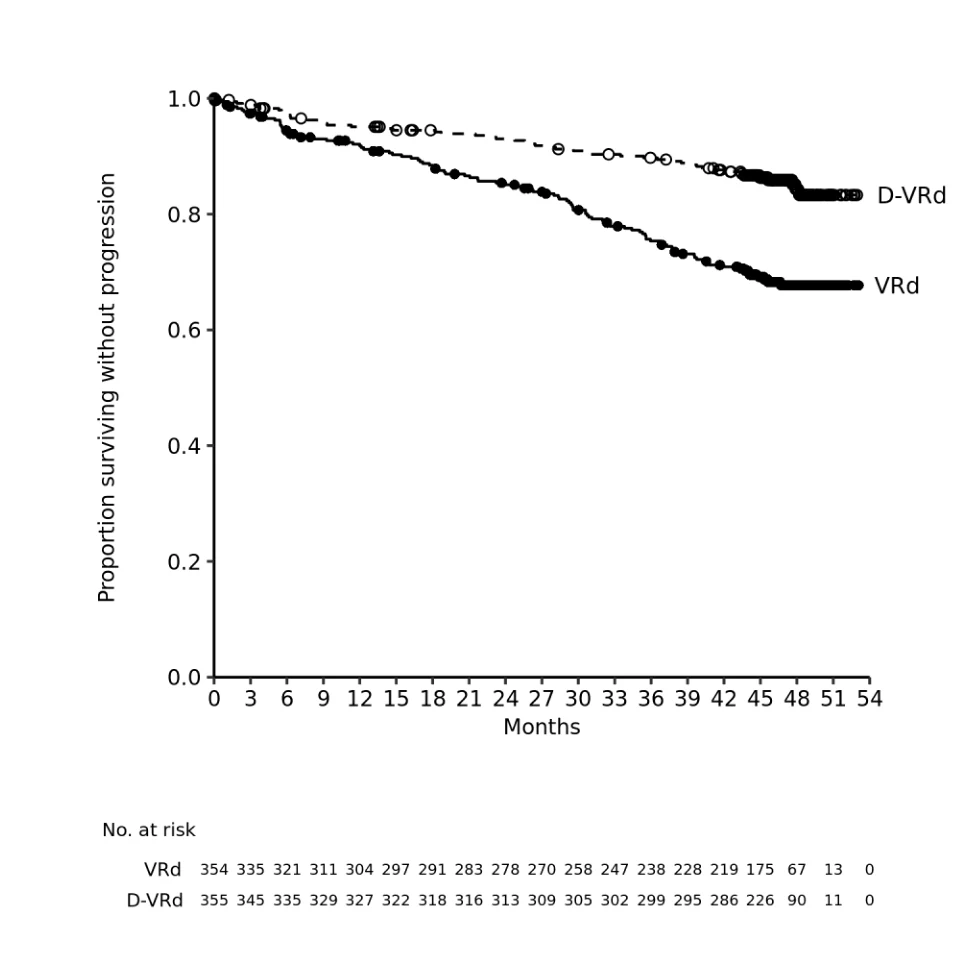
MRD-negativity rates by next-generation sequencing (NGS) assay post consolidation were 57.5% (95% CI: 52.1%, 62.7%) in the D-VRd arm and 32.5% (95% CI: 27.6%, 37.6%) in the VRd arm.
With a median follow-up of 47.5 months, 78 deaths were observed; 34 in the D-VRd group and 44 in the VRd group. Median overall survival (OS) was not reached for either treatment group.
Newly diagnosed multiple myeloma, not a candidate for autologous stem cell transplant.
| Table 44: Summary of Darzalex SC clinical trials in patients with newly diagnosed multiplemyeloma who are not candidates for autologous stem cell transplant. | |||||
Study # Trial design | Dosage, route of administration and duration | Number of subjects | |||
Study MMY3019 (CEPHEUS Study), Phase 3, open-label, randomized, active-controlled study in patients with newly diagnosed multiple myeloma for whom ASCT was not planned as initial therapy or who were not eligible for ASCT that compared treatment with Darzalex SC (1800 mg) in combination with bortezomib, lenalidomide and dexamethasone (D-VRd), to treatment with bortezomib, lenalidomide and dexamethasone (VRd). | Darzalex SC 1800 mg subcutaneously on Days 1, 8, and 15 of Cycles 1 and 2 (weekly dosing), followed by once every three weeks for Cycles 3 to 8, and once every four weeks in Cycle 9 and beyond until disease progression or unacceptable toxicity. Bortezomib 1.3 mg/m2 body surface area subcutaneously twice weekly on Days 1, 4, 8, and 11 of repeated 21-day (3-week) Cycles 1-8. Lenalidomide administered orally at 25 mg daily on Days 1 to 14 of Cycles 1-8 and on Days 1-21 of Cycle 9 and beyond. Dexamethasone administered orally at 20 mg on Days 1, 2, 4, 5, 8, 9, 11, and 12 of each 21-day (3-week) cycle for Cycles 1-8 (or at 20 mg on Days 1, 4, 8, and 11 for patients > 75 years or with a body mass index [BMI] < 18.5). In Cycles 9 and beyond, dexamethasone was administered orally at 40 mg on Days 1, 8, 15, and 22 of each 28-day (4-week) cycle (or at 20 mg weekly for patients > 75 years or with a body mass index [BMI] < 18.5). On the days of Darzalex SC injection, the dexamethasone dose was administered orally or intravenously as a pre-injection medication. Dose adjustments for bortezomib, lenalidomide and dexamethasone were applied according to manufacturer’s prescribing information. | N=395 D-VRd arm: 197 VRd arm: 198 | |||
The clinical efficacy and safety of Darzalex SC for the treatment of adult patients with newly diagnosed multiple myeloma who are not candidates for autologous stem cell transplant was demonstrated in an open-label, randomized, active-controlled study, MMY3019 also known as CEPHEUS (
Table 44).
Study MMY3019: Darzalex in combination with bortezomib, lenalidomide and dexamethasone (D-VRd) in patients with NDMM who are not candidates for ASCT
See
Table 44 for a summary of study design and dosing. Patients were randomized 1:1 to receive D-VRd or VRd. The randomization was stratified by ISS Stage (I, II, or III, based on β2 microglobulin and albumin by central laboratory) and age/transplant eligibility (<70 years ineligible, or <70 years and refusal to transplant [meaning transplant was not planned as initial therapy], or ≥70 years). Key inclusion criteria included 1) newly diagnosed patients for whom an ASCT is not planned as initial therapy, 2) monoclonal plasma cells in the bone marrow ≥10% or presence of a biopsy proven plasmacytoma and documented multiple myeloma, 3) measurable disease, and 4) ECOG performance score (PS) of 0, 1, or 2.
Of the 395 patients who were randomized, the median age was 70 years (range: 31 to 80 years). Fifty percent were male, 39% had an ECOG PS of 0, 51% had an ECOG PS of 1 and 9% had an ECOG PS of 2. Eighteen percent were less than 70 years of age and transplant ineligible, 27% were less than 70 years of age with refusal to transplant (meaning transplant was not planned as initial therapy) and 55% were 70 years of age or older. Thirty-four percent had ISS Stage I, 38% had ISS Stage II, and 28% had ISS Stage III disease; 75% had a standard cytogenetic risk, 13% had a high cytogenetic risk (del17p, t[4;14], t[14;16]), and 11% had an indeterminate cytogenetic risk.
Study Results:
The primary efficacy endpoint was the overall minimal residual disease (MRD) negativity rate defined as the proportion of participants who achieved complete response (CR) or better and had MRD negative status (at 10-5) after randomization but prior to progressive disease, subsequent anti-myeloma therapy, or both. The overall MRD negativity rate was evaluated in bone marrow aspirate at a threshold value of 10-5 and analyzed utilizing the clonoSEQ® v2.0 next-generation sequencing (NGS) assay. Key secondary endpoints were overall CR or better rate, progression free survival (PFS), and sustained MRD negativity rate. The Type I error rate was controlled across the primary and key secondary endpoints using a hierarchical testing approach.
With a median follow-up of 22.3 months, overall MRD negativity rate and CR or better rate were tested. At the time of the interim PFS analysis, with a median follow-up of 39 months, PFS was tested (see Figure 2) as well as sustained MRD negativity rate (by NGS at or below 10-5) for patients reaching CR or better. The efficacy results for the endpoints included in the statistical testing hierarchy are summarized in Table 45.
| Table 45: Efficacy results from Study MMY3019a | |||||||||
|---|---|---|---|---|---|---|---|---|---|
| D-VRd (n=197) | VRd (n=198) | ||||||||
| Overall MRD negativity rateb | 105 (53.3%) | 70 (35.4%) | |||||||
| Risk ratio (95% CI)c | 1.51 (1.20, 1.90) | ||||||||
| Risk difference (95% CI)d | 17.9% (7.5%, 27.5%) | ||||||||
| p-value | 0.0004 | ||||||||
| PFS | |||||||||
| Median (95% CI)e | NE (NE, NE) | NE (NE, NE) | |||||||
| Hazard ratio (95% CI)f | 0.61 (0.42, 0.90) | ||||||||
| p-valueg | 0.0104 | ||||||||
| CR or better rate | 151 (76.6%) | 117 (59.1%) | |||||||
| Risk ratio (95% CI)c | 1.30 (1.13, 1.49) | ||||||||
| Risk difference (95% CI)d | 17.6% (7.9%, 27.3%) | ||||||||
| p-valueg | 0.0002 | ||||||||
| Sustained MRD negativity rateh | 84 (42.6%) | 50 (25.3%) | |||||||
| Risk ratio (95% CI)c | 1.69 (1.26, 2.25) | ||||||||
| Risk difference (95% CI)d | 17.4% (7.5%, 26.6%) | ||||||||
| p-valueg | 0.0003 | ||||||||
D-VRd=daratumumab-bortezomib-lenalidomide-dexamethasone; VRd=bortezomib-lenalidomide-dexamethasone; MRD=minimal residual disease; CI=confidence interval a Based on intent-to-treat population b Patients achieved both MRD negativity (threshold of at or below 10-5) and CR or better c Risk ratio is D-VRd vs VRd d Exact 95% confidence interval e Kaplan-Meier estimate (months) f Hazard ratio and 95% CI from a Cox proportional hazards model with treatment as the sole explanatory variable and stratified with ISS staging ((I, II, III), and age/transplant eligibility (<70 years ineligible, or age<70 years and refusal to transplant, or age ≥70 years) as randomized. A hazard ratio <1 indicates an advantage for D-VRd. g P-value from Fisher’s exact test h Sustained MRD negativity is defined as MRD negative and confirmed by at least 1 year apart without MRD positive in between. | |||||||||
Figure 2: Kaplan-Meier Curve of PFS at Interim Analysis in Study MMY3019
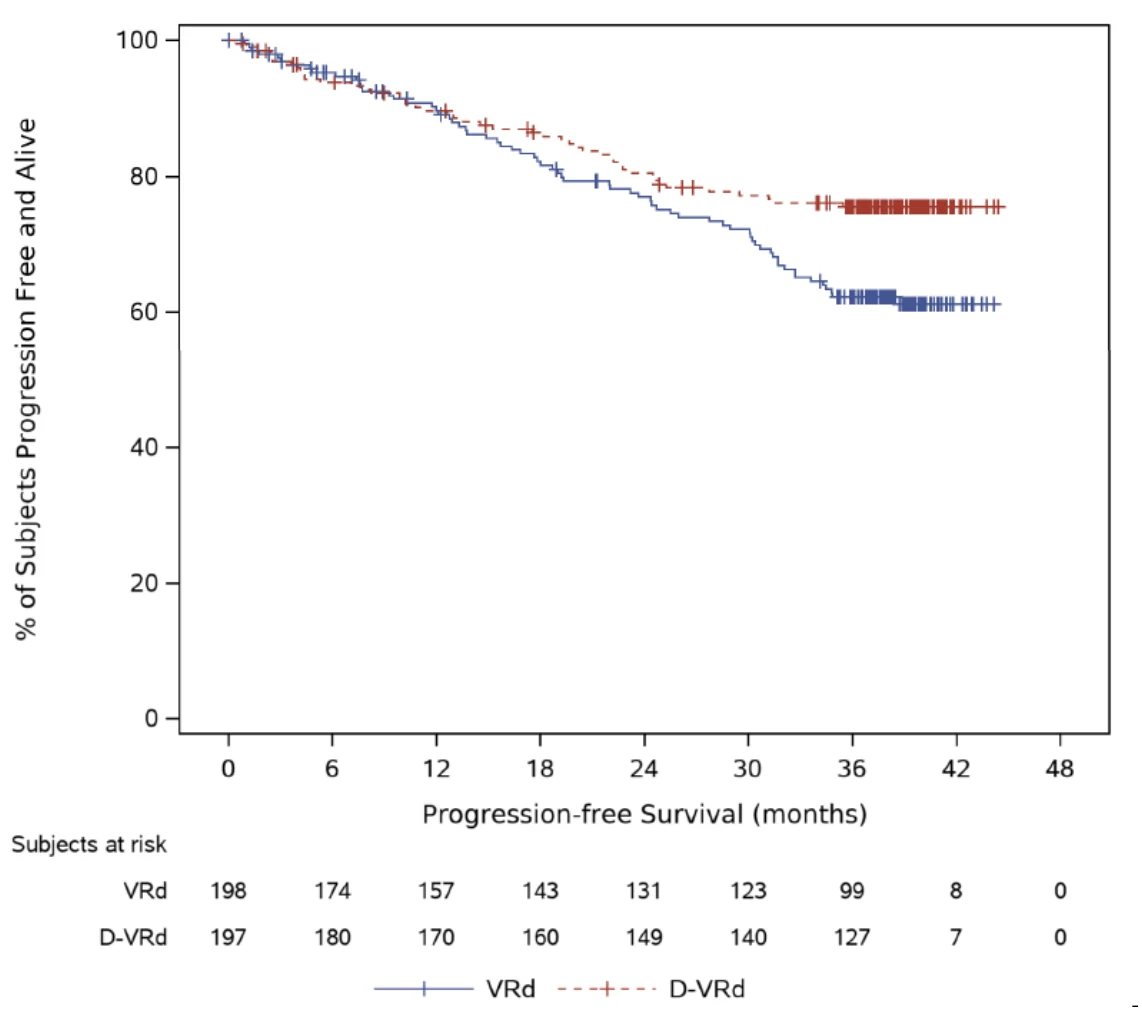
At the final PFS analysis (median follow-up of 58.7 months), overall MRD negativity rates were 60.9% (95% CI: 53.7, 67.8) in the D-VRd arm and 39.4% (95% CI: 32.5, 46.6) in the VRd arm (risk ratio [D-VRd versus VRd] 1.55 with 95% CI: 1.26, 1.90); CR or better rates were 81.2% in the D-VRd arm and 61.6% in the VRd arm (risk ratio [D-VRd versus VRd] 1.32 with 95% CI: 1.16, 1.50); and sustained MRD negativity rates were 48.7% (95% CI: 41.6, 55.9) in the D-VRd arm and 26.3% (95% CI: 20.3, 33.0) in the VRd arm (risk ratio [D-VRd versus VRd] 1.86 with 95% CI: 1.41, 2.44).
At the final PFS analysis (median follow-up of 58.7 months) the final PFS hazard ratio was 0.57 (95% CI: 0.41, 0.79), representing a 43% reduction in the risk of disease progression or death in patients treated with D-VRd. The median PFS had not been reached in the D-VRd arm and was 52.6 months in the VRd arm.
Newly diagnosed multiple myeloma, ineligible for autologous stem cell transplant.
The clinical efficacy and safety of Darzalex for the treatment of patients with newly diagnosed multiple myeloma who are ineligible for ASCT was demonstrated in two open-label, randomized, active-controlled studies using the intravenous formulation (Table 46).
| Table 46: Summary of Darzalex (intravenous formulation) clinical trials in patients with newly diagnosed multiple myeloma who are ineligible for ASCT. | ||||||
Study # Trial design | Dosage, route of administration and duration | Number of subjects | ||||
Study MMY3008 (MAIA Study), Phase 3, open-label, randomized, active-controlled study comparing treatment with Darzalex in combination with lenalidomide and low-dose dexamethasone (DRd), to treatment with lenalidomide and low-dose dexamethasone (Rd) in patients with newly diagnosed multiple myeloma who are ineligible for ASCT. | Darzalex 16 mg/kg (IV) on Days 1, 8, 15, and 22 of Cycles 1 and 2 (weekly dosing), on Days 1 and 15 of Cycles 3 to 6 (every two week dosing), and on Day 1 of Cycle 7 and subsequent cycles (every four week dosing). Lenalidomide (25 mg once daily orally on Days 1-21 of repeated 28-day [4-week] cycles) with low dose oral or intravenous dexamethasone 40 mg/week (or a reduced dose of 20 mg/week for patients >75 years or body mass index [BMI] <18.5). | N=737 DRd arm: 368 Rd arm: 369 | ||||
Study MMY3007 (ALCYONE Study), Phase 3, open-label, randomized, active-controlled study comparing treatment with Darzalex in combination with bortezomib -melphalan-prednisone (D-VMP), to treatment with VMP in patients with newly diagnosed multiple myeloma who are ineligible for ASCT. | Darzalex* 16 mg/kg (IV): Cycle** 1 (weeks 1-6): weekly; Cycle 2-9 (weeks 7-54): every 3 weeks; Cycle ≥10 (week 55 onwards): every 4 weeks until disease progression, unacceptable toxicity or study end (D-VMP arm only). Bortezomib 1.3 mg/m2 body surface area (BSA), subcutaneous (SC): Cycle** 1 (week 1, 2, 4, and 5): twice-weekly; Cycle 2-9 (for week 1, 2, 4, and 5 of each cycle): once weekly Melphalan 9 mg/m2 BSA orally (PO) and prednisone 60 mg/m2 BSA (PO): Days 1-4 of each bortezomib cycle. * Darzalex was administered before bortezomib on treatment days when both bortezomib and Darzalex were to be administered. ** Cycle = 6 weeks. | N=706 D-VMP arm: 350 VMP arm: 356 | ||||
Study MMY3008: Darzalex in combination with lenalidomide and dexamethasone (DRd)
See Table 46 for a summary of study design and dosing. Patients were randomized 1:1 to receive DRd or Rd. The randomization was stratified by ISS (I, II or III), region (North America vs Other) and age (<75 vs ≥75). Key inclusion criteria included 1) patient must be newly diagnosed and not considered a candidate for high-dose chemotherapy with stem cell transplant due to a) being ≥65 years of age, or b) in patients <65 years old, the presence of comorbid condition(s) likely to have a negative impact on tolerability of high dose chemotherapy and stem cell transplant; and 2) patient must have an ECOG score of 0-2. On Darzalex infusion days, dexamethasone served as the treatment dose of steroid for that day, as well as the required pre-infusion medication. Treatment was continued in both arms until disease progression or unacceptable toxicity.
The baseline demographic and disease characteristics were similar between the two treatment groups. The median age was 73 (range 45-90) years old, with 44% of the patients ≥75 years of age. The majority were White (92%), 52% were male, and 83% had an ECOG performance score of 0 or 1. Patients had IgG/IgA/Light chain myeloma in 66%/19%/11% instances; 27% had ISS Stage I, 43% had ISS Stage II and 29% had ISS stage III disease. Of the 642 subjects who had baseline cytogenetic data reported, 14% had high-risk cytogenetic abnormalities, which included t(4;14) (5%), del17p (8%), and t(14;16) (1%), with similar proportions in the 2 arms (DRd:15%, Rd: 14%).
Study Results:
The primary efficacy endpoint was progression free survival (PFS) based on International Myeloma Working Group (IMWG) criteria using a computer algorithm. Key secondary endpoints were overall response rate (ORR), minimal residual disease (MRD) negative rate, and overall survival (OS).
With a median follow-up of 28 months, the primary analysis of PFS in Study MMY3008 demonstrated an improvement in PFS in the DRd arm as compared to the Rd arm; the median PFS had not been reached in the DRd arm and was 31.9 months in the Rd arm (hazard ratio [HR]=0.56; 95% CI: 0.43, 0.73; p<0.0001), representing a 44% reduction in the risk of disease progression or death in patients treated with DRd (Figure 3).
Figure 3: Kaplan-Meier Curve of PFS (Primary Analysis) in Study MMY3008
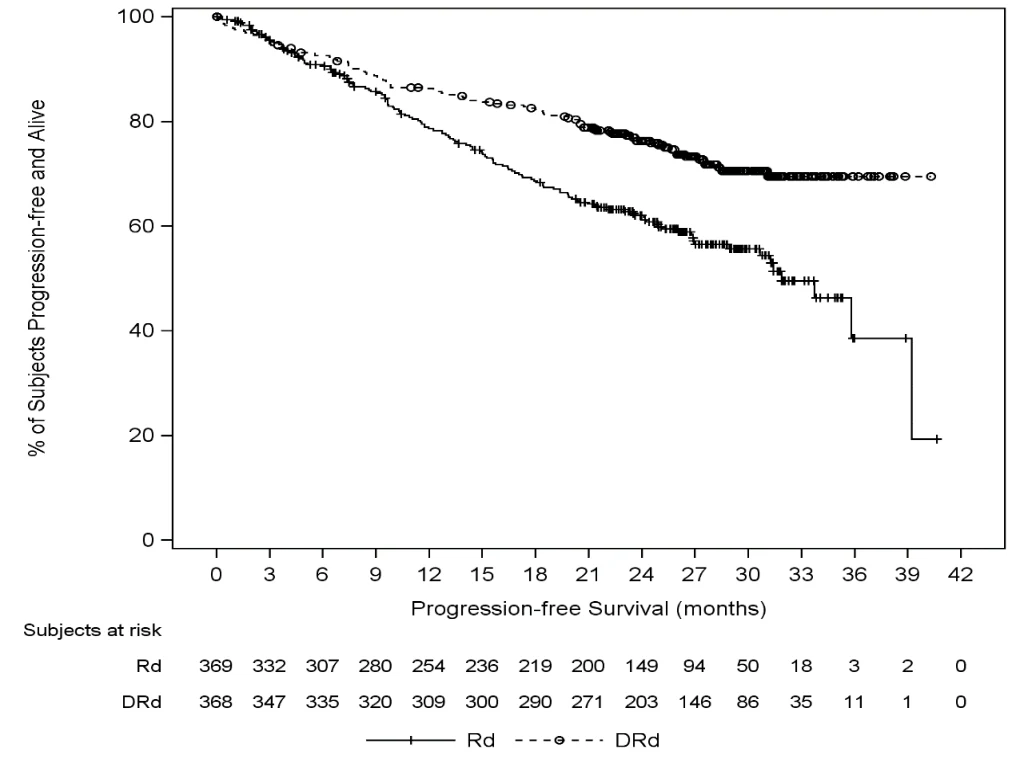
Pre-specified subgroup analyses based on PFS hazard ratio were generally consistent across the subgroups and showed a PFS improvement for subjects in the DRd group compared to those in the Rd group.
Efficacy results from Study MMY3008 are presented in Table 47 below.
| Table 47: Efficacy results (Primary Analysis) from Study MMY3008 | |||||||||
|---|---|---|---|---|---|---|---|---|---|
| DRd (n=368) | Rd (n=369) | ||||||||
| PFS | |||||||||
| Number of events (%) | 97 (26.1) | 143 (38.8) | |||||||
| Hazard Ratio [95% CI]a | 0.56 (0.43, 0.73) | ||||||||
| Stratified log-rank test p-valueb | <0.0001 | ||||||||
| Median PFS in months [95% CI] | NE (NE, NE) | 31.87 (28.94, NE) | |||||||
| Overall response (sCR+CR+VGPR+PR) n(%) | 342 (92.9%) | 300 (81.3%) | |||||||
| Risk difference [95% CI]c | 11.6% (4.5%, 18.8%) | ||||||||
| p-valued | <0.0001 | ||||||||
| Stringent complete response (sCR) | 112 (30.4%) | 46 (12.5%) | |||||||
| Complete response (CR) | 63 (17.1%) | 46 (12.5%) | |||||||
| Very good partial response (VGPR) | 117 (31.8%) | 104 (28.2%) | |||||||
| Partial response (PR) | 50 (13.6%) | 104 (28.2%) | |||||||
| Duration of Response, median in months (95% CI)e | NE (NE, NE) | 34.7 (30.8, NE) | |||||||
DRd=daratumumab-lenalidomide-dexamethasone; Rd=lenalidomide-dexamethasone; CI=confidence interval a Hazard ratio and 95% CI from a Cox proportional hazards model with treatment as the sole explanatory variable and stratified with ISS staging (I, II, III), region (North America vs. Other), and age (<75 years vs. ≥75 years) as randomized. A hazard ratio <1 indicates an advantage for DRd. b p-value is based on the log-rank test stratified with ISS staging (I, II, III), region (North America vs. Other), and age (<75 years vs. ≥75 years) as randomized. c exact 95% CI. A risk difference > 0 indicates a benefit for DRd. d p-value from Fisher’s exact test. e The Kaplan-Meier estimates of duration of response were provided based on subjects with overall response of PR or better. Note: A hierarchical testing procedure was used to control the overall Type I error rate for the primary and secondary endpoints. The corresponding alpha levels for PFS and ORR were 0.0085 and 0.0244, respectively. | |||||||||
In responders, the median time to response was 1.05 months (range: 0.2 to 12.1 months) in the DRd group and 1.05 months (range: 0.3 to 15.3 months) in the Rd group.
In the ITT population, 89 (24.2%) patients in the DRd group achieved CR or better and minimal residual disease (MRD) negativity status at the threshold of 10-5 versus 27 (7.3%) in the Rd group (risk difference: 16.9%; 95% CI: 9.7%, 23.9%; p<0.0001). Among patients who achieved CR/sCR this corresponds to 50.9% in the DRd group versus 29.3% in the Rd group.
In an updated PFS analysis occurring after a median follow-up of 64 months (range 0.0 to 77.6 months), median PFS was 61.9 months (95% CI: 54.8, NE) in the DRd arm and 34.4 months (95% CI: 29.6, 39.2) in the Rd arm.
After a median follow-up of 56 months, the primary analysis of overall survival has demonstrated an improvement in favour of DRd over Rd with a hazard ratio of 0.68 (95% CI: 0.53, 0.86; p=0.0013), representing a 32% reduction in the risk of death in patients treated in the DRd arm. Median OS was not reached for either arm. The 60-month survival rate was 66% (95% CI: 61, 71) in the DRd arm and was 53% (95% CI: 47, 59) in the Rd arm (Figure 4).
Figure 4: Kaplan-Meier Plot for OS in Study MMY3008 (ITT population)
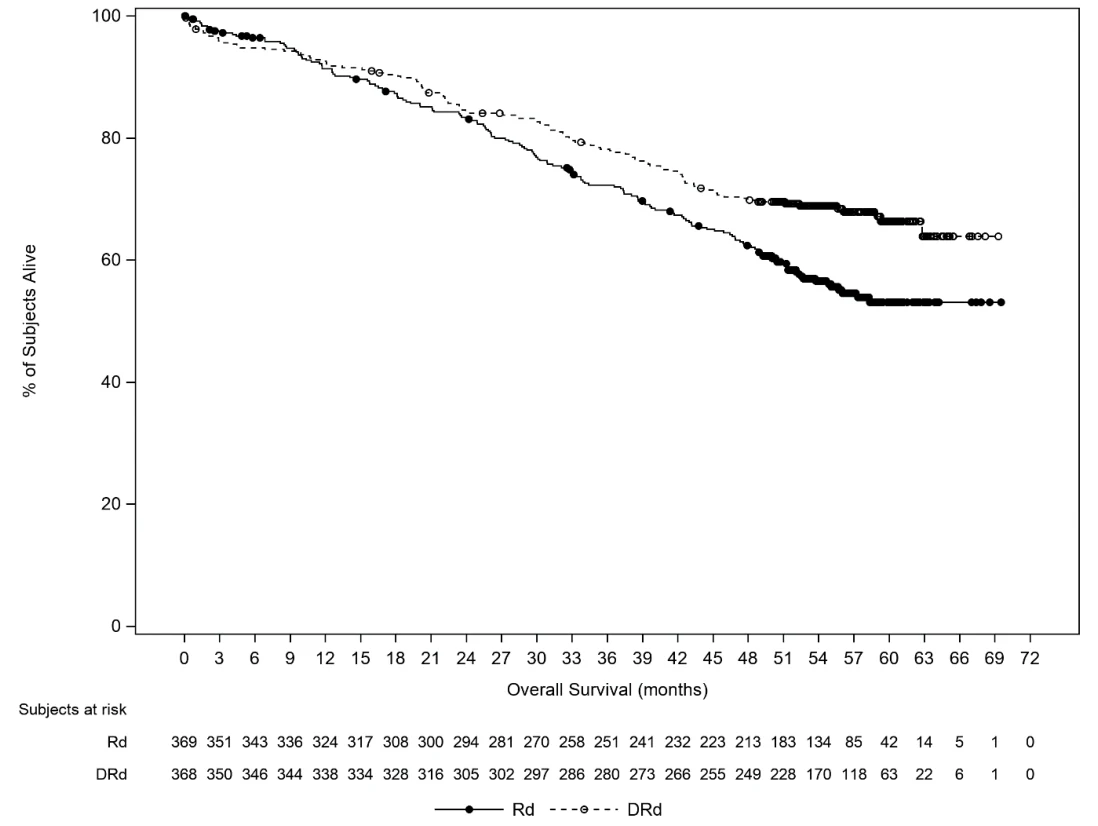
Study MMY3007: Darzalex in combination with bortezomib, melphalan, and prednisone (D-VMP)
See Table 46 for summary of study design and dosing. Patients were randomized 1:1 to receive D-VMP or VMP. The randomization was stratified by ISS (I, II, or III), region (Europe vs Other), and age (<75 vs ≥75).
Key inclusion criteria included 1) patient must be newly diagnosed and not considered a candidate for high-dose chemotherapy with stem cell transplant due to a) being ≥65 years of age, or b) in patients <65 years old, the presence of comorbid condition(s) likely to have a negative impact on tolerability of high dose chemotherapy and stem cell transplant; and 2) patient must have an ECOG score of 0-2. The baseline demographic and disease characteristics were similar between the two treatment groups. The median age was 71 (range 40-93) years old, with 29.9% of the patients ≥75 years of age. The majority were white (85%), 46% were male, and 75.4% had an ECOG performance score of 0 or 1. Patients had
IgG/IgA/Light chain myeloma in 64%/22%/10% instances; 19% had ISS Stage I, 42% had ISS Stage II and 38% had ISS stage III disease. Of the 616 subjects who had baseline cytogenetic data reported, 16% had high-risk cytogenetic abnormalities, which included t(4;14) (7%), del17p (9%), and t(14;16) (2%), with similar proportions in the 2 arms (D-VMP:17%, VMP:15%).
Study Results:
The primary efficacy endpoint was progression free survival (PFS) based on International Myeloma Working Group (IMWG) criteria using a computer algorithm. Key secondary endpoints were objective response rate (ORR), minimal residual disease (MRD) negative rate, and overall survival (OS).
Based on the pre-defined interim analysis, Study MMY3007 demonstrated an improvement in PFS in the D-VMP arm as compared to the VMP arm; the median PFS had not been reached in the D-VMP arm and was 18.1 months in the VMP arm (hazard ratio [HR]=0.5; 95% CI: 0.38, 0.65; p<0.0001), representing a 50% reduction in the risk of disease progression or death in patients treated with D-VMP (Figure 5).
Figure 5: Kaplan-Meier Plot for Progression-free Survival in Study MMY3007 (median follow-up of 16.5 months)
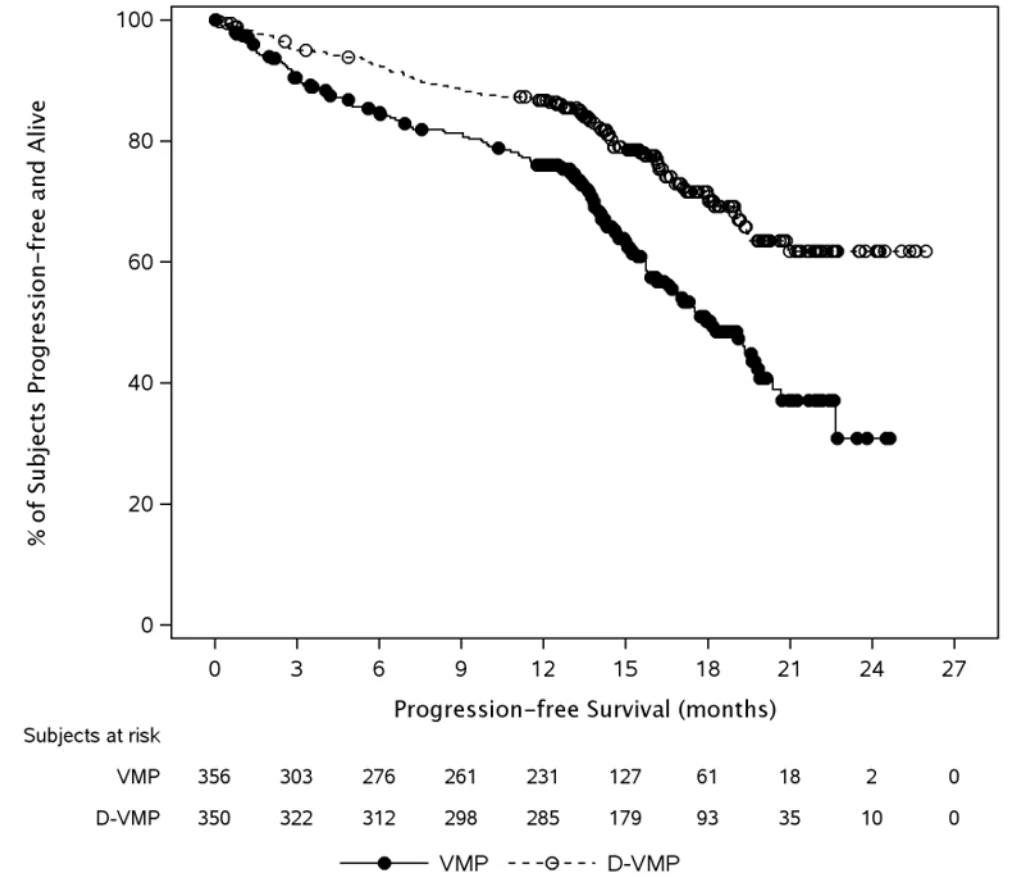
Subgroup analyses based on PFS hazard ratio were consistent across the pre-specified subgroups and showed PFS improvement for subjects in the D-VMP group versus patients in the VMP group.
Efficacy results from Study MMY3007 are presented in Table 48 below.
| Table 48: Efficacy results from Study MMY3007 (ITT population) | |||||||||||
|---|---|---|---|---|---|---|---|---|---|---|---|
| D-VMP (n =350) | VMP (n =356) | ||||||||||
| PFS | |||||||||||
| Number of events (%) | 88 (25.1) | 143 (40.2) | |||||||||
| Hazard Ratio [95% CI]a | 0.50 (0.38, 0.65) | ||||||||||
| Stratified log-rank test p-valueb | <0.0001 | ||||||||||
| Median PFS in months [95% CI] | NE (NE, NE) | 18.14 (16.53, 19.91) | |||||||||
| Overall response (sCR+CR+VGPR+PR) n (%) | 318 (90.9) | 263 (73.9) | |||||||||
| p-valuec | <0.0001 | ||||||||||
| Stringent complete response (sCR) | 63 (18.0) | 25 (7.0) | |||||||||
| Complete response (CR) | 86 (24.6) | 62 (17.4) | |||||||||
| Very good partial response (VGPR) | 100 (28.6) | 90 (25.3) | |||||||||
| Partial response (PR) | 69 (19.7) | 86 (24.2) | |||||||||
| Time to Response, median in months (range)d | 0.79 (0.4, 15.5) | 0.82 (0.7, 12.6) | |||||||||
| Duration of Response, median in months (range)d | NE (NE, NE) | 21.3 (18.4, NE) | |||||||||
D-VMP = daratumumab-bortezomib-melphalan-prednisone; VMP = bortezomib-melphalan-prednisone; MRD = minimal residual disease; CI = confidence interval; NE = not estimable. a Hazard ratio and 95% CI from a Cox proportional hazards model with treatment as the sole explanatory variable and stratified with ISS staging (I, II, III), region (Europe vs. Other), and age (<75 years vs. ≥75 years) as randomized. A hazard ratio <1 indicates an advantage for D-VMP. b p-value is based on the log-rank test stratified with ISS staging (I, II, III), region (Europe vs. Other), and age (<75 years vs. ≥75 years) as randomized. c p-value from Cochran Mantel-Haenszel Chi-Squared test. d The descriptive statistics of time to response and the Kaplan-Meier estimates of duration of response were provided based on subjects with overall response of PR or better. | |||||||||||
In the ITT population, 74 (21.1%) patients in the D-VMP group achieved CR or better and MRD negativity status at the threshold of 10-5 versus 22 (6.2%) in the VMP group, which met the prespecified significance level of ≤0.0244. Among patients who achieved CR/sCR this corresponds to 49.7% in the D-VMP group versus 25.3% in the VMP group.
In an updated analysis of PFS occurring after a median follow-up of 40 months (range 0.0 to 52.1 months), median PFS was 36.4 months (95% CI: 32.1, 45.9) in the D-VMP arm and 19.3 months (95% CI: 18.0, 20.4) in the VMP arm.
In a pre-specified interim analysis of OS, with a median follow-up of 40 months, an OS advantage was shown for the D-VMP arm over the VMP arm (HR=0.60; 95% CI: 0.46, 0.80; p=0.0003), representing a 40% reduction in the risk of death in patients treated with D-VMP versus VMP (Figure 6). Median OS was not reached for either arm. There were 267 subjects (76.3%) still alive in the D-VMP group and 230 subjects (64.6%) still alive in the VMP group.
Figure 6: Kaplan-Meier Plot for Overall Survival; Intent-to-treat Analysis Set in Study MMY3007
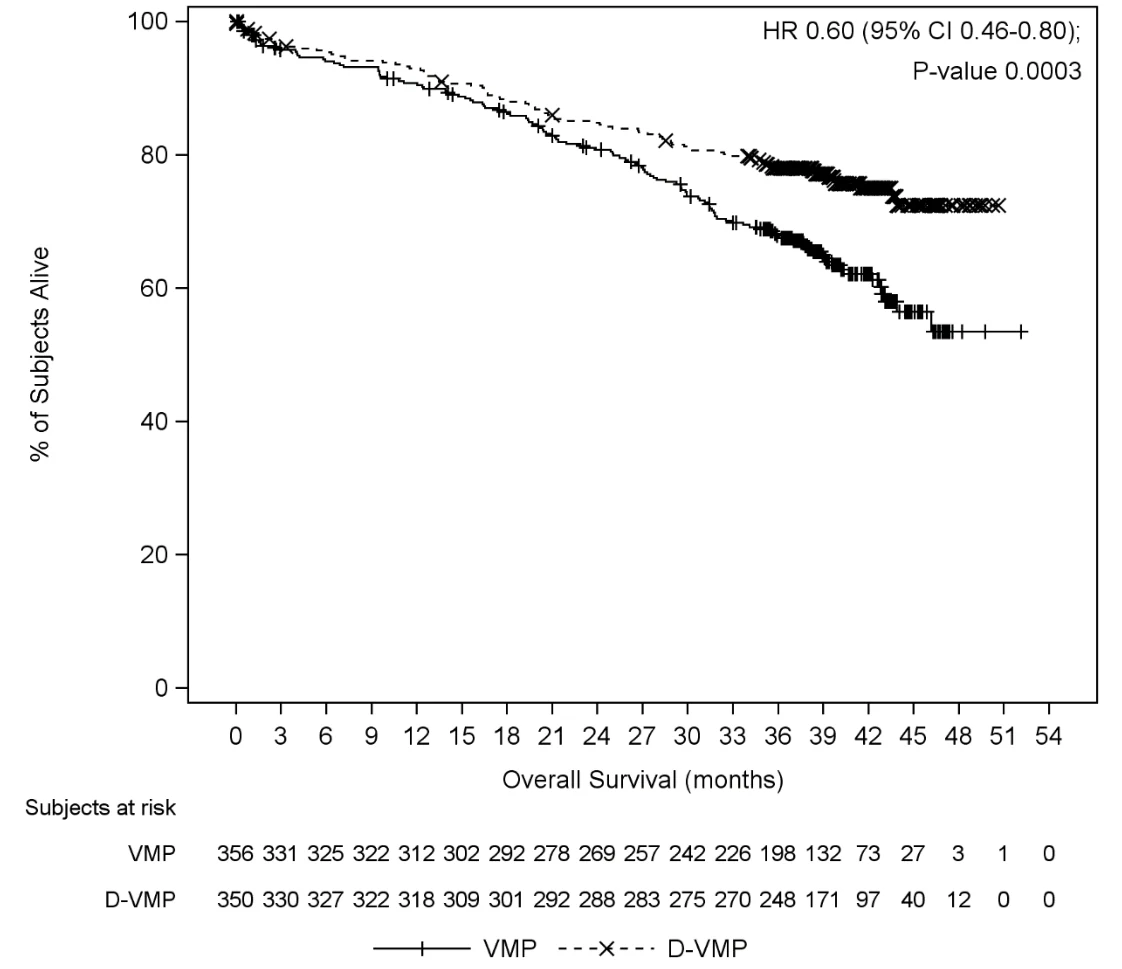
Multiple myeloma, received at least one prior therapy.
The clinical efficacy and safety of Darzalex for the treatment of patients with multiple myeloma who have received at least one prior therapy was demonstrated in two open-label, randomized, active-controlled studies using the intravenous formulation (Table 49).
| Table 49: Summary of clinical trials in patients with multiple myeloma who have received at least one prior therapy who were treated with Darzalex (intravenous formulation), 16 mg/kg | |||||
Study # Trial design | Dosage, route of administration and duration | Number of subjects | |||
Study MMY3003 (POLLUX Study), Phase 3, open-label, randomized, active-controlled study comparing treatment with Darzalex in combination with lenalidomide and low-dose dexamethasone (DRd) to treatment with lenalidomide and low-dose dexamethasone (Rd) in patients with multiple myeloma who had received at least one prior therapy. | Darzalex 16 mg/kg (IV) on Days 1, 8, 15, and 22 of Cycles 1 and 2 (weekly dosing), on Days 1 and 15 of Cycles 3 to 6 (every two week dosing), and on Day 1 of Cycle 7 and subsequent cycles (every four week dosing). Lenalidomide (25 mg once daily orally on Days 1-21 of repeated 28-day [4-week] cycles) with low dose oral or intravenous dexamethasone 40 mg/week (or a reduced dose of 20 mg/week for patients >75 years or body mass index [BMI] <18.5). | N=569 DRd arm: 286 Rd arm: 283 | |||
Study MMY3004 (CASTOR Study), Phase 3, open-label, randomized, active-controlled study comparing treatment with Darzalex in combination with bortezomib and dexamethasone (DVd), to treatment with bortezomib and dexamethasone (Vd). | Darzalex 16 mg/kg (IV) on Days 1, 8, 15 of Cycles 1 to 3, on Day 1 of Cycles 4 to 8, and on Day 1 of Cycle 9 and subsequent cycles every four weeks. Bortezomib by subcutaneous injection or IV injection at a dose of 1.3 mg/m2 body surface area twice weekly for two weeks (Days 1, 4, 8, and 11) of repeated 21 day (3-week) treatment cycles, for a total of 8 cycles. Dexamethasone orally at a dose of 20 mg on Days 1, 2, 4, 5, 8, 9, 11, and 12 of the 8 bortezomib cycles (80 mg/week for two out of three weeks of each of the bortezomib cycle) or a reduced dose of 20 mg/week for patients >75 years, BMI <18.5, poorly controlled diabetes mellitus or prior intolerance to steroid therapy. | N=498 DVd arm: 251 Vd arm: 247 | |||
Study MMY3003: Darzalex in combination with lenalidomide and dexamethasone (DRd)
See Table 49 for a summary of study design and dosing. On Darzalex infusion days, 20 mg of the dexamethasone dose was given as a pre-infusion medication and the remainder given the day after the infusion. For patients on a reduced dexamethasone dose, the entire 20 mg dose was given as a Darzalex pre-infusion medication. Dose adjustments for lenalidomide and dexamethasone were applied according to manufacturer’s prescribing information. Treatment was continued in both arms until disease progression or unacceptable toxicity. Patients were randomized 1:1 to receive DRd or Rd. The randomization was stratified by ISS (I, II or III) at screening, number of prior lines of therapy (1 vs 2 or 3 vs >3), and prior lenalidomide (yes vs no).
Key inclusion criteria included i) patients must have achieved a partial response or better to at least 1 prior regimen; and ii) patients must have an ECOG status 0-2. Patients refractory to lenalidomide were excluded from the study. A total of 569 patients were randomized; 286 to the DRd arm and 283 to the Rd arm. The baseline demographic and disease characteristics were generally balanced between the Darzalex and the control arm. The median patient age was 65 years (range 34 to 89 years), 11% were ≥75 years, 59% were male; 69% Caucasian, 18% Asian, and 3% African American. Patients had received a median of 1 prior line of therapy. Sixty-three percent (63%) of patients had received prior autologous stem cell transplantation (ASCT). The majority of patients (86%) received a prior proteasome inhibitor (PI) including bortezomib (84%), and carfilzomib (2%). Fifty-five percent, (55%) of patients had received a prior immunomodulatory agent (IMiD), including lenalidomide (18%) and thalidomide (43%). Forty-four percent (44%) of patients had received both a prior PI and IMiD. At baseline, 27% of patients were refractory to the last line of treatment. Eighteen percent (18%) of patients were refractory to a PI only, and 21% were refractory to bortezomib. Of the 439 subjects who had baseline cytogenetic data reported, 16% had high-risk cytogenetic abnormalities, which included t(4;14) (6%), del17p (10%), and t(14;16) (2%), with similar proportions in the 2 arms (DRd:15%, Rd:17%).
Study Results:
The primary efficacy endpoint was progression free survival (PFS) based on International Myeloma Working Group (IMWG) criteria using a computer algorithm. Key secondary endpoints were objective response rate (ORR) and overall survival (OS).
Based on the pre-defined interim analysis, Study MMY3003 demonstrated an improvement in PFS in the DRd arm as compared to the Rd arm; the median PFS had not been reached in the DRd arm and was 18.4 months in the Rd arm (hazard ratio [HR]=0.37; 99.39% CI: 0.23, 0.59; p<0.0001) representing 63% reduction in the risk of disease progression or death in patients treated with DRd (Figure 7).
| Figure 7: Kaplan-Meier Plot for Progression-free Survival in Study MMY3003 (median follow-up of 13.5 months) |
Subgroup analyses based on PFS hazard ratio were consistent across the pre-specified subgroups and showed PFS improvement for subjects in the DRd group versus patients in the Rd group.
Efficacy results from Study MMY3003 are presented in Table 50.
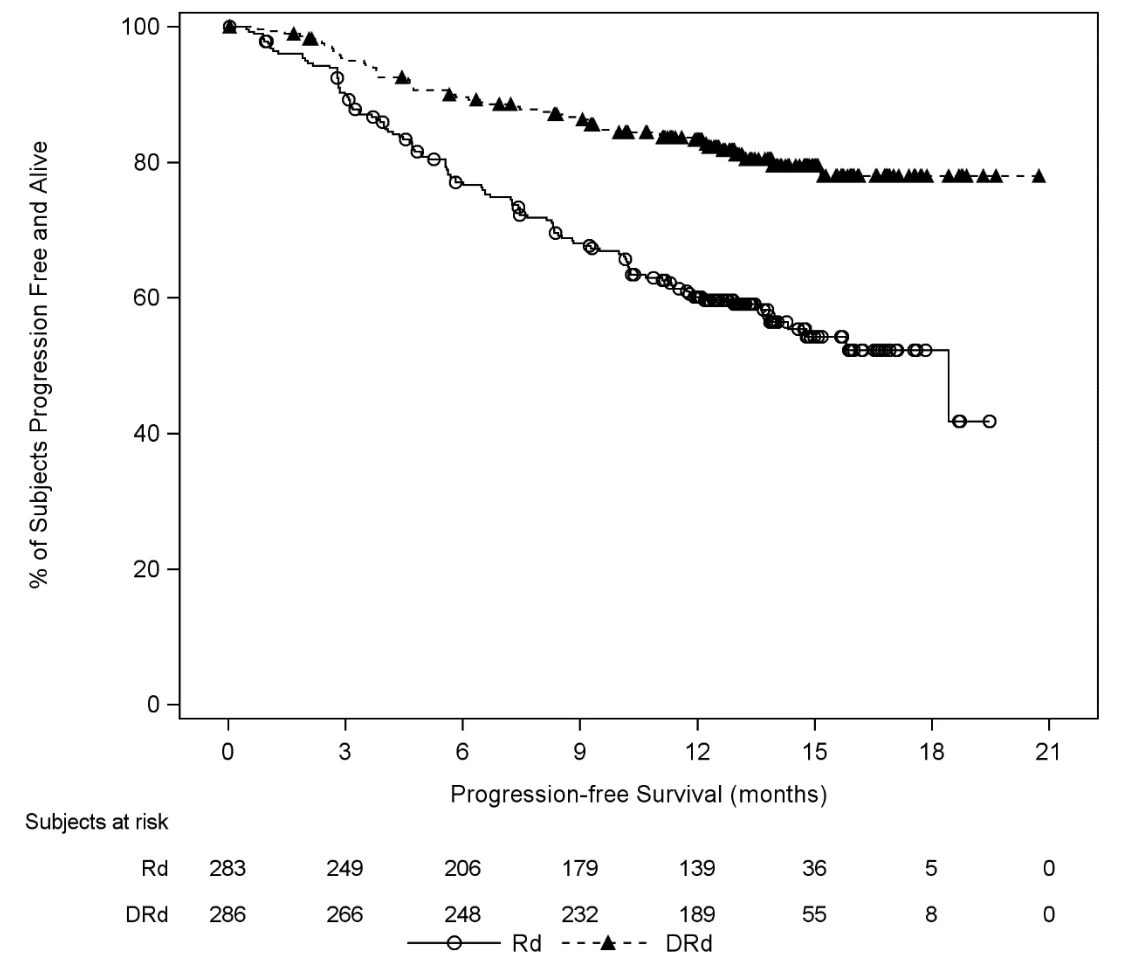 |
| Table 50: Efficacy results from Study MMY3003 | ||||||||||
|---|---|---|---|---|---|---|---|---|---|---|
| Intent-to-treat patient number | DRd (n=286) | Rd (n=283) | ||||||||
| PFSa | ||||||||||
| Number of events (%) | 53 (18.5%) | 116 (41.0%) | ||||||||
| Hazard Ratio [99.39% CI] | 0.37 (0.23, 0.59) | |||||||||
| Stratified log-rank test p-valueb | <0.0001 | |||||||||
| Median PFS in months [95% CI] | NE (NE, NE) | 18.4 (13.9, NE) | ||||||||
| Responsea | ||||||||||
| Overall response (sCR+CR+VGPR+PR) n (%) | 261 (91.3) | 211 (74.6) | ||||||||
| p-valuec | <0.0001 | |||||||||
| Stringent complete response (sCR) | 51 (17.8) | 20 (7.1) | ||||||||
| Complete response (CR) | 70 (24.5) | 33 (11.7) | ||||||||
| Very good partial response (VGPR) | 92 (32.2) | 69 (24.4) | ||||||||
| Partial response (PR) | 48 (16.8) | 89 (31.4) | ||||||||
| Time to Response, median in months (range)d | 1.0 (0.9, 13.0) | 1.1 (0.9, 10.2) | ||||||||
| Duration of Response, median in months (range)d | NR (1+, 19.8+) | 17.4 (1.4, 18.5+) | ||||||||
DRd=daratumumab-lenalidomide-dexamethasone; Rd=lenalidomide-dexamethasone; CI=confidence interval; NE=not estimable; NR=not reached. aThe PFS and ORR interim analysis were based on an adjusted alpha level of 0.00612 and 0.02442 respectively. b p-value was based on the log-rank test stratified with ISS (I, II, or III), number of prior lines of therapy (1 vs. 2 or 3 vs. >3), and prior lenalidomide treatment (no vs. yes). c p-value from Cochran Mantel-Haenszel Chi-Squared test. d Time to response and duration of response were based on subjects with overall response of PR or better. | ||||||||||
Twenty-nine percent (29.0%) of the subjects in the DRd group achieved minimal residual disease (MRD) negativity status by the threshold of 10-4 versus 7.8% in the Rd group.
In an updated PFS analysis occurring after a median follow-up of 55 months (range 0.0 to 61.9 months), median PFS was 45.0 months (95% CI: 34.1, 53.9) in the DRd arm and 17.5 months (95% CI: 13.9, 20.8) in the Rd arm.
In the final analysis of OS, which occurred after a median follow up of 80 months, an improvement in OS was observed for the DRd arm compared to the Rd arm. The hazard ratio was 0.73 (95% CI: 0.58, 0.91; p=0.0044), in favour of DRd, representing a 27% reduction in the risk of death. The median OS was 67.6 months in the DRd arm and 51.8 months in the Rd arm (Figure 8).
Figure 8: Kaplan-Meier Plot for OS in Study MMY3003 (ITT population)
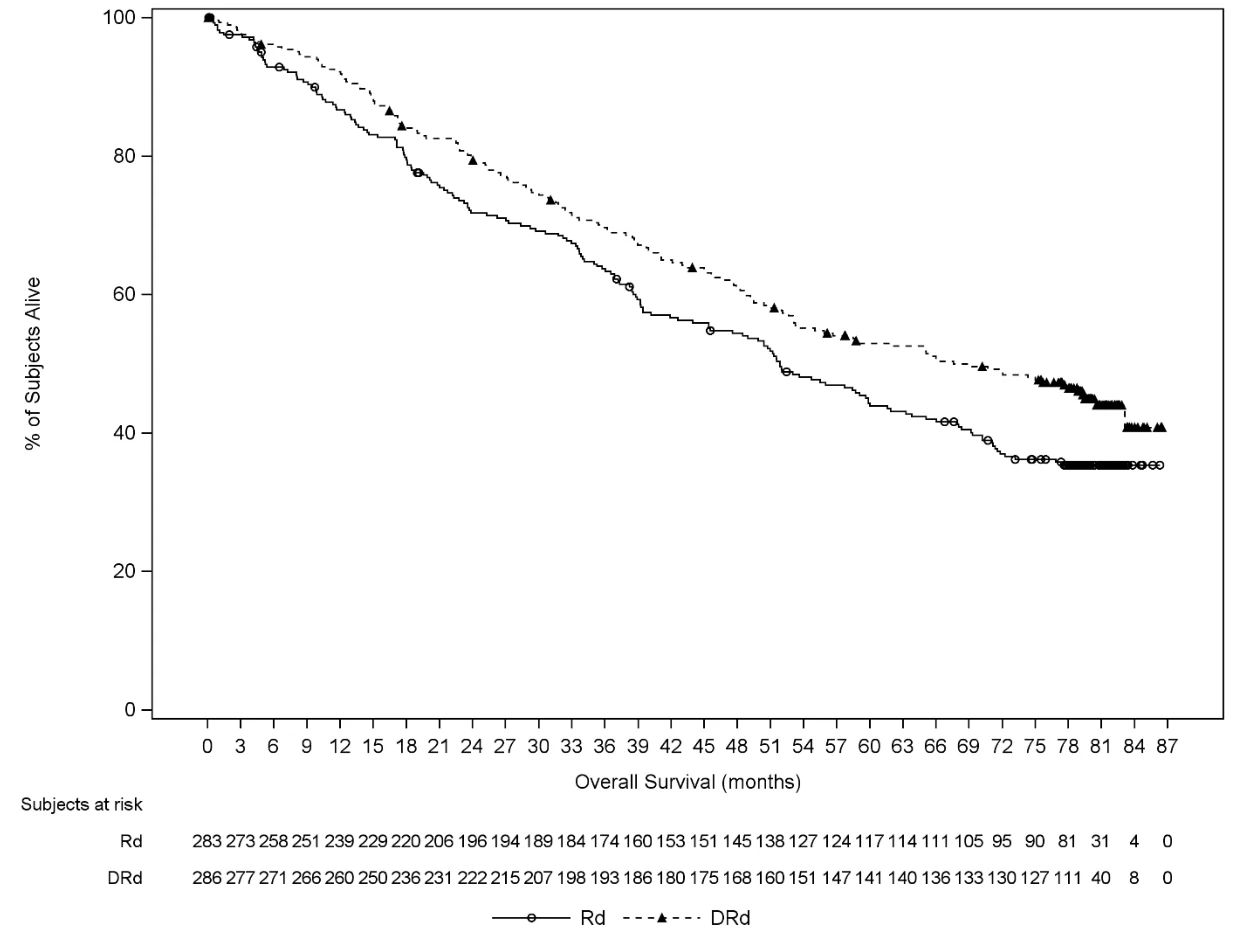
Study MMY3004: Darzalex in combination with bortezomib and dexamethasone (DVd)
See Table 49 for a summary of study design and dosing. On the days of Darzalex infusion, 20 mg of the dexamethasone dose was administered as a pre-infusion medication. For patients on a reduced dexamethasone dose, the entire 20 mg dose was given as a Darzalex pre-infusion medication. Bortezomib and dexamethasone were given for 8 three-week cycles in both treatment arms; whereas Darzalex was given until disease progression in the DVd arm. However, dexamethasone 20 mg was continued as a Darzalex pre-infusion medication in the DVd arm. Dose adjustments for bortezomib and dexamethasone were applied according to manufacturer’s prescribing information. Patients were randomized 1:1 to receive DVd or Vd. The randomization was stratified by ISS (I, II or III) at screening, number of prior lines of therapy (1 vs 2 or 3 vs >3), and prior bortezomib (yes vs no).
Key inclusion criteria included i) patients must have achieved a partial response or better to at least 1 prior regimen; and ii) patients must have an ECOG status 0-2. Key exclusion criteria included i) patients refractory to bortezomib or another proteasome inhibitor; and ii) patients intolerant to bortezomib. A total of 498 patients were randomized; 251 to the DVd arm and 247 to the Vd arm. The baseline demographic and disease characteristics were generally balanced between the Darzalex and the control arm. The median patient age was 64 years (range 30 to 88 years); 12% were ≥75 years, 57% were male; 87% Caucasian, 5% Asian and 4% African American. Patients had received a median of 2 prior lines of therapy and 61% of patients had received prior autologous stem cell transplantation (ASCT). Sixty-nine percent (69%) of patients had received a prior PI, including bortezomib (66%) and carfilzomib (4%); 76% of patients received an IMiD, including lenalidomide (42%), pomalidomide (3%) and thalidomide (49%). At baseline, 32% of patients were refractory to the last line of treatment and the proportions of patients refractory to any specific prior therapy were well balanced between the treatment groups. Thirty-three percent (33%) of patients were refractory to an IMiD only, with 24% of patients in the DVd arm and 33% of patients in the Vd arm refractory to lenalidomide. Of the 355 patients who had baseline cytogenetic data reported, 22% had high-risk cytogenetic abnormalities by karyotype and/or FISH analysis, which included t(4;14) (8%), del17p (14%), and t(14;16) (3%), with similar proportions in the 2 arms (DVd:23%, Vd:21%).
Study Results:
The primary efficacy endpoint was progression free survival (PFS) based on International Myeloma Working Group (IMWG) criteria using a computer algorithm. Key secondary endpoints were objective response rate (ORR) and overall survival (OS).
Based on the pre-defined interim analysis, Study MMY3004 demonstrated an improvement in PFS in the DVd arm as compared to the Vd arm; the median PFS had not been reached in the DVd arm and was 7.2 months in the Vd arm (HR=0.39; 98.98% CI: 0.26, 0.58; p-value < 0.0001), representing a 61% reduction in the risk of disease progression or death for patients treated with DVd versus Vd (Figure 9).
| Figure 9: Kaplan-Meier Plot for Progression-free Survival in Study MMY3004 (median follow-up of 7.4 months) |
Subgroup analyses based on PFS hazard ratio were consistent across the pre-specified subgroups and showed PFS improvement for subjects in the DVd group versus patients in the Vd group.
Efficacy results from Study MMY3004 are presented Table 51 below.
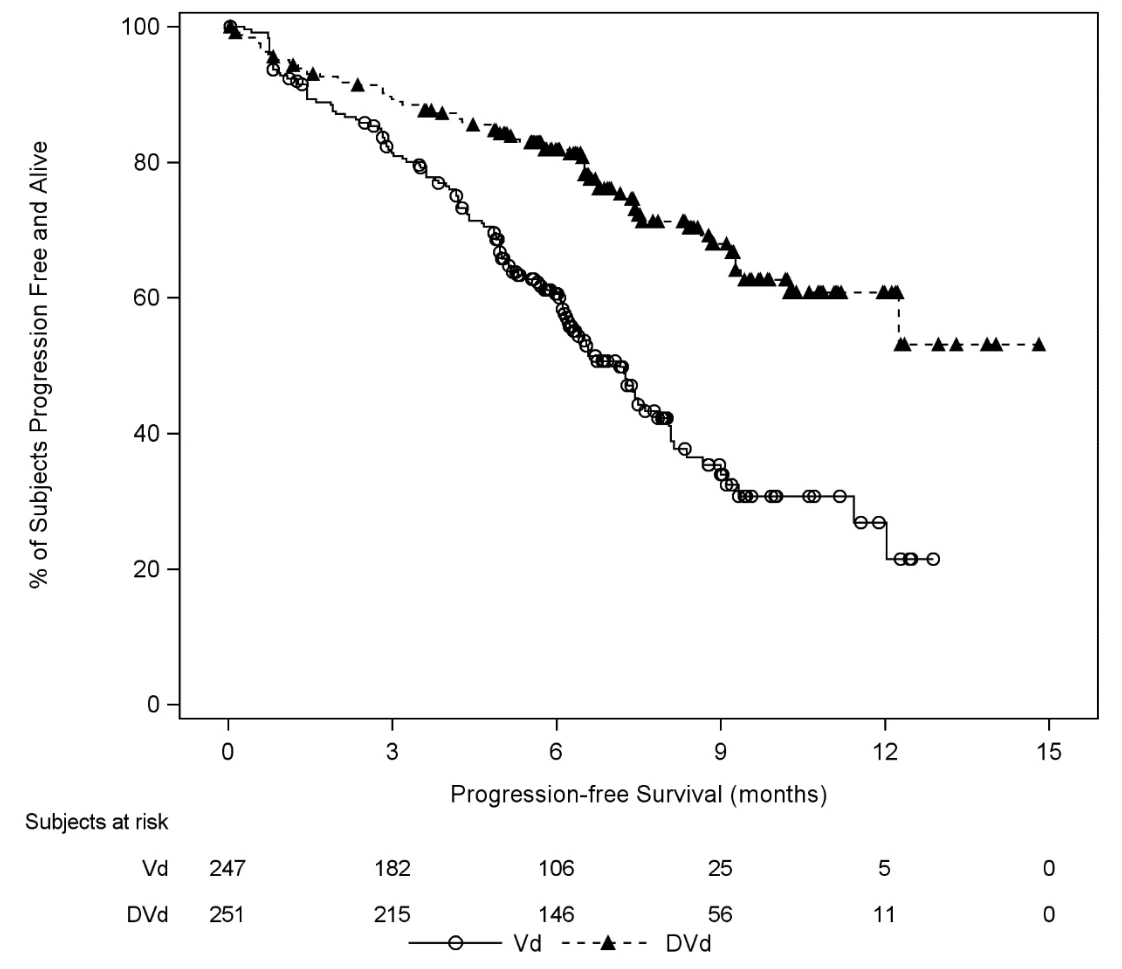 |
| Table 51: Efficacy results from Study MMY3004 | ||||||||||||
|---|---|---|---|---|---|---|---|---|---|---|---|---|
| Intent-to-treat patient number | DVd (n=251) | Vd (n=247) | ||||||||||
| PFSa | ||||||||||||
| Number of events (%) | 67 (26.7%) | 122 (49.4%) | ||||||||||
| Hazard Ratio [98.98% CI] | 0.39 (0.26, 0.58) | |||||||||||
| Stratified log-rank test p-valueb | <0.0001 | |||||||||||
| Median PFS in months [95% CI] | NE (12.3, NE) | 7.2 (6.2, 7.9) | ||||||||||
Responsea Overall response (sCR+CR+VGPR+PR) n (%) | 199 (79.3) | 148 (59.9) | ||||||||||
| P-valuec | <0.0001 | |||||||||||
| Stringent complete response (sCR) | 11 (4.4) | 5 (2.0) | ||||||||||
| Complete response (CR) | 35 (13.9) | 16 (6.5) | ||||||||||
| Very good partial response (VGPR) | 96 (38.2) | 47 (19.0) | ||||||||||
| Partial response (PR) | 57 (22.7) | 80 (32.4) | ||||||||||
| Time to Response, median in months (range)d | 0.8 (0.7, 4.0) | 1.5 (0.7, 5.1) | ||||||||||
| Duration of Response, median in months (range)d | NR (1.4+, 14.1+) | 7.9 (1.4+, 12.0+) | ||||||||||
DVd=daratumumab- bortezomib-dexamethasone; Vd=bortezomib-dexamethasone; CI=confidence interval; NE=not estimable; NR=not reached a The PFS and ORR interim analysis were based on an adjusted alpha level of 0.0102 and 0.02442 respectively. b p-value was based on the log-rank test stratified with ISS (I, II, or III), number of prior lines of therapy (1 vs. 2 or 3 vs. >3), and prior bortezomib treatment (no vs. yes). c p-value from Cochran Mantel-Haenszel Chi-Squared test. d Time to response and duration of response were based on subjects with overall response of PR or better. | ||||||||||||
Thirteen-point five percent (13.5%) of the subjects in the DVd group achieved MRD negativity status by the threshold of 10-4 versus 2.8% in the Vd group.
In an updated analysis of PFS occurring after a median follow-up of 50 months (range 0.0 to 58.6 months), median PFS was 16.7 months (95% CI: 13.1, 19.4) in the DVd arm and 7.1 months (95% CI: 6.2, 7.7) in the Vd arm.
In the final analysis of OS, which occurred after a median follow-up of 73 months, an improvement in OS was observed for the DVd arm compared to the Vd arm. The hazard ratio was 0.74 (95% CI: 0.59, 0.92; p=0.0075), in favour of DVd, representing a 26% reduction in the risk of death. The median OS was 49.6 months in the DVd arm and 38.5 months in the Vd arm (Figure 10).
Figure 10: Kaplan-Meier Plot for OS in Study MMY3004 (ITT population)
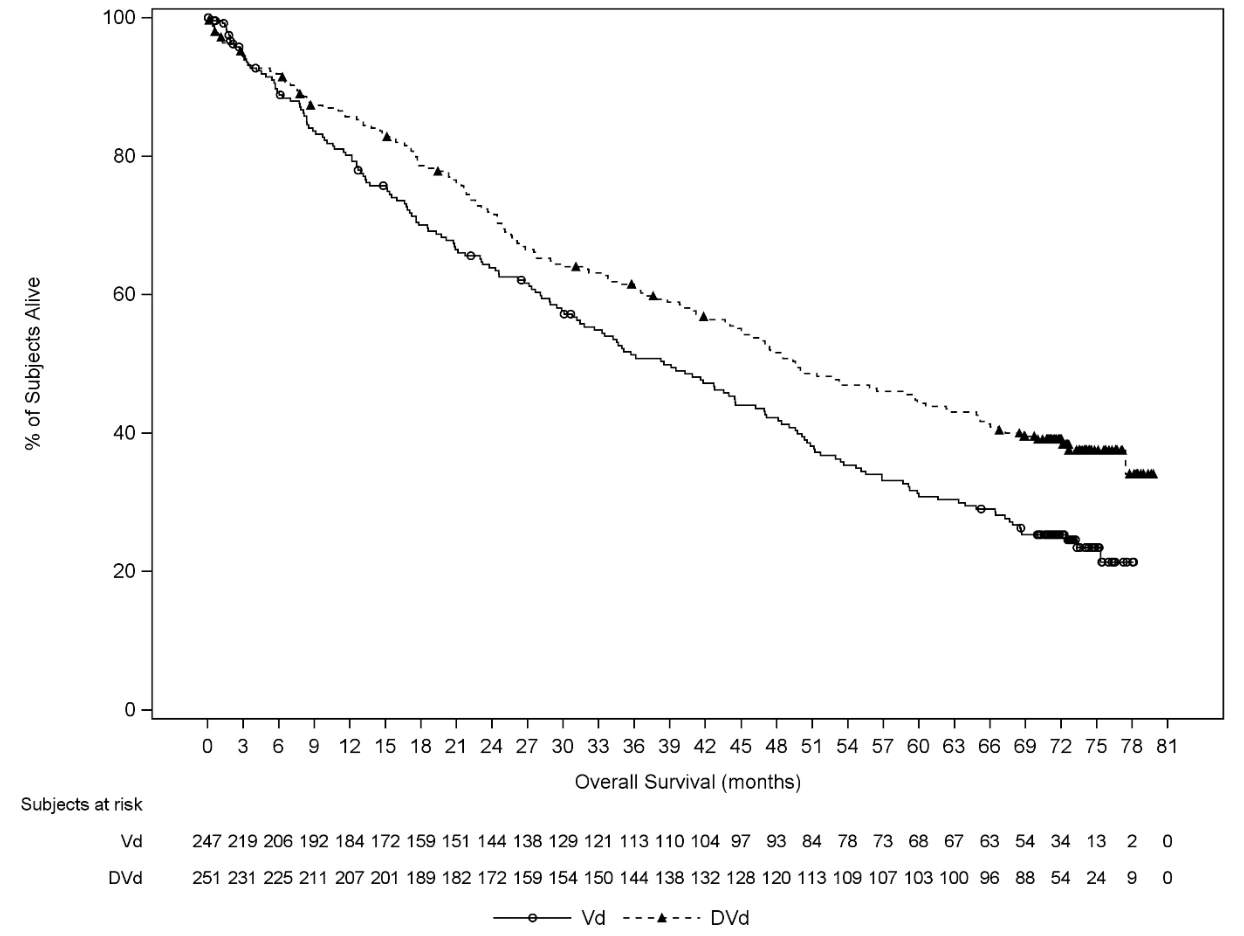
Multiple myeloma, received at least one prior therapy, including lenalidomide and a proteasome inhibitor.
| Table 52: Summary of clinical trials in patients with relapsed or refractory multiple myeloma who were administered Darzalex SC 1800 mg | ||||||
|---|---|---|---|---|---|---|
Study # Trial design | Dosage, route of administration and duration | Number of subjects | ||||
Study MMY3013 (APOLLO Study) Phase 3, randomized, open-label, active-controlled study comparing treatment with Darzalex SC in combination treatment with pomalidomide and dexamethasone (DPd) versus pomalidomide and dexamethasone (Pd) alone in patients with relapsed or refractory multiple myeloma who have received at least one prior therapy with both lenalidomide and a proteasome inhibitor (PI). | Darzalex SC 1800 mg (SC): Cycles* 1-2: weekly; Cycles 3-6: every 2 weeks; Cycle ≥7: every 4 weeks Pomalidomide (4 mg p.o): Days 1-21 of each cycle Dexamethasone (40 mg p.o): Once weekly (reduced dose of 20 mg per week for patients ≥75 years) * Cycle = 4 weeks. | N=304 DPd arm: 151 Pd arm: 153 | ||||
Study MMY3013: Darzalex SC in combination with pomalidomide and dexamethasone
DPd was compared to Pd in Study MMY3013. Table 52 summarizes the study design and dosing regimen. Patients were randomized 1:1 to DPd or Pd. Randomization was stratified by number of lines of prior therapy and ISS stage (I, II or III). Key eligibility criteria included: age at least 18 years, measurable multiple myeloma, receipt of at least 1 prior treatment regimen, and prior treatment with both lenalidomide and a PI. Patients must have experienced a response to prior treatment and had subsequent documented disease progression based on International Myeloma Working Group (IMWG) criteria. Subjects who received only 1 line of prior treatment must have demonstrated progressive disease within 60 days of completion of the lenalidomide-containing regimen (i.e., lenalidomide refractory). Subjects must have had an ECOG performance status score of 0, 1, or 2. Patients were ineligible for the study if they had received a previous allogeneic stem cell transplant or an autologous stem cell transplant that occurred within 12 weeks prior to cycle 1 day 1 of the study.
On Darzalex SC administration days, dexamethasone served as the treatment dose of steroid for that day, as well as the required pre-infusion medication. Treatment was continued in both arms until disease progression or unacceptable toxicity.
A total of 304 patients were randomized: 151 to DPd and 153 to Pd. The median age was 67 years (range: 35 to 90); 53% were male; 89% were White; <1% were Black or African American; <1% were Asian; 45% had ISS Stage I, 33% had ISS Stage II, and 22% had ISS Stage III disease. Ninety-two percent (92%) of patients had an ECOG performance status of 0 – 1, and 8% had an ECOG performance status of
- 2. Patients had received a median of 2 prior lines of therapy (range: 1-5). All patients had received prior treatment that included a PI and lenalidomide, and 56% of patients received prior ASCT. The majority of patients were refractory to lenalidomide (80%), a PI (48%), or both an immunomodulatory agent and a PI (42%). Of the 211 patients who had baseline cytogenetic data reported, 38% in the DPd arm and 32% in the Pd arm had high-risk cytogenetics abnormalities which included del17p (16%), t(4;14) (17%) and t(14;16) (6%).
Study Results:
The primary efficacy endpoint was progression free survival (PFS) based on International Myeloma Working Group (IMWG) criteria using a computer algorithm. Key secondary endpoints were overall response rate (ORR), rate of VGPR or better, rate of CR or better, minimal residual disease (MRD) negativity rate, and overall survival (OS).
MMY3013 demonstrated an improvement in the primary endpoint of progression free survival (PFS) in the DPd treatment group as compared to the Pd treatment group; the median PFS was 12.4 months (95%CI: 8.34, 19.3) in the DPd treatment group and 6.9 months (95%CI: 5.5, 9.3) in the Pd treatment group (HR [95% CI]: 0.63 [0.47, 0.85]; p-value = 0.0018), representing a 37% reduction in the risk of disease progression or death for patients treated with DPd versus Pd. Pre-specified, exploratory subgroup analyses based on PFS hazard ratio were generally consistent across the subgroups and showed a PFS improvement for subjects in the DPd group compared to those in the Pd group. With a median follow-up time of 16.9 months, 99 deaths were observed (48 in the DPd arm, 51 in the Pd group. Median OS was not reached for either treatment group.
Figure 11: Kaplan-Meier Curve of PFS in MMY3013
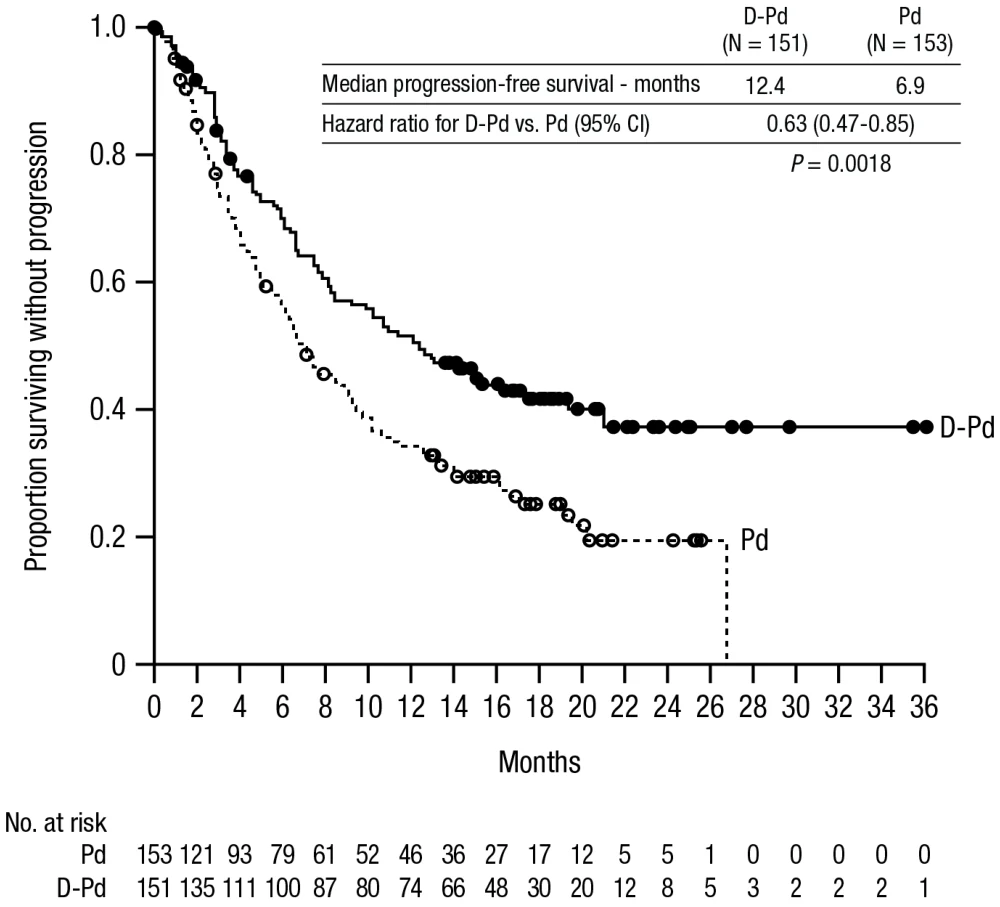
Efficacy results from MMY3013 are presented in Table 53.
| Table 53: Efficacy results from Study MMY3013 | ||||||||||
|---|---|---|---|---|---|---|---|---|---|---|
| D-Pd (n=151) | Pd (n=153) | |||||||||
| PFS | ||||||||||
| Number of events (%) | 84 (55.6) | 106 (69.3) | ||||||||
| Hazard Ratio [95% CI]a | 0.63 (0.47, 0.85) | |||||||||
| Stratified log-rank test p-valueb | 0.0018 | |||||||||
| Median PFS in months [95% CI] | 12.4 (8.3, 19.3) | 6.9 (5.5, 9.3) | ||||||||
| Overall response (sCR+CR+VGPR+PR) n(%)c | 104 (68.9%) | 71 (46.4%) | ||||||||
| P-valued | <0.0001 | |||||||||
| Stringent complete response (sCR) | 14 (9.3%) | 2 (1.3%) | ||||||||
| Complete response (CR) | 23 (15.2%) | 4 (2.6%) | ||||||||
| Very good partial response (VGPR) | 40 (26.5%) | 24 (15.7%) | ||||||||
| Partial response (PR) | 27 (17.9%) | 41 (26.8%) | ||||||||
| MRD negativity ratee n (%) | 13 (8.7%) | 3 (2.0%) | ||||||||
| 95% CI (%) | (4.7%, 14.3%) | (0.4%, 5.6%) | ||||||||
| P-valuef | 0.0102 | |||||||||
D-Pd=daratumumab-pomalidomide-dexamethasone; Pd=pomalidomide-dexamethasone; MRD=minimal residual disease; CI=confidence interval a Hazard ratio and 95% CI from a Cox proportional hazards model with treatment as an explanatory variable and stratified with ISS staging (I, II, III), and number of prior lines of therapy. A hazard ratio <1 indicates an advantage for DPd. b P-value is obtained from the two-sided log-rank test stratified with ISS (1, 2, 3), and number of lines of prior therapy (1, 2-3, ≥ 4). c based on intent-to-treat population d p-value from Cochran Mantel-Haenszel Chi-Squared test adjusted for stratification factors e MRD Negative rate is based on the intent-to-treat population and a threshold of 10-5 using a next generation sequencing assay. f p-value from Fisher’s exact test. | ||||||||||
In responders, the median time to response was 1 month (range: 0.9 to 9.1 months) in the DPd group and 1.9 months (range: 0.9 to 17.3 months) in the Pd group. The median duration of response had not been reached in the DPd group (range: 1 to 34.9+ months) and was 15.9 months (range: 1+ to 24.8 months) in the Pd group.
With a median follow-up of 16.9 months, 99 deaths were observed; 48 in the DPd group and 51 in the Pd group.
Multiple myeloma, received one to three prior lines of therapy.The clinical efficacy and safety of Darzalex in combination with carfilzomib and dexamethasone for the treatment of patients with relapsed or refractory multiple myeloma was demonstrated in the CANDOR Study (with twice-weekly carfilzomib) using the intravenous formulation (Table 54).
| Table 54: Summary of clinical trials in patients with multiple myeloma who have received 1 to 3 prior lines of therapy | |||||
|---|---|---|---|---|---|
Study # Trial design | Dosage, route of administration and duration | Number of subjects | |||
CANDOR Study, Phase 3, randomized, open-label, multicenter superiority trial of Darzalex with carfilzomib and dexamethasone (DKd) vs. carfilzomib and dexamethasone (Kd) in patients with relapsed or refractory multiple myeloma who had received 1 to 3 prior lines of therapy. | Darzalex 16 mg/kg (IV; 28-day cycles): Cycle 1: Split dose (8 mg/kg) on Days 1 and 2; thereafter, 16 mg/kg once weekly on Days 8, 15, and 22. Cycle 2: once weekly dosing on Days 1, 8, 15 and 22 Cycles 3 to 6: every two-week dosing Cycle 7 and subsequent cycles: every four-week dosing until disease progression or unacceptable toxicity. Carfilzomib 20/56 mg/m2 (IV): Administered at a dose of 20 mg/m2 in Cycle 1 on Days 1 and 2; at a dose of 56 mg/m2 in Cycle 1 on Days 8, 9, 15, and 16; and at a dose 56 mg/m2 on Days 1, 2, 8, 9, 15, and 16 of each 28-day cycle thereafter. Dexamethasone 20 mg was administered orally or intravenously on Days 1, 2, 8, 9, 15 and 16 and then 40 mg orally or intravenously on Day 22 of each 28-day cycle. | N=466 DKd arm: 312 Kd arm: 154 | |||
CANDOR Study: Darzalex in combination with carfilzomib (20/56 mg/m2) and dexamethasone (DKd)
See Table 54 above for study design and dosing. Patients were excluded if they had known moderate or severe persistent asthma within the past 2 years, known chronic obstructive pulmonary disease (COPD) with a FEV1 <50% of predicted normal, and active congestive heart failure. A total of 466 patients were enrolled and randomized in a 2:1 randomization (312 in DKd arm and 154 in Kd arm). Randomization was stratified by the ISS (stage 1 or 2 vs stage 3) at screening, prior proteasome inhibitor exposure (yes vs no), number of prior lines of therapy (1 vs ≥ 2), and prior cluster differentiation antigen 38 (CD38) antibody therapy (yes vs no).
The baseline demographic and disease characteristics were similar between arms. In the study population, the median age was 64 years (range 29 to 84 years), 9% were ≥75 years, 58% were male; 79% White, 14% Asian, and 2% Black. Patients had received a median of 2 prior lines of therapy and 58% of patients had received prior autologous stem cell transplantation (ASCT). The majority of patients (92%) received a prior PI and of those 34% were refractory to PI including regimen. Forty-two percent (42%) of patients had received prior lenalidomide and of those, 33% were refractory to a lenalidomide containing regimen.
Patients received treatment with any study drug for a median duration of 70 weeks in the DKd arm and 40 weeks in the Kd arm. Patients in the DKd group received a median of 68 weeks of treatment with daratumumab. Patients received a median of 58 weeks of treatment with carfilzomib in the DKd arm and 40 weeks in the Kd arm.
Study Results:
The primary efficacy endpoint of the CANDOR study was PFS determined by a Blinded Independent Review Committee using IMWG Uniform Response Criteria. Key secondary efficacy endpoints were overall response rate, minimal residue disease-negative complete response (MRD [-] CR) rate at 12 months and overall survival. The trial demonstrated an improvement in PFS in the DKd arm as compared to the Kd arm; the median PFS has not been reached in the DKd arm vs. 15.8 months in the Kd arm (hazard ratio [HR]=0.630; 95% CI: 0.464, 0.854; p=0.0014) representing a 37% reduction in the risk of disease progression or death in patients treated with DKd (Figure 12).
Figure 12: Kaplan-Meier Curve of PFS in CANDOR
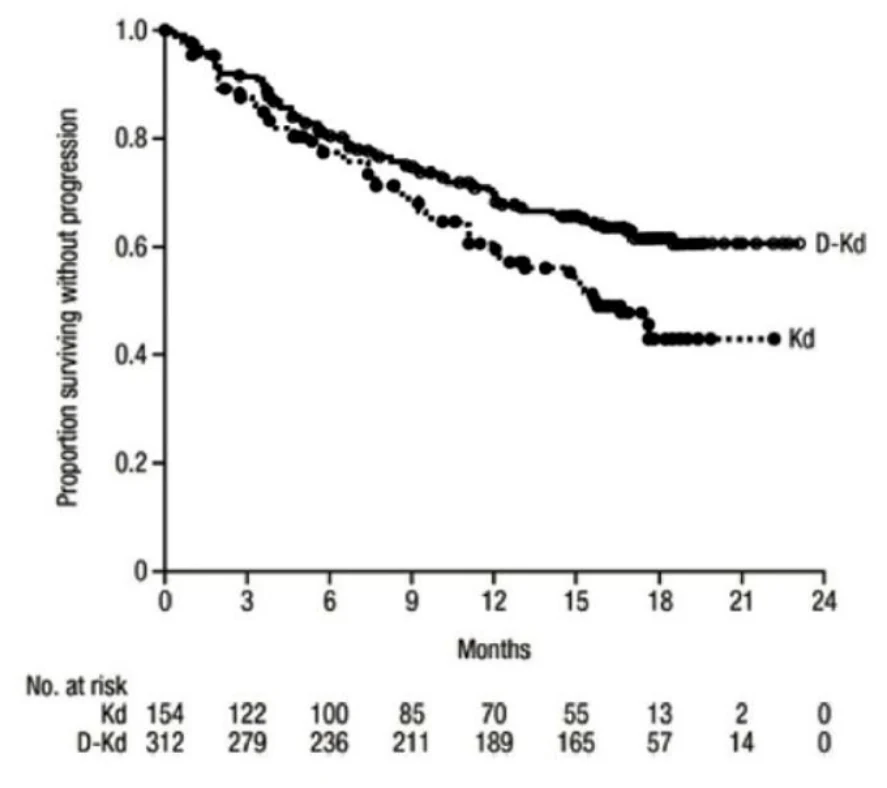
Efficacy results from CANDOR are presented in Table 55.
Table 55: Efficacy Results From CANDOR (Intent-to-Treat Population)
| DKd (N=312) | Kd (N=154) | |||||||||||
|---|---|---|---|---|---|---|---|---|---|---|---|---|
| PFSa | ||||||||||||
| Number of events, n (%) | 110 (35.3) | 68 (44.2) | ||||||||||
| Median, Months (95% CI) | NE (NE, NE) | 15.8 (12.1, NE) | ||||||||||
| Hazard Ratio (95% CI) | 0.630 (0.46, 0.85) | |||||||||||
| p-value (1-sided) | 0.0014 | |||||||||||
| Overall responseb (sCR+CR+VGPR+PR) | ||||||||||||
| N with Response | 263 | 115 | ||||||||||
| ORR, (%) (95% CI) | 84.3 (79.8, 88.1) | 74.7 (67.0, 81.3) | ||||||||||
| Odds Ratio (95% CI) | 1.925 (1.18, 3.13) | |||||||||||
| p-value (1-sided) | 0.0040 | |||||||||||
| CR, n (%) | 89 (28.5) | 16 (10.4) | ||||||||||
| VGPR, n (%) | 127 (40.7) | 59 (38.3) | ||||||||||
| PR, n (%) | 47 (15.1) | 40 (26.0) | ||||||||||
| MRD [-] CR at 12 months (at a 10-5 level)b, c | ||||||||||||
| MRD[-]CR rate (%) (95% CI) | 12.5 (9.0, 16.7) | 1.3 (0.2, 4.6) | ||||||||||
| Odds Ratio (95% CI) | 11.329 (2.70, 47.48) | |||||||||||
| p-value (1-sided) | <0.0001 | |||||||||||
CI = confidence interval; CR = complete response; Kd = carfilzomib and dexamethasone; DKd = Darzalex, carfilzomib, dexamethasone; MRD[-]CR = minimal residual disease negative-complete response; NE = not estimable; ORR = overall response rate; PR = partial response; PFS = progression-free survival; VGPR = very good partial response Stratification factors used in the analyses include (as assessed at randomization): International Staging System (ISS) stage (Stage 1 or 2 vs Stage 3) at screening; prior proteasome inhibitor exposure (yes vs no); number of prior lines of therapy (1 vs ≥ 2). a Hazard ratio and 95% CI were estimated using stratified Cox proportional hazards model; 1-sided p-value was calculated using log-rank test stratified by the randomization stratification factors at level of 0.025 (1-sided); medians were estimated using the Kaplan-Meier method. 95% CIs for medians were estimated using the method by Klein and Moeschberger (1997) with log-log transformation. b Odds ratio and 95% CI were estimated by a stratified analysis using the Mantel-Haenszel method; 1-sided p-values were calculated using Cochran-Mantel-Haenszel Chi-Square test controlling for the stratification factors at level of 0.025(1-sided); 95% CIs for proportions were estimated using the Clopper-Pearson method. c MRD[-]CR at 12-month is defined as achievement of CR or better per IMWG-URC and MRD[-] status as assessed by NGS at 12 months landmark (from 8 months to 13 months window). | ||||||||||||
Overall survival data were not mature. The median duration of response was not estimable for the DKd arm and was 16.6 months (13.9, NE) for the Kd arm. The median time to response was 1 (range: 1, 14) months for the DKd arm and 1 (range: 1,10) months for the Kd arm.
Multiple myeloma, received at least three prior lines of therapy including a proteasome inhibitor (PI) and an immunomodulatory agent (IMiD), or who are refractory to both a PI and an IMiD.
| Table 56: Summary of clinical trials in patients with multiple myeloma who were administered Darzalex SC 1800 mg | ||||||
|---|---|---|---|---|---|---|
Study # Trial design | Dosage, route of administration and duration | Number of subjects | ||||
Study MMY3012 (COLUMBA Study), Phase 3, randomized, open-label, active-controlled, multicenter study to demonstrate that the efficacy and PK for Darzalex SC (subcutaneous) are non-inferior to those for Darzalex (intravenous) in terms of ORR and the maximum trough concentration (Ctrough) in patients with multiple myeloma who have received at least 3 prior lines of therapy including a proteasome inhibitor (PI) and an immunomodulatory drug (IMiD), or whose disease is double refractory to both a PI and an IMiD. | Darzalex SC 1800 mg (SC): Cycles** 1-2: weekly; Cycles 3-6: every 2 weeks; Cycle ≥7: every 4 weeks; Darzalex 16 mg/kg (intravenous): Cycles 1-2: weekly; Cycles 3-6: every 2 weeks; Cycle ≥7: every 4 weeks; ** Cycle = 4 weeks. | N=522 SC arm: 263 IV arm: 259 | ||||
Study MMY3012
MMY3012, an open-label, randomized, Phase 3 non-inferiority study, compared the efficacy and safety of treatment with Darzalex SC (1800 mg) vs. intravenous (16 mg/kg) daratumumab. Key inclusion criteria included 1) patients must have relapsed or refractory multiple myeloma and received ≥3 prior lines of therapy including a PI and an IMiD or are refractory to both a PI and an IMiD; 2) patients must have achieved evidence of response to ≥1 prior treatment regimen; and 3) patients must have an ECOG status of 0-2. See Table 56 for a summary of study design and dosing. Treatment continued until unacceptable toxicity or disease progression.
A total of 522 patients were randomized; 263 to the Darzalex SC arm and 259 to the intravenous Darzalex arm. Randomization was stratified by body weight at baseline (≤65 kg, 66 to 85 kg, and >85 kg), number of prior lines of therapy (≤4 prior lines versus >4 prior lines), and type of myeloma (IgG versus non-IgG). The baseline demographic and disease characteristics were similar between the two treatment groups. The median patient age was 67 years (range: 33-92 years), 55% were male and 78% were Caucasian. The median patient weight was 73 kg (range: 29 – 138 kg); 29% had an ECOG Performance score of 0, 54% had a score of 1, and 16% had a score of 2; patients had IgG/IgA/Light chain myeloma in 57%/17%/22% of instances; 34% of subjects had ISS Stage I, 36% had ISS stage II, and
30% had ISS stage III disease. Of 400 subjects who had baseline cytogenetic data reported, 22% had high-risk cytogenetic abnormalities, with 26% in the SC group and 17% in the IV group, which included del17p (14%), t(4;14) (9%), t(14;16) (3%). Patients had received a median of 4 prior lines of therapy. A total of 51% of patients had prior autologous stem cell transplant (ASCT). Prior therapies included bortezomib (99%), carfilzomib (22%), lenalidomide (86%), thalidomide (57%), and pomalidomide (32%). All subjects were previously treated with both PI(s) and IMiD(s) and most patients were refractory to a prior systemic therapy, including both PI and IMiD (49%).
Study Results:
The study was designed to demonstrate non-inferiority of treatment with Darzalex SC versus intravenous Darzalex based on co-primary endpoints of ORR by computer algorithm using the IMWG response criteria and maximum Ctrough at pre-dose Cycle 3 Day 1 (see 10.3. Pharmacokinetics).
The ORR was 41.1% (95% CI: 35.1%, 47.3%) in the Darzalex SC arm and 37.1% (95% CI: 31.2%, 43.3%) in the intravenous Darzalex arm.
Efficacy results from Study MMY3012 are presented in Table 57 below.
| Table 57: Efficacy results from Study MMY3012 | ||||||||
Darzalex SC (N=263) | Darzalex (N=259) | |||||||
| Primary Endpoint | ||||||||
| Overall response (sCR+CR+VGPR+PR), n (%)a | 108 (41.1%) | 96 (37.1%) | ||||||
| 95% CI (%) | (35.1%, 47.3%) | (31.2%, 43.3%) | ||||||
| Ratio of response rates (95% CI)b | 1.11 (0.89, 1.37) | |||||||
| CR or better, n (%) | 5 (1.9%) | 7 (2.7%) | ||||||
| Very good partial response (VGPR) | 45 (17.1%) | 37 (14.3%) | ||||||
| Partial response (PR) | 58 (22.1%) | 52 (20.1%) | ||||||
| a Based on intent-to-treat population. b p-value <0.0001 from Farrington-Manning test for non-inferiority hypothesis that Darzalex SC retains at least 60% of ORR in Darzalex (intravenous formulation). | ||||||||
The PK evaluation portion of maximum Ctrough (Cycle 3 Day 1 pre-dose) included 149/263 (56.7%) patients from the Darzalex SC arm and 146/259 (56.4%) patients from the Darzalex (intravenous formulation) arm. A total of 227 patients were excluded from the PK evaluation (N=114 Darzalex SC and N=113 Darzalex). The main reasons for exclusion were: patients did not receive full protocol specified doses in Cycle 1 and Cycle 2 (N=161), Cycle 1 and Cycle 2 doses were not all within dosing window (N=35), and Cycle 3 Day 1 predose sample was not within sampling window (N=20).
The PK results demonstrated that Darzalex SC yields non-inferior maximum Ctrough levels at Cycle 3 Day 1 pre-dose as compared with Darzalex (intravenous formulation) as the lower bound of the two-sided 90% Confidence Interval (90% CI) of the geometric mean ratio (GMR) for Ctrough(SC)/Ctrough(IV) was above the pre-specified non-inferior boundary of 80% (GMR of 107.93%; 90% CI: 95.74-121.67).
The study met its co-primary objectives to show that Darzalex SC is non-inferior to intravenous Darzalex in terms of ORR (Table 57) and maximum trough concentration.
Median progression-free survival was 5.6 months in the Darzalex SC arm and 6.1 months in the intravenous Darzalex arm.
After a median follow-up of 29.3 months, the median overall survival (OS) was 28.2 months (95% CI: 22.8, NE) in the Darzalex SC arm and was 25.6 months (95% CI: 22.1, NE) in the intravenous Darzalex arm.
The clinical efficacy and safety of Darzalex for the treatment of patients with relapsed and refractory multiple myeloma was also demonstrated in two open-label studies using the intravenous formulation (Table 58).
| Table 58: Summary of clinical trials in patients with relapsed and refractory multiple myeloma treated with Darzalex (intravenous formulation), 16 mg/kg | |||||
Study # Trial design | Dosage, route of administration and duration | Number of subjects | |||
MMY2002 (SIRIUS Study) Phase 2, open-label, 2-part, single arm study in patients with multiple myeloma who have received at least three prior lines of therapy including a proteasome inhibitor (PI) and an immunomodulatory agent (IMiD), or who are double-refractory to a PI and an IMiD. | 16 mg/kg (IV) on Days 1, 8, 15, and 22 of Cycles 1 and 2 (weekly dosing), on Days 1 and 15 of Cycles 3 to 6 (every two week dosing), and on Day 1 of Cycle 7 and subsequent cycles (every four week dosing). | 106 subjects treated with 16 mg/kg | |||
GEN501 Phase 1/2, open-label, 2-part, single arm study in patients with multiple myeloma whose disease was relapsed or refractory to at least 2 prior lines of therapies. | 16 mg/kg (IV): first dose followed by three week resting period, then weekly for eight weeks, then every two weeks for sixteen weeks, then every four weeks. | 42 subjects treated with 16 mg/kg | |||
Study MMY2002: Darzalex monotherapy
Study MMY2002 was a Phase 2, open-label, 2-part, single arm study in patients with multiple myeloma who had received at least three prior lines of therapy including a PI and an IMiD, or who were refractory to both a PI and an IMiD. The selected dose from Part 1 was 16 mg/kg. Part 1 of the study was to establish an optimal dose schedule, and Part 2 was an expansion cohort. A total of 106 patients received 16 mg/kg Darzalex monotherapy weekly for 8 weeks, then every two weeks for 16 weeks, and every four weeks thereafter until disease progression or unacceptable toxicity. The primary efficacy endpoint was objective response rate (ORR) according to the International Myeloma Working Group (IMWG) criteria (2011) as assessed by an Independent Review Committee (IRC). Tumour assessment was performed every 28 days (± 3 days) until disease progression. Key secondary endpoints included duration of response.
The median patient age was 63.5 years (range: 31-84), 49% were male, and 79% were white. Twenty-seven percent of patients had a baseline ECOG score of 0 while 65% and 7.5% of patients had an ECOG baseline of 1 and 2, respectively. Based on the International Staging System (ISS), 24.5%, 37.7% and 37.7% of the patients had disease stage I, II and III, respectively.
Patients had received a median of 5 (range: 2-14) prior lines of therapy. Eighty percent of patients had received prior autologous stem cell transplantation (ASCT). Prior therapies included proteasome inhibitors (bortezomib [99%] and carfilzomib [50%]), and immunomodulatory drugs (lenalidomide [99%], and pomalidomide [63%]). At baseline, 97% of patients were refractory to the last line of treatment, 95% were refractory to both a PI and an IMiD, 77% were refractory to alkylating agents, 63% were refractory to pomalidomide and 48% of patients were refractory to carfilzomib. Patient cytogenetic profiles included t(4;14) (9.5%), del17p (16.8%), del13q (31.6%) and amp1q21 (24.2%).
Study Results:
Efficacy results based on the Independent Review Committee (IRC) assessment are presented in Table 59.
| Table 59: IRC assessed efficacy results for Study MMY2002 | ||
|---|---|---|
| Efficacy Endpoint | Darzalex 16 mg/kg N=106 | |
| Overall response rate1 (ORR: sCR+CR+VGPR+PR) [n (%)] | 31 (29.2) | |
| 95% CI (%) | (20.8, 38.9) | |
| Stringent complete response2 (sCR) [n (%)] | 3 (2.8) | |
| Complete response (CR) [n (%)] | 0 | |
| Very good partial response (VGPR) [n (%)] | 10 (9.4) | |
| Partial response (PR) [n (%)] | 18 (17.0) | |
| Median Duration of Response [months (95% CI)] | 7.4 (5.5, NE) | |
1 Primary efficacy endpoint (International Myeloma Working Group criteria) 2 Defined as negative immunofixation on the serum and urine and disappearance of any soft tissue plasmacytomas and < 5% plasma cells in bone marrow plus normal FLC ratio and absence of clonal cells in bone marrow by immunohistochemistry or immunofluorescence (International Myeloma Working Group criteria). Clearance of plasma cells from bone marrow was demonstrated in 3 subjects with a stringent CR. CI = confidence interval; NE = not estimable | ||
The median time to response was 1 month (range: 0.9-5.6).
Study GEN501: Darzalex monotherapy
Study GEN501 was a Phase 1/2, open-label, 2-part, single arm study in patients with multiple myeloma whose disease was relapsed or refractory to at least 2 prior lines of therapy. Part 1 of the study was to establish the optimal dose schedule and Part 2 was an expansion cohort. In Study GEN501, 42 patients received 16 mg/kg Darzalex until disease progression. Patients received the first full infusion with a 3-week resting period, followed by weekly dosing for 7 weeks and then biweekly (every 2 weeks) infusions for 14 additional weeks. Patients then received monthly infusions for up to 72 weeks or until disease progression or unmanageable toxicity. Tumour assessment was performed on weeks 2, 4, 6 (±1 day), and 9 (±4 days), followed by assessment every 4 weeks (±4 days) until disease progression. The primary efficacy endpoint was ORR according to the IMWG criteria (2011) as assessed by an IRC. The key secondary endpoints included duration of response.
The median patient age was 64 years (range, 44 to 76 years), 64% were male and 76% were white. Patients in the study had received a median of 4 prior lines of therapy. Seventy-four percent of patients had received prior ASCT. Prior therapies included bortezomib (100%), lenalidomide (95%), pomalidomide (36%) and carfilzomib (19%). At baseline, 76% were refractory to the last line of treatment, 64% of patients were refractory to both a PI and IMiD, 60% were refractory to alkylating agents, 36% were refractory to pomalidomide and 17% were refractory to carfilzomib.
Study Results:
Treatment with daratumumab at 16 mg/kg led to a 36% ORR (95% CI: 21.6, 52.0) with 1 CR and 3 VGPR. The median time to response was 1 month (range: 0.5 to 3.2 months). The median duration of response was not reached (95% CI: 5.55 months, not estimable).
High-risk smouldering multiple myeloma (SMM)
Table 60: Summary of clinical trials in patients with high-risk smouldering multiple myeloma (SMM) who were administered Darzalex SC 1800 mg
Study # Trial design | Dosage, route of administration and duration | Number of subjects |
Study SMM3001 (AQUILA Study), Phase 3, open-label, randomized, multicenter study evaluating the safety and efficacy of Darzalex SC compared to active monitoring (ACTM) in participants with high-risk SMM. | Darzalex SC 1800 mg administered subcutaneously weekly in Cycles 1 and 2, then every 2 weeks for Cycle 3 to Cycle 6, and every 4 weeks thereafter until 39 cycles or up to 36 months or confirmed PD or unacceptable toxicity, whichever occurred first. For participants randomized to ACTM, no disease-specific treatment was administered. | N=390 Darzalex SC arm: 194 ACTM arm: 196 |
Study SMM3001: Darzalex SC monotherapy
The efficacy and safety of Darzalex SC were investigated in an open-label, randomized, Phase 3 study (Table 60). See Table 60 for a summary of study design and dosing.
Patients were randomized 1:1 to receive either Darzalex SC or ACTM. The randomization was stratified based on the following risk factors: involved versus uninvolved free light chain (FLC) ratio ≥8 (yes vs no); serum M protein ≥30 g/L (yes vs no); Immunoglobulin A (IgA) SMM (yes vs no); immunoparesis (reduction of 2 uninvolved immunoglobulin isotypes) (yes vs no); and bone marrow plasma cells (BMPCs) (>50% to <60% vs ≤50%). Key inclusion criteria included 1) diagnosis of SMM for ≤5 years with measureable disease at randomization (serum M protein ≥10 g/L or urine M protein ≥200 mg/24 hours or involved serum FLC ≥100 mg/L and abnormal serum FLC ratio), 2) Clonal BMPCs ≥10% plus one risk factor (serum M protein ≥30 g/L, IgA SMM, immunoparesis with reduction of 2 uninvolved Ig isotypes, serum involved: uninvolved FLC ratio ≥8 and <100, or clonal BMPCs >50% to <60% with measurable disease) and, 3) ECOG PS of 0 or 1. Key exclusions were primary systemic AL (immunoglobulin light chain) amyloidosis and multiple myeloma requiring treatment.
A total of 390 patients were randomized: 194 to the Darzalex SC arm and 196 to the ACTM arm. The median patient age was 64 years (range: 31-86 years); 12% were ≥75 years; 48% were male; 83% Caucasian, 8% Asian, and 3% were African American. Eighty-three percent had an ECOG performance score of 0 and 17% had an ECOG performance score of 1. Median percentage of plasma cells in the bone marrow was 20% and the median time from initial diagnosis date of SMM to randomization was 0.7 years. Eighty percent of patients had less than 3 risk factors associated with progression to multiple myeloma. Risk factors were serum M protein ≥30 g/L; IgA SMM; immunoparesis with reduction of 2 uninvolved immunoglobulin isotypes; serum involved: uninvolved FLC ratio ≥8 and <100, clonal bone marrow plasma cells (BMPCs) >50% to <60% with measurable disease. To be eligible for enrolment, patients were required to have at least one of these risk factors and clonal BMPCs ≥10%. Nineteen percent of patients had a serum M protein ≥30 g/L, 25% had IgA SMM, 60% had immunoparesis with reduction of 2 uninvolved immunoglobulin isotypes, 72% had serum involved:uninvolved FLC ratio ≥8 and <100, and 3% had clonal BMPCs >50% to <60% with measurable disease. Fifteen percent had at least 1 of the following risk cytogenetic abnormalities: del(17p13), t(4;14), and t(14;16).
Study Results:
The primary outcome of the study was Progression Free Survival (PFS), defined as the time from randomization to documented progression to multiple myeloma based on IMWG diagnostic criteria or the date of death, whichever occurred first. The median follow-up time was 65.2 months. The primary analysis results are shown in Table 61. Additional efficacy results from Study SMM3001 are also presented in Table 61.
Table 61: Efficacy results from Study SMM3001a
Darzalex SC (n=194) | ACTM (n=196) | |||||||
|---|---|---|---|---|---|---|---|---|
| Progression-free survival (PFS) | ||||||||
| Number of events, n (%)a | 67 (34.5%) | 99 (50.5%) | ||||||
| Hazard ratio (95% CI)b | 0.49 (0.36,0.67) | |||||||
| p-valuec | <0.0001 | |||||||
| Median PFS in months (95% CI)b | NE (66.7, NE) | 41.5 (26.4, 53.3) | ||||||
| Overall response (sCR+CR+VGPR+PR), n(%)a,d | 123 (63.4%) | 4 (2.0%) | ||||||
Figure 13: Kaplan-Meier Curve of PFS in Study SMM3001
| Odds ratio (95% CI)e | 83.80 (26.69, 236.54) | |
|---|---|---|
| p-value | <0.0001 | |
| Stringent Complete Response (sCR) | 5 (2.6%) | 0 |
| Complete response (CR) | 12 (6.2%) | 0 |
| Very good partial response (VGPR) | 41 (21.1%) | 2 (1.0%) |
| Partial response (PR) | 65 (33.5%) | 2 (1.0%) |
ACTM=active monitoring.; CI=confidence interval; NE=not estimable a Based on intent-to-treat population b Hazard ratio and 95% CI was calculated using the Cox proportional hazards model with treatment as the sole explanatory variable and stratified by the stratification factor. A hazard ratio < 1 indicates an advantage for Dara-SC. c p-value is based on the log-rank test stratified by the stratification factor (number of risk factors associated with progression to multiple myeloma [<3 vs ≥3]). The risk factors were: a. serum M protein ≥30 g/L; b. IgA SMM; c. immunoparesis with reduction of 2 uninvolved immunoglobulin isotypes (only IgA, IgM, and IgG were considered in determination for immunoparesis, IgD and IgE were not considered in this assessment); d. serum involved: uninvolved FLC ratio ≥8 and <100, or e. clonal BMPCs >50% to <60% with measurable disease. d Response was assessed by computerized algorithm, based on International Uniform Response Criteria Consensus Recommendations e Mantel-Haenszel estimate of the common odds ratio for stratified tables is used | ||
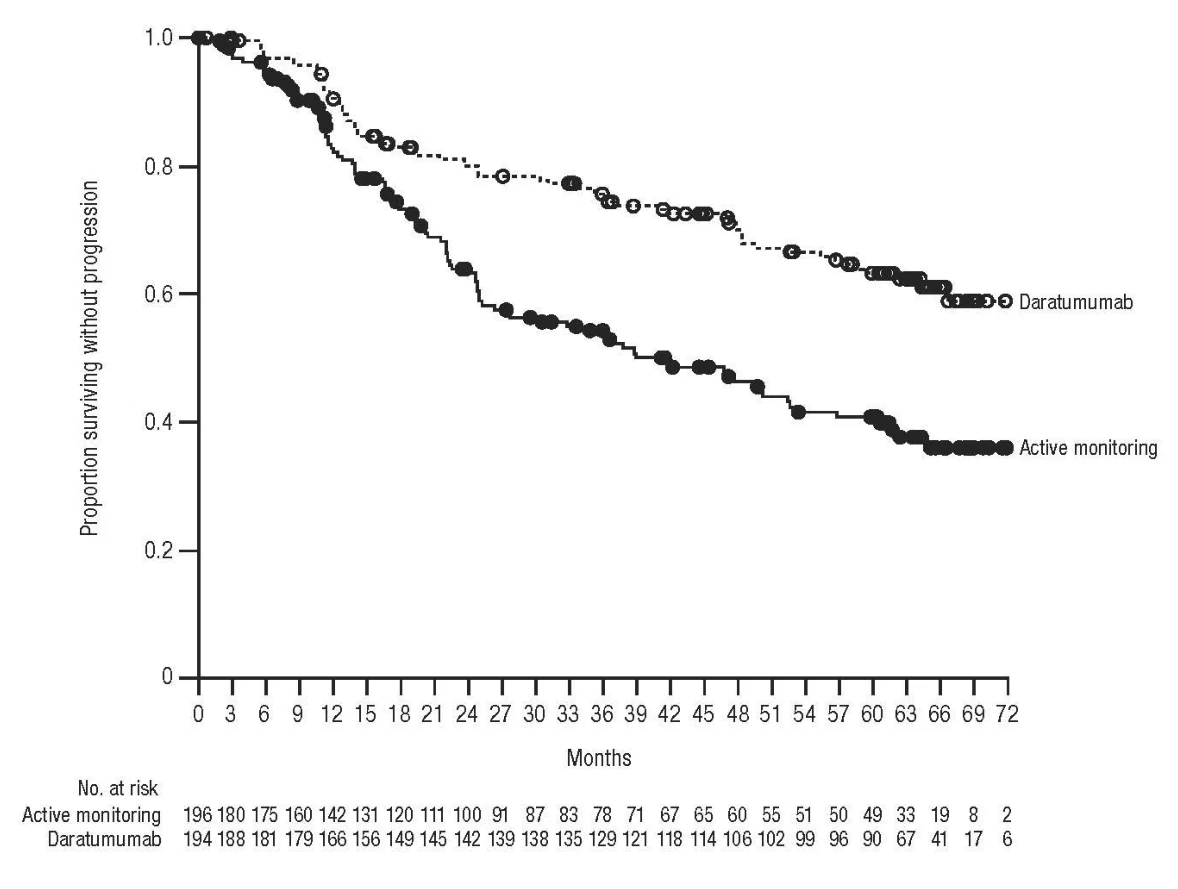
Newly diagnosed light chain (AL) amyloidosis
| Table 62: Summary of clinical trials in patients with newly diagnosed AL amyloidosis who were administered Darzalex SC 1800 mg | |||||
|---|---|---|---|---|---|
Study # Trial design | Dosage, route of administration and duration | Number of subjects | |||
Study AMY3001 (ANDROMEDA Study) Phase 3 randomized, open-label, active-controlled, multicenter study in subjects with newly diagnosed AL amyloidosis comparing the combination treatment of Darzalex SC plus bortezomib, cyclophosphamide and dexamethasone (D-VCd) to bortezomib, cyclophosphamide and dexamethasone alone (VCd). | Darzalex SC 1800 mg (SC): Cycles* 1-2: weekly; Cycles 3-6: every 2 weeks; Cycle ≥7: every 4 weeks; (Darzalex SC is given until disease progression or start of subsequent therapy, or for a maximum of 24 cycles) Bortezomib** 1.3 mg/m2 BSA (SC): Cycles 1-6: weekly Cyclophosphamide 300 mg/m2 BSA (PO or IV): Cycles 1-6: weekly (maximum cyclophosphamide weekly dose of 500 mg, irrespective of BSA) Dexamethasone*** 40 mg (PO or IV): Weekly * Cycle = 4 weeks. ** For subjects whose bortezomib was discontinued because of a bortezomib-related toxicity (eg, peripheral neuropathy), doses of daratumumab, cyclophosphamide, and dexamethasone were continued unless criteria existed to hold these medications as well. *** D-VCd arm: subjects received 20 mg on the day of daratumumab dosing as premedication and 20 mg on the day after daratumumab dosing. VCd arm: on weeks that daratumumab was not administered, subjects were given 40 mg weekly on a single day or divided into 2 days. For subjects who were older than 70 years, underweight (BMI <18.5), had hypervolemia, poorly controlled diabetes mellitus, or prior intolerance/AE to steroid therapy, dexamethasone was administered at a dose of 20 mg weekly. For subjects receiving dexamethasone 20 mg weekly, on days of daratumumab treatment, it was recommended that dexamethasone 20 mg was administered as premedication. | N=388 D-VCd arm: 195 VCd arm: 193 | |||
Study AMY3001, an open-label, randomized, active-controlled Phase 3 study, compared treatment with Darzalex SC subcutaneous formulation (1800 mg) in combination with bortezomib, cyclophosphamide and dexamethasone (D-VCd) to treatment with bortezomib, cyclophosphamide and dexamethasone
(VCd) alone in patients with newly diagnosed AL amyloidosis. Key inclusion criteria included 1) histopathological diagnosis of amyloidosis; 2) measurable disease of AL amyloidosis based on serum M-protein ≥0.5 g/dL by protein electrophoresis, or serum free light chain ≥50 mg/L with abnormal kappa:lambda ratio or the difference between involved and uninvolved free light chains (dFLC) ≥50 mg/L; 3) one or more organs impacted by AL amyloidosis according to consensus guidelines; patients must have an ECOG status of 0-2. Patients with NYHA classification IIIB or IV heart failure were excluded from the study. See Table 62 for a summary of study design.
A total of 388 patients were randomized: 195 to the D-VCd arm and 193 to the VCd arm. Randomization was stratified by AL amyloidosis Cardiac Staging System, countries that typically offer autologous stem cell transplant (ASCT) for patients with AL amyloidosis, and renal function. The baseline demographic and disease characteristics were similar between the two treatment groups. The majority (79%) of patients had lambda free light chain disease. The median patient age was 64 years (range: 34 to 87); 47% were ≥ 65 years; 58% were male; 76% Caucasian, 17% Asian, and 3% African American; 23% had AL amyloidosis Clinical Cardiac Stage I, 40% had Stage II, 35% had Stage IIIA, and 2% had Stage IIIB. The median number of organs involved was 2 (range: 1-6) and 66% of patients had 2 or more organs involved. Vital organ involvement was: 71% cardiac, 59% renal and 8% hepatic. The median treatment duration of was 9.6 months (range: 0.03 to 21.16 months) for the D-VCd arm and 5.3 months (range: 0.03; 7.33 months) for the VCd arm.
Study Results:
The primary endpoint was hematologic complete response (HemCR) rate, as determined by the Independent Review Committee assessment based on International Consensus Criteria. Key secondary endpoints included major organ deterioration progession-free survival (MOD-PFS).
Efficacy results are summarized in Table 63.
| Table 63: Efficacy results from Study AMY3001a | ||||||
|---|---|---|---|---|---|---|
D-VCd (n=195) | VCd (n=193) | P value | ||||
| Hematologic complete response (HemCR), n (%) | 104 (53.3%) | 35 (18.1%) | <0.0001b | |||
| Very good partial response (VGPR), n (%) | 49 (25.1%) | 60 (31.1%) | ||||
| Partial response (PR), n (%) | 26 (13.3%) | 53 (27.5%) | ||||
| Hematologic VGPR or better (HemCR + VGPR), n (%) | 153 (78.5%) | 95 (49.2%) | <0.0001b | |||
| Major organ deterioration progression-free survival (MOD-PFS), Hazard ratio with 95% CIc | 0.58 (0.36, 0.93)d | |||||
D-VCd=daratumumab-bortezomib-cyclophosphamide-dexamethasone; VCd=bortezomib-cyclophosphamide-dexamethasone a Based on intent-to-treat population b p-value from Cochran Mantel-Haenszel Chi-Squared test. c MOD-PFS defined as hematologic progression, major organ (cardiac or renal) deterioration or death d Based on interim analysis; boundary not crossed (nominal p-value 0.0211). Note: A hierarchical testing procedure was used to control the overall Type I error rate for the primary and secondary endpoints. The corresponding alpha levels for HemCR and MOD-PFS were 0.0499 and 0.00136, respectively. | ||||||
The median time to HemCR was 60 days (range: 8 to 299 days) in the D-VCd group and 85 days (range: 14 to 340 days) in the VCd group. The median time to VGPR or better was 17 days (range: 5 to 336 days) in the D-VCd group and 25 days (range: 8 to 171 days) in the VCd group. The median duration of HemCR had not been reached in either arm. The median follow-up for the study is 11.4 months.
15. Microbiology
No microbiological information is required for this drug product.
16. Non-Clinical Toxicology
SUBCUTANEOUS FORMULATION (Darzalex SC)
No carcinogenicity, genotoxicity, or fertility studies were conducted for recombinant human hyaluronidase, an excipient of Darzalex SC. There were no effects on reproductive tissues and function and no systemic exposure of hyaluronidase in monkeys given 22,000 U/kg/week subcutaneously (12 times higher than the human dose) for 39 weeks and there were no effects on embryo-fetal development in pregnant mice given 330,000 U/kg hyaluronidase subcutaneously daily during organogenesis, which is 45 times higher than the human dose. There were no effects on pre- and post-natal development through sexual maturity in offspring of mice treated daily from implantation through lactation with 990,000 U/kg hyaluronidase subcutaneously, which is 134 times higher than the human doses. As hyaluronidase is a recombinant form of the endogenous human hyaluronidase, no carcinogenicity, mutagenesis, or effects on fertility are expected.
INTRAVENOUS FORMULATION (Darzalex)
Nonclinical toxicity was assessed in a 6-week repeat dose study in chimpanzees and a 2-week repeat dose study with a surrogate anti-CD38 antibody in cynomolgus monkeys.
Daratumumab targeted primarily hematopoietic and lymphatic systems with decreased red blood cells, hemoglobin, white blood cells, platelets and lymphoid depletion. Infusion reactions and cytokine release syndrome, with one fatal event, were reported in chimpanzees that did not receive pre-infusion medication. Mild spinal cord inflammation was observed in one monkey treated with 100 mg/kg of a surrogate antibody targeting monkey CD-38.
No carcinogenicity or genotoxicity studies have been conducted with daratumumab. No animal studies have been performed to evaluate the potential effects of daratumumab on reproduction or development, or to determine the potential effects on fertility in males or females.
A summary of toxicology studies is provided in Table 64.
Table 64: Summary of Toxicology Studies
| Study Type, Test Article | Treatment Duration, Dose Schedule | Species, Number | Doses | Findings/Conclusions |
|---|---|---|---|---|
| Study Type, Test Article | Treatment Duration, Dose Schedule | Species, Number | Doses | Findings/Conclusions |
| General Toxicity | ||||
Repeat-Dose Toxicity (GLP) Daratumumab | 6 weeks, once weekly IV infusion, ~ 3 month recovery | Chimpanzee 1/sex/group | 0 (vehicle predose), 5 or 25 mg/kg | Infusion-related reactions (IRRs), including the death of one 5 mg/kg female; IRRs in the 25 mg/kg were milder due to a predose of 10 mg of daratumumab on the day prior to the first infusion. Thrombocytopenia and decreased lymphocyte cell populations (recovered as daratumumab was cleared from the circulation) |
Repeat-Dose Toxicity (non-GLP) HuMab CD38d | 2 weeks, once weekly IV infusion, 2 month recovery | Cynomolgus monkey 2/sex/group | 0, 20, or 100 mg/kg | Anemia, decreased lymphocyte cell populations in peripheral blood and lymph nodes, lymphoid atrophy or cell depletion of thymus, lymph nodes, and spleen. Mild multifocal inflammation in the spinal cord in one monkey in 100 mg/kg group |
| Other Studies | ||||
Tissue Cross-Reactivity (GLP) Daratumumab | Human | 0, 0.5, 1, or 2μg/mL | Specific daratumumab-FITC staining occurred in the lymphoid cells in the spleen, tonsil, lymph nodes, and thymus. | |
Tissue Cross-Reactivity (GLP) Daratumumab | Chimpanzee | 0, 0.25, or 1.25μg/mL | Specific daratumumab-FITC staining occurred in the lymphoid cells and macrophages, and in hematopoietic cells in the spleen, tonsil, lymph nodes, and lamina propria of the intestinal tract. | |
Tissue Cross-Reactivity (GLP) HuMab CD38 | Cynomolgus Monkey | 0, 0.2, 0.5, or 1μg/mL | Specific HuMab-CD38-FITC staining was observed in the cytoplasm of blood vessels, bone marrow lymphocytes, cerebellum white matter, cerebrum white matter, cervix, colon lamina propria, fallopian tube interstitium, ileum lamina propria, lung alveolar cells, lymph node T-cells, peripheral nerve myelin, retina/choroidea glassy membrane, spinal cord white matter, spleen T-cell zone, stomach, striated muscle fibers, thymus T-cells in medulla and cortex, and tonsil T-cell zone. | |