


Product Monograph - Epsolay
Recent Major Label Changes
None at time of the most recent authorization.
Table of Contents
Certain sections or subsections that are not applicable at the time of the preparation of the most recent authorized product monograph are not listed.
Recent Major Label Changes ....................................................................................... 2
Table of Contents .......................................................................................................... 2
Part 1: Healthcare Professional Information ............................................................... 4
- 1.
Indications........................................................................................................... 4
1.1. Pediatrics ................................................................................................... 4
1.2. Geriatrics ................................................................................................... 4
- 2. Contraindications ............................................................................................... 4
- 4.
Dosage and Administration ............................................................................... 4
4.1. Dosing Considerations ............................................................................... 4
4.2. Recommended Dose and Dosage Adjustment .......................................... 4
4.4. Administration ............................................................................................ 4
4.5. Missed Dose .............................................................................................. 5
- 5. Overdose ............................................................................................................. 5
- 6. Dosage Forms, Strengths, Composition, and Packaging ............................... 5
- 7.
Warnings and Precautions ................................................................................ 5
General ................................................................................................................. 5
Carcinogenesis and Genotoxicity ......................................................................... 6
Immune ................................................................................................................ 6
Reproductive Health ............................................................................................. 6
Skin ...................................................................................................................... 6
7.1. Special Populations ................................................................................... 6
7.1.1. Pregnancy .......................................................................................... 6
7.1.2. Breastfeeding ..................................................................................... 6
7.1.3. Pediatrics ............................................................................................ 7
7.1.4. Geriatrics ............................................................................................ 7
- 8.
Adverse Reactions ............................................................................................. 7
8.1. Adverse Reaction Overview ....................................................................... 7
8.2. Clinical Trial Adverse Reactions ................................................................ 7
8.3. Less Common Clinical Trial Adverse Reactions ........................................ 8
8.5. Post-Market Adverse Reactions ................................................................ 8
- 9.
Drug Interactions ................................................................................................ 9
9.2. Drug Interactions Overview ........................................................................ 9
9.3. Drug-Behaviour Interactions ...................................................................... 9
9.4. Drug-Drug Interactions............................................................................... 9
9.5. Drug-Food Interactions .............................................................................. 9
9.6. Drug-Herb Interactions............................................................................... 9
9.7. Drug-Laboratory Test Interactions ............................................................. 9
- 10.
Clinical Pharmacology ....................................................................................... 9
10.1. Mechanism of Action .............................................................................. 9
10.2. Pharmacodynamics ................................................................................ 9
10.3. Pharmacokinetics ................................................................................... 9
- 11. Storage, Stability, and Disposal ...................................................................... 10
- 12. Special Handling Instructions ......................................................................... 10
Part 2: Scientific Information ..................................................................................... 11
- 13. Pharmaceutical Information ............................................................................ 11
- 14.
Clinical Trials .................................................................................................... 11
14.1. Clinical Trials by Indication ................................................................... 11
Treatment of Inflammatory Lesions of Rosacea in Adults .................................. 11
- 15. Microbiology ..................................................................................................... 13
- 16. Non-Clinical Toxicology ................................................................................... 13
Patient Medication Information .................................................................................. 14
Part 1: Healthcare Professional Information
1. Indications
EPSOLAY (benzoyl peroxide cream) is indicated for the treatment of inflammatory lesions (papules and pustules) of rosacea in adults.
1.1. Pediatrics
Pediatrics (< 18 years of age): No data are available to Health Canada; therefore, Health Canada has not authorized an indication for pediatric use (see 7.1.3 Pediatrics).
1.2. Geriatrics
Geriatrics (≥ 65 years of age): No overall differences in safety or effectiveness were observed between geriatric patients and younger patients in the clinical trials (see 7.1.4 Geriatrics).
2. Contraindications
EPSOLAY is contraindicated in patients with a history of hypersensitivity reactions to benzoyl peroxide or any ingredients in the formulation, including any non-medicinal ingredient, or component of the container. For a complete listing, see 6 Dosage Forms, Strengths, Composition, and Packaging.
4. Dosage and Administration
4.1. Dosing Considerations
EPSOLAY is for topical use only.
4.2. Recommended Dose and Dosage Adjustment
The recommended dose of EPSOLAY is a pea-sized amount applied once daily as a thin layer to each area of the face (forehead, chin, nose, each cheek) on clean and dry skin. Avoid the eyes, lips and mouth.
Pediatrics (< 18 years of age): Health Canada has not authorized an indication for pediatric use. No data are available in this population.
Geriatrics (≥ 65 years of age): No dose adjustment is required.
4.4. Administration
- Before initial use, prime the pump until the first drop of cream is released.
- Apply a pea-sized amount of EPSOLAY once daily in a thin layer to each area of the face (forehead, chin, nose, each cheek) on clean and dry skin. Avoid the eyes, lips, mouth and sensitive areas (e.g., cuts, abrasions, eczematous or sunburned skin).
- If EPSOLAY gets in or near eyes, rinse thoroughly with water.
- Wash hands thoroughly after application.
- EPSOLAY may bleach hair or colored fabric.
- EPSOLAY is for topical use only. Not for oral, ophthalmic, or intravaginal use.
- Any unused EPSOLAY should be discarded 60 days after first use.
4.5. Missed Dose
In the event of a missed dose, the patient should be instructed to continue with the next scheduled application as usual. The patient should not apply an additional amount to compensate for the missed dose.
5. Overdose
Acute overdosage with the topical use of EPSOLAY is unlikely. If EPSOLAY is applied excessively, no more rapid, or better results will be obtained and marked redness, peeling or discomfort may occur. If accidental oral ingestion occurs, the patient should be monitored and appropriate supportive measures should be administered as necessary.
For the most recent information in the management of a suspected drug overdose, contact your regional poison control centre or Health Canada’s toll-free number, 1-844 POISON-X (1-844-764-7669).
- 6. Dosage Forms, Strengths, Composition, and Packaging
EPSOLAY contains 50 mg/gram (5%) of benzoyl peroxide in a white to off-white cream. The benzoyl peroxide in EPSOLAY is in a solid form that is incorporated in a microcapsule composed of silicon dioxide, cetrimonium chloride and polyquaternium-7 that creates a shell which gradually releases benzoyl peroxide into the skin.
EPSOLAY is available in 3 g (Physician sample) and 30 g pumps.
Table 1 – Dosage Forms, Strengths, Composition and Packaging
| Route of Administration | Dosage Form/ Strength/Composition | Non-Medicinal Ingredients |
|---|---|---|
| Topical | Cream, 50 mg of benzoyl peroxide/gram (5%) | anhydrous citric acid, cetrimonium chloride, cetyl alcohol, cyclomethicone, edetate disodium, glycerin, hydrochloric acid, lactic acid, macrogol stearate Type I, mono and di-glycerides, phenoxyethanol, polyquaternium-7, purified water, silicon dioxide and sodium hydroxide. |
7. Warnings and Precautions
General
EPSOLAY is for topical use only. Not for oral, ophthalmic, or intravaginal use.
Carcinogenesis and Genotoxicity
Carcinogenicity and mutagenicity studies were not conducted with EPSOLAY. The role of benzoyl peroxide as a tumor promoter has been well established in several animal species. However, the significance of this finding in humans is unknown. See 16 Non-Clinical Toxicology for additional information.
Immune
- Hypersensitivity
Hypersensitivity reactions, including anaphylaxis, angioedema, and urticaria, have been reported with the use of benzoyl peroxide products. If a serious hypersensitivity reaction occurs, discontinue EPSOLAY immediately and initiate appropriate therapy.
Reproductive Health
Fertility studies were not conducted with EPSOLAY.
Skin
- Skin irritation/Contact Dermatitis
Erythema, scaling, dryness and stinging/burning may be experienced with use of EPSOLAY. Irritation and contact dermatitis may occur. Apply a moisturizer and discontinue EPSOLAY if symptoms do not improve. Avoid application of EPSOLAY to cuts, abrasions, eczematous or sunburned skin.
- Photosensitivity
Benzoyl peroxide may increase sensitivity to sunlight. Minimize or avoid exposure to natural or artificial sunlight (tanning beds or UVA/B treatment) while using EPSOLAY. Instruct the patient to implement sun protection measures (e.g., sunscreen and loose-fitting clothes) when sun exposure cannot be avoided. Discontinue EPSOLAY at the first evidence of sunburn.
7.1. Special Populations
7.1.1. Pregnancy
The systemic exposure of benzoyl peroxide is unknown. Based on the published literature, benzoyl peroxide is metabolized to benzoic acid (an endogenous substance), which is eliminated in the urine. Hence, maternal use of EPSOLAY is not expected to result in significant fetal exposure to the drug. Animal reproductive studies have not been conducted with EPSOLAY or benzoyl peroxide (see 16 Non-Clinical Toxicology).
7.1.2. Breastfeeding
There are no data on the presence of benzoyl peroxide in human milk, its effects on the breastfed infant or its effects on milk production. The systemic exposure of benzoyl peroxide is unknown. Based on the published literature, benzoyl peroxide is metabolized to benzoic acid (an endogenous substance), which is eliminated in the urine. Any amount of benzoyl peroxide excreted into human milk by a nursing mother would be expected to be metabolized by tissue and stomach esterases. Therefore, breastfeeding is not expected to result in exposure of the infant to EPSOLAY. The developmental and health benefits of breastfeeding should be considered along with the mother's clinical need for EPSOLAY and any potential adverse effects on the breastfed child from EPSOLAY or from the underlying maternal condition.
7.1.3. Pediatrics
Pediatrics (< 18 years of age): No data are available to Health Canada; therefore, Health Canada has not authorized an indication for pediatric use.
7.1.4. Geriatrics
Of the 733 patients in the two pivotal clinical trials of EPSOLAY, 127 (17%) were aged 65 and over. No overall differences in safety or effectiveness were observed between patients ≥ 65 years of age and younger patients.
8. Adverse Reactions
8.1. Adverse Reaction Overview
Most adverse reactions were cutaneous and occurred primarily at the application site.
8.2. Clinical Trial Adverse Reactions
Clinical trials are conducted under very specific conditions. Therefore, the frequencies of adverse reactions observed in the clinical trials may not reflect frequencies observed in clinical practice and should not be compared to frequencies reported in clinical trials of another drug.
In two randomized, double-blind, vehicle-controlled trials, adult patients with rosacea applied EPSOLAY (n = 488) or vehicle (n = 234) once daily for 12 weeks. The majority of patients were White (93%), female (73%) and had a mean age of 51 years.
Table 2 presents the most common adverse reactions occurring in ≥ 1% of patients treated with EPSOLAY and more frequently than in patients treated with vehicle.
Table 2 – Adverse Reactions Occurring in ≥ 1% of Patients Treated with EPSOLAY and with Greater Frequency than Patients Treated with Vehicle
System Organ Class/ Preferred Term | EPSOLAY N = 488 (%) | Vehicle N = 234 (%) | |
|---|---|---|---|
| General Disorders and Administration Site Conditions | |||
| Application site pain | 11 (2%) | 2 (1%) | |
| Application site erythema | 11 (2%) | 2 (1%) | |
| Application site pruritus | 6 (1%) | 1 (<1%) | |
| Application site edema* | 4 (1%) | 0 (0%) | |
* Application site edema includes application site swelling and application site edema.
Local tolerability evaluations were conducted at baseline and at each study visit in the clinical trials by assessing the patients for the signs and symptoms of dryness, itching, scaling and stinging/burning.
Table 3 presents the assessed local facial tolerability by severity grade at baseline and Week 12 in patients treated with EPSOLAY or vehicle. Across post-baseline study visits, the incidence rates of signs/symptoms and severity were similarly reduced from baseline to Week 12 in both treatment groups.
Table 3 – Facial Cutaneous Tolerability Assessment
EPSOLAY N = 488 (%) | Vehicle N = 234 (%) | ||||||||||||||||||||||
| Baseline | Week 12* | Baseline | Week 12† | ||||||||||||||||||||
| Mild | Moderate | Severe | Mild | Moderate | Severe | Mild | Moderate | Severe | Mild | Moderate | Severe | ||||||||||||
| Dryness | 31% | 20% | 3% | 25% | 7% | 0% | 33% | 19% | 1% | 29% | 7% | 0% | |||||||||||
| Itching | 34% | 21% | 3% | 24% | 6% | 0% | 29% | 21% | 3% | 28% | 10% | 0% | |||||||||||
| Scaling | 23% | 10% | 0% | 13% | 4% | 0% | 23% | 9% | 1% | 17% | 5% | 0% | |||||||||||
Stinging/ burning | 21% | 18% | 2% | 20% | 3% | 1% | 25% | 14% | 0% | 20% | 6% | 0% | |||||||||||
* Of the 488 patients treated with EPSOLAY, 455 patients had local tolerability assessments at Week 12.
† Of the 234 patients treated with vehicle, 221 patients had local tolerability assessments at Week 12.
In a 40-week open-label extension safety study (for a total of up to 52 weeks of treatment), the frequency and severity of local tolerability signs and symptoms at Week 52 were comparable to those reported at Week 12.
8.3. Less Common Clinical Trial Adverse Reactions
General disorders and administration site conditions: Application site dermatitis, application site irritation, application site reaction, application site discharge, application site dryness, application site exfoliation, application site rash
Infections and infestations: Oral herpes
Nervous system disorders: Burning sensation
Skin and subcutaneous tissue disorders: Pruritus, rosacea, dry skin
Vascular disorders: Flushing
8.5. Post-Market Adverse Reactions
The following adverse reactions have been identified during use of benzoyl peroxide. Because these reactions are reported voluntarily from a population of uncertain size, it is not always possible to reliably estimate their frequency or establish a causal relationship to drug exposure.
Immune System Disorders: Anaphylaxis, angioedema and urticaria
9. Drug Interactions
9.2. Drug Interactions Overview
No clinical studies evaluating the drug interaction potential of EPSOLAY have been conducted.
As EPSOLAY has the potential for local irritation, it is possible that concomitant use of abrasive cleansers, strong drying agents, or irritant products may produce additive irritant effects.
9.3. Drug-Behaviour Interactions
EPSOLAY should not come into contact with any coloured material including hair and fabrics as this may result in bleaching and discolouration.
9.4. Drug-Drug Interactions
Interactions with other drugs, including other topical medications, have not been established.
9.5. Drug-Food Interactions
Interactions with food have not been established.
9.6. Drug-Herb Interactions
Interactions with herbal products have not been established.
9.7. Drug-Laboratory Test Interactions
Interactions with laboratory tests have not been established.
10. Clinical Pharmacology
10.1. Mechanism of Action
Benzoyl peroxide is an oxidizing agent with bactericidal and keratolytic effects but the precise mechanism of action in the treatment of rosacea is unknown.
10.2. Pharmacodynamics
The pharmacodynamics of EPSOLAY in the treatment of rosacea are unknown.
10.3. Pharmacokinetics
Benzoyl peroxide is absorbed by the skin where it is converted to benzoic acid, an endogenous substance, which is eliminated in the urine. The systemic exposure of benzoyl peroxide following the application of EPSOLAY was not assessed.
Special populations and conditions
Pharmacokinetic studies have not been conducted in special populations or in patients with a medical condition which might interfere with the absorption, distribution, metabolism, or excretion of EPSOLAY.
- 11. Storage, Stability, and Disposal
EPSOLAY should be stored between 15-25°C. EPSOLAY should be used within 60 days after opening. Keep away from heat. Do not freeze. Any unused EPSOLAY should be discarded 60 days after first use. Keep out of sight and reach of children.
12. Special Handling Instructions
Cleanse and dry the area to be treated. Prime pump bottle before initial use. Apply EPSOLAY as a thin layer, avoiding the eyes, lips and mouth. Wash hands immediately after application. EPSOLAY may bleach hair or colored fabric.
Part 2: Scientific Information
13. Pharmaceutical Information
Drug Substance
Proper name: benzoyl peroxide
Chemical name: benzoyl benzenecarboperoxoate
Molecular formula and molecular mass: C14H10O4 Molecular Weight: 242.23 g/mol
Structural formula:
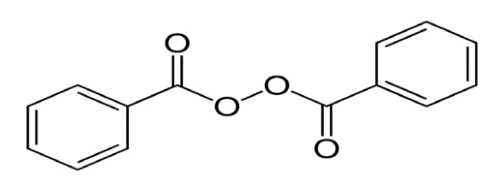
Physicochemical properties: white granular powder
14. Clinical Trials
14.1. Clinical Trials by Indication
Treatment of Inflammatory Lesions of Rosacea in Adults
Table 4 – Summary of Patient Demographics for Clinical Trials in Rosacea
| Study # | Study design | Dosage, route of administration and duration | Study subjects (n) | Age (range) | Sex |
Study 1 (SGT-54-01) | Multi-centre, double-blind, randomized, parallel group, vehicle-controlled | EPSOLAY once daily Vehicle once daily Topical (facial application) 12 weeks | 243 118 | 52.8 (19-81) 52.4 (24-85) | M/F 60/183 M/F 35/83 |
Study 2 (SGT-54-02) | Multi-centre, double-blind, randomized, parallel group, vehicle-controlled | EPSOLAY once daily Vehicle once daily Topical (facial application) 12 weeks | 250 122 | 49.5 (18-79) 51.5 (22-84) | M/F 69/181 M/F 35/87 |
M = male; F = female.
The safety and efficacy of EPSOLAY was evaluated in two multicenter, randomized, double-blind, vehicle-controlled studies in patients with moderate to severe papulopustular rosacea. The trials were conducted in 733 patients, aged 18 years and older. Patients were treated once daily for 12 weeks with either EPSOLAY or vehicle cream.
Patients were required to have a minimum of 15 to 70 total inflammatory lesions (papules and/or pustules) and no more than 2 nodules (where a nodule was defined as a papule or pustule greater than 5 mm in diameter) and an Investigator Global Assessment (IGA) score of 3 (“moderate”) or 4 (“severe”) at baseline. Overall, 93% of patients were White and 73% were female, and the mean age was 51 years (ranged from 18 to 85 years). At baseline, patients had a mean inflammatory lesion count of 27.5, 89% were scored as moderate (IGA = 3) and 11% scored as severe (IGA = 4).
Study Results
The co-primary efficacy endpoints in both studies were the proportion of patients with treatment success at Week 12, defined as an IGA score of 0 (“clear”) or 1 (“almost clear”) with at least a two-grade reduction from baseline, and the absolute change from baseline in inflammatory lesion counts at Week 12. EPSOLAY demonstrated superiority to the vehicle cream, with greater reductions in inflammatory lesion counts and higher percentages of patients achieving an IGA success starting from Week 4 and continuing at Week 8. The results at Week 12 are presented in Table 5. EPSOLAY was more effective than vehicle cream on the co-primary efficacy endpoints in both trials.
Table 5 – Efficacy Results of EPSOLAY in Patients with Moderate to Severe Papulopustular Rosacea at Week 12 (Intent-to-Treat Population)
Study 1 EPSOLAY Vehicle (N = 243) (N = 118) | Study 2 EPSOLAY Vehicle (N = 250) (N = 122) | |
|---|---|---|
IGA Treatment Success* Difference from Vehicle (95% CI) | 47.4% 20.7% 26.7% (16.7%, 36.8%) | 49.2% 28.2% 21.0% (10.7%, 31.3%) |
Inflammatory Lesions Mean† Absolute Change Difference from Vehicle (95% CI) Mean† Percent Change Difference from Vehicle (95% CI) | -17.4 -9.5 -7.9 (-10.0, -5.9) -68.2% -38.3% -29.9% (-37.8%, -22.0%) | -20.3 -13.3 -6.9 (-9.0, -4.9) -69.4% -46.0% -23.4% (-30.5%, -16.3%) |
* Investigator Global Assessment (IGA) success was defined as an IGA score of 0 (“clear”) or 1 (“almost clear”) with at least a two-grade reduction from baseline.
† Means presented in table are Least Square (LS) Means.
CI = confidence interval.
15. Microbiology
No microbiological information is required for this drug product. Microbiological activity was not specifically studied in the development of EPSOLAY.
16. Non-Clinical Toxicology
Genotoxicity
No studies have been performed to evaluate the genotoxic potential of the formulation of benzoyl peroxide in EPSOLAY.
Bacterial mutagenicity assays (Ames test) with benzoyl peroxide reported mutagenic potential in a few but not in the majority of investigations. Benzoyl peroxide has been shown to produce single-strand DNA breaks in human bronchial epithelial and mouse epidermal cells, DNA-protein cross-links in the human cells, and a dose-dependent increase in sister chromatid exchanges in Chinese hamster ovary cells.
Carcinogenicity
No animal carcinogenicity or photocarcinogenicity studies have been conducted with the benzoyl peroxide formulation in EPSOLAY.
The role of benzoyl peroxide as a tumor promoter has been well established in several animal species. However, the significance of this finding in humans is unknown.
No significant increase in tumor formation was observed in rodents treated topically with a 15 to 25% benzoyl peroxide carbopol gel (3 to 5 times the concentration of benzoyl peroxide in EPSOLAY) for two years. Similar results were obtained in mice topically treated with 25% benzoyl peroxide gel for 56 weeks followed by intermittent treatment with 15% benzoyl peroxide gel for rest of the 2 years study period and in mice topically treated with 5% benzoyl peroxide gel for two years.
In a photocarcinogenicity study conducted with 5% benzoyl peroxide in carbopol gel, no increase in UV induced tumor formation was observed in hairless mice topically treated for 40 weeks.
Reproductive and Developmental Toxicology
No dedicated animal fertility studies have been conducted with the benzoyl peroxide formulation in EPSOLAY.