


Product Monograph - Ethacrynate Sodium
SUMMARY PRODUCT INFORMATION
| Route of Administration | Dosage Form / Strength | Clinically Relevant Non-medicinal Ingredients |
| Intravenous | Injection / Ethacrynate sodium equivalent to 50 mg ethacrynic acid | Mannitol For a complete listing see Dosage Forms, Composition and Packaging section. |
INDICATIONS AND CLINICAL USE
Ethacrynate Sodium (ethacrynate sodium for injection, USP) is especially useful in patients unresponsive to the commonly used diuretics.
Ethacrynic acid has been found useful in the following conditions:
Congestive Heart Failure
Acute Pulmonary Oedema
Renal Oedema (Nephrotic syndrome)
Hepatic Cirrhosis with Ascites
The majority of patients studied to date have been resistant in some degree to other diuretic agents; the remaining patients received ethacrynic acid as their first diuretic in the treatment of oedema or were placed on the drug for comparative evaluations.
Patients with chronic congestive heart failure many of whom were unresponsive to other diuretics have responded successfully to short or long term therapy. These include patients with arteriosclerotic heart disease, rheumatic heart disease, hypertensive cardiovascular disease, pulmonary heart disease, and congenital heart disease. Long term studies in patients who have received ethacrynic acid for over six months have been in patients with cardiac oedema secondary to arteriosclerotic or valvular heart disease. The average duration of these studies has been about nine months.
Patients with acute pulmonary oedema have responded rapidly to the intravenous use of ethacrynate sodium. Clinical improvement is coincidental with the large increases in water and electrolyte excretion usually observed to begin within 5 minutes after injection. Ethacrynate sodium offers advantages over other diuretics because of its rapid action and effectiveness.
Ethacrynate Sodium is indicated for patients with the nephrotic syndrome. The greatest experience with this agent in renal oedema has been in patients with the nephrotic syndrome.
Use of the drug in these patients usually has been of short duration, ranging from one to three months, with treatment usually being initiated in the hospital.
Saluresis and diuresis may be achieved in patients unresponsive to other diuretics. Patients whose response to other diuretics has been suboptimal may obtain a greater effect from ethacrynic acid.
As with other diuretics, hypoproteinaemia may reduce responsiveness to ethacrynic acid and the use of salt-poor albumin should be considered. In some patients, larger doses may be necessary to produce effective diuresis in renal than in cardiac oedema. Ethacrynic acid is effective in many patients who have significant degrees of renal insufficiency. It has little or no effect on renal blood flow except following pronounced reduction in plasma volume when associated with rapid diuresis. The extreme sensitivity of patients with chronic renal failure to alterations in fluid or electrolyte balance dictates careful clinical and laboratory observation when diuretics are used, and these agents must be discontinued immediately if further deterioration in renal function occurs.
For reasons given below, initiation of diuretic therapy with Ethacrynate Sodium in the cirrhotic patient with ascites is best carried out in the hospital. When maintenance therapy has been established, the individual can be satisfactorily followed as an outpatient.
Ethacrynic acid is usually effective in patients with cirrhosis who have ascites. Most studies have been of three months' duration, or less. Diuresis and saluresis have occurred in previously unresponsive patients. However, cirrhotic patients tolerate poorly acute shifts in electrolyte balance, and potassium excretion is often augmented as a result of associated aldosteronism. Therefore, careful clinical and laboratory observation is essential to avoid serious loss of potassium and chloride ions and the development of metabolic alkalosis, with resultant hepatic encephalopathy. These effects may be minimized by appropriate adjustment of dosage and by the use of supplemental potassium as the chloride with or without a potassium sparing agent (see DOSAGE AND ADMINISTRATION).
A variety of other oedematous states have been successfully treated with ethacrynic acid; most of the experience has been of short duration. These include ascites due to malignancy, idiopathic oedema, and lymphoedema.
Pediatrics (2 > years of age)
Ethacrynic acid has been found useful in patients of the pediatric age group with the nephrotic syndrome. This experience has been mostly of short duration, in hospitalized patients resistant to other therapy. Pediatric patients with congenital heart disease also have responded to this agent.
CONTRAINDICATIONS
- Patients who are hypersensitive to this drug or to any ingredient in the formulation or component of the container. For a complete listing, see the Dosage Forms, Composition and Packaging section of the product monograph.
- All diuretics, including ethacrynic acid, are contraindicated in anuria. If increasing azotemia and/or oliguria occur during treatment of severe, progressive renal disease, the diuretic should be discontinued.
- Until further experience in infants is accumulated, therapy with parenteral ethacrynic acid is contraindicated.
(See also Use in Pregnant women, Nursing women and Pediatrics under WARNINGS).
WARNINGS AND PRECAUTIONS
Ethacrynate Sodium (ethacrynate sodium for injection, USP) is a potent and rapidly-acting diuretic that may lead to excessive diuresis and natriuresis with water depletion and electrolyte imbalance, which may result in hypokalaemia or hypochloremic alkalosis with potassium depletion, hydrogen ion loss and extracellular fluid space contraction. This may occur in patients with marked fluid accumulation or when excessive doses are used but these adverse effects may also be encountered in patients with moderate degrees of oedema. The safe use of potent diuretics requires careful understanding of their pharmacologic actions and in particular of their mechanism of development of electrolyte imbalance. Close attention should be given to the directions of use and to identification of the individual patient response to the drug.
General
Weakness, muscle cramps, paresthesias, thirst, anorexia, and signs of hyponatraemia, hypokalaemia, and/or hypochloremic alkalosis may occur following vigorous or excessive diuresis and these may be accentuated by rigid salt restriction. Rarely tetany has been reported following vigorous diuresis. During therapy with ethacrynic acid, liberalization of salt intake and supplementary potassium chloride are often necessary.
The effects of ethacrynic acid on electrolytes are related to its renal pharmacologic activity and are dose-dependent. The possibility of profound electrolyte and water loss may be avoided by weighing the patient throughout the treatment period, by monitoring electrolyte changes, by careful adjustment of dosage, by initiating treatment with small doses, and by using the drug on an intermittent schedule when possible. When excessive diuresis occurs, the drug should be withdrawn until homeostasis is restored. When excessive electrolyte loss occurs, the dosage should be reduced or the drug temporarily withdrawn, and if necessary judicious repletion of losses should be considered.
Avoidance of potassium depletion may be possible by adequate dietary supplementation, intermittent therapy, and when possible by careful liberalization of salt intake. Supplementary potassium chloride may however be required, particularly in cirrhosis or patients with a pre-existing degree of aldosteronism.
While potassium supplements may be indicated there have been numerous reports, published and unpublished, concerning non-specific small bowel lesions, consisting of stenosis with or without ulceration, associated with administration of enteric- coated potassium salts alone or with oral diuretics. Surgery was frequently required and deaths have occurred.
Cardiovascular
Too vigorous a diuresis, as evidenced by rapid and excessive weight loss, may induce an acute hypotensive episode. In elderly cardiac patients, rapid contraction of plasma volume and the resultant haemoconcentration should be avoided to prevent the development of thromboembolic episodes, such as cerebral vascular thromboses and pulmonary emboli which may be fatal. In patients receiving digitalis glycosides, excessive loss of potassium may precipitate digitalis toxicity. Care should also be exercised in patients receiving potassium-depleting steroids.
Ear/Nose/Throat
Deafness, tinnitus and vertigo with a sense of fullness in the ears have occurred, most frequently in patients with severe impairment of renal function. These symptoms have been associated most often with intravenous administration and with doses in excess of those recommended. The deafness has usually been reversible and of short duration (one to 24 hours). However, in some critically ill patients the hearing loss has been permanent. A number of these patients were also receiving drugs known to be ototoxic.
Endocrine and Metabolism
When metabolic alkalosis may be anticipated, e.g., in cirrhosis with ascites, the use of potassium chloride with or without a potassium sparing agent before and continuously during therapy with ethacrynic acid may mitigate or prevent the hypokalaemia. If a potassium sparing agent is used, continued monitoring of electrolytes is still required because of the possible occurrence in this case of hyperkalaemia.
Gastrointestinal
In a few patients, ethacrynic acid has produced severe, watery diarrhea. If this occurs, it should be discontinued and not re-administered.
Hepatic/Biliary/Pancreatic
Ethacrynic acid should be given with caution to patients with advanced cirrhosis of the liver, particularly those with a history of previous episodes of electrolyte imbalance or hepatic encephalopathy. Like other diuretics it may precipitate hepatic coma and death.
Renal
Ethacrynate Sodium has little or no effect on glomerular filtration or on renal blood flow, except following pronounced reductions in plasma volume when associated with rapid diuresis. A transient increase in serum urea nitrogen may occur. This is usually reversible when the drug is discontinued.
Special Populations
Pregnant Women: Ethacrynate Sodium is not recommended for use in pregnant patients. Use of the drug in women of the child-bearing age requires that its potential benefits be weighed against the possible hazards to the fetus. The safety and efficacy of the drug in toxemia of pregnancy have not been established.
Nursing Women: Ethacrynate Sodium is contraindicated in nursing mothers. If use of the drug is deemed essential, the patient should stop nursing.
Pediatrics (2 < years of age): Information in infants is insufficient to recommend therapy with ethacrynic acid.
Monitoring and Laboratory Tests
Frequent assessments of serum electrolyte, CO2 and BUN levels should be performed early in therapy with Ethacrynate Sodium and periodically during active diuresis. Baseline determination of electrolytes and renal function before therapy with Ethacrynate Sodium is recommended when pre-existing derangements are suspected. Any electrolyte abnormalities should be corrected or the drug temporarily withdrawn.
ADVERSE REACTIONS
Gastrointestinal
Anorexia, malaise, abdominal discomfort or pain, dysphagia, nausea, vomiting, and diarrhea. In a few patients, watery, profuse diarrhea, gastrointestinal bleeding, and acute pancreatitis has been reported.
Metabolic
Reversible hyperuricemia, decreased urinary urate excretion, and hyperglycemia have been reported. Acute gout has been precipitated. Rarely acute symptomatic hypoglycemia with convulsions, jaundice and abnormal tests of hepatocellular function have been reported.
Hematologic
Agranulocytosis, severe neutropenia, thrombocytopenia, and Henoch-Schönlein purpura have been reported rarely.
Special Senses
Vertigo, deafness, and tinnitus, with a sense of fullness in the ears and blurred vision have occurred (see WARNINGS AND PRECAUTIONS).
Central Nervous System
Fatigue, apprehension, and confusion.
Other
Skin rash, headache, fever, chills and haematuria.
Ethacrynate sodium occasionally has caused local irritation and pain, and a rare instance of local thrombophlebitis has been reported after its use.
A number of possibly drug-related deaths have occurred in critically ill patients refractory to other diuretics. These generally have fallen into two categories: (1) patients with severe myocardial disease who have been receiving digitalis and presumably developed acute hypokalaemia with fatal arrhythmia; (2) patients with severely decompensated hepatic cirrhosis with ascites, with or without accompanying encephalopathy, who were in electrolyte imbalance and died because of intensification of the electrolyte defect.
DRUG INTERACTIONS
Anti-hypertensive Agents
The safety and efficacy of ethacrynic acid in hypertension have not been established. However, the dosage of coadministered antihypertensive agents may require adjustment.
Orthostatic hypotension may occur in patients receiving antihypertensive agents when given ethacrynic acid.
Antibiotics
Ethacrynate Sodium (ethacrynate sodium for injection, USP) may increase the ototoxic potential of other drugs such as aminoglycoside antibiotics. Their concurrent use should be avoided.
Warfarin
A number of drugs, including ethacrynic acid, have been shown to displace warfarin from plasma protein; a reduction in the usual anticoagulant dosage may be required in patients receiving both drugs.
Lithium
Lithium should generally not be given to patients receiving diuretics, since diuretics reduce renal clearance of lithium making the risk of lithium toxicity very high in such patients.
Corticosteroid
Ethacrynate Sodium may increase the risk of gastric hemorrhage associated with corticosteroid treatment.
Patients with Special Diseases and Conditions
Patients with refractory oedema or having pre-existing degrees of aldosteronism and those receiving potassium depleting steroids are more likely to develop hypokalaemia. This may be responsible for increased digitalis toxicity or result in hepatic coma in patients with advanced liver disease. These patients may therefore require potassium supplementation.
Drug-Drug Interactions
Interactions with drugs have not been studied
Drug-Food Interactions
Interactions with food have not been studied.
Drug-Herb Interactions
Interactions with herbal products have not been studied.
Drug-Laboratory Interactions
Interactions with laboratory tests have not been studied.
Drug-Lifestyle Interactions
Interactions with lifestyle or activities have not been studied.
DOSAGE AND ADMINISTRATION
Dosing Considerations
Dosage must be regulated carefully to prevent a more rapid or substantial loss of fluid or electrolyte than is indicated or necessary. The magnitude of diuresis and natriuresis is largely dependent on the degree of fluid accumulation present in the patient. Similarly, the extent of potassium excretion is determined in large measure by the presence and magnitude of aldosteronism.
Ethacrynate Sodium (ethacrynate sodium for injection, USP) is for intravenous use when oral intake is impractical or in urgent conditions, such as acute pulmonary oedema.
The usual intravenous dose for the average sized adult is 50 mg, or 0.5 to 1 mg per kg of body weight. Usually only one dose has been necessary; occasionally a second dose at a new injection site, to avoid possible thrombophlebitis, may be required. A single intravenous dose not exceeding 100 mg has been used in critical situations. Insufficient pediatric experience precludes recommendation for this age group.
The solution may be given slowly through the tubing of a running infusion or by direct intravenous injection over a period of several minutes.
Ethacrynate sodium should not be given subcutaneously or intramuscularly because of local pain and irritation.
Reconstitution:
To reconstitute the dry material, add 50 mL of 5 percent Dextrose Injection or Sodium Chloride Injection to the vial. Occasionally, some 5 percent Dextrose Injection solutions may have a low pH (below 5). The resulting solution with such a diluent may be hazy or opalescent. Intravenous use of such a solution is not recommended.
| Vial Size | Volume of Diluent to be Added to Vial | Approximate Available Volume | Nominal Concentration per mL |
| 50 mg | 50 mL | 50 mL | 1 mg / mL |
Do not mix this solution with whole blood or its derivatives. Because there is no preservative contained in the vial, a fresh solution should be prepared just prior to each administration. Any unused solution should be discarded.
OVERDOSAGE
| For management of a suspected drug overdose, contact your regional Poison Control Centre. |
|---|
ACTION AND CLINICAL PHARMACOLOGY
Mechanism of Action
Ethacrynate Sodium (ethacrynate sodium for injection, USP) is a saluretic-diuretic agent with marked potency and rapid onset of action. It is chemically unrelated to other diuretics. Once reconstituted into a solution, the lyophilized powder of ethacrynate sodium takes on its active form of ethacrynic acid. Patients with congestive heart failure (including acute pulmonary oedema), renal oedema, hepatic cirrhosis with ascites, and other conditions involving fluid retention have responded well to ethacrynic acid.
Ethacrynic acid has the following major characteristics:
(1) Water and electrolyte excretion may be increased several times over that observed with thiazide diuretics. The urinary output is usually dose-dependent and related to the magnitude of fluid accumulation.
(2) Electrolyte excretion pattern differs from that of thiazides. Initially, sodium and chloride excretion is usually substantial, and chloride loss exceeds that of sodium. With prolonged therapy, chloride excretion declines, and potassium and hydrogen ion excretion may increase. In patients with increased diuresis excessive amounts of potassium may be excreted. Ethacrynic acid is effective whether or not there is clinical acidosis or alkalosis.
(3) Rapid onset of action usually is observed within 5 minutes after an intravenous injection.
(4) Sulfhydryl binding propensity differs in certain respects from that of the organomercurials. Its mode of action is not by carbonic anhydrase inhibition.
(5) Multiple sites of action: Ethacrynic acid acts on the proximal and distal portions of the tubule, and also on the ascending limb of the loop of Henle.
STORAGE AND STABILITY
Ethacrynate Sodium (ethacrynate sodium for injection, USP) should be stored in the tightly closed container at controlled room temperature (15º C - 30º C).
SPECIAL HANDLING INSTRUCTIONS
Ethacrynate Sodium (ethacrynate sodium for injection, USP) should not be used past the expiration date.
DOSAGE FORMS, COMPOSITION AND PACKAGING
Ethacrynate Sodium (ethacrynate sodium for injection, USP) is a dry white material either in a plug form or as a powder. It is supplied in vials containing sodium ethacrynate equivalent to 50 mg of ethacrynic acid.
Each vials of Ethacrynate Sodium (ethacrynate sodium for injection, USP) contains:
Medicinal ingredient:
Ethacrynate sodium equivalent to ethacrynic acid 50 mg
Non-medicinal ingredient:
Mannitol 62.5 mg
PART II: SCIENTIFIC INFORMATION
PHARMACEUTICAL INFORMATION
Drug Substance
Proper name: Ethacrynate sodium
Chemical name: Sodium [2,3-dichloro-4-(2- methylenebutyryl) phenoxy] acetate
Molecular formula: C13H11Cl2NaO4
Molecular mass: 325.12
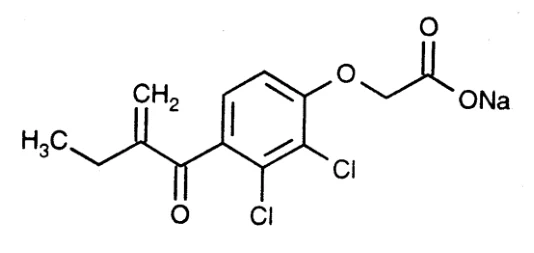
Structural formula:
Physicochemical properties: The sodium salt of ethacrynic acid is soluble in water at 25ºC to the extent of about 7 percent. Solutions of the sodium salt are relatively stable at about pH 7 at room temperature for short periods, but as the pH and/or temperature increases the solutions are less stable.
DETAILED PHARMACOLOGY
In both animals and man, ethacrynic acid causes a marked increase in excretion of salt and water under conditions of hydropenia as well as hydration. Experimental studies indicate that ethacrynic acid influences both the diluting and concentrating mechanisms of the kidney. By inhibiting active sodium reabsorption, probably in the ascending limb of the loop of Henle, as well as elsewhere in the nephron, it depresses reversibly the operation of the diluting mechanism and diminishes the increasing solute gradient of the kidney from cortex to medulla. The concentrating mechanism of the more distal nephron, which is dependent on this osmotic gradient from lumen to medullary interstitium, is likewise diminished. The net effect is the excretion of large amounts of virtually iso-osmotic urine. This renal effect is very different from that of the thiazides, mercurials, or other diuretics, and reflects a unique mechanism of action for ethacrynic acid.
In dogs, ethacrynic acid produces a maximal sodium excretion that is considerably greater than that which can be achieved with the thiazides. For example, moderate doses of ethacrynic acid given intravenously (as a solution of the sodium salt) regularly caused the excretion of sodium in excess of 1000 microequivalents/minute, whereas hydrochlorothiazide even in maximally effective doses seldom caused the excretion of 500 microequivalents/minute of sodium when the animals received no prior salt supplementation. Ethacrynic acid induced a chloruresis at least equal to the natriuresis in magnitude. This is in contrast to the thiazides which, especially in high doses, tend to cause increased excretion of bicarbonate as well as chloride along with sodium. Of particular interest is the fact that with intravenous doses of ethacrynic acid (as a solution of the sodium salt) sufficient to induce a maximal rate of sodium excretion several-fold that evoked by a maximal dose of hydrochlorothiazide, the kaliuretic response to the two agents was equivalent. Oral administration of ethacrynic acid to dogs also caused greater saluresis than the maximum obtainable with hydrochlorothiazide.
In both acidotic and alkalotic dogs the intravenous injection of ethacrynic acid (as a solution of the sodium salt) caused an equally large excretion of sodium and of chloride. Potassium excretion also was increased to a lesser extent. Glomerular filtration rate was slightly depressed, reflecting the hypovolemia secondary to the marked diuresis.
In carefully controlled studies in animals and experimental subjects this compound produced a more favorable Na+/K+ ratio of elimination than observed with the thiazides.
Following the addition of ethacrynic acid (as a solution of the sodium salt) to an infusion of a maximally effective dose of hydrochlorothiazide in dogs, the excretion of sodium, chloride, and urine increased greatly. Potassium excretion also increased, but less than proportionately. The diuretic and saluretic effects of moderate doses of ethacrynic acid and hydrochlorothiazide were studied separately and together by the oral route in normal humans and dogs. The joint effect, especially on sodium excretion, was greater than predicted from the separate effects. Ethacrynic acid apparently can block an aspect of sodium reabsorption that is not affected by the thiazides.
TOXICOLOGY
ACUTE TOXICITY
Ethacrynic acid has a moderate order of acute toxicity in mice, with an oral LD50 of about 600 mg/kg and an intravenous LD50 of about 200 mg/kg when given in solution as the sodium salt. The compound is somewhat less toxic for the rat, the oral LD50 for weanling and adult male and female rats being in the order of 1000 to 1200 mg/kg. The acute oral LD50 for rabbits and guinea pigs was about 450 mg/kg.
TABLE 1: LD50 values
| Route of administration | Mouse | Rats (weanling and adult male and female) | Rabbits | Guinea Pigs |
|---|---|---|---|---|
Oral (as ethacrynic Acid) | 600 mg/kg | 1000 to 1200mg/kg | 450 mg/kg | 450 mg/kg |
Intravenous (as Ethacrynate Sodium) | 200 mg/kg |
CHRONIC TOXICITY
In chronic studies rats, which are largely unresponsive to the saluretic effect of ethacrynic acid, tolerated oral doses up to about 80 mg/kg/day in the diet for 18 months. When ethacrynic acid was given by gavage, as a suspension in methylcellulose, at doses of 5 to 400 mg/kg/day superficial mucosal necrosis was found in the squamous portion of the stomach of occasional rats at dose levels of 10, 100, 200 and 400 mg/kg/day, but not among rats that received 5, 25 or 50 mg/kg/day. These changes were not observed in rats that received the drug in the diet for 18 months, although one rat on the middle dose (15 mg/kg/day) had small ulcers in the glandular portion of the stomach which were considered incidental to treatment. Other histomorphologic changes due to treatment were not found in other tissues in either of the oral toxicity studies.
Dogs, being very sensitive to the saluretic action of the drug, tolerated 10 to 15 mg/kg/day, as divided doses, for 1 year. A greater degree of tolerance, 30 mg/kg/day as single daily doses, was achieved in this species by adding sodium chloride to the drinking water. This indicated that the toxicity of ethacrynic acid in the dog was primarily the result of altered electrolyte balance brought about by its inherent pharmacodynamic properties rather than the result of a direct toxic effect. There were no hematologic, biochemical, or histomorphologic changes observed in the chronic studies, except those secondarily related to its saluretic-diuretic action, at doses as high as 10 mg/kg/day, given as divided doses, or 30 mg/kg/day as single doses supplemented by saline. When 10 mg/kg/day (as single daily doses) or larger doses (divided or single without saline) were given, some animals showed marked electrolyte imbalance and dehydration. Under these conditions, dogs that died or were sacrificed because of poor condition, showed hemorrhage of the mucosa of the gallbladder and, more rarely, of the trachea and endocardium. The hemorrhage in the gallbladder, and the rare mucosal cysts observed, were not related to drug irritancy, particularly since doses of 30 mg/kg/day with saline did not produce similar changes. The only evidence of gastrointestinal irritation in the dog was the rare occurrence of erythema of the duodenum in the saline-deprived dogs.
On the other hand, gastrointestinal lesions were absent in dogs that received single daily doses of 30 mg/kg with saline supplementation for 6 months. In this latter study there were no histomorphologic changes that could be directly attributed to an adverse effect of ethacrynic acid.
TABLE 2: Chronic Toxicity
| Species | Route of Administration | Dose | Duration | Results | ||||||
|---|---|---|---|---|---|---|---|---|---|---|
| Rats | Oral | 80 mg/kg/day | 18 months | Dose was tolerated. No effect seen. | ||||||
| Gavage | 5 to 400 mg/kg/day | Dose levels of 10, 100, 200 and 400 mg/kg/day: Superficial mucosal necrosis was found in the squamous portion of the stomach of occasional rats. Dose levels of 5, 25 or 50 mg/kg/day: No effect seen. | ||||||||
| Dogs | Oral | 10 to 15 mg/kg/day (as divided dose) | 1 year | Dose was tolerated. No hematologic, biochemical, or histomorphologic changes observed. Some animals showed marked electrolyte imbalance and dehydration. Dogs who died or sacrificed showed hemorrhage of the mucosa of the gallbladder and, rarely, of the | ||||||
| Species | Route of Administration | Dose | Duration | Results | |||
|---|---|---|---|---|---|---|---|
| trachea and endocardium | |||||||
| Oral | 30 mg/kg/day (as single dose) with NaCl added to drinking water | 1 year | Dose was tolerated. No hematologic, biochemical, or histomorphologic changes observed. Some animals showed marked electrolyte imbalance and dehydration. | ||||
| Oral | 30 mg/kg/day with NaCl added to drinking water | 6 months | No histomorphologic changes and no gastrointestinal lesions were seen. | ||||
REPRODUCTION
Reproduction studies on ethacrynic acid in the mouse, rat, rabbit, and dog revealed no drug-related changes in the reproductive capacity or fetal developments in these species.
REFERENCES
- 1. Baer JE, Michaelson JK, McKinstry DN, Beyer KH. A new class of diuretic- saluretic agents, the alpha, beta-unsaturated ketone derivatives of aryloxyacetic acids. Proc Soc Exp Biol Med 1964;115:87-90.
- 2. Cannon PJ, Ames RP, Laragh JH. Methylene-butyryl phenoxyacetic acid: Novel and potent natriuretic and diuretic agent. J Am Med Assoc 1963;185:854-63.
- 3. Cannon PJ, Heinemann HO, Stason WB, Laragh JH. Ethacrynic acid: effectiveness and mode of diuretic action in man. Circulation 1965;31:5-18.
- 4. Cannon PJ, Heinemann HO, Albert MS, Laragh JH, Winters RW. "Contraction" alkalosis after diuresis of oedematous patients with ethacrynic acid. Ann Intern Med 1965;62: 979-90.
- 5. Edwards KDG, Sinnett P, Steward JH. Ethacrynic acid: assessment of saluretic and diuretic potency in patients with severe chronic renal failure. Med J Aust 1967;1: 275-81.
- 6. Goldberg M, McCurdy DK, Foltz EL, Bluemie LW Jr. Effects of ethacrynic acid (a new saluretic agent) on renal diluting and concentrating mechanisms: evidence for site of action in the loop of Henle. J Clin Invest 1964;43: 201-6.
- 7. Goldberg M. Ethacrynic acid. Site and mode of action. Ann NY Acad Sci 1966;139:443-52.
- 8. Ledingham JGG, Bayliss RIS. Metabolic effects and site of action of ethacrynic acid. Clin Pharmacol Ther 1965;6: 474-85.
- 9. Nash HL, Fitz AE, Wilson WR, Kirkendall WM, Kioschos JM. Cardiorenal hemodynamic effects of ethacrynic acid. Am Heart J 1966;71:153-65.
- 10. Zatuchni J. The diuretic effects of intravenously administered ethacrynic acid. Am J Med Sci 1966;252:162-70.
- 11. Product Monograph: Sodium Edecrin® (ethacrynate sodium for injection, USP), Valeant Canada LP, Montreal, Quebec, February 28, 2012.