


Product Monograph - Etibi
Recent Major Label Changes
| 2025-09 |
|---|---|
| 2025-09 |
TABLE OF CONTENTS
Sections or subsections that are not applicable at the time of authorization are not listed.
Recent Major Label Changes ...................................................................................................... 2
Table of Contents ..................................................................................................................... 2
Part 1: Healthcare Professional Information ................................................................................ 4
- 1.
Indications........................................................................................................................ 4
1.1. Pediatrics.............................................................................................................. 4
1.2. Geriatrics .............................................................................................................. 4
- 2. Contraindications .............................................................................................................. 4
- 3. Serious Warnings and Precautions Box………………………………………………….………………………4
- 4.
Dosage and Administration ................................................................................................ 5
4.1. Dosing Considerations ............................................................................................ 5
4.2. Recommended Dose and Dosage Adjustment ............................................................ 5
4.4. Administration....................................................................................................... 5
4.5. Missed Dose.......................................................................................................... 5
- 5. Overdose.......................................................................................................................... 5
- 6. Dosage Forms, Strengths, Composition, and Packaging .......................................................... 6
- 7.
Warnings and Precautions .................................................................................................. 6
7.1. Special Populations ................................................................................................ 7
7.1.1. Pregnancy ..................................................................................................... 7
7.1.2. Breastfeeding ................................................................................................ 7
7.1.3. Pediatrics ...................................................................................................... 7
7.1.4. Geriatrics ...................................................................................................... 8
- 8.
Adverse Reactions ............................................................................................................. 8
8.1. Adverse Reaction Overview ..................................................................................... 7
8.5. Post-Market Adverse Reactions………………………………………………………………………………………..8
- 9.
Drug Interactions……………………………………………………………………………………………………………………….8
9.2. Drug Interaction Overview……………………………………………………………………………………8
9.3 Drug-Behaviour Interactions…………………………………………………………………………………8
9.4 Drug-Drug Interactions……………………………..………………………………………………………….8
9.5 Drug-Food Interactions………………………………………………………………………..………………..8
9.6 Drug-Herb Interactions………………………………………………………………………..………………..9
9.7 Drug-Laboratory Test Interaction………………………………………………………………………..…9
- 10.
Clinical Pharmacology ........................................................................................................ 9
10.1. Mechanism of Action.............................................................................................. 9
10.2. Pharmacodynamics ................................................................................................ 9
10.3. Pharmacokinetics................................................................................................... 9
- 11. Storage, Stability, and Disposal ......................................................................................... 10
Part 2: Scientific Information ................................................................................................... 10
- 13. Pharmaceutical Information ............................................................................................. 11
- 14. Clinical Trials................................................................................................................... 12
- 15. Microbiology .................................................................................................................. 12
- 16. Non-Clinical Toxicology .................................................................................................... 12
Patient Medication Information ............................................................................................... 14
Part 1: Healthcare Professional Information
1. Indications
ETIBI (ethambutol) is indicated in combination with other antituberculosis medications for:
- Treatment of all forms of tuberculosis, including tuberculous meningitis, caused by Mycobacterium tuberculosis.
In retreatment cases, Etibi should be given together with at least one other second line drug for which bacterial susceptibility has been indicated by appropriate in vitro studies and which has not been administered previously to the patient.
To reduce the development of drug-resistant bacteria and maintain the effectiveness of Etibi Tablets and other antibacterial drugs, Etibi Tablets should be used only to treat infections that are proven or strongly suspected to be caused by susceptible bacteria. When culture and susceptibility information are available, they should be considered in selecting or modifying antibacterial therapy. In the absence of such data, local epidemiology and susceptibility patterns may contribute to the empiric selection of therapy.
1.1. Pediatrics
Pediatrics (˂ 13 years of age): No data are available to Health Canada; therefore, Health Canada has not authorized an indication for pediatric use.
1.2. Geriatrics
It is unknown if use in the geriatric population is associated with differences in safety or effectiveness.
2. Contraindications
ETIBI (ethambutol) is contraindicated in patients with optic neuritis unless clinical judgment deems it necessary that the drug be used. ETIBI is also contraindicated in patients with known hypersensitivity to the drug.
3. Serious Warnings and Precautions Box
- Hypersensitivity: Severe cutaneous adverse reactions (SCARs) including Stevens-Johnson syndrome (SJS), toxic epidermal necrolysis (TEN), drug reaction with eosinophilia and systemic symptoms (DRESS), which can be life-threatening or fatal, have been reported post-marketing in association with ethambutol treatment. (See 7 Warnings and precautions, hypersensitivity and 7 Warnings and precautions, skin).
4. Dosage and Administration
4.1. Dosing Considerations
Children up to 13 years of age - Dosage has not been established. However, ETIBI should be considered for all children with organisms resistant to other medications, and in whom susceptibility to ethambutol has been demonstrated or is likely. ETIBI is generally not recommended in children whose visual acuity cannot be monitored (younger than 6 years of age).
Etibi (ethambutol) may be taken with food if gastrointestinal irritation occurs. Since daily administration in divided doses may not result in therapeutic serum concentrations, it is recommended that Etibi be administered only in a single daily dose if feasible.
Since bacterial resistance may develop rapidly when ethambutol is administered alone, it should only be administered concurrently with other antituberculosis medications.
4.2. Recommended Dose and Dosage Adjustment
Usual adult and adolescent (≥13 years of age) dose: - Tuberculosis - for the initial treatment of patients who have not received previous therapy with antituberculosis agents, the usual dosage of ETIBI is 15 mg/kg once daily. In patients who have received previous antituberculosis therapy, the usual dosage is 25 mg/kg daily for 60 days or until bacteriologic smears and cultures become negative, followed by 15 mg/kg daily.
Dosage Adjustment
Renal Impairment in patients with impaired renal function, doses and/or frequency of administration of Etibi should be modified in response to the degree of renal impairment.
4.4. Administration
Alternatively, when ETIBI is used in combination with other antituberculosis agents and these drugs are administered twice weekly, the usual adult dose is 50 mg/kg up to 2.5 grams twice weekly. In a three times weekly administration regimen with other antituberculosis agents, the dosage of ETIBI is 25-30 mg/kg to a maximum of 2.5 grams.
4.5. Missed Dose
If you forget a dose, take it as soon as you remember, unless it is almost time for your next dose. In this case, skip the missed dose and take the next one. Do not take a double dose to make up for a missed dose.
5. Overdose
Symptoms of overdose include a change in vision.
For the most recent information in the management of a suspected drug overdose, contact your regional poison control centre or Health Canada's toll-free number, 1-844 POISON-X (1-844-764-7669).
Usually ETIBI (ethambutol) is well tolerated. However, optical disturbances, as noted above, are reversible when the drug is discontinued. This may require a period of weeks to months. Any unusual sign or symptom should be investigated thoroughly and the drug discontinued if the condition persists.
- 6. Dosage Forms, Strengths, Composition, and Packaging
Table [1] – Dosage Forms, Strengths, and Composition
Each blue, film coated, single-scored on one side Etibi 100 mg tablet contains 100 mg of ethambutol hydrochloride, USP. Bottles of 100.
Each blue, film coated, single-scored on one side and engraved ICN E12 on the other Etibi 400 mg tablet contains 400 mg of ethambutol hydrochloride, USP. Bottles of 100.
7. Warnings and Precautions
Ophthalmologic
Visual testing should be performed prior to initiating Etibi (ethambutol) therapy and then periodically during therapy with the drug. Testing should be done monthly in patients receiving more than 15 mg/kg daily. Examinations should include ophthalmoscopy, finger perimetry, and testing of color discrimination. Patients developing adverse ocular effects during Etibi therapy may show subjective visual symptoms either before or simultaneously with decreases in visual acuity (See 8.1 Adverse reactions overview). All patients receiving the drug should be questioned periodically about blurred vision and other subjective visual symptoms and should be instructed to report to their physician any such changes as soon as they are noticed. If substantial changes in visual acuity occur, Etibi should be discontinued immediately.
Immune
Hypersensitivity: Severe cutaneous adverse reactions (SCARs) have been reported post-marketing (See 7 Warnings and precautions, skin)
Renal
Renal, hepatic, and hematopoietic tests should be performed periodically during long-term Etibi therapy. Serum uric acid concentration measurements may be required during treatment since elevated serum uric acid concentrations frequently occur, possibly resulting in precipitation of acute gout (see 8.1 Adverse reactions overview).
Etibi should be used with caution and in reduced dosage in patients with impaired renal function. The drug should also be used with caution in patients with ocular defects (e.g., cataracts, recurrent ocular
| Route of Administration | Dosage Form/ Strength/Composition | Non-Medicinal Ingredients |
| Oral | tablet 100 mg, 400 mg | Corn starch, Hydroxypropyl Cellulose, Lactose, Magnesium Stearate, Polyvinyl Alcohol, Polyethylene Glycol, Titanium Dioxide, Talc, FD&C Blue No. 1 Al Lake, D&C Yellow No. 10 Al Lake. |
inflammatory conditions, diabetic retinopathy) that make visual changes difficult to detect or evaluate; consideration should be given to whether the benefits of Etibi therapy justify the possible ocular effects in these patients.
Sensitivity/Resistance
Development of Drug-Resistant Bacteria
Prescribing Etibi Tablets in the absence of a proven or strongly suspected bacterial infection is unlikely to provide benefit to the patient and risks the development of drug-resistant bacteria.
Skin
Severe cutaneous adverse reactions (SCARs) including Stevens-Johnson syndrome (SJS), toxic epidermal necrolysis (TEN), drug reaction with eosinophilia and systemic symptoms (DRESS), which can be life-threatening or fatal, have been reported post-marketing in association with ethambutol treatment (See 8.5 Post-market adverse reactions).
At the time of prescription patients should be advised of the signs and symptoms and monitored closely for skin reactions.
If signs and symptoms suggestive of these reactions appear, ethambutol should be withdrawn immediately, and an alternative treatment considered (as appropriate).
If the patient has developed a serious reaction such as SJS, TEN or DRESS with the use of ethambutol, treatment with ethambutol must not be restarted in this patient at any time.
7.1. Special Populations
7.1.1. Pregnancy
It is recommended that pregnant women with tuberculosis be treated for a minimum of 9 months with multi-drug therapy, including ethambutol. Ethambutol crosses the placenta, resulting in fetal plasma concentrations approximately 30% of maternal plasma concentrations. However, problems in humans have not been documented.
7.1.2. Breast-feeding
Ethambutol is distributed into breast milk in concentrations approximating maternal serum concentrations. However, problems in humans have not been documented.
7.1.3. Pediatrics (˂ 13 years of age):
No data are available to Health Canada; therefore, Health Canada has not authorized an indication for pediatric use.
In children, the presentation of a rash can be mistaken for the underlying infection or an alternative infectious process, and physicians should consider the possibility of a reaction to ethambutol in children that develop symptoms of rash and fever during therapy with ethambutol (See 7 Warnings and precautions, skin).
7.1.4 Geriatrics
No information is available on the relationship of age to the effects of ethambutol in geriatric patients. However, elderly patients are more likely to have an age-related decrease in renal function, which may require an adjustment of dosage in patients receiving ethambutol.
8. Adverse Reactions
8.1. Adverse Reaction Overview
The most important adverse effect of ethambutol is optic neuritis with decreases in visual acuity, constriction of visual fields, central and peripheral scotomas, and loss of red-green color discrimination. The extent of ocular toxicity appears to be related to dose and duration of ethambutol therapy, occurring most frequently with daily doses of 25 mg per kg of body weight and after two months of therapy; however, optic neuritis has occurred after only a few days of treatment. Most cases are reversible after several weeks or months. Visual changes may be unilateral or bilateral; therefore, each eye must be tested separately and both eyes tested together (See 7 Warnings and precautions, opthalmologic).
Peripheral neuritis, with numbness and tingling of the extremities, has been reported infrequently. Increased serum uric acid concentrations and precipitation of acute gout have occurred occasionally in patients receiving ethambutol and are probably the result of decreased renal clearance of urate. Transient impairment of liver function, as indicated by abnormal liver function test results, has also occurred (See 7 Warnings and precautions, renal).
Other adverse reactions to ethambutol include dermatitis, pruritus, headache, malaise, dizziness, fever, mental confusion, disorientation, possible hallucinations, joint pain, and rarely anaphylactoid reactions. Gastrointestinal upset, abdominal pain, nausea, vomiting, and anorexia have also occurred occasionally with ethambutol.
8.5 Post-Market Adverse Reactions
Severe cutaneous adverse reactions (SCARs) such as Drug reaction with eosinophilia and systemic symptoms (DRESS)" have been described in patients under therapy with ethambutol (see 7 Warnings and precautions, skin).
9. Drug Interactions
9.2. Drug Interactions Overview
Neurotoxic medications - concurrent administration of ethambutol with other neurotoxic medications may increase the potential for neurotoxicity, such as optic and peripheral neuritis.
9.3. Drug-Behaviour Interactions
The interaction of ETIBI with individual behavioural risks (e.g. cigarette smoking, cannabis use, and/or alcohol consumption) has not been studied.
9.4. Drug-Drug Interactions
Outside of neurotoxic medications, interactions with other drugs have not been established.
9.5. Drug-Food Interactions
Interactions with food have not been established.
9.6. Drug-Herb Interactions
Interactions with herbal products have not been established.
9.7. Drug-Laboratory Test Interaction
ETIBI may cause abnormal blood test results. Health care professionals may choose to conduct blood tests prior to a patient commencing treatment with ETIBI, to provide a baseline to compare with tests performed during treatment.
10. Clinical Pharmacology
A single 25 mg/kg dose of ETIBI (ethambutol) was administered to each of twenty (20) human volunteers, and plasma concentration and urinary recovery rate determinations were performed. In 12 subjects the average highest plasma level, 5.18 mcg/mL, was seen two hours after drug ingestion, while in the other 8, the highest concentration was seen at four hours. The peak plasma level may thus be expected to occur between one and four hours following drug ingestion.
Recovery of ethambutol from urines of the test group showed a urinary recovery rate of 46.68% in 24 hours. These results are in good agreement with published data on absorption and excretion.
10.1. Mechanism of Action
Ethambutol is bacteriostatic in action. Although the exact mechanism of action has not been fully elucidated, the drug appears to inhibit the synthesis of one or more metabolites in susceptible bacteria resulting in impairment of cellular metabolism, arrest of multiplication, and cell death. Ethambutol is active against susceptible bacteria only when they are undergoing cell division.
Ethambutol is a highly specific agent and is active only against organisms of the genus Mycobacterium. The drug is active in vitro and in vivo against M. tuberculosis, M. bovis, M. marinum, and some strains of M. kansasii, M. avium, M. fortuitum, and M. intracellulare. In vitro, the minimum inhibitory concentration (MIC) of ethambutol for most susceptible mycobacteria is 1 to 8 mcg/mL, depending on the culture media used.
Natural and acquired resistance to ethambutol have been demonstrated in vitro and in vivo in strains of M. tuberculosis. In vitro, resistance to ethambutol appears to occur in a stepwise manner. Resistant strains of initially susceptible M. tuberculosis develop rapidly if ethambutol is used alone in the treatment of clinical tuberculosis. When ethambutol is combined with other antituberculosis agents in the treatment of the disease, emergence of resistant strains may be delayed or prevented. There is no evidence of cross-resistance between ethambutol and other antituberculosis agents currently available on the market.
10.2. Pharmacodynamics
No data is available
10.3. Pharmacokinetics
Absorption
Approximately 75 to 80% of an oral dose of ethambutol is rapidly absorbed from the GI tract. Absorption is not substantially affected when the drug is administered with food. Following a single oral dose of 25 mg/kg, peak serum ethambutol concentrations of 2 to 5 mcg/mL are attained within 2 to 4 hours; serum concentrations of the drug are undetectable 24 hours after the dose. There is no evidence that accumulation of the drug occurs when ethambutol doses of 25 mg/kg are given once daily in patients with normal renal function. Serum concentrations of the drug are higher and accumulation may occur when ethambutol is used in patients with impaired renal function.
Distribution
Ethambutol is widely distributed into most body tissues and fluids. Highest concentrations of the drug are found in erythrocytes, kidneys, lungs, and saliva; lower drug concentrations are found in ascitic fluid, pleural fluid, brain, and CSF. Peak intracellular concentrations of ethambutol in erythrocytes are about twice peak plasma concentrations and maintain this ratio for at least 24 hours after a single oral dose. In patients with meningitis, administration of an oral ethambutol dose of 25 mg/kg has produced peak CSF concentrations of the drug ranging from 0.15 to 2.0 mcg/mL.
Ethambutol crosses the placenta and is distributed into cord blood and amniotic fluid. Ethambutol is distributed into milk in concentrations approximately equal to plasma concentrations of the drug. Plasma protein binding of ethambutol is low and ranges between 20 and 30%.
Elimination
The plasma half-life of ethambutol is approximately 3.3 hours in patients with normal renal function. The half-life is prolonged in patients with impaired renal or hepatic function. In patients with renal failure, the half-life may be 7 hours or longer.
Ethambutol is excreted renal by glomerular filtration and tubular secretion. Up to 80% of the dose is excreted within 24 hours (at least 50% excreted unchanged and up to 15% as inactive metabolite). Twenty (20%) per cent of the dose is excreted unchanged in feces. Ethambutol can be removed from the blood by hemodialysis and peritoneal dialysis.
- 11. Storage, Stability, and Disposal
Store in well-closed containers at room temperature (15 – 30º C).
Protect from light, moisture, and excessive heat.
Keep out of sight and reach of children
PART II: SCIENTIFIC INFORMATION
13. Pharmaceutical Information
Drug Substance: Ethambutol hydrochloride
Chemical Name: (1) 1-Butanol,2,2'-(1,2-ethanediyldiimino)
bis-,dihydrochloride
(2) (+)-2,2'-(Ethylenediimino)-di-1-butanol dihydrochloride
Structural Formula:
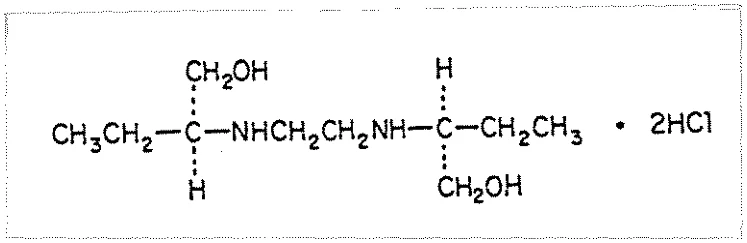
Molecular Formula: C10H24N2O2.2HCl
Molecular Weight: 277.23 g/mol
Description: Ethambutol hydrochloride is a synthetic antituberculosis agent. The drug occurs as a white, crystalline powder and is freely soluble in water and soluble in alcohol. The drug has pKa of 6.1 and 9.2
14. Clinical Trials
No data is available
15. Microbiology
In vitro tests were carried out on 100 strains of M. tuberculosis isolated from patients previously not treated with ETIBI, and on 20 strains isolated from patients unsuccessfully treated.
In these studies, ethambutol was incorporated in Löwenstin-Jensen media in concentrations of 1, 2, and 3 mcg/mL. The previously untreated strains were inhibited to a large extent by 1 mcg/mL. On media containing 2 mcg /mL ethambutol, complete inhibition was observed in 78 strains and, in the remaining strains, the rate of inhibition was 95% or more. At the level of 3 mcg/mL, all strains were inhibited.
In contrast, strains isolated from patients unsuccessfully treated with ethambutol were not inhibited satisfactorily at any dose level.
From in vivo studies using 15 patients, a bacteriostatic concentration is maintained for at least 6 hours at a dose level of 25 mg/kg given orally. The observed concentration started at 6.86 mcg/mL in the first 2 hours decreasing to 1.61 mcg/mL at 8 hours.
16. Non-Clinical Toxicology
Two species were used to determine the Acute Oral Toxicity of ETIBI. In albino mice, a test dose of 10,000 mg/kg did not cause immediate or delayed mortality in animals of either sex. At this high dose level, most mice appeared slightly ataxic, but at postmortem examination, no significant gross pathological changes were found. In a second experiment using beagle dogs, dose levels of from 300 mg/kg to 2,000 mg/kg of body weight were administered without ensuing mortality. Due to the mechanical difficulties of administering larger doses the experiment was terminated. The acute oral toxicity of ETIBI was thus determined to be greater than 2,000 mg/kg. Significant signs of acute intoxication with ETIBI at 2 g/kg were not detected.
The Chronic Oral Toxicity of ETIBI was the subject of a twelve-month study in the beagle dog. Daily dose levels of 25 mg/kg, 100 mg/kg, and 400 mg/kg were evaluated. Survival was 100% but hind limb stiffness and mild ataxia were observed in all animals at the highest dose level.
Results of blood chemistry studies indicated a drug related effect on the liver of all dosage levels. The most consistent of these changes was a slight increase in the level of SGPT (ALT) although increased values for alkaline phosphatase were occasionally recorded together with evidence of a mild degree of bromsulfophthalein retention.
Hemograms were obtained for all animals prior to and following 1, 2, 6, and 12 months of drug treatment. The following parameters were evaluated: total and differential leucocyte counts, prothrombin time, clotting time, RBC count, hemoglobin concentration, hematocrit, mean corpuscular volume, sedimentation rate, and platelet count.
Hematologic changes included marginal depressed values for hemoglobin, hematocrit and RBC count after one month of treatment in one dog. Transient leucocytosis was observed in two animals and several had unusual low WBC counts after 6 and 12 months of treatment.
Ocular examinations revealed complete depigmentation of the tapetum lucidum of each animal at the 400 mg/kg level and partial depigmentation at the 100 mg/kg level. Cardia hypertrophy discovered at autopsy was a prominent finding but no electrocardiographic or histopathologic changes were observed.
A study of fetal toxicity was carried out in Sprague-Dawley albino rats and New Zealand rabbits. Ethambutol was administered subcutaneously in three dose levels, 0, 50, and 100 mg/kg.
In the rat, ethambutol produced fetal malformation of 1.87% at the level of 100 mg/kg. However, no significant changes were observed on fertility and reproduction.
In the rabbit the 100 mg/kg dose level produced a mortality of 50% in the dams, caused by hepatic and renal damage. Malformations were not observed at any dose level, however, resorption and fetal toxicity were evident at both 50 and 100 mg/kg.