Patient Medication Information: uses, side effects, how to take - Femyso
Serious Warnings and Precautions
Follow-up appointment:
You must have a follow-up appointment with a health professional, 7 to 14 days after Step 1 (taking the mifepristone tablet from the green box). The health professional will check whether your pregnancy has completely ended. If the pregnancy continues, there is a possibility of birth defects. Your health professional will talk with you about your options.
Risk of infection and sepsis:
If you have abdominal pain or discomfort, or you are “feeling sick”, including weakness, nausea, vomiting or diarrhea, with or without fever, more than 24 hours after taking misoprostol, you should contact your health professional without delay. Very rarely, this can cause death.
Risk of skin reactions:
Taking Femyso may lead to serious skin reaction conditions such as toxic epidermal necrolysis and acute generalized exanthematous pustulosis. Stop using Femyso and seek medical attention immediately if you notice any of the symptoms. See Serious side effects and what to do about them for more information on the symptoms. If you get a serious skin reaction you should not use Femyso again in the future.
Prolonged heavy bleeding:
Contact a health professional right away if you bleed enough to soak through two thick full-size sanitary pads per hour for two consecutive hours. Bleeding can be so heavy that it requires a surgical procedure. Some patients also require a blood transfusion.
Risks of birth defects:
Once you start Femyso, you should complete both steps. Both Mifepristone and Misoprostol can cause birth defects if your pregnancy is continued.
If you do NOT want to get pregnant after the termination of your pregnancy: You must start using birth control right away.
You can get pregnant right after the abortion:
If you want to have a baby, tell your health professional. To decrease the chance of birth defects, avoid getting pregnant again before your next period. This will protect the baby from any exposure to Femyso. Use birth control during this one month waiting period
What Femyso is used for:
- Femyso is used for ending your pregnancy. This is called a medicalabortion. Femyso is only used if your last period started 63 days ago or less.
How Femyso works:
Do NOT use Femyso as birth control.
Femyso is prescribed by health professionals. They must have knowledge of abortion. Before you take it, they must determine the age of your pregnancy.
Before you take Femyso:
You will get counselling. Your health professional will tell you about:
- The chance of bleeding
- The chance of infection
- The chance of an incomplete abortion
- How to access the treatment centre by telephone or local access
- You should give your informed consent to take Femyso
- You might get an ultrasound scan
You will get a printed copy of the Femyso:
- Patient Medication Information
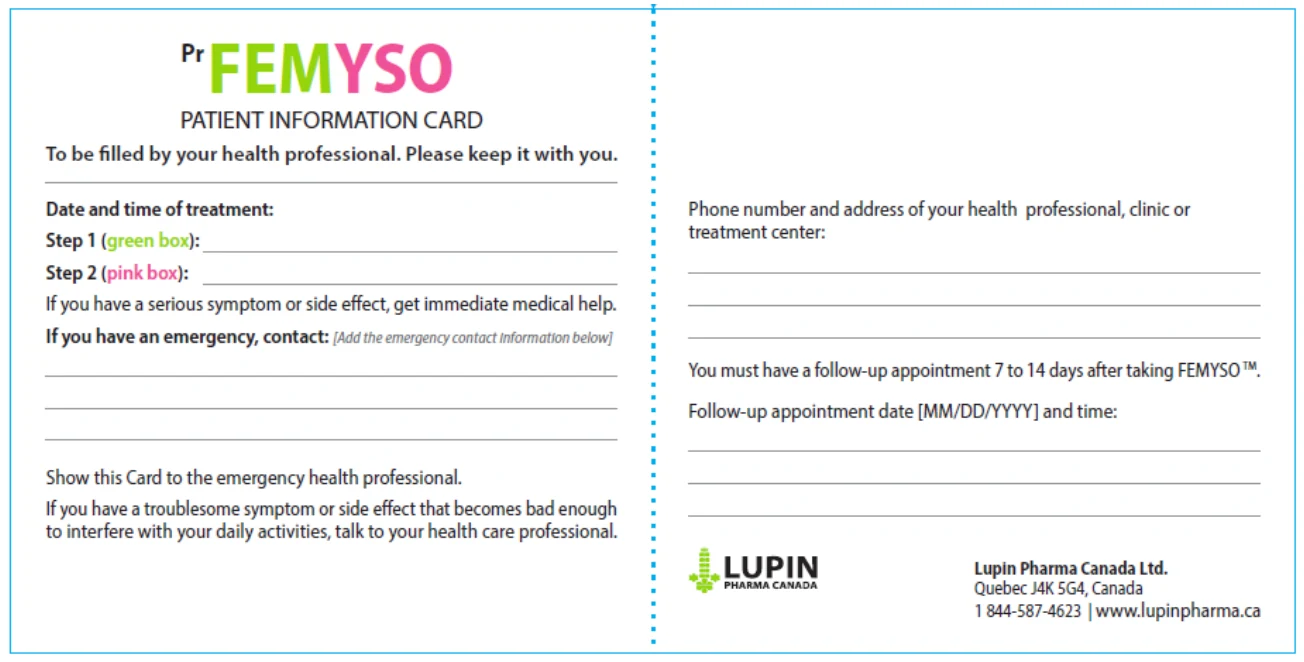
- Patient Information Card that was completed by the health professional.
Patient Information Card
Keep this card with you at all times while taking Femyso until your health professional tells you that your abortion is complete.
When completed, the Patient Information Card contains the following information:
- When you should take the drugs for Step 1 and Step 2
- Your follow-up appointment date, and time
- Contact information in case you need to call your health professional or clinic
- Where to go if you have an emergency in the 14 days after you take Femyso. Show this Card to the emergency health professional.
To end your pregnancy, you will need to take two drugs.
Step 1 (Green Box)
Mifepristone is taken first to block a hormone that is needed for your pregnancy to continue.
Step 2 (Pink Box)
Misoprostol is the second drug. It is taken 24-48 hours later. It causes the uterus to contract and relaxes the opening of the cervix.
Vaginal bleeding usually starts a few hours after taking the Misoprostol tablets.
Cramping and vaginal bleeding are normal with this treatment. Usually, this indicates that the treatment is working. Bleeding lasts for an average of 11 days. It is usual for bleeding to be heavier than a normal period for 2 to 3 days. You may see blood clots and tissue. This is an expected part of ending the pregnancy.
The ingredients in Femyso are:
Medicinal ingredients:
Green box: Mifepristone
Pink box: Misoprostol
Non-medicinal ingredients:
Mifepristone (green box): colloidal Silicon Dioxide, magnesium stearate, maize starch, microcrystalline cellulose, povidone K30
Misoprostol (Pink box): hydrogenated castor oil, Hypromellose (HPMC), microcrystalline cellulose, sodium starch glycolate
Femyso comes in the following dosage forms:
Green box: 1 Mifepristone tablet, 200 mg for oral use
Pink box: 4 Misoprostol tablets, 200 mcg each (800 mcg total) for buccal use
Do not use Femyso if:
- You are pregnant and wish to carry your pregnancy to term
- You do NOT have access to emergency medical care. You must be able to get medical help in the 14 days after you take the mifepristone tablet
- You have or suspect an ectopic pregnancy (This is when the egg is implanted outside the womb)
- You are using an intrauterine contraceptive device (IUD) in your uterus
- The duration of your pregnancy is uncertain
- You have any allergies to mifepristone, misoprostol or any of the other ingredients listed in this leaflet
- You have a chronic adrenal disease
- You take corticosteroids on a regular basis
- You have a bleeding problem
- You take a blood thinner (anticoagulant like coumadin)
- You have inherited porphyria. This is a blood disease that causes skin symptoms as a result of oversensitivity to sunlight
- You have uncontrolled asthma
To help avoid side effects and ensure proper use, talk to your healthcare professional before you take Femyso. Talk about any health conditions or problems you may have, including if you:
- Have kidney problems
- Have liver problems
- Are underweight
- Have problems with your adrenal glands
- Have a heart or cardiovascular disease
- Have anemia (problems of red blood cells)
- Have asthma
- Have had seizures
- Are taking medications (corticosteroids) for the treatment of asthma
- Are diabetic
- Are a heavy smoker and over 35 years old
Other warnings you should know about:
If your blood group is negative (A-, B-, AB-, O-), your health professional will give you an additional medication prior to giving you Femyso.
Femyso does not work in 3 to 5 of cases out of 100. As pregnancy progresses the risk of this goes up. If this happens to you, you will need a surgical abortion.
Driving and using machines: Before you perform tasks which may require special attention, wait until you know how you respond to Femyso. Dizziness, fatigue, headache, and fainting can occur. These side effects slow down after Day 3. They are usually gone by Day 14. Plan to rest for 3 hours after taking the Misoprostol tablets (Step 2, Pink box).
Tell your healthcare professional about all the medicines you take, including any drugs, vitamins, minerals, natural supplements or alternative medicines.
The following may interact with Femyso:
- Drugs used in the treatment of fungal infection such as ketoconazole, itraconazole
- Antibacterial named erythromycin
- Antibiotic used in the treatment of tuberculosis named rifampin
- Certain anticonvulsants used to treat epilepsy, such as phenytoin, phenobarbital and carbamazepine
- Corticosteroids
- Herbal supplements containing St. John’s Wort
Grapefruit juice
- Some drugs used for general anaesthesia.
How to take Femyso:
- Femyso will be given to you by a healthcare professional in a healthcare setting.
Usual dose:
Take Femyso as directed by your health professional.
Step 1:
(Green box)
Take the Mifepristone tablet
- Swallow tablet with a glass of water
24 to 48 hours after taking the Mifepristone tablet, you must do Step 2.
Step 2:
(Pink box)
- Place the 4 Misoprostol tablets (as a single 800 mcg buccal dose) in your mouth
- Keep the 4 tablets between your cheeks and gums for 30 minutes
- Then, swallow any fragments that are left with water
Plan to rest for 3 hours after taking the Misoprostol tablets.
Overdose:
If you think you, or a person you are caring for, have taken too much Femyso, contact a healthcare professional, hospital emergency department, regional poison control centre or Health Canada’s tollfree number, 1-844 POISON-X (1-844-764-7669) immediately, even if there are no signs or symptoms.
Missed Dose:
Take each step of Femyso at the date and time written on the Patient Information Card.
Step 1 (Green box) Mifepristone tablet
Contact your health professional right away if you delay or if you did NOT take the Mifepristone tablet. Your health professional will tell you if it is still safe for you to take Femyso.
Step 2 (Pink box) Misoprostol tablets
Contact your health professional immediately if you forget to take the Misoprostol tablets and it is more than 48 hours after you took the Mifepristone tablet (Step 1).
If it is less than 48 hours since you took Step 1 but after the time and date on your card, take the Misoprostol tablets (Step 2) right away.
If you have any question about when to take your medication, contact your health professional.
Possible side effects from using Femyso
These are not all the possible side effects you may have when taking Femyso. If you experience any side effects not listed here, tell your healthcare professional.
Side effects may include:
- breast tenderness
- hot flushes, chills
- diarrhea
- dizziness, headache, fainting
- fatigue
- nausea
- vomiting
Patients who are less than 18 years old often get more vomiting and pain.
These side effects slow down after Day 3 and are usually gone by Day 14. Your health professional will tell you how to manage any pain or other side effects.
Femyso can cause abnormal blood test results. Your health professional will decide when to perform tests and interpret the results.
Serious side effects and what to do about them
| Frequency/Side Effect/Symptom | Talk to your healthcare professional | Stop taking drug and get immediate medical help | |
|---|---|---|---|
| Frequency/Side Effect/Symptom | Talk to your healthcare professional | Stop taking drug and get immediate medical help | |
| Only if severe | In all cases | ||
| Only if severe | In all cases | ||
| COMMON | |||
Prolonged heavy bleeding Severe hemorrhage: you bleed enough to soak through two full- size sanitary pads per hour for two consecutive hours. | √ √ | ||
| Fever | √ | ||
Endometritis (an infection in the lining of the uterus): Pain in the lower abdomen. Fever and abnormal vaginal discharge and bleeding. | √ | ||
| UNCOMMON | |||
Hemorrhagic shock (shock from blood loss): Dizziness and confusion. Rapid breathing and heartbeat. Weakness, low blood pressure, less urine than normal Cool clammy skin, thirst and dry mouth. | √ | ||
| Hypotension (low blood pressure): dizziness, fainting, lightheadedness | √ | ||
Infection: 24 hours or more after Step 2, fever, chills and abdominal pain, cramps or tenderness that persist for 4 hours with or without nausea, vomiting, diarrhea, weakness, rapid heartbeat or feel unwell. | √ | ||
| Skin rash: Red spots on your skin | √ | ||
Acute generalised exanthematous pustulosis: target-like circular reddish patches on the trunk, often with central blisters, skin peeling, ulcers of mouth, throat, nose, genitals and eyes; sometimes with fever and flu-like symptoms | √ | ||
| RARE | |||
Cardiovascular accidents: Chest pain, difficulty breathing, feeling dizzy or light-headed, confusion, irregular heartbeat, or very low blood pressure. This may lead to heart attack or cardiac arrest. | √ | ||
| Anaphylactic shock or Angioedema (serious allergic reaction): Itching, rash, hives. Swelling of the face, lips, tongue or throat. Difficulty swallowing or breathing. | √ | ||
| Toxic shock syndrome (life- threatening infection): Fever, diarrhea, nausea, vomiting, muscle aches. Low blood pressure, headache, confusion and seizures. Rash or red spots that look like a sun burn. Redness of the eyes, mouth and throat. | √ | ||
| Asthma or bronchospasm: Difficulty breathing and coughing. Whistling sound when you breathe. Chest tightness and mucus in your lungs. | √ | ||
Severe Skin Reaction: Urticarial reaction: Skin with red spots which burn, itch or sting. | √ | ||
Toxic epidermal necrolysis: Severe skin peeling, especially in mouth and eyes | √ | ||
Erythema nodosum (swelling of the fat cells under the skin): Tender red lumps usually on both shins. | √ | ||
If you have a troublesome symptom or side effect that is not listed here or becomes bad enough to interfere with your daily activities, tell your healthcare professional.
Reporting Side Effects
You can report any suspected side effects associated with the use of health products to Health Canada by:
- Visiting the Web page on Adverse Reaction Reporting ((canada.ca/drug-device-reporting)) for information on how to report online, by mail or by fax; or
- Calling toll-free at 1-866-234-2345.
NOTE: Contact your health professional if you need information about how to manage your side effects. The Canada Vigilance Program does not provide medical advice.
Storage:
Do not use after any expiry date printed on the boxes, or if the boxes are damaged.
Keep out of reach and sight of children.
Storage of Femyso
Store entire package between 15-30°C in its original box in order to protect from light.
Storage of mifepristone 200 mg tablet
When separated, mifepristone should be stored in the green box between 15-30°C, in order to protect from light.
Storage of misoprostol 200 mcg tablets
When separated, misoprostol should be stored in the pink box between 15-30°C.
If you want more information about Femyso:
- Talk to your healthcare professional
- Find the full product monograph that is prepared for healthcare professionals and includes this Patient Medication Information by visiting the Health Canada website: (https://www.canada.ca/en/health-canada/services/drugs-health-products/drug-products/drug- product-database.html; the manufacturer’sweb site (https: //www.lupinpharma.ca), or by calling 1-844-587-4623.
Date of revision: 2025-08-26