


Product Monograph - Flamazine
RECENT MAJOR LABEL CHANGES
| 3 Serious Warnings and Precautions Box | 11/2022 |
| 7 Warnings and Precautions, General | 11/2022 |
| 7 Warnings and Precautions, Skin | 11/2022 |
TABLE OF CONTENTS
Sections or subsections that are not applicable at the time of authorization are not listed.
RECENT MAJOR LABEL CHANGES............................................................................................ 2
TABLE OF CONTENTS .............................................................................................................. 2
PART I: HEALTH PROFESSIONAL INFORMATION ..................................................................... 4
1 INDICATIONS .............................................................................................................. 4
1.1 Pediatrics .......................................................................................................... 4
1.2 Geriatrics........................................................................................................... 4
2 CONTRAINDICATIONS ................................................................................................. 4
3 SERIOUS WARNINGS AND PRECAUTIONS BOX ............................................................ 4
4 DOSAGE AND ADMINISTRATION................................................................................. 4
4.1 Dosing Considerations ....................................................................................... 4
4.2 Recommended Dose and Dosage Adjustment..................................................... 5
4.4 Administration................................................................................................... 5
4.5 Missed Dose ...................................................................................................... 5
5 OVERDOSAGE ............................................................................................................. 5
6 DOSAGE FORMS, STRENGTHS, COMPOSITION AND PACKAGING ................................. 6
7 WARNINGS AND PRECAUTIONS .................................................................................. 6
7.1 Special Populations ............................................................................................ 7
7.1.1 Pregnant Women ......................................................................................... 7
7.1.2 Breast-feeding.............................................................................................. 7
7.1.3 Pediatrics ..................................................................................................... 7
7.1.4 Geriatrics ..................................................................................................... 8
8 ADVERSE REACTIONS .................................................................................................. 8
8.1 Adverse Reaction Overview................................................................................ 8
9 DRUG INTERACTIONS.................................................................................................. 8
9.2 Drug Interactions Overview................................................................................ 8
9.4 Drug-Drug Interactions ...................................................................................... 9
9.5 Drug-Food Interactions ...................................................................................... 9
9.6 Drug-Herb Interactions ...................................................................................... 9
9.7 Drug-Laboratory Test Interactions ...................................................................... 9
10 CLINICAL PHARMACOLOGY ......................................................................................... 9
10.1 Mechanism of Action.................................................................................... 9
10.2 Pharmacodynamics ...................................................................................... 9
10.3 Pharmacokinetics ......................................................................................... 9
11 STORAGE, STABILITY AND DISPOSAL ......................................................................... 10
12 SPECIAL HANDLING INSTRUCTIONS........................................................................... 10
PART II: SCIENTIFIC INFORMATION ...................................................................................... 10
13 PHARMACEUTICAL INFORMATION............................................................................ 10
14 CLINICAL TRIALS........................................................................................................ 11
15 MICROBIOLOGY ........................................................................................................ 11
16 NON-CLINICAL TOXICOLOGY ..................................................................................... 12
PATIENT MEDICATION INFORMATION ................................................................................. 15
PART I: HEALTH PROFESSIONAL INFORMATION
1 INDICATIONS
FLAMAZINE (Silver Sulfadiazine Cream 1% w/w) is indicated for:
- the treatment of leg ulcers, burns, skin grafts, incisions and other clean lesions, abrasions, minor cuts and wounds;
- the treatment and prophylaxis of infection in serious burn victims.
To reduce the development of drug-resistant bacteria and maintain the effectiveness of FLAMAZINE and other antibacterial drugs, FLAMAZINE should be used only to treat infections that are proven or strongly suspected to be cause by susceptible bacteria.
1.1 Pediatrics
Pediatrics (neonates): FLAMAZINE is contraindicated in premature infants or newborn infants during the first months of life (see 2 CONTRAINDICATIONS).
Pediatrics (> 2 months to 18 years): No data are available to Health Canada; therefore, Health Canada has not authorized an indication for pediatric use.
1.2 Geriatrics
Geriatrics: There is no known evidence to suggest that use in the geriatric population is associated with differences in safety or effectiveness.
2 CONTRAINDICATIONS
- FLAMAZINE is contraindicated in patients who are hypersensitive to this drug or to any ingredient in the formulation, including any non-medicinal ingredient, or component of the container. For a complete listing, see 6 DOSAGE FORMS, STRENGTHS, COMPOSITION AND PACKAGING.
- FLAMAZINE is contraindicated in pregnant females at term, in premature infants, or in newborn infants during the first months of life as sulfonamide therapy is known to increase the possibility of kernicterus.
3 SERIOUS WARNINGS AND PRECAUTIONS BOX
Serious Warnings and Precautions
|
4 DOSAGE AND ADMINISTRATION
4.1 Dosing Considerations
For extensively burned patients or patients suspected of excessive absorption see 5 OVERDOSAGE.
4.2 Recommended Dose and Dosage Adjustment
Adults and children >2 months: Apply FLAMAZINE cream over all the affected areas to a depth of 3 - 5 mm. FLAMAZINE cream should be re-applied at least every 24 hours or more frequently if exudate levels are high.
Health Canada has not authorized an indication for pediatric use (See 1 INDICATIONS, Pediatrics). FLAMAZINE is contraindicated in premature infants or newborn infants during the first months of life (see 2 CONTRAINDICATIONS).
FLAMAZINE should be used with caution in patients with hepatic or renal impairment as both may reduce the elimination of absorbed sulfadiazine.
4.4 Administration
Burns
The burn wounds should be cleaned and FLAMAZINE cream applied over all the affected areas to a depth of 3 - 5 mm. One technique is to apply the cream with a sterile gloved hand and/or sterile spatula. Where necessary, the cream should be re-applied to any area from which it has been removed by patient activity. FLAMAZINE cream should be re-applied at least every 24 hours or more frequently if exudate levels are high.
Hand burns and finger injuries
One recommended method is to apply FLAMAZINE cream to the burn and the whole hand is then enclosed in a clear plastic bag or glove, which is then closed at the wrist. The patient should be encouraged to move the hand and fingers. The dressing should be changed every three days or when an excessive amount of exudate has accumulated in the bag.
Leg ulcers
One acceptable method involves filling the cavity of the ulcer with FLAMAZINE cream to a depth of at least 3-5 mm. Care should be taken to prevent the spread of the cream onto non-ulcerated areas. The cream should be followed by an absorbent pad or gauze dressing, with further application of pressure bandaging as appropriate for the ulcer. The dressing should be changed every 2 or 3 days, with cleaning and debriding being performed before application of FLAMAZINE cream. It is not recommended that FLAMAZINE cream be used in leg ulcers that are very exudative.
A container of FLAMAZINE cream should be reserved for use for a specific patient.
4.5 Missed Dose
If a single dose is missed, the patient should apply FLAMAZINE when he/she remembers and dosing should continue as usual for the next application, and the usual amount should be applied.
5 OVERDOSAGE
In extensively burned patients or in patients suspected of showing symptoms of excessive absorption, it is important to optimally maintain fluid balance not only to prevent dehydration but also to avoid the possibility of renal impairment.
| For management of a suspected drug overdose, contact your regional poison control centre. |
6 DOSAGE FORMS, STRENGTHS, COMPOSITION AND PACKAGING
Table – Dosage Forms, Strengths, Composition and Packaging
FLAMAZINE is a white cream containing 1% w/w silver sulfadiazine and is available in the following containers: 500g jars; 20g and 50g tubes. FLAMAZINE should be stored at 8°C to 25°C. Store FLAMAZINE in the original container to protect from light. To ensure sterility, 500g jars should be discarded 24 hours after opening and tubes of FLAMAZINE 7 days after opening.
7 WARNINGS AND PRECAUTIONS
| Please see 3 SERIOUS WARNINGS AND PRECAUTIONS BOX. |
General
When treatment with silver sulfadiazine cream involves prolonged administration and/or large burned surfaces, considerable amount of silver sulfadiazine is absorbed. Serum concentration of sulfadiazine may approach adult therapeutic levels (8-12 mg %).
Use of FLAMAZINE may delay separation of burn eschar and may alter the appearance of burn wounds.
Patients treated with FLAMAZINE should not smoke or go near open flames due to the risk of severe burns. Fabric (clothing, bedding, dressings etc.) that has been in contact with FLAMAZINE burns more easily and is a serious fire hazard. Washing clothing and bedding may reduce product build-up but not totally remove it.
Hematologic
Silver sulfadiazine cream should be used with caution on patients with a history of glucose-6-phosphate dehydrogenase deficiency as hemolysis may occur.
Leukopenia has been reported following the use of silver sulfadiazine, especially on patients with large area burns. This may be a drug-related effect, and often occurs 2 to 3 days after treatment has commenced. It is usually self-limiting and therapy with FLAMAZINE cream does not normally need to be discontinued, as the WBC count usually returns to the normal range in a few days. WBC counts should be closely monitored.
Hepatic/Biliary/Pancreatic
Silver sulfadiazine cream should be used with caution in patients with hepatic impairment as the elimination of absorbed sulfadiazine may be reduced.
Renal
Silver sulfadiazine cream should be used with caution in patients with renal impairment as the
| Route of Administration | Dosage Form / Strength/Composition | Non-medicinal Ingredients |
| Topical | Cream, 1% w/w | Cetyl Alcohol, Distilled Water, Glyceryl Stearate, Liquid Paraffin, Polysorbate 60, Polysorbate 80, Propylene Glycol |
elimination of absorbed sulfadiazine may be reduced.
Sensitivity/Resistance
Sensitization to topically applied silver sulfadiazine is rarely predicted or proven by patch testing. Caution should be exercised in the use of FLAMAZINE cream in individuals who have previously shown sensitization reactions to sulfonamides.
Development of Drug Resistant Bacteria
Prescribing FLAMAZINE in the absence of a proven or strongly suspected bacterial infection is unlikely to provide benefit to the patient and risks development of resistant organisms.
Potential for Microbial Overgrowth
The use of FLAMAZINE may promote the selection on non-susceptible organisms. Should superinfection occur during therapy, appropriate measures should be taken.
Skin
Potentially life-threatening skin rashes (Stevens-Johnson Syndrome (SJS), toxic epidermal necrolysis (TEN)) have been reported with the use of silver sulfadiazine, appearing initially as reddish target-like spots or circular patches often with central blisters on the trunk. Additional signs to look for include ulcers in the mouth, throat, nose, genitals and conjunctivitis (red and swollen eyes). These are often accompanied by flu-like symptoms and may progress to widespread blistering or peeling of the skin. The highest risk for occurrence of serious skin reactions is within the first few weeks of treatment. If your patient has developed Stevens-Johnson syndrome or toxic epidermal necrolysis with the use of silver sulfadiazine, the patient must not be re-started on silver sulfadiazine at any time.
7.1 Special Populations
7.1.1 Pregnant Women
FLAMAZINE cream is contraindicated when the patient is near term. (See 2 CONTRAINDICATIONS).
The safe use of FLAMAZINE has not been established in pregnancy. FLAMAZINE cream should only be used in badly burned pregnant women if the benefit to the patient outweighs the risk to the foetus.
7.1.2 Breast-feeding
The safe use of FLAMAZINE has not been established in lactation. The sulfonamide concentration in breast milk is 15-35% of that in the serum. Since all sulfonamides increase the possibility of kernicterus, caution is required in nursing mothers.
7.1.3 Pediatrics
Pediatrics (< 2 months): FLAMAZINE is contraindicated in premature infants and in newborn infants less than 2 months of age (See 2 CONTRAINDICATIONS).
Pediatrics (> 2 months): No data are available to Health Canada; therefore, Health Canada has not authorized an indication for pediatric use.
7.1.4 Geriatrics
There is no known evidence to suggest that use in the geriatric population is associated with differences in safety or effectiveness.
8 ADVERSE REACTIONS
8.1 Adverse Reaction Overview
Blood & Lymphatic Tissue Disorders
Common: ≥1% and <10% | Leukopenia Leukopenia has been reported in up to 3-5% of patients treated with FLAMAZINE cream. This may be a drug-related effect, and often occurs within 48-72 hours after therapy has commenced. It is usually self-limiting and therapy with FLAMAZINE does not usually need to be discontinued, although the blood count must be carefully monitored to ensure that it returns to normal within a few days. |
Skin & Subcutaneous Tissue Disorders
Common: ≥1% and <10% | Application site rash, including eczema and contact dermatitis, may occur in about 2% of patients. Other commonly reported adverse reactions during treatment with FLAMAZINE are application site burning, rash, and itching and pruritus. |
Rare: ≥0.01% and <0.1% | Argyria There is evidence that in large area burn wounds and/or after prolonged application, systemic absorption of silver can occur causing clinical argyria. |
Very rare: <0.01% | Stevens-Johnson Syndrome (SJS) and toxic epidermal necrolysis (TEN) Life-threatening skin reactions such as Stevens-Johnson Syndrome (SJS) and toxic epidermal necrolysis (TEN) have been reported with the use of sulfadiazine. When symptoms or signs of SJS or TEN (e.g. progressive skin rash, often with blisters or mucosal lesions), treatment should be discontinued. |
Renal & Urinary Disorders
Very rare: <0.01% | Renal failure |
9 DRUG INTERACTIONS
9.2 Drug Interactions Overview
There may be an interaction between silver sulfadiazine and any of the following: oral hypoglycemic agents and phenytoin, cimetidine, and enzymatic debriding agents.
9.4 Drug-Drug Interactions
In patients with large area burns where serum sulfadiazine levels may approach therapeutic levels, the action of oral hypoglycemic agents and Phenytoin may be potentiated and it is recommended that blood levels be monitored.
In patients with large area burns, it has been reported that co-administration of cimetidine may increase the incidence of leukopenia.
FLAMAZINE may inactivate enzymatic debriding agents; thus the concomitant use of these compounds may be inappropriate.
9.5 Drug-Food Interactions
Interactions with food have not been established.
9.6 Drug-Herb Interactions
Interactions with herbal products have not been established.
9.7 Drug-Laboratory Test Interactions
Interactions with laboratory tests have not been established.
10 CLINICAL PHARMACOLOGY
10.1 Mechanism of Action
The mechanism of silver sulfadiazine's antibacterial action has not been fully elucidated. After exposure to the drug, structural changes in the bacterial cell membrane occur, including distortion and enlargement of the cell and a weakening of the cell wall membrane. This is accompanied by reduced viability in sensitive strains due to interference with macromolecular synthesis. The sulfadiazine moiety also provides a bacteriostatic action against sensitive organisms.
10.2 Pharmacodynamics
Silver sulfadiazine is released slowly from the cream and thus, rapid depletion of chloride and associated electrolyte disturbances are minimized. Silver sulfadiazine is not inhibited by PABA.
10.3 Pharmacokinetics
Absorption
There is very little penetration of the silver below the outer layers of the wound surface and in burned pigs, the absorption of silver was less than 1% of the applied dose, however 5 to 8% of the sulfadiazine was absorbed. In adults, up to 10% of the sulfadiazine may be absorbed. The sulfadiazine concentration in burn wound exudate, was 900-1000 mg/L 24 hours after application, which is approximately 20 times the MIC of sensitive bacteria (50 mg/L).
Distribution:
After a 500 to 1000 g application of 1% silver sulfadiazine, (corresponding to 5-10 g of silver sulfadiazine), to burn patients, serum levels of sulfadiazine were 2-5 mg/L. The largest amount of the absorbed silver is found in the liver.
Metabolism:
High concentrations of silver have been measured in the bile, which suggest a hepatobiliary excretion of the silver moiety. The sulfadiazine moiety is metabolised and excreted via the kidneys.
Elimination
In one study of 23 patients, mean silver serum levels were moderately higher than the normal range however the urinary excretion of silver, was markedly elevated (0.402 mg/24h). Six patients with 60% or greater B.S.A. burns had a mean peak excretion of 1.100 mg/24 hours (approximately 1,0000 times the normal level). None of the patients had silver toxicity. In adults, 60-85 % of the absorbed sulfadiazine is excreted in the urine. In children with 13 % body surface area burns, the urinary sulfadiazine concentration was 31.8 mg/L. After a 500 to 1000 g application of 1% silver sulfadiazine, to burn patients, urine levels were 60-1000 mg/L and the daily urinary excretion of sulfadiazine was 100-200 mg, corresponding to less than 5% of the applied amount of silver sulfadiazine.
Special Populations and Conditions
- Hepatic Insufficiency FLAMAZINE Cream should be used with caution in patients with hepatic impairment as the elimination of absorbed sulfadiazine may be reduced.
- Renal Insufficiency FLAMAZINE Cream should be used with caution in patients with renal impairment as the elimination of absorbed sulfadiazine may be reduced.
11 STORAGE, STABILITY AND DISPOSAL
FLAMAZINE should be stored at 8°C to 25°C. Store FLAMAZINE in the original container to protect from light. To ensure sterility, 500g jars should be discarded 24 hours after opening and tubes of FLAMAZINE 7 days after opening.
12 SPECIAL HANDLING INSTRUCTIONS
There are no special handling instructions for FLAMAZINE.
PART II: SCIENTIFIC INFORMATION
13 PHARMACEUTICAL INFORMATION
Drug Substance
Proper name: Silver sulfadiazine cream
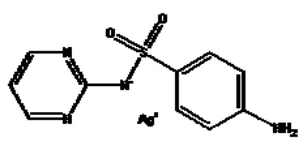
Chemical name: Silver 2-(4-aminobenzenesulfonamido)-pyrimidine
Molecular formula and molecular mass: C10 H9 N4 O2 S Ag (molecular weight: 357.14)
| Structural formula: |
Physicochemical properties: Silver sulfadiazine is a light-stable white powder, very slightly soluble in water and most organic solvents, but readily soluble in nitric acid and concentrated ammonia solutions. The pH of the cream is between 3.5-6.0.
14 CLINICAL TRIALS
The clinical trial data on which the original indication was authorized is not available.
15 MICROBIOLOGY
The minimum inhibitory concentration (MIC) as determined by the serial tube dilution of susceptible organisms is shown in Tables 1 & 2.
Table #1 - Minimum Inhibitory Concentration of Silver Sulphadiazine in mg/L
| At 24 hours | At 3 days | ||||||||||
| ORGANISM | STRAINS | Expt.1 | Expt.2 | Expt.1 | Expt.2 | ||||||
| Pseudomonas aeruginosa | (SNR) | 25 | <6 | 100 | 100 | ||||||
| Pseudomonas aeruginosa | 6750 NCTC | 25 | 12,5 | 100 | 12,5 | ||||||
| Pseudomonas aeruginosa | USA 1* | >100 | 300 | >100 | >300 | ||||||
| Pseudomonas aeruginosa | USA 4* | 25 | 25 | >100 | >300 | ||||||
| Pseudomonas aeruginosa | 6741 NCTC | 50 | 12,5 | 100 | 100 | ||||||
| Pseudomonas aeruginosa | 8203 NCTC | 50 | 25 | 50 | >100 | ||||||
| Pseudomonas aeruginosa | 661322 NCTC | 50 | 37,5 | >100 | 300 | ||||||
| Aerobacter aerogenes | 749 NCTC | 25 | >18,7 | 100 | 25 | ||||||
| Escherichia coli | (SNR) | 50 | 37,5 | >100 | 150 | ||||||
| Proteus vulgaris | (SNR) | 25 | 37,5 | >100 | 150 | ||||||
| Staphylococcus aureus | (OxH)6571 | 50 | 50 | 100 | 100 | ||||||
| Candida albicans | (SNT) | 100 | 300 | >100 | >300 | ||||||
| Aspergillus niger | (SNR) | 25 | 18,7 | >100 | 300 | ||||||
*These strains were isolated from burn patients treated with silver nitrate.
Table #2 - Susceptibility to Silver Sulphadiazine of 643 Isolates of 14 Bacterial Species
Minimal Inhibitory Concentrations (cumulative percentage) mg/L Silver Sulphadiazine | ||||||||||||||
| Micro-organism | No. Tested | <0,7 8 | 1,56 | 3,13 | 6,25 | 12,5 | 25 | 50 | 100 | |||||
| Pseudomonas aeruginosa | 130 | 0,8 | 5,4 | 29,2 | 60,0 | 79,2 | 93,1 | 100 | - | |||||
| P. maltophilia | 7 | 14,3 | 14,3 | 28,6 | 42,9 | 85,8 | 100 | - | - | |||||
| Klebsiella | 54 | 7,4 | 11,1 | 14,8 | 31,5 | 61,1 | 74,1 | 98,2 | 100 | |||||
 |
Enterobacter (except E.cloacae) | 50 | 0 | 8,0 | 10,0 | 20,0 | 44,0 | 66,0 | 96,0 | 100 |
| E. cloacae | 24 | 0 | 4,2 | 4,2 | 20,8 | 45,8 | 79,2 | 100 | - |
| Escherichia coli | 63 | 3,2 | 6,3 | 30,2 | 50,8 | 71,4 | 90.5 | 100 | - |
| Proteus Mirabilis | 53 | 24,5 | 50,9 | 73,6 | 88,7 | 96,2 | 96,2 | 100 | - |
| P. morganii | 10 | 10,0 | 30,0 | 40,0 | 80,0 | 80,0 | 90,0 | 100 | - |
| Serratia | 28 | 7,1 | 25,0 | 39,3 | 75,0 | 89,3 | 92,9 | 96,4 | 100 |
| Citrobacter | 10 | 20,0 | 20,0 | 40,0 | 60,0 | 60,0 | 80,0 | 100 | - |
| Herellea | 9 | 11,1 | 22,2 | 55,6 | 66,7 | 77,8 | 88,9 | 100 | - |
| Staphylococcus aureus | 101 | 3,0 | 6,0 | 16,9 | 27,8 | 37,7 | 76,3 | 99,1 | 100 |
| S.epidermidis | 51 | 3,9 | 7,8 | 29,4 | 51,0 | 74,5 | 86,3 | 100 | - |
Enteroccoccus (group D Streptococcus) | 53 | 0 | 0 | 0 | 0 | 0 | 1,9 | 96,2 | 100 |
16 NON-CLINICAL TOXICOLOGY
General Toxicology:
Acute Toxicity
The following LD50's were determined in mice, rats, guinea pigs, and rabbits.
| SPECIES | ROUTE | LD50 |
| Mice (male) | I.P. | 37,8 mg/kg |
| Rats (both sexes) | S.C. | > 2,150 mg/kg |
| Guinea pigs (both sexes) | S.C. | > 2,150 mg/kg |
| Rabbits (both sexes) | S.C. | > 2,150 mg/kg |
| Newborn rats | Oral | 482 mg/kg |
| Adult rats (both sexes) | Oral | > 10,000 mg/kg |
Subacute Studies
Ointments containing 1, 8 and 20% silver sulfadiazine were applied to the abraded and occluded skin of rabbits for six hours each day, seven days a week for three consecutive weeks. Additional groups of rabbits were treated with the ointment without silver sulfadiazine or received no treatment, and therefore served as procedural controls.
The same ointments were also applied to the intact and non-occluded skin of rabbits for six hours a day, seven days a week for thirteen consecutive weeks. An additional group of rabbits was treated with the ointment without silver sulfadiazine.
The ointment base alone and the ointments containing silver sulfadiazine elicited mild irritation of the skin. The irritation produced by the silver sulfadiazine ointment was similar to or slightly less than the ointment alone.
Varying degrees of skin inflammation were observed histologically at week 13 in both ointment base and high concentration silver sulfadiazine ointment treated rabbits.
Urinary pH was lower at week 3 in the male rabbits treated with the high concentration of silver sulfadiazine and the ointment base alone.
There was a tendency to lowered RBC counts at 13 weeks in female rabbits treated with the high concentration of silver sulfadiazine.
Serum protein levels were elevated in some rabbits treated with the high concentration and with the ointment base alone.
In all other respects including food consumption, bodyweight change, ophthalmoscopy, urinalysis, blood chemistry, haematology, organ weights, macroscopic and microscopic pathology, the rabbits treated with silver sulfadiazine ointment remained comparable with the ointment base and "no treatment" control groups.
Skin Irritation Studies
The primary irritation potential of silver sulfadiazine cream was assessed using an occlusive patch test technique in rabbits. The primary irritation index was zero.
Eye Irritation Studies
Eye irritation studies in the rabbits revealed no behavioural indications of discomfort immediately after treatment. Four out of six animals had slightly red lids when observed after one hour, but this had completely disappeared by the time of the second observation at 24 hours. No other symptoms were observed.
Sensitivity Studies
The sensitizing potential of the silver sulfadiazine cream was assessed in guinea pigs using a standard technique. A positive control group was included in which the guinea pigs were challenged with the known sensitizer 2, 4-dinitrochlorobenzene. The animals were shown to be capable of sensitization by a positive response to the latter compound but did not react by sensitization to the silver sulfadiazine cream.
Carcinogenicity:
No carcinogenicity studies have been carried out.
Reproductive and Developmental Toxicology:
Teratological Studies
A study was conducted in rabbits using a control (placebo cream), 3% or 10% cream. 5 mL cream was applied to their shaved backs for four (4) hours each day, from day 6 through day 18 of gestation. There were no compound-related effects upon reproductive or fetal parameters observed in either the 3% or 10% groups. Variations between the silver sulfadiazine treated groups and the control groups were within the normal range of intergroup variations in studies of this type and were not significant.