


Product Monograph - Fluphenazine Decanoate Injection, USP
INDICATIONS AND CLINICAL USE
Fluphenazine Decanoate Injection (fluphenazine decanoate) is a long-acting parenteral preparation, indicated in the management of manifestations of schizophrenia (see DOSAGE AND ADMINISTRATION).
CONTRAINDICATIONS
Phenothiazines are contraindicated in patients with marked cerebral atherosclerosis, suspected or established subcortical brain damage, with or without hypothalamic damage, since a hyperthermic reaction with temperatures above 40°C may occur, sometimes not until14 to 16 hours after drug administration.
Phenothiazine compounds should not be used in patients receiving large doses of hypnotics, due to the possibility of potentiation. Fluphenazine Decanoate Injection (fluphenazine decanoate) is contraindicated in comatose or severely depressed patients and in the presence of blood dyscrasias, liver damage, renal insufficiency, pheochromocytoma, or in patients with severe cardiovascular disorders. Patients who have shown hypersensitivity to other phenothiazines, including fluphenazine, should not be given fluphenazine decanoate as cross sensitivity reactions may occur.
Fluphenazine decanoate is not indicated for the management of severely agitated psychotic patients, psychoneurotic patients or geriatric patients with confusion and/or agitation.
Fluphenazine decanoate is not intended for use in children under 12 years of age.
WARNINGS
Severe adverse reactions requiring immediate medical attention may occur and are difficult to predict. Therefore, the evaluation of tolerance and response, and establishment of adequate maintenance therapy, require careful stabilization of each patient under continuous, close medical observation and supervision.
The use of this drug may impair the mental and physical abilities required for driving a car or operating heavy machinery. Potentiation of the effects of alcohol may also occur.
Use in Pregnancy
The safety of use in pregnant women has not been established. Therefore, fluphenazine decanoate should not be administered to women of childbearing potential, particularly during the first trimester of pregnancy, unless, in the opinion of the physician, the expected benefit to the patient outweighs the potential risk to the fetus.
Use in Children
The safety and efficacy of fluphenazine decanoate in children have not been established. Therefore, fluphenazine decanoate is not indicated for use in the pediatric age group.
Tardive Dyskinesia
Tardive dyskinesia (TD) is a syndrome of involuntary hyperkinetic abnormal movements that occur in predisposed individuals during or following the cessation of long-term neuroleptic drug therapy. TD is characterized by involuntary, repetitive, purposeless hyperkinetic movements that involve the tongue, face, mouth, lips or jaw, trunk and extremities. The prevalence of TD greatly varies; when the mildest symptoms are included, prevalence can be 70%, whereas severe symptom rates are around 2.5%. The frequency and severity of TD increases with age, particularly in females.
Whether neuroleptic drugs differ in their potential to cause TD is unknown. The cautious interpretation is that any neuroleptic drug that suppresses TD, has the capacity to produce it. The mechanism of TD is not known; though dopamine dysfunction is believed to underlie TD, it may be necessary but not sufficient to explain this complex disorder.
There is no known treatment for established cases of TD, although the syndrome may remit, partially or completely, if neuroleptic treatment is withdrawn. However, neuroleptic treatment itself suppresses the signs and symptoms of the syndrome thereby masking the underlying disease process.
Given these considerations, neuroleptic drugs should be prescribed in a manner that is most likely to minimize the occurrence of TD. Reducing the dose to the lowest effective level or discontinuing the drug for as long as possible continues to be the most rational approach. In patients who require chronic treatment, the smallest dose and the shortest duration of treatment producing a satisfactory clinical response should be sought. The need for continued treatment should be reassessed periodically.
PRECAUTIONS
Phenothiazines, particularly those with a long duration of action, should be used with caution in patients with a history of convulsive disorders since grand mal convulsions have been known to occur.
Because of the possibility of cross-sensitivity, fluphenazine decanoate should be used with caution in patients who have developed cholestatic jaundice, and dermatoses or other allergic reactions to phenothiazine derivatives.
Hypotensive phenomena may develop in phenothiazine-treated patients who are undergoing surgery. Careful observation is necessary and anesthetic or central nervous system depressant dosages may have to be reduced.
Particularly during the first few months of therapy routine blood counts and hepatic function tests are advised as blood dyscrasias and liver damage, manifested by cholestatic jaundice, may occur. In patients on long-term therapy renal function should be monitored; if BUN (blood urea nitrogen) becomes abnormal, treatment should be discontinued.
The effects of atropine or other drugs with similar action may be potentiated in patients receiving phenothiazines because of added anticholinergic effects. Paralytic ileus, even resulting in death, may occur especially in the elderly. Fluphenazine decanoate should be used cautiously in patients exposed to extreme heat or phosphorus insecticides.
As with other antipsychotic agents, the physician should be alert to the possible development of silent pneumonias in patients under treatment with phenothiazines.
The possibility of liver damage, lenticular and corneal deposits, pigmentary retinopathy, and the development of irreversible dyskinesia should be borne in mind when patients are on prolonged therapy.
Since hypotension and electrocardiographic changes suggestive of myocardial ischemia have been associated with the administration of phenothiazines, fluphenazine decanoate should be used with caution in patients with compensated cardiovascular or cerebrovascular disorders.
Alterations in Cephalin flocculation, alkaline phosphatase, sometimes accompanied by abnormalities in other liver function tests, have been reported in patients receiving esterified fluphenazine who have had no clinical evidence of liver damage. This, however, is not uncommon with phenothiazine therapy.
Neuroleptic drugs elevate prolactin levels; the elevation persists during chronic administration. Tissue culture experiments indicate that approximately one-third of human breast cancers are prolactin dependent in vitro, a factor of potential importance if the prescription of these drugs is contemplated in a patient with a previously detected breast cancer. Although disturbances such as galactorrhea, amenorrhea, gynecomastia, and impotence have been reported, the clinical significance of elevated serum prolactin levels is unknown for most patients. An increase in mammary neoplasms has been found in rodents after chronic administration of neuroleptic drugs. Neither clinical studies nor epidemiologic studies conducted to date, however, have shown an association between chronic administration of these drugs and mammary tumorigenesis; the available evidence is considered too limited to be conclusive at this time.
ADVERSE REACTIONS
CENTRAL NERVOUS SYSTEM
Extrapyramidal Symptoms
The side effects most frequently reported with phenothiazine compounds are extrapyramidal symptoms including pseudoparkinsonism (tremor, rigidity, etc.), dystonia, dyskinesia, akathisia, oculogyric crises, opisthotonos, and hyperreflexia. Fluphenazine decanoate produces a higher incidence of extrapyramidal reactions than the less potent piperazine derivatives or the straight chain phenothiazines such as chlorpromazine. Extrapyramidal reactions tend to occur in the first few days after an injection of fluphenazine decanoate. Caution should be exercised in those who have marked extrapyramidal reactions to oral phenothiazines or similar drugs, particularly elderly females. Extrapyramidal reactions may be alarming, and the patient should be forewarned and reassured. These reactions are often dose-related and tend to subside when the dose is reduced or the drug temporarily withdrawn. However, antiparkinsonian medication may be required to control serious reactions.
The use of prophylactic antiparkinson medication may be considered, although its therapeutic value has not yet been established.
Tardive Dyskinesia (See WARNINGS)
The syndrome is characterized by rhythmical involuntary movements of the tongue, face, mouth, or jaw (e.g. protrusion of tongue, puffing of cheeks, puckering of mouth, chewing movements). Sometimes, these may be accompanied by involuntary movements of the trunk and the extremities.
As with all antipsychotic agents, tardive dyskinesia may appear in some patients on long-term therapy or may occur upon dosage reduction or after drug therapy has been discontinued. The risk seems to be greater in elderly patients on high dose therapy, especially females. The symptoms are persistent and in some patients appear to be irreversible.
There is no known effective treatment for tardive dyskinesia; antiparkinsonian agents do not alleviate the symptoms of this syndrome.
Neuroleptic drugs should be prescribed in a manner that is most likely to minimize the occurrence of tardive dyskinesia. Reducing the dose to the lowest effective level or discontinuing the drug for as long as possible continues to be the most rational approach. In patients who require chronic treatment, the smallest dose and the shortest duration of treatment producing a satisfactory clinical response should be sought. The need for continued treatment should be reassessed periodically.
Other CNS Effects
Drowsiness or lethargy, if they occur, may necessitate a reduction in dosage; the induction of a catatonic-like state has been known to occur with high dosages of fluphenazine. As with other phenothiazine compounds, reactivation or aggravation of psychotic processes may be encountered.
In some patients, phenothiazine derivatives have been known to cause restlessness, excitement, or bizarre dreams.
Rare occurrences of neuroleptic malignant syndrome (NMS) have been reported in patients on neuroleptic therapy. The syndrome is characterized by hyperthermia, muscular rigidity, autonomic instability (labile blood pressure, tachycardia, diaphoresis), akinesia, and altered consciousness, sometimes progressing to stupor or coma. Leukocytosis, elevated CPK, liver function abnormalities, and acute renal failure may also occur. Neuroleptic therapy should be discontinued immediately and vigorous symptomatic treatment implemented since the syndrome is potentially fatal.
Autonomic Nervous System:
Hypotension, hypertension and fluctuations in blood pressure have been reported with fluphenazine.
Patients with pheochromocytoma, cerebral vascular or renal insufficiency, or a severe cardiac reserve deficiency such as mitral insufficiency, appear to be particularly prone to hypotensive reactions with phenothiazine compounds and should therefore be observed closely when the drug is administered. If severe hypotension should occur, supportive measures including the use of intravenous vasopressor drugs should be instituted immediately. Levarterenol Bitartrate Injection, USP is the most suitable drug for this purpose; epinephrine should not be used since phenothiazine derivatives have been found to reverse its action, resulting in a further lowering of blood pressure.
Autonomic reactions including nausea and loss of appetite, salivation, polyuria, perspiration, dry mouth, headache, and constipation may occur. Autonomic effects can usually be controlled by reducing or temporarily discontinuing dosage.
In some patients, phenothiazine derivatives have caused blurred vision, glaucoma, bladder paralysis, fecal impaction, paralytic ileus, tachycardia, or nasal congestion.
Metabolic Endocrine:
Weight change, peripheral edema, abnormal lactation, gynecomastia, menstrual irregularities, false results on pregnancy tests, impotency in men and increased libido in women have all been known to occur in some patients on phenothiazine therapy.
Allergic Reactions:
Skin disorders such as itching, erythema, urticaria, seborrhea, photosensitivity, eczema and exfoliative dermatitis have been reported with phenothiazine derivatives. The possibility of anaphylactoid reactions occurring in some patients should be borne in mind.
Hematologic:
Leukopenia, agranulocytosis, thrombocytopenic or nonthrombocytopenic purpura, eosinophilia, and pancytopenia have been observed with phenothiazine derivatives. If any soreness of the mouth, gums, or throat or any symptoms of upper respiratory infection occur and confirmatory leukocyte count indicates cellular depression, therapy should be discontinued and other appropriate measures instituted immediately.
Hepatic:
Liver damage as manifested by cholestatic jaundice may be encountered, particularly during the first months of therapy; treatment should be discontinued if this occurs. An increase in cephalin flocculation, sometimes accompanied by alterations in other liver function tests, has been reported in patients receiving the enanthate ester of fluphenazine (a closely related compound) who have had no clinical evidence of liver damage.
Others:
Sudden, unexpected and unexplained deaths have been reported in hospitalized psychotic patients receiving phenothiazines. Previous brain damage or seizures may be predisposing factors; high doses should be avoided in known seizure patients. Several patients have shown flare-ups of psychotic behaviour patterns shortly before death. Autopsy findings have usually revealed acute fulminating pneumonia or pneumonitis, aspiration of gastric contents or intramyocardial lesions.
Potentiation of central nervous system depressants (opiates, analgesics, antihistamines, barbiturates, alcohol) may occur.
The following adverse reactions have also occurred with phenothiazine derivatives: systemic lupus erythematosus-like syndrome, hypotension severe enough to cause fatal cardiac arrest, altered electrocardiographic and electroencephalographic tracings, altered cerebrospinal fluid proteins, cerebral edema, asthma, disturbances of body temperature (hypo- or hyperthermia), laryngeal edema, and angioneurotic edema. Skin pigmentation, and lenticular and corneal opacities have been seen with long-term use.
Injections of fluphenazine decanoate are well tolerated, local tissue reactions occurring only rarely.
SYMPTOMS AND TREATMENT OF OVERDOSAGE
Symptoms of overdose will likely be manifested as extrapyramidal signs, hypotension and sedation. Initial hospitalization may be required in cases of large overdose and close medical supervision should be maintained throughout the duration of drug action.
Treatment is essentially supportive and symptomatic: no further injections should be given until the patient shows signs of relapse and the dosage then should be decreased.
An airway should be maintained. Severe hypotension calls for the immediate use of an i.v. vasopressor drug, such as levarterenol bitartrate USP. Epinephrine should not be used, as a further lowering of blood pressure may result. Extrapyramidal symptoms may be treated with antiparkinsonian agents.
DOSAGE AND ADMINISTRATION
Fluphenazine Decanoate Injection (fluphenazine decanoate) is usually given as an intramuscular injection preferably in the gluteus maxim us, although it may also be administered subcutaneously. Fluphenazine Decanoate Injection (fluphenazine decanoate) is not for intravenous use.
As a long-acting depot fluphenazine, fluphenazine decanoate has been found useful in the maintenance treatment of non-agitated, chronic schizophrenic patients who have been stabilized with short-acting neuroleptics and might benefit from transfer to a longer-acting injectable medication. The changeover of medication should aim at maintaining a clinical outcome similar to, or better than, that obtained with the previous therapy. To achieve and maintain the optimum dose, the changeover from other neuroleptic medication should proceed gradually and constant supervision is required during the period of dosage adjustment in order to minimize the risk of overdosage or insufficient suppression of psychotic symptoms before the next injection.
The initial recommended dose is 2.5 mg to 12.5 mg. An initial dose of 12.5 mg is usually well tolerated. However, an initial test dose of 2.5 mg is recommended in patients:
- a) over the age of 50 or with disorders that predispose to undue reactions;
- b) whose individual or family history suggests a predisposition to extrapyramidal reactions;
- c) who have not previously received a long-acting depot neuroleptic.
The onset of action generally appears between 24 to 72 hours after injection, and the effects of the drug on psychotic symptoms become significant within 48 to 96 hours.
Discontinuation of oral neuroleptic medication has been recommended for up to one week prior to initiation of depot fluphenazine therapy.
Subsequent doses and frequency of administration must be determined for each patient. There is no reliable dosage comparability between a short-acting neuroleptic and depot fluphenazine and, therefore, the dosage of the long-acting drug must be individualized. Except in particularly sensitive patients, a second dose of 12.5 mg or 25 mg can be given 4 to 10 days after the initial injection. Subsequent dosage adjustments are made in accordance with the clinical circumstances and the response of the patient. Patients can usually be controlled with 25 mg or less, every two to three weeks. Although doses greater than 50 mg are usually not deemed necessary, doses up to 100 mg have been used in some patients. If doses greater than 50 mg are necessary, the next dose and succeeding doses should be increased in increments of 12.5 mg. While the response to a single injection lasts usually two to three weeks, it may last for four weeks or more.
After an appropriate dosage adjustment is achieved, regular and continuous supervision and reassessment is considered essential in order to permit any further dosage adjustments that might be required to ensure use of the lowest effective individual dose and avoid troublesome side-effects.
Since higher doses increase the incidence of extrapyramidal reactions and other adverse effects, the amount of drug used should not be increased in order to prolong the intervals between injections. With higher doses, there is also more variability in the action of depot fluphenazine.
A dry syringe with a needle of at least 21 gauge should be used to inject Fluphenazine Decanoate. Use of a wet needle or syringe may cause the solution to become cloudy.
PHARMACEUTICAL INFORMATION
DRUG SUBSTANCE
Proper/Common Name: Fluphenazine decanoate
Chemical Names: 1) 2-{4-[3-(2-(Trifluoromethyl)phenothiazin-10-yl)-propyl]-1- piperazinyl}ethyl decanoate
- 2) 2-{4-[3-(2-(Trifluoromethyl)-10H-phenothiazin-10-yl)- propyl]-1-piperazinyl}ethyl decanoate
Structural Formula: 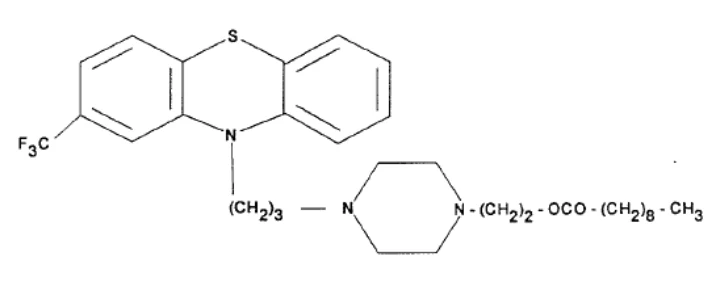
Molecular Formula: C32H44F3N3O2S
Molecular Weight: 591.77
Description: Fluphenazine decanoate is a pale yellow viscous liquid or a yellow solid. Practically insoluble in water, very soluble in dehydrated ethanol, ether, and in dichloromethane; freely soluble in methyl alcohol.
pKa Values: The pKa and pKa2 values for fluphenazine decanoate have not been reported. However, they would be expected to be very similar to those of fluphenazine enanthate of about 3.4 and 8.0.
Melting Range: The melting range of crystallized fluphenazine decanoate has been determined as 30-32°C.
COMPOSITION
Fluphenazine Decanoate contains 25 mg/mL fluphenazine decanoate as solution in sesame oil. Benzyl alcohol 1.2% (v/v) is added as a preservative.
STABILITY AND STORAGE RECOMMENDATIONS
Protect from freezing and from light. Store at room temperature 15-30°C. Unused portions should be discarded 28 days after initial puncture. Keep in carton until discarded.
AVAILABILITY OF DOSAGE FORMS
Fluphenazine Decanoate Injection is available in 5 mL flint vials with white flip-off caps, packaged in individual outer cartons or in cartons of 5.
PHARMACOLOGY
Single doses of fluphenazine decanoate exerted long-lasting pharmacological effects in several species.
Fluphenazine decanoate protected mice from amphetamine-induced group toxicity. Five, 10 and 20 mg/Kg doses protected 20, 30 and 50% of the mice, respectively, from the lethal effect of amphetamine. The protective effect of a single dose lasted for 21 days.
Fluphenazine decanoate 35 mg/Kg, inhibited the conditioned avoidance response in rats by 50 to 60%. Inhibition was maximal two to ten days after injection. Conditioned avoidance behavior was still inhibited by 25%, 50 to 55 days after injection, indicating that this behavior returns to baseline only very slowly. Two subsequent injections, at monthly intervals, kept the conditioned avoidance response suppressed by 50 to 70%.
Fluphenazine decanoate, 5 and 10 mg/Kg, antagonized the apomorphine-induced stereotyped behavior in rats for 10 and 21 days, respectively.
Fluphenazine decanoate, 8.6 mg/Kg, protected dogs from the emetic effect of apomorphine for up to 28 days.
Fluphenazine decanoate also induced sedation and ataxia in dogs and a decrease in rectal temperature. The drug also produced moderate hypotension in unanesthetized dogs, dose related hypotension in anesthetized dogs and marked hypotension in anesthetized, curarized cats.
Pharmacokinetic studies of fluphenazine decanoate in dogs have demonstrated that the excretion rate is dependent upon the rate of release from the injection site. Fluphenazine decanoate is hydrolysed by plasma esterases to fluphenazine and appears in the bile as the glucuronide of 7-hydroxy-fluphenazine. Only 1-3% of an intramuscular dose is excreted in the urine, the remainder appearing in the feces. Uptake of fluphenazine-C14 into the brain does not show any striking localization.
TOXICOLOGY
Acute Toxicity
| Species | Route | LD50 (mg/Kg) |
| Mice Rat Rat | s.c. i.p. s.c. | 510 750, 960, 820 968 |
Subacute and Chronic Toxicity Studies
| Species | Route | Doses (mg/Kg/wk) | Duration | Comments |
| Rat | s.c. | 30,10,3 | 3 months | Depression proportion to dosage. Growth retardation, reversible upon discontinuation. No morphological evidence of toxicy. |
| Rat | s.c. | 50,25,10 | 3 months | Catalepsy after injection. 1/10 males at 10 mg/Kg/wk; recovered day 3. 1/10 males at 25 mg/Kg/wk; recovered day 3. 5/10 males at 50 mg/Kg/wk; recovered day 5. |
| Dog | s.c. | 90,30,10 | 3 months | Reduced activity, miosis, prolapsed nictitating membrane and tremors – decreased with time. No morphological evidence of toxicity. |
| Dog | s.c. | 10 | 3 months | No catalepsy. No Histological anomalies. |
| Rat | s.c. | 30,10,3 | 6 months | Decreased activity and apathy (not dose-related). Decreased body weight gain and food utilization. Slight hypertrophy of mammary glands and lactation. Increased pituitary weight in males. Decreased adrenal weight in females. |
Reproductive Studies
| Species | Sex | Dose (mg/Kg) | Route | Times of Administration | Comments |
| Rabbit | F | 0.84, 5.6 | s.c | Day 6 of gestation | No teratogenic effects. Possible interference with nidation. Delayed ossification in high dose group (may be related to other factors) |
| Rat | F M | 0.5, 2.5 0.5, 2.5 | s.c s.c | Once weekly; 2 weeks before mating and throughout gestation and lactation. Once weekly; 10 weeks before mating | Index of fertility decreased in 2.5 mg/Kg/wk group. Follow-up study showed normal spermatogenesis and abundant sperms in epididymis. |
| Rat | F | 0.5, 2.5 | s.c | Day 8 of gestation | No teratogenic changes or effects upon fetal development |
| Rat | F | 0.5, 2.5 | s.c | Day 15 of gestation | No significant adverse effects observed |
BIBLIOGRAPHY
- 1)
Ayd FJ. Depot fluphenazines: Twelve years' experience -An overview, edited by Frank J
Ayd. Baltimore: Ayd Medical Communications, c1978, pps: 136-158.
- 2) Babiker IE. Comparative efficacy of long-acting depot and oral neuroleptic medications in preventing schizophrenic recidivism. J Clin Psychiat 1987; 48: 94-97.
- 3) Brown WA and Silver MA. Serum neuroleptic levels and clinical outcome in schizophrenic patients treated with fluphenazine decanoate. J Clin Psychopharmacol1985; 5: 143-147.
- 4) Casey DE. Tardive dyskinesia ln: Meltzer HY (ed.), Psychopharmacology: The third generation of progress. Raven Press, New York, 1411-1419, 1987.
- 5) Chouinard G, et al. Fluphenazine enanthate and fluphenazine decanoate in the treatment of schizophrenic outpatients: Extrapyramidal symptoms and therapeutic effect. Amer J Psychiat 1982; 139: 312-318.
- 6) Comaty JE and Janicak PG. Depot neuroleptics. Psychiat Ann 1987; 17: 491-496.
- 7)
Curson DA, et al. Long-term depot maintenance of chronic schizophrenic outpatients:
The Seven year follow-up of the Medical Research Council fluphenazine/placebo trial. Brit J Psychiat 1985; 146: 464-480.
- 8) Davis JM and Andriukaitis S. The natural course of schizophrenia and effective maintenance drug treatment. J Clin Psychopharmacol1986; 6 (Suppl. 1): S2-S10.
- 9) Gaby N, et al. Experience with fluphenazine decanoate in the management of chronic schizophrenic outpatients. N C Med J 1982; 43: 641-644.
- 10)
Glazer WM. Depot fluphenazine: Risk/benefit ratio. J Clin Psychiat 1984; 45 (5, Part 2):
28-35.
- 11) lmlah NW and Murphy KP. The outcome of 14 years' continuous treatment with fluphenazine decanoate. In: Schizophrenia: New pharmacological and clinical developments, edited by AA Schiff, Sir Martin Roth and HL Freeman. London: Royal Society of Medicine Services Limited, 1985. pps: 35-45.
- 12)
Jann MW, et al. Clinical pharmacokinetics of the depot antipsychotics. Clin
Pharmacokinet 1985; 10: 315-333.
- 13) Jayaram G, et al. Relapse in chronic schizophrenics treated with fluphenazine decanoate is associated with low serum neuroleptic levels. J Clin Psychiat 1986; 47: 247-248.
- 14) Johnson D. Observations on the use of long-acting depot neuroleptic injections in the maintenance therapy of schizophrenia. J Clin Psychiat 1984; 45: 13-21.
- 15)
Kane JM. Antipsychotic drug side effects: Their relationship to dose. J Clin Psychiat 1985;
46 (5, Section 2): 16-21.
- 16)
Kane JM. The use of depot neuroleptics: Clinical experience in the United States. J Clin
Psychiat 1984; 45 (5, Part 2): 5-12.
- 17) Kane JM. Dosage strategies with long-acting injectable neuroleptics, including haloperidol decanoate. J Clin Psychopharmacol 1986; 6 (1 Suppl.): 20S-23S.
- 18)
Marder SR. Depot neuroleptics: Side effects and safety. J Clin Psychopharmacol1986; 6
(1 Suppl.): 24S-29S.
- 19) Tan CT, et al. The use of fluphenazine decanoate (Modecate) depot therapy in outpatient schizophrenics- A retrospective study. Singapore Med J 1981; 22: 214-218.
- 20)
Product Monograph. Modecate® and Modecate® Concentrate (Fluphenazine
Decanoate) Injection. Squibb Canada, Revised July 10, 1991.