


Patient Medication Information: uses, side effects, how to take - Fsme-Immun
What the vaccine is used for:
FSME-IMMUN is a vaccine, which is used to prevent disease caused by Tick-Borne Encephalitis (TBE) Virus. It is suitable for persons of at least 16 years of age.
The Tick-Borne Encephalitis Virus can cause very serious infections of the brain or the spine and its covering. These often start with headache and high temperature. In some people and in the most se-vere forms, they can progress to loss of consciousness, coma and death.
The virus can be carried by ticks. It is passed on to man by tick bites. The chance of being bitten by ticks that carry the virus is high in some parts of central and northern Europe. People who live in or take holidays in these parts of Europe are most at risk. The ticks are not always spotted on the skin and the bites may not be noticed.
- Like all vaccines, FSME-IMMUN may not completely protect everyone who is vaccinated.
- Also, protection does not last for life.
- A single dose of the vaccine is not likely to protect you against infection. You need 3 doses (please refer to the vaccination sche-dule for more information).
What it does:
FSME-IMMUN provides protection against tick-borne encephali-tis and should be given before the start of the tick activity season. The season begins in the spring and so your course of vaccination should preferably start in the winter months.
The vaccine works by causing the body to make its own antibod-ies, which protect against this disease.
Please note: A tick bite may also cause infection with Borrelia bacteria. The symptoms of such infections may resemble those of tick-borne encephalitis. TBE vaccines like FSME-IMMUN do not provide protection against Borrelia infections.
As with all vaccines, FSME-IMMUN may not completely protect all patients receiving the vaccine against the infection that it is intended to prevent.
When it should not be used:
Do not use FSME-IMMUN if:
- you ever had an allergic reaction to a previous dose of this vaccine or to any ingredient of the vaccine. For example, you have had skin rash, swelling of the face and throat, dif-ficulty in breathing, blue discoloring of the tongue or lips, low blood pressure and collapse.
- you ever had an allergic reaction to neomycin or gentamicin or to formaldehyde or protamine sulphate (used during the manufacturing process).
- you ever had cross-allergies with aminoglycosides
- you ever had a severe allergic reaction after eating egg or chicken.
- you are known to be allergic to latex rubber.
you have an infection with a fever (raised temperature)
you may have to wait before having FSME-IMMUN. Your doctor could ask you to wait for the injection until you feel better.
What the medicinal ingredient is:
Tick-borne Encephalitis Virus Vaccine, Inactivated, with Adju-vant
What the important nonmedicinal ingredients are:
2% Aluminum hydroxide suspension, disodium hydrogen phos-phate dehydrate, 0.1% human albumin, potassium dihydrogen phosphate, sodium chloride, water for injection.
Residues of formaldehyde, gentamicin, sucrose, neomycin, and protamine sulphate may be present.
For a full listing of nonmedicinal ingredients see Part 1 of the product monograph.
What dosage forms it comes in:
Each dose contains 2.4 micrograms (target value) inactivated tick-borne encephalitis virus.
The vaccine is provided in a one-dose (0.5 mL) prefilled glass syringe for use in individuals aged 16 years and above.
WARNINGS AND PRECAUTIONS
Serious Warnings and Precautions Talk to your doctor before having the vaccine if you
|
Vaccination should be postponed in patients with acute clinical conditions (with or without fever) that could be aggravated by adverse reactions to the vaccine or could impair the interpretation of possible adverse reactions to the vaccine.
| INTERACTIONS WITH THIS VACCINE |
Drugs that may interact with FSME-IMMUN include: No interaction studies with other vaccines or medicinal products have been performed. The administration of other vaccines at the same time as FSME-IMMUN should be performed only in accor-dance with official recommendations. If other injectable vaccines are to be given at the same time, administrations should be into separate sites and, preferably, into separate limbs.
A protective immune response may not be elicited in persons un-dergoing immunosuppressive therapy or persons with an impaired immune system (for vaccination schedule please see section “proper use of this vaccines”). There are no specific clinical data on which to base dose recommendations in such patients.
| PROPER USE OF THIS VACCINE |
Usual dose:
Recommended dosage for FSME-IMMUN (tick-borne encephali-tis virus vaccine, inactivated, with adjuvant) is summarized in the following table:
VACCINATION SCHEDULE
Basic Immuniza- tion | Dose | Interval |
| 1st dose | 0.5 mL i.m. | - |
| 2nd dose | 0.5 mL i.m. | 1 to 3 months after the 1st vaccination |
| 3rd dose | 0.5 mL i.m. | 5 to 12 months after the 2nd vaccination |
Rapid Immuniza- tion Schedule | Dose | Interval |
| 1st dose | 0.5 mL i.m. | - |
| 2nd dose | 0.5 mL i.m. | 2 weeks after the 1st vaccination |
| 3rd dose | 0.5 mL i.m. | 5 to 12 months after the 2nd vaccination |
The doctor or nurse will inject the recommended dose of the vac-cine.
FSME-IMMUN will be injected into the deltoid muscle of your upper arm. Intravascular administration may lead to severe hyper-sensitivity reactions. A complete vaccination course involves 3 doses of the vaccine. The second dose will be given between 1 to 3 months after the first dose and the third dose will be given 5 to 12 months after the second dose. A booster vaccination is then necessary every 3 to 5 years.
In order to quickly achieve protection, as may for instance be ne-cessary when the first dose is given in the summer months, the second dose may be given 14 days after the first injection.
It is important to follow the instruction from the doctor/nurse re-garding return visits for the follow-up doses.
Overdose:
An overdose is highly unlikely to happen because the injection is given from a single-dose syringe by a doctor.
In case of drug overdose, contact a health care practitioner, hospi-tal emergency department or regional Poison Control Centre im-mediately, even if there are no symptoms.
If you have any further questions on the use of this vaccine, ask your doctor or pharmacist.
Missed Dose:
If you leave too much time between the 3 doses, you may not have full protection against infection.
SIDE EFFECTS AND WHAT TO DO ABOUT THEM
As with all medicines, FSME-IMMUN may cause side effects in some persons. If any side effects worry you, or you have any un-usual symptoms, please contact your doctor. As with all vaccines, severe allergic reactions can happen. They are very rare, but the right medical treatment and supervision must always be readily available. Symptoms of serious allergic reactions include:
- swelling of the lips, mouth, throat (which may make it difficult to swallow or breathe),
- a rash and swelling of the hands, feet and ankles,
- loss of consciousness due to a drop in blood pressure. These signs or symptoms usually happen very quickly after the injection is given, while the person is still in the clinic. If any of these symptoms happen after you leave the place where your in-jection was given, you must see a doctor IMMEDIATELY.
The following side effects have been reported in clinical safety studies
Very common side effects
Pain, where the injection was given
Common side effects
Headache, nausea, feeling tired or unwell, muscle and joint pains
Uncommon side effects
Swelling of lymph glands, vomiting, fever, injection site hemor-rhage
Rare side effects
Allergic reactions, sleepiness or drowsiness, diarrhea, abdominal pain, dizziness characterized by a sensation of whirling motion, injection site induration, injection site swelling, injection site paresthesia, injection site warmth, injection site erythema, injec-tion site itching
The following additional side effects have been reported under the spontaneous reporting system
- Rapid beating of the heart
Blurred vision or being more sensitive to light, pain in the
eye
Chills, weakness, influenza-like illness, unsteady walk-
ing, local swelling
Severe allergic (anaphylactic) reaction, and aggravation
of autoimmune disease (e.g., Multiple sclerosis)
- Neck pain, muscle stiffness, pain in arms and/or legs
- Ringing in the ears (tinnitus)
- Shortness of breath
Signs of meningeal irritation like stiffness of neck, feel-
ing dizzy, inflamed nerves of various degrees (e.g., ab-normal or reduced sensation, facial nerve paralysis, pare-sis), convulsion, inflammation of the brain (encephalitis)
Damage of the myelin sheath, the material that surrounds
and protects your nerve cells (demyelination)
Rashy and/or itchy skin, hives, redness of skin, inflamma-
tion of skin, sweating
- Herpes zoster (triggered in pre-exposed patients)
If you notice any other side effects not mentioned in this leaflet, please inform your doctor or pharmacist (chemist). This is not a complete list of side effects. For any unexpected effects while taking FSME-IMMUN, contact your doctor or pharmacist.
Store your vaccine in a refrigerator between +2°C to +8°C. The vaccine should not be frozen, not even for a short period of time.
Store the vaccine out of the reach of children.
The expiry date is indicated on the label and packaging. The vac-cine should not be administered after this date.
Following use, the syringe is disposed of in accordance with the relevant national regulations.
Specific information for the health care provider
Shake well prior to administration to thoroughly mix the vaccine suspension.
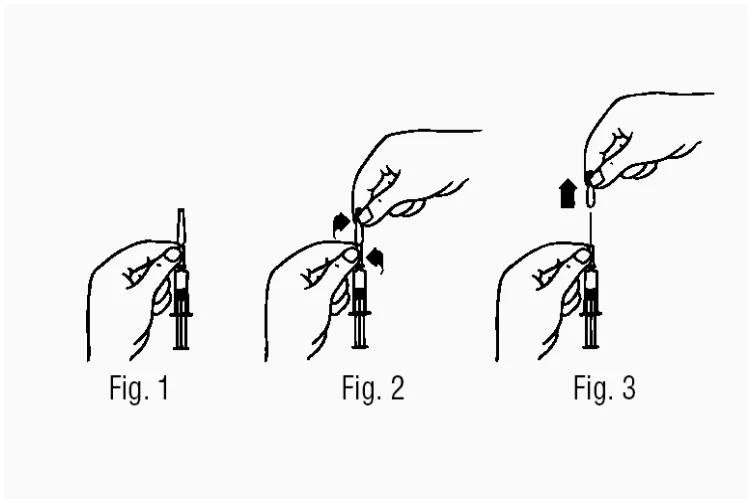
Remove needle guard as follows:
- 1. Hold the syringe at the lower part of the needle guard fixed onto the glass recipient (fig. 1);
- 2. Use the other hand to take the upper part of the needle guard between thumb and forefinger, and twist to break the seal (fig. 2).
- 3. Remove the detached part of the needle guard from the needle by a vertical movement (fig. 3).
REPORTING SUSPECTED SIDE EFFECTS
To monitor vaccine safety, the Public Health Agency of Canada collects information on serious and unexpected adverse events following vaccination. If you suspect you have had a serious or unexpected event following receipt of a vaccine you may notify the Public Health Agency of Canada:
By toll-free telephone: 866-844-0018
By toll-free fax: 866-844-5931
Email: cacfi@phac-aspc.gc.ca
Web: http://www.phac-aspc.gc.ca/im/vs-sv/index-eng.php
Mail:
The Public Health Agency of Canada
Vaccine Safety Section
130 Colonnade Road
Ottawa, Ontario K1A 0K9
A/L: 6502A
NOTE: Should you require information related to the management of side effect, please contact your health care provider before notifying the Public Health Agency of Canada. The Public Health Agency of Canada does not provide medical advice.
HOW TO STORE IT
Following twisting-off and removal of the needle guard, FSME-IMMUN can be used immediately. To avoid loss of sterility and/or clogging of the needle, it should not be left without protec-tion over prolonged periods of time. Therefore, the needle guard should only be removed immediately before use.
MORE INFORMATION
This document plus the full product monograph, prepared for health professionals can be found at:
http://www.baxter.com
or by contacting the sponsor, Baxter Corporation, at: 1-800-387-8399