


Patient Medication Information: uses, side effects, how to take - Gabapentin Oral Solution
Serious warnings and precautions box
What GABAPENTIN ORAL SOLUTION is used for:
GABAPENTIN ORAL SOLUTION is used in combination with other medications to treat epilepsy in adults.
How GABAPENTIN ORAL SOLUTION works:
GABAPENTIN ORAL SOLUTION belongs to the family of medicines called antiepileptic drugs. It works by acting on the brain to help decrease the number of seizures you may have.
The ingredients in GABAPENTIN ORAL SOLUTION are:
Medicinal ingredients: Gabapentin
Non-medicinal ingredients: Acesulfame Potassium, Banana Type NAT & ART, Flavor, Glycerin, Hydrochloric acid, Methyl Paraben, Propyl Paraben, Purified water, Saccharin Sodium, Sodium hydroxide.
GABAPENTIN ORAL SOLUTION comes in the following dosage form(s):
Oral Solution: 250 mg/5 mL
Do not use Gabapentin if:
- You are allergic to gabapentin or to any other ingredient in GABAPENTIN ORAL SOLUTION.
To help avoid side effects and ensure proper use, talk to your healthcare professional before you take Gabapentin. Talk about any health conditions or problems you may have, including if you:
- Have mixed seizure disorders, or experience absence seizures (brief, sudden lapses of consciousness where you stare into space for a few seconds).
- Have any breathing or lung problems.
- Have any kidney problems.
- Are pregnant, think you may be pregnant or thinking about becoming pregnant.
Are breastfeeding or plan to breastfeed. You and your healthcare professional should decide
Taking GABAPENTIN ORAL SOLUTION with opioid medicines, alcohol, or other central nervous system depressants (including street drugs) can cause severe drowsiness, decreased awareness, breathing problems, coma, and death.
- whether you should take GABAPENTIN ORAL SOLUTION or breastfeed, but you should not do both.
- Have a history of alcohol abuse.
- Have a current or history of addiction or abuse, misuse, physical dependence or withdrawal.
- Have a history of a psychiatric disorder.
- Drink alcohol on a regular basis.
- Are elderly (65 years of age or older).
- Drive a vehicle or perform hazardous tasks during your work.
Other warnings you should know about:
Stopping your treatment: Do NOT suddenly stop taking GABAPENTIN ORAL SOLUTION without talking to your healthcare professional first. If you do this, it may cause you to:
- have more seizures; or
- experience other withdrawal symptoms such as anxiety, sleeplessness, nausea, pain and/or sweating, shaking (tremor), headache, depression, dizziness, or feeling abnormal or unwell.
Stopping your treatment must be a gradual process that you discuss with your healthcare professional.
Dependence/Tolerance: Even when GABAPENTIN ORAL SOLUTION has been taken exactly as directed, there have been some cases of abuse, misuse, addiction, physical dependence and withdrawal. Your healthcare professional will monitor you while you are taking GABAPENTIN ORAL SOLUTION. If you feel like you are craving GABAPENTIN ORAL SOLUTION, or not using it as directed, talk to a healthcare professional right away.
Pregnancy: If you take GABAPENTIN ORAL SOLUTION during the first trimester of your pregnancy, your baby may be at risk for serious birth defects. Do not take GABAPENTIN ORAL SOLUTION if you are pregnant (or think you might be pregnant), unless advised by your healthcare professional. You must use an effective birth control method while taking Gabapentin if you are able to get pregnant. If you are planning on becoming pregnant, talk to your healthcare professional before taking GABAPENTIN ORAL SOLUTION.
Pregnancy registry: If you become pregnant while taking GABAPENTIN ORAL SOLUTION, talk to your healthcare professional about registering with the North American Antiepileptic Drug Pregnancy Registry. You can enroll in this registry by calling 1-888-233-2334. The purpose of this registry is to collect information about the safety of antiepileptic medicines during pregnancy. Information on the registry can also be found at the following website: http://www.aedpregnancyregistry.org/.
Severe skin reactions: In very rare cases, skin reactions that can be serious or life-threatening have been reported. This includes skin conditions such as Stevens-Johnson syndrome (SJS)/ toxic epidermal necrolysis (TEN), erythema multiforme (EM), and drug reaction with eosinophilia and systemic symptoms (DRESS). The following symptoms may be related to these skin reactions:
- Fever
- severe rash
- swollen lymph glands
- flu-like feeling
- blisters and peeling skin that may start in and around the mouth, nose, eyes and genitals and spread to other areas of the body
- yellow skin or eyes
- shortness of breath
- dry cough
- chest pain or discomfort
- feeling thirsty
- urinating less often, less urine
Suicidal thoughts and behaviour: There have been reports that antiepileptic medications like GABAPENTIN ORAL SOLUTION may cause you to have thoughts of harming or killing yourself. If you have these thoughts at any time, contact a healthcare professional or go to a hospital right away. You may find it helpful to tell a relative or close friend how you are feeling and ask them to tell you if they notice any changes in your behaviour.
Driving and Operating Machinery: Do not drive at all if you have uncontrolled epilepsy. GABAPENTIN ORAL SOLUTION may cause you to feel dizzy or drowsy. Avoid driving, using machinery, or doing dangerous activities until you know how GABAPENTIN ORAL SOLUTION affects you.
Tell your healthcare professional about all the medicines you take, including any drugs, vitamins, minerals, natural supplements or alternative medicines.
Serious drug interactions:
The following may also interact with GABAPENTIN ORAL SOLUTION:
- Aluminum and magnesium-based antacids.
How to take GABAPENTIN ORAL SOLUTION:
- Take GABAPENTIN ORAL SOLUTION exactly as your healthcare professional tells you to.
- Do NOT change your dose unless your healthcare professional tells you to.
- Do NOT stop taking GABAPENTIN ORAL SOLUTION suddenly, as this can increase the number of seizures you have.
Take GABAPENTIN ORAL SOLUTION with or without food.
Use the oral dosing syringe and bottle adaptor provided in the carton to measure your dose. Follow the instructions below on how to measure and take GABAPENTIN ORAL SOLUTION.
- Do NOT take GABAPENTIN ORAL SOLUTION with opioid medicines, alcohol, or other central nervous system depressants (including street drugs). This can cause severe drowsiness, decreased awareness, breathing problems, coma, and death.
How to measure and take GABAPENTIN ORAL SOLUTION:
Provided in the GABAPENTIN ORAL SOLUTION carton
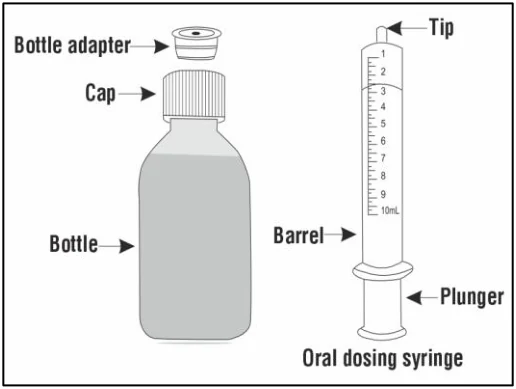
- A press-in bottle adapter to connect the oral dosing syringe to the bottle. After it is inserted, the bottle adapter must always stay in the bottle.
- A bottle containing GABAPENTIN ORAL SOLUTION, with a child-resistant cap. Always put the child-resistant cap back on the bottle and close it tightly after use.
- A 10 milliliter (mL) oral dosing syringe that has markings used to measure the dose.
Step 1:
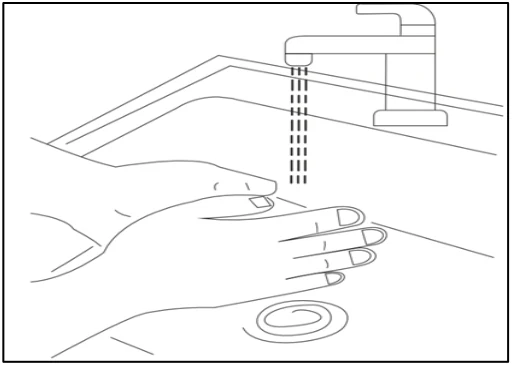
- Wash and dry your hands.
- The first time you use GABAPENTIN ORAL SOLUTION remove the oral dosing syringe and bottle adapter from the carton.
Step 2:
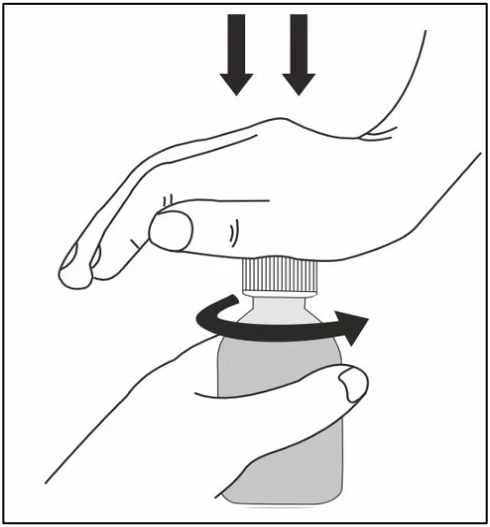
Push the child-resistant cap down. Turn left (counterclockwise) to remove the cap.
Note: Save the child-resistant cap. You will need it to close the bottle after each use.
Step 3:
- The first time you use each bottle the adapter will need to be inserted.
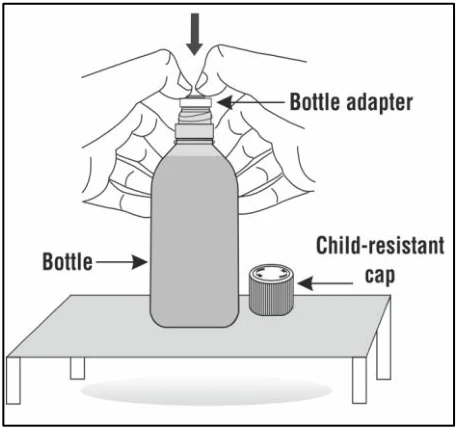
- Hold the open bottle upright on a table. Push the narrow end of the bottle adapter firmly into the neck of the bottle as far as you can. You may not be able to push the bottle adapter fully into the bottle.
Put the child-resistant cap back on the bottle and close it tightly by turning it to the right (clockwise). This will help force the bottle adapter further into the neck of the bottle.
The bottle is now ready to use with the syringe. The bottle adapter must always stay in the bottle. Do not remove the bottle adapter.
Step 4:
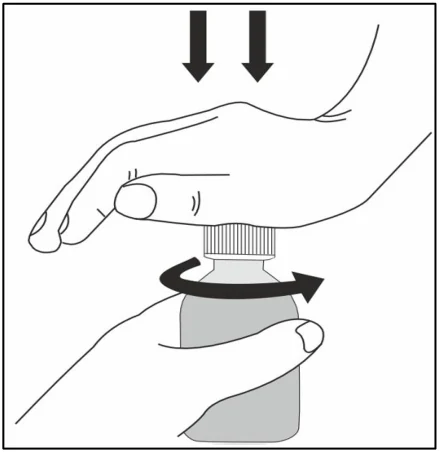
Push and turn the child-resistant cap counterclockwise to open the bottle.
Note: Always put the child-resistant cap tightly back on the bottle after use.
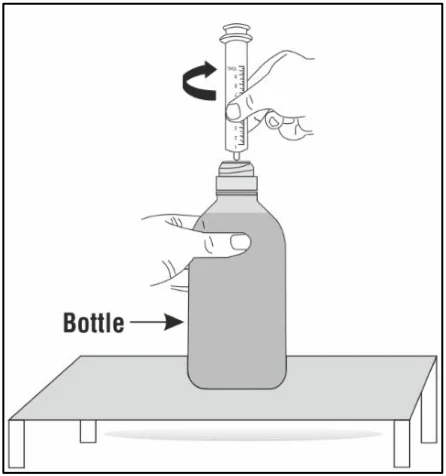
- Take the oral dosing syringe and push the plunger all the way down inside the barrel of the syringe.
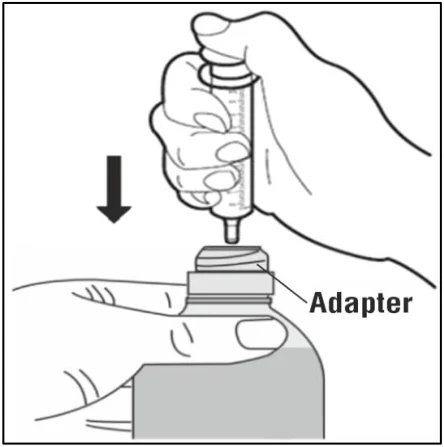
- Keep the bottle upright. Push the tip of the syringe firmly into the hole in the bottle adapter.
Step 5:
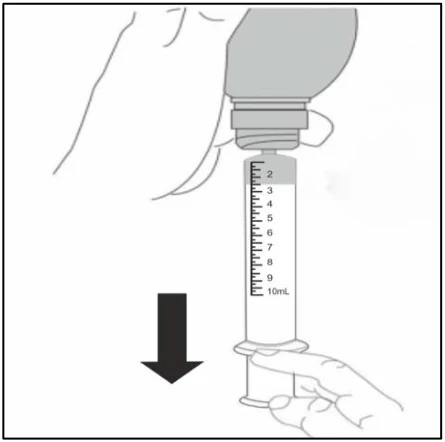
- Hold the attached syringe in place and carefully turn the bottle upside down.
- Check the oral dosing syringe to find the mark on the syringe that corresponds to the right dose in milliliters (mL) that has been prescribed by the healthcare professional.
- Slowly pull the plunger downwards to fill the oral dosing syringe. Pull the plunger until the top edge of the plunger is slightly past the mark on the syringe that corresponds to the prescribed dose.
Step 6:
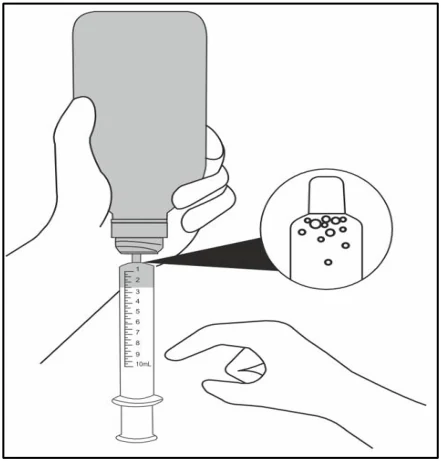
- Tap the syringe barrel to move air bubbles to the top. It will help to set the correct dose.
- Push the plunger slowly upwards just enough to completely push out any large or small air bubbles that may be trapped in the syringe.
Step 7:
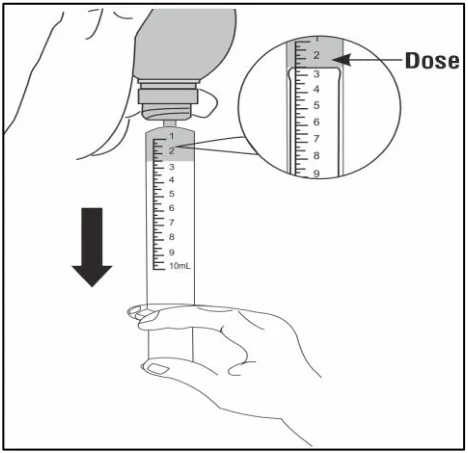
Slowly pull the plunger downwards until the top edge of the plunger is exactly level with the mark on the syringe barrel that corresponds to the prescribed dose. See the Figure for an example of a dose of 2.5 mL. Your prescribed dose may be different.
Note: If the prescribed dose is more than 10 mL, you will need to repeat steps 4 through 9 to refill the syringe and to take the full dose.
Step 8:
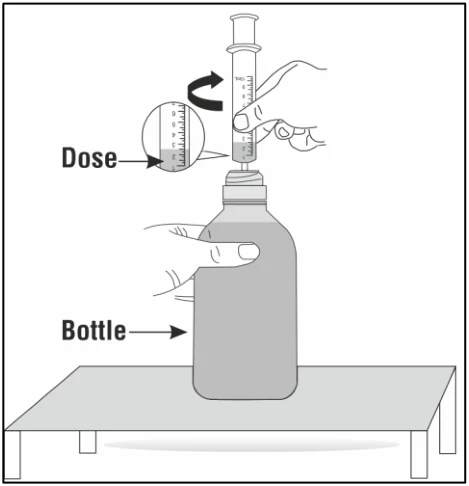
- Carefully turn the bottle with the attached oral dosing syringe upright.
- Place the bottle on the table.
- Take out the syringe by gently twisting it out of the bottle adapter. The bottle adapter should stay in the bottle.
- Check that the correct dose (mL) is measured in the oral dosing syringe.
If the oral dosing syringe does not contain the correct dose:
- Put the tip of the syringe back into the bottle adapter and push the plunger to the bottom of the barrel. This will empty the contents of the syringe into the bottle.
- Repeat steps 4 through 8.
Step 9:
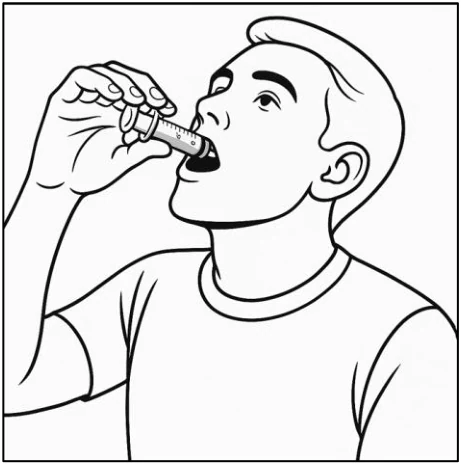
- Sit in an upright position when taking GABAPENTIN ORAL SOLUTION.
- Place the oral dosing syringe gently into your mouth and close your mouth tightly around the barrel of the syringe.
- Push the plunger down slowly to release the medicine into your mouth.
- Swallow the medicine.
- Check to make sure that there is no medicine left in the oral dosing syringe.
- If the prescribed dose is more than 10 mL, repeat steps 4 through 9.
- Put the child-resistant cap tightly back on the bottle to close the bottle after use.
Step 10:
- After use, remove the plunger from the oral dosing syringe.
- Rinse the plunger and oral dosing syringe with warm water. Allow them to fully dry before using them again.
- After touching GABAPENTIN ORAL SOLUTION, wash your hands and any surfaces that came into contact with GABAPENTIN ORAL SOLUTION as soon as possible.
Usual dose:
Your healthcare professional will decide the best dose of GABAPENTIN ORAL SOLUTION for you. They may increase or decrease the dose depending on your response to the medication.
Overdose:
Signs of overdose may include:
- dizziness,
- drowsiness,
- unusually weak breathing, and/or
- loss of consciousness.
Missed Dose:
If you miss a dose, take it as soon as possible. However, if it is within 4 hours of your next dose do not take the missed dose and return to your regular dosing schedule. Do not allow more than 12 hours to go by between doses because your seizures may increase. If that happens, consult your healthcare professional as soon as possible.
Possible side effects from using GABAPENTIN ORAL SOLUTION:
These are not all the possible side effects you may have when taking GABAPENTIN ORAL SOLUTION. If you experience any side effects not listed here, tell your healthcare professional.
- Agitation
- Drowsiness
- Dizziness
- Lack of muscle coordination
- Fatigue
- Eye twitching
- Tremors
- Nausea
- Vomiting
- Breast enlargement (in men and women)
- If you think you, or a person you are caring for, have taken too much GABAPENTIN ORAL SOLUTION, contact a healthcare professional, hospital emergency department, regional poison control centre or Health Canada’s toll-free number, 1-844 POISON-X (1-844-764-7669) immediately, even if there are no signs or symptoms.
Call your healthcare professional immediately if your seizures get worse.
Serious side effects and what to do about them
| Frequency/Side Effect/Symptom | Talk to your healthcare professional | Get immediate medical help | |||||
|---|---|---|---|---|---|---|---|
| Frequency/Side Effect/Symptom | Talk to your healthcare professional | Get immediate medical help | |||||
| Only if severe | In all cases | ||||||
| Only if severe | In all cases | ||||||
| Common | |||||||
Edema: unusual swelling of the arms, hands, legs, feet and ankles, face or airway passages | √ | ||||||
| Uncommon | |||||||
Allergic reaction: difficulty swallowing or breathing, wheezing, feeling sick to your stomach and throwing up, hives or rash, swelling of the face, lips, tongue or throat | √ | ||||||
| Angina (chest pain): discomfort in the shoulder, arm, back, throat, jaw or teeth, pain or pressure in the chest | √ | ||||||
| Behavior and mood changes: agitation including aggressive behavior or hostility, compulsive gambling, compulsive shopping, changes in sexual desire or sexual activity, increased eating | √ | ||||||
Hallucinations: seeing or hearing things that are not there | √ | ||||||
Heart palpitations: fast-beating, fluttering or pounding of the heart | √ | ||||||
Incontinence: inability to control urination | √ | ||||||
| Jaundice: yellowing of skin and eyes, dark urine, light-coloured stool, itching all over your body | √ | ||||||
Respiratory depression (also known as hypoventilation): slow, shallow or weak breathing, blue lips, fingers or toes, confusion, headaches | √ | ||||||
| Rhabdomyolysis (breakdown of damaged muscle): muscle tenderness, weakness, red- brown (tea-coloured) urine | √ | ||||||
| Seizures (fits): uncontrollable shaking with or without loss of consciousness | √ | ||||||
| Suicidal thoughts or actions | √ | ||||||
| Syncope (fainting): a temporary loss of consciousness due to a sudden drop in blood pressure. | √ | ||||||
| Tinnitus (hearing problems): ringing, buzzing, clicking or hissing noise in the ears | √ | ||||||
| Unknown | |||||||
| Blood glucose fluctuations (for patients suffering from diabetes): increased thirst, frequent urination, headache, confusion, low energy | √ | ||||||
| Confusion | √ | ||||||
Hyperglycemia (high blood sugar): increased thirst, frequent urination, dry skin, headache, blurred vision and fatigue | √ | ||||||
Hypoglycemia (low blood sugar): increased thirst, frequent urination, hunger, nausea and dizziness, fast heartbeat, tingling, trembling, nervousness, sweating, low energy | √ | ||||||
| Hyponatremia (low sodium in the blood): lethargy, confusion, muscular twitching or worsening of convulsions | √ | ||||||
Severe skin reactions: fever, severe rash, swollen lymph glands, flu-like feeling, blisters and peeling skin that may start in and around the mouth, nose, eyes and genitals and spread to other areas of the body, yellow skin or eyes, shortness of breath, dry cough, chest pain or discomfort, feeling thirsty, urinating less often, less urine | √ | ||||||
| Sleeplessness | √ | ||||||
If you have a troublesome symptom or side effect that is not listed here or becomes bad enough to interfere with your daily activities, tell your healthcare professional.
Storage:
Store GABAPENTIN ORAL SOLUTION refrigerated, 2°C to 8°C.
Keep out of reach and sight of children.
If you want more information about GABAPENTIN ORAL SOLUTION:
- Talk to your healthcare professional
- Find the full product monograph that is prepared for healthcare professionals and includes the Patient Medication Information by visiting the Health Canada Drug Product Database website (https://www.canada.ca/en/health-canada/services/drugs-health-products/drug-products/drug-product-database.html); the manufacturer’s website or by calling 888-575-8191.
Date of Authorization: 2026-07-10
Reporting Side Effects
You can report any suspected side effects associated with the use of health products to Health Canada by:
- Visiting the Web page on Adverse Reaction Reporting (canada.ca/drug-device-reporting) for information on how to report online, by mail or by fax; or
- Calling toll-free at 1-866-234-2345.
NOTE: Contact your healthcare professional if you need information about how to manage your side effects. The Canada Vigilance Program does not provide medical advice.