


Product Monograph - Gastrografin
RECENT MAJOR LABEL CHANGES
Not applicable.
TABLE OF CONTENTS
Sections or subsections that are not applicable at the time of authorization are not listed.
RECENT MAJOR LABEL CHANGES............................................................................................ 2
TABLE OF CONTENTS .............................................................................................................. 2
PART I: HEALTH PROFESSIONAL INFORMATION ..................................................................... 4
1 INDICATIONS .............................................................................................................. 4
1.1 Pediatrics .......................................................................................................... 4
1.2 Geriatrics........................................................................................................... 4
2 CONTRAINDICATIONS ................................................................................................. 4
4 DOSAGE AND ADMINISTRATION................................................................................. 4
4.1 Dosing Considerations ....................................................................................... 4
4.2 Recommended Dose and Dosage Adjustment..................................................... 4
4.4 Administration................................................................................................... 5
5 OVERDOSAGE ............................................................................................................. 5
6 DOSAGE FORMS, STRENGTHS, COMPOSITION AND PACKAGING ................................. 5
7 WARNINGS AND PRECAUTIONS .................................................................................. 6
General....................................................................................................................... 6
Carcinogenesis and Mutagenesis ................................................................................ 6
Endocrine and Metabolism ......................................................................................... 6
Gastrointestinal .......................................................................................................... 6
Monitoring and Laboratory Tests ................................................................................ 7
Respiratory ................................................................................................................. 7
Sensitivity/Resistance................................................................................................. 7
7.1 Special Populations ............................................................................................ 8
7.1.1 Pregnant Women ......................................................................................... 8
7.1.2 Breast-feeding.............................................................................................. 8
7.1.3 Pediatrics ..................................................................................................... 8
8 ADVERSE REACTIONS .................................................................................................. 8
8.1 Adverse Reaction Overview................................................................................ 8
8.4 Abnormal Laboratory Findings: Hematologic, Clinical Chemistry and Other Quantitative Data ........................................................................................................ 9
9 DRUG INTERACTIONS.................................................................................................. 9
9.2 Drug Interactions Overview................................................................................ 9
9.3 Drug-Behavioural Interactions............................................................................ 9
9.4 Drug-Drug Interactions ...................................................................................... 9
9.5 Drug-Food Interactions ...................................................................................... 9
9.6 Drug-Herb Interactions ...................................................................................... 9
9.7 Drug-Laboratory Test Interactions .................................................................... 10
10 CLINICAL PHARMACOLOGY ....................................................................................... 10
10.1 Mechanism of Action.................................................................................. 10
10.3 Pharmacokinetics ....................................................................................... 10
11 STORAGE, STABILITY AND DISPOSAL ......................................................................... 11
12 SPECIAL HANDLING INSTRUCTIONS........................................................................... 11
PART II: SCIENTIFIC INFORMATION ...................................................................................... 12
13 PHARMACEUTICAL INFORMATION............................................................................ 12
14 CLINICAL TRIALS........................................................................................................ 12
15 MICROBIOLOGY ........................................................................................................ 13
16 NON-CLINICAL TOXICOLOGY ..................................................................................... 13
PATIENT MEDICATION INFORMATION ................................................................................. 14
PART I: HEALTH PROFESSIONAL INFORMATION
1 INDICATIONS
GASTROGRAFIN® (diatrizoate meglumine and diatrizoate sodium solution) is indicated for:
- Radiographic examination of the gastrointestinal tract, particularly in cases in which barium suspensions would be potentially risky.
- Examinations for foreign bodies in the pharynx and esophagus and disorders of the swallowing mechanism.
1.1 Pediatrics
Pediatrics (0-18 years): Based on the data submitted and reviewed by Health Canada, the safety and efficacy of GASTROGRAFIN® in pediatric patients has been established. Therefore, Health Canada has authorized an indication for pediatric use (see 4 DOSAGE AND ADMINISTRATION).
1.2 Geriatrics
Geriatrics: Evidence from clinical studies and experience suggests that use in the geriatric population is not associated with any differences in safety or effectiveness.
2 CONTRAINDICATIONS
GASTROGRAFIN® is contraindicated in patients with severe debility and hypersensitivity to salts of diatrizoic acid or to any ingredient in the formulation, including any non-medicinal ingredient, or component of the container. For a complete listing, see 6 DOSAGE FORMS, STRENGTHS, COMPOSITION AND PACKAGING.
GASTROGRAFIN® is contraindicated for intravenous and intramuscular use.
4 DOSAGE AND ADMINISTRATION
4.1 Dosing Considerations
This medium is for oral or rectal administration only. It is not to be used for the preparation of solutions for parenteral administration.
The routine preparatory measures employed for barium studies are also appropriate for this agent.
For pediatric and severely cachectic patients the maintenance of an intravenous fluid line may be advisable.
Each mL of GASTROGRAFIN® contains 660 mg diatrizoate meglumine and 100 mg diatrizoate sodium. The solution contains 37% (11 g per 30 mL) firmly bound iodine.
4.2 Recommended Dose and Dosage Adjustment
Oral adult doses may range from 30 to 90 mL depending on the nature of the examination and the size of the patient. Give by mouth, tube, nursing bottle, or by rectum.
Infants and children up to 5 years of age: 30 mL.
Children 5 to 10 years of age: 60 mL.
4.4 Administration
Debilitated children, or infants weighing less than 10 kg require diluted doses: 1 part diatrizoate meglumine to 3 parts of water may be given.
Elderly, cachectic patients, or infants and children may be given a 1:1 dilution, using water, carbonated beverages, milk or mineral oil as the diluent.
As an enema, or for enterostomy instillations for adults, dilute 240 mL in 1000 mL of tap water. For rectal administration to children of 5 years of age or more, 90 mL of the contrast agent in 500 mL would be a suitable dilution. Under 5 years, a 1:5 dilution may be given.
5 OVERDOSAGE
See 7 WARNINGS AND PRECAUTIONS regarding potential hypovalemia, hypotension or shock. The maintenance of an open intravenous fluid line for rehydration may be advisable. See 4 DOSAGE AND ADMINISTRATION for appropriate doses and dilutions. Treatment of an overdose should be directed toward the support of all vital functions, and prompt institution of symptomatic therapy.
| For management of a suspected drug overdose, contact your regional poison control centre. |
6 DOSAGE FORMS, STRENGTHS, COMPOSITION AND PACKAGING
Table – Dosage Forms, Strengths, Composition and Packaging
Each mL of GASTROGRAFIN® contains 660 mg diatrizoate meglumine and 100 mg diatrizoate sodium. pH has been adjusted with sodium hydroxide to 6.0 to 7.6. Each mL contains approximately 4.8 mg (0.21 mEq) sodium and 367 mg organically bound iodine.
GASTROGRAFIN® is supplied as an aqueous, palatable lemon-flavoured solution, providing 66% diatrizoate meglumine and 10% diatrizoate sodium. The solution contains 37% (11 g per 30 mL) firmly bound iodine. Alcohol and sugar free. Bottles of 30 and 120 mL.
| Route of Administration | Dosage Form / Strength/Composition | Non-medicinal Ingredients |
| Oral, Rectal | Solution/660 mg diatrizoate meglumine and 100 mg diatrizoate sodium | edetate sodium, flavour, polysorbate 80, purified water, saccharin sodium, simethicone and sodium citrate |
7 WARNINGS AND PRECAUTIONS
General
Avoid use of GASTROGRAFIN® in patients with esophagotracheal fistula due to risk of serious pulmonary complications (see 7 WARNINGS AND PRECAUTIONS, Respiratory).
A 1 in 4.6 dilution of GASTROGRAFIN® yields an approximately isotonic 16.5% diatrizoate salts solution; less dilute solutions are hypertonic and may lead to intraluminal movement of fluid with resulting hypovolemia. In young or debilitated children and in elderly cachectic persons, the loss of plasma fluid may be sufficient to cause a shock-like state. See 4 DOSAGE AND ADMINISTRATION for recommended dilutions that must be used for infants and young children (under 10 kg) and for dehydrated or debilitated patients. Electrolyte disturbances must be corrected prior to using hypertonic solutions. In debilitated patients and in patients with electrolyte imbalances, postprocedural monitoring of hydration, serum osmolarity, electrolytes and clinical status is essential. In pediatric or severely debilitated patients, the maintenance of an open intravenous fluid line for rehydration may be advisable should hypotension or shock supervene.
Consideration should be given to the potential for precipitation of water-soluble contrast agents under conditions that may promote hyperacidity (i.e. fasting, emotional upset, or stress). Harmful effects directly attributable to precipitate formation have not been reported. However, the possibility of interpreting the precipitate radiologically as an anatomical abnormality (i.e. ulceration of the stomach or small intestine) or injury, should be kept in mind.
Carcinogenesis and Mutagenesis
Long-term studies in animals have not been performed to evaluate carcinogenic or mutagenic potential, or possible impairment of fertility in males or females.
Endocrine and Metabolism
Thyroid Dysfunction:
GASTROGRAFIN®, like all other iodinated contrast media, may induce changes in thyroid function in some patients. Transient hyperthyroidism or hypothyroidism has been reported following iodinated contrast media administration to adult and pediatric patients. Decreased levels of thyroxine (T4) and triiodothyronine (T3) and increased level of TSH were reported after exposure to ICM in infants, especially preterm infants, which remained for up to a few weeks or even more than a month (see 8 ADVERSE REACTIONS). Some patients were treated for hypothyroidism (see 7 WARNINGS AND PRECAUTIONS, 7.1 Special Populations, 7.1.3 Pediatrics).
Cases of hyperthyroidism have been reported with the use of oral contrast media. Some of these patients reportedly had multinodal goiters which may have been responsible for the increased hormone synthesis in response to excess iodine. Administration of an intravascular iodinated radiopaque diagnostic agent to a hyperthyroid patient precipitated thyroid storm: a similar situation could follow administration of oral preparations of iodides. Therefore, caution should be exercised when administering enteral gastrointestinal radiopaque agents to hyperthyroid and euthyroid goiterous patients.
Gastrointestinal
Rectal administration of undiluted GASTROGRAFIN® in any patient, particularly with large doses and/or in those with overdistension, has been reported to be associated with mucosal irritation.
Monitoring and Laboratory Tests
In general, any test which might be affected by contrast media should be performed prior to administration of the contrast medium.
Thyroid Function Tests:
The results of protein bound iodine and radioactive iodine uptake studies, which depend on iodine estimations, will not accurately reflect thyroid function for six months, and possibly as long as one year, following the administration of diagnostic enteral radiopaque media.
Therefore, if thyroid function tests are indicated they should be performed prior to the administration of any iodinated agent if possible. However, thyroid function tests can be evaluated after use of these agents by using (T3) resin uptake and total or free thyroxine (T4) assays which are not dependent on iodine estimations.
Pancreatic Tests:
Small quantities of contrast medium in the intestinal tract may cause false low trypsin values when determined spectrophotometrically. Therefore, duodenal instillation should not precede pancreatic function tests involving spectrophotometric trypsin assays.
Respiratory
The possibility of accidental aspiration into the trachea or into a tracheosophageal fistula following ingestion or instillation could result in serious pulmonary complications (e.g. pulmonary edema or pneumonitis) even though the medium may be promptly expectorated. Bronchial entry of any orally administered contrast medium causes a copious osmotic effusion. Therefore, pulmonary entry by aspiration and use in patients with esophagotracheal fistula should be avoided.
Sensitivity/Resistance
A history of sensitivity to iodine per se or to contrast media other than salts of diatrizoic acid, is not an absolute contraindication to the use of GASTROGRAFIN®, but calls for extreme caution in administration.
A history of bronchial asthma or allergy or a family history of allergy warrants special attention and may predict the likelihood of an allergic reaction, although neither the severity nor type of reaction in the individual case may be predicted.
Treatment of Adverse Reactions to Contrast Media:
If, in spite of uneventful history taking, one or more of the following symptoms reveals the occurrence of an anaphylactoid reaction, i.e. respiratory difficulty (with laryngeal edema, pulmonary edema or asthma), shock, total vascular collapse, or cardiac arrest (with atonia and fibrillation), immediate therapeutic measures must be taken. Heart and respiratory functions must be maintained, and allergic phenomena should be treated concomitantly by the injection of epinephrine USP 1:1000, 0.3 to 0.5 mL subcutaneously, repeated every 10 to 15 minutes until a definite permanent response or toxicity (tachycardia, excitability) occurs. Cardiac arrest may be treated by the injection of 0.2 mL epinephrine USP 1:1000, diluted by 10 mL physiological saline, into the left ventricle. Cardiac compression and defibrillation should be carried out whenever indicated. Acidosis should be combatted by injections of 3.75 g of sodium bicarbonate repeated every 5 minutes.
Asthma may be treated with intravenous aminophylline injection USP. Secondary treatments with anti arrhythmics, antihistamines, corticosteroids and anticonvulsants should then be considered.
Metaraminol bitartrate injection, USP or levarterenol bitartrate injection, USP should also be considered if hypotension is encountered.
7.1 Special Populations
7.1.1 Pregnant Women
The safety of the preparation for use during pregnancy has not been established; therefore, it should only be used when its use is deemed essential to the welfare of the patient.
When administered intravenously, diatrizoate salts cross the placenta and are evenly distributed in fetal tissues. No teratogenic effects attributable to diatrizoate meglumine or diatrizoate sodium have been observed in teratology studies performed in animals. There are, however, no adequate and well-controlled studies in pregnant women. Because small amounts of these agents may be absorbed, and animal teratology studies are not always predictive of human response, these agents should be used during pregnancy only when clearly needed.
7.1.2 Breast-feeding
Diatrizoate meglumine is excreted in breast milk following intravascular administration.
Because small amounts of enteral gastrointestinal radiopaque agents may be absorbed following oral or rectal administration, caution should be exercised when they are administered to a nursing woman.
7.1.3 Pediatrics
Use in Children:
Local injury to colonic mucosa, particularly in the presence of underlying disease which interferes with intestinal viability, has been reported in cases where recommended doses and dilutions (see 4 DOSAGE AND ADMINISTRATION) were not used; when extemporaneous dosage is elected, the polysorbate 80 level in the dose may be a contributing factor to injury (see 7 WARNINGS AND PRECAUTIONS, General).
Infants:
Decreased levels of thyroxine (T4) and triiodothyronine (T3) and increased level of TSH were reported after exposure to ICM in infants, especially preterm infants, which remained for up to a few weeks or more than a month (see 8 ADVERSE REACTIONS). Hypothyroidism in infants may be harmful for growth and development, including mental development and may require treatment. Thyroid function in infants exposed to ICM should therefore be evaluated and monitored until thyroid function is normalized.
8 ADVERSE REACTIONS
8.1 Adverse Reaction Overview
Most adverse reactions to enteral diagnostic radiopaque agents are mild and transitory. Occasionally some degree of diarrhea may be encountered due to the osmotic activity of the preparation when it is used as an enema. Nausea, vomiting and/or diarrhea, urticaria with erythema, hypoxia, acute dyspnea, tacchyarrhythmia and anaphylaxis have occurred following ingestion of the contrast medium, particularly when high concentrations or large volumes are administered.
Oral administration in children may cause a decrease in circulating plasma volume due to osmosis when the contrast agent passes through the stomach and small intestine. In the very young child (weighing less than 10 kg) and the debilitated child, the loss of plasma fluid may be sufficient to cause a shock like state which, if left untreated, could be life threatening. This hazard can be avoided by dilution of the contrast medium with water before administration, and by the adequate hydration of the child before and after the procedure. The same considerations may possibly apply in elderly cachectic individuals as well.
It should be kept in mind that serious or anaphylactoid reactions that may occur with intravascular administration of radiopaque contrast agents are theoretically possible following administration by other routes.
8.4 Abnormal Laboratory Findings: Hematologic, Clinical Chemistry and Other Quantitative Data
Clinical Trial Findings
Endocrine Disorders:
Thyroid function tests indicative of hypothyroidism or transient thyroid suppression have been uncommonly reported following iodinated contrast media administration to adult and pediatric patients, including infants. Some patients were treated for hypothyroidism (see 7 WARNINGS AND PRECAUTIONS, Endocrine and Metabolism).
9 DRUG INTERACTIONS
9.2 Drug Interactions Overview
Interactions with laboratory tests (thyroid function and pancreatic function) have been documented. For more information, see 9.7 Drug-Laboratory Test Interactions.
9.3 Drug-Behavioural Interactions
Interactions with behaviour have not been established
9.4 Drug-Drug Interactions
Interactions with other drugs have not been established.
9.5 Drug-Food Interactions
Interactions with food have not been established
9.6 Drug-Herb Interactions
Interactions with herbs have not been established
9.7 Drug-Laboratory Test Interactions
Thyroid Function Tests:
The results of protein bound iodine and radioactive iodine uptake studies, which depend on iodine estimations, will not accurately reflect thyroid function for six months, and possibly as long as one year, following the administration of diagnostic enteral radiopaque media.
Therefore, if thyroid function tests are indicated they should be performed prior to the administration of any iodinated agent if possible. However, thyroid function tests can be evaluated after use of these agents by using (T3) resin uptake and total or free thyroxine (T4) assays which are not dependent on iodine estimations (see 7 WARNINGS AND PRECAUTIONS, Monitoring and Laboratory Tests).
Pancreatic Tests:
Small quantities of contrast medium in the intestinal tract may cause false low trypsin values when determined spectrophotometrically. Therefore, duodenal instillation should not precede pancreatic function tests involving spectrophotometric trypsin assays (see 7 WARNINGS AND PRECAUTIONS, Monitoring and Laboratory Tests).
10 CLINICAL PHARMACOLOGY
10.1 Mechanism of Action
Diatrizoate meglumine and diatrizoate sodium are sparingly absorbed from the intact gastrointestinal tract, and therefore permit gastrointestinal opacification and delineation after oral or rectal administration. Oral administration is used for radiographic evaluation of the esophagus, stomach and proximal small intestine. Rectal administration is used for examination of the colon; however, visualisation of the distal small bowel is generally unsatisfactory, since the hypertonicity of the medium causes intraluminal diffusion of water and subsequent dilution of the medium.
Diatrizoate meglumine and diatrizoate sodium exert a mild laxative effect attributable to their high osmolarity.
Enough absorption from the gastrointestinal tract to permit incidental visualisation of the urinary tract has been reported; this should be considered when thyroid testing is being contemplated, since iodine-mediated thyrotropic effects may occur.
10.3 Pharmacokinetics
There was significant excretion of the medium through the urinary tract, with visualization of the kidneys and urinary bladder in 2 of 45 patients examined with meglumine and sodium diatrizoates. One of the two patients had undergone partial gastrectomy for an ulcer. In the other patient to whom oral meglumine and sodium diatrizoates were administered as an enema, opacification of the collecting system of both kidneys revealed marked left sided pyeloectasis and caluctasis, probably secondary to inflammation in the pelvis.
There was sufficient absorption of GASTROGRAFIN® to give a pyelogram in 1 of 27 patients who had received the medium.
11 STORAGE, STABILITY AND DISPOSAL
Protect from light. Store at room temperature.
12 SPECIAL HANDLING INSTRUCTIONS
Not applicable.
PART II: SCIENTIFIC INFORMATION
13 PHARMACEUTICAL INFORMATION
Drug Substance
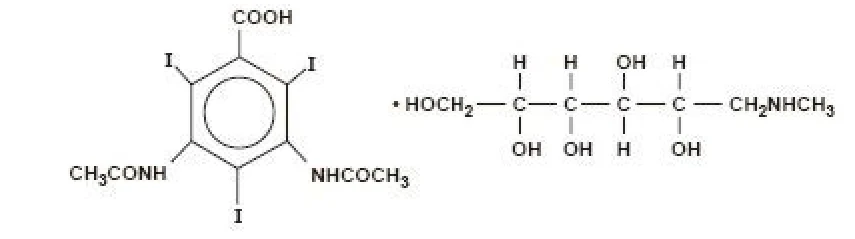
Proper name: Diatrizoate Meglumine
Chemical name: 1-deoxy-l(methylamino)-D-glucitol 3,5-diacetamido-2,4,6-triiodobenzoate
Molecular formula and molecular mass: C18H26I3N309 809.13
Structural formula:
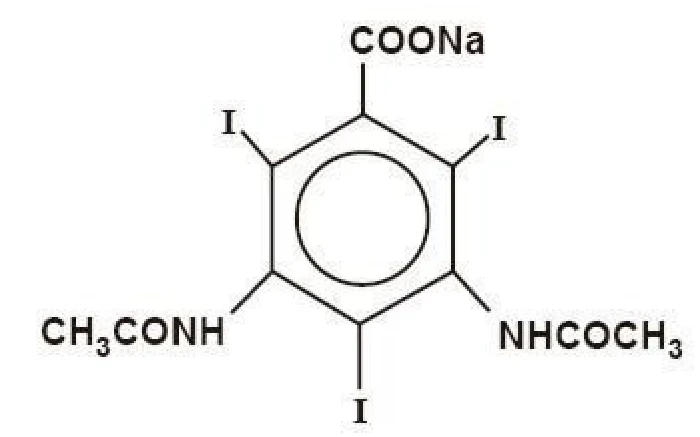
Proper name: Diatrizoate Sodium
Chemical name: monosodium 3,5-diacetamido-2,4,6-triiodobenzoate
Molecular formula and molecular mass: C11H8I3N2NaO4 635.90
Structural formula:
14 CLINICAL TRIALS
The clinical trial data on which the original indication was authorized is not available.
15 MICROBIOLOGY
No microbiological information is required for this drug product.
16 NON-CLINICAL TOXICOLOGY
General Toxicology:
Single oral doses of 20mL of meglumine and sodium diatrizoates 76% were given to two dogs weighing 7.1 and 8.6 kg. There were no signs of toxic effects and urine samples collected at 1, 3, 6 and 24 hours after dosing showed traces of iodine excretion, that is, on the basis of the dose administered, of 0.4% in one dog and less than 0.4% in the other dog.
GASTROGRAFIN® was administered orally to both mice and dogs. A dose of 10 mL per kg was not lethal to 10 mice during the 10 day observation period. After an oral dose of 10 mL/kg of GASTROGRAFIN® in 10 mice all of the animals had diarrhea approximately 3 to 5 hours after dosing. All animals were normal the next day and all survived.
Four dogs fasted for 18 hours were given single oral doses of 7.5 mL GASTROGRAFIN®/kg. Other than a slight emesis in one dog, 30 minutes after dosage, no adverse signs were noted. After a 5 hour observation period, the dogs were sacrificed and their gastrointestinal tracts examined grossly. No significant gross pathological changes were revealed.