


Patient Medication Information: uses, side effects, how to take - Glatiramer Acetate Injection
Serious Warnings and Precautions
Serious Allergic Reactions: Life-threatening allergic reactions may happen shortly after you inject Glatiramer Acetate Injection. These reactions may occur after months or even years after your treatment with Glatiramer Acetate Injection, even if you did not have an allergic reaction before. Stop using Glatiramer Acetate Injection and seek immediate medical help if you think you are having an allergic reaction.
Signs of an allergic reaction may include:
- Widespread rash
- Swelling of the face, eyelids, lips, mouth, throat, or tongue
- Sudden shortness of breath, difficulty breathing, or wheezing
- Uncontrolled shaking (convulsions)
- Trouble swallowing or speaking
- Fainting, or feeling dizzy or faint
- Collapse
What is Glatiramer Acetate Injection used for?
Glatiramer Acetate Injection 20 mg / mL (once-daily) is used to treat patients with Relapsing Remitting Multiple Sclerosis (RRMS), including those who have experienced one episode of nervous system symptoms and who have abnormalities on their brain scan that may be the first signs of Multiple Sclerosis.
Glatiramer Acetate Injection is not a cure. Patients treated with Glatiramer Acetate Injection experience fewer relapses (flare-ups of the disease).
How does Glatiramer Acetate Injection work?
Multiple Sclerosis (MS) is thought to be a disease where your immune system causes your body to attack its own cells. This leads to loss of myelin, a substance that covers your nerve fibers. The loss of myelin eventually leads to the symptoms of MS.
Glatiramer Acetate Injection is a mixture of small proteins. These small proteins are similar to a protein found in myelin. Glatiramer Acetate Injection is thought to work by modifying the immune processes that are believed to cause MS.
What are the ingredients in Glatiramer Acetate Injection?
Medicinal ingredients: Glatiramer acetate
Non-medicinal ingredients: Mannitol in sterile water for injection
Glatiramer Acetate Injection comes in the following dosage forms:
Once-daily solution: 20 mg/mL pre-filled syringe.
Do not use Glatiramer Acetate Injection if:
- you are allergic to glatiramer or mannitol.
- the solution in the pre-filled syringe is cloudy, leaking or contains any particles.
To help avoid side effects and ensure proper use, talk to your healthcare professional before you take Glatiramer Acetate Injection. Talk about any health conditions or problems you may have, including if you:
- have heart disease. Some patients taking glatiramer acetate experience chest pain.
- have a history of developing severe allergic reactions.
- have chronic obstructive pulmonary disease (COPD).
- have asthma.
- have kidney and/or liver problems.
are pregnant, planning to become pregnant, or if you become pregnant while you are using this medication.
- are nursing.
- are under 18 years of age.
Other warnings you should know about:
Injection Site Reactions: Use of Glatiramer Acetate Injection may cause small indentations or depressions in the skin at the site of injection. This can occur as early as several months after you begin treatment, and it can be permanent. To minimize the chance of this happening, it is important that you follow the Instructions for Use and rotate your injection sites on a regular basis. In very rare cases, some patients have experienced tissue death at the site of injection.
Tell your healthcare professional about all the medicines you take, including any drugs, vitamins, minerals, natural supplements or alternative medicines.
How to take Glatiramer Acetate Injection:
The first time you use Glatiramer Acetate Injection you:
- will be given full instructions on how to use it.
- should be supervised by a healthcare professional.
Each pre-filled syringe should be:
- used only once.
- used only for subcutaneous injection.
Usual Adult Dose:
- Glatiramer Acetate Injection 20 mg / mL is injected once a day.
Your doctor will prescribe the correct dose for you. Do NOT change the dose or dosing schedule without consulting your doctor.
Do NOT stop using Glatiramer Acetate Injection without consulting your doctor.
Glatiramer acetate 20 mg / mL (once-daily) is not interchangeable with glatiramer acetate 40 mg / mL (three times-a-week) because they are different in their strength and dosing schedule.
INSTRUCTIONS FOR USE
Step 1: Gathering the materials
With clean hands, collect one of each of the items you will need on a clean, flat surface in a well-lit area.
- 1 Glatiramer Acetate Injection pre-filled syringe. (Each syringe is contained inside a protective blister. Holding the package of syringes, tear off only 1 blister at a time. Keep all unused syringes in the refrigerator)
Alcohol swab (not supplied) or access to soap, water and a clean towel
- Dry cotton ball (not supplied)
- Ensure that the solution is at room temperature. Let the unopened blister containing the syringe stand at room temperature for at least 20 minutes.
- Do not use if the medication is frozen. If Glatiramer Acetate Injection is frozen or has ever been frozen, discard the product.
- Small air bubbles may be present in the liquid, which are harmless and can be injected. Do NOT try to force small air bubbles out of the syringe before injecting the medicine.
Step 2: Choosing the site for injection
You should have a planned schedule for your chosen injection sites and make note of it in a diary.
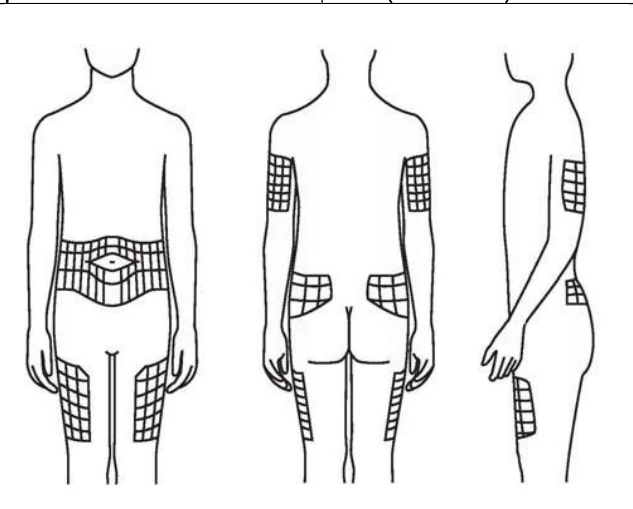
There are 7 possible areas on your body for injection (see Figure 1):
- back of upper arms (right and left)
- front and outside of thighs (right and left)
- upper buttocks/rear of hips (right and left)
- stomach (abdomen)
- If you are taking Glatiramer Acetate Injection 20 mg / mL (once-daily), pick a different area each day (one for each day of the week).
Within each of the 7 areas there are many sites where you can inject the drug. Rotate the injection sites within the chosen area. Choose a different injection site each time.
Figure 1:
Arms Administer the injection in the upper back portion of the arm. | Stomach Administer the injection leaving 5 cm (2 inches) around the navel |
|---|
Please note: do NOT inject in any area that is:
- painful.
- discoloured.
- where you feel firm knots or lumps.
- where skin depression has occurred (a “dent” at the injection site). Further injections in these sites may make the depression deeper.
Hard to inject areas: There may be some areas on your body that are hard for you to inject the drug yourself (such as the back of your arms). You should ask your healthcare professional for instructions on how to inject Glatiramer Acetate Injection in these areas.
Step 3: Injection
- 1. Before you inject wash and dry your hands. Avoid touching your hair or skin, after you have washed your hands. This will help prevent infection.
- 2. Remove the syringe from its protective blister by peeling back the paper label. Place the syringe back on the clean, flat surface.
- 3.
Clean the site you have chosen to inject by using:
- a fresh alcohol swab. (Let it air dry for 1 minute to reduce any stinging)
or
- soap and water (dry with a clean towel)
Buttocks Administer the injection in the upper and outer rear quadrant. | Thighs Administer the injection in the front and outer part of the thigh, 5 cm (2 inches) above the knee and 5 cm (2 inches) below the groin. |
|---|
- 4. Using the hand you write with, pick up the syringe as you would a pencil. Remove the needle cap from the needle.
- 5. With your other hand, pinch about a 5 centimeter (2 inch) fold of skin between your thumb and index finger (See Figure 2).
- 6. While resting the heel of your hand against your body, insert the needle at a 90° angle. When the needle is all the way in the skin, let go the fold of skin (See Figure 3).
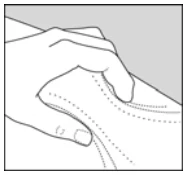
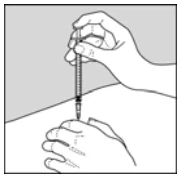
Figure 2 Figure 3
- 7. To inject the medication, hold the syringe steady and push down on the plunger. This should take only a few seconds. (See Figure 3)
- 8. Pull the needle straight out.
- 9. Press a dry cotton ball on the injection site for few seconds.
- 10. Throw out the syringe and the needle cap in a safe hard-walled plastic container.
Proper disposal of needles:
- Throw out all used syringes in a hard-walled plastic container (such as a Sharps container from a pharmacy).
- Keep the cover of this container closed tight and out of the reach and sight of children.
- When the container is full, check with your healthcare professional about proper disposal.
Overdose:
If you think you, or a person you are caring for, have taken too much Glatiramer Acetate Injection, contact a healthcare professional, hospital emergency department, regional poison control centre or Health Canada's toll-free number, 1-844 POISON-X (1-844-764-7669) immediately, even if there are no signs or symptoms.
Missed Dose:
Glatiramer Acetate Injection 20 mg / mL (once-daily): If you miss a dose, you should take it as soon as you remember. If it is less than 12 hours before your next dose, skip the missed dose and take your next dose at the usual time. Do NOT give yourself 2 injections in the same 12-hour period.
What are possible side effects from using Glatiramer Acetate Injection?
These are not all the possible side effects you may have when taking Glatiramer Acetate Injection. If you experience any side effects not listed here, tell your healthcare professional.
The most common side effects of Glatiramer Acetate Injection are:
Skin reactions at the injection site. These include:
- Redness
- Pain
- Inflammation
- Itching
- Swelling
- Lumps
- A permanent “dent” under the skin at the injection site, caused by damage to the fatty tissue at that site.
- Rash
- Hives
- Headache
- A feeling of worry, nervousness, unease (anxiety)
Serious side effects and what to do about them
| Serious side effects and what to do about them | |||
|---|---|---|---|
| Symptom / effect | Talk to your healthcare professional | Stop taking drug and get immediate medical help | |
| Symptom / effect | Talk to your healthcare professional | Stop taking drug and get immediate medical help | |
| Only if severe | In all cases | ||
| Only if severe | In all cases | ||
COMMON Post-injection Reaction: Flushing, dizziness, skin eruptions with irritation, sweating, chest pain, chest tightness, irregular heartbeat, anxiety, difficulty in breathing, tightness in the throat, hives appearing immediately after injection | ✓ | ||
| Low blood pressure: dizziness, fatigue, nausea | ✓ | ||
| High blood pressure: headache, dizziness, blurred vision or shortness of breath | ✓ | ||
| Breathing problems: shortness of breath, difficulty breathing | ✓ | ||
| Fast heart beat or skipping a beat | ✓ | ||
| Chest pain: pressure or tightness in the chest | ✓ | ||
| Back, neck or joint pain | ✓ | ||
| Angioedema: Swelling of the arms, legs or face | ✓ | ||
| Depression: change in weight, difficulty sleeping, lack of interest in regular activities | ✓ | ||
| Changes to your vision | ✓ | ||
UNCOMMON Serious Allergic Reactions (anaphylactic reactions): widespread rash, hives, swelling of the face, eyelids, lips, mouth, throat or tongue, sudden shortness of breath, difficulty breathing or wheezing, uncontrolled shaking (convulsions), trouble swallowing or speaking, fainting, feeling dizzy or faint, collapse | ✓ | ||
VERY RARE Liver injury: Yellowing of the skin or eyes, dark urine, abdominal pain, nausea, vomiting, loss of appetite, weight loss, unusual tiredness. | ✓ | ||
If you have a troublesome symptom or side effect that is not listed here or becomes bad enough to interfere with your daily activities, tell your healthcare professional.
Reporting Side Effects
You can report any suspected side effects associated with the use of health products to Health Canada by:
- Visiting the Web page on Adverse Reaction Reporting (canada.ca/drug-device-reporting) for information on how to report online, by mail or by fax; or
- Calling toll-free at 1-866-234-2345.
NOTE: Contact your health professional if you need information about how to manage your side effects. The Canada Vigilance Program does not provide medical advice.
Storage:
- Refrigerate (2°C - 8°C) immediately. Do NOT FREEZE.
- If you cannot store Glatiramer Acetate Injection in the refrigerator, it can be stored for 1 month at room temperature (15°C - 30°C). Do NOT store for longer than 1 month at room temperature.
- Protect from light. This drug is sensitive to light.
Keep out of reach and sight of children.
If you want more information about Glatiramer Acetate Injection:
- Talk to your healthcare professional.
- Find the full product monograph that is prepared for healthcare professionals and includes this Patient Medication Information by visiting the Health Canada Drug Product Database website (Drug Product Database: Access the database); the manufacturer's website www.mylan.ca; or by calling 1-844-596-9526.
Last Revised: OCT 16, 2025
Mylan Pharmaceuticals ULC Etobicoke, ON M8Z 2S6 1-844-596-9526 www.mylan.ca