


Patient Medication Information: uses, side effects, how to take - Glucagon
ABOUT THIS MEDICATION
What the medication is used for:
Notice: Recombinant glucagon replaces the animal sourced glucagon. The structure and activity of recombinant glucagon is identical to animal sourced glucagon.
GLUCAGON (glucagon for injection, rDNA origin) and the GLUCAGON kit are used for emergency treatment of severe hypoglycemia (unconsciousness due to low blood glucose) which may occur in diabetic patients treated with insulin.
Symptoms of low blood glucose include:
- sweating • drowsiness
- dizziness • sleep disturbances
- palpitations • anxiety
- tremor • blurred vision
- hunger • slurred speech
- restlessness • depressive mood
tingling in the hands,
feet, lips, or tongue
- irritability
- lightheadedness • abnormal behaviour
- inability to concentrate • unsteady movement
- headache • personality changes
If not treated, the patient may progress to severe hypoglycemia, which can include:
- disorientation • death
- unconsciousness • palpitations
- seizures
The occurrence of early symptoms calls for prompt and, if necessary, repeated administration of some form of carbohydrate, for example, candy, orange juice, corn syrup, honey or lumps of sugar. If improvement does not occur or if administration of carbohydrate is impossible, GLUCAGON should be given. Glucagon, a naturally occurring substance produced by the pancreas, is helpful because it enables the patient to produce his/her own blood glucose to correct the hypoglycemic state. The patient can then take carbohydrates by mouth. In this way, severe hypoglycemic reactions can be avoided, and diabetic control will be easier to accomplish. Patients who are unable to take sugar orally, or who are unconscious, require an injection of GLUCAGON or should be
treated with intravenous administration of glucose at a medical facility. The physician should always be notified promptly whenever severe hypoglycemic reactions occur.
GLUCAGON is an emergency drug to be used only under the direction of a physician. People in regular contact with a person with diabetes should become familiar with the proper use of this medication before an emergency arises.
What it does:
GLUCAGON (glucagon for injection, rDNA origin) is a high blood sugar agent that causes an increase in blood glucose concentration. Glucagon acts on liver glycogen, converting it to glucose.
When it should not be used:
GLUCAGON (glucagon for injection, rDNA origin) should not be used in patients with known hypersensitivity to it or in patients with pheochromocytoma (adrenal gland tumour).
What the medicinal ingredient is:
Glucagon (rDNA origin)
What the important nonmedicinal ingredients are:
Glycerin (in diluting solution), lactose monohydrate, and hydrochloric acid (pH adjuster).
What dosage forms it comes in:
GLUCAGON (glucagon for injection, rDNA origin) comes in a powder form with accompanying diluting solution.
WARNINGS AND PRECAUTIONS
Serious Warnings and Precautions
GLUCAGON should be given only if the patient is unconscious or unresponsive and unable to ingest oral glucose. After intramuscular injection, the patient will normally respond within 10 minutes. If the patient does not respond within 10 minutes, intravenous glucose must be administered as soon as an IV access can be established.
When the patient has responded to the treatment, give oral carbohydrate to restore liver glycogen and prevent relapse of hypoglycemia.
Because glucagon is of little help in states of starvation, adrenal insufficiency, or chronic hypoglycemia, intravenous glucose should be used for treatment of hypoglycemia in those conditions.
BEFORE you use GLUCAGON talk to your doctor or pharmacist if:
you are fasting, have low levels of adrenaline, chronic low blood sugar or low levels of liver glycogen due to excessive consumption of alcohol
- you have chronic hypoglycemia
- you have an adrenal gland tumour
- you have an insulin releasing tumour
IMPORTANT: PLEASE READ
you are pregnant or breast feeding
- you are allergic to glucagon, lactose or glycerin
INTERACTIONS WITH THIS MEDICATION
Drugs that may interact with Glucagon include:
- insulin
- indomethacin
- warfarin
PROPER USE OF THIS MEDICATION
Usual dose:
- Adults: 1 mg/1 mL (1 unit/1 mL)
Children weighing more than 20 kg: 1 mg/mL
(1 unit/1 mL)
Children weighing less than 20 kg: 0.5 mg/1 mL
(0.5 unit/1 mL)
Doses must be given by subcutaneous, intramuscular, or intravenous injection.
Note: The patient with diabetes may also be in coma from diabetic acidosis (hyperglycemia) rather than from hypoglycemia and in such cases will not respond to glucagon. These patients require immediate medical attention for the treatment of the diabetic acidosis. Contact the physician immediately.
Overdose:
If overdosage occurs, it would be associated with nausea, vomiting, stomach relaxation and diarrhea.
Immediately contact the Regional Poison Control Centre or your doctor or go to the nearest hospital emergency department.
TO PREPARE GLUCAGON FOR USE:
Note: GLUCAGON should not be prepared for injection until emergency arises. The expiry date should be checked regularly and a new kit purchased when approaching expiry date. Do not use this kit after the date stamped on the outside of the box. GLUCAGON should be used immediately after mixing with diluent.
- 1.
Remove the flip-off seal from the bottle of GLUCAGON.
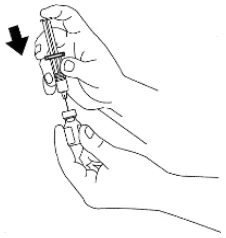
- 2. Remove the needle protector from the syringe, and inject the entire contents of the syringe into the bottle of GLUCAGON. DO NOT REMOVE THE PLASTIC CLIP FROM THE SYRINGE. Remove syringe from the bottle.
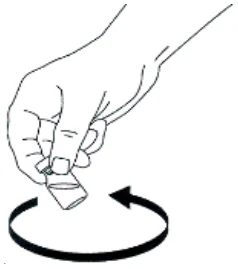
- 3. Swirl bottle gently until GLUCAGON dissolves completely. GLUCAGON SHOULD NOT BE USED UNLESS THE SOLUTION IS CLEAR AND OF A WATER-LIKE CONSISTENCY.
TO ADMINISTER GLUCAGON
Use Same Technique as for Injecting Insulin
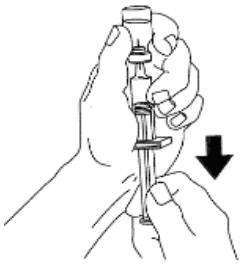
- 1. Using the same syringe, hold bottle upside down and, making sure the needle tip remains in solution, withdraw all of the solution (1 mg mark on syringe) from bottle. The plastic clip on the syringe will prevent the plunger from being pulled out of the syringe; however, if the plastic plunger rod separates from the rubber stopper, simply reinsert the rod by turning it clockwise.
- 2. The usual adult dose is 1 mg (1 unit). For children weighing less than 44 lb (20 kg), give 1/2 adult dose (0.5 mg). For children, withdraw ½ of the solution from the bottle (0.5 mg mark on syringe). DISCARD UNUSED PORTION.
USING THE FOLLOWING DIRECTIONS, INJECT GLUCAGON IMMEDIATELY AFTER MIXING.
- 1.
Cleanse injection site on buttock, arm, or thigh with alcohol
swab.
- 2.
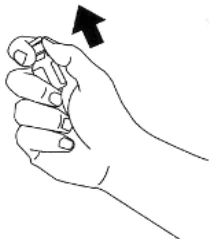
Insert the needle into the fatty tissue under the cleansed
injection site, and inject all of the GLUCAGON solution. THERE IS NO DANGER OF OVERDOSE. Apply light pressure at the injection site, and withdraw the needle. Press an alcohol swab against the injection site.
- 3.
Turn the patient on his/her side. When an unconscious
person awakens, he/she may vomit. Turning the patient on his/her side will prevent him/her from choking.
FEED THE PATIENT AS SOON AS HE/SHE AWAKENS AND IS ABLE TO SWALLOW. Give the patient a fast-acting source of sugar (such as a regular soft drink or sweetened orange juice) and a long-acting source of sugar (such as crackers and cheese or a meat sandwich). If the patient does not awaken within 15 minutes, give another dose of GLUCAGON and CALL A PHYSICIAN IMMEDIATELY.
CAUTION: Low blood glucose may cause convulsions.
What to tell your friends, family, caregiver or co-workers:
Your doctor may have given you GLUCAGON so that your friends or relatives can give you the injection, if you become severely hypoglycemic (unconsciousness due to low blood sugar) and cannot take sugar by mouth. Make sure they know:
how to use GLUCAGON and where it is kept before an
emergency arises.
- They must inject GLUCAGON into a muscle.
You must be given a high sugar snack like sweets, biscuits
or fruit juice after you have responded to treatment (as soon as you are able to take it). This is because glucagon depletes glycogen stores. The high sugar snack will prevent relapse of the hypoglycemia.
After using GLUCAGON, you or someone else must contact
your doctor or healthcare provider. You need to find out why you had severe hypoglycemia and how to avoid it happening again.
SIDE EFFECTS AND WHAT TO DO ABOUT THEM
GLUCAGON is relatively free of side effects except for occasional nausea, vomiting, and generalized allergic reactions.
| SERIOUS SIDE EFFECTS, HOW OFTEN THEY | ||||
| HAPPEN AND WHAT TO DO ABOUT THEM | ||||
| Symptom / effect | Talk with your doctor or pharmacist | Stop taking drug and call your doctor or pharmacist | ||
| Only if severe | In all cases | |||
Very Rare (less than 1 in 10, 000) | Nausea Vomiting Allergic Reaction (including hives, respiratory distress and low blood pressure) | T T | T | |
This is not a complete list of side effects. For any unexpected effects while taking GLUCAGON, contact your doctor or pharmacist.
HOW TO STORE IT
Keep all medicines out of reach of children.
GLUCAGON should be stored as follows:
Before Reconstitution: Prior to reconstitution, Vials of GLUCAGON and prefilled Hyporets of Diluting Solution may be stored at room temperature (15° to 30°C).
Reconstituted Solutions: GLUCAGON should be used immediately after reconstitution. Discard any unused portion.
The expiry date of this medicine is printed on the package label. Do not use past expiry date.
For management of a suspected drug overdose, contact a healthcare practitioner, hospital emergency department or regional poison control centre
REPORTING SUSPECTED SIDE EFFECTS
You can report any suspected adverse reactions associated with the use of health products to the Canada Vigilance Program by one of the following 3 ways:
--------------------------------------------------------------------------
- Report online at www.healthcanada.gc.ca/medeffect
- Call toll-free at 1-866-234-2345
Complete a Canada Vigilance Reporting Form and:
- Fax toll-free to 1-866-678-6789, or
Mail to: Canada Vigilance Program
Health Canada
Postal Locator 0701D
Ottawa, Ontario
K1A 0K9
Postage paid labels, Canada Vigilance Reporting Form and the adverse reaction reporting guidelines are available on the MedEffect™ Canada Web site at
www.healthcanada.gc.ca/medeffect.
NOTE: Should you require information related to the management of side effects, contact your health professional. The Canada Vigilance Program does not provide medical advice.
MORE INFORMATION
For more information, please contact your healthcare professionals or pharmacist first, or Eli Lilly Canada Inc. at: 1-888-545-5972 or visit the website at www.lilly.ca
The information in this document is current as of the last revision date shown below. For the most current information please visit our website or contact us directly.
You may need to read this package insert again. Please do not throw it away until you have finished your medicine.