


Product Monograph - Halycil
Recent Major Label Changes
| 2026-09 |
|---|---|
| 2026-09 |
| 2026-09 |
| 2026-09 |
| Patient Medication Information | 2026-09 |
Table of Contents
Subsections that are not applicable at the time of authorization are not listed.
Recent Major Label Changes ................................................................................................... 2
Table of Contents ................................................................................................................... 2
Part I: Healthcare Professional Information ........................................................................... 5
- 1.
Indications .................................................................................................................. 5
1.1 Pediatrics ................................................................................................................ 5
1.2 Geriatrics ................................................................................................................ 5
- 2. Contraindications ........................................................................................................ 5
- 3. Serious Warnings and Precautions Box ....................................................................... 5
- 4.
Dosage And Administration ........................................................................................ 6
4.1 Dosing Considerations ................................................................................................ 6
4.2 Recommended Dose and Dosage Adjustment ........................................................... 6
4.4 Administration ............................................................................................................ 7
4.5 Missed Dose ............................................................................................................... 7
- 5. Overdose..................................................................................................................... 7
- 6. Dosage Forms, Strengths, Composition And Packaging ............................................... 8
- 7.
Warnings And Precautions .......................................................................................... 8
General ............................................................................................................................. 8
Cardiovascular .................................................................................................................. 8
Driving and Operating Machinery .................................................................................... 9
Endocrine and Metabolism .............................................................................................. 9
Hematologic ..................................................................................................................... 9
Hepatic/Biliary/Pancreatic ............................................................................................... 9
Monitoring and Laboratory Tests ................................................................................... 10
Perioperative Considerations ......................................................................................... 10
Renal .............................................................................................................................. 10
Reproductive Health ...................................................................................................... 10
Respiratory ..................................................................................................................... 10
Skin ................................................................................................................................. 11
7.1 Special Populations .................................................................................................. 11
7.1.1 Pregnancy .............................................................................................................. 11
7.1.2 Breast-feeding ....................................................................................................... 11
7.1.3 Pediatrics ............................................................................................................... 11
7.1.4 Geriatrics ............................................................................................................... 11
- 8.
Adverse Reactions ..................................................................................................... 12
8.1 Adverse Reaction Overview ...................................................................................... 12
8.5 Post-Market Adverse Reactions ............................................................................... 13
- 9.
Drug Interactions ...................................................................................................... 13
9.1 Serious Drug Interactions ......................................................................................... 13
9.2 Drug Interactions Overview ...................................................................................... 13
9.4 Drug-Drug Interactions ............................................................................................. 13
9.5 Drug-Food Interactions ............................................................................................ 14
9.6 Drug-Herb Interactions ............................................................................................. 14
9.7 Drug-Laboratory Test Interactions ........................................................................... 14
- 10.
Clinical Pharmacology ............................................................................................... 14
10.1 Mechanism of Action .............................................................................................. 14
10.2 Pharmacodynamics ................................................................................................ 14
10.3 Pharmacokinetics ................................................................................................... 14
- 11. Storage, Stability And Disposal .................................................................................. 15
- 12. Special Handling Instructions .................................................................................... 15
Part II: Scientific Information ............................................................................................... 15
- 13. Pharmaceutical Information ...................................................................................... 15
- 14. Clinical Trials ............................................................................................................. 16
- 15. Microbiology ............................................................................................................. 16
- 16. Non-Clinical Toxicology ............................................................................................. 16
- 17. Supporting Product Monographs .............................................................................. 16
Patient Medication Information ........................................................................................... 17
Part I: Healthcare Professional Information
1. Indications
HALYCIL® (propylthiouracil tablets) is indicated:
- For the medical management of hyperthyroidism.
- In conjunction with radioiodine to hasten recovery while awaiting the effects of radiation.
- For the control of thyrotoxicosis prior to surgery.
- In the management of a thyroid storm in addition to other therapeutic measures.
1.1 Pediatrics
Pediatrics (<18 years): No data are available to Health Canada; therefore, Health Canada has not authorized an indication for pediatric use.
1.2 Geriatrics
Geriatrics (>65 years): Evidence from clinical studies and experience suggests that use in the geriatric population is associated with no differences in safety or effectiveness.
2. Contraindications
- HALYCIL is contraindicated in patients who are hypersensitive to this drug, related thioamide derivatives or to any ingredient in the formulation, including any non-medicinal ingredient, or component of the container. For a complete listing, see 6. Dosage Forms, Strengths, Composition and Packaging.
- HALYCIL is contraindicated in breast-feeding.
3. Serious Warnings and Precautions Box
|
|---|
4. Dosage And Administration
4.1 Dosing Considerations
- treatment with HALYCIL should be individualized, according to the severity of symptoms and signs of hyperthyroidism and response to therapy.
- prior to starting HALYCIL therapy, evaluate the patient’s thyroid hormone levels and initiate at the lowest effective dose that will control the hyperthyroidism. This approach minimises the risk of over-treatment and drug-induced hypothyroidism (See 7. Warnings and Precautions, Endocrine and Metabolism).
- usually after one or 2 weeks, but certainly after 3 weeks of therapy, objective signs of clinical improvement should be seen.
- delayed responses are sometimes noted when the thyroid is unusually large and when iodine in any form has previously been given.
- the course of therapy may last from 6 months to 3 years. Usually within 1 to 2 years, a prolonged remission in 50% of the cases can be expected.
- when remission is observed, HALYCIL should be withdrawn over a period of 1-2 months under close supervision.
4.2 Recommended Dose and Dosage Adjustment
Adults (≥18 years of age): The recommended initial dose is 50-100 mg (1 to 2 tablets of HALYCIL) every 8 hours, with increases as necessary up to a maximum of 500 mg/day. In some cases, initial doses as high as 900 mg/day may be required. The lowest possible effective dose should be used to avoid the risk of hypothyroidism (see Section 7. Warnings and Precautions, Endocrine and Metabolism).
When doses larger than 300 mg/day of HALYCIL are needed, the drug should be administered every 4 to 6 hours.
The patient should be examined regularly by the physician and the dose of HALYCIL adjusted until the patient is euthyroid (usually after 6-8 weeks). At this stage, the dose should be reduced by 1/3 every 4-6 weeks to a maintenance dosage of one tablet of HALYCIL 2 or 3 times daily, administered at regular intervals.
Geriatric (>65 years of age): Evidence from clinical studies and experience suggests that use in the geriatric population is associated with no differences in safety or effectiveness. Dose selection for an elderly patient should be cautious reflecting the greater frequency of decreased hepatic, renal, or cardiac function, and of concomitant disease or other drug therapy.
Pediatric (<18 years of age): Health Canada has not authorized an indication for pediatric use.
Hepatic impairment: No clinical studies have been performed with HALYCIL in patients with hepatic insufficiency. Since liver toxicity is associated with the use of propylthiouracil, caution is warranted in these patients. Whenever possible, obtain baseline liver enzyme tests before starting therapy.
Renal impairment: No clinical studies have been performed with HALYCIL in patients with renal impairment. The following schedule is recommended by W.M. Bennett et al1:
| Glomerular Filtration Rate (creatinine clearance) | 10-50 mL/min | <10 mL/min |
| Reduce dose by | 25% of the usual maintenance dose | 50% of the usual maintenance dose |
4.4 Administration
HALYCIL can be taken with or without food. Patients should be instructed to swallow tablets whole and not to chew, split, or crush tablets. Patients should not ingest if tablets are broken, cracked, or otherwise not intact. HALYCIL should be taken at the same time each day.
4.5 Missed Dose
Advise patients to not double a dose to make up for a missed dose.
When a dose is missed, HALYCIL should be taken as soon as the missed dose is noted. However, if the next scheduled dose is close, the patient should wait and take the next scheduled dose; the missed dose should not be taken.
5. Overdose
Agranulocytosis is the most serious adverse effect resulting from overdose and/or prolonged administration.
Overdosage can result in enlargement of the thyroid gland, with signs and symptoms of hypothyroidism. This can be readily reversed by reducing or even temporarily withdrawing medication. Thyroxine replacement therapy, until the patient becomes euthyroid, may be indicated. Overdose may manifest as vomiting, epigastric distress, headache, fever, arthralgia, pruritus and pancytopenia.
Overdosage in pregnancy may result in congenital goiter and hypothyroidism in the fetus. The newborn child should be examined carefully for signs of hypothyroidism and immediate thyroid therapy should be instituted if hypothyroidism is confirmed.
The treatment of HALYCIL overdose should aim to minimise the amount of drug absorbed in the circulation. A full blood analysis should be considered because of the risk of haematological complications and appropriate therapy given if bone marrow depression develops.
Hemorrhage may be controlled by the administration of vitamin K1 and the dosage of HALYCIL should be reduced.
There is no specific antidote for propylthiouracil.
| For the most recent information in the management of a suspected drug overdose, contact your |
|---|
- 1. Bennett WM et al. Guidelines for drug therapy in renal failure. Ann Intern Med 1977; 86:754-83.
| regional poison control centre or Health Canada’s toll-free number, 1-844 POISON-X (1-844-764-7669). |
|---|
6. Dosage Forms, Strengths, Composition And Packaging
Table 1 – Dosage Forms, Strengths, Composition and Packaging
Description
HALYCIL tablets are white, circular, biconvex tablets of approximately 6.5 mm by 3 mm. HALYCIL is supplied in bottles of 100 tablets or blister packs of 56 tablets.
7. Warnings And Precautions
Please see 3 Serious Warnings and Precautions Box
General
HALYCIL should be reserved for patients who cannot tolerate methimazole and in whom radioactive iodine therapy or surgery are not appropriate treatments for the management of hyperthyroidism.
The vascularity and size of the thyroid gland may increase during treatment with HALYCIL. This suggests over treatment and indicates the need for reduced dosage.
Cardiovascular
Vasculitis: Cases of vasculitis resulting in severe complications and death have been reported rarely in patients receiving HALYCIL therapy.
The cases of vasculitis include: glomerulonephritis (sometimes leading to acute renal failure), leukocytoclastic cutaneous vasculitis, alveolar/pulmonary hemorrhage, cerebral angiitis, and ischemic colitis. Most cases were associated with anti-neutrophilic cytoplasmic antibodies (ANCA)-positive vasculitis.
Early recognition of vasculitis is important to prevent long term organ damage and/or death. Inform patients to promptly report symptoms that may be associated with vasculitis including new rash, hematuria or decreased urine output, dyspnea or hemoptysis.
| Route of Administration | Dosage Form / Strength / Composition | Non-medicinal Ingredients |
| Oral | Tablet 50 mg of propylthiouracil | Lactose monohydrate, acacia spray-dried, croscarmellose sodium, sodium laurilsulfate, and magnesium stearate |
If vasculitis is suspected, discontinue HALYCIL therapy and initiate appropriate intervention.
Driving and Operating Machinery
HALYCIL has no or negligible influence on the ability to drive and use machines.
Endocrine and Metabolism
Hypothyroidism: HALYCIL can cause hypothyroidism necessitating routine monitoring of serum thyrotropin (TSH) and free T4 levels with adjustments in dosing to maintain a euthyroid state. The dose of HALYCIL should be reduced or temporarily discontinued if signs of hypothyroidism occur during treatment.
Lactose: HALYCIL contains lactose monohydrate. Patients with hereditary problems of galactose intolerance, the Lapp lactase deficiency or glucose-galactose malabsorption should not take this product.
Hematologic
Agranulocytosis: Agranulocytosis is a potentially life-threatening side effect of HALYCIL therapy. Agranulocytosis typically occurs within the first few months of therapy. Patients should be instructed to immediately report to their physicians any symptoms suggestive of agranulocytosis, such as sore throat, fever, mouth ulcers, bruising, malaise, non-specific illness or other symptoms of infection immediately. Leukopenia, thrombocytopenia, and aplastic anemia (pancytopenia) may also occur.
HALYCIL should be discontinued if agranulocytosis, aplastic anemia (pancytopenia) is suspected, and the patient’s bone marrow function should be monitored. A full blood count should be performed and treatment should be discontinued immediately if there is clinical or laboratory evidence of neutropenia. Particular care should be exercised with patients who are receiving concomitant drugs known to be associated with agranulocytosis.
Anticoagulant therapy: HALYCIL has occasionally been reported to cause hypoprothrombinemia which would increase the effect of anticoagulants. Doses of oral anticoagulants, administered concurrently, should be adjusted accordingly. See 9.4 Drug-Drug Interactions.
Hepatic/Biliary/Pancreatic
Some cases of severe hepatic reaction resulting in liver failure, liver transplantation, or death, have been reported with propylthiouracil therapy in adult and pediatric patients. Propylthiouracil-induced hepatotoxicity is not dose-related and is thought to be idiosyncratic with an autoimmune component. Hepatocellular necrosis and fulminant hepatic failure have been reported in patients treated with propylthiouracil. Time to onset has varied but in a majority of cases the liver reaction occurred within six months. Injury is reversible upon discontinuation of propylthiouracil although encephalopathy and/or substantial hepatic necrosis have been reported. Routine monitoring of serum transaminases is not required but may be recommended for patients with a history of liver disease or for those who have other risk factors for hepatitis, e.g., alcohol use.
Discontinue HALYCIL when signs and symptoms of hepatic injury are present (anorexia, pruritus, jaundice, light colored stools, dark urine, right upper quadrant pain, etc.). When these symptoms occur, measurement should be made of liver function (bilirubin, alkaline phosphatase) and hepatocellular integrity (ALT/AST levels). Further thionamide therapy is contraindicated as death has resulted upon rechallenge.
Monitoring and Laboratory Tests
The patient’s liver function, hepatic transaminase levels, and the complete blood count should be closely monitored. Blood formula should be determined prior to institution of treatment. Liver Function Tests are also recommended at periodic intervals during therapy. Serum Alkaline Phosphatase, Serum Glutamic Oxaloacetic Transaminase (SGOT) and Serum Glutamic Pyruvic Transaminase (SGPT) levels may be increased.
Thyroid function tests should be monitored periodically during therapy (recommended prior to initiation of therapy, at monthly intervals during stabilization, then every 2 to 3 months) via Free (unbound) Serum Thyroxine (T4) levels, Total Serum T4 levels, Serum Thyrotropin (TSH), Total Serum Triiodothyronine (T3). Once clinical evidence of hyperthyroidism has resolved, the finding of an elevated serum TSH indicates that a lower maintenance dose of HALYCIL should be employed.
Monitoring of prothrombin time should be considered during therapy with the drug, especially before surgical procedures because HALYCIL may cause hypoprothrombinemia and bleeding. See 8. Adverse Reactions.
Perioperative Considerations
When HALYCIL is administered pre-operatively, iodine, in the form of a strong iodine solution (Lugol’s solution or potassium iodide solution) should be given concomitantly for 7-10 days prior to surgery. The rationale for this is to reduce the vascularity and fragility of the thyroid gland.
Renal
HALYCIL should be used with caution in patients with renal impairment.
Reproductive Health
Please see also 7.1.1 Pregnancy.
Fertility
Hyperthyroidism can cause a marked reduction in sperm count resulting in infertility. Treatment with HALYCIL may result in normalisation in sperm count once the thyroid function is controlled.
Hyperthyroidism can cause a reduction in fertility. Treatment with HALYCIL can result in rapid normalisation in fertility once the thyroid function is controlled. Women of childbearing potential should use effective methods of contraception during HALYCIL therapy and should be informed about the potential risks of HALYCIL use during pregnancy. See 7.1.1 Pregnancy.
Teratogenic Risk
See section 7.1.1 Pregnancy below.
Respiratory
In view of the fact that hypothyroid patients seem to have poor adrenergic nervous function, HALYCIL should be used with caution in patients with asthma.
Skin
HALYCIL should be discontinued immediately at the appearance of a skin rash, as the rash may be, in some instances, followed by dermatological reactions/hypersensitivity syndrome (including Stevens-Johnson Syndrome and toxic epidermal necrolysis). See 8. Adverse Reactions.
7.1 Special Populations
7.1.1 Pregnancy
Hyperthyroidism in pregnancy should be adequately treated to prevent serious maternal and fetal complications.
Individual benefit/risk assessment is necessary before treatment with HALYCIL during pregnancy. If HALYCIL is used during pregnancy, or if the patient becomes pregnant while taking this drug, the patient should be warned of the potential hazard to the mother and fetus of liver damage.
HALYCIL can be used prior to conception and in the first trimester of pregnancy where clinically appropriate due to the higher risk of congenital abnormalities with methimazole during fetal organogenesis in the first trimester. After the first trimester of pregnancy, the use of an alternative antithyroid medication may be advisable given the potential for maternal hepatotoxicity from HALYCIL.
HALYCIL should be administered during pregnancy at the lowest effective dose without additional administration of thyroid hormones. Close maternal, fetal and neonatal monitoring is recommended, with adjustment of HALYCIL as necessary.
HALYCIL, used judiciously, is an effective drug for the treatment of hyperthyroidism in pregnancy. However, the drug readily crosses the placental barrier where it can induce goiter and hypothyroidism in the developing fetus. Rare cases of congenital anomalies have been observed post-marketing. See 8.5 Post-Market Adverse Reactions.
7.1.2 Breast-feeding
HALYCIL is excreted in breast milk and is contraindicated in breast-feeding. See 2. Contraindications.
7.1.3 Pediatrics
Pediatrics (<18 years of age): No data are available to Health Canada; therefore, Health Canada has not authorized an indication for pediatric use.
7.1.4 Geriatrics
Geriatrics (>65 years of age): Evidence from clinical studies and experience suggests that use in the geriatric population is associated with no differences in safety or effectiveness.
8. Adverse Reactions
8.1 Adverse Reaction Overview
The most serious adverse reactions associated with HALYCIL are agranulocytosis (severe neutropenia), hepatotoxicity (including hepatic failure) and rarely, systemic vasculitis (e.g. ANCA-associated vasculitis) that may involve multiple organs. These reactions can be life-threatening; recovery is often possible following immediate cessation of the drug (see 7. Warnings and Precautions).
Inhibition of hemopoiesis (agranulocytosis, granulocytopenia, leukopenia, neutropenia, thrombocytopenia) is the most serious side effect. The incidence of agranulocytosis is less than 0.5%. It usually develops in the first few months of therapy, is dose-related and is reversible on rapid withdrawal of the drug.
Severe adverse reactions include liver injury presenting as hepatitis, liver failure necessitating liver transplantation or resulting in death. See 7. Warnings and Precautions.
Hepatocellular necrosis and fulminant hepatic failure have been reported in patients treated with HALYCIL. Typically, these reactions occur within the first two months of HALYCIL treatment. Injury is reversible upon discontinuation of HALYCIL although encephalopathy and/or substantial hepatic necrosis have been reported. See 7. Warnings and Precautions.
Hepatotoxicity has an estimated frequency of 0.1 - 0.2% in patients treated with HALYCIL. HALYCIL-induced hepatotoxicity is not dose-related and is thought to be idiosyncratic with an autoimmune component.
There have been rare reports of serious hypersensitivity reactions (e.g., Stevens-Johnson syndrome and toxic epidermal necrolysis) in patients treated with HALYCIL. (see 7. Warnings and Precautions, Skin)
Blood and Lymphatic System Disorders: Leukopenia, neutropenia, granulocytopenia, agranulocytosis, thrombocytopenia, aplastic anemia, pancytopenia; a rare complication of therapy is a tendency to hemorrhage associated with hypoprothrombinemia which may be controlled by the administration of vitamin K1, lymphadenopathy, hemolytic anemia.
Ear and Labyrinth Disorders: Hearing impairment may occur with HALYCIL. The impairment usually becomes less marked after withdrawal of the drug.
Gastrointestinal Disorders: Nausea, gastrointestinal disturbances, taste disturbances, vomiting, stomach pain, sialoadenopathy.
General Disorders and Administration Site Conditions: Fever, peripheral oedema and other forms of oedema have been reported.
Hepatobiliary Disorders: Liver disorders including hepatitis, jaundice (usually cholestatic), hepatomegaly, liver failure, hepatic necrosis (sometimes with fatal consequences), encephalopathy, asymptomatic liver function test abnormalities (increased serum bilirubin, alanine transaminase and/or alkaline phosphatase concentrations), which are reversible on dose reduction or discontinuation of treatment.
Immune System Disorders: Hypersensitivity reactions may also be associated with the development of antineutrophil cytoplasmic antibodies (ANCA) (see 7. Warnings and Precautions), vasculitis and lupus erythematosus-like syndromes have been reported in patients treated with HALYCIL.
Musculoskeletal and Connective Tissue Disorders: Myopathy, arthralgia, myalgia, back pain.
Nervous System Disorders: Headache, dizziness, paraesthesia.
Renal and Urinary Disorders: Nephritis, acute glomerulonephritis, renal vasculitis.
Respiratory, Thoracic and Mediastinal Disorders: Interstitial lung disease, pulmonary (alveolar) haemorrhage).
Skin and Subcutaneous Tissue Disorders: Rash, pruritus, urticaria, alopecia, allergic vasculitis, systemic lupus erythematosus (rare), skin pigmentation, serious hypersensitivity reactions. See 7. Warnings and Precautions.
8.5 Post-Market Adverse Reactions
Epidemiological studies provide conflicting results regarding the risk of congenital malformations associated with propylthiouracil use during pregnancy. Some studies indicate an increased risk when comparing to people without hyperthyroidism, whereas other studies indicate that this risk may be comparable in magnitude to that observed in people with untreated overt hyperthyroidism. The interpretation of these study findings is limited by the observational nature of the data.
Cases of congenital anomalies have been rarely reported in neonates whose mothers were treated with HALYCIL and other drugs during pregnancy. The pattern of congenital anomalies associated with HALYCIL is unclear, but may include anal atresia, accessory auricle, intestinal malrotation, gastrointestinal malformation and ventricular septal defect. See 7.1.1 Pregnancy.
9. Drug Interactions
9.1 Serious Drug Interactions
Serious Drug Interactions
|
|---|
9.2 Drug Interactions Overview
Pre-treatment with HALYCIL may reduce the effectiveness of radio-iodine (131I) therapy for hyperthyroidism.
9.4 Drug-Drug Interactions
Anticoagulants (oral): Due to the potential inhibition of vitamin K activity by HALYCIL, the activity of oral anticoagulants (e.g., warfarin) may be increased; additional monitoring of PT/INR should be considered, especially before surgical procedures.
Beta-adrenergic blocking agents: Hyperthyroidism may cause an increased clearance of beta-blockers with a high extraction ratio. A reduced dose of beta-adrenergic blockers may be needed when a hyperthyroid patient becomes euthyroid.
Digitalis glycosides: Serum digitalis levels may be increased when hyperthyroid patients on a stable digitalis glycoside regimen become euthyroid; a reduced dose of digitalis glycosides may be needed.
Theophylline: Theophylline clearance may decrease when hyperthyroid patients on a stable theophylline regimen become euthyroid; a reduced dose of theophylline may be needed.
9.5 Drug-Food Interactions
Interactions with food have not been established.
9.6 Drug-Herb Interactions
Interactions with herbal products have not been established.
9.7 Drug-Laboratory Test Interactions
Interactions with laboratory tests have not been established.
10. Clinical Pharmacology
10.1 Mechanism of Action
Propylthiouracil is an antithyroid drug that depresses the formation of thyroid hormone. This is effected by interference both with the incorporation of iodine into tyrosyl residues and the coupling of such residues to form iodothyronines. Propylthiouracil achieves these actions by the inhibition of the enzyme peroxidase.
The observation that 131iodine uptake remains elevated in hyperthyroid patients even when the euthyroid state is approached suggests that its action may be more complex, involving effects on organic binding and coupling.
The rapidity of the therapeutic response will depend largely on the completeness of blockade of thyroid hormones synthesis, the amount of stored hormones and the peripheral rate of turnover of these hormones. The clinical response to propylthiouracil may be delayed for up to 2 weeks since the release of stored thyroid hormones is not affected.
10.2 Pharmacodynamics
The effects of propylthiouracil are only manifested after a latent period of up to 3 to 4 weeks because all the preformed hormone has to be used up before circulatory concentrations will fall.
10.3 Pharmacokinetics
Absorption: Propylthiouracil is rapidly absorbed from the gut with average peak blood levels about one hour after administration of an oral dose. Between half and three quarters of the oral dose is bioavailable due to incomplete absorption or rapid first pass metabolism by the liver.
Distribution: Plasma half-life is 1-3 hours, the volume of distribution approximately 30 L with about 80% plasma binding. Propylthiouracil labelled with 35S has been found to accumulate in the thyroid gland. It crosses the placental barrier and is found in the milk of nursing mothers.
Metabolism: The metabolites of propylthiouracil have not yet been satisfactorily identified.
Elimination: Propylthiouracil, to the extent of 50% of the dose, is conjugated to glucuronic acid and is mainly excreted via the kidneys within 24 hours. Only a small amount (1-3%) of the drug is found free in the urine.
- 11. Storage, Stability And Disposal
Do not store above 30°C. Store in the original package in order to protect from light.
Keep this medicine out of the sight and reach of children.
- 12. Special Handling Instructions
None required.
Part II: Scientific Information
- 13. Pharmaceutical Information
Drug Substance
Proper name: Propylthiouracil
Chemical name: 4(1H)-Pyrimidinone, 2,3,-dihydro-6-propyl-2-thioxo and 6-Propyl-2-thiouracil
Molecular formula and molecular mass: C7H10N2OS and 170.2 g/mol
Structural formula:
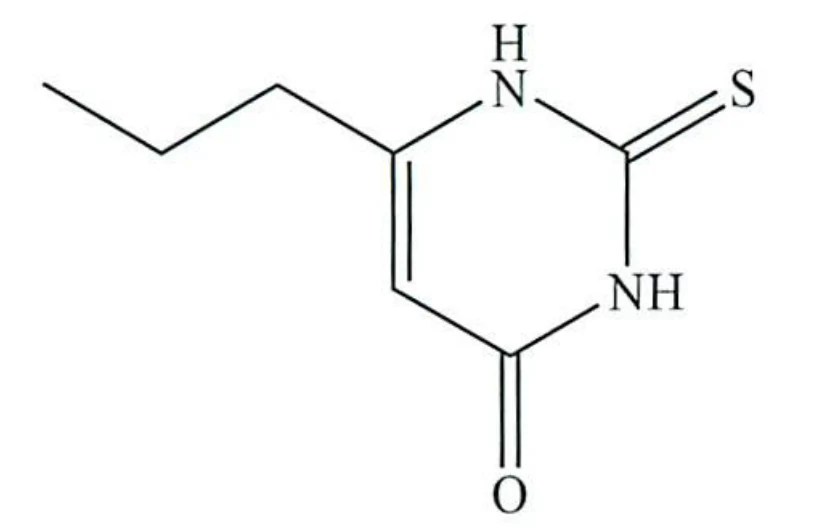
Physicochemical properties:
Description: Propylthiouracil contains not less than 98.0 percent and not more than the equivalent of 100.5 percent of 2,3-dihydro-6-propyl-2-thioxopyrimidin-4(1H)-one, calculated with reference to the dried substance.
Characters: White or almost white, crystalline powder or crystals, very slightly soluble in water, sparingly soluble in alcohol. It dissolves in solutions of alkali hydroxides.
Melting Point: 218 - 221°C
Acidity: pKa = 8.3 (20°C)
- 14. Clinical Trials
The clinical trial data on which the original indication was authorized is not available.
- 15. Microbiology
No data available.
- 16. Non-Clinical Toxicology
General Toxicology: There have been no systematic long term animal toxicology studies performed. Some short-term studies carried out when this class of drugs was introduced show that rats and rodents treated with high doses of propylthiouracil and made markedly hypothyroid will frequently develop thyroid hyperplasia, adenomas, carcinoma, pituitary adenomas and parathyroid hyperplasia.
- 17. Supporting Product Monographs
- 1. Prescribing Information for PrPROPYL-THYRACIL® Dated April 6, 2020 from Paladin Labs Inc. Control No. 233767.