


Product Monograph - Hiberix
SUMMARY PRODUCT INFORMATION
| Route of Administration | Dosage Form / Strength | Nonmedicinal Ingredients |
| Intramuscular Injection | Powder and diluent for injection/10 mcg of purified polyribosyl-ribitol-phosphate capsular polysaccharide of Haemophilus influenzae type b covalently bound to approximately 25 mcg tetanus toxoid per 0.5 mL dose. | Lactose, sodium chloride, and water for injection. |
DESCRIPTION
HIBERIX (Haemophilus influenzae type b conjugate vaccine) is a lyophilized vaccine of purified polyribosyl-ribitol-phosphate capsular polysaccharide (PRP) of Hib, covalently bound to tetanus toxoid.
INDICATIONS AND CLINICAL USE
Pediatrics:
HIBERIX is indicated for active immunization of all infants from the age of 2 months against disease caused by Hib.
The primary vaccination schedule consists of three doses in the first 6 months of life. To ensure long-term protection, a booster is recommended in the second year of life.
Previously unvaccinated infants between the ages of 6 and 12 months should receive 2 injections one month apart, followed by a booster in the second year of life. Previously unvaccinated children aged 1-5 years should be given one dose of vaccine.
HIBERIX does not prevent against disease due to other types of H. influenzae nor against meningitis caused by other organisms.
CONTRAINDICATIONS
HIBERIX should not be administered to subjects with known hypersensitivity to any component of the vaccine, or to subjects having shown signs of hypersensitivity after a previous dose of this vaccine or any injection containing Haemophilus influenzae type b.
WARNINGS AND PRECAUTIONS
General
HIBERIX should under no circumstances be administered intravascularly.
As with any other vaccine, a protective immune response may not be elicited in all vaccinees.
Other injectable vaccines should always be administered at different injection sites with separate syringes.
As with any parenteral vaccine, appropriate medication (i.e. epinephrine 1:1000) and supervision should be readily available for immediate use in case of anaphylaxis or anaphylactoid reactions following administration of the vaccine.
As with other vaccines, the administration of HIBERIX should be postponed in subjects suffering from moderate or severe illness with or without fever. The presence of minor illnesses with or without a low grade fever are not a contraindication.
It is good clinical practice that immunization should be preceded by a review of the medical history (especially with regard to previous immunization and possible occurrence of undesirable events) and a clinical examination.
Although limited immune response to the tetanus toxoid component may occur, vaccination with HIBERIX alone does not substitute for routine tetanus vaccination.
Excretion of capsular polysaccharide antigen in the urine has been described following administration of Hib vaccines, and therefore antigen detection may not have a diagnostic value in suspected Hib disease within 1-2 weeks of vaccination.
Syncope (fainting) can occur following, or even before, any vaccination as a psychogenic response to the needle injection. It is important that procedures are in place to avoid injury from faints.
Hematologic
As for other vaccines administered intramuscularly, HIBERIX should be given with caution to individuals with thrombocytopenia or any coagulation disorder since bleeding may occur following an intramuscular administration to these subjects.
Immune
Human Immunodeficiency Virus (HIV) infection is not considered as a contraindication for HIBERIX.
In patients receiving immunosuppressive therapy or patients with immunodeficiency, an adequate immunologic response may not be achieved.
Respiratory
Although a moderate or severe febrile illness with or without fever is a reason to defer vaccination, minor illness such as mild upper respiratory infections with or without low-grade fever are not a contraindication.
Special Populations
Pregnant Women: HIBERIX is not intended for use in adults.
Nursing Women: HIBERIX is not intended for use in adults.
Pediatrics: The potential risk of apnea and the need for respiratory monitoring for 48-72h should be considered when administering the primary immunization series to very premature infants (born ≤ 28 weeks of gestation) and particularly for those with a previous history of respiratory immaturity. As the benefit of vaccination is high in this group of infants, vaccination should not be withheld or delayed.
ADVERSE REACTIONS
Adverse Drug Reaction Overview
HIBERIX is generally well tolerated.
Clinical Trial Adverse Drug Reactions
Because clinical trials are conducted under very specific conditions the adverse reaction rates observed in the clinical trials may not reflect the rates observed in practice and should not be compared to the rates in the clinical trials of another drug. Adverse drug reaction information from clinical trials is useful for identifying drug-related adverse events and for approximating rates.
The following frequencies were based on the analysis of approximately 3,000 infants enrolled in study Hib-097 and of approximately 1,200 infants enrolled in study DTPa-HBV-IPV-011.
Adverse reactions reported are listed according to the following frequency:
Very common ≥ 1/10
Common ≥ 1/100 to < 1/10
Uncommon ≥ 1/1,000 to < 1/100
Rare ≥ 1/10,000 to < 1/1,000
Very rare < 1/10,000
Metabolism and nutrition disorders
Very common: loss of appetite
Psychiatric disorders
Very common: crying, irritability, restlessness
Nervous system disorders
Very common: somnolence
Rare: convulsions (including febrile convulsions)
Gastrointestinal disorders
Very common: diarrhea
Common: vomiting
General disorders and administration site conditions
Very common: fever, swelling, pain and redness at the injection site
Post-Market Adverse Drug Reactions
Undesirable effects reported are listed below (frequency is very rare, i.e., <1/10,000).
Immune system disorders: Allergic reactions (including anaphylactic and anaphylactoid reactions), angioedema.
Nervous system disorders: Hypotonic-hyporesponsive episode, syncope or vasovagal responses to injection.
Respiratory, thoracic and mediastinal disorders: Apnea (see WARNINGS AND PRECAUTIONS for apnea in very premature infants (≤ 28 weeks of gestation)).
Skin and subcutaneous tissue disorders: Urticaria, rash.
General disorders and administration site conditions: Extensive swelling of vaccinated limb, injection site induration.
DRUG INTERACTIONS
Drug-Drug Interactions
HIBERIX can be administered either simultaneously or at any time before or after diphtheria-tetanus-acellular pertussis vaccine (DTaP), diphtheria-tetanus-whole cell pertussis vaccine (DTPw), inactivated polio vaccine (IPV), or measles, mumps, rubella, hepatitis B, pneumococcal or meningococcal vaccines or ROTARIX at different injection sites with separate syringes.
Drug-Food Interactions
Interactions with food have not been established.
Drug-Herb Interactions
Interactions with herbal products have not been established.
Drug-Laboratory Interactions
Interactions with laboratory tests have not been established.
DOSAGE AND ADMINISTRATION
Recommended Dose
As recommended by the Canadian Immunization Guide, primary immunization consists of three intramuscular injections of 0.5 mL of vaccine. The first three doses, starting at 2 months of age, are given at 2 month intervals between doses. To ensure long term protection, a booster dose is recommended at 15 to 18 months of age.
Infants between the ages of 6 and 12 months previously unvaccinated should receive 2 injections, given with an interval of one month, followed by a booster in the second year of life. Previously unvaccinated children aged 1-5 years should be given one dose of vaccine.
Children in whom invasive Hib disease develops before 24 months of age should still receive vaccine as recommended, since such children may not have adequate antibody levels after natural disease.
HIBERIX can be mixed in the same syringe with INFANRIX-IPV (diphtheria, tetanus, pertussis and inactivated poliomyelitis vaccine).
HIBERIX should not be mixed with other vaccines in the same syringe except for authorised combinations.
Missed Dose
Interruption of the recommended schedule with a delay between doses should not interfere with the final immunity achieved with HIBERIX. There is no need to start the series over again regardless of the time elapsed between doses.
Administration
The diluent and reconstituted vaccine should be inspected visually for any foreign particulate matter and/or variation of physical aspects prior to reconstitution or administration. In the event of either being observed, do not use the diluent or the reconstituted vaccine.
The vastus lateralis (mid-thigh laterally) is the preferred site of injection in infants. The deltoid muscle should be used as the injection site in children when the muscle has developed sufficiently to accommodate the vaccine. The site of injection should be prepared with a suitable antiseptic. Do not inject intravascularly or subcutaneously. However, it is good clinical practice that in patients with thrombocytopenia or bleeding disorders the vaccine should be administered subcutaneously.
Instructions for reconstitution of the vaccine
HIBERIX must be reconstituted by adding the entire contents of the pre-filled syringe of diluent to the vial containing the powder.
To attach the needle to the syringe, carefully read the instructions given with pictures 1 and 2.
Note: However, the syringe provided with HIBERIX might be slightly different (without screw thread) than the syringe illustrated. In that case, the needle should be attached without screwing.
Always hold the syringe by the barrel, not by the syringe plunger or the Luer Lock Adaptor (LLA), and maintain the needle in the axis of the syringe (as illustrated in picture 2). Failure to do this may cause the LLA to become distorted and leak.
During assembly of the syringe, if the LLA comes off, a new vaccine dose (new syringe and vial) should be used.
- 1. Unscrew the syringe cap by twisting it anticlockwise (as illustrated in picture 1).
- 2. Attach the needle to the syringe by gently connecting the needle hub into the LLA and rotate a quarter turn clockwise until you feel it lock (as illustrated in picture 2).
- 3. Remove the needle protector, which may be stiff.
- 4. Add the diluent to the powder. The mixture should be well shaken until the powder is completely dissolved in the diluent.
The reconstituted vaccine is a clear to opalescent and colourless solution.
After reconstitution, the vaccine should be used promptly.
- 5. Withdraw the entire contents of the vial.
- 6. A new needle should be used to administer the vaccine. Unscrew the needle from the syringe and attach the injection needle by repeating step 2.
As stated in section “Recommended Dose” above, HIBERIX can be mixed in the same syringe with INFANRIX-IPV (diphtheria, tetanus, pertussis and inactivated poliomyelitis vaccine). In this case, the diluent supplied in the HIBERIX package is replaced by the
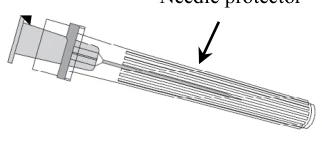 Needle Needle protector 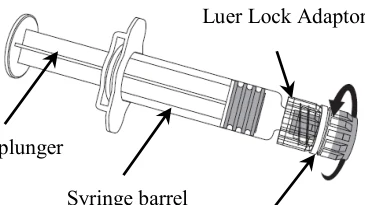 Syringe cap Syringe barrel Syringe plunger Needle hub Syringe Luer Lock Adaptor Picture 1 | 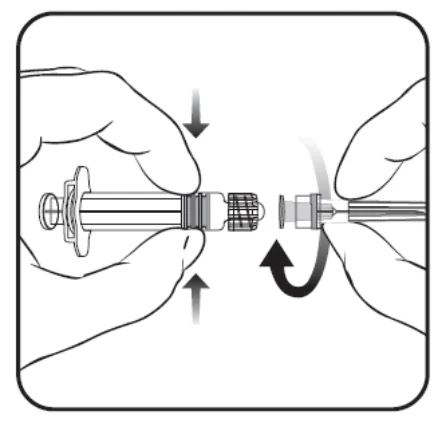 Picture 2 |
liquid vaccine.
Make sure the container of the vaccine intended for mixing with HIBERIX is a monodose container. From the HIBERIX package, discard the pre-filled syringe containing the diluent.
The combined vaccine must be reconstituted by adding the entire contents of the other vaccine container to the vial containing the Hib white powder.
This extemporaneously combined vaccine should be handled in the same way as the monocomponent reconstituted HIBERIX vaccine.
Any unused product or waste material should be disposed of in accordance with local requirements.
OVERDOSAGE
In general, the adverse event profile reported following overdosage was similar to that observed after administration of the recommended dose of HIBERIX.
For management of a suspected drug overdose, contact your regional Poison Control Centre.
ACTION AND CLINICAL PHARMACOLOGY
In the 1980s, prior to the widespread use of Hib vaccines, Haemophilus influenzae type b was a leading cause of invasive bacterial infection world-wide among infants and children less than 5 years. This included, in particular meningitis, pneumonia and epiglottitis. Without treatment, the mortality from H. influenzae disease is extremely high. Vaccines consisting of polyribosyl-ribitol-phosphate (PRP), the major surface polysaccharide of the type b bacteria conjugated to tetanus toxoid as a carrier protein, have been developed and have been shown to prevent invasive disease. Their wide-spread use has been associated with a decrease in the incidence of invasive Hib disease.
STORAGE AND STABILITY
The lyophilized Hib vaccine must be stored at 2°C to 8°C. The lyophilized vaccine is not affected by freezing. Do not use beyond the expiry date printed on the label.
The sterile diluent can be stored in the refrigerator (2°C to 8°C) or at ambient temperatures (up to 25°C). DO NOT FREEZE DILUENT.
DOSAGE FORMS, COMPOSITION AND PACKAGING
Dosage Forms
HIBERIX is supplied as a lyophilized white powder in a glass vial. The 0.5 mL sterile diluent (saline) is clear and colourless and is presented in a prefilled syringe.
Glass vials and prefilled syringes are made of neutral glass type 1, which conforms to European Pharmacopoeia Requirements.
Composition
HIBERIX (single 0.5 mL dose) contains 10 mcg of purified polyribosyl-ribitol-phosphate capsular polysaccharide of Hib, covalently bound to approximately 25 mcg tetanus toxoid. It also contains lactose, sodium chloride and water for injection.
Packaging
HIBERIX is available as a Monopack (1 vaccine dose per pack: 1 vial of lyophilized vaccine/1 prefilled syringe with diluent).
PART II: SCIENTIFIC INFORMATION
PHARMACEUTICAL INFORMATION
Drug Substance
Proper name: Haemophilus influenzae type b (Hib) conjugate vaccine
Product Characteristics
HIBERIX (H. influenzae type b conjugate vaccine) is a lyophilized vaccine of purified polyribosyl-ribitol-phosphate capsular polysaccharide (PRP) of Hib, covalently bound to tetanus toxoid.
The Hib polysaccharide is prepared from Hib, strain 20,752 and after activation with cyanogen bromide and derivatisation with an adipic hydrazide spacer is coupled to tetanus toxoid via carbodiimide condensation. After purification the conjugate is lyophilized in the presence of lactose as stabilizer.
HIBERIX meets WHO requirements for manufacture of biological substances and of Hib conjugated vaccines.
CLINICAL TRIALS
Study results
A titre of 0.15 mcg/mL was obtained in 95-100% of infants one month after the completion of the primary vaccination course. A titre of 0.15 mcg/mL was obtained in 100% of infants one month after the booster dose (94.7% with a titre of 10 mcg/mL).
DETAILED PHARMACOLOGY
Not applicable
MICROBIOLOGY
Not applicable
TOXICOLOGY
Not applicable
REFERENCES
- 1. Adams WG, Deaver KA, Cochi SL, Plikaytis BD, Zell ER, Broome CV, et al. Decline of childhood Haemophilus influenzae type b (Hib) disease in the Hib vaccine era. JAMA 1993 Jan 13; 269(2): 221-6.
- 2. Makela PH, Peltola H, Kayhty H, Jousimies H, Pettay O, Ruoslahti E, et al. Polysaccharide vaccines of group A Neisseria meningtitidis and Haemophilus influenzae type b: a field trial in Finland. J Infect Dis 1977 Aug; 136 Suppl: S43-S50.
- 3. Murphy TV, White KE, Pastor P, Gabriel L, Medley F, Granoff DM, et al. Declining incidence of Haemophilus influenzae type b disease since introduction of vaccination. JAMA 1993 Jan 13; 269(2): 246-8.
- 4. National Advisory Committee on Immunization: Canadian Immunization Guide, 7th Edition. Minister of Public Works and Government Services Canada, 2006.
- 5. Notifiable Diseases Annual Summary, 1994. Canadian Communicable Disease Report 2006 Jun; 22S2.
- 6. Recommendations of the Advisory Committee on Immunization Practices (ACIP): use of vaccines and immune globulins for persons with altered immunocompetence. MMWR Recomm Rep 1993 Apr 9; 42(RR-4): 1-18.
- 7. Rothstein EP, Madore DV, Girone JA, Schiller RP, Hipp TJ, Souder RL, et al. Comparison of antigenuria after immunization with three Haemophilus influenzae type b conjugate vaccines. Pediatr Infect Dis J 1991 Apr; 10(4): 311-4.
- 8. Shapiro ED, Ward JI. The epidemiology and prevention of disease caused by Haemophilus influenzae type b. Epidemiol Rev 1991; 13: 113-42.
- 9. Taylor HG, Michaels RH, Mazur PM, Bauer RE, Liden CB. Intellectual, neuropsychological, and achievement outcomes in children six to eight years after recovery from Haemophilus influenzae meningitis. Pediatrics 1984 Aug; 74(2): 198-205.
- 10. Teare EL, Fairley CK, White J, Begg NT. Efficacy of Hib vaccine (letter). Lancet 1994; 344: 828-9.
- 11. W.H.O.Expert Committee on Biological Standardization. Requirements for Haemophilus type b conjugate vaccines. WHO Tech Rep Ser 1991; 814: 15-37.
- 12. W.H.O.Expert Committee on Biological Standardization. Good Manufacturing Practices for biological products. WHO Tech Rep Ser 1992; 822: 20-33.
- 13. Zeilen S, Ahrens P, Hofmann D. Efficacy of Hib vaccine (letter). Lancet 1994; 344: 828.