


Product Monograph - Hydroxyzine Hydrochloride Injection USP
RECENT MAJOR LABEL CHANGES
| 2 CONTRAINDICATIONS | 05/2022 |
| 4 DOSAGE AND ADMINISTRATION, 4.1 Dosing Considerations | 05/2022 |
| 5 OVERDOSAGE | 05/2022 |
| 7 WARNINGS AND PRECAUTIONS | 05/2022 |
TABLE OF CONTENTS
Sections or subsections that are not applicable at the time of authorization are not listed.
RECENT MAJOR LABEL CHANGES ..................................................................................................2
TABLE OF CONTENTS ..................................................................................................................2
PART I: HEALTH PROFESSIONAL INFORMATION .............................................................................4
1 INDICATIONS...........................................................................................................................4
1.1 Pediatrics ............................................................................................................4
1.2 Geriatrics ............................................................................................................4
2 CONTRAINDICATIONS ..............................................................................................................4
4 DOSAGE AND ADMINISTRATION................................................................................................5
4.1 Dosing Considerations...........................................................................................5
4.2 Recommended Dose and Dosage Adjustment...........................................................5
4.4 Administration .....................................................................................................5
5 OVERDOSAGE..........................................................................................................................6
6 DOSAGE FORMS, STRENGTHS, COMPOSITION AND PACKAGING....................................................6
7 WARNINGS AND PRECAUTIONS.................................................................................................6
7.1 Special Populations...............................................................................................9
7.1.1 Pregnant Women.................................................................................................9
7.1.2 Breast-feeding .....................................................................................................9
7.1.3 Pediatrics............................................................................................................9
8 ADVERSE REACTIONS ...............................................................................................................9
8.5 Post-Market Adverse Reactions ..............................................................................9
9 DRUG INTERACTIONS ............................................................................................................. 10
9.1 Serious Drug Interactions .................................................................................... 10
9.3 Drug-Behavioural Interactions.............................................................................. 10
9.4 Drug-Drug Interactions........................................................................................ 10
9.5 Drug-Food Interactions ....................................................................................... 11
9.6 Drug-Herb Interactions ....................................................................................... 11
9.7 Drug-Laboratory Test Interactions ........................................................................ 11
10 CLINICAL PHARMACOLOGY ................................................................................................... 12
11 STORAGE, STABILITY AND DISPOSAL ...................................................................................... 12
12 SPECIAL HANDLING INSTRUCTIONS ........................................................................................ 12
PART II: SCIENTIFIC INFORMATION ............................................................................................. 13
13 PHARMACEUTICAL INFORMATION ......................................................................................... 13
14 CLINICAL TRIALS................................................................................................................... 13
15 MICROBIOLOGY ................................................................................................................... 13
16 NON-CLINICAL TOXICOLOGY.................................................................................................. 13
PATIENT MEDICATION INFORMATION ........................................................................................ 14
PART I: HEALTH PROFESSIONAL INFORMATION
1 INDICATIONS
HYRDOXYZINE HYDROCHLORIDE INJECTION USP (hydroxyzine hydrochloride) is indicated for:
- the symptomatic alleviation of pathological anxiety in patients with psychoneurotic disorders
- the alleviation of acutely disturbed psychoneurotic patients
- the alleviation of excessive anxiety and tension prior to surgical procedures
- the reduction in narcotic dosage and controls emesis, when used as pre and postoperative medication
- the symptomatic management of patients with acute alcoholic withdrawal
1.1 Pediatrics
Pediatrics (0 to 18 years of age): Health Canada has not authorized an indication for pediatric use. See 4.2 Recommended Dose and Dosage Adjustment, Pediatrics.
1.2 Geriatrics
Geriatrics: Evidence from experience suggests that use in the geriatric population is associated with differences in safety or effectiveness.
2 CONTRAINDICATIONS
HYRDOXYZINE HYDROCHLORIDE INJECTION USP is contraindicated:
- In patients who are hypersensitive to hydroxyzine hydrochloride, cetirizine, other piperazine derivatives, aminophylline or ethylenediamine or to any ingredient in the formulation, including any non-medicinal ingredient, or component of the container. For a complete listing, see 6 DOSAGE FORMS, STRENGTHS, COMPOSITION AND PACKAGING.
- In patients with history of QT prolongation and/or torsade de pointes, including congenital long QT syndromes; history of cardiac arrhythmias; significant electrolyte imbalance (hypokalemia, hypomagnesium); significant bradycardia; family history of sudden cardiac death. See 7 WARNINGS AND PRECAUTIONS, Cardiovascular
- With concomitant use of other QT/QTc-prolonging drugs. See 7 WARNINGS AND PRECAUTIONS, Cardiovascular; 9.4 Drug-Drug Interactions.
- With concomitant use of CYP3A4/5 inhibitors (See 7 WARNINGS AND PRECAUTIONS, Cardiovascular; 9.4 Drug-Drug Interactions; 9.5 Drug-Food Interactions).
- In asthmatics who have previously experienced a serious anti-histamine induced adverse bronchopulmonary effect.
- In patients with porphyria.
- In women of childbearing potential and early pregnancy.
4 DOSAGE AND ADMINISTRATION
4.1 Dosing Considerations
- Hydroxyzine should also be administered cautiously to epileptic patients.
- In order to help mitigate the potential risk of QT interval prolongation HYDROXYZINE should be used for as short a duration as possible, at the lowest effective dose up to specified maximums. See 2 CONTRAINDICATIONS; 4.2 Recommended Dose and Dosage Adjustment; 7 WARNINGS AND PRECAUTIONS, Cardiovascular; 9.4 Drug-Drug Interactions.
4.2 Recommended Dose and Dosage Adjustment
The dosage should be individualized and adjusted in accordance with tolerance and the patient's response to therapy.
Symptomatic use for alleviation of excessive anxiety should usually be limited to periods of one week.
Adults: The maximum total daily dose in adults is 100 mg, given in divided doses.
Pediatrics:
- Not recommended in children under 6 years of age.
- In children and adolescents up to 40 kg in weight, the maximum daily dose is 2 mg /kg /day, given in divided doses. (Therefore, at the maximum weight of 40 kg, the maximum daily dose is 80 mg).
- In children and adolescents over 40 kg, the maximum daily dose is the same as for adults: 100 mg per day, given in divided doses.
Geriatrics: Use should generally be avoided, but if judged to be an appropriate option in an individual case, the maximum daily dose is 50 mg, given in divided doses.
Hepatic impairment: The total daily dose should be reduced by 33%. Use in patients with severe liver impairment should be avoided.
Renal impairment: For patients with moderate or severe renal impairment, the total daily dosage should be reduced by 50%.
4.4 Administration
- HYDROXYZINE HYDROCHLORIDE INJECTION USP is intended only for intramuscular administration and should not, under any circumstances, be injected subcutaneously, intra-arterially, or intravenously.
- HYDROXYZINE HYDROCHLORIDE INJECTION USP should be injected well within the body of a relatively large muscle such as the upper outer quadrant of the buttocks or the lateral thigh. Inadvertent subcutaneous injection may result in significant tissue damage. See 7 WARNINGS AND PRECAUTIONS, Skin.
5 OVERDOSAGE
QT prolongation and torsade de pointes have been observed with excessive blood concentrations of hydroxyzine in a context of overdose or impaired drug metabolism. Electrocardiogram monitoring is recommended in the event of overdosage.
Close monitoring of patient and symptomatic management.
Hypotension, though unlikely, may be controlled with intravenous fluids and vasopressors (such as norepinephrine). Do not use epinephrine as HYDROXYZINE HYDROCHLORIDE INJECTION USP counteracts its pressor action. There is no specific antidote. It is doubtful that hemodialysis would be of any value in the treatment of overdosage with hydroxyzine. However, if other agents have been ingested concomitantly, hemodialysis may be indicated.
| For management of a suspected drug overdose, contact your regional poison control centre. |
6 DOSAGE FORMS, STRENGTHS, COMPOSITION AND PACKAGING
Table 1 – Dosage Forms, Strengths, Composition and Packaging
Hydroxyzine Hydrochloride Injection USP, 50 mg/mL, is available in single use amber ampoules of 1 mL, boxes of 10.
7 WARNINGS AND PRECAUTIONS
General
Because of its potential antimuscarinic actions, HYDROXYZINE HYDROCHLORIDE INJECTION USP should be used with caution in patients suffering from angle closure glaucoma, urinary retention, prostatic hyperplasia, or pyloroduodenal obstruction.
Concomitant Use with CNS depressants: In view of its sedative properties, hydroxyzine may potentiate the effects of other central nervous system depressants such as sedatives, hypnotics, narcotics, non-narcotic analgesics, barbiturates, psychotropic agents and alcohol. Patients should be cautioned not to drink alcohol while taking hydroxyzine and reductions in the dosages may be required if hydroxyzine is used in conjunction with other central nervous system depressants. See 9.4 Drug-Drug Interactions.
Cardiovascular
Caution is required in patients with cardiovascular disease and hypertension.
Hydroxyzine has been associated with QT/QTc interval prolongation. Rare events of torsade de pointes,
| Route of Administration | Dosage Form / Strength/Composition | Non-medicinal Ingredients |
| Intramuscular | Solution, Hydroxyzine Hydrochloride 50 mg / mL | Benzyl Alcohol, Sodium hydroxide, Water for Injection |
cardiac arrest, and sudden death have been reported with hydroxyzine during post-market use.
Torsade de pointes is a polymorphic ventricular tachyarrhythmia. Generally, the risk of torsade de pointes increases with the magnitude of QT/QTc prolongation produced by the drug. Torsade de pointes may be asymptomatic or experienced by the patient as dizziness, palpitations, syncope, or seizures. If sustained, torsade de pointes can progress to ventricular fibrillation and sudden cardiac death.
Particular care should be exercised when administering hydroxyzine to patients who are suspected to be at an increased risk of experiencing torsade de pointes during treatment with a QT/QTc-prolonging drug. Risk factors for torsade de pointes in the general population include, but are not limited to, the following:
- female gender;
- age 65 years or older;
- baseline prolongation of the QT/QTc interval;
- presence of genetic variants affecting cardiac ion channels or regulatory proteins, especially congenital long QT syndromes;
- family history of sudden cardiac death at <50 years;
- cardiac disease (e.g., myocardial ischemia or infarction, congestive heart failure, left ventricular hypertrophy, cardiomyopathy, conduction system disease);
- history of arrhythmias (especially ventricular arrhythmias, atrial fibrillation, or recent conversion from atrial fibrillation);
- electrolyte disturbances (e.g., hypokalemia, hypomagnesemia, hypocalcemia) or conditions leading to electrolyte disturbances (e.g., gastrointestinal disease, eating disorders);
- bradycardia (<50 beats per minute);
- acute neurological events (e.g., intracranial or subarachnoid haemorrhage, stroke, intracranial trauma);
- diabetes mellitus;
- autonomic neuropathy.
When drugs that prolong the QT/QTc interval are prescribed, healthcare professionals should counsel their patients concerning the nature and implications of the ECG changes, underlying diseases and disorders that are considered to represent risk factors, demonstrated and predicted drug-drug interactions, symptoms suggestive of arrhythmia, risk management strategies, and other information relevant to the use of the drug. See 2 CONTRAINDICATIONS; 4.1 Dosing Considerations; 9.4 Drug-Drug Interactions; 9.5 Drug-Food Interactions.
Driving and Operating Machinery
Since hydroxyzine may produce sedation and drowsiness, patients should be warned against driving or operating dangerous machinery while taking hydroxyzine.
Endocrine and Metabolism
Caution is required in patients with hyperthyroidism.
Gastrointestinal
Caution is required in patients with decreased GI motility and stenosing peptic ulcer.
Hepatic/Biliary/Pancreatic
Use in patients with severe liver impairment should be avoided.
For patients with other liver impairment, dose reduction is required. See 4.2 Recommended dose and Dosage Adjustment.
Neurologic
Caution is required in patients with myasthenia gravis, dementia and seizure disorders, including epilepsy.
Ophthalmologic
Caution is required in patients with increased intraocular pressure.
Reproductive Health: Female and Male Potential
- Fertility
No data is available on the effects of hydroxyzine hydrochloride on fertility.
Renal
Caution is required in patients with bladder outflow obstruction.
For patients with moderate or severe renal impairment, dose reduction is required. See 4.2 Recommended dose and Dosage Adjustment.
Respiratory
Caution is required in patients with breathing problems (e.g. emphysema, chronic bronchitis).
Skin
Inadvertent subcutaneous injection may result in significant tissue damage. See 4.4 Administration.
Acute Generalized Exanthematous Pustulosis (AGEP): Hydroxyzine may rarely cause acute generalized exanthematous pustulosis (AGEP), a serious skin reaction characterized by fever and numerous small, superficial, nonfollicular, sterile pustules, arising within large areas of edematous erythema. Inform patients about the signs of AGEP, and discontinue hydroxyzine at the first appearance of a skin rash, worsening of pre-existing skin reactions which hydroxyzine may be used to treat, or any other sign of hypersensitivity. If signs or symptoms suggest AGEP, use of hydroxyzine should not be resumed and alternative therapy should be considered. Avoid cetirizine or levocetirizine in patients who have experienced AGEP or other hypersensitivity reactions with hydroxyzine, due to the risk of cross-sensitivity.
7.1 Special Populations
7.1.1 Pregnant Women
HYDROXYZINE HYDROCHLORIDE INJECTION USP (hydroxyzine hydrochloride) is contraindicated in early pregnancy. See 2 CONTRAINDICATIONS.
Hydroxyzine hydrochloride, when administered to the pregnant mouse, rat, and rabbit, induced fetal abnormalities in the rat and mouse at doses substantially above the human therapeutic range. Clinical data in human beings are inadequate to establish safety in early pregnancy.
7.1.2 Breast-feeding
It is unknown if HYDROXYZINE HYDROCHLORIDE INJECTION USP is excreted in human milk. Since many drugs are excreted in human milk, HYDROXYZINE HYDROCHLORIDE INJECTION USP should not be given to nursing mothers.
7.1.3 Pediatrics
Pediatrics (0 to 18 years of age): Health Canada has not authorized an indication for pediatric use. See 4.2 Recommended Dose and Dosage Adjustment, Pediatrics.
8 ADVERSE REACTIONS
HYDROXYZINE HYDROCHLORIDE INJECTION USP may cause sedation, drowsiness and impairment of mental alertness which tend to disappear in a few days of continued therapy or upon reduction of the dose. Anticholinergic activity, including dryness of the mouth have been reported. Involuntary movements, including tremor and convulsions have also occurred. Rarely, blood dyscrasias have been reported.
8.5 Post-Market Adverse Reactions
Cardiac disorders: Rare cases of cardiac arrest, cardio-respiratory arrest, electrocardiogram QT prolonged, and torsade de pointes, some fatal, have been reported following the use of hydroxyzine-containing products.
Immune system disorders: allergic reaction.
Nervous system disorders: headache.
Psychiatric disorders: hallucination.
Skin and subcutaneous tissue disorders: pruritus, rash, urticaria.
9 DRUG INTERACTIONS
9.1 Serious Drug Interactions
Serious Drug Interactions QT/QTc-prolonging drugs Concomitant use of HYDROXYZINE with another QT/QTc prolonging drug is contraindicated as it may result in QT/QTc prolongation. See 2 CONTRAINDICATIONS; 9.4 Drug-Drug Interactions. CYP3A4/5 inhibitors Concomitant use of HYDROXYZINE with CYP3A4/5 inhibitors is contraindicated as it may result in increased blood level of HYDROXYZINE and in QT/QTc prolongation. See 2 CONTRAINDICATIONS; 9.4 Drug-Drug Interactions; 9.5 Drug-Food Interactions. |
9.3 Drug-Behavioural Interactions
HYDROXYZINE HYDROCHLORIDE INJECTION USP may product additive CNS depressant effects when co-administered with alcohol. See 7 WARNINGS AND PRECAUTIONS, General, Concomitant Use with CNS depressants.
9.4 Drug-Drug Interactions
CNS depressants: HYDROXYZINE HYDROCHLORIDE INJECTION USP may potentiate the effects of other central nervous system depressants. See 7 WARNINGS AND PRECAUTIONS, General, Concomitant Use with CNS Depressants.
QT/QTc-Prolonging Drugs: The concomitant use of hydroxyzine with another QT/QTc prolonging drug is contraindicated. Drugs that have been associated with QT/QTc interval prolongation and/or torsade de pointes include, but are not limited to, the examples in the following list. Chemical/pharmacological classes are listed if some, although not necessarily all, class members have been implicated in QT/QTc prolongation and/or torsade de pointes:
- Class IA antiarrhythmics (e.g., quinidine, procainamide, disopyramide);
- Class III antiarrhythmics (e.g., amiodarone, sotalol, ibutilide);
- Class 1C antiarrhythmics (e.g., flecainide, propafenone);
- antipsychotics (e.g., chlorpromazine, pimozide, haloperidol, droperidol, ziprasidone, risperidone, olanzapine);
- antidepressants (e.g., fluoxetine, citalopram, venlafaxine, tricyclic/tetracyclic antidepressants e.g., amitriptyline, imipramine, maprotiline). See 7 WARNINGS AND PRECAUTIONS, General, Concomitant Use with CNS depressants);
- opioids (e.g., methadone);
- macrolide antibiotics and analogues (e.g., erythromycin, clarithromycin, azithromycin, tacrolimus);
- quinolone antibiotics (e.g., moxifloxacin, levofloxacin, ciprofloxacin);
- pentamidine;
- antimalarials (e.g., quinine, chloroquine);
- azole antifungals (e.g., ketoconazole, fluconazole, voriconazole);
- domperidone;
- 5-hydroxytryptamine (5-HT3) receptor antagonists (e.g.,ondansetron);
- arsenic trioxide
- tyrosine kinase inhibitors (e.g., vandetanib, sunitinib, nilotinib);
- histone deacetylase inhibitors (e.g., vorinostat);
- beta-2 adrenoceptor agonists (e.g., salmeterol, formoterol).
Drugs that Cause Electrolyte Depletion: The use of hydroxyzine with drugs that can disrupt electrolyte levels is not recommended. Such drugs include, but are not limited to, the following:
- loop, thiazide, and related diuretics;
- laxatives and enemas;
- amphotericin B;
- high dose corticosteroids
CYP3A4/5 Inhibitors: Hydroxyzine is a substrate for CYP3A4/5. Plasma levels of hydroxyzine can be increased by inhibitors of CYP3A4/5. Prolongation of the QT/QTc interval by hydroxyzine is anticipated to be increased in the presence of CYP3A4/5 inhibitors. Drugs that inhibit CYP3A4/5 include, but are not limited to, certain azole antifungals, macrolide antibiotics, and HIV protease inhibitors. The concomitant use of these drugs with hydroxyzine is contraindicated. See 2 CONTRAINDICATIONS.
The above lists of potentially interacting drugs are not comprehensive. Current information sources should be consulted for newly approved drugs that prolong the QT/QTc interval, inhibit CYP3A4/5, or cause electrolyte disturbances, as well as for older drugs for which these effects have recently been established.
9.5 Drug-Food Interactions
CYP3A4 can be inhibited by certain foods, including, but not limited to, grapefruit, grapefruit juice, and grapefruit-containing products, which could lead to increased plasma concentrations of hydroxyzine. Patients should be instructed not to consume these foods during treatment with hydroxyzine because the risk of QT/QTc prolongation may be increased. See 7 WARNINGS AND PRECAUTIONS, Cardiovascular; 9.4 Drug-Drug Interactions.
9.6 Drug-Herb Interactions
Interactions with herbal products have not been established.
9.7 Drug-Laboratory Test Interactions
Treatment should be stopped for one week before skin testing for allergy is undertaken, and for 96 hours prior to a methacholine test.
10 CLINICAL PHARMACOLOGY
Hydroxyzine is an antihistamine with anticholinergic, antiemetic and sedative properties.
11 STORAGE, STABILITY AND DISPOSAL
Temperature:
Store between 15 and 30°C.
Light:
Protect from light.
12 SPECIAL HANDLING INSTRUCTIONS
None.
PART II: SCIENTIFIC INFORMATION
13 PHARMACEUTICAL INFORMATION
Drug Substance
Proper name: Hydroxyzine Hydrochloride
Molecular formula and molecular mass: C21H27ClN2O2·2HCl, 447.83 g/mol
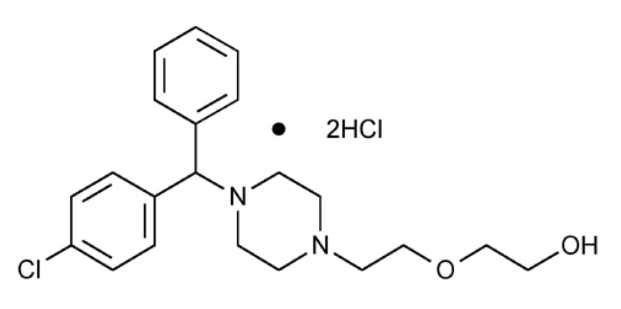
Structural formula:
14 CLINICAL TRIALS
The clinical trial data on which the original indication was authorized is not available.
15 MICROBIOLOGY
No microbiological information is required for this drug product.
16 NON-CLINICAL TOXICOLOGY
Information not available.