


Product Monograph - Iheezo
Recent Major Label Changes
N/A
Table of Contents
Certain sections or subsections that are not applicable at the time of the preparation of the most recent authorized product monograph are not listed.
Recent Major Label Changes .................................................................................................... 2
Table of Contents .................................................................................................................... 2
Part 1: Healthcare Professional Information ............................................................................ 4
- 1.
Indications ................................................................................................................... 4
1.1. Pediatrics ............................................................................................................... 4
1.2. Geriatrics ............................................................................................................... 4
- 2. Contraindications ......................................................................................................... 4
- 4.
Dosage and Administration .......................................................................................... 4
4.1. Dosing Considerations ........................................................................................... 4
4.2. Recommended Dose and Dosage Adjustment ...................................................... 4
4.4. Administration ....................................................................................................... 5
4.5. Missed Dose .......................................................................................................... 5
- 5. Overdose...................................................................................................................... 5
- 6. Dosage Forms, Strengths, Composition, and Packaging ................................................ 5
- 7.
Warnings and Precautions ............................................................................................ 6
Carcinogenesis and Genotoxicity ...................................................................................... 6
Driving and Operating Machinery ..................................................................................... 6
Ophthalmologic ................................................................................................................. 6
7.1. Special Populations ................................................................................................ 6
7.1.1. Pregnancy .......................................................................................................... 6
7.1.2. Breastfeeding .................................................................................................... 6
7.1.3. Pediatrics ........................................................................................................... 6
7.1.4. Geriatrics ........................................................................................................... 7
- 8.
Adverse Reactions ........................................................................................................ 7
8.1. Adverse Reaction Overview ................................................................................... 7
8.2. Clinical Trial Adverse Reactions ............................................................................. 7
8.3. Less Common Clinical Trial Adverse Reactions ...................................................... 8
8.4. Abnormal Laboratory Findings: Hematologic, Clinical Chemistry and Other Quantitative Data .............................................................................................................. 8
8.5. Post-Market Adverse Reactions ............................................................................ 8
- 9.
Drug Interactions ......................................................................................................... 8
9.2. Drug Interactions Overview ................................................................................... 8
9.3. Drug-Behaviour Interactions ................................................................................. 9
9.4. Drug-Drug Interactions .......................................................................................... 9
9.5. Drug-Food Interactions .......................................................................................... 9
9.6. Drug-Herb Interactions .......................................................................................... 9
9.7. Drug-Laboratory Test Interactions ......................................................................... 9
- 10.
Clinical Pharmacology .................................................................................................. 9
10.1 Mechanism of Action ......................................................................................... 9
10.2 Pharmacodynamics ........................................................................................... 9
10.3 Pharmacokinetics .............................................................................................. 9
- 11. Storage, Stability, and Disposal .................................................................................. 10
Part 2: Scientific Information ................................................................................................. 11
- 13. Pharmaceutical Information ....................................................................................... 11
- 14.
Clinical Trials ............................................................................................................. 11
14.1. Clinical Trials by Indication .............................................................................. 11
Ocular surface anesthesia during ophthalmologic procedures ....................................... 11
- 15. Microbiology .............................................................................................................. 13
- 16. Non-Clinical Toxicology .............................................................................................. 13
Patient Medication Information ............................................................................................ 15
Part 1: Healthcare Professional Information
1. Indications
IHEEZO (chloroprocaine hydrochloride ophthalmic gel) is indicated for:
- Ocular surface anesthesia during ophthalmologic procedures in adults.
1.1. Pediatrics
Pediatrics (<18 years of age): No data are available to Health Canada; therefore, Health Canada has not authorized IHEEZO for pediatric use.
1.2. Geriatrics
Geriatrics (>65 years of age): Evidence from clinical studies suggests that use in the geriatric population is not associated with differences in safety or effectiveness.
2. Contraindications
IHEEZO is contraindicated:
- in patients who are hypersensitive to this drug, medicinal products of the PABA (para-aminobenzoic acid) ester group, or to any ingredient in the formulation, including any non-medicinal ingredient, or component of the container. For a complete listing, see 6 Dosage Forms, Strengths, Composition, and Packaging.
4. Dosage and Administration
4.1. Dosing Considerations
IHEEZO is intended for topical ophthalmic use only and must only be administered by a qualified eye care clinician. IHEEZO is not intended for patient self-administration (see 7 Warnings and Precautions, Ophthalmologic).
4.2. Recommended Dose and Dosage Adjustment
The recommended dose of IHEEZO is three (3) drops applied to the ocular surface in the area of the planned procedure.
For procedures that do not require ocular surface disinfection:
- Apply the three drops 1 minute apart.
For procedures that require ocular surface disinfection:
- Apply first drop. Wait 5 minutes, proceed with ocular surface disinfection.
- Apply the second and third drops 1 minute apart.
Each dose (3 drops) contains 3.60 mg of chloroprocaine hydrochloride.
Additional drops of IHEEZO may be applied as clinically indicated to maintain anesthetic effect. The maximum recommended dose is 6 total drops (see 7 Warnings and Precautions, Ophthalmologic, 8.1 Adverse Reactions Overview, 14.1 Clinical Trials by Indication).
Health Canada has not authorized an indication for pediatric use.
4.4. Administration
IHEEZO is not indicated for injection or intraocular administration.
Do not touch the eye or other surfaces when applying IHEEZO to avoid contamination.
Each vial is intended for a single patient. Discard any unused gel after use.
4.5. Missed Dose
Not applicable.
5. Overdose
Acute emergencies from local anesthetics are generally related to high plasma levels encountered during therapeutic use of local anesthetics or to unintended subarachnoid or intravascular injection of local anesthetic solution.
However, systemic exposure to chloroprocaine is expected to be undetectable or negligible following topical ophthalmic application of the recommended dose of IHEEZO.
For the most recent information in the management of a suspected drug overdose, contact your regional poison control centre or Health Canada’s toll-free number, 1-844 POISON-X (1-844-764-7669).
- 6. Dosage Forms, Strengths, Composition, and Packaging
Table 1 – Dosage Forms, Strengths, and Composition
IHEEZO (chloroprocaine hydrochloride ophthalmic gel, 3%) is a sterile, clear, colourless to light yellow, gel.
| Route of Administration | Dosage Form / Strength/Composition | Non-medicinal Ingredients |
| Ophthalmic | Gel, 3% w/w chloroprocaine hydrochloride | Hydroxyethylcellulose and water for injection. Contains hydrochloric acid for pH adjustment. |
Available in a carton of 1 single-use vial or 10 single-use vials.
7. Warnings and Precautions
Carcinogenesis and Genotoxicity
Chloroprocaine did not show any genotoxic potential, however no carcinogenicity studies have been conducted. See 16 Non-Clinical Toxicology.
Driving and Operating Machinery
IHEEZO is a topical local anesthetic used during ophthalmologic procedures. Visual disturbances may occur following use of IHEEZO or ophthalmologic procedures. Visual acuity should be assessed as appropriate, and patients should be advised not to drive or operate machinery until their vision is no longer impaired.
Ophthalmologic
Corneal Opacification
Prolonged use of a topical ophthalmic anesthetic may lead to corneal epithelial toxicity and may manifest as epithelial defects, which may progress to permanent corneal damage, such as corneal opacification and ulceration with accompanying visual loss.
Injury Due to Insensitivity
Patients should be advised to avoid touching the eye until the anesthesia has worn off as accidental injuries can occur due to insensitivity of the eye.
7.1. Special Populations
7.1.1. Pregnancy
There are no animal reproduction studies for chloroprocaine. There are no adequate and well-controlled studies of IHEEZO use during pregnancy to inform a drug-associated risk of adverse developmental outcomes.
7.1.2. Breastfeeding
It is not known whether chloroprocaine and its metabolites are excreted in human milk. Because many drugs are excreted in human milk, caution should be exercised when IHEEZO is administered to a nursing woman.
7.1.3. Pediatrics
Pediatrics (<18 years of age): No data are available to Health Canada; therefore, Health Canada has not authorized IHEEZO for pediatric use.
7.1.4. Geriatrics
Geriatrics (>65 years of age): Evidence from clinical studies suggests that use in the geriatric population is not associated with differences in safety or effectiveness.
8. Adverse Reactions
8.1. Adverse Reaction Overview
The safety of IHEEZO was assessed in one Phase 3 and two Phase 2 studies. The Phase 3 study (CHL.3/01-2019/M) was conducted in 338 patients that underwent cataract surgery in a single eye and received either IHEEZO (chloroprocaine hydrochloride 3% ophthalmic gel) or tetracaine hydrochloride 0.5% eye drops. The two placebo-controlled Phase 2 studies (n = 201) were conducted in healthy participants that did not undergo any ophthalmologic procedure. IHEEZO was used at the recommended dose of 3 drops. Only 9 participants received 6 drops in one of the Phase 2 studies.
No serious or severe adverse events were reported.
8.2. Clinical Trial Adverse Reactions
Clinical trials are conducted under very specific conditions. Therefore, the frequencies of adverse reactions observed in the clinical trials may not reflect frequencies observed in clinical practice and should not be compared to frequencies reported in clinical trials of another drug.
The overall incidence of ocular adverse events was 10% with chloroprocaine hydrochloride 3% ophthalmic gel treatment and 11% with tetracaine hydrochloride 0.5% eye drops treatment.
Table 2 – Treatment-Emergent Adverse Events with an Incidence of Greater Than 1% for IHEEZO and at a higher incidence than for tetracaine hydrochloride 0.5% eye drops in Phase 3 Study CHL.3/01-2019/M
| System organ class/preferred term | Chloroprocaine hydrochloride 3% ophthalmic gel N = 166 n (%) | Tetracaine hydrochloride 0.5% eye drops N =172 n (%) |
|---|---|---|
| Eye disorders | ||
| Corneal edema | 7 (4%) | 2 (1%) |
Table 3 - Treatment-Emergent Adverse Events with an Incidence of Greater Than or Equal to 1% for IHEEZO in placebo-controlled Phase 2 studies
| System organ class/preferred term | Chloroprocaine hydrochloride 3% ophthalmic gel N = 151 n (%) | Placebo N = 50 n (%) | |||
|---|---|---|---|---|---|
| System organ class/preferred term | Chloroprocaine hydrochloride 3% ophthalmic gel N = 151 n (%) | Placebo N = 50 n (%) | |||
| Eye disorders | |||||
| Mydriasis | 39 (26) | 1 (2) | |||
| Conjunctival hyperemia | 16 (11) | 6 (12) | |||
| Eye irritationa | 10 (7) | 2 (4) | |||
| Punctate keratitis | 6 (4) | 0 (0) | |||
| Conjunctival hemorrhage | 5 (3) | 2 (4) | |||
| Foreign body sensation in eyes | 4 (3) | 3 (6) | |||
| Vision blurred | 3 (2) | 0 (0) | |||
| Eye pruritus | 2 (1) | 1 (2) | |||
| a Includes preferred terms eye irritation and instillation site pain | |||||
8.3. Less Common Clinical Trial Adverse Reactions
Treatment-emergent adverse events reported with IHEEZO at an incidence of less than 1% and not previously listed in the Phase 2 and Phase 3 studies:
Eye disorders: conjunctival edema, dry eye, eye pain, hyperesthesia of the eye, photophobia, retinal pigment epitheliopathy.
Injury, poisoning and procedural complications: incision site edema.
Investigations: intraocular pressure increased.
Product issues: device dislocation.
8.4. Abnormal Laboratory Findings: Hematologic, Clinical Chemistry and Other Quantitative Data
Not applicable.
8.5. Post-Market Adverse Reactions
Post-marketing reactions reported to date have been consistent with the events recorded during the controlled clinical trials.
9. Drug Interactions
9.2. Drug Interactions Overview
No drug interaction studies have been conducted with IHEEZO; however, no clinically relevant drug interactions are expected.
9.3. Drug-Behaviour Interactions
The interaction of IHEEZO with individual behavioural risks (e.g. cigarette smoking, cannabis use, and/or alcohol consumption) has not been studied.
9.4. Drug-Drug Interactions
See 9.2 Drug Interactions Overview above.
9.5. Drug-Food Interactions
Interactions with food have not been studied.
9.6. Drug-Herb Interactions
Interactions with herbal products have not been studied.
9.7. Drug-Laboratory Test Interactions
Interactions with laboratory tests have not been studied.
10. Clinical Pharmacology
10.1 Mechanism of Action
Chloroprocaine, like other local anesthetics, blocks the inward movement of sodium ions through the nerve cell membrane, causing a reversible blockade of impulse generation and conduction along nerve fibers.
10.2 Pharmacodynamics
The ocular surface is innervated by sensory nerve fibers originating from the trigeminal nerve (fifth cranial nerve). These fibers transmit the sensations of pain, temperature, and touch. Topical ophthalmic anesthetics exert their anesthetic effect by blocking the nerve endings of these fibers.
10.3 Pharmacokinetics
The systemic exposure to chloroprocaine following topical ophthalmic administration of IHEEZO has not been studied. However, it is expected to be undetectable or negligible at the recommended dose.
Metabolism: Chloroprocaine is metabolized by non-specific esterases in ocular tissues and pseudocholinesterase in the plasma. Chloroprocaine plasma half-life in vitro is approximately 25 seconds in adults. The hydrolysis of chloroprocaine results in the production of two major metabolites, β-diethylaminoethanol and 2-chloro-4-aminobenzoic acid (ACBA). These metabolites are pharmacologically inactive.
Elimination: The kidney is the main excretory organ for most local anesthetics and their metabolites. Urinary excretion is affected by urinary perfusion and factors affecting urinary pH.
Special Populations and Conditions
- Pediatrics: IHEEZO is not indicated for use in pediatric patients (see 1.1 Pediatrics).
- Geriatrics: No overall differences in safety or effectiveness have been observed between geriatric and younger adult patients.
- Storage, Stability, and Disposal
Store at 15°C to 25°C. Do not freeze. Keep in aluminum pouch before use. Discard after use.
Part 2: Scientific Information
13. Pharmaceutical Information
Drug Substance
Non-proprietary name of the drug substance: chloroprocaine hydrochloride
Chemical name: 2-(Diethylamino) ethyl 4 amino-2-chlorobenzoate monohydrochloride
Molecular formula and molecular mass: C13H19ClN2O2HCl and 307.22 g/mol
Structural formula:
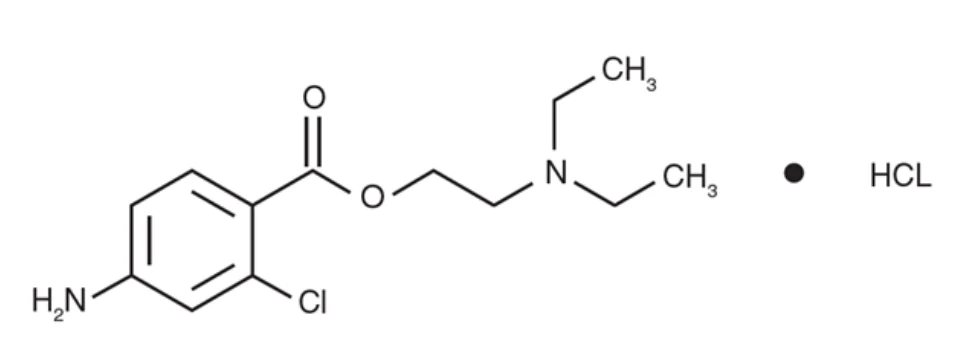
Physicochemical properties: Chloroprocaine hydrochloride is a white crystalline powder. It is practically insoluble in ether, very slightly soluble in chloroform, slightly soluble in ethanol, and soluble in water.
14. Clinical Trials
14.1. Clinical Trials by Indication
Ocular surface anesthesia during ophthalmologic procedures
A phase 3, multicenter, prospective, randomized, observer-blind study was used to evaluate the safety and efficacy of IHEEZO (chloroprocaine hydrochloride 3% ophthalmic gel) versus tetracaine hydrochloride 0.5% eye drops in ocular surface anesthesia in patients undergoing cataract surgery in a single eye using the phacoemulsification method (Study CHL.3/01-2019/M).
Table 4 - Summary of patient demographics for the clinical trial in ocular surface anesthesia during ophthalmologic procedures.
| Study # | Study design | Dosage, route of administration and duration | Study subjects (N) | Mean age (range) | Sex (M/F) |
|---|---|---|---|---|---|
| Study # | Study design | Dosage, route of administration and duration | Study subjects (N) | Mean age (range) | Sex (M/F) |
| Phase 3 CHL.3/01-2019/M | Prospective, randomized, observer-blind, | IHEEZO (Chloroprocaine hydrochloride 3% ophthalmic gel), 3 drops, topical | 166 | 70 (37 - 87) | 73M/93F |
| active-controlled | application onto eye to be operated | ||||
| Tetracaine hydrochloride 0.5% eye drops, 3 drops, topical application onto eye to be operated | 172 | 69 (40 - 92) | 85M/87F | ||
Efficacy Results - Study CHL.3/01-2019/M (Phase 3)
In Study CHL.3/01-2019/M, disinfection of the ocular surface occurred 5 minutes after application of the first drop. Two minutes following disinfection, the second and third drops were applied one minute apart.
The primary endpoint was the proportion of patients in each treatment group with successful ocular surface anesthesia during cataract surgery. Successful ocular surface anesthesia was defined as a patient’s assessment of ocular discomfort of 0 (no pain) or 1 (occasional pressure sensation) on a 6-point scale from the beginning of surgery until the fourth timepoint (T4, right before intraocular lens implantation) without the use of additional treatment.
IHEEZO was equivalent to tetracaine hydrochloride 0.5% eye drops for ocular surface anesthesia during cataract surgery (Table 5). In the per protocol set, three (2%) patients in the IHEEZO arm received supplementation, compared to five (3%) patients in the tetracaine hydrochloride 0.5% eye drops arm.
Key secondary endpoints included the time to onset of anesthesia (interval between the 3rd drop and anesthesia) and duration of anesthesia.
Table 5 – Proportion of patients with successful anesthesia during cataract surgery using the phacoemulsification method in study CHL.3/01-2019/M (Per Protocol Set)
IHEEZO (N = 163) | Tetracaine hydrochloride 0.5% eye drops (N = 169) | |||||||
|---|---|---|---|---|---|---|---|---|
| Primary endpoint | ||||||||
| Successful ocular surface anesthesia at T4 | 139/163 | 142/169 | ||||||
| Proportion of patients with successful anesthesia at T4 | 85.3% | 84.0% | ||||||
Difference in proportionsa (95% two-sided CI)b | 1.2% (-6.6, 9.0) | |||||||
| Secondary endpoints | ||||||||
Onset of anesthesia (minutes) (Mean ± SD) | 1.35 ± 0.87 | 1.47 ± 1.60 | ||||||
| Duration of anesthesia (minutes) | 20.01 ± 2.25 | 19.87 ± 2.26 | ||||||
| (Mean ± SE)c | ||||||||
aMantel-Haenszel approach for estimation of the common risk difference adjusting for country effect bEquivalence margin was set at 10%
cBased on a post-hoc analysis
15. Microbiology
No microbiological information is required for this drug product.
16. Non-Clinical Toxicology
The intended clinical route of administration is topical ophthalmic application. See Local Tolerance Toxicity studies.
General toxicology:
The single and repeat-dose toxicity studies performed via the intrathecal route of administration do not reflect the intended clinical route of administration, which is topical ophthalmic application. While the systemic exposure is expected to be significantly higher following intrathecal administration, no toxicokinetic data were included in those studies.
In rats, both the single- and 7-day repeat-dose studies did not identify any serious adverse reactions, including any histopathological changes in the spinal tissues to intrathecally administered 1% or 2% chloroprocaine. All treated rats exhibited the pharmacological response of rear-limb immobility and slower respiratory rate. In the 7-day repeat-dose study one female rat receiving the 40 mcL of 2% chloroprocaine (0.8 mg) died on Day 2 from respiratory depression. No deaths were observed in the 2% chloroprocaine group once the dose was reduced to 30 mcL of 2% chloroprocaine (0.6 mg). The latter dose (0.6 mg/animal/day) was therefore considered the NOAEL.
In dogs, a single-dose study and 7-day repeat-dose intrathecally-administered toxicity study, no significant toxic effects were observed with chloroprocaine at up to 500 mcL of 2% chloroprocaine (10 mg), which was the highest dose tested. Dose-dependent pharmacological effects, such as hind-limb immobility, were observed in treated dogs across the doses tested, but the doses were considered well tolerated as the findings lasted only 15- 25 minutes. No toxicologically significant histopathological changes were observed at the injection sites and in the spinal neural regions examined in dogs. Therefore, the NOAEL of the study was set at 2% chloroprocaine.
A 4-week repeated (once weekly for a total of 5 administrations) study in dogs, with lumbar intrathecal administration of chloroprocaine HCl 1% (20 mg) or 3% (60 mg), in fixed volume of 2 mL/animal/administration (maximum applicable volume), a single case of mortality occurred with chloroprocaine 3% likely due to a respiratory block (no diaphragmatic movement). Transient, not life-threatening, respiratory distress was recorded in all surviving animals treated with chloroprocaine HCl 3%. Treatment with chloroprocaine HCl 1% did not induce changes in respiration but did lead to a transient block of hindlimbs. No other toxicologically relevant changes were recorded in the study. The NOAEL was set at chloroprocaine 1% with a volume of 2 mL/animal/administration (corresponding to 20 mg/dog/administration).
Genotoxicity:
Chloroprocaine and the main metabolite, ACBA, were negative in the in vitro bacterial reverse mutation test (AMES assay) and the in vitro chromosomal aberration assay.
Carcinogenicity:
Long-term studies in animals to evaluate carcinogenic potential of chloroprocaine have not been conducted.
Reproductive and developmental toxicology:
Studies in animals to evaluate the impairment of fertility have not been conducted with chloroprocaine.
Local Tolerance study:
To assess the ocular local tolerance of chloroprocaine itself and of chloroprocaine hydrochloride ophthalmic gel 3% (30mg/mL), a primary ocular irritation study with chloroprocaine 3% solution and a 7-day ocular tolerance study following five daily ocular topical administrations of chloroprocaine hydrochloride ophthalmic gel 3% (30 mg/mL) during 5 days followed by a 48-hour observation period in New Zealand White (albino) rabbits were performed.
In the primary ocular irritation study, three animals were treated by applying 0.1 mL (30 mg/mL) of chloroprocaine in the left eye only, and examined for up to 72 hours. No signs of irritation were noted in any of the test or control eyes of any of the animals at any of the observation points. Based on the methods employed, the test article, chloroprocaine 30 mg/mL, was not considered irritant to the ocular tissue of New Zealand White rabbits.
In the 7-day ocular tolerance study, 5 animals of each sex were allocated in two groups to receive either chloroprocaine HCl ophthalmic gel 3% (30 mg/mL) or the vehicle. Each animal received five topical administrations per day (50 mcL; 1.5 mg per administration) (5 min ± 1 min between each administration) in the right eye over 5 days. Chloroprocaine gel 3% was well tolerated, considering that the transient absence of pupillary reflex is an expected pharmacological effect observed for this class of compound (amino-ester local anesthetics).
Other toxicological studies:
Photoirritation Study:
Phototoxicity was assessed in a guinea pig model where chloroprocaine 3% gel was applied to the skin and observed for 72 hours following UV irradiation. There was no evidence of photoinduced irritation.
Sensitization potential study:
Chloroprocaine did not show any allergenic potential or sensitizing capacity following direct contact on guinea pig skin using the Kligman Maximization test. None of the animals treated with chloroprocaine HCl ophthalmic gel 3% (3 mg) exhibited any reaction to the challenge (0% sensitized) while the positive control article elicited discrete to moderate reactions in all animals (100%) sensitized.