


Patient Medication Information: uses, side effects, how to take - Inprosub
What is INPROSUB™ used for?
INPROSUB™ is used in adult women who need extra progesterone while undergoing in vitro fertilization (IVF). These women must be 34 years of age or younger. As well, they will not be able to use or tolerate other products given through the vagina.
INPROSUB™ is intended to be used only by women who are able to get pregnant (of child-bearing age).
How does INPROSUB™ work?
INPROSUB™ contains the active ingredient progesterone. Progesterone is a hormone normally found in females. INPROSUB™ works on the lining of the womb and helps you to become and to stay pregnant.
What are the ingredients in INPROSUB™?
Medicinal ingredients: progesterone
Non-medicinal ingredients: hydroxypropylbetadex, water for injection
INPROSUB™ comes in the following dosage forms:
Solution: 25 mg / 1.112 mL (22.5 mg / mL)
Do not use INPROSUB™ if you:
- are allergic to progesterone or any of the other ingredients in INPROSUB™;
- have bleeding from the vagina that can’t be explained and has not been assessed by your healthcare professional;
- have had a miscarriage and your healthcare professional thinks some tissue is still in your uterus;
- have had an ectopic pregnancy. This is when the pregnancy occurs outside of the uterus;
Serious Warnings and Precautions
- Blood clots can occur with INPROSUB™ use. These can happen in your arteries (arterial thromboembolism) or in your veins (venous thromboembolism). If you experience a blood clot, your healthcare professional will stop your INPROSUB™. You may also receive other medications to treat the clots.
- have or have had liver problems;
- have or think you have breast cancer or cancer of the reproductive tract;
- have or have had blood clots in the legs (thrombophlebitis), lungs (pulmonary embolism), eyes (retinal thrombosis) or somewhere else in the body (venous or arterial thromboembolism);
- have porphyria disorders. These are disorders of certain enzymes that affect how your blood works;
you have suffered from any of the following during a previous pregnancy:
- yellowing of eyes and skin due to liver problems. This is called jaundice;
- severe itching and / or red bumps or blisters on the skin
- you are breastfeeding.
To help avoid side effects and ensure proper use, talk to your healthcare professional before you take INPROSUB™. Talk about any health conditions or problems you may have, including if you:
- have epilepsy
- suffer from migraines
- have asthma
- have heart or kidney problems
- are 35 years of age or older
- are a smoker
- are at risk for atherosclerosis. This condition happens when fatty substances build up in your arteries
- have diabetes
- have depression
- have a BMI above 30
Other warnings you should know about:
Before starting INPROSUB™, your healthcare professional will assess both you and your partner. This will be done to find out:
- why you are not able to get pregnant, or
- why you are having complications with pregnancies.
Your healthcare professional will also do a physical exam including breast and internal exams as well as a Pap smear.
- INPROSUB™ is a progestin drug. Using these drugs can affect blood test results. Be sure to tell your healthcare professional about your INPROSUB™ treatment each time you have blood tests.
- Using hormones like progesterone may cause retinal vascular lesions. These are serious eye problems that happen when there is a clot in a blood vessel in the eye. See the Serious side effects and what to do about them table, below, for more information on this and other serious side effects.
- Reactions at the site of the injection are possible with INPROSUB™.
If you experience any of the following during treatment, tell your healthcare professional
right away. Your treatment may need to be stopped. Be sure to also tell your healthcare professional right away if you experience these a few days after your last dose:
- Heart attack (pains in the chest, or back pain and/or deep aching and throbbing in one or both arms, a sudden shortness of breath, sweating, dizziness, light-headedness, nausea, palpitations);
- Stroke (severe headache or vomiting, dizziness, faintness, or changes in vision or speech, weakness or numbness of an arm or leg);
- Arterial or venous thromboembolism anywhere in the body, retinal thrombosis or thrombophlebitis (pain in your eyes or pain and swelling in your ankles, feet and hands);
- Worsening of depression; and
- Severe headaches, changes in vision.
- If you experience any unusual vaginal bleeding, tell your healthcare professional. They will do tests to find out why this is happening.
Driving and using machines: INPROSUB™ can cause drowsiness and dizziness. Before you perform tasks that require special attention, wait until you know how you respond to INPROSUB™.
- Spontaneous or missed abortions are possible in women who use INPROSUB™. This is a miscarriage that happens before 20 weeks of pregnancy. As well, birth defects are possible in babies who are exposed to INPROSUB™ while in the womb. If you become pregnant while receiving INPROSUB™, your healthcare professional will monitor your baby and do screening tests.
Breast-feeding: You should not use INPROSUB™ if you are breastfeeding. Talk to your healthcare professional about the best way to feed you baby during your treatment.
- Do not stop using INPROSUB™ without speaking to your healthcare professional first. Stopping your treatment abruptly may cause increased anxiety, moodiness and increase your risk of having seizures.
Tell your healthcare professional about all the medicines you take, including any drugs, vitamins, minerals, natural supplements or alternative medicines.
The following may interact with INPROSUB™:
- A medicine used to treat seizures called carbamazepine.
- A medicine used to treat bacterial infections called rifampicin.
- Medicines used to treat fungal infections including griseofulvin and ketoconazole.
- Medicines used to treat epilepsy including phenytoin and phenobarbital.
- Herbal products containing St. John’s Wort, which are often used to treat depression.
- A medicine used after organ transplants and to treat inflammation called cyclosporine.
- Medicines used to treat diabetes.
How to take INPROSUB™:
Only use INPROSUB™ under the supervision of a healthcare professional who is experienced in treating fertility problems. Use INPROSUB™ exactly as your healthcare professional tells you. Do not inject INPROSUB™ at the same time as any other injectable medicine.
- Give INPROSUB™ by injecting it under your skin. This is called a subcutaneous injection.
You will give yourself these injections. Beforehand, your healthcare professional with train you on what to do. They will show you:
- how to prepare the solution for injection;
- where to give the injection; and
- how to give the injection.
Your healthcare professional will let you practice giving these injections. You will give yourself your first injection under the supervision of this healthcare professional. Do not try to inject INPROSUB™ until you have been shown the right way to give the injection.
Read and follow the step-by-step instructions below on how to prepare and give INPROSUB™. If you have questions about how to give yourself the injection or are not sure how to do it, contact your healthcare professional.
IMPORTANT: Use each vial, needle and syringe ONLY once. Inject the solution immediately after opening the vial. Do NOT store the solution in the syringe.
Step-by-Step instructions for injection:
Step 1: Preparing for your injection
- It is important to keep everything as clean as possible.
- Start by washing your hands thoroughly. Dry them on a clean towel.
- Choose a clean area to prepare your medicine.
On this area lay out all the supplies you will need:
- One vial containing INPROSUB™ solution for injection
- One syringe
- One large needle to fill the syringe. This is usually a 21-gauge green needle.
- One small fine needle for the subcutaneous injection. This is usually a 27-gauge grey needle.
Two alcohol wipes
- A sharps container. This is a container used to safely dispose of your needles, vials and syringes.
The needles, syringes, wipes and sharps container are not provided with your INPROSUB™. Ask your doctor or pharmacist about these supplies.
Step 2: Checking the packaging
- The INPROSUB™ vial, syringe, and needles all have protective covers.
- Check that all protective covers are on firmly. Do not use if any protective covers are not attached properly or are damaged.
- Make sure that the expiry date is still valid on the vial of INPROSUB™. Do not use if the expiry date has passed. The expiry date is stated on the label and refers to the last day of that month.
- Check the INPROSUB™ solution. It should be clear and colourless to light brown in appearance. Do NOT use INPROSUB™ if the solution is hazy, contains particles, is discoloured or if the vial is leaking.
Step 3: Preparing the vial and syringe
- Remove the plastic cap from the top of the INPROSUB™ vial by gently pushing it upwards. This is shown in Figure 1.

Figure 1
- Wipe the rubber top of vial with an alcohol wipe. Let it dry.
- Remove the syringe from the packaging.
- Remove the large 21-gauge green needle from its packaging. Keep the needle cover on.
- Hold the syringe in your hand. Attach the large 21-gauge green needle to the syringe by joining them together. Remove the needle cover. Do not touch the needle.
Step 4: Filling the syringe
- With the INPROSUB™ vial upright, push the large 21-gauge green needle through the middle of the rubber top of the vial.
- Keep the needle in the vial and turn it upside down, keeping it vertical. This is shown in Figure 2.
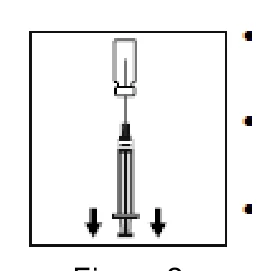
Figure 2
- Make sure the end of the needle tip is in the liquid and not in the airspace.
- With the needle tip in the liquid, gently pull back the plunger to draw all the liquid into the syringe.
- Pull the large needle out of the vial.
Step 5: Changing the injecting needle
- Put the needle cover on the large 21-gauge green needle. Carefully remove the large needle from the syringe.
- Take the smaller 27-gauge grey injecting needle out of its packaging. Keep the needle cover on.
- Attach the small 27-gauge grey needle to the syringe by joining them together. Remove the needle cover. Do not touch the needle.
- Administer the injection immediately according to the following steps.
Step 6: Removing air bubbles
- Hold the syringe straight up with the small 27-gauge grey needle pointing to the ceiling. Pull back slightly on the plunger. Tap the syringe so that any air bubbles rise to the top. This is shown in Figure 3.
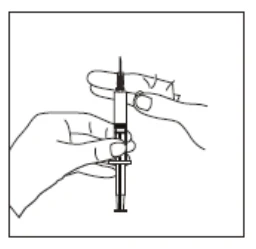
Figure 3
- Slowly press the plunger upwards until all the air is out of the syringe. At least one drop of solution should come out of the tip of the needle.
Step 7: Injection by subcutaneous administration
Your healthcare professional will have already shown you where to inject INPROSUB™. This location will be the stomach or the front of your thigh (as shown in Figure 4a), choose
- a different injection site each day. Do not inject INPROSUB™ into an area of skin that is tender, bruised, red or hard.
- Open the alcohol wipe. Use it to carefully clean the area of skin where you will inject INPROSUB™. Let the area dry. Do not touch this area again before giving the injection.
- Hold the syringe in your dominant hand (the one you write with) like you are holding a pencil. With your other hand, use the thumb and index finger to gently pinch the skin of the injection site area. This is shown in Figure 4b.

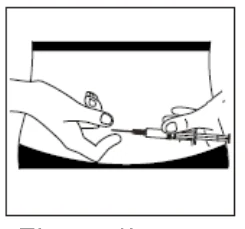
Figure 4a Figure 4b
Using a quick, firm (dart-like) motion insert the small 27-gauge grey needle into the skin. Insert the needle at a 45o angle or as directed by your healthcare professional. Push the needle all the way into the skin. This is shown in Figure 5. Do not inject directly into a vein.
- If there is any blood drawn into the syringe, it may mean the needle tip has pierced a vein. If this happens, remove the syringe. Cover the injection site with an alcohol wipe and apply pressure. Choose a new injection site.
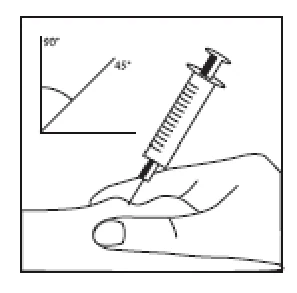
Figure 5
- Once the needle is inserted into the skin, inject the solution by pushing gently on the plunger in a slow and steady motion. Be sure to inject all of the solution. Count to 5.
- Let go of your skin. Pull the needle straight out.
- Using a circular motion, wipe the skin at the injection site with an alcohol wipe. You may cover the injection site with a small adhesive bandage, if needed.
Step 8: Disposal of used items
- Once you have finished your injection, carefully put all needles, syringes and empty vials into a sharps container.
- Any unused solution must also be thrown away.
Usual dose:
One 25 mg injection per day usually until 12 weeks of a pregnancy is confirmed. This means you will normally use INPROSUB™ for a total of 10 weeks.
Overdose:
Tell your healthcare professional if you use more INPROSUB™ than you should. The symptoms of an overdose include drowsiness.
| If you think you have taken too much INPROSUB™, contact your healthcare professional, hospital emergency department or regional poison control centre immediately, even if there are no symptoms. |
Missed Dose:
If you forget to use INPROSUB™, take the dose as soon as you remember. Do not inject two doses at the same time to make up for a missed dose.
What are possible side effects from using INPROSUB™?
These are not all the possible side effects you may feel when taking INPROSUB™. If you experience any side effects not listed here, contact your healthcare professional:
- reactions at the site of the injection (bruising, irritation, itching, pain or discomfort, swelling, bump under the skin, thickening of the tissue under the skin)
- headache
- constipation
- diarrhea
- gas
- heartburn
- fever
- nausea
- abdominal bloating, discomfort or pain
- discharge from the vagina
- vaginal itching and discomfort
- breast pain or tenderness
- back pain
- hives
- rash
- flushing
- acne
- hair loss
- excessive growth of dark, coarse hair on the face, chest and back
- weight gain
- mood swings
- depression
- irritability
- fatigue
- drowsiness
- trouble sleeping
- dizziness
- fluid retention
- infections
Serious side effects and what to do about them
| Symptom / effect | Talk to your healthcare professional | Stop taking drug and get immediate medical help | |
| Only if severe | In all cases | ||
| VERY COMMON | |||
| Uterine cramping | ✔ | ||
| Vaginal bleeding | ✔ | ||
| COMMON | |||
| Ovarian hyperstimulation syndrome (extra hormones in the blood trigger eggs to develop causing the ovaries to swell): abdominal pain, bloating, nausea, vomiting, diarrhea | ✔ | ||
| Antepartum hemorrhage (bleeding from the genital tract in the last half of pregnancy): bleeding from the vagina, abdominal pain and cramping | ✔ | ||
| Spontaneous abortion / missed abortion (miscarriage before 20 weeks of pregnancy): cramping in the lower abdomen, discharge of fluid or tissue from the vagina | ✔ | ||
| Vomiting | ✔ | ||
| RARE | |||
| Retinal vascular lesions (blood clots in the eyes): loss of vision | ✔ | ||
| Arterial or venous thromboembolism (blood clots in an artery or vein): chest pain, shortness of breath, dizziness, face drooping on one side, swelling, pain or weakness in arm or leg, arm or leg may be red and feel warm to the touch | ✔ | ||
| Jaundice (build-up of bilirubin in the blood): yellowing of the skin and eyes, dark urine, light coloured stool, itching all over your body | ✔ | ||
If you have a troublesome symptom or side effect that is not listed here or becomes bad enough to interfere with your daily activities, talk to your healthcare professional.
Reporting Side Effects
You can report any suspected side effects associated with the use of health products to Health Canada by:
NOTE: Contact your health professional if you need information about how to manage your side effects. The Canada Vigilance Program does not provide medical advice. |
Storage:
Keep out of reach and sight of children.
Store at room temperature (15ºC to 25ºC). Keep INPROSUB™ in the outer carton until the time of use to protect from light. Do not refrigerate or freeze.
If you want more information about INPROSUB™:
- Talk to your healthcare professional
- Find the full product monograph that is prepared for healthcare professionals and includes this Patient Medication Information by visiting the Health Canada website (https://health-products.canada.ca/dpd-bdpp/index-eng.jsp); the manufacturer’s website www.inprosub.net, or by calling (905) 477-4553.