


Product Monograph - Intrarosa
RECENT MAJOR LABEL CHANGES
Not Applicable.
TABLE OF CONTENTS
Sections or subsections that are not applicable at the time of authorization are not listed.
RECENT MAJOR LABEL CHANGES ................................................................................................... 2
TABLE OF CONTENTS ...................................................................................................................... 2
PART I: HEALTH PROFESSIONAL INFORMATION ........................................................................... 4
1 INDICATIONS ............................................................................................................... 4
1.1 Pediatrics ............................................................................................................ 4
1.2 Geriatrics............................................................................................................. 4
2 CONTRAINDICATIONS ................................................................................................. 4
4 DOSAGE AND ADMINISTRATION ................................................................................ 4
4.1 Dosing Considerations .........................................................................................4
4.2 Recommended Dose and Dosage Adjustment ....................................................4
4.4 Administration .....................................................................................................5
4.5 Missed Dose .........................................................................................................5
5 OVERDOSAGE .............................................................................................................. 5
6 DOSAGE FORMS, STRENGTHS, COMPOSITION AND PACKAGING ............................. 5
7 WARNINGS AND PRECAUTIONS ................................................................................. 5
7.1 Special Populations ..............................................................................................6
7.1.1 Pregnant Women.................................................................................................6
7.1.2 Breast-feeding .....................................................................................................6
7.1.3 Pediatrics .............................................................................................................6
7.1.4 Geriatrics..............................................................................................................6
8 ADVERSE REACTIONS .................................................................................................. 6
8.1 Adverse Drug Reactions Overview ......................................................................6
8.2 Clinical Trial Adverse Drug Reactions ..................................................................6
8.4 Abnormal Laboratory Findings: Hematologic, Clinical Chemistry and
Other Quantitative Data ......................................................................................7
9 DRUG INTERACTIONS .................................................................................................. 7
9.2 Drug Interactions Overview .................................................................................7
9.3 Drug-Behavioural Interactions ............................................................................7
9.4 Drug-Drug Interactions ........................................................................................7
9.5 Drug-Food Interactions ........................................................................................7
9.6 Drug-Herb Interactions ........................................................................................7
9.7 Drug-Laboratory Interactions ..............................................................................8
10 CLINICAL PHARMACOLOGY ........................................................................................ 8
10.1 Mechanism of Action ...........................................................................................8
10.2 Pharmacodynamics .............................................................................................8
10.3 Pharmacokinetics ................................................................................................8
11 STORAGE, STABILITY, AND DISPOSAL ........................................................................ 8
12 SPECIAL HANDLING INSTRUCTIONS ........................................................................... 9
PART II: SCIENTIFIC INFORMATION ............................................................................................. 10
13 PHARMACEUTICAL INFORMATION .......................................................................... 10
14 CLINICAL TRIALS ........................................................................................................ 10
14.1 Trial Design and Study Demographics ...............................................................10
14.2 Study Results .....................................................................................................11
15 MICROBIOLOGY ......................................................................................................... 12
16 NON-CLINICAL TOXICOLOGY ..................................................................................... 12
PATIENT MEDICATION INFORMATION ........................................................................................ 13
PART I: HEALTH PROFESSIONAL INFORMATION
1 INDICATIONS
Intrarosa® (prasterone vaginal ovules) is indicated for:
- Treatment of postmenopausal vulvovaginal atrophy.
1.1 Pediatrics
Pediatrics (< 16 years of age): Intrarosa® is indicated only for postmenopausal women.
1.2 Geriatrics
Geriatrics (> 65 years of age): Use as recommended.
2 CONTRAINDICATIONS
- Intrarosa® is contraindicated in patients who are hypersensitive to this drug or to any ingredient in the formulation, including any non-medicinal ingredient, or component of the container. For a complete listing, see 6 DOSAGE FORMS, STRENGTHS, COMPOSITION AND PACKAGING.
- Intrarosa® is contraindicated in women with undiagnosed abnormal genital bleeding. Any postmenopausal woman with undiagnosed, persistent, or recurring genital bleeding should be adequately evaluated to determine the cause before considering initiating treatment with Intrarosa®.
4 DOSAGE AND ADMINISTRATION
4.1 Dosing Considerations
No dose adjustment is required in these situations:
- elderly women (> 65 years of age).
- in case of hepatic or renal impairment. The pharmacokinetics of prasterone have not been studied in these patients.
4.2 Recommended Dose and Dosage Adjustment
- Intrarosa® is administered intravaginally with the use of the provided applicator or with fingers.
- One vaginal ovule is administered once a day at bedtime.
Once treatment has been initiated, women should be re-evaluated periodically, preferably every
6 months or as clinically appropriate, to determine if treatment is still necessary.
- Intrarosa® is not indicated for pediatric use.
4.4 Administration
Intrarosa® can be placed into the vagina with the use of the provided applicator:
- 1. Using an applicator, administer one vaginal ovule once a day at bedtime.
- 2. Place the vaginal ovule into the vagina as far as it can comfortably go without force.
- 3. Press the plunger to release the ovule.
- 4. Withdraw the applicator, disassemble, and rinse the two pieces for 30 seconds under running water before wiping with a paper towel or the like and reassemble.
- 5. Discard the applicator after one week of usage.
- 6. Two extra applicators are provided, if necessary.
Intrarosa® can be placed into the vagina with fingers:
- 1. The vaginal ovule should be placed into the vagina as far as it can comfortably go without force.
4.5 Missed Dose
If a dose is forgotten, it should be taken as soon as the woman remembers. However, if the next dose is due in less than 8 hours, the woman should skip the missed vaginal ovule. Do not use two vaginal ovules to make up for a forgotten dose.
5 OVERDOSAGE
No experience of overdosage is available.
For management of a suspected drug overdose, contact your regional poison control centre.
6 DOSAGE FORMS, STRENGTHS, COMPOSITION AND PACKAGING
Table 1 – Dosage Forms, Strengths, Composition and Packaging
| Route of Administration | Dosage Form / Strength/Composition | Non-medicinal Ingredients |
| Vaginal | Ovule / 6.5 mg prasterone | Hard fat |
Intrarosa® is a white, bullet-shaped vaginal ovule approximately 28 mm long and 8.6 mm in diameter at its widest end.
Each vaginal ovule contains 6.5 mg of prasterone in a hard fat. Intrarosa® is available in a small carton box containing 4 blister packs of 7 ovules each (28 vaginal ovules per box). The box containing the vaginal ovules is packed inside a larger carton box with 6 plastic applicators and the patient medication information.
7 WARNINGS AND PRECAUTIONS
General
Estrogen is a metabolite of prasterone. Use of exogenous estrogen is contraindicated in women with a known history of breast cancer. Intrarosa® has not been studied in women with a history of breast cancer.
- Women should undergo regular gynecological and breast exams according to current Canadian guidelines.
- Women with vaginal infection should be treated with appropriate antimicrobial therapy before starting treatment with Intrarosa®.
- The melting of the hard fat, associated with increased vaginal secretions, may result in vaginal discharge.
7.1 Special Populations
7.1.1 Pregnant Women
Intrarosa® is only indicated in postmenopausal women. There are no data on the use of Intrarosa® in pregnant women. No studies in animals were performed with regard to reproductive toxicity.
7.1.2 Breast-feeding
Intrarosa® is not indicated during breast-feeding.
It is unknown if the drug is excreted in human milk.
7.1.3 Pediatrics
Pediatrics (< 16 years of age): Intrarosa® is indicated only in postmenopausal women, therefore safety and effectiveness have not been examined in pediatric patients.
7.1.4 Geriatrics
Geriatrics (> 65 years of age): Among 1196 patients who received Intrarosa® in clinical trials, 17% of participants in the four 12-week placebo-controlled studies were older than 65 years of age and 9.2% of participants in the 52-week open-label clinical trial were over age 65. Use as recommended.
8 ADVERSE REACTIONS
8.1 Adverse Drug Reactions Overview
The adverse reactions associated with Intrarosa® were generally similar between placebo and the 6.5 mg prasterone group, except for application site discharge (3.4% for placebo versus 8.3% for 6.5 mg prasterone).
8.2 Clinical Trial Adverse Drug Reactions
Clinical trials are conducted under very specific conditions. The adverse reaction rates observed in the clinical trials, therefore may not reflect the rates observed in practice and should not be compared to the rates in the clinical trials of another drug. Adverse reaction information from clinical trials may be useful in identifying and approximating rates of adverse drug reactions in real-world use.
The safety data for Intrarosa® were obtained from one single-center and four multicenter, randomized, double blind, placebo-controlled PK/efficacy studies and one uncontrolled, 52-week open-label safety study. The safety data was pooled for a total of 1196 postmenopausal women treated with vaginal ovules containing 6.5 mg of prasterone, including 435 women treated daily for one year.
The most frequent adverse reaction (≥ 1%) reported with 6.5 mg prasterone vaginal ovules from the clinical studies was application site discharge, with an incidence of 8.3% compared to 3.4% for placebo.
Table 2 –Most Frequent Adverse Reaction (≥ 1%) Reported with Intrarosa® from Clinical Trials
System Organ Class Preferred Term | Intrarosa® | Placebo | ||||
| n = 1196 | n = 474 | |||||
| (%) | (%) | |||||
General Disorders and Administration Site Conditions Application Site Discharge | 8.3 | 3.4 | ||||
8.4 Abnormal Laboratory Findings: Hematologic, Clinical Chemistry and Other Quantitative Data
Clinical Trial Findings
Laboratory Parameters - Hematology, serum chemistry and urinalysis parameters displayed no clinically significant changes from baseline to the final assessment (up to 12 weeks), and values generally remained within the normal adult female ranges.
Serum Prasterone and Related Steroid Levels - Following intravaginal administration of prasterone, serum steroid levels did not increase beyond the normal upper limits for postmenopausal women.
Endometrial Biopsies - A total of 882 women had an end-of-study endometrial biopsy in clinical trials ERC-210 (12 weeks), ERC-230 (52 weeks), ERC-231 (12 weeks) and ERC-234 (12 weeks; reduced dosing regimen). The endometrium was atrophic in 92.6% (817) of subjects.
Cervical Cytology - According to study protocol, participants were to have a normal Pap smear and normal mammography at study entrance. In the 521 postmenopausal women who participated in the 52-week non-comparative, open-label clinical trial, 11 cases of abnormal Pap smear (2.1%) were reported. The 11 cases of abnormal Pap smear at week 52 included 10 cases of atypical squamous cells of unknown significance (ASCUS) and 1 case of low grade squamous intraepithelial lesion (LSIL).
9 DRUG INTERACTIONS
9.2 Drug Interactions Overview
Interference of Intrarosa® with the action of other medicines is not expected.
9.3 Drug-Behavioural Interactions
Intrarosa® can weaken condoms, diaphragms or cervical caps made of latex.
Intrarosa® has no potential interaction with alcohol.
9.4 Drug-Drug Interactions
Interactions with other drugs have not been established.
9.5 Drug-Food Interactions
Interactions with food have not been established but are not expected.
9.6 Drug-Herb Interactions
Interactions with herbal products have not been established but are not expected.
9.7 Drug-Laboratory Interactions
Interactions with laboratory tests are not expected.
10 CLINICAL PHARMACOLOGY
10.1 Mechanism of Action
Prasterone is a natural steroid compound, inactive by itself, with no estrogenic, androgenic, or other hormonal activity. Following intravaginal administration, it is transformed inside the vaginal cells into estrogens and androgens, and the sex steroids made intracellularly are also inactivated locally inside the same cells, thus avoiding exposure of other tissues. This mechanism is comparable to the physiological functioning observed in normal postmenopausal women, where the peripheral tissues make and inactivate their own intracellular sex steroids exclusively from circulating endogenous prasterone, explaining why serum estrogens and androgens remain at low concentrations following menopause and during intravaginal administration of Intrarosa®.
10.2 Pharmacodynamics
Statistically significant beneficial effects (p=0.017 to < 0.0001) were observed at 2 weeks on pH as well as on parabasal and superficial cells, with 52% to 81% of the 12-week effects observed by 2 weeks. For the effect on pain with sexual activity and vaginal dryness, the severity score decreased by 40% and 65% at 2 weeks compared to 12 weeks, an effect which became statistically significant at 8 weeks (p=0.04 and 0.004, respectively).
10.3 Pharmacokinetics
Absorption
Prasterone administered locally in the vagina is an inactive precursor of sex steroids that enters the vaginal cells and is converted intracellularly into estrogens and androgens, depending upon the level of enzymes expressed in each cell type, thus exerting beneficial effects on the symptoms and signs of vulvovaginal atrophy through activation of the vaginal estrogen and androgen receptors. Outside the vaginal cells, there are limited increases in serum estrogen (estradiol, E2) or androgen (testosterone) concentrations, which all remain within normal postmenopausal values.
Distribution
The distribution of intravaginally administered prasterone is essentially limited to the vagina.
Metabolism
Exogenous prasterone is metabolized in the same manner as endogenous prasterone.
Elimination
Prasterone as well as the resulting estrogens and androgens formed in the vagina are inactivated intracellularly and are excreted by the kidney and liver as inactive glucuronide and sulfate conjugates.
11 STORAGE, STABILITY, AND DISPOSAL
Store between 2°C to 30°C in original package to protect from light.
Keep in safe place out of the reach and sight of children.
12 SPECIAL HANDLING INSTRUCTIONS
None required.
PART II: SCIENTIFIC INFORMATION
13 PHARMACEUTICAL INFORMATION
Drug Substance
Proper/Common Name: Prasterone
Chemical name: 3β-hydroxyandrost-5-en-17-one, 5-androstene-3β -ol-17-one
Molecular formula and molecular mass: C19H28O2 (288.43 g/mol)
Structural formula:
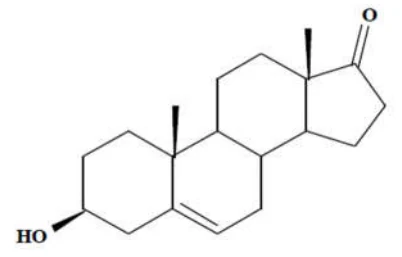
Physicochemical properties: Prasterone is a white to off-white crystalline powder.
- Prasterone occurs mainly as dimorphous needles with a melting point of 140-141°C and leaflets with a melting point of 152-153°C. Other polymorphic forms (form III, form IV, form V) and hydrates (S1, S2 and S3) are also known.
- pH: Not applicable: Prasterone is insoluble in water and possesses only an aliphatic alcohol function.
- pKa (s): Not applicable: Prasterone is insoluble in water and possesses only an aliphatic alcohol function.
A typical DSC curve has a melting peak onset at 146.13°C with a maximum at 148.38°C
(scanning at 1°C/min).
Rotation [α] D25 = +11.0 to 13.0° (in ethanol 95%), as per current United States
Pharmacopoeia, section <781S>.
14 CLINICAL TRIALS
14.1 Trial Design and Study Demographics
Table 3 - Summary of Patient Demographics for Clinical Trials on Vulvovaginal Atrophy
| Study # | Study design | Dosage, route of | Study subjects (n) | Mean age (Range) | Sex | ||
| administration and | |||||||
| duration | |||||||
| ERC-231 | Randomized (1:1:1) Double-blind Placebo-controlled | 0, 3.25, or 6.5 mg Vaginal 12 weeks | 255 | 58.6 (40 to 75) | F | ||
| ERC-238 | Randomized (1:2) Double-blind Placebo-controlled | 0 or 6.5 mg Vaginal 12 weeks | 558 | 59.5 (40 to 80) | F | ||
The effectiveness of Intrarosa® on moderate to severe dyspareunia and vaginal dryness, two symptoms of vulvovaginal atrophy due to menopause, was confirmed in two pivotal 12-week placebo-controlled efficacy trials, namely ERC-231 and ERC-238.
The first clinical trial ERC-231 was a 12-week randomized, double-blind and placebo-controlled Phase III study that enrolled 255 generally healthy postmenopausal women between 40 to 75 years of age (mean 58.6 years) who, at baseline, had identified moderate to severe dyspareunia as their most bothersome symptom of vulvovaginal atrophy. In addition to dyspareunia, women had ≤ 5% superficial cells on vaginal smear and a vaginal pH ˃ 5. Women were randomized in a 1:1:1 ratio between the three treatment groups who received daily one vaginal ovule containing 3.25 mg prasterone (n=87), 6.5 mg prasterone (n=87) or placebo (n=81). All women were assessed for improvement in the change from baseline to week 12 for the co-primary efficacy endpoints, namely the most bothersome symptom dyspareunia, the percentage of vaginal superficial cells, the percentage of parabasal cells, and vaginal pH.
The second clinical trial ERC-238 was a 12-week randomized, double-blind and placebo-controlled Phase III study that enrolled 558 generally healthy postmenopausal women between 40 to 80 years of age (mean 59.5 years) who, at baseline, had identified moderate to severe dyspareunia as their most bothersome symptom of vulvovaginal atrophy. In addition to dyspareunia, the women had ≤ 5% superficial cells on vaginal smear and a vaginal pH ˃ 5. Women were randomized in a 2:1 ratio between 6.5 mg prasterone (n=376) and placebo (n=182). Primary endpoints and study conduct were similar to those in Study ERC-231.
14.2 Study Results
Table 4 - Results of Study ERC-231 on Vulvovaginal Atrophy (ITT Population)
| Primary Endpoints | Difference compared to | P value | ||||
| placebo | (compared to placebo) | |||||
| Dyspareunia1,2 |
| 0.0132 | ||||
| Superficial cells | + 4.7 % | < 0.0001 | ||||
| Parabasal cells |
| < 0.0001 | ||||
| Vaginal pH |
| < 0.0001 | ||||
1 Moderate to severe dyspareunia at baseline was considered by women as their most bothersome symptom. 2 A similar significant improvement of moderate to severe vaginal dryness was also demonstrated in this pivotal trial with p value versus placebo of 0.013.
Table 5 - Results of Study ERC-238 on Vulvovaginal Atrophy (ITT Population)
| Primary Endpoints | Difference compared to | P value | ||||
| placebo | (compared to placebo) | |||||
| Dyspareunia1,2 |
| 0.0002 | ||||
| Superficial cells | + 8.5 % | < 0.0001 | ||||
| Parabasal cells |
| < 0.0001 | ||||
| Vaginal pH |
| < 0.0001 | ||||
1 Moderate to severe dyspareunia at baseline was considered by women as their most bothersome symptom. 2 A similar significant improvement of moderate to severe vaginal dryness was also demonstrated in this pivotal trial with p value versus placebo of 0.004.
Comparable effectiveness was observed in all four co-primary endpoints of the two pivotal 12-week clinical trials. When the severity score of moderate to severe dyspareunia considered by women at baseline as their most bothersome symptom was analyzed in the intent-to-treat (ITT) population, decreases of 0.40 and 0.35 score units compared to placebo were observed, with p values versus placebo of 0.0132 (ERC-231) and 0.0002 (ERC-238). Compared to placebo, superficial cells increased by 4.7% and 8.5%, and parabasal cells decreased by 45.8% and 29.5%, respectively, while vaginal pH decreased by 0.83 and 0.67 unit over placebo, respectively (p< 0.0001 versus placebo for the three parameters in both studies). A similar significant improvement of moderate to severe vaginal dryness was also demonstrated in these two pivotal trials, with p values versus placebo of 0.013 (ERC-231) and 0.004 (ERC-238).
Serum prasterone and related steroid levels were determined for women aged 40-80 years with moderate to severe symptoms of vulvovaginal atrophy (VVA) who received daily intravaginal administration of 6.5 mg prasterone for 12 weeks (n=723) compared with those who received placebo (n=266). Serum steroid levels were measured at Day 1 and week 12 by liquid chromatography-tandem mass spectrometry (LC-MS/MS). All serum sex steroid levels remained within normal postmenopausal values.
15 MICROBIOLOGY
No microbiological information is required for this drug product.
16 NON-CLINICAL TOXICOLOGY
Carcinogenicity: Long-term studies in animals to determine carcinogenic potential have not been performed with prasterone. Estradiol and testosterone, two metabolites of prasterone, are carcinogenic in animals.
Genotoxicity: The mutagenic potential of prasterone was evaluated in three standard genotoxicity assays performed under GLP conditions, namely a bacterial mutagenicity assay, a human blood lymphocyte assay, and an in vivo mouse bone marrow micronucleus assay. Prasterone was considered negative in the three genotoxicity assays.
Reproductive and Developmental Toxicology: Reproductive and teratology studies were not performed since intravaginal prasterone is for exclusive use in postmenopausal women for the proposed indication namely, vulvovaginal atrophy.