


Product Monograph - IPG-Losartan
SUMMARY PRODUCT INFORMATION
Route of Administration | Dosage Form / Strength | All Nonmedicinal Ingredients |
| Oral | 25, 50 mg and 100 mg | Microcrystalline cellulose, Starch pregelatinized, Colloidal silicon dioxide, Lactose monohydrate, Magnesium Stearate, Hypromellose 5 cps, Hydroxypropyl Cellulose, Titanium dioxide and water. |
INDICATIONS AND CLINICAL USE
Hypertension: IPG-Losartan (losartan potassium) is indicated for the treatment of essential hypertension. IPG-Losartan is also indicated in patients with essential hypertension and left ventricular hypertrophy (see CLINICAL TRIALS).
IPG-Losartan may be used alone or concomitantly with thiazide diuretics.
A great majority of patients with severe hypertension in controlled clinical trials required combination therapy. Losartan potassium has been used concomitantly with beta-blockers and calcium channel blockers, but the data on such use are limited.
Type 2 Diabetic Patients with Proteinuria and Hypertension: IPG-Losartan is also indicated to delay the progression of renal disease as measured by the occurrence of doubling of serum creatinine, and end stage renal disease, and to reduce proteinuria (see CLINICAL TRIALS).
Geriatrics (≥ 65 years of age): In clinical studies, there was no age-related difference in the efficacy or safety profile of losartan (see WARNINGS AND PRECAUTIONS).
Pediatrics (6-16 years of age): Antihypertensive effects of losartan potassium have been demonstrated in hypertensive pediatric patients aged 6 to 16 years. Use of losartan potassium in these age groups is supported by evidence from adequate and well-controlled studies of losartan potassium in pediatric patients (see CONTRAINDICATIONS, WARNINGS AND PRECAUTIONS, ACTION AND CLINICAL PHARMACOLOGY and CLINICAL TRIALS).
CONTRAINDICATIONS
- Patients who are hypersensitive to this drug or to any ingredient in the formulation or component of the container. For a complete listing, see DOSAGE FORMS, COMPOSITION AND PACKAGING section of the Product Monograph.
- Concomitant use of angiotensin receptor antagonists (ARBs) –including losartan - or of angiotensin-converting-enzyme inhibitors (ACEIs) with aliskiren-containing drugs in patients with diabetes mellitus (type 1 or type 2) or moderate to severe renal impairment (GFR < 60 ml/min/1.73 m2) is contraindicated (see WARNINGS and PRECAUTIONS, Dual Blockade of the Renin-Angiotensin System (RAS) and Renal, and DRUG INTERACTIONS, Dual Blockade of the Renin-Angiotensin-System (RAS) with ACEIs, ARBs or aliskiren-containing drugs).
WARNINGS AND PRECAUTIONS
Serious Warnings and Precautions
When used in pregnancy, angiotensin receptor (AT1) blockers (ARB) can cause injury or even death of the developing fetus. When pregnancy is detected, IPG-Losartan should be discontinued as soon as possible (see WARNINGS AND PRECAUTIONS, Special Populations).
Carcinogenesis and Mutagenesis
There is no evidence of carcinogenesis and mutagenesis associated with losartan (see TOXICOLOGY).
Cardiovascular
Hypotension: Occasionally, symptomatic hypotension has occurred after administration of losartan, in some cases after the first dose. It is more likely to occur in patients who are volume-depleted by diuretic therapy, dietary salt restriction, dialysis, diarrhea, or vomiting. In these patients, because of the potential fall in blood pressure, therapy should be started under close medical supervision. Similar considerations apply to patients with ischemic heart or cerebrovascular disease, in whom an excessive fall in blood pressure could result in myocardial infarction or cerebrovascular accident.
Valvular Stenosis: There is concern on theoretical grounds that patients with aortic stenosis might be at particular risk of decreased coronary perfusion when treated with vasodilators because they do not develop as much afterload reduction.
Dual blockade of the Renin-Angiotensin System (RAS)
There is evidence that co-administration of angiotensin receptor antagonists (ARBs), such as losartan, or of angiotensin-converting-enzyme inhibitors (ACEIs) with aliskiren increases the risk of hypotension, syncope, stroke, hyperkalemia and deterioration of renal function, including renal failure, in patients with diabetes mellitus (type 1 or type 2) and/or moderate to severe renal impairment (GFR < 60 ml/min/1.73 m2). Therefore, the use of losartan in combination with aliskiren-containing drugs is contraindicated in these patients. Co-administration of ARBs, including losartan, with other agents blocking the RAS, such as ARBs or aliskiren-containing drugs, is not recommended in any patients, as adverse outcomes cannot be excluded.
Hepatic/Biliary/Pancreatic
Hepatic Impairment: Based on pharmacokinetic data which demonstrate significantly increased plasma concentrations of losartan and its active metabolite in cirrhotic patients after administration of losartan potassium, a lower dose should be considered for patients with hepatic impairment, or a history of hepatic impairment (see DOSAGE AND ADMINISTRATION and DETAILED PHARMACOLOGY).
Renal
Renal Impairment: As a consequence of inhibiting the renin-angiotensin-aldosterone system, changes in renal function have been reported in susceptible individuals. In patients whose renal function may depend on the activity of the renin-angiotensin-aldosterone system, such as patients with bilateral renal artery stenosis, unilateral renal artery stenosis to a solitary kidney, or severe congestive heart failure, treatment with agents that inhibit this system has been associated with oliguria, progressive azotemia, and rarely, acute renal failure and/or death. In susceptible patients, concomitant diuretic use may further increase risk.
The use of ARBs – including losartan – or of ACEIs with aliskiren-containing drugs is contraindicated in patients with moderate to severe renal impairment (GFR <60 ml/min/1.73 m2). (See CONTRAINDICATIONS and DRUG INTERACTIONS, Dual Blockade of the Renin-Angiotensin-System (RAS) with ARBs, ACEIs, or aliskiren-containing drugs).
Use of losartan should include appropriate assessment of renal function.
Hyperkalemia: In a clinical study conducted in patients with type 2 diabetes with proteinuria and hypertension, the incidence of hyperkalemia was higher in the group treated with losartan potassium (9.9%) as compared to the placebo group (3.4%), however, few patients discontinued therapy due to hyperkalemia. Careful monitoring of serum potassium is recommended (see CLINICAL TRIALS and ADVERSE REACTIONS, Abnormal Hematologic and Clinical Chemistry Findings).
Sensitivity/Resistance
Hypersensitivity: Anaphylactic reactions, angioedema (involving swelling of the larynx and glottis causing airway obstruction and/or swelling of the face, lips, and/or tongue and pharynx, requiring intubation/tracheotomy in some cases) have been reported rarely in patients treated with losartan; some of these patients previously experienced angioedema with ACE inhibitors. Vasculitis, including Henoch-Schoenlein purpura, has been reported rarely.
Special Populations
Pregnant Women: Drugs that act directly on the renin-angiotensin-aldosterone-system (RAAS)
can cause fetal and neonatal morbidity and death when administered to pregnant women. When pregnancy is detected, IPG-Losartan should be discontinued as soon as possible.
The use of ARB is not recommended during pregnancy. Epidemiological evidence regarding the risk of teratogenicity following exposure to angiotensin converting enzyme inhibitors (another class of therapeutic products interfering with the RAAS) during the first trimester of pregnancy has not been conclusive; however a small increase in risk cannot be excluded. Given the current evidence available on the risk with ARB, similar risks may exist for this class of drugs. Patients planning pregnancy should be changed to alternative anti-hypertensive treatments which have an established safety profile for use in pregnancy. When pregnancy is diagnosed, treatment with angiotensin II antagonists should be stopped immediately, and, if appropriate, alternative therapy should be started.
The use of ARBs during the second and third trimesters is known to induce human fetotoxicity (decreased renal function; oligohydramnios, skull ossification retardation) and neonatal toxicity (renal failure, hypotension, hyperkalemia).
Infants with a history of in utero exposure to ARBs should be closely observed for hypotension, oliguria, and hyperkalemia. If oliguria occurs, attention should be directed toward support of blood pressure and renal perfusion. Exchange transfusion or dialysis may be required as means of reversing hypotension and/or substituting for impaired renal function; however, limited experience with those procedures has not been associated with significant clinical benefit. Neither losartan nor the active metabolite can be removed by hemodialysis.
Animal data
Losartan potassium has been shown to produce adverse effects in rat fetuses and neonates, which include decreased body weight, mortality and/or renal toxicity. Significant levels of losartan and its active metabolite were shown to be present in rat milk. Based on pharmacokinetic assessments, these findings are attributed to drug exposure in late gestation and during lactation.
Nursing Women: It is not known whether losartan or its active metabolite are excreted in human milk, but significant levels of both of these compounds have been found in the milk of lactating rats. Because many drugs are excreted in human milk, and because of their potential for affecting the nursing infant adversely, a decision should be made whether to discontinue nursing or discontinue the drug, taking into account the importance of the drug to the mother.
Geriatrics (≥ 65 years of age): No overall differences in safety were observed between elderly and younger patients, but appropriate caution should nevertheless be used when prescribing to elderly, as increased vulnerability to drug effect is possible in this patient population. This conclusion is based on 391 of 2085 (19%) patients, 65 years and over who received losartan monotherapy in controlled trials for hypertension. This was also the finding in a controlled clinical study in type 2 diabetic patients with proteinuria and hypertension with 248 (33%) of patients 65 years of age and over and in a controlled clinical study in hypertensive patients with left ventricular hypertrophy with 2857 (62%) of patients 65 years of age and over (see CLINICAL TRIALS).
Pediatrics: The antihypertensive effect has been demonstrated in a dose-response study of a limited duration of three weeks, after which half of the patients continued on assigned dosage up to six weeks. Blood pressure declines were maintained in the two highest dose groups.
Renal Impairment
There are no data on the effect of losartan potassium on blood pressure in pediatric patients under the age of six years and neonate, or in pediatric patients with glomerular filtration rate <30 mL/min/1.73 m2.
As a consequence of inhibiting the renin-angiotensin-aldosterone system, changes in renal function have been reported in susceptible individuals. In patients whose renal function may depend on the activity of the renin-angiotensin-aldosterone system, such as patients with bilateral renal artery stenosis, unilateral renal artery stenosis to a solitary kidney, or severe congestive heart failure, treatment with agents that inhibit this system has been associated with oliguria, progressive azotemia, and rarely, acute renal failure and/or death. In susceptible patients, concomitant diuretic use may further increase risk.
Use of losartan should include appropriate assessment of renal function.
Hepatic Impairment
There are no data on the effect of losartan potassium in pediatric patients with hepatic impairments. Long-term safety has been studied in pediatric patients, as an extension of 6 months of the above cited dose-response study.
The pharmacokinetics of losartan have been investigated in 50 hypertensive pediatric patients >1 month to <16 years of age following once daily oral administration of approximately 0.54 to 0.77 mg/kg of losartan (mean doses). The active metabolite is formed from losartan in all age groups. Pharmacokinetics of losartan and its active metabolite are generally similar across the studied age groups and consistent with pharmacokinetic historic data in adults (see ADVERSE REACTIONS and CLINICAL TRIALS).
Race: In the LIFE study, Afro-American Black patients treated with atenolol were at lower risk of experiencing the primary composite endpoint and stroke compared with Afro-American Black patients treated with losartan potassium. Based on the LIFE study, the benefits of losartan potassium on the primary composite endpoint and stroke compared to atenolol do not apply to Afro-American Black patients with hypertension and left ventricular hypertrophy although both treatment regimens effectively lowered blood pressure in these patients (see CLINICAL TRIALS).
Monitoring and Laboratory Tests
Not applicable.
ADVERSE REACTIONS
Adverse Drug Reaction Overview
Losartan potassium has been evaluated for safety in more than 3300 patients treated for essential hypertension. Of these, 2085 were treated with losartan monotherapy in controlled clinical trials.
In open studies, over 1200 patients were treated with losartan for more than 6 months, and over 800 for more than one year.
In controlled clinical trials, discontinuation of therapy due to clinical adverse experiences occurred in 2.3% and 3.7% of patients treated with losartan potassium and placebo, respectively.
The following potentially serious adverse reactions have been reported rarely with losartan in controlled clinical trials: syncope, hypotension.
No relevant differences between the adverse experience profile for pediatric patients and the previously reported for adult patients were identified.
Clinical Trial Adverse Drug Reactions
Because clinical trials are conducted under very specific conditions the adverse reaction rates observed in the clinical trials may not reflect the rates observed in practice and should not be compared to the rates in the clinical trials of another drug. Adverse drug reaction information from clinical trials is useful for identifying drug-related adverse events and for approximating rates.
In these double-blind controlled clinical trials, the following adverse reactions reported with losartan occurred in ≥1 % of patients, regardless of drug relationship:
Losartan (n=2085) | Placebo (n=535) |
Body as a Whole Asthenia/fatigue 3.8 3.9 Edema/swelling 1.7 1.9 Abdominal pain 1.7 1.7 Chest pain 1.1 2.6
Cardiovascular Palpitation 1.0 0.4 Tachycardia 1.0 1.7
Digestive Diarrhea 1.9 1.9 Dyspepsia 1.1 1.5 Nausea 1.8 2.8
Musculoskeletal Back pain 1.6 1.1 Muscle cramps 1.0 1.1
Nervous/Psychiatric Dizziness 4.1 2.4
Headache 14.1 17.2
Losartan (n=2085) | Placebo (n=535) | |
Insomnia Respiratory Cough Nasal congestion Pharyngitis Sinus disorder Upper respiratory infection | 1.1 3.1 1.3 1.5 1.0 6.5 | 0.7 2.6 1.1 2.6 1.3 5.6 |
In these controlled clinical trials for essential hypertension, dizziness was the only adverse experience, occurring in more than 1% of cases, that was reported as drug-related, and that occurred at a greater incidence in losartan-treated (2.4%) than placebo-treated (1.3%) patients.
Losartan potassium was generally well tolerated in a controlled clinical trial in type 2 diabetic patients with proteinuria and hypertension. The most common drug-related side effects were asthenia/fatigue, dizziness, hypotension and hyperkalemia (See WARNINGS AND PRECAUTIONS). In hypertensive patients with left ventricular hypertrophy, the most common drug-related side effects were dizziness, asthenia/fatigue, and vertigo.
Less Common Clinical Trial Adverse Drug Reactions (<1%)
In double-blind, controlled clinical trials for essential hypertension, the following adverse reactions were reported with losartan potassium at an occurrence rate of less than 1%, regardless of drug relationship: orthostatic effects, somnolence, vertigo, epistaxis, tinnitus, constipation, malaise, rash.
Abnormal Hematologic and Clinical Chemistry Findings
In controlled clinical trials for essential hypertension, clinically important changes in standard laboratory parameters were rarely associated with administration of losartan potassium.
Liver Function Tests: In double-blind hypertensive trials, elevations of AST and ALT occurred in 1.1% and 1.9% of patients treated with losartan monotherapy and in 0.8% and 1.3% of patients treated with placebo, respectively. When AST or ALT elevations ≥2X upper limit of normal were compared, the frequency was similar to that seen in placebo.
Hyperkalemia: In controlled clinical trials for essential hypertension, hyperkalemia (serum potassium >5.5 mEq/L) occurred in 1.5% of patients treated with losartan potassium.
In a clinical study conducted in type 2 diabetic patients with proteinuria and hypertension, 9.9% of patients treated with losartan potassium and 3.4% of patients treated with placebo developed hyperkalemia (see WARNINGS AND PRECAUTIONS, Renal, Hyperkalemia).
Creatinine, Blood Urea Nitrogen: Minor increases in blood urea nitrogen (BUN) or serum creatinine were observed in less than 0.1 percent of patients with essential hypertension treated with losartan potassium alone. No patient discontinued taking losartan potassium alone due to increased BUN or serum creatinine.
Hemoglobin and Hematocrit: Small decreases in hemoglobin and hematocrit (mean decreases of approximately 0.11 gram percent and 0.09 volume percent, respectively) occurred frequently in patients treated with losartan potassium alone, but were rarely of clinical importance. In controlled clinical trials no patients were discontinued due to anemia. Discontinuation of losartan treatment due to anemia was reported with post-marketing use of losartan.
In clinical trials, the following were noted to occur with an incidence of <1%, regardless of drug relationship: thrombocytopenia, eosinophilia.
Post-Market Adverse Drug Reactions
Other adverse reactions reported rarely in open-label studies or post-marketing use in patients with essential hypertension, regardless of drug relationship, include anemia, thrombocytopenia (reported rarely), hepatitis, liver function tests abnormalities, vomiting, drug induced cough, asthenia, diarrhea, migraine, dysgeusia, arthralgia, pruritus, erythroderma, taste disorder, urticaria malaise, erectile dysfunction/impotence and photosensitivity. Cases of muscle pain, muscle weakness, myositis and rhabdomyolysis have been reported in patients receiving angiotensin II receptor blockers.
Anaphylactic reactions, angioedema (involving swelling of the larynx and glottis causing airway obstruction and/or swelling of the face, lips, and/or tongue and pharynx, requiring intubation/tracheotomy in some cases) have been reported rarely in patients treated with losartan; some of these patients previously experienced angioedema with ACE inhibitors. Vasculitis, including Henoch-Schoenlein purpura, has been reported rarely.
DRUG INTERACTIONS
Drug-Drug Interactions
Diuretics: Patients on diuretics, and especially those in whom diuretic therapy was recently instituted, may occasionally experience an excessive reduction of blood pressure after initiation of therapy with losartan potassium. The possibility of symptomatic hypotension with the use of losartan potassium can be minimized by discontinuing the diuretic prior to initiation of treatment and/or lowering the initial dose of losartan (see WARNINGS AND PRECAUTIONS, Cardiovascular, Hypotension and DOSAGE AND ADMINISTRATION). No drug interaction of clinical significance has been identified with thiazide diuretics.
Agents Increasing Serum Potassium: Concomitant use of potassium-sparing diuretics (e.g. spironolactone, triamterene, amiloride), potassium supplements, or salt substitutes containing potassium may lead to increases in serum potassium.
Since losartan potassium decreases the production of aldosterone, potassium-sparing diuretics or potassium supplements should be given only for documented hypokalemia and with frequent monitoring of serum potassium. Potassium-containing salt substitutes should also be used with caution.
Dual Blockade of the Renin-Angiotensin-System (RAS) with ARBs, ACEIs or aliskiren containing drugs: Dual Blockade of the Renin-Angiotensin-System (RAS) with ARBs, ACEIs or aliskiren-containing drugs is contraindicated in patients with diabetes and/or renal impairment, and is not recommended in any other patients, as adverse outcomes cannot be excluded. See CONTRAINDICATIONS and WARNINGS AND PRECAUTIONS, Dual Blockade of the Renin-Angiotensin-System (RAS).
Lithium Salts: As with other drugs which affect the excretion of sodium, lithium excretion may be reduced. Therefore, serum lithium levels should be monitored carefully if lithium salts are to be coadministered with angiotensin II receptor antagonists.
Digitalis: In 9 healthy volunteers, when a single oral dose of 0.5 mg digoxin was administered to patients receiving losartan for 11 days, digoxin AUC and digoxin Cmax ratios, relative to placebo, were found to be 1.06 (90% C.I. 0.98 - 1.14) and 1.12 (90% C.I. 0.97 - 1.28), respectively. The effect of losartan on steady state-pharmacokinetics of cardiac glycosides is not known.
Warfarin: Losartan administered for 7 days did not affect the pharmacokinetics or pharmacodynamic activity of a single dose of warfarin. The effect of losartan on steady-state pharmacokinetics of warfarin is not known.
Drugs Affecting Cytochrome P450 System: Rifampin, an inducer of drug metabolism, decreases the concentrations of the active metabolite of losartan. In humans, two inhibitors of P450 3A4 have been studied. Ketoconazole did not affect the conversion of losartan to the active metabolite after intravenous administration of losartan, and erythromycin had no clinically significant effect after oral losartan administration. Fluconazole, an inhibitor of P450 2C9, decreased active metabolite concentration. The pharmacodynamic consequences of concomitant use of losartan and inhibitors of P450 2C9 have not been examined.
When losartan was administered to 10 healthy male volunteers as a single dose in steady-state conditions of phenobarbital, a cytochrome P450 inducer, losartan AUC, relative to baseline, was 0.80 (90% C.I. 0.72 - 0.88), while AUC of the active metabolite, E-3174, was 0.80 (90% C.I. 0.78
- 0.82).
When losartan was administered to 8 healthy male volunteers as a single dose in steady-state conditions of cimetidine, a cytochrome P450 inhibitor, losartan AUC, relative to baseline, was 1.18 (90% C.I. 0.1. 1.10 - 1.27), while AUC of the active metabolite, E-3174, was 1.00 (90% C.I. 0.92 - 1.08).
Non-Steroidal Anti-Inflammatory Drugs Including Cyclooxygenase-2 Inhibitors: Non-steroidal anti-inflammatory drugs (NSAIDs) including indomethacin and selective cyclooxygenase-2 inhibitors (COX-2 inhibitors) may reduce the effect of diuretics and other antihypertensive drugs.
Therefore, the antihypertensive effect of angiotensin II receptor antagonists or ACE inhibitors may be attenuated by NSAIDs including selective COX-2 inhibitors.
In some patients with compromised renal function (e.g., elderly patients or patients who are volume-depleted, including those on diuretic therapy) who are being treated with NSAIDS, including selective COX-2 inhibitors, the coadministration of angiotensin II receptor antagonists or ACE inhibitors may result in a further deterioration of renal function. Cases of acute renal failure, usually reversible, have been reported. Therefore, this combination should be administered with caution in this patient population.
Drug-Food Interactions
Losartan potassium may be administered with or without food.
Drug-Herb Interactions
Interactions with herbal products have not been established.
Drug-Laboratory Test Interactions
Interactions with laboratory tests have not been established.
DOSAGE AND ADMINISTRATION
Recommended Dose and Dosage Adjustment
IPG-Losartan may be administered with or without food, however it should be taken consistently with respect to food intake at about the same time every day.
Hypertension: The dosage of IPG-Losartan must be individualized.
Initiation of therapy requires consideration of recent antihypertensive drug treatment, the extent of blood pressure elevation, salt restriction, and other pertinent clinical factors. The dosage of other antihypertensive agents used with IPG-Losartan may need to be adjusted.
Monotherapy: The usual starting dose of IPG-Losartan is 50 mg once daily.
Dosage should be adjusted according to blood pressure response. The maximal antihypertensive effect is attained 3-6 weeks after initiation of therapy.
The usual dose range for IPG-Losartan is 50 to 100 mg once daily. A dose of 100 mg daily should not be exceeded, as no additional antihypertensive effect is obtained with higher doses.
In most patients taking IPG-Losartan 50 mg once daily, the antihypertensive effect is maintained. In some patients treated once daily, the antihypertensive effect may diminish toward the end of the dosing interval. This can be evaluated by measuring the blood pressure just prior to dosing to determine whether satisfactory control is being maintained for 24 hours. If it is not, either twice daily administration with the same total daily dosage, or an increase in the dose should be considered. If blood pressure is not adequately controlled with IPG-Losartan alone, a non-potassium-sparing diuretic may be administered concomitantly.
For patients with volume-depletion, a starting dose of 25 mg once daily should be considered (see WARNINGS AND PRECAUTIONS, Cardiovascular, Hypotension and DRUG INTERACTIONS).
Concomitant Diuretic Therapy: In patients receiving diuretics, IPG-Losartan therapy should be initiated with caution, since these patients may be volume-depleted and thus more likely to experience hypotension following initiation of additional antihypertensive therapy. Whenever possible, all diuretics should be discontinued two to three days prior to the administration of IPG-Losartan, to reduce the likelihood of hypotension (see WARNINGS AND PRECAUTIONS, Cardiovascular, Hypotension and DRUG INTERACTIONS). If this is not possible because of the patient’s condition, IPG-Losartan should be administered with caution and the blood pressure monitored closely. Thereafter, the dosage should be adjusted according to the individual response of the patient.
Type 2 Diabetic Patients with Proteinuria and Hypertension: The usual starting dose is 50 mg once daily. The dose may be increased to 100 mg once daily based on blood pressure response. IPG-Losartan may be administered with other antihypertensive agents (e.g. diuretics, calcium channel blockers, alpha- or beta-blockers, and centrally acting agents) as well as with insulin and other commonly used hypoglycemic agents (e.g. sulfonylureas, glitazones and glucosidase inhibitors).
Geriatrics (≥ 65 years of age): No initial dosage adjustment is necessary for most elderly patients. However, appropriate monitoring of these patients is recommended.
Pediatrics (6-16 years of age): For patients who can swallow tablets, the recommended dose is 25 mg once daily in patients ≥20 to <50 kg. The dose can be increased to a maximum of 50 mg once daily. In patients ≥50 kg, the starting dose is 50 mg once daily. The dose can be increased to a maximum of 100 mg once daily.
Dosage should be adjusted to blood pressure response.
In pediatric patients who are intravascularly volume depleted, these conditions should be corrected prior to administration of IPG-Losartan.
IPG-Losartan is not recommended in pediatric patients with glomerular filtration rate
<30 mL/min/1.73 m2, in pediatric patients with hepatic impairment, or in neonates as no data are available.
Renal Impairment: No initial dosage adjustment is usually necessary for patients with renal impairment, including those requiring hemodialysis. However, appropriate monitoring of these patients is recommended.
Hepatic Impairment: An initial dosage of 25 mg should be considered for patients with hepatic impairment, or a history of hepatic impairment (see WARNINGS AND PRECAUTIONS, Hepatic/Biliary/Pancreatic, Hepatic Impairment and DETAILED PHARMACOLOGY).
Missed Dose
If a dose is missed, an extra dose should not be taken. The usual schedule must be resumed.
OVERDOSAGE
Limited data are available in regard to overdosage with losartan potassium in humans. The most likely manifestation of overdosage would be hypotension and/or tachycardia. If symptomatic hypotension should occur, supportive treatment should be instituted.
Neither losartan nor the active metabolite can be removed by hemodialysis.
For management of a suspected drug overdose, contact your regional Poison Centre immediately.
ACTION AND CLINICAL PHARMACOLOGY
Mechanism of Action
Losartan potassium antagonizes angiotensin II by blocking the angiotensin type one (AT1) receptor.
Angiotensin II is the primary vasoactive hormone of the renin-angiotensin system. Its effects include vasoconstriction and the stimulation of aldosterone secretion by the adrenal cortex.
Losartan, and its active metabolite, E-3174, block the vasoconstrictor and aldosterone-secreting effects of angiotensin II by selectively blocking the binding of angiotensin II to AT1 receptors found in many tissues, including vascular smooth muscle. A second type of angiotensin II receptor has been identified as the AT2 receptor, but it plays no known role in cardiovascular homeostasis to date. Both losartan and its active metabolite do not exhibit any agonist activity at the AT1 receptor, and have much greater affinity, in the order of 1000-fold, for the AT 1 receptor than for the AT2 receptor. In vitro binding studies indicate that losartan itself is a reversible, competitive antagonist at the AT1 receptor, while the active metabolite is 10 to 40 times more potent than losartan, and is a reversible, non-competitive antagonist of the AT1 receptor.
Neither losartan nor its active metabolite inhibits angiotensin converting enzyme (ACE), also known as kininase II, the enzyme that converts angiotensin I to angiotensin II and degrades bradykinin, nor do they bind to or block other hormone receptors or ion channels known to be important in cardiovascular regulation.
Pharmacodynamics
Losartan inhibits the pressor effect of angiotensin II. A dose of 100 mg inhibits this effect by about 85% at peak, with 25-40% inhibition persisting for 24 hours. Removal of the negative feedback of angiotensin II causes a 2-3 fold rise in plasma renin activity, and a consequent rise in angiotensin II plasma concentration, in hypertensive patients.
Maximum blood pressure lowering, following oral administration of a single dose of losartan, as seen in hypertensive patients, occurs at about 6 hours.
In losartan-treated patients during controlled trials, there was no meaningful change in heart rate.
There is no apparent rebound effect after abrupt withdrawal of losartan therapy.
Black hypertensive patients show a smaller average blood pressure response to losartan monotherapy than other hypertensive patients.
Pharmacokinetics
Table 1: Pharmacokinetic Parameters in Hypertensive Adults Following Multiple Dosing
| Adults given 50 mg once daily for 7 days n=12 | ||
| Parent | Active Metabolite | |
| AUC0-24 hra(ng·hr/mL) | 442 ± 173 | 1685 ±452 |
| Cmax (ng/mL)a | 224 ± 82 | 212 ±73 |
| T½ (h)b | 2.1 ± 0.70 | 7.4 ± 2.4 |
| Tmax (h)c | 0.9 | 3.5 |
| CLr (mL/min) a | 56 ± 23 | 20 ±3 |
a Mean ± standard deviation
b Harmonic mean ± standard deviation
c Median
Absorption: Following oral administration, losartan is well absorbed, with systemic bioavailability of losartan approximately 33%. About 14% of an orally-administered dose of losartan is converted to the active metabolite, although about 1% of subjects did not convert losartan efficiently to the active metabolite.
Mean peak concentrations of losartan occur at about one hour, and that of its active metabolite at about 3-4 hours. Although maximum plasma concentrations of losartan and its active metabolite are approximately equal, the AUC of the metabolite is about 4 times greater than that of losartan.
Distribution: Both losartan and its active metabolite are highly bound to plasma proteins, primarily albumin, with plasma free fractions of 1.3% and 0.2% respectively. Plasma protein binding is constant over the concentration range achieved with recommended doses. Studies in rats indicate that losartan crosses the blood-brain barrier poorly, if at all.
The volume of distribution of losartan is about 34 litres, and that of the active metabolite is about
12 litres.
Metabolism: Losartan is an orally active agent that undergoes substantial first-pass metabolism by cytochrome P450 enzymes. It is converted, in part, to an active carboxylic acid metabolite, E-3174, that is responsible for most of the angiotensin II receptor antagonism that follows oral losartan administration.
Various losartan metabolites have been identified in human plasma and urine. In addition to the active carboxylic acid metabolite, E-3174, several inactive metabolites are formed. In vitro studies indicate that the cytochrome P450 isoenzymes 2C9 and 3A4 are involved in the biotransformation of losartan to its metabolites.
Excretion: The terminal half-life of losartan itself is about 2 hours, and that of the active metabolite, about 6-9 hours. The pharmacokinetics of losartan and this metabolite are linear with oral losartan doses up to 200 mg and do not change over time. Neither losartan nor its metabolite accumulate in plasma upon repeated once-daily administration.
Total plasma clearance of losartan is about 600 mL/min, with about 75 mL/min accounted for by renal clearance. Total plasma clearance of the active metabolite is about 50 mL/min, with about 25 mL/min accounted for by renal clearance. Both biliary and urinary excretion contribute substantially to the elimination of losartan and its metabolites.
Following oral 14C-labeled losartan, about 35% of radioactivity is recovered in the urine and about 60% in the feces. Following an intravenous dose of 14C-labeled losartan, about 45% of radioactivity is recovered in the urine and 50% in the feces.
Pediatrics: The pharmacokinetics of losartan and its active metabolite were generally similar across the studied age groups and historical pharmacokinetic data in adults.
Table 2: Pharmacokinetic Parameters in Hypertensive Infants and Toddlers (Group I: 3-23 months), Preschool Children (Group II; 2-5 years), School-Age Children (Group III; 6-11 years), and Adolescents (Group IV; 12-15 years) Following Multiple Dosing
| Parent | Active Metabolite | |
| AUC0-24 hr observed (ng·hr/mL)a | ||
| Group I (n=9) Group II (n=12)† Group III (n=11) Group IV (n=14) | 244.5 ± 175.7 314.5 ± 177.8 251.0 ± 265.6 303.1 ± 123.6 | 1456.5 ± 1422.7 950.9 ± 498.0 1163.6 ± 1 017.5 1589.9 ± 996.2 |
| AUC0-24 hr per 0.7 mg/kga | ||
| Group I (n=9) Group II (n=13) Group III (n=11) Group IV (n=14) | 246.1 ± 154.0 305.2 ± 164.9 232.6 ± 199.4 405.4 ± 120.3 | 1466.3 ± 1498.8 933.2 ± 510.5 1078.0 ± 783.4 2126.8 ± 1082.4 |
| Cmax observed (ng/mL)a | ||
| Group I (n=9) Group II (n=12)† Group III (n=11) Group IV (n=14) | 66.6 ± 103.6 89.8 ± 96.5 98.7 ± 94.5 105.1 ± 112.3 | 146.9 ± 179.5 91.5 ± 75.2 139.1 ± 148.1 188.2 ± 91.2 |
| Cmax per 0.7 mg/kga | ||
| Group I (n=9) Group II (n=13) Group III (n=11) Group IV (n=14) | 67.0 ± 92.8 89.5 ± 88.3 91.4 ± 81.7 140.6 ± 90.5 | 147.9 ± 190.6 92.0 ± 77.6 128.8 ± 112.1 251.7 ± 118.2 |
| T max (hr)c | ||
| Group I (n=9) Group II (n=13) Group III (n=11) Group IV (n=14) | 1.05 ± 1.38 1.07 ± 1.43 2.03 ± 1.79 1.54 ± 1.27 | 5.53 ± 2.0 6.01 ± 1.5 4.46 ± 2.1 5.00 ± 1.0 |
Parent Active Metabolite Half-Life (hr)b
Group I (n=9) 1.93 ± 0.44 4.83 ± 1.1 Group II (n=13) 2.37 ± 1.24 5.59 ± 1.1 Group III (n=11) 2.18 ± 1.50 5.37 ± 1.4 Group IV (n=14) 2.41 ± 1.84 5.72 ± 1.0 a Geometric Mean ± Standard Deviation
b Harmonic Mean ± Standard Deviation
c Median ± Standard Deviation
† n=12: excludes AN 4051 who received 2.5 times the intended dose
A pharmacokinetic study was performed to estimate plasma and urine pharmacokinetic parameters of losartan and its active metabolite, E-3174, in infants and toddlers, preschool children, school-age children, and adolescents.
The pharmacokinetics of losartan and its active metabolite, E-3174, in this study were comparable in all age groups studied. Differences in some parameters were statistically significant, especially for the active metabolite, E-3174, when the preschool children were compared with adolescents. Importantly, the youngest patients were comparable with older pediatric patients, and the active metabolite, E-3174, was formed from losartan in all age groups studied.
STORAGE AND STABILITY
Store at room temperature (15°C - 30°C). Keep container tightly closed. Protect from light.
DOSAGE FORMS, COMPOSITION AND PACKAGING
IPG-Losartan (Losartan Potassium) is available as film coated tablets for oral administration.
IPG-Losartan 25 mg tablets are white coloured oval shaped film coated tablets with debossing “25” on one side and plain on other side. Available in bottles of 100 tablets, and blister packs of 30’s (3 x 10’s).
IPG-Losartan 50 mg tablets are white coloured oval shaped film coated tablets with breakline and debossing “5” on one side of the breakline and “0” on other side of breakline and plain on other side. Available in bottles of 100 tablets, and blister packs of 30’s (3 x 10’s).
IPG-Losartan 100 mg tablets are white coloured tear drop shaped film coated tablets with “100” debossing on one side and plain on other side. Available in bottles of 100 tablets, and blister packs of 30’s (3 x 10’s).
Each tablet either 25mg, 50mg or 100mg, contains the following non-medicinal ingredients: microcrystalline cellulose, starch pregelatinized, colloidal silicon dioxide, lactose monohydrate, magnesium stearate, hypromellose 5 cps, hydroxypropyl cellulose and titanium dioxide.
PART II: SCIENTIFIC INFORMATION
PHARMACEUTICAL INFORMATION
Drug Substance
Proper name: Losartan potassium
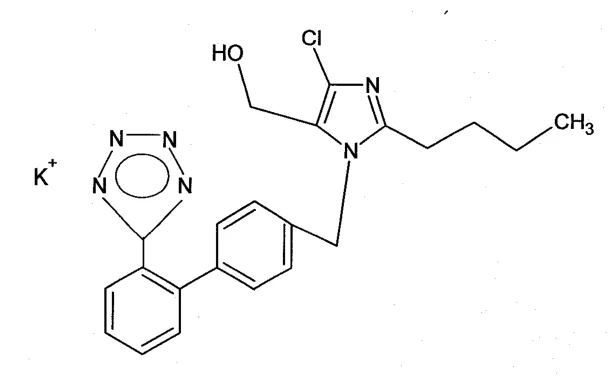
Chemical name: 2-butyl-4-chloro-1-[[2’-(1H-tetrazol-5-yl)[1,1’-biphenyl]-4- yl]methyl]- 1 H-imidazole-5-methanol monopotassium salt
Molecular formula: C22H22ClKN6O
Molecular mass: 461.00
Structural formula:
Physicochemical properties: Losartan potassium is a white or almost white, crystalline powder, hygroscopi. It is freely soluble in water and in methanol, slightly soluble in acetonitrile.
CLINICAL TRIALS
Comparative Bioavailability Studies:
A blinded, randomized, single oral dose, two-way crossover comparative bioavailability study of IPG-Losartan (losartan potassium) 100 mg Film-Coated Tablets (Marcan Pharmaceuticals Inc.) and Cozaar® (losartan potassium) 100 mg tablets (Merck Sharp & Dohme Limited, U.K.) was conducted in 31 healthy adult Asian male subjects under fasting conditions. The Bioavailability Data were measured and the results are summarized in the following table.
Summary Table of the Comparative Bioavailability
Losartan (1 x 100 mg) From measured data Geometric Mean Arithmetic Mean (CV %) | ||||
| Parameter | Test* | Reference† | % Ratio of Geometric Means | 90% Confidence Interval |
AUCT (hr.ng/mL) | 1414.0 1526.9 (42.2) | 1391.7 1508.2 (43.8) | 101.6 | 96.2-107.3 |
AUCI (hr.ng/mL) | 1448.3 1562.6 (42.1) | 1425.1 1542.6 (43.6) | 101.6 | 96.4-107.2 |
Cmax (ng/mL) | 801.5 901.1 (50.7) | 844.9 971.3 (54.8) | 94.9 | 81.1-111.0 |
Tmax§ (h) | 1.7 (71.9) | 1.6 (60.0) | ||
T½§ (h) | 1.7 (39.1) | 1.7 (34.4) | ||
* IPG-Losartan (losartan potassium) 100 mg Film-Coated Tablets (Marcan Pharmaceuticals Inc) † Cozaar® (losartan potassium) 100 mg tablets, Merck Sharp & Dohme Ltd., U.K., were purchased in the United Kingdom
§ Expressed as the arithmetic mean (CV%) only.
Adult Hypertension
Study Demographics and Trial Design:
Table 3: Summary of Patient Demographics for Double-Blind, Placebo-Controlled Clinical Trials in Adult Patients with Hypertension
Study No. | Trial Design | Dosage, Route of Administration and Duration | Study Subjects N=number | Mean Age (Range) (Years) | Gender (%) |
| 011 | Double-blind, randomized, parallel, placebo- | Oral administration, once daily Treatment groups: | 576 | 53.1 (22-88) | Male: 66 Female: 34 |
Study No. | Trial Design | Dosage, Route of Administration and Duration | Study Subjects N=number | Mean Age (Range) (Years) | Gender (%) |
| controlled | Losartan 10, 25, 50, 100, 150 mg Enalapril 20 mg and losartan placebo Duration: 8 weeks double-blind therapy | ||||
| 021 | Double-blind, randomized, parallel, placebo- controlled | Oral administration, once or twice daily Treatment groups: Losartan 50 mg once daily Losartan 100 mg once daily Losartan 50 mg twice daily Losartan placebo Duration: 4 weeks double-blind monotherapy | 122 | 53.5 (28-76) | Male: 68 Female: 32 |
| 050 | Double-blind, randomized, parallel, placebo- controlled | Oral administration, once daily Treatment groups: Placebo Losartan 50 mg/placebo Losartan 50 mg/losartan 100 mg (possible titration to losartan 100 mg after 6 weeks) Duration: 12 weeks double-blind therapy | 366 | 54 (26-78) | Male: 64 Female: 36 |
| 054 | Double-blind, randomized, parallel, placebo- controlled | Oral administration, once daily Treatment groups: Placebo Losartan 50 mg HCTZ 12.5 mg Losartan 50 mg/HCTZ 6.25 mg Losartan 50 mg/HCTZ 12.5 mg Duration: 12 weeks double-blind therapy | 703 | 52.8 (21-79) | Male: 60 Female: 40 |
| 065 | Double-blind, randomized, parallel, placebo- controlled | Oral administration, once or twice daily Placebo Losartan 25 mg once daily Losartan 50 mg once daily Losartan 25 mg twice daily Duration: 12 weeks double-blind therapy | 428 | 54 (24-79) | Male: 65 Female: 35 |
Study Results
Table 4: Results of Losartan Efficacy Compared to Placebo in Double-Blind, Controlled Outpatient Trials
| Study No. | Treatment (Dosage in mg) | Baseline Mean DBP (S.D.) mmHg | Adjusted Mean DBP Change | Vs Placebo | Efficacy Parameter (Duration) |
| 011 | Placebo | 103.3 (3.8) | -5.3 | -- | SuDBP (8 weeks) |
| Losartan 25 mg qd | 103.3 (3.7) | -6.4 | NS | ||
| Losartan 50 mg qd | 104.1 (3.7) | -10.1 | ** | ||
| Losartan 100 mg qd | 104.1 (4.3) | -9.9 | ** | ||
| 021 | Placebo | 100.3 (3.6) | -2.1 | -- | SiDBP (4 weeks) |
| Losartan 50 mg qd | 100.0 (4.6) | -6.7 | * | ||
| Losartan 100 mg qd | 101.1 (4.8) | -9.7 | ** | ||
| Losartan 50 mg bid | 101.4 (4.7) | -8.6 | ** | ||
| 021 | Placebo | 94.8 (5.9) | -0.8 | -- | ABPM 24 hr Mean DBP (4 weeks) |
| Losartan 50 mg qd | 94.0 (6.9) | -5.6 | ** | ||
| Losartan 100 mg qd | 93.8 (6.0) | -7.1 | ** | ||
| Losartan 50 mg bid | 94.4 (6.9) | -9.0 | ** | ||
| 050 | Placebo | 101.3 (4.9) | -4.5 | -- | SiDBP (12 weeks) |
| Losartan 50 mg qd | 102.1 (5.1) | -7.9 | ** | ||
| Losartan 50/100 mg bid | 102.2 (5.0) | -8.6 | ** | ||
| 054 | Placebo | 101.3 (5.3) | -4.0 | -- | SiDBP (12 weeks) |
| Losartan 50 mg qd | 100.9 (5.0) | -9.0 | ** | ||
| 065 | Placebo | 101.3 (5.1) | -2.1 | -- | SiDBP (12 weeks) |
| Losartan 25 mg qd | 101.8 (5.5) | -5.9 | ** | ||
| Losartan 50 mg qd | 102.3 (6.3) | -6.6 | ** |
NS: Treatment difference not statistically significant
*: Treatment difference statistically significant, p≤0.05 **:
Treatment difference statistically significant, p≤0.01
SiDBP: Sitting diastolic blood pressure
SuDP: Supine diastolic blood pressure
ABPM: Ambulatory blood pressure monitoring qd:
Once daily
bid: Twice daily
The antihypertensive effects of losartan potassium were demonstrated principally in 5 placebo-controlled, 6- to 12-week trials (study no. 011, 021, 050, 054, 065) of dosages from 10 to 150 mg per day in patients with baseline diastolic blood pressures of 95-115. The studies allowed comparisons of two doses (50-100 mg/day) as once-daily or twice-daily regimens, comparisons of peak and trough effects, and comparisons of response by gender, age, and race.
Analysis of age, gender, and race subgroups of patients showed that men and women, and patients over and under 65, had generally similar responses. The effect of losartan potassium was somewhat less in Black patients (usually a low-renin population).
The effect of losartan is substantially present within one week but in some studies the maximal effect occurred in 3-6 weeks.
RENAAL STUDY
Study Demographics and Trial Design
Table 5: Summary of Patient Demographics for Clinical Trials
| Study No. | Trial Design | Dosage, Route of Administration and Duration | Study Subjects (n=number) | Mean Age (Range) | Gender |
| 147 | Double-blind, randomized placebo-controlled (non-ACE inhibitor, non AIIA conventional antihypertensives) multinational study | Oral administration Losartan 50 mg once daily with titration to losartan 100 mg Matching placebo Duration: 3.4 years mean follow up | 1513 | 60 (31 to 74 years) | Male: 956 (31 to 74 years) Female: 557 (34 to 73 years) |
Study Results
Table 6: Results of RENAAL Study
| End Point | Losartan Group (n=751) | Placebo Group (n=762) | p-Value | Risk Reduction % (95% CI) | ||
| No | % | No | % | |||
Primary Composite* endpoint | 327 | (43.5) | 359 | (47.1) | 0.022 | 16.1 (2 to 28) |
Doubling of serum creatinine concentration | 162 | (21.6) | 198 | (26.0) | 0.006 | 25.3 (8 to 39) |
| End-stage renal disease | 147 | (19.6) | 194 | (25.5) | 0.002 | 28.6 (11 to 42) |
| Death | 158 | (21.0) | 155 | (20.3) | 0.884 | -1.7 (-27 to 19) |
* The primary endpoint was the time to first occurrence of any one of the following events: doubling of serum creatinine concentration, end-stage renal disease (need for dialysis or transplantation) or death.
The Reduction of Endpoints in Non-Insulin Dependent Diabetes Mellitus (NIDDM) with the Angiotensin II Receptor Antagonist Losartan (RENAAL) study was a large, multicenter, randomized, placebo-controlled, double-blind study conducted worldwide in 1513 hypertensive patients with type 2 diabetes and proteinuria [751 patients entered treatment with losartan potassium]. The goal of the study was to demonstrate the renal protective effects of losartan potassium over and above the benefits of blood pressure control alone. To meet this objective the study was designed to achieve equal blood pressure control in both treatment groups. Patients with proteinuria and serum creatinine of 1.3-3.0 mg/dL were randomized to receive losartan potassium 50 mg once daily titrated according to blood pressure response, or placebo, on a background of conventional antihypertensive therapy excluding ACE inhibitors and angiotensin II antagonists. Investigators were instructed to titrate study drug to 100 mg once daily as appropriate; 72% of patients were taking the 100 mg daily dose the majority of the time they were on study drug. Other antihypertensive agents (diuretics, calcium-channel blockers, alpha- or beta-blockers, and centrally-acting agents) could be added as needed in both groups. Patients were followed for approximately 5 years (mean of 3.4 years).
Important inclusion criteria of the RENAAL study included: type 2 diabetes defined as : (1) diabetes diagnosed after the age of 30; (2) insulin not required within the first 6 months of diagnosis; and (3) no history of diabetic ketoacidosis; ages of 31 to 70; serum creatinine between 1.3 (1.5 for males >60 kg) and 3.0 mg/dL; and first morning urinary albumin/creatinine ratio (UA/Cr) of ≥300 mg/g (or a 24-hour urine total protein of >500 mg/day). Patients could have been normotensive or hypertensive.
Important exclusion criteria of the RENAAL study included: type 1 diabetes; history of heart failure; history of myocardial infarction or coronary artery bypass graft surgery within 1 month prior to study start, cerebral vascular accident or percutaneous transluminal coronary angioplasty within 6 months prior to study start, and history of transient ischemic attacks (TIA) within the year prior to study start; known history or current diagnosis of non-diabetic renal disease such as chronic glomerulonephritis or polycystic kidney disease; and uncontrolled diabetes, i.e. HBA1c >12%.
The primary endpoint of the study was the composite endpoint of doubling of serum creatinine, end-stage renal disease (need for dialysis or transplantation), or death. The results showed that treatment with losartan potassium (327 events, 43.5%) as compared with placebo (359 events, 47.1%) resulted in a 16.1% risk reduction (p=0.022) for patients reaching the primary composite endpoint. For the following individual components of the primary endpoint, the results also showed significant risk reduction in the group treated with losartan potassium as compared to placebo: 25.3% risk reduction in doubling of serum creatinine (21.6% vs 26.0%), (p=0.006); 28.6% risk reduction in end-stage renal disease (19.6% vs 25.5%), (p=0.002). The rate of the all-cause deaths component was not significantly different between losartan and placebo group, 21.0% and 20.3%, respectively.
The secondary endpoints of the study were: change in proteinuria; the rate of progression of renal disease; and the composite of morbidity and mortality from cardiovascular causes (hospitalization for heart failure, myocardial infarction, revascularization, stroke, hospitalization for unstable angina, or cardiovascular death). For the secondary endpoint of change in proteinuria, the results showed an average reduction of 34.3% in the level of proteinuria in the group treated with losartan potassium (p<0.001) over the mean of 3.4 years. For the secondary endpoint of rate of progression of renal disease, treatment with losartan potassium reduced the rate of decline in renal function during the chronic phase of the study by 13.9%, (p=0.01) as measured by the reciprocal of the serum creatinine concentration.
In this study, losartan potassium was generally well tolerated as evidenced by a similar incidence of discontinuations due to side effects compared to placebo. A tertiary endpoint in the study was assessment of quality of life. The results of this analysis suggest that there is no difference in the change of quality of life between treatment arms.
Pediatric Indication
Study Demographics and Trial Design
Table 7: Summary of Patient Demographics for Clinical Trials
| Study No. | Trial Design | Dosage, Route of Administration and Duration | Study Subjects (n=number) | Mean Age (Range) | Gender |
| 227 | A double-blind, randomized dose- response study of losartan in children with diastolic hypertension | Oral administration once daily Losartan 2.5 mg, 25 mg, or 50 mg for patients weighing <50 kg Losartan 5 mg, 50 mg, or 100 mg for patients who weigh ≥50 kg Duration: 3 weeks double-blind treatment period | 177 | 12 (6 to 16 years) | Male: 99 Female: 78 |
Study Results
Table 8: Losartan Pediatric Dose-Response Study - Summary of Weight - Adjusted Dose Responses (Intention-to-Treat Approach)
| Dose | N | Day 1 | Day 15 | Day 22 | Mean Change (Day 15-Day 1) (SD) | Mean Change (Day 22-Day 1) (SD) | 95% CI for Mean Change (Day 22-Day 1) |
Low (2.5/5 mg) | 70 | 87.92 | 80.80 | 81.91 | -7.12 (6.47) | -6.01 (7.61) | -7.82, 4.19 |
Middle (25/50 mg) | 40 | 89.38 | 78.40 | 77.73 | -10.98 (8.66) | -11.65 (9.08) | -14.55, -8.75 |
High (50/100 mg) | 64 | 88.80 | 78.56 | 76.59 | -10.24 (9.14) | -12.21 (8.86) | -14.42, -10.00 |
N: Patients with both baseline (on Day 1) and post-dose measurements
SD: Standard Deviation
Mean Change: Measurement on day 15 (or 22) minus measurement on Day 1
CI: Confidence Interval
In a clinical study involving 177 hypertensive pediatric patients 6 to 16 years of age, patients who weighed ≥20 kg to <50 kg received either 2.5, 25 or 50 mg of losartan daily and patients who weighed ≥50 kg received either 5, 50 or 100 mg of losartan daily. Losartan administration once daily lowered trough diastolic blood pressure in a dose-dependent manner. The dose response to losartan was observed across all subgroups (e.g. age, tanner stage, gender, and race). Evaluation of dose response based on the mean weight adjusted dose indicates that a starting dose of losartan 0.75 mg/kg (up to 50 mg) once daily is appropriate. However, the lowest doses studied, 2.5 mg and 5 mg, corresponding to an average daily dose of 0.07 mg/kg, did not appear to offer consistent antihypertensive efficacy. In this study, losartan potassium up to an average daily dose of 1.44 mg/kg (maximum 100 mg) once daily, is generally tolerated in hypertensive children.
Overall, no significant differences in antihypertensive effect of losartan were detected when patients were analyzed according to age (<, ≥ 12 years old) or gender. While blood pressure was reduced in all racial groups examined, too few non-white patients were enrolled to compare the dose-response of losartan in non-white subgroup.
LIFE Study
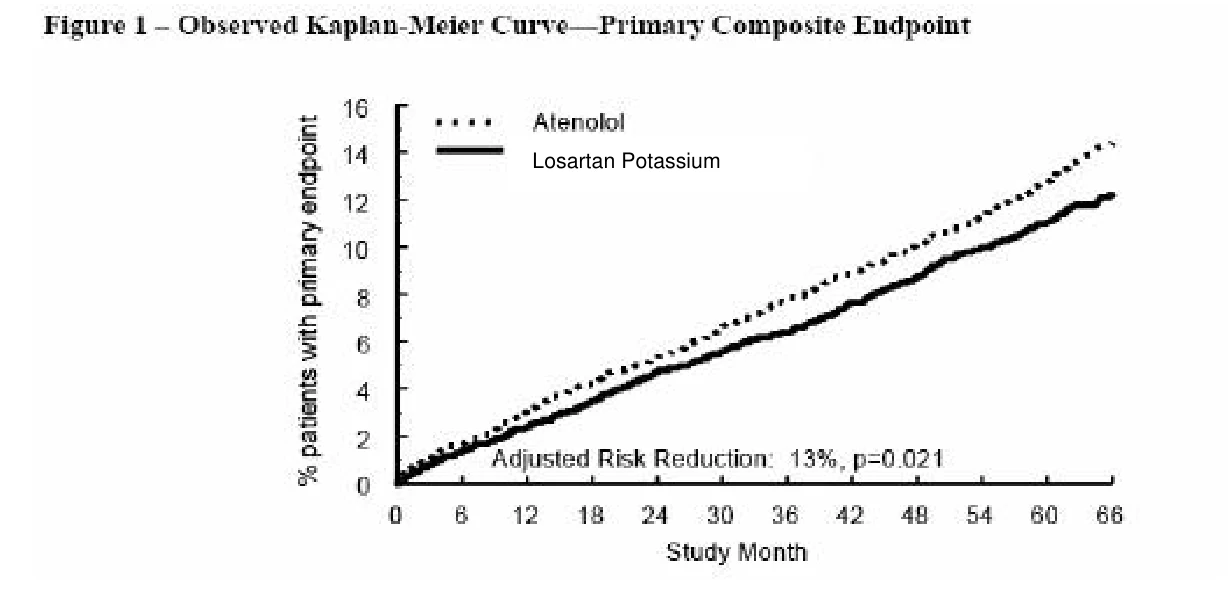
The Losartan Intervention For Endpoint reduction in hypertension (LIFE) was a multicentre, randomized, double-blind study comparing losartan potassium-and atenolol-based therapies in 9193 hypertensive patients with ECG-documented left ventricular hypertrophy (LVH). The primary endpoint was a composite of cardiovascular death, nonfatal stroke, or nonfatal myocardial infarction (MI). A 15% relative difference in the primary endpoint was selected to demonstrate superiority between the treatment groups with 80% power. A primary event occurred in 11% of the losartan potassium-based group and 13% of the atenolol-based group yielding a relative difference of 13% (adjusted hazard ratio of 0.87 (CI 0.77, 0.98) and p=0.021). The individual components of the primary composite endpoint did not consistently support the overall result. The difference between the groups was primarily the result of an effect on stroke. Treatment with losartan potassium reduced the risk of stroke by 25% relative to atenolol (p=0.001) (see Figure 1 and Table 5). For the cardiovascular mortality component, there was a non-significant trend in favour of the losartan potassium-based therapy, while for the myocardial infarction component there was a non-significant difference in favour of atenolol-based treatment. Although the LIFE study favoured losartan potassium over atenolol with respect to the primary composite endpoint, corroborative results from a confirmatory study are not available. A per-protocol analysis, which excluded patients with important protocol violations and censored patients 14 days after permanently discontinuing study medications or 14 days after starting prohibited therapy, showed that the primary endpoint was consistent but, did not reach statistical significance (hazard ratio, 0.865, 95% CI 0.748, 1.002; p=0.053). The statistical power of the per-protocol analysis was lower than for the intent-to-treat analysis because approximately one third of the events were excluded.
Patients aged 55-80 years, with previously treated or untreated hypertension and ECG signs of LVH were included in the study. According to NHANES III, the prevalence of LVH, established by ECG, in patients with hypertension who are similar to the patients in the LIFE study is 12.8% in White patients and 26.8% in Black patients in the general population. The following patients were excluded: patients with secondary hypertension; myocardial infarction or stroke within the previous six months; angina pectoris requiring treatment with β-blockers or calcium-antagonists; heart failure or left ventricular ejection fraction of 40% or less; or a disorder that, in the treating physician’s opinion, required treatment with losartan-based or another angiotensin-II type 1-receptor antagonist, atenolol or another β-blocker, hydrochlorothiazide, or angiotensin-converting-enzyme inhibitors. Patients were randomized to receive once daily losartan potassium 50 mg (n= 4605) or atenolol 50 mg (n= 4588). If goal blood pressure (<140/90 mmHg) was not reached, hydrochlorothiazide (12.5 mg) was added first and, if needed, the dose of losartan potassium or atenolol was then increased to 100 mg once daily. If necessary, other antihypertensive treatments (e.g. increase in dose of hydrochlorothiazide therapy to 25 mg or addition of other diuretic therapy, calcium-channel blockers, alpha-blockers, or centrally-acting agents, but not ACE inhibitors, angiotensin II antagonists, or beta-blockers) were added to the treatment regimen to reach the goal blood pressure.
Of the randomized 9193 patients, 54% were female and 6% were Black. The mean age was 67 years with 62% being 65 years or older. At baseline, 13% had diabetes, 14% had isolated systolic hypertension, 16% had coronary heart disease, and 8% had cerebrovascular disease. There were no significant differences in baseline demographics, clinical characteristics and medical history between the two groups. Baseline mean blood pressure was 174/98 mmHg in both treatment groups. The mean length of follow-up was 4.8 years. At the end of study or at the last visit before a primary endpoint, 77% of the group treated with losartan potassium and 73% of the group treated with atenolol were still taking study medication. Of the patients still taking study medication, the mean doses of losartan potassium and atenolol were both about 80 mg/day, and 15% were taking atenolol or losartan as monotherapy, while 77% were also receiving hydrochlorothiazide (at a mean dose of 20 mg/day in each group). Blood pressure reduction measured at trough was similar for both treatment groups, but blood pressure was not measured at any other time of the day. At the end of the study or at the last visit before a primary endpoint, the average blood pressures were 144.1/81.3 mmHg for the group on losartan-based therapy and 145.4/80.9 mmHg for the atenolol-based therapy patients. The difference in systolic blood pressure of 1.3 mmHg was significant (p< 0.001), while the difference of 0.4 mmHg in diastolic blood pressure was not significant (p=0.098).
The results obtained for the primary endpoint and its components are shown in Figure 1.
Losartan Potassium
Figure 1. Kaplan-Meier estimates of the primary endpoint of time to cardiovascular death, nonfatal stroke, or nonfatal myocardial infarction in the groups treated with losartan potassium and atenolol. The Risk Reduction is adjusted for baseline Framingham risk score and level of electrocardiographic left ventricular hypertrophy.
Table 9 also shows the results obtained for the components of the primary endpoint and those for the secondary endpoints. It can be seen that the primary endpoint reached statistical significance almost entirely due to the stroke component.
Table 9: LIFE Study–Primary Composite Endpoint and Components of Primary Composite Endpoint
| Losartan-Based Therapy (n=4605) | Atenolol-Based Therapy (n=4588) | Relative Risk Reduction† | 95% CI | p-Value | |
| Number of events (%) | Number of events (%) | ||||
| Primary Composite Endpoint | 508 (11) | 588 (13) | 13% | 2% to 23% | 0.021 |
| Components of Primary Composite Endpoint (as a first event) | |||||
| Stroke (nonfatal‡ ) | 209 (4.5) | 286 (6.2) | |||
Myocardial infarction (nonfatal‡ ) | 174 (3.8) | 168 (3.7) | |||
| Cardiovascular mortality | 125 (2.7) | 134 (2.9) | |||
| Secondary Endpoints (any time in study) | |||||
| Stroke (fatal/nonfatal) | 232 (5) | 309 (7) | 25% | 11% to 37% | 0.001 |
Myocardial infarction (fatal/nonfatal) | 198 (4) | 188 (4) | -7% | -13% to 12% | 0.491 |
| Cardiovascular mortality | 204 (4) | 234 (5) | 11% | -7% to 27% | 0.206 |
| Due to CHD | 125 (3) | 124 (3) | -3% | -32% to 20% | 0.839 |
| Due to Stroke | 40 (1) | 62 (1) | 35% | 4% to 67% | 0.032 |
| Other § | 39 (1) | 48 (1) | 16% | -28% to 45% | 0.411 |
† Adjusted for baseline Framingham risk score and level of electrocardiographic left ventricular hypertrophy ‡ First report of an event, in some cases the patient died subsequently to the event reported § Death due to heart failure, non-coronary vascular disease, pulmonary embolism, or a cardiovascular cause other than stroke or coronary heart disease
Although the LIFE study favoured losartan potassium-based therapy over atenolol-based therapy with regards to stroke, it should be remembered that stroke was a secondary endpoint in the LIFE study. A difference was observed between the two treatment groups in terms of the number of patients with stroke who also had an atrial fibrillation: losartan potassium group (13.4%) and atenolol group (20.5%).
Other clinical endpoints of the LIFE study were: total mortality, hospitalization for heart failure or angina pectoris, coronary or peripheral revascularization procedures, and resuscitated cardiac arrest. There were no significant differences in the rates of these endpoints between the losartan potassium and atenolol groups.
In the Life study, Afro-American Black patients treated with atenolol-based treatment were at lower risk of experiencing the primary composite endpoint compared with Afro-American Black patients treated with losartan-based treatment. In the subgroup of Afro-American Black patients (n=533), there were 29 primary endpoints among 263 patients on atenolol (11%, 26 per 1000 patient-years) and 46 primary endpoints among 270 patients (17%, 42 per 1000 patient-years) on losartan potassium. This finding could not be explained on the basis of differences in the populations other than race or on any imbalances between treatment groups. In addition, blood pressure reductions in both treatment groups were consistent between Afro-American Black and non-Black patients. Regarding stroke, the results favoured atenolol-based therapy in Afro-American Blacks. The LIFE study provides no evidence that the benefits of losartan-based treatment on reducing the risk of cardiovascular events in hypertensive patients with left ventricular hypertrophy apply to Afro-American Black patients.
DETAILED PHARMACOLOGY
Following oral administration of losartan potassium to patients with mild to moderate alcoholic cirrhosis, AUC of losartan and its active metabolite, E-3174, were about 5-times and 1.7-times greater, respectively, than in young healthy male volunteers. Compared to these normal subjects, the total plasma clearance of losartan in patients with hepatic insufficiency was about 50% lower and the oral bioavailability was about 2-times higher.
In an 8-week controlled study of the incidence of cough in hypertensive patients with a history of cough during ACE inhibitor therapy, the incidence of cough reported by patients receiving losartan potassium or hydrochlorothiazide was similar and was significantly less than in patients rechallenged with an ACE inhibitor. In addition, an overall analysis of double-blind clinical trials in 4131 patients revealed that the incidence of spontaneously reported cough in patients treated with losartan potassium monotherapy (n=2085; 3.1%) or losartan potassium plus hydrochlorothiazide (n=858; 2.6%) was similar to that of patients treated with placebo (n=535; 2.6%) or hydrochlorothiazide alone (n=271; 4.1%), whereas the incidence with ACE inhibitors (n=239) was 8.8%.
TOXICOLOGY
Acute Toxicity
The oral LD50 of losartan potassium in male mice is 2248 mg/kg (6744 mg/m2). Significant lethality was observed in mice and rats after oral administration of 1000 mg/kg (3000 mg/m2) and 2000 mg/kg (11800 mg/m2) respectively (see Table 10).
Table 10: Acute Toxicity
| Route | Species | Sex | LD50 Values | Maximum Tolerated Dose |
| Intraperitoneal | Mouse Rat | Female Male Female Male | -- -- | >160 mg/kg - < 400 mg/kg >100 mg/kg - < 200 mg/kg |
Intraperitoneal study with active metabolite, E-3174 (L-158,641) | Mice | Female | 441.3 mg/kg | - |
| Route | Species | Sex | LD50 Values | Maximum Tolerated Dose |
| Oral | Mouse Rat Dog | Female Male Female Male Female Male | 2248 mg/kg - - - - | 500 mg/kg – 1000 mg/kg ~1000 mg/kg >160 mg/kg - < 320 mg/kg |
Chronic Toxicity
The toxic potential of losartan potassium was evaluated in a series of repeated dose oral toxicity studies of up to three months in monkeys and up to one year in rats and dogs. There were no findings that would preclude administration at the therapeutic dosage level (see Table 11).
Table 11: Chronic Toxicity
- a) Oral Administration
Species Duration No. of Dose Effects
mg/kg/
Animals/
day
Group
Rat 5 weeks 12 M + 12 0, 15, 45, Mid- and high-dose males: slight decrease in body weight
[Sprague F 135 gain.
-Dawley High-dose males: slight decrease in red blood cell count.
Crl:CD Males all dosage levels: decrease in heart weight.
(SD) BR] High-dose groups: slight increases in BUN; focal gastric lesions.
Mid- and high-dose groups: slight increase in serum chloride.
All dosage levels: slight increases in serum glucose.
Rat 14 weeks 17 M + 17 0, 15, 45, Mid- and high-dose males: slight decreases in the rate of
[Sprague F 135 body weight gain; increase in BUN; grossly evident focal
-Dawley lesions in the gastric mucosa.
Crl:CD High-dose males: slight decreases in RBC parameters;
(SD) BR] increase in cholesterol; alkalinization of the urine.
Males all dosage levels: decrease in heart weight.
High-dose females: increase in BUN.
High-dose groups: increase in sodium, chloride, and/or potassium.
Rat 53 weeks 30 M + 30 0, 15, 45, High-dose males: slight decrease in erythrocyte parameters
[Sprague F 135 (week 25); slight increase in serum phosphorus (week 25);
-Dawley focal erosions of the glandular mucosa of the stomach (also
Crl:CD noted in one low-dose male).
(SD) BR] Mid- and high-dose males: increases in BUN; decreased heart weight and heart weight relative to brain weight (at terminal necropsy); very slight hyperplasia of juxtaglomerular cells (at interim necropsy).
High-dose females: increases in BUN; decreased absolute heart weight and heart weight relative to brain weight (at interim necropsy).
Mid- and high-dose females: slight decreases in food
Species Duration No. of Dose Effects
mg/kg/
Animals/
day
Group
consumption; slight decrease in erythrocyte parameters (high- dose week 39, mid-dose weeks 39 and 51).
All females: decreases in serum triglycerides.
All groups: decreases in urinary protein; very slight
juxtaglomerular cell hyperplasia; lower incidence and severity of spontaneous chronic nephritis.
Mid- and high-dose groups: postdose salivation (weeks 11 and 20).
High-dose groups: decrease in body weight gain.
Dog 5 weeks 4 M + 4 F 0, 15, All groups: adverse gastrointestinal effects (emesis, abnormal
(Beagle) 45,135 stools, positive fecal occult blood).
No treatment-related mortality or change in body weight, food consumption, urinalysis, serum biochemistry, or hematology parameters. No treatment related postmortem findings.
Dog 14 weeks 5 M + 5 F 0, 5, High-dose males: slight decrease in erythroid parameters.
(Beagle) 25, 125 High-dose groups: gastrointestinal toxicity (emesis, abnormal stool colour and consistency, fecal occult blood); slight decrease in heart weight.
Mid-dose groups: excessive salivation and emesis.
No treatment-related effects on body weight, food
consumption, clinical pathology, electrocardiography, physical exams, ophthalmoscopic exams, or gross and microscopic postmortem findings.
Dog 53 weeks 8 M + 8 F 0, 5, High-dose groups: predose and/or postdose hypersalivation;
(Beagle) 25, 125 occasional emesis and change in stool consistency and colour.
Mid- and high-dose groups: sporadic, isolated increases in serum ALT.
No treatment-related alteration in body weight or food consumption, ophthalmologic findings or changes in
electrocardiographic, hematologic, or urinalysis parameters. No treatment-related mortality.
Monkey 14 weeks 4 M + 4 F 0, 20, 100, High-dose group: slight decrease in erythrocyte parameters
[Rhesus 300 (weeks 8 and 11); slight decrease in BUN (week 11); increase
(Macaca in angiotensin II levels (24 hours postdose); tarry intestinal mulatta)] contents and small depressed, reddened foci in the stomach and/or small intestine (at necropsy).
No treatment-related physical signs, mortality, or changes in food consumption, body weight, ophthalmic exams, or urinalysis. No treatment-related changes in organ weights.
Table 11 - Chronic Toxicity (continued)
- b) IV Administration
Species Duration No. of Animals/ Dose Effects
Group mg/kg/day
Rats 16 days 15 M + 15 F 0, 0.92, High-dose males: slight decreases in erythrocyte count [Sprague- 4.59, 9.17 and hematocrit.
Dawley
Crl:CD (SD) No treatment-related deaths, clinical signs, or changes in BR] body weight gain, food consumption, ophthalmology, serum biochemistry, or urinalysis.
Rats 15 days 15 M + 15 F 0, 1, 5, 10† Mid- and high-dose males: slight decrements in body [Sprague- weight.
Dawley All groups: slight decrease in heart weight; slight Crl:CD (SD) decrease in mean terminal body weight. BR]
No treatment-related effects on food consumption, ophthalmologic exams, hematology, serum biochemical determinations, or urinalysis.
Dogs 17 days 4 M + 4 F 0, 0.92, No drug-related deaths, no drug-related clinical signs, and (Beagle) 4.59, 9.17 no drug-related changes in body weight gain, food consumption, ophthalmology, electrocardiography, hematology, serum biochemistry and urinalysis.
No treatment-related changes in organ weight or gross microscopic changes.
Dogs 15 days 4 M + 4 F 0, 1, 5, 10† No drug-related deaths, no drug-related clinical signs, and (Beagle) no drug-related changes in body weight gain, food consumption, ophthalmology, electrocardiography, hematology, serum biochemistry and urinalysis.
No treatment-related changes in organ weight or gross microscopic changes.
† E-3174 (L-158,641): Primary pharmacologically active metabolite of losartan
Reproduction
Fertility and reproductive performance were not affected in male and female rats given oral doses of losartan potassium up to approximately 150 and 300 mg/kg/day, respectively.
Teratology
Losartan potassium has been shown to produce adverse reactions in rat fetuses and neonates. The reactions include decreased body weight, mortality and/or renal toxicity. Pharmacokinetic evaluation of fetal plasma showed significant levels of losartan and its active metabolite, E-3174 (L-158,641), on Gestation Day 20 compared to negligible value on Gestation Day 15. In addition, significant levels of losartan and its active metabolite were shown to be present in rat milk. Based on these findings, the fetal and neonatal effects of losartan potassium in rats are attributed to drug exposure in late gestation and during lactation.
Carcinogenesis
Losartan potassium was not carcinogenic when administered at maximum tolerated dosage levels to rats and mice for 105 weeks (maximum dose of 270 mg/kg/day) and 92 weeks (maximum dose of 200 mg/kg/day), respectively.
Mutagenesis
Losartan potassium was negative in the microbial mutagenesis and V-79 mammalian cell mutagenesis assays. In addition, there was no evidence of direct genotoxicity in the in vitro alkaline elution and in vitro chromosomal aberration assays. Similarly, there was no induction of chromosomal aberrations in bone marrow cells of male or female mice after the administration of toxic oral doses of up to 1500 mg/kg (4500 mg/m2). In addition, the active metabolite showed no evidence of genotoxicity in the microbial mutagenesis, in vitro alkaline elution, and in vitro chromosomal aberration assays.
BIBLIOGRAPHY
- 1.
Brenner BM, Cooper ME, DeZeeuw D, Keane WF, Mitch WE, Parving HH, Remuzzi G,
Snappin SM, Zhang Z, Shahinfar S, for the RENAAL Study Investigators. Effects of Losartan on Renal and Cardiovascular Outcomes in Patients with Type 2 Diabetes and Nephropathy. N Engl J Med 2001; 345:861-9.
- 2.
Chan JCN, Critchley JAJH, Lappe JT, Raskin SJ, Snavely D, Goldberg AI, Sweet CS.
Randomised, Double-blind, Parallel study of the Anti-hypertensive Efficacy and Safety of Losartan Potassium Compared with Felodipine ER in Elderly Patients with Mild to Moderate Hypertension. J Human Hypertens 1995;9:765-71.
- 3.
Dahlöf B, Devereux RB, Kjeldsen SE, Julius S, Beevers G, de Faire U, Fyhrquist F, Ibsen
H, Kristiansson K, Lederballe-Pedersen O, Lindholm LH, Nieminen MS, Omvik P, Oparil S, Wedel H, for the LIFE study group. Cardiovascular Morbidity and Mortality in the Losartan Intervention for Endpoint Reduction in Hypertension Study (LIFE): a randomized trial against atenolol. The Lancet 2002;359(9311):995-1003.
- 4.
Dahlöf B, Keller SE, Makris L, Goldberg AI, Sweet CS, Lim NY. Efficacy and
Tolerability of Losartan Potassium and Atenolol in Patients with Mild to Moderate Essential Hypertension. Am J Hypertens 1995;8:578-83.
- 5.
Eberhardt RT, Kevak RM, Kang PM, Frishman WH. Angiotensin II Receptor Blockade:
An Innovative Approach to Cardiovascular Pharmacotherapy. J Clin Pharmacol 1993;33(11):1023-38.
- 6.
Ellis D. et al. Antihypertensive and Renoprotective Efficacy and Safety of Losartan;
AJH 2004; 17:928-935.
- 7. Goldberg AI, Dunlay MC, Sweet CS. Safety and Tolerability of Losartan Potassium, an Angiotensin II Receptor Antagonist, Compared With Hydrochlorothiazide, Atenolol, Felodipine ER, and Angiotensin-Converting Enzyme Inhibitors for the Treatment of Systemic Hypertension. Am J Cardiol 1995;75:793-5.
- 8.
Goldberg M, Tanaka W, Barchowsky A, Bradstreet T, McCrea J, Lo MW, McWilliams
E, Bjornsson T. Effects of Losartan on Blood Pressure, Plasma Renin Activity, and Angiotensin Il in Volunteers. Hypertension 1993;21:704-13.
- 9.
Julius S, Alderman MH, Beevers G, Dahlof B, Devereux RB, Douglas JG, Edelman JM,
Harris KE, Kjeldsen SE, Nesbitt S, Randall OS, Wright JT Jr. Cardiovascular risk reduction in hypertensive black patients with left ventricular hypertrophy: the LIFE study, J AM Coll Cardiol 2004 Mar 17;43(6):1047-55.
- 10.
Lacourcière Y, Brunner H, Irwin R, Karlberg BE, Ramsay LE, Snavely DB, Dobbins TW,
Faison EP, Nelson EB, the Losartan Cough Study Group. Effects of modulators of the renin angiotensin-aldosterone system on cough. J Hypertens 1994;12(12):1387-93.
- 11.
Ohtawa M, Takayama F, Saitoh K, Yoshinaga T, Nakashima M. Pharmacokinetics and
Biochemical Efficacy After Single and Multiple Oral Administration of Losartan, An Orally Active Nonpeptide Angiotensin II Receptor Antagonist, In Humans. Br J Clin Pharmacol 1993;35:290-7.
- 12.
Shahinfar Sh.et al. A Double-Blind, Dose-Response Study of Losartan in
Hypertensive Children, 1 AJH 2005; 18:183-190.
- 13.
Weber MA, Byyny RL, Pratt JH, Faison EP, Snavely DB, Goldberg AI, Nelson EB.
Blood Pressure Effects of the Angiotensin II Receptor Blocker, Losartan. Arch Intern Med 1995;155:405-11.
- 14.
Merck Canada Inc, PrCozaar® Product Monograph. Control no. 161159, Revision date:
March 27, 2013.