


Product Monograph - Ixiaro
RECENT MAJOR LABEL CHANGES
Indication, Paediatrics March, 2018
Dosage and Administration March, 2018
Dosage forms, strenghts, composition and packaging March, 2018
Warnings and Precautions, Special Populations March, 2018
Special Handling Instructions March, 2018
TABLE OF CONTENTS
RECENT MAJOR LABEL CHANGES ...................................................................................... 2
TABLE OF CONTENTS ............................................................................................................... 3
PART I: HEALTH PROFESSIONAL INFORMATION .......................................................... 5
1 INDICATIONS ................................................................................................................... 5
1.1 Pediatrics .................................................................................................................... 5
2 CONTRAINDICATIONS ................................................................................................. 5
3 SERIOUS WARNINGS AND PRECAUTIONS BOX ................................................... 5
4 DOSAGE AND ADMINISTRATION .............................................................................. 6
4.1 Dosing Considerations ............................................................................................... 6
4.2 Recommended Dose and Dosage Adjustment ........................................................... 6
4.3 Administration ............................................................................................................ 7
4.4 Missed Dose ............................................................................................................... 7
5 OVERDOSAGE ................................................................................................................. 8
6 DOSAGE FORMS, STRENGTHS, COMPOSITION AND PACKAGING ................ 8
7 WARNINGS AND PRECAUTIONS ................................................................................ 8
7.1 Special Populations .................................................................................................... 8
8 ADVERSE REACTIONS .................................................................................................. 9
8.1 Clinical Trial Adverse Reactions ............................................................................... 9
8.2 Serious Adverse Reactions reported in Clinical Trials ............................................ 12
8.3 Abnormal Hematologic and Clinical Chemistry Findings ....................................... 12
8.4 Serious Adverse Reactions reported in Clinical Trials ............................................ 13
8.5 Abnormal Hematologic and Clinical Chemistry Findings ....................................... 14
8.6 Post-Market Adverse Drug Reactions ...................................................................... 14
9 DRUG INTERACTIONS ................................................................................................ 14
9.1 Overview .................................................................................................................. 14
9.2 Drug-Drug Interactions ............................................................................................ 15
9.3 Drug-Food Interactions ............................................................................................ 15
9.4 Drug-Herb Interactions ............................................................................................ 15
9.5 Drug-Laboratory Interactions ................................................................................... 15
9.6 Drug-Lifestyle Interactions ...................................................................................... 15
10 ACTION AND CLINICAL PHARMACOLOGY ........................................................ 16
10.1 Mechanism of Action ........................................................................................... 16
10.2 Duration of effect .................................................................................................. 16
11 STORAGE, STABILITY AND DISPOSAL .................................................................. 20
12 SPECIAL HANDLING INSTRUCTIONS .................................................................... 20
PART II: SCIENTIFIC INFORMATION ................................................................................ 22
13 PHARMACEUTICAL INFORMATION ...................................................................... 22
14 CLINICAL TRIALS ........................................................................................................ 22
15 MICROBIOLOGY ........................................................................................................... 49
16 TOXICOLOGY ................................................................................................................ 51
PATIENT MEDICATION INFORMATION ........................................................................... 55
IXIARO*
Japanese encephalitis vaccine (inactivated, adsorbed)
PART I: HEALTH PROFESSIONAL INFORMATION
1 INDICATIONS
IXIARO* is indicated for:
- active immunization against Japanese encephalitis for persons 2 months of age and older.
IXIARO* should be considered for use in individuals at risk of exposure through travel or in the course of their occupation.
1.1 Pediatrics
Pediatrics (2 months of age and older): Based on the data submitted and reviewed by Health Canada, the safety and efficacy of IXIARO* in pediatric patients has been established; therefore, Health Canada has authorized an indication for pediatric use. (see sections: Dosage and Administration as well as Special Handling Instructions)
2 CONTRAINDICATIONS
- Patients who are hypersensitive to this vaccine or to any ingredient in the formulation or component of the container. For a complete listing, see the Dosage Forms, Composition and Packaging section of the product monograph.
- Individuals who show hypersensitivity reactions after receiving the first dose of the vaccine should not be given the second dose.
- As with other vaccines, vaccination with IXIARO* must be postponed in persons with acute severe febrile conditions.
3 SERIOUS WARNINGS AND PRECAUTIONS BOX
Serious Warnings and Precautions
As with all injectable vaccines, appropriate medical treatment and supervision should always be available to treat rare cases of anaphylactic reactions following the administration of the vaccine.
- IXIARO* should under no circumstances be administered intravascularly.
- Like other intramuscular injections, this vaccine should not be administered intramuscularly to persons with thrombocytopenia, haemophilia or other bleeding disorders.
4 DOSAGE AND ADMINISTRATION
4.1 Dosing Considerations
Children from 2 months to < 3 years of age should receive 0.25 mL per single dose.
See section Special Handling Instructions for instructions on preparing a 0.25 mL dose for children aged 2 months to <3 years.
- Children and adolescents from 3 years to <18 years of age should receive
0.5 mL per single dose.
- Adults (18 years and older) should receive 0.5 mL per single dose.
4.2 Recommended Dose and Dosage Adjustment
Adults (18 years of age and older)
The primary vaccination series consists of two separate doses of 0.5 mL each according to the following schedule:
First dose at Day 0.
Second dose: 28 days after first dose.
It is recommended that vaccinees who received the first dose of IXIARO complete the primary 2-dose vaccination course with IXIARO.
In the event the primary series (Day 0 and Day 28) cannot be completed due to time constraints, , a rapid immunization schedule (i.e. first dose at Day 0 and second dose at Day 7) in persons aged 18-65 years may be used. For details see Part II – Scientific Information.
With both schedules, primary immunisation should be completed at least one week prior to potential exposure to Japanese encephalitis virus (JEV).
Booster dose
A booster dose (third dose) should be given within the second year (i.e. 12 - 24 months) after primary immunization, prior to potential re-exposure to JEV.
Persons at continuous risk for acquiring Japanese encephalitis (laboratory personnel or persons residing in endemic areas) should receive a booster dose at month 12 after primary immunization.
Long-term seroprotection data following a first booster dose administered 12 - 24 months after primary immunization suggest that a second booster should be given 10 years after the first booster dose, prior to potential exposure to JEV.
Please see Part I, section Duration of Effect.
Paediatric Population
Children and adolescents from 3 years to < 18 years of age
The primary vaccination series consists of two separate doses of 0.5 mL according to the following schedule:
First dose at Day 0.
Second dose: 28 days after first dose.
Children from 2 months to < 3 years of age
The primary vaccination series consists of two separate doses of 0.25 mL according to the following schedule:
First dose at Day 0.
Second dose: 28 days after first dose.
It is recommended that vaccinees who received the first dose of IXIARO* complete the primary 2-dose vaccination course with IXIARO*.
There are no data to support a rapid immunization schedule in children and adolescents (2 months to 17 years of age).
Booster dose (Children and adolescents)
A booster dose (third dose) should be given within the second year (i.e. 12 - 24 months) after primary immunization, prior to potential re-exposure to JEV.
Children and adolescents at continuous risk for acquiring Japanese encephalitis (residing in endemic areas) should receive a booster dose at month 12 after primary immunization.
Children and adolescents from 3 years to < 18 years of age should receive a single 0.5 mL booster dose.
Children from 14 months to < 3 years of age should receive a single 0.25 mL booster dose.
No long-term seroprotection data beyond two years after a first booster administered 1 year after primary immunization has been generated in children.
Children below 2 months of age
The safety and efficacy of IXIARO* in children younger than 2 months has not been established. No data are available.
4.3 Administration
The vaccine should be administered by intramuscular injection into the deltoid muscle. In infants, the anterolateral aspect of the thigh may be used as injection site. It should never be injected intravascularly.
When IXIARO is administered concomitantly with injectable vaccines, they should be given with separate syringes at opposite sites.
Exceptionally, IXIARO* may also be administered subcutaneously to patients with thrombocytopenia or bleeding disorders since bleeding may occur following an intramuscular administration. Subcutaneous administration could lead to a suboptimal response to the vaccine. However, it should be noted that there are no clinical efficacy data to support administration by the subcutaneous route.
Each pre-filled syringe is for single use only and should not be used for more than one individual. Inject the entire contents of the syringe.
4.4 Missed Dose
If the primary vaccination series of two injections is not completed, full protection against the disease might not be achieved. The missed dose should be replaced as soon as possible. There are data that showed that a second injection given up to 11 months after the first dose results in high seroconverion rates. For details see Part II – Scientific Information.
5 OVERDOSAGE
Few cases of overdose have been reported during post-marketing surveillance. None of them was associated with any specific or serious important clinical symptoms.
For management of a suspected drug overdose, contact your regional Poison Control Centre.
6 DOSAGE FORMS, STRENGTHS, COMPOSITION AND PACKAGING
Dosage form
Suspension for injection.
Composition
A single dose (0.5 mL of sterile suspension) of IXIARO* contains purified, inactivated Japanese encephalitis virus (attenuated strain SA14-14-2 produced in Vero cells) having a potency ≤ 460 ng ED50 per 0.5 mL adsorbed on aluminum hydroxide, hydrated (0.25 mg Al/dose).
Nonmedicinal ingredients are:
Adjuvant: Aluminium hydroxide
Phosphate Buffered Saline: Sodium chloride, Potassium dihydrogen phosphate, Disodium hydrogen phosphate, Water for injection
Packaging
0.5 mL of sterile suspension in a pre-filled syringe (Type I glass) with a plunger stopper (halobutyl elastomer). Pack size of 1 syringe with or without a separate needle.
7 WARNINGS AND PRECAUTIONS
Please see the Serious Warnings and Precautions Box at the beginning of Part I:
Health Professional Information.
As with any other vaccine, vaccination with IXIARO* may not result in protection in all cases.
IXIARO* will not protect against encephalitis caused by other micro-organisms.
7.1 Special Populations
Pregnant Women:
There is limited amount of data from the use of IXIARO* in pregnant women. In animal studies findings of unclear clinical relevance have been identified.
As a precautionary measure, the use of IXIARO* during pregnancy or lactation should be avoided.
Nursing Women:
IXIARO* should be given to a nursing woman only if the benefit outweighs the theoretical risks to mother and child.
It is unknown whether IXIARO* is excreted in human milk.
Pediatrics (2 months < 18 years of age):
IXIARO* is indicated for active immunisation against Japanese encephalitis in adults, adolescents, children and infants aged 2 months and older.
Geriatrics (≥ 65 years of age):
The safety and immunogenicity of IXIARO* was evaluated in elderly persons (≥65 years).
As with many vaccines, the immune response in elderly persons (≥ 65 years of age) to IXIARO* is lower (SCR 65%, GMT 37.4 at Day 70) than in younger adults. Duration of protection is uncertain in older persons, therefore a booster dose (third dose) should be considered before any further exposure to JE virus.
IXIARO* is generally well tolerated in the elderly, and the safety profile is largely comparable with younger adults.
For details see Part II – Scientific Information.
Immunosuppressed Individuals:
In patients receiving immunosuppressive therapy or patients with immunodeficiency an adequate immune response may be diminished.
8 ADVERSE REACTIONS
8.1 Clinical Trial Adverse Reactions
Because clinical trials are conducted under very specific conditions the adverse reaction rates observed in the clinical trials may not reflect the rates observed in practice and should not be compared to the rates in the clinical trials of another drug. Adverse drug reaction information from clinical trials is useful for identifying drug-related adverse events and for approximating rates.
Adults
The safety of the vaccine was assessed in a separate Pooled Safety Analysis of 10 different controlled and uncontrolled phase 3 clinical studies in 4,043 healthy adults aged 18 to 86 years who received at least one dose of IXIARO*(Results are shown in table 1 and 3). Further studies were conducted at a later time-point, adding another 978 subjects, resulting in a total subject number of 5.021 healthy adults. No further pooled analysis was performed including these additional subjects.
Non-study population: pregnant and nursing women, persons younger than 18 years, persons with any underlying disease.
Common Adverse Reactions from Clinical Trials after primary immunisation or booster doses
Most commonly reported adverse reactions in adults included headache (20% of subjects) myalgia (13%), fatigue (12.9%), injection site pain (33%), injection site tenderness (33%).
Table 1: Adverse Reactions occurring in ≥1% of subjects who received IXIARO*: Pooled Safety Analysis
| System organ class and preferred term | IXIARO* N=4043 | |
|---|---|---|
| n | (%) | |
| Nervous system disorders | 806 | (19.94) |
| Headache | 779 | (19.27) |
| General Disorders and Administration Site Conditions | 738 | (18.25) |
| Fatigue | 395 | (9.77) |
| Influenza Like Illness | 363 | (8.98) |
| Pyrexia | 84 | (2.08) |
| Musculoskeletal and Connective Tissue Disorders | 541 | (13.38) |
| Myalgia | 524 | (12.96) |
| Gastrointestinal Disorders | 228 | (5.64) |
| Nausea | 193 | (4.77) |
Local Tolerability
Local tolerability (pain, itching, tenderness, hardening, swelling, redness) was documented in a subject diary for seven consecutive days after each vaccination (inclusively) in studies IC51-301, IC51-302, IC51-304, IC51-309 IC51-310 and IC51-314. Tenderness was not collected in subject diaries of clinical study IC51-304.
The frequency of local symptoms of any (mild, moderate, severe or missing) severity within days 0-6 after the vaccination at day 0, vaccination at day 28 and after any vaccination are presented in Table 2.
Table 2: Local tolerability after any vaccination by symptom (mild, moderate, severe or missing severity) within Days 0-6, Pooled Safety Analysis
| Local tolerability symptom | Days 0-6 n (N,%) |
| Pain | 1334 (4016, 33.2%) |
| Tenderness | 1210 (3642, 33.2%) |
| Redness | 373 (4016, 9.3%) |
| Hardening | 332 (4016, 8.3%) |
| Swelling | 195 (4016, 4.9%) |
| Itching | 140 (4016, 3.5%) |
n=diary periods with at least one diary day with symptom, N=diary periods with at least one non-missing diary entry for symptom, %=n/N
Less Common Adverse Reactions from Clinical Trials after primary immunisation or booster doses
Table 3: Adverse Reactions occurring in <1% of subjects, condensed after medical review: Pooled Safety Analysis
System Organ Class Preferred Term | IXIARO* N=4043 | |
|---|---|---|
| n | (%) | |
| Nervous System Disorders | ||
| Dizziness | 16 | (0.40) |
| Migraine | 11 | (0.27) |
| Paraesthesia | 3 | (0.07) |
| General Disorders and Administration Site Conditions | ||
| Injection site haematoma | 27 | (0.67) |
| Chills | 5 | (0.12) |
| Malaise | 5 | (0.12) |
| Oedema peripheral | 1 | (0.02) |
| Musculoskeletal and Connective Tissue Disorders | ||
| Musculoskeletal stiffness | 5 | (0.12) |
| Pain in extremity | 3 | (0.07) |
| Arthralgia | 2 | (0.05) |
| Gastrointestinal Disorders | ||
| Vomiting | 27 | (0.67) |
| Diarrhea | 23 | (0.57) |
| Abdominal Pain | 4 | (0.10) |
| Infections and infestations | ||
| Nasopharyngitis | 33 | (0.82) |
| Rhinitis | 15 | (0.37) |
| Skin and Subcutaneous Tissue Disorders | ||
| Pruritus | 4 | (0.10) |
| Erythema | 3 | (0.07) |
| Urticaria | 1 | (0.02) |
| Rash | 39 | (0.96) |
| Respiratory, Thoracic and Mediastinal Disorders | ||
| Dyspnea | 2 | (0.05) |
| Investigations | ||
| Hepatic Enzyme Increased | 9 | (0.22) |
| Blood and Lymphatic System Disorders | ||
| Lymphadenopathy | 8 | (0.20) |
| Thrombocytopenia | 1 | (0.02] |
| Ear and Labyrinth Disorders | ||
| Vertigo | 16 | (0.40) |
| Cardiac Disorders | ||
| Palpitations | 2 | (0.05) |
| Tachycardia | 2 | (0.05) |
8.2 Serious Adverse Reactions reported in Clinical Trials
Two serious adverse events assessed as possibly related were reported in clinical trials in adults.
Table 4: Serious Adverse Events assessed as possibly or probably related to vaccination in or as follow-up to clinical trials completed and ongoing to date
| Event | Interval to vaccination | Outcome | Causality assessment by Investigator |
| Syndactyly# | 8.5 months## | not recovered | possibly related |
| Hypertension | 12 days | recovered | possibly related |
# Syndactyly of 2nd and 3rd toes, in infant of vaccinated subject
## Delivery 8.5 months after vaccination. Estimated interval between last menstrual period and last IXIARO* vaccination was 5 weeks.
8.3 Abnormal Hematologic and Clinical Chemistry Findings
There were no safety concerns with regard to haematological parameters, clinical chemistry or urinalysis across studies. Increased hepatic enzymes occurred in <1% of subjects, there was no safety concern associated.
Children and Adolescents
The safety of the vaccine was assessed in controlled and uncontrolled clinical studies in 1,559 children and adolescents (mostly from endemic countries).
Common Adverse Reactions from Clinical Trials after primary immunisation or booster doses
Most commonly reported adverse reactions in children and adolescents included pyrexia, diarrhoea, influenza like illness irritability and injections site reactions (pain, tenderness, redness). The frequency of adverse reactions observed in children and adolescents is described as follows.
Table 5: Frequency of adverse reactions observed in children given the 0.25 mL dose (2 months to <3 years of age) and in children and adolescents given the 0.5 mL dose (3 to <18 years of age)
| Frequency of adverse reactions (%) by dose/age | |||||
|---|---|---|---|---|---|
System Organ Class Preferred Term | 0.25 mL N=783 2 months to <3 years | 0.5 mL N=628 3 to <18 years | |||
| Blood and Lymphatic System Disorders | |||||
| Lymphadenopathy | 0.1 | 0.0 | |||
| Metabolic and Nutrition disorders | |||||
| Decreased appetite | 8.2 | 1.9 | |||
| Nervous System Disorders | |||||
| Headache | 2.9 | 6.1 | |||
| Respiratory, Thoracic and Mediastinal Disorders | |||||
| Cough | 0.5 | 0.3 | |||
| Gastrointestinal Disorders | |||||
| Diarrhoea | 11.9 | 1.4 | |||
| Vomiting | 7.3 | 1.9 | |||
| Nausea | 3.9 | 1.9 | |||
| Skin and Subcutaneous Tissue Disorders | |||||
| Rash | 6.3 | 1.4 | |||
| Musculoskeletal and Connective Tissue Disorders | |||||
| Myalgia | 3.0 | 7.1 | |||
| General Disorders and Administration Site Conditions | |||||
| Pyrexia | 28.5 | 10.4 | |||
| Influenza like illness | 10.9 | 2.9 | |||
| Irritabilty | 10.9 | 1.9 | |||
| Fatigue | 3.5 | 3.5 | |||
| Injection site tenderness | 4.2 | 14.7 | |||
| Injection site swelling | 3.6 | 2.2 | |||
| Injection site hardening | 1.2 | 1.9 | |||
| Injection site itching | 0.6 | 1.6 | |||
| Investigations | |||||
| Hepatic enzymes increased | 0.5 | 0.2 | |||
8.4 Serious Adverse Reactions reported in Clinical Trials
Two serious adverse events assessed as possibly related were reported in clinical trials in children and adolescents.
Table 6: Serious Adverse Events assessed as possibly or probably related to vaccination in clinical trials completed in children and adolescents
| Event | Interval to vaccination | Outcome | Causality assessment by Investigator |
| Dizziness | 4.5 months | recovered | possibly related |
| Kawasaki’s disease | Approx.. 3 months after 2nd vaccination | recovered with sequelae | possibly related |
8.5 Abnormal Hematologic and Clinical Chemistry Findings
There were no safety concerns with regard to haematological parameters, clinical chemistry or urinalysis across studies. Increased hepatic enzymes occurred in <1% of subjects, there was no safety concern associated.
8.6 Post-Market Adverse Drug Reactions
More than 2 million persons have been vaccinated with IXIARO since licensure. The number and kind of adverse reactions reported are those which may be expected for similar inactivated vaccines and are in general in congruence with safety information gained in clinical trials. No particular safety signals have been confirmed nor important risks identified to date.
Individual review of convulsion cases received since licensure has been made. Most of the reports of possibly vaccination induced seizures – in particular where syncope is explicitly reported or where onset is temporally close to vaccination – are what may best be described as ‘convulsive syncope’. As discussed by Bergfeldt and others, causation is mostly by vasovagal mechanisms, hence it is strictly speaking not ingredient related, but rather administration related.
9 DRUG INTERACTIONS
9.1 Overview
Not applicable.
Use with other vaccines:
Concomitant administration of IXIARO* with inactivated hepatitis A vaccine has been evaluated in one clinical study. There was no interference with the immune response to JEV and HAV vaccines, respectively. Concomitant administration of IXIARO* and hepatitis A vaccine was shown to be non-inferior to single vaccinations with regard to geometric mean titres (GMT) of anti-JEV neutralizing antibody and HAV antibody, and for seroconversion rates.
There were no statistically significant higher rates in systemic or local tolerability symptoms among subjects who received concomitant vaccination with IXIARO* and hepatitis A vaccine compared with those who received IXIARO* or hepatitis A vaccine alone.
The most frequently reported local tolerability symptom on the day of the first vaccination in all three groups was injection site pain in 59.0% of subjects receiving IXIARO* + HAVRIX, in
48.4% of subjects receiving IXIARO* + placebo vaccine and in 48.4% of subjects receiving HAVRIX + placebo vaccine. The second most frequent symptom was tenderness in 45.9%, 43.8% and 42.2% of subjects, respectively.
If co-administration with another vaccine is indicated, immunisation should be carried out on separate limbs.
In an observer-blind Phase 3 study, concomitant administration of IXIARO* and Rabipur (inactivated rabies vaccine) has been studied in adults aged 18 to 65 years of age in comparison to respective single vaccinations in conventional schedule. No interference was observed with regards to geometric mean titer (GMT) and seroconversion rates for anti JEV neutralizing antibodies (Table 7). There was also no interference with the immune response to Rabipur.
Table 7: Seroconversion rates (rate of subjects with PRNT50≥1:10) and GMTs (plaque reduction neutralization test) for anti-JEV neutralizing antibodies after administration of IXIARO and Rabipur in conventional schedule, Per Protocol population
| Seroconversion rates and geometric mean titer for JEV neutralizing antibody at Day 56 | ||
| SCR [%] (n/N) | GMT [95% CI] (N) | |
| IXIARO + Rabipur | 100 (157/157) | 299 [254-352] (157) |
| IXIARO | 100 (49/49) | 337 [252-451] (49) |
Vaccination schedules: IXIARO: Day 0/28, Rabipur: Day 0/7/28.
9.2 Drug-Drug Interactions
Interactions with other drugs have not been established.
9.3 Drug-Food Interactions
Interactions with food have not been established.
9.4 Drug-Herb Interactions
Interactions with herbal products have not been established.
9.5 Drug-Laboratory Interactions
Interactions with laboratory tests have not been established.
9.6 Drug-Lifestyle Interactions
No studies on the effect of IXIARO* on the ability to drive or use machines have been performed.
10 ACTION AND CLINICAL PHARMACOLOGY
Disease Burden
Japanese Encephalitis is one of the most common viral encephalitis with over 70,000 cases reported worldwide annually, although the figure could be much higher due to the lack of proper surveillance systems in many Asian countries where the virus is endemic. JEV is a mosquito-borne flavivirus; humans are an accidental host and are not considered reservoirs for virus transmission. The majority of infections in humans are asymptomatic, and overt encephalitis occurs in only one out of every 50 to 1,000 individuals infected. JE disease has an associated mortality rate of 30-40%, and 50% of affected patients are left with permanent neuropsychiatric sequelae. Hence, although the relative mortality rate in a healthy population might be very low, due to the permanent neurological sequelae, the public health burden for the society is much higher.
Visitors to areas where JE is endemic or epidemic are at higher risk of being infected with JE compared to the local population. Incidence rates for JE disease in non-immunized Western troops have been observed to reach up to 2 per 10,000 individuals per week [5]. Sporadic cases of JE disease in travellers from Europe and North America are reported every year.
10.1 Mechanism of Action
Studies in animals have shown that the vaccine triggers the immune system to produce antibodies against Japanese encephalitis virus that are most often protective. Challenge studies were performed in mice that were treated with human IXIARO* antisera. These studies showed that almost all mice that had a Plaque Reduction Neutralization Test titre of at least 1:10 were protected from a lethal Japanese encephalitis virus challenge. These studies suggest that protection is mediated by antibodies raised against the vaccine.
10.2 Duration of effect
Antibody persistence was evaluated in an uncontrolled Phase 3 follow up clinical trial, enrolling subjects who had completed two pivotal trials, and who received at least one dose of IXIARO*. Long term immunogenicity of IXIARO* was assessed in a subset of 181 subjects up to month 24 (ITT Population) and in 152 subjects up to month 36 after the first IXIARO* vaccination. Rates of subjects with PRNT50≥1:10 and GMTs at Month 2, 6, 12, 24 and 36 are summarized in Table 8.
Table 8: SCR and GMT at Month 2, 6, 12, 24 and 36 after vaccination with IXIARO* – results from a pivotal long-term immunogenicity study
| Month | SCR | GMT | |||
| % (n/N) | 95% Confidence Interval | 95% Confidence Interval | |||
| 2 | 98.9 (179/181) | [96.1, 99.7] | 310.8 | [268.8, 359.4] | |
| 6 | 95.0 (172/181) | [90.8, 97.4] | 83.5 | [70.9, 98.4] | |
| 12 | 83.4 (151/181) | [77.3, 88.1] | 41.2 | [34.4, 49.3] | |
| 24 | 81.8 (148/181) | [75.5, 86.7] | 44.3 | [36.7, 53.4] | |
| 36 | 84.9 (129/152) | [78.3, 89.7] | 43.8 | [36.5, 52.6] | |
In another open-label, follow-up Phase 3 study, antibody persistence up to 24 months after primary vaccination was assessed. The primary endpoint was the SCR at 24 months after the primary vaccination. A total of 116 subjects who had received the standard schedule of IXIARO* were included in the follow-up study. SCRs and GMTs at Month 24 are summarized in Table 9 for the ITT population.
Table 9: SCR and GMT at Month 6, 12 and 24 after vaccination with IXIARO* – results from a supporting long term persistence study
| Month | SCR | GMT | |||||
| % (n/N) | 95% Confidence Interval | 95% Confidence Interval | |||||
| 6 | 82.8 (96/116) | [74.9, 88.6] | 46.6 | [38.7, 56.1] | |||
| 12 | 58.3 (67/115) | [49.1, 66.9] | 18.0 | [15.5, 20.8] | |||
| 24 | 48.3 (56/116) | [39.4, 57.3] | 16.2 | [13.8, 19.0] | |||
Booster immunisation (adults)
In an uncontrolled, open-label phase 3 study a single 6 mcg (0.5 mL) booster dose of IXIARO was given at month 15 after primary immunization. All of the 198 subjects treated were included in the ITT and Safety Populations.
Rates of subjects with PRNT 50≥1:10 and GMT over time are summarised in Table 10:
Table 10: Rates of subjects with PRNT50≥1:10 and GMT before and at months 1, 6 and 12 after a single 6 mcg (0.5 mL) booster dose administered to subjects at 15 months after recommended primary immunization with IXIARO (ITT population)
| Rate of subjects with PRNT50≥1:10 | GMT | ||||||||
| 95% CI | 95% CI | ||||||||
| Pre-booster, Day 0 (n=198) | 69.2% | [62.4%, 75.2%] | 22.5 | [19.0, 26.7] | |||||
| Day 28 (n=198) | 100.0% | [98.1%, 100.0%] | 900.1 | [742.4, 1091.3] | |||||
| Month 6 (n=197) | 98.5% | [95.6%, 99.5%] | 487.4 | [390.7, 608.1] | |||||
| Month 12 (n=194) | 98.5% | [95.6%, 99.5%] | 361.4 | [294.5, 443.5] | |||||
Antibody persistence after booster immunisation (adults)
In an uncontrolled, open-label extension to the booster study described above, 67 subjects were followed up for determination of JEV neutralizing antibody titres at approximately 6 years after a booster dose. 96% of subjects (64/67) still had protective antibody levels (PRNT 50≥1:10), with a GMT of 148 (95%CI: 107; 207). Mathematical modelling was applied to project the average duration of protection. Based on this model, it is estimated that average duration of protection will be 14 years and 75% of vaccinees will retain protective antibody levels (PRNT 50≥1:10) for 10 years. A second booster should therefore be given 10 years after the first booster dose, administered 1 year after the primary immunization, prior to potential exposure to JEV.
Antibody persistence and booster dose in children and adolescents from a JEV-endemic country
The persistence of JEV neutralizing antibodies after primary immunisation and safety and immunogenicity of an IXIARO booster dose 12 months after primary immunization were evaluated in a randomized, controlled, open-label clinical trial conducted in the Philippines, where JEV is endemic (300 children, mean age 5.3 years, range 1.2 - 17.3 years). 150 children were followed-up for three years without booster, additional 150 children received a booster after 1 year (0.25 mL if aged <3 years at time of the booster, 0.5 mL if aged 3 years and above) and were followed-up for further two years. Seroprotection rate (SPR) defined as neutralizing antibody titer ≥1:10 and geometric mean titers (GMT) are presented in Table 11. The booster dose led to a pronounced increase in GMTs and seroprotection rate remained at 100% two years after the booster.
Table 11: Seroprotection Rates and Geometric Mean Titers with and without a booster of IXIARO at Month 12, 13, 24 and 36, Intent To Treat Population
| Without Booster N = 150 | Booster dose 12 months after primary immunization N = 149 | ||||||||||||
| Time point after primary immunization | 0.25 mL Booster Dose N=81 | 0.5 mL Booster Dose N=67 | |||||||||||
| Seroprotection Rate % (n/N) | |||||||||||||
| Month 12 | 89.9 (134/149) | 97.5 (79/81) | 89.6 (60/67) | ||||||||||
| Month 13 | n.a. | 100 (81/81) | 100.0 (67/67) | ||||||||||
| Month 24 | 89.0 (130/146) | 100 (80/80) | 100.0 (67/67) | ||||||||||
| Month 36 | 90.1 (128/142) | 100.0 (76/76) | 100.0 (67/67) | ||||||||||
| Geometric Mean Titer | |||||||||||||
| Month 12 | 46 | 67 | 40 | ||||||||||
| Month 13 | n.a. | 2911 | 1366 | ||||||||||
| Month 24 | 50 | 572 | 302 | ||||||||||
| Month 36 | 59 | 427 | 280 | ||||||||||
n.a. = not available
Antibody persistence in children and adolescents from non-endemic countries
Antibody persistence was evaluated for three years after the primary vaccination with IXIARO in an uncontrolled, open-label follow-up clinical trial conducted in the United States, Europe and Australia. Long-term immunogenicity data were evaluated in 23 children, mean age 14.3 years, range 3 - 18 years).
Immunogenicity results
Primary endpoint was seroprotection rate 12 months after primary immunisation. Subjects were followed up for 3 years after the last vaccine dose.
SPR and GMTs at Month 12 (Visit 2): The SPR of the ITT Population was 89.5% (17 of 19 subjects with available immunogenicity data) and the GMT was 47.8 (95% CI [28.7; 79.8]). SPR and GMT were similar in the Per protocol population for 12 months (SPR: 93.8% and GMT: 57.2; 95% CI [33.9; 96.5]).
SPR and GMTs at Month 24 (Visit 3): The SPR for the ITT Population was 91.3% (21 of 23 subjects with available immunogenicity data) and the GMT was 75.4 (95% CI [45.9; 123.7]). SPR and GMT were again similar in the Per protocol population for 24 months (SPR: 93.8% and GMT: 76.3; 95% CI [42.1; 138.3]).
SPR and GMTs at Month 36 (Visit 4): The SPR for the ITT Population was 89.5% (17 of 19 subjects) and the GMT was 60.8 (95% CI [34.8; 106.1]). SPR and GMT were also similar in the Per protocol Population for 36 months (SPR: 92.9% and GMT: 69.4; 95% CI [36.7; 131.3]).
11 STORAGE, STABILITY AND DISPOSAL
Store in a refrigerator (2°C - 8°C). Do not freeze.
Store in the original package to protect from light.
Do not use after the expiry date shown on the label.
12 SPECIAL HANDLING INSTRUCTIONS
Do not use if the blister foil is not intact or packaging is damaged.
Upon storage, a fine white deposit with a clear colorless supernatant can be observed.
Do not use if the product appears discolored (i.e. off-white) or if the syringe is damaged.
The pre-filled syringe is ready to use. If a needle is not provided, use a sterile needle. To attach Luer needle, remove the syringe tip cap by gently twisting it. Do not attempt to snap or pull the tip off as this may damage the syringe.
Shake before use. Thorough agitation immediately before administration is necessary to maintain suspension of the vaccine. The full recommended dose of the vaccine should be used.
Prior to agitation, IXIARO* may appear as a clear liquid with a white precipitate. After thorough agitation, it forms a white, cloudy liquid/suspension. The vaccine should be visually inspected for particulate matter and discoloration prior to administration. Discard the product if particulates are present or if it appears discolored or if the syringe appears to be physically damaged.
Any unused product or waste material should be disposed of in accordance with local requirements.
Information on the administration of a 0.5 mL dose of IXIARO for persons 3 years of age and above
For administration of the full 0.5 mL dose follow the steps below:
- 1. Shake the syringe to obtain a homogeneous suspension.
- 2. Remove the syringe tip cap by gently twisting it. Do not attempt to snap or pull the tip off as this may damage the syringe.
- 3. Attach a needle to the pre-filled syringe.
Information on the preparation of a 0.25 mL dose of IXIARO for use in children below 3 years of age
For administration of a 0.25 mL dose in children aged 2 months to < 3 years, follow the steps below:
- 1. Shake the syringe to obtain a homogeneous suspension.
- 2. Remove the syringe tip cap by gently twisting it. Do not attempt to snap or pull the tip off as this may damage the syringe.
- 3. Attach a needle to the pre-filled syringe.
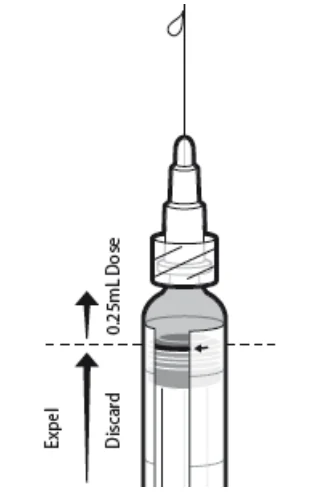
- 4. Hold the syringe in an upright position.
- 5. Push the plunger stopper up to the edge of the red line on the syringe barrel, indicated by a red arrow (see Figure 1)+, to discard excess volume.
- 6. Attach a new sterile needle prior to injection of the remaining volume.
+If you pushed the plunger stopper beyond the red line, a 0.25 mL dose is not guaranteed and a new syringe should be used.
Figure 1:
Preparation for
Administration of 0.25 mL Dose
* Registered Trademark
PART II: SCIENTIFIC INFORMATION
13 PHARMACEUTICAL INFORMATION
Drug Substance
Proper name: Japanese encephalitis purified inactivated virus (JE-PIV)
Product Characteristics
IXIARO* is a purified and inactivated Japanese encephalitis virus (JEV) vaccine. The virus is grown in Vero cells, purified, inactivated, and then adsorbed on aluminium hydroxide. The final vaccine is in the form of a suspension in a pre-filled syringe. Each unit dose of IXIARO* contains inactivated JEV, strain SA14-14-2 having a potency ≤ 460 ng ED50 per 0.5 mL. The vaccine does not contain any preservative or antibiotic. The vaccine does not contain any preservative or antibiotic. The vaccine is stored at 2-8°C. After thorough agitation, IXIARO* is a white, cloudy suspension.
14 CLINICAL TRIALS
Study Demographics and Trial Design
Two pivotal and 15 supporting phase 3 clinical studies have been conducted to gather efficacy (immunogenicity) and safety data of IXIARO*.
Seroconversion
The analysis of clinical efficacy was done using a cutoff of a neutralizing antibody titre of ≥1:10, which was also used as a criterion for Seroconversion. Seroconversion or the threshold antibody level for protection is defined as a PRNT50 titre ≥ 1:10, as recommended by the World Health Organization (WHO) consultation group and is widely used worldwide. Experiments done in mice also confirmed the above mentioned fact.The PRNT or Plaque neutralization assay, measures virus neutralizing antibody that correlates with protection. The virus neutralising antibody titre is expressed as the serum dilution giving a 50% plaque or virus reduction (PRNT50) compared to 100% plaque formation in virus only control. All PRNT50 results are expressed as reciprocal titres. GMT was defined as the geometric mean of PRNT50 titres.
Pivotal Efficacy Study: IC51-301
Table 12: Trial Design and Demographics
| Study # | Trial design | Dosage, route of administration and duration | Study subjects (n=number) | Mean age (Range) | Gender |
|---|---|---|---|---|---|
| IC51-301 | Randomized, active-controlled, observer-blinded, non-inferiority (IXIARO* vs. JE-VAX), phase 3 study | 2 injections of IXIARO* (6 mcg in 0.5 mL) intramuscularly (i.m.) on days 0 and 28 and 1 i.m. injection of 0.5 mL placebo vaccine at Day 7 (Group A) or 3 subcutaneous injections of JE-VAX (1.0 mL dose) on Day 0, 7 and 28 (Group B). Study duration: 6 months | IXIARO*: n=365 JE-VAX: n=370 | IXIARO*: 41.2 years (18-78) JE-VAX: 41.2 years (18-80) | IXIARO*: 133 Male (M)/232 Female (F) JE-VAX: 152M/218 F |
Demographic characteristics and baseline laboratory values were similar between the groups and are presented for the safety population.
Overall, 80.8% of the subjects were Caucasian, 13.1% were African American, 5.3% were “Other” and 0.8% were Asian. Overall, 77.8% of the subjects had negative anti-flavivirus immune status at baseline; 12.4% of the subjects had received TBE vaccination within the last 10 years and 34.4% had received any vaccination within the last 3 years. Notably, a higher proportion of subjects with positive baseline anti-flavivirus status in Europe (60.7% of 201 subjects) compared with North America (7.7% of 662 subjects) were observed.
Results
By Day 56, the proportion of subjects who had seroconverted was similar for both treatment groups (96.4% vs. 93.8% for IXIARO* and JE-VAX, respectively). GMT at Day 56 were 243.6 for IXIARO* and 102.0 for JE-VAX, respectively. The immune response elicited by IXIARO* was non-inferior to those induced by JE-VAX
Table 13: SCR and GMT of IXIARO* and JE-VAX – Primary Endpoints
| Primary Endpoints | Associated value and statistical significance for IXIARO* at specific time points | Associated value and statistical significance for JE-VAX or active control |
|---|---|---|
| To demonstrate the non-inferiority of IXIARO* (2 x 6 mcg) compared to JE-VAX (3 x 1.0 mL) in terms of the seroconversion rate (SCR) and geometric mean titre (GMT) at Day 56; four weeks after the last vaccination. | SCR [N=365, n (%)] Day 0 (Screening): 0 Day 28: 197 (54.0) Day 56: 352 (96.4) GMT [N=365] Day 0 (Screening): 5 Day 28: 17.4 Day 56: 243.6 | SCR [N=370, n (%)] Day 0 (Screening): 0 Day 28: 321 (86.8) Day 56: 347 (93.8) GMT [N=365] Day 0 (Screening): 5 Day 28: 76.9 Day 56: 102.0 |
Risk difference estimate [95% CI]:Day 56: 1.05 [-1,33, 3.43]
Table 14: Immunogenicity Results of Study IC51-301 in Specific Indication – Secondary Endpoints
| Secondary Endpoints | Associated value and statistical significance for IXIARO* at specific dosages | Associated value and statistical significance for JE-VAX or active control |
|---|---|---|
| SCR and GMT in subjects aged <50 and ≥50. | SCR <50 years: 284/301 (94.4%) SCR ≥50 years: 113/129 (87.6%) | SCR <50 years: 273/304 (89.8%) SCR ≥50 years: 120/133 (90.2%) |
| SCR and GMT in subjects aged <65 versus ≥65 years, post-hoc analysis | SCR <65 years: 328/337 (96.5%) SCR ≥65 years: 24/25 (96.0%) | SCR <65 years: 326/341 (94.0%) SCR ≥65 years: 21/23 (91.3%) |
| Adverse events (AEs) | In the safety population 61.0% experienced at least one TEAE (treatment emergent adverse event). No deaths were reported. One subject in the IXIARO* group experienced a serious adverse event (SAE) of myocardial infarction which was severe in intensity and unlikely related to study treatment. This subject had a history of myocardial infarction. In general, the systemic tolerability profile was similar between IXIARO* and JE-VAX. Systemic symptoms were most common one day after vaccination, decreasing over time for both treatment groups. | In the safety population 60.7% experienced at least one TEAE (treatment emergent adverse event). No deaths were reported. No serious adverse events (SAEs) were reported. In general, the systemic tolerability profile was similar between IXIARO* and JE-VAX. Systemic symptoms were most common one day after vaccination, decreasing over time for both treatment groups. |
Table 15: Possibly or probably related Treatment Emergent Adverse Events:
| TEAE system organ class1 and preferred term2 | n(%) of subjects | |||||||||||||||
| IXIARO* N=428 | JE-VAX N=435 | |||||||||||||||
| n | (%) | n | (%) | |||||||||||||
| Any TEAE | 159 | (37.1) | 149 | (34.3) | ||||||||||||
| Gastrointestinal disorders | 21 | (4.9) | 29 | (6.7) | ||||||||||||
| Diarrhoea | 2 | (0.5) | 3 | (0.7) | ||||||||||||
| Nausea | 20 | (4.7) | 26 | (6.0) | ||||||||||||
| Vomiting | 3 | (0.7) | 2 | (0.5) | ||||||||||||
| General disorders and administration site conditions | 80 | (18.7) | 73 | (16.8) | ||||||||||||
| Fatigue | 41 | (9.6) | 35 | (8.0) | ||||||||||||
| Influenza like illness | 37 | (8.6) | 30 | (6.9) | ||||||||||||
| Pyrexia | 16 | (3.7) | 10 | (2.3) | ||||||||||||
| Infections and infestations | 2 | (0.5) | 4 | (0.9) | ||||||||||||
| Nasopharyngitis | 1 | (0.2) | 3 | (0.7) | ||||||||||||
| Musculoskeletal and connective tissue disorders | 65 | (15.2) | 54 | (12.4) | ||||||||||||
| Myalgia | 65 | (15.2) | 52 | (12.0) | ||||||||||||
| Nervous system disorders | 76 | (17.8) | 80 | (18.4) | ||||||||||||
| Headache | 74 | (17.3) | 79 | (18.2) | ||||||||||||
| Respiratory, thoracic and mediastinal disorders | 5 | (1.2) | 2 | (0.5) | ||||||||||||
| Skin and subcutaneous tissue disorders | 5 | (1.2) | 7 | (1.6) | ||||||||||||
| Rash | 3 | (0.7) | 5 | (1.1) | ||||||||||||
Source: Clinical Study Report, Section 14, Table 4.2.5 1 Only includes SOCs in which TEAEs were reported in ≥0.5% subjects overall 2 Preferred terms only given for TEAEs occurring in ≥0.5% subjects overall Treatment related is possibly or probably related | ||||||||||||||||
Table 16: Subject Diary Local Tolerability One Day (Day 1) After Vaccination: Safety Population
| Symptom | IXIARO* N=428 | JE-VAX N=435 | |||||||
| n | (%) | n | (%) | ||||||
| Pain | Vaccination 1 | 46 | (10.7) | 32 | (7.4) | ||||
| Vaccination 2# | 28 | (6.5) | 32 | (7.4) | |||||
| Vaccination 3 | 19 | (4.4) | 29 | (6.7) | |||||
| Itching | Vaccination 1 | 3 | (0.7) | 22 | (5.1) | ||||
| Vaccination 2# | 2 | (0.5) | 29 | (6.7) | |||||
| Vaccination 3 | 4 | (0.9) | 34 | (7.8) | |||||
| Tenderness | Vaccination 1 | 82 | (19.2) | 54 | (12.4) | ||||
| Vaccination 2# | 55 | (12.9) | 75 | (17.2) | |||||
| Vaccination 3 | 54 | (12.6) | 75 | (17.2) | |||||
| Hardening | Vaccination 1 | 13 | (3.0) | 24 | (5.5) | ||||
| Vaccination 2# | 6 | (1.4) | 36 | (8.3) | |||||
| Vaccination 3 | 9 | (2.1) | 46 | (10.6) | |||||
| Swelling | Vaccination 1 | 4 | (0.9) | 18 | (4.1) | ||||
| Vaccination 2# | 5 | (1.2) | 20 | (4.6) | |||||
| Vaccination 3 | 4 | (0.9) | 36 | (8.3) | |||||
| Redness | Vaccination 1 | 8 | (1.9) | 34 | (7.8) | ||||
| Vaccination 2# | 4 | (0.9) | 49 | (11.3) | |||||
| Vaccination 3 | 8 | (1.9) | 61 | (14.0) | |||||
Source: Clinical Study Report, Section 14, Table 4.4.6 #IXIARO* group: Vaccination 2 was placebo vaccine | |||||||||
Local tolerability symptoms were most common one day after vaccination, decreasing over time for both treatment groups.
Pivotal Safety Study: IC51-302
Table 17: Trial Design and Demographics
| Study # | Trial design | Dosage, route of administration and duration | Study subjects (n=number) | Mean age (Range) | Gender |
| IC51-302 | Randomized, placebo-controlled, double-blind, multi-centre safety and tolerability, phase 3 study | 2 injections of IXIARO* (6 mcg in 0.5 mL) intramuscularly (i.m.) on days 0 and 28 (Verum group) or 2 injections of placebo vaccine (0.5 mL) intramuscularly on days 0 and 28 (Control group). Study duration: 6 months | Verum group: n=1993 Control group: n=657 | Verum group: 33.9 years (18-86) Control group: 33.4 years (18-76) | Verum group: 905M/1088F Control group: 279M/378F |
The two treatment groups were well matched for demographic characteristics. Brief narrative is presented for the safety population.
The most common race was Caucasian (91.7%) followed by African American (3.4%), Asian (1.8%), and Other (3.0%).
Results
Table 18: Results of Study IC51-302 in Specific Indication – Primary Endpoints
| Primary Endpoints | Associated value and statistical significance for IXIARO* at specific dosages | Associated value and statistical significance for Placebo vaccine or active control |
|---|---|---|
| To investigate the safety and tolerability of IXIARO* during a vaccination period of 28 days until 4 weeks after the last vaccination compared with an inactive control. | During the total study period, 58.9% of subjects experienced at least one TEAE. | During the total study period, 56.6% of subjects experienced at least one TEAE. |
Table 19: Results of Study IC51-302 in Specific Indication – Secondary Endpoints
| Secondary Endpoints | Associated value and statistical significance for IXIARO* at specific dosages | Associated value and statistical significance for Placebo vaccine or active control |
|---|---|---|
| To analyze the rates of serious adverse events (SAEs) and medically attended adverse events (AEs) in individuals before and after immunization with IXIARO*. | No deaths occurred in this study. A total of 16 subjects who experienced serious TEAEs during the total study period, ten (0.5%) subjects in the IXIARO* group. No serious TEAEs occurred in more than 0.3% of subjects overall in any SOC There were no treatment-related serious TEAEs. | No deaths occurred in this study. A total of 16 subjects who experienced serious TEAEs during the total study period, six (0.9%) subjects in the placebo vaccine group. No serious TEAEs occurred in more than 0.3% of subjects overall in any SOC, only appendicitis which occurred in more than 1 subject, i.e., in 2 subjects. There were no treatment-related serious TEAEs. |
Table 20: Possibly or probably related Treatment Emergent Adverse Events (Total Study Period) – Safety Population
| TEAE system organ class1 and preferred term2 | n (%) of subjects | ||||||||||
| IXIARO* N=1993 | Placebo vaccine N=657 | ||||||||||
| n | (%) | n | (%) | ||||||||
| Any TEAE | 774 | (38.8) | 254 | (38.7) | |||||||
| Blood and lymphatic system disorders | 10 | (0.5) | 4 | (0.6) | |||||||
| Gastrointestinal disorders | 117 | (5.9) | 39 | (5.9) | |||||||
| Nausea | 101 | (5.1) | 36 | (5.5) | |||||||
| Vomiting | 13 | (0.7) | 7 | (1.1) | |||||||
| General disorders and administration site conditions | 343 | (17.2) | 119 | (18.1) | |||||||
| Fatigue | 188 | (9.4) | 65 | (9.9) | |||||||
| Influenza like illness | 178 | (8.9) | 57 | (8.7) | |||||||
| Pyrexia | 47 | (2.4) | 15 | (2.3) | |||||||
| Infections and infestations | 42 | (2.1) | 9 | (1.4) | |||||||
| Nasopharyngitis | 15 | (0.8) | 4 | (0.6) | |||||||
| Investigations | 20 | (1.0) | 3 | (0.5) | |||||||
| Musculoskeletal and connective tissue disorders | 276 | (13.8) | 101 | (15.4) | |||||||
| Myalgia | 271 | (13.6) | 94 | (14.3) | |||||||
| Nervous system disorders | 439 | (22.0) | 134 | (20.4) | |||||||
| Dizziness | 8 | (0.4) | 4 | (0.6) | |||||||
| Headache | 428 | (21.5) | 131 | (19.9) | |||||||
| Respiratory, thoracic and mediastinal disorders | 17 | (0.9) | 8 | (1.2) | |||||||
| Pharyngolaryngeal pain | 9 | (0.5) | 5 | (0.8) | |||||||
| Skin and subcutaneous tissue disorders | 26 | (1.3) | 8 | (1.2) | |||||||
| Rash | 18 | (0.9) | 4 | (0.6) | |||||||
Source: Section 14, Table 4.2.6.1 1 Only includes SOCs in which treatment-related TEAEs were reported in ≥0.5% subjects overall 2 Preferred terms only given for treatment-related TEAEs occurring in ≥0.5% subjects overall N=number of subjects in group; n (%) = number and percentage of subjects affected (subjects are only counted once per line); TEAE=treatment emergent adverse event Treatment-related is possibly or probably related or missing | |||||||||||
Table 21: Subject Diary Local Tolerability One Day (Day 1) After Vaccination – Safety Population
| Symptom reported | IXIARO* N=1993 | Placebo vaccine N=657 | ||||||||
| n | (%) | n | (%) | |||||||
| Pain | Vaccination 1 | 369 | (18.5) | 102 | (15.5) | |||||
| Vaccination 2 | 210 | (10.5) | 62 | (9.4) | ||||||
| Itching | Vaccination 1 | 15 | (0.8) | 11 | (1.7) | |||||
| Vaccination 2 | 15 | (0.8) | 8 | (1.2) | ||||||
| Tenderness | Vaccination 1 | 414 | (20.8) | 114 | (17.4) | |||||
| Vaccination 2 | 295 | (14.8) | 79 | (12.0) | ||||||
| Hardening | Vaccination 1 | 55 | (2.8) | 24 | (3.7) | |||||
| Vaccination 2 | 49 | (2.5) | 12 | (1.8) | ||||||
| Swelling | Vaccination 1 | 24 | (1.2) | 14 | (2.1) | |||||
| Vaccination 2 | 28 | (1.4) | 3 | (0.5) | ||||||
| Redness | Vaccination 1 | 65 | (3.3) | 23 | (3.5) | |||||
| Vaccination 2 | 58 | (2.9) | 10 | (1.5) | ||||||
N=number of subjects in group; n=number of subjects with data; %=percentage of subjects based on number of patients in the group Source: Section 14, Table 4.4.7 |
Local symptoms were most common on Day 0, decreasing over time for both treatment groups. For all symptoms the incidence on Day 1 after vaccination was slightly higher in the IXIARO* group for both vaccinations, with the exception of itching (0.8%) after vaccination 1 and 0.8% subjects after vaccination 2, hardening (2.8% after vaccination 1), swelling (1.2% after vaccination 1) and redness (3.3% after vaccination 1).
Supporting Study: IC51-303
Table 22: Trial Design and Demographics
| Study # | Trial design | Dosage, route of administration and duration | Study subjects (n=number) | Mean age (Range) | Gender |
|---|---|---|---|---|---|
| IC51-303 | Prospective, multi-center, uncontrolled phase 3 follow-up study | No treatment given. Follow-up to IC51-301 and IC51-302 . Study duration: Follow-up for up to 60 months for immunogenicity and safety ongoing, 36 months data available to date. | Months 6, 12 and 24 (ITT): 181 ITT population Month 36: 152 | Months 6, 12 and 24 (ITT): 32.1 (18-74) ITT Month 36: 30.9 (18-67) | ITT Months 6, 12 and 24 85M/96F Month 36: 57M/74F |
Most of the subjects included were Caucasian (98.3% of subjects); other races were Black or African American (0.6%), Asian (0.0%) and Other (1.1%).
Results
Long term immunogenicity of IXIARO* was assessed in a subset of 181 subjects up to month 24 (Intent-to-treat (ITT) population) and in 152 subjects up to month 36 after the first IXIARO vaccination.
The first 298 subjects reaching Day 1 of study IC51-303 who were willing to participate in the immunogenicity part of the study were enrolled in the long-term immunogenicity study. Following the database lock for studies IC51-301 and IC51-302, subjects with negative plaque reduction neutralization assays (PRNT) or had received JE-VAX or placebo vaccine were discontinued.
Table 23: Results of Study IC51-303 in Specific Indication – Primary Endpoints
| Primary Endpoints | Associated value and statistical significance for IXIARO* at specific time points | Associated value and statistical significance for JE-VAX or active control |
|---|---|---|
| SCR [N=181, n (%)] | ||
| SCR (anti-JEV neutralizing antibody titre ≥1:10) 24 months after the first vaccination | SCR at Month 24 : 148 (81.8%), 95% CI [75.50, 86.71] | Not applicable |
Table 24: Results of Study IC51-303 in Specific Indication – Secondary Endpoints
| Secondary Endpoints | Associated value and statistical significance for IXIARO* at specific dosages | Associated value and statistical significance for JE-VAX or active control |
| SCR and GMTs 36 months after the first vaccination. | SCR, n/N (%) [95% CI, %] 129/152 (84.9) [78.32, 89.7] GMT (n) [95% CI] 43.8 (152) [36.5, 52.6] | Not applicable |
| GMTs for anti-JEV neutralizing antibody 24 months after the first vaccination. | GMT (n) [95% CI] Month 24: 44.3 (181) [36.72, 53.44] | Not applicable |
| SCR and GMT 12 months after the first vaccination. | SCR, n/N (%) [95% CI, %] 151/181 (83.4) [77.33, 88.14] GMT (n) [95% CI] 41.2 (181) [34.39, 49.33] | Not applicable |
| SCR and GMT 6 months after the first vaccination. | ITT population, IXIARO* only (imputed values): SCR, n/N (%) [95% CI, %] 172/181 (95.0) [90.82, 97.36] Risk difference estimate for SCRs (IXIARO*-JE-VAX), [95%CI]: 17.81 [6.75, 28.86] GMT (n) [95% CI] 83.5 (181) [70.89, 98.38] GMT ratio (IXIARO*-JE-VAX) [95% CI]: 2.2632 [1.6151, 3.1714] | Treatment comparison, ITT3 population (imputed values) SCR, n/N (%) [95% CI, %]: 61/82 (74.4%) [64.00, 82.60] GMT (n) [95% CI] 34.1 (82) [25.11, 46.44] |
Supporting Study: IC51-304
Table 25: Trial Design and Demographics
| Study # | Trial design | Dosage, route of administration and duration | Study subjects (n=number) | Mean age (Range) | Gender |
| IC51-304 | Prospective, multi-center, observer-blind, randomized (1:1:1), parallel-group, phase 3 study | IXIARO* 12 mcg (2 x 6 mcg i.m. injections) on Day 0 (and placebo vaccine on Day 28) IXIARO* 6 mcg i.m. injection, Days 0 and 28 (and placebo vaccine on Day 0) IXIARO* 6 mcg i.m. injection on Day 0 (and placebo vaccine on Days 0 and 28) Study duration: 6 months | IXIARO* 1 x 12 mcg: 115 IXIARO* 2 x 6 mcg: 115 IXIARO* 1 x 6 mcg: 119 | IXIARO* 1 x 12 mcg: 41.2 (18-76) IXIARO*2 x 6 mcg: 40.5 (18-74) IXIARO* 1 x 6 mcg: 41.7 (18-75) | IXIARO* 1 x 12 mcg: 54M/61F IXIARO* 2 x 6 mcg: 49M/66F IXIARO* 1 x 6 mcg: 62M/57F |
The most common race was Caucasian (99.4% of subjects), followed by Asian (0.3%), and Black or African American (0.3%).
Results
Table 26: Results of Study IC51-304 in Specific Indication – Primary Endpoints
| Primary Endpoints | Associated value and statistical significance for IXIARO* 2x6 mcg at specific timepoints | Associated value and statistical significance for IXIARO* 1x12 mcg |
|---|---|---|
| SCR % (n/N) [95% CI] | SCR% (n/N) [95% CI] | |
| SCR (anti-JEV neutralizing antibody titre ≥1:10) at Day 56. | 97.3 (110/113) [94.4, 100.0] SCR difference (1x12 mcg minus 2x6 mcg) [95% CI]: -56.1 [-65.6, -46.6] P-value (non-inferiority one-tailed test) : >0.99 | 41.2 (47/114) [32.2, 50.3] |
Table 27: Results of Study IC51-304 in Specific Indication – Secondary Endpoints
| Secondary Endpoints | Associated value and statistical significance for IXIARO* 2x6 mcg | Associated value and statistical significance for IXIARO* 1x12 mcg and IXIARO* 1x6mcg |
|---|---|---|
| SCR at Day 35 | SCR % (n/N) [95% CI] 97.3 (110/113) [94.4, 100.0] | SCR % (n/N) [95% CI] IXIARO* 1 x 12 mcg: 58.8 (67/114) [49.7, 67.8] IXIARO* 1 x 6 mcg: 37.9 (44/116) [29.1, 46.8] |
| GMT for anti-JEV neutralizing antibody at Days 35 and 56 | GMT (n) [95% CI] Day 35 265.82 (113) [214.19, 329.89] Day 56 218.04 (113) [179.81, 264.41] | GMT (n) [95% CI] Day 35 IXIARO* 1 x 12 mcg: 17.62 (114) [14.21, 21.85] IXIARO* 1 x 6 mcg: 11.29 (116) [9.12, 13.97] Day 56 IXIARO* 1 x 12 mcg: 11.21 (114) [9.25, 13.58] IXIARO* 1 x 6 mcg: 8.05 (117) [6.66, 9.74] |
Supporting Study: IC51-305
Table 28: Trial Design and Demographics
| Study # | Trial design | Dosage, route of administration and duration | Study subjects (n=number) | Mean age (Range) | Gender |
| IC51-305 | Prospective, multi-center, open-label, phase 3 follow-up study. | Follow-up to IC51-304 IXIARO* 6 mcg i.m. booster injection (0.5 mL) at Month 11 and/or Month 23 after primary vaccination in subjects with a negative PRNT result at Month 6 and/or Month 12 after primary vaccination Study duration: Follow-up up to Month 24 after first dose. | Randomized: IXIARO* 1 x 12 mcg: 116 IXIARO* 2 x 6 mcg: 116 IXIARO* 1 x 6 mcg: 117 | IXIARO* 1 x 12 mcg: 42.2 (19-76) IXIARO* 2 x 6 mcg: 40.8 (19-74) IXIARO* 1 x 6 mcg: 42.0 (19-75) | IXIARO* 1 x 12 mcg: 57M/60F IXIARO* 2 x 6 mcg: 49M/67F IXIARO* 1 x 6 mcg: 59M/57F |
The most common race was Caucasian (99.4% of subjects), followed by Asian (0.9%), and Black or African American (0.9%).
Results
Table 29: Results of Study IC51-305 in Specific Indication – Primary Endpoints
| Primary Endpoints | Associated value and statistical significance for IXIARO* 2x6 mcg at specific timepoints | Associated value and statistical significance for IXIARO* 1x12 mcg and IXIARO* 1x6mcg |
|---|---|---|
| Seroconversion rate without booster, % (n/N) [95% CI] | Seroconversion rate without booster, % (n/N) [95% CI] | |
| SCR without booster (anti-JEV neutralizing antibody titre ≥ 1:10 throughout study) 24 months after primary vaccination. | 48.3 (56/116) [39.4, 57.3] | 1x12 mcg: 6.0 (7/116) [3.0, 11.9] 1x6 mcg: 4.3 (5/117) [1.8, 9.6] |
Table 30: Results of Study IC51-305 in Specific Indication – Secondary Endpoints
| Secondary Endpoints | Associated value and statistical significance for IXIARO* 2x6 mcg | Associated value and statistical significance for IXIARO* 1x12 mcg and IXIARO* 1x6mcg |
|---|---|---|
| SCR one month after the booster doses in subjects with titres below the seroconversion threshold | SCR (n/N) [95%CI] Month 12 100% (17/17) [81.6, 100.0] Month 24 100% (27/27) [87.5, 100.0]] | SCR (n/N) [95%CI] Month 12 1x6 mcg group 99% (99/100) [94.6, 99.8] 1x12 mcg group 100% (89/89) [95.9,100.0] Month 24 1x6 mcg group 100% (4/4) [51.0,100.0] 1x12 mcg group 100% (12/12) [75.8,100.0] |
| GMT one month after the booster doses in subjects with titres below the seroconversion threshold | GMT (N) [95%CI] Month 12: 673.6 (17) [378.7, 1198.2] Month 24: GMT (27) 2536.7 [1467.7, 4384.4]. | GMT (N) [95%CI] Month 12: 1x6 mcg group 504.3 (100) [367.3, 692.3] 1x12 mcg group 990.1 (89) [755.8,1297.0] Month 24: 1x6 mcg group 821.1 (4) [79.9, 8438.2] 1x12 mcg group 6622.8 (12) [3092.0, 14185] |
| SCR without booster and GMTs 6 and 12 months after primary vaccination | SCR: Month 6: 82.8% Month 12: 58.3% GMT: Month 6: 46.6 Month 12: 18.0 | SCR: IXIARO* 1x12 mcg group: Month 6: 14.7% Month 12: 7.8% IXIARO* 1x6 mcg group: Month 6: 8.5% Month 12: 4.3% GMT: IXIARO* 1x12 mcg group: Month 6: 7.2 Month 12: 5.7 IXIARO* 1x6 mcg group: Month 6: 6.1 Month 12: 5.3 |
Supporting Study: IC51-311
Table 31: Trial Design and Demographics
| Study # | Trial design | Dosage, route of administration and duration | Study subjects (n=number) | Mean age (Range) | Gender |
| IC51-311 | Multi-center, uncontrolled, open-label, phase 3 follow-up study. | Follow-up to IC51-309 IXIARO* 6 mcg i.m. booster injection (0.5 mL) at Month 15 after first vaccination. Study duration: Follow-up up to Month 12 after booster vaccination (Month 27 after first vaccination). | 198 | 31.2 (19-66) | 94M/104F |
The most common race was Caucasian (98% of subjects), followed by Other (1%), Asian (0.5%), and Black or African American (0.5%).
Results
Table 32: Results of Study IC51-311 in Specific Indication – Primary Endpoints
| Primary Endpoints | Associated value and statistical significance for IXIARO* 0.5 mL booster dose at specific timepoint |
|---|---|
| SCR % (n/N) [95% CI] | |
| SCR (anti-JEV neutralizing antibody titre ≥1:10) at Month 12 after the booster vaccination (Month 27 after primary immunization). | 98.5 (194/198) [95.6, 99.5] |
Table 33: Results of Study IC51-311 in Specific Indication – Secondary Endpoints
| Secondary Endpoints | Associated value and statistical significance for IXIARO* 0.5 mL booster dose at specific timepoints |
|---|---|
| SCR (anti-JEV neutralizing antibody titre ≥1:10) at Day 28 and Month 6 after the booster vaccination (Months 16 and 21 after first vaccination) | SCR % (n/N) [95% CI] Day 0 69.2 (137/198) [62.4, 75.2] Day 28 100 (198/198) [98.1, 100.0] Month 6 98.5 (197/198) [95.6, 99.5] |
| GMT for anti-JEV neutralizing antibody at Day 0, Day 28, Month 6 and Month 12 after the booster vaccination (Months 16, 21 and 27 after first vaccination) | GMT (n) [95% CI] Day 0 22.5 (198) [19.0, 26.7] Day 28 900.1 (198) [742.4, 1091.3] Month 6 487.4 (198) [390.7, 608.1] Month 12 361.4 (198) [294.5, 443.5] |
Supporting study IC51-311_FU2013
Antibody persistence after booster immunisation (adults)
In an uncontrolled, open-label extension to the booster study described above, 67 subjects were followed up for determination of JEV neutralizing antibody titres at approximately 6 years after a booster dose. 96% of subjects (64/67) still had protective antibody levels (PRNT 50≥1:10), with a GMT of 148 (95%CI: 107; 207). Mathematical modelling was applied to project the average duration of protection. Based on this model, it is estimated that average duration of protection will be 14 years and 75% of vaccinees will retain protective antibody levels (PRNT 50≥1:10) for 10 years. A second booster should therefore be given 10 years after the first booster dose, administered 1 year after the primary immunization, prior to potential exposure to JEV.
Supporting Study: IC51-308
Table 34: Trial Design and Demographics
| Study # | Trial design | Dosage, route of administration and duration | Study subjects (n=number) | Mean age (Range) | Gender |
| IC51-308 | Multi-center, single-blind, randomized (1:1:1), controlled phase 3 study | IXIARO* + HAVRIX: IC51 6 mcg i.m. (Days 0 and 28) and HAVRIX 1440 1 mL i.m. (Day 0) IXIARO* +placebo vaccine: 6 mcg IC51 i.m. injection (Days 0 and 28) and 0.5 mL placebo vaccine i.m. (Day 0) HAVRIX+ placebo vaccine: HAVRIX 1440 1 mL i.m. (Day 0) and 0.5 mL placebo vaccine i.m. (Days 0 and 28) Study duration: 6 months | IXIARO* + HAVRIX: 62 IXIARO* + placebo vaccine: 65 HAVRIX+ placebo vaccine: 65 | IXIARO* + HAVRIX 27.6 (18.0-60.0) IXIARO* + placebo vaccine: 28.5 (19.0 to 51.0) HAVRIX+ placebo vaccine: 28.1 (19.0 to 61.0) | IXIARO* + HAVRIX 28M/34F IXIARO* + placebo vaccine: 31M/34F HAVRIX+ placebo vaccine: 30M/35F |
At least 95% of subjects in each group were Caucasian; other races were Oriental, Asian, Caucasian/Black/African American, and Hispanic, all occurring in 2 subjects or less in any treatment group.
Results
Table 35: Results of Study IC51-308 in Specific Indication – Primary Endpoints
| Primary Endpoints | Associated value and statistical significance for IXIARO* + HAVRIX at specific time points | Associated value and statistical significance for IXIARO* + placebo vaccine and HAVRIX+ placebo vaccine |
|---|---|---|
| GMT for anti-JEV neutralizing antibody at Day 56 and anti-HAV antibody at Day 28 | GMT (anti-JEV) Day 56, (n) [95% CI]: IXIARO* +HAVRIX: 202.7 (58) [157.3, 261.2] GMT ratio estimate (p-value) [95% CI] IXIARO* +HAVRIX/ IXIARO* + placebo vaccine: 1.0544 (<0.0001) [0.7541, 1.4743] GMT (anti-HAV) Day 28, (n) [95% CI]: IXIARO* + HAVRIX: 150.3 mIU/mL (58) [111.7 mIU/mL, 202.3 mIU/mL] GMT ratio estimate (p-value) [95% CI] IXIARO* +HAVRIX/ HAVRIX +placebo vaccine: 1.2127 (<0.0001) [0.8119, 1.8113] (<0.0001) [0.8115, 1.5041] | GMT (anti-JEV) Day 56, (n) [95% CI]: IXIARO* +placebo vaccine: 192.2 (55) [147.9, 249.8] GMT (anti-HAV) Day 28, (n) [95% CI]: HAVRIX + placebo vaccine: 124.0 mIU/mL (52) [91.4 mIU/mL, 168.2 mIU/mL] |
Table 36: Results of Study IC51-308 in Specific Indication – Secondary Endpoints
| Secondary Endpoints | Associated value and statistical significance for IXIARO* + HAVRIX at specific time points | Associated value and statistical significance for IXIARO* + placebo vaccine and HAVRIX+ placebo vaccine |
|---|---|---|
| SCR for Anti-JEV at Day 56 and Anti-HAV at Day 28 | Anti-JEV SCR, n/N (%) IXIARO* + HAVRIX: 58/58 (100) SCR difference estimate, % (p-value) [95% CI, %]: 0.6% (p<0.0001) [-0.5, 1.7] Anti-HAV SCR at Day 28, n/N (%): IXIARO* + HAVRIX: 58/58 (100) SCR difference estimate, % (p-value) [95% CI, %]: 4.9 (p<0.0001) [-1.6, 11.5] | Anti-JEV SCR, n/N (%) IXIARO* + placebo: 54/55 (98.18) Anti-HAV SCR at Day 28, n/N (%): HAVRIX +placebo vaccine: 50/52 (96.2) |
| GMT for Anti-JEV at Day 28 and Anti-HAV at Day 56 | GMT (anti-JEV) Day 28, (n) [95% CI]: IXIARO* +HAVRIX: 18.3 (58) [CI: 12.9, 26.0] GMT ratio estimate (p-value) [95% CI]: 1.1379 (p=0.0002) [0.7224, 1.7925] GMT (anti-HAV) Day 56, (n) [95% CI]: IXIARO* + HAVRIX: 102.0 mIU/mL (58) [76.9 mIU/mL, 135.2 mIU/mL] GMT ratio estimate (p-value) [95% CI]: 1.1652 (p<0.0001) [0.7958, 1.7060] | GMT (anti-JEV) Day 28, (n) [95% CI]: IXIARO* + placebo: 16.1 (58) [11.3, 22.9] GMT (anti-HAV) Day 56, (n) [95% CI]: HAVRIX+placebo vaccine: 87.5 mIU/mL (52)[65.5 mIU/mL, 117.0 mIU/mL] |
| SCR for Anti-JEV at Day 28 and Anti-HAV at Day 56 | Anti-JEV SCR at Day 28, n/N (%) IXIARO* + HAVRIX: 39/58 (67.24) SCR difference estimate, % (p-value) [95% CI, %]: 0.1 (p<0.1086) [-16.0, 16.3] Anti-HAV SCR at Day 56, n/N (%): IXIARO* +HAVRIX: 55/58 (94.83) SCR difference estimate, % (p-value) [95% CI, %]: 0.3 (p=0.0064) [CI: -7.8, 8.5] | Anti-JEV SCR at Day 28, n/N (%) IXIARO* + placebo vaccine: 39/58 (67.24) Anti-HAV SCR at Day 56, n/N (%): HAVRIX+placebo vaccine: 50/52 (96.15) |
Pooled Safety Analysis
Ten clinical trials (IC51-301, -302, -303, -304, -305, -308, -309, -310, -311 and -314) have been pooled for analysis of the safety and tolerability of IC51 during six months after the first vaccination.
Table 37: Overview of Treatment-Emergent Adverse Events
| Subjects with at least | IXIARO*# (N=4043) No. (%) | JE-VAX (N=435) No. (%) | HAVRIX1440 (N=65) No. (%) | PLACEBO Vaccine (N=657) No. (%) |
|---|---|---|---|---|
| One TEAE | 2657 (65.7) | 279 (64.1) | 31 (47.7) | 402 (61.2) |
| One severe TEAE | 272 ( 6.7) | 19 ( 4.4) | 3 ( 4.6) | 42 ( 6.4) |
| One TEAE resulting in discontinuation of the study medication (=leading to withdrawal) | 39 (0.97) | 8 ( 1.8) | 0 | 5 ( 0.8) |
| One serious TEAE | 73 ( 1.8) | 3 ( 0.7) | 0 | 13 ( 2.0) |
| One TEAE with fatal outcome | 1 ( 0.0) | 0 | 0 | 0 |
| One related TEAE | 1557 (38.5) | 149 (34.3) | 12 (18.5) | 255 (38.8) |
| One related severe TEAE | 117 ( 2.9) | 6 ( 1.4) | 0 | 18 ( 2.7) |
| One related TEAE resulting in discontinuation of the study drug | 17 ( 0.4) | 4 ( 0.9) | 0 | 1 ( 0.2) |
| One related serious TEAE | 0 | 0 | 0 | 0 |
| One related TEAE with fatal outcome | 0 | 0 | 0 | 0 |
# Data taken from two different pooled analyses
Supporting study V49_23 Rapid immunization
Results
Table 38: Trial Design and Demographics
| Study # | Trial design | Dosage, route of administration and duration | Study subjects (n=number) | Mean age | Sex | ||||
| V49_23 | Phase 3, multicenter, randomized, observer-blind study of two different vaccination schedule of rabies and JE vaccine in ≥18 to ≤65 years; 3:4:4:1 randomization ratio | Conventional (Rabies + JE vaccines) i.m (rabies vaccine on days 0, 7 and 28 and placebo on day 3; and JE vaccine on days 0 and 28 and placebo on day 7) | 167 | 37.3 | 91M/76F | ||||
| Accelerated (Rabies + JE vaccine) i.m. (rabies vaccine on days 0, 3 and 7 and placebo on day 28; JE vaccine on days 0 and 7 and placebo on day 28) | 217 | 36.8 | 89M/128F | ||||||
| Conventional (Rabies vaccine alone) i.m.(days 0, 7 and 28 and placebo on day 3; and placebo on days 0, 7 and 28) | 221 | 35.7 | 96M/125F | ||||||
| Conventional (JE vaccine alone) i.m (placebo on days 0, 3, 7 and 28 and JE vaccine on days 0 and 28 and placebo on day 7) | 56 | 38.8 | 26M/30F | ||||||
The most common race was White (98%) followed by Asian Black and other (<1%).
Table 39: Immunogenicity Results of Study V49_23, Per Protocol Population – Secondary Endpoints
| Secondary Endpoints | Associated value and statistical significance for IXIARO at specific dosages | |||||||||||||||||
| Vaccination scheme | Day 0 | Day 14 | Day 21 | Day 35 | Day 56 | Day 365 | ||||||||||||
| SCR | Rapid schedule % (n/N) | IXIARO - Day 0, 7 Rabipur - Day 0, 3, 7 | 6 (13/2 15) | 99 (206/ 209) | 100 (207/ 208) | 99 (203/ 206) | 98 (200/ 204) | 94 (188/ 199) | ||||||||||
Conventi onal Schedule % (n/N) | IXIARO - Day 0, 28 - | 9 (5/ 55) | NA | NA | 100 (47/ 47) | 100 (49/ 49) | 88 (42/48) | |||||||||||
| GMT | Rapid schedule (N) | IXIARO - Day 0, 7 Rabipur - Day 0, 3, 7 | 5,63 (215) | 715 (209) | 1 255 (208) | 690 (206) | 372 (204) | 117 (199) | ||||||||||
Conventi onal Schedule (N) | IXIARO - Day 0, 28 - | 5,73 (55) | NA | NA | 376 (47) | 337 (49) | 39 (48) | |||||||||||
SCR=Seroconversion Rate (Rate of subjects with PRNT50≥1:10)
GMT=plaque reduction neutralization test
Supporting study IC51-315
Study IC51-315 was an open-label, uncontrolled, multicenter, Phase 4 study that investigated the safety and immunogenicity of IXIARO in elderly (≥ 65 years). Overall 200 subjects have been enrolled to receive 0.5 mL (6mcg) IXIARO at Day 0 and Day 28. Primary analysis (safety and immunogenicity) was done at day 70 post first dose. Only safety was assessed at month 7 post first dose.
Results:
The rate of subjects with serious or medically attended AEs up to Day 70 (primary endpoint) was 19.0% (38 subjects, 95% CI: 14.2 to 25.0) and none of which were assessed as related to IXIARO vaccination.
Immunogenicity results showed seroconversion (defined as reaching a PRNT50 titer of 1:10 or above) at day 70 in 65.0% of subjects (N=197) compared to 4.0% of subjects at Visit 1 (Day 0, N=200). The corresponding GMT at day 70 was 37.4, with a 95% CI of 29.2 to 47.8 and a range of 5.0 to 10856.0. GMT and SCR at Day 70 were comparable between subjects aged 65 to <75 years (N=173) and subjects aged ≥75 years (N=23), with GMTs of 32.7 and 42.2 and SCRs of 65.3% and 65.2%, respectively (p=n.s.).
Pediatric Studies
Pediatric Study IC51-322:
Results
Table 40: Trial Design and Demographics
| Study # | Trial design | Dosage, route of administration and duration | Study subjects (n=number) | Mean age | Sex | ||||||
| IC51-322 | Open-label, pediatric, phase 3 study, non-endemic population, including children ≥2 months to <18 years | IC51 0.25 mL1 i.m.: subjects aged ≥ 2 months to < 3 years (half adult dose) (Days 0 and 28) | 12 | 1.81 | 7M/5F | ||||||
IC51 0.5 mL i.m.: subjects aged ≥ 3 years to < 12 years (Days 0 and 28) | 29 | 6.98 | 17M/12F | ||||||||
IC51 0.5 mL i.m.: subjects aged ≥ 12 years to < 18 years (Days 0 and 28) | 59 | 15.90 | 23M/36F | ||||||||
1 0.25 mL vaccine containing 3 mcg per dose. The most common race were White (83%) followed by Asian (13%) and Black or African heritage (3%).
Table 41: Results of Study IC51-322 -Primary Endpoints
| Primary endpoints1 | Associated value and statistical significance for IXIARO at specific time points | Associated value and statistical significance for active control |
Rate of subjects with serious adverse events (SAEs) and medically-attended adverse events (AEs) up to Day 56 after the first vaccination. | The rate of SAEs or medically-attended AEs to Day 56, the primary endpoint of the study, was 12.0% (12 of 100 subjects; ): 33.3% (4 of 12 subjects) in the IC51 0.25 mL group and 9.1% (8 of 88 subjects) in the 0.5 mL group | Not applicable |
1 To counteract recruitment challenges, the primary endpoint was changed during the study. After reduction of the number of immunogenicity samples, the primary objective was changed to focus on the assessment of safety.
Table 42: Immunogenicity Results of Study IC51-322, Intent-to-treat Population – Secondary Endpoints
| Secondary Endpoints | Associated value and statistical significance for IXIARO dose 0.25 mL Age Group ≥ 2 months to < 3 years | Associated value and statistical significance for IXIARO dose 0.5 mL Age Group ≥ 3 to < 12 years | Associated value and statistical significance for IXIARO dose 0.5 mL Age Group ≥ 12 to < 18 years |
| SCRs at Day 56 and Month 7 | SCR (n/N) Day 56 100 % (5/5) 95% CI 56.6 ; 100.0 | SCR (n/N) Day 56 100 % (15/15) 95% CI 79.6; 100.0 | SCR (n/N) Day 56 100% (42/42) 95% CI 91.6; 100.0 |
SCR (n/N) Month 7 100 % (2/2) 95%CI 34.2 ; 100.0 | SCR (n/N) Month 7 66.7 % (2/3) 95% CI 20.8; 93.9 | SCR (n/N) Month 7 93.1 % (27/29) 95% CI 78.0 ; 98.1 | |
| GMTs at Day 56 and Month 7 | GMT [95 % CI] Day 56 216,18 [106,0 ; 441,0] | GMT [95 % CI] Day 56 508 [267.76; 963.90 ] | GMT [95 % CI] Day 56 295.44 [235.96; 369.90 ] |
GMT [95 % CI] Month 7 47,96 [0,0 ; 3214485,7] | GMT [95 % CI] Month 7 31,96 [0,48 ; 2120,78] | GMT [95 % CI] Month 7 60,65 [40.72; 90.36 ] |
Pediatric Study IC51-323:
Results
Table 43: Trial Design and Demographics
| Study # | Trial design | Dosage, route of administration and duration | Study subjects (n=number) | Mean age | Sex | |||||
| IC51-323 | Open‐label, randomized, active-controlled Phase 3 study in children aged ≥ 2 months to < 18 years | IC 51, 0.251 mL, i.m. (Days 0 and 28) | 871 | 2.41 | 422M/449F | |||||
| IC 51, 0.5 mL, i.m. (Days 0 and 28) | 540 | 10.64 | 291M/249F | |||||||
| Prevnar 0.5 mL i.m. (age dependent on days 0, 28, 56 and Month 7-13 or days 0, 56 and Month 7) | 64 | 0.67 | 34M/30F | |||||||
HAVRIX®720 0.5 mL, i.m. (Day 0 and Month 7) | 394 | 5.98 | 197M/197F | |||||||
1 0.25 mL vaccine containing 3 mcg per dose
The subjects included in this trial were Asian (100%.
Table 44: Results of Study IC51-323 - Primary Endpoints
| Primary endpoint | Associated value and statistical significance for IXIARO | Associated value and statistical significance for active control | ||
| Rate of subjects with serious adverse events (SAEs) and medically-attended AEs until Day 56 after the first vaccination. | Population aged ≥ 2 months to < 1 year, 39.5% (77 of 195) of subjects (IC51 0.25 mL group 38.2%) | Prevnar® group 42.2% | ||
| Population aged ≥ 1 year to < 3 years, 25.6% (218 of 853) of subjects (IC51 0.25 mL group 26.7%) | HAVRIX®720 group 22.1% | |||
| Population aged ≥ 3 years to < 12 years, 7.4% (37 of 501) of subjects (IC51 0.25 mL group 7.0%; IC51 0.5 mL group 8.0%) | HAVRIX®720 group 5.9% | |||
| Population aged ≥ 12 years to < 18 years, 2.2% (7 of 320) of subjects (IC51 0.5 mL group 1.7%) | HAVRIX®720 group 3.8% | |||
Table 45: Immunogenicity Results of Study IC51-323, Intent-to-treat Population – Secondary Endpoints
| Secondary Endpoints | Associated value and statistical significance for IXIARO at specific dosages | ||
| Vaccine dose | |||
| Age Group | |||
| Pre-vaccination | Day 56 | Month 7 | |
Seroconversion Rates % (n/N) | |||
IXIARO 0.25 mL | |||
| 2 months – < 6 months | 30 % (3/10) | 100 % (9/9) | |
| 100 % (10/10) | |||
| 6 months – < 12 months | 0 % (0/20) | 100 % (19/19) | 100 % (18/18) |
| 1 year – < 3 years | 3.2 % (4/125) | 99.2 % (119/120) | 85.5 % (106/124) |
IXIARO 0.5 mL | |||
| 3 years - < 12 years | |||
| 16.8 % (17/101) | 100 % (100/100) | ||
| 91.0 % (91/100) | |||
| 12 years - < 18 years | 45.7 % (64/140) | 100 % (137/137) | 97.1 % (133/137) |
Proportion of Subjects Achieving an ≥ 4-fold Increase in JEV Antibody Titers % (n/N) | |||
IXIARO 0.25 mL | |||
| 2 months – < 6 months | n.a. | 100 (9/9) | 90.0 (9/10) |
| 6 months – < 12 months | n.a. | 94.7 (18/19) | 83.3 (15/18) |
| 1 year – < 3 years | n.a. | 96.7 (116/120) | 75.8 (94/124) |
IXIARO 0.5 mL | |||
| 3 years - < 12 years | n.a. | 94.0 (94/100) | 71.0 (71/100) |
| 12 years - < 18 years | n.a. | 77.4 (106/137) | 65.0 (89/137) |
Geometric Mean Titer (N) | |||
IXIARO 0.25 mL | |||
| 2 months – < 6 months | 8.42 (10) | 687.35 (9) | 159.27 (10) |
| 6 months – < 12 months | 5◊ (20) | 377.79 (19) | 64.00 (18) |
| 1 year – < 3 years | 5.52 (124) | 258.90 (121) | 38.91 (125) |
IXIARO 0.5 mL | |||
| 3 years - < 12 years | 6.54 (101) | 213.67 (100) | 43.60 (100) |
| 12 years - < 18 years | 13.08 (140) | 175.63 (137) | 86.61 (137) |
n.a. not applicable
◊Negative Pre-vaccination titers were imputed to 5
Pediatric Study IC51-325:
Results
Table 46: Trial Design and Demographics
| Study # | Trial design | Dosage, route of administration and duration | Study subjects (n=number) | Mean age | Sex | |||||||
| IC51-325 | Open-label, Randomized Phase 3 study, including children aged ≥ 2 months to < 17 years, follow-up study to IC-51-323, 1:1 randomization in booster group and non-booster group; single booster dose, 12 months after first IC51 vaccination | IC51 0.25 mL i.m: ≥2 Months to <1 year | 15 | 1.47 | 8M/7F | |||||||
IC51 0.25mL i.m: ≥ 1 to < 3 years age group | 66 | 2.23 | 30M/36F | |||||||||
IC51 0.5mL i.m: ≥ 1 to < 3 years age group | 28 | 3.14 | 17M/11F | |||||||||
IC51 0.5mL i.m: ≥ 3 to < 12 years | 11 | 8.58 | 7M/4F | |||||||||
IC51 0.5mL i.m: ≥ 12 to < 17 | 28 | 14.88 | 16M/12F | |||||||||
The subjects included in this study were Asian (100%).
Table 47: Results of Study IC51-325 - Primary Endpoints
| Primary endpoint | Associated value and statistical significance for IXIARO at specific time points | Associated value and statistical significance for active control |
| SCR at 1 month after the booster dose (Month 13).) | The rates of seroconversion increased after the booster to 100% in all age groups | Not applicable |
Table 48: Immunogenicity Results of Study IC51-325, Intent-to-treat Population– Secondary Endpoints
| Secondary Endpoints | Associated value and statistical significance for IXIARO at specific dosages | |||||
| Time point after primary immunization | M12 | M13 | M24 | M36 | ||
| Seroprotection Rate % (n/N) | Without booster N=150 | 89.9 (134/149) | n.a. | 89.0 (130/146) | 90.1 (128/142) | |
Booster dose 12 months after primary immunization N=149 | 0.25 mL N=81 | 97.5 (79/81) | 100 (81/81) | 100 (80/80) | 100 (76/76) | |
0.5 mL N=67 | 89.6 (60/67) | 100 (67/67) | 100 (67/67) | 100 (67/67) | ||
| Geometric Mean Titer | Without booster N=150 | 46 | n.a. | 50 | 59 | |
Booster dose 12 months after primary immunization N=149 | 0.25 mL N=81 | 67 | 2911 | 572 | 427 | |
0.5 mL N=67 | 40 | 1366 | 302 | 280 | ||
n.a.= not available
Comparative Bioavailability Studies
Not applicable.
15 MICROBIOLOGY
Detailed pharmacology
Non-clinical pharmacology data
Pharmacodynamic Summary
Primary pharmacodynamic studies performed with IXIARO* included immunogenicity studies in mice, rats and rabbits. Active protection following immunization, passive protection following injection of immune sera from Phase 2 and Phase 3 clinical studies, and cross protection to different strains of JEV (namely JEV Beijing and JEV KE-093) was demonstrated for IXIARO* in lethal challenge studies in mice. The efficacy was based on the number of mice surviving 21 days after the JEV challenge. A dose-dependent increase in neutralizing antibody titre (PRNT50 assay) which correlated with protection was demonstrated for IXIARO* in each of these studies.
In several non-clinical studies, JE-VAX was used as a comparator. JE-VAX is a Japanese encephalitis (JE) vaccine produced by a Japanese company, BIKEN (Research Foundation for
Microbial Disease of Osaka University). The vaccine is manufactured using the virulent Nakayama-NIH virus strain, propagated in suckling mouse brains, purified and inactivated with formaldehyde. In addition to in vivo studies, cross-protection of IXIARO* and JE-VAX immune sera was evaluated in vitro using different JEV viruses in the PRNT (Plaque Reduction Neutralization Test) assay.
IXIARO* was immunogenic when administered by various routes in mice (s.c. and i.p. routes), rats (i.m.) and rabbits (i.m.). A dose-related increase in immunogenicity with IXIARO* could be clearly demonstrated.
The efficacy of IXIARO* was ascertained by challenge studies in mice, immunized twice, 2 weeks apart, with different concentrations of IXIARO* vaccine. This was followed by a challenge with a lethal dose of the wild-type JEV strain SA14.
The results demonstrated a dose-related increase in protection, i.e. immunization with higher doses of IXIARO* resulted in greater protection against lethal challenge.
In a second study, IXIARO* and JE-VAX were tested at various doses for protection in mice against challenge with a lethal dose of JEV strains SA14 and Beijing following a similar protocol as described above. IXIARO* was shown to protect mice in a dose dependent manner against both JEV strains. In addition, a. dose dependent relationship between vaccine dose and neutralizing antibody titre (PRNT50) in both IXIARO* and JE-VAX treatment groups was observed.
Furthermore, comparison of GMT titres and survival demonstrates a direct relationship between the antibody titre and survival of mice. The overall conclusion of the described studies is that IXIARO* provided equal or better protection to mice against two JEV strains (SA14 and Beijing) than the currently licensed JEV vaccine, JE-VAX. IXIARO* doses of 0.6 to 36.4 mcg/kg bw provided 90% to 100% protection in mice against lethal challenge with JEV SA14. IXIARO* doses of 2.1 to 35.2 mcg/kg bw provided 90% to 100% protection in mice against lethal challenge with JEV Beijing.
The proposed dose for IXIARO* in humans is two injections of 6mcg each, and for an average adult of 60 kg body weight the comparative dose is 0.1mcg/kg body weight.
A passive immunization study was performed to test JEV antiserum obtained from human subjects vaccinated with IXIARO* or JE-VAX for the ability to confer protection against challenge with two wild-type JEV strains (SA14 or KE-093) in a JEV mouse model. Human sera were obtained from subjects who had taken part in clinical study IC51-301, a Phase 3 randomized, blinded non-inferiority study to compare the immunogenicity of IXIARO* against JE-VAX (see Clinical Trials section). IXIARO* immune sera were collected from study subjects vaccinated with two doses of 6 mcg/0.5 mL IXIARO*. Serum was pooled into four batches based on antibody titre: high (measured pooled titre: 214), medium (43), low (21) and negative (non-responders, imputed to titre of 5).
Intermediate titre from subjects vaccinated with the recommended schedule of 3 doses of JE-VAX served as a positive control (55) and negative titre serum from subjects never vaccinated with a JEV vaccine served as a negative control.
Mice were given 0.5 mL of test serum, pre-diluted to either 1:2 or 1:10, via i.p. injection, followed 17-18 hours later by a challenge with a lethal dose of either JEV strain SA14 or KE-093.
Serum from human subjects vaccinated with IXIARO* successfully protected mice against lethal challenge with two different JEV strains in the highest titre groups. The protection offered in the intermediate titre groups was somewhat lower with the heterologous KE-093 challenge as compared to the homologous SA14 challenge. In addition survival range and median survival data indicated that pre-treatment with serum from individuals vaccinated with IXIARO* also delayed the onset of disease in affected animals.
As overall conclusion, these pharmacodynamic studies demonstrate that:
- 1. Antibodies are able to protect against JE infection i.e. protection is antibody based.
- 2. Antibodies generated against IXIARO* vaccination protect mice equally against lethal challenge with JEV SA14 and KE-093 (genotype III and genotype I respectively).
- 3. Protection against JEV correlates with the anti-JEV neutralizing antibody titre as measured by PRNT50 assay.
- 4. A protective threshold for neutralizing antibodies of 1:10 is confirmed for the validated PRNT assay done at Intercell.
- 5. A PRNT titre of 1:10 is a reasonable cut-off for seroconversion.
16 TOXICOLOGY
Single dose and repeat dose toxicity studies, and local tolerance studies were not performed.
An extensive pre- and postnatal development study was performed with IXIARO* in rats which covered all stages of female reproduction.
Dosing was initiated with 6 mcg/0.5 mL IXIARO* either one or three weeks prior to mating, and continued every two weeks up to day 6 of gestation (i.e. either 2 or 3 intramuscular injections were administered in total). The rats were allowed to litter and followed together with the F1 generation for 21 days after birth for assessment of postnatal development and maternal behaviour.
Preliminary immunogenicity studies predicted that antibody levels would remain high up 42 days after the first injection. Therefore the animals were exposed both to the vaccine itself, as well as to antibodies generated against the vaccine, during the critical time periods likely to affect fertility, organogenesis, early to late embryo-foetal development, birth, maternal function, and also postnatal development. Furthermore, different levels of anti-JE virus antibodies were induced in the rats by two different IXIARO* treatment schedules prior to mating.
Table 49: Toxicology Studies Overview
| Type of Study | Species | IXIARO* Lot Number | IXIARO* Route + Dose + Schedule |
| Pre- / post-natal developmental toxicity | Rat | ICB05/501 | Two i.m. injections (day -7 before mating, day 6 after mating) |
or Three i.m. injections (day -21, day -7 before mating, day 6 after mating). 6 mcg/0.5 mL of IXIARO* Neutralizing Ab titres by PRNT (day 21, 35, 49, 65) |
There were no significant effects of treatment on the adult females (as measured by clinical signs, bodyweight or food consumption), or on the reproductive performance in terms of fertility, pregnancy outcome or post-natal care. There were no effects on F1 neonatal pup weight, survival or development as assessed by the physical and functional tests applied.
The only statistically significant finding in this study was an increased incidence of incomplete ossification on skeletal examination of fetuses in the Vaccine II group at day 20 of gestation. The mean incidences per litter per group attained statistical significance (p>0.05) for incomplete ossification of 4 or more skull bones and ischia in the Vaccine II fetuses (where the adult females received 2 injections). Paradoxically, incomplete ossification in the Vaccine I group (where the animals received 3 injections) was essentially similar to the Controls.
The relevance of these findings for the use of the IXIARO* vaccine in humans was investigated further by considering historical control data on the strain of rats used in this study. The results from the control group used in this study were comparable to historical control data obtained in this strain of rats.
In the Vaccine II group, the only parameter that was statistically different from the control group was the incomplete in utero ossification in some regions (particularly pelvis and skull) noted in some gestation day 20 fetuses. There were no other indications of in utero growth delays and no indication of any postnatal growth retardation. If this truly represented a delay in in utero growth, it would be expected that other parameters measured would also reflect this. Since this observed delay in ossification occurred in isolation and was not corroborated by other evidence of delayed development (such as lower foetal weights corrected for litter size) and was without consequence (based on the extensive postnatal evaluations conducted in this study up to day 21 after birth), it was not considered to be an adverse effect. Furthermore, since it occurred in the group given just two injections and not in the group given three injections and in the group with the lower antibody titre at the beginning of gestation and a similar titre at the end of gestation (when ossification occurs), it seems unlikely that it can be attributed to treatment with the vaccine. Therefore, this isolated instance of more fetuses with incomplete ossification of some regions of the skeleton in the Vaccine II group (2 injections) was considered to be a spurious event and without relevance to the use of the vaccine in humans.
In the pre- and postnatal development toxicity study performed in rats either two or three doses of 6 mcg/0.5 mL IXIARO* were administered by intramuscular injection at two-week intervals. The dose, route of administration and the immunization schedule used in these studies is comparable to the intended clinical use in humans of two intramuscular injections of 6 mcg / 0.5 mL given four weeks apart, which was used in the Phase 1, Phase 2 and Phase 3 clinical studies. This represents a very wide safety margin (i.e. a much higher dose in animals with respect to the human dose) in terms of dose per body weight and injection schedule.
In conclusion, the overall toxicology data demonstrate that IXIARO* is a safe and well tolerated vaccine. The findings concerning incomplete ossification in the pre- and postnatal development toxicity study could not be attributed to treatment with IXIARO* and were considered to be a spurious event although of unknown significance to the use of the vaccine in humans.
REFERENCES
- 1 Bergfeldt L. Differential Diagnosis of Cardiogenic Syncope and Seizure Disorders. Heart. 2003 Mar; 89(3): 353–358.
- 2 Srivastava, A.K., Putnak, J.R., Lee, S. H., Hong, S.P., Moon, S.B., Barvir, D.A., Zhao, B., Olson, R.A., Kim, S., Yoo, W., Towle, A.C., Vaughn, D.W., Innis, B.L.,Eckels, K. H.. A purified inactivated Japanese encephalitis virus vaccine made in Vero cells. Vaccine 2001, 19:4557-4565
- 3 Hasegawa H, Yoshida M, Kobayashi Y, Fujita. Antigenic analysis of Japanese encephalitis viruses in Asia using monoclonal antibodies. Vaccine 1995, 13:1713-1721
- 4 Tauber E., Kollaritsch H., Korinek M., Rendi-Wagner P., Jilma B., Firbas C., Schranz S., Jong E., Klingler A., Dewasthaly S., Klade C.S. Safety and immunogenicity of a Vero-cell-derived, inactivated Japanese encephalitis vaccine: a non-inferiority, phase III, randomised controlled trial. Lancet 2007, 370:1-7.
- 5 Centers for Disease Control and Prevention. Inactivated Japanese encephalitis virus vaccine. Recommendations of the advisory committee on immunization practices (ACIP). MMWR 1993, 42:(No. RR- 1)
- 6 Tauber E, Kollaritsch H et al. Randomized, Double-Blind, Placebo-Controlled Phase 3 Trial of the Safety and Tolerability of IC51, an Inactivated Japanese Encephalitis Vaccine. Journal of Infectious Diseases 2008; 198: 493-9
- 7 Schuller E, Jilma B et al. Long–term immunogenicity of the new Vero cell-derived, inactivated Japanese encephalitis virus vaccine IC51 Six and 12 month results of a multicenter follow-up phase 3 study. Vaccine 2008; 26: 4382-86
- 8 Kaltenböck A, Dubischar-Kastner K et al. Safety and immunogenicity of concomitant vaccination with the cell-culture based Japanese Encephalitis vaccine IC51 and the hepatitis A vaccine HAVRIX1440 in healthy subjects: A single-blind, randomized, controlled Phase 3 study. Vaccine 2009; 27: 4483-4489
8 Hombach J, Solomon T et al. Report on a WHO consultation on immunological endpoints for evaluation of new Japanese encephalitis vaccines, WHO, Geneva, 2-3 September, 2004. Vaccine 2005; 23: 5205-5211.
9 Schuller E, Klade CS et al. Comparison of a single, high-dose vaccination regimen to the standard regimen for the investigational Japanese encephalitis vaccine, IC51: A randomized, observer-blind, controlled Phase 3 study. Vaccine 2009; 27: 2188-2193
10 Kaltenböck A, Dubischar-Kastner K et al. Immunogenicity and safety of IXIARO* (IC51) in a Phase II study in healthy Indian children between 1 and 3 years of age. Vaccine 2010; 28: 834-839
11 Dubischar-Kastner K, Eder S et al. Long Term Immunity and Immune Response to a Booster Dose Following Vaccination with the Inactivated Japanese Encephalitis Vaccine IXIARO* , IC51.
Vaccine 2010; 28: 5197-5202
12 Dubischar-Kastner K, Kaltenböck A et al. Safety Analysis of a Vero-cell Culture Derived Japanese Encephalitis Vaccine, IXIARO* (IC51), in 6 Months of Follow-up. Vaccine 2010, 28: 6463-6469
13 Eder S, Dubischar-Kastner K et al. Long Term Immunity Following a Booster Dose of the Inactivated Japanese Encephalitis Vaccine IXIARO*, IC51.Vaccine 2011, 29: 2607-12