


Product Monograph - Jamp Eplerenone
SUMMARY PRODUCT INFORMATION
| Route of Administration | Dosage Form / Strength | All Non-medicinal Ingredients |
|---|---|---|
| Oral | Tablets 25 mg, 50 mg | Calcium carbonate, croscarmellose sodium, hypromellose, iron oxide red, iron oxide yellow, isomalt, lactose monohydrate, magnesium stearate, medium chain triglycerides, microcrystalline cellulose, talc. |
INDICATIONS AND CLINICAL USE
JAMP Eplerenone (eplerenone) is indicated as an adjunct to standard therapy to reduce the risk of cardiovascular mortality and hospitalization for heart failure in patients with NYHA class II systolic chronic heart failure and left ventricular systolic dysfunction. In patients 75 years and older a reduction in cardiovascular mortality was not observed with eplerenone (see WARNINGS AND PRECAUTIONS - Special Populations - Geriatrics, and CLINICAL TRIALS – EMHASIS-HF Study).
JAMP Eplerenone (eplerenone) is indicated as an adjunct to standard therapy to reduce the risk of mortality and hospitalization for heart failure following myocardial infarction in clinically stable adult patients who have evidence of heart failure and left ventricular systolic dysfunction (ejection fraction ≤40%). In patients 75 years and older a reduction in mortality was not observed with eplerenone (see WARNINGS AND PRECAUTIONS - Special Populations - Geriatrics, and CLINICAL TRIALS – EPHESUS Study).
JAMP Eplerenone (eplerenone) is indicated for the treatment of mild and moderate essential hypertension, usually in combination with other drugs, for patients who cannot be treated adequately with other agents or for whom other agents are considered inappropriate.
Serum potassium level should be measured and glomerular filtration rate should be estimated before starting JAMP Eplerenone therapy and JAMP Eplerenone should not be administered if initial serum potassium is >5.0 mmol/L or if estimated glomerular filtration rate is <30 mL/min/1.73 m2 (see CONTRAINDICATIONS, WARNINGS AND PRECAUTIONS, and DOSAGE AND ADMINISTRATION).
CONTRAINDICATIONS
JAMP Eplerenone (eplerenone) is contraindicated in all patients with the following:
- hypersensitivity to eplerenone or any component of this medication (for a complete listing of the JAMP Eplerenone components, see DOSAGE FORMS, COMPOSITION AND PACKAGING);
- patients with clinically significant hyperkalemia;
- severe hepatic impairment (Child-Pugh Class C);
- serum potassium >5.0 mmol/L at initiation;
- severe renal impairment [eGFR <30 mL/min/1.73 m2];
- concomitant use with potassium-sparing diuretics, potassium supplements or strong CYP3A4 inhibitors such as ketoconazole, itraconazole, nefazodone, telithromycin, clarithromycin, ritonavir, and nelfinavir (see DRUG INTERACTIONS and DOSAGE AND ADMINISTRATION).
JAMP Eplerenone (eplerenone) is also contraindicated for the treatment of hypertension in patients with:
- type 2 diabetes with microalbuminuria
- serum creatinine >132 mcmol/L in males or > 115 mcmol/L in females
- moderate to severe renal impairment [eGFR<50 mL/min/1.73 m2]
WARNINGS AND PRECAUTIONS
Hyperkalemia
The principal risk of JAMP Eplerenone is hyperkalemia. Hyperkalemia, if not recognized in a timely manner, can cause serious, sometimes fatal, arrhythmias. All patients prescribed JAMP Eplerenone must have their serum potassium level measured before initiating JAMP Eplerenone therapy, within one week and at one month after the first dose or after a dose adjustment, and measured periodically thereafter, as clinically warranted (see DOSAGE AND ADMINISTRATION).
Hyperkalemia can be minimized by appropriate patient selection, avoidance of certain concomitant treatments, thoroughly informing the patient and periodic monitoring until the effect of JAMP Eplerenone has been established.
For patient selection and medications which should not be prescribed concomitantly with JAMP Eplerenone or prescribed with caution, see CONTRAINDICATIONS, DRUG INTERACTIONS; and ADVERSE REACTIONS.
JAMP Eplerenone should not be administered to heart failure patients with initial serum potassium >5.0 mmol/L, and/or eGFR <30 mL/min/1.73 m2. The incidence of hyperkalemia increases with declining renal function (see ADVERSE EVENTS, Tables 6 and 9).
JAMP Eplerenone should not be administered to hypertensive patients with initial serum potassium >5.0 mmol/L, and/or eGFR <50 mL/min/1.73 m2. In patients with hypertension who have reduced eGFR, serum potassium concentrations should be closely monitored when treated with JAMP Eplerenone, especially when co-administrated with other antihypertensive drugs.
Even in hypertensive patients with normal renal function, hyperkalemia may occur when treated with eplerenone (see ADVERSE REACTIONS, Table 11). Overdose is associated with a significantly increased frequency of hyperkalemia (serum potassium > 5.5 mmol/L).
Diabetic patients with heart failure (HF) who are treated with JAMP Eplerenone, especially those with proteinuria or renal impairment, should also be treated with caution as they have an increased risk of hyperkalemia. Patients with either diabetes or renal impairment / proteinuria also have an increased risk of hyperkalemia, however the incidence remains lower than in patients with both of these comorbidities (see ADVERSE REACTIONS, Tables 7 and 10).
Impaired Hepatic Function
In 16 subjects with mild-to-moderate hepatic impairment (Child-Pugh Class B) who received 400 mg of eplerenone, no elevations of serum potassium above 5.5 mmol/L were observed. Cmax was not significantly changed but AUC was increased by 42% and eplerenone clearance 30% lower compared to matched controls. The dose recommended is 8 times smaller and, therefore, no dose adjustment is necessary in patients with mild to moderate hepatic impairment.
The use of eplerenone in patients with severe hepatic impairment has not been evaluated and therefore, JAMP Eplerenone is contraindicated in these patients (see CONTRAINDICATIONS, DOSAGE AND ADMINISTRATION and ACTION AND CLINICAL PHARMACOLOGY, Special Populations and Conditions).
Impaired Renal Function
See CONTRAINDICATIONS, WARNINGS AND PRECAUTIONS – Hyperkalemia, ADVERSE REACTIONS.
Carcinogenesis, Mutagenesis
Preclinical studies of safety pharmacology, genotoxicity, carcinogenic potential and toxicity to reproduction revealed no special hazard for humans.
In repeat dose toxicity studies, prostate atrophy was observed in rats and dogs at exposure levels several-fold above clinical exposure levels. The prostatic changes were not associated with adverse functional consequences. The clinical relevance of these findings is unknown.
Studies in rats and rabbits showed no teratogenic effects, although decreased body weight in maternal rabbits and increased rabbit fetal resorptions and post-implantation loss were observed at the highest administered dosage.
Special Populations
Pregnant Women
There are no eplerenone studies in pregnant women. Eplerenone did not impair fertility and was not teratogenic in animals but the risk to the fetus of pregnant women is not known. Therefore, JAMP Eplerenone should be used during pregnancy only if the potential benefit to the mother justifies the potential risk to the fetus (see TOXICOLOGY).
Nursing Women
It has not been determined if eplerenone is present in human breast milk, however it was present in rat breast milk at a milk to plasma ratio of 0.85. Because many drugs are excreted in human milk and because of the unknown potential for adverse effects on the nursing infant, a decision should be made whether to discontinue nursing or discontinue the drug, taking into account the importance of the drug to the mother (see TOXICOLOGY).
Pediatrics
The safety and effectiveness of eplerenone have not been established in pediatric patients and JAMP Eplerenone is not recommended in this patient population.
Geriatrics
There were 1641 (46%) patients treated with eplerenone in EPHESUS who were 65 and over, while 616 (18.6%) were 75 and over. Patients greater than 75 years did not appear to benefit from the use of eplerenone (see CLINICAL TRIALS – EPHESUS study).
There were 1854 (68%) patients treated with eplerenone in EMPHASIS-HF who were 65 years and over, while 657 (24%) were 75 years and over. Both subgroups of patients appeared to benefit from the use of eplerenone compared to placebo-treated patients, based on the results from the primary endpoint (composite endpoint CV mortality or hospitalization for heart failure) but these results were driven by a significant reduction of hospitalization for heart failure. While hospitalization for heart failure was reduced in all age groups, the study did not show a reduction in cardiovascular mortality with eplerenone in patients 75 years and older (see CLINICAL TRIALS – EMPHASIS-HF study).
Of the patients treated with eplerenone in hypertension studies, 629 (22%) were 65 years old and over, and 104 (3.7%) were 75 years old and over. No differences in safety or effectiveness were observed between elderly patients and younger subjects.
No initial dose adjustment is required in the elderly. Due to an age-related decline in renal function, the risk of hyperkalemia is increased in elderly patients. This risk may be further increased when co-morbidity associated with increased systemic exposure is also present, in particular mild-to-moderate hepatic impairment. Periodic monitoring of serum potassium is recommended.
ADVERSE REACTIONS
Clinical Trial Adverse Events
Because clinical trials are conducted under very specific conditions the adverse drug reaction rates observed in the clinical trials may not reflect the rates observed in practice and should not be compared to the rates in the clinical trials of another drug. Adverse drug reaction information from clinical trials is useful for identifying drug-related adverse events and for approximating rates.
NYHA Class II Chronic Heart Failure
EMPHASIS-HF study: NYHA Class II chronic heart failure
In the Eplerenone in Mild Patients Hospitalization and Survival Study in Heart Failure (EMPHASIS-HF), safety was evaluated in 1364 patients treated with eplerenone and followed-up for a median duration of 675 days, and 1372 placebo-treated patients, followed-up for a median of 615 days during the double-blind phase of the trial. All causality adverse events that occurred in >2% of subjects treated with eplerenone (also incidence higher than placebo) are presented in Table 1.
Table 1. Incidence of Adverse Events ≥ 2% of Subjects in the Eplerenone arm and more frequent than placebo, in the EMPHASIS-HF Study.
Body System Adverse Event | Eplerenone 25-50 mg QD N=1364 | Placebo N=1372 | P-value† | ||
|---|---|---|---|---|---|
Blood and Lymphatic System Disorders Anemia | 32 | (2.3%) | 28 | (2.0%) | - |
| Cardiac Disorders Myocardial infarction | 36 | (2.6%) | 34 | (2.5%) | - |
Gastrointestinal Disorders Constipation | 32 | (2.3%) | 15 | (1.1%) | 0.0123 |
Infections and Infestations Nasopharyngitis Upper respiratory tract infection | 49 39 | (3.6%) (2.9%) | 48 35 | (3.5%) (2.6%) | - - |
Metabolism and Nutrition Disorders Diabetes mellitus Hyperkalemia* | 33 118 | (2.4%) (8.7%) | 28 55 | (2.0%) (4.0%) | - < 0.0001 |
Musculoskeletal and Connective Tissue Disorders Pain in extremity | 30 | (2.2%) | 29 | (2.1%) | - |
Nervous System Disorders Dizziness Headache Syncope | 66 35 37 | (4.8%) (2.6%) (2.7%) | 65 32 31 | (4.7%) (2.3%) (2.3%) | - - - |
Renal and Urinary Disorders Renal impairment | 68 | (5.0%) | 44 | (3.2%) | 0.0205 |
Respiratory, Thoracic and Mediastinal Disorders Cough | 57 | (4.2%) | 48 | (3.5%) | - |
| Skin and Subcutaneous Tissue Disorders Pruritus | 29 | (2.1%) | 15 | (1.1%) | 0.0338 |
Vascular Disorders Hypotension | 55 | (4.0%) | 42 | (3.1%) | - |
* Judged as an adverse event by the investigator regardless of specific serum potassium value.
† A dash indicates no statistically significant difference between treatment groups (p>0.05).
The overall incidence of treatment-related adverse events reported with eplerenone versus placebo was 21.3% and 17.1%, respectively. The only treatment-related AE that occurred in ≥2% of subjects in either treatment group was hyperkalemia (7.0% in the eplerenone group vs 2.9% in the placebo group).
A total of 1272 subjects reported serious adverse events (SAE); 586 subjects (43.0%) in the eplerenone group and 686 subjects (50.0%) in the placebo group.
A total of 472 subjects discontinued from the study due to adverse events; 215 subjects (15.8%) in the eplerenone group and 257 subjects (18.7%) in the placebo group. A total of 32 subjects discontinued due to hyperkalemia; 19 subjects (1.4%) in the eplerenone group and 13 subjects (0.9%) in the placebo group.
A summary of the incidence of hyperkalemia and hypokalemia is provided in Table 5.
Heart Failure following Myocardial Infarction
EPHESUS study: Post-myocardial infarction heart failure
In the eplerenone post-acute myocardial infarction heart failure efficacy and survival study (EPHESUS), safety was evaluated in 3307 patients treated with eplerenone and 3301 placebo- treated patients. Patients were followed for an average of 16 months (see CLINICAL TRIALS). Vital status was confirmed for 99.7% of patients.
The most serious adverse events in EPHESUS were endpoint events (e.g., death, cardiac failure) and these were significantly more frequent in the placebo treatment group. Serious adverse events that were significantly associated with eplerenone treatment included dehydration, arterial leg thrombosis, increased creatinine, and pyelonephritis; the incidence of these was low (≤0.5%).
Headache was the most frequent adverse reaction among eplerenone subjects in single- and multiple-dose trials. Adverse events that occurred more frequently in patients treated with eplerenone than placebo were hyperkalemia (summarized in Table 7). Eplerenone-treated patients also experienced more postural hypotension (0.7% vs 0.3% on placebo). Other adverse events more frequent during eplerenone treatment were increased blood urea nitrogen (BUN), increased creatinine, hypothyroidism, gastroesophageal reflux, pancreatitis, ketosis, arterial leg thrombosis, sepsis, and varicose veins. Hypokalemia (<3.5 mmol/l) occurred less frequently in patients treated with eplerenone (8.4% vs. 13.1%).
Elevation of serum potassium led to appropriate dose adjustments of eplerenone (see Table 16, Dose adjustment). Permanent discontinuations of eplerenone treatment due to hyperkalemia were infrequent (0.7% eplerenone vs 0.3% placebo); no eplerenone patient died from hyperkalemia. Sepsis led to permanent discontinuation of study medication in 2 eplerenone patients. No patients permanently discontinued study medication due to postural hypotension.
Adverse events experienced by ≥2.0% of subjects treated with eplerenone (also incidence higher than placebo) are presented in Table 2.
Table 2. Incidence of Adverse Events ≥ 2% of Subjects in the eplerenone arm and more frequent than placebo, in the EPHESUS Study.
| Body System Adverse Event | Eplerenone 25-50 mg QD N=3307 | Placebo N=3301 | P-value† | ||
|---|---|---|---|---|---|
Autonomic Nervous System Disorders Hypotension Syncope | 119 71 | (3.6%) (2.1%) | 109 58 | (3.3%) (1.8%) | - - |
| Body as a Whole - General Disorders | |||||
|---|---|---|---|---|---|
| Asthenia | 89 | (2.7%) | 68 | (2.1%) | - |
| Chest Pain Non-Cardiac | 213 | (6.4%) | 206 | (6.2%) | - |
| Fatigue | 95 | (2.9%) | 91 | (2.8%) | - |
| Fever | 67 | (2.4%) | 65 | (2.0%) | - |
| Central and Peripheral Nervous System Disorders | |||||
| Dizziness | 214 | (6.5%) | 197 | (6.0%) | - |
| Headache | 126 | (3.8%) | 119 | (3.6%) | - |
| Gastrointestinal System Disorders | |||||
| Constipation | 98 | (3.0%) | 92 | (2.8%) | - |
| Diarrhea | 115 | (3.5%) | 113 | (3.4%) | - |
| Dyspepsia | 129 | (3.9%) | 120 | (3.6%) | - |
| Nausea | 139 | (4.2%) | 133 | (4.0%) | - |
| Vomiting | 76 | (2.3%) | 59 | (1.8%) | - |
Heart Rate and Rhythm Disorders Tachycardia Ventricular | 70 | (2.1%) | 63 | (1.9%) | - |
Metabolism and Nutritional Disorders Hyperkalemia | 113 | (3.4%) | 66 | (2.0%) | 0.0005 |
| Myo Endo Pericardial & Valve Disorders | |||||
| Angina Pectoris | 459 | (13.9%) | 415 | (12.6%) | - |
| Coronary Artery Disorder | 100 | (3.0%) | 91 | (2.8%) | - |
Red Blood Cell Disorders Anemia | 115 | (3.5%) | 98 | (3.0%) | - |
| Urinary System Disorders | |||||
| Creatinine Increase | 81 | (2.4%) | 51 | (1.5%) | 0.0105 |
| Hematuria | 70 | (2.1%) | 55 | (1.7%) | - |
| Renal Function Abnormal | 96 | (2.9%) | 79 | (2.4%) | - |
Vascular (Extracardiac) Disorders Cerebrovascular Disorder | 103 | (3.1%) | 101 | (3.1%) | - |
† From Fisher’s exact test. A dash indicates no statistically significant difference between treatment groups (p>0.05).
The incidences of sex hormone-related adverse events are shown in Table 3.
Table 3. Rates of Sex Hormone-Related Adverse Events in EPHESUS
| Rates in Males | Rates in Females | ||||||||
|---|---|---|---|---|---|---|---|---|---|
| Gynecomastia | Mastodynia | Abnormal Vaginal Bleeding | |||||||
| Eplerenone | 0.4% | 0.1% | 0.4% | ||||||
| Placebo | 0.5% | 0.1% | 0.4% | ||||||
Hypertension:
Eplerenone has been evaluated for safety in 3,299 patients as either monotherapy or co- administration therapy in the hypertension clinical trials. A total of approximately 499 patients were treated with eplerenone for over 6 months and more than 176 patients were treated for over 1 year. The most commonly reported adverse events were headache (11.2%) and upper respiratory tract infection (7.6%).
In placebo-controlled fixed-dose trials, the overall rates of adverse events were 46% with recommended doses of eplerenone and 48% % with placebo. Adverse events occurred at a similar rate regardless of age, gender, or race. Therapy was discontinued due to an adverse event in 2.5% of patients treated with eplerenone and 2.7% of patients given placebo.
The adverse events that were reported at a rate of at least 1% of patients and at a higher rate in patients treated with eplerenone versus placebo are shown in Table 4.
Table 4. Incidence of Adverse Events ≥1% of Subjects in the Eplerenone pooled arms and More Frequent than Placebo in the Placebo-Controlled Fixed-Dose Monotherapy Trials
| Placebo | Eplerenone | ||||||||||
|---|---|---|---|---|---|---|---|---|---|---|---|
| 25 mg/day | 50 mg/day | 100 mg/day | |||||||||
| Subjects | 244 | 97 | 294 | 239 | |||||||
Body as a Whole – General disorders Edema peripheral Fatigue Influenza-like symptoms | 4 (1.6%) 1 (0.4%) 3 (1.2%) | 3 (3.1%) 1 (1.0%) 2 (2.1%) | 5 (1.7%) 4 (1.4%) 5 (1.7%) | 2 (0.8%) 2 (0.8%) 5 (2.1%) | |||||||
Cardiovascular Disorders Palpitation | 1 (0.4%) | 1 (1.0%) | 3 (1.0%) | 3 (1.3%) | |||||||
Central and Peripheral Nervous System Disorders Dizziness | 5 (2.0%) | 3 (3.1%) | 8 (2.7%) | 7 (2.9%) | |||||||
Gastrointestinal System Disorders Abdominal pain | 2 (0.8%) | 3 (3.1%) | 2 (0.7%) | 4 (1.7%) | |||||||
Liver and Biliary system Disorders Bilirubinemia Increased GGT SGOT increased SGPT increased | 0 2 (0.8%) 2 (0.8%) 1 (0.4%) | 0 1 (1.0%) 1 (1.0%) 1 (1.0%) | 1 (0.3%) 5 (1.7%) 4 (1.4%) 7 (2.4%) | 5 (2.1%) 3 (1.3%) 2 (0.8%) 3 (1.3%) | |||||||
Metabolic Creatine Phosphokinases Increased | 2 (0.8%) | 0 | 4 (1.4%) | 4 (1.7%) | |||||||
Hypercholesterolemia Hypertriglyceridemia Hyperuricemia | 0 3 (1.2%) 2 (0.8%) | 0 0 0 | 5 (1.7%) 4 (1.4%) 4 (1.4%) | 3 (1.3%) 6 (2.5%) 4 (1.7%) | |||||||
Musculoskeletal System Disorders Arthralgia | 1 (0.4%) | 0 | 4 (1.4%) | 3 (1.3%) | |||||||
| Respiratory System Disorders | |||||||||||
Bronchitis Coughing Sinusitis Upper respiratory Tract Infection | 3 (1.2%) 2 (0.8%) 5 (2.0%) 10 (4.1%) | 1 (1.0%) 0 3 (3.1%) 5 (5.2%) | 2 (0.7%) 3 (1.0%) 6 (2.0%) 17 (5.8%) | 4 (1.7%) 3 (1.3%) 8 (3.3%) 13 (5.4%) |
|---|---|---|---|---|
Urinary System Disorders Albuminuria | 2 (0.8%) | 0 | 3 (1.0%) | 3 (1.3%) |
Gynecomastia and abnormal vaginal bleeding were reported with eplerenone (around 1%) but not with placebo. The rates increased with increasing duration of therapy.
Clinical Chemistry Findings
EMPHASIS-HF study: NYHA Class II chronic heart failure
A summary of the incidence of hyperkalemia and hypokalemia is provided in Table 5.
Table 5. Rates of Hyperkalemia and Hypokalemia - Treated Patients in EMPHASIS-HF Study
| Serum potassium mmol/L | Eplerenone N=1344 | Placebo N=1349 | P-value |
|---|---|---|---|
| >6.0 | 2.7% | 2.1% | 0.3141 |
| >5.5 | 12.9% | 8.2% | <0.0001 |
| <4.0 | 42.0% | 51.7% | <0.0001 |
| <3.5 | 9.0% | 12.3% | 0.0060 |
>5.5 at least 2 consecutive measurements | 1.6% | 0.9% | 0.1182 |
The higher risk of hyperkalemia in patients with renal impairment and, low estimated glomerular filtration rate (eGFR) and history of diabetes mellitus (EMPHASIS-HF study) are shown in Table 6 and Table 7 respectively.
Table 6. Rates of Hyperkalemia (>5.5 mmol/L) in EMPHASIS-HF by Baseline Creatinine Clearance*
| Baseline Creatinine Clearance | Eplerenone | Placebo |
|---|---|---|
| ≤30 mL/min | 21.4% | 5.6% |
| 31–50 mL/min | 15.8% | 11.8% |
| 51–70 mL/min | 13.8% | 7.9% |
| >70 mL/min | 10.0% | 6.7% |
* Estimated using the Cockroft-Gault formula.
Table 7. Rates of Hyperkalemia ( >5.5 mmol/L) in EMPHASIS-HF by baseline eGFR 30-50* and History of Diabetes
| Eplerenone | Placebo | |
|---|---|---|
| eGFR 30-<50, No Diabetes | 15.4% | 7.6% |
| eGFR >50, Diabetes | 13.6% | 8.6% |
| eGFR 30-<50, Diabetes | 21.8% | 17.6% |
|---|---|---|
| eGFR >50, No Diabetes | 10.7% | 7.0% |
EPHESUS study: Post-myocardial infarction heart failure
A summary of the incidence of hyperkalemia and hypokalemia is provided in Table 8.
Table 8. Rates of Hyperkalemia and Hypokalemia - Treated Patients in EPHESUS Study
| Serum potassium mmol/L | Eplerenone N=1344 | Placebo N=1349 | P-value |
|---|---|---|---|
| >6.0 | 4.2% | 2.7% | 0.001 |
| >5.5 | 15.6% | 11.2% | <0.001 |
| <4.0 | 42.6% | 52.2% | <0.001 |
| <3.5 | 8.4% | 13.1% | <0.001 |
>5.5 at least 2 consecutive measurements | 3.0% | 1.7% | <0.001 |
The higher risk of hyperkalemia in patients with renal impairment and, proteinuria and history of diabetes mellitus (EPHESUS study) are shown in Table 9 and Table 10 respectively.
Table 9. Rates of Hyperkalemia (>5.5 mmol/L) in EPHESUS by Baseline Creatinine Clearance*
| Baseline Creatinine Clearance | Eplerenone | Placebo |
|---|---|---|
| ≤30 mL/min | 31.5% | 22.6% |
| 31–50 mL/min | 24.1% | 12.7% |
| 51–70 mL/min | 16.9% | 13.1% |
| >70 mL/min | 10.8% | 8.7% |
* Estimated using the Cockroft-Gault formula.
Table 10. Rates of Hyperkalemia ( >5.5 mmol/L) in EPHESUS by Proteinuria and History of Diabetes*
| Eplerenone | Placebo | |
|---|---|---|
| Proteinuria, No Diabetes | 16.1% | 10.8% |
| No Proteinuria, Diabetes | 18.0% | 12.9% |
| Proteinuria and Diabetes | 26.0% | 15.9% |
| No Proteinuria, No Diabetes | 12.8% | 10.3% |
*Diabetes assessed as positive medical history at baseline; proteinuria assessed by positive dipstick urinalysis at baseline.
Creatinine: Increases of more than 44 mcmol/L were reported in 6.5% of patients administered eplerenone and in 4.9% of placebo-treated patients.
Blood Urea Nitrogen: In EPHESUS, a mean increase of 0.17 mmol/L in blood urea nitrogen (BUN) was reported in patients treated with eplerenone and a mean 0.31 mmol/L decrease for placebo-treated patients. BUN increased in 1.6% and 1.0% of subjects, respectively. The incidence of patients with a value of 1.3xULN for BUN is 36.0% for the eplerenone group compared to 30.5% for placebo.
Abnormal Hematologic and Clinical Chemistry Findings in Hypertension Trials
Potassium: In the combined controlled trials, hyperkalemia rate increased with decreasing renal function, and increased with the co-administration with other antihypertensive drugs as shown in Table 11 below. It is noted that in the trial some patients were treated with higher than the maximal recommended dose of 50 mg twice daily.
Table 11. Maximal Serum Potassium >5.5 mmol/L and >5.9 mmol/L by Baseline Creatinine Clearance in the Combined Controlled Hypertension Trials*
| Baseline Creatinine Clearance | Maximum Potassium (mmol/L) | Placebo % (patient #) | Eplerenone monotherapy % (patient #) | Co-Administration therapy % (patient #) |
|---|---|---|---|---|
| <50 mL/min | >5.5 | 0 (0/6) | 18.2% (6/33) | 33.3 (3/9) |
| >5.9 | 0 (0/6) | 6.1 % (2/33) | 11.1 (1/24) | |
| 50 – 70 mL/min | >5.5 | 0 (0/35) | 7.5 (12/160) | 17.2 (15/87) |
| >5.9 | 0 (0/35) | 2.5% (4/160) | 4.6 (4/87) | |
| >70 – 100 mL/min | >5.5 | 2.5 (3/121) | 5.0 (31/624) | 12.1 (33/272) |
| >5.9 | 1.7 (2/121) | 1.1 (7/624) | 2.6 (7/272) | |
| >100 mL/min | >5.5 | 0.8 (2/252) | 2.7 (27/1014) | 3.9 (22/563) |
| >5.9 | 0.4 (1/252) | 0.7 (7/1014) | 1.2 (7/563) |
*It is noted that in these trials some patients were treated with higher than maximal recommended dose of 50 mg twice daily.
Sodium: Hyponatremia (<135 mmol/L) was reported for 0% of placebo-treated patients, 0% in 25 mg daily eplerenone group, 0.7% in 50 mg daily eplerenone group and 2.1% in 100 mg daily eplerenone group.
Triglycerides: Increases in triglycerides (above 2.83 mmol/L) were reported for 6.5% in placebo group, 9.2% in 25 mg eplerenone group, 6.0% in 50 mg daily eplerenone group and 7.8% in 100 mg daily eplerenone group.
Cholesterol: Increases in serum cholesterol values greater than 5.17 mmol/L were reported for 0% in placebo group, 0% in 25 mg daily eplerenone group, 1.7% in 50 mg daily eplerenone group and 1.3% in 100 mg daily eplerenone group.
Less Common Clinical Trial Adverse Events
EMPHASIS-HF study: NYHA Class II chronic heart failure
Table 12. Incidence of Adverse Events <2%* of Subjects in the eplerenone arm and more frequent than placebo, in the EMPHASIS-HF Study
| Blood and lymphatic system disorders | Uncommon: Thrombocytopenia |
|---|---|
| Cardiac Disorders | Common: Bradycardia Uncommon: Acute myocardial infarction, Cardiac asthma, Cardiogenic shock, Cardiovascular disorder, Congestive cardiomyopathy, Coronary artery disease, Extrasystoles, Mitral valve incompetence, Sinus tachycardia, Supraventricular tachycardia, Tachycardia, Ventricular arrhythmia, Ventricular fibrillation |
| Eye disorders | Uncommon: Conjunctival hemorrhage, Glaucoma, Vision blurred |
|---|---|
| Gastrointestinal disorders | Common: Dyspepsia, Gastritis, Uncommon: Abdominal pain upper, Anal fissure, Ascites, Duodenitis, Hemorrhoids, Inguinal hernia, Toothache |
| General disorders and administration site conditions | Uncommon: Influenza like illness, Malaise, Pain |
| Immune system disorders | Uncommon: Hypersensitivity |
| Infections and infestations | Common: Gastroenteritis, Influenza Uncommon: Cellulitis, Gangrene, Gastroenteritis viral, Gastrointestinal infection, Herpes zoster, Implant site infection, Localised infection, Lung infection, Pharyngitis, Pyelonephritis, Sinusitis, Tooth abscess, Tooth infection, Viral infection |
| Injury, poisoning and procedural complications | Common: Fall Uncommon: Laceration, Ligament sprain, Radius fracture, Road traffic accident, Upper limb fracture |
| Investigations | Common: Blood creatinine increased, Blood urea increased Uncommon: Alanine aminotransferase increase, Blood glucose increased, Blood potassium increased, Blood uric acid increased, Epidermal growth factor receptor, Glomerular filtration rate decrease, Hemoglobin decreased, Hepatic enzyme increased, International normalised ratio increase, Liver function test abnormal, Weight decreased, Weight increased |
| Metabolism and nutrition disorders | Common: Dehydration Uncommon: Decreased appetite, Dyslipidemia, Hyponatremia, Hypovolemia, Iron deficiency |
| Musculoskeletal and connective tissue disorders | Common: Arthralgia, Muscle spasms, Osteoarthritis Uncommon: Bursitis, Muscular weakness, Musculoskeletal chest pain, Musculoskeletal pain, Osteitis, Osteochondrosis, Osteoporosis |
| Neoplasms benign, malignant and unspecified | Uncommon: Bronchial carcinoma, Colon neoplasm, Lung neoplasm |
| Nervous system disorders | Uncommon: Carotid artery stenosis, Carpal tunnel syndrome, Dementia, Diabetic neuropathy, Dizziness postural, Dysarthria, Hypoesthesia, Neuralgia, Neuropathy peripheral, Paresthesia, Polyneuropathy |
| Psychiatric disorders | Uncommon: Anxiety, Depressed mood |
| Renal and urinary disorders | Uncommon: Nocturia, Pollakiuria, Renal failure chronic, Urinary retention |
| Respiratory, thoracic and mediastinal disorders | Uncommon: Acute pulmonary oedema, Hemoptysis, Lung disorder, Nasal congestion, Pneumothorax, Productive cough |
| Skin and subcutaneous tissue disorders | Uncommon: Dermatitis allergic, Psoriasis, Rash, Skin lesion |
| Surgical and medical procedures | Uncommon: Cardiac pacemaker replacement, Prophylaxis |
| Vascular disorders | Uncommon: Extremity necrosis, Intermittent claudication, Peripheral coldness, Phlebitis |
*[common: >1% - < 2%; uncommon >0.1%<1%)]
EPHESUS study: Post-myocardial infarction heart failure
Table 13. Incidence of Adverse Events <2%* of Subjects in the eplerenone arm and more frequent than placebo, in the EPHESUS Study
| Application Site Disorders | Uncommon: Injection site reaction |
|---|---|
| Autonomic Nervous System Disorders | Uncommon: Hypotension Postural, Pre-syncope |
| Body as a Whole - General Disorders | Common: Influenza-like symptoms, Vertigo Uncommon: Chills, Cyst NOS, Edema, Edema generalized, Face edema, Hot flushes, Laboratory test abnormal, Malaise, Pain, Post-operative incision pain, Respite care, Sternal wound infection |
| Cardiovascular Disorders, General | Uncommon: Circulatory failure, Intra-cardiac thrombus |
|---|---|
| Central and Peripheral Nervous System Disorders | Common: Cramps legs Uncommon: Aphasia, Ataxia, Dementia, Dysphonia, Encephalopathy, Hemiparesis, Hypotonia, Paresthesia, Tremor |
| Disorders, Female | Uncommon: Breast neoplasm female, Breast neoplasm malignant female, Leukorrhea, Mastitis acute female, Menstrual disorder, Uterine disorder NOS, Vaginitis, Vaginitis atrophic, |
| Disorders, Male | Uncommon: Benign prostatic hyperplasia, Impotence |
| Endocrine Disorders | Uncommon: Hyperthyroidism, Hypothyroidism |
| Gastro-intestinal System Disorders | Common: Gastritis Uncommon: Abdominal distension, Appendicitis, Duodenal ulcer, Duodenitis, Dysphagia, Flatulence, Gastric ulcer, Gastroenteritis, Gastroesophageal reflux, Hematemesis, Hemorrhage rectum, Hemorrhoids, Hernia, Hiatal hernia, Pancreatitis, Peptic ulcer |
| Hearing and Vestibular Disorders | Uncommon: Earache, Tinnitus |
| Heart Rate and Rhythm Disorders | Common: Arrhythmia atrial, Fibrillation ventricular, Palpitation Uncommon: AV block, Tachycardia, Tachycardia supraventricular |
| Liver and Biliary System Disorders | Uncommon: Biliary pain, Cholecystitis, Cholelithiasis, Jaundice, Liver fatty |
| Metabolic and Nutritional Disorders | Uncommon: Acidosis, Dehydration, Hypertriglyceridemia, Hypoproteinemia, Ketosis, Weight decrease |
| Musculo-Skeletal System Disorders | Common: Fracture accidental Uncommon: Arthrosis, Osteoporosis, Tendonitis, |
| Myo Endo Pericardial & Valve Disorders | Common: Myocardial ischemia Uncommon: Cardiomyopathy, Pericardial effusion, |
| Neoplasm | Uncommon: GI neoplasm malignant, Neoplasm, Pulmonary carcinoma |
| Platelet, Bleeding & Clotting Disorders | Uncommon: Ecchymosis, Prothrombin decreased, Thrombosis arterial leg |
| Psychiatric Disorders | Uncommon: Apathy, Neurosis, Thinking abnormal |
| Resistance Mechanism Disorders | Uncommon: Herpes Zoster, Infection, Infection viral, Moniliasis, Moniliasis genital, Otitis media, Sepsis |
| Respiratory System Disorders | Uncommon: Abnormal breath sounds, Atelectasis, Hyperventilation, Laryngitis, Pharyngitis, Respiratory arrest, Respiratory disorder, Respiratory insufficiency, Rhinitis, Sinusitis, Sputum increased |
| Skin and Appendages Disorders | Common: Pruritus Uncommon: Alopecia, Angioedema, Dermatitis, Inflammation, Rash Maculo- papular, Skin dry, Sweating increased, Urticaria |
| Special Senses Other, Disorders | Uncommon: Taste perversion |
| Urinary System Disorders | Common: Albuminuria, Bun increased Uncommon: Bladder carcinoma, Hydronephrosis, Micturition frequency, Nocturia, Polyuria, Pyelonephritis, Renal calculus, Renal cyst, Urinary incontinence, Urinary retention |
| Vascular (Extracardiac) Disorders | Uncommon: Cerebral hemorrhage, Claudication intermittent, Gangrene, Peripheral ischemia, Peripheral vascular disease, Phlebitis, Thrombophlebitis, Vein varicose |
| Vision Disorders | Uncommon: Diplopia, Retinal disorder |
| White Cell and RES Disorders | Uncommon: Eosinophilia, Leukocytosis, Leukopenia, Lymphadenopathy, Lymphocytosis |
*[common: >1% - < 2%; uncommon >0.1%<1%)]
Hypertension Trials: the pooled placebo-controlled, fixed-dose eplerenone hypertension studies data
Table 14. Incidence of Adverse Events <1% of Subjects in the eplerenone arms and more frequent than placebo, in the placebo-controlled, fixed-dose Study
| Application Site Disorders | Cellulitis |
|---|---|
| Autonomic Nervous System | Syncope, Glaucoma, Mouth Dry |
| Body as A Whole – General Disordoers | Allergy, Chills, Laboratory test abnormal, Pain |
| Cardiovascular Disorders | Angina pectoris, ECG abnormal, Myocardial infarction, Arrhythmia (atrial and ventricular), Fibrillation atrial |
| Central and Peripheral Nervous System Disorders | Cramps legs, Migraine, Neuralgia, Paresthesia, Scotoma, Vertigo |
| Collagen Disorders | Arthritis Rheumatoid |
| Female Patients Disorders | Menstrual disorder, |
| Male Patients Disorders | Libido decreased |
| Endocrine Disorders | Sialoadenitis |
| Gastro-Intestinal System Disorders | Diverticulitis, Esophagitis, Gastroesophageal reflux, H Pylori, Hemorrhoids, Oral pain, Stomatitis, Vomiting |
| Hearing and Vestibular Disorders | Labyrinthine disorder, Tinnitus |
| Metabolic and Nutritional Disorders | Gout, Hypercalcemia, Hyperchloremia |
| Musculoskeletal System Disorders | Arthritis, Myalgia |
| Platelet, Bleeding & Clotting Disorders | Prothrombin decreased, Thrombocytopenia |
| Psychiatric Disorders | Agitation, Confusion, Depression, Anxiety |
| Red Blood Cell Disorders | Anemia, Hyperhemoglobinemia |
| Resistance Mechanism Disorders | Herpes zoster, Infection bacterial, Moniliasis genital, Otitis Media, Sepsis |
| Respiratory System Disorders | Bronchospasm, Laryngitis, Rhinitis, Sputum Increased |
| Skin and appendages Disorders | Eczema, Nail disorder, Rash macolo-papular |
| Urinary System Disorders | BUN increased, Cystitis, Hematuria, Oligura, Renal function abnormal, Renal pain, Urine abnormal, Micturition Frequency |
| Vision Disorders | Blurred vision, Vision abnormal |
| White Cell and RES Disorders | Eosinophilia, Granulocytosis, Leukopenia, Monocytosis |
DRUG INTERACTIONS
Overview
Inhibitors of CYP3A4
Eplerenone metabolism is predominantly mediated via CYP3A4 and therefore, JAMP Eplerenone should not be used with drugs described as strong inhibitors of CYP3A4 in their labeling (see CONTRAINDICATIONS, Drug-Drug Interactions – Table 15, and DOSAGE AND ADMINISTRATION).
Caution should be used in patients treated with mild to moderate CYP3A4 inhibitors; dosing should not exceed 25 mg QD in patients with an eGFR ≥ 50 mL/min/1.73 m2. For patients with moderate renal impairment (eGFR 30-49 mL/min/1.73 m2), JAMP Eplerenone is not recommended because a lower dose than 25 mg once daily has not been studied.
Inducers of CYP3A4
St. John’s Wort was found to decrease exposure and to increase clearance of eplerenone significantly indicating that concomitant use of strong inducers of CYP3A4 such as phenobarbital, phenytoin, rifampicin, carbamazepine should be avoided.
ACE Inhibitors and Angiotensin II Receptor Antagonists
In EPHESUS and EMPHASIS-HF, 3020 (91%) and 1282 (94%) patients, respectively, receiving eplerenone 25 to 50 mg, also received ACE inhibitors or angiotensin II receptor antagonists (ACEI/ARB). Rates of patients with maximum potassium levels >5.5 mmol/L were similar regardless of the use of ACEI/ARB. However, as ACEI/ARB can also increase serum potassium levels in some patients, concomitant use with eplerenone dictates that greater caution should be exercised.
Lithium
A drug interaction study of eplerenone with lithium has not been conducted. However, lithium toxicity has been reported in patients receiving lithium concomitantly with diuretics and ACE inhibitors and concomitant administration of eplerenone may worsen lithium toxicity. Serum lithium levels should be monitored frequently if eplerenone is administered concomitantly with lithium, as excretion may be altered as a result of modifications in sodium balance induced by the aldosterone antagonist. Lithium has also been reported to increase plasma renin activity and aldosterone levels.
Nonsteroidal Anti-Inflammatory Drugs (NSAIDs)
A drug interaction study of eplerenone with an NSAID has not been conducted. The administration of potassium-sparing antihypertensive drugs with NSAIDs has been shown to reduce the antihypertensive effect in some patients and result in severe hyperkalemia in patients with impaired renal function. Therefore, when eplerenone and NSAIDs including COX-2 Inhibitors, are used concomitantly, blood pressure, renal function and serum potassium should be closely monitored.
Herbal Preparations and Salt Substitutes
The full consequence of using eplerenone in patients taking herbal preparations and/or salt substitutes has not been established, and caution should be exercised. Theoretically, patients who are taking herbal preparations that affect blood pressure or contain high levels of potassium may be at risk of hypotension/hypertension or hyperkalemia (see WARNINGS and PRECAUTIONS). Clinicians should consider discontinuing the herbal preparation or salt substitute or closely monitoring patients using such a combination. Such preparations may include (but not limited to): dandelion, potassium iodine, laminaria, morinda, oleander, phosphate salts and potassium preparations, cat’s claw, cod liver oil, and licorice.
Drug-Drug Interactions
Drug-drug interaction studies were conducted with a 100 mg dose of eplerenone and the outcomes are summarized in Table 15.
Table 15. Established or Potential Drug-Drug Interactions
| Proper name | Ref | Effect | Clinical comment |
|---|---|---|---|
| Digoxin | CT | no clinically significant interactions | Systemic Exposure (AUC) to digoxin increases by 16% (90% CI: 4-30%) when co-administered with eplerenone. Caution is warranted when digoxin is dosed near the upper limit of the therapeutic range. |
| Warfarin | CT | no clinically significant interactions | |
| CYP3A4 substrates (e.g. midazolam, cisapride) | T and CT | no clinically significant interactions | |
| Potent CYP3A4 inhibitors (e.g. ketoconazole, itraconazole, ritonavir, nelfinavir, clarithromycin, telithromycin, nefazodone) | T and CT | significant increases in eplerenone AUC | Concomitant use is contraindicated (see CONTRAINDICATIONS) |
| Mild to Moderate CYP3A4 inhibitors (erythromycin, saquinavir, amiodarone, diltiazem, verapamil, fluconazole) | T and CT | significant increases in eplerenone AUC | Eplerenone dosing should not exceed 25 mg daily when mild to moderate inhibitors of CYP3A4 are co-administered (see DOSAGE AND ADMINISTRATION). For patients with moderate renal impairment (eGFR 30-49 mL/min/1.73 m2) JAMP Eplerenone is not recommended. For hypertension, reduce the dose to 25 mg once daily when used with mild to moderate CYP3A4 inhibitors (e.g., verapamil, erythromycin, saquinavir, fluconazole). |
| Potent CYP3A4 Inducers (e.g. carbamazepine, phenytoin, Phenobarbital, St John’s Wort, rifampicin) | T and CT | decreases eplerenone AUC | Due to the risk of decreased eplerenone efficacy, concomitant use of strong CYP3A4 inducers with eplerenone is not recommended because a lower dose than 25 mg once daily has not been studied. |
|---|---|---|---|
| Aluminum and magnesium- containing antacids | CT | No significant changes in eplerenone pharmacokinetics |
Legend: C = Case Study; CT = Clinical Trial; T = Theoretical
Drug-Food Interactions
JAMP Eplerenone may be administered with or without food.
DOSAGE AND ADMINISTRATION
Glomerular filtration rate should be estimated (eGFR) and serum potassium measured before initiating JAMP Eplerenone therapy since JAMP Eplerenone dosing depends on these variables.
JAMP Eplerenone should not be administered to heart failure patients with initial serum potassium >5.0 mmol/L, serum creatinine >221 mcmol/L and/or eGFR <30 mL/min/1.73 m2.
Serum potassium should be measured before initiating JAMP Eplerenone therapy, within the first week and at one month after the start of treatment or after a dose adjustment. Serum potassium should be measured periodically thereafter, as clinically warranted. Hyperkalemia can be expected at any time during treatment with JAMP Eplerenone.
Efforts should be made to decrease the dietary potassium intake. Patients should be asked about their use of potassium containing salt substitutes and dietary supplements. Factors, such as patient characteristics, serum potassium levels and concomitant medications, may indicate that additional monitoring of serum potassium is appropriate (see WARNINGS AND PRECAUTIONS - Hyperkalemia, ADVERSE REACTIONS, and DRUG INTERACTIONS).
JAMP Eplerenone may be administered with or without food.
Recommended Dose and Dosage Adjustment
Heart failure
Renal Impairment
Patients with eGFR of ≥50 mL/min/1.73 m2:
For chronic heart failure NYHA Class II and post-myocardial infarction heart failure patients with serum potassium ≤ 5 mmol/L, treatment should be initiated at a dose of 25 mg once daily and titrated to the target dose of 50 mg once daily preferably within 4 weeks, taking into account the serum potassium level (see Table 16). Following myocardial infarction JAMP Eplerenone should be initiated 3 - 14 days after MI.
The maximum daily dose in patients with eGFR of ≥50 mL/min/1.73 m2 is 50 mg daily. In patients using a mild to moderate CYP3A4 inhibitor, the maximum daily dose of JAMP Eplerenone is 25 mg.
Patients with eGFR of 30-49 mL/min/1.73 m2:
For chronic heart failure NYHA Class II and post-myocardial infarction heart failure patients with serum potassium ≤ 5 mmol/L, treatment should be initiated at a dose of 25 mg once every other day and titrated to the target dose of 25 mg once daily preferably within 4 weeks, taking into account the serum potassium level (see Table 16). Following myocardial infarction JAMP Eplerenone should be initiated 3 – 14 days after MI.
The maximum dose in patients with an eGFR 30-49 mL/min/1.73 m2 is 25 mg once daily. JAMP Eplerenone should not be given to patients on a mild to moderate CYP3A4 inhibitor because a lower dose than 25 mg once daily has not been studied.
Patients with eGFR of <30 mL/min/1.73 m2: JAMP Eplerenone is contraindicated in patients with severe renal impairment.
Hepatic Impairment
Mild-to-Moderate Hepatic Impairment: No initial dosage adjustment is necessary. Severe Hepatic Impairment (see CONTRAINDICATIONS and WARNINGS and PRECAUTIONS).
Dose adjustment based on serum potassium levels for heart failure patients
Patients who develop hyperkalemia (>5.5 mmol/L) may still benefit from JAMP Eplerenone with proper dose adjustment. The dose should be adjusted based on the serum potassium level and the dose adjustment table shown in Table 16.
Table 16 Dose Adjustment recommendations after initiation
| Serum Potassium (mmol/L) | Action | Dose Adjustment |
|---|---|---|
| < 5.0 | Increase | If 25 mg QOD* to 25 mg QD** If 25 mg QD to 50 mg QD; except (no increase) if:
|
| 5.0-5.4 | Maintain | No adjustment |
| 5.5-5.9 | Decrease | If 50 mg QD to 25 mg QD If 25 mg QD to 25 mg QOD If 25 mg QOD to withhold; restart ONLY if K+ falls <5.0 |
| ≥ 6.0 | Withhold | Restart at a lower dose ONLY when K+ falls <5.0 |
*QOD: every other day; **QD: every day
Following withholding JAMP Eplerenone due to serum potassium ≥6.0 mmol/L and the return of potassium levels within acceptable limits, JAMP Eplerenone can be restarted at a test dose of 25 mg every other day. There are no data to demonstrate that 25 mg every other day is effective and such dosing should be considered to be only a temporary situation. After a test period of one week on 25 mg every other day, serum potassium levels should be measured. If potassium levels return within acceptable limits, the dose can be increased to 25 mg every day and serum potassium should be measured after one week. It could then be determined if JAMP Eplerenone therapy should be continued or stopped.
Hypertension
JAMP Eplerenone should not be administered to hypertensive patients with initial serum potassium >5.0 mmol/L, serum creatinine >132 mcmol/L in males or >115 mcmol/L in females, and/or eGFR <50 mL/min/1.73 m2.
In patients with hypertension who have reduced eGFR, serum potassium concentrations should be closely monitored when treated with JAMP Eplerenone, especially when co-administrated with other antihypertensive drugs).
For hypertension, the recommended starting dose of JAMP Eplerenone is 50 mg administered once daily. The full therapeutic effect of JAMP Eplerenone is apparent within 4 weeks. For patients with an inadequate blood pressure response to 50 mg once daily the dosage of JAMP Eplerenone should be increased to 50 mg twice daily. Higher dosages of JAMP Eplerenone are not recommended because they have no greater effect on blood pressure and are associated with an increased risk of adverse reactions, including hyperkalemia. (See CLINICAL TRIALS)
Specific Populations
Patients with hypertension: for patients with hypertension receiving mild to moderate CYP3A4 inhibitors (e.g., erythromycin, saquinavir, verapamil, and fluconazole), the dose of JAMP Eplerenone should be reduced to 25 mg once daily. (See DRUG INTERACTIONS).
OVERDOSAGE
| For the management of a suspected drug overdose, contact your regional poison control centre. |
|---|
In the hypertension clinical trials, increased incidence of hyperkalemia, hyponatremia, hyperglycemia, hypertriglyceridemia, increased GGT, and increased creatinine have been observed with the higher than maximal recommended doses (over 100 mg daily)
No cases of adverse events associated with overdose of eplerenone in humans have been reported. Lethality was not observed in mice, rats, or dogs after single oral doses that provided Cmax exposures at least 25 times higher than in humans receiving eplerenone
100 mg/day. Dogs showed emesis, salivation, and tremors at a Cmax 41 times the human therapeutic Cmax, progressing to sedation and convulsions at higher exposures.
The most likely manifestation of human overdosage would be anticipated to be hypotension and/or hyperkalemia. Eplerenone cannot be removed by hemodialysis. Eplerenone has been shown to bind extensively to charcoal. If symptomatic hypotension should occur, supportive treatment should be instituted. If hyperkalemia develops, standard treatment should be initiated.
ACTION AND CLINICAL PHARMACOLOGY
Mechanism of Action
Eplerenone binds to the mineralocorticoid receptor and blocks the binding of aldosterone, a component of the renin-angiotensin-aldosterone-system (RAAS). Aldosterone synthesis, which occurs primarily in the adrenal gland, is modulated by multiple factors, including angiotensin II and non-RAAS mediators, such as adrenocorticotropic hormone (ACTH) and potassium.
Aldosterone binds to mineralocorticoid receptors in both epithelial (e.g., kidney) and nonepithelial (e.g., heart, blood vessels, and brain) tissues, and increases blood pressure through induction of sodium reabsorption and possibly other mechanisms through both genomic and non- genomic effects.
Pharmacodynamics
Eplerenone has been shown to produce sustained increases in plasma renin and serum aldosterone, consistent with inhibition of the negative regulatory feedback of aldosterone on renin secretion. The resulting increased plasma renin activity and aldosterone circulating levels do not overcome the effects of eplerenone.
Eplerenone selectively binds to recombinant human mineralocorticoid receptors relative to its binding to recombinant human glucocorticoid, progesterone and androgen receptors.
In dose-ranging studies of chronic heart failure (NYHA classification II-IV), the addition of eplerenone to standard therapy resulted in expected dose-dependent increases in aldosterone. Similarly, in a cardiorenal substudy of EPHESUS, therapy with eplerenone led to a significant increase in aldosterone. These results are consistent with blockade of the mineralocorticoid receptor in these populations.
No consistent effects of eplerenone on heart rate, QRS duration, or PR or QT interval were observed in 147 normal subjects evaluated for electrocardiographic changes during pharmacokinetic studies.
Pharmacokinetics
General: Eplerenone is cleared predominantly by cytochrome P450 (CYP) 3A4 metabolism, with an elimination half-life of 3 to 6 hours. Steady state is reached within 2 days. Absorption is not affected by food. Inhibitors of CYP3A4 increase blood levels of eplerenone.
Absorption and Distribution: Mean peak plasma concentrations of eplerenone are reached approximately 1.5 to 2 hours following oral administration. The absolute bioavailability of eplerenone is 69% following administration of a 100 mg oral tablet. Both peak plasma levels (Cmax) and area under the curve (AUC) are dose proportional for doses of 25 to 100 mg and less than proportional at doses above 100 mg.
The plasma protein binding of eplerenone is about 50% and it is primarily bound to alpha L-acid glycoproteins. The apparent volume of distribution at steady state ranged from 42 to 90 L. Eplerenone does not preferentially bind to red blood cells.
Metabolism and Excretion: Eplerenone metabolism is primarily mediated via CYP3A4. No active metabolites of eplerenone have been identified in human plasma.
Less than 5% of an eplerenone dose is recovered as unchanged drug in the urine and feces. Following a single oral dose of radiolabeled drug, approximately 32% of the dose was excreted in the feces and approximately 67% was excreted in the urine. The elimination half-life of eplerenone is approximately 3 to 6 hours. The apparent plasma clearance is approximately
10 L/hr.
Special Populations and Conditions
Age, Gender, and Race: The pharmacokinetics of eplerenone at a dose of 100 mg once daily has been investigated in the elderly (≥65 years), in males and females, and in blacks. The pharmacokinetics of eplerenone did not differ significantly between males and females. At steady state, elderly subjects had increases in Cmax (22%) and AUC (45%) compared with younger subjects (18 to 45 years). At steady state, Cmax was 19% lower and AUC was 26% lower in blacks (see WARNINGS AND PRECAUTIONS, Geriatric Use and DOSAGE AND ADMINISTRATION).
Renal Insufficiency: The pharmacokinetics of eplerenone was evaluated in patients with varying degrees of renal insufficiency and in patients undergoing hemodialysis. Compared with control subjects, steady-state AUC and Cmax were increased by 38% and 24%, respectively, in patients with severe renal impairment and were decreased by 26% and 3%, respectively, in patients undergoing hemodialysis. No correlation was observed between plasma clearance of eplerenone and creatinine clearance. Eplerenone is not removed by hemodialysis (see WARNINGS AND PRECAUTIONS, Hyperkalemia).
Hepatic Insufficiency: The pharmacokinetics of eplerenone 400 mg has been investigated in patients with moderate (Child-Pugh Class B) hepatic impairment and compared with normal subjects. Steady-state Cmax and AUC of eplerenone were increased by 3.6% and 42%, respectively (see DOSAGE AND ADMINISTRATION).
Heart Failure: The pharmacokinetics of eplerenone 50 mg was evaluated in 8 patients with heart failure (NYHA classification II-IV) and 8 matched (gender, age, weight) healthy controls. Compared with the controls, steady state AUC and Cmax in patients with stable heart failure were 38% and 30% higher, respectively.
Drug-Drug Interactions
(see DRUG INTERACTIONS)
Drug-drug interaction studies were conducted with a 100 mg dose of eplerenone.
Eplerenone is metabolized primarily by CYP3A4. A potent inhibitor of CYP3A4 (ketoconazole) caused increased exposure of 5.4 fold; while less potent CYP3A4 inhibitors (erythromycin, saquinavir, verapamil, and fluconazole) resulted in increases ranging from 2.0-2.9 fold.
Grapefruit juice caused only a small increase (about 25%) in exposure (see DRUG INTERACTIONS).
Eplerenone is not an inhibitor of CYP1A2, CYP3A4, CYP2C19, CYP2C9, or CYP2D6. Eplerenone did not inhibit the metabolism of amiodarone, amlodipine, astemizole, chlorzoxazone, cisapride, dexamethasone, dextromethorphan, diclofenac, 17α-ethinyl estradiol, fluoxetine, losartan, lovastatin, mephobarbital, methylphenidate, methylprednisolone, metoprolol, midazolam, nifedipine, phenacetin, phenytoin, simvastatin, tolbutamide, triazolam, verapamil, and warfarin in vitro. Eplerenone is not a substrate or an inhibitor of P-Glycoprotein at clinically relevant doses.
No clinically significant drug-drug pharmacokinetic interactions were observed when eplerenone was administered with cisapride, cyclosporine, digoxin, glyburide, midazolam, oral contraceptives (norethindrone/ethinyl estradiol), simvastatin, or warfarin. St. Johns Wort (a CYP3A4 inducer) caused a small (about 30%) decrease in eplerenone AUC.
No significant changes in eplerenone pharmacokinetics were observed when eplerenone was administered with aluminum and magnesium-containing antacids.
STORAGE AND STABILITY
Store at controlled room temperature, 15-30ºC.
SPECIAL HANDLING INSTRUCTIONS
Not Applicable.
DOSAGE FORMS, COMPOSITION AND PACKAGING
Dosage Forms
JAMP Eplerenone tablets are formulated for oral administration and are available in tablet doses of 25 mg and 50 mg.
Composition
JAMP Eplerenone tablets contain either 25 mg or 50 mg of eplerenone as the active ingredient.
The non-medicinal ingredients are as follows: calcium carbonate, croscarmellose sodium, hypromellose, iron oxide red, iron oxide yellow, isomalt, lactose monohydrate, magnesium stearate, medium chain triglycerides, microcrystalline cellulose, talc.
Packaging
JAMP Eplerenone tablets, 25 mg, are yellow, diamond shaped, biconvex, film-coated tablets debossed with ‘E’ over ‘25’on one side and ‘JP’ on other side. They are available in blister packs of 30 (3x10) and bottles of 90 tablets.
JAMP Eplerenone tablets, 50 mg, are yellow, diamond shaped, biconvex, film-coated tablets debossed with ‘E’ over ‘50’on one side and ‘JP’ on other side. They are available in blister packs of 30 (3x10) and bottles of 90 tablets.
PART II: SCIENTIFIC INFORMATION
PHARMACEUTICAL INFORMATION
Drug Substance
Common name: Eplerenone
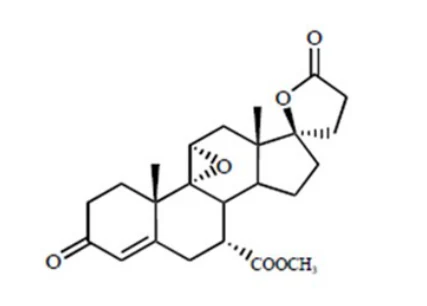
Chemical name: Pregn-4-ene-7,21-dicarboxylic acid, 9,11-epoxy-17-hydroxy-3-oxo-,γ-lactone, methyl ester, (7α,11α,17α)-
Molecular formula and molecular mass: C24H30O6
414.5 g/mol
Structural formula:
Physicochemical properties: Eplerenone is white, almost white or slightly yellow crystalline powder. It is practically-insoluble in water, freely soluble in Methylene chloride, slightly soluble in Ethanol (96%).
CLINICAL TRIALS
Comparative Bioavailability Studies
A double-blind, randomized, two-treatment, two-period, single-dose (1 × 50 mg) crossover bioequivalence study of PrJAMP Eplerenone (Jamp Pharma Corporation) and PrINSPRA® (Pfizer Canada Inc.) was conducted in healthy adult human subjects under fasting conditions. A summary of the data from the 24 subjects that were included in the pharmacokinetic and statistical analyses is presented in the following table.
SUMMARY TABLE OF THE COMPARATIVE BIOAVAILABILITY DATA
Eplerenone (1 x 50 mg) From measured data Geometric Mean Arithmetic Mean (CV%) | ||||
| Parameter | Test1 | Reference2 | % Ratio of Geometric Means | 90% Confidence Interval |
AUCT (hr*ng/mL) | 9339.83 9966.60 (36.1) | 9349.01 9869.73 (33.8) | 99.9 | 94.4 - 105.7 |
AUCI (ng.h/mL) | 9460.68 10110.15 (36.6) | 9470.16 10009.82 (34.2) | 99.9 | 94.3 - 105.8 |
Cmax (ng/mL) | 1371.17 1398.71 (20.9) | 1256.92 1281.72 (20.0) | 109.1 | 104.6 - 113.7 |
Tmax3 (hr) | 1.01 (0.50 – 2.67) | 1.75 (0.50 - 4.50) | ||
T1/24 (hr) | 4.60 (30.9) | 4.56 (29.2) | ||
1 PrJAMP Eplerenone (eplerenone) tablets, 50 mg (JAMP Pharma Corporation).
2 PrINSPRA® (eplerenone) tablets, 50 mg (Pfizer Canada Inc.).
3 Expressed as the median (range) only.
4 Expressed as the arithmetic mean (CV%).
EMPHASIS-HF study: NYHA Class II chronic heart failure
In the EMPHASIS-HF trial (Eplerenone in Mild Patients Hospitalization and Survival Study in Heart Failure) the effect of eplerenone when added to standard therapy on clinical outcomes was investigated in patients with systolic heart failure and mild symptoms (NYHA functional class II).
Patients were included if they were at least 55 years old, had a left ventricular ejection fraction
(LVEF) ≤ 30% (or LVEF <35% only if QRS duration was >130 msec) and were either hospitalized for cardiovascular (CV) reasons less than 6 months prior to inclusion or had a plasma level of B-type natriuretic peptide (BNP) of at least 250 pg/mL or a plasma level of N- terminal pro-BNP of at least 500 pg/mL in men (750 pg/mL in women). Patients enrolled were still symptomatic, albeit mildly, in spite of recommended standard therapy (Table 18). The main exclusion criteria were a contraindication to eplerenone, severe heart failure, recent stroke or MI, cardiac surgery, uncontrolled hypertension (diastolic >110 and or systolic >180 mmHg), symptomatic hypotension, need for potassium-sparing diuretics, surgically amenable cause of HF, intra-aortic pump or other assist device, concomitant potent inhibitor or inducer of CPY3A4, hemoglobin <10 g/dL, significant liver disease, alcohol abuse, progressive fatal disease, pregnancy or no acceptable method of contraception, other acute or chronic medical or psychiatric conditions or laboratory abnormalities that could increase the risk associated with participation in the trial or product administration that would interfere with the interpretation of the results.
In patients with eGFR >50 mL/min/1.73 m2, eplerenone was started at a dose of 25 mg once daily and was increased after 4 weeks to 50 mg once daily if the serum potassium level was < 5.0 mmol/L. Alternatively, if the estimated GFR was 30-49 mL/min/1.73 m2, eplerenone was started at 25 mg on alternate days for 4 weeks, and then increased to 25 mg once daily only if serum potassium levels remained <5.0 mmol/L.
In total, 2737 patients were randomized (double-blind) to the treatment with eplerenone or placebo. They presented with concurrent medical conditions (at screening) listed in Table 17 and they received the concomitant treatments shown in Table 18. Patients on eplerenone were followed-up for a median duration of 533 days and on placebo for a median duration of 494 days.
Demographic and baseline characteristics were generally well matched with some exceptions when there were only a limited number of patients for a given characteristic. Most were males (77-78%), white (83%), had ischemic heart failure (69%) for a mean duration of 5.35 years, a significant medical condition (97%) the most common being hypertension (45%) and/or prior MI (50%), angina (43%), diabetes mellitus (31%), and had been hospitalized for congestive HF (53%).
TABLE 17 - Significant medical conditions in ≥10% of subjects in eplerenone and placebo treatment groups at screening.
| Concomitant Condition | Percent (%) of patients (rounded) | |
|---|---|---|
Eplerenone N=1364 | Placebo N= 1373 | |
| Angina pectoris | 43 | 44 |
| Hypertenstion | 67 | 66 |
| Diabetes Mellitus | 34 | 29 |
| Chronic obstructive pulmonary disease (COPD) | 15 | 14 |
| Coronary artery bypass grafting | 19 | 19 |
| Precutaneous coronary revascularization | 22 | 22 |
| Implanted cardioverter defibrillator | 13 | 13 |
| Pacemaker implanted | 14 | 15 |
| Atrial fibrillation/flutter | 30 | 32 |
|---|
TABLE 18 - Summary of selected prior and concomitant drug treatments
| Prior or Concomitant Treatment | Percent (%) of patients | |
|---|---|---|
Eplerenone N=1364 | Placebo N=1373 | |
| Drug treatment before start of study treatment | ||
| ACE inhibitor, alone or combination | 81 | 80 |
| ARB, alone or combination | 21 | 20 |
| ACE or ARB | 95 | 94 |
| Beta-blockers* | 88 | 89 |
| Diuretics | 87 | 88 |
| Antithrombotic agents** | 90 | 90 |
| Drug treatment at randomization visit | ||
| ACE inhibitor, alone or combination | 81 | 80 |
| ARB, alone or combination | 25 | 25 |
| ACE or ARB | 96 | 95 |
| Beta-blockers* | 87 | 87 |
| Diuretics | 84 | 86 |
| Antithrombotic agents** | 88 | 88 |
| Concomitant drug treatments | ||
| ACE inhibitor, alone or combination | 78 | 77 |
| ARB, alone or combination | 19 | 19 |
| ACE or ARB | 94 | 93 |
| Beta-blockers* | 90 | 91 |
| Diuretics | 88 | 90 |
| Antithrombotic agent** | 91 | 91 |
* Mainly carvedilol, metoprolol and bisoprolol
** Mainly ASA and clopidogrel
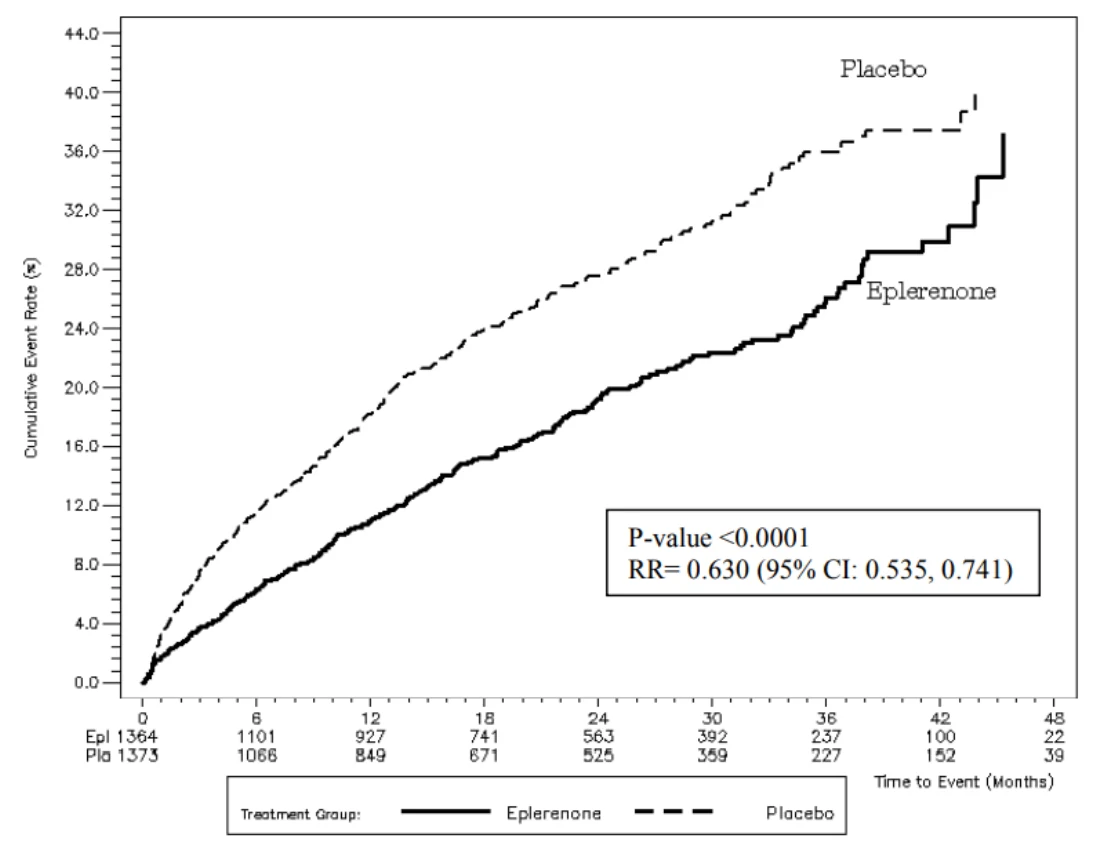
The primary endpoint, death from cardiovascular causes or hospitalization for heart failure occurred in 249 patients (18.3%) in the eplerenone group and 356 patients (25.9%) in the placebo group (RR 0.63, 95% CI, 0.54-0.74; p<0.001). The effect of eplerenone on the primary endpoint outcomes was consistent across all pre-specified subgroups (see Table 19).
TABLE 19. Survival analysis for the composite primary endpoint and its components (cardiovascular death or hospitalization for heart failure). The adjusted* values are in plain font and unadjusted values are shown in italic.
| EVENT | Number (%) of patients | HR and (95% CI) | p-value | ARR % | RRR % |
|---|---|---|---|---|---|
| Eplerenone N=1364 | Placebo N=1373 | ||||
| CV death/HF hospitalization | 249 (18.3) | ||||
| 356 (25.9) | 0.63 (0.535, 0.741) 0.66 (0.561, 0.0776) | <0.0001 <0.0001 | 7.6 | 30 | |
| CV death | 147 (10.8) | 185 (13.5) | 0.76 (0.609, 0.941) 0.77 (0.620, 0.956) | 0.0120 0.018 | 2.7 | 20 |
|---|---|---|---|---|---|---|
HF hospitalization | 164 (12.0) | 253 (18.4) | 0.58 (0.473, 0.702) 0.61 (0.503, 0.746) | <0.0001 <0.0001 | 6.4 | 35 |
CI = confidence interval; CV = cardiovascular; HF = heart failure; HR = hazard ratio; ARR = absolute risk reduction; RRR = relative risk reduction.
* Hazard ratio, 95% CI of hazard ratio, and p-value were based on a Cox proportional hazard model including treatment as the major factor, adjusting for age, eGFR, LVEF, BMI, hemoglobin, heart rate, SBP, diabetes, history of hypertension, prior MI, baseline LBBB or QRS>130 msec, and atrial fibrillation as covariates.
During the study, hyperkalemia (serum potassium level > 5.5 mmol/L) was reported in 173 patients (12.9%) in the eplerenone group and 111 patients (8.2%) in the placebo group (p < 0.001). Hypokalemia, defined as serum potassium levels < 4.0 mmol/L, was statistically lower with eplerenone when compared to placebo (42.0% for eplerenone compared to 52.7% for placebo, p<0.0001). These results are summarized in Table 2, found under the ADVERSE REACTIONS section.
Kaplan-Meier estimates of CV death or hospitalization for heart failure are shown in Figure 1 and the components of cardiovascular mortality or hospitalization are provided in Table 20.
Figure 1. Survival Plot of Time to First Event of Heart Failure Hospitalization or Cardiovascular Death
The secondary endpoint of all cause mortality was met by 171 patients (12.5%) in the eplerenone group and 213 patients (15.5%) in the placebo group (HR 0.76; 95% CI, 0.62-0.93; p = 0.008). Death from CV causes was reported in 147 (10.8%) patients in the eplerenone group and 185 (13.5%) patients in the placebo group (HR 0.76; 95% CI, 0.61-0.94; p = 0.01). Hospitalization for heart failure occurred in 164 (12.0%) in the eplerenone group as compared with 253 (18.4%) patients in the placebo group (HR 0.58; 95% CI, 0.47-0.70; p<0.001). Results from other secondary endpoints are also summarized in Table 21.
Table 20. Summary of Causes for Cardiovascular Death and Cardiovascular Hospitalization (Full Analysis Set)
| Eplerenone | Placebo | |
|---|---|---|
| Total number of subjects | 1364 | 1373 |
| Number (%) of subjects with HF hospitalization or CV death | 249 (18.3) | 356 (25.9) |
| Number (%) of subjects with HF hospitalization | 164 (12.0) | 253 (18.4) |
| Number (%) of subjects with CV death | 147 (10.8) | 185 (13.5) |
| Sudden cardiac death | 60 (4.4) | 76 (5.5) |
| Worsening heart failure | 45 (3.3) | 61 (4.4) |
| Myocardial infarction | 13 (1.0) | 8 (0.6) |
| Arrhythmia | 7 (0.5) | 7 (0.5) |
| Stroke | 6 (0.4) | 7 (0.5) |
| Emergency CV procedure/operation | 0 | 0 |
| Other CV event | 3 (0.2) | 1 (0.1) |
|---|---|---|
| Unknowna | 13 (1.0) | 25 (1.8) |
| Number (%) subjects with CV hospitalization | 304 (22.3) | 399 (29.1) |
| Heart failure | 164 (12.0) | 253 (18.4) |
| Arrhythmia | 49 (3.6) | 74 (5.4) |
| Myocardial infarction, unstable angina, other chest pain | 68 (5.0) | 61 (4.4) |
| Stroke, TIA | 25 (1.8) | 32 (2.3) |
| Syncope/near syncope, hypotension | 19 (1.4) | 18 (1.3) |
| Cardiac tamponade, endocarditis, hypertension, valvular | 25 (1.8) | 40 (2.9) |
| heart disease, other CV event, other | ||
| Pulmonary embolism | 1 (0.1) | 2 (0.1) |
| Other peripheral arterial problem | 13 (1.0) | 11 (0.8) |
| Ruptured aneurysm | 1 (0.1) | 0 |
HF = heart failure; CV = cardiovascular; TIA = transient ischemic attack. a: Death without sufficient data on the cause of the death was adjudicated as death with unknown cause, which is defaulted into the CV death category according to protocol | ||
Table 21. Survival Analysis of the Secondary Endpoints
| Number (%) of Subjects | HR | P-value | 95% CI | ARR % | RRR % | ||||||||
|---|---|---|---|---|---|---|---|---|---|---|---|---|---|
| Eplerenone (N=1364) | Placebo (N=1373) | ||||||||||||
All-cause mortality or HF hospitalization | 270 (19.8) | 376 (27.4) | 0.647 | <0.0001 | 0.552, 0.757 | 7.6 | 30 | ||||||
| All-cause mortality | 171 (12.5) | 213 (15.5) | 0.761 | 0.0081 | 0.622, 0.932 | 3.0 | 19 | ||||||
| CV mortality | 147 (10.8) | 185 (13.5) | 0.757 | 0.0120 | 0.609, 0.941 | 2.7 | 20 | ||||||
All-cause hospitalization | 408 (29.9) | 491 (35.8) | 0.768 | <0.0001 | 0.673, 0.876 | 5.9 | 16 | ||||||
| HF hospitalization | 164 (12.0) | 253 (18.4) | 0.576 | <0.0001 | 0.473, 0.702 | 6.4 | 35 | ||||||
All-cause death or all cause hospitalization | 462 (33.9) | 569 (41.4) | 0.751 | <0.0001 | 0.664, 0.849 | 7.5 | 18 | ||||||
| CV hospitalization | 304 (22.3) | 399 (29.1) | 0.694 | <0.0001 | 0.598, 0.806 | 6.8 | 3523 | ||||||
Hospitalization for hyperkalemia | 4 (0.3) | 3 (0.2) | 1.154 | 0.8539 | 0.251, 5.312 | ||||||||
* HR = Hazard Ratio; ARR=Absolute Risk Reduction; RRR= Relative Risk Reduction
In 330 eplerenone and 327 placebo patients ≥ 75 years of age (subgroup analysis), the statistical significance of the composite primary endpoint rates (HR 0.66, p=0.005) was driven by a significant reduction in hospitalization for heart failure (HR 0.55, p=0.0007) as there was no statistically significant reduction in cardiovascular mortality (HR 0.98; p=0.92). The analysis also showed significant reductions (p<0.003) in both CV hospitalization and all cause hospitalization, while it did not show a difference for all-cause mortality, fatal/non-fatal MI or fatal/non-fatal stroke in these elderly patients.
Heart Failure Post-Myocardial Infarction
The eplerenone post-acute myocardial infarction heart failure efficacy and survival study (EPHESUS) was a multinational, multicentre, double-blind, randomized, placebo-controlled study in patients clinically stable 3-14 days after an acute myocardial infarction (MI) with left ventricular dysfunction (as measured by left ventricular ejection fraction [LVEF] ≤40%) and either diabetes or clinical evidence of heart failure (HF) (pulmonary congestion by exam or chest x-ray or S3). Patients with HF of valvular or congenital etiology, patients with unstable post- infarct angina, and patients with serum potassium >5.0 mmol/L or serum creatinine >221 mcmol/L were to be excluded. Patients were allowed to receive standard post-MI drug therapy and to undergo revascularization by angioplasty or coronary artery bypass graft surgery.
Patients randomized to eplerenone were given an initial dose of 25 mg once daily and titrated to the target dose of 50 mg once daily after 4 weeks if serum potassium was < 5.0 mmol/L. Dosage was reduced or suspended anytime during the study if serum potassium levels were ≥ 5.5 mmol/L (see DOSAGE AND ADMINISTRATION).
EPHESUS randomized 6,632 patients at 671 centers in 27 countries. The study population was primarily Caucasian (90%, with 1% black, 1% Asian, 6% Hispanic, 2% other) and male (71%). The mean age was 64 years (range, 22-94 years). The majority of patients had pulmonary congestion (75%) by exam or x-ray and were Killip Class II (64%). The mean ejection fraction was 33%. The average time to enrollment was 7 days post-MI. Medical histories prior to the index MI included hypertension (60%), coronary artery disease (62%), dyslipidemia (48%), angina (41%), type 2 diabetes (30%), previous MI (27%), and HF (15%).
The mean dose of eplerenone was 43 mg/day. Patients also received standard care including aspirin (92%), ACE inhibitors (90%), ß-blockers (83%), nitrates (72%), loop diuretics (66%), or HMG-CoA reductase inhibitors (60%).
Patients were followed for an average of 16 months (range, 0-33 months). The ascertainment rate for vital status was 99.7%.
The co-primary endpoints for EPHESUS were (1) the time to death from any cause, and (2) the time to first occurrence of either cardiovascular (CV) mortality [defined as sudden cardiac death or death due to progression of heart failure (HF), stroke, or other CV causes] or CV hospitalization (defined as hospitalization for progression of HF, ventricular arrhythmias, acute myocardial infarction, or stroke). To maintain an overall type I error rate of 0.05 (two-sided), the rate of death from any cause was tested at the 0.04 level of significance and the rate of death from cardiovascular causes or hospitalization for cardiovascular events was tested at the 0.01 level of significance.
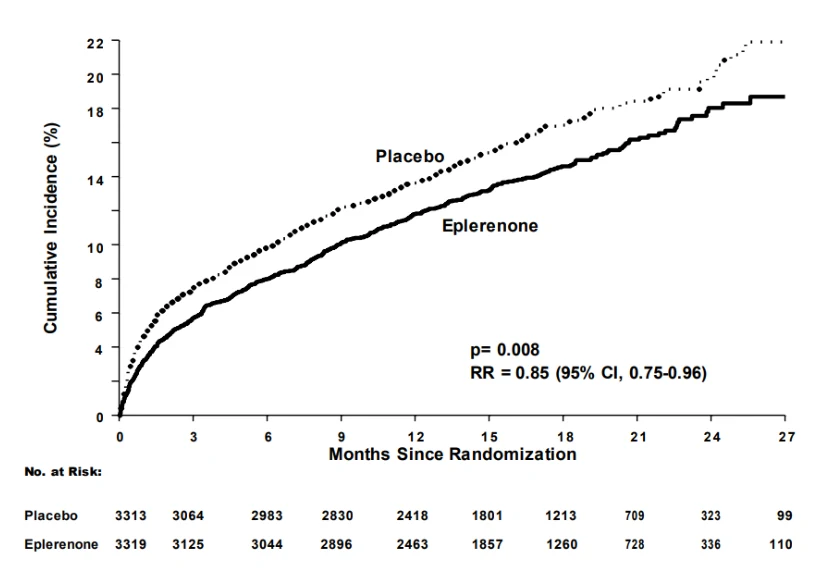
For the co-primary endpoint for death from any cause, there were 478 deaths in the eplerenone group (14.4%) and 554 deaths in the placebo group (16.7%). The risk of death with eplerenone was reduced by 15% [hazard ratio equal to 0.85 (95% confidence interval 0.75 to 0.96; p = 0.008 by log rank test)]. Kaplan-Meier estimates of all-cause mortality are shown in Figure 2 and the components of mortality are provided in Table 22.
Figure 2. Kaplan-Meier Estimates of All-Cause Mortality
It can be seen in Table 22 that the effect on total mortality is driven by a decrease in CV mortality. Most CV deaths were attributed to sudden death, acute MI, and HF.
Table 22 - Summary of Events Contributing to All Cause Mortality (Intent-to-Treat Population)
| Eplerenone N=3319 | Placebo N=3313 | p-value | Relative Risk Ratio (RRR) | 95% CI for RRR | |
|---|---|---|---|---|---|
| Deaths - all causes | 478 (14.4%) | 554 (16.7%) | 0.008 | 0.85 | (0.75, 0.96) |
| CV deaths | 407 (12.3%) | 483 (14.6%) | 0.005 | 0.83 | (0.72, 0.94) |
| Sudden | 162 (4.9%) | 201 (6.1%) | 0.025 | 0.79 | (0.64, 0.97) |
| Recurrent AMI | 78 (2.4%) | 94 (2.8%) | 0.187 | 0.82 | (0.61, 1.10) |
| HF | 104 (3.1%) | 127 (3.8%) | 0.096 | 0.80 | (0.62, 1.04) |
| Stroke | 26 (0.8%) | 28 (0.6%) | 0.734 | 0.91 | (0.53, 1.55) |
| Aneurysm | 1 (0.0%) | 1 (0.0%) | 0.998 | 0.98 | (0.06, 15.64) |
| Pulmonary embolism | 4 (0.1%) | 4 (0.1%) | 0.977 | 0.98 | (0.25, 3.92) |
| Other CV deaths | 32 (1.0%) | 28 (0.8%) | 0.672 | 1.12 | (0.67, 1.85) |
| Non-CV deaths | 60 (1.8%) | 54 (1.6%) | 0.644 | 1.09 | (0.75, 1.58) |
| Sepsis | 9 (0.3%) | 7 (0.2%) | 0.657 | 1.25 | (0.47, 3.36) |
| Pneumonia | 10 (0.3%) | 8 (0.2%) | 0.675 | 1.22 | (0.48, 3.09) |
| Cancer | 20 (0.6%) | 19 (0.6%) | 0.918 | 1.03 | (0.55, 1.94) |
| Other non-CV deaths | 21 (0.6%) | 20 (0.6%) | 0.909 | 1.04 | (0.56, 1.91) |
| Unwitnessed deaths | 0 | 1 (0.0%) | |||
| Unknown cause | 11 (0.3%) | 16 (0.5) | 0.314 | 0.68 | (0.31, 1.46) |
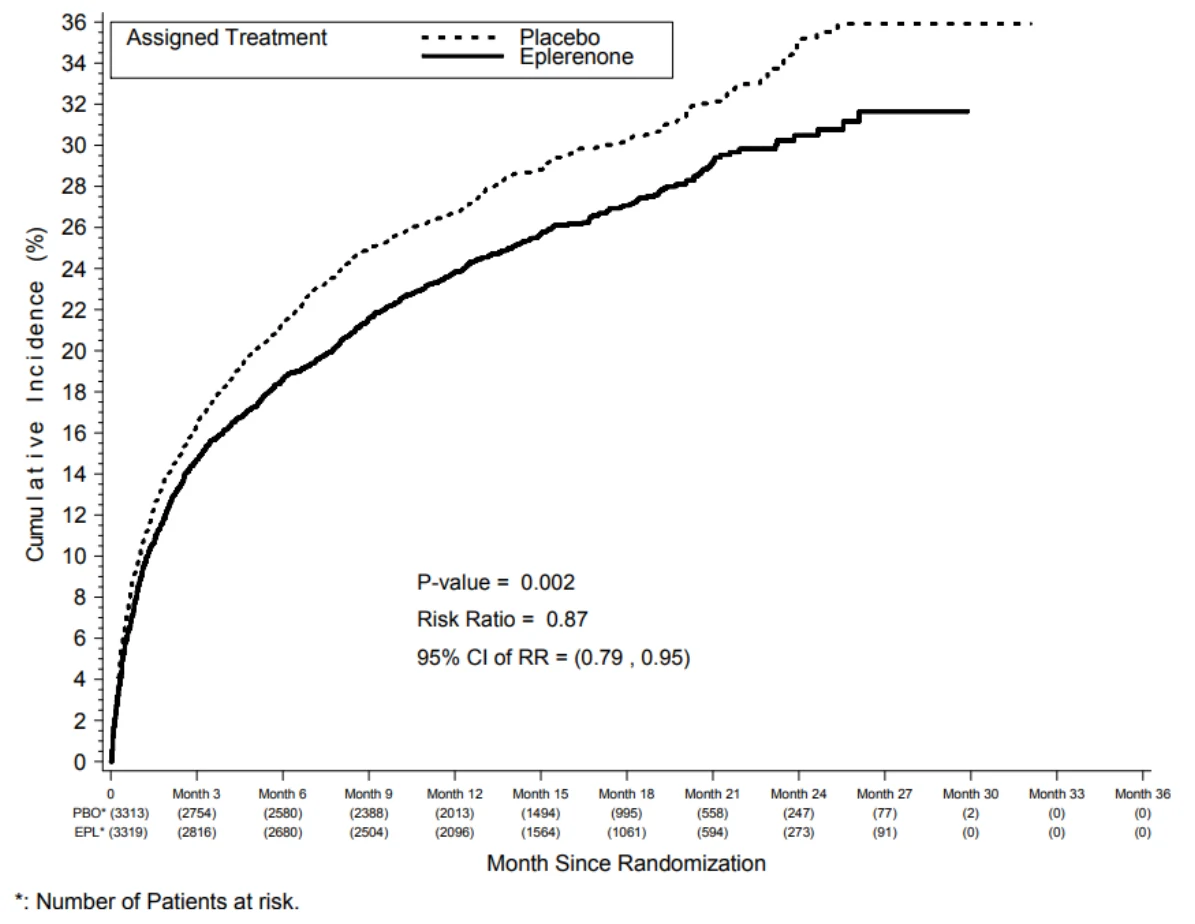
The time to first event for the second primary endpoint of CV death or hospitalization (defined as hospitalization for progression of HF, ventricular arrhythmias, acute MI or stroke), was longer in the eplerenone group (hazard ratio 0.87, 95% confidence interval 0.79 to 0.95, p = 0.002). An analysis that included the time to first occurrence of CV mortality and CV hospitalizations as defined above, as well as other causes of hospitalization showed a smaller effect with a hazard ratio of 0.92 (95% confidence interval 0.86 to 0.99; p = 0.028). The combined endpoints, including combined all-cause hospitalization and mortality, were driven primarily by CV mortality. Adjudicated nonfatal CV and non-CV events causing or prolonging hospitalization are shown in Table 23. Kaplan-Meier estimates for CV death or hospitalization are provided in Figure 3.
Table 23. Adjudicated Nonfatal Events Causing or Prolonging Hospitalization (Intent-to-Treat Population)
Eplerenone 25-50 mg QD N=3319 | Placebo N=3313 | |||||||||||||||
|---|---|---|---|---|---|---|---|---|---|---|---|---|---|---|---|---|
| Incidence | Episodes | Incidence | Episodes | |||||||||||||
| All hospitalizations | 1493 | (45.0%) | 2815 | 1525 | (46.0%) | 2984 | ||||||||||
| CV hospitalization - primary | 606 | (18.3%) | 876 | 649 | (19.6%) | 1004 | ||||||||||
| HF | 345 | (10.4%) | 477 | 391 | (11.8%) | 618 | ||||||||||
| Ventricular arrhythmias | 52 | (1.6%) | 58 | 54 | (1.6%) | 63 | ||||||||||
| Recurrent AMI | 224 | (6.7%) | 268 | 229 | (6.9%) | 269 | ||||||||||
| Stroke | 70 | (2.1%) | 73 | 51 | (1.5%) | 54 | ||||||||||
| CV hospitalization - other | 917 | (27.6%) | 1389 | 925 | (27.9%) | 1450 | ||||||||||
| Atrial fibrillation/flutter | 86 | (2.6%) | 97 | 95 | (2.9%) | 107 | ||||||||||
| Stable angina | 89 | (2.7%) | 100 | 87 | (2.6%) | 100 | ||||||||||
| Unstable angina | 321 | (9.7%) | 404 | 307 | (9.3%) | 398 | ||||||||||
| PVD | 38 | (1.1%) | 47 | 32 | (1.0%) | 36 | ||||||||||
| Hypotension | 31 | (0.9%) | 34 | 29 | (0.9%) | 31 | ||||||||||
| CV surgery | 320 | (9.6%) | 348 | 301 | (9.1%) | 349 | ||||||||||
| Other | 318 | (9.6%) | 359 | 368 | (11.1%) | 429 | ||||||||||
| Non-CV hospitalization | 539 | (16.2%) | 745 | 559 | (16.9%) | 755 | ||||||||||
| Pneumonia | 35 | (1.1%) | 39 | 70 | (2.1%) | 74 | ||||||||||
| COPD/COLD | 17 | (0.5%) | 21 | 19 | (0.6%) | 23 | ||||||||||
| Other pulmonary disease | 28 | (0.8%) | 30 | 26 | (0.8%) | 27 | ||||||||||
| Diabetes | 28 | (0.8%) | 29 | 38 | (1.1%) | 38 | ||||||||||
| Elective Surgery | 65 | (2.0%) | 70 | 44 | (1.3%) | 48 | ||||||||||
| Other | 422 | (12.7%) | 556 | 420 | (12.7%) | 545 | ||||||||||
Incidence of hospitalization due to heart failure was 10.4% in the eplerenone group versus 11.8% in the placebo group (HR 0.85 [0.74-0.99]; 95% CI; P=0.03).
Figure 3. Cumulative Incidence of CV Mortality/Hospitalization
In 616 eplerenone and 710 placebo patients ≥ 75 years of age, the subgroup analysis did not show a significant difference for all-cause mortality (HR=1.005; p=0.965).
Hypertension
A total of 3,299 patients were treated with eplerenone alone or in combination with other antihypertensive agents in clinical studies. These studies excluded patients with elevated baseline serum potassium (>5.0 mmol/L), elevated baseline serum creatinine generally >132 mcmol/L in males and >115 mcmol/L in females.
A 8-week, randomized, double-blind, multicenter, placebo-controlled, parallel group comparison trial was conducted in patients with baseline mild to moderate hypertension, seDBP of ≥ 95 mmHg and ≤ 114 mmHg. Patients received placebo, or eplerenone in doses of 25 mg twice daily, 50 mg once daily, and 50 mg twice daily. The adjusted mean change from baseline at each visit is shown in Table 24 and Table 25.
Table 24. Mean Change (±SD) from Baseline of Trough Sitting Diastolic Blood Pressure at Each Visit
| Placebo | Eplerenone 25 mg BID | Eplerenone 50 mg QD | Eplerenone 50 mg BID | |
|---|---|---|---|---|
| Number of Patients | 52 | 53 | 54 | 53 |
| Week 2 (mmHg) | -4.9±7.68 | -5.5±6.92 | -4.5±8.07 | -7.5±7.92 |
| Week 4 (mmHg) | -3.9±7.50 | -6.3±6.64 | -5.7±7.27 | -7.5±7.44 |
| Week 8 (mmHg) | -1.3±6.93 | -4.9±7.94 | -4.4±7.77 | -7.8±8.61 |
Table 25. Mean Change (±SD) from Baseline of Trough Sitting Systolic Blood Pressure* at Each Visit
| Placebo | Eplerenone 25 mg BID | Eplerenone 50 mg QD | Eplerenone 50 mg BID | |
|---|---|---|---|---|
| Number of Patients | 52 | 53 | 54 | 53 |
| Week 2 (mmHg) | -5.5±11.26 | -11.6±10.15 | -7.1±12.51 | -10.8±11.95 |
| Week 4 (mmHg) | -3.2±13.95 | -12.6±10.76 | -8.0±15.77 | -11.7±12.44 |
| Week 8 (mmHg) | 1.4±12.32 | -8.9±13.63 | -5.0±14.72 | -11.8±16.55 |
*pre-specified secondary endpoint
The reductions in mean sitting DBP observed in the 3 eplerenone treatment groups at final study visit were statistically significantly different compared to placebo. Similarly, the statistically significant reductions in the 3 eplerenone treatment groups comparing to the placebo in mean sitting SBP (pre-specified secondary endpoint) at final visit are also detected.
DETAILED PHARMACOLOGY
Human Pharmacology
Pharmacokinetics
Absorption
Mean peak plasma concentrations of eplerenone are reached approximately 1.5 to 2 hours following oral administration. The absolute bioavailability of eplerenone is 69% following administration of a 100 mg oral tablet. Absorption is not affected by food. Both peak plasma levels (Cmax) and area under the curve (AUC) are dose proportional for doses of 25 to 100 mg, and less than proportional at doses above 100 mg.
Distribution
Eplerenone is approximately 50% bound to plasma proteins, primarily to alpha 1-acid glycoprotein. The protein binding is concentration-independent within the expected therapeutic range of total plasma concentrations. The apparent volume of distribution at steady state ranges from 42 to 90 L. Eplerenone does not selectively partition into erythrocytes; the average ratio of plasma/whole blood concentrations is approximately 1.4:1.
Metabolism
Eplerenone is extensively metabolized in humans, and less than 5% of the dose is recovered unchanged in urine plus feces. Elimination of eplerenone involves Phase I metabolism, including hydroxylation of the methyl group to form several pharmacologically-inactive metabolites. Metabolites of eplerenone representing 5% or greater of the administered dose recovered in urine and feces are 6β-OH (primary metabolite), 6β-21-OH, 21-OH, 3α-6β-21-OH, and 3α-6β-OH. The 6β-OH, 6β-21-OH and 21-OH metabolites were the major metabolites of eplerenone recovered in the urine, representing approximately 28%, 13% and 5% of the dose, respectively. In vitro studies indicate that formation of the primary 6β-OH metabolite is predominantly mediated by CYP3A4. Plasma exposure of the 6β-OH metabolite is about 32% of the exposure of eplerenone in healthy adult subjects.
Excretion
Following a single oral dose of radiolabeled drug, approximately 32% of the dose was excreted in the feces and approximately 67% was excreted in the urine. The elimination half-life of eplerenone is approximately 3 to 6 hours. The apparent plasma clearance is approximately 10 L/hr.
Special Populations and Conditions
Geriatrics
Healthy elderly subjects receiving eplerenone 100 mg QD for 12 days showed significantly higher plasma concentrations of eplerenone compared to healthy young adults. Mean steady- state Cmax and AUC0-24 of eplerenone were 22% and 45% greater, respectively, for elderly subjects as compared to young subjects. Mean eplerenone AUC0-inf after single-dose administration approximated steady-state AUC0-24 after QD dosing in both elderly and young subjects, suggesting the absence of time-dependent pharmacokinetics.
Pediatrics
A population pharmacokinetic model was developed to describe the single-dose pharmacokinetics of eplerenone in pediatric (2 to 16 years) and adult (≥ 18 years) hypertensive patients. No covariates (age, body weight, body surface area, sex, or race) were found to influence apparent oral clearance (CL/F), and hence exposure (in terms of AUC) to eplerenone for a given dose would not be expected to differ between pediatric and adult patients. Body weight was found to be a significant covariate for apparent central volume of distribution (Vc/F). The peak concentration, Cmax, which is influenced by Vc/F, was predicted to decrease by approximately 28% for each doubling of body weight. Overall, no differences between pediatric and adult patients were found that could not be explained by body weight.
Gender
The pharmacokinetics of eplerenone did not differ significantly between males and females.
Race
No statistically significant differences were found in mean steady-state AUC0-24, Cmax, and Tmax of eplerenone between Black subjects and Caucasian subjects following a single oral 100 mg dose of eplerenone. Steady-state mean CL/F was 33% greater in Black than Caucasian subjects, resulting in a statistically insignificant 26% decrease in AUC0-24 in Blacks compared to Caucasians.
Results from healthy volunteer and patient studies indicate no significant difference in the pharmacokinetics of eplerenone between Japanese subjects and Caucasian subjects.
Renal Insufficiency
The single- and multiple-dose pharmacokinetics of eplerenone were evaluated in subjects with mild, moderate and severe renal impairment, in subjects with end-stage renal disease and in subjects with normal renal function.
Following single and multiple doses, eplerenone was generally readily absorbed, reaching maximum plasma concentrations within approximately 2 hours after dosing across all renal impairment groups. The T1/2 for eplerenone was consistent across all groups, ranging from 4 to 6 hours. In patients with severe renal dysfunction, a 32% increase in steady state average AUC 0-24 of eplerenone was observed as compared to age matched normal renal function control subjects. No apparent relationship was found between weight-normalized eplerenone CL/F and creatinine clearance among subjects with normal renal function and subjects with renal impairment, indicating that there was no correlation between eplerenone disposition kinetics and degree of renal dysfunction.
Based upon pharmacokinetic considerations alone, no dose adjustment is required in patients with varying degrees of renal impairment.
Hemodialysis removed only about 10% of the administered eplerenone dose from the systemic circulation. No dosage adjustment would be necessary for the hemodialysis procedure.
Hemodialysis would not be expected to be a good method of removing eplerenone from the systemic circulation in case of overdosage.
Hepatic Insufficiency
The effect of moderate hepatic impairment (Child-Pugh Class B) on the single-dose and steady- state pharmacokinetics of eplerenone was evaluated. Compared to normal control subjects, there was a 42% increase in mean eplerenone AUC0-24 after QD dosing in subjects with moderate hepatic impairment. No significant differences were found in mean steady-state Cmax and Tmax of eplerenone between subjects with moderate hepatic impairment and normal control subjects.
Steady-state terminal T1/2 of eplerenone was 8.1 hours for subjects with moderate hepatic impairment and 7.6 hours for normal control subjects.
The results of this study indicate that dose adjustment may not be required for patients with moderate (Child Pugh B) hepatic impairment based upon pharmacokinetic considerations alone. Patients with severe hepatic dysfunction were not studied and therefore, eplerenone is contraindicated in Child-Pugh C.
Pharmacokinetic Interaction Studies
An extensive in vitro evaluation of the metabolism-based drug interaction potential of eplerenone was conducted. The data indicate that it is unlikely that eplerenone will inhibit the metabolism of other drugs due to its high concentration causing 50% inhibition (IC50) [> 300 mcM] against the major human CYP isoforms (1A2, 2C9, 2D6, 2C19, and 3A4). Drug-drug interactions based on P-glycoprotein mechanism are unlikely since eplerenone is not a substrate for, or an inhibitor of, the P-glycoprotein transporter.
Food consumption, concomitant antacid use, or consumption of double-strength grapefruit juice had no clinically important effects on the extent of eplerenone absorption when compared to administration of eplerenone tablets in a fasting state.
In vivo drug interaction studies focused on compounds that were known to be inhibitors, substrates, or inducers of CYP hepatic isoforms, specifically the CYP3A4 isozyme, or were substrates or inhibitors of P-glycoprotein.
Eplerenone (100 mg QD) has no clinically significant effect on the pharmacokinetics of glyburide, simvastatin, midazolam, cisapride, warfarin, cyclosporine, and oral contraceptives. Results indicate that eplerenone does not impact the metabolism of CYP3A4 or CYP2C9 substrates.
Coadministration of eplerenone (100 mg QD) with digoxin (200 mcg QD), a substrate for P- glycoprotein, did not produce any clinically significant changes in plasma exposure of digoxin.
Coadministration of eplerenone (100 mg QD) with St. John’s Wort (300 mg TID for 14 days), an inducer of CYP3A4, lead to decreases in Cmax (19%) and AUC0-inf (31%), which are considered to be clinically insignificant.
The effect of a number of strong and moderate CYP3A4 inhibitors on the pharmacokinetics of eplerenone was evaluated. Coadministration of single 100 mg oral doses of eplerenone with ketoconazole (200 mg BID for 7 days) or fluconazole (200 mg QD for 7 days) resulted in statistically significant increases (441% and 123%, respectively) in total plasma exposure (AUC0-inf) of eplerenone. Additionally, coadministration of erythromycin (500 mg BID) with eplerenone 100 mg QD for 7 days significantly increased total plasma exposure (187%) of eplerenone.
Coadministration of verapamil (240 mg QD) with eplerenone 100 mg QD for 7 days significantly increased total plasma exposure (98%) and maximum plasma exposure (36%) of eplerenone.
Coadministration of saquinavir (1200 mg TID) with eplerenone 100 mg QD for 7 days significantly increased total plasma exposure (107%) of eplerenone.
Pharmacodynamics
Effects on Urinary Sodium and Potassium Excretion
The effect of eplerenone on urinary sodium and potassium excretion was evaluated in 3 single- dose studies and in 2 multiple-dose, dose-ranging studies.
The results of 2 single-dose studies showed increased urinary excretion of sodium and urinary log10 (Na+/K+) ratio in a dose-dependent manner following single-dose administration.
Whereas, the other single dose study showed that there were no significantly high or low values of excreted sodium, Na+/K+ ratio or log10 Na+/K+ in urine 48 hours after administration.
Findings from one of the multiple-dose, dose-ranging study showed that these increases in urinary excretion of sodium and urinary log10 (Na+/K+) ratio were not sustained after multiple dosing, while the other multiple-dose, dose-ranging study, only slight increases were observed in these parameters.
Other Pharmacodynamic Assessments
The effects of eplerenone on plasma renin activity, plasma aldosterone and plasma hormones were assessed in 2 studies. The results showed that in one study, no significantly high or low values of changes in these parameters were observed in any of the non-fasting groups. In the other study, obvious increases in plasma aldosterone concentration and plasma renin activity were not noted, however, as the values in the eplerenone group were apparently higher than those in the placebo group, a pharmacological action of eplerenone was suggested.
Electrocardiographic Interval Analyses
The effects of eplerenone on ECG interval durations were retrospectively evaluated in 5 clinical pharmacology studies. The results of the ECG analyses were uniform across the 5 studies and indicated that there was no effect of eplerenone on any ECG parameter, most notably the QTc interval. The results of the studies suggest that eplerenone is devoid of any ECG effects and should not pose any safety concern in regards to cardiac repolarization effects.
The electrocardiographic effects of eplerenone as compared to amlodipine were further evaluated by ambulatory ECG (Holter) monitoring in a cohort of patients with mild to moderate hypertension. There were no differences between eplerenone and amlodipine on ventricular repolarization as assessed by QT interval analysis. Within the eplerenone group, no changes from baseline were apparent from the QTc interval analysis.
Animal Pharmacology
Heart Failure
Nonclinical studies suggest that aldosterone acts directly on the cardiac MR to produce deleterious effects such as cardiac hypertrophy and fibrosis. Nonclinical studies using eplerenone provide additional support for this hypothesis. For example, eplerenone inhibits non- genomic actions of aldosterone in cardiomyocytes and reduces left ventricular hypertrophy (LVH) in rats with pressure-overload-induced hypertrophy resulting from aortic banding.
Further support for the cardioprotective effect of direct blockade of MR in the heart was obtained from studies in experimental models of heart failure (HF). Evaluation of eplerenone efficacy in diverse models of HF demonstrated that selective aldosterone blockade effectively attenuates HF development, improves left ventricular function, and reduces LVH independent of HF etiology and in the absence of hemodynamic effects. Moreover, the benefit was achieved when eplerenone was administered prior to HF or during disease progression. In addition, cardio protection may result from direct actions of eplerenone on the myocardium, as efficacy was accompanied by a reduction in cardiac gelatinase activity, cardiomyocyte cross-sectional area, and reduced expression of proinflammatory and hypertrophy marker genes.
The Eplerenone Efficacy in Experimental Models of Heart Failure is presented in Table 25.
Table 25. Eplerenone Efficacy in Experimental Models of Heart Failure
| Model | Eplerenone Dose | Treatment | Enalapril Dose | Eplerenone Efficacy |
|---|---|---|---|---|
| Transgenic mice overexpressing cardiac 11βHSD2 | ~200 mg/kg/day, chow | 1 - 3.5 mo of age | ↑ EF 16%* and normalization of EDV and ESV ↓ Expression of LVH and inflammatory marker genes (βMHC, ANP, Collagen I, OPN) | |
| Post-MI Rat | 300 mg/kg/day, b.i.d., gavage | 3, 7, or 28 days post-MI | No significant impact on infarct healing | |
| Post-MI Rat | ~100 mg/kg/day, chow | 8 weeks post- MI | 10 mg/kg/day, in water | Eplerenone, Enalapril, and Co-administration therapy: ↑ EF (Epl ↑ EF 7%†) ↓ LVAd, LVAs Eplerenone did not change SBP Enalapril ↓ SBP |
| Post-MI Mouse | ~200 mg/kg/day, chow | 2 - 14 weeks post-MI | 20 mg/kg/day, in water | Eplerenone, Enalapril, and Co-administration therapy: ↑ EF (Epl ↑ EF 11%†) ↓ LVAs, MCSA, ICF Eplerenone did not change SBP Enalapril ↓ SBP |
| Canine Microembolism HF model | 20 mg/kg/day, b.i.d., oral | 3 months starting at EF ≤ 40% | EF ↑ 6%‡ and prevention of LV dilation as measured by preserved EDV and ESV ↓ Cardiac gelatinase activity, MCSA, ICF Eplerenone did not change SBP, HR, or SVR | |
| SHHF | ~ 100 mg/kg/day, chow | 14 - 17 mo of age | 10 mg/kg/day, in water | Eplerenone + Enalapril Co-administration: Maintained EF and prevented LV dilation as measured by LVAs and LVAd ↓Cardiac and renal inflammatory marker gene expression (OPN, MCP-1, IL-1, IL-6) |
| SHHF | ~ 100 mg/kg/day , chow | 3.5 - 17.5 mo of age | EF ↑ 12%‡ ↓ LVAs and LVAd |
* p < 0.05 vs. Transgenic Control Mice; †, p < 0.05 vs. Untreated Post-MI animals; ‡ p < 0.05 vs. Untreated animals. EF, Ejection Fraction; LVAd, Left Ventricular Area at Diastole; LVAs, Left Ventricular Area at Systole; EDV, End Diastolic Volume; ESV, End Systolic Volume; bMHC, beta Myosin Heavy Chain; ANP, Atrial Natriuretic Peptide; OPN, Osteopontin; SBP, Systolic Blood Pressure; MCSA, Myocyte Cross-Sectional Area; ICF, Interstitial Collagen Fraction; HR, Heart Rate; SVR, Systemic Vascular Resistance; MCP-1, Monocyte Chemoattractant Protein-1; IL-1, Interleukin-1; IL-6, Interleukin-6.
TOXICOLOGY
The nonclinical safety assessment of eplerenone comprised studies of acute and repeat-dose toxicity in mice, rats and dogs, in vivo and in vitro genotoxicity, carcinogenicity in rats and mice, reproductive toxicity in rats and rabbits, and in vivo and in vitro mechanistic studies designed to clarify specific findings. The major toxic endpoints of the pivotal repeat-dose studies in animals are summarized in Table 26.
Table 26. Outcomes of Pivotal In Vivo Toxicity Studies
| Species and Study Type | Major Endpoint | Threshold Dosage mg/kg/day | NOAEL* mg/kg/day | Animal:Human AUC(0-24 h) Exposure Multiple at NOAEL* |
|---|---|---|---|---|
Mouse Repeat-Dose Toxicity 13-Wk | None | NA | 1000 | 8x |
Rat Repeat-Dose Toxicity 13- and 26-Wk and 52-Wk interim in 2-Yr Carcinogenicity | Kidney- chronic progressive nephropathy |
|
| 4.5x Males and Females |
Dog Repeat-Dose Toxicity 13- and 52-Wk |
|
|
|
|
Mouse Carcinogenicity 26-Wk | None | NA | 1000 | 9x |
Rat Carcinogenicity 2-Year | Thyroid- benign follicular cell adenoma |
|
|
|
Rat Fertility and Embryo Development |
| 1000 Males |
|
|
Rat Embryo-Fetal Development |
|
|
|
31x Gestation Day 6
|
Rat Pre- and Post-natal Development |
| 1000 Females (dams) and offspring | 300 Females (dams) and offspring | 15x Females (Dams) (estimated) |
| Rabbit Embryo-fetal Development |
| 300 Females (dams) and fetuses | 100 Females (dams) and fetuses | Females (Dams): 9x on Gestation Days 7 and 19 |
NOAEL = no-observed-adverse-effect level
Acute Toxicity
Eplerenone had a low level of acute toxicity in animals. It caused severe clinical signs and/or deaths only at high doses in the mouse (≥ 1500 mg/kg) and the dog (≥ 500 mg/kg), but not in the rat (up to 2000 mg/kg).
Repeat-Dose Toxicity
In repeat-dose animal toxicity studies, the principal adverse effects of eplerenone were an increase in the incidence and/or severity of chronic progressive nephropathy (CPN), which is a rat-specific kidney disease having no human counterpart, and reversible prostate atrophy in the male dog. Neither of these is considered to represent a significant human hazard, and they occur only at multiples of the human therapeutic exposure (~ 12-fold higher for rats and 7-fold higher for dogs compared to the area under the concentration-time curve for humans taking 100 mg).
Eplerenone also caused pharmacologically mediated reversible changes, such as increased serum aldosterone, increased urinary sodium to potassium ratio, and/or hypertrophy of the zona glomerulosa of the adrenal cortex. Certain other changes in rodents, such as increased serum cholesterol, triglycerides and protein, and secondary thyrotrophic effects, were considered to be physiological adaptations related to hepatic enzyme induction and the associated increased liver mass.
Carcinogenicity and Genotoxicity Studies
Eplerenone was not genotoxic in an extensive battery of in vitro and in vivo tests. Eplerenone was not carcinogenic in heterozygous p53 knock-out mice, a strain that is highly susceptible to genotoxic carcinogens. When tissues from a 2-year rat carcinogenesis study were examined by standard histolopathological methods, eplerenone produced only benign thyroid follicular cell adenomas by a mechanism related to increased hepatic clearance of thyroid-stimulating hormone. This mechanism is considered to be irrelevant to humans. When an extended histopathological evaluation of rat kidneys was conducted, female rats, at the highest dose tested (250 mg/kg/day), were found to have an increased incidence of benign renal tubular cell adenomas. The increased incidence was highly correlated to an increased severity of CPN in these rats. As indicated previously, CPN has no human counterpart and its increased severity in rats is not considered to represent a hazard for human health.
There was no drug-related tumor response in heterozygous P53 deficient mice when tested for 6 months at dosages up to 1000 mg/kg/day (systemic AUC exposures up to 9 times the exposure in humans receiving the 100 mg/day therapeutic dose). Statistically significant increases in benign thyroid tumors were observed after 2 years in both male and female rats when administered eplerenone 250 mg/kg/day (highest dose tested), and in male rats only at 75 mg/kg/day. These dosages provided systemic AUC exposures approximately 2 to 12 times higher than the average human therapeutic exposure at 100 mg/day. Repeat dose administration of eplerenone to rats increases the hepatic conjugation and clearance of thyroxin, which results in increased levels of thyroid stimulating hormone (TSH) by a compensatory mechanism. Drugs that have produced thyroid tumors by this rodent-specific mechanism have not shown a similar effect in humans.
Reproductive and Teratogenicity Studies
There was no evidence of eplerenone related teratogenicity in rats or rabbits. Fertility was not affected in female rats. Male rats showed only a slight decrease in fertility at a highly exaggerated dose (1000 mg/kg/day). This is considered to be secondary to decreased size of seminal plugs, a mechanism that is irrelevant to humans.
REFERENCES
- 1. Delyani JA, Rocha R, Cook CS, et al. Eplerenone: a selective aldosterone receptor antagonist (SARA). Cardiovasc Drug Rev. 2001 Fall;19(3):185-200.
- 2. Desai, A. Hyperkalemia associated with inhibitors of the renin-angiotensin-aldosterone system: balancing risk and benefit. Circulation 2008;118:1609-1611.
- 3. Funder, JW. Minireview: Aldosterone and the cardiovascular system: genomic and nongenomic effects. Endocrinology 2006;147:5564-5567.
- 4. Jessup, M. Aldosterone blockade and heart failure. N Eng J Med 2003;348:1380-1382.
- 5. Palmer BF. Managing hyperkalemia caused by inhibitors of the renin-angiotensin- aldosterone system. N Eng J Med 2004;351:585-592.
- 6. Pitt B, Bakris, G, Ruilope LM et al. Serum potassium and clinical outcomes in the eplerenone post-myocardial infarction heart failure efficacy and survival study (EPHESUS). Circulation 2008;118:1643-1650.
- 7. Pitt B, Gheorghiade M, Zannad F, et al. Evaluation of eplerenone in the subgroup of EPHESUS patients with baseline left ventricular ejections fraction ≤ 30%. Eur J Heart Fail 2006; 8(3): 295-301.
- 8. Pitt B, Remme W, Zannad F, et al. Eplerenone, a selective aldosterone blocker, in patients with left ventricular dysfunction after myocardial infarction. NEJM 2003; 348 (14): 1309-21.
- 9. Pitt B, White H, Nicolau J, et al. Eplerenone reduces mortality 30 days after randomization following acute myocardial infarction in patients with left ventricular systolic dysfunction and heart failure. J Am Coll Cardiol 2005; 46 (3): 425-31.
- 10. Zannad F, McMurray JJ, Krum H, et al. Eplerenone in patients with systolic heart failure and mild symptoms. N Engl J Med 2011;364(1):11-21
- 11. PrINSPRA® (Tablets, 25 mg and 50 mg), submission control 276281, Product Monograph, BGP Pharma ULC July 5, 2023