


Product Monograph - Locacorten Vioform
RECENT MAJOR LABEL CHANGES
None at time of most recent authorization
TABLE OF CONTENTS
Sections or subsections that are not applicable at the time of authorization are not listed.
RECENT MAJOR LABEL CHANGES ............................................................................................ 2
TABLE OF CONTENTS .............................................................................................................. 2
PART I: HEALTH PROFESSIONAL INFORMATION ...................................................................... 4
1 INDICATIONS ............................................................................................................... 4
1.1 Pediatrics .............................................................................................................. 4
1.2 Geriatrics .............................................................................................................. 4
2 CONTRAINDICATIONS ................................................................................................. 4
4 DOSAGE AND ADMINISTRATION ................................................................................. 4
4.1 Dosing Considerations .......................................................................................... 4
4.2 Recommended Dose and Dosage Adjustment ..................................................... 5
5 OVERDOSAGE .............................................................................................................. 5
6 DOSAGE FORMS, STRENGTHS, COMPOSITION AND PACKAGING ................................. 5
7 WARNINGS AND PRECAUTIONS .................................................................................. 5
7.1 Special Populations ............................................................................................... 6
7.1.1 Pregnant Women ............................................................................................. 6
7.1.2 Breast-feeding .................................................................................................. 6
7.1.3 Pediatrics .......................................................................................................... 6
7.1.4 Geriatrics .......................................................................................................... 6
8 ADVERSE REACTIONS .................................................................................................. 7
8.1 Adverse Reaction Overview .................................................................................. 7
9 DRUG INTERACTIONS .................................................................................................. 7
9.3 Drug-Behavioural Interactions .............................................................................. 7
9.4 Drug-Drug Interactions ......................................................................................... 7
9.5 Drug-Food Interactions ......................................................................................... 7
9.6 Drug-Herb Interactions ......................................................................................... 7
9.7 Drug-Laboratory Test Interactions ........................................................................ 7
10 CLINICAL PHARMACOLOGY ......................................................................................... 8
10.1 Mechanism of Action ............................................................................................ 8
11 STORAGE, STABILITY AND DISPOSAL ........................................................................... 8
12 SPECIAL HANDLING INSTRUCTIONS ............................................................................. 8
PART II: SCIENTIFIC INFORMATION ......................................................................................... 9
13 PHARMACEUTICAL INFORMATION .............................................................................. 9
14 CLINICAL TRIALS ........................................................................................................ 10
15 MICROBIOLOGY ........................................................................................................ 10
16 NON-CLINICAL TOXICOLOGY ..................................................................................... 10
PATIENT MEDICATION INFORMATION .................................................................................. 11
PART I: HEALTH PROFESSIONAL INFORMATION
1 INDICATIONS
LOCACORTEN VIOFORM (flumethasone pivalate and clioquinol cream) is indicated:
- the initial treatment of corticosteroid-responsive inflammatory skin disorders complicated by bacterial and/or fungal infections, with appropriate systemic antibiotics if necessary, such as: seborrheic dermatitis, atopic dermatitis, localized neurodermatitis, contact dermatitis, intertrigo, superficial forms of pyoderma (e.g., impetigo).
- dermatomycosis in which acute inflammation is a prominent feature.
The cream has a slightly drying effect primarily useful for moist, weeping lesions and in intertriginous areas.
1.1 Pediatrics
Pediatrics (< 18 years old): No data are available to Health Canada; therefore, Health Canada has not authorized an indication for pediatric use.
1.2 Geriatrics
Geriatrics (>65 years old): No data are available to Health Canada.
2 CONTRAINDICATIONS
LOCACORTEN VIOFORM is contraindicated in:
- patients with viral infections of the skin (e.g., chicken pox, skin eruptions following vaccination, herpes simplex, herpes zoster), tuberculosis of the skin, syphilis, rosacea, acne vulgaris and perioral dermatitis.
- patients with known hypersensitivity to flumethasone pivalate or to corticosteroids in general, to hydroxyquinolines, clioquinol or other quinoline derivatives, to iodine as well as to any other components of LOCACORTEN VIOFORM, including any non-medicinal ingredient or component of the container. For a complete listing, see 6 DOSAGE FORMS, STRENGTHS, COMPOSITION AND PACKAGING.
- application to ulcerated areas.
- application to the eye.
- children under 2 years of age.
4 DOSAGE AND ADMINISTRATION
4.1 Dosing Considerations
- Use of LOCACORTEN VIOFORM under occlusive dressings is not recommended as the resulting humid conditions may promote secondary infection with non-sensitive organisms and also may increase the possibility of elevated protein-bound iodine (PBI).
- If no improvement occurs within 1 week, therapy should be discontinued; it is then advisable to identify and treat the causative pathogens.
- LOCACORTEN VIOFORM may turn yellow when exposed to air and may cause staining of the skin, nails, hair or fabrics.
4.2 Recommended Dose and Dosage Adjustment
LOCACORTEN VIOFORM should be applied to the affected areas in a thin layer 2 to 3 times daily.
Pediatrics (< 18 years old): Health Canada has not authorized an indication for pediatric use (see 7.1.3 Pediatrics).
5 OVERDOSAGE
Application to extensive or eroded areas of skin may lead to increased protein-bound iodine (PBI) values within 1 week. Elevated PBI values may also occur where relatively small areas of skin are treated for more than 1 week.
If signs and symptoms resembling those of thyrotoxicosis occur, the preparation should be withdrawn at once.
| For management of a suspected drug overdose, contact your regional poison control centre. |
|---|
6 DOSAGE FORMS, STRENGTHS, COMPOSITION AND PACKAGING
Table 1 – Dosage Forms, Strengths, Composition and Packaging
LOCACORTEN VIOFORM is available in tubes of 30 g and 50 g.
7 WARNINGS AND PRECAUTIONS
General
LOCACORTEN VIOFORM should not be used to treat bacterial or mycotic skin diseases in which acute inflammation is not present.
Patients should, as a general rule, be advised to inform subsequent physicians of the prior use of corticosteroids.
If, in exceptional cases, LOCACORTEN VIOFORM is applied in large amounts, the patient should be kept under regular medical supervision.
| Route of Administration | Dosage Form / Strength / Composition | Non-medicinal Ingredients |
| Topical | Cream (off-white water-soluble) 0.02% flumethasone pivalate and 3% clioquinol | Cetyl alcohol, cetyl palmitate, glycerin, petrolatum, phenoxyethanol, sodium lauryl sulfate, stearyl alcohol, water |
Ear/Nose/Throat
LOCACORTEN VIOFORM should not be used in the external auditory canal if the eardrum is perforated.
Endocrine and Metabolism
Adrenal function: Provided the preparation is used as recommended, unwanted systemic effects are unlikely to occur. On basic medical grounds, the possibility of a clinically important effect on adrenocortical function should nevertheless be borne in mind, particularly if the preparation is used under occlusion, over large areas of the body, in pediatrics and in patients undergoing prolonged therapy.
Thyroid function: Application to relatively large and/or eroded areas, treatment for longer than 1 week, as well as use under occlusive dressings may lead to a marked increase in protein-bound iodine (PBI) and should therefore be avoided.
Hepatic/Biliary/Pancreatic
Caution is indicated in patients suffering from hepatic failure.
Renal
Caution is indicated in patients suffering from renal failure.
Ophthalmologic
LOCACORTEN VIOFORM should not be allowed to come into contact with the conjunctiva.
7.1 Special Populations
7.1.1 Pregnant Women
The safety of LOCACORTEN VIOFORM during pregnancy has not been established. Animal studies have shown that corticosteroids may induce fetal abnormalities in pregnant animals. The relevance of this finding to human use has not been elucidated.
The potential benefit of LOCACORTEN VIOFORM during pregnancy (particularly in the first three months) should be weighed against possible hazard to the fetus.
7.1.2 Breast-feeding
The safety of LOCACORTEN VIOFORM during lactation has not been established. It is not known whether flumethasone pivalate and/or clioquinol pass into breast milk when applied topically. The potential benefit of LOCACORTEN VIOFORM during lactation should be weighed against possible hazard to the nursing infant.
7.1.3 Pediatrics
Pediatrics (18 years old): No data are available to Health Canada; therefore, Health Canada has not authorized an indication for pediatric use.
7.1.4 Geriatrics
Geriatrics (>65 years old): No data are available to Health Canada.
8 ADVERSE REACTIONS
8.1 Adverse Reaction Overview
Occasionally: signs of irritation such as burning sensation, itching, or skin rash at the site of application; hypersensitivity reactions.
Isolated cases: mild skin atrophy due to flumethasone pivalate.
If an exacerbation or an allergic type reaction occurs, treatment with LOCACORTEN VIOFORM should be discontinued.
Local adverse reactions reported during topical treatment with glucocorticoids include contact allergy, changes in skin pigmentation, and secondary infections. Topically applied glucocorticoids may give rise to striae rubrae distensae, telangiectasia, purpura, skin atrophy or steroid acne, especially if applied for prolonged periods of time, under occlusive dressings, to large areas or to permeable areas (e.g., face, axillae).
9 DRUG INTERACTIONS
9.3 Drug-Behavioural Interactions
Interactions with individual behaviour risks such as alcohol consumption, sexual activity and smoking have not been established.
9.4 Drug-Drug Interactions
Interactions with other drugs have not been established.
9.5 Drug-Food Interactions
Interactions with food have not been established.
9.6 Drug-Herb Interactions
Interactions with herbal products have not been established.
9.7 Drug-Laboratory Test Interactions
Thyroid function test: Topical use of clioquinol, as well as other iodine-containing compounds, may increase the amount of protein-bound iodine (PBI) in patients with normal thyroid function and therefore may interfere with some thyroid function tests (such as PBI, radioactive iodine and butanol-extractable iodine). These tests should not be performed within a period shorter than 1 month following the use of LOCACORTEN VIOFORM.
Other thyroid function tests, such as the T3 resin sponge test or the T4 determination, are unaffected by clioquinol.
Phenylketonuria test: The ferric chloride test for phenylketonuria may yield a false-positive result when clioquinol is present in the urine.
10 CLINICAL PHARMACOLOGY
10.1 Mechanism of Action
Flumethasone pivalate is a moderately potent difluorinated corticosteroid ester with anti-inflammatory, antipruritic and vasoconstrictive properties. As it is a pivalate, its anti-inflammatory action is concentrated at the site of application. This local effect on diseased areas results in a prompt decrease in inflammation, exudation and itching.
Clioquinol, the antimicrobial component of LOCACORTEN VIOFORM (flumethasone pivalate and clioquinol), is active against a broad spectrum of pathogenic microorganisms, including fungi (e.g., Candida, Microsporum, Trichophyton) and gram-positive bacteria (e.g., Staphylococci). Clioquinol has only a slight inhibitory effect on gram-negative bacteria. Clioquinol exerts a bacteriostatic, rather than a bactericidal action.
LOCACORTEN VIOFORM combines the antifungal and antibacterial effects of clioquinol with the anti-inflammatory and antipruritic effects of flumethasone.
11 STORAGE, STABILITY AND DISPOSAL
Store between 15-30 oC. Protect from heat and freezing.
12 SPECIAL HANDLING INSTRUCTIONS
Not Applicable
PART II: SCIENTIFIC INFORMATION
13 PHARMACEUTICAL INFORMATION
Drug Substances
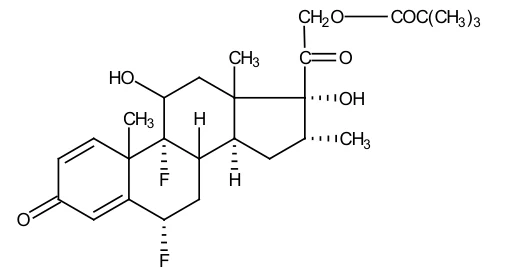
Proper name: Flumethasone pivalate
Chemical name: 6α, 9-difluoro-11β, 17α-dihydroxy-16β-methyl-21-trimethylacetoxy-1,4-pregnadiene-3,20-dione
Molecular formula and molecular mass: C27H36F2O6; 494.6 g/mol
Structural formula:
Physicochemical properties: Virtually white, odorless, fine crystalline powder. Slightly soluble in methanol and ethanol, very slightly soluble in chloroform and methylene chloride, and is insoluble in carbon tetrachloride and isooctane.
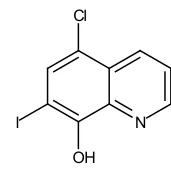
Proper name: Clioquinol
Chemical name: 5-chloro-7-iodo-8-quinolinol
Molecular formula and molecular mass: C9H5ClINO; 305.5 g/mol
Structural formula:
Physicochemical properties: Practically white to faintly yellowish powder. Freely soluble in pyridine, soluble in dimethylformamide and hot ethyl acetate, sparingly soluble in dioxane, slightly soluble in ethanol, practically insoluble in water.
14 CLINICAL TRIALS
The clinical trial data, on which the original indication was authorized, is not available.
15 MICROBIOLOGY
No microbiological information is required for this drug product.
16 NON-CLINICAL TOXICOLOGY
The non-clinical toxicology data, on which the original indication was authorized, is not available.