


Product Monograph - Lupin-Sodium Cromoglicate
Recent Major Label Changes
Not Applicable
Table of Contents
Sections or subsections that are not applicable at the time of authorization are not listed.
Table of Contents .................................................................................................................. 2
PART 1: Health Professional Information ............................................................................... 4
1 Indications ................................................................................................................. 4
1.1 Pediatrics ................................................................................................................. 4
2 Contraindications ....................................................................................................... 4
4 Dosage and Administration ........................................................................................ 4
4.2 Recommended Dose and Dosage Adjustment ....................................................... 4
4.4 Administration ........................................................................................................ 5
4.5 Missed Dose ............................................................................................................ 5
5 Overdosage ................................................................................................................ 5
6 Dosage forms, Strengths, Composition and Packaging ................................................ 5
7 Warnings and Precautions .......................................................................................... 5
7.1 Special Populations ................................................................................................. 6
7.1.1 Pregnant Women ................................................................................................ 6
7.1.2 Breast-feeding ..................................................................................................... 6
7.1.3 Pediatrics ............................................................................................................. 6
8 Adverse Reactions ...................................................................................................... 6
8.1 Adverse Reaction Overview .................................................................................... 6
9 Drug Interactions ....................................................................................................... 7
9.3 Drug-Behavioural Interactions ................................................................................ 7
9.4 Drug-Drug Interactions ........................................................................................... 7
9.5 Drug-Food Interactions ........................................................................................... 7
9.6 Drug-Herb Interactions ........................................................................................... 7
9.7 Drug-Laboratory Test Interactions.......................................................................... 7
10 Clinical Pharmacology ................................................................................................ 7
10.1 Mechanism of Action .............................................................................................. 7
10.2 Pharmacodynamics ................................................................................................. 7
10.3 Pharmacokinetics .................................................................................................... 8
11 Storage, Stability and Disposal .................................................................................... 9
PART 2: Scientific Information ............................................................................................. 10
13 Pharmaceutical Information ..................................................................................... 10
14 Clinical Trials ............................................................................................................ 10
14.4 Immunogenicity .................................................................................................... 10
15 Microbiology ............................................................................................................ 11
16 Non-Clinical Toxicology ............................................................................................ 11
Patient Medication Information .......................................................................................... 14
PART 1: HEALTH PROFESSIONAL INFORMATION
1 Indications
LUPIN-SODIUM CROMOGLICATE (Sodium Cromoglicate) is indicated for:
- The treatment of food allergy (where adequate investigations have been performed to determine sensitivity to one or more ingested allergens) in conjunction with restriction of main causative allergens.
1.1 Pediatrics
Pediatrics (<2 years of age): Based on the data submitted and reviewed by Health Canada, the safety and efficacy of LUPIN-SODIUM CROMOGLICATE in pediatric patients below the age of 2 years has not been established. Therefore, Health Canada has not authorized an indication for pediatric use < 2 years of age (see Dosage and Administration).
2 Contraindications
LUPIN-SODIUM CROMOGLICATE is contraindicated in patients who are hypersensitive to this drug or to any ingredient in the formulation, including any non-medicinal ingredient, or component of the container. For a complete listing, see Dosage Forms, Strengths, Composition, and Packaging.
4 Dosage and Administration
4.2 Recommended Dose and Dosage Adjustment
- Food Allergy:
Initial Treatment Dose:
Adults:
200 mg four times daily 15-20 minutes before meals.
Children (2-14 years of age):
100 mg four times daily 15-20 minutes before meals.
Maximum dose:
If satisfactory control of symptoms is not achieved within two to three weeks the dosage may be doubled, but should not exceed 40 mg/kg/day.
Maintenance Dose:
Once a therapeutic response has been achieved the dose may be reduced to the minimum required to maintain the patient free of symptoms.
Prevention:
Patients who are unable to avoid allergenic foods under certain circumstances (i.e., school meals, restaurants) may be able to protect themselves against the effect of these foods by taking a single dose of LUPIN-SODIUM CROMOGLICATE 15 minutes before the meal. The optimum dosage will need to be determined for each patient and a suitable starting dose would be 200 mg in adults and 100 mg in children.
4.4 Administration
- Administration as a solution is the method of choice: Open the capsule(s) and put all of the powder in a cup, dissolve the powder in 1 teaspoonful of very hot water and dilute it with 4 teaspoonfuls of cold water; or
- Swallow the capsules whole.
4.5 Missed Dose
Patients who forget a dose should take it as soon as they remember. However, if it is nearly time for the next dose, the missed dose must be skipped to avoid taking a double dose.
5 Overdosage
As Sodium Cromoglicate is absorbed only to a very limited extent, no action other than medical observation should be necessary alone or with symptomatic treatment if any symptoms appear.
| For the most recent information in the management of a suspected drug overdose, contact your regional poison control centre or Health Canada’s toll-free number, 1-844 POISON-X (1-844-764-7669). |
|---|
6 Dosage forms, Strengths, Composition and Packaging
Table 1 – Dosage Forms, Strengths, Composition and Packaging
LUPIN-SODIUM CROMOGLICATE is presented in clear, hard gelatin capsules printed Sodium Cromoglicate 100 mg in black. Each capsule contains 100 mg sodium cromoglicate, as a white powder. Tartrazine-free. Bottles of 100.
7 Warnings and Precautions
General
Patients with a history of anaphylactic shock or similar life-threatening reaction to foods should not rely upon LUPIN-SODIUM CROMOGLICATE to protect them. Experience in patients is limited and therefore they should be carefully observed while undergoing treatment. Severe anaphylactic reactions may occur rarely in association with sodium cromoglicate administration.
Dependence/Tolerance
Patients should be warned against suddenly discontinuing therapy when symptoms have been partially or completely controlled.
The optimum dose required to maintain remission will need to be determined for each patient, but it is
| Route of Administration | Dosage Form / Strength/Composition | Non-medicinal Ingredients |
| oral | Capsule 100 mg sodium cromoglicate | gelatin and iron oxide. |
probably not less than 200 mg four times daily.
Hepatic/Biliary/Pancreatic
In view of the biliary and renal routes of excretion of Sodium Cromoglicate , consideration should be given to decreasing the dosage of the drug in patients with impaired hepatic function. The recommended dosage should be decreased in patients with decreased hepatic function.
Immune
The effect of sodium cromoglicate has been studied on those antibody systems concerned with immunity. No effect was observed.
Renal
In view of the biliary and renal routes of excretion of Sodium Cromoglicate, consideration should be given to decreasing the dosage of the drug in patients with impaired renal function. The recommended dosage should be decreased in patients with decreased renal function.
7.1 Special Populations
7.1.1 Pregnant Women
The safety of capsules of granulated sodium cromoglicate (100 mg) in pregnancy has not yet been established. The drug should not be used in such patients unless, in the opinion of the prescribing physician, the potential benefits outweigh the possible hazards.
7.1.2 Breast-feeding
It is unknown if LUPIN-SODIUM CROMOGLICATE is excreted in human milk, but on the basis of its physico-chemical properties this is considered unlikely. Precaution should be exercised because many drugs can be excreted in human milk.
There is no information to suggest that the use of sodium cromoglicate has any undesirable effects on the baby.
7.1.3 Pediatrics
Pediatrics (<2 years of age): Based on the data submitted and reviewed by Health Canada, the safety and efficacy of LUPIN-SODIUM CROMOGLICATE in pediatric patients below the age of 2 years has not been established. Therefore, Health Canada has not authorized an indication for pediatric use < 2 years of age (see DOSAGE AND ADMINISTRATION ).
8 Adverse Reactions
8.1 Adverse Reaction Overview
Nausea, vomiting, diarrhoea, abdominal discomfort, headache, insomnia, skin rashes, sneezing, cough, unpleasant taste in the mouth, and joint pains have been reported. Hypersensitivity reactions have been reported rarely.
Possible immunologic changes resulting in reactions such as polymyositis, pneumonitis and heart failure, urticaria and anaphylaxis, have been reported.
Cases of erythema, urticaria or maculopapular rash have been reported and these have cleared within a few days on withdrawal of the drug.
9 Drug Interactions
9.3 Drug-Behavioural Interactions
LUPIN-SODIUM CROMOGLICATE has no known effects on ability to drive or operate machinery.
9.4 Drug-Drug Interactions
Interactions with other drugs have not been established.
9.5 Drug-Food Interactions
Interactions with food have not been established.
9.6 Drug-Herb Interactions
Interactions with herbal products have not been established.
9.7 Drug-Laboratory Test Interactions
Interactions with laboratory tests have not been established.
10 Clinical Pharmacology
10.1 Mechanism of Action
Sodium cromoglicate is considered to exert a stabilizing effect upon mast cells capable of releasing mediators. In gastrointestinal disease the release of mediators causes a local inflammation which can either result in gastrointestinal symptoms or may allow absorption of antigenic material leading to systemic allergic reactions.
Sodium cromoglicate has no antihistaminic, anti-inflammatory or bronchodilator activity.
10.2 Pharmacodynamics
The principal effect of the drug is its specific ability to prevent disruption of sensitized cells and thus inhibit the release of the mediators of anaphylaxis initiated by the interaction of antigen with reagin-type antibodies.
The compound inhibited the passive cutaneous anaphylactic (PCA) reactions in monkeys (Macaca speciosa) sensitized with human reaginic serum when the compound was given intradermally with the antigen. It did not affect the skin reactions to intradermal histamine, 5-hydroxy-tryptamine or bradykinin. Antigen-induced bronchoconstriction in anaesthetized marmosets (Hapale jacchus) sensitized intravenously with human reaginic serum was substantially reduced by sodium cromoglicate compared with untreated controls.
In rats it was shown that sodium cromoglicate inhibited passive cutaneous anaphylactic (PCA) reactions induced by antigen challenge in animals which had been sensitized with sera containing reaginic-like antibodies to either egg albumin combined with B. pertussis organisms or to the helminth Nippostrongylus brasiliensis. The local disruption of mast cells and the release of histamine caused by these reaginic-like antibodies were also inhibited by cromoglicate, but the drug did not inhibit PCA reactions induced in rats by rabbit serum containing non-reaginic antibodies (which were not dependent on mast cell disruption), or skin reactions induced by compound 48/80 (a known mast cell disruptor). These findings appear to suggest that sodium cromoglicate inhibits selectively only those reactions which involve reaginic antibodies and mast cells.
Homologous PCA reactions with precipitating antibody in guinea pigs were unaffected, as were aerosol or intravenous antigen-induced bronchospasm and the release of histamine and slow-reacting substance of anaphylaxis (SRS-A) from actively or passively sensitized guinea-pig lung in vitro.
The release of histamine and SRS-A from portions of fresh human lung passively sensitized with human reaginic serum was measured after exposure to specific antigens in vitro. Inhibition with sodium cromoglicate was found over a narrow range of concentrations.
Weighed portions of passively sensitized human lung were shocked in an organ bath containing an unsensitized human bronchial chain which contracted in response to the liberated spasmogens. Reproducible contractions were obtained by using fresh pieces of sensitized lung tissue of the same weight. Sodium cromoglicate caused a significant (40%) reduction in contraction compared with previous control responses.
A further series of experiments, using the isolated ileum of the guinea pig, confirmed that sodium cromoglicate has no antagonizing action against the following spasmogens: histamine, serotonin (5-HT), acetylcholine, nicotine, substance P, bradykinin, or SRS-A.
Sodium cromoglicate had no direct action on human bronchial chain in vitro nor did it antagonize the response to histamine, SRS-A, acetylcholine, or prostaglandin F2α.
These observations indicate that sodium cromoglicate interferes with the release of spasmogens in some way following the union of antigen and reaginic antibody, but does not directly antagonize these spasmogens.
Large doses of sodium cromoglicate had only weak inconsistent effects on the cardiovascular and respiratory systems of monkey, pig, cat, guinea pig and rat.
In conscious and anaesthetized dogs, the drug activated chemoreceptors originating in the pulmonary and coronary circulations, mediated by the vagi, producing bradycardia, hypotension, bradypnea and sometimes apnoea.
In the anaesthetized marmoset, sodium cromoglicate caused a rise in blood pressure and heart rate due to stimulation of post-ganglionic sympathetic fibres.
Other experiments showed that the drug does not affect steroid metabolism as indicated by plasma corticosterone and adrenal ascorbic acid levels.
In experiments on isolated frog oesophagus and human bronchial epithelium in vitro and on cat trachea in vivo, sodium cromoglicate was used in high concentrations. There was no evidence that the compound interfered with pulmonary clearance.
10.3 Pharmacokinetics
Absorption
No more than 1% of an oral dose is absorbed by humans. Only 0.4% of the dose is recovered in urine with the remainder excreted in feces via biliary excretion.
Metabolism
Following a 20 mg oral dose of sodium cromoglicate in 4 asthmatic subjects, no metabolites were detected chromatographically.
Elimination
After oral administration, sodium cromoglicate is mainly excreted in feces (82%) with only 0.4% being recovered in urine over 24 hours. Approximately equal amounts of drug is excreted in the urine and in the feces after intravenous administration, therefore the compound is eliminated via biliary and urinary excretion with each route of excretion accounting for approximately half the total amount absorbed.
After oral administration of 20 mg sodium cromoglicate, plasma concentrations were very low so that elimination half-life could not be determined.
11 Storage, Stability and Disposal
Store in a dry place between 15-30°C.
PART 2: Scientific Information
13 Pharmaceutical Information
Drug Substance
Proper name: Sodium Cromoglicate
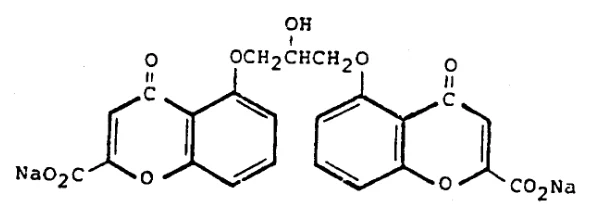
Chemical name: Sodium Cromoglicate Disodium 1,3-bis(2-carboxychromon-5-yloxy)-2hydroxypropane
Molecular formula and molecular mass: C23H14Na2011 and 512
Structural formula:
Product Characteristics:
White or creamy powder having little odour. Hygroscopic. It is tasteless at first but leaves a slightly bitter after-taste. It is soluble in water (1 in 10) and the resulting solution is neutral.
14 Clinical Trials
Data on which indications were initially approved is not available.
14.4 Immunogenicity
The effect of sodium cromoglicate was studied on those antibody systems concerned with immunity. In this context no effect was observed on:
- Various antibody neutralizing or agglutinating systems
- Development of active immunity or antibody production
- Protection conferred by passive or active immunity.
No effect was found on the following virus/antibody neutralizing systems in vitro:
- Influenza A. Polio Type II; with human or rabbit antisera
- Vaccinia; with rabbit antisera
- Herpes simplex; with human antisera
No effects were observed on the LD50 in mice of mouse-adapted polio virus; nor in their protection by Salk vaccine.
No effect was found on the neutralization of Clostridium welchii Type A α-toxin by specific antiserum, nor on the cytotoxic behaviour of rabbit anti-HeLa serum on HeLa cells in vitro.
15 Microbiology
No microbiological information is required for this drug product.
16 Non-Clinical Toxicology
General Toxicology:
The method of clinical administration of the drug is orally as capsules of granulated sodium cromoglicate.
Toxic effects attributable to sodium cromoglicate have been found only at very high dose levels.
Acute Toxicity Studies:
In acute toxicity studies in mice, rats (including newborn and adult), guinea pigs, hamsters, rabbits and monkeys, the LD50 of sodium cromoglicate given by the intravenous or intraperitoneal routes was usually between 2000 and 4000 mg/kg, but with doses below 1000 mg/kg there was little apparent effect in any of these species. The highest dose it was feasible to administer by the oral route in rats and mice was 8000 mg/kg at which level no deaths occurred.
Long-Term Toxicity Studies:
Subcutaneous Injection - 90-day Test in Rats:
In a group of rats given subcutaneous injections of sodium cromoglicate on 90 consecutive days, the highest dose of 198 mg/kg produced one death in 24 animals. All but three rats at this level showed renal damage, which in most cases was fairly severe. At a level of 78 mg/kg a quarter of the rats were affected, but at 30 mg/kg no histological abnormalities were observed. No histological changes were found in any other organ (at all dosage levels), and blood biochemical determinations failed to reveal any effect on kidney or liver function. The primary lesion in rats demonstrating evidence of renal damage was a tubular degeneration commencing in the proximal convoluted tubules. At lethal doses widespread necrosis was seen and death appeared to be due to acute renal failure.
Intravenous Injection - 180-day Test in Monkeys:
In this test, Rhesus monkeys were given daily intravenous injections of sodium cromoglicate for 180 days at dose levels up to 50 mg/kg. No compound-induced effects were observed.
Proliferative Arteriopathy in Macaque Monkeys:
In Macaque monkeys, arterial lesions have been described during the course of toxicity studies on sodium cromoglicate. These lesions affected mainly the medium-sized arteries of the kidneys and were characterised by eccentric swellings of the tunica media, where normal smooth muscle was replaced by irregularly proliferating cells. No thrombosis or fibrinoid necrosis was observed in the lesions and there were no secondary effects such as infarction or glomerular or tubular degeneration
Table 2 - Proliferative Arteritis in the Macaque Monkey in Sodium Cromoglicate Studies
| ROUTE | DURATION | OVERALL | CONTROL | TREATED |
| Inhalation | 3 Months | 0 in 18 | 0 in 6 | 0 in 12 |
| Inhalation | 4 Months | 5 in 30 | 1 in 18 | 4 in 12 |
| Inhalation | 4 Months | 2 in 45 | 1 in 18 | 1 in 27 |
| Inhalation | 3 Months | 1 in 25 | 0 in 17 | 1 in 8 |
| Intravenous | Acute (7 days) | 0 in 16 | None | 0 in 16 |
| Intravenous | Acute (7 days) | 1 in 8 | 0 in 2 | 1 in 6 |
| Intravenous | 6 Months | 0 in 30 | 0 in 6 | 0 in 24 |
| TOTAL | 9 in 172 | 2 in 67 | 7 in 105 |
Although this condition was first observed during sodium cromoglicate toxicity studies it has subsequently been seen in Macaque monkeys which had not received the drug. Histological examinations of renal tissues from several sources (including untreated monkeys as well as those which had received sodium cromoglicate by various routes) showed that the lesions were spontaneous and not related to administration of the drug. Whilst the aetiology of this arteriopathy remains obscure, it appears to be a distinct entity confined to the genus Macaca.
Oral Administration – Six months Test in Rats:
Sodium cromoglicate has been given to rats at oral doses of 100, 300 and 1000 mg/kg/day for six months.
No drug-related effects were seen in body and organ weight or food and water consumption.
In the haematology, urinalysis, blood biochemistry, serum protein electrophoresis and ophthalmoscopic studies there were no differences between test and control animals.
There were no toxic morphological changes in the tissues of any rat in the vehicle control or high dose groups. Detailed examination of bone marrow preparations revealed no effects attributable to daily administration of sodium cromoglicate.
A detailed histopathological examination of every segment of the gastrointestinal tract revealed distinct alterations in the gastric mucosa of rats treated at 300 and 1000 mg/kg. The changes were a heightened incidence of increased cornification of the fore-stomach mucosa and basal cell proliferation at the level of the cardia. In addition, a further change noted in the cardia was referred to as mucinous microcyst formation. This latter lesion was not seen in the stomach of any of the high dose recovery animals at the end of the 30-day withdrawal period and appeared, therefore, to be fully reversible.
Carcinogenicity: Long-term studies in hamsters and mice gave no evidence of drug-related neoplasia and indicated that sodium cromoglicate appears to be free of carcinogenic potential even at dose levels high enough to induce some expected renal damage.
Hamsters were given either 52.6 or 17.5 mg/kg three times a week intraperitoneally for 15 weeks and one-third of that dosage for the remainder of the one-year dosing period. The overall tumour incidence was 15% with no significant differences between the treated and control groups.
Two tests, one lasting 18 months and the other 12 months, were conducted in mice. In the 18-month study animals were treated intraperitoneally with 150 or 50 mg/kg three times a week for 12 months and were then sacrificed at 18 months. All animals, treated, untreated and saline-injected controls, were examined daily. Any which died before the end of the study, as well as the survivors, were subjected to detailed autopsy. Although the large doses given over a period of one year were sufficient to cause some renal damage they had no observable effect on neoplasia. These sizeable doses also did not adversely affect survival.
Significant differences could not be detected between control and treated animals in the 12-month study.
Reproductive and Development Toxicology: Studies of the effect of sodium cromoglicate on the various stages of the reproductive cycle have been carried out in rabbits, rats and mice. No effect on mating or fertility was noted following the daily administration of 100 mg/kg sodium cromoglicate to male rats for a period of 80 days, and to female rats for a period of 14 days prior to mating.
Teratogenicity: In rabbits, no teratogenic effects were observed following the intravenous administration of 500 mg/kg sodium cromoglicate daily throughout pregnancy. Although the dose proved lethal to some rabbits and produced renal lesions in all the survivors, there were no deformities in the 81 foetuses removed at full term. There was also no substantial increase in the resorption rate, but two partially resorbed foetuses did show developmental defects (limb flexures). In rats given daily doses of 185 mg/kg subcutaneously throughout pregnancy, one foetus (out of 272) showed a grossly shortened humerus, but no abnormalities were seen following daily doses of 90 mg/kg sodium cromoglicate given either with or without 0.05 mg/kg isoprenaline.
Similarly, no teratogenic effects were observed in mice following daily doses of up to 540 mg/kg subcutaneously, but doses in excess of 60 mg/kg significantly increased the incidence and severity of foetal abnormalities produced by doses of 0.9 mg/kg isoprenaline and above. However, there were no teratogenic effects when the daily dosage of the combination was reduced to 20 mg/kg sodium cromoglicate and 0.1 mg/kg isoprenaline.
Juvenile Toxicity: Neonatal rats have been given daily oral doses of 100, 300 and 1000 mg/kg of sodium cromoglicate from five days of age to weaning at 22 days. This treatment, for 17 consecutive days, had no apparent effect on neonatal rats.
Young rats were given oral doses of 100, 400 and 1600 mg/kg of sodium cromoglicate for 56 consecutive days to investigate its possible effect on general endocrine function. The rats were 26 days old at the start of the dosing period.
Sodium cromoglicate did not appear to have any adverse effect on general endocrine development at the stated dose levels.