


Product Monograph - Menjugate Liquid
SUMMARY PRODUCT INFORMATION
| Route of Administration | Dosage Form / Strength per 0.5mL dose of vaccine | Nonmedicinal Ingredients |
| Intramuscular (IM) Injection | Suspension for injection 10 mcg Meningococcal Group C Oligosaccharide conjugated to 12.5 to 25 mcg CRM197 | Aluminium hydroxide, histidine, sodium chloride, water for injection |
INDICATIONS AND CLINICAL USE
MENJUGATE is indicated for the active immunization of children from 2 months of age, adolescents and adults, for the prevention of invasive disease caused by Neisseria meningitidis serogroup C.
CONTRAINDICATIONS
MENJUGATE is contraindicated in persons with a known hypersensitivity to any component of the vaccine, including diphtheria toxoid (CRM197), and in persons who have shown signs of hypersensitivity after previous administration of MENJUGATE.
As with other vaccines, administration of MENJUGATE should be postponed in subjects with an acute severe febrile illness.
WARNINGS AND PRECAUTIONS
General
Before the injection of any biological, the health professional responsible for administration should take all precautions known for the prevention of allergic or any other reactions. As with all injectable vaccines, appropriate medical treatment and supervision should always be readily available in case of a rare anaphylactic event following administration of the vaccine.
Prior to administration of any dose of MENJUGATE (Meningococcal Group C-CRM 197 Conjugate Vaccine), the vaccine recipient (or parent or guardian) should be asked about personal history, family history, and recent health status, including immunization history, current health status and any adverse event associated with previous immunizations.
MENJUGATE will not protect against meningococcal diseases caused by any of the other types of meningococcal bacteria (A, B, 29-E, H, I, K, L, W-135, X, Y, or Z, including non-typed). Complete protection against meningococcal serogroup C infection cannot be guaranteed.
No data on the applicability of the vaccine for post-exposure outbreak control are available.
Although symptoms of meningism such as neck pain/stiffness or photophobia have been reported, there is no evidence that the vaccine causes meningococcal C meningitis. Clinical alertness to the possibility of co-incidental meningitis should therefore be maintained.
Conjugate vaccines containing Cross Reacting Material 197 (CRM197) should not be considered as immunizing agents against diphtheria. No changes in the schedule for administering vaccines containing Diphtheria Toxoid are recommended.
Any acute infection or febrile illness is reason for delaying the use of MENJUGATE except when, in the opinion of the physician, withholding the vaccine entails a greater risk. A minor afebrile illness, such as a mild upper respiratory infection, is not usually reason to defer immunization.
The vaccine must not be injected intravenously, subcutaneously or intradermally.
Parents should be informed of the immunization schedule for this vaccine. Precautions such as use of antipyretic measures should be relayed to the parent or guardian, as well as the need to report any adverse event.
Latex-sensitive individuals - for syringe presentation:
Although no natural rubber latex is detected in the syringe tip cap, the safe use of MENJUGATE in latex-sensitive individuals has not been established.
Anxiety-related reactions, including vasovagal reactions (syncope), hyperventilation or stress-related reactions may occur in association with vaccination as a psychogenic response to the needle injection (see ADVERSE REACTIONS). It is important that procedures are in place to avoid injury from fainting.
As with all injectable pediatric vaccines, the potential risk of apnoea and the need for respiratory monitoring for 48-72 hours should be considered when administering the primary immunization series to very premature infants (born ≤ 28 weeks of gestation) and particularly for those with a previous history of respiratory immaturity. As the benefit of vaccination is high in this group of infants, vaccination should not be withheld or delayed.
Hematologic
MENJUGATE has not been evaluated in persons with thrombocytopenia or other bleeding disorders. The risk versus benefit for persons at risk of hemorrhage following intramuscular injection must be evaluated.
Immune
In individuals deficient in antibody production, vaccination may not result in an appropriate protective antibody response. While HIV infection is not a contraindication to vaccination, MENJUGATE has not been specifically evaluated in an immunocompromised population.
Individuals with complement deficiencies and individuals with functional or anatomical asplenia may mount an immune response to meningococcal C conjugate vaccines; however, the degree of protection that would be afforded is unknown.
Individuals receiving treatment that inhibits terminal complement activation (for example, eculizumab) remain at increased risk of invasive disease caused by Neisseria meningitidis group C even following vaccination with MENJUGATE.
Special Populations
Impairment of fertility was not evaluated in humans or in animal studies.
Pregnant Women: Animal studies have not demonstrated a risk to the fetus following administration of MENJUGATE. However, since no specific studies in humans have been carried out, caution is advised. The vaccine should not be used during pregnancy unless there is defined risk of meningococcal C disease, in which case the risk-benefit ratio should be evaluated.
Nursing Women: The effect on breast-fed infants of the administration of MENJUGATE to their mothers has not been studied. The risk-benefit ratio should be examined before making the decision as to whether to immunize during lactation.
Geriatrics (> 65 years of age): There are no data in adults aged 65 years and older.
ADVERSE REACTIONS
Clinical Trial Adverse Drug Reactions
Because clinical trials are conducted under very specific conditions the adverse reaction rates observed in the clinical trials may not reflect the rates observed in practice and should not be compared to the rates in the clinical trials of another drug. Adverse drug reaction information from clinical trials is useful for identifying drug-related adverse events and for approximating rates.
In controlled clinical studies performed in all age groups, signs and symptoms were actively monitored and recorded on diary cards following administration of the vaccine.
Of the local solicited symptoms, the most frequently reported were injection-site pain, erythema and swelling, which were normally mild and resolved within 24-72 hours following vaccination.
The general symptoms that have been solicited and reported were predominantly mild and resolved spontaneously. These include headache, malaise, nausea, arthralgia and myalgia in adolescents and adults; and irritability, change in appetite, diarrhea and fever in younger children. These solicited general symptoms were also reported in the control groups and have been reported when MENJUGATE (Meningococcal Group C–CRM197 Conjugate Vaccine) was administered concomitantly with other vaccines.
In infants and children aged 12 through 23 months, symptoms including crying, irritability, drowsiness, impaired sleeping, anorexia, diarrhea and vomiting were common after vaccination but there was no evidence that these were related to MENJUGATE rather than concomitant vaccines, particularly DTP.
The safety of MENJUGATE liquid formulation was compared with that of MENJUGATE lyophilised formulation in a randomised clinical study involving 989 children aged 12 months to 2 years. The safety profile of both formulations of MENJUGATE was comparable.
Children (12 through 23 months of age) Through Adults:
Table 1 presents an analysis of local and systemic reactions occurring within 7 days after one immunization with MENJUGATE. Data are pooled from 11 studies, representing approximately 1400 subjects. Most local and systemic reactions occurred by day 1 following immunization. In general, lower percentages of local and systemic reactions were present on days 2 through 6 following the first immunization.
Table 1 - Summary of Local and Systemic Post immunization Reactions Within 7 Days Following One Immunization of MENJUGATE, by Age Group at Enrollment*
| Percentage of Subjects | ||||||
MENJUGATE 1-2 years n=942 (%) | MENJUGATE 3-5 years n=198 (%) | MENJUGATE 11-64 years n=269 (%) | ||||
| Injection Site | ||||||
Pain (Any) Severe | 22 <1 | 25 0 | 81 2 | |||
Temperature (Any) Hot | 15 <1 | 5 1 | 47 8 | |||
Erythema (Any) >50 mm | 28 <1 | 16 0 | 19 1 | |||
Induration (Any) >50 mm | 16 <1 | 7 0 | 24 1 | |||
| Systemic | ||||||
| Change in Eating Habits | 16 | 6 | - | |||
| Sleepiness | 19 | 9 | - | |||
| Unusual Crying | 4 | 1 | - | |||
| Persistent Crying | 1 | 0 | - | |||
| Irritability | 30 | 10 | - | |||
| Vomiting | 9 | 5 | - | |||
| Diarrhea | 18 | 8 | - | |||
| Rash | 9 | 4 | - | |||
| Chills | - | - | 13 | |||
| Nausea | - | - | 16 | |||
| Malaise | - | - | 25 | |||
| Myalgia | - | - | 29 | |||
| Arthralgia | - | - | 16 | |||
| Headache | - | - | 34 | |||
| Temp ≥38°C | 9 | 4 | 2 | |||
| Stayed Home Due to Reaction | - | - | 7 | |||
| Analgesic/ Antipyretic Medication used | 25 | 9 | 18 | |||
*This is a summary of data derived from a meta-analysis of 11 studies conducted in the United States, United Kingdom, Netherlands, and Canada. The recording of systemic reactions varied by age group, not all reactions were collected in all studies.
In clinical studies where subjects received MENJUGATE or a meningococcal polysaccharide vaccine, the rates of local pain and warmth were significantly lower with MENJUGATE in children 1 to 2 and 3 to 5 years of age; no differences were seen in the older subjects. In children 3 to 5 years of age, severe pain was seen in 9% of subjects with the polysaccharide vaccine and no subjects with MENJUGATE. The systemic reactions that were significantly less common in MENJUGATE subjects were fever, change in eating habits, irritability, and analgesic/antipyretic use in children aged 12 through 23 months of age, and irritability and analgesic/antipyretic use in children 3 to 5 years of age.
In adolescents and adults, the rates of all postimmunization reactions were similar after MENJUGATE or polysaccharide vaccine administration. The only difference seen in this age group was a tendency for injection-site pain to persist somewhat longer in MENJUGATE recipients (72 hours) than in polysaccharide vaccine recipients (48 hours). This difference may be due to the aluminum hydroxide adjuvant, which is present in MENJUGATE but not the polysaccharide vaccine.
Infants:
Table 2 presents a summary of clinical safety data from two clinical studies in infants who received up to three immunizations with MENJUGATE, beginning at the age of two months.
Table 2- Summary of Local and Systemic Post immunization Reactions Within 7 Days Following 1, 2 or 3 Injections of MENJUGATE
| Percentage of Subjects | ||||||||||||
UK (Multicenter) (N=467) | Canada (Multicenter) (N=175) | |||||||||||
| Age at First Immunization | 2 months | 2 months | ||||||||||
| Schedule | 3 doses 1 month apart | 3 doses 2 months apart | ||||||||||
| Concomitant Vaccine | DTP, HIB, OPV | DTaP, HIB, IPV (PENTACEL) | ||||||||||
| Local Reactions: | ||||||||||||
| Tenderness | 31% | 22% | ||||||||||
| Erythema>25 mm | 7% | 0% | ||||||||||
| Induration>25 mm | 4% | 0% | ||||||||||
| Systemic Reactions: | ||||||||||||
| Irritability | 81% | 68% | ||||||||||
| Sleepiness | 69% | 54% | ||||||||||
| Change in Eating Habits | 46% | 39% | ||||||||||
| Diarrhea | 43% | 28% | ||||||||||
| Vomiting | 34% | 19% | ||||||||||
| Rash | 16% | --* | ||||||||||
| Temp≥38°C | 4% | 21% | ||||||||||
| High-pitched crying | 38% | --* | ||||||||||
| Persistent crying | 16% | 4% | ||||||||||
* Data not collected
In a randomized, controlled clinical study performed in infants at three centers in Canada, the profile for MENJUGATE administered at 2, 4, and 6 months of age with concomitant PENTACEL (DTaP/Hib/IPV) was similar to that observed in earlier infant studies (See Tables 3 and 4 below). The frequency of two local adverse events, induration and erythema, was higher in MENJUGATE recipients than in the control HBV vaccine subjects, however the incidence of these reactions was lower among MENJUGATE or HBV subjects than following the routine vaccine (DTaP/Hib/IPV) in these same subjects. These differences between the MENJUGATE and HBV groups may in part be related to the lower dose of aluminum hydroxide in the HBV vaccine relative to the MENJUGATE vaccine (i.e., 0.5 mg per dose in HBV compared with 1 mg per dose in MENJUGATE). The most frequently reported systemic reactions were irritability, analgesic/antipyretic medication use, sleepiness and change in eating habits, which were reported with similar frequency in MENJUGATE and HBV vaccine subjects.
Table 3- Local Reactogenicity Within 7 Days Following Any Immunization Infant Study - Canada (Multicenter)
MENJUGATE group N=175 | HBV group N=176 | P-value MenC vs HBV group | |||||||||||
| Local Reactions | MENJUGATE | PENTACEL | HBV | PENTACEL | Study Vaccine | PENTACEL | |||||||
Tenderness (Any) (Cried when injected leg moved) | 38 (22%) 0 | 53 (30%) 3 (2%) | 31 (18%) 0 | 35 (20%) 0 | .33 | .025 | |||||||
Erythema (Any) >25 mm | 55 (31%) 0 | 67 (38%) 5 (3%) | 33 (19%) 0 | 63 (36%) 4 (3%) | .006 | .63 | |||||||
Induration (Any) >25 mm | 42 (24%) 0 | 65 (37%) 6 (3%) | 19 (11%) 1 (1%) | 70 (40%) 2 (1%) | .001 | .61 | |||||||
Table 4- Systemic Reactogenicity Within 7 Days Following Any Immunization Infant Study - Canada (Multicenter)
| Systemic Reactions | MENJUGATE group N=175 | HBV group N=176 | P-value |
| Change in Eating Habits | 68 (39%) | 63 (36%) | .55 |
| Sleepiness | 94 (54%) | 98 (56%) | .71 |
| Persistent Crying | 7 (4%) | 4 (2%) | .35 |
| Irritability | 119 (68%) | 124 (70%) | .62 |
| Vomiting | 34 (19%) | 39 (22%) | .53 |
| Diarrhea | 49 (28%) | 44 (25%) | .52 |
| Rectal temp ≥ 38°C | 37 (21%) | 47 (27%) | .22 |
| Analgesic/antipyretic medication required | 96 (55%) | 105 (60%) | .36 |
Less Common Clinical Trial Adverse Drug Reactions (<1%)
In clinical trials of MENJUGATE, approximately 6700 infants through adults were evaluated/ monitored for the occurrence of serious adverse experiences (SAEs). There were four SAEs which were considered to be at least possibly related to vaccine. These were one report each of: hypotonia, screaming syndrome, maculopapular rash and agitation, all of which occurred in an open label infant study conducted in the United Kingdom (UK), in which MENJUGATE was administered concomitantly with DTP, Hib and OPV vaccines. Because these reactions have been reported previously in conjunction with DTP vaccines alone, a causal relationship between these experiences and MENJUGATE administration cannot be established.
Post-Market Adverse Drug Reactions
The most commonly reported suspected reactions in post marketing surveillance include dizziness, pyrexia, headache, nausea, vomiting and faints.
The frequencies given below are based on spontaneous reporting rates, for this and other Meningococcal C Conjugate vaccines and have been calculated using the number of reports received as the numerator and the total number of doses distributed as the denominator.
Immune System Disorders:
Very rare (<0.01%): lymphadenopathy, anaphylaxis including anaphylactic shock, hypersensitivity reactions including bronchospasm, facial edema and angioedema.
Neurologic:
Very rare (<0.01%): dizziness, convulsions including febrile convulsions, faints, hypoaesthesia and paresthesia, hypotonia.
There have been very rare reports of seizures following MENJUGATE vaccination; individuals have usually recovered rapidly. Some of the reported seizures may have been faints. The reporting rate of seizures was below the background rate of epilepsy in children. In infants seizures were usually associated with fever and were likely to be febrile convulsions.
There have been very rare reports of visual disturbances and photophobia following vaccination with Meningococcal group C conjugate vaccines, usually in conjunction with other neurological symptoms like headache and dizziness.
Skin and Subcutaneous tissue disorders:
Very rare (<0.01%): rash, urticaria, pruritus, purpura, erythema multiforme and Stevens-Johnson Syndrome.
Gastrointestinal:
Very rare (<0.01%): nausea, vomiting and diarrhea.
General disorders and administrative site conditions
Extensive swelling of the vaccinated limb.
Musculoskeletal, connective tissue and bone disorders:
Very rare (<0.01%): myalgia and arthralgia.
Renal:
Relapse of nephrotic syndrome has been reported in association with Meningococcal group C conjugate vaccines.
Respiratory, thoracic and mediastinal disorders:
Apnoea in very premature infants (≤28 weeks of gestation).
DRUG INTERACTIONS
Drug-Drug Interactions
In various studies with different vaccines, concomitant administration of meningococcal group C conjugates with combinations containing acellular pertussis (aP) components (with or without IPV, hepatitis B surface antigen or Hib conjugates) has been shown to result in lower serum bactericidal activity (SBA) geometric mean titres (GMTs) compared to separate administrations or to co-administration with whole cell pertussis vaccines. The proportions reaching SBA titres of at least 1:8 or 1:128 are not affected. The potential implications of these observations for the duration of protection are not known.
Table 5 presents data on the immunological response of infants to concomitant vaccines, as measured one month after the third dose of MENJUGATE or HBV vaccine.
Table 5- Response to Routine Infant Concomitant Vaccine (PENTACEL) Antigens Among MENJUGATE vs HBV Vaccine Recipients Measured at 1 Month After Third Dose Infant Study - Canada (Multicenter)2
| Concomitant Vaccine Antigen, Measure of Response | Group | ||||||||||
| MenC | HBV | P-value | |||||||||
| N=64 | N=61 | ||||||||||
| Polio type I | % with antibody titers ≥1:8 | 97% | 95% | .53 | |||||||
| Polio type II | % with antibody titers ≥1:8 | 98% | 100% | .32 | |||||||
| Polio type III | % with antibody titers ≥1:8 | 98% | 98% | .94 | |||||||
Diphtheria toxin antibody responses | GMT (IU/mL) | 4.7 | 1.9 | < .001 | |||||||
| % ≥ 0.10 IU/mL | 100% | 100% | 1.0 | ||||||||
| Tetanus antibody response | GMT (IU/mL) | 2.4 | 2.5 | .76 | |||||||
| % ≥ 0.1 IU/mL | 100% | 100% | 1.0 | ||||||||
| N=91 | N=89 | ||||||||||
| Anti-pertussis with 69K antigen | GMT (EU/mL) | 31 | 36 | .29 | |||||||
| Anti-pertussis with FHA antigen | GMT (EU/mL) | 26 | 31 | .12 | |||||||
| Anti-pertussis with PT antigen | GMT (EU/mL) | 23 | 25 | .31 | |||||||
| N=148 | N=148 | ||||||||||
| PRP-T/Hib antibody responses | GMT (μg /mL) | 3.1 | 3.7 | .28 | |||||||
| % ≥ 1.0 μg/mL | 81% | 83% | .40 | ||||||||
Drug-Lifestyle Interactions
No studies on the effects on the ability to drive and use machines have been performed for MENJUGATE. MENJUGATE has no or negligible influence on the ability to drive and use machines. However, some of the effects mentioned under section ADVERSE REACTIONS may temporarily affect the ability to drive or use machines.
DOSAGE AND ADMINISTRATION
Dosing Considerations
There are no data on the use of different meningococcal group C conjugate vaccines within the primary series or for boosting. Whenever possible, the same vaccine should be used throughout.
Recommended Dose and Dosage Adjustment
Primary Immunization
Infants 2-12 months should receive 3 doses of 0.5 mL each, with an interval of at least 1 month between doses.
Children older than 12 months, adolescents and adults should receive a single dose of 0.5 mL.
Booster doses
It is recommended that a booster dose should be given after completion of the primary immunization series in infants. The timing of this booster should be in accordance with NACI recommendations. The need for booster doses in subjects primed with a single dose (i.e. aged 12 months or more when first immunized) has not yet been established.
For further information on responses to booster doses and on co-administration with other childhood vaccines please see DRUG INTERACTIONS and CLINICAL TRIALS.
Administration
Do not inject intravenously, subcutaneously or intradermally. MENJUGATE is to be administered by deep intramuscular injection only, preferably in the anterolateral thigh in infants and in the deltoid region in older children, adolescents and adults.
Care must be taken to ensure the vaccine is not injected into a blood vessel.
MENJUGATE should not be mixed with other vaccines in the same syringe. Separate injection sites should be used if more than one vaccine is being administered on the same date.
Syringe:
Gently shake the syringe containing the vaccine before administration. Remove the syringe tip cap and fit a suitable needle. The vaccine should be visually inspected for particulate matter and discoloration prior to administration. Ensure that no air bubbles are present in the syringe before injecting the vaccine. In the event of any foreign particulate matter and/or variation of physical aspect being observed, discard the vaccine.
Vial:
Gently shake the vaccine vial. Using a syringe and a suitable needle (21G, 1 ½ inch (40 mm) length) withdraw the entire content of vial. Prior to injection, change the needle for one suitable for the administration. The vaccine should be visually inspected for particulate matter and discoloration prior to administration. Ensure that no air bubbles are present in the syringe before injecting the vaccine. In the event of any foreign particulate matter and/or variation of physical aspect being observed, discard the vaccine.
OVERDOSAGE
There is no experience of overdosage with MENJUGATE.
For management of a suspected drug overdose, contact your regional Poison Control Centre.
ACTION AND CLINICAL PHARMACOLOGY
MENJUGATE is intended for the prevention of meningitis and/or septicemia caused by Neisseria meningitidis group C in infants and older age groups. MENJUGATE is composed of meningococcal group C oligosaccharides conjugated to a protein carrier, a non-toxic mutant of diphtheria toxin, CRM197. In the final vaccine, aluminum hydroxide is used as an adjuvant.
As shown in clinical trials, MENJUGATE is highly immunogenic 3,4 and induces protective levels of bactericidal antibodies5-7 in a significant number of subjects after vaccination (See CLINICAL TRIALS).
Compared to licensed unconjugated polysaccharide vaccines, the primary immune response induced by MENJUGATE is superior in children (from 12 months of age) and adolescents,8 and is comparable in adults.
Additionally, unlike unconjugated polysaccharide vaccines,9 MENJUGATE has been shown to induce immunologic memory in infants and children from 12 months of age.1,10,11
No pharmacodynamic or pharmacokinetic studies have been conducted with MENJUGATE, in accordance with its status as a vaccine. Several immunogenicity studies were conducted in animals, showing that MENJUGATE induced antibody titers that were dose dependent. (See Detailed Pharmacology).
STORAGE AND STABILITY
Store under refrigeration (+2°C to +8°C). Do not freeze. Protect from exposure to light. Stability studies have indicated that the product has a shelf life of 36 months.
DOSAGE FORMS, COMPOSITION AND PACKAGING
Dosage Forms
MENJUGATE Liquid is supplied as a 0.5 mL dose, consisting of 1 vial or 1 syringe of vaccine.
The vaccine is a white opalescent suspension.
Composition
Each 0.5 mL dose of the vaccine contains:
| Neisseria meningitidis group C (strain C11) oligosaccharide - Conjugated to | 10 mcg |
| Corynebacterium diphtheriae14 CRM-197 protein | 12.5 to 25 mcg |
Excipients: aluminium hydroxide 1 mg, histidine 0.78 mg, sodium chloride 4.5 mg, and water for injection.
MENJUGATE contains no preservative.
Packaging
Prefilled Syringe
MENJUGATE Liquid is presented in a Type I glass syringe, with bromobutyl rubber stopper and tip cap (styrene butadiene Type II rubber), filled with 0.6 mL of vaccine. Prefilled syringes are available in pack sizes of 1, 5* or 10 single doses.
Vial*
MENJUGATE Liquid is presented in a Type I glass vial, with bromobutyl rubber stopper, filled with 0.6 mL of vaccine. Vials are available in pack sizes of 1, 5 or 10 single doses.
*Format not available in Canada.
PART II: SCIENTIFIC INFORMATION
PHARMACEUTICAL INFORMATION
Drug Substance
Proper name: Meningococcal Group C Conjugate Vaccine
Chemical name: Not applicable
Molecular formula and molecular mass: Not applicable
Structural formula: Not applicable
Physicochemical properties: Not applicable
CLINICAL TRIALS
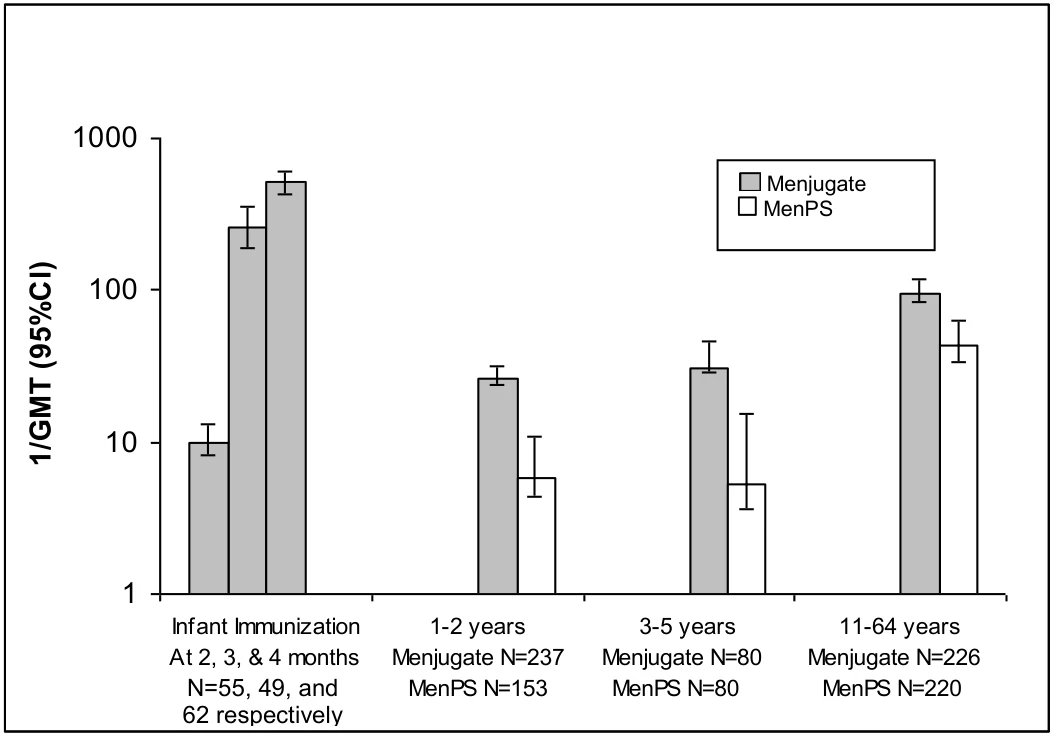
As shown in clinical trials, MENJUGATE is highly immunogenic3,4 and induces protective levels of bactericidal antibodies5-7 in a significant number of subjects after vaccination. (See Figure 1 below.) 8,10,12 Data from trials in infants using a 2, 3, 4 month schedule demonstrate that >98% of infants developed serum bactericidal antibody titers of at least 1:8 one month after the second and third dose.1 A booster dose in the second year of life induces an anamnestic response. 10,11,13
Compared to licensed unconjugated polysaccharide vaccines, the primary immune response induced by MENJUGATE is superior in children from 12 months of age and adolescents,8 and is comparable in adults.
Additionally, unlike unconjugated polysaccharide vaccines,9 MENJUGATE has been shown to induce immunologic memory in infants and children from 12 months of age.1,10,11
Figure 1: Bactericidal Responses 1 Month following MENJUGATE or Meningococcal Polysaccharide (MenPS) Vaccine by Age*
*Infants did not receive MenPS vaccine
1/GMT (95% CI) = reciprocal geometric mean titer (95% confidence interval)
In a randomised clinical study involving 989 children aged 12 months to 2 years the immunogenicity of MENJUGATE liquid formulation was compared with that of MENJUGATE lyophilised formulation produced with active substance from two different manufacturing sites. For MENJUGATE liquid formulation, the geometric mean of post-vaccination to baseline titers ratio (GMR) was 4.69 (4.01-5.49); for MENJUGATE lyophilised formulation the GMRs were 5.6 (4.79-6.54) and 6.34 (5.4-7.45). The antibody response induced by both formulations of MENJUGATE was comparable. This was demonstrated by the two-sided 95% CI for the corresponding vaccine group GMT ratios falling within the predefined equivalence interval (0.5 - 2.0) 28 days post-vaccination. At the same time point, the proportion of subjects with hSBA ≥1:8 were 60% (54-65) for the liquid formulation, 63% (57-69) and 70% (64-76) for the lyophilized formulation. These results were consistent with the pooled rate observed in children aged 12-23 months in previous studies (63%, CI 60-67) with MENJUGATE lyophilized formulation.
There are no data in children 2-12 months of age with liquid formulation.
No pharmacodynamic or pharmacokinetic studies have been conducted with MENJUGATE, in accordance with its status as a vaccine. Several immunogenicity studies were conducted in animals, showing that MENJUGATE induced antibody titers that were dose dependent (See DETAILED PHARMACOLOGY).
DETAILED PHARMACOLOGY
No pharmacodynamics studies and no pharmacokinetics studies have been conducted with MENJUGATE, in accordance with its status as a vaccine.
Animal Immunogenicity
Multiple immunogenicity studies were conducted in mice and guinea pigs to evaluate different subcutaneous dose levels of Meningococcal Group C–CRM197 conjugate (MenC conjugate) with and without the adjuvant aluminium hydroxide. Results showed that the induced antibody titers were dose-dependent and were higher when the MenC conjugate was combined with the adjuvant. The number of animals responding increased with dose.
An immunogenicity study in infant baboons was also conducted15. Five infant baboons (1.5 to 4 months of age) per group were immunized with three intramuscular injections (0.5 mL each) of MenC conjugate in combination with a Hib conjugated vaccine reconstituted either with aluminium hydroxide or phosphate buffered saline (PBS). Injections were given four weeks apart.
Titers of serum antibodies to MenC conjugate were measured by an enzyme-linked immunosorbent assay (ELISA). Complement-mediated bactericidal activity against N meningitidis group C was measured in a bactericidal assay.
The MenC conjugate was well tolerated; there was no evidence of specific local reactions at the injection sites when animals were inspected four weeks after the injection. After two injections, high antibody titers to meningococcus group C (bactericidal) were observed in animals vaccinated with MenC conjugate adjuvanted with aluminium hydroxide, while MenC conjugate in PBS (no adjuvant) showed low titers at all times. The bactericidal assay response paralleled the ELISA results.
TOXICOLOGY
The nonclinical safety of intramuscular injections of single and multiple doses of Meningococcal Group C–CRM197 Conjugate Vaccine (equivalent to MENJUGATE) was evaluated in rabbits. In each study, the human dose was administered to rabbits. Five studies were performed under Good Laboratory Practices (GLPs)16:
| 1 | Single dose intramuscular toxicity study | The vaccine was well tolerated. Slight, transient intramuscular injection site inflammation was seen, and was consistent with other alum-containing products. |
| 2 | Repeat-dose subacute toxicity study (three intramuscular injections) | Three injections of the vaccine were well tolerated (no effects on clinical signs including skin irritation, body temperature or weight, hematology or serum chemistry, ophthalmologic exams, or organ weights). Microscopic examination of muscle injection sites indicated mild inflammation. The mild inflammatory changes generally resolved within 2 weeks. |
| 3 | Repeat-dose subacute toxicity study (five intramuscular injections) | Five injections of the vaccine were well tolerated (no effects on clinical signs including skin irritation, body temperature or weight, hematology or serum chemistry, ophthalmologic exams, or organ weights). Slight to moderate inflammatory changes in muscle injection sites were seen and were generally resolved within 2 weeks. |
| 4 | Dose range-finding study of the effects on embryo/fetal development (eight intramuscular injections) | Three doses of vaccine were administered prior to conception and five doses were given during gestation. No clinically relevant maternal toxicity was seen and there were no vaccine-related effects on the external appearance of fetuses. |
| 5 | Study of the effects on embryo/fetal development (eight intramuscular injections) | Three doses of vaccine were administered prior to conception and five doses were given during gestation. No clinically relevant maternal toxicity was seen and there were no vaccine-related effects on fetuses based on evaluation of external, soft tissue, skeletal, and developmental parameters. |
Overall, the vaccine was well tolerated and was associated with injection site findings consistent with the administration of any alum-adjuvanted vaccine.
REFERENCES
- 1. MacLennan JM, Shackley F, Heath PT, et al. Safety, immunogenicity, and induction of immunologic memory by a serogroup C meningococcal conjugate vaccine in infants: a randomized controlled trial. JAMA. 2000;283:2795-2801.
- 2. Data on File
- 3. Granoff DM, Maslanka SE, Carlone GM, et al. A modified enzyme-linked immunosorbent assay for measurement of antibody responses to meningococcal C polysaccharide that correlate with bactericidal responses. Clin Diagn Lab Immunol. 1998;5:479-485
- 4. Maslanka SE, Gheesling LL, Libutti DE, et al. Standardization and a multilaboratory comparison of Neisseria meningitidis serogroup A and C serum bactericidal assays. Clin Diag Lab Immunol. 1997;4:156-167.
- 5. Mandrell RE, Azmi FH, Granoff DM. Complement-mediated bactericidal activity of human antibodies to poly α 2→8 N-acetylneuraminic acid, the capsular polysaccharide of Neisseria meningitidis serogroup B. J Infect Dis. 1995;172:1279-1289.
- 6. Goldschneider I, Gotschlich EC, Artenstein MS. Human immunity to the meningococcus. I. The role of humoral antibodies. J Exp Med. 1969;129:1307-1326
- 7. Santos G, Wacknov B, Borrow R, et al. Comparison of bactericidal assays used to measure immunological responses to vaccines developed against Neisseria meningitidis serogroup C. ICAAC 2000; 17-20 October 2000; Toronto, Canada (accepted for poster presentation).
- 8. Choo S, Zuckerman J, Goilav C, et al. Immunogenicity and reactogenicity of a group C meningococcal conjugate vaccine compared with a group A+C meningococcal polysaccharide vaccine in adolescents in a randomised observer-blind controlled trial. Vaccine. 2000;18:2686-2692.
- 9. De Wals P, De Serres G, Niyonsenga T. Effectiveness of a mass immunization campaign against serogroup C meningococcal disease in Quebec. JAMA. 2001;285:177-181.
- 10. MacDonald NE, Halperin SA, Law BJ, et al. Induction of immunologic memory by conjugated versus plain meningococcal polysaccharide vaccine in toddlers: a randomized controlled trial. JAMA. 1998;280:1685-1689.
- 11. Richmond P, Borrow R, Goldblatt D, et al. Ability of 3 different meningococcal C conjugate vaccines to induce immunologic memory after a single dose in UK toddlers. J Infect Dis. 2001;183:160-163.
- 12. MacDonald NE, Halperin SA, Law BJ, et al. Can meningococcal C conjugate vaccine overcome immune hyporesponsiveness induced by previous administration of multiple doses of plain polysaccharide vaccine? JAMA. 2000;283:1826-1827.
- 13. Trotter CL, Andrews NJ, Kaczmarski EB, Miller E, Ramsay ME, Effectiveness of meningococcal serogroup C conjugate vaccine 4 years after introduction. The Lancet. 2004;364:365-367
- 14. Rappuoli R. Isolation and characterization of Corynebacterium diphtheriae nontandem double lysogens hyperproducing CRM197. Appl Env Microbiol. 1983;46:560-564.
- 15. Granoff DM, McHugh YE, Raff HV, et al. MF59 adjuvant enhances antibody responses of infant baboons immunized with Haemophilus influenzae type b and Neisseria meningitidis group C oligosaccharide-CRM197 conjugate vaccine. Infect Immun. 1997;65:1710-1715.
- 16. Data on File