


Patient Medication Information: uses, side effects, how to take - Methacholine Chloride, USP
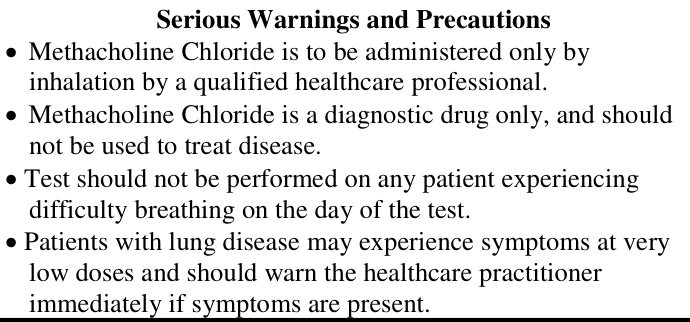 Serious Warnings and Precautions
- Methacholine Chloride is to be administered only by inhalation by a qualified healthcare professional. • Methacholine Chloride is a diagnostic drug only, and should not be used to treat disease.
- Test should not be performed on any patient experiencing difficulty breathing on the day of the test.
- Patients with lung disease may experience symptoms at very low doses and should warn the healthcare practitioner immediately if symptoms are present.
IMPORTANT: PLEASE READ
PART III: CONSUMER INFORMATION
Pr Methacholine Chloride, USP
Powder for inhalation solution
100 mg, 160 mg, 320 mg, 1280 mg and 1600 mg
This leaflet is part III of a three-part "Product Monograph" published when Pr Methacholine Chloride was approved for sale in Canada and is designed specifically for Consumers. This leaflet is a summary and will not tell you everything about Pr
Methacholine Chloride. Contact your doctor or pharmacist if you have any questions about the drug.
What the important nonmedicinal ingredients are: There are no nonmedicinal ingredients in Pr Methacholine Chloride Powder.
What dosage forms it comes in:
Methacholine Chloride comes in the following dosage forms – 100 mg, 160 mg, 320 mg, 1280 mg and 1600 mg
What the medication is used for:
Methacholine Chloride is used as part of a breathing test called a methacholine challenge test. This test is used to help your doctor decide if you have asthma. It can also be used to measure how severe your asthma is or to confirm whether or not you have occupational asthma.
What it does:
Methacholine Chloride can cause muscles in the airways to tighten. When a Methacholine Chloride mist is inhaled, people with asthma are much more likely to react to it than people without asthma.
During this test, a healthcare professional will measure your lung function before and after each dose of Methacholine Chloride. The test will be stopped if:
- Your lung function drops to the target level.
You have reached the highest dose of Methacholine Chloride
and your lung function has not dropped to the target level. • Your healthcare professional determines you are unable to
continue with the test due to symptoms.
BEFORE you take a breathing test with Methacholine Chloride talk to your doctor or respiratory therapist if:
- You have epilepsy.
- You have an ulcer.
- You have thyroid disease.
- You have an obstructed urinary tract. • You have any type of heart disease.
- You have an irritable vagus nerve.
You are pregnant.
- You are nursing.
At the end of the test, you may be given a reversal agent. Your healthcare professional will measure your lung function to make sure your breathing is back to normal before you are sent home.
When it should not be used:
- Methacholine Chloride should not be used by patients who have had an abnormal reaction to this or similar drugs.
- You should not have more than one test with this drug on the same day.
Methacholine Chloride should not be used in children under 5 years of age.
- Lung function tests should be performed by a healthcare professional prior to starting a test with Methacholine Chloride. If the results are too low, the healthcare professional may decide not to proceed with the test and to contact the physician who ordered the test.
What the medicinal ingredient is:
The medicinal ingredient in Methacholine Chloride is called methacholine chloride USP.
Some drugs may affect the safety of a breathing test with Methacholine Chloride. Speak with your doctor if you are taking any other medications.
There are also many drugs that can affect the results of a breathing test with Methacholine Chloride. These drugs may need to be stopped prior to the test. If you are taking any other medications, ask your doctor if you should stop taking them prior to the test and for how long.
Usual dose:
For Methacholine Chloride Powder, adults and children (5 years or older):
- 0.03, 0.0625, 0.125, 0.25, 0.5, 1, 2, 4, 8 and 16 mg/mL. WARNINGS AND PRECAUTIONS
ABOUT THIS MEDICATION
PROPER USE OF THIS MEDICATION
INTERACTIONS WITH THIS MEDICATION HOW TO STORE IT
IMPORTANT: PLEASE READ
Overdose:
Methacholine Chloride should never be administered by any route other than inhalation. When administered by mouth or by injection overdosage can result in fainting, with loss of consciousness and heart attack.
Missed Dose:
N/A
Adverse reactions to Methacholine Chloride are uncommon. There have been some reports of headache, throat irritation, light-headedness and itching.
A positive reaction to a breathing test with Methacholine Chloride may cause symptoms such as chest tightness, cough or wheezing.
Methacholine chloride is to be administered only by inhalation. When administered orally or by injection there have been reports of nausea and vomiting, chest pain or pressure, low blood pressure, fainting and heart attack.
This is not a complete list of side effects. For any unexpected effects while taking Methacholine chloride, notify the healthcare professional immediately so that the test may be stopped. If unexpected effects are noticed following the completion of the test, contact your physician.
NOTE: Methacholine Chloride is a diagnostic drug. It should never be removed from the clinic and/or pulmonary function lab.
Temperature:
Store unopened vials of Methacholine chloride powder at room temperature (15° to 30°C).
Freezing does not affect the stability of dilutions made with Methacholine chloride powder and 0.9% saline or 0.9% saline with 0.4% phenol or 0.9% saline with 0.9% benzyl alcohol.
Reconstituted Solutions:
Methacholine chloride Powder reconstituted with 0.9% saline or 0.9% saline with 0.4% phenol or 0.9% saline with 0.9% benzyl alcohol,
using aseptic technique, may be stored under refrigeration (2° to 8°C) for up to 2 weeks.
This document plus the full product monograph, prepared for health professionals can be found obtained by contacting the sponsor, PANDA Pharmaceuticals, at: 647-202-4536
Prepared on: September 14, 2017
SIDE EFFECTS AND WHAT TO DO ABOUT THEM 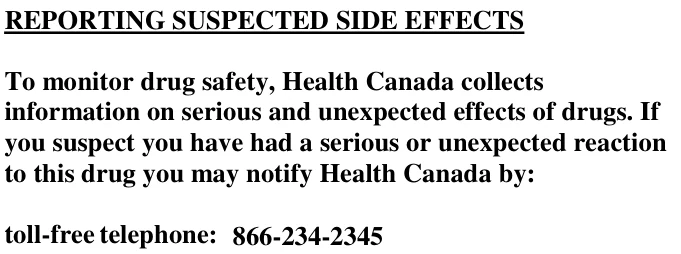
REPORTING SUSPECTED SIDE EFFECTS
To monitor drug safety, Health Canada collects information on serious and unexpected effects of drugs. If you suspect you have had a serious or unexpected reaction to this drug you may notify Health Canada by:
toll-free telephone: 
toll-free fax: 
866-234-2345 866-678-6789 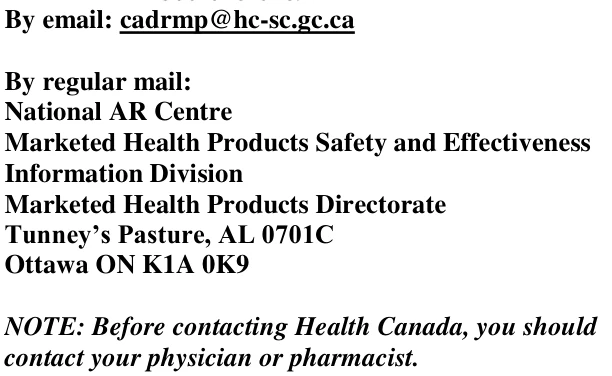
By email: cadrmp@hc-sc.gc.ca
By regular mail:
National AR Centre
Marketed Health Products Safety and Effectiveness Information Division
Marketed Health Products Directorate
Tunney’s Pasture, AL 0701C
Ottawa ON K1A 0K9
NOTE: Before contacting Health Canada, you should contact your physician or pharmacist.