


Product Monograph - Methyldopa
RECENT MAJOR LABEL CHANGES
| 2 CONTRAINDICATIONS | 04/2025 |
|---|---|
| 4 DOSAGE AND ADMINISTRATION, 4.2 Recommended Dose and Dosage Adjustment | 04/2025 |
| 7 WARNINGS AND PRECAUTIONS, Driving and Operating Machinery | 04/2025 |
| 7 WARNINGS AND PRECAUTIONS, Endocrine and Metabolism | 04/2025 |
| 7 WARNINGS AND PRECAUTIONS, Psychiatric | 04/2025 |
| 7 WARNINGS AND PRECAUTIONS, Reproductive Health: Female and Male Potential | 04/2025 |
| 7 WARNINGS AND PRECAUTIONS, 7.1.1 Pregnant Women | 04/2025 |
| 7 WARNINGS AND PRECAUTIONS, 7.1.2 Breast-Feeding | 04/2025 |
| 7 WARNINGS AND PRECAUTIONS, 7.1.4 Geriatrics | 04/2025 |
TABLE OF CONTENTS
Sections or subsections that are not applicable at the time of authorization are not listed.
RECENT MAJOR LABEL CHANGES..............................................................................................2
TABLE OF CONTENTS ................................................................................................................2
PART I: HEALTH PROFESSIONAL INFORMATION .......................................................................4
1 INDICATIONS ................................................................................................................4
1.1 Pediatrics...........................................................................................................4
1.2 Geriatrics ...........................................................................................................4
2 CONTRAINDICATIONS ...................................................................................................4
3 SERIOUS WARNINGS AND PRECAUTIONS BOX ..............................................................5
4 DOSAGE AND ADMINISTRATION...................................................................................5
4.2 Recommended Dose and Dosage Adjustment .....................................................5
4.4 Administration ...................................................................................................6
4.5 Missed Dose ......................................................................................................6
5 OVERDOSAGE ...............................................................................................................6
6 DOSAGE FORMS, STRENGTHS, COMPOSITION AND PACKAGING ...................................7
7 WARNINGS AND PRECAUTIONS ....................................................................................7
7.1 Special Populations .......................................................................................... 10
7.1.1 Pregnant Women .........................................................................................10
7.1.2 Breast-feeding..............................................................................................10
7.1.3 Pediatrics .....................................................................................................11
7.1.4 Geriatrics .....................................................................................................11
8 ADVERSE REACTIONS .................................................................................................. 11
8.1 Adverse Reaction Overview .............................................................................. 11
8.4 Abnormal Laboratory Findings: Hematologic, Clinical Chemistry and Other Quantitative Data ........................................................................................................ 12
9 DRUG INTERACTIONS.................................................................................................. 12
9.1 Serious Drug Interactions ................................................................................. 12
9.4 Drug-Drug Interactions..................................................................................... 12
9.5 Drug-Food Interactions .................................................................................... 14
9.6 Drug-Herb Interactions..................................................................................... 14
9.7 Drug-Laboratory Test Interactions .................................................................... 14
10 CLINICAL PHARMACOLOGY ......................................................................................... 14
10.1 Mechanism of Action ....................................................................................... 14
10.2 Pharmacodynamics .......................................................................................... 15
10.3 Pharmacokinetics............................................................................................. 16
11 STORAGE, STABILITY AND DISPOSAL ........................................................................... 16
12 SPECIAL HANDLING INSTRUCTIONS............................................................................. 16
PART II: SCIENTIFIC INFORMATION ........................................................................................ 17
13 PHARMACEUTICAL INFORMATION.............................................................................. 17
14 CLINICAL TRIALS.......................................................................................................... 17
15 MICROBIOLOGY .......................................................................................................... 17
16 NON-CLINICAL TOXICOLOGY ....................................................................................... 18
PATIENT MEDICATION INFORMATION ................................................................................... 19
PART I: HEALTH PROFESSIONAL INFORMATION
1 INDICATIONS
METHYLDOPA (methyldopa tablets) is indicated:
- For the treatment of arterial hypertension. May be employed in a general treatment program in conjunction with a diuretic and/or other antihypertensive drugs as needed for proper response in patients with hypertension of various severity.
- As the initial agent in the treatment of hypertension in those patients for which treatment should not be started with a diuretic.
1.1 Pediatrics
Pediatrics (<18 years of age): Based on the data submitted and reviewed by Health Canada, the safety and efficacy of methyldopa tablets in pediatric patients has been established; therefore, Health Canada has authorized an indication for pediatric use. See 4.2 Recommended Dose and Dosage Adjustment, Pediatrics.
1.2 Geriatrics
Geriatrics (>65 years of age): Evidence from clinical studies and experience suggests that use in the geriatric population is associated with differences in safety or effectiveness. See 4.2 Recommended Dose and Dosage Adjustment, Geriatrics.
2 CONTRAINDICATIONS
METHYLDOPA is contraindicated in patients:
- Who are hypersensitive to this drug or to any ingredient in the formulation, including any non-medical ingredient, or component of the container. For a complete listing, see 6 DOSAGE FORMS, STRENGTHS, COMPOSITION AND PACKAGING.
- With active hepatic disease, such as acute hepatitis and active cirrhosis.
- Where previous methyldopa tablets therapy has been associated with liver disorders or hemolytic anemia. See 3 SERIOUS WARNINGS AND PRECAUTIONS BOX and 7 WARNINGS AND PRECAUTIONS, Hepatic/Biliary/Pancreatic; Monitoring and Laboratory Tests.
- With depression.
- On therapy with monoamine oxidase (MAO) inhibitors.
- With a catecholamine-secreting tumour such as pheochromocytoma or paraganglioma.
- With porphyria.
3 SERIOUS WARNINGS AND PRECAUTIONS BOX
Serious Warnings and Precautions
|
|---|
4 DOSAGE AND ADMINISTRATION
4.2 Recommended Dose and Dosage Adjustment
Adults: The usual starting dosage is 250 mg 2 or 3 times a day in the first 48 hours. The daily dosage then may be increased or decreased, preferably at intervals of not less than 2 days, until an adequate response is achieved. To minimize the sedation, start dosage increases in the evening. By adjustment of dosage, morning hypotension may be prevented without sacrificing control of afternoon blood pressure.
When METHYLDOPA is given to patients on other antihypertensives, the dose of the agents may need to be adjusted to effect a smooth transition. When METHYLDOPA is added to a thiazide, the dosage of thiazide usually need not be changed. A thiazide may be added at any time during METHYLDOPA therapy and is recommended if therapy has not been started with a thiazide or if effective control of blood pressure cannot be maintained on 2 g of METHYLDOPA daily. When METHYLDOPA is given with antihypertensives other than thiazides, its initial dosage should be limited to 500 mg daily in divided doses.
The usual daily maintenance dosage of METHYLDOPA is 500 mg to 2 g in 2 to 4 doses. Although occasional patients have responded to higher doses, the maximum recommended daily dosage is 3 g.
Studies suggest that once optimum dosage is ascertained, the antihypertensive effect can be maintained by giving the same total daily dose once every 24 hours.
Occasionally, tolerance may occur, usually between the second and third month of therapy. Adding a diuretic or increasing the dosage of METHYLDOPA frequently will restore effective control of blood pressure.
Geriatrics: The initial dose in elderly patients should be kept as low as possible, not exceeding 250 mg daily; an appropriate starting dose in the elderly would be 125 mg b.d. increasing slowly as required, but not to exceed a maximum daily dosage of 2 g. Smaller doses may be needed in older patients with an increased sensitivity or an advanced arteriosclerotic vascular disease. See 7.1.4 Geriatrics.
Pediatrics: Initial dosage is based on 10 mg/kg body weight daily in 2 to 4 doses. The daily dosage then is increased or decreased until an adequate response is achieved. The maximum dosage is 65 mg/kg or 3 g daily, whichever is less.
Renal Impairment: Smaller doses may be needed in patients with impaired renal function. See 7 WARNINGS AND PRECAUTIONS, Renal.
4.4 Administration
METHYLDOPA tablets are for oral administration.
4.5 Missed Dose
If the patient misses a dose, inform the patient to skip the missed dose and take the next dose at the regular dosing schedule.
5 OVERDOSAGE
Symptoms: Acute overdosage may produce acute hypotension, bradycardia, dizziness, with other major responses attributable to brain and gastrointestinal malfunction (excessive sedation, weakness, light-headedness, constipation, distention, flatus, diarrhea, nausea, vomiting).
Potentiation of antihypertensive action may occur in combination therapy with other antihypertensives.
Chronic overdosage may produce hypotension and syncope, especially in the presence of advanced arteriosclerosis.
Treatment: Discontinue the drug. If ingestion is recent, gastric lavage or emesis may reduce absorption; when ingestion has been earlier, infusions may be helpful to promote urinary excretion. Otherwise, management includes symptomatic treatment with special attention to cardiac rate and output, blood volume, electrolyte balance, paralytic ileus, urinary function, and cerebral activity. Administration of sympathomimetic drugs [e.g., norepinephrine, epinephrine, metaraminol bitartrate] may be indicated.
Methyldopa is dialyzable.
The oral LD50 of methyldopa is greater than 1.5 g/kg in both the mouse and the rat.
| For the most recent information in the management of a suspected drug overdose, contact your regional poison control centre or Health Canada’s toll-free number, 1-844 |
|---|
| POISON-X (1-844-764-7669). |
|---|
6 DOSAGE FORMS, STRENGTHS, COMPOSITION AND PACKAGING
Table 1 – Dosage Forms, Strengths, Composition and Packaging
METHYLDOPA (methyldopa) 125 mg tablets: Each yellow, round, biconvex, film-coated tablet, engraved 125 on one side, other side plain, contains methyldopa 125 mg.
METHYLDOPA (methyldopa) 250 mg tablets: Each yellow, round, biconvex, film-coated tablet, engraved 250 on one side, other side plain, contains methyldopa 250 mg.
METHYLDOPA (methyldopa) 500 mg tablets: Each yellow, round, biconvex, film-coated tablet, engraved 500 on one side, other side plain, contains methyldopa 500 mg.
Available in bottles of 100.
7 WARNINGS AND PRECAUTIONS
Please see 3 SERIOUS WARNINGS AND PRECAUTIONS BOX.
Driving and Operating Machinery
METHYLDOPA may cause sedation, usually transient, during the initial period of therapy or whenever the dose is increased. If affected, patients should not carry out activities where alertness is necessary, such as driving a car or operating machinery.
Endocrine and Metabolism
Some patients taking METHYLDOPA experience clinical edema or weight gain which may be controlled by use of a diuretic. METHYLDOPA should not be continued if edema progresses or signs of heart failure appear.
| Route of Administration | Dosage Form / Strength / Composition | Non-medicinal Ingredients |
| Oral | Tablet 125 mg, 250 mg and 500 mg | Non-medicinal ingredients: Carnauba wax, croscarmellose sodium, magnesium stearate and microcrystalline cellulose. The film-coating contains the non-medicinal ingredients: D&C yellow #10 aluminum lake, ferric oxide yellow, hydroxypropyl methylcellulose, polydextrose, polyethylene glycol, and titanium dioxide. |
Hematologic
Rarely, a reversible reduction of the white blood cell count with a primary effect on the granulocytes has been seen. The granulocyte count returned promptly to normal on discontinuance of the drug. Rare cases of granulocytopenia have been reported. In each instance, upon stopping the drug, the white cell count returned to normal. Reversible thrombocytopenia has occurred rarely.
Hepatic/Biliary/Pancreatic
Rarely, fatal hepatic necrosis has been reported after use of methyldopa tablets. These hepatic changes may represent hypersensitivity reactions. Periodic determination of hepatic function should be done particularly during the first 6 to 12 weeks of therapy, or whenever an unexplained fever occurs. If fever, abnormalities in liver function tests, or jaundice appear, stop therapy with METHYLDOPA. If caused by methyldopa tablets, the temperature and abnormalities in liver function characteristically have reverted to normal when the drug was discontinued. METHYLDOPA should not be reinstituted in such patients. METHYLDOPA should be used with caution in patients with a history of previous liver disease or dysfunction.
Monitoring and Laboratory Tests
Prior existence or development of a positive direct Coombs test is not in itself a contraindication to use of METHYLDOPA. If a positive Coombs test develops during METHYLDOPA therapy, the physician should determine whether hemolytic anemia exists, and whether the positive Coombs test may be a problem. For example, in addition to a positive direct Coombs test, there is less often a positive indirect Coombs test which may interfere with cross-matching of blood.
At the start of METHYLDOPA therapy, it is desirable to do a blood count (hematocrit, hemoglobin, or red cell count) for a baseline or to establish whether there is anemia. Periodic blood counts should be done during therapy to detect hemolytic anemia. It may be useful to do a direct Coombs test before therapy and at 6 and 12 months after the start of therapy.
If Coombs positive hemolytic anemia occurs, the cause may be METHYLDOPA, and the drug should be discontinued. Usually the anemia remits promptly. If not, corticosteroids may be given and other causes of anemia should be considered. If hemolytic anemia occurs, the drug should not be reinstituted.
When METHYLDOPA causes Coombs positivity alone or with hemolytic anemia, the red cell is usually coated with gamma globulin of the IgG (gamma G) class only. The positive Coombs test may not revert to normal until weeks to months after the METHYLDOPA is stopped.
Should the need for transfusion arise in a patient receiving METHYLDOPA, both a direct and indirect Coombs test should be performed on his blood. In the absence of hemolytic anemia, usually only the direct Coombs test will be positive. A positive direct Coombs test alone will not interfere with typing or cross matching. If the indirect Coombs test is also positive, problems may arise in the major cross match and the assistance of a hematologist or transfusion expert will be needed.
Occasionally, fever has occurred within the first 3 weeks of METHYLDOPA therapy, associated in some cases with eosinophilia or abnormalities in one or more liver function tests, such as serum alkaline phosphatase, serum transaminases (SGOT, SGPT), bilirubin, cephalin cholesterol flocculation, prothrombin time and bromsulphalein retention. Jaundice, with or without fever, may occur with onset usually within the first 2 to 3 months of therapy. In some patients the findings are consistent with those of chloestasis. In others the findings are consistent with hepatitis and hepatocellular injury.
Neurologic
Rarely, involuntary choreoathetotic movements have been observed during therapy with METHYLDOPA in patients with severe bilateral cerebrovascular disease. Should these movements occur, stop therapy.
Peri-Operative Considerations
Patients may require reduced doses of anesthetics when on METHYLDOPA. If hypotension does occur during anesthesia, it usually can be controlled by vasopressors. The adrenergic receptors remain sensitive during treatment with METHYLDOPA.
Psychiatric
Depression following METHYLDOPA administration has been reported. Care should be taken to monitor for depression. METHYLDOPA should be stopped if depression is developed, and it should not be prescribed in patients with a history of depression.
Renal
METHYLDOPA is largely excreted by the kidney and patients with impaired renal function may respond to smaller doses.
Hypertension has recurred occasionally after dialysis in patients given METHYLDOPA because the drug is removed by this procedure.
Reproductive Health: Female and Male Potential
Fertility
Methyldopa decreased sperm count, sperm motility, the number of late spermatids and the male fertility index when given to male rats at certain doses. (See 16 NON-CLINICAL TOXICOLOGY).
7.1 Special Populations
7.1.1 Pregnant Women
Reproduction studies performed with methyldopa at various oral doses in mice, rabbits and rats revealed no evidence of harm to the fetus. (See 16 NON-CLINICAL TOXICOLOGY). There are, however, no adequate and well-controlled studies in pregnant women in the first trimester of pregnancy. Because animal reproduction studies are not always predictive of human response, METHYLDOPA should be used during pregnancy only if clearly needed.
Published reports of the use of methyldopa during all trimesters indicate that if this drug is used during pregnancy the possibility of fetal harm appears remote. In five studies, three of which were controlled, involving 332 pregnant hypertensive women, treatment with Methyldopa was associated with an improved fetal outcome. The majority of these women were in the third trimester when methyldopa therapy was begun.
In one study, women who had begun methyldopa treatment between weeks 16 and 20 of pregnancy gave birth to infants whose average head circumference was reduced by a small amount (34.2 ± 1.7 cm vs. 34.6 ± 1.3 cm [mean ± 1 S.D.]). Long-term follow up of 195 (97.5%) of the children born to methyldopa-treated pregnant women (including those who began treatment between weeks 16 and 20) failed to uncover any significant adverse effect on the children. At four years of age, the developmental delay commonly seen in children born to hypertensive mothers was less evident in those whose mothers were treated with methyldopa during pregnancy than those whose mothers were untreated. The children of the treated group scored consistently higher than the children of the untreated group on five major indices of intellectual and motor development. At age seven and one-half developmental scores and intelligence indices showed no significant differences in children of treated or untreated hypertensive women.
METHYLDOPA has been used under close medical supervision for the treatment of hypertension during pregnancy. There was no clinical evidence that methyldopa caused foetal abnormalities or effected the neonate.
Though no obvious teratogenic effects have been reported, the possibility of fetal injury cannot be excluded. Use of any drug in women who are or may become pregnant requires that anticipated benefits be weighed against possible risks.
7.1.2 Breast-feeding
Methyldopa appears in breast milk. If the use of methyldopa is considered essential, then mothers should stop breast-feeding.
7.1.3 Pediatrics
Pediatrics (<18 years of age): Based on the data submitted and reviewed by Health Canada, the safety and efficacy of methyldopa tablets in pediatric patients has been established; therefore, Health Canada has authorized an indication for pediatric use. See 4.2 Recommended Dose and Dosage Adjustment, Pediatrics.
7.1.4 Geriatrics
Geriatrics (>65 years of age): Of the total number of subjects (1,685) in clinical studies of Methyldopa, 223 patients were 65 years of age and over while 33 patients were 75 years of age and over. No overall differences in safety or effectiveness were observed between these subjects and younger subjects, and other reported clinical experience has not identified differences in responses between the elderly and younger patients, but greater sensitivity of some older individuals cannot be ruled out. See 4.2 Recommended Dose and Dosage Adjustment, Geriatrics.
This drug is known to be substantially excreted by the kidney, and the risk of toxic reactions to this drug may be greater in patients with impaired renal function. Because elderly patients are more likely to have decreased renal function, care should be taken in dose selection and it may be useful to monitor renal function.
Syncope in older patients may be related to an increased sensitivity and advanced arteriosclerotic vascular disease. This may be avoided by lower doses.
8 ADVERSE REACTIONS
8.1 Adverse Reaction Overview
Sedation, usually transient, may occur during the initial period of therapy or whenever the dose is increased. Headache, asthenia, or weakness may be noted as early and transient symptoms.
Blood and lymphatic system disorders: hemolytic anemia, leukopenia, granulocytopenia, thrombocytopenia, bone marrow depression, eosinophilia.
Cardiac disorders: bradycardia, aggravation of angina pectoris, myocarditis, pericarditis, congestive heart failure, prolonged carotid sinus hypersensitivity, atrioventricular block.
Endocrine disorders: hyperprolactinemia.
Gastrointestinal disorders: nausea, vomiting, distention, constipation, flatus, diarrhea, mild dryness of mouth, sore or black·tongue, pancreatitis, sialadenitis, colitis, glossodynia.
General disorders and administration site conditions: asthenia or weakness, edema (and weight gain) usually relieved by the use of a diuretic (Discontinue methyldopa if edema progresses or if signs of heart failure appear), drug-related fever.
Hepatobiliary disorders: liver disorders including hepatitis, jaundice.
Musculoskeletal and connective tissue disorders: mild arthralgia, myalgia.
Nervous system disorders: sedation, headache, dizziness, lightheadedness, symptoms of cerebrovascular insufficiency (may be due to lowering of blood pressure), paresthesias, parkinsonism, Bell's palsy, decreased mental acuity, involuntary choreoathetotic movements, toxic encephalopathy.
Psychiatric disorders: psychic disturbances including nightmares and reversible mild psychoses or depression, decreased libido.
Reproductive system and breast disorders: breast enlargement, gynecomastia, lactation, impotence, amenorrhea.
Respiratory, thoracic, and mediastinal disorders: nasal stuffiness.
Skin and subcutaneous tissue disorders: dermatologic reactions including eczema and lichenoid eruptions, lupus-like syndrome, toxic epidermal necrolysis, angioedema, urticaria.
Vascular disorders: orthostatic hypotension (decrease daily dosage), vasculitis.
8.4 Abnormal Laboratory Findings: Hematologic, Clinical Chemistry and Other Quantitative Data
Clinical Laboratory Test Findings: abnormal liver function tests, positive Coombs test, rise in BUN, positive tests for antinuclear antibody, LE cells and rheumatoid factor.
9 DRUG INTERACTIONS
9.1 Serious Drug Interactions
Serious Drug Interactions
|
|---|
9.4 Drug-Drug Interactions
The drugs listed in this table are based on either drug interaction case reports or studies, or potential interactions due to the expected magnitude and seriousness of the interaction (i.e., those identified as contraindicated).
Table 2 - Established or Potential Drug-Drug Interactions
| Proper / Common name | Source of Evidence | Effect | Clinical comment |
| Anesthetics | T | ↑ Hypotensive effect | Patients may require reduced doses of anesthetics when on METHYLDOPA. If hypotension does occur during anesthesia, it usually can be controlled by vasopressors. The adrenergic receptors remain sensitive during treatment with METHYLDOPA. |
| Iron | CT |
| Several studies demonstrate a decrease in the bioavailability of methyldopa when it is ingested with ferrous sulfate or ferrous gluconate. This may adversely affect blood pressure control in patients treated with METHYLDOPA. Coadministration of methyldopa with ferrous sulfate or ferrous gluconate is not recommended. |
| Lithium | T | ↑ Lithium Toxicity | When METHYLDOPA and lithium are given concomitantly the patient should be carefully monitored for symptoms of lithium toxicity. |
| Other antihypertensive drugs | T | ↑antihyper-tensive effect | When METHYLDOPA is used with other antihypertensive drugs, potentiation of antihypertensive effect may occur. Patients should be followed closely to detect side reactions or unusual manifestations of drug idiosyncrasy. A paradoxical pressor response has been reported with i.v. methyldopa. |
| Proper / Common name | Source of Evidence | Effect | Clinical comment |
| Sympathomimetics, phenothiazines, tricyclic antidepressants and MAOIs | T |
| The antihypertensive effect of METHYLDOPA may be diminished by sympathomimetics, phenothiazines, tricyclic antidepressants and MAOIs (see 2 CONTRAINDICATIONS). In addition, phenothiazines may have additive hypotensive effects. |
Legend: CT = Clinical Trial, T = Theoretical
9.5 Drug-Food Interactions
Interactions with food have not been established.
9.6 Drug-Herb Interactions
Interactions with herbal products have not been established.
9.7 Drug-Laboratory Test Interactions
METHYLDOPA may interfere with measurement of uric acid by the phosphotungstate method, creatinine by the alkaline picrate method, and SGOT by colorimetric methods. Interference with spectrophotometric methods for SGOT analysis has not been reported.
Since methyldopa causes fluorescence in urine samples at the same wave lengths as catecholamines, falsely high levels of urinary catecholamines may be reported. This will interfere with the diagnosis of pheochromocytoma. It is important to recognize this phenomenon before a patient with a possible pheochromocytoma is subjected to surgery. Methyldopa tablets does not interfere with measurement of VMA (vanillylmandelic acid), a test for pheochromocytoma, by those methods which convert VMA to vanillin. METHYLDOPA is not recommended for the treatment of patients with pheochromocytoma. Rarely when urine is exposed to air after voiding, it may darken because of breakdown of methyldopa or its metabolites.
10 CLINICAL PHARMACOLOGY
10.1 Mechanism of Action
Methyldopa is an aromatic-amino acid decarboxylase inhibitor; it inhibits the decarboxylation of dopa, thereby interfering with the formation of dihydroxyphenethylamine (dopamine), a precursor of norepinephrine. It also inhibits the formation of serotonin from 5-hydroxytryptophane. While the inhibition of decarboxylation by methyldopa tablets has been successfully demonstrated in man, the useful effect on blood pressure has not yet been shown definitely to result from this biochemical effect, and is more likely due to a central effect.
Only the levoisomer (methyldopa tablets) has the ability to inhibit dopa decarboxylase and to deplete animal tissues of norepinephrine. In man, the antihypertensive activity appears to be due solely to the levoisomer. Approximately twice the dosage of the racemate is required for equal antihypertensive effects.
10.2 Pharmacodynamics
Methyldopa tablets has been shown to influence the balance of physiologically important amines in various tissues. Thus, this compound can be shown to cause a net reduction in the tissue concentration of serotonin, norepinephrine, or epinephrine that varies from tissue to tissue. The effect on norepinephrine is apparently related to formation of alpha-methylnorepinephrine, a metabolite of methyldopa tablets, which displaces norepinephrine from adrenergic neurons. Laboratory evidence indicates that alpha-methylnorepinephrine may be involved in the antihypertensive action of methyldopa tablets by becoming a substitute transmitter at sites in the CNS responsible for the control of hemodynamic function. Normal or elevated plasma renin activity may be decreased by methyldopa tablets.
The effect of methyldopa tablets on the balance of adrenergic amines is reversible. In the laboratory it is relatively difficult, with any dosage, to evoke a paralysis of sympathetic control (i.e. nictitating membrane) as can be induced by sympathectomy, ganglion blocking agents, or by the depleting action of excessive dosages of reserpine of guanethidine. Although the relevance of this observation may be questioned, clinical experience indicates that postural adjustments by the hypertensive patient are not as seriously embarrassed by methyldopa tablets as by sympathectomy, ganglion-blocking agents, or guanethidine.
Methyldopa has no direct effect on cardiac function and usually does not reduce glomerular filtration rate, renal blood flow, or filtration fraction. Cardiac output usually is maintained without cardiac acceleration. In some patients the heart rate is slowed.
Methyldopa reduces both supine and standing blood pressure. Methyldopa usually produces highly effective lowering of the supine pressure with infrequent symptomatic postural hypotension. Exercise hypotension and diurnal blood pressure variations rarely occur.
Methyldopa tablets has a close structural similarity to the naturally occurring amino acid precursors of the amines that are responsible for the adrenergic mediation of autonomic nerve impulses.
The mechanism of the development of a positive Coombs test has been under study in several species of animals including primates. The results indicate that a positive direct Coombs test of unknown etiology has been observed occasionally in dogs and rats at high doses of methyldopa tablets. Further, in 1 dog, anemia and arrest of erythropoietic maturation at the prorubricyte-rubricyte concentration occurred during 2 periods of treatment with methyldopa tablets at doses of 1000 mg/kg/day, and-1 period of treatment at doses of 20 mg/kg/day. On each occasion, withdrawal of the drug was followed by a return of the hemoglobin to pretest concentrations.
10.3 Pharmacokinetics
Absorption:
Absorption of oral methyldopa is variable and incomplete. Bioavailability after oral administration averages 25%. The average time to reach maximum plasma concentration (tmax) is 2 hours.
Distribution:
The maximum decrease in blood pressure occurs four to six hours after oral dosage. Once an effective dosage level is attained, a smooth blood pressure response occurs in most patients in 12 to 24 hours. After withdrawal, blood pressure usually returns to pretreatment levels within 24 to 48 hours.
Metabolism:
Methyldopa is extensively metabolized. The known urinary metabolites are: α- methyldopa mono-0-sulfate; 3-0-methyl-α-methyldopa; 3,4-dihydroxyphenylacetone; α- methyldopamine; 3-0-methyl-α-methyldopamine and their conjugates. Significant first-pass gut metabolism occurs when methyldopa is administered orally.
Elimination
Peak plasma concentrations in plasma occur at two to three hours, and elimination of the drug is biphasic regardless of the route of administration. Approximately 70% of the drug which is absorbed is excreted in the urine as methyldopa and its mono-0-sulfate conjugate. The renal clearance is about 130 mL/min in normal subjects and is diminished in renal insufficiency. The plasma half-life of methyldopa is 105 minutes. After oral doses, excretion is essentially complete in 36 hours.
11 STORAGE, STABILITY AND DISPOSAL
Store at room temperature 15°C to 30°C.
Keep out of reach and sight of children.
12 SPECIAL HANDLING INSTRUCTIONS
None.
PART II: SCIENTIFIC INFORMATION
13 PHARMACEUTICAL INFORMATION
Drug Substance
Proper name: Methyldopa
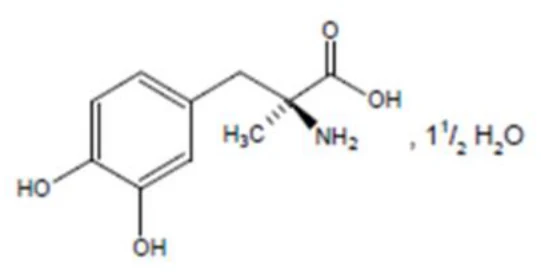
Chemical name: (2S)-2-amino-3-(3, 4-dihydroxyphenyl)-2-methylpropanoic acid
L-Tyrosine, 3-hydroxy-α-methyl-, sesquihydrate.
L-3-(3, 4-Dihydroxyphenyl)-2-methylalanine sesquihydrate
Molecular formula and molecular mass: C10H13NO4 3/2H2O and 238.2 g/mol
Structural formula:
Physicochemical properties:
Physical Description
White to yellowish-white, odorless, fine crystalline powder, which may contain friable lumps.
Solubility profile
Sparingly soluble in water; very soluble in 3N hydrochloric acid; slightly soluble in alcohol;
practically insoluble in ether.
Chirality and Isomers
According to the method described in USP, the specific rotation is -25° ~ -28°.
14 CLINICAL TRIALS
The clinical trial data on which the original indication was authorized is not available.
15 MICROBIOLOGY
No microbiological information is required for this drug product.
16 NON-CLINICAL TOXICOLOGY
Carcinogenicity
No evidence of a tumorigenic effect was seen when methyldopa was given for two years to mice at doses up to 1,800 mg/kg/day or to rats at doses up to 240 mg/kg/day (30 and 4 times the maximum recommended human dose in mice and rats, respectively, when compared on the basis of body weight; 2.5 and 0.6 times the maximum recommended human dose in mice and rats, respectively, when compared on the basis of body surface area; calculations assume a patient weight of 50 kg).
Genotoxicity
Methyldopa was not mutagenic in the Ames Test and did not increase chromosomal aberration or sister chromatid exchanges in Chinese hamster ovary cells. These in vitro studies were carried out both with and without exogenous metabolic activation.
Reproductive and Developmental Toxicology
Fertility was unaffected when methyldopa was given to male and female rats at 100 mg/kg/day (1.7 times the maximum daily human dose when compared on the basis of body weight; 0.2 times the maximum daily human dose when compared on the basis of body surface area). Methyldopa decreased sperm count, sperm motility, the number of late spermatids and the male fertility index when given to male rats at 200 and 400 mg/kg/day (3.3 and 6.7 times the maximum daily human dose when compared on the basis of body weight; 0.5 and 1 times the maximum daily human dose when compared on the basis of body surface area).
Reproduction studies performed with methyldopa at oral doses up to 1,000 mg/kg in mice, 200 mg/kg in rabbits and 100 mg/kg in rats revealed no evidence of harm to the fetus. These doses are 16.6 times, 3.3 times and 1.7 times, respectively, the maximum daily human dose when compared on the basis of body weight; 1.4 times, 1.1 times and 0.2 times, respectively, when compared on the basis of body surface area; calculations assume a patient weight of 50 kg. There are, however, no adequate and well-controlled studies in pregnant women in the first trimester of pregnancy. Because animal reproduction studies are not always predictive of human response, METHYLDOPA should be used during pregnancy only if clearly needed.