


Product Monograph - Monoferric
RECENT MAJOR LABEL CHANGES
| 1 INDICATIONS, 1.1 Pediatrics | 01/2025 |
|---|---|
| 4 DOSAGE AND ADMINISTRATION, 4.2 Recommended Dose and Dosage Adjustment | 01/2025 |
| 7 WARNINGS AND PRECAUTIONS, Skin | 01/2025 |
| 7 WARNINGS AND PRECAUTIONS, 7.1.1 Pregnant Women | 01/2025 |
| 7 WARNINGS AND PRECAUTIONS, 7.1.3 Pediatrics | 01/2025 |
TABLE OF CONTENTS
Sections or subsections that are not applicable at the time of authorization are not listed.
RECENT MAJOR LABEL CHANGES ............................................................................................. 2
TABLE OF CONTENTS ............................................................................................................... 2
PART I: HEALTH PROFESSIONAL INFORMATION ....................................................................... 4
1 INDICATIONS ................................................................................................................... 4
1.1 Pediatrics ....................................................................................................................... 4
1.2 Geriatrics ....................................................................................................................... 4
2 CONTRAINDICATIONS ...................................................................................................... 4
3 SERIOUS WARNINGS AND PRECAUTIONS BOX ................................................................. 5
4 DOSAGE AND ADMINISTRATION ...................................................................................... 5
4.1 Dosing Considerations ................................................................................................... 5
4.2 Recommended Dose and Dosage Adjustment .............................................................. 5
4.4 Administration ............................................................................................................... 7
5 OVERDOSAGE .................................................................................................................. 8
6 DOSAGE FORMS, STRENGTHS, COMPOSITION AND PACKAGING ...................................... 8
7 WARNINGS AND PRECAUTIONS ....................................................................................... 9
7.1 Special Populations ..................................................................................................... 11
7.1.1 Pregnant Women ...................................................................................................... 11
7.1.2 Breast-feeding ........................................................................................................... 12
7.1.3 Pediatrics ................................................................................................................... 12
7.1.4 Geriatrics ................................................................................................................... 12
8 ADVERSE REACTIONS ..................................................................................................... 12
8.1 Adverse Reaction Overview ......................................................................................... 12
8.2 Clinical Trial Adverse Reactions ................................................................................... 13
8.4 Abnormal Laboratory Findings: Hematologic, Clinical Chemistry and Other Quantitative Data .................................................................................................................... 16
8.5 Post-Market Adverse Reactions .................................................................................. 16
9 DRUG INTERACTIONS ..................................................................................................... 17
9.2 Drug Interactions Overview ......................................................................................... 17
9.3 Drug-Behavioural Interactions .................................................................................... 17
9.4 Drug-Drug Interactions ................................................................................................ 17
9.5 Drug-Food Interactions ............................................................................................... 17
9.6 Drug-Herb Interactions ................................................................................................ 17
9.7 Drug-Laboratory Test Interactions .............................................................................. 17
10 CLINICAL PHARMACOLOGY ........................................................................................ 18
10.1 Mechanism of Action .................................................................................................. 18
10.2 Pharmacodynamics ..................................................................................................... 18
10.3 Pharmacokinetics ........................................................................................................ 18
11 STORAGE, STABILITY AND DISPOSAL .......................................................................... 19
12 SPECIAL HANDLING INSTRUCTIONS ............................................................................ 20
PART II: SCIENTIFIC INFORMATION ........................................................................................ 21
13 PHARMACEUTICAL INFORMATION ............................................................................. 21
14 CLINICAL TRIALS ......................................................................................................... 22
14.1 Clinical Trials by Indication .......................................................................................... 22
Iron Deficiency Anemia (IDA) of different etiologies ............................................................... 22
Iron Deficiency Anemia in Non-dialysis-dependent Chronic Kidney Disease (NDD-CKD) Patients ................................................................................................................................... 27
Iron Deficiency Anemia in Hemodialysis-dependent Chronic Kidney Disease Patients ........... 31
15 MICROBIOLOGY ......................................................................................................... 34
16 NON-CLINICAL TOXICOLOGY ...................................................................................... 34
PATIENT MEDICATION INFORMATION ................................................................................... 36
PART I: HEALTH PROFESSIONAL INFORMATION
1 INDICATIONS
MONOFERRIC® (ferric derisomaltose for injection) is indicated for:
- the treatment of iron deficiency anemia in adult patients who have intolerance or unresponsiveness to oral iron therapy.
The diagnosis must be based on laboratory tests.
1.1 Pediatrics
Pediatrics (< 18 years of age): Limited data are available to Health Canada; therefore, Health Canada has not authorized an indication for pediatric use (see 7.1.3 Pediatrics).
1.2 Geriatrics
A careful risk benefit assessment is required before MONOFERRIC is used in patients aged ≥ 65 years and close monitoring for adverse events is required (see 7.1.4 Geriatrics).
2 CONTRAINDICATIONS
MONOFERRIC is contraindicated in the following situations:
- Patients who are hypersensitive to this drug or to any ingredient in the formulation, including any non-medicinal ingredient, or component of the container. For a complete listing, see 6 DOSAGE FORMS, STRENGTHS, COMPOSITION AND PACKAGING
- Known serious hypersensitivity to other parenteral iron products
- Non-iron deficiency anemia (e.g. hemolytic anemia)
- Iron overload or disturbances in utilization of iron (e.g. hemochromatosis, hemosiderosis)
- Decompensated liver cirrhosis or active hepatitis
3 SERIOUS WARNINGS AND PRECAUTIONS BOX
4 DOSAGE AND ADMINISTRATION
4.1 Dosing Considerations
- The dose of MONOFERRIC (ferric derisomaltose for injection) is expressed in terms of mg of elemental iron, with each mL of undiluted MONOFERRIC containing 100 mg of elemental iron.
- The patient’s total body iron deficit (cumulative amount of iron needed to replete body iron stores and correct IDA) is not the same as the allowable iron dose per infusion which is limited to 20 mg iron/kg body weight with MONOFERRIC. The optimal hemoglobin (Hb) target level and iron stores may vary in different patient groups and between patients. Iron deficiency anemia will not appear until essentially all iron stores have been depleted. Iron therapy should therefore replenish both hemoglobin iron and iron stores.
4.2 Recommended Dose and Dosage Adjustment
- The iron dose and administration schedule for MONOFERRIC must be individually established for each patient, with allowance for clinical judgement. Clinicians may choose between calculating the cumulative dose for iron repletion based on patient’s Hb and body weight based on the Simplified Table or Ganzoni formula, or treating with a fixed dose (repeated dose might be needed if the patient requires further iron repletion). Training materials on dosage and administration of MONOFERRIC are available to clinicians by visiting the manufacturer’s website www.monoferricpro.ca or by calling 1-800-463-6001
Serious Warnings and Precautions
MONOFERRIC is contraindicated in patients with any allergy to this drug or known serious hypersensitivity to other parenteral iron products.
The following are clinically significant adverse events:
- Serious hypersensitivity reactions including life threatening and fatal anaphylaxis/anaphylactoid reactions have been reported in patients receiving intravenous iron products including MONOFERRIC (see Immune, Hypersensitivity below).
- Serious cases of hypotension (see Cardiovascular below).
MONOFERRIC should only be administered when personnel and therapies are immediately available for the treatment of anaphylaxis and other hypersensitivity reactions (see Immune, Hypersensitivity below).
Patients should be carefully monitored for signs and symptoms of hypersensitivity reactions including monitoring of blood pressure and pulse during and for at least 30 minutes following each administration of MONOFERRIC.
- For pregnant patients, it is recommended that the maximum single dose is restricted to 1000 mg and maximum cumulative dose is restricted to 2000 mg. Treatment with MONOFERRIC should be confined to gestation week 16 and beyond (see 7.1.1 Pregnant Women).
- Treatment approach based on calculating total body iron deficit
The posology of MONOFERRIC can follow a stepwise approach: [1] determination of the individual iron need [2] calculation and administration of the iron dose(s), [3] post-iron repletion assessments.
Step 1: Determination of the iron need:
The cumulative iron need can be determined using either the Simplified Table (i) or the Ganzoni formula below (ii). In the clinical studies with CKD patients, the Ganzoni formula was used and in the clinical study with IDA patients of various causes other than CKD, the Simplified table was used.
The iron need is expressed in mg elemental iron.
i. Simplified Table:
| Hb (g/dL) | Patients with bodyweight <50 kg | Patients with bodyweight 50 kg to <70 kg | Patients with bodyweight ≥70 kg |
|---|---|---|---|
| ≥10 | 500 mg | 1000 mg | 1500 mg |
| <10 | 500 mg | 1500 mg | 2000 mg |
ii. Ganzoni formula:
Iron need = Body weight(A) x (Target Hb(D) – Actual Hb)(B) x 2.4 + Iron for iron stores(C) [mg iron] [kg] [g/dL] [mg iron] |
|---|
(A) It is recommended to use the patient’s ideal body weight for obese patients. For all other patients use actual body weight. Ideal body weight may be calculated in a number of ways e.g. by calculating weight at BMI 25 i.e. ideal body weight = 25 * (height in m)2
(B) To convert Hb [mM] to Hb [g/dL] you should multiply Hb [mM] by factor 1.61145
(C) For a person with a body weight above 35 kg, the iron stores are 500 mg or above. Iron stores of 500 mg are at the lower limit normal for small women. Some guidelines suggest using 10-15 mg iron /kg body weight and others 1000 mg iron as stores.
(D) Default Hb target is 15 g/dL in the Ganzoni formula. Consider using a lower haemoglobin target as appropriate based on clinical judgement.
Step 2: Calculation and administration of the maximum individual iron dose(s):
Based on the iron need determined above the appropriate dose(s) of MONOFERRIC should be administered taking into consideration the following:
A single MONOFERRIC infusion should not exceed 20 mg iron/kg body weight. Single doses above 1500 mg are not recommended.
Step 3: Post-iron repletion assessments:
Re-assessment should be performed by the clinician based on the individual patient's condition. The Hb level should be re-assessed no earlier than 4 weeks post final MONOFERRIC administration to allow adequate time for erythropoiesis and iron utilisation. In the event the patient requires further iron repletion, the iron need should be recalculated.
- 2. Fixed dose approach
For both NDD-CKD patients and patients of various causes other than CKD with IDA receiving an IV infusion weighing more than 50 kg, a fixed dose of 1000 mg can be given, and the patient is re-evaluated for further iron need. Re-assessment should be performed by the clinician based on the individual patient's condition. The Hb level should be re-assessed no earlier than 4 weeks post MONOFERRIC administration to allow adequate time for erythropoiesis and iron utilisation. For patients weighing less than 50 kg, MONOFERRIC should be administered as 20 mg/kg actual body weight.
4.4 Administration
MONOFERRIC can be administered either as an intravenous drip infusion, as an intravenous bolus injection, or as a direct injection into the venous limb of the dialyzer.
Inspect vials visually for sediment and damage before use. Use only those containing sediment-free, homogeneous solution. The reconstituted solution for injection should be visually inspected prior to use. Use only clear solutions without sediment.
MONOFERRIC should only be administered when personnel trained to evaluate and manage anaphylactic reactions are immediately available, in an environment where full resuscitation facilities can be assured. Monitor patients carefully for signs and symptoms of hypersensitivity reactions during and following each administration of MONOFERRIC. The patient should be observed for adverse effects for at least 30 minutes following each MONOFERRIC administration (see Hypersensitivity and Monitoring and Laboratory Tests).
Each IV iron administration is associated with a risk of a hypersensitivity reaction. Thus, to minimize risk the number of single IV iron administrations should be kept to a minimum.
Intravenous drip infusion:
The MONOFERRIC dose required may be administered in a single infusion up to 20 mg iron/kg body weight or as weekly infusions until the cumulative iron need has been addressed. Single doses above 1500 mg are not recommended.
If the cumulative iron need exceeds 20 mg iron/kg body weight, the dose must be split into two administrations with an interval of at least one week. It is recommended whenever possible to give 20 mg iron/kg body weight in the first administration. Dependent on clinical judgement the second administration could await follow-up laboratory tests.
Recommended administration rates for intravenous infusion
| MONOFERRIC dose | Minimum administration time |
|---|---|
≤1000 mg >1000 mg | 20 minutes 30 minutes |
MONOFERRIC must only be diluted in sterile 0.9 % sodium chloride solution. For stability reasons, MONOFERRIC should not be diluted to concentrations less than 1 mg iron/mL (not including the volume of the ferric derisomaltose solution) and never diluted in more than 500 mL sterile 0.9 % sodium chloride. When diluting, there is no lower volume limit of 0.9 % sodium chloride solution.
Intravenous bolus injection:
MONOFERRIC may be administered as an intravenous bolus injection up to 500 mg up to once a week at an administration rate of up to 250 mg iron/minute. It may be administered undiluted or diluted in maximum 20 mL sterile 0.9 % sodium chloride.
Recommended administration rates for intravenous bolus injection
| Volume of MONOFERRIC | Equivalent iron dose | Administration rate / Minimum administration time | Frequency |
|---|---|---|---|
| ≤5 mL | ≤500 mg | 250 mg iron/minute | 1 time a week |
Injection into dialyzer:
MONOFERRIC may be administered during a hemodialysis session directly into the venous limb of the dialyzer under the same procedures as outlined for intravenous bolus injection.
5 OVERDOSAGE
Overdose may lead to accumulation of iron in storage sites eventually leading to hemosiderosis. Monitoring of iron parameters such as serum ferritin may assist in recognizing iron accumulation. Supportive measures such as chelating agents can be used.
Do not administer MONOFERRIC to patients with iron overload. See 2 CONTRAINDICATIONS.
| For management of a suspected drug overdose, contact your regional poison control centre. |
|---|
6 DOSAGE FORMS, STRENGTHS, COMPOSITION AND PACKAGING
Table 1: Dosage Forms, Strengths, Composition and Packaging
| Route of Administration | Dosage Form / Strength / Composition | Non-medicinal Ingredients |
| Intravenous | solution 100 mg/mL elemental iron (as ferric derisomaltose) | hydrochloric acid, sodium hydroxide, water for injection |
MONOFERRIC (ferric derisomaltose [also known as iron isomaltoside 1000] for injection) is a dark brown, non-transparent, sterile aqueous colloidal preservative-free solution. Each mL of MONOFERRIC contains the equivalent of 100 mg of elemental iron in Water for Injection (WFI). Hydrochloric acid and sodium hydroxide may be added to adjust the pH.
MONOFERRIC is available in glass single use vials.
MONOFERRIC is available in the following formats:
| Single dose vial size | Number of vials per box |
|---|---|
| 1 mL | 5 |
| 5 mL | 1 |
| 10 mL | 1 |
7 WARNINGS AND PRECAUTIONS
Please see 3 SERIOUS WARNINGS AND PRECAUTIONS BOX
General
Excessive therapy with parenteral iron can lead to excess storage of iron and possible iatrogenic hemosiderosis. Do not administer MONOFERRIC to patients with iron overload (see 2 CONTRAINDICATIONS).
Carcinogenesis and Mutagenesis
Carcinogenicity studies have not been conducted. MONOFERRIC showed no evidence of genotoxicity or mutagenicity in a standard battery of tests. These included an in vitro Ames test with and without metabolic activation, an in vitro human lymphocyte chromosome aberration test with and without metabolic activation and an in vivo mouse micronucleus test.
Cardiovascular
In clinical studies hypotension was reported in 0.7 % (29/3922) of patients, including serious events in 0.03 % (1/3922) of patients who received MONOFERRIC. Hypotension has also been reported in the post-marketing experience. Hypotensive episodes may occur if intravenous injection is administered too rapidly. Observe patients for signs and symptoms of hypersensitivity including hypotension during and for at least 30 minutes following each administration.
Hepatic/Biliary/Pancreatic
MONOFERRIC is contraindicated in patients with decompensated liver cirrhosis or active hepatitis (see 2 CONTRAINDICATIONS). In patients with compensated liver dysfunction, parenteral iron should only be administered after careful benefit/risk assessment. Parenteral iron administration should be avoided in patients with hepatic dysfunction (alanine aminotransferase and/or aspartate aminotransferase > 3 times upper limit of normal) where iron overload is a precipitating factor, in particular Porphyria Cutanea Tarda (PCT). Careful monitoring of iron status is recommended to avoid iron overload.
Immune
Hypersensitivity
Parenterally administered iron preparations can cause hypersensitivity reactions including serious and potentially fatal anaphylactic/anaphylactoid reactions. Hypersensitivity reactions have also been reported after previously uneventful doses of parenteral iron complexes. MONOFERRIC is contraindicated in patients with known serious hypersensitivity to other parenteral iron products (see 2 CONTRAINDICATIONS).
The risk is enhanced for patients with known allergies including drug allergies, including patients with a history of severe asthma, eczema or other atopic allergy.
There is also an increased risk of hypersensitivity reactions to parenteral iron complexes in patients with immune or inflammatory conditions (e.g. systemic lupus erythematosus, rheumatoid arthritis).
MONOFERRIC may cause life-threatening and fatal hypersensitivity reactions, including anaphylaxis and/or anaphylactoid reactions. In clinical trials, severe or serious hypersensitivity reactions were reported in 0.7% (28/3922) of patients who received MONOFERRIC and 0.2 % (8/3922) of these patients reported a severe or serious hypersensitivity reaction within 1 day of dosing. Hypersensitivity reactions have been seen in spontaneously reported adverse events from post-marketing experience (see 8.5 Post-market Adverse Reactions).
Fishbane reaction is an infusion reaction characterised by flushing in the face, acute chest and/or back pain and tightness sometimes with dyspnoea that may occur with IV iron treatment (frequency uncommon). This may mimic the early symptoms of an anaphylactoid/anaphylactic reaction. The infusion should be stopped and the patient's vital signs should be assessed. These symptoms disappear shortly after the iron administration is stopped. They typically do not reoccur if the administration is restarted at a lower infusion rate.
Delayed reactions may also occur with parenteral iron preparations and can be severe. They are characterised by arthralgia, myalgia and sometimes fever. The onset varies from several hours up to four days after administration. Symptoms usually last two to four days and settle spontaneously or following the use of simple analgesics.
MONOFERRIC should only be administered when personnel and therapies are immediately available for the treatment of anaphylaxis and other hypersensitive reactions. Observe patients for signs and symptoms of hypersensitivity during and for at least 30 minutes following each administration of MONOFERRIC. If hypersensitivity reactions or signs of intolerance occur during administration, the treatment must be stopped immediately. The MONOFERRIC Patient Information Booklet is available in the product package, by visiting the manufacturer’s website www.monoferric.ca or by calling 1-800-463-6001, for complete information regarding precautions and adverse events.
Infection
There is a risk that iron preparations enhance bacterial growth and inhibit leucocyte function and phagocytosis. Parenteral iron should be used with caution in case of severe acute or chronic infection. In patients with chronic infection a risk/benefit evaluation has to be performed, taking into account the suppression of erythropoiesis. MONOFERRIC should not be used in patients with ongoing bacteraemia.
Monitoring and Laboratory Tests
Patients must have confirmed iron deficiency anemia (IDA) based on appropriate laboratory tests before treatment (see General).
Regularly monitor the haematologic response and iron parameters, such as serum ferritin and transferrin saturation, during parenteral iron therapy. Monitoring of iron parameters such as serum ferritin may assist in recognizing iron accumulation.
Monitor patient’s blood pressure and heart rate for signs and symptoms of hypotension before, during and for 30 minutes after each MONOFERRIC administration. Each patient should be observed for adverse effects, including signs and symptoms of hypersensitivity reactions (e.g., urticaria, oedema, bronchospasm, hypotension, cardiorespiratory arrest, syncope, unresponsiveness, or loss of consciousness) during administration and for at least 30 minutes following each MONOFERRIC administration. If hypersensitivity reactions or signs of intolerance occur during administration, the treatment must be stopped immediately.
Hypophosphataemia
In clinical trials the frequencies of a transient drop in phosphate below 2 mg/dL have been 5-20 % in patients treated with MONOFERRIC from the studies in patients with iron deficiency anemia (IDA) of various aetiologies and 1-2 % in studies with chronic kidney disease (CKD) patients. Nadir was in the first weeks. No clinical symptoms were reported. One of the risks with profound hypophosphataemia is osteomalacia which has been reported after repeated use of IV iron. No cases of osteomalacia after MONOFERRIC use have been received.
Reproductive Health: Female and Male Potential
Fertility
MONOFERRIC did not affect fertility in male or female rats when administered intravenous (IV) at up to 19 mg/kg/day in males and 32 mg/kg/day in females (3 and 2.5 times the maximum recommended human (2000 mg in a 70 kg human) exposure from a single course of MONOFERRIC). Degenerative changes of the male reproductive system of unknown reversibility were observed in male rats at 80 mg/kg/day thrice weekly (5 times the maximum recommended human exposure from a single course of MONOFERRIC) (see 16 NON-CLINICAL TOXICOLOGY).
Skin
MONOFERRIC should be administered with caution to avoid paravenous leakage during administration. Paravenous leakage may lead to irritation of the skin and long-lasting brown discoloration at the injection site. Distant skin discolouration has also been reported. In case of paravenous leakage, the administration of MONOFERRIC must be stopped immediately. The risk of injection-site leakage or extravasation can be minimized by flushing with 0.9% saline before the infusion starts.
7.1 Special Populations
7.1.1 Pregnant Women
There are limited data from the use of MONOFERRIC in pregnant women. In a randomized study, 100 women with iron deficiency with or without anemia who were in gestation week 16-21 received MONOFERRIC at a maximum single dose of 1000 mg and maximum cumulative dose of 2000 mg. The most commonly reported adverse events were uterine contractions during pregnancy, pelvic pain, and viral upper respiratory tract infection.
A careful risk/benefit evaluation is required before use during pregnancy. There are risks to the mother and fetus associated with untreated iron deficiency anemia in pregnancy as well as risks to the fetus associated with maternal hypersensitivity reactions. Treatment with MONOFERRIC should be confined to gestation week 16 and beyond if the benefit is judged to outweigh the potential risks to both the mother and fetus.
Fetal bradycardia may occur following administration of parenteral irons. It is usually transient and a consequence of a hypersensitivity reaction in the mother. Patients should be advised of the potential risk to the fetus. If intravenous administration of MONOFERRIC to a pregnant woman occurs, the unborn baby should be carefully monitored.
Embryofetal toxicity and teratogenicity have been observed in animal reproduction studies (see 16 NON-CLINICAL TOXICOLOGY). Administration of ferric derisomaltose to female rats prior to mating through organogenesis resulted in skeletal developmental delays starting at 11 mg Fe/kg/day (2 times the maximum recommended human exposure from a single course of MONOFERRIC). Administration of ferric derisomaltose to pregnant rabbits during organogenesis increased fetal malformations starting at 25 mg Fe/kg/day, and increased post implantation loss and fetal mortality at 43 mg Fe/kg/day (4 and 7 times the maximum recommended human exposure from a single course of MONOFERRIC, respectively).
7.1.2 Breast-feeding
The available data on the use of MONOFERRIC in lactating women demonstrate that iron is present in breast milk. However, the data do not inform the potential exposure of iron for the breastfed child or the effects on milk production. The developmental and health benefits of breastfeeding should be considered along with the mother’s clinical need for MONOFERRIC in addition to any potential adverse effects on the breastfed child from the drug or from the underlying maternal condition (see 10 CLINICAL PHARMACOLOGY). Monitor breastfed children for gastrointestinal toxicity (constipation, diarrhea).
7.1.3 Pediatrics
Pediatrics (< 18 years of age): Limited data are available to Health Canada; therefore, Health Canada has not authorized an indication for pediatric use.
In an ongoing clinical study in children (<18 years old), serious hypersensitivity reaction (anaphylactic reaction) was reported when MONOFERRIC was administered at 10 mg/kg and 20 mg/kg.
7.1.4 Geriatrics
Clinical studies with MONOFERRIC have not identified differences in adverse reactions between elderly and younger adult patients, but there was a higher percentage of patients experiencing serious adverse events (SAEs) and adverse events (AEs) leading to fatal outcome in patients ≥ 65 years (SAEs: < 65 years at 5 %, ≥ 65 years at 11 %; AEs leading to fatal outcome: < 65 years at < 1 %, ≥ 65 years at 1 %). A careful risk benefit assessment is required before MONOFERRIC is used in patients aged ≥ 65 years and close monitoring for adverse events is required.
8 ADVERSE REACTIONS
8.1 Adverse Reaction Overview
In phase II and III clinical trials, 3922 patients were treated with MONOFERRIC. 1638 (42 %) patients reported a total of 3622 adverse events (AEs). The most common treatment-emergent adverse events (TEAEs) (all causality) reported in more than 2 % of patients by preferred term were constipation (63 (2 %)), diarrhoea (71 (2 %)), dizziness (59 (2 %)) headache (92 (2 %)), nasopharyngitis (80 (2 %)) and nausea (97 (2%)).
Of the 3622 AEs, 346 serious adverse events (SAEs) were reported in 273 patients (7 %). No treatment-emergent SAEs were reported in > 1 % in patients treated with MONOFERRIC. The most common SAE was pneumonia (11 patients) and congestive heart failure (10 patients).
In the 3922 patients treated with MONOFERRIC, a total of 17 SARs reported in 16 patients (< 1 %) were considered as probably or possibly related to MONOFERRIC (all whom recovered). These were anaphylactic reaction, staphylococcal sepsis, angina unstable, generalized tonic-clonic seizure, dyspnea, rash pruritic, syncope, and eight cases of hypersensitivity, acute myocardial infarction, and infusion related reaction.
Of the 3922 patients treated with MONOFERRIC in clinical trials, 65 (2 %) patients experienced TEAEs leading to withdrawal from study.
Overall in clinical trials, a total of 28/3922 (0.7 %) patients reported a serious or severe hypersensitivity reaction, in which 8 of these cases occurred within one day of dosing with MONOFERRIC.
8.2 Clinical Trial Adverse Reactions
Clinical trials are conducted under very specific conditions. The adverse reaction rates observed in the clinical trials, therefore, may not reflect the rates observed in practice and should not be compared to the rates in the clinical trials of another drug. Adverse reaction information from clinical trials may be useful in identifying and approximating rates of adverse drug reactions in real-world use.
Across five randomized clinical trials a total of 2799 patients received MONOFERRIC.
Iron Deficiency Anemia (IDA) Studies:
In Study IDA-01, a total of 333 patients with IDA of various causes (gynecological, gastroenterological, oncological and unknown or unspecified IDA) other than CKD were exposed to MONOFERRIC, of which, 32 (9.6 %) received a cumulative dose of 1000 mg, 164 (49.2 %) received a cumulative dose of 1500 mg, and 130 (39.0 %) received a cumulative dose of 2000 mg. Seven (2.1 %) patients were listed as receiving ‘other’ cumulative dose. MONOFERRIC was administered either as an IV infusion of 1000 mg over approximately 15 minutes or as an IV injection of 500 mg over 2 minutes per week, for an individual dose up to a maximum cumulative dose of 2000 mg. A total of 168 patients received 200 mg of IV iron sucrose by infusion up to twice weekly up to a cumulative dose of 2000 mg.
In Study IDA-03, a total of 989 patients with IDA of various causes (gynecological, gastroenterological, oncological and unknown or unspecified IDA) other than CKD were exposed to MONOFERRIC, which was administered as an IV infusion of a single fixed 1000 mg dose over 20 minutes. A total of 494 patients received iron sucrose administered as 200 mg IV injections repeated up to five times for a cumulative dose of 1000 mg.
The frequency of cardiovascular events was 0.8% and 1.2% in the MONOFERRIC and iron sucrose groups, respectively.
Non-Dialysis-Dependent Chronic Kidney (NDD-CKD) Disease
A total of 228 non-dialysis dependent patients with CKD (NDD-CKD) were exposed to MONOFERRIC in Study CKD-02. MONOFERRIC was administered either as IV infusions or IV bolus injections. The infusion was given in weekly doses for up to 2 weeks, to a maximum of 1000 mg iron each week until full replacement dose was achieved. The dose was diluted in 100 mL 0.9 % sodium chloride and given over approximately 15-20 minutes. Bolus injections of 500 mg were administered undiluted over approximately 2 minutes, once per week until full replacement dose was achieved. Oral iron was administered as 200 mg iron sulphate daily for 8 weeks. The mean cumulative dose of MONOFERRIC administered to the patients in the infusion and bolus subgroups were 907 ± 170 mg (range: 750:1500 mg) and 926 ± 241 mg (range: 500:2000 mg), respectively. The mean cumulative dose of MONOFERRIC was 916 ± 208 mg (range: 500:2000 mg).
In Study CKD-04, a total of 1019 non-dialysis dependent CKD (NDD-CKD) patients were exposed to MONOFERRIC, which was administered as an IV infusion of a single fixed 1000 mg dose over 20 minutes. A total of 506 patients received iron sucrose administered as 200 mg IV injections repeated up to five times for a cumulative dose of 1000 mg.
The incidence of adjudicated and confirmed composite cardiovascular AEs was 4.1% and 6.9% in the MONOFERRIC and iron sucrose groups, respectively.
Dialysis-Dependent Chronic Kidney Disease (DD-CKD) Studies
In Study CKD-03, a total of 230 hemodialysis-dependent CKD (DD-CKD) patients were exposed to MONOFERRIC, of which 114 (50 %) received a dose of 500 mg by IV single bolus injection and 116 (50 %) received a total dose of 500 mg as fractionated (100 mg + 200 mg + 200 mg) IV bolus injections. A total of 117 patients received 500 mg of IV iron sucrose administered as 500 mg fractioned (100 mg + 200 mg + 200 mg) IV bolus injections.
Table 2: Clinical Trial TEAEs Reported in ≥ 2% of Patients by Study (IDA-01, IDA-03, in patients with IDA* and CKD-02, CKD-03, and CKD-04 in patients with CKD)
Iron Deficiency Anemia IDA-01+IDA-03 | Chronic Kidney Disease CKD-02 | Chronic Kidney Disease CKD-03 | Chronic Kidney Disease CKD-04 | |||||||||||||||||||||||
| ferric derisomaltose | iron sucrose | ferric derisomaltose | oral iron | ferric derisomaltose | iron sucrose | ferric derisomaltose | iron sucrose | |||||||||||||||||||
| N [%] | N [%] | N [%] | N [%] | N [%] | N [%] | N [%] | N [%] | |||||||||||||||||||
| Safety Analysis Set | 1322 | 662 | 228 | 117 | 230 | 114 | 1019 | 506 | ||||||||||||||||||
| Any AE(s) | 460 (35%) | 208 (31%) | 95 (42%) | 53 (45%) | 110 (48%) | 47 (41%) | 335 (33%) | 168 (33%) | ||||||||||||||||||
| Infections and infestations | 97 (7%) | 41 (6%) | 25 (11%) | 12 (10%) | 22 (10%) | 15 (13%) | 81 (8%) | 40 (8%) | ||||||||||||||||||
| 19 (1%) | 5 (<1%) | 7 (3%) | 4 (3%) | 6 (3%) | 1 (<1%) | 10 (<1%) | 2 (<1%) | ||||||||||||||||||
| 19 (1%) | 8 (1%) | 4 (2%) | 1 (<1%) | 25 (2%) | 16 (3%) | ||||||||||||||||||||
| 1 (<1%) | 1 (<1%) | 4 (2%) | 3 (3%) | 2 (<1%) | |||||||||||||||||||||
| Gastrointestinal disorders | 128 (10%) | 59 (9%) | 22 (10%) | 15 (13%) | 19 (8%) | 6 (5%) | 58 (6%) | 24 (5%) | ||||||||||||||||||
| 4 (<1%) | 5 (4%) | 1 (<1%) | |||||||||||||||||||||||
| 48 (4%) | 23 (3%) | 2 (<1%) | 2 (2%) | 1 (<1%) | 16 (2%) | 7 (1%) | |||||||||||||||||||
| 17 (1%) | 9 (1%) | 7 (3%) | 4 (3%) | 5 (2%) | 2 (2%) | 15 (1%) | 7 (1%) | ||||||||||||||||||
| 15 (1%) | 11 (2%) | 6 (3%) | 1 (<1%) | 3 (1%) | 2 (2%) | 10 (<1%) | 5 (<1%) | ||||||||||||||||||
| Injury, poisoning and procedural complications | 21 (2%) | 19 (3%) | 2 (<1%) | 25 (11%) | 9 (8%) | 16 (2%) | 19 (4%) | |||||||||||||||||||
| 2 (<1%) | 1 (<1%) | 1 (<1%) | 7 (3%) | 3 (<1%) | 9 (2%) | ||||||||||||||||||||
| 5 (2%) | 1 (<1%) | ||||||||||||||||||||||||
| General disorders and administration site conditions | 87 (7%) | 48 (7%) | 23 (10%) | 9 (8%) | 10 (4%) | 5 (4%) | 40 (4%) | 26 (5%) | ||||||||||||||||||
| 15 (1%) | 4 (<1%) | 7 (3%) | 4 (3%) | 1 (<1%) | 3 (<1%) | 2 (<1%) | |||||||||||||||||||
| 8 (<1%) | 1 (<1%) | 5 (2%) | 2 (2%) | 13 (1%) | 5 (<1%) | ||||||||||||||||||||
| Nervous system disorders | 83 (6%) | 62 (9%) | 14 (6%) | 6 (5%) | 13 (6%) | 6 (5%) | 35 (3%) | 22 (4%) | ||||||||||||||||||
| 40 (3%) | 25 (4%) | 2 (<1%) | 2 (2%) | 7 (3%) | 4 (4%) | 9 (<1%) | 10 (2%) | ||||||||||||||||||
| 32 (2%) | 18 (3%) | 5 (2%) | 1 (<1%) | 5 (<1%) | 8 (2%) | ||||||||||||||||||||
| 3 (<1%) | 15 (2%) | 1 (<1%) | 3 (<1%) | 1 (<1%) | |||||||||||||||||||||
| Metabolism and nutrition disorders | 24 (2%) | 8 (1%) | 12 (5%) | 2 (2%) | 8 (3%) | 8 (7%) | 62 (6%) | 30 (6%) | ||||||||||||||||||
| 1 (<1%) | 1 (<1%) | 5 (2%) | 4 (4%) | 5 (<1%) | 1 (<1%) | ||||||||||||||||||||
| 4 (<1%) | 1 (<1%) | 6 (3%) | 1 (<1%) | 1 (<1%) | 25 (2%) | 9 (2%) | |||||||||||||||||||
| Musculoskeletal and connective tissue disorders | 66 (5%) | 27 (4%) | 10 (4%) | 3 (3%) | 16 (7%) | 1 (<1%) | 32 (3%) | 15 (3%) | ||||||||||||||||||
| 17 (1%) | 4 (<1%) | 5 (2%) | 7 (<1%) | 3 (<1%) | |||||||||||||||||||||
| 7 (<1%) | 7 (1%) | 1 (<1%) | 1 (<1%) | 5 (2%) | 3 (<1%) | 4 (<1%) | |||||||||||||||||||
| Skin and subcutaneous tissue disorders | 89 (7%) | 14 (2%) | 10 (4%) | 1 (<1%) | 26 (3%) | 11 (2%) | ||||||||||||||||||||
| 35 (3%) | 4 (<1%) | 2 (<1%) | 11 (1%) | 2 (<1%) | |||||||||||||||||||||
| Cardiac disorders | 12 (<1%) | 9 (1%) | 6 (3%) | 3 (3%) | 31 (3%) | 29 (6%) | ||||||||||||||||||||
| 1 (<1%) | 1 (<1%) | 1 (<1%) | 8 (<1%) | 11 (2%) | |||||||||||||||||||||
| Investigations | 48 (4%) | 25 (4%) | 11 (5%) | 5 (4%) | 46 (5%) | 28 (6%) | ||||||||||||||||||||
| 5 (<1%) | 3 (<1%) | 6 (3%) | 1 (<1%) | 1 (<1%) | |||||||||||||||||||||
| Vascular disorders | 34 (3%) | 19 (3%) | 8 (4%) | 4 (3%) | 8 (3%) | 1 (<1%) | 29 (3%) | 19 (4%) | ||||||||||||||||||
Iron Deficiency Anemia IDA-01+IDA-03 | Chronic Kidney Disease CKD-02 | Chronic Kidney Disease CKD-03 | Chronic Kidney Disease CKD-04 | |||||||||||||||||
| ferric derisomaltose | iron sucrose | ferric derisomaltose | oral iron | ferric derisomaltose | iron sucrose | ferric derisomaltose | iron sucrose | |||||||||||||
| N [%] | N [%] | N [%] | N [%] | N [%] | N [%] | N [%] | N [%] | |||||||||||||
| 13 (<1%) | 6 (<1%) | 7 (3%) | 2 (2%) | 3 (1%) | 1 (<1%) | 14 (1%) | 13 (3%) | ||||||||||||
| N: Number of patients (%): Percentage of patients Preferred terms in all treatment groups presented if incidence in at least one group ≥2%. If no preferred term within a study has incidence ≥ 2%, the corresponding system organ class is not presented | ||||||||||||||||||||
*Causes of IDA included different etiologies such as gynecological, gastroenterological, oncological and unknown or unspecified IDA.
8.4 Abnormal Laboratory Findings: Hematologic, Clinical Chemistry and Other Quantitative Data
Clinical trial findings
Hypophosphataemia:
In Study IDA-01, 65 (19.5 %) patients in the MONOFERRIC group and 7 (4.2 %) patients in the iron sucrose group had serum phosphate (s-phosphate) level < 2 mg/dL. Hypophosphataemia defined as s-phosphate < 2 mg/dL was reported in 3 patients in CKD-02 and 4 patients in CKD-03 (1.3 % and 1.7 %, respectively) in the MONOFERRIC group compared to 1 patient (< 1 %) in the oral iron sulfate group in Study CKD-02 and 2 patients (1.8 %) in the iron sucrose group in Study CKD-03.
One (1) patient treated with MONOFERRIC had s-phosphate level < 1 mg/dL (0.8 mg/dL) at week 4 which was normalised (2.6 mg/dL) at the following visit in Study IDA-01. Two patients in the MONOFERRIC group had s-phosphate level < 1 mg/dL in Study CKD-03 and none in Study CKD-02.
Most patients exposed to MONOFERRIC had low s-phosphate values for 1-4 weeks and 7 (2.2 %) patients had s-phosphate < 2 mg/dL at week 5 in Study IDA-01. In the iron sucrose group, most patients had low s-phosphate values for 1-2 weeks and 1 patient had s-phosphate < 2 mg/dL at week 5. Thus, the hypophosphataemia events were transient and, in most cases, normalised at the end of the trial.
No event of hypophosphataemia was considered as an AE in both Study CKD-02 and CKD-03 but was reported as an AE in Study IDA-01 in 6 (2 %) patients.
8.5 Post-Market Adverse Reactions
Because these adverse events are spontaneously reported in a voluntary manner from a population of uncertain size, it is not possible to reliably estimate their frequency. The following adverse reactions have been reported from the post-marketing spontaneous reports with MONOFERRIC:
Cardiac disorders:
Fetal bradycardia due to maternal hypersensitivity reactions, cardiac arrest, tachycardia
General disorders and administration site conditions:
Asthenia, chest discomfort, chest pain, chills, feeling abnormal, feeling hot, Fishbane reaction, influenza like illness, infusion site erythema, injection site discolouration, injection site extravasation, pain, pyrexia
Immune system disorders:
Hypersensitivity, anaphylactic and anaphylactoid reactions, including very rare cases of anaphylactic shock with a fatal outcome, have been reported
Investigations:
Blood pressure decreased, blood pressure increased, body temperature increased
Musculoskeletal and connective tissue disorders:
Joint swelling, pain in extremity
Nervous system disorders:
Burning sensation, cerebrovascular accident, generalized tonic-clonic seizure, head discomfort, loss of consciousness, paraesthesia, seizure, syncope, tremor
Respiratory, thoracic and mediastinal disorders:
Asphyxia, bronchospasm, pharyngeal edema, respiratory arrest, respiratory distress, wheezing
Skin and subcutaneous tissue disorders:
Angioedema, dermatitis allergic, erythema, generalized erythema, purpura, rash generalized, skin discolouration, swelling face, urticaria
Vascular disorders:
Circulatory collapse, flushing, hypotension, shock
9 DRUG INTERACTIONS
9.2 Drug Interactions Overview
As with all parenteral iron preparations the absorption of oral iron is reduced when administered concomitantly. Therefore, clinical judgment is required to consider when oral iron should be restarted.
9.3 Drug-Behavioural Interactions
No studies on the effects on the ability to drive and use machines have been performed.
9.4 Drug-Drug Interactions
Interactions with other drugs have not been established.
9.5 Drug-Food Interactions
Interactions with food have not been established.
9.6 Drug-Herb Interactions
Interactions with herbal products have not been established.
9.7 Drug-Laboratory Test Interactions
Parenteral iron may cause falsely elevated values of serum bilirubin and falsely decreased values of serum calcium.
Large doses of parenteral iron have been reported to give a brown colour to serum from a blood sample drawn four hours after administration.
10 CLINICAL PHARMACOLOGY
10.1 Mechanism of Action
Iron is essential to the synthesis of haemoglobin to maintain oxygen transport and to the function and formation of the physiologically important heme and non-heme compounds.
MONOFERRIC (ferric derisomaltose for injection) is a colloid with strongly bound iron in spheroidal iron-carbohydrate particles. The MONOFERRIC formulation contains iron in a strongly bound complex that enables a controlled and slow release of bioavailable iron to iron-binding proteins with little risk of free iron. MONOFERRIC is an iron carbohydrate complex with a matrix structure composed of alternating layers of ferric hydroxide and the carbohydrate derisomaltose. Derisomaltose consists of linear, hydrogenated isomaltooligosaccharides with an average molecular weight of 1000 Da and a narrow molecular weight distribution that is almost devoid of mono- and disaccharides.
The derisomaltose component of MONOFERRIC consists of 3-5 glucose units with an average molecular weight of approximately 1000 Da. It has no detectable branching structures as evidenced by careful 13C and 1H NMR spectroscopic analysis. Furthermore, derisomaltose does not contain any reducing sugar residues, which can be involved in complex redox reactions.
The MONOFERRIC formulation contains iron in a complex with derisomaltose that releases bioavailable iron to iron-binding proteins.
10.2 Pharmacodynamics
Evidence of a therapeutic response can be seen within a few days of administration of MONOFERRIC as an increase in the reticulocyte count.
Serum ferritin peaks approximately 7 days after an intravenous dose of MONOFERRIC and slowly returns to stable levels after about 4 weeks.
In a subgroup of 32 patients randomised to MONOFERRIC a thorough QT monitoring of ECG was performed. Results demonstrated no effect of MONOFERRIC on QT interval durations. No clinically meaningful effect of MONOFERRIC on heart rate was observed.
10.3 Pharmacokinetics
MONOFERRIC pharmacokinetics was examined across four patient populations. In patients with inflammatory bowel disease (IBD), non-haematological malignancies associated with chemotherapy induced anemia (CIA), in stage 5 chronic kidney disease on dialysis therapy and non-dialysis dependent chronic kidney disease (CKD). MONOFERRIC pharmacokinetics was examined across a dose range of 100 to 1000 mg. There is no data investigating the pharmacokinetics of single or multiple doses of MONOFERRIC above 1000 mg. There seems to be a dose-dependent increase in AUC and Cmax which is observed within all 3 patient populations; IBD, CKD, and CIA. T1/2 varies between 23.2 to 87.9 h with the highest value observed for patients dosed with 1000 mg of MONOFERRIC.
MONOFERRIC demonstrates dose proportional increases up to 500 mg. MONOFERRIC demonstrated linear pharmacokinetics up to 500 mg, with higher doses demonstrating dose dependent pharmacokinetics.
Distribution
Following intravenous administration of iron complex, it is taken up by the cells in the reticuloendothelial system (RES), particularly in the liver and spleen from where iron is slowly released.
Metabolism
Circulating iron is removed from the plasma by cells of the RES. The iron is immediately bound to the available protein moieties to form hemosiderin or ferritin, the physiological storage forms of iron, or to a lesser extent, to the transport molecule transferrin. This iron, which is subject to physiological control, replenishes haemoglobin and depleted iron stores.
Excretion
After administration of a single dose of MONOFERRIC of 100 to 1000 mg of iron in the pharmacokinetic studies, the iron injected or infused was cleared from the plasma with a half-life that ranged from 1 to 4 days. Renal elimination of iron was negligible.
Iron is not easily eliminated from the body and accumulation can be toxic. Due to the size of the complex, MONOFERRIC is not eliminated via the kidneys. Small quantities of iron are eliminated in urine and faeces.
IV iron complexes are not clinically interchangeable, as they differ in their structures, which impact their comparative pharmacokinetic profiles.
Special Populations and Conditions
Pregnancy and Breast-feeding
In a subset of patients (n=65) in a post-partum hemorrhage study, the mean maternal milk iron level was higher in the MONOFERRIC group (72.1 μg/dL) than in the standard medical care (oral iron treatment) group (40.0 μg/dL) at day 3. However, at week 1 the mean maternal milk iron level in the MONOFERRIC group had decreased to the same level as in the standard medical care group (46.8 μg/dL and 44.2 μg/dL, respectively).
A total of 8 patients in the MONOFERRIC group had an abnormally high maternal milk iron level (i.e. > 80 μg/dL) at day 3 (81-164.4 μg/dL) compared to 1 patient in the standard medical care group (99.4 μg/dL). At week 1, the corresponding numbers were 1 patient in the MONOFERRIC group (99.8 μg/dL) and 2 patients in the standard medical care group (115.4 μg/dL).
11 STORAGE, STABILITY AND DISPOSAL
Store between 15-30 °C. Do Not Freeze.
For storage conditions of the diluted solution, see below.
MONOFERRIC (ferric derisomaltose for injection) must be only mixed with sterile 0.9 % sodium chloride. No other intravenous dilution solutions should be used. No other therapeutic agents should be added. For dilution instructions, see 4 DOSAGE AND ADMINISTRATION.
MONOFERRIC is for single use only and any unused solution should be disposed of in accordance with local requirements.
Shelf life after first opening (undiluted):
From a microbiological point of view, the product should be used immediately.
Shelf life after dilution with sterile 0.9 % sodium chloride:
From a microbiological point of view, preparations for parenteral administration should be used immediately after dilution with sterile 0.9 % sodium chloride solution.
12 SPECIAL HANDLING INSTRUCTIONS
No special handling instructions are required for this product.
PART II: SCIENTIFIC INFORMATION
13 PHARMACEUTICAL INFORMATION
Drug Substance
Proper name: Ferric derisomaltose (also known as iron isomaltoside 1000)
Chemical name: (1→6)-α-D-glucopyranan-(1→6)-D-glucitol iron(III) complex
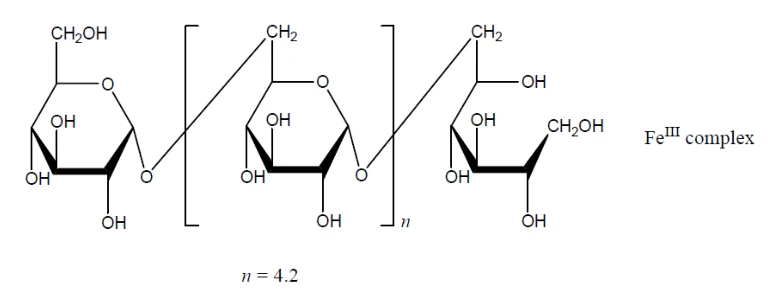
The drug substance is a colloidal particle containing approximately 640 repeat units of the following molecular formula. The formula is normalized with respect to iron stoichiometry.
Molecular formula and molecular mass: {FeO(1-3X) (OH)(1+3X) (C6H5O73-)X}, (H20)T, -
(C6H10O6)R(-C6H10O5-)Z(C6H13O5)R, (NaCl)Y
X= 0.0311; T = 0.25; R = 0.14; Z = 0.49; Y = 0.14
Molecular mass: 235 g/mol
The apparent molecular weight = 150kDa
Structural formula: Ferric derisomaltose is an iron carbohydrate complex with a matrix structure composed of alternating layers of ferric hydroxide and the carbohydrate derisomaltose. Derisomaltose consists of linear, hydrogenated isomaltooligosaccharides with an average molecular weight of 1000 Da and a narrow molecular weight distribution that is almost devoid of mono- and disaccharides.
Physicochemical properties: MONOFERRIC is a sterile colloidal solution containing a complex of iron (III) with derisomaltoses of an average molecular weight of approximately 1000 Daltons. The pH is between 5.0 and 7.0.
14 CLINICAL TRIALS
Phase III trials included studies in IDA from different etiologies (IDA-01, IDA-03), including gastroenterology, gynecology, oncology and unknown or unspecified IDA. Additionally, the Phase III trials included studies conducted in non-dialysis dependent CKD patients (CKD-02 and CKD-04), and a study conducted in hemodialysis dialysis dependent CKD patients (CKD-03).
14.1 Clinical Trials by Indication
Iron Deficiency Anemia (IDA) of different etiologies
Study IDA-01
| Trial Design | Phase III, 2:1 randomised, open-label, comparative, non-inferiority study |
|---|---|
| Diagnosis |
|
| Dosage, route of administration, duration | MONOFERRIC IV infusion of 1000 mg over approximately 15 minutes or IV bolus injection of maximum 500 mg over 2 minutes in an individual dose. Additional doses separated by 1 week. Hb and body weight used to calculate cumulative dose. The simplified table below was used to calculate the full iron replacement dose. |
| Hb (g/dL) | Cumulative Dose | |
|---|---|---|
| BW < 70 kg | BW ≥ 70 kg | |
| ≥ 10 | 1000 mg | 1500 mg |
| < 10 | 1500 mg | 2000 mg |
Iron sucrose infusion of 200 mg over approximately 30 minutes up to twice weekly up to max cumulative dose of 2000 mg. The Ganzoni formula was used to calculate full iron replacement dose. Duration – 5 weeks The mean (SD) cumulative dose of MONOFERRIC was 1640.2 (357.6) mg and of iron sucrose 1127.9 (343.3) mg. A total of 32 (9.6 %) patients received a cumulative dose of 1000 mg MONOFERRIC, 164 (49.2 %) patients received 1500 mg, 130 (39.0 %) patients received 2000 mg, and 7 (2.1 %) patients received other dosages. | |
| Study patients (n) | 491 (Full Analysis Set (FAS)) |
Table 3: Baseline Demographics and Laboratory Values – IDA-01
The primary endpoint analysis (proportion of patients with an Hb increase of ≥ 2 g/dL from baseline at any time from week 1 to week 5) showed that there were more responders in the MONOFERRIC group compared with the iron sucrose group, with a risk difference of 16.7 %-points in the FAS and 15.9 %-points in the PP set. Since the lower end of the 95 % CI for the risk difference was above 12.5 %-points in both the FAS and PP analysis set, non-inferiority of MONOFERRIC to iron sucrose could be claimed. As non-inferiority was proven, the predetermined test for superiority was performed, which also confirmed superiority of MONOFERRIC compared with iron sucrose (p<0.0001, Table 4).
MONOFERRIC (n=330) | Iron Sucrose (n=161) | |
|---|---|---|
Mean Age, years (±SD) Range | 49.2 (15.7) 19; 95 | 46.8 (15.1) 19; 87 |
| Gender (M/F %) | 10/90 | 9/91 |
Ethnic Origin (%) Caucasian Asian Other | 62 34 1 3 | 62 33 1 4 |
| Mean Hb, g/dL (±SD) | 9.39 (1.15) | 9.39 (1.31) |
| Mean s-ferritin, ng/L (±SD) | 14.3 (32.8) | 15.6 (47.2) |
| Mean TSAT, % (±SD) | 5.8 (5.0) | 6.4 (5.9) |
Type of disease causing IDA (N, %) Gastroenterology Gynaecology Oncology Others | 111 (33.6) 158 (47.9) 6 (1.8) 55 (16.7) | 53 (32.9) 79 (49.1) 3 (1.9) 26 (16.1) |
Table 4: Results for the Primary Endpoint and Clinically Relevant Secondary Endpoints – IDA-01
| MONOFERRIC | Iron Sucrose | |||||||||
|---|---|---|---|---|---|---|---|---|---|---|
| Primary Endpoint | ||||||||||
| Proportion of patients with an Hb increase of ≥ 2 g/dL from baseline at any time from week 1 to week 5 | ||||||||||
| FAS (n, %) | 330 (100.0) | 161 (100.0) | ||||||||
| Responders, n (%) | 226 (68.5) | 83 (51.6) | ||||||||
| Risk Difference (%) [95 % CI] | 16.7 [7.5; 25.7] | |||||||||
| Superiority test, p-value(1) | <0.0001 | |||||||||
| Secondary Endpoints: | ||||||||||
| Time (days) to Hb increase ≥ 2 g/dL (FAS) | ||||||||||
| Median | 26 | 37 | ||||||||
| HR [95%CI] | 2.488 [1.916; 3.230] | |||||||||
| p-value | ˂0.0001 | |||||||||
| Change in Hb (g/dL) from baseline to week 5 (FAS) | ||||||||||
| Mean (±SD) | 2.52 (1.41) | 2.05 (1.27) | ||||||||
| Estimate Difference | 0.46 [0.30; 0.62] | |||||||||
| p-value | < 0.0001 | |||||||||
| Change in s-ferritin (ng/mL) from baseline to week 5 (with outlier excluded) (FAS)2 | ||||||||||
| Mean (±SD) | 241.2 (209.3) | 185.7 (166.8) | ||||||||
| Estimate Difference | 58.8 [21.8; 95.8] | |||||||||
| p-value | 0.0019 | |||||||||
| Change in TSAT(%) from baseline to week 5 (FAS) | ||||||||||
| Mean (±SD) | 15.6 (8.6) | 11.8 (9.5) | ||||||||
| Estimate Difference | 3.50 [1.89; 5.10] | |||||||||
| p-value | < 0.0001 | |||||||||
CI, confidence interval; FAS, full analysis set; %, percentage of patients. Risk difference adjusted for strata using the Cochran-Mantel-Haenszel method. P-value from a Cochran-Mantel-Haenszel Chi-square test adjusted for strata.
Non-inferiority can be claimed if the lower bound of the 95 % CI is above -0.125.
1Similar results was obtained in the per protocol (PP) analysis set (p=0.0002).
2One patient had s-ferritin value at week 2 of > 100000 ng/mL (outlier) and a sensitivity analysis was performed excluding this value.
Study IDA-03
Table 5: Baseline Demographics and Laboratory Values – IDA-03
The co-primary endpoints were incidence of adjudicated serious or severe hypersensitivity reactions starting during or after the first dose of randomized treatment and change in Hb from baseline to week 8.
For the co-primary efficacy endpoint, MONOFERRIC was non-inferior to iron sucrose in its ability to increase Hb from baseline to week 8 (from 9.25 to 11.78 g/dL for MONOFERRIC and from 9.17 to 11.71 g/dL for iron sucrose). Compared to iron sucrose MONOFERRIC led to a higher increase in Hb from baseline to weeks 1 and 2 (p<0.0001; Graph 1). Clinically relevant secondary efficacy endpoints showed that the proportion with s-ferritin ≥100 ng/mL and TSAT of 20 % to 50 % at any time from weeks one to eight was statistically significantly higher in the MONOFERRIC group compared with the iron sucrose group (70 % vs 34 %, p < 0.0001).
For the co-primary safety endpoint, serious or severe hypersensitivity reactions occurred in 3/989 patients (0.3%; 95% CI 0.06; 0.88) in the MONOFERRIC group. As the upper bound of the 95% CI was <3%, the co-primary safety endpoint was considered met. In the iron sucrose group, serious or severe hypersensitivity reactions occurred in 2/494 patients (0.4%; 95% CI 0.05; 1.45).
| Trial Design | Phase III, 2:1 randomised, multicentre, open-label, comparative, non-inferiority study |
|---|---|
| Diagnosis |
|
| Dosage, route of administration, duration | MONOFERRIC IV infusion was administered as a single fixed dose of 1000 mg infused over 20 minutes at baseline. Iron sucrose administered as 200 mg IV injections according to label and repeated up to five times for a cumulative dose of 1000 mg. The mean (SD) dose of MONOFERRIC was 975 (145) mg and 905 (217) mg dose iron sucrose. Duration – 8 weeks from baseline |
| Study patients (n) | 1512 |
MONOFERRIC (n=1009) | Iron Sucrose (n=503) | |
|---|---|---|
Mean Age, years (±SD) Range | 44.1 (14.8) 18; 91 | 43.8 (14.4) 18; 91 |
| Gender (M/F %) | 12/88 | 9/91 |
Ethnic Origin (%) Caucasian Asian Other | 50 48 1 1 | 53 44 1 2 |
| Mean Hb, g/dL (±SD) | 9.25 (1.28) | 9.17 (1.27) |
| Mean s-ferritin, ng/L (±SD) | 14.4 (42.6) | 11.9 (37.6) |
| Mean TSAT, % (±SD) | 7.43 (10.9) | 6.69 (7.4) |
Graph 1: Results for the Co-primary Efficacy Endpoint and Clinically Relevant Secondary Endpoints –IDA-03
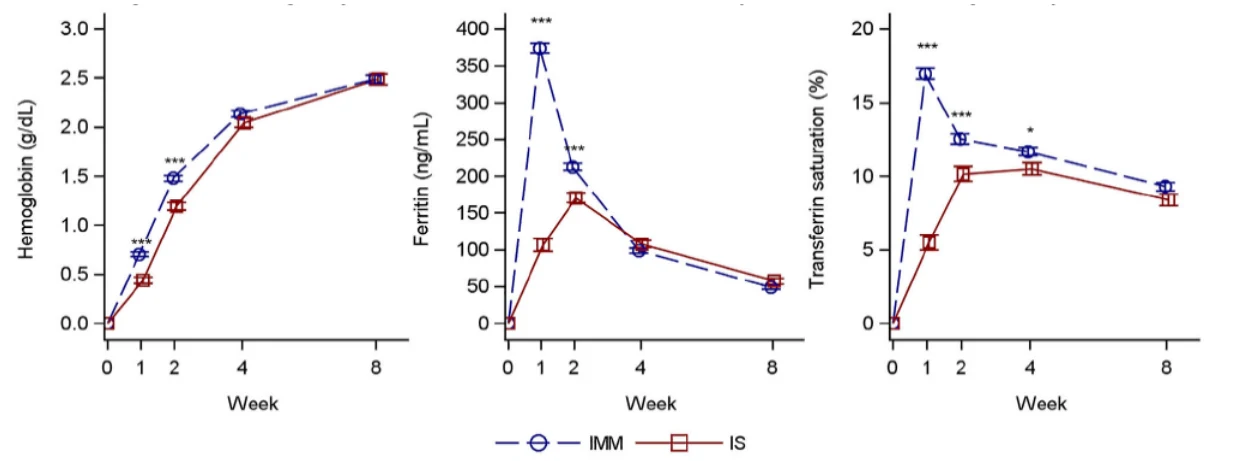
Hemoglobin, s-ferritin, and transferrin saturation over time by treatment group (intention to treat analysis set). Estimates (mean and SE) from a mixed model with repeated measures with strata, treatment and time as factors, treatment*time and baseline value*time interactions and baseline value as covariate. IMM, /ferric derisomaltose; IS, iron sucrose.
*P < .05
***P < .001
Iron Deficiency Anemia in Non-dialysis-dependent Chronic Kidney Disease (NDD-CKD) Patients
Study CKD-02
*Ganzoni formula:
Iron need = Body weight(A) x (Target Hb(E) – Actual Hb)(B) x 2.4(C) + depot iron (D)
[mg iron] [kg] [g/dL] [mg iron]
(A) It is recommended to use the patient’s ideal body weight for obese patients or pre-pregnancy weight for pregnant women. Ideal body weight may be calculated in a number of ways e.g. by calculating weight at BMI 25 i.e. ideal body weight = 25 * (height in m)2
(B) To convert Hb [mM] to Hb [g/dL] you should multiply Hb [mM] by factor 1.61145
(C) Factor 2.4 = 0.0034 x 0.07 x 10,000
0.0034: Iron content of haemoglobin is 0.34 %
0.07: Blood volume 70 mL/kg of body weight ≈ 7% of body weight
10,000: The conversion factor 1 g/dL = 10,000 mg/L
(D) For a person with a body weight above 35 kg, the iron stores are 500 mg or above. Iron stores of 500 mg are at the lower limit normal for small women. Some guidelines suggest using 10-15 mg iron /kg body weight and others 1000 mg iron as stores.
(E) Default Hb target is 13 g/dL in the Ganzoni formula.
| Trial Design | Phase III, 2:1 randomised, comparative, open-label, non-inferiority study |
|---|---|
| Diagnosis | NDD-CKD, Hb < 11 g/dL, TSAT < 20 %, ferritin < 200 ng/mL Not receiving ESA treatment Excluding patients with known intolerance to oral iron therapy. |
| Dosage, route of administration, duration | Iron need was calculated according to Ganzoni formula*. Patients treated with MONOFERRIC either received IV infusion (group A1) of maximum 1000 mg MONOFERRIC as single doses over 15 minutes; full iron replacement achieved by 1 or up to 2 doses at a weekly interval or IV bolus injections (group A2) of 500 mg MONOFERRIC administered over 2 minutes once weekly until full replacement dose was achieved. The maximum dosage per infusion was 1000 mg for patients with a weight > 45 kg, 750 mg for patients with a weight between 35.1 and 45 kg, and 500 mg for patients with a weight of 30-35 kg. The maximum dose per bolus injection was 500 mg. Patients who received iron sulphate (group B) were treated daily for 8 weeks with 200 mg. |
| Study patients (n) | 351 |
Table 6: Baseline Demographics and Laboratory Values – CKD-02
MONOFERRIC (n=233) | Iron Sulphate (n=118) | |
|---|---|---|
Mean Age, years (±SD) Range | 58 (15.54) 22; 93 | 58 (16.34) 20; 90 |
| Gender (M/F %) | 39/61 | 54/46 |
Ethnic Origin (%) Caucasian Asian Other | 37 - 60 3 | 40 1 54 5 |
| Mean Hb, g/dL (±SD) | 9.67 (1.13) | 9.64 (1.05) |
| Mean s-ferritin, µg/L (±SD) | 94.99 (112.79) | 98.81 (90.19) |
| Mean TSAT, % (±SD) | 18.10 (27.45) | 15.51 (7.76) |
The primary endpoint analysis (change in Hb from baseline to week 4) showed that MONOFERRIC was non-inferior to iron sulphate in its ability to increase Hb from baseline to week 4 in both the FAS and PP data sets (p<0.0001). The non-inferiority margin was set as -0.5 g/dL. As non-inferiority was proven and the 95 % CI lay entirely above 0, the predetermined test for superiority was performed. MONOFERRIC showed a significantly higher increase in Hb concentration from baseline to week 4 compared to iron sulfate (FAS: p=0.039; PP: p=0.047; Table 7).
Table 7: Results for the Primary Endpoint and Clinically Relevant Secondary Endpoints CKD-02
| MONOFERRIC | Iron Sulfate | |||||||||
|---|---|---|---|---|---|---|---|---|---|---|
| Primary Endpoint | ||||||||||
| Change in Hb (g/dL) from baseline to week 4 (FAS) | ||||||||||
| Mean (±SD) | 0.57 (0.94) | 0.35 (0.96) | ||||||||
| Difference estimate [95% CI] | 0.2216 [0.012: 0.431] | |||||||||
| Non-inferiority p-value(1) | ˂0.0001 | |||||||||
| Testing of superiority p-value(2,3) | 0.0385 | |||||||||
| Secondary Endpoints | ||||||||||
| Number of patients who had a change in Hb concentration ≥ 1.0 g/dL from baseline to week 4 (FAS) | ||||||||||
| n (%) | 62 (29.7) | 28 (25.9) | ||||||||
| p-value(4) | 0.3944 | |||||||||
| Change in Hb (g/dL) from baseline to week 8 (FAS) | ||||||||||
| Mean (±SD) g/dL | 0.92 (1.19) | 0.45 (1.04) | ||||||||
| Difference estimate [95% CI] | 0.4450 [0.199: 0.691] | |||||||||
| p-value(2,3) | 0.0004 | |||||||||
| Change in concentrations of s-ferritin (μmol/L) from baseline to week 4 (FAS) | ||||||||||
| Mean (±SD) | 280.96 (175.51) | 58.44 (337.50) | ||||||||
| Difference estimate [95% CI] | 235.2231 [169.697: 300.749] | |||||||||
| p-value(2,3) | < 0.0001 | |||||||||
| Change in TSAT (%) from baseline to week 4 (FAS) | ||||||||||
| Mean (±SD) | 6.99 (29.40) | 4.97 (8.87) | ||||||||
| Difference estimate [95% CI] | 4.7666 [2.452: 7.082] | |||||||||
| p-value(2,3) | < 0.0001 | |||||||||
1 Non-inferiority was tested by shifting the distribution of difference estimate by a non-inferiority margin -0.5 and testing the equality between treatment groups by deriving p-value. Similar result was obtained in the PP analysis set (p<0.0001).
2 P-value for infusion, bolus MONOFERRIC group indicates the significance of treatment differences.
3 MMRM included treatment, country and stratum (past treatment with parenteral iron (Yes/No) and current eGFR be-tween 15-45 mL/min or between 46-59 mL/min) as factors and baseline value as covariates using PROC Mixed procedure of SAS software.
4 P-value was calculated by logistic regression with treatment and stratum as factors and baseline values as covariates using PROC LOGISTIC procedure of SAS.
Study CKD-04
Table 8: Baseline Demographics and Laboratory Values – CKD-04
The co-primary endpoints were incidence of adjudicated serious or severe hypersensitivity reactions starting during or after the first dose of randomized treatment and change in Hb from baseline to week 8.
For the co-primary efficacy endpoint, MONOFERRIC was non-inferior to iron sucrose in its ability to increase mean Hb concentration from baseline to week 8 (from 9.66 to 10.92 g/dL in the MONOFERRIC group and from 9.71 to 10.89 g/dL in the iron sucrose group). Treatment with MONOFERRIC led to a faster increase in hemoglobin from baseline to weeks 1, 2 (p<0.0001), and 4 (p=0.02) compared to iron sucrose (Graph 2). Clinically relevant secondary efficacy endpoints showed that the incidence of achievement of serum ferritin ≥100 ng/mL and TSAT of 20–50 % at any time from weeks 1 to 8 was significantly higher in the MONOFERRIC group compared with the iron sucrose group (p<0.0001).
For the co-primary safety endpoint, serious or severe hypersensitivity reactions occurred in 3/1019 (0.3%; 95% CI 0.06; 0.86) patients in the MONOFERRIC group. As the upper bound of the 95% CI was <3%, the co-primary safety endpoint was considered met. No serious or severe hypersensitivity reactions occurred in the iron sucrose group (0%; 95% CI 0.00; 0.73).
| Trial Design | Phase III, 2:1 randomised, multicentre, open-label, comparative, non-inferiority study |
|---|---|
| Diagnosis |
|
| Dosage, route of administration, duration | MONOFERRIC IV infusion was administered as a single fixed dose of 1000 mg infused over 20 minutes at baseline. Iron sucrose administered as 200 mg IV injections according to label and repeated up to five times for a cumulative dose of 1000 mg. The mean (SD) dose of MONOFERRIC was 993 (71) mg and 899 (198) mg dose for iron sucrose. Duration – 8 weeks from baseline |
| Study patients (n) | 1538 |
MONOFERRIC (n=1027) | Iron Sucrose (n=511) | |
|---|---|---|
Mean Age, years (±SD) Median | 68.3 (12.3) 69.0 | 69.3 (12.3) 71.0 |
| Gender (M/F %) | 38/62 | 36/64 |
Ethnic Origin (%) Caucasian Asian Other | 71 26 2 1 | 73 23 2 2 |
| Mean Hb, g/dL (±SD) | 9.66 (1.14) | 9.71 (1.12) |
| Mean s-ferritin, ng/L (±SD) | 82.4 (84.0) | 86.2 (80.2) |
| Mean TSAT, % (±SD) | 18.51 (29.23) | 17.44 (11.78) |
Graph 2: Results for Clinically Relevant Secondary Endpoints in ITT–CKD-04
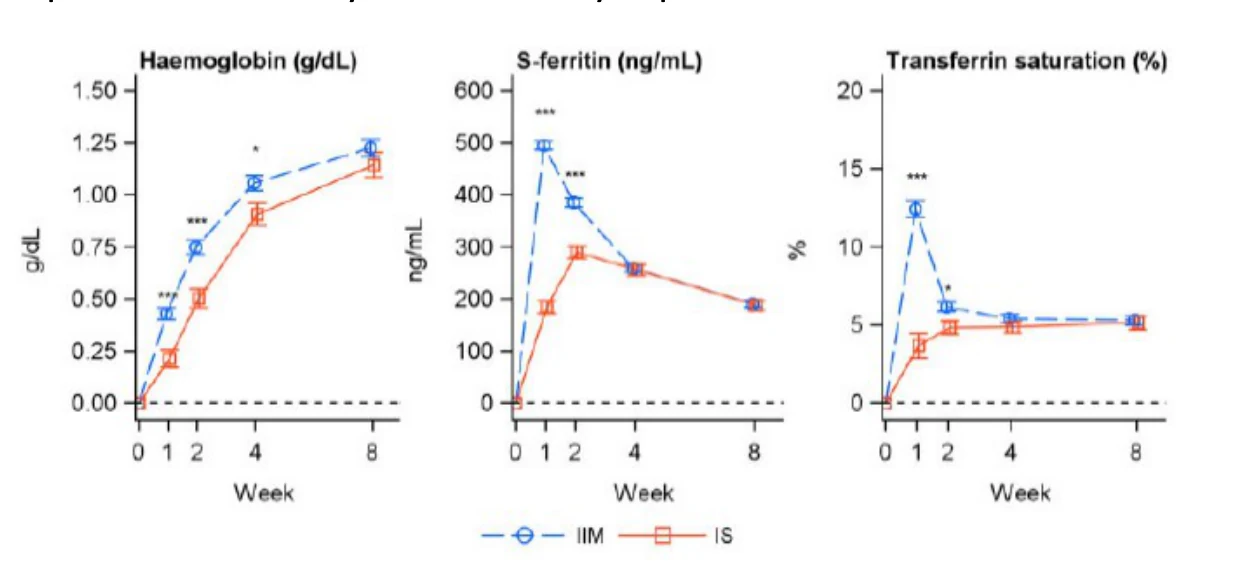
Change in Hb (g/dL), serum ferritin (ng/mL) and TSAT (%) from baseline to Weeks 1, 2, 4 and 8 (intention-to-treat analysis set). Estimated (LS mean and SE) from a mixed model with repeated measures with treatment, strata and time as factors, treatment x time and baseline value x time interactions and baseline value as covariate.
*p < 0.05
***p < 0.001
Iron Deficiency Anemia in Hemodialysis-dependent Chronic Kidney Disease Patients
Study CKD-03
| Trial Design | Phase III, 2:1 randomised, comparative, open-label, non-inferiority study |
|---|---|
| Diagnosis | CKD-5D in haemodialysis Hb between 9.5 and 12.5 g/dL (both values included), TSAT < 35 %, ferritin < 800 ng/mL Patients receiving ESA treatment were in stable dosing |
| Dosage, route of administration, duration | All patients received a cumulative dose of 500 mg iron. Treatment Groups: A. MONOFERRIC: administered as a single intravenous bolus injection of 500 mg over 2 minutes at baseline or administered in 500 mg fractionated doses of 100 mg at baseline and 200 mg each at weeks 2 and 4 as intravenous bolus injections over 2 minutes. B. Iron sucrose: administered as 500 mg fractionated doses of 100 mg at baseline and 200 mg each at weeks 2 and 4 as intravenous bolus injections |
| Study patients (n) | 351 |
Table 9: Baseline Demographics and Laboratory Values – CKD-03
MONOFERRIC N= 234 | Iron Sucrose N=117 | ||||||||
|---|---|---|---|---|---|---|---|---|---|
Mean Age, years (±SD) Range | 60.13 (16.21) 18; 89 | 59.50 (15.39) 26; 84 | |||||||
| Gender (M/F %) | 68/32 | 63/37 | |||||||
| Ethnic Origin (%) | |||||||||
| Caucasian: | 66 | 63 | |||||||
| 6 | 4 | ||||||||
| Asian | 27 | 32 | |||||||
| Other | 1 | 1 | |||||||
| Mean Hb, g/dL (±SD) | 11.20 (0.83) | 11.08 (0.93) | |||||||
| Mean s-ferritin, µg/L (±SD) | 350.88 (186.17) | 357.74 (192.98) | |||||||
| Mean TSAT, % (±SD) | 22.20 (17.90) | 22.57 (8.49) | |||||||
The primary endpoint analysis (ability to maintain Hb between 9.5 and 12.5 g/dL) showed that the majority (> 82 %) of patients treated with either MONOFERRIC or iron sucrose were able to maintain Hb between 9.5 and 12.5 g/dL at week 6. The test for non-inferiority showed that MONOFERRIC was non-inferior to iron sucrose (FAS: p=0.0106; PP: p=0.0057) (Table 10. An analysis has been performed with a narrower Hb range of 10-12 g/dL. The proportion of responders was 63 % and 64 % in patients treated with MONOFERRIC or iron sucrose, respectively, with no statistically significant difference between the groups. Thus, this analysis shows similar response as the primary endpoint analysis.
Table 10: Results for the Primary Endpoint and Clinically Relevant Secondary Endpoints - CKD-03
| MONOFERRIC | Iron Sucrose | |||||||||||
|---|---|---|---|---|---|---|---|---|---|---|---|---|
| Primary Endpoint | ||||||||||||
| Proportion of patients who were able to maintain Hb between 9.5 and 12.5 g/dL (both values included) at week 6 (FAS) | ||||||||||||
| FAS (n, %) | 226 | 115 | ||||||||||
| Maintained | 187 (82.7) | 95 (82.6) | ||||||||||
| Not maintained | 39 (17.3) | 20 (17.4) | ||||||||||
| Risk difference [95% CI] | 1.0 [-7.4:9.4] | |||||||||||
| Non-inferiority p-value(1) | 0.0106 | |||||||||||
| Secondary Endpoints: | ||||||||||||
| Change in s-ferritin (μg/L) from Baseline to week 4 (FAS) | ||||||||||||
| Mean (±SD) | 128.04 (157.75) | 86.33 (126.79) | ||||||||||
| Difference estimate [95% CI] | 49.3393 [18.174:80.505] | |||||||||||
| p-value(2) | 0.0020 | |||||||||||
| Change in TSAT (%) from Baseline to week 4 (FAS) | ||||||||||||
| Mean (±SD) | 1.80 (19.26) | 2.85 (8.98) | ||||||||||
| Difference estimate [95% CI] | -0.9972 [-3.090:1.095] | |||||||||||
| p-value(2) | 0.3487 | |||||||||||
| Change in Reticulocytes from Baseline to week 1 (FAS) | ||||||||||||
| Mean (±SD) | 0.12 (0.42) | -0.02 (0.38) | ||||||||||
| Difference estimate [95% CI] | 0.1540 [0.066:0.242] | |||||||||||
| p-value(2) | 0.0006 | |||||||||||
1Adjusted risk difference, 95 % CI and p-value were calculated for treatment differences (MONOFERRIC - iron sucrose) using generalised linear model using the identity link function with treatment and stratum (s-ferritin (< 100 versus ≥ 100 ng/mL)) as factors and baseline value as covariate using PROC GENMOD procedure of SAS software. Similar results was obtained in the PP analysis set (p=0.0057).
2MMRM included treatment, visit, treatment*visit interactions, country and stratum (s-ferritin [< 100 versus ≥ 100 ng/mL]) as factors and baseline values as covariates using PROC Mixed procedure of SAS software.
15 MICROBIOLOGY
No microbiological information is required for this drug product.
16 NON-CLINICAL TOXICOLOGY
General Toxicology:
Single-Dose Toxicity
In single-dose intravenous toxicity studies, the minimum lethal dose in male mice was 125 mg Fe/kg (HED =10 mg/kg, the maximum recommended weekly clinical dose is 20 mg/kg), and the no observed adverse effects level (NOAEL) was determined to be 80 mg Fe/kg in male and female mice corresponding to a HED of 6.5 mg/kg.
In male and female rats, ferric derisomaltose administered at 80 mg/kg produced a decrease in urinary output, a decrease in urinary Na+ output and an increase in protein excretion. No signs of toxicity were observed at doses up to 250 mg Fe/kg (HED= 42 mg/kg). Treatment related clinical signs of reddish-brown urine, swollen dark feet, swollen face and muzzle, dark colored skin, dark colored mouth and rough coat were observed at single doses of 500 and 1000 mg Fe/kg between days 0-4. No adverse histopathological changes were observed in the kidneys, liver, and heart of rats receiving 142 mg Fe/kg, but accumulation of iron pigment was noted in tubular epithelial cells and in interstitial macrophages in the kidneys, and in macrophages of medullary sinuses of the lymph nodes. The acute intravenous approximate lethal dose in rats was determined to be > 1000 mg/kg (HED of > 169 mg/kg).
Repeat Dose Toxicity
Repeat-dose toxicity studies were conducted in rats and beagle dogs for a duration of up to 4 weeks.
In a dose-range finding study, male rats were administered doses up to 250 mg Fe/kg, once on days 0, 2, 5, 7, and 9. In the main definitive study, male and female rats received up to 80 mg Fe/kg, 3 times per week for 4 weeks.
In rats, general signs of systemic toxicity (body weight loss) were evident at all dose levels except for effects on the male reproductive system. Degeneration of the seminiferous epithelium, degenerate germ cells in the epididymides, and atrophy of the prostate were only observed in the 80 mg Fe/kg dose group (HED=14 mg/kg) of the 4-week toxicity study. Due to the lack of a recovery group in this study, it is not known whether these degenerative changes are reversible following a non-dosing period.
Beagle dogs were administered doses up to 80 mg Fe/kg (HED=43 mg/kg), 3 times per week for 4 weeks. No toxicologically relevant clinical signs of toxicity were seen in dogs administered 5, 20, and 80 mg/kg 3 times a week for 4 weeks. In the dose tolerance study where dogs received 50 mg Fe/kg on days 0, 2, 5, 7, 9 and 12, clinical signs of toxicity were seen in dogs on Day 9 at cumulative doses over 250 mg/kg.
In the dose range-finding study, dose-dependent body weight losses/decreases in body weight gains were observed in rats, although body weight gains recovered during the 7-day post-treatment period. No treatment-related effects on mean body weights were observed in dogs. In both species, a dose-dependent increase in tissue discoloration was noted at macroscopic and microscopic examinations and hyperplasia and brown pigment in macrophages were seen in the Kuppfer cells in all treated groups. Increases in the liver weights were seen in both species at 80 mg Fe/kg.
In laboratory investigations, a statistically significant increase in the levels of alanine aminotransferase, aspartate aminotransferase, cholesterol, and globulin, and a decrease in the albumin to globulin (A/G)
ratio were seen in male rats, and a statistically significant increase in the levels of alanine aminotransferase, alkaline phosphatase, cholesterol, total protein, urea nitrogen, and globulin, and a decrease in the A/G ratio were seen in female rats. Similarly, in dogs, alkaline phosphatase, aspartate aminotransferase, γ-glutamyl-transferase, and triglycerides were elevated in males at 80 mg Fe/kg, while albumin was decreased in females at 80 mg Fe/kg.
Carcinogenicity:
Carcinogenicity studies have not been conducted.
Genotoxicity:
No evidence of mutagenic activity was found in an in vitro bacterial reverse mutation assay, an in vitro chromosomal aberrations test and an in vivo mouse micronucleus assay.
Reproductive and Developmental Toxicology:
In a fertility and embryo-fetal development study in rats, ferric derisomaltose had no effect on male or female fertility or general reproductive functions in rats at doses up to 19 mg Fe/kg/day (3 times the maximum recommended human (2000 mg in a 70 kg human)) exposure from a single course of MONOFERRIC) in males administered for 28 days prior to mating and up to 32 mg Fe/kg/day (2.5 times the maximum recommended human exposure from a single course of MONOFERRIC) in females dosed for 14 days prior to mating. Dosing through gestation Day 17 in pregnant rats resulted in a significant increase in the incidence of skeletal developmental delays (bent scapula and/or bent rib(s)) at 11 and 32 mg Fe/kg/day (2 and 6 times the maximum recommended human exposure from a single course of MONOFERRIC).
In a repeat-dose toxicity study in rats given ferric derisomaltose at an intravenous dose of 80 mg Fe/kg (5 times the maximum recommended human exposure from a single course of MONOFERRIC), 3 times per week for 4 weeks, degeneration of the seminiferous epithelium, degenerate germ cells in the epididymides, and atrophy of the prostate were observed. Due to the lack of a recovery group in this study, it is not known whether these degenerative changes are reversible following a non-dosing period.
Administration of ferric derisomaltose to pregnant rabbits did not result in maternal effects at doses of 11 and 25 mg Fe/kg/day for 14 days. Maternal toxicity was limited to the 43 mg Fe/kg/day dose group (7 times the maximum recommended human exposure from a single course of MONOFERRIC, respectively), as evidenced by increased mortality, abortion, and/or premature delivery for several females at this dose group. The 43 mg Fe/kg/day dose group was associated with a higher mean litter proportion of post-implantation loss, a corresponding lower mean number and litter proportion of viable fetuses, and lower mean fetal weights. Intrauterine growth, survival, external, visceral and skeletal fetal morphology were unaffected at 11 mg Fe/kg/day the pregnant rabbits given ferric derisomaltose. Fetal malformations (domed head, narrow pectoral region, carpal and/or tarsal flexure, cleft palate, microglossia, narrow pelvic region, high-arched palate, hydrocephaly, small brain and absent cartilaginous bands on the trachea) were noted in the 25 and 43 mg Fe/kg/day groups (4 and 7 times the maximum recommended human exposure from a single course of MONOFERRIC, respectively), and fetal developmental variations were noted at 43 mg Fe/kg/day.