


Product Monograph - Mutamycin Inj 5mg/Vial
ACTIONS AND CLINICAL PHARMACOLOGY
Mitomycin was investigated at first as an antibiotic in Japan. It was then found to be active as an antineoplastic agent. It selectively inhibits the synthesis of deoxyribonucleic acid (DNA). The exact point of mitomycin attachment to DNA remains unknown. At high concentrations of the drug, cellular RNA and protein synthesis are also suppressed.
Mitomycin is rapidly cleared from the plasma after intravenous administration with a biphasic plasma elimination curve. Mitomycin is widely distributed but does not appear to cross the blood brain barrier.
After intravenous injection of 30, 20 or 10 mg of mitomycin, the maximal serum concentrations were 2.4,
1.7 and 0.52 :g/mL respectively. Serum half-life after a 30 mg bolus injection is 17 minutes. Clearance is effected primarily by metabolism in the liver, but metabolism occurs in other tissues as well. In general, the smaller the dose, the more rapidly blood levels of mitomycin decreased.
Approximately 10% of a dose of mitomycin is excreted unchanged in the urine. Since metabolic pathways are saturated at relatively low doses, the percent of a dose excreted in urine increases with increasing doses.
In children, excretion of intravenously administered mitomycin is similar.
Mitomycin is not appreciably absorbed from the urinary bladder following intravesical administration. Serial plasma samples from 55 patients treated with doses of 20-40 mg of mitomycin by intravesical instillation were assayed. There was no mitomycin detectable (assay limit 10-100 ng/mL) in any plasma samples collected during and 30 minutes post-therapy at any dose.
INDICATIONS AND CLINICAL USES
MUTAMYCIN (mitomycin) is indicated in the palliative treatment as an adjunct to surgery, radiation, or chemotherapy for adenocarcinoma of the stomach and colon.
MUTAMYCIN as a single agent is indicated as topical therapy for superficial (no invasion beyond the lamina propria) transitional cell carcinoma of the urinary bladder. Efficacy has been demonstrated both in patients who have had no prior intravesical chemotherapy and in those who have failed such therapy with Thiotepa or other antineoplastic agents.
CONTRAINDICATIONS
MUTAMYCIN (mitomycin) is contraindicated in patients who have demonstrated hypersensitivity or an idiosyncratic reaction to it, or any component of its formulation, in the past.
MUTAMYCIN is contraindicated in patients with thrombocytopenia, leukopenia, coagulation disorder, or an increased bleeding tendency due to other causes.
MUTAMYCIN is contraindicated for intravesical administration in patients who have demonstrated a hypersensitive or idiosyncratic reaction to it in the past.
WARNINGS
It is recommended that MUTAMYCIN (mitomycin) be administered under the supervision of a qualified physician experienced in the use of cancer chemotherapeutic agents. Since facilities for necessary laboratory studies must be available, hospitalization of patients is recommended.
MUTAMYCIN should not be administered to any patient with a white blood cell count below 4,000 mm3 or a platelet count below 150,000 mm3, or those with potentially serious infections.
Bone marrow depression, notably thrombocytopenia and leukopenia is the most severe toxicity (see "Adverse
Reactions"). Thrombocytopenia may contribute to hemorrhage and leukopenia to overwhelming infection in an already compromised, poor risk patient and may result in death.
In the treatment of each patient, the physician must weigh carefully the possibility of achieving therapeutic benefit versus the risk of toxicity. Studies have shown that mitomycin is carcinogenic in animals.
Use in Pregnancy
Safe use of MUTAMYCIN in pregnant women has not been established. MUTAMYCIN has known teratogenic properties in animals, therefore, the benefits derived from the use of MUTAMYCIN must be weighed against the hazards involved.
Nursing Women
It is not known if mitomycin is excreted in human milk. It is recommended that women receiving mitomycin not breast feed because of the potential for serious adverse reactions from mitomycin in nursing infants.
PRECAUTIONS
MUTAMYCIN (mitomycin) should be administered, preferably, to patients who are hospitalized.
It should be used with extreme caution in patients with significant impairment of renal function.
Since MUTAMYCIN has a high incidence of bone marrow depression, particularly thrombocytopenia and leukopenia, dose adjustment according to nadir count may be required. The following studies should be obtained repeatedly during therapy and for at least eight weeks following therapy: platelet count, prothrombin time, bleeding time, white blood count and differential. The persistence of thrombocytopenia below 150,000/mm3 or a significant prolongation of prothrombin time or bleeding time or a WBC below
4,000/mm3 is an indication for the termination of therapy.
Hemolytic Uremic Syndrome (HUS), a serious complication of chemotherapy, consisting primarily of microangiopathic hemolytic anemia, thrombocytopenia and irreversible renal failure has been reported in patients receiving MUTAMYCIN. The syndrome may occur at any time during systemic therapy with
MUTAMYCIN as a single agent or in combination with other cytotoxic drugs, however, most cases occur at doses $ 60 mg of MUTAMYCIN. Blood product transfusion may exacerbate the symptoms associated with this syndrome. The incidence of the syndrome has not been defined. (See ADVERSE REACTIONS)
Patients should be advised of the potential toxicity of this drug, particularly bone marrow depression. A low incidence of septicemic deaths, as a result of leukopenia attributable to the drug, have been reported. Patients should be instructed of the relevant symptomatology and advised of the importance of promptly notifying their physicians of the development of these symptoms.
Patients receiving MUTAMYCIN should be observed for evidence of renal toxicity. MUTAMYCIN should not be given to patients with a serum creatinine greater than 1.7 mg/dL (150 :mol/L).
MUTAMYCIN-associated pulmonary events have occurred infrequently but can be severe and life threatening. Cases have been reported with both single-agent therapy and combination chemotherapy.
Dyspnea and nonproductive cough are the usual presenting symptoms. Radiographic evidence of interstitial infiltrates may or may not be present. If other etiologies have been eliminated, a diagnosis of
MUTAMYCIN-related pulmonary toxicity may be made. Corticosteroids have been employed in treatment, but their therapeutic value has not been determined.
Signs and symptoms of pneumonitis associated with MUTAMYCIN may be reversed if appropriate therapy is instituted early. The use of MUTAMYCIN should be discontinued. Corticosteroids have been reported by several authors to expedite symptomatic relief.
Acute shortness of breath and severe bronchospasm have been reported following the administration of vinca alkaloids in patients who had previously or simultaneously received MUTAMYCIN. The onset of this acute respiratory distress has occurred within minutes to hours after the vinca alkaloid injection. The total number of doses for each drug has varied considerably. Bronchodilators, corticosteroids and/or oxygen have produced symptomatic relief.
A few cases of adult respiratory distress syndrome have been reported in patients receiving MUTAMYCIN in combination with other chemotherapeutic agents who were being maintained perioperatively at Fi02 concentrations greater than 50%. Therefore, caution should be exercised, and only enough oxygen to provide adequate arterial saturation should be used since oxygen itself can be toxic to the lungs. Careful attention should be paid to fluid balance and overhydration should be avoided.
Reports of bladder fibrosis/contraction following intravesicular administration, which in rare cases have required cystectomy, have been received postmarketing.
ADVERSE REACTIONS
Hematologic
The most serious and most common toxicity of MUTAMYCIN (mitomycin) is bone marrow suppression.
Thrombocytopenia and/or leukopenia may occur anytime within eight weeks after initiation of therapy, with an average time of 4 weeks. The return to normal counts after cessation of therapy was within 10 weeks. In a recent study, at a dose of 20 mg/m² every six to eight weeks, by itself or in combination with 5-fluorouracil, leukopenia occurred in 74 of 94 patients, with 10 being in the life-threatening category and thrombocytopenia occurring in 68 of 94 patients, with 18 being in the life-threatening category. In a previous study, at doses of 0.5 mg/kg/day for five days and repeating once monthly, or 0.25 mg/kg every two weeks, leukopenia and/or thrombocytopenia occurred in 605 of 937 patients. About 25% of the leukopenic or thrombocytopenic episodes did not resolve. MUTAMYCIN produces cumulative myelosuppression.
Skin and Mucus Membrane
Dermatitis occurred in approximately 10% of the patients treated. It was commonly manifested as palmar rash with desquamation, generally appearing on the extremities and less often on the trunk, and also as genital rash. Topical steroids have been employed, but their therapeutic value has not been determined.
Cellulitis at the injection site has been reported and is occasionally severe. Stomatitis and alopecia also occur frequently. Rashes are rarely reported. The most important dermatological event is necrosis and consequent sloughing of tissue which results if the drug is extravasated during injection.
Extravasation may occur with or without an accompanying stinging or burning sensation and even if there is adequate blood return when the injection needle is aspirated. There have been reports of delayed erythema and/or ulceration occurring either at or distant from the injection site, weeks to months after MUTAMYCIN, even when no obvious evidence of extravasation was observed during administration. Skin grafting has been required in some of the cases.
Pulmonary Toxicity
Refer to section on pulmonary toxicity in PRECAUTIONS.
Renal
A small number of patients in clinical trials demonstrated a significant rise in BUN from a base-line pre-therapy. There appeared to be no correlation between total dose administered or duration of therapy and renal toxicity. Seventy-five percent of the patients with a definite renal toxicity had evidence of metastatic disease.
The data, to date, are inconclusive as far as a direct relationship of MUTAMYCIN (mitomycin) to renal toxicity.
Hemolytic Uremic Syndrome (HUS)
This serious complication of chemotherapy consisting of microangiopathic hemolytic anemia (hematocrit #
25%), thrombocytopenia (# 100,000/mm3), and irreversible renal failure (serum creatinine $1.6 mg/dL or
$140 :mol/L) has been reported in patients receiving systemic MUTAMYCIN. Most of these patients received long-term therapy (6 to 12 months) with MUTAMYCIN in combination with fluorouracil and doxorubicin; however, some patients received MUTAMYCIN in combination with other drugs or were treated for less than six months. Microangiopathic hemolysis with fragmented red blood cells seen on peripheral blood smears has occurred in 98% of the patients with the syndrome. Other less frequent complications of the syndrome may include pulmonary edema (65%), neurologic abnormalities (16%), and hypertension. Exacerbation of the symptoms associated with HUS has been reported in some patients receiving blood product transfusions. The incidence of the syndrome has not been defined. A high mortality rate (52%) has been associated with this syndrome (See PRECAUTIONS).
The syndrome may occur at any time during systemic therapy with MUTAMYCIN as a single agent or in combination with other cytotoxic drugs. Less frequently, HUS has also been reported in patients receiving combinations of cytotoxic drugs not including MUTAMYCIN. Of 83 patients studied, 72 developed the syndrome at total doses exceeding 60 mg of MUTAMYCIN. Consequently, patients receiving $ 60 mg of
MUTAMYCIN should be monitored closely for unexplained anemia with fragmented cells on peripheral blood smear, thrombocytopenia, and decreased renal function.
Cardiac
Congestive heart failure, often responding to conventional therapy, has been reported rarely. Almost all patients who experienced this side effect had received prior doxorubicin therapy. Acute Adverse Effects
Fever, hemolytic anemia, anorexia, nausea, vomiting, stomatitis, hypoglycemia and mucositis have occurred.
Other Adverse Effects
Other Adverse Effects that have been reported during MUTAMYCIN therapy have been: headache, blurring of vision, confusion, diarrhea, drowsiness, syncope, fatigue, asthenia, malaise, weakness, edema, thrombophlebitis, hematemesis, weight loss, ataxia and pain. These do not appear to be dose-related and it was unclear whether they were drug-related or due to the primary or metastatic disease process.
Intravesical Administration
Genitourinary irritation following intravesical administration indicated dysuria, cystitis, nocturia and increased frequency of micturition, hematuria and other symptoms of local irritation. Approximately 25% of the patients treated experienced irritative symptoms, but not all were unequivocally drug-related and may have been symptoms of the disease. Reports of bladder fibrosis/contraction, which in rare cases have required cystectomy, have been received postmarketing (see also WARNINGS/PRECAUTIONS).
SYMPTOMS AND TREATMENT OF OVERDOSAGE
No specific antidote for MUTAMYCIN (mitomycin) is known. Management of overdosage would include general supportive measures to sustain the patient through any period of toxicity that might occur.
DOSAGE AND ADMINISTRATION
MUTAMYCIN (mitomycin) should be given with care to avoid extravasation of the compound into the tissue. If extravasation occurs, cellulitis, ulceration and sloughing may result.
To reconstitute a vial of MUTAMYCIN, add Sterile Water for Injection as listed in the Reconstitution Table below:
| Vial Size | Diluent Added to Vial (mL) | Approximate Available Volume (mL) | Approximate Concentration (mg/mL) |
| 5 mg | 10 | 9.5 | 0.5 |
| 20 mg | 40 | 39.0 | 0.5 |
Shake well until dissolved. If the product does not dissolve immediately, shake under warm tap water for approximately two (2) minutes until a solution is obtained.
Intravenous Use
After full hematological recovery from any previous chemotherapy, either of the following Dosage Schedules may be used at 6 to 8 week intervals. Because of cumulative myelosuppression, patients should be re-evaluated after each course of MUTAMYCIN and the dose reduced if the patient has experienced any toxicities (see Guide to Dosage Adjustment). Doses greater than 20 mg/m2 do not demonstrate increased effectiveness and are more toxic than lower doses.
(1) 20 mg/m2 intravenously as a single dose via a functioning intravenous catheter.
(2) 2 mg/m2/day intravenously for 5 days. After a drug free interval of 2 days, 2 mg/m2/day for 5 days, thus making the total initial dose of 20 mg/m2 given over 10 days.
Intravesicle Use
20 - 40 mg intravesically at a concentration of 1 mg/mL in sterile water once per week for 8 weeks. Patients are advised to abstain from liquids for 12 hours prior to therapy. The patient is catheterized, bladder drained and MUTAMYCIN instilled. The solution should be retained for 2 hours. If desired, the patient may rotate positions every 15 minutes, for maximum area-contact.
Guide to Dosage Adjustment
The following schedule is suggested:
| Nadir after Prior Dose | Percentage of Prior Dose to be Given (%) | |
Leukocytes (mm3) | Platelets (mm3) | |
| > 4000 | > 100,000 | 100 |
| 3000 - 3999 | 75,000 - 99,999 | 100 |
| 2000 - 2999 | 25,000 - 74,999 | 70 |
| < 2000 | < 25,000 | 50 |
No repeat dosage should be given until leukocyte count has returned to 3000 and platelet count to
75,000/mm3.
When MUTAMYCIN is used in combination with other myelosuppressive agents, the doses should be adjusted accordingly. If the disease continues to progress after two courses of MUTAMYCIN, the drug should be stopped since chances of response are minimal.
PHARMACEUTICAL INFORMATION
CHEMISTRY
Trade Name: Mutamycin
Proper Name: Mitomycin
Chemical Name: 6-Amino-1, 1", 2, 8, 8$-hexahydro-8-(hydroxymethyl)-8"-methyoxy-5-methylaziridino (2',3': 3,4) pyrrolo(1,2-") indole-4, 7-dione carbamate (ester).
Structural Formula: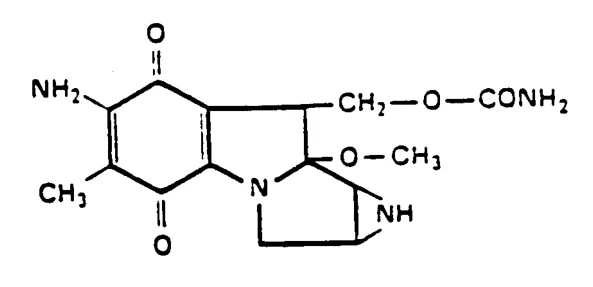
Molecular Formula: C15H18N4O5
Molecular Weight: 334.34
Description: MUTAMYCIN (mitomycin) is an antibiotic isolated from the broth of Streptomyces caespitosus which has been shown to have antitumor activity. It has a melting point of $ 260°C and is soluble in water and organic solvents. It has a pH of 6.0 - 8.0 in water.
Composition:
MUTAMYCIN vials contain mitomycin and mannitol as sterile lyophilized powder.
5 mg vials - mitomycin 5 mg and mannitol 10 mg
20 mg vials - mitomycin 20 mg and mannitol 40 mg
RECONSTITUTION
Solution for Reconstitution: Sterile Water for Injection
Reconstitution Table
| Vial size | Diluent Added to Vial (mL) | Approximate Available Volume (mL) | Approximate Concentration (mL) |
| 5 mg | 10 | 9.5 | 0.5 |
| 20 mg | 40 | 39.0 | 0.5 |
Shake well until dissolved. If the product does not dissolve immediately, shake under warm tap water for approximately two (2) minutes until a solution is obtained.
STABILITY
- 1. Store MUTAMYCIN at room temperature (15° to 30°C) and protect from light.
- 2. When reconstituted with Sterile Water for Injection to a concentration of 0.5 mg/mL, MUTAMYCIN is stable for 14 days when refrigerated (2° to 8°C), or for 7 days at room temperature (15° to 30°C). Protect from light.
- 3. When reconstituted with Sterile Water for Injection to a concentration of 1 mg/mL, MUTAMYCIN is stable for 7 days at room temperature (25°C). If undissolved particles appear after reconstitution, warm the vial slightly with shaking. Solutions of MUTAMYCIN at a concentration of 1 mg/mL, should not be stored under refrigeration since precipitation may occur.
- 4. When diluted in various intravenous fluids at room temperature (15° to 30°C), to a concentration of 20 to 40 :g/mL, MUTAMYCIN is stable as follows:
| IV Fluid | Stability (Hours) |
| 5% Dextrose Injection | 3 |
| 0.9% Sodium Chloride Injection | 12 |
| Sodium Lactate Injection | 24 |
- 5.
The combination of MUTAMYCIN (5 to 15 mg) and heparin (1000 to 10,000 units) in 30 mL of 0.9%
Sodium Chloride Injection is stable for 48 hours at room temperature (15° to 30°C).
HANDLING AND DISPOSAL
- 1.
Preparation of MUTAMYCIN should be done in a vertical laminar flow hood (Biological Safety Cabinet -
Class II).
- 2. Personnel preparing MUTAMYCIN should wear PVC gloves, safety glasses, disposable gowns and masks.
- 3. All needles, syringes, vials and other materials which have come in contact with MUTAMYCIN should be segregated and incinerated at 1000°C or more. Sealed containers may explode sealed. Intact vials should be returned to the Manufacturer for destruction. Proper precautions should be taken in packaging these materials for transport.
- 4.
Personnel regularly involved in the preparation and handling of MUTAMYCIN should have bi-annual blood examinations.
DOSAGE FORMS
Availability
MUTAMYCIN (mitomycin) is available as sterile lyophylized powder with mannitol in the following sizes:
5 mg vials
20 mg vials
Storage
MUTAMYCIN vials should be stored at room temperature (15° to 30°C) and protected from light.
PHARMACOLOGY
MUTAMYCIN (mitomycin) disappears rapidly from the plasma and there is no evidence of specific tissue localization.
In dogs, after intravenous injection, MUTAMYCIN appeared in the urine within five to six minutes. Eighteen to twenty-nine percent is recovered within one hour. Simultaneous creatinine clearance studies indicate that excretion is primarily by glomerular filtration.
In children given intravenous doses, the urinary recovery was five to 20% within one hour and was essentially complete in two hours.
TOXICOLOGY
Acute Toxicity
| Species | Route | Number of Successive Daily Doses | LD50 (mg/kg/day) |
| Mice | Intraperitoneal | 1 | 8.5 |
| Mice | Intraperitoneal | 5 | 2.3 |
| Mice | Intravenous | 1 | 7.83 |
| Rats | Intraperitoneal | 1 | 2.5 |
| Rats | Intraperitoneal | 5 | 1.0 |
| Rats | Intravenous | 1 | 3.41 |
| Dogs | Intravenous | 1 | 1.25 |
| Dogs | Intravenous | 10 | 0.125 |
Repeated dose toxicity in monkeys
No pharmacotoxic signs were observed following intravenous injections of 0.2 or 0.4 mg/kg/day given for
10 consecutive days.
At higher dosage levels (up to 3.2 mg/kg) dose-related pharmacologic signs included moderate to marked anorexia, soft stools, diarrhea, decreased activity, depression and weight losses. An increase in BUN was noted and on autopsy, damage to renal tubules and the hematopoietic tissue was found.
The toxicity of MUTAMYCIN (mitomycin) in five species studied is fairly uniform. Moreover, the constancy of the total dose required to produce lethal effects has been suggested in the toxicity studies. The
LD50 as a single intravenous dose was about the same as the total dose in a ten-day schedule.
Clinical signs of intoxication in animals were intestinal and hematopoietic disturbances, hyperthermia non-related to agranulocytosis, tissue hemorrhages and necrotizing nephrosis. Therefore, diarrhea and neutropenia may offer suitable warnings of impending severe intoxication in man.
BIBLIOGRAPHY
- 1. Crooke, S.T. and Bradner, W.T.: Mitomycin C: A review. Cancer. 1976; 3: 121-139
- 2. Moertel, C.G., Reitemeier, R.J., and Hahn, R.G.: Mitomycin C therapy in advanced gastrointestinal cancer. JAMA. 1968; 204:111-114
- 3. Martino, S., Baker, L.H., Pollard, R.J., Correa, J.J., and DeMattia, M.D.: Pulmonary toxicity of mitomycin. In, (Mitomycin C-Current Status and New Developments( (S.K. Carter & S.T. Crooke, eds) Academic Press, New York. 1979; 231-242.
- 4. Early, K., Elias, E.G., Mittelman, A., Albert, D., and Murphy, G.P.: Mitomycin C in the treatment of metastatic transitional cell carcinoma of urinary bladder. Cancer. 1973; 31: 1150-1153
- 5.
Liu, K., Mittelman, A., Sproul, E.E., and Elias, E.G.: Renal toxicity in man treated with mitomycin
C. 1971; 28: 1314-1320.
- 6.
Phillips, F.S., Schwartz, H.S. and Sternberg, S.S.: Pharmacology of Mitomycin C, I: Toxicity and
Pathologic Effects. Cancer Res. 1960; 20: 1354-1361.
- 7.
Mishina, T., Oda, K., Murata, S., Ooe, H., Mori, Y. and Takahashi, T.: Mitomycin C Bladder
Instillation Therapy for Bladder Tumors. J. Urol. 1975; 114: 217-219.
- 8. Fujita, H.: Comparative Studies on the Blood Level, Tissue Distribution, Excretion and Inactivation of Anticancer Drugs. Jpn. J. Clin. Oncol. 1971; 12: 151-162.
- 9.
Buzdar, A.U., Lega, S.S., Luna, M.A., Tashima, C.K., Hortobagyi, G.N., and Blumenschein, G.R.:
Pulmonary Toxicity of Mitomycin. Cancer 1980' 45: 236-244.
- 10.
Ginsberg, S.J. and Comis, R.L.: The Pulmonary Toxicity of Antineoplastic Agents. Semin Oncol;
1982 9 : 34-51
- 11.
Luedke K, McLaughlin TT, Daughaday C, Luedke S, Harrison B, Reed G, Martello O: Mitomycin
C and Vindesine Associated Pulmonary Toxicity With Variable Clinical Expression. Cancer 1985; 55: 542-545.
- 12. Kris MG, Pablo D, Gralla RJ, Burke MT, Prestifilippo J, Lewin D: Dyspnea Following Vinblastine or Vindesine Administration in Patients Receiving Mitomycin Plus Vinca Alkaloid Combination Therapy. Cancer Treat. Rep. 1984; 68(7-8): 1029-1031.
- 13.
Rao SX, Ramaswamy G, Levin M, McCravey JW: Fatal Acute Respiratory Failure After
Vinblastine-Mitomycin Therapy in Lung Carcinoma. Arch. Int. Med. 1985; 145: 1905-1907.
- 14.
Moertel CG, Reitemeier RJ, Hahn RG: Mitomycin C Therapy in Advanced Gastrointestinal Cancer.
JAMA 1968; 204(12): 1045-1048.
- 15.
Franklin R, Steiger Z, Vaishampayan G, Asfaw I, Rosenberg J, Loh J, Hoschner J, Miller P:
Combined Modality Therapy for Esophageal Squamous Cell Carcinoma. Cancer 1983; 51(6): 1062-1071.
- 16.
Unpublished Confidential Data, "Cancer Associated Hemolytic Uremic Syndrome: Analysis of 85
Cases from National Registry," 1987.