


Product Monograph - Neosporin Irrigating Solution
Clinical Pharmacology
The anti-infective components in the combination are included to provide action against specific organisms susceptible to them. Polymyxin B sulfate and neomycin sulfate together are considered active against the following microorganisms: Staphylococcus aureus, Escherichia coli, Haemophilus influenzae, Klebsiella-Enterobacter species, Neisseria species and
Pseudomonas aeruginosa. Bacitracin is active against most Gram-positive bacteria, pathogenic Neisseria spp and Haemophilus influenzae.
Indications and Clinical Use
Ointment
NEOSPORIN® (Neomycin and Polymyxin B Sulfates, and Bacitracin Zinc)
Ointment is indicated for all lesions which are infected or likely to become infected by bacteria.
Irrigating Solution
NEOSPORIN® (Neomycin and Polymyxin B Sulfates) Irrigating Solution is to be diluted and used as a continuous irrigant or rinse for short-term use in the urinary bladder of abacteriuric patients to help prevent bacteriuria and gram-negative rod bacteremia associated with the use of indwelling catheters.
Contraindications
General
The use of NEOSPORIN® is contraindicated in patients who have demonstrated allergic hypersensitivity to any of the components of the preparation or to cross-sensitizing substances such as aminoglycosides and other related antibiotics.
Due to the known ototoxic and nephrotoxic potential of neomycin sulfate, the use of NEOSPORIN® in large quantities or on large areas for prolonged periods of time is not recommended in circumstances where significant systemic absorption may occur.
A possibility of increased absorption exists in very young children, thus
NEOSPORIN® is not recommended for use in neonates and infants (<2 years). In neonates and infants, absorption by immature skin may be enhanced and renal function may be immature.
Ointment
NEOSPORIN® (Neomycin and Polymyxin B Sulfates, and Bacitracin Zinc)
Ointment should not be used in the eyes. It should not be used to treat otitis externa in the presence of a perforated tympanic membrane because of the risk of ototoxicity.
The presence of preexisting nerve deafness is a contraindication to the use of
NEOSPORIN® (Neomycin and Polymyxin B Sulfates, and Bacitracin Zinc)
Ointment or any topical aminoglycoside in circumstances where significant systemic absorption could occur.
Warnings
General
Neomycin sulfate may cause cutaneous sensitization. A precise incidence of hypersensitivity reactions (primarily skin rash) due to topical neomycin is not known.
When using neomycin-containing products to control secondary infection in the chronic dermatoses, such as chronic otitis externa or stasis dermatitis, it should be borne in mind that the skin in these conditions is more liable than is normal skin to become sensitized to many substances including neomycin.
The manifestation of sensitization to neomycin is usually a low-grade reddening with swelling, dry scaling and itching; it may be manifested simply as a failure to heal. Periodic examination for such signs is advisable, and the patient should be told to discontinue the product if they are observed. These symptoms regress quickly on withdrawing the medication. Neomycin-containing applications should be avoided for the patient thereafter.
Following significant systemic absorption: aminoglycosides such as neomycin can cause irreversible ototoxicity; neomycin sulfate, polymyxin B sulfate, and bacitracin zinc have nephrotoxic potential; polymyxin B sulfate has neurotoxic potential.
The concurrent use of other aminoglycoside antibiotics is not recommended in circumstances where significant systemic absorption of neomycin sulfate following topical application could occur.
Gastrointestinal
Clostridium difficile-associated disease:
Clostridium difficile-associated disease (CDAD) has been reported with use of many antibacterial agents. CDAD may range in severity from mild diarrhea to fatal colitis. It is important to consider this diagnosis in patients who present with diarrhea, or symptoms of colitis, pseudomembranous colitis, toxic megacolon, or perforation of colon subsequent to the administration of any antibacterial agent. CDAD has been reported to occur over 2 months after the administration of antibacterial agents.
Treatment with antibacterial agents may alter the normal flora of the colon and may permit overgrowth of Clostridium difficile. Clostridium difficile produces toxins A and B, which contribute to the development of CDAD. CDAD may cause significant morbidity and mortality. CDAD can be refractory to antimicrobial therapy.
If the diagnosis of CDAD is suspected or confirmed, appropriate therapeutic measures should be initiated. Mild cases of CDAD usually respond to discontinuation of antibacterial agents not directed against Clostridium difficile.
In moderate to severe cases, consideration should be given to management with fluids and electrolytes, protein supplementation, and treatment with an antibacterial agent clinically effective against Clostridium difficile. Surgical evaluation should be instituted as clinically indicated, as surgical intervention may be required in certain severe cases.
Irrigating Solution
Prophylactic bladder care with NEOSPORIN® (Neomycin and Polymyxin B
Sulfates) Irrigating Solution should not be given where there is a possibility of systemic absorption.
NEOSPORIN® Irrigating Solution is intended for continuous prophylactic irrigation of the lumen of the intact urinary bladder of patients with indwelling catheters.
Patients should be under constant supervision by a physician. Irrigation should be avoided in patients with defects in the bladder mucosa or bladder wall, such as vesical rupture, or in association with operative procedures on the bladder wall, because of the risk of toxicity due to systemic absorption following diffusion into absorptive tissues and spaces.
NEOSPORIN® Irrigating Solution should not be used for irrigation other than for the urinary bladder. Systemic absorption after topical administration of neomycin to open wounds, burns and granulating surfaces is significant and serum concentrations comparable to and often higher than those attained following oral and parenteral therapy have been reported.
Absorption of neomycin from the denuded bladder surface has been reported.
However, the likelihood of toxicity following topical irrigation of the intact urinary bladder with NEOSPORIN® Irrigating Solution is low since no appreciable amounts of these antibiotics enter the systemic circulation by this route if irrigation does not exceed 10 days (see Precautions section).
When absorbed, neomycin and polymyxin B are nephrotoxic antibiotics, and the nephrotoxic potentials are additive. In addition, both antibiotics, when absorbed, are neurotoxins: neomycin can destroy fibers of the acoustic nerve causing permanent bilateral deafness; neomycin and polymyxin B are additive in their neuromuscular blocking effects, not only in terms of potency and duration but also in terms of characteristics of the blocks produced.
Precautions
General
The use of NEOSPORIN® should not be continued for more than 7 days without medical supervision. If the infection is not improved after one week, cultures and susceptibility tests should be repeated to verify the identity of the organism and to determine whether therapy should be changed (see Warnings section).
Articles in current medical literature indicate an increase in the incidence of allergies to neomycin in patient with stasis ulcers or eczema. The possibility of an allergic reaction to neomycin should be borne in mind.
As with other antibiotic preparations, prolonged use may result in overgrowth of nonsusceptible organisms, including fungi. Appropriate measures should be taken if this occurs.
Because of the potential hazard of nephrotoxicity and ototoxicity due to neomycin, care should be exercised when treating extensive burns, trophic ulceration and other extensive conditions where absorption of neomycin is possible.
After a maximal course, treatment should not be repeated for at least 3 months.
Ointment
Avoid introduction of NEOSPORIN® ointment into the eye. If NEOSPORIN® ointment is accidentally introduced into the eye, the eye should be rinsed thoroughly with cold water.
NEOSPORIN® should be kept out of reach of children.
Irrigating Solution
Care should be taken to prevent reflux of NEOSPORIN® Irrigating Solution up to the ureters, since the concentration of neomycin may cause renal toxicity.
Ototoxicity, nephrotoxicity, and neuromuscular blockade may occur if the components of the preparation are systemically absorbed (see Warnings).
Absorption of neomycin from the denuded bladder surface has been reported.
Patients with impaired renal function, dehydrated patients, elderly patients, and patients receiving high doses of prolonged treatment are especially at risk for the development of toxicity.
The safety and effectiveness of the preparation for use in the care of patients with recent lower urinary tract surgery have not been established.
Urine specimens should be collected during prophylactic bladder care for urinalysis, culture, and susceptibility testing. Positive cultures suggest the presence of organisms which are resistant to the bladder rinse antibiotics.
Use in the Elderly
NEOSPORIN® is suitable for use in elderly patients. Caution should be exercised in cases where a decrease in renal function exists and significant systemic absorption of neomycin sulfate may occur (see Dosage and Administration section).
Use in Children
NEOSPORIN® is suitable for use in children (2 years and over) at the same dose as adults. A possibility of increased absorption exists in very young children, thus
NEOSPORIN® is not recommended for use in neonates and infants (<2 years)
(see Contraindications and Dosage and Administration sections).
Use in Pregnancy
There is little information to demonstrate the possible effect of topically applied neomycin in pregnancy. However, neomycin present in maternal blood can cross the placenta and may give rise to a theoretical risk of foetal toxicity, thus use of
NEOSPORIN® is not recommended in pregnancy.
Nursing Mothers
There is little information to demonstrate the possible effect of topically applied neomycin in lactation. Thus, use of NEOSPORIN® is not recommended in nursing mothers.
Patients with Special Diseases and Conditions
In renal impairment the plasma clearance of neomycin is reduced (see Dosage and Administration).
Drug Interactions
Following significant systemic absorption, both neomycin sulfate and polymyxin B sulfate can intensify and prolong the respiratory depressant effects of neuromuscular blocking agents. However, the neuromuscular blocking activity of neomycin sulfate and polymyxin B sulfate is unlikely to present a hazard during use of NEOSPORIN®.
Adverse Reactions
Adverse reactions have occurred with topical use of antibiotic combination containing neomycin and polymyxin B. Exact incidence figures are not available since no denominator of treated patients is available. The reaction occurring most often is allergic sensitization. In 1 clinical study, using a 20% neomycin patch, neomycin-induced allergic skin reactions occurred in two of 2175 (0.09%)
individuals in the general population. In another study the incidence was found to be approximately 1%.
Ototoxicity and nephrotoxicity have been reported (see Warnings section).
Stinging and burning have been reported rarely when this product has gained access to the middle ear.
The incidence of allergic hypersensitivity reactions to neomycin sulphate in the general population are low. There is, however, an increased incidence of hypersensivity to neomycin sulfate in certain selected groups of patients in dermatological practice, particularly those with venous stasis eczema and ulceration, and chronic otitis externa.
Allergic hypersensitivity to neomycin following topical use may manifest itself as an eczematous exacerbation with reddening, scaling, swelling and itching of the affected skin, or as a failure of the lesion to heal.
Allergic hypersensitivity reactions following the topical administration of bacitracin zinc and polymyxin B sulfate are rare events.
Anaphylactic reactions following the topical application of bacitracin zinc have been reported, but are rare events.
Reactions occurring most often from the presence of the anti-infective ingredient in ophthalmic use are localized hypersensitivity, including itching, swelling and conjunctival erythema. Local irritation on instillation has also been reported.
Irritation of the urinary bladder mucosa has been reported with use of
NEOSPORIN® Irrigating Solution.
Postmarketing Data
Immune System Disorders
Application site hypersensitivity
General Disorders and Administration Site Conditions
Application site reaction including pain, erythema, edema, pruritus and exacerbation of underlying skin conditions.
Symptoms and Treatment of Overdosage
Symptoms
No specific symptoms or signs have been associated with excessive use of
NEOSPORIN®. However, consideration should be given to significant systemic absorption (see Contraindications, Warnings, and Precautions sections).
Following accidental ingestion, minimal absorption is expected.
Treatment
Use of the product should be stopped and the patient's general status, hearing acuity, renal and neuromuscular functions should be monitored.
Blood levels of neomycin sulfate, polymyxin B, and bacitracin zinc should be determined. Hemodialysis may reduce the serum level of neomycin sulfate.
For management of a suspected drug overdose, contact your regional Poison Control Centre immediately.
Dosage and Administration
NEOSPORIN® ointment is for topical skin administration only. Treatment should not be continued for more than 7 days without medical supervision.
Use in Adults
Ointment
Prior to treatment, remove any debris such as pus, crusts, etc. from the affected area; apply a thin film to the affected area 2 to 5 times per day, depending on the clinical condition. Cover with dressing or leave exposed.
Do not use in the eyes.
Irrigating Solution
For use with three-way catheters or with other catheter systems permitting continuous bladder irrigation. Under sterile conditions, add 1 mL of solution to a
1000 mL bottle of isotonic saline solution. Connect this solution to the inflow lumen of the three-way catheter, which has been inserted with aseptic precautions. The outflow lumen is connected via a sterile disposable plastic hose to a sterile disposable collection bag. The in-flow rate, for most patients, should be adjusted to a slow drip to deliver about 1,000 mL every 24 hours. If the patient's urine output exceeds 2 litres per day, it is recommended that the in-flow rate should be adjusted to deliver 2,000 mL of the solution in a 24-hour period.
Use in Children
NEOSPORIN® is suitable for use in children (2 years and over) at the same dose as adults. A possibility of increased absorption exists in very young children, thus
NEOSPORIN® is not recommended for use in neonates and infants (<2 years)
(see Contraindications and Precautions sections).
Use in the Elderly
NEOSPORIN® is suitable for use in elderly patients. Caution should be exercised in cases where a decrease in renal function exists and significant systemic absorption of neomycin sulfate may occur (see Warnings, and Precautions sections).
Use in Renal Impairment
Dosage should be reduced in patients with reduced renal function (see
Precautions section).
Pharmaceutical Information
Drug Substance
NEOSPORIN® formulations are antibacterial preparations for topical use.
Polymyxin B Sulfate
Polymyxin B sulfate is the sulfate salt of polymyxin B1 and B2, which are produced by the growth of Bacillus polymyxa (Prazmowski) Migula (Fam.
Bacillaceae). It has a potency of not less than 6,000 polymyxin B units per mg, calculated on an anhydrous basis. The structural formulae are:
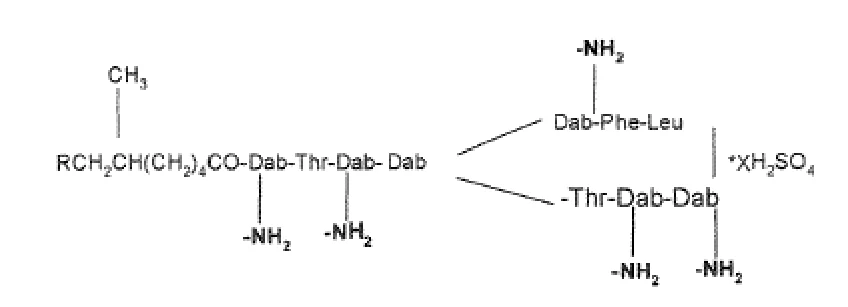
Polymyxin B1:
R=CH3
Polymyxin B2:
R=H DAB = α,γ-diaminobutyric acid
Neomycin Sulfate
Neomycin sulfate is the sulfate salt of neomycin B and C, which are produced by the growth of Streptomyces fradiae Waksman (Fam. Streptomycetaceae). It has a potency equivalent of not less than 600μg of neomycin standard per mg, calculated on an anhydrous basis. The structural formulae are:
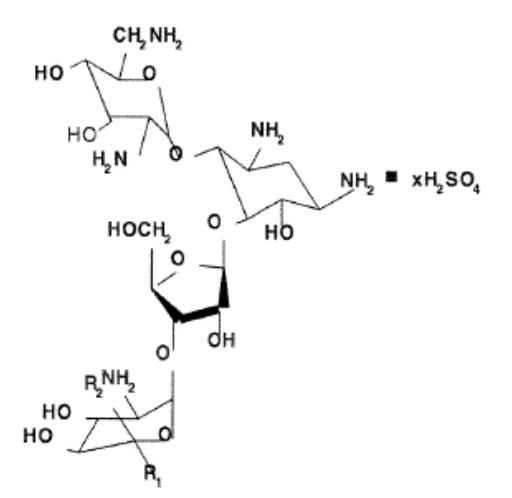
Neomycin B: R1=H, R2=CH2NH2
Neomycin C: R1=CH2NH2, R2=H
Composition
Ointment
Each g contains: polymyxin B sulfate 5,000 units, bacitracin zinc 400 units, and neomycin sulfate 5mg in a low melting point petrolatum base.
Irrigating Solution
Each mL of sterile, aqueous solution contains: polymyxin B sulfate 200,000 units and neomycin sulfate 57mg, equivalent to 40mg neomycin base. Non-medicinal ingredients: methylparaben, sulfuric acid and/or sodium hydroxide, as pH adjusters. Not for injection.
Stability and Storage Recommendations
Store NEOSPORIN® (Neomycin and Polymyxin B Sulfates) Irrigating Solution at
2° to 8°C.
Store NEOSPORIN® Ointment (Neomycin and Polymyxin B Sulfates and
Bacitracin Zinc) between 15° to 25°C.
Special Instructions
Except for NEOSPORIN® (Neomycin and Polymyxin B Sulfates) Irrigating
Solution — for which dilution is required for administration — dilution of
NEOSPORIN® is not recommended; reduction of the antibiotic concentrations may reduce their therapeutic efficacy.
Availability of Dosage Forms
Ointment
NEOSPORIN® (Neomycin and Polymyxin B Sulfates, and Bacitracin Zinc)
Ointment is available in tubes of 15g.
Irrigating Solution
NEOSPORIN® (Neomycin and Polymyxin B Sulfates) Irrigating Solution is available in ampoules of 1mL and vials of 20mL.
Information for the Consumer
General
If redness, irritation, swelling or pain persists or increases, discontinue use and notify your physician.
References
- 1. Bjorkner B, Moller H. Bacitracin: A cutaneous allergen and histamine liberator. Acta Dermatovener (Stockholm) 1973; 53: 487-492.
- 2. Edson RS, Keys TF. The Aminoglycosides. Mayo Clin Proc 1983; 58: 99-102.
- 3. Forstrom L, Pirila V, Pirila L Cross-sensitivity within the neomycin group of antibiotics. Acta Dermato-Venereologica 1979; 59: 67-69.
- 4.
Leyden JJ, Kligman AM. Contact dermatitis to neomycin sulfate. JAMA
1979; 242: 1276-1278.
- 5.
Leyden JJ, Sulzberger MB. Topical antibiotics and minor skin trauma.
Am Fam Physician 1981; 23: 121-5.
- 6.
Moller H. Eczematous contact allergy to oxytetracycline and Polymyxin
B. Contact Derm 1976; 5(2): 289-90.
- 7. Prystowsky SD, Allen AM, Smith RW, Nonomura JH, Akers WA. Allergic hypersensitivity to nickel, neomycin, ethylenediamine and benzocaine. Arch Dermatol 1979: 115: 959-962.