Patient Medication Information: uses, side effects, how to take - Nexplanon
Serious warnings and precautions box
What NEXPLANON is used for:
NEXPLANON is used to prevent pregnancy in adult women for up to 3 years.
How NEXPLANON works:
NEXPLANON is a birth control implant that contains a hormone called etonogestrel. It does not contain estrogen. This implant is a small, soft, flexible plastic rod that is about the size of a matchstick (Figure 1). It is contained in an applicator. This applicator allows the healthcare professional to insert (place) the implant just below the skin on the inside of your upper arm.
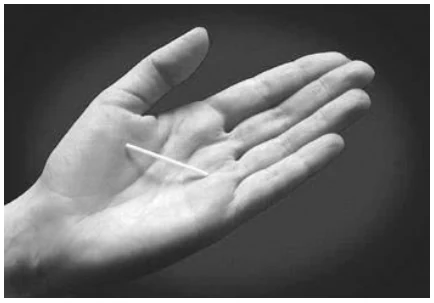
Figure 1
NEXPLANON will continuously release a small amount of etonogestrel into your blood. The etonogestrel works in two ways to prevent pregnancy:
- NEXPLANON will be inserted and removed by a healthcare professional who is familiar with this implant. They should be trained in how to perform the procedure.
- If, at any time, you cannot feel the implant, contact your healthcare professional as soon as possible. The implant may have moved from the place it was inserted and may need to be removed.
- NEXPLANON will NOT protect you against sexually transmitted infections (STIs), including Human Immunodeficiency Virus (HIV)/ Acquired immunodeficiency syndrome (AIDS). To protect yourself against STIs, use latex or polyurethane condoms while you are using NEXPLANON.
- It stops the release of egg cells from your ovaries.
- It causes changes in your cervical mucus to make it hard for sperm to enter your uterus.
NEXPLANON is a long-acting reversible contraceptive. This means that it can provide birth control over a long period of time. In fact, NEXPLANON can be left in place for up to 3 years. It is also reversible. This means that, if you want to stop using NEXPLANON before 3 years, the implant can be removed at any time. You may be able to get pregnant as early as 1 week after the implant is removed. If you wish to continue to prevent pregnancy, start a different type of birth control right away.
Long-acting reversible contraceptives are highly effective in preventing pregnancy.
Other Ways to Prevent Pregnancy
Other methods of birth control are available to you, including the birth control pill. When used properly, other methods of birth control are effective enough for many women.
The following table lists pregnancy rates for different types of birth control. It also shows the pregnancy rate when no birth control is used. A pregnancy rate is the number of women out of 100 who would become pregnant in one year.
Reported Pregnancies per 100 Women per Year:
| Subdermal implant | less than 0.05 |
|---|---|
| Combination pill | less than 1 to 2 |
| Contraceptive vaginal ring | between 1 and 2 |
| Intrauterine device (IUD) | less than 1 to 6 |
| Condom with spermicidal foam or gel | 1 to 6 |
| Mini-pill | 3 to 6 |
| Condom | 2 to 12 |
| Diaphragm with spermicidal foam or gel | 3 to 18 |
| Spermicide | 3 to 21 |
| Sponge with spermicide | 3 to 28 |
| Cervical cap with spermicide | 5 to 18 |
| Periodic abstinence (rhythm), all types (example natural family planning) | 2 to 20 |
| No birth control | 60 to 85 |
There are differences in these pregnancy rates. This is because not all women use their birth control as carefully or as regularly as they should. This does not apply to intra-uterine devices (IUD) or implants (like NEXPLANON) as these are placed into the body. If other types of birth control are used carefully and regularly, pregnancy rates should be lower. Talk to your healthcare professional about the different types of birth control available to you and any associated risks.
The ingredients in NEXPLANON are:
Medicinal ingredients: etonogestrel
Non-medicinal ingredients: barium sulfate, ethylene vinyl acetate copolymer, magnesium stearate.
The implant itself is made of a plastic that will not dissolve in your body. It also contains a small amount of barium sulfate. This ensures that the implant can be seen on an x-ray.
NEXPLANON comes in the following dosage form(s):
Subdermal implant, 68 mg
Once inserted, NEXPLANON will release up to 70 mcg etonogestrel per day. More etonogestrel will be released during the first few weeks after insertion. The amount released will slowly decrease over time.
Do not use NEXPLANON if:
- you are allergic to etonogestrel or any of the other ingredients in this medicine.
you are pregnant or think you might be pregnant.
- Before NEXPLANON is inserted, a pregnancy test should be done to confirm that you are not pregnant.
- If you do become pregnant while using NEXPLANON, tell your healthcare professional right away.
you have a clotting disorder or have had blood clots in veins (venous thrombosis) or arteries (arterial thrombosis) of the:
- leg. This is called deep vein thrombosis;
- lungs. This is called pulmonary embolism;
- eyes. This is called retinal vascular occlusion;
- heart. This is called a heart attack; or
- brain. This is called a stroke.
- you have, think you have, or have previously had breast cancer or any cancer that is sensitive to the female hormone, progestin.
- you have liver disease or liver tumours that may be either cancerous or not.
- you have any unexplained bleeding from the vagina.
If any of the above conditions appear for the first time while using NEXPLANON, contact your healthcare professional right away.
To help avoid side effects and ensure proper use, talk to your healthcare professional before you use NEXPLANON. Talk about any health conditions or problems you may have, including if you:
- have had a liver disease;
- have diabetes. This is a disease that occurs when your blood sugar is too high;
- are overweight. This is because your implant may need to be replaced earlier;
- have high cholesterol or a high level of fat called triglyceride in your blood;
- have high blood pressure;
- have kidney problems;
- have a condition that causes you to retain fluid;
- wear contact lenses;
- are going to have surgery or if you have mobility issues;
- suffer from depression;
- suffer from epilepsy (uncontrolled seizures) or tuberculosis (a bacterial infection of the lungs). This is because NEXPLANON may interact with drugs used to treat these conditions.
If you use NEXPLANON and have any of these conditions, you may need to be kept under close observation. Your healthcare professional will explain what to do. If the condition develops or gets worse while you are using NEXPLANON, tell your healthcare professional right away.
Other warnings you should know about:
Breast cancer
Breast cancer has been found more often in women who use birth control pills (“the Pill”). It is not known if the increased risk in these women is caused by the treatment.
It may be that tumours are found more in these women because they are examined more often by a healthcare professional. The risk for breast cancer in these women slowly lessens after stopping the Pill.
It is not known if this same risk applies to women who use birth control implants. While you are using NEXPLANON, check your breasts regularly. See your healthcare professional if you notice any lump in your breast. Be sure to tell your healthcare professional if a close relative has or ever had breast cancer.
Liver tumours
In rare cases, benign and even more rarely malignant (cancerous) liver tumours have been reported in women using the Pill. Contact your healthcare professional if you experience severe abdominal pain or if you are jaundiced. This is when your skin or the whites of your eyes turn yellow. These may be signs that you have a problem with your liver.
Gallbladder disease
The risk for gallbladder disease is higher in women who use birth control pills that contain hormones. It is not known if this risk is also associated with the use of NEXPLANON.
Thrombosis
Combined hormonal birth control contains two hormones, progestin and estrogen. Using this type of birth control increases a woman’s risk of developing blood clots. It is not known if this risk is the same for birth control methods like NEXPLANON that only contain etonogestrel (a progestin hormone). There have been reports of blood clots in women using etonogestrel implants. Seek medical help right away if you develop any signs or symptoms of a blood clot including:
- swelling, pain, tenderness or discolouration in the leg or arms
- chest pain, shortness of breath
- slurred speech, face drooping to one side
- loss of vision, double vision, bulging eyeball
- dizziness, headache
If you are to be immobilized or are to have surgery, tell your healthcare professional that you are using NEXPLANON. It may need to be removed.
Menstrual bleeding pattern changes
Your period bleeding pattern may change while you are using NEXPLANON including changes in:
- frequency. This means that your periods may be absent, happen less often, happen more often or may not stop.
- intensity. This means that your periods may be lighter or heavier than normal.
- duration. This means that your periods may be shorter or longer than normal.
About 1 in 5 women have reported that their periods stopped. Another 1 in 5 women reported more frequent and / or prolonged period bleeding.
The bleeding pattern that you experience in the first three months should generally continue during your treatment with NEXPLANON.
A changing bleeding pattern does not mean that NEXPLANON does not suit you or is not working. In general, you do not need to take any action unless your period bleeding is heavy or does not stop. If this happens, contact your healthcare professional.
Ectopic Pregnancy
If you become pregnant while using NEXPLANON, you have a slightly higher chance that the pregnancy will be ectopic than women who do not use birth control. Ectopic pregnancy happens when a fertilized egg attaches into tissue outside of the uterus. Unusual vaginal bleeding or lower abdominal pain may be signs of ectopic pregnancy. Ectopic pregnancy is a medical emergency that often requires surgery. It can cause serious internal bleeding, infertility, and even death. Call your healthcare professional right away if you think you are pregnant or have unexplained lower abdominal pain.
Ovarian cysts
While using birth control that contains low levels of hormones, small fluid-filled sacs may form in the ovaries. These are called ovarian cysts. Sometimes, these cause mild abdominal pain. Ovarian cysts usually disappear on their own. In rare cases, these may lead to more serious problems.
Breastfeeding
A small amount of the medicinal ingredient in NEXPLANON, etonogestrel, will pass into your breast milk. You may use NEXPLANON while breastfeeding, four weeks after the baby is born, or as directed by your healthcare professional. However, using NEXPLANON while you are breastfeeding may lower the amount of milk you make.
Skin conditions
Tell your healthcare professional if you have or have had chloasma. This skin condition appears as yellowish-brown patches on the skin particularly on the face. Chloasma may develop while you are using NEXPLANON. It is more likely to happen if you had chloasma gravidarum. This is when these patches appear during pregnancy (often known as “the mask of pregnancy”). If you have or had chloasma, avoid exposure to the sun while using NEXPLANON. The sun contains invisible rays that can burn the skin. These rays are called ultraviolet radiation.
Complications of insertion and removal
NEXPLANON should be inserted directly under the skin. You should be able to feel it after it is inserted. You may experience pain, numbness, bleeding, infection or scarring at the site after insertion and removal.
It is possible that the NEXPLANON implant could move from the original insertion site in your arm. This might happen if it is not inserted correctly or as a result of force like during contact sports.
If the implant moves, finding it may be difficult. You may need a bigger incision (a cut into your skin) or surgery to remove it. If the implant cannot be found and there are no signs it has come out, the prevention of pregnancy and the risk for side effects may last longer than you want. If you have questions about this, talk to your healthcare professional.
In rare cases, implants have been found in the pulmonary artery. This is a blood vessel in the lung. If the implant cannot be found in the arm, your healthcare professional may use x-rays or other imaging methods to find it. In some cases where NEXPLANON has been found in the pulmonary artery, chest pain and breathing problems (such as shortness of breath, cough and coughing up blood) were reported. Contact your healthcare professional immediately if you have any of these symptoms. If the implant is found in your chest, you may need surgery to remove it.
While you are using NEXPLANON, feel for the implant occasionally. If, at any time, you cannot feel it, contact your healthcare professional as soon as possible.
Broken or bent implant
The implant could break or bend while in your arm. This should not affect how the implant works. Breakage or bending may occur due to external forces (e.g., manipulation of the implant, using a tourniquet at the implant site or trauma to the implant site during contact sports). The broken implant may move from the insertion site.
Magnetic Resonance Imaging (MRI)
NEXPLANON is Magnetic Resonance (MR) safe.
Regular check-ups
Before NEXPLANON is inserted, you will need to have examinations and tests. Your healthcare professional will conduct a physical exam. They will also ask you some questions about your personal health history and that of your close relatives. Your blood pressure will be measured and a pregnancy test may be conducted.
While you are using NEXPLANON, you will need to have regular check-ups. Your first check-up should be about three months after NEXPLANON is inserted. Additional check-ups will be scheduled periodically thereafter. Your healthcare professional will measure your blood pressure at these visits. You may also need to have other tests done. Your healthcare professional should feel for the implant at each of these visits.
Tell your healthcare professional about all the medicines you take, including any drugs, vitamins, minerals, natural supplements or alternative medicines.
If you see a different doctor or a dentist who prescribes another medication to you, be sure to tell them that you use NEXPLANON. You should also tell the pharmacist. These healthcare professionals can tell you if your other medications will affect how NEXPLANON works. This means you might experience some vaginal bleeding or that you may not be fully protected from getting pregnant.
Your healthcare professionals may suggest that you use an extra birth control method that doesn’t contain hormones, while you are using another medication. Continue to use this birth control 28 days after your last dose of the other medication. This is because the effect of another medication on NEXPLANON may last for that long.
The following may interact with NEXPLANON:
Some medications can affect how NEXPLANON works. These may include:
- medicines for epilepsy (such as phenytoin, barbiturates, carbamazepine, oxcarbazepine, topiramate, felbamate, rufinamide),
- medicines for tuberculosis (such as rifampicin),
- medicines for HIV infection (such as ritonavir, nelfinavir, nevirapine, efavirenz, etravirine, indinavir),
- medicines for Hepatitis C Virus infection (such as boceprevir, telaprevir),
- medicines for other infectious diseases (such as griseofulvin, rifabutin, itraconazole, voriconazole, fluconazole, ketoconazole),
- medicines for high blood pressure in the blood vessels of the lungs (such as bosentan),
- medicines to prevent nausea and vomiting that may be caused by chemotherapy (such as aprepitant),
- an herbal remedy for depressive moods (St. John’s wort),
grapefruit juice.
NEXPLANON may affect how other medicines work. These include:
- medicines for organ transplantation (such as cyclosporine),
- medicines for seizures or mood disorders (such as lamotrigine).
How to use NEXPLANON:
NEXPLANON will be placed and removed by your healthcare professional, who will be familiar with how to do this. The insertion of NEXPLANON will require a small surgical procedure in their office. The implant is inserted under the skin on the inside of your non-dominant upper arm. This is the arm that you do not write with.
Before insertion, tell your healthcare professional if you are pregnant or think you might be pregnant (e.g., if you had unprotected sex during the current menstrual cycle).
The timing of the insertion is important. You and your healthcare professional will decide when to have the implant placed. It will depend your personal situation including:
- your menstrual cycle,
- whether you are using other types of birth control, and
- if you have recently had a baby, miscarriage or abortion.
Unless you are switching from another type of birth control, NEXPLANON is usually placed between day 1 and 5 of your cycle. This is to avoid the chance that you will be pregnant. If it cannot be inserted until after the 5th day of your cycle, use another form of birth control for the first seven days of NEXPLANON use.
NEXPLANON will be inserted according to the following steps:
Step 1. Lie on your back, with your arm bent at the elbow. Put your hand underneath your head, or as close as possible. This position will help with the insertion of the implant (Figure 2).
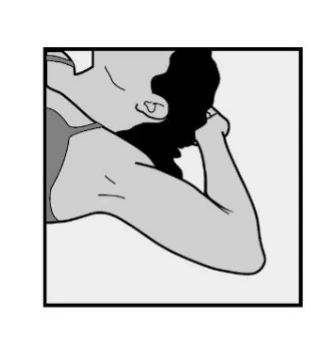
Figure 2
Step 2. Your healthcare professional will find the correct spot on your arm for the insertion. They will mark your arm in two spots using a marker. These spots will help to make sure the implant is placed in the correct spot.
Step 3. Your healthcare professional will clean the area and give you a medication to numb your arm. This is called an anesthetic. This medication may be sprayed onto your arm or given with a needle.
Step 4. Your healthcare professional will stretch the skin of your upper arm and use the applicator to place the implant. The applicator has a small needle, which will puncture your skin. This allows the implant (rod) to be inserted under the skin.
Step 5. Your healthcare professional will remove the applicator and apply a small bandage over the insertion site.
Step 6. Your healthcare professional will feel for the implant. They will also ask you to feel it. You should be able to feel both ends between your thumb and finger (Figure 3).
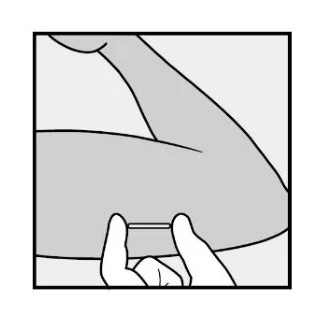
Figure 3
Step 7. The insertion site will then be covered with some gauze. A second bandage, called a pressure bandage, will also be applied. This will help to reduce bruising. You may remove the pressure bandage after 24 hours. The other bandage should stay in place for 3 to 5 days.
Step 8. Your healthcare professional will give you a Patient Alert Card. This card shows when and where NEXPLANON was inserted, and when it must be removed. Your healthcare professional will also show you how to feel for the implant. Occasionally feel for the implant. If, at any time, you cannot feel it, contact your healthcare professional as soon as possible. The Patient Alert card will also remind you about this. Store the card in a safe place.
If your healthcare professional is not sure the implant was inserted properly:
- you may need to have blood tests and an x-ray, ultrasound or MRI. These will help to confirm if NEXPLANON was inserted.
- you will need to use other methods of birth control until your healthcare professional is certain that NEXPLANON was inserted correctly. This is because you may not be protected against pregnancy during this time. Continue to use this form of birth control until your healthcare professional confirms that the implant was placed correctly. Talk to your healthcare professional about types of birth control to use.
- in the event the implant cannot be found in your arm, you may need an x-ray or other scan of your chest.
- once your healthcare professional finds the implant that they were not initially able to feel, it should be removed.
Removing NEXPLANON:
The implant can be removed at your request or, at the latest, 3 years after it was inserted.
A new implant may be inserted immediately after the old implant is removed. In some cases, the same incision can be used. However, this will only be possible if the insertion site was correct.
You may be able to get pregnant as early as 1 week after your implant is removed. If you do not want to become pregnant after NEXPLANON is removed, ask your healthcare professional about other ways to prevent pregnancy.
If you wish to stop using NEXPLANON because you want to get pregnant, wait until you have had a period before trying to conceive. This will help you to determine when the baby will be due.
NEXPLANON will be removed according to the following steps:
Step 1. Lie on your back, with your arm bent at the elbow. Put your hand underneath your head, or as close as possible (Figure 2).
Step 2. Your healthcare professional will find the implant. If it cannot be found, your healthcare professional may have to use X-ray, CT, ultrasound or MRI techniques to find it.
Step 3. Your healthcare professional will mark a spot on your arm at the end of the implant. This mark will help to ensure the implant is removed correctly.
Step 4. Your healthcare professional will clean your arm and then give you an anesthetic to numb your arm.
Step 5. Your healthcare professional will make a small incision in your arm, just below the tip of the implant. They will gently push the implant towards this incision and pull the implant out using forceps.
Sometimes, the implant is surrounded by hard tissue. This will make it more difficult to remove. If this is the case, your healthcare professional will make a small incision into this tissue.
Step 6. The incision site will be closed using a sterile adhesive wound closure.
A pressure bandage will be placed on top to minimize bruising. You may remove the pressure bandage in 24 hours. The sterile adhesive wound closure should remain in place for 3 to 5 days.
Usual dose:
68 mg
One implant is inserted at a time. The implant can stay in place for up to three years. However, you can ask your healthcare professional to remove it at any time.
If you are overweight, your healthcare professional may suggest replacing your implant earlier.
Overdose:
An implant should always be removed before another is inserted or an overdose could happen.
If you think you, or a person you are caring for, are overdosing, contact a healthcare professional, hospital emergency department, regional poison control centre or Health Canada’s toll-free number, 1-844 POISON-X (1-844-764-7669) immediately, even if there are no signs or symptoms.
Possible side effects from using NEXPLANON:
These are not all the possible side effects you may have when taking NEXPLANON. If you experience any side effects not listed here, tell your healthcare professional.
- period bleeding that is not regular (lighter or heavier bleeding, more or less frequent periods, continuous bleeding, longer or shorter periods, no period at all)
- painful period
- ovarian cyst
- vaginal infection or abnormal discharge
- decreased sex drive
- breast pain or tenderness
- inflammation of the vagina
- vaginal pain
- milky discharge from the breast
- breast enlargement
- pain or reaction (including redness, swelling, bruising, numbness) at the insertion site
- fatigue
- drowsiness or trouble sleeping
- flu-like symptoms, fever, pain
- back pain
- abdominal pain, joint, muscle or bone pain
- headache, migraine, dizziness
- depression, anxiety, nervousness
- mood swings (uncontrollable laughing or crying)
- nausea, gas
- weight gain or weight loss
- increased appetite
- diarrhea, constipation, vomiting
- acne, rash, hair loss
- hot flushes
- excessive hair growth
- skin itching
- oily skin
- yellowish-brown patches on the skin particularly on the face
- hives
- dandruff
- fluid retention
- sore throat
- stuffy or runny nose
- urinary tract infection
- painful or difficult urination
- increased blood pressure
If your period bleeding is heavy or does not stop, contact your healthcare professional.
During the insertion or removal of NEXPLANON, drop in blood pressure, dizziness, or fainting, some bruising, pain, swelling, or itching may occur and, in rare cases, infection. A scar may form or an abscess (blister) may develop at the site. This site may also be numb. It is possible that the implant could move or come out. This is especially true if it has not been inserted properly. Surgery might be necessary when removing the implant. In rare cases, implants have been reported to be found in a blood vessel, including those in the lung. This can cause shortness of breath, cough, coughing up blood or blood-stained mucus.
NEXPLANON may cause abnormal blood test results. Your healthcare professional will decide when to perform blood tests and will interpret the results.
Serious side effects and what to do about them
| Frequency/Side Effect/Symptom | Talk to your healthcare professional | Get immediate medical help | |
|---|---|---|---|
| Frequency/Side Effect/Symptom | Talk to your healthcare professional | Get immediate medical help | |
| Only if severe | In all cases | ||
| Only if severe | In all cases | ||
| Uncommon | |||
| Abnormal vaginal bleeding | √ | ||
| Allergic reaction: difficulty swallowing or breathing, wheezing, nausea, vomiting, swollen face, lips, tongue or throat, hives | √ | ||
| Breast Cancer: breast lumps or tumours that you can see or feel | √ | ||
| Deep vein thrombosis (blood clot in the leg): pain or swelling in the leg, may be warm to the touch | √ | ||
| Jaundice (build-up of bilirubin in the blood): yellowing of the skin and eyes, dark urine, light coloured stool | √ | ||
| Liver tumour: Abnormal liver test and/or yellowing of the skin or eyes, dark urine, nausea, vomiting, severe pain or lump in the abdomen | √ | ||
| Myocardial infarction (heart attack): crushing chest pain, pressure or heaviness | √ | ||
| Peripheral edema: unusual swelling of the extremities | √ | ||
| Pulmonary embolism (blood clot in the lung): sharp pain in the chest, coughing blood, or sudden shortness of breath | √ | ||
| Retinal vascular occlusion (blood clot in the eye): sudden partial or complete loss of vision, double vision | √ | ||
| Stroke: sudden severe or worsening headache, vomiting, dizziness or fainting, disturbance of vision or speech, weakness or numbness in the arm or leg | √ | ||
| Unknown | |||
| Angioedema (swelling of the tissue under the skin): difficulty breathing; swelling of the face, | √ | ||
| hands, feet, genitals, tongue, throat; diarrhea, nausea, vomiting | |||
| Ectopic pregnancy (when a fertilized egg attaches to tissue outside of the uterus): abdominal or pelvic pain, bleeding from the vagina, lightheadedness, fainting, shoulder pain | √ | ||
| Idiopathic intracranial hypertension (IIH) (increased pressure inside your skull): severe or recurrent headaches, eyesight problems/ visual changes, tinnitus (ringing/ buzzing in the ear) | √ | ||
If you have a troublesome symptom or side effect that is not listed here or becomes bad enough to interfere with your daily activities, tell your healthcare professional.
Reporting side effects
You can report any suspected side effects associated with the use of health products to Health Canada by:
- Visiting the Web page on Adverse Reaction Reporting (canada.ca/drug-device-reporting) for information on how to report online, by mail or by fax; or
- Calling toll-free at 1-866-234-2345.
NOTE: Contact your healthcare professional if you need information about how to manage your side effects. The Canada Vigilance Program does not provide medical advice.
Storage:
Store NEXPLANON at 2-30°C.
Keep out of reach and sight of children.
If you want more information about NEXPLANON:
- Talk to your healthcare professional
- Find the full product monograph that is prepared for healthcare professionals and includes the Patient Medication Information by visiting the Health Canada Drug Product Database website (https://www.canada.ca/en/health-canada/services/drugs-health-products/drug-products/drug-product-database.html); the manufacturer’s website (www.organon.ca); or by calling 1-844-820-5468.
Date of Authorization: 2026-07-02
® N.V. Organon. Used under license.
© 2026 Organon group of companies. All rights reserved.
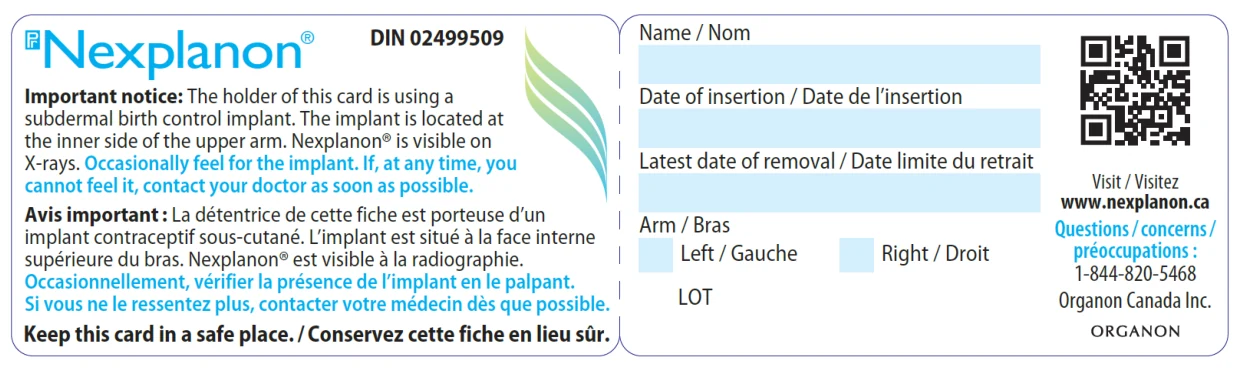
A copy of the Patient Alert Card included with the NEXPLANON® carton is shown below.