


Product Monograph - Nix Creme Rinse
RECENT MAJOR LABEL CHANGES
| 1 INDICATIONS, 4 DOSAGE AND ADMINISTRATION | 01/2022 |
TABLE OF CONTENTS
RECENT MAJOR LABEL CHANGES............................................................................................ 2
TABLE OF CONTENTS .............................................................................................................. 2
PART I: HEALTH PROFESSIONAL INFORMATION ..................................................................... 4
1 INDICATIONS .............................................................................................................. 4
1.1 Pediatrics .......................................................................................................... 4
1.2 Geriatrics........................................................................................................... 4
2 CONTRAINDICATIONS ................................................................................................. 4
3 SERIOUS WARNINGS AND PRECAUTIONS BOX ............................................................ 4
4 DOSAGE AND ADMINISTRATION................................................................................. 4
4.1 Dosing Considerations ....................................................................................... 4
4.2 Recommended Dose and Dosage Adjustment..................................................... 5
4.3 Reconstitution ................................................................................................... 5
4.4 Administration................................................................................................... 5
5 OVERDOSAGE ............................................................................................................. 6
6 DOSAGE FORMS, STRENGTHS, COMPOSITION AND PACKAGING ................................. 6
7 WARNINGS AND PRECAUTIONS .................................................................................. 6
7.1 Special Populations ............................................................................................ 7
7.1.1 Pregnant Women ......................................................................................... 7
7.1.2 Breast-feeding.............................................................................................. 7
7.1.3 Pediatrics ..................................................................................................... 7
7.1.4 Geriatrics ..................................................................................................... 7
8 ADVERSE REACTIONS .................................................................................................. 7
8.1 Adverse Reaction Overview................................................................................ 7
8.2 Clinical Trial Adverse Reactions .......................................................................... 7
8.2.1 Clinical Trial Adverse Reactions – Pediatrics .................................................. 8
8.3 Less Common Clinical Trial Adverse Reactions .................................................... 8
8.3.1 Less Common Clinical Trial Adverse Reactions – Pediatrics ............................ 8
8.4 Abnormal Laboratory Findings: Hematologic, Clinical Chemistry and Other Quantitative Data ........................................................................................................ 8
8.5 Post-Market Adverse Reactions.......................................................................... 8
9 DRUG INTERACTIONS.................................................................................................. 8
9.1 Drug Interactions Overview................................................................................ 8
9.2 Drug-Behavioural Interactions............................................................................ 8
9.3 Drug-Drug Interactions ...................................................................................... 8
9.4 Drug-Food Interactions ...................................................................................... 8
9.5 Drug-Herb Interactions ...................................................................................... 8
9.6 Drug-Laboratory Test Interactions ...................................................................... 8
10 CLINICAL PHARMACOLOGY ......................................................................................... 9
10.1 Mechanism of Action.................................................................................... 9
10.2 Pharmacodynamics ...................................................................................... 9
10.3 Pharmacokinetics ......................................................................................... 9
11 STORAGE, STABILITY AND DISPOSAL ........................................................................... 9
12 SPECIAL HANDLING INSTRUCTIONS............................................................................. 9
PART II: SCIENTIFIC INFORMATION ...................................................................................... 10
13 PHARMACEUTICAL INFORMATION............................................................................ 10
14 CLINICAL TRIALS........................................................................................................ 10
14.1 Trial Design and Study Demographics ......................................................... 10
14.2 Study Results ............................................................................................. 10
15 MICROBIOLOGY ........................................................................................................ 11
16 NON-CLINICAL TOXICOLOGY ..................................................................................... 11
PATIENT MEDICATION INFORMATION ................................................................................. 12
PART I: HEALTH PROFESSIONAL INFORMATION
1 INDICATIONS
NIX® CRÈME RINSE (Permethrin 1% cream) is indicated for the treatment of infestation with head lice and their nits (eggs).
1.1 Pediatrics
Pediatrics (two years and older): Health Canada has authorized an indication for pediatric use (two years and older). Safety and effectiveness in children less than two years of age have not been established.
1.2 Geriatrics
Geriatrics (> 65 years of age): No data are available to Health Canada; therefore, Health Canada has not authorized an indication for geriatric use.
2 CONTRAINDICATIONS
- NIX® CRÈME RINSE is contraindicated in patients who are hypersensitive to this drug or to any ingredient in the formulation, including any non-medicinal ingredient, or component of the container. For a complete listing, see 6 DOSAGE FORMS, STRENGTHS, COMPOSITION AND PACKAGING.
3 SERIOUS WARNINGS AND PRECAUTIONS BOX
Serious Warnings and Precautions
|
4 DOSAGE AND ADMINISTRATION
4.1 Dosing Considerations
- A single application is usually sufficient to eliminate a head lice infestation. The active ingredient in NIX® CRÈME RINSE persists on the hair for 10 days, even after subsequent washing with a conditioner-free shampoo. If you see live lice or nits after the first application, the residual effect should kill these. If you still see live lice or nits on the 7th day (or after) following the first application, NIX® CRÈME RINSE should be applied a second time.
- Cleaning of personal articles is also an important part of head lice management and may help prevent reinfestation. Personal belonging including recently worn clothing, towels and bed linens should be machine washed in hot water and dried using the hot cycle of the dryer for at least 20 minutes. Personal articles of clothing or bedding that cannot be washed may be dry cleaned or sealed in a plastic bag for a period of two weeks. Combs and brushes should be disinfected by soaking in hot water (above 130 °F/54 °C) for 5 to 10 minutes.
- Children should be advised not to use any borrowed combs or brushes, nor wear anyone else’s clothes, especially hats.
- Inspect all family members from time to time for any new lice infestation. If a new infestation is found treat with NIX® CRÈME RINSE.
4.2 Recommended Dose and Dosage Adjustment
See Section 4.1 Dosing Considerations.
4.3 Reconstitution
Not applicable.
4.4 Administration
Directions
Adults and children 2 years of age and over:
- 1. Wash the hair with conditioner-free shampoo. Do not use conditioner. Rinse with water and towel dry thoroughly.
- 2. Shake NIX® CRÈME RINSE bottle well. Apply a sufficient amount of NIX® CRÈME RINSE (1/2 to 1 bottle) to thoroughly saturate the hair and scalp, especially behind the ears and at the base of the neck.
- 3. Leave NIX® CRÈME RINSE on the hair for 10 minutes.
- 4. Rinse NIX® CRÈME RINSE off hair with water.
- 5. Towel dry hair.
- 6. Comb hair with regular comb to remove tangles.
- 7. Remove nits: Part hair into sections; starting as close to the scalp as possible, remove the nits using the nit removal comb provided. Be sure to comb to the end of the hair shaft. The nit comb should be disinfected by soaking in hot water after each use. Inspect full head of hair thoroughly for any stray nits. The nit removal procedure should be repeated daily for the 7 days following treatment.
5 OVERDOSAGE
In the event of accidental ingestion of permethrin, please seek immediate medical attention. Symptoms of overdose may include dizziness, loss of appetite, nausea, vomiting, headache, weakness, seizures, and loss of consciousness.
| For management of a suspected drug overdose, contact your regional poison control centre. |
6 DOSAGE FORMS, STRENGTHS, COMPOSITION AND PACKAGING
Table – Dosage Forms, Strengths, Composition and Packaging
NIX® CRÈME RINSE is packaged in a 59 mL HDPE bottle (inner (primary) package) and cardboard carton (outer (secondary) package). Each carton contains 2 bottles and 2 nit combs.
7 WARNINGS AND PRECAUTIONS
General
Do not use if allergic to any of the ingredients, synthetic pyrethroids or pyrethrin, or chrysanthemums. Discontinue use if reaction occurs (see 3 SERIOUS WARNINGS AND PRECAUTIONS BOX).
NIX® CRÈME RINSE is for use when live lice or their eggs are present. It is not for prophylactic/regular use to prevent head lice.
NIX® CRÈME RINSE should be discontinued if hypersensitivity occurs.
Keep out of reach of children. For external use only. To prevent accidental ingestion by children, the remaining contents of NIX® CRÈME RINSE should be discarded after use.
In case of swallowing, consult your doctor or Poison Control Centre immediately.
It is important to ensure that the course of treatment is followed as directed because treatment failure has been reported when this has not occurred.
Ophthalmologic
| Route of Administration | Dosage Form / Strength/Composition | Non-medicinal Ingredients |
| Topical | Cream 1% | Balsam Canada, Cetyl Alcohol, Citric Acid, FD&C Yellow No. 6, Hydrolyzed Animal Protein, Hydroxyethyl Cellulose, Isopropyl Alcohol, Methylparaben, Poloxyethylene 10 Cetyl Ether, Propylene Glycol, Propylparaben, Stearalkonium Chloride, Water |
Permethrin is not irritating to eyes, but contact with the eyes should be avoided because other components of the product may cause marked irritation. If NIX® CRÈME RINSE comes in contact with the eyes, rinse eyes immediately with water.
Skin
Head lice infestation is often accompanied by itching, redness, and swelling. Treatment with NIX® CRÈME RINSE may temporarily worsen these conditions. If skin irritation occurs and does not improve, consult a doctor.
7.1 Special Populations
7.1.1 Pregnant Women
There are no adequate or well-controlled studies in pregnant women. Consult a doctor before using this drug (see 3 SERIOUS WARNINGS AND PRECAUTIONS BOX).
7.1.2 Breast-feeding
There are no adequate or well-controlled studies in breast-feeding women. Consult a doctor before using this drug (see 3 SERIOUS WARNINGS AND PRECAUTIONS BOX).
7.1.3 Pediatrics
Pediatrics (two years and older): Health Canada has authorized an indication for pediatric use (two years and older). Safety and effectiveness in children less than two years of age have not been established. Do not use on children under 2 years of age.
7.1.4 Geriatrics
Geriatrics (> 65 years of age): No data are available to Health Canada; therefore, Health Canada has not authorized an indication for geriatric use.
8 ADVERSE REACTIONS
8.1 Adverse Reaction Overview
In clinical studies, occasional itching has been known to occur. This is usually a consequence of head lice infestation itself, but may be temporarily worsened following treatment with NIX® CRÈME RINSE. Other reactions which are less frequent include: stinging/burning, tingling, numbness or discomfort, redness, swelling or rash of the scalp, paraesthesia, eczema, skin oedema, skin irritation, smarting, and pain of skin. All these reactions are usually mild and temporary.
8.2 Clinical Trial Adverse Reactions
See 8.1 Adverse Reaction Overview.
8.2.1 Clinical Trial Adverse Reactions – Pediatrics
Information is not available.
8.3 Less Common Clinical Trial Adverse Reactions
Information is not available.
8.3.1 Less Common Clinical Trial Adverse Reactions – Pediatrics
Information is not available.
8.4 Abnormal Laboratory Findings: Hematologic, Clinical Chemistry and Other Quantitative Data
Information is not available.
8.5 Post-Market Adverse Reactions
Information is not available.
9 DRUG INTERACTIONS
9.1 Drug Interactions Overview
Information is not available.
9.2 Drug-Behavioural Interactions
Information is not available.
9.3 Drug-Drug Interactions
Information is not available.
9.4 Drug-Food Interactions
Information is not available.
9.5 Drug-Herb Interactions
Information is not available.
9.6 Drug-Laboratory Test Interactions
Information is not available.
10 CLINICAL PHARMACOLOGY
10.1 Mechanism of Action
Permethrin is a synthetic pyrethroid, active against lice, ticks, mites, and fleas. It acts on the nerve cell membrane to disrupt the sodium channel current by which the polarization on the membrane is regulated. Delayed repolarization and paralysis of the pests are the consequences of this disturbance.
10.2 Pharmacodynamics
Information on which the original indication was authorized is not available.
10.3 Pharmacokinetics
Information on which the original indication was authorized is not available.
11 STORAGE, STABILITY AND DISPOSAL
Store between 15 °C and 25 °C.
12 SPECIAL HANDLING INSTRUCTIONS
None.
PART II: SCIENTIFIC INFORMATION
13 PHARMACEUTICAL INFORMATION
Drug Substance
Proper name: Permethrin
Chemical name: (3-phenoxyphenyl)methyl 3-(2,2-dichloroethenyl)-2,2-dimethylcyclopropane-1-carboxylate
Molecular formula and molecular mass: C21Cl2H20O3 ; 391.3
Structural formula:
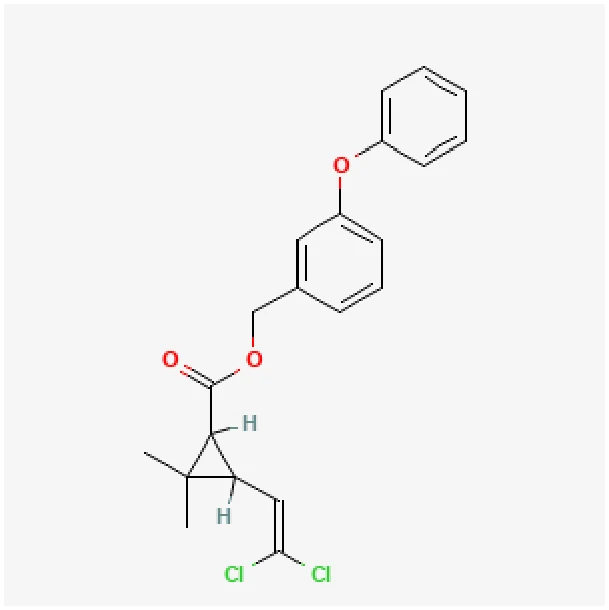
Physicochemical properties: Permethrin is a pale brown liquid. Relatively water insoluble. Used as an insecticide.
Product Characteristics:
Drug product is an orange liquid cream with a characteristic aromatic odour.
14 CLINICAL TRIALS
14.1 Trial Design and Study Demographics
The clinical data on which the original indication was authorized is not available.
14.2 Study Results
Please see Clinical Trials – Trials Design and Study Demographics Section.
15 MICROBIOLOGY
No microbiological information is required for this drug product.
16 NON-CLINICAL TOXICOLOGY
Information on which the product was authorized is not available.