


Product Monograph - Nix Dermal Cream
1 INDICATIONS
NIX Dermal Cream (Permethrin Cream, 5% w/w) is indicated for:
- the treatment of infestation with Sarcoptes scabiei (scabies).
1.1 Pediatrics
Pediatrics (< 2 years of age): NIX Dermal Cream is well tolerated and effective in children two years of age and older. Based on the data submitted and reviewed by Health Canada, the safety and efficacy of NIX Dermal Cream in patients under 2 years of age has not been established; therefore, Health Canada has not authorized an indication for use in children under 2 years of age.
1.2 Geriatrics
Adults over 70 years of age, should be treated under medical supervision before using NIX Dermal Cream.
2 CONTRAINDICATIONS
NIX Dermal Cream is contraindicated in patients who are hypersensitive to permethrin (including pyrethroids and pyrethrins) or to any ingredient in the formulation, including any non-medicinal ingredient, or component of the container. For a complete listing, see Dosage Forms, Strengths, Composition and Packaging.
- Nix Dermal Cream is also contraindicated in patients who are hypersensitive to chrysanthemums.
3 DOSAGE AND ADMINISTRATION
3.1 Dosing Considerations
- In view of the great individual variability in body area and skin type’s precise recommendations are not possible. As such, dosage information provided below is for guidance purposes only.
- It is recommended that family members and close contacts, including sexual partners, be treated with NIX Dermal Cream to reduce the risk of transmission or eliminate reinfestation.
3.2 Recommended Dose and Dosage Adjustment
| Adults and Children over 12 years: | Approximately 1 (30 g) tube. Usually 30 g is sufficient for an average adult. If more than 30 g is required for full body coverage, not more than 60 g should be used during a single application. |
|---|---|
| Children 5 to 12 years: | Approximately ½ of a 30 g tube (15g). |
| Children 2 to 4 years: | Approximately ¼ of a 30 g tube (7.5g). |
Health Canada has not authorized an indication for use in patients under 2 years of age.
3.3 Administration
For external use only.
Adults:
Patients should apply NIX Dermal Cream to clean and dry skin. Patients should not take a hot bath before application. NIX Dermal Cream should be thoroughly massaged into the whole body, excluding the head and face, paying particular attention to the areas between the fingers and toes, wrists, axillae (arm pits), external genitalia (external sexual organs), buttocks and under the finger area and toe nails. In women, the whole body application should include the breasts. NIX Dermal Cream should not be applied to mucous membranes, head, face, mouth, broken skin or near the eyes. Following application, the patient should put on clean clothes, and hands should be washed before eating. NIX Dermal Cream should be reapplied to the hands if washed off with soap and water within 8 hours of application. Patients should be instructed that it is not necessary to apply a thick visible layer of cream into the skin as it disappears on application.
Pediatrics (>2 years):
Children should use as directed for adults, and should be supervised by an adult when applying the product to ensure thorough treatment is administered.
Geriatrics:
Scabies rarely infests the scalp of adults, although the hairline, neck, temple, outer ears, and forehead may be infested in geriatric patients. Therefore, elderly patients should use as directed for adults but apply the product to the whole body including the neck, face, ears and scalp, avoiding the area close to the eyes.
NIX Dermal Cream should be removed by washing (shower or bath) after 12 to 14 hours (at a minimum the cream should be left on for 8 hours), and patients should change into clean clothes.
In the majority of individuals, the scabies infestation is cleared with a single application of the cream. If necessary, a second application may be given 7 to 10 days after the first, but only if live mites can be demonstrated or new lesions appear.
To prevent reinfestations all clothing and bed linens used within two days prior to treatment should be machine-washed in hot water and dried in the dryer for at least 20 minutes, or dry cleaned. Mattresses which have been used by an infested person should not be used for 48 hours. Toilet seats should be disinfected.
Persistent pruritus after treatment is not an indication of retreatment (see WARNINGS AND PRECAUTIONS: General).
4 OVERDOSAGE
Symptoms and Signs
Symptoms of overdose are generally likely to occur after accidental or deliberate oral ingestion due to swallowing and in rare cases because of skin absorption following excessive topical application and may include dizziness, loss of appetite, nausea, vomiting, headache, weakness, seizures, and loss of consciousness.
Treatment
In the event of overdose or accidental ingestion, the patient should seek immediate medical attention. Symptomatic treatment is indicated should hypersensitivity-type reactions occur.
| For management of a suspected drug overdose, contact your regional poison control centre. |
|---|
5 DOSAGE FORMS, STRENGTHS, COMPOSITION AND PACKAGING
Table 1 – Dosage Forms, Strengths, Composition and Packaging.
NIX Dermal Cream is a topical scabicidal agent available in an off-white, vanishing cream base. NIX Dermal Cream is supplied in a 30 g tube.
6 WARNINGS AND PRECAUTIONS
General
Keep out of reach of children.
| Route of Administration | Dosage Form / Strength/Composition | Non-medicinal Ingredients |
| Topical | Cream, 5% | butylated hydroxytoluene, carbomer 974P, coconut oil, glycerin, glyceryl monostearate, isopropyl myristate, lanolin alcohols, mineral oil, palm oil, polyoxyethylene cetyl ethers, purified water, and sodium hydroxide; formaldehyde 1 mg (0.1%) is added as a preservative. For a complete listing see Dosage Forms, Composition and Packaging section. |
For external use only. In the event of accidental ingestion of permethrin, patient should seek immediate medical attention.
The product should not be applied to mucous membranes, head, face, near the eyes, nose, mouth or broken skin.
Permethrin is not an eye irritant, but contact of NIX Dermal Cream with the eyes should be avoided because the cream itself may cause marked irritation. If it should get into eyes, rinse them immediately with plenty of water or, if readily available, normal saline.
If hypersensitivity to NIX Dermal Cream occurs, patients should discontinue use.
Patients with scabies should be advised that itching, mild burning and/or stinging may occur after application of NIX Dermal Cream. If skin irritation occurs patients should stop using NIX Dermal Cream, and consult a doctor if it does not improve.
Scabies infestation is often accompanied by pruritus, edema and erythema. Treatment with NIX Dermal Cream may temporarily exacerbate these conditions. Pruritus caused by an acquired sensitivity to mites and their products frequently persists for one to several weeks following treatment; this reaction does not indicate treatment failure.
It is important to ensure that the course of treatment is followed as directed because treatment failure has been reported when this has not occurred.
Carers who routinely apply permethrin may wish to wear gloves to avoid any possible irritation to the hands.
6.1 Special Populations
6.1.1 Pregnant Women
Teratogenic Effects: Reproduction studies have been performed in mice, rats and rabbits (200 to 400 mg/kg/day orally) and have revealed no evidence of impaired fertility or harm to the fetus due to permethrin. Negative in vivo genotoxicity tests (see TOXICOLOGY section of Part II: Scientific Information) and the very low mammalian toxicity would suggest that any risk to the foetus following treatment with NIX Dermal Cream is minimal. There are, however, no adequate and well-controlled studies in pregnant women. Because animal reproduction studies are not always predictive of human response, this drug should not be used during pregnancy.
6.1.2 Breast-feeding
It is not known whether this drug is excreted in human milk. Because many drugs are excreted in human milk and because of the evidence for tumorigenic potential of permethrin in animal studies, consideration should be given to discontinuing nursing temporarily or withholding the drug while the mother is nursing.
6.1.3 Pediatrics
Pediatrics (< 2 years of age): NIX Dermal Cream is well tolerated and effective in children two years of age and older. Based on the data submitted and reviewed by Health Canada, the safety and efficacy of NIX Dermal Cream in patients under 2 years of age has not been established; therefore, Health Canada has not authorized an indication for use in children under 2 years of age.
6.1.4 Geriatrics
Adults over 70 years of age, should be treated under medical supervision before using NIX Dermal Cream.
7 ADVERSE REACTIONS
7.1 Adverse Reaction Overview
In scabies patients, skin discomfort, usually described as burning, stinging or tingling, occurs in a few individuals soon after NIX Dermal Cream is applied. This occurs more frequently in patients with severe scabies and is usually mild and transient.
Other transient signs and symptoms of irritation, including erythema, oedema, eczema, rash and pruritus which may follow the treatment of scabies with NIX Dermal Cream are generally considered to be part of the natural history of scabies.
In patients being treated for scabies, the pruritus may persist for up to 4 weeks after treatment. This is generally considered to be an allergic reaction to the dead mites present under the skin and is not necessarily a sign that the treatment has failed.
7.2 Clinical Trial Adverse Reactions
Because clinical trials are conducted under very specific conditions, the adverse reaction rates observed in the clinical trials may not reflect the rates observed in practice and should not be compared to the rates in the clinical trials of another drug. Adverse reaction information from clinical trials is useful for identifying drug-related adverse events and for approximating rates.
Ten percent of patients in clinical trials experienced generally mild and transient burning and stinging followed application with permethrin 5%. This was associated with the severity of infestation. Pruritus and erythema were reported in 6% and 4%, respectively, of patients at various times post-application. Approximately 75% of patients treated with NIX Dermal Cream who continued to manifest pruritus at 2 weeks had cessation by 4 weeks. Tingling and rash were reported in up to 2% of patients.
7.3 Less Common Clinical Trial Adverse Reactions
There were isolated reports of skin pain, diarrhea, papules and excoriation observed in clinical trials.
7.4 Abnormal Laboratory Findings: Hematologic, Clinical Chemistry and Other Quantitative Data
There were no drug-related laboratory findings observed in the clinical trials.
7.5 Clinical Trial Adverse Reactions (Pediatrics)
The evaluation of the safety and efficacy of permethrin 5% cream for the treatment of infants and children with scabies was of particular interest and children aged two months to 5 years were included in three of the pivotal studies. No age or size-related adverse experiences were observed in any study and there were no meaningful differences in the adverse reactions observed in the pediatrics population.
7.6 Post-Market Adverse Reactions
Nervous system disorders
Paraesthesia
Skin and subcutaneous tissue disorders
Eczema, skin oedema, rash, erythema, pruritus, burning sensation, skin irritation, skin discomfort, smarting, pain of skin.
Skin discomfort occurs in patients with severe scabies, is not usually severe and is of short duration. Other symptoms of irritation are part of the natural development of the infection.
8 DRUG INTERACTIONS
8.1 Overview
Interactions with other drugs have not been established, however, use of other topical medications, steroids and cosmetics should be discontinued prior to treatment.
8.2 Drug-Drug Interactions
The treatment of eczematous-like reactions with corticosteroids should be withheld prior to treatment with NIX Dermal Cream, as there is a risk of exacerbating the scabies infestation by reducing the immune response to the mite. The likelihood of interactions between the two treatments leading to potential adverse reactions or reduced efficacy is, however, small.
8.3 Drug-Food Interactions
Interactions with food have not been established.
8.4 Drug-Herb Interactions
Interactions with herbal products have not been established.
8.5 Drug-Laboratory Test Interactions
Interactions with laboratory tests have not been established.
9 ACTION AND CLINICAL PHARMACOLOGY
9.1 Mechanism of Action
Permethrin is a synthetic pyrethroid, which is active against a broad range of pests including lice, ticks, fleas, mites, and other arthropods. It acts on the nerve cell membranes in these pests to disrupt the sodium channel current by which the polarization of the membrane is regulated. Delayed repolarization and paralysis of the pests are the consequences of this disturbance.
9.2 Pharmacodynamics
There was no evidence of contact sensitization to permethrin during induction or challenge phases of maximization testing. No reactions were observed during phototoxicity testing.
9.3 Pharmacokinetics
Absorption: A very small amount (<2%) of topically administered permethrin is absorbed through the skin. This contrasts to the 32% absorption seen after ingestion. The maximum absorption occurs during the first 48 hours following application. Lag time for penetration of permethrin through the skin ranged from 1.3 to 4 hours for cis-permethrin and 2.6 to 4.8 hours for trans-permethrin.
Distribution: The distribution of topically applied permethrin is primarily limited to the skin, since very little permethrin is systemically absorbed.
Metabolism: Permethrin is metabolized by ester hydrolysis to dichlorovinyl acid derivatives (DCVAs). Blood levels of metabolites were still quantifiable after 28 days in one-third of test samples.
Elimination: The main route of excretion is via the kidneys. Male patients excreted more DCVA than female patients. Excretion of trans-DCVA in the urine was 4 to 5 times faster than cis-DCVA reflecting its greater concentration and more rapid rate of metabolism. Presence of esterase in skin could account for observed differences in the amount of DCVA excreted in urine of male and female patients.
10 STORAGE, STABILITY AND DISPOSAL
Store at 15° to 25°C. Keep out of reach of children.
In order to prevent accidental ingestion by children, the remaining contents of NIX Dermal Cream should be discarded after use.
11 SPECIAL HANDLING INSTRUCTIONS
There are no special requirements for handling of this product.
PART II: SCIENTIFIC INFORMATION
12 PHARMACEUTICAL INFORMATION
Drug Substance
Proper name: Permethrin
Chemical name: (+-)-3-Phenoxybenzyl
3-(2,2-dichlorovinyl)-2,2-dimethylcyclopropanecarboxylate (cis:trans/25:75)
Molecular formula: C21H20Cl2O3
Molecular mass: 391.29
Structural formula:
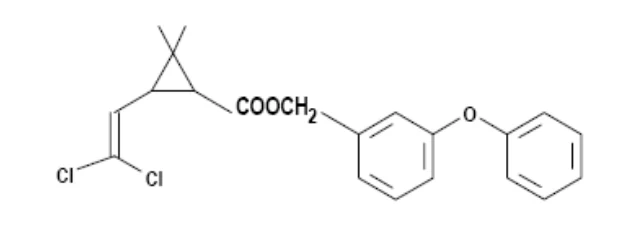
Physicochemical properties: Permethrin is an approximate 1:3 mixture of the cis and trans isomers of the pyrethroid (±)-3-phenoxybenzyl 3-(2,2-dichlorovinyl)-2,2- dimethylcyclopropanecarboxylate (cis:trans/25:75). It is a yellow to light orange-brown, low-melting solid or viscous liquid.
13 CLINICAL TRIALS
13.1 Trial Design and Study Demographics
The clinical efficacy of permethrin 5% has been evaluated in 5 randomized, active-controlled studies for the treatment of infestation with Sarcoptes scabiei (scabies). A total of 720 patients were included in these 5 clinical studies and received permethrin cream 5% (362 patients) or an active comparator [1% lindane (289 patients) or 10% crotamiton (69 patients)].
Table 2 - Summary of patient demographics for clinical trials in the treatment of Scabies
| Study # | Trial design | Dosage, route of administration and duration | Study subjects enrolled (n) | Mean age (Range) | Sex |
| 04-01 | Active-controlled, randomized, single-blind | Permethrin Cream, 5% Single application, Topical, Mean duration: 10 hours | N = 27 | 9.4 years (2-32 years) | 13M/14F |
| Study # | Trial design | Dosage, route of administration and duration | Study subjects enrolled (n) | Mean age (Range) | Sex | |||
1% Lindane Lotion Single application, Topical, Mean duration: 10 hours | N = 26 | 8.7 years (2-40 years) | 10M/16F | |||||
| 15-01 | Active-controlled, randomized, double-blind | Permethrin Cream, 5% Single application, Topical, Mean duration: 12 hours | N = 48 | 2 years (2 months- 5 years) both groups | 24M/24F | |||
10% Crotamiton Cream Single application, Topical, Mean duration: 12 hours | N= 48 | 18M/30F | ||||||
| 14-01 | Active-controlled, randomized, double-blind | Permethrin Cream, 5% Single application, Topical, Mean duration: 21 hours | N = 23 (includes 9 index patients) | 19.5 years (1- 49 years) | 6M/17F | |||
10% Crotamiton Cream Single application, Topical, Mean duration: 22 hours | N= 21 (includes 8 index patients) | 16.6 years (1-59 years) | 10M/11F | |||||
| 06 | Multi-center, active-controlled, randomized, single-blind | Permethrin Cream, 5% Single application, Topical, Mean duration: 12.5 hours | N = 234 | 20.8 years (0.25 -62 years) | 144M/90F | |||
1% Lindane Lotion Single application, Topical, Mean duration: 12.5 hours | N = 233 | 23.4 years (1-75 years) | 153M/80F | |||||
| H32/C/ 85/DH/ 002 | Active-controlled, randomized, single-blind | Permethrin Cream, 5% Single application, Topical, Duration: 8 hours | N = 30 | 12.13 years (4-44 years) | 16M/14F | |||
1% Lindane Lotion Single application, Topical, Duration: 24 hours | N = 30 | 8.33 years (4-16 years) | 14M/16F | |||||
Study 04-01 evaluated efficacy and safety at 2 and 4 weeks following treatment of either permethrin 5% or 1% lindane. Approximately 8.8 g of permethrin 5% or 16.2 g of 1% lindane was applied to the patients and remained on the skin for approximately 10 hours. 27 patients were treated with permethrin 5%, of these 85% had severe infestations (>50 lesions), and 25 patients treated with 1% lindane, of these 76% had severe infestations. Out of 52 patients, 43 were children aged 2 – 15 years. Cure was defined as no new lesions and all old lesions healed or healing at the 4-week follow –up.
Study 15-01 was designed to evaluate the safety and efficacy of a single application of either permethrin 5% or 10% crotamiton for the treatment of scabies in infants and young children. Approximately 12.7g of permethrin 5% or 11.9g of 10% crotamiton was applied to the children and remained on the skin for approximately 12 hours. 48 patients, ranging in age from 2 months to 5 years, were assigned to each treatment group. The mean degree of infestation for the children was approximately 60 lesions per child; the median was 42 lesions. Improvement was measured as mean decline in lesion count.
Study 14-01 evaluated the efficacy and acute dermal tolerance of permethrin 5% compared to 10% crotamiton. A single application (mean 18-20 g) of either cream was applied and remained on the skin for a mean duration of 21 to 22 hours. Forty-four patients entered the study (23 treated with permethrin and 21 with crotamiton). Of these, 9 were index patients randomized to treatment with permethrin 5% and 8 were randomized to treatment with 10% crotamiton. The remainder were family members of index patients assigned the same drug as the index patient. Diagnosis and efficacy evaluations were made by counting characteristic lesions and grading their severity before treatment and 14 and 28 days after treatment.
Study 06 evaluated the efficacy and tolerance of permethrin 5% and 1% lindane, 14 and 28 days post-therapy. A single application of 21g permethrin 5% or 32g 1% lindane was applied and remained on the skin for approximately 12.5 hours. A total of 467 patients aged 2 months – 75 years (mean 22 ± 13 years) were enrolled; of these 297 were males. Approximately half were Caucasian and half were Hispanic. Demographic and disease characteristics were similar for both treatment groups except for age distribution. A total of 54 children under the age of 5 years were included in the study population, and of these 35 (65%) were treated with permethrin. For all enrolled patients the mean number of lesions was 85 (± 97). Forty-five percent of patients had 10-49 lesions and 51% had ≥ 50 lesions (20% of these had ≥ 200). Diagnosis of infestation with scabies was based on clinical evaluation in all cases and was supported when possible by microscopic visualization of mites, eggs or fecal pellets. The final clinical judgement of the investigator(s) at Day 28 was accepted as cure; objective cure was defined as all lesions healed or healing at that time. Clinical judgement was supported by counting active lesions and rating their severity at 2 and 4 weeks.
Study H32/C/DH/85/002 evaluated the effect of permethrin 5% and 1% lindane in 60 patients. Up to 25g of permethrin 5% was applied and was washed off 8 hours after treatment; up to 50 g 1% lindane was applied and was washed off24 hours after treatment. Both treatment groups have 30 patients each. Each patient’s skin was examined for scabies and local irritation prior to and 7 and 21 days after administration using a scabies scoring system (mild, moderate, severe) of 5 signs and symptoms (burrows, pruritus, excoriation, papules, nodules) on 6 sites (hands/wrists, ankles, breasts, groin/genitalia, buttocks, feet). The total maximum score possible was 162.
13.2 Study Results
In all studies (Study 04-01, Study 15-01, Study 14-01, Study 06 and Study H/32/C/DH/85/002), permethrin showed comparable or superior efficacy when compared to the control treatment.
Clinical improvement was evident as follows:
- within the first 2 weeks in at least one third of the patients, and
- by weeks 3 or 4 usually at least 80% of the patients treated with permethrin were cured (i.e., no new lesions and/or all old lesions healed or healing at that time).
Individual study results for the treatment of scabies infestation are presented in Tables 2 to 6.
Table 3 - Results of study 04-01 in treatment of Scabies Infestation
| Primary Endpoints | Associated value and statistical significance for permethrin 5% N=27 | Associated value and statistical significance for 1% lindane N=25 |
| Percent clinical improved at Day 14* | 89% ** | 38% ** |
| Percent Itching Present at Day 14 | 26% | 58% |
| Percent cured at Day 28 | 93% † | 67% † |
| Percent itching present at Day 28 | 7% | 38% |
*All lesions healed or healing, no new lesions ** p<0.001, Cochran-Mantel-Haenszel test † p = 0.102, two-tailed | ||
Table 4 - Results of study 15-01 in treatment of Scabies Infestation
| Primary Endpoints | Associated value and statistical significance for permethrin 5% N = 47 | Associated value and statistical significance for 10% crotamiton N= 47 |
| Percent clinically improved at Day 14* | 30% | 13% |
| Percent cured at Day 28 | 89%** | 60% ** |
| Percent itching present at Day 28 | 13% | 40% |
*All lesions healed or healing; no new lesions **p = 0.002, Fisher’s Exact Test | ||
Table 5 - Results of study 14-01 in treatment of Scabies Infestation
| Primary Endpoints | Associated value and statistical significance for permethrin 5% | Associated value and statistical significance for 10% crotamiton |
| Index patients N = 8 | ||
| All patients N = 20 | Index patients N = 8 | |
| All patients N = 21 | ||
| Percent cured at Day 28 | 100%* | |
| 100% | 75%* | |
| 48% | ||
*p>0.4, Fisher’s Exact Test, 2 tailed Note: no statistical analysis was performed for non-index patients. | ||
Table 6 - Results of study 06 in treatment of Scabies Infestation
| Primary Endpoints | Associated value and statistical significance for permethrin 5% N=193 | Associated value and statistical significance for 1% lindane N=213 |
| Percent clinical improved at Day 14* | 38% | 37% |
| Percent Itching Present at Day 14 | 66% | 69% |
| N=199 | N=205 | |
| Percent cured at Day 28 | 91% ** | 86% ** |
| Percent itching present at Day 28 | 14% | 25% |
*All lesions healed or healing, no new lesions **p=0.175, 2-sided Cochran –Mantel Haenszel Test | ||
Table 7 - Results of study H32/C/DH/85/002 in treatment of Scabies Infestation
| Primary Endpoints | Associated value and statistical significance for permethrin 5% N=30 | Associated value and statistical significance for 1% lindane N=29 |
| Percent cured at Day 21 | 43% | 45% |
14 TOXICOLOGY
Animals
In vitro clastigenicity studies with permethrin have shown contradictory results. However, no evidence of genotoxicity was demonstrated in in vivo studies.
Six carcinogenicity bioassays were performed with permethrin, three each in rats and mice. No tumorigenicity was seen in the rat studies. However, in three mouse studies, increases in pulmonary adenomas, a common benign tumor of high spontaneous background incidence, were seen. In one of these studies, there was also an increased incidence of pulmonary alveolar-cell carcinomas and benign liver adenomas. This occurred only in female mice given permethrin in their food at a concentration of 5000 ppm for two years.
At an oral dose of 180 mg/kg/day in a three-generation rat study, permethrin did not have any adverse effect on reproductive function.
Humans
Results of maximization testing, phototoxicity and photoallergenicity testing in 17 healthy volunteers have shown that Permethrin 5% Dermal Cream produced no sensitization or irritant reactions. The drug was well tolerated following two whole body applications (with a one-week interval between applications). No dermal or systemic reactions were reported. Although no permethrin was detected in plasma samples at any time during the study, major metabolites, primarily trans-DCVA, were detected in the urine. The majority of metabolites were excreted within 72 hours after application. Detectable but not quantifiable levels of trans-DCVA were reported at two weeks after the second whole body application. Based on the results of these studies, it was concluded that Permethrin 5% Dermal Cream was safe for further investigation in humans.