


Patient Medication Information: uses, side effects, how to take - NTP-Hydrochlorothiazide
ABOUT THIS MEDICATION
What the medication is used for:
NTP-HYDROCHLOROTHIAZIDE has been prescribed to you for edema (swelling) associated with heart failure, cirrhosis of the liver, corticosteroid and estrogen therapy and for edema originating from the kidneys; or hypertension; or toxemia (hypertension) due to pregnancy.
What it does:
NTP-HYDROCHLOROTHIAZIDE elevates the rate of urine secretion and lowers blood pressure. Hydrochlorothiazide affects the kidneys ability to reabsorb electrolytes. It increases excretion of sodium and chloride in approximately equivalent amounts and reduces the rate of formation of solute-free water.
When it should not be used:
You should not use NTP-
HYDROCHLOROTHIAZIDE if you:
are allergic to Hydrochlorothiazide or to other
sulfonamide-derived drugs.
are allergic to any of the other ingredients in
the product (please see “What the nonmedicinal ingredients are”)
- have no production of urine.
experience an increase of urea or creatinine
and a decrease in urine production during treatment of severe progressive kidney disease.
Stop taking the drug and contact your doctor immediately if you experience an allergic reaction or any severe or unusual side effects.
What the medicinal ingredient is:
Hydrochlorothiazide.
What the nonmedicinal ingredients are: colloidal silicon dioxide, FD&C Yellow #6, lactose, magnesium stearate, microcrystalline cellulose and sodium starch glycolate.
What dosage forms it comes in:
Tablets: 25 mg & 50 mg
WARNINGS AND PRECAUTIONS
Before you use NTP-HYDROCHLOROTHIAZIDE talk to your doctor or pharmacists if:
- If you are taking enteric-coated potassium salts
- If you have impaired liver function or progressive liver disease
- If you have impaired kidney function
- If you are taking anti-hypertensive medication or other adrenergic blocking drugs.
- If you have a history of sensitivity reactions or a history of allergic reactions to this or other medications
- If you have lupus
Remember to keep this and other medications away from children.
Tell your physician or pharmacist all medication you are taking, including any non-prescription or herbal medicines.
Other precautions:
Do not take NTP-HYDROCHLOROTHIAZIDE if you are:
- pregnant or breast-feeding.
- are allergic to any of its ingredients.
INTERACTIONS WITH THIS MEDICATION
Drugs that may interact with NTP-
HYDROCHLOROTHIAZIDE include:
- Lithium. Concomitant therapy with lithium is not recommended with NTP-HYDROCHLOROTHIAZIDE because of the reduction of kidney clearance of lithium and therefore an added risk of lithium toxicity.
Orthostatic hypotension (low blood pressure while you are standing) may occur and may be enhanced by alcohol, barbiturates, or narcotics
16
You should always tell your physician about all drugs you are taking, including those obtained without a prescription.
PROPER USE OF THIS MEDICATION
Take this medicine exactly as prescribed by your physician.
Adult patients
Diuresis
The recommended adult dosage is 50 mg to 100 mg once or twice a day. Many patients respond to intermittent therapy, i.e. administration on alternate days or on three to five days each week.
Toxemia of pregnancy
The recommended dosage is 100 mg daily or, in severe cases and for brief periods, 200 mg daily (in divided doses). Frequency of administration may range from once every four days to daily.
Premenstrual tension with swelling
The recommended dosage is 25mg to 50 mg once or twice a day from the first appearance of symptoms until onset of the menses.
Control of Hypertension
The usual recommended starting dosage is 50 or 100 mg a day as a single or divided dose. Dosage is increased or decreased according to the blood pressure response of the patient. Some patients may require doses of 200 mg a day in divided doses.
Infants and Children
The usual recommended pediatric dosage is based on 1.0 mg of NTP-HYDROCHLOROTHIAZIDE per pound of body weight per day in two doses. Infants under 6 months of age may require up to 1.5 mg per pound per day in two doses.
On this basis, infants up to 2 years of age may be given 12.5 to 37.5 mg daily in two doses.
The 25 mg tablet can not be divided into quarters.
Overdose:
If you take too many doses, call your
physician immediately.
Missed Dose:
If you miss a dose, and it is close to the next scheduled dose, take your medicine at the next scheduled time. Do NOT double dose.
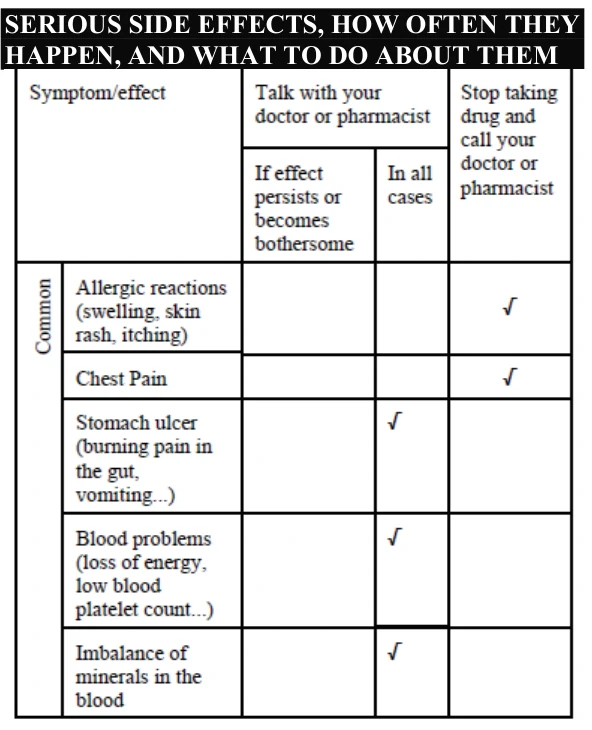
SIDE EFFECTS AND WHAT TO DO ABOUT THEM
Gastrointestinal system: Decreased appetite, gastric irritation, nausea, vomiting, cramps, diarrhea, constipation, jaundice (intrahepatic cholestatic jaundice), inflammation of the pancreas, inflammation or enlargement of salivary glands. Central nervous system: Dizziness, a feeling that you or your surroundings are moving, sensation of tingling or numbness, headache, impaired sense of sight.
Hematologic: Leukopenia, agranulocytosis, thrombocytopenia, aplastic anemia.
Cardiovascular: postural hypotension (may be aggravated by alcohol, barbiturates, or narcotics). Hypersensitivity: spontaneous bleeding under the skin, sensitivity to light , rash, red patches on the skin, fever, respiratory distress including pneumonitis, anaphylactic reactions.
Other: Hyperglycemia, muscle spasm, weakness, restlessness, transient blurred vision.
SERIOUS SIDE EFFECTS, HOW OFTEN THEY HAPPEN, AND WHAT TO DO ABOUT THEM
This is not a complete list of side effects. If you have any unexpected effects while taking this drug, contact your doctor or pharmacist.
In case of drug overdose, contact a health care practitioner, hospital emergency department or regional Poison Control Centre immediately, even if there are no symptoms.
17
HOW TO STORE IT
- Store at controlled room temperature, 15°- 30°C.
- Keep out of the reach and sight of children.
- Do not use after the expiry date indicated on the package.
- Protect from heat and light.
REPORTING SUSPECTED SIDE EFFECTS
You can report any suspected adverse reactions associated with the use of health products to the Canada Vigilance Program by one of the following 3 ways:
Report online at www.healthcanada.gc.ca/medeffect Call toll-free at 1-866-234-2345
Complete a Canada Vigilance Reporting Form and:
- Fax toll-free to 1-866-678-6789, or
Mail to:
Canada Vigilance Program
Health Canada
Postal Locator 0701E
Ottawa, Ontario
K1A 0K9
Postage paid labels, Canada Vigilance Reporting Form and the adverse reaction reporting guidelines are available on the MedEffect™ Canada Web site at www.healthcanada.gc.ca/medeffect.
NOTE: Should you require information related to the management of side effects, contact your health professional. The Canada Vigilance Program does not provide medical advice.
MORE INFORMATION
This document plus the full product monograph, prepared for health professionals can be obtained by contacting, NT Pharma Canada Limited at:
1-800-268-4127 ext 5005 (English)
1-877-777-9117 (French)
or druginfo@tevacanada.com
NT Pharma Canada Limited.
5691 Main Street
Stouffville, Ontario
Canada, L4A 1H5