


Product Monograph - Nubain Injection 20mg/mL
SUMMARY PRODUCT INFORMATION
| Route of Administration | Dosage Form / Strength | Clinically Relevant Nonmedicinal Ingredients |
| Subcutaneously, intramuscularly or intravenously | Solution for injection | Sodium chloride (only for 10 mg/mL), sodium citrate dihydrate, citric acid and water for injection. For a complete listing see Dosage Forms, Composition and Packaging section. |
INDICATIONS AND CLINICAL USE
NUBAIN (nalbuphine hydrochloride) is indicated for the relief of moderate to severe pain.
NUBAIN can also be used as a supplement to surgical anesthesia, an adjunct to preoperative and postoperative analgesia, and obstetrical analgesia during labor and delivery.
Pediatrics (< 18 years of age): Because clinical experience in children is limited, the administration of NUBAIN in this age group is not recommended.
CONTRAINDICATIONS
NUBAIN (nalbuphine hydrochloride) should not be administered to patients who are hypersensitive to the drug or to its inactive ingredients (see DOSAGE FORMS, COMPOSITION AND PACKAGING).
WARNINGS AND PRECAUTIONS
NUBAIN should be administered as a supplement to surgical anesthesia only by persons specifically trained in the use of intravenous anesthetics and management of the respiratory effects of potent opioids.
Naloxone, resuscitative and intubation equipment and oxygen should be readily available.
Myocardial Infarction: As with all potent analgesics, NUBAIN should be used with caution in patients with myocardial infarction who have nausea or vomiting. Hemodynamic studies in patients with severe arteriosclerotic heart changes reveal that NUBAIN has circulatory effects similar to those of morphine, i.e., a minimal decrease in oxygen consumption, cardiac index, left ventricular end-diastolic pressure and cardiac work.
Dependence/Tolerance
Drug Dependence: In patients physically dependent on opiate drugs, NUBAIN (nalbuphine hydrochloride) should not be given prior to detoxification since withdrawal symptoms are likely to be produced.
On the basis of behavioral, substitution and direct addiction studies in humans NUBAIN has been shown to have low abuse potential. When compared with drugs which are not mixed agonist-antagonists, it has been reported that nalbuphine’s potential for abuse would be less than that of codeine and propoxyphene. Psychological and physical dependence and tolerance may follow the abuse or misuse of nalbuphine. Therefore, caution should be observed in prescribing it for emotionally unstable patients, or for individuals with history of narcotic abuse. Such patients should be closely supervised when long-term therapy is contemplated.
Care should be taken to avoid increases in dosage which might result in physical dependence in susceptible individuals.
Abrupt discontinuation of NUBAIN following prolonged use has been followed by symptoms of narcotic withdrawal, i.e., abdominal cramps, nausea and vomiting, rhinirrhea, lacrimation, restlessness, anxiety, elevated temperature and piloerection.
Patients Dependent on Opioids: Patients who have been taking narcotics chronically may experience withdrawal symptoms upon the administration of NUBAIN. If necessary, narcotic withdrawal symptoms can be controlled by the slow intravenous administration of small increments of morphine, until symptomatic relief.
Hepatic/Biliary/Pancreatic
Biliary Tract Surgery: NUBAIN may cause spasm of the sphincter of Oddi. It is not recommended to be used for analgesia in patients with acute abdominal conditions. It should only be used for anesthesia in these patients when its benefits outweigh its potential risks.
Neurologic
Head Injury and Increased Intracranial Pressure: The possible respiratory depressant effects and the potential of potent analgesics to elevate cerebrospinal fluid pressure
(resulting from vasodilation following CO2 retention) may be markedly exaggerated in the presence of head injury, intracranial lesions, or a pre-existing increase in intracranial pressure. Furthermore, potent analgesics can produce effects which may obscure the clinical course of patients with head injuries. Therefore, NUBAIN should be administered in these circumstances only when essential, and then should be administered with extreme caution.
Peri-Operative Considerations
Outpatients: NUBAIN may impair the mental or physical abilities required for the performance of potentially dangerous tasks such as driving a car or operating machinery. Outpatients must be maintained under observation until adequately recovered from the NUBAIN effects.
Renal
Impaired Renal or Hepatic Function: Because NUBAIN is metabolized in the liver and excreted by the kidneys, patients with renal or liver dysfunction may show an exaggerated response to customary doses. In these individuals, NUBAIN should be used with caution and administered in reduced amounts.
Respiratory
Impaired Respiration: At the usual adult dose of dose 10 mg/70 kg, NUBAIN causes respiratory depression approximately equal to that produced by equal doses of morphine. In contrast to morphine, respiratory depression is not appreciably increased with higher doses of NUBAIN. Respiratory depression induced by NUBAIN can be reversed by naloxone hydrochloride when indicated. NUBAIN should be administered with caution at low doses to patients with impaired respiration (e.g., from other medication, uremia, bronchial asthma, severe infection, cyanosis or respiratory obstructions).
Special Populations
Pregnant WomenThere are no adequate and well-controlled studies in pregnant women. Because animal reproduction studies are not always predictive of human response, nalbuphine should be used during pregnancy only if, in the judgment of the physician, the potential benefits outweigh the possible risks (see TOXICOLOGY, Reproduction and Teratology).
Women Giving Birth
NUBAIN should be used in women during labour and delivery only when benefits outweigh the potential risks, and newborns should be monitored for respiratory depression, apnea, bradycardia, and arrhythmias. NUBAIN can produce respiratory depression in the neonate. It should be administered with extreme caution to women delivering premature infants.
The placental transfer of nalbuphine is high, relatively rapid and variable with a maternal to fetal ratio ranging from 1:0.37 to 1:6.03. Fetal and neonatal adverse effects that have been reported following the administration of nalbuphine to the mother during labour include fetal bradycardia, respiratory depression at birth, apnea, cyanosis, and hypotonia.
Severe and prolonged fetal bradycardia has been reported. Permanent neurological damage attributed to fetal bradycardia has occurred. A sinusoidal fetal heart rate pattern associated with the use of nalbuphine has also been reported.
Nursing Women: Limited data suggest that NUBAIN is excreted in maternal milk in small amounts (less than 1% of the administered dose) considered clinically insignificant. Caution should be exercised when NUBAIN is administered to a nursing mother.
Pediatrics (< 18 years of age): Because clinical experience in children under the age of 18 years is limited, the administration of NUBAIN in this age group is not recommended.
Monitoring and Laboratory Tests
NUBAIN may interfere with enzymatic methods for the detection of opioids depending on the specificity and sensitivity of the tests. Please consult the test manufacturer for specific details.
ADVERSE REACTIONS
In clinical trials with NUBAIN (nalbuphine hydrochloride) the most frequently reported side effects were: sedation (36% of 1066), sweating or clammy (9%), nausea or vomiting (6%), dizziness or vertigo (5%), dry mouth (4%) and headache (3%).
Less Common Clinical Trial Adverse Drug Reactions:
Central Nervous System: nervousness, crying, depression, restlessness, euphoria, hostility, confusion, faintness, floating, unusual dreams, numbness, feeling of heaviness, and psychotomimetic effects such as hallucinations, feeling of unreality and dysphoria. The incidence of psychotomimetic effects, such as unreality, depersonalization, delusions, dysphoria and hallucinations has been shown to be less than that which occurs with pentazocine.
Cardiovascular: Hypertension, hypotension, bradycardia, tachycardia.
Gastrointestinal: Cramps, dyspepsia, bitter taste.
Respiration: Depression, dyspnea, asthma.
Dermatological: Itching, burning, urticaria.
Miscellaneous: Speech difficulty, urinary urgency, blurred vision, flushing and warmth.
Allergic Reactions: Anaphylactic/anaphylactoid and other serious hypersensitivity reactions have been reported following the use of nalbuphine and may require immediate, supportive medical treatment. These reactions may include shock, respiratory distress, respiratory arrest, bradycardia, cardiac arrest, hypotension, or laryngeal edema. Other allergic-type reactions reported with patients using NUBAIN include stridor, bronchospasm, wheezing, edema, rash, pruritis, nausea, vomiting, diaphoresis, weakness, and shakiness.
Post-marketing: Other reports include pulmonary edema, agitation and injection site reactions such as pain, swelling, redness, burning and hot sensations.
DRUG INTERACTIONS
Interaction With Other Central Nervous System Depressants
Although NUBAIN possesses narcotic antagonist activity, there is evidence that in non-dependent patients it will not antagonize a narcotic analgesic administered just before, concurrently, or just after an injection of NUBAIN. Therefore, patients receiving a narcotic analgesic, general anesthetics, phenothiazines or other tranquilizers, sedatives, hypnotics, or other CNS depressants (including alcohol) with NUBAIN may exhibit an additive effect. When such combined therapy is contemplated, the dose of one or both agents should be reduced.
DOSAGE AND ADMINISTRATION
Analgesia
The usual recommended adult dose of NUBAIN (nalbuphine hydrochloride) is 10 mg for a 70 kg individual, administered subcutaneously, intramuscularly or intravenously. This dose may be repeated every 3 to 6 hours as required. In non-tolerant individuals, the recommended dosage range is 10 mg to 20 mg, with a maximum single dose of 20 mg and a maximum total daily dose of 160 mg. Dosage should be adjusted according to the severity of the pain, physical status of the patient, and other medications which the patient may be receiving (see Interaction with Other Central Nervous System Depressants under WARNING).
Recommended Dose and Dosage Adjustment
Opioid Analgesics - Approximate Analgesic Equivalences
| Drug | Equivalent Dose (mg) [compared to morphine 10 mg IM] | Duration of Action (hours) | |
|---|---|---|---|
| Parenteral | Oral | ||
| Strong Opioid Agonists | |||
| Morphine (single dose) | 10 | 60 | 3 - 4 |
| (chronic dose) | 10 | 20 – 30 | 3 - 4 |
| Hydromorphone | 1.5 - 2 | 6 – 7.5 | 2 - 4 |
| Anileridine | 25 | 75 | 2 - 3 |
| Levorphanol | 2 | 4 | 4 - 8 |
| Meperidine | 75 | 300 | 1 - 3 |
| Oxymorphone | 1.5 | 5 (rectal) | 3 – 4 |
| Heroine | 5 – 8 | 10 – 15 | 3 – 4 |
| Drug | Equivalent Dose (mg) [compared to morphine 10 mg IM] | Duration of Action (hours) |
|---|
| Parenteral | Oral | ||
|---|---|---|---|
| Weak Opioid Agonists | |||
| Codeine | 120 | 200 | 3 – 4 |
| Oxycodone | 5 – 10 | 10 – 15 | 2 – 4 |
| Propoxyphene | 50 | 100 | 2 – 4 |
| Mixed Agonist- Antagonists | |||
| Pentazocine | 60 | 180 | 3 – 4 |
| Nalbuphine | 10 | 3 – 6 | |
| Butorphanol | 2 | 3 – 4 |
Patients who have been taking narcotics chronically for pain under medical supervision may experience withdrawal symptoms upon the administration of NUBAIN. If NUBAIN is administered to these patients as an analgesic, it should be introduced gradually. NUBAIN should not be used as a substitute for other narcotics or for tapering individuals dependent on these drugs.
Patients Dependent on Narcotics: If the previous analgesic was morphine, meperidine, codeine, or other narcotic with similar duration of activity, one fourth of the anticipated dose of NUBAIN can be administered initially and the patient observed for signs of withdrawal, i.e., abdominal cramps, nausea and vomiting, lacrimation, rhinorrhea, anxiety, restlessness, elevation of temperature or piloerection. If untoward symptoms do not occur, progressively larger doses may be tried at appropriate intervals until the desired level of analgesia is obtained with NUBAIN.
Balanced Anesthesia
Balanced anesthesia with NUBAIN requires larger doses than for the multiple doses recommended above for analgesia. Induction schedules with NUBAIN range from
0.3 mg/kg to 5 mg/kg intravenously over a 10 to 15 minute period.
After induction with NUBAIN is completed, maintenance doses of 0.25 mg/kg to
0.5 mg/kg can be used as required in single doses. Significant respiratory depression at the end of anesthesia rarely occurs with proper use of NUBAIN. Naloxone remains the specific antidote for any respiratory depression.
As a component to regional anesthesia, NUBAIN can be used in doses of 0.2 mg/kg to 0.5 mg/kg of body weight. NUBAIN produces sedation and additional analgesia to such regional techniques as alveolar nerve block and can be an adjunct to spinal anesthesia, regional nerve blocks, block of extremities, etc.
Incompatibility With Other Therapeutic Agents
NUBAIN is physically incompatible with nafcillin and ketorolac. Solutions of these drugs should not be mixed.
OVERDOSAGE
For management of a suspected drug overdose, contact your regional Poison Control Centre for the most current information.
Symptoms
These are expected to be similar to those of other drugs of this class. The administration of single I.M. doses of 72 mg of NUBAIN to eight normal subjects has been reported to have resulted primarily in symptoms of sleepiness and mild dysphoria.
Treatment
Naloxone hydrochloride administered intravenously is a specific antidote for NUBAIN. Since the duration of action of NUBAIN may exceed that of NARCAN, the patient should be kept under continued surveillance and repeated doses of NARCAN should be administered as necessary. Oxygen, intravenous fluids, vasopressors and other supportive measures should be employed as indicated.
ACTION AND CLINICAL PHARMACOLOGY
NUBAIN (nalbuphine hydrochloride) is a synthetic opioid agonist-antagonist analgesic for parenteral use, related chemically to the opioid oxymorphone, and to the opioid antagonist naloxone. Nalbuphine has an analgesic (agonist action) potency equivalent to that of morphine on a milligram for milligram basis. Receptor studies show that nalbuphine binds to mu, kappa, and delta receptors, but not to sigma receptors. Nalbuphine is primarily a kappa agonist/ mu antagonist analgesic. The onset of action of nalbuphine occurs within 2 to 3 minutes after intravenous administration, and in less than 15 minutes following subcutaneous or intramuscular injection. The plasma half-life of nalbuphine is five hours and in clinical studies the duration of analgesic activity has been reported to range from three to six hours. The narcotic antagonist activity of NUBAIN is one-fourth as potent as that of nalorphine and ten times that of pentazocine.
At the usual adult dose of 10 mg / 70 kg, nalbuphine may produce respiratory depression equivalent to that of equianalgesic doses of morphine. However, NUBAIN exhibits a ceiling effect such that increases in dose greater than 30 mg do not produce further respiratory depression.
Nalbuphine by itself has potent opioid antagonist activity at doses equal to or lower than its analgesic dose. When administered following or concurrent with mu agonist opioid analgesics (e.g., morphine, oxymorphone, fentanyl), nalbuphine may partially reverse or block opioid-induced respiratory depression from the mu agonist analgesic. Nalbuphine may precipitate withdrawal in patients dependent on opioid drugs. Nalbuphine should be used with caution in patients who have been receiving mu opioid analgesics on a regular basis.
STORAGE AND STABILITY
Store at controlled room temperature (15°c to 30°c). Protect from excessive light. Store in carton until contents have been used.
SPECIAL HANDLING INSTRUCTIONS
Parenteral drug products should be inspected visually for particulate matter and discolouration prior to administration whenever solution and container permit.
DOSAGE FORMS, COMPOSITION AND PACKAGING
NUBAIN (10.0 mg/mL) 1 mL Ampoule: Each mL contains 10.0 mg nalbuphine hydrochloride, 2.0 mg sodium chloride, 9.41 mg sodium citrate dihydrate, 12.62 mg citric acid and water for injection; pH adjusted with hydrochloric acid.
NUBAIN (20.0 mg/mL) 1 mL Ampoule: Each mL contains 20.0 mg nalbuphine hydrochloride, 9.41 mg sodium citrate dihydrate, 12.62 mg citric acid and water for injection; pH adjusted with hydrochloric acid.
NUBAIN is available in 1 mL ampoules, boxes of 2 x 5 ampoules.
PART II: SCIENTIFIC INFORMATION
PHARMACEUTICAL INFORMATION
Proper name: nalbuphine hydrochloride
Chemical name: 17- (cyclobutylmethyl)-4,5-epoxy-, morphinan - 3,6,14- triol, hydrochloride
Molecular formula C21H27NO4 • HCl
Molecular mass: 393.91 g/mol
Structural formula:
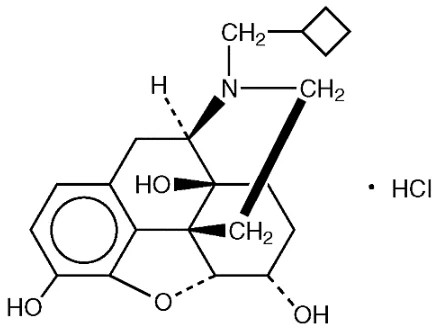
Physicochemical properties: NUBAIN (nalbuphine hydrochloride) is a synthetic narcotic agonist-antagonist analgesic of the phenanthrene series. It is chemically related to both the widely used narcotic antagonist, naloxone, and the potent narcotic analgesic, oxymorphone, The pH is adjusted with hydrochloric acid. Nalbuphine hydrochloride is soluble in H2O (35.5 mg/mL at 25°C) and ethanol (0.8%); insoluble in CHCl3 and ether. Nalbuphine hydrochloride has pKa values of 8.71 and 9.96
NUBAIN (nalbuphine hydrochloride) is a Schedule G (Controlled) drug.
CLINICAL TRIALS
Animal tests show that parenterally administered nalbuphine HCI is an analgesic of the agonist-antagonist type. When administered subcutaneously in the mouse antiphenylquinone writhing tests nalbuphine hydrochloride, at the time of peak activity, was 2.3 times as potent as morphine sulfate 8.3 times as potent as codeine phosphate and 3.5 times as potent as pentazocine hydrochloride. In the same tests, orally administered nalbuphine, at peak activity time, was 0.27 times as potent as morphine, about equipotent with codeine, and 2.4 times as potent as pentazocine.
The onset of the analgesic effect of nalbuphine, codeine, and morphine by the subcutaneous route in mice was prompt; the peak time of the effect was similar for the three drugs. The duration of the effect of nalbuphine was the same as that of codeine;, but morphine lasted longer. Orally, the onset of the analgesic effect of nalbuphine, codeine and morphine in mice was prompt. The peak times of effect for both nalbuphine and codeine were 5 minutes after administration, and the morphine peak time was after 20 minutes. The duration of the effect of all three drugs was similar.
Nalbuphine resembled known narcotic antagonists in several other tests. Administered subcutaneously, it blocked the oxymorphone, etonitazine and morphine-induced Straub tail response in mice, and oxymorphone-induced loss of righting reflex in rats. Oral nalbuphine also blocked the induction of oxymorphone-induces Straub tail response in mice. When administered subcutaneously to mice, nalbuphine was about three times as potent as an agonist than as an antagonist, based upon the results of the antiphenylquinone test for antagonist activity and upon the blockage of morphine-induced Straub tail response for antagonist activity.
Nalbuphine’s predominant component, the alpha epimer, was 9.4 times as active as the beta epimer as an analgesic (in the mouse antiphenylquinone writhing test), 1.9 times as active as a narcotic antagonist (in blocking morphine-induced Straub tail response in mice), when tested subcutaneously. The beta epimer appeared to be qualitatively similar to the alpha epimer in its analgesic and narcotic antagonist actions but was quantitatively less potent.
TOXICOLOGY
Acute Toxicology: The animals which died within 14 days of dosing: mouse 1240 mg/kg (S.C.), 775 mg/kg (I.M.), 490 mg/kg (I.V.); rat: >1000 mg/kg (S.C.), 1200-1240 mg/kg (I.M.), 182-218 mg/kg (I.V.); dog: 200 mg/kg (S.C.), ~140 mg/kg (I.V.).
Depending on species and route of administration, the animals died either during clonic-tonic convulsions, in respiratory failure following clonic-tonic convulsions, or in respiratory failure without prior convulsions. Deaths generally occurred rapidly, and always within 72 hours of dosing. Other signs included cyanosis, depression, emesis, piloerection, ptosis, rapid or laboured respiration, salivation and tremor. Surviving animals generally appeared normal within 24 hours of dosing and most signs had disappeared within 2 to 4 hours. There were no obvious sex differences in response to the drug. Other than skin sores at subcutaneous and intramuscular injection sites, there were no drug-induced abnormalities at autopsy.
Subacute Toxicology: Nalbuphine HCI was administered subcutaneously to groups of 20 male and 20 female young rats for two weeks (14 daily injections in 16 days) at dosage levels of 0, 6.6, 20 and 100 mg/kg/day. The only evidence of toxicity was decreased body weight at high dosage level. Some local irritation was observed at the injection site, but this was apparently due to repeated injections in the same area. Nalbuphine HCI was administered subcutaneously to groups of male and two female young adult beagles for two weeks (14 daily injections in 15 days) at dosage levels of 0, 2, 4, and 50 mg/kg/day. At the high dosage level, the signs of toxicity were slight weight loss, slight tremoring and hind-limb weakness, slight salivation and a few occurrences of emesis. Except for some mild local irritation at the injection sites in the 50 mg/kg/day group, due to large volumes of a 20 mg/ml drug solution, there were no other signs of toxicity. When nalbuphine HCI was administered intravenously to groups of three male and three female young adult beagle dogs once a day, 7 days a week for at least 2 weeks at dosage levels of 4, 8, and 32 mg/kg/day, there were no significant signs of toxicity.
Chronic Toxicology: Nalbuphine HCI was administered subcutaneously to starting groups of 35 male and 35 female young adult rats once a day, seven days a week for up to six months at dosage levels of 0, 7, 14 and 56 mg/kg/day. There was an interim sacrifice of 15 males and 15 females after three months. The drug caused a slight reduction in body weight gain, a slight to moderate increase in food consumption and decrease in food efficiency, a slight to marked but reversible hair loss and a slight normochromic, normocytic anemia, depending on the dosage level, frequency of dosing and animal’s sex. Nalbuphine HCI was administered subcutaneously to groups of four male and four female adult beagle dogs once a day, seven days a week for six months at dosage levels of 0, 4, 8, and 50 mg/kg/day. The drug caused weight loss at all dosage levels.
Carcinogenesis and Mutagenesis: No evidence of carcinogenicity was found in a 24-month carcinogenicity study in rats and an 18-month carcinogenicity study in mice at oral doses as high as the equivalent of approximately three times the maximum recommended therapeutic dose. No evidence of a mutagenic/genotoxic potential to NUBAIN was found in the Ames, Chinese Hamster Ovary HGPRT, and Sister Chromatid Exchange, mouse micronucleus, and rat bone marrow cytogenicity assays. Nalbuphine induces an increased frequency of mutation in mouse lymphoma cells.
Reproduction and Teratology: The reproductive effects of parenterally administered nalbuphine HCI were evaluated in 1) a Segment I fertility and general reproductive performance study in rats at subcutaneous dosage levels of 14, 28 and 56 mg/kg/day, 2) a Segment II teratology study in rats at subcutaneous dosage levels of 7, 14, and 100 mg/kg/day and in rabbits at intravenous dosage levels of 4, 8 and 32 mg/kg/day, and 3) a Segment III perinatal-postnatal study in rats at subcutaneous dosage levels of 14, 28 and 56 mg/kg/day. No adverse effects of compound administration were observed during the evaluation of fertility and general reproductive performance and there was no evidence of compound-induced embryotoxicity or teratogenesis.
Reproduction studies have been performed in rabbits and in rats at dosages as high as approximately 14 and 31 times respectively the maximum recommended daily dose and revealed no evidence of impaired fertility or harm to the fetus due to NUBAIN.
Neonatal body weight and survival was reduced when NUBAIN was subcutaneously administered to female rats prior to mating and throughout gestation and lactation or to pregnant rats during the last third of gestation and throughout lactation at doses approximately 8 to 17 times the maximum recommended therapeutic dose. The clinical significance of this effect is unknown.
Local Irritation Study: A solution of nalbuphine HCI (10 mg/ml) was tested for local irritation by high subcutaneous injection in the shaved abdomen of young mice. Both the 24- and 48- hour readings showed only slight irritation.
Special Studies – Distant Alopecia: The purpose of these studies was to determine the maximum “no-effect” dosage level for distant hair loss in rats and dogs. Nalbuphine hydrochloride was administered subcutaneously to groups of 35 male and 35 female rats at dosages of 0.1 to 56 mg/kg/day. The number of rats exhibiting alopecia increased with increases in dosage, but never exceeded 44 % (at the highest dose level of 56 mg/kg/day). The onset of alopecia was not dose-related or dose-related or dose-dependent (appearing within the first 3 weeks) and the time to peak effect was generally from 3 to 12 weeks. The degree of alopecia ranged from slight to marked and was seen on the abdomen, chest, back, neck, sides, limbs, paw, hip, shoulders and head. The threshold dose was estimated to be 0.16 mg/kg/day.
Dose of 0.1 to 50 mg/kg/day were administered subcutaneously to groups of four male and four female beagle dogs once daily for 1-1/2 to 2-1/2 months. Alopecia was seen at all dosage levels, including the controls, and its incidence increased with dose. All animals in the 4 mg/kg/day group exhibited alopecia. The onset of alopecia was dose-related and generally occurred within eight weeks. The degree of alopecia ranged from slight to marked and was seen on the abdomen, muzzle, chest, ears, limbs, neck, forehead, and tail. The threshold dose for alopecia was estimated to be 0.09 mg/kg/day.
REFERENCES
- 1. Beaver, W.T., Feise, G.A.: A comparison of the analgesic effect of intramuscular nalbuphine and morphine in patients with post-operative pain. J. Pharmacol. Exp. Ther. 204:487-496, 1978.
- 2. Blumberg H., Dayton, H.B., Wolf, P8.: Analgesic properties of the narcotic antagonist EN-2234A. Pharmacologist 10(2): Fall, 1968.
- 3. Elliott, KW., Navarro, G., Nomof, N.: Double blind controlled study 0f the pharmacologic effects of nalbuphine (EN-2234A). J. Med. 1:74-89, 1970.
- 4. Forrest, W.H. Jr.: Report of the Veterans’ Administration Cooperative Analgesic Study: parenteral analgesic bioassay of Endo 2234A (N-cyclo-butylmethyl-7-8-dihydro-14-hydroxynormophine. Prob Drug Depend. 239-291, 1971.
- 5. Houde, R.W., Wallenstein, S.L., Rogers, A., Kaika, R.F.: Annual report of the analgesic studies section of the Memorial S Cancer Center. Probi. Drug Depend. 149-168, 1976.
- 6. Jasinsky, D.R., Mansky, P.A.: Evaluation of nalbuphine for abuse potential. Clin. Pharmacol. Ther. :78-90, 1972.
- 7. Lee, G., et al. Hemodynamic Effects of Morphine and Nalbuphine in Acute Myocardial lnfarction. Clin. Pharmac. Ther. 29 (5):576-581, 1981.
- 8. Magruder, M.R., et ai. Reversal of Narcotic Induced Respiratory depression with nalbuphine hydrochioride. Anesthesiol. Rev. :34-37, 1982.
- 9. Romagnoli, A., Keats, AS.: Ceiling effect for respiratory depression by nalbuphine, Clin. Pharmacol. Ther. 27:478-485, 1980.
- 10. Romagnoli, A., Keats, AS.: Comparative hemodynamic effects of nalbuphine and morphine in patients with coronary artery disease. Buil. Tex. Heart Inst. 5:19-24, 1978.
- 11. Stambaugh, J.E.: Evaluation of nalbuphine: efficacy and safety in the management of chronic pain associated with advanced malignancy. Curr. Ther. Res. 31:393-401, 1982.
- 12. Tammisto, T., Tigerstedt, I.: Comparison ofthe analgesic effects of intravenous nalbuphine and pentazocine in patients with post-operative pain. Acta Anaesth. Scand. Zi:390-394, 1977.