


Product Monograph - Odan-Sulfacetamide
ACTION AND CLINICAL PHARMACOLOGY
The sulfonamides are bacteriostatic agents and the spectrum of activity is similar for all. Sulfonamides inhibit bacterial synthesis of dihydrofolic acid by preventing the condensation of the pteridine with aminobenzoic acid through competitive inhibition of the enzyme dihydropteroate synthetase. Resistant strains have altered dihydropteroate synthetase with reduced affinity for sulfonamides or produce increased quantities of aminobenzoic acid.
Topically applied sulfonamides are considered active against susceptible strains of the following common bacterial eye pathogens: Escherichia coli, Staphylococcus aureus, Streptococcus pneumoniae, Streptococcus (viridans group), Haemophilus influenzae, Klebsiella species, and Enterobacter species.
Topically applied sulfonamides do not provide adequate coverage against Neisseria species, Serratia marcescens and Pseudomonas aeruginosa. A significant percentage of staphylococcal isolates are completely resistant to sulfadrugs.
INDICATIONS
For the treatment of conjunctivitis and other superficial ocular infections due to susceptible microorganisms and as an adjunctive in systemic sulfonamide therapy of trachoma:
Escherichia coli, Staphylococcus aureus, Streptococcus pneumoniae, Streptococcus (viridans group), Haemophilus influenzae, Klebsiella species, and Enterobacter species.
Topically applied sulfonamides do not provide adequate coverage against Neisseria species, Serratia marcescens and Pseudomonas aeruginosa. A significant percentage of staphylococcal isolates are completely resistant to sulfadrugs.
To reduce the development of drug-resistant bacteria and maintain the effectiveness of ODAN-SULFACETAMIDE and other antibacterial drugs, ODAN-SULFACETAMIDE should be used only to treat infections that are proven or strongly suspected to be caused by bacteria.
3
CONTRAINDICATIONS
Hypersensitivity to sulfonamides or to any ingredient of the preparation.
DRUG INTERACTIONS
Sulfacetamide preparations are incompatible with silver preparations.
PRECAUTIONS
Susceptibility/Resistance
Development of Drug Resistant Bacteria
Prescribing ODAN-SULFACETAMIDE in the absence of a proven or strongly suspected bacterial infection is unlikely to provide benefit to the patient and risks the development of resistant organisms.
Potential for Microbial Overgrowth
Prolonged use of ODAN-SULFACETAMIDE may give rise to overgrowth of nonsusceptible bacteria and fungi. Bacterial resistance to sulfonamides may also develop. Should superinfection occur during therapy, appropriate measures should be taken.
General
Ophthalmic ointments may retard corneal wound healing.
The effectiveness of sulfonamides may be reduced by the para-aminobenzoic acid present in purulent exudates.
Sensitization may recur when a sulfonamide is readministered irrespective of the route of administration, and cross-sensitivity between different sulfonamides may occur. At the first sign of hypersensitivity, increase in purulent discharge, or aggravation of inflammation or pain, the patient should discontinue use of the medication and consult a physician (see WARNINGS).
Safety and effectiveness for use in children below the age of 6 years have not been established.
Usage in Pregnancy and Nursing Mothers: Safety during pregnancy has not been established.
Do not use solutions if coloured.
WARNINGS
FOR TOPICAL EYE USE ONLY – NOT FOR INJECTION.
4
ADVERSE EFFECTS
Bacterial and fungal corneal ulcers have developed during treatment with sulfonamide ophthalmic preparations.
The most frequently reported reactions are local irritation, stinging and burning. Less commonly reported reactions include non-specific conjunctivitis, conjunctival hyperemia, secondary infections and allergic reactions.
Fatalities have occurred, although rarely, due to severe reactions to sulfonamides including Stevens-Johnson syndrome, toxic epidermal necrolysis, fulminant hepatic necrosis, agranulocytosis, aplastic anemia, and other blood dyscrasias (see WARNINGS), and systemic lupus erythematosus (in one case producing a fatal outcome).
OVERDOSAGE
A single overdose of ophthalmic sodium sulfacetamide would not be expected to produce symptoms.
DOSAGE AND ADMINISTRATION
For conjunctivitis and other superficial ocular infections:
Solution: Instill one or two drops into the conjunctival sac(s) of the affected eye(s) every two to three hours initially. Dosages may be tapered by increasing the time interval between doses as the condition responds. The usual duration of treatment is seven to ten days.
For Trachoma:
Solution: Instill two drops into the conjunctival sac(s) of the affected eye(s) every two hours. Topical administration must be accompanied by systemic administration.
AVAILABILITY
Each mL of sterile ophthalmic solution contains: Sulfacetamide Sodium 100 mg and the following non-medicinal ingredients: hydroxypropyl methylcellulose, sodium thiosulfate and monobasic sodium phosphate to adjust pH in purified water. Contains methylparaben 0.5 mg and propylparaben 0.1 mg as preservatives. Supplied as a sterile 10 % solution in 15 mL plastic dropper bottles.
STORAGE CONDITIONS
Store between 2° and 30°C. Keep container tightly closed.
5
PHARMACEUTICAL INFORMATION
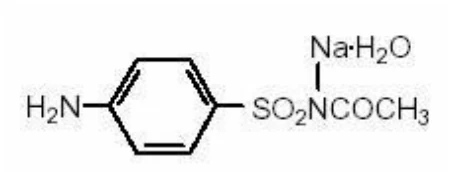
Structural Formula:
Chemical Name: N-Sulfanilylacetamide monosodium salt monohydrate
Molecular Formula: C8H9 N2NaO3S•H2O
Molecular Weight: 254.24 g / mol