


Product Monograph - Orciprenaline (Apotex)
RECENT MAJOR LABEL CHANGES
| None | N/A |
| 7 Warnings and Precautions | 09/2021 |
TABLE OF CONTENTS
TABLE OF CONTENTS ...............................................................................................................2
1 INDICATIONS ................................................................................................................4
1.1 Pediatrics ............................................................................................................4
1.2 Geriatrics.............................................................................................................4
2 CONTRAINDICATIONS ...................................................................................................4
4 DOSAGE AND ADMINISTRATION...................................................................................4
4.1 Dosing Considerations .........................................................................................4
4.2 Recommended Dose and Dosage Adjustment.......................................................5
5 OVERDOSAGE ...............................................................................................................5
6 DOSAGE FORMS, STRENGTHS, COMPOSITION AND PACKAGING ...................................6
7 WARNINGS AND PRECAUTIONS ....................................................................................6
7.1 Special Populations ..............................................................................................7
7.1.1 Pregnant Women .......................................................................................... 7
7.1.2 Breast-feeding............................................................................................... 8
7.1.3 Pediatrics ...................................................................................................... 8
7.1.4 Geriatrics .......................................................................................................8
8 ADVERSE REACTIONS ....................................................................................................8
8.1 Adverse Reaction Overview..................................................................................8
9 DRUG INTERACTIONS....................................................................................................9
9.4 Drug-Drug Interactions ........................................................................................9
9.5 Drug-Food Interactions ........................................................................................9
9.6 Drug-Herb Interactions ........................................................................................9
9.7 Drug-Laboratory Test Interactions ........................................................................9
10 CLINICAL PHARMACOLOGY ...........................................................................................9
10.1 Mechanism of Action......................................................................................9
10.2 Pharmacodynamics ...................................................................................... 10
10.3 Pharmacokinetics ......................................................................................... 11
11 STORAGE, STABILITY AND DISPOSAL ........................................................................... 12
12 special handling instructions....................................................................................... 12
PART II: SCIENTIFIC INFORMATION ........................................................................................ 13
13 PHARMACEUTICAL INFORMATION.............................................................................. 13
14 CLINICAL TRIALS.......................................................................................................... 13
15 MICROBIOLOGY .......................................................................................................... 13
16 NON-CLINICAL TOXICOLOGY ....................................................................................... 13
PATIENT MEDICATION INFORMATION ................................................................................... 16
PART I: HEALTH PROFESSIONAL INFORMATION
1 INDICATIONS
ORCIPRENALINE (Orciprenaline Sulfate Syrup) has been found useful in the following conditions:
- Bronchial asthma
- Chronic bronchitis
- Pulmonary emphysema
Orciprenaline sulfate may also be useful when bronchospasm is present in sarcoidosis, silicosis, carcinoma of the lung and tuberculosis.
Limitation of use: Orciprenaline should not be used for the treatment of acute episodes of bronchospasm.
1.1 Pediatrics
Pediatrics (<4 years of age): No data in patients less than 4 years of age are available to Health Canada; therefore, Health Canada has not authorized an indication for pediatric use in patients less than 4 years of age (See 4 DOSAGE AND ADMINISTRATION).
1.2 Geriatrics
No data are available to Health Canada; therefore, Health Canada has not authorized an indication for geriatric use.
2 CONTRAINDICATIONS
- ORCIPRENALINE is contraindicated in patients who are hypersensitive to this drug or to any ingredient in the formulation, including any non-medicinal ingredient, or component of the container. For a complete listing, see 6 DOSAGE FORMS, STRENGTHS, COMPOSITION AND PACKAGING.
- ORCIPRENALINE is contraindicated in patients with a known sensitivity to this drug or other sympathomimetic amines.
- ORCIPRENALINE is contraindicated in patients with hypertrophic obstructive cardiomyopathy and cardiac arrhythmias associated with tachycardia.
- ORCIPRENALINE is contraindicated in concomitant use with beta–adrenergic blocking agents, such as propranolol.
As a tocolytic in patients at risk of premature labour or threatened abortion.
4 DOSAGE AND ADMINISTRATION
4.1 Dosing Considerations
- The dosage should be individualized, and the patient’s response should be monitored by the prescribing physician on an ongoing basis.
Asthma
- Like other beta-agonists, ORCIPRENALINE should not be used without appropriate concomitant anti-inflammatory therapy. [Copied from Warnings and Precautions.]
- If a previously effective dosage regimen fails to provide the usual relief, or the effects of a dose last for less than three hours, patients should seek prompt medical advice as this is a sign of seriously worsening asthma that requires reassessment of therapy.
- As there may be adverse effects associated with excessive dosing, the dosage or frequency of administration should not be increased.
- The effect of an inhalant bronchodilator may be potentiated by oral administration of 20 mg of orciprenaline sulfate 90 minutes prior to use of the inhalant. No additive effect occurs when the drugs are given in reverse order (see 10.2 Pharmacodynamics).
4.2 Recommended Dose and Dosage Adjustment
The recommended doses of ORCIPRENALINE syrup are:
Adults: Two teaspoons (10 mL) of syrup (20 mg) three or four times daily.
Adolescents 12 to <18 years of age: Two teaspoons (10 mL) of syrup (20 mg) three times daily.
Children 4 to < 12 years of age: One teaspoon (5 mL) of syrup (10 mg) three times daily.
- The maximum daily dose is 80 mg.
4.4 Administration
ORCIPRENALINE syrup should be administered orally. ORCIPRENALINE syrup should be measured by a spoon to ensure the appropriate dose is administered.
4.5 Missed Dose
If a dose of ORCIPRENALINE is missed, it should be taken as soon as the patient remembers. Patients should not take two doses at the same time to make up for a missed dose.
5 OVERDOSAGE
The symptoms of overdosage are those of excess beta stimulation including exaggeration of the known pharmacological effects, i.e. any of the symptoms listed under adverse reactions, the most prominent being tachycardia, palpitation, tremor, hypertension, hypotension, widening of the pulse pressure, anginal pain, arrhythmias, hypokalemia and flushing. Serum potassium levels should be monitored.
Treatment
Treatment should be discontinued and appropriate symptomatic therapy should be considered.
To antagonise the effect of orciprenaline, the judicious use of a cardioselective beta-adrenergic blocking agent (e.g. metoprolol, atenolol, propranolol) may be considered but only under the supervision of a healthcare professional since bronchospasm may be induced. The dose should be adjusted carefully in patients suffering from asthma.
Therapy may include administration of sedative, tranquilizers or in severe cases, intensive therapy.
| For management of a suspected drug overdose, contact your regional poison control centre. |
6 DOSAGE FORMS, STRENGTHS, COMPOSITION AND PACKAGING
Table 1 – Dosage Forms, Strengths and Composition
ORCIPRENALINE (orciprenaline sulfate) syrup is clear and grape–flavoured. Each mL contains 2 mg of active ingredient orciprenaline sulfate.
Available in amber–coloured bottles containing 250 mL of clear syrup.
7 WARNINGS AND PRECAUTIONS
General
ORCIPRENALINE should not be initiated in patients with significantly worsening or acutely deteriorating asthma, which may be life threatening. Like other β2 agonists, ORCIPRENALINE (orciprenaline sulfate) should not be used on a regular daily basis without appropriate concomitant anti-inflammatory therapy (see 4.1 Dosing Considerations).
Deterioration of asthma
Patients should be advised to seek medical aid in the event that they do not respond to their dose of a rescue medication inhaler (e.g. salbutamol).
In acute tests, orciprenaline sulfate has been shown to have minimal effect on blood pressure and pulse. The drug should be used with care, however, in asthmatic or emphysematous patients who also have systemic hypertension, coronary artery disease, acute and recurring congestive heart failure, diabetes mellitus, glaucoma or hyperthyroidism or in patients sensitive to sympathomimetic amines.
Cardiovascular
Beta-adrenergic agonists may have clinically significant cardiac effects. Orciprenaline is a non-selective beta-adrenergic agonist and may have more cardiac side effects than more selective beta2-adrenergic agonists.
Care should be taken with patients suffering from cardiovascular disorders, especially coronary insufficiency, myocardial insufficiency, cardiac arrhythmias, recent myocardial infarction, severe organic heart and/or other vascular disorders, hypertension, hyperthyroidism phaeochromocytoma or
| Route of Administration | Dosage Form / Strength/Composition | Non-medicinal Ingredients |
| Oral | Syrup 2 mg/mL | Artificial grape flavour, edetate disodium, glycerin, hydroxyethyl cellulose, methylparaben, propylparaben, purified water, and sorbitol. |
diabetes mellitus.
Endocrine and Metabolism
Potentially serious hypokalemia may result from β2–agonist therapy, mainly from parenteral and nebulized administration. Particular caution is advised in acute severe asthma as this may be potentiated by concomitant treatment with xanthine derivatives, steroids and diuretics; the adverse effects of hypokalemia on cardiac rhythm may be exacerbated by hypoxia. It is recommended that serum potassium levels be monitored in such situations. Hypokalemia will increase the susceptibility of digitalis–treated patients to cardiac arrhythmias.
If therapy does not produce a significant improvement or if the patient’s condition gets worse, medical advice must be sought in order to determine a new plan of treatment. In the case of acute or rapidly worsening dyspnea, a doctor should be consulted immediately.
Immune
Hypersensitivity
Immediate hypersensitivity reactions may occur after administration of orciprenaline sulfate. Care should be taken in patients who are unusually responsive to sympathomimetic amines.
Respiratory
Deterioration of asthma
Increasing use of ß2–agonists to control symptoms of bronchial obstruction, especially administration on a regular basis or in high amounts, indicates deterioration of asthma control. Under these conditions, the patient’s therapy plan has to be revised. It is inadequate simply to increase the use of bronchodilators under these circumstances, in particular over extended periods of time (see 4. DOSAGE AND ADMINISTRATION).
Paradoxical Bronchospasm
Paradoxical bronchospasm may occur with inhaled medications and is characterized by an immediate increase in wheezing after the dose. This should be treated immediately with an alternative presentation or a different fast-acting inhaled bronchodilator to relieve acute asthmatic symptoms. The use of the preparation should be discontinued immediately and alternate therapy instituted. The cause of this refractory state is unknown. It is advisable that in such instances the use of the preparation be discontinued immediately and alternate therapy instituted since, in the reported cases, the patients. Fatalities have been reported following excessive use of isoproterenol inhalation preparations and the exact cause is unknown. Cardiac arrest was noted in several instances.
7.1 Special Populations
7.1.1 Pregnant Women
ORCIPRENALINE should not be administered to pregnant women or to women of childbearing potential unless in the opinion of the physician the expected benefits outweigh the possible risks to the fetus. Clinical evidence presently available from the use of ORCIPRENALINE in pregnancy is limited. In rabbits, high oral doses (100 mg/kg) and low subcutaneous doses (0.2 mg/kg) have resulted in malformed offspring in some experiments, but not in others. Studies in the rat, mouse and rhesus monkey have shown no adverse effects on the developing fetus. Other sympathomimetic drugs tested, viz., ephedrine and phenylephrine, produced teratogenic effects in the rabbit when given orally at high doses as did isoproterenol given subcutaneously at low doses. The significance of these findings is not known.
There is no well documented experience in pregnant women. Orciprenaline sulfate should only be used during pregnancy if the potential benefit outweighs the potential risk to the fetus.
Use in labour and delivery
Beta–agonists should be used with caution before and during childbirth in view of their inhibiting effect on uterine contractions. Orciprenaline is contraindicated as a tocolytic in patients at risk of premature labour or threatened abortion.
7.1.2 Breast-feeding
It is not known whether orciprenaline sulfate is excreted in human milk; therefore, orciprenaline sulfate should be used during nursing only if the potential benefit justifies the possible risk to the newborn.
7.1.3 Pediatrics
Pediatrics (< 4 years of age): The safety and efficacy in children below the age of 4 years have not been established.
7.1.4 Geriatrics
No data are available to Health Canada; therefore, Health Canada has not authorized an indication for geriatric use. As with other beta-agonists, special caution should be observed when using Orciprenaline in elderly patients who have concomitant cardiovascular disease that could be adversely affected by this class of drug.
8 ADVERSE REACTIONS
8.1 Adverse Reaction Overview
The most frequently observed adverse reactions to orciprenaline sulfate at the recommended dosage include, fine tremor of skeletal muscles, nervousness, headache, dizziness, tachycardia, and palpitations.
As with other beta-mimetics, nausea, vomiting, sweating, weakness and myalgia/muscle cramps may occur. In rare cases decrease in diastolic blood pressure, increase in systolic blood pressure, arrhythmia, particularly after higher doses, may occur.
In rare cases skin reactions or allergic reactions have been reported, especially in hypersensitive patients. There have been isolated cases of anaphylactic or anaphylactoid reactions.
In individual cases psychological alterations have been reported under inhalational therapy with beta-mimetics.
Potentially serious hypokalemia may result from beta2-agonist therapy.
9 DRUG INTERACTIONS
9.4 Drug-Drug Interactions
Sympathomimetics: Concomitant use of orciprenaline sulfate with other sympathomimetic agents is not recommended since the combined use may lead to deleterious cardiovascular effects. If concomitant use is necessary, this should take place only under strict medical supervision.
Beta-adrenergic Blockers: beta-adrenergic blockers may weaken or antagonise the effect of orciprenaline. Therefore orciprenaline should not be given together with beta-adrenergic blockers (including eye drops) unless there are compelling reasons for their use.
Monoamine Oxidase Inhibitors and Tricyclic Antidepressants: Extreme care should be exercised in the concomitant use of orciprenaline sulfate with epinephrine, monoamine oxidase inhibitors or tricyclic antidepressants since the action of beta adrenergic agonists may be enhanced.
Corticosteroids, Methylxanthines and Diuretics: Concomitant treatment with xanthine derivatives, steroids, or non-potassium sparing diuretics may potentiate a possible hypokalemic effect of beta2-agonists (See 7 WARNINGS AND PRECAUTIONS, Cardiovascular). Hypokalemia may increase susceptibility to cardiac arrhythmias in patients treated with digitalis.
Anaesthetics: Inhalation of halogenated hydrocarbon anaesthetics such as halothane, trichloroethylene and enflurane may increase the susceptibility to the cardiovascular effects of beta-agonists.
9.5 Drug-Food Interactions
Interactions with food have not been established.
9.6 Drug-Herb Interactions
Interactions with herbal products have not been established.
9.7 Drug-Laboratory Test Interactions
Interactions with laboratory tests have not been established.
10 CLINICAL PHARMACOLOGY
10.1 Mechanism of Action
Orciprenaline sulfate is a bronchodilating agent that acts through stimulation of beta2-adrenergic receptors in bronchial smooth muscle, thereby causing relaxation of bronchial muscle fibres. The bronchospasm associated with various pulmonary diseases - chronic bronchitis, pulmonary emphysema, bronchial asthma, silicosis, tuberculosis, sarcoidosis and carcinoma of the lung, has been reversed by therapy with orciprenaline sulfate.
Orciprenaline is considered a non-selective beta-adrenergic agonist. It is an agonist for beta2-adrenergic receptors in bronchial smooth muscle as well as cardiac beta1-adrenergic receptors. It is less selective for beta2-adrenergic receptors than salbutamol, a beta2-adrenergic agonist, used for the acute relief of bronchospasm.
Receptor sites in the bronchi and bronchioles are somewhat more sensitive to the drug than those in the heart and blood vessels, so that the ratio of bronchodilating to cardiovascular effects is favourable.
Consequently, it is usually possible clinically to produce good bronchodilation at dosage levels which are unlikely to cause cardiovascular side effects.
The efficacy of the bronchodilator after both oral and inhalation administration has been demonstrated by pulmonary function studies (spirometry, and by measurement of airways resistance by body plethysmography).
Following oral administration, the effect is usually noted within 30 minutes. The peak effect of bronchodilator activity following orciprenaline sulfate generally occurs within 60 to 90 minutes, and this activity lasts for 3 to 6 hours.
Orciprenaline sulfate taken orally potentiates the action of a bronchodilator inhalant administered 90 minutes later, whereas no additive effect occurs when the drugs are given in reverse order.
Tolerance to the drug during prolonged therapy has not been observed.
10.2 Pharmacodynamics
Bronchodilator Action
In guinea–pigs and dogs, orciprenaline sulfate has a marked relaxing effect on bronchospasm induced by histamine, acetylcholine, or serotonin. When administered orally, orciprenaline sulfate protects guinea–pigs from histamine–induced asthma. In dogs, orciprenaline sulfate is better absorbed and acts longer than isoproterenol. In dogs in which bronchospasm has been induced with morphine or pilocarpine, 1 mg/kg isoproterenol and 30 mg/kg orciprenaline sulfate administered intravenously, have the same degree of bronchodilator action; however, the effect of orciprenaline sulfate lasts considerably longer than that of isoproterenol.
The efficacy of orciprenaline sulfate has been demonstrated by improvement of flow rates (FEV1, MMFR, MEFR) and airways resistance measurements (body plethysmography). Repeated measurements of pulmonary function made over a 4–hour period showed that orciprenaline sulfate 20 mg orally gives a generally better result regarding duration of action and magnitude of response than placebo, 100 mg methoxyphenamine, 30 mg ephedrine by mouth, or 10 mg isoproterenol sublingually.
Studies have shown that patients with bronchitis and emphysema respond to continuous therapy with orciprenaline sulfate. The frequency and severity of acute attacks decrease, and patients experience relief of wheezing, chest congestion and shortness of breath. A close association is apparent between objective measurements of pulmonary function and the subjective response.
The effect of an inhalant bronchodilator may be potentiated by oral administration of 20 mg of orciprenaline sulfate 90 minutes prior to use of the inhalant. No additive effect occurs when the drugs are given in reverse order. The probable reason for this is that a bronchodilator delivered to the lungs via the vascular system (intravenous or oral medication) acts upon bronchioles whether or not they are occluded. Such an effect causes a wider distribution in the lungs of a subsequently given drug, and consequently the bronchodilation is more intense. Knowledge of this interaction is of value when instructing patients in the combined use of oral orciprenaline sulfate and an inhaled bronchodilator.
Cardiovascular Effects
Orciprenaline sulfate administered intravenously to anesthetized dogs in equivalent bronchodilator doses tends to have less effect on blood pressure and heart rate than isoproterenol. In dogs, with small intravenous doses there is occasionally a fall in diastolic pressure and, because of the increase in the cardiac output, there is an increase in systolic pressure with a consequent increase in pulse pressure.
The ratio between intramuscular and oral effects is 1:67 for orciprenaline sulfate and 1:333 for isoproterenol. Thus the oral absorption of orciprenaline sulfate in dogs is approximately 5 times better than that of isoproterenol.
In various isolated heart preparations, orciprenaline sulfate has positive inotropic and chronotropic effects. In the spontaneously beating right atrium (cat) a dose of orciprenaline sulfate 41 times greater than that of isoproterenol is required to achieve the same inotropic effect but with electrically stimulated atrium and papillary muscle, concentrations only 1.2 and 2.7 times greater were required respectively. Thus in heart preparations which lack a pacemaker, the effects of orciprenaline sulfate and isoproterenol are similar whereas when a pacemaker is present, as in the right atrium, the effect of orciprenaline sulfate is much less than that of isoproterenol. It can be concluded that orciprenaline sulfate, like isoproterenol, acts mainly on the sinus node in the right atrium and that the affinity of orciprenaline sulfate for the pacemaker is appreciably less than that of isoproterenol. In heart preparations which ordinarily do not beat spontaneously, orciprenaline sulfate induced spontaneous activity much less frequently than isoproterenol. In guinea–pigs, doses of orciprenaline sulfate from 1 to 100 mg/kg intravenously failed to induce any cardiac arrhythmia. On the other hand, orciprenaline sulfate provided protection against arrhythmias experimentally induced by adrenaline. For example, 30 minutes to 2 hours after 30-100 mg/kg of orciprenaline sulfate had been administered intravenously, arrhythmias were not induced by doses of adrenaline from 3 to 30 times greater than those which formerly produced arrhythmias.
Although orciprenaline has lower cardiovascular effects than isoproterenol, a non-selective beta-adrenergic agonist, orciprenaline has the potential for more cardiovascular effects than selective beta2-adrenergic agonists, e.g. salbutamol.
Effects on Other Systems
Orciprenaline sulfate produces an inhibitory effect on the smooth muscle of the gastrointestinal tract, as demonstrated by its action on histamine and acetylcholine–induced contractions of the isolated guinea–pig ileum and on serotonin–induced spasm of the rat duodenum. The inhibitory effect on the gastrointestinal tract was further demonstrated by studying charcoal meal progression in the guinea–pig.
A mild mydriatic effect has been shown in mice and on the enucleated eyes of cattle.
10.3 Pharmacokinetics
Absorption
Excretion studies in humans with the orally administered labelled compound have demonstrated that an average of approximately 40% of the drug is absorbed. Animal studies (rat, rabbit and monkey) have also demonstrated good absorption as evidenced by recovery of substantial amounts in the urine.
Distribution:
The concentration of radioactivity in blood plasma was determined in rabbits following intravenous administration of radiolabelled orciprenaline sulfate. Radioactivity decreased in two phases of different velocity. During the first phase, the decrease is linear on the semilogarithmic scale with a half–life of about 40 minutes. This may represent tissue penetration. The second phase is considerably slower and has a half–life of approximately 15 hours.
Metabolism:
The major metabolite in animals is also the conjugated form of the drug.
Elimination
The drug is excreted primarily as glucuronic acid conjugates.
11 STORAGE, STABILITY AND DISPOSAL
ORCIPRENALINE syrup should be stored at room temperature (15 -30 ° C).
Protect from exposure to light.
Keep out of reach and sight of children.
12 SPECIAL HANDLING INSTRUCTIONS
There are no special handling instructions for ORCIPRENALINE syrup.
PART II: SCIENTIFIC INFORMATION
13 PHARMACEUTICAL INFORMATION
Drug Substance
Proper name: Orciprenaline sulfate
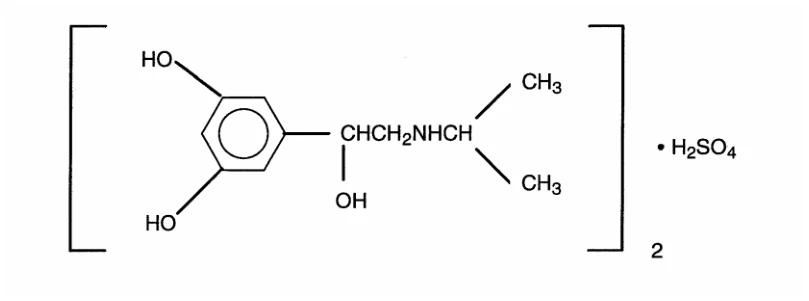
Chemical name: 1)1,3-Benzenediol,5-[1-hydroxy-2-[1-methylethyl)-amino]
ethyl]-,sulfate (2:1)(salt);
- 2) 3,5-Dihydroxy-α-[(iso-propylamino)methyl]benzyl alcohol sulfate (2:1).
Molecular formula and molecular mass: (C11H17NO3)2 • H2SO4 and 520.60
Structural formula:
Physicochemical properties: White to off–white crystalline powder, freely soluble in water.
Product Characteristics:
Each mL of ORCIPRENALINE syrup contains 2 mg orciprenaline sulfate. Each mL also contains artificial grape flavour, edetate disodium, glycerin, hydroxyethyl cellulose, methylparaben, propylparaben, purified water, and sorbitol.
14 CLINICAL TRIALS
There are no clinical trial data available for this drug product.
15 MICROBIOLOGY
No microbiological information is required for this drug product.
16 NON-CLINICAL TOXICOLOGY
General Toxicology
The toxic effects of orciprenaline sulfate have been studied in 5 species: rat, mouse, rabbit, dog and monkey. In acute and subchronic studies, orciprenaline sulfate was given by various routes including oral, inhalation, intravenous, intraperitoneal, and subcutaneous and in doses ranging from 0.2 mg to 500 mg/kg.
Acute Toxicity
The following table compares the LD50’s in various species for oral orciprenaline sulfate.
| Species | LD50 (mg/kg) |
| Rat | 4420-5276 |
| Mouse | 4800-8130 |
| Rabbit | 3114-5000 |
| Dog | 50-900 |
| Monkey | 4000 |
The oral LD50 ranges represent values found by different investigators.
In mice, for an oral LD50 of 4800 mg/kg, the subcutaneous LD50 is 200 mg/kg and the intravenous LD50 is 114 mg/kg. Depending upon the species and the dosage, the toxic signs included decreased activity followed by hyperpnea and salivation, which proceeded to ataxia, and finally, prostration or convulsions before death. Animals which survived the toxic dose had uneventful recoveries.
Subchronic Toxicity
Orciprenaline sulfate has been studied for various periods in rats, dogs and monkeys. In rats given up to 25 times (4.5, 13.5, 40.5 mg/kg/day) the recommended maximum human dose orally for 3 months, there were only increases in the weights of the hearts and livers. In dogs given orciprenaline sulfate for 3 months in doses of 6.25, 25 and 100 mg/kg/day, there were no dose– related toxic effects, although one dog in each of the three drug level groups died following the first dose. In monkeys, doses of orciprenaline sulfate of 10, 30 and 100 mg/kg/day for six months had no demonstrable toxic effects and all the animals survived.
Inhalation Toxicity
Hemorrhages occurred in the myocardium and bladder mucosa of 2 of 6 dogs that received 0.5-0.6 mg of orciprenaline sulfate aerosol/kg/day for 3 months. Three of 6 dogs that received a single dose of 11 to 13 mg of drug per kg had endocardial and/or renal hemorrhages; one of these also had a small hemorrhage in the circle of Willis. Petechial hemorrhages were observed in the coronary groove and auricles of a dog that died, and suspicious macroscopic lesions occurred in the hearts of 6 other dogs that received doses of orciprenaline sulfate aerosol ranging from 125 to 455 mg/kg.
Questionable macroscopic lesions also occurred in kidneys and hearts of monkeys given 250-750 mg/kg. However, isoproterenol also causes myocardial hemorrhages and infarcts in dogs and rats. Subcutaneous doses as small as 2.5 and 0.8 mg/kg produced these effects in dogs and rats respectively; minimal hemorrhage–producing doses were not investigated in the canine experiment.
Carcinogenicity
No long-term animal studies have been performed to evaluate carcinogenic or mutagenic potential.
Teratogenicity
The teratogenicity of orciprenaline sulfate has been studied in rabbits, rats, mice and monkeys. In rabbits and rats, the drug was given orally and parenterally; in mice it was given only parenterally; in monkeys it was given only orally. The results of these studies indicate that orciprenaline sulfate has no appreciable teratogenic effects even at dosages considerably higher than the recommended human dose. At extremely high dosage levels in the rabbit, all sympathomimetic amines studied (ephedrine, isoproterenol, orciprenaline sulfate, and phenylephrine) caused abnormalities such as limb flexures, agenesis of digits, hydrocephalus, agenesis of mouth, cleft palate and polycystic liver, in a proportion of the test animals. At the high dosage levels used in these studies, there was a decreased conception rate suggesting maternal toxicity. There was also suggestive evidence that the pregnant rabbit was more susceptible to the toxic effects which occur at extremely high dosage levels, than non–pregnant animals.